Category Archives: charter schools

Eva Moskowitz Cannot Help Herself

My grandfather had many folk wisdom expressions, but one that sticks with me is “When you are sitting 100 feet in the air, sawing furiously at the branch you are on, be sure to sit on the the TREE side of the cut.”  The meaning here is simple enough: perilous situations demand caution, and it is probably a good idea to check and double check what you are doing lest you end up like these guys:

giphy

I don’t think anyone has shared this advice with Eva Moskowitz.

The Success Academy charter school CEO just had a truly horrible October, in which her suspension policies were put into an uncomfortable spotlight, she retaliated by publishing the disciplinary records of a former student who is only ten years old and by demanding an apology from PBS, a complaint about Moskowitz’s violation of privacy laws was filed with federal DOE, and The New York Times ran a blockbuster story on how one of Moskowitz’s principals kept a “got to go” list of students who he deliberately pushed out of his Success Academy, confirming what data already shows: Success Academy uses a combination of excessive punishment and direct pressure to remove students who win lottery seats at the school.

Under normal circumstances, a polarizing figure like Moskowitz might consider staying out of the spotlight for a time, let coverage find different stories, and work with her powerful backers behind the scenes.  Such thinking does not appear to be in Moskowitz’s DNA, for she took to the pages of The Wall Street Journal on November 12th to explain what Success Academy discipline is based upon.  According to Moskowitz’s telling of the story, when she founded the original school as Harlem Success Academy, she had no specific pedagogy or theory of discipline in mind, but it was the work one inspirational veteran teacher who converted her and her teachers to his particular brand of magic:

I wish I could claim that I’ve developed some revolutionary pedagogical approach at Success, but the humbling truth is this: Most of what I know about teaching I learned from one person, an educator named Paul Fucaloro who taught in New York City district schools for four decades…

…I wasn’t completely sold on Paul’s approach at first, but when one of our schools was having trouble, I’d dispatch him to help. He’d tell the teachers to give him a class full of all the kids who had the worst behavioral and academic problems. The teachers thought this was nuts but they’d do so, and then a few days later they’d drop by Paul’s classroom and find these students acting so differently that they were nearly unrecognizable. Within weeks, the students would make months’ worth of academic progress.

According to Moskowitz, Mr. Fucaloro’s technique was nothing more complicated than very high expectations and a strict insistence that students focus upon him or whoever else was talking with clear physical signs: hands clasped, eyes fixed on whoever was speaking, no fidgeting or other distractions:

Paul’s students had to sit with hands clasped and look at whomever was speaking (called “tracking”). They couldn’t stare off into space, play with objects, rest their head on their hands in boredom, or act like what Paul called “sourpusses” who brought an attitude of negativity or indifference to the classroom. Paul made students demonstrate to him that at every single moment they were focused on learning.

Readers are obviously supposed to infer that Mr. Fucaloro’s methods are so fool-proof that any sufficiently determined teacher can employ them with any group of students and achieve the same results which explains the sky high results on state examinations in her network of schools.  Moskowitz claims that she was essentially a pedagogical blank slate who was only convinced by Paul Fucaloro’s astonishing results and then perpetuated his methods so effectively that Success Academy schools can literally have almost any teacher command almost any class’ full attention all day.

wheels

This narrative is not believable on numerous fronts.  First, it is nearly impossible to believe that Eva Moskowitz went into the development of her charter school network a complete naif with no idea how she wanted the school to operate.   Whatever criticisms she has earned over the years, not knowing her mind is hardly typical.  Daniel Bergner of The New York Times published a hagiographic portrait of Moskowitz in the summer of 2014 in which the 1982 Stuyvesant graduate could not contain her contempt for what she saw as lax standards at New York City’s most selective high school.  As a member of the New York City Council, Moskowitz was known as tough, confrontational, and an expert on education issues while her demanding managerial style led to high levels of turn over among her staff.  Moskowitz’s own impatience with other people is even evident her only published work of scholarship following her doctoral degree in history.  The book, published in 2001, is titled In Therapy We Trust: America’s Obsession With Self-Fulfillment, claiming that Americans today turn to psychology and self-help experts for guidance and “excuses” as fervently as they used to seek religious guidance. Such negative assessments of most her fellow citizens’ needs probably explains why she reacted with overt derision when Mayor Bill De Blasio sought to implement restorative discipline strategies in city schools.

Suffice to say that I find it laughable that Eva Moskowitz had no idea how strict a discipline system she wished to implement from the beginning.

Another reason for doubting this narrative is that we know that Success Academy methods are hardly limited to what Moskowitz describes, and we know it from Mr. Fucaloro himself.  New York Magazine did an extensive story on the rapidly growing Success Academy chain  and Ms. Moskowitz herself in 2010, and Mr. Fucaloro is featured prominently boasting that his test preparation focus and extra work transforms children into “little test taking machines.”  Further, the type of extremely rigid behavior accepted at Success Academy is drilled early via Kindergarten “boot camps,” and Mr. Fucaloro makes what would be a shocking confession in a true public school:

At Harlem Success, disability is a dirty word. “I’m not a big believer in special ed,” Fucaloro says. For many children who arrive with individualized education programs, or IEPs, he goes on, the real issues are “maturity and undoing what the parents allow the kids to do in the house—usually mama—and I reverse that right away.” When remediation falls short, according to sources in and around the network, families are counseled out. “Eva told us that the school is not a social-service agency,” says the Harlem Success teacher. “That was an actual quote.”

Such attitudes appear foundational and durable at Success Academy given Kate Taylor’s report on the network’s “polarizing methods” for The New York Times earlier this year where public shaming of low performers is common enough that children have been known to wet themselves from the stress.  Mr. Fucaloro’s stance on disabilities is particularly shocking, however, and indicative that Success Academy’s Director of Instruction did far more than teach Moskowitz’s teachers to have high expectations for student behavior – and that his methods go far beyond anything he was allowed to do as a public school teacher.  Simply ignoring an IEP and subjecting students with disabilities to behavior modification is not an option for public school teachers (unless abetted by an unethical administration).  Nor is a Kindergarten “boot camp.”  Nor is out of school suspension for five year olds.  Nor is a 65 infraction long behavioral manual.  This list is lengthy, but the message is clear: far from simply being inspired by the high expectations Mr. Fucaloro and his singular attention to student focus, Success Academy teachers are trained in a program of extreme behavior modification backed by punitive consequences, options that are neither professionally nor morally available to truly public schools.

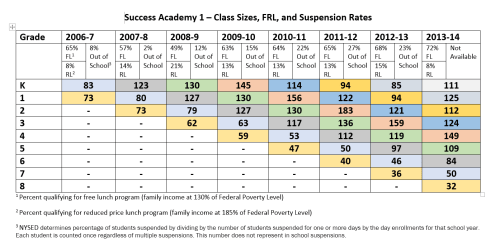
Finally, we know that Moskowitz is being highly selective in her story because of the data.  Let’s take her at her word that Mr. Fucaloro was a demanding but highly effective and appreciated teacher in his public school career.  Not to take anything away from that, but he is hardly unique in that regard. There are countless public school teachers who work hard to effectively establish the learning environment for their students.  Lots of teachers set high expectations for both learning and behavior, so that is hardly unique either.  However, just demonstrating and proving tracking and other techniques, as Moskowitz claims, is hardly all that happened in the early days of Success Academy.  Consider the following table, compiled from NYSED data:
SA1 Data

Two items are of note here.  First, the pattern of student attrition is curious.  Success Academy has not backfilled vacated seats after third grade until this year and still only does so through fourth grade, claiming that admitting new students unused to Success Academy methods would be detrimental.  It is therefore not surprising to see how many of the cohorts in the chart show drop offs around third and fourth grades – any students who left the school were not replaced as is required policy for fully public schools.  This pattern repeats cohort after cohort with growth in early grades, followed by sharp winnowing accumulating over time.  The third Kindergarten cohort is especially noteworthy, growing from 130 students in 2008 to 136 by third grade before shrinking to 109 two years later in fifth grade, an almost 20% change.  Remember, every student who begins at a Success Academy represents a family that went out of its way to seek out that school.

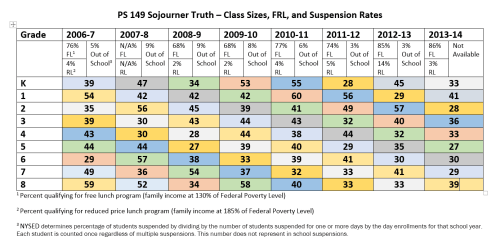
The second item is the dramatic growth in out of school suspensions.  NYSED reports the percentage of students suspended in a given school year, which does not account for single students suspended multiple time nor does it account for in school discipline.  In its first two years, Success Academy 1 suspended 8% and 2% of its students respectively. Over the next five years, however, those numbers jumped to 12%, 15%, 22%, 27%, and 23%.  These figures are eye-watering, and to compare, we can look at the same data from PS149 Sojourner Truth, the zoned K-8 public school co-located with Success Academy 1 grades Kindergarten through 4th grade:
PS149 Data

Of course, cohorts in PS149 do experience attrition as well, sometimes significant attrition, but there is no specific pattern of when students leave the school or of when cohorts shrink or grow.  However, the most striking difference is the out of school suspension rates which top out at 9% and are as low as 3% for two successive years.  Whatever else is happening at PS 149, the school is not heavily wielding out of school suspension with its students.

What does this mean?  The most obvious inference is that even if Moskowitz is being truthful and that Mr. Fucaloro is an astonishing teacher who was quickly able to establish a well disciplined and effective classroom environment where others struggled, it was far harder to scale up that level of discipline and effectiveness without massively increasing punitive disciplinary consequences, including out of school suspension rates nine times higher than a co-located school in the 2011-2012 school year.  The “secret sauce” at Success Academy’s setting of behavior for its students is not duplicating “the most gifted educator” Moskowitz has ever met – it is sending very young children home from school, sometimes until their parents give up and go away.

By the way, the out of school suspension rate for 2011-2012 at Upper West Success, a school where 29% of students qualify for free lunch and 10% for reduced price lunch?  5%.   Apparently suspension rates in the high 20s are a necessity for schools where 78% of the students are in or near poverty.

None of this is really surprising to those who have been paying attention over the years, but what is surprising is Moskowitz’s inability to resist mythologizing herself and her schools — when the people she is telling myths about are on record with the press and when the school’s use of heavy handed suspensions is not in dispute.  Then again, maybe it isn’t surprising.  Moskowitz provides a big and likely inadvertent insight into her thought process:

Some critics find our approach rigid and overbearing. I’ve got two of these critics in my own home: my kids, who attend Success. They complain when they get into trouble for not tracking the speaker. They were listening, they protest. Maybe so. But sometimes when kids look like they’re daydreaming, it’s because they are, and we can’t allow that possibility.

“Daydreaming….and we can’t allow that possibility.”  Nobody denies that a well managed environment where students are attentive is a big part of successful teaching.  Nobody even denies that some teachers have an incredible capability for that and others can learn from them.  But at the point when your desire for order and control cannot allow the “possibility” that a very young child might occasionally daydream during a long school day, you are no longer practicing classroom management.

You are engaging in a pathology.

7 Comments

Filed under charter schools, classrooms, Data, teaching

Who Was The Last “Education President”?

On September 25th, 1988, Vice President George H.W. Bush, then the Republican nominee for President, was in a debate with his Democratic Party rival, Massachusetts Governor Michael Dukakis, and declared that he wanted to be “The Education President.”

I want to be the education President, because I want to see us do better. We’re putting more money per child into education, and we are not performing as we should. […] And I would like to urge the school superintendents and the others around the country to stand up now and keep us moving forward on a path towards real excellence.

Eventually, the Republican nominee would become President George H.W. Bush, and his education agenda was a continuation of the path forged under Ronald Reagan that led to the era of test-based accountability.  Presidents and Presidential aspirants have all set their sights on making an impact on our nation’s education system, whether it was Bill Clinton calling for 90% graduation rates and “meaningful” national examination standards, or George W. Bush claiming standardized test scores were stagnant and promoting new accountability for teachers and students – including a system of rewards and punishments that would become known as No Child Left Behind, or Barack Obama promising more aid to the neediest schools, touting merit pay plans, and decrying too much focus on testing.

But who was the most recent occupant of the Oval Office who deserves the title “The Education President”?  When was the last time an American President signed into law an education bill that has had a substantial, sustained,  and positive impact upon education?

Gerald Ford.

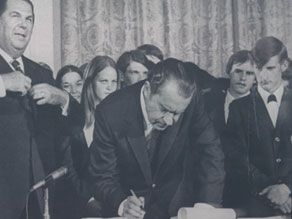
This is not sarcasm because it was President Gerald Ford who, on November 29th, 1975, signed PL94-142, also known as the Education for All Handicapped Children Act, into law.  President Ford issued a signing statement expressing his concern that the law would cost too much, but over its 40 year history and re-authorization as the Individuals with Disabilities in Education Act (IDEA), the legislation has improved educational opportunities and outcomes for millions upon millions of students who had previously faced neglect and discrimination within school.  While the law continuously needs reflection and improvement, especially in the realm of federal funding which has never approached the 40% promised by Congress in 1975, the legislation remains a landmark that provides the basis for a vastly expanded mission for our nation’s schools and progress towards fulfilling opportunity for all.

Ford

PL94-142 was not an isolated case of federal legislation signed by the President improving our nation’s schools.  President Richard Nixon signed the Rehabilitation Act of 1973 that included Section 504, providing protection from discrimination based on disability when an employer or organization receives federal funding.  Section 504 meant that schools could not bar students with physical and mental impairments from receiving an education and required them to provide a free and appropriate public education (FAPE) to all qualified students.   Prior to signing this legislation, President Nixon signed the Education Amendments of 1972 which included Title IX, stating, “No person in the United States shall, on the basis of sex, be excluded from participation in, be denied the benefits of, or be subjected to discrimination under any education program or activity receiving Federal financial assistance.”

Nixon

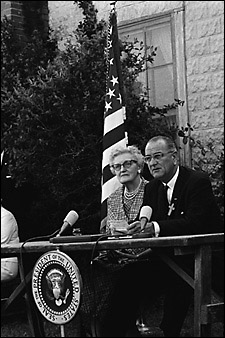
President Lyndon Johnson, following the landmark Civil Rights Act, signed the Elementary and Secondary Education Act (ESEA) into law on April 11th, 1965.  The original law provided federal funds for research, strengthening state departments of education, and, perhaps most importantly, funding to assist the schooling of low income students, and among its earliest amendments were provisions for handicapped children and bilingual education programs.  The Title I provisions, especially, noted the inequitable ways in which schools are funded using property tax revenues that immediately place communities with high percentages of low income families at a disadvantage.  Although the ESEA has since been subsumed by the standardized test based accountability regime of the 2001 amendments known as No Child Left Behind, the original legislation was intended to help with President Johnson’s “War on Poverty” by bringing resources that only the federal government could leverage to schools serving our neediest children.

Johnson2

Indeed, that focus upon using federal reach and the enforcement of civil rights to expand resources available to schools while requiring them not to discriminate upon race, gender, language spoken, or disability status marked a robust period of education legislation premised upon equity and the recognition that certain populations of students were historically marginalized and required direct action of the law aimed at states and municipalities that might have otherwise ignored them.  In many regards, these efforts were astonishingly successful.  In 1971, before the passage of Title IX, women were 3.7 million of 8.9 million college students.  In 1991, they were 7.7 million of 14.1 million.  Before the passage of PL94-142, 5.9% of students in public schools were identified as disabled with no data available on the numbers with specific learning disabilities.  In 1989, 11.4% of students were identified as disabled, including more than 2 million classified with specific learning disabilities.  These efforts were substantive, aimed at increasing access and equity, and their positive benefits have continued for decades and likely more to come.

Since then?  Not so much.

President Ronald Reagan, after campaigning on abolishing the newly minted cabinet seat of Secretary of Education, set education policy away from equity and opportunity and into standards and accountability with the harsh language of school failure that has dominated our discussion  ever since the 1983 publication of A Nation At Risk:

If an unfriendly foreign power had attempted to impose on America the mediocre educational performance that exists today, we might well have viewed it as an act of war. As it stands, we have allowed this to happen to ourselves. We have even squandered the gains in student achievement made in the wake of the Sputnik challenge. Moreover, we have dismantled essential support systems which helped make those gains possible. We have, in effect, been committing an act of unthinking, unilateral educational disarmament.

Our society and its educational institutions seem to have lost sight of the basic purposes of schooling, and of the high expectations and disciplined effort needed to attain them. This report, the result of 18 months of study, seeks to generate reform of our educational system in fundamental ways and to renew the Nation’s commitment to schools and colleges of high quality throughout the length and breadth of our land.

The Reagan Administration followed in 1988 with amendments to the ESEA requiring states to “document and define” academic achievement for disadvantaged students using standardized test score measures, and ESEA funds began being tied to academic performance of disadvantaged children.  President George H.W. Bush proposed his “America 2000” legislation calling for national standards and testing of students but which failed due to conservative opposition in the Senate.  Standards based education policies were similarly advanced, however, by President Bill Clinton whose “Goals 2000” agenda focused upon student achievement, tougher academic standards, application of those standards to all students, and monitoring reform efforts via standardized testing.

The stage, then, was well set by three previous administrations for the 2001 re-authorization of the ESEA which was touted as “No Child Left Behind” by President George W. Bush.  NCLB required all schools to demonstrate annual yearly progress for all students in all subgroups, and failure to meet AYP for five years in row could result in school closures, turning schools over to private charter operators, or giving school operation to private or state managers.

Upon passage, the law enjoyed support in both parties and numerous civil rights organizations, and the logic of that is not difficult to understand.  By 2001, wide gulfs in test measured achievement remained stubbornly persistent between well off, mostly white, suburban communities and their poor, most African American and Hispanic, urban counterparts, and the language of NCLB demanded that states and municipalities address that through accountability systems with little wiggle room.  Given the undeniable need for federal action in both civil rights and expansion of educational equity in the 1960s and 1970s, the federal accountability in NCLB was a logical, if ill-fated, marriage of federal standards and accountability efforts with vigorous enforcement from Washington.

The ill-fated portion of that assessment lies with what was obvious from the beginning: by tying lofty goals to punishing consequences dependent entirely upon the results of standardized testing, NCLB unleashed entirely predictable and increasingly damaging consequences to the depth and breadth of curriculum enjoyed by children, especially children in schools labeled as struggling:

In contrast, since the advent of No Child Left Behind (NCLB), with its high stakes for schools, the traditional pattern of time allocation across subjects in elementary schools has changed markedly. Five years into NCLB, researchers found that 62 percent of a nationally representative sample of all districts in the United States—and 75 percent of districts with at least one school identified as needing improvement—increased the amount of time spent on language arts and math in elementary schools. These increases were substantial: a 47 percent increase in language arts and a 37 percent increase in math. Correspondingly, these districts decreased time allotted to other subjects and activities, including science, social studies, art, music, physical education, and recess (McMurrer, 2007).

President Barack Obama campaigned in 2008 as a Presidential aspirant who was aware of these fact, deriding the test and punish focus of the law, the lack of resources given to schools and teachers working with struggling students, and the teaching to the test that was incentivized by the law:

“Math and science are not the opposite of art and music. Those things are compatible and we want kids to get a well-rounded education. Part of the problem we’ve had is that ‘No Child Left Behind,’ the law that was passed by Bush, said we want high standards, which is good, but they said we are going to measure those high standards only by a single high stakes standardized test that we are going to apply during the middle of the school year…a whole bunch of schools said we gotta teach to this test, and art and music isn’t tested… It’s a shame.”

In reality, the administration of President Barack Obama, while loosening some of the proficiency targets of NCLB, has plainly made the most problematic aspects of the law even worse, and quite likely earning President Obama the label as the worst President for education policy in the post-World War II era.  President Obama, acting through Secretary of Education Arne Duncan, has made testing an even bigger focus of school by coercing states to adopt invalid and unproven measures of teacher performance using standardized tests.  Instead of merely working in a school that faces negative consequences based on test scores, teachers themselves face career sanctions if they do not “adequately” raise student test scores.  President Obama’s Department of Education has lavished money and favorable policies upon the charter school sector while thoroughly failing to oversee the money it has dispersed.   The administration was so interested in fulfilling the long held goal of national standards, that it helped the Gates Foundation push through rushed and unproven standards to almost all states by using the promise of federal grants and waivers from NCLB provisions.  These changes have been touted as voluntary and “state led,” but when Washington state did not pass legislation tying teacher evaluations to student growth measures, the Obama DOE brought down the hammer and revoked its waiver.

Today, 32 years after the beginning of the standards and accountability movement, 14 years into the test and punish era of school accountability, and almost 7 years into the Obama administration’s doubling down on standardized testing to measure teachers, teacher morale is at all time lows and the nation’s teacher preparation programs are struggling to find candidates.  Far from continuing the vital work of expanded opportunity and equity that spanned administrations from President Eisenhower’s use of federal troops to desegregate Central High School in Little Rock, Arkansas to  President Ford’s signing of PL94-142, the past five administrations have slowly tightened the grip of standardized testing on our schools until they have become a warped goal in and of themselves and have damaged the very children supposedly helped by them.  Standardized tests used to sort children have always disproportionately harmed poor children and children of color, and the frequent, high-stakes, accountability testing of NCLB has both narrowed the curriculum and slowed progress in closing the achievement gap, progress that saw its most sustained and dramatic gains in the 1970s.

So what has been missing from the education policies of Ronald Reagan, George H.W. Bush, Bill Clinton, George W. Bush, and Barack Obama? Equity.  The educational policies that came to fruition via the original ESEA, Title IX, Section 504, and PL94-142 all were premised on the federal role of expanding resources and equity for children facing discrimination in school and society at large.  They marshaled funding and rules for schools so that they could not deny either access or equity, and they tasked the federal government with treating these as matters of civil rights.  More recent “reform” efforts are entirely about accountability without increasing the resources available to schools in order to meet those goals in a meaningful way, nor does “reform” specifically address the conditions within which schools exist, leaving them with the sole responsibility to uplift all children regardless of circumstance.  Where once federal education efforts sought to increase access to education and to increase the resources available for that education, today it demands that school increase performance in all situations without any other state actor taking responsibility for the well-being of the children in school.  David Berliner noted this in 2006:

It does take a whole village to raise a child, and we actually know a little bit about how to do that. What we seem not to know how to do in modern America is to raise the village, to promote communal values that insure that all our children will prosper. We need to face the fact that our whole society needs to be held as accountable for providing healthy children ready to learn, as our schools are for delivering quality instruction. One-way accountability, where we are always blaming the schools for the faults that we find, is neither just, nor likely to solve the problems we want to address.

We won’t have a President who deserves the title “The Education President” until we once again have a public servant in the Oval Office who sets equity of access and equity of resources as primary goals of federal education policy.  Five administrations ignoring the lessons of history and the evidence of research is enough.

obama-bush-clinton-530x375

“Wait, you hated your teachers too?”


5 Comments

Filed under Activism, Arne Duncan, charter schools, Common Core, Funding, Gates Foundation, NCLB, politics, schools, Social Justice, standards, Testing, VAMs

Dr. John King Jr.’s Experience and the Failures of Today’s Reform

When current U.S. Secretary of Education Arne Duncan announced that he would step down at the end of this calendar year, President Obama immediately stated that current deputy secretary and former Commissioner of the New York State Education Department, Dr. John B. King, Jr. would replace him in January.  Supporters of the Secretary designee took to Twitter with #ISupportJohnKing, touting his personal biography and what they called his lifelong experience in education.  It is undeniable that Dr. King has an immensely impressive, even inspirational, biography.  Orphaned at a young age, the future Secretary of Education credits New York City school teachers with “saving” him, and he has built upon his obviously prodigious academic talents to earn degree credentials second to none.  After a short stint teaching, he co-founded the Roxbury Prep charter school in Boston before helping to lead the Uncommon Schools network of no-excuses charter schools.  He was tapped in 2009 to become the assistant commissioner of education at NYSED, and in 2011, he was elevated to the Commissioner’s office at the age of 36.  It is without question, that he is a man of enormous drive and intelligence, and, as his supporters say, he has extensive experience in the field of education.

But what if it is totally the wrong experience?

This is not an idle question because while public education advocates often note how frequently major proponents of reform have no practical experience in education before being elevated to positions of influence and authority, all experience is not equivalent, and there is plenty of evidence that Dr. King’s experience in education leaves him ill prepared for the political exigencies of educational leadership outside of the no-excuses charter sector.  In fact, the first time in his long career in education that Dr. King was truly answerable to political and parental constituencies was when he was elevated to lead the NYSED, and it was a disaster.  While informed and dogged in pursuit of the policies which landed him his office, he demonstrated no legitimate understanding that he was leader of a system of education that depended upon support from lawmakers, parents, and the body politic in general.  Policies on the Common Core State Standards and associated testing were both disruptive and demanding with little effort to help teachers and families adjust, and promises to listen to what educators were saying about policies went unfulfilled.  Public meetings where parents voiced their opinions on new state policies did not go well, forcing him to cancel scheduled meetings and change the format to decrease his contact with constituents.  Lawmakers similarly found Dr. King unresponsive to their concerns, leading to a rare display of bipartisan sentiment in Albany as legislators called for his removal.

While I know many critics of education reform in general and of John King in particular who have a wide range of opinions on why his tenure at NYSED was as stormy as his public affect was passive, the simplest explanation that I can see is that there is nothing in Dr. King’s experience that remotely prepared him for the responsiveness needed in our fully public school system.  When he took the Commissioner’s office at NYSED, that was the first time in his entire career in various sectors of education where he was accountable to the political constituencies that have voice in public education policy and practice.  Consider his role as a charter school leader.  While the charter school sector is publicly funded, it is not remotely fully publicly accountable.  Some charter operators are exceptionally aggressive in defending themselves from public oversight, but all of them are deliberately separated from the democratic processes that oversee the funding and operation of our fully public schools.  A school principal is a an educational leader and a political figure with constituencies among elected officials, taxpayers, parents of children in the school, the children themselves, and teachers.  Public school superintendents are similarly situated although at a higher level than school principals.  Charter school operators excuse themselves from much of that, periodically subjecting themselves to review by their authorizing bodies, but otherwise functioning not only outside of local, elected accountability systems, but often excusing themselves from following education law – and gaining support from the courts to do so.

Even in responsiveness to parents, charters are not particularly obligated to be especially deferential.  The “no excuses” sector of charter schools in particular tends to place heavy demands upon parents and vigorously enforces narrow behavioral norms on children as young as five years old.  Since charter schools are schools of choice, the response to any parent concerned over disciplinary or academic practices can be limited to “maybe this isn’t the school for you” or other means to counsel out families.  The Uncommon School Network that Dr. King led before joining NYSED is an exemplar in this respect with Roxbury Prep inflicting a 40% out of school suspension rate upon its students in 2013-2014 (which, sadly, is an improvement on a the previous school year’s 60% out of school suspension rate).  This pattern is typical among the entire Uncommon Schools network which have much higher suspension rates than their neighboring schools in the three state where they operate.  And since there is no political authority to which charter schools need to answer and since parents who dislike these policies do not have to be considered, it is hardly surprising that many such school demonstrate stunning cohort attrition rates, such as North Star Academy, an Uncommon affiliate in Newark, New Jersey, where only 25% of African American boys who enroll in 5th grade are likely to make it to 12th.

This level of inflicted control without giving voice to any constituency was and apparently still is unproblematic to Dr. King who points to the measured outcomes for the students who manage to adapt to and remain within the system.  Dr. Pedro Noguera of New York University, speaking at the Courageous Schools Conference in 2011, recalled a visit to Roxbury Prep where he asked Dr. King a pointed question about the type of messages his students were receiving:

I’ve visited this school, and I noticed that children are not allowed to talk in the hall, and they get punished for the most minor infraction. And when I talked with John King afterwards, I said, “I’ve never seen a school that serves affluent children where they’re not allowed to talk in the hall.” And he said, “Well, that might be true, but this is the model that works for us, we’ve found that this is the model that our kids need.”

So I asked him, “Are you preparing these kids to be leaders or followers? Because leaders get to talk in the hall. They get to talk over lunch, they get to go to the bathroom, and people can trust them. They don’t need surveillance and police officers in the bathroom.” And he looked at me like I was talking Latin, because his mindset is that these children couldn’t do that.

It is unlikely that there is a competent principal or superintendent of schools in the country who would be surprised to face questions about methods and policies, but Dr. Noguera’s recounting demonstrates the extreme limitations of John King’s experiences.  His extreme focus and concentration upon executing an agreed upon set of priorities are traits that serve executives well in the business world (although even there an ability to pause, evaluate, and change direction are necessary), but in our fully public schools that focus has to be tempered by full awareness of and a degree of deference to the overlapping and sometimes in conflict constituencies that oversee, fund, and participate in our schools.

This is trickier than most expect.  A typical school district looks like a highly integrated, top down system of management that is mostly analogous to a corporate structure.  You have an elected school board (corporate board elected by shareholders) that hires a superintendent of schools (CEO) who is then responsible for hiring various central office administrators (corporate vice presidents and other chief officers) and school administrators (upper and management) who in turn hire and manage classroom teachers (customer contact personnel).  From the outside it looks very neat and corporate with an easy flow of directives from the top of the organization all the way down to the classroom, but the reality is far more complicated than that and of necessity.  When Karl Weick analyzed the concept of “loosely coupled systems” he used educational organizations as a clear exemplar precisely because tight top down control is not truly compatible with how schools and school systems work, which actually lends a number of clear advantages to the system.  Within the loosely coupled system, different elements of the organization are connected to each other, but each retains significant individual identity and may only influence the behavior of the others indirectly.

A result of this is how different relationships and associations that exist outside of the formal organizational chart of the school system can exert a great deal of influence upon how the school system responds to needs both inside the school and within the community.  Phil Cusick explains how this operates in his 1993 work, The School System: Its Nature and Logic:

Of the different types of associations in the system, the primary is the designation of the formal organization’s participants according to role and status…..

A second type of association in the personal but purposeful relations among those with formal designation and within the formal system….Each chapter in this book reveals participants deciding how they will behave and seeking out colleagues inside the organization with whom to act out their decisions.  The formal organization is filled with these personal and purposeful associations, too numerous to be formally recognized, which operate inside and drive the organization.

The third type of association consists of those that join people inside with people outside the schools. The system is replete with freestanding, single purpose associations that include parents, students, policymakers, critics, change agents, teachers, and administrators, combining their efforts to achieve some end.  These are the most interesting, because they reveal the breadth of the system and thereby justify the assertion that the system extends far beyond the schools….

…Not only do those outside seek to influence those inside.  Those inside and those outside are part of the same system.  They adhere to the same principles of free conscience and free association, and they join efforts and act out their visions of education in the same arena.  This constant shifting into multiple and overlapping groups and groups into coalitions is what makes school board politics, as described by Cuban (1975), so entertaining. It is also why school administrators tend to be cautious and to regard their communities warily.  Their authority is always open to challenge by one or another group: either one of the system’s recognized groups or a group organized for the purpose of opposing an administrative action. (pp. 219-221)

To be certain, such associations have not always protected students’ interests, especially students in the Jim Crow era where local “interests” maintained White Supremacism, but powerful associations of advocates for children of color, for students with disabilities, for gender equality, and for LGBT students have used these same mechanisms to influence change at every level of the system.  The weakness of Dr. King and of many of today’s reform advocates in understanding and navigating these systems should be apparent, and their general surprise at the backlashes they have faced further indicates their lack of understanding of the how the system operates.  Bill Gates himself openly admitted “The cities where our foundation has put the most money is where there is a single person responsible. In New York, Chicago and Washington, DC, the mayor has the responsibility for the school system.” That may have been expedient in pushing his favored reforms from the top into schools, but it has pretty well failed to win over lawmakers, teachers, and parent constituencies who still operate within a system that provides them with the means to influence the direction of policy and have a say in outcomes.

Gates is occasionally able to admit that he was mistaken in an area he intended to reform, but he seems oddly incapable of grappling with why those efforts founder. It seems evident that he has spent precious little time trying to actually understand how public education functions at either the organization or system level.  Similarly, reform advocates who get Gates support, such as John King, often have extremely limited experience with the majority of the education system and seem absolutely flustered when it does not respond like the tightly controlled systems they prefer.

This does not mean, of course, that people with extensive experience in the education system will reject the reforms embraced by Gates and his beneficiaries.  Dr. King’s successor in New York State is Commissioner MaryEllen Elia, and she has precisely the kind of biography that would teach one how to operate a statewide school system – and she is as dedicated to common standards and mass standardized testing as anyone in the country.  That’s a talent set that seems in short supply on the reform side of the debate, and until they stop acting as if public input is something that can be bullied out of the way or papered over with slick ad and social media campaigns, they will continue to lurch about our schools, running into growing opposition to their priorities.

3 Comments

Filed under Arne Duncan, charter schools, Gates Foundation, John King, MaryEllen Elia

Eva Moskowitz and the Terrible, Horrible, No Good, Very Bad Month

Eva Moskowitz, founder and CEO of the Success Academy charter school network in New York City, is used to getting her way.

Since founding her first school in 2006, her network has grown to 34 schools with 11,000 students, and she is on track for 43 schools by next year with a goal of 100 eventually.  Her school lotteries were portrayed as the only hope of desperate parents in Waiting for Superman, a 2010 documentary/propaganda piece by David Guggenheim, and email records demonstrate that the administration of Mayor Michael Bloomberg lavished her with preferential treatment.  When both the state legislature and the office of Comptroller tried to exert legal authority to audit how Success Academy spends the public money it receives, Moskowitz has gone to court to block them – and won.  Her deep pocketed backers can raise millions of dollars on her behalf in a single night, and their donations to New York Governor Andrew Cuomo, along with donations from Moskowitz’s own political action committee, have guaranteed preferential treatment from the Governor’s office.

This treatment had tangible results early in the administration of Mayor Bill DeBlasio when Governor Cuomo rode to Moskowitz’s “rescue” after the new administration put a stop to 3 of 17 hastily approved Success Academy co-locations – one of which would have displaced severely disabled students from their school and into district schools far less able to serve them properly.  Moskowitz ran to the press, declaring that the new mayor had “declared war” on her and the entire charter sector, and a multi-million dollar ad campaign materialized practically overnight.  Moskowitz closed all of her schools to take parents and students to Albany for a rally on the same day that Mayor DeBlasio was in the state capitol rallying for universal pre-Kindergarten, and Governor Cuomo appeared at her side vowing to “save” charter schools.  It was later revealed that Governor Cuomo not only attended the Moskowitz rally, but also he essentially helped orchestrate from his office.  Later that Spring, Governor Cuomo delivered a budget package that required New York City to either house charter schools in public school buildings or to pay for their private space and that forbids charging such schools rent.  Recall that Moskowitz has fought tooth and nail to prevent anyone from knowing how she spends the public funds she collects.

Moskowitz has grown used to adulation in the media as well.  Jonathan Chait believes that Moskowitz is a “hero of social justice” and declared her schools “a staggering triumph of social mobility” – an odd claim for a school network that has not graduated a single high school student yet.  Chait chalks up opposition to Moskowitz solely to unions grousing that her non-unionized faculty have such staggeringly high test scores.  The New York Times’ Daniel Bergner authored a piece for the weekly magazine that was an astonishing exercise in hagiography, plainly ignoring almost any input he got that was not laudatory.  Interestingly enough, Mr. Bergner pretty much signaled his intention to write such an imbalanced piece in the comments section of this WNYC story — almost 6 months before his article in the Times was published:

Daniel Bergner from Brooklyn

There’s something bizarre about the way the charter school story tends to be reported by the New York media….Success, the charter organization that’s been most vilified by Mayor DeBlasio, has a stunning record of academic achievement. It’s a record that puts many traditional public schools to shame. This should come at the top of any story like this one by WNYC….Money matters, yes. But the biggest question is how a school run by Success in Harlem, a school that teaches mostly underprivileged kids, has managed to out-perform every single public school in the state on math exams. Let’s look closely at that. We all might learn something infinitely valuable.

In July of this year, billionaire hedge fund manager John Paulson, gave a single $8.5 million gift to the network for creating even more schools. My goodness, but it is good to be Queen.

But things have unraveled a bit for Moskowitz.  First, The New York Times ran a fairly comprehensive story in April covering the network’s record of very high standardized test scores and its similar record of extreme practices, including public shaming of students with low scores and practice test environments so high pressure that young children wet themselves. Moskowitz immediately wrote an email to her network’s employees to complain that the article, which included both positives and negatives, was “slanted” and that the Times was “out to get us.”  Moskowitz erroneously claimed that the article was the “first time” that the Times had given Success Academy “even moderate praise” — apparently forgetting the Sunday magazine feature by Daniel Bergner less than a year previously.  In her email, she continued her long standing habit of telling her employees and families that the outside world is out to get them: “We are disrupters, we are changing the status quo, and that threatens a system that has existed more or less unchanged for decades.”

The new school year began in a manner to which we have grown accustomed: Moskowitz’s political allies in the billionaire funded astroturf organization, “Families” for Excellent Schools, running hit ads on Mayor DeBlasio. The ads were racially charged, accusing the mayor of leaving over half a million students in “failing schools” (up from last year’s accusations of 140,000 students suffering that fate), and the ads drew immediate and harsh criticism.  Moskowitz used two scheduled half days of classes to provide students, families, and teachers as window dressing for different “Families” for Excellent Schools sponsored rallies, an action that would likely get any public school superintendent swiftly fired.  Moskowitz also teased the media early in October with a planned big announcement on the 7th, which turned out to be her stating that she would not seek the mayor’s office in 2017 as many of her supporters had anticipated.  Instead, she declared she would continue to focus on education where she compared the work of her network to the development of the iPhone.

Things went south rather quickly from there.

On October 12th, PBS Newshour aired a story by retiring veteran education reporter, John Merrow, detailing the use of repeated suspensions on children as young as 5 years old within the Success Academy network and accusations that Moskowitz uses her 65 infraction long discipline policy to repeatedly suspend students she does not wish to educate until parents withdraw them from school:

The piece, which includes lengthy segments of Moskowitz looking uncomfortable while claiming her schools don’t suspend students for many of the very minor infractions that are listed as suspension worthy (Mr. Merrow includes the entire disciplinary code, verbatim, on his personal blog), also included material from a mother and son who were willing to talk on camera about some of the incidents that led to his repeated suspensions from a Success Academy.  While those incidents were quite minor, his mother also speaks about her son having outbursts, allowing a reasonable viewer can infer that his full range of behavior was broader than discussed on camera, and the mother says her son was suspended in first grade for losing his temper.  The mother and son take up a grand total of one minute and 12 seconds in the over nine minute long story.  Although the story says their names, I am not going to do so for reasons that should be evident next.

Eva Moskowitz was not happy.

In a lengthy and accusatory letter to PBS that she posted to Success Academy’s website (and to which I refuse to link), she demanded an apology from PBS, disputed Mr. Merrow’s factual findings, and was especially incensed about the inclusion of material from the mother and son who were willing to go on camera.  She released a series of a email communications where she claimed Mr. Merrow misled her (although to my reading they also seem to indicate that she wanted practical editorial control over the story), and then she did something that any ethical educator should find completely unthinkable: she detailed specific incidents from the young man’s disciplinary record, including verbatim text of email communications from teachers about particular events.  PBS Newshour responded with a clarification that acknowledges the story should have allowed Moskowitz an opportunity to respond on camera to the allegations but that also defended the accuracy of Mr. Merrow’s piece overall.

The reason that I refuse to link to the Success Academy letter or to name the mother and son in this piece is because of a federal law that should have limited Moskowitz’s response to the Newshour segment.  The Federal Education Rights and Privacy Act (FERPA) forbids schools and school officials from releasing education records to anyone without prior approval from a parent or a student (if that student is over 18).  While I am not bound by FERPA in this matter, as a matter of ethics, I find it appalling that Moskowitz would respond to the situation by publicly releasing information on a child, now ten years old. While the mother and son did go on camera to discuss some of his disciplinary problems at Success Academy, they did not approve of the release of his full disciplinary record and FERPA is written in such a way that such express permission must be granted.  Even if one is inclined to think that Merrow did not play fair in his story, the only fully legal response from Moskowitz, and the only one Mr. Merrow could have aired, would be: “We cannot discuss his whole record without permission, but suffice to say, there was more going on than his mother said.”  It is also the only moral response, but Moskowitz has always had a scorched earth approach when it comes to her reputation.

Moskowitz was sent a cease and desist letter demanding the letter be taken down from the school web site and disputing a number of facts as portrayed in it.  In response, Success Academy put another letter on its website, claiming a “First Amendment” right to respond as they did, saying: “Success Academy had a constitutional right to speak publicly to set the record straight about the reasons that your son received suspensions.”  This interpretation is false as FERPA does not prevent them from responding, but it absolutely limits the legal content of that response.  As of October 30th, the Federal Department of Education has been sent a formal request to intervene in the case on the grounds of Moskowitz’s violation of FERPA and refusal to remedy the situation.

Moskowitz’s bad month was not over, believe it or not.

On October 29th, The New York Times ran a blockbuster story that the principal of Success Academy in Fort Greene, Brooklyn, Candido Brown, kept a list of 16 students entitled “Got to Go,” meaning they were students he wanted to leave the school due to their difficulties in adjusting to the strict disciplinary policies.  Kate Taylor’s story confirms that the mother of one student on the list was actually told that Mr. Brown would have to call 911 if her daughter, who was six years old at the time, continued to defy rules.  Nine students on the list withdrew from the Fort Greene Success Academy, parents reported their lives disrupted by constant calls to pick up their children early, and four of the parents told the Times they were directly told they should seek another school.  While the “got to go” list may have been restricted to Principal Brown’s school, other sources reported similar behavior at other schools in the network.  One principal told employees not to automatically send re-enrollment paperwork to certain families, and another source described a network attorney describing the withdrawal of a particular student “a big win” for the school.  Other sources described network staff and leaders “explicitly talked about suspending students or calling parents into frequent meetings as ways to force parents to fall in line or prompt them to withdraw their children.”

Eva 4

Moskowitz quickly threw together a press conference on October 30th with many of her network’s principals standing behind her and denied that Principal Brown was following Success Academy policy.  She affirmed her support for the tough disciplinary practices of her schools but insisted they were about having high standards and denied any intention to use them to drive away undesired students.  In an interesting twist, Moskowitz declared that, despite advice from others, she would not fire Principal Brown, asserting “at Success we simply don’t believe in throwing people on the trash heap for the sake of public relations.” (That fate after all, is reserved for Kindergarten children)  Principal Brown then took the podium in tears and took full responsibility for the “got to go” list, saying “I was not advised by my organization to put children on the list. I was not advised by my organization to push children out of my school.”  Moskowitz, true to form, sent an email to staffers on the 30th where she, again, accused the media of having “conspiracy theories” about Success Academy – because when faced with the slow unraveling of your organizational mythology, the best thing to do is harp about how outsiders are out to get you.

It is, honestly, puzzling that Success Academy would continue to go through this charade trying to convince people that they do not force students out as policy – given that in 2010, they pretty much admitted it in the open in a lengthy portrait of the growing network in New York Magazine.  Consider this from the last section of the article:

At Harlem Success, disability is a dirty word. “I’m not a big believer in special ed,” Fucaloro says. For many children who arrive with individualized education programs, or IEPs, he goes on, the real issues are “maturity and undoing what the parents allow the kids to do in the house—usually mama—and I reverse that right away.” When remediation falls short, according to sources in and around the network, families are counseled out. “Eva told us that the school is not a social-service agency,” says the Harlem Success teacher. “That was an actual quote.”

…. “They don’t provide the counseling these kids need.” If students are deemed bad “fits” and their parents refuse to move them, the staffer says, the administration “makes it a nightmare” with repeated suspensions and midday summonses. After a 5-year-old was suspended for two days for allegedly running out of the building, the child’s mother says the school began calling her every day “saying he’s doing this, he’s doing that. Maybe they’re just trying to get rid of me and my child, but I’m not going to give them that satisfaction.”At her school alone, the Harlem Success teacher says, at least half a dozen lower-grade children who were eligible for IEPs have been withdrawn this school year. If this account were to reflect a pattern, Moskowitz’s network would be effectively winnowing students before third grade, the year state testing begins. “The easiest and fastest way to improve your test scores,” observes a DoE principal in Brooklyn, “is to get higher-performing students into your school.” And to get the lower-performing students out.

So we’ve known this since at least 2010.  Eva Moskowitz does not believe in serving children with special needs as required by federal law, and the network openly scoffs at individualized education plans, blaming them on bad parenting.  Her schools don’t provide needed resources and counseling, favoring repeated suspensions and harassing parents until they leave.  Moskowitz, referencing special needs children, directly told teachers that the school is “not a social service agency.”

But we’re supposed to believe Principal Brown came up with his “got to go” list all on his own.

data laughing

And just to make the month complete: Moskowitz is heading for another legal showdown.  This time, it is over her insistence that the city of New York give her money allocated for pre-Kindergarten providers but not require her to sign the city contract that every other provider, including other charter schools, has signed.  Success Academy already has 72 pre-K students, and the network would be eligible for $10,000 per student in funding, but city Comptroller Scott Stringer declared that Moskowitz cannot decline the contract that every one of the other 277 approved pre-K providers has already signed.  This is true to form for Moskowitz who has won other legal fights to prevent any state or city authority from oversight over how she spends the public money she receives.  Given how other charter providers have already signed the same contract, some grudgingly, this fight seems more geared towards maintaining her special status as the charter network entirely above public accountability of any sort than over much else.

I suspect that Moskowitz will bounce back from this month.  After all, she still has Governor Cuomo in her hip pocket (although he isn’t winning many popularity contests himself).  More importantly, she still has her billionaire backed political machine designed to bend public opinion and politicians to her cause, and there is no indication that they are going anywhere.  She is still the driving force behind the largest charter network in the city, and her goal of 100 schools is still probably attainable.  However, in a very real way, I suspect one thing is changing permanently.

Moskowitz is losing total control of her situation.

Success Academy is run in a very particular way.  It has a dynamic, forceful, and very visible personality at the top of the organization.  The policies, tone, and demeanor of the organization flow entirely from that person who exerts an extraordinary level of control of the operation right down to the classroom.  There is a very narrow band of acceptable behaviors and attitudes.  Teachers who embody those behaviors and attitudes can rise very quickly with some becoming school principals in their mid-20s, and students who do similarly well are rewarded with toys and other goodies. Those who do not thrive are subjected to rigorous and frequent “corrections” that either mold them into proper form or convince them to leave. The network has an arguably paranoid attitude towards “outsiders,” frequently declaring to themselves that figures in the press and public are out to get them because they have cracked the code and are disruptors of the status quo.  Those who leave and speak out about the network’s inside information are viciously attacked.

But Success Academy has grown far too large to keep the lid on everything now.  Moskowitz enrolls 11,000 students in 34 schools.  She has around 1000 teachers and staff.  With such numbers and given their policies, there will likely be 1000s of former “scholars” and 100s of former teachers in short order, and all of them are not going to be intimidated into silence about what they saw while there.  The simple fact is that Moskowitz absolutely cannot keep total control over what people say and know anymore, and it is her own policies of driving away students she does not want and burning out teachers that has put her in this position.  So even if she fully recovers from this month, I think it is likely we will see many more months like this.

The next couple of years will be interesting.

16 Comments

Filed under "Families" For Excellent Schools, charter schools, Corruption, Media, politics

Eva Moskowitz is Out of Control

Fresh off their rally with charter school parents and students on October 7th, “Families” For Excellent Schools has announced that they will hold another rally on Wednesday the 21st of October.   This rally, which will be held in Manhattan’s Foley Square, will reportedly feature nearly 1,000 charter school teachers predominantly from Eva Moskowitz’s Success Academy network.  While some teachers from Achievement First, Uncommon Schools, and KIPP are expected to be present, Ms. Moskowitz’s workforce will be the primary participants, and the network just so happens to have a scheduled half school day so that teachers can show up to the rally for the purpose of pressuring law makers into allowing more charter schools in the city.  Chew on that for a moment: a scheduled half day of school.  A political rally.  The teachers in attendance.

I don’t know about you, but when my children’s unionized public school teachers take a half day, it is because they are in professional development workshops and related activities.  They certainly are not being taken from their schools to a rally organized by a lobbying group funded specifically to increase their influence with lawmakers in City Hall and in Albany.  In fact, try to imagine this scenario: Chancellor Farina organizes a half day of work for all city schools and then coordinates a rally for public schools with the UFT on the same day and 1000s of public school teachers, rather than using the half day for professional development, show up near city hall to provide the optics.  If you can pretend for one second that Governor Cuomo would not be demanding that the Assembly and Senate hold hearings and seek potential sanctions against both the union and the Chancellor, I question your grip on reality.

It would be one thing for “Families” For Excellent Schools to organize political rallies for parents and supporters of charter schools to attend and to use that platform to advocate for more such schools.  That is indisputably their right.  It becomes much more questionable when those rallies are organized in such a way that Eva Moskowitz closes her schools during multiple rallies, leaving parents with no place to send their children and essentially forcing them to take a day from work to attend so that they and their children add to event’s optics.  That is within their rights, but frankly, it is cheap and coercive.  But now the network will use a half day of instruction to provide its teachers to send a political message on education policy.  And considering the extraordinarily high pressure work environment at Success Academy that is also verified by job review sites, it is hard to believe that very many of the promised teachers for next week’s rally feel comfortable declining to participate.

And it is monstrously unethical: our fully public schools would spark legitimate outrage if they organized a school day around sending their employees to a political rally organized by a lobbyist organization.  How can it be tolerable for Eva Moskowitz to use her employees, and students, and parents as window dressing for campaigns to funnel more and more public school funding and public school facilities into her organization that she has repeatedly refused to allow “outsiders” to hold her accountable?  What Superintendent of schools has such authority?

It is important to remind ourselves that “Families” for Excellent Schools is a 501 (c) (3) “public charity” that is a front for billionaire backed efforts to radically privatize public education and break public sector unions.  While tax exempt law forbids them from backing specific political campaigns, they are allowed to lobby and to “educate” the public which they do by funneling money from a variety of sources such as the Walton Family Foundation, the Broad Foundation, and Education Reform Now – another dark money financed organization connected with “Democrats” For Education Reform.  “Families” For Excellent Schools suddenly shot up in revenue from June of 2013 when they reported $1,000,777 in revenue to June 2014 when they reported $12,265,162.  Of that, an eye watering $9,137,910 was spent on campaign and advocacy activities, and while their 990 Schedule A cites no portion of their contributions from “individuals” giving more than 2% of total contributions — that means anyone could give $278,103 without it showing up in that part of the form.

This is supposed to be a grassroots organization representing the families of children in charter schools.

And Eva Moskowitz consistently gives them compelling optics at their rallies with children, parents, and, now, teachers – dismissed from school for a “half day” that would get any superintendent in the state fired and possibly prosecuted.

Is Eva Moskowitz running a chain of schools or is she running the lobbying arm for her billionaire backers who see the expansion of the charter school sector as a means for profit and as a means to break public sector unions? Public school advocates certainly hold rallies to support public education, but we have to do so on weekends and after school hours for reasons that should similarly prohibit Success Academy and other charter schools from providing school hour props for “Families” For Excellent Schools.  Our appallingly lax rules for tax exempt organizations may allow for this, but there is no reason why our charter school authorizing bodies and the legislators who write school law should tolerate this.  We need our representatives in Albany to change charter school rules so that orchestrating the participation of students and teachers in obviously political events during what should be school hours is expressly prohibited.

And then maybe we should explore whether or not “Families” for Excellent Schools is actually within the allowable exempt purposes in the Internal Revenue Code, or whether it is there to use children, their families, and their teachers to enact policies that enrich its donors.

Boy, would that be interesting.

klein mosk

10 Comments

Filed under "Families" For Excellent Schools, charter schools, Unions

The Passion of St. Arne

Secretary of Education Arne Duncan will step down at the end of this year, and President Obama has announced that he will be replaced by former New York Commissioner of Education Dr. John King, Jr. as the acting Secretary of Education through the remainder of the administration.  Praising his often embattled Secretary of Education, President Obama said, ““He’s done more to bring our educational system, sometimes kicking and screaming, into the 21st century than anyone else….America will be better off for what he has done.”

We’ll leave that judgement to history.

As is often the case when prominent Washington figures prepare to ride off into the sunset (or out of town under cover of darkness depending on your point of view) it is time for “legacy punditry” to kick into overdrive and attempt to place Secretary Duncan in history.  Most of it is premature.  Quite a lot of it is insipid. And much of it just cannot resist creating a “balanced” narrative whether it is honest or not, which is where, Secretary Arne Duncan, Martyr of the Intransigent Teacher Unions comes into play.  Michael Grunwald of Politico.com wrote just such a piece last week, explaining the the choice of John King signals that President Obama has no intention of backing off any controversial reforms and strongly emphasizing union opposition to both Secretary Duncan and his chosen successor:

Duncan has been the public face of those differences; the National Education Association called for his resignation, while the American Federation of Teachers put him on an “improvement plan” like the ones school reformers have endorsed for incompetent teachers. He is leaving with U.S. graduation rates at an all-time high and dropout rates at an all-time low, but there has been a growing bipartisan backlash over some of his favored reforms, like the Common Core math and reading standards (derided as “Obamacore” by many conservatives) or the use of student test scores in teacher evaluations (derided as “test-and-punish” by unions). I recently mentioned to Duncan that it seems like the main theme uniting his reforms has been the idea that adults in the education system should be held accountable for making sure kids learn. “Just a little bit!” he responded.

That is, shall we say, a very charitable explanation of the central themes in Secretary Duncan’s reform portfolio of Common Core standards, high stakes testing, value added measures in teacher assessment, and favoritism for charter schools despite the ongoing and shocking series of scandals coming out of the sector.  Another way of explaining the Arne Duncan is approach is to ratchet up expectations without increasing supports, mistake things that are harder with things that are better, work hand in hand with one billionaire’s vision of education reform to push through or coerce over 40 states to adopt new standards largely written in secret, and ignore growing mountains of evidence that growth measures from standardized tests are not suited for individual teacher evaluation.  So while Mr. Grunwald may be right to point out union exasperation with Mr. Duncan and concern about his successor, there is a hell of a lot of context to that exasperation that is left out as he tries to balance his piece with current critics of both men.

So let me state it very clearly:  Secretary Duncan in Washington and Commissioner King in New York absolutely were not victims of the teacher unions.  They are victims of their own bull headed insistence in backing abjectly harmful policies even as the evidence mounted that they are harmful.

But that does not make a traditional Washington narrative where if there is one side, there must be an equal and equivalent other side, so the story of President Obama’s embattled Secretary of Education and his soon to be embattled next Secretary of Education is one where the reform side faces implacable resistance from unions seeking to maintain the status quo at all costs.  It is true that the National Education Association called for Arne Duncan’s resignation, and it is true that the American Federation of Teachers put him on a metaphorical improvement plan — last year.  After years of trying to work with education reform.

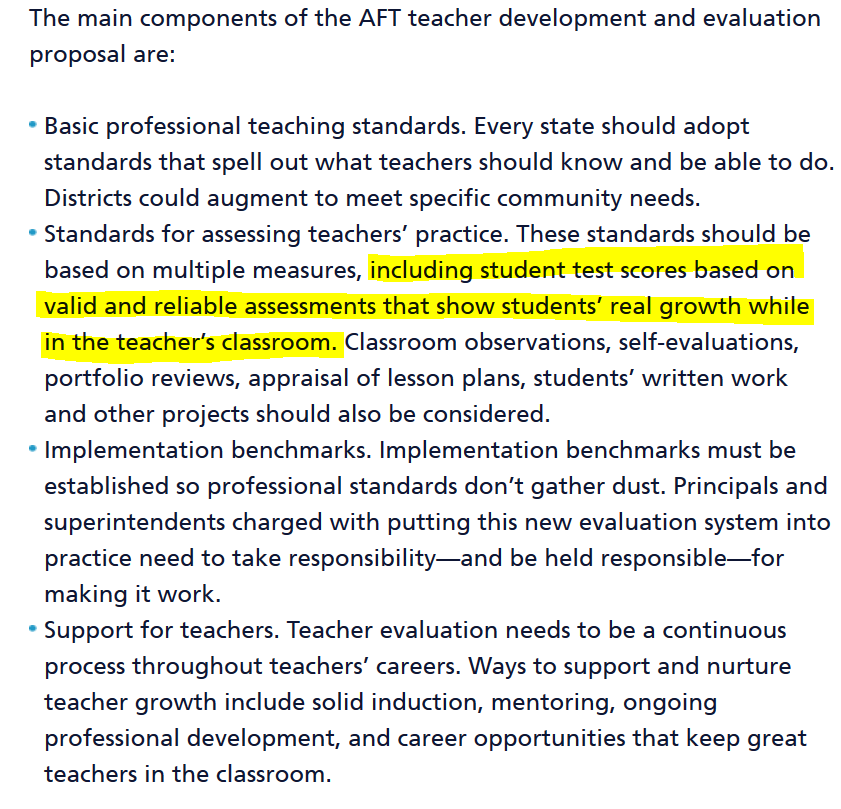
Both the NEA and AFT were early supporters of the Common Core State Standards and maintain high levels of support for the standards themselves to this day.  The NEA maintains this website on the CCSS, including a “ten facts” section that could have been penned by David Coleman himself, and the AFT is equally optimistic going back to a 2011 resolution urging good implementation.  Both national unions took initially positive views of potentially using student test score data as part of a “multiple measures” approach to teacher evaluation.  Part of the AFT’s 2010 statement on teacher evaluation and labor-management relations reads:

AFT teacher eval 2010

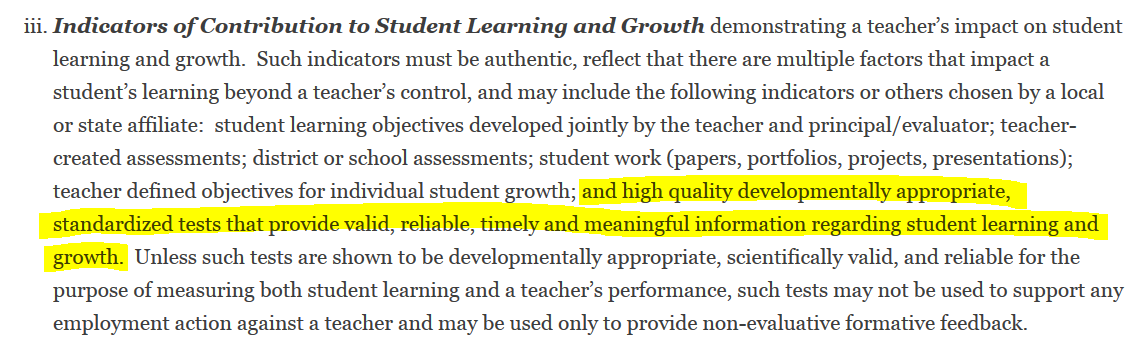
And from the NEA’s 2011 policy statement:

NEA teacher eval 2011

While both unions have repeatedly warned Secretary Duncan and the Obama administration that the push for more and more standardized testing was risking the entire education reform agenda, both unions were cooperative early on with key elements of education reform from the Obama White House: Common Core State Standards and the use of standardized testing data aligned with those standards in teacher evaluation.  It just so happens that these were key components in the White House’s Race to the Top grant competition and were conditions that had to be met to be granted waivers from the worst consequences of No Child Left Behind.  It also just so happens that another person, outside of the Cabinet, was pushing hard to get people on board to support the Common Core standards and growth models based on standardized tests:

Bill Gates

Not for nothing, both unions and their respective leaders at the time were listed as “important partners” when the Gates Foundation in 2009 announced $290 million in grants to 4 major school districts across the country to “develop and implement new approaches, strategies, and policies, including adopting better measures of teacher effectiveness that include growth in student achievement and college readiness; using those measures to boost teacher development, training, and support; tying tenure decisions more closely to teacher effectiveness measures and rewarding highly effective teachers through new career and compensation opportunities that keep them in the classroom; strengthening school leadership; and providing incentives for the most effective teachers to work in the highest-need schools and classrooms.”  The same announcement included the plan to spend $45 million on the Measures of Effective Teaching study – more or less to buy the research saying growth measures based on test data can be used in teacher evaluation and which, well, comes to that conclusion via some seriously dubious reasoning.  President of the AFT, Randi Weingarten, eventually backtracked from the support of growth measures in teacher evaluation, saying “VAM is a sham,” but this was in 2014, long after flaws with the Measures of Effective Teaching study’s conclusion began to be obvious.

So let’s be very clear: far from being antagonists to the Obama White House on education reform, the national teacher unions were key partners in critical elements of it from early on.  If Secretary Duncan’s simply G-d awful oversight of those initiatives (thoughtfully organized for careful consumption by Jersey Jazzman here) finally turned those organizations against him by 2014, it is strange to place union opposition at the center of the story.  In fact, despite the increased criticism and despite the late support for the parental Opt Out movement, teacher unions are STILL keeping their biggest leverage at bay.  Both the NEA and the AFT have already endorsed former Secretary of State Hillary Clinton for President despite her long standing connections with figures like John Podesta, who is running her campaign and was the founder of the Center for American Progress, a left of center think tank that is reliably in the pro-reform camp.  Further, with a few high visibility exceptions like the Chicago and Seattle strikes, neither union has been eager to take to the streets in opposition to the Duncan education agenda.  You don’t have to take my word for it, either.  The Bureau of Labor Statistics has an historic table of labor actions by any group of workers over 1000. The average public school teacher to pupil ratio in 2011 was 16 to 1 (this includes special education teachers and teachers of non-core classes), and there are 453 school districts in the country with more than 16,000 students – meaning if their teacher workforce went on strike, they’d be recorded in the BLM tables.  Considering how the education reforms most embraced by Secretary Duncan and the Obama administration have played out most contentiously in our large urban school systems, wouldn’t we be embroiled in job actions across the country if the AFT and NEA were the kind of opposition imagined by Michael Grunwald in his Politico piece?

I am sure that Secretary Duncan and his supporters both in the White House and in the education reform community would like to invoke the image of a martyr in a passion play, set upon by self interested forces seeking to maintain their privilege at the expense of the nation’s children.  But our national teacher unions do not fit that bill.  Far from opposing the reforms proposed from the Obama Department of Education, they embraced large portions of it and offered mainly precautions rather than opposition on other parts.  While elements of reform policies from this administration were involved in the Chicago Teacher Strike in 2012, there simply has not been labor unrest promoted by the AFT and NEA in the past 6 years.  Discontent among rank and file teachers has been growing in recent years, but union leadership did not really turn the corner on Arne Duncan until 2014. Value added measures are so poorly suited for teacher evaluation that the American Statistical Association urged policy makers not to use them, but AFT President Randi Weingarten’s opposition to VAMs preceded the ASA statement by only 3 months.

The reality is that Arne Duncan and John King did not merely run afoul of national and state level teacher unions – after years of doggedly pursuing policies that harm teaching – they ran afoul of parents and lawmakers as well.  Key aspects of Duncan and King’s favorite reforms are not favored by Americans and by parents even less so.  While charter schools enjoy public support, the Common Core standards, standardized testing, and using test data to evaluate teachers are widely viewed negatively.  67% of public school parents agree there is too much emphasis on standardized tests, and 80% of public school parents said student engagement was “very important” for measuring effectiveness compared to only 14% who said the same about test scores. 63% of public school parents disapprove of using standardized tests to evaluate teachers.

I’m not the only one noticing a theme here, right?  The problems that faced Arne Duncan and which John King faced in New York and will now face on a national level are problems born of loss of trust from parents, key stakeholders in education who turned around between 2009 and 2014 to find huge portions of their schools changing without even the least effort to include them in the conversation.  Secretary Duncan’s tin ear on these matters is almost legendary, but his successor may actually be worse, if that is possible. Dr. King could never communicate effectively with parents, leading to disastrous public meetings, and his refusal to discuss issues or entertain other viewpoints led lawmakers to bipartisan calls for his removal from office.  Mr. Grundwald’s piece in Politico suggests that Dr. King’s problem in New York were mainly with the union, but he fails to acknowledge that he left Albany just ahead of an angry mob of parents and legislators.

Sadly, it is the very background that Mr. Grunwald suggests should help Dr. King repair relationships with the nation’s teachers that actually prevents him from doing so.  Dr. King’s background story includes the loss of his teacher mother at a young age and his crediting teachers for turning around his life (Peter Greene rightly wonders if those same Brooklyn teachers, working under Dr. King’s policy environment, would have the room to set aside pacing guides and practice tests to nurture a child in need).  His allies in reform took to Twitter with #ISupportJohnKing to tout his life in education, but his particular life in education left him sorely unprepared for his role as NY Commissioner and even less prepared to be Secretary of Education.  Dr. King taught for three years, only one of them in a fully public school.  He then helped to found Roxbury Prep charter school in Boston before helping to found the Uncommon School network of no excuses charter schools, which relies heavily on out of school suspensions far in excess of local schools where they operate.  As a “no excuses” chain, Uncommon Schools can employ discipline methods disallowed by public schools and parents have no say if they disagree.  Dr. King was tapped from this sector to become Deputy Commissioner in New York and then ascended to the Commissioner’s office in 2011 at the age of 36.

Dr. King has almost no experience in his career where he was answerable to parents and the overlapping constituencies that are stakeholders in public education.  His style of charter school is almost entirely private in operation and parents unhappy with the way the school operates have no input via elected boards. He never served as principal of a fully public school or as a superintendent in a public school district where he was answerable to different people with sometimes opposing interests that needed to find compromise.  That lack of experience was evident in New York state as he increasingly avoided engaging parents and legislators, and there is no reason to believe he will change in the Secretary’s office.  While our new Secretary of Education will certainly be in for tough times from the national teacher unions, he will undoubtedly be in for equally or worse rough times from parents.

Inflexible unions versus the earnest reformers makes for good copy.  But it isn’t even half the story.

3 Comments

Filed under Arne Duncan, charter schools, Common Core, John King, politics

“Families” For Excellent Schools Sets a New Bar for Chutzpah

“Families” For Excellent Schools, the hedge-fund and foundation backed advocacy group that has waged constant war on New York Mayor Bill DeBlasio on behalf of the charter school sector in general and Eva Moskowitz’s Success Academy brand in particular, has postponed a planned rally for September 30th due to weather concerns.  Ms. Moskowitz’s 34 schools had planned to cancel classes for the morning to boost attendance for the gathering in Cadman Plaza which was to feature Jennifer Hudson.  Organizers announced the rally will go ahead on October 7th, but it also comes in the wake of a controversial ad buy by FES in which they accuse Mayor DeBlasio of condemning African American children to inferior educations, presumably by merely failing to embrace 100% of what the charter sector in New York City wants and by not allowing Ms. Moskowitz to simply point at an existing school and say “gimme” any longer.

The ad, entitled “A Tale of Two Boys,” can be easily found, and goes like this: Two young boys, one white and one black, are being walked to school, passing each other on the street.  The ad declares that the white child lives in a wealthy neighborhood and has an excellent school and will probably go on to college.  The black child, however, lives in a poor neighborhood, is forced to attend a failing school and will not have a chance to go to college.  The ad ends by contrasting the two young boys with the white child reading happily in school and the black child looking morose and bored, and then it chides the Mayor for allowing this to happen and declaring that “half a million” children “need new schools”.

The ad, which is costing FES 100s of 1000s of dollars, drew immediate criticism from numerous sources for relying upon racial stereotypes and for using the circumstances of minority children to advocate “solutions” that serve the political agenda of conservative organizations (such as the Walton Family Foundation and the Broad Foundation) who have been pushing privatizing education and breaking teachers’ unions for years.  Bertha Lewis of the Black Institute flatly declared the ad racist, and Zakiyah Ansari of the Alliance for Quality Education said, “They are using a black face to push their political agenda, and they make the assumption that all black people are poor…They used our children in a race-baiting commercial.”

Criticism of FES is not limited to the new ad buy.  Writing for The Progressive, New York City teacher, activist, and author Jose Vilson notes about the now postponed rally:

Families for Excellent Schools (an awkward name since everyone wants excellent schools surely), prints “Don’t Steal Possible” on red shirts and hands them out across the city. When a whole host of inequitable conditions, including the stratification of rich and poor, steal possibilities (and lives) from children and adults of color on a daily basis, we won’t see similarly impassioned rallies for their rights. When parents have to take off work for a rally or risk their student getting transferred to a local public school that was stripped of funds for losing students to charter schools, that’s also stealing possible….

What’s most disenchanting about the upcoming rally, though, is that the rally doesn’t serve equal and equitable agency for school-aged children. It ultimately serves the agenda of a handful of people who won’t put their shoes to the cement alongside parents who just want their children to thrive in a good school. If the messaging comes from an unknown busybody and not from the very people affected by the schooling of their children, that’s another swindle our children cannot afford.

Allow me to grant FES a crumb of fact within all of this: educational opportunities are not equally or evenly distributed throughout this city, just as they are not within this country.  Our nation is deeply segregated by income which becomes in many cases a proxy for segregation by race.  A consequence of this is that communities with notable levels of poverty tend to have high levels of poverty, meaning that in order to function well their schools need substantial funding, funding which is denied to them by state and local sources.  Many such schools struggle to provide their students with what they need, leading to lower educational outcomes and diminished opportunities.  However, Jose Vilson rightly points out that many schools with high levels of poverty actually have excellent programs, skilled teachers, and involved PTAs, and they are unfairly deemed “failures” by groups like FES because of one measure only: standardized test scores.  If such schools were also fairly funded and given the resources and capacity to provide all of the services their students need, they could thrive even more.  This is hardly an isolated case.  The portrayal of schools serving mostly minority and mostly impoverished children as nightmares of uncaring and corrupt adults passing along children without concern is a vicious narrative used to justify poaching off as much as the public system into private hands as possible.  “Families” For Excellent Schools’ preferred solutions actually make matters worse for the majority of students.

FES has only a passing relationship with the truth, as demonstrated by Professor Bruce Baker of Rutgers University.  Dr. Baker thoroughly destroys the group’s argument that more money per pupil in fully public schools actually harms outcomes by demonstrating that the schools with the highest per pupil spending also have the highest concentrations of special education students and students qualifying for free lunch.  Unshockingly, schools with those populations of students need more money per student in general, and achieving higher value added as measured by tests absolutely takes more money.  Dr. Baker’s research further demonstrates that the charter school sector, as currently administered, acts in a parasitic manner, siphoning off students who have lower rates of high poverty, learning disabilities, and language learning needs and skimming the resources the fully public schools need to provide appropriate services for the children who remain.  While high need districts within New York are face serious underfunding by the state’s own formula for school aid, advocates for charter schools like FES simultaneously call for more resources to be funneled from those public schools and dare to call them “failures” for not thriving.
The nerve of FES running an ad accusing the mayor of allowing African American children to languish is failing schools should be obvious – and deeply offensive – to anyone informed on the issue.  There is no doubt that too many schools struggle, but “Families” For Excellent Schools has no actual interest in improving the educational outcomes for all students in New York City.  In fact, extending genuine opportunities to all students in New York City is completely antithetical to their operating principles and would damage their brand management strategies.
Nationwide, the charter school sector has well-crafted approaches to winnow down the families who even apply to enter open lotteries – even in states where they are mandated to use random lotteries to prevent them from cherry picking students.  While Stephanie Simon’s report for Reuters noted that well known charter operators such as KIPP and Success Academy use simple application forms, that does not mean they seek to retain all of the students who make it into their schools.  Success Academy is known, in particular for practices that drive away significant portions of their students as noted here by former New York high school principal and current Executive Director of the Network for Public Education, Carol Burris who noted how Success Academy 1 in Harlem opened with 127 first graders in 2009 but only 82 remained to begin 6th grade (Interestingly, Success CEO Eva Moskowitz denied the accusation of excessive attrition in the comments section, accusing Ms. Burris of ignoring data that showed charter retention was somewhat higher overall than in nearby schools within the city.  Of course, Ms. Moskowitz was citing data for the entire charter sector while Ms. Burris was looking at the original Success Academy, and Ms. Moskowitz consistently fails to acknowledge that district schools have to replace children who leave when new students arrive at any time and that every child who leaves her schools represents a family that sought out Success Academy deliberately.)
Families that do seek out and get to attend Ms. Moskowitz’s schools quickly learn what it takes to remain there.  A parent handbook for Success Academy obtained by FOIL requests shows that Success Academy requires weekend or additional “academy” sessions for repeat “violations” of its requirements.  Excused absences cannot be had for parental illness, transportation problems, or doctor appointments.  Parental reading is a daily requirement in K-2 with no exceptions as is parental oversight of homework – which is given only in English.  While parental involvement is an important aspect for many students’ achievement, Ms. Moskowitz is essentially mandating parents who are both competent in English and who are in work and family situations stable enough to meet those expectations.  A single parent working evenings and whose child care is a relative speaking limited English is going to be unable to fulfill these requirements.
 The Success Academy network is not precisely subtle that it neither has the time to work with students who need even minor behavioral accommodations nor is it willing to keep them.  Kevin Sprowal was a Kindergarten student in Success Academy who had never been in serious trouble for behavior in three years of pre-school was suddenly disciplined constantly to the point that he felt sick at the thought of going to school.  His mother, Katherine Sprowal, received a direct message from Ms. Moskowitz that she interpreted as a veiled urging to transfer, and the school psychologist flatly said her child should be in a different school.  It is hard to take the “open lottery” for Success Academy seriously when it immediately begins to filter out five year olds who turn out to have perfectly manageable attention deficit.
The network’s methods are plainly brutal in many respects. In a special report in April of this year (that, of course, drew indignant responses from Ms. Moskowtiz), The New York Times documented the extreme high pressure placed upon the network’s very young children, including practices that are, in turn, manipulative and plainly abusive:

But at Success Academy Harlem 4, one boy’s struggles were there for all to see: On two colored charts in the hallway, where the students’ performance on weekly spelling and math quizzes was tracked, his name was at the bottom, in a red zone denoting that he was below grade level….

Success has stringent rules about behavior, down to how students are supposed to sit in the classroom: their backs straight, and their feet on the floor if they are in a chair or legs crossed if they are sitting on the floor. The rationale is that good posture and not fidgeting make it easier to pay attention. Some teachers who had orderly classrooms and a record of good student performance said, after their first year, their school leaders allowed them to bend the rules somewhat, such as not requiring students to clasp their hands as long as their hands were still….

Success did not allow a reporter to observe test preparations, but teachers and students described a regimen that can sometimes be grueling.

To prepare for the reading tests, students spend up to 90 minutes each day working on “Close Reading Mastery” exercises, consisting of passages followed by multiple-choice questions. The last two Saturdays before the exams, students are required to go to school for practice tests.

Students who do well on practice tests can win prizes, such as remote-controlled cars, arts and crafts kits, and board games. Former teachers said that they were instructed to keep the prizes displayed in the front of their classroom to keep students motivated.

Students who are judged to not be trying hard enough are assigned to “effort academy.” While they redo their work, their classmates are getting a reward — like playing dodge ball against the teachers, throwing pies in the face of the principal or running through the hallways while the students in the lower grades cheer….

At one point, her leadership resident — what the network calls assistant principals — criticized her for not responding strongly enough when a student made a mistake. The leadership resident told her that she should have taken the student’s paper and ripped it up in front of her. Students were not supposed to go to the restroom during practice tests, she said, and she heard a leader from another school praise the dedication of a child who had wet his pants rather than take a break….

At Success Academy Harlem 1, as the original school is now called, 23 percent of the 896 students were suspended for at least one day in 2012-13, the last year for which the state has data. At Public School 149, a school in the same building, 3 percent of students were suspended during that same period. Statewide, the average suspension rate is 4 percent. (A spokeswoman for Success said that the suspension rate at Success Academy Harlem 1 has since declined to 14 percent, and that several of the newer schools had rates below 10 percent.)

Students who frequently got in trouble sometimes left the network, former staff members said, because their parents got frustrated with the repeated suspensions or with being called in constantly to sit with their children at school…

“We can NOT let up on them,” she continued. “Any scholar who is not using the plan of attack will go to effort academy, have their parent called, and will miss electives. This is serious business, and there has to be misery felt for the kids who are not doing what is expected of them.”

Public shaming.  Extremely narrow behavioral norms for children as low as five.  Extra school work as punishment for not meeting standardized testing goals.  Obsessive focus on standardized test preparation. Open and blatant bribes for children who excel on test based measures.  Children who can quickly adapt to this and perform on tests as expected are welcome at Success Academy.

Which brings us back to chutzpah.  “Families” For Excellent Schools will rally next week with Ms. Moskowitz’s students front and center providing the optics of minority children in need of great schools and opportunities.  They will claim to be there for the “half a million” children “trapped in failing schools” (last year, they claimed it was 143,000) and who need “new schools, now” – by which they mean charter schools in the Eva Moskowitz model.

But those charter schools – and Ms. Moskowitz’s schools in particular – do not want all of those children they will claim to speak for next week.  They want the children whose parents have stable enough work lives and English proficient enough that they can meet all of the out of school expectations without exception.  They want children who do not require any accommodations that would alter their extraordinarily rigid approach to early childhood behavior.  They want children who can immediately adapt at the age of five to excessive conformity, who can handle public shaming and extraordinary pressure, and who will emerge from that environment with high standardized scores.  Everyone else can go pound sand.  More specifically, everyone else can go back to their district schools which now have even higher concentrations of children in high poverty, with serious special learning needs, and with English language learning needs but which have fewer monetary and physical resources with which to help those children.  Far from speaking for half a million kids in need of great schools, “Families” For Excellent Schools will use 1000s of children as props to denigrate the work and efforts of 100s of schools and tens of 1000s of teachers and hundreds of 1000s of other children simply because of their test scores.  Worse, they will call for even more resources to be hoovered out of those schools – even though the “no excuses” charter sector in New York is 100% dependent upon having zoned schools that will take the children they refuse to accommodate.

“Families” For Excellent Schools does not give a damn about most of the children in New York.  Don’t let them get away with claiming they do.

2 Comments

Filed under "Families" For Excellent Schools, charter schools, Social Justice, Testing

#FightForDyett: What Would YOU Sacrifice for a Fully Supported, Fully Public School?

The hunger strike by 12 parents and community activists in Chicago fighting for an open enrollment, fully public, high school in the Bronzeville neighborhood will soon pass the one month mark.  Ten days ago, Chicago Public Schools announced a “compromise” that would have Dyett re-open as an open enrollment school but with an arts based focus instead of the as the Global Leadership and Green Technology school that was submitted by the Coalition to Save Dyett.  That school proposal, developed over the course of years with assistance from the University of Illinois at Chicago, the Chicago Teachers Union, the Kenwood Oakland Community Organization, Teachers for Social Justice, Black Metropolis Convention & Tourism Council, Blacks in Green, the Chicago Botanic Garden, and the Annenberg Institute, was submitted earlier in the year when CPS solicited proposals to re-open the Dyett campus.  The announcement of an arts based school was done suddenly and with no discussion with community members who have been fighting for years to keep a fully public high school open in Bronzeville.

And so the hunger strike continues, including continued public pressure on CPS and elected officials, and candlelight vigils outside the Obama family home:

Pressure has perhaps increased with national media picking up on the story in outlets such as The New York Times, Slate Magazine, Essence Magazine,  and Public Radio International.  The Takeaway’s John Hockenberry spoke with hunger striker and grandmother of three, April Stogner, for nearly 7 minutes on the 25th day of the hunger strike.

Mr. Hockenberry asked her why the hunger strike was continuing when the city had agreed to an open enrollment school:

“…the decision to re-open Dyett as an open enrollment school we already had that decision last year to re-open it. What we’ve been fighting for is to have it as the global leadership school. What they’re trying to give us is not what the community asked for.  They never brought us to the table to make this decision. Many people think that it’s a win for us, but we don’t see it as that. We don’t feel that that’s victorious, and for that reason, that’s why we’re in day 25 of the hunger strike.”

Peter Greene of Curmudgucation made an excellent point about this on his blog shortly after the CPS decision was announced:

Emanuel faced an ever-growing mess, and he had to decide what to save, what absolutely could not be sacrificed in salvaging some sort of end to the public hunger strike. And he decided the one thing that he absolutely could not give up was the policy of keeping community voices silent. Okay, let them have open enrollment. But don’t let them speak. Don’t let them have a say in making any decisions about the school. And just to make it clear, don’t use their years of research and planning for the school design– because that’ll make it clear who’s still in complete control of what happens in their school.

This effort to run around the community activists – the very people who have been in Bronzeville trying to make Dyett a success despite the continuous history of being undermined by Chicago Public Schools from day one — allows Mayor Rahm Emanuel to claim he met the protestors “part way” and made a “compromise” while entirely ignoring their voices. The move was for public relations, not for the community and their goals.

And what are their goals?  Ms. Stogner explained that to Mr. Hockenberry as well:

“I would envision Dyett being a school that’s connected to the other schools in the community, the grammar schools. You’re talking about a school that has a beautiful garden, a rooftop where you can have a garden. Everything is geared toward green technology where our kids would be ensured to have a future in green technology and be sure that they’ll have jobs. Yes, we like arts and all that.  That’s fine and dandy.  But our kids can do more than dance and sing and jump around…..It’s crazy when I was listening to the statement that you played from the mayor and they always say that they want to do what’s best for the children. This is not what’s best for our children. When you talk about community, the community should be involved in the decisions, and we were not involved. We submitted this plan. We’ve been working on this plan for well over five years, so it’s funny that he said you’re doing what’s best for our community. You don’t know what’s best for our community, or we wouldn’t have had 49 schools closing at one time. Tell the truth and say what it is.  They just want to make money off the backs of our children, and they feel like they can just come into our community and take what they want. But we’re not having that anymore.”

This vision is incredibly powerful because it is not simply about what kinds of schools are available for the children in Bronzeville, but also it is about whether or not the community itself will be heard when it plainly makes clear what is desired. It is also about pointing out that when communities are called upon to “sacrifice” during times of economic crisis, the bulk of that sacrifice comes from communities that are disproportionately black, brown, and poor:

Julian Vasquez Heilig makes this abundantly clear in one of his recent posts about the Dyett hunger strikers.  Chicago Public Schools spends $13,433 per pupil.  How does that compare to wealthy, suburban communities uneffected by school closures or the need to go on a hunger strike to highlight the plight of their schools?  Seneca Township spends $25,289 per pupil.  Sunset Ridge spends $22,683.  Evanston Township, $21,428.  Ms. Stogner is keenly aware of this:

“The mayor — he’s one of the biggest gangsters I’ve seen in a long time.  Yes, anyone who doesn’t value our kids that already speaks to what kind of person our mayor is. Anyone who closes schools — those are community institutions. Where else would our children have to go?  What schools need is to be invested in, not disinvested in. It’s easy to take away all the resources from these children and these schools and say that they’re failing. But what did you do to make sure that they were excelling?  You took everything.  They don’t have libraries. No resources. You take out all of our black and brown teachers, people who love and care about our kids, who can teach them their history. That’s not what you want, but you have money for charters, turnaround schools.  I have a problem with that. Everybody should have a problem with that.”

The perversity of this is abundantly clear:  we task public education with offering opportunity to those willing to take it in our society, and to ensure that such opportunity is equitably available, we charge truly public schools with taking and accommodating all the students who arrive at their door, regardless of circumstances. It is one of the most truly democratic exercises in our society and it has historically expanded its reach as we have expanded the political and social franchise as well.  But there is one glaring obstacle to it truly functioning that way: the same economic inequality that infuses and segregates our society along race and class similarly segregates our schools into institutions offering astonishing opportunities and institutions struggling to keep up with the needs that arrive every day without equitable funding.  That term, equitable, is important because when a school has a high concentration of students with needs that must be accommodated, the appropriate per pupil funding will almost certainly be greater than in communities where almost all children come from comfortable homes with abundant family resources.

And yet, instead of that promise, they are given closed schools, fired teachers, unaccountable charters, and blighted neighborhoods; so the hunger strike continues.

The #Dyett12 require all of us to ask just what would we sacrifice for the principals of democratic education and community voices in our own schools?  I have to confess that I have been entirely lucky in my life in this question.  I grew up in a suburban Massachusetts town with well resourced schools.  My own children are growing up in a neighborhood of New York City where we have never had to question if they would have access to excellent public schools. My children go through their lives never knowing what it is like to be suspected of wrong doing simply for the color of their skin. Residents of our borough who live a mere two miles from us are not so lucky and live with injustices we can read about but will never experience.  That in the city of Chicago in 2015 there are people who have been on hunger strike for nearly a month to simply have what their peers in the suburbs never even question – an excellent, fully public school – is heart breaking and infuriating at the same time.

Ms. Stogner and her fellow hunger strikers offer a glimpse of a potential shifting of our education debate in this country to one that listens to the voices from the ground up instead of imposing solutions from above that more often than not hurt rather than help. When asked about her family, Ms. Stogner said:

“My grandson, I brought him out with me yesterday for the first time because I felt like he needed to know why when they’re at home eating, and grandma is just drinking water, why she isn’t eating. I need him to understand that you are important, you do matter. I don’t want him to believe that people can just come in his neighborhood and tell him he’s not good enough to have s school to go to up the street from him, a good community school, a great community school, a world class community school. He needs to know whatever you believe in, you stand up and you fight for it by any means necessary.”

We should all be teaching lessons so valuable to our children.

1 Comment

Filed under #blacklivesmatter, #FightForDyett, Activism, charter schools, Corruption

#FightForDyett Puts Parents’ Actual Bodies on the Line for Fully Public Education

On August 17th, a group of 12 parents and community activists in the historic Bronzeville section of Chicago began a hunger strike to preserve the last open enrollment high school in their community.  Their fast, where they have consumed nothing but water and light liquids such as broth, is now in its third week, and even though they managed to get Chicago Mayor Rahm Emanuel to meet briefly with them after a contentious town hall style budget meeting yesterday, no commitments were made that satisfied their needs.  So they continue their hunger strike, despite the adverse effects on their health, and a public plea from a coalition of health professionals urging the Mayor to taking action on the strikers’ issues to prevent a tragedy.

Despite the insulting tone argument that The Chicago Tribune’s Eric Zorn recently offered, chiding the Dyett hunger strikers for their tactics, this action is not taken rashly and is the result of a true community coalition being rebuffed at every turn.  The Bronzeville neighborhood of Chicago is one of America’s most historic African American communities and was a major destination for African Americans seeking a better life during the Great Migration.  In 2012, Chicago Public Schools announced it would “phase out” and close Dyett High School which is the last open enrollment high school for Bronzeville, and this year the CPS accepted three proposals for a new school in the building, two from outside organizations and a proposal for a “Global Leadership and Green Technology” school submitted by the Coalition to Revitalize Walter H. Dyett High School.  The coalition, which has been advocating all along to keep the school open and to transform it into the leadership and green technology school based in the community, has played by every rule and procedure put in front of it by Mayor Emanuel’s school department, seeking to keep their voices and the voices of their neighbors heard.

The process, however, has been repeatedly delayed, most recently with an August meeting pushed out to September, which precipitated the decision to begin a hunger strike:

And the strikers remain there, outside a shuttered high school that, as Peter Greene rightfully points out, was actually improving before the central office decided to abandon it and where an entirely community based proposal for its future remains ignored and stalled by a city bureaucracy more interested in opportunities to gentrify than in building up communities. They are now in their third week without solid food, waiting for the city to answer them.

Especially significant is for what the Dyett hunger strikers have put their bodies on the line. Dr. Julian Vasquez Heilig details a timeline for Dyett High School since 1999 when it was converted from a middle school that seemed almost intentionally to court failure.  Nearby King High School was turned into a selective enrollment school, and CPS converted Dyett into a high school that opened with only 7 books in its library and unequipped science labs.  Community members worked to build up the school which is where students who do not qualify for King go, and then in 2006, CPS closed Englewood High School, sending an additional 125 students to Dyett with no additional resources.  Despite this, the community continued to invest in Dyett and its future and then in 2012, CPS announced plans to phase out and close the school.  At every point, community organizations and parents have worked together to help develop a school community within Dyett, and at every point, authorities outside of Bronzeville have hurled wrenches into those efforts.

If Walter H. Dyett remains closed or if it is replaced with schools that do not have open enrollment, there will be no high school in Bronzeville that is truly the responsibility of the entire community.  While education reform touts parental “choice” as a cure-all for urban education, it is far too often comprised of “any choice but a democratically organized and locally comprised school.”  The ideal of an open enrollment, neighborhood, school is not merely an organizational choice for school departments.  It is a profound expression of the democratic ideal and of communities’ investments in themselves.  A truly public school is open to everyone who lives in its zone with no exceptions, and it is bound by law and by professional morality to do its utmost for every child regardless of race, socioeconomic circumstances, or special needs.  Public schools cannot counsel out or harass students with special needs until they give up and transfer somewhere else, and while it would be incorrect to assert that our urban and predominantly minority public schools have always lived up to these ideals, when properly supported and given investments in facilities, staff development, and surrounding community development, they remain one of the truest expressions of democratic equality in our society and are bedrock for their neighborhoods.  Consider the stunning investment in architecture that was once expressed in Chicago’s public schools for a nice visual understanding of how important these ideals were and wonder at what children must have thought when brought to the doors of these buildings.

The point is not lost to note that as neighborhoods became more and more minority over decades such grand investment vanished.  Organizer and now hunger striker Jitu Brown expressed this eloquently last year as he questioned CPS’ plans for Dyett:

Why can’t we have public schools? Why do low-income minority students need to have their schools run by private contractors? We want this school to anchor the community for the next 75 years. We’re not interested in a short-term contract that can be broken.

And there may be more at stake than the consequences to Bronzeville if Dyett is not allowed to reopen as an open enrollment school.  Chicago teacher and activist Michelle Gunderson notes:

For those of us who have witnessed the privatization of our school systems, we know all too well what is at stake if Dyett High School no longer is in the hands of the community. Once we have one neighborhood without an open enrollment high school it will be all too easy for subsequent parts of our city to fall like dominoes, creating a system of privatized schools.

Perhaps that goal makes sense to people who only envision disruption and competition as vehicles of improvement over investment and cooperation, but to lose all fully public schools is to lose far more than a system of governance.  It is to lose community identity, shared responsibility for community youth, and institutions purposed for democratic equality.  Hunger striker Monique Smith told The Washington Post, ““This is really about the privatization of education, it’s about having sustainable community schools in every neighborhood…This is a much larger struggle.”

That this should happen in Bronzeville — which Eve Ewing reminds us is historically significant for its role in The Great Migration and for the African American intellectual, literary, and political leaders who have called it home — is an even more significant blow in a time when black activists have organized to highlight the violence state sanctioned actions have inflicted against their bodies.  It is not an exaggeration to observe that the deliberate neglect and subsequent closing of Walter H. Dyett High School is an act of state sanctioned violence against the community body of Bronzeville.

And now 12 brave activists have called upon a long tradition of direct action and placed their actual bodies on the line for the sake of their community and whether or not it will be deprived of a core democratic institution.  If you believe that Mayor Rahm Emanuel and Chicago Public Schools are long overdue to respond to that injustice, call (773) 533-1500 to leave a message for CPS CEO Forrest Claypool.  It is week three.  Enough is enough.

Leave a comment

Filed under #blacklivesmatter, #FightForDyett, Activism, charter schools, Social Justice

Newark, Please Meet the New Boss: Who Is The Old Boss’ Boss’ Old Boss

Controversial Newark, New Jersey Superintendent of Schools Cami Anderson is out of a job only 4 months into her renewed contract, and after a tumultuous year implementing the “One Newark” school reform program, including mass student walk outs, a 4 day occupation of Anderson’s office, and repeated calls for her ouster by Mayor Ras Baraka.  “One Newark” was controversial from the start, and essentially “blew up” the idea of a traditional public school system by throwing open the entire district to school choice, expanding the charter school sector within the city, and placing fully public schools under “renewal plans” (in many cases requiring entire schools of teachers to reapply for their jobs) while maintaining state control of the district which has been in effect for 20 years.  The plan opened with significant chaos and uncertainty, and a year in, there are significant questions about the capability of One Newark to really deliver on its promises, and, since the “renewal” plans began in 2012, there is more evidence that the reforms have not yielded better achievement and have had discriminatory impact on faculty and staff.

One thing is not in question: Anderson had a particularly difficult relationship with both parental and political stakeholders.  She slated schools to close even though they were meeting their growth targets.  She abruptly stopped attending school board meetings in an effort to not face parents angry at the impacts of reforms on their children.  The summer enrollment process for parents to simply put their children’s names into the system to have a school selected was poorly thought out and insensitively implementedState lawmakers waited for a year for Anderson to finally show up to a committee meeting to discuss her performance as superintendent.  Even if One Newark were indisputably a net good for Newark Public Schools, the sheer incompetence displayed when doing a basic job of a superintendent, effectively communicating with and balancing the overlapping needs of all of the stakeholders in public education, should have long ago disqualified Anderson from her job.

Allow me to indulge in a moment of praise for the young activists of the Newark Students’ Union who have been Profiles in Courage this past year.  When many of the organizations run by adults have been far too quiet, these young people have stood up and demanded that the media and public at large pay attention to what has been thrust upon Newark’s children, families, and teachers in the name of reform.  Their protests have brought national attention to Newark, and almost certainly contributed to Anderson’s departure.

Sadly, that is the end of the good news.

The reason for that is that replacement for Anderson will be none other than former Commissioner of Education for the State of New Jersey, Christopher Cerf, who abruptly left his office to join his former New York City DOE boss, Joel Klein, at Rupert Murdoch’s education technology venture, Amplify.  The Newark education board, which has no direct control over the school system, passed a nonbinding resolution calling for the appointment of assistant superintendent Roger Leon, and is scheduled to meet with Assistant Commissioner Peter Shulman to discuss “next steps” for the district’s leadership.  So, if Cerf’s appointment goes through, it will mean that he will replace a superintendent he himself appointed, and he will report to former underlings in Trenton.  The new boss isn’t the same as the old boss.  The new boss is the old boss’ boss’ old boss.

It is not hard to understand why Cerf might be looking for new employment opportunities after little more than a year at Amplify.  The technology venture is struggling mightily with expensive contracts, breakable hardware, and buggy software. Anderson’s mounting problems and inability to lead may have provided him with an opportune moment to jump ship.  It is unclear how many people in the country would be willing to step into the mess that exists in the Newark Superintendent’s office, and Cerf will certainly bring an intimate knowledge of the plans to completely change public education in Newark.  After all, he, along with former Mayor Cory Booker and Governor Chris Christie, was central in using Mark Zuckerberg’s $100 million donation to set the process in motion, setting up an expensive consulting operation before he was appointed to Commissioner’s office.

So this bizarre situation, where the state’s former highest education official will now run a school district whose outgoing superintendent reported to the incoming superintendent’s former underlings, may, as hard as it is to believe, be even worse for Newark.  As New Jersey teacher and Rutgers graduate student, Mark Weber notes on his personal blog:

This is why the S-L (Star Ledger) is almost certain to run an editorial very soon lauding Cerf ([editor]Moran’s neighbor in the very reformy town of Montclair) as the perfect pick to lead Newark’s schools to new heights. Because he’ll do exactly the same things Anderson is doing right now — but he’ll do it with a smile. He won’t fly off the handle when people dare to mention his own kids. He’ll show up to school board meetings and nod and take notes and promise to take everyone’s views under advisement.

And then he’ll go do exactly what Cami Anderson was doing before. Why wouldn’t he? Just as recently as this past December, Cerf was singing Anderson’s praises, even as he was demonizing those who stood against her. – See more at: http://jerseyjazzman.blogspot.com/2015/06/cerfs-up-in-newark-and-that-means-more.html#sthash.TvPD8ZhL.dpuf

Weber goes on to observe:

It’s also worth noting this same destructive idiocy was at play in Cerf’s policies later, when he ran the entire state’s education system. But this is how Cerf was trained. His (and Anderson’s) time at the NYCDOE under Joel Klein, coupled with his involvement in the Broad Superintendent’s Academy Book Club, formed his “creative disruption” mindset: use test scores to justify closing public schools and let privately governed charters take over. And if that’s not feasible, reconstitute the schools, generating as much instability as is possible.

This is precisely what has happened to Newark’s schools under Anderson. Even though there is no evidence that Newark’s charter schools are more effective or efficient, they have been given the green light to take an increasingly large share of the market. The district itself has been complicit in painting a false picture of the extent of their “success”; the district has also abetted their expansion as part of its One Newark plan, likely leading to even greater segregation within the district. – See more at: http://jerseyjazzman.blogspot.com/2015/06/cerfs-up-in-newark-and-that-means-more.html#sthash.TvPD8ZhL.dpuf

So Christopher Cerf is cut entirely of the same cloth as Cami Anderson with precisely the same training in philosophy and education reform.  He is a strong proponent of a business oriented view to schooling as if our public schools were similar to old business models that have failed to compete against consumer innovation.  He has no problem inflicting entirely unproven changes upon the education of 10s of 1000s of children because he believes “creative disruption” is just as valid a means of innovation in education as it is in consumer electronics.  Apparently, it is okay if some students get the Apple Macintosh 128K education while others get the Coleco Adam.

What makes Cerf stand out is not his policy differences with Anderson (of which he has precisely none).  It is his political ability, connections, and powerful patrons, including Senator Cory Booker, Governor Chris Christie, and former NYC Chancellor Joel Klein.  There is no reason to believe that he will not plunge straight ahead with One Newark and turn Newark into the “charter school capital of the nation.” There is no reason to believe that anything more than lip service will be paid to local control from a new superintendent who formerly ran the state with total disregard for local control, especially in the districts controlled by the state and subjected to maximum disruption regardless of local concerns.  The only thing to expect is that Chris Cerf will be skilled at inflicting harm upon Newark for however long he is in that office.

So Newark, please meet the new boss — and watch your back.

cerf is coming

2 Comments

Filed under Activism, Cami Anderson, charter schools, Chris Christie, Corruption, Cory Booker, Newark, Newark Students Union, One Newark, politics