Category Archives: charter schools

Four More Things To Tell President Obama

Valerie Strauss of the Washington Post wrote last week that President Obama and Secretary of Education Arne Duncan had a meeting with teachers over lunch.  Her column provided space for the 2007 Arkansas Teacher of the Year, Justin Minkel, to offer his insights into how the meeting went and what the President and Secretary heard from the teachers present.  Mr. Minkel, who is a member of both the National Network of State Teachers of the Year and the Center for Teacher Quality and who blogs for Education Week and for CTQ, wrote cogently and intelligently about four key points:

1. There’s Nothing Wrong With the Kids

2. “Responsibility and Delight Can Co-exist”

3. It’s not about good and bad teachers.  It is about good and bad teaching.

4. If we want students to innovate, collaborate, and solve real-world problems, we need to make it possible for teachers to do the same things.

These are outstanding points, and I thank Mr. Minkel and his fellow teachers for communicating them directly at such a high level.  There are, of course, many other points that the President and his Secretary of Education need to genuinely hear and know.  I would like to offer my own four points to build upon these:

1. You are looking for teacher effectiveness in all the wrong places

Teachers matter.  Nobody should ever suggest otherwise.  But No Child Left Behind and Race to the Top both represent sustained efforts to locate how teachers matter in standardized test scores, and since Race to the Top, the strongest proxy for teacher effectiveness written into state and federal policy has been annual student progress on standardized testing. This is a flawed approach for several reasons.  To begin with, the tests that are designed to demonstrate if a student has mastered a body of knowledge or a set of skills are designed for that purpose and that purpose only.  As Dr. Nunoz of Concordia University Chicago notes, testing and measurement is a precise field and it is improper and inaccurate to use an examination for a different purpose because it would not be designed the same way.  The American Statistical Association released a statement on value added measurements earlier this year that clearly stated that the association does not believe any examination currently used to measure teacher effectiveness meets the strict criteria necessary for such a test, and they noted that most studies on VAMs find that teachers’ input only accounts for between 1-14% of the variability among student results on such tests.  Looking for teacher effectiveness in the results of standardized examinations is essentially playing dice with teachers’ futures.

Even the research that claims such models are useful is suspect.  As Dr. Jesse Rothstein of U.C. Berkeley found, even the Gates Foundation funded research on “Measures of Effective Teaching” makes claims that are poorly supported by their own data. Despite the MET study’s endorsement of VAMs, Dr. Rothstein notes that “teacher evaluations based on observed state test outcomes are only slightly better than coin tosses at identifying teachers whose students perform unusually well or badly  on assessments of conceptual understanding (p. 5),” and goes on to note that teachers whose students did well on standardized exams did far less well on measurements of critical thinking.  Using standardized examinations as a measure of teacher effectiveness can reward a weak teacher who focuses on test preparation and punish a highly skilled teacher who emphasizes higher order thinking and creative problem solving.

Teachers, of course, do make a difference for students.  And there are teachers who do not teach well, and there are teachers who excel at the work.  But the impact of that teaching is simply poorly represented in paper and pencil standardized examinations.  It can be found in student produced artifacts that explore rich content in creative and insightful ways.  It can be found in a classroom that “buzzes” with the constant hum of excited work.  It can be found in the individual lives of children who are inspired to explore a field they never knew held interest before.  It can be found in the children who find a mentor and reliable adult among the body of teachers in a school and stick with their education when nobody thought they could.  It can be found the eyes of a student whose talents and passions are affirmed for the first time in his or her young life.  This is what happens in millions of classrooms across the country on a daily basis that cannot be captured on a standardized examination.

Taylor Mali, teacher and poet, captures quite a lot of that nicely in this poetry performance:

2. It’s the poverty

You’ve been told by a lot of current reformers that talking about the extraordinary difficulties of educating children born into poverty is just “making excuses” for “bad teachers”.  I cannot say not only how much this refrain hurts  teachers who have dedicated themselves to working with our most needy students, but also how much it hurts those very same students.  It places upon the teachers a burden to, on their own, lift children of poverty to a level playing field with their more advantaged peers.  It thrusts upon those children schools that keep cutting out critical thinking and aesthetic enrichment in favor of test preparation because of draconian  layoff and reorganization threats while offering the students a brutally unlevel playing field if they graduate. I can think of few practical jokes more cruel than this.

Poverty is not an “excuse”; it is a fact that broadly impacts the earliest childhood of 22% of our young people.  It is a fact that we do much less to alleviate poverty’s deprivations than our peer democracies in the West.  And because our residential income segregation is very high and has risen by over a third since 1980, it is a fact that poverty disproportionately impacts specific schools and school systems.

And it is not a fact that is fully constrained to those meeting the federal definition of poverty.  Income, housing and food insecurity impact the lower middle class, many of whom are clinging to that status solely because of federal assistance programs and the Earned Income Tax Credit.  In 2011, only North Dakota and New Hampshire had child food insecurity rates below 15%.   The Hamilton Project report also notes that food insecurity can have potentially life long consequences in both educational outcomes and economic security, but teachers are going to be held accountable for children who will suffer lower birth weights, worse lifetime health outcomes and lower economic outcomes because Congress refuses to fund expanded SNAP benefits that amount to less than half of the cost of USS Gerald Ford.

This is not meant to “excuse” those teachers and administrators who give up on children in poverty or near poverty and do not do their utmost to educate, inspire and mentor those in their care.  However, it is intellectually and morally bankrupt to ignore that our much lamented gap in PISA can be located almost entirely within our poverty level, and to blame teachers and schools for failing to single-handedly overcome a phenomenon much larger than our schools and about which the billionaires driving today’s “reforms” refuse to discuss.

3. There is no “secret sauce” for educating our most struggling children

Former White House Chief of Staff and current Chicago Mayor Rahm Emanuel opined that Noble Network of charter schools in Chicago had the “secret sauce” for motivating students to perform.  An element of that recipe?  Collecting $400,000 in disciplinary “fines” from its students since 2008.  Advocates of the rapidly expanding charter sector of education like to paper over such practices, but it is vitally important to expose them because while their sponsors and leaders like to hype test performance, they often achieve those results at the expense of up to half of their students.

This should be absolutely clear: with 1000s of charter schools across the country, there must be many schools and teachers who do a genuinely great job with the students in their care.  Unfortunately, they are overshadowed by the high profile charter schools that are essentially corporate entities and that tout themselves as miracle factories based upon high test scores.  They consume public dollars, refuse public accountability, have astonishing attrition rates usually at the expense of the neediest children enrolled in them, and have formed powerful lobbies to influence politicians to continue to favor charter schools over fully public schools.

This is not to say that none of these schools do a good job of educating the students that they do accommodate and that there are not students and families who are sincerely grateful to be in those schools.  But it does mean that they cannot legitimately claim to have found any “secret sauce” for educating our neediest students when they engage in extreme cream skimming, refuse to let the public examine their finances and rely upon their extremely wealthy patrons to strong arm politicians on their behalf.  To put this in perspective:  In 2012, the NEA spent $13 million in campaign contributions total across the country, and the AFT spent $5.9 million.  Success Academy Charter’s supporters spent $3.6 million in THREE WEEKS just because Mayor de Blasio slowed down the expansion of the network.

Truly working with our neediest takes far more than advertising and cherry-picked student bodies.

4. Arts and the humanities matter

Despite very shaky evidence to back up the claim, we have been treated to nonstop rhetoric about our “crisis” in graduates with STEM degrees, and policy has pushed hard to create more pipelines for people to enter such fields regardless of the actual employment picture for them.  There is, however, evidence that in the age of test based accountability, we have marginalized endeavors that are critical to both our civic life and our general well being.  Social studies instruction has shrunk from 9.5% of instructional time to 7.6%, meaning that our students spend less time today learning history and engaging in critical thinking about their civic life.  While instruction in the English Language Arts has increased because of its status as a tested subject, there are legitimate concerns that the emphasis on reading informational texts in the Common Core State Standards and associated testing, will drive more classrooms away from reading great works of literary fiction and poetry.

And then there is the long term and precipitous decline in arts education which fell below 50% for 18 year olds in their childhood education in 2008.  That means that half of the children in America born in 1990 received no arts education in their entire education K-12.  Research is very clear that participation in the arts has a wide range of academic benefits from higher test scores to higher rates of college completion among low income students.  Eliot Eisner of Stanford University notes the lessons that the arts teach such as: making judgments about relationships, seeing multiple answers to problems, accepting multiple perspectives, complex problem solving, learning that cognition is not limited by language, seeing large effects from small differences, and thinking through materials to fruition of an idea.  It is not hard at all to see the connection between these capacities and the capacities that lead not simply to STEM competencies but also to STEM understanding and innovation.  No wonder, then, that there is a small but growing movement to “move from STEM to STEAM” and place arts at the center of our drive for more STEM education.

While this is admirable, it is also not enough to envision the importance of the arts and humanities as a partner to scientific and technological advancement because they possess their own warrants.  Eisner’s “ten lessons” also include:  teaching children how to say what “cannot be said” via “poetic capacities,” experiencing things that cannot be experienced in any other way and exploring one’s capacity for feeling, symbolizing what is important in society.  The arts and humanities, therefore, enrich us in ways that cannot be measured via test based accountability but which are part of our essential humanity.  That 50% of our young people experience no arts education means that their education was fundamentally inattentive to their humanity.  As we advocate for literature, poetry, music, visual and performing arts for all children, we must remember this — the arts and humanities cannot become yet another preserve of the wealthy and we cannot allow test based accountability to squeeze what is left of them from our public schools.

1 Comment

Filed under charter schools, Common Core, DFER, politics, schools, Social Justice, Testing, Unions, VAMs

Eva Moskowitz’s “Success”

The founding class of Eva Moskowitz’s Success Academy chain of “no excuses” charter schools graduated from eighth grade last week.  Of the original class of 73 students who enrolled in 2006, 32 made it to last week, and, according to Juan Gonzalez of the New York Daily News, despite 27 of those students sitting for the entrance exams to New York City’s highly selective public high schools, no Success Academy graduate qualified for admission.  Moskowitz has widely touted her schools’ closing of the achievement gap between racial demographics on state issued standardized tests, and while the city’s elite high schools are rightly criticized for their low enrollment of black and Latino children, Gonzalez notes that the overall 12% acceptance rate for black and Latino students taking the test should have given as many as 3 acceptances from Moskowitz’s school.

This is not news that should produce any satisfaction even among Ms. Moskowitz’s most fierce critics, nor should any criticism be aimed at the young children involved.  Despite my serious reservations about the atmosphere and techniques employed by Ms. Moskowitz’s charter chain, I have no doubt that the young people who have been at Success Academy 1 since 2006 are admirable and hard working young people, and it is my sincerest hope that they have bright futures ahead of them.  Nor do I want my criticism of Moskowitz’s methods and self promotion to second guess the parents who have sought out and appreciated her schools’ focus on discipline and raising test scores.  However, Ms. Moskowitz has applied to the state for another 14 Success Academies and under the current state budget deal approved in Albany, New York City will have no say in granting these charters and will have to provide space for the schools or pay Moskowitz’s rent in another facility.  The sharp decline in the enrollment of her first graduating class and her curriculum’s inability to place graduates in the city’s most selective high schools (despite her claims of closing the achievement gap) requires the asking of some sharp questions.

And it is well beyond time that Ms. Moskowitz answer questions of the public that is required by law to pay for her schools.

Ms. Moskowitz is not controversial merely for her confrontational manner nor for her refusal to let the state examine how her chain uses the substantial sums it gets from taxpayers.  Success Academy is part of the “no excuses” camp of education reform that insists if you fire the right teachers, insist upon extreme personal rigor and focus upon the “basics” that you can close the historic achievement gap between white and Asian students and their black and Latino peers. The school of thought has powerful advocates among the likes of Michelle Rhee and Joel Klein and demonstrably has the ear of Secretary of Education Arne Duncan and the rest of the Obama administration.  It has a certain appeal if you do not think about it too hard.  These critics decry those who focus on anti-poverty and anti-racism efforts as “excusing” bad teaching and claim that if people just work hard enough, historic gaps in academic progress, and presumably economic progress, would close.  In doing so, however, they take up two exceptionally pernicious implied arguments.  The first is that the well-demonstrated deprivations of poverty do not matter so long as the school demands enough out of its students.  The second is that the existence of children who demonstrate the desired perseverance proves that others are just slacking and could overcome if only they just worked hard enough.  Both of these beliefs diminish genuinely complex issues to slogans and side step societal responsibility to address poverty.

Moskowitz’s schools take this to extremes.  The New York Times reported in 2011, when the Success chain had only 7 schools, how children who do not fit into its very narrow mode find themselves subjected to excessive punishments and ongoing suggestions that they should leave.  In less than a month of Kindergarten at Success Academy 3, Matthew Sprowal was subjected to so much pressure and punishment (he has ADD) that he was throwing up most mornings, and his mother received direct communication from Moskowitz herself strongly implying her son should be at another school.  This is not an isolated case.  In 2010-2011, Success 1 suspended a fifth of its students at least once.  Public schools in the same neighborhood suspend 3% of students in a typical year.  Further, evidence exists that the schools place special pressures on the parents of disabled students to seek different schools.  A parent at Upper West Success taped school officials saying they could not properly accommodate her Kindergarten student’s IEP and offering to find him a public school placement.

Charter schools like Success Academy take students from a lottery, and in theory, that lottery ensures that they are not selective like exclusive private schools, but practices like those reported by former Success Academy families demonstrate that the schools do not abide by a spirit of inclusiveness (and may actually violate state and federal law).  Moskowitz repeatedly tells the media that she is succeeding with the city’s neediest children, but her schools clearly enroll far fewer children on free and reduced lunch, fewer children with disabilities and fewer children who are second language learners than her neighboring district schools, and the pattern of those students who leave the schools in the early grades is not random.

It is true that Success Academy students get higher than average scores on state tests, but this is coming from a population of students who have already had those most likely to struggle on the tests weeded out — and it comes with the cost of extreme test preparation rolled in the curriculum.  A Success Academy teacher, writing on terms of anonymity, gave the following account to NYU’s Dr. Diane Ravitch:

“Custom Test Prep Materials: I think many schools use practice workbooks from publishers like Kaplan, etc. We have people whose job it is to put together custom test prep packets based on state guidance. Much more aligned to common core and closer to the test than the published books I’ve seen. Also, teachers are putting together additional worksheets and practice based on what we see in the classroom. Huge volume of practice materials for every possible need (and we use it all, too). Also many practice tests and quizzes that copy format of the test.

“Intensive organization-wide focus on test prep: For the last months and weeks before the test, everyone from Eva on down is completely focused on test prep. Just a few examples….

“We have to give kids 1/2/3/4 scores daily. Kids are broken up into small groups based on the data and get differentiated instruction. If they get a 1, they stay back from recess or after school for extra practice.

“Thousands of dollars spent on prizes to incentivize the kids to work hard. Some teachers have expressed concern about bribing them with basketballs and other toys instead of learning for the sake of learning. The response is “prizes aren’t optional.”

“We get daily inspirational emails from principals with a countdown, anecdotes about the importance of state tests, and ever-multiplying plans for “getting kids over the finish line” (these get old fast).

Excessive test preparation is a concern for all New York City schools, and the teacher evaluation incentives implemented as part of Race to the Top have not helped.  The New York legislature passed a law this Spring mandating that test preparation can take up no more than 2% of instructional time in public schools.  Charter schools were exempt, which is a relief for Ms. Moskowitz’s schools who would apparently lose months of their planned curricula.

In a follow up message, the same teacher forwarded a message to Success Academy teachers from a senior administrator giving his ideas on why they have been “attacked” in the media.  The message contrasts their work to the work of “failure factories”, claims to have found the “solution” to urban education, claims that people are jealous of their schools and frames Success Academy, which can raise over 7 million dollars in a one night fundraiser, as victims of teacher unions.

Missing in the self congratulatory rhetoric and the extreme test preparation?  The children pressured and forced out of the network’s schools for reasons no public school could ever employ.  There is no “solution” for urban education that involves losing over half a graduating class of students between first grade and eighth.  There is no “solution” for the challenges of educating students with learning disabilities, behavioral disabilities or who are learning English that includes pushing them off on to other schools.

Which brings me back to the first graduating class of eighth graders at Success Academy 1.  I genuinely wish them well, and I certainly admire the qualities they must possess to thrive in an environment like the one described above.  But the children Ms. Moskowitz failed to mention in her address to her first class of “scholars” are the ones she failed to get to that day.  Those are the children she refused to accommodate and whose education she washed her hands of.

And she should be made to account for every single one of them before New York grants her a single new classroom.

Leave a comment

Filed under charter schools, politics, Social Justice, teaching

Open Letter to President Obama — You Are Listening to the Wrong People

Dear Mr. President:

I am writing to you with three different roles.  First, I am the director of secondary education and secondary/special education teacher preparation at Seton Hall University where I have been on the faculty since 2002.  Second, I am a lifelong educator whose teaching experience at levels from seventh grade to graduate school courses stretches back to 1993. Finally and most importantly, sir, I am the father of two school aged children enrolled in the public schools of New York City.  All three of those roles in life have prompted me to write to you, and it is my hope that you will seriously consider what I have to say, for it is based upon my devotion to my children, my experience as a teacher and upon the data that is readily available about what is being done to schools during your administration.

With respect, Mr. President, you are listening to all the wrong people about our nation’s schools.

When you were inaugurated, many of us in education had hoped that your administration would urge Congress to roll back the detrimental aspects of the No Child Left Behind act, which had taken the previous two decades of educational failure rhetoric and placed a punishing regimen of unreasonable expectations, high stakes testing and punishment into effect that left schools and schools systems under threat of a “failure” label if they did not achieve near miraculous score gains in standardized examinations.  Instead, we got the Race to the Top program which has taken the worst elements of NCLB and made them even worse.  Your signature education initiative incentivized participating states to enroll in rushed and unproven common standards, increases the amount of high stakes testing at all levels of public education, subjects teachers to invalid measures of job performance and creates preferential treatment for charter schools that cynically manipulate data on their enrollment and achievements, sue to prevent public oversight of the public moneys they receive and whose expansion provides new investment vehicles for the very wealthy.  All of these results have rich and powerful advocates, and all of them are damaging to our nation’s public schools.

The Common Core State Standards have been described as a state led effort because of the role of the National Governors Association in their creation, but the work of a very few people is far more directly responsible for them.  David Coleman, now President of the College Board, Jason Zimba and Susan Pimentel of Student Achievement Incorporated worked with a small group of core writers that were largely representative of the testing and publishing industries to produce K-12 standards in English Language Arts and Mathematics in less than two years.  This is a staggering pace for such a complex project, and it was conducted in clear violation of highly regarded and accepted processes for the creation of standards.  Dr. Sandra Stotsky of the University of Arkansas was a member of the validation committee that was convened, in theory, to validate the quality of the standards, but she refused to signed off on them when, by her own account, repeated efforts to have the research basis for the standards produced by the writing committees went unanswered.  Once written, the standards were rapidly adopted by states due to the incentives of Race to the Top and aggressive spending of the Bill and Melinda Gates Foundation.  Diane Ravitch of New York University has repeatedly pointed out that this process was staggeringly flawed, and even more flawed than the opaque writing and promotion efforts has been the race to roll out the standards in nearly all states simultaneously with no small scale field testing and no known way for data from the implementation to be fed back to any body that is tasked with revising the standards based on such data.

Mr. Bill Gates seems enormously confident, absent any defensible evidence, that this is the correct path.  He provided funding to Student Achievement Incorporated and the National Governors Association, and has been spending lavishly since 2010 to make certain all forms of organizations continue to boost the standards.  Mr. Gates spoke this year at the Teaching and Learning Conference hosted by the National Board for Professional Teaching Standards (an organization he has given grants to recently), and his defense of national standards was telling.  According to the Washington Post:

Standardization is especially important to allow for innovation in the classroom, said Gates, who used an analogy of electrical outlets.

“If you have 50 different plug types, appliances wouldn’t be available and would be very expensive,” he said. But once an electric outlet becomes standardized, many companies can design appliances and competition ensues, creating variety and better prices for consumers, he said.

The version posted to the Gates Foundation website offers a more explanatory framing of the metaphor, but Mr. President, I hope the flaw in his thinking is evident.  Multi-state standards are not, inherently, a bad thing, primarily if used like the National Assessment of Educational Progress as a NO STAKES diagnostic tool, and Mr. Gates is correct that a variety of INDUSTRY standards have led to consumer innovations.  However, even after we accept a standard for early literacy acquisition to be age appropriate and based on research into how children learn to read, the process by which any given child meets that standard is vastly more complex than the process of attaching an electric motor to a hand blender; worse, it does not demonstrate an understanding that children develop at very varied rates, and that an age appropriate target for one child may be entirely inappropriate for a peer in the same classroom.

Even assuming that Mr. Gates is correct and that CCSS would allow teachers to innovate, Race to the Top and Mr. Gates’ own advocacy have worked to tie the CCSS to a regimen of high stakes testing the likes of which we have never seen and which are already incentivizing teachers and school districts to vastly narrow their teaching in response.  Mr. President, policy analysts refer to perverse incentives as those elements of policy that incentivize behavior in such a way that people can obtain the incentive while engaging in practices that are damaging or undesirable.  In this case, Race to the Top is the Mother of All Perverse Incentives.  Your administration required states to adopt test-based evaluation of teachers in addition to adoption of common standards.  This has resulted in states both enrolling in the CCSS testing consortia, and adopting Value Added Models (VAM) of teacher effectiveness as part of teacher assessment and retention.  Mr. President, you recently remarked that schools should not be teaching to the test even while your administration was stripping Washington State of its NCLB waiver over its desire to not use high stakes testing to evaluate teachers, but you could do little that incentivizes teaching to the test more than this.  Michelle Rhee’s tenure as D.C. Schools Chancellor provides an instructive anecdote.  Despite her denials and cursory investigation, it is very clear that her “raise test scores or be fired” approach spawned widespread cheating. That behavior is not excusable, but it is evidence of how far some people placed in extraordinarily difficult circumstances will go when subject to such incentives, and it is simply inevitable that short of cheating, the use of VAMs in teacher evaluation will result in more teaching to the test.

And VAMs themselves are invalid, Mr. President.  The American Statistical Association is quite clear on this in its recent statement on the use of VAMs for teacher evaluation.

The measure of student achievement is typically a score on a standardized test, and VAMs are only as good as the data fed into them. Ideally, tests should fully measure student achievement with respect to the curriculum objectives and content standards adopted by the state, in both breadth and depth. In practice, no test meets this stringent standard, and it needs to be recognized that, at best, most VAMs predict only performance on the test and not necessarily long-range learning outcomes. Other student outcomes are predicted only to the extent that they are correlated with test scores. A teacher’s efforts to encourage students’ creativity or help colleagues improve their instruction, for example, are not explicitly recognized in VAMs…

It is unknown how full implementation of an accountability system incorporating test-based indicators, such as those derived from VAMs, will affect the actions and dispositions of teachers, principals and other educators. Perceptions of transparency, fairness and credibility will be crucial in determining the degree of success of the system as a whole in achieving its goals of improving the quality of teaching. Given the unpredictability of such complex interacting forces, it is difficult to anticipate how the education system as a whole will be affected and how the educator labor market will respond.

This is clear-cut, sir.  There are no current high stakes tests that meet the requirements of a well developed VAM, and there is no evidence about how VAMs will influence the schools in which they are deployed, but your signature education program is incentivizing them anyway.

To date, no study reliably shows that current VAMs can be used the way they are going to be used over the next few years, but that has not stopped the Gates Foundation from being front and center in this issue as well.  The Gates commissioned “Measures of Effective Teaching” study concluded that VAMs can be effectively used to evaluate teachers, but Jesse Rothstein of the University of California at Berkeley demonstrated clearly how flawed the study was, especially how it drew conclusions only weakly supported by its own data:

The results presented in the report do not support the conclusions drawn from them. This is especially troubling because the Gates Foundation has widely circulated a stand-alone policy brief (with the same title as the research report) that omits the full analysis, so even careful readers will be unaware of the weak evidentiary basis for its conclusions…

Hence, while the report’s conclusion that teachers who perform well on one measure “tend to” do well on the other is technically correct, the tendency is shockingly weak.  As discussed below (and in contrast to many media summaries of the MET study), this important result casts substantial doubt on the utility of student test score gains as a measure of teacher effectiveness.  Moreover, the focus on the stable components – which cannot be observed directly but whose properties are inferred by researchers based on comparisons between classes taught be the same teacher – inflates the correlations among measures.  Around 45% of teacher who appear based on the actually-observed scores to be at the 80th percentile on one measure are in fact below average on the other. Although this problem would decrease if information from multiple years (or multiple courses in the same year) were averaged, in realistic settings misclassification rates would remain much higher than the already high rates inferred for the stable components.

It is almost inconceivable how it is that our nation is rushing forward with a package of reforms that are being implemented at breakneck speed with such damaging potential and with so little evidence to suggest that they will do anyone any good, and with mounting evidence that they are objectively harmful.  But one thing is actually very certain: these “reforms” and their attendant policies are making some people a substantial profit.

Three years ago, education writer and consultant and former National Board Certified Teacher Nancy Flanagan noted that the rush for CCSS implementation meant that a publishing bonanza was on the horizon.   Certainly, their implementation with the coming testing requirements has been a bonanza for Pearson who landed the contract to write and implement the Partnership for Assessment of Readiness for College and Careers (PARCC)  testing consortium.  At a predicted cost of 24 dollars for a set of tests as the math and ELA testing comes on line, Pearson is guaranteed a huge new income stream from the more than 10 million students currently in PARCC states.  But Pearson is only the most public face of making money off of the reforms put in place by your administration.  Common standards and mass testing generate vast amount of data, and technology companies are starting up all intending to mine that data for profit.  This is ground that has been ploughed by Rupert Murdoch who, when he began acquiring education technology firms, identified a “500 billion dollar sector” waiting for “big breakthroughs”.  Bill Gates has also been involved in this sector, setting up the data cloud storage firm InBloom for 100 million dollars, and watching it close when parental concerns over data security and the plan to allow vendors to access the data could not be overcome.  But other firms such as Knewton intend to continue data mining and creating products based upon that analysis, and none of them, regardless of how intriguing their products might be, demonstrate sufficient care about the need to explain their services to parents, the need to allow parents and guardians to opt their children out of the data pool or the need to build real support among the people whose children are being transformed into revenue.

I am asking you as a father, sir: would this be acceptable to you?  I regret to inform you, Mr. President, that your own administration has abetted this by changing the regulations that implement the Federal Education Rights and Privacy Act.

Publishers, testing companies and technology firms are not the only ones who are reaping new windfalls from your education policies, Mr. President.  It turns out that Wall Street investors are eager to see another aspect of Race to the Top, charter school expansion, continue as rapidly as everything else, and while many of them proclaim to be fans of the charter schools’ alleged “successes” it is also clear that many of them have also figured out how to make guaranteed money from supporting charter schools.  Hedge fund billionaires can use a combination of federal tax credits to make investing in charter school construction a vehicle that can guarantee a doubled return within 7 years.  This is entirely unlike traditional school construction funding via bond issues because such bond issues are done in the open and for a public with a vote for or against the responsible school boards.  This is done entirely in private and with no oversight and precious little public knowledge.  It is little wonder then that Wall Street interests are not only investing in charter school construction, they are also organizing PACs such as Democrats for Education Reform specifically to keep state governments granting more and more charters, something else that you enabled with the provisions of Race to the Top.

You might be able to justify this, Mr. President if you could claim that charter schools are actually the solution to American education, but to make that claim you would have to ignore evidence.  Many charters are excellent schools.  Many are terrible.  But there is no evidence that the charter school segment is consistently outperforming fully public schools.  There is, however, evidence that charter schools do not educate children with disabilities at comparable levels as fully public schools.  There is evidence that charter schools do not serve students who are English Language Learners like their fully public peer schools do.  There is evidence that one of the most prominent charter operators in New York City, Eva Moskowitz of Success Academy, is not telling the truth about the number of children in poverty that she serves, the real achievements of her schools test scores, or the rate of attrition for students with disabilities and language learning issues.

These schools are not miracle factories, Mr. President, but supporting their expansion is making people money.  Your Secretary of Education, Arne Duncan, once opined that Hurricane Katrina was the “best thing” ever for New Orleans Schools because it shook up the status quo and got people “serious” about reform.  That “reform” has meant that this week, the last public school in New Orleans has closed for good, and the city school system in entirely comprised of charter schools.  Amidst growing evidence that many prominent charter operators are not equally educating students and amidst disturbing studies about rising segregation in the charter sector, I cannot help but wonder how Secretary Duncan justifies his statement today.

No wonder teacher morale is at an all time low.

Your public voice in these issues has been a disaster for you, Mr. President.  Secretary Duncan may be the most controversial person to hold that office since its creation, and he has repeatedly demonstrated that he is both insensitive to teacher and parental concerns and fully vested in a false narrative about American education.  Mr. Duncan has frequently repeated to charges from corporate reformers and privatizers that American education is stagnant and that we can infer a need for their favored reforms from international testing data.  This is part of a narrative of deepening failure which thoroughly ignores how American students have never fared well on such measures and how these scores and our economic health have little connection.  Mr. Duncan has observed that he believes our teachers are not educated enough and we should be more like South Korea, despite the fact that South Korea’s educational “success” comes with high costs:  20% of family income on average spent on private “cram” classes, focus on drill and rote learning that leads to high test scores, and wide recognition that South Korean children face too much pressure, leading to an alarming youth suicide rate.  This is hardly praise worthy, sir.

Secretary Duncan’s misunderstanding extends to why people are criticizing the CCSS and other Race to the Top reforms.  I am sure that you know how he said that Common Core opponents are often “white suburban moms” who are upset to find out their children are not “as brilliant as they thought they were”.  Mr. Duncan apologized for the remark, but his insinuation that any opposition to CCSS is unreasonable betrays that he really does not understand the issue.  Mr. President, American parents, by wide margins, believe that the schools their children attend are doing very good work, and despite three decades of an unrelenting failure narrative, that percentage, over 70%, has remained stable.  What parents are saying is that Common Core, evaluating teachers by tests and the increase in high stakes testing and heavy pressure on schools to raise test scores at all costs have come too rapidly, with too little transparency, and with extreme negatives vis-a-vis how children experience school.  Mr. Duncan does not understand that as evidenced by his remarks in April with NY Commissioner John King where he called parental protests “drama and noise.”  Mr. Duncan may call the 10s of 1000s of families who have opted out of Pearson’s testing and the list of districts refusing to field test the exams “drama and noise”.  Many, myself included, call it a movement that is ignored and dismissed at peril.  I do not know if your Secretary of Education has told you that most opposition to reform comes from Glenn Beck styled cranks and spoiled suburbanites, but if he has, you have been sorely misinformed.

Mr. President, in 1999 Congress passed the Gramm-Leach-Bliley Act, also known as the Financial Services Modernization Act, and President Clinton signed it into law.  Although the trends in mortgage lending and investment products that led to the financial crisis had begun long before 1999, the removal of regulations that prevented commercial and investment banks and insurance firms from blending their businesses greatly accelerated the damage being done to our financial industry.

Mr. President, I am afraid that history will look upon Race to the Top as your Financial Services Modernization Act, a tool crafted to be cynically misappropriated by interests with no concern for the public good.

And what is so frustrating, Mr. President, is how entirely unnecessary this judgment of history will be.  Our schools need help, sir, but it is not help that will be found by racing to implement new standards, layering on more high stakes tests, threatening teachers’ livelihoods with invalid statistical models or by turning more and more of our urban school districts over to for profit charter school corporations.  Our schools are afflicted by the same thing that afflicts our society: rising poverty and constant cuts to assistance for the poor.  16 million children in the United States live in poverty; that is 22% of all children, 38.2% of all African American children and 35% of Hispanic children.  Our schools serve communities, and our segregation by income has increased over the past 30 years, meaning that both rich and poor increasingly live in communities with people mostly of their own income level.  The Residential Income Segregation Index (RISI) scores for Houston, Dallas, New York, Los Angeles and Philadelphia are all above 50, and the RISI has gone up in every region of the country since 1980.  Nationally, it is 46, an increase of 39% since 1980.

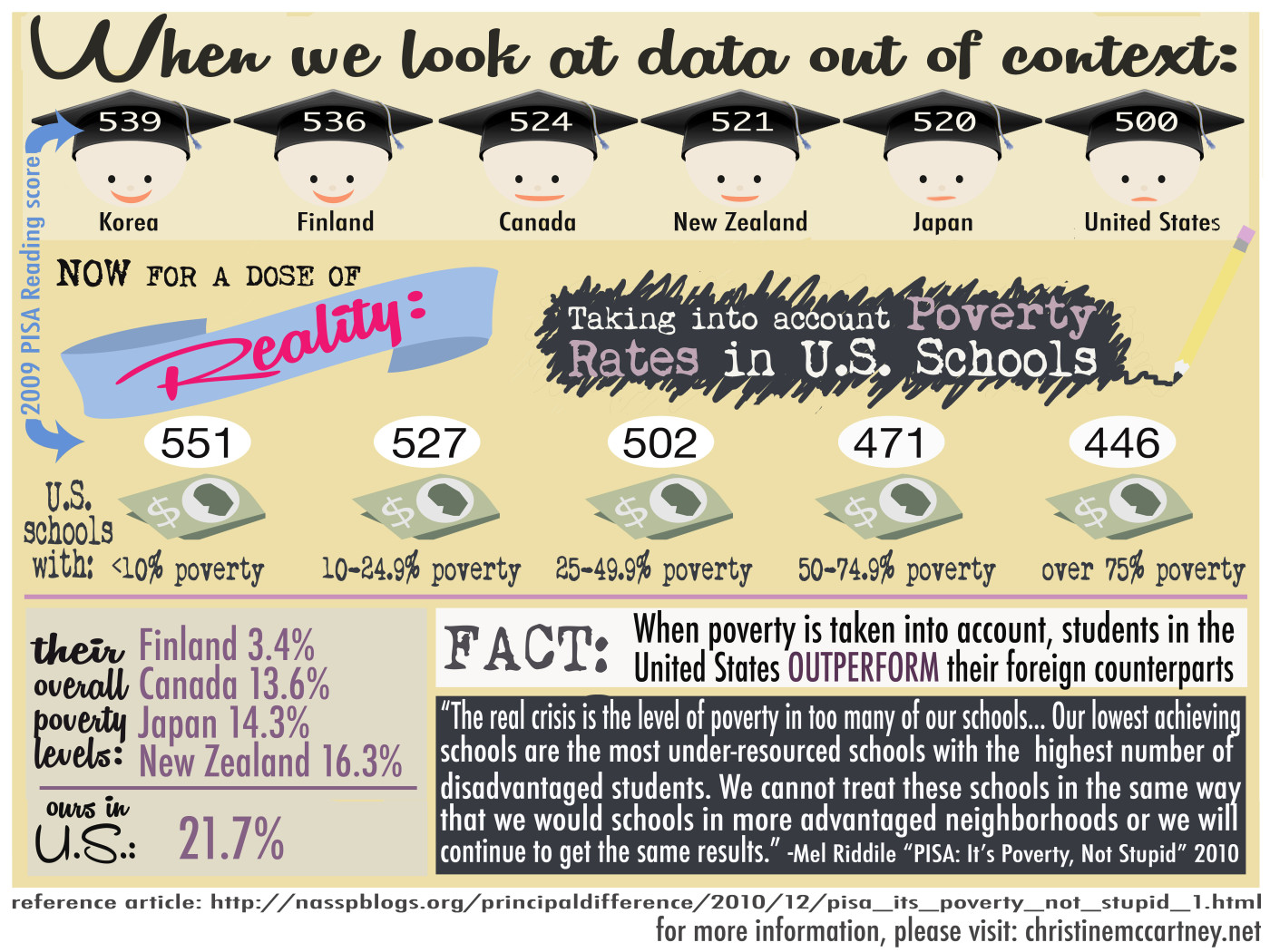
We see this when we look at our PISA scores broken down by the income characteristics of communities.  According to USC Professor Emeritus Stephen Krashen, the portrait of America’s schools look very different when poverty characteristics are considered.  In schools where less than 10% of the students qualify for free and reduced lunch, our PISA scores are higher than the average for any OECD nation, but where 75% or more of students are in poverty, the PISA scores are second to last.  Given that our communities are increasingly segregated by income, Mr. President, it is inevitable that test score data compared nation to nation will be misleading.

It is at this point that Arne Duncan, Michelle Rhee, Joel Klein, Eva Moskowitz, Andrew Cuomo, Bill Gates, Whitney Tilson, and a host of other corporate “reformers” will line up to accuse me of making “excuses” for “bad schools”.  They will insist, absent any evidence, that “great teachers” can close the achievement gap even if we completely fail to address poverty in our communities.  But it is not “making excuses” to insist that if we want a child living in poverty to succeed in school that we cannot ignore whether or not she knows if she is going to eat tonight, or if she will have a place to sleep, or if her parents will continue to work or any of the host of other matters that afflict children in poverty in ways that negatively impact their formal education.  Mr. President, we have known the long term impacts of poverty on children for some time now just as we have known that it has been growing and deepening, and we spend far less than our peer nations on helping to alleviate the detrimental impacts of poverty.  Nothing in education policy in the past three decades has done anything to address that.

That is not “excuse making,” Mr. President, that is aiming the analysis at the actual problem, whether or not addressing the problem will make anyone a profit.

You have an advantage that few of your predecessors had, Mr. President, and it is your demonstrated interest in and ability to genuinely listen to others.  Joshua Dubois wrote about your meetings with the families at Sandy Hook Elementary School, and how for hours, you sat, embraced, asked questions and listened to them. What strikes me, sir, is how, despite an election year warming up, you never once mentioned this to the press and never once used this remarkable testament to your character for political gain.  I urge you, Mr. President, to visit teachers, parents and children in the same manner, without cameras or vetting, and just ask them what they want our schools to be.  You will not find their answers easily mapped onto your education policies.

It is not too late for you to have a transformational impact on America’s schools, Mr. President, but it will take a number of immediate actions to have a chance.  I ask you to consider the following, badly needed, steps:

  1. Scrap Race to the Top: Your signature education policy is detrimental to children, teachers, schools and communities.  Ending it will not do away with the Common Core State Standards, testing or charter schools, but it will free states and districts to look truly reflectively at these initiatives and to voluntarily engage in as little or as much of them as they deem necessary and beneficial.  It will require proponents of these policies to make their cases in full view of the public in all 50 states instead of hiding behind coercive requirements for federal funding.
  2. Restore Federal Privacy Protections: Technology entrepreneurs may have truly powerful learning tools in development, but to make them work, they need student records deemed private under federal law.  Instead of engaging teachers and parents about these tools, they got your administration to revise regulations and are now mining those records without any meaningful consent.  This is unacceptable, and it must stop.  Our children are not sent to public school to be monetized without our consent.  Parents will listen to open and honest efforts to describe how these tools can benefit their children, but they will oppose efforts to bypass them.
  3. Be Serious About Holding Charter Schools Accountable to Civil Rights Legislation: Your administration recently expressed interest in making certain that charter schools meet federal civil rights requirements.  This is a good first step.  It must be applied vigorously, especially given how poorly many high profile charter operators do in serving students with disabilities, educating English Language Learners and retaining students of color after admission.  Your administration has granted enormous favoritism to charter schools, and they must be made fully accountable.
  4. Demand a Marshall Plan for School Aid and Construction:  Nearly all states are spending less money per pupil today than in 2008. In New York State, the average school district still receives $3.1 million less in state aid than they would have without budgetary tricks like the Gap Elimination Adjustment.  All across the country, our public schools are being told to implement a complex new curriculum, meet unrealistic testing requirements and to do so while having their budgets cut to the bone.  Further, in 2008, the AFT commissioned a study that estimated a need for over $250 billion in school infrastructure spending nationwide, a need that remains unmet.  It adds insult to injury that students come from homes that suffer from the deprivations of poverty and arrive in schools that are cold in the winter, hot in the summer and wet when it rains.  Our nation must do something about this.  At the same time, you must highlight schools where children in poverty thrive, not merely where they get good test scores.
  5. Replace Secretary Duncan: Mr. Duncan is entwined so deeply in the Race to the Top approach to reform that he is incapable of moving away from it.  Your Secretary of Education demonstrates no understanding of why people oppose current reforms, little willingness to see his mistakes as more than verbal slip ups, and he consistently misuses international test data to denigrate the quality of our schools and teachers.  If you want to protect our schools from the forces of corporate reform, Secretary Duncan cannot lead.

You have an opportunity, Mr. President, to retask the federal Department of Education with protecting our national Commons, our history of 200 years of seeing public education as a public good for communities and a private good for individuals.  Your administration has abetted the use of our public schools by private and corporate interests in ways that are actually detrimental to education.  If you wish that to not be your legacy, you must act now.

Sincerely,

Daniel S. Katz, Ph.D.

Director, Secondary and Secondary/Special Education Teacher Preparation, Seton Hall University

Career Educator

Father of Two Public School Children


Leave a comment

Filed under Activism, charter schools, Common Core, DFER, Gates Foundation, politics, Privacy, schools, Social Justice, Stories, teaching, Testing, VAMs

Can We Talk About Poverty And Violence NOW?

I became aware of this via a graduate school colleague.  Research from the CDC and Harvard University identifies that as much as 30% of young people in our urban areas suffer from Post Traumatic Stress Disorder as the result of living in communities afflicted by violence, a rate higher than soldiers returning from Iraq and Afghanistan.  This citation recently went viral because of report on a San Francisco CBS affiliate that mentioned the research — while deciding to coin the phrase “hood disease” to describe the phenomenon.  Response to that polarizing and sensationalist turn of phrase was swift, and it was well earned.  Hopefully, it will not obscure a chance to focus on a conversation that is desperately missing from today’s education conversation — the impact of poverty and violence on children and what it means to provide meaningful education for those children.

I am not optimistic, unfortunately.  Discussing the impacts of poverty and community violence on children would mean taking a good hard look at American society as a whole, how segregated we remain as a society (and how it is getting worse since 1980), how poorly we do as a country at helping families in poverty and how we largely ignore problems that are clustered in communities that are predominantly of color. I find it hard to believe that we are ready for a conversation today.  It would require more willingness for painful introspection and confrontation of racism that many prefer to believe does not exist.

Optimism is further undercut by the fact that the impacts of poverty on all sorts of outcomes for young people is not precisely news, although the PTSD estimates for community violence should cause more people to take notice.  “Effects of Poverty on Children” was published in 1997 and found vast differences in physical, cognitive, school achievement, and emotional and behavioral outcomes for children living in poverty, and it described the ways in which poverty influences these outcomes.  They recommended community health, parental education, in home interventions, and renewed efforts to eliminate deep, sustained poverty.  Not one of these recommendations found their way into the Bush era No Child Left Behind education reform bill nor into its Obama administration successor, Race to the Top.  Arizona State University Regents’ Professor Emeritus David Berliner delivered the Presidential Invited Speech at the 2005 meeting of the American Educational Research Association, and he titled in “Our Impoverished View of Education Reform.”  Among his conclusions:

All I am saying in this essay is that I am tired of acting like the schools, all alone, can do what is needed to help more people achieve higher levels of academic performance in our society. As Jean Anyon (1997, p. 168) put it “Attempting to fix inner city schools without fixing the city in which they are embedded is like trying to clean the air on one side of a screen door.”

To clean the air on both sides of the screen door we need to begin thinking about building a two-way system of accountability for contemporary America. The obligation that we educators have accepted to be accountable to our communities must become reciprocal. Our communities must also be accountable to those of us who work in the schools, and they can do this by creating social conditions for our nation that allow us to do our jobs well. Accountability is a two way process, it requires a principal and an agent. For too long schools have thought of themselves only as agents who must meet the demands of the principal, often the local community, state, or federal government. It is time for principals (and other school leaders) to become principals. That is, school people need to see communities as agents as well as principals and hold communities to standards that insure all our children are accorded the opportunities necessary for growing well.

It does take a whole village to raise a child, and we actually know a little bit about how to do that. What we seem not to know how to do in modern America is to raise the village, to promote communal values that insure that all our children will prosper. We need to face the fact that our whole society needs to be held as accountable for providing healthy children ready to learn, as our schools are for delivering quality instruction. One-way accountability, where we are always blaming the schools for the faults that we find, is neither just, nor likely to solve the problems we want to address.

But since that address in 2005, “one-way accountability” has not only dominated policy, it has actually spawned an entire industrial scaled investment in testing and data, entrenching it even deeper.  Even though it has very little to do with the issues that plague impoverished communities in our country and the schools that try to serve them.

Most of what you’ve read about our “failing” national schools is based on flawed data.  Even using the preferred tool of accountability advocates, standardized tests, the crisis in our public schools is one of community poverty.  This graphic comes courtesy of Christine McCarthy, a New York City public school teacher and recipient of a Distinguished Fullbright Award in Teaching:

Image

Stephen Krashen, professor emeritus at USC provides the data for this chart which should make it crystal clear that the constant doubling down on standards and testing will have no serious impact on the international testing gaps that produce such gnashing on the teeth in the media and in Washington.  A test does not alleviate the well documented impacts of poverty.  Firing a teacher whose students are performing poorly on a test does not alleviate the well documented impacts of poverty.

It is at this junction, that a Michelle Rhee or Joel Klein comes along, sometimes on a talk show, to say that there should be “no excuses” for even a school with a 75% or higher poverty rate.  Their preferred “no excuses” methods involve firing as many people as they can, closing down schools and turning more and more children over to charter school operators.  Certainly, many of those operators like to claim that they’ve found the “secret sauce” to educating within communities afflicted by high rates of poverty.  Eva Moskowitz’s “Success Academy” empire claims that it is educating the exact same students as the neighborhood schools in Harlem, but that claim is simply false, and a parent at Upper West Side Success documented on tape how administrators have tried to counsel out her son who has an IEP, something no neighborhood school could do.  Northstar Academy in Newark loves to claim at 100% graduation rate for seniors, but it fails to report its 50% attrition rate prior to senior year.

The lesson here is that there is no “special sauce” and “Superman” is a comic book hero.  We, as a society, have never figured out a way to provide large scale, genuine, educational opportunity to children growing up in communities with deep and persistent poverty.  We, as a society, are woefully uncommitted to alleviating poverty and have even come to accept the terrifying 20% rate of childhood poverty as normal and perhaps inevitable.  But absent those two commitments, no amount of firing teachers or testing students until they cry is going to “fix” American education.

And this is where I worry for the future again:  I think it is very likely that a combination of suburban parental outrage and teacher activism is going to push back hard on current reforms.  If Common Core survives, it will be substantially modified with fewer tests and less emphasis on value added models of teacher evaluation.  The fact is that pushing the punishment narrative that has been the burden of urban schools for so long to communities that generally like their schools is going to create a backlash.  But once those parents have pushed back and changed these systems, we will still be left with communities rife with damaging poverty and violence, and we will most likely go back to ignoring those facts.

And the next cycle of “reform” will ignore it too.

Leave a comment

Filed under charter schools, politics, schools, Social Justice, teaching, Testing, VAMs

Newark Student Union — Standing Up for Their Schools

I’ve mentioned several times how much I believe young people today need to become active and to become advocates.  It is with a great deal of admiration that I noted this story this week.  Their message was clear: radical changes forced upon their city from powerful private and public forces must be slowed down or stopped.  Public schools, whatever their faults, are a matter of public interest and plans for change that shut out students, parents and teachers are not acceptable.

Their efforts have certainly caught someone’s attention.  New Jersey’s acting Commissioner of Education, David Hespe, will reportedly meet with them.  Such a meeting, if it indeed happens, does not guarantee that Mr. Hespe will arrive with open ears and a willingness to include all of Newark’s stakeholders, but just announcing the desire to meet is a major change for a city that has been subjected to rapid paced, outside imposed changes that are aimed to provide massively preferential treatment to charter school operators. Little signs of listening at any level has been evident so far.

I absolutely applaud students in Newark for taking action.  Hopefully, they are being heard by people who understand how to listen.


Leave a comment

Filed under Activism, charter schools, Newark

Ras Baraka Wins in Newark Despite Millions in Wall Street Money Going Against Him

Ras Baraka, high school principal and son of poet Amiri Barak, won the Newark mayor’s race yesterday, on a campaign that heavily emphasized the influence of outside reformers who have rushed to impose massive change on Newark’s school system.  According to Bob Braun, 50 year veteran of the Star Ledger, Wall Street interests rushed in the waning days of the campaign with 3 million dollars to try to get Shavar Jeffries over the top. It will remain to be seen if the new mayor has the ability to do anything to slow down or stop Trenton appointed school chief Cami Anderson and her controversial “One Newark” plan, but Mr. Baraka’s victory is instructive.

School reformers will undoubtedly decry this as a set back for “the children” as they often do when people question the endless emphasis on standards, high stakes testing, firing teachers, closing schools and turning them over to charter operators, but we have known for many years now the detrimental effects of poverty in childhood and not one of the corporate reformers’ ideas has any answer for that.  Pointing out that placing unrealistic demands on schools, essentially setting them up to fail, and then turning them over to charter operators who have become an investment vehicle for Wall Street is unfair and anti-democratic is not making excuses — it is demanding that “reformers” be upfront about how they have been monetizing public education.

The Newark race is also instructive because it represents a voter backlash against the general pace of change being placed upon public education from outside the democratic process.  Newark was placed under an astonishingly rapid pace for wholesale reform by former Mayor Cory Booker and Governor Chris Christie who had gained massive funding pledges from financial interests.  Booker himself is quoted in the New Yorker article as urgently pushing “reform” ahead regardless of what anyone in the path of it might think.  Now I doubt that anyone who is being honest would question that Newark needs change — administrative overhead is astonishingly high just as an example.  (I would like to thank Leonie Haimson of Class Size Matters who sent me a fact check from Bruce Baker of Rutgers University.  I sourced the observation of administration costs in Newark from The New Yorker article, but Professor Baker points out that Newark’s administration ranks 24th out of 103 K-12 districts in New Jersey school systems with over 3500 students.  Data from the state DOE can be found here.)

But Booker and Christie’s race to push reform from the top down absent any real effort to build a grassroots coalition for change is illustrative of the entire approach to “reform” that we have seen since No Child Left Behind raised the stakes on public education in the Bush administration.  Everything — from Common Core, to assessments, to value-added teacher evaluation, to tenure reform, to charter school expansion, to creating vast data clouds for vendors to mine — has come at a break neck clip without meaningful involvement of parents and teachers.

Public education is a part of our national “Commons” — our collective cultural and economic resources.  What has been going on in the past 15 years has been a cynical exploitation reminiscent of Garrett Hardin’s essay “The Tragedy of the Commons” where individuals pursuing rational self interest deplete or even destroy that resource.  It is certain that many involved in the Newark story sincerely believed they were working to improve Newark’s schools, but it is equally certain that many others were urging that process forward without democratic input because they saw many millions to be made regardless of whether or not the schools became great.

Yesterday, the voters of Newark said “enough” to that.  It is up to the new mayor to bring change for all of Newark’s children and to do so with the input of parents and teachers.

Leave a comment

Filed under Activism, charter schools, Newark, politics

Of Greenbacks and Green Cards — Why Wall Street Likes Charter Schools

Yesterday, I contemplated why hedge fund manager and principle founder of Democrats for Education Reform, Whitney Tilson, would be quoted in the New York Times saying that “hedge funds are always looking for ways to turn a small amount of capital into a large amount of capital” as an explanation for financial support of charter schools by Wall Street.  Offering the benefit of the doubt, I considered that Tilson may have simply meant that relatively small cash investments could result in returns of human capital in the form of better educated students.

I no longer consider that.

It turns out that United States tax and immigration laws have created a healthy flow of money from the very wealthy into the charter school movement, possibly in ways not exactly imagined by the authors of those laws but which nevertheless have made charters a favored project of quite a few .1% movers and shakers in world capital.  The New York Times printed an article back in 2010 that reported the interest of the financial sector in promoting charter schools, but it did not examine the connection of that interest to actual returns on investment. While I cannot dispute claims that hedge fund managers like charters because many of them focus on test scores, are not unionized and they are seen as a way of polishing local philanthropic credentials, there is another reason that money flows into charters: it gives a return on investment.

In this piece on Forbes, financial analyst and author Addison Wiggins, explains the mechanism in the tax code that allows Wall Street to show a return on investment in charter schools:

In part, it’s the tax code that makes charter schools so lucrative: Under the federal “New Markets Tax Credit” program that became law toward the end of the Clinton presidency, firms that invest in charters and other projects located in “underserved” areas can collect a generous tax credit — up to 39% — to offset their costs.


So attractive is the math, according to a 2010 article by Juan Gonzalez in the New York Daily News, “that a lender who uses it can almost double his money in seven years.”

That isn’t sexy Gordon Gecko kind of money, but it is also guaranteed.  Put down money to fund the creation or expansion of a charter school, and a firm can double its money in a predictable time table and get to brag to the press about it is bringing new education options to urban areas.  The Gonzalez article in the New York Daily News also reported that JPMoragan Chase was setting up a more than 325 million dollar fund to invest in charter schools taking advantage of the tax credits.  This strategy is attractive enough that there are firms specifically devoted to connecting charter schools and financial backers.

To be fair, it is entirely possible that this is a more cost effective way of increasing the number of classrooms in some urban areas than traditional school construction projects funded by bonds; I do not currently possess the data to make such an analysis.  However, two very important considerations must also be made.  First, using the federal tax code in this way means that the cost to the public comes from potentially lost federal revenue instead of being paid in a predictable way at the local and state levels.  Second, when a city funds school construction traditionally, it is usually doing so to create schools that are obligated to educate and accommodate every student within its zone.  Many charter schools love to brag about their “awesome” results and make incredibly impressive claims about their test scores and graduation rates.  As Bruce Baker of Rutgers demonstrates here, such claims rarely can stand even moderate scrutiny.  North Star Academy in Newark, NJ, for example, claims that 100% of its seniors graduate, which is true — if you ignore that 50% of the students who enroll in 5th grade never make it to senior year.

So what we have are major charter school chains with deceptive or outright fraudulent marketing backed by the titans of finance who are making hefty returns on investment and are donating significant sums to politicians to keep the returns flowing.

In addition to onshore capital returns, investments in charter schools can be beneficial to foreign investors via the EB-5 visa program.  Under this program, foreign investors who spend at least $500,000 in the United States on a development project can earn a visa for himself and his family. According the Reuters article, this path is so attractive to foreign investors that Florida alone expected 90 million dollars for charter schools from foreign investors in 2013.  Much like the tax credits for domestic hedge funds, there is an industry developing to connect wealthy donors looking for EB-5 eligible projects to charter schools seeking capital.

To my knowledge none of these actors are channeling investments into neighborhood schools in need of infrastructure funds, estimated at over 250 billion dollars in 2008.  But the good news is that some hedge funds are getting a guaranteed return on investments and some foreign born multi-millionaires are getting green cards.

Al Shanker, the former head of the American Federation of Teachers, helped envision the idea of charter schools.  In a blog post from 2012, NYU’s Diane Ravitch wrote an open reminder to then New Jersey Commissioner of Education, Chris Cerf, about what Mr. Shanker thought charter schools should do. Charter schools, in Shanker’s vision, were meant to serve students who were most needy and had potentially failed already within other schools — instead, many of today’s charters deliberately avoid or push out those students.  Shanker also saw charters collaborating with other public schools.  As small laboratories of innovation, their goal should have been to translate what they had learned about working with students to the rest of the public school system.  Today, many charters aggressively compete with public schools and far from being a true part of the public education system, large numbers in some states are managed by for profit Educational Management Organizations who are responsible for their bottom lines.  According to Ravitch, Shanker turned against charters when he saw a pattern of corporate and for profit interests taking over the movement.

I have no doubt that with 1000s of charters operating across the country, that many of them embody the original vision to provide innovation and collaboration and truly dedicate themselves to serving the most needy of our students.  However, today, they are being greatly overshadowed by deceptively marketed brands of charter chains that rake in Wall Street and foreign investment, aggressively lobby state and federal officials for preferential treatment and build their reputations for success on the backs of students they refuse to serve and work to evict from their schools.  Eva Moskowitz of the Success Academy chain can summon 7.75 million dollars in donations in one evening while most states’ education spending remains below pre-recession levels.

But, again, the good news is that some hedge funds are getting a guaranteed return on investments and some foreign born multi-millionaires are getting green cards

2 Comments

Filed under charter schools, DFER, Funding, politics

Who are “Democrats for Education Reform”?

Jan Resseger is the former chair of the National Council of Churches Committee on Public Education, and she has a blog post linking to a very insightful infographic on the organization “Democrats for Education Reform,” the group behind the “Camp Philos” education reform meeting in Lake Placid this week.

The graphic can be found here, and it comes courtesy of Billy Easton of the Alliance for Quality Education.  The short version is that, far from being a genuine organization of members of the Democratic party with ideas about education reform, it is a lobbying group designed to influence the policy choices of Democratic party politicians and which has taken huge sums of money from the same interests that have lobbied for aggressive charter expansion, curtailing teacher unions and assessing teachers  based on test scores.  While Democrats such as California’s Gloria Romero and New York’s Joel Klein have been prominent in the organization, it is extremely clear that on education, they are firmly allied with the pro-testing and pro-privatization forces that have been trying to drive education “reform” further and further away from schools as a locally democratic institution.  DFER is largely the creation of Whitney Tilson, founder of hedge fund T2 Partners, who was quoted in this New York Times article about the tenure of Joel Klein:

Charter schools, explained Whitney Tilson, the founder of T2 Partners and one of their most ardent supporters, are the perfect philanthropy for results-oriented business executives. For one thing, they can change lives permanently, not just help people get by from day to day. For another, he said, “hedge funds are always looking for ways to turn a small amount of capital into a large amount of capital.”

I’ve looked at that quote from several different angles: And assuming that it only unfortunately suggests an effort to turn schools into a profit stream, it staggering misconstrues why education costs what it costs.  If Tilson meant that a hedge fund can take a small investment in a charter school and turn it into a “large amount of capital” in the form of educated adults, the idea still misses why non-charter schools often need to spend more money to be in compliance with offering an appropriate education to ALL students in their zoned schools.  Charter schools’ cost “savings” frequently come from refusing or simply weeding out students who need more intensive and expensive interventions to succeed at school.  That’s a bit like praising the economy of a car manufacturer who gets permission to build cars without seatbelts.

It is also emblematic of the age we live in: groups across the spectrum adopt “brands” that can pass a very cursory glance, but which fall apart after more scrutiny.  The lesson?  Always use more scrutiny – whether it is a chain of hedge fund backed charter schools claiming miraculous results or a supposedly grass roots sounding organization that fronts for those same interests.

2 Comments

Filed under Activism, charter schools, DFER, Funding

Education “Reformers” Go to Camp!

If you considered yourself well-informed but have not heard of “Camp Philos,” the education reform retreat in the Lake Placid which is opening today, don’t worry.  Its organizers really are not interested in you, but they have wrapped themselves in some very intellectual and romantic imagery.  Billing itself as a “philosopher’s retreat” modeled after the 19th century meetings of Ralph Waldo Emerson, Russell Lowell, with Horatio Woodman, the website claims that the nation’s “thought leaders in education reform” will convene for “fun, fellowship and strategy.”  Governor Andrew Cuomo is the honorary chair of the event where he will be joined by Joe Williams of “Education Reform Now,” a “reform” group mostly dedicated to the spread of charter schools and test based teacher evaluations and with a board populated by hedge fund managers.

ERN has also donated $65,000 to Cuomo’s campaign fund and individual members of its board have donated on their own.  Quelle surprise.

For an entry price of $1000 to $2500 dollars, participants have the advertised opportunity to speak with Louisiana Senator Mary Ladrieu, Sacramento Mayor Kevin Johnson and Assistant Education Secretary for Civil Rights Russlynn Ali.  Other reports mentioned that film director turned education “thought leader” M. Night Shyamalan would be present as well. A registered guest list is not available as far as I can determine.

However, the schedule of events is available.  A session such as “Living to Tell the Tale: Changing Third-Rail Teacher Policies,” given the known participants, is likely to focus on taking away tenure protections and subjecting teachers to test based evaluations.  Governor Cuomo can certainly address his take on “Adequacy, Fairness and Equity: School Finance in the Age of Austerity” given how his administration has systematically strangled school aid.

While my geeky side is offended by tomorrow morning’s session entitled “Rocketships, Klingons and Tribbles: Charters’ Course to Where No Schools Have Gone Before” (somehow I think Gene Roddenberry would disapprove of being associated with this), I wish I had the money or the connections to be present at “The Next Big Thing: Groundbreaking Approaches to Teacher Preparation”.  This is a subject directly connected to my own work and current livelihood.  So surely, if the “thought leaders” of the country are present to discuss teacher preparation, that must mean the list of invited panelists and discussants will include some lofty names, right?  They must have sought out Sharon Feiman-Nemser.  It would make little sense to host this session of “thought leaders” without the input of Linda Darling-Hammond, obviously.  It would be an appalling oversight for such an event to overlook inviting John I. Goodlad.  The nation’s “thought leaders” in education reform in a self-style philosopher’s retreat talking about teacher preparation without the input of our leading experts on what it takes to learn to teach?  That could never happen.

Even if I had the money to attend, there is a good question if I would even be allowed in.  Diane Ravitch of NYU reported on her blog that three public school teachers and parents from New York tried to sign up for the event and initially were told that there were some openings available.  That changed almost immediately.  One of them, Bianca Tanis of NYS Allies for Public Education, spoke to a retired teacher who reported that she had successfully registered for the event — only to have her registration refunded without explanation.  I am having great doubts that Ralph Waldo Emerson would appreciate having his status utilized for a gathering that has shaped up to be as unpromising as this one.

NYSUT will be present today — on the outside, of course, but at least there will be actual teachers with them.


Leave a comment

Filed under Activism, charter schools, politics, schools

Education Week Blog Piece on Charter School Funding Research

This caught my eye yesterday….for several reasons.

The first is that we can expect the charter school movement to latch on to these findings and demand that more states impose upon cities and communities the sorts of “protections” that were recently added to the New York state budget, which amount to extraordinary favors to well connected and already well funded chains of charter schools.  I have no doubt that there are probably many small, individual charter schools that do excellent work and struggle for sufficient funding, but I also have no doubt that the biggest noise about so-called threats to charters are coming from chains like Success and KIPP that are lavishly funded and connected to hedge fund billionaire patrons.

The second reason is that the blogger actually raised important additional considerations about why charter funding may be lagging on a per pupil basis that is frequently overlooked by lofty news organizations that report on charter school claims.

The issue of charter funding and the disparities that exist may depend on the methods used to do the calculations, though.


“For me, this is not research that’s helping draw good policies,” said Gary Miron, a professor at Western Michigan University who researchers and evaluates school reforms and education policies.


Drawing on his own previous analyses, Miron contends that charter schools already have a cost advantage that may not be captured and explained by the data.


“Special education and student support services explains most of the difference in funding,” said Miron. “Charters can get a lot more funding, but it would require that they enroll more students with severe and moderate disabilities. They aren’t enrolling these students.”


Other categorical funding, such as that distributed for vocational education, would also bring more funding to charters, should they choose to provide it.


In fact, in his studies, Miron found that charters have a cost advantage, because charters do not have to provide the same services or have the same expenditures as traditional public schools.Transportation costs, for example, are an area in which charters have a funding advantage. Districts are required to provide student transportation while charters are not.

If charter schools do not enroll similar numbers of students on IEPs and English Language Learners, it is entirely reasonable for their funding to be less than entirely public schools that are required to fully serve those populations of students.  Without accounting for that, the report draws a very questionable conclusion using figures that have dogged public discussion of education for years but which are, bluntly, one of my biggest pet peeves.

Which is reason number three: per pupil allocations as a marker of funding and a tool for policy.  It is an easy number to come up with: take the total school budget, divide it by the number of students in the district and voila! You have a per pupil spending figure.

And you have absolutely no idea what that number could possibly mean.

Per pupil costs make for a simple talking point, but a very little thinking effort demonstrates that two children do not necessarily cost the same to educate.  A classroom full of AP students may cost more than a classroom of college preparatory students because the teacher may be a well compensated veteran with a smaller number of students.  A student with an IEP or in ESL classes will cost more than the per pupil average if the district is properly committed to providing them with all legal accommodations, including additional personnel.  A district that is top heavy with administrators will have a higher per pupil cost without necessarily having more resources for the classroom. A district that cannot budget capital improvements will have a higher per pupil cost to cover the price of additional heating fuel in the winter due to leaky windows — and kids will have a harder time concentrating if they remain cold from November to April.

Any policy or discussion of policy that ignores or glosses over these facts is both deceptive and possibly destructive.  Consider vouchers as an example.  Taking a child’s “per pupil” money and handing it over to a new school does not make the old school magically one child less expensive to run.  Until enough children leave that the school starts dismissing staff and faculty or perhaps shuttering a disused wing, the lost student just ups the per pupil average for those who remaining — while skimming money out of the budget.  Meanwhile, the school getting voucher money did not magically become exactly one more student more expensive to run.

Here’s a mantra to repeat to politicians and education reporters: An individual child’s public education is not a product.  It costs what it costs to most effectively assist that child to learn as much as he or she can…and to preserve that child’s joy for learning and curiosity about the world.

Practices that shunt aside students who are harder to accommodate or that cover content while crushing the spirit, may be good for the budget, but we don’t aspire to them for children. So when we are discussing whether or not a particular sector of education is being “underfunded” it is important to consider far more than the sum of money they receive.


Leave a comment

Filed under charter schools, Funding, Media, politics, schools