Category Archives: Funding

The Moral Perversity of Today’s Education “Reform”

The narrative of school failure that fuels today’s reform policies in education stretches back to the 1983 Reagan administration report, “A Nation at Risk.”  That document asserted that our national education system was so woefully inadequate to the task of educating for the future, that if it had been imposed upon us it “might be considered an act of war.”  The dire warnings have hardly abated, and in 2014, we are frequently told that our children and economy are in danger unless we fully embrace the vision of today’s reformers.  Moreover, today’s menu of reform, common standards, mass high stakes testing, value added evaluation of teachers, elimination of or severe curtailing of teachers’ workplace protections, promotion of charter schools and school choice, are frequently promoted by politicians and policy makers as civil rights issues.  Dr. Julian Vasquez Heilig notes:

Student achievement data in the U.S. show long-standing and persistent gaps in minority versus majority performance (Vasquez Heilig & Darling-Hammond, 2008). Public concern about pervasive inequalities in traditional public schools, combined with growing political, parental, and corporate support, has created the expectation that school choice is the solution for poor and minority youth (Vasquez Heilig, Williams, McNeil, & Lee, 2011). As a result, many reformers have framed school choice as a “civil rights” issue. Scott (2013a) argued that philanthropists, policy advocates, and leading pundits have followed Secretary Arne Duncan’s conjuring of Rosa Parks and the broader Civil Rights Movement as synonymous with market-based school choice.

It is notable that the school choice movement counts on prominent African American and Latina/o leaders to support vouchers, charters, parent trigger, and other forms of choice….In our recent Twitter exchange, (former California State Senator Gloria) Romero framed her bill as a civil rights remedy for low-performing schools. Clearly, African American and Latina/o leaders have formed advocacy coalitions to press for school choice as an alternative to the status quo as our nation has consistently and purposefully underserved students of color (Scott, 2011).

In the 21st century, we are exhorted to education reformers’ policy agenda by language invoking the struggles undertaken by some of our most heroic figures, Dr. Martin Luther King, Jr., Rosa Parks, Representative John Lewis, and told that the best way to close the historic education achievement gap between suburban white children and their urban African American and Latino peers is to embrace highly disruptive change.  We are further told that all of our children are still “at risk” because even in the well-off communities of our upper middle class, students are not learning what they need in a global economy.  Without education reform, our impoverished students will remain locked in poverty, and our comfortable students will slide into stagnation.

For the sake of this discussion, let me do something I never do.  Let me assume, momentarily, that the education reformers are correct.  Assume that common standards and aligned mass assessments will create a seamless system of curricula that challenge students meaningfully, and that those standards encompass a strong vision of student accomplishment.  Assume that adoption of the standards and assessments narrow the differences between states and districts so that expectations remain high for all students.  Assume the assessments are well-crafted and valid measures that stand as good proxies for student learning.  Assume value added measures of teacher evaluation are statistically valid and supported by a robust body of research.  Assume that eliminating the job protections of tenure would mean that vast numbers of students would have greater contact with skilled teachers and that there would be no negative consequences to the rest of the teacher workforce.  Assume that the proliferation of charter schools in urban school districts would give vastly more students options to attend a high performing school and that pressures from school choice schemes would increase the quality of zoned schools.  Assume that urban charter schools fully serve all students who arrive at their doors.  Assume that the advocates of “no excuses” charter schools are correct and that they genuinely demonstrate that closing the achievement gap can be accomplished entirely within school through teachers armed with extremely high expectations.

Assume every last bit of that is true.

Then what?

This is a more critical question than many realize because even if the performance gaps in American education closed overnight, we would still need an economy that can accommodate many more and more equitably distributed high performing graduates than we currently have.  Advocates of current reforms certainly seem to be banking on this.  Jonathan Chait of New York Magazine recently wrote that Eva Moskowitz of the Success Academy charter school network should be considered a “hero of American social justice,” and he declared that her schools have “been a staggering triumph of upward mobility.”  That’s quite a claim to make for a chain of schools whose oldest students have just begun high school, and, in fact, it rests almost entirely about the network’s accomplishments in state administered standard examinations.

However, the attractiveness of the claim is fairly obvious.  If we admit that economic injustice and that institutional racism have a detrimental impact upon students in poverty and students of color, then we have to admit that many of the gains made over the decades by students from upper middle class and upper class backgrounds are at least partially attributable to unearned privileges as well as to individual merit.  Further, we would have to engage in a policy discussion that attempts to alleviate the deprivations of poverty and institutional racism rather than to extol individuals to claw their way past such obstacles largely on their own.  The “no excuses” brand of charter schools claims that they have figured out how to lift all of their students to the same level of education and opportunity as students in the suburbs, and their policy allies are hardly shy about singing their virtues, as represented in standardized test scores:

Former New York City School Chancellor Joel Klein does not want to talk about the complicating factors surrounding Success Academy results, nor does he spend time considering how far such results could be replicated. Success Academy fits into a narrative that believes schools and teachers are fully responsible for providing all of the lift out of poverty.

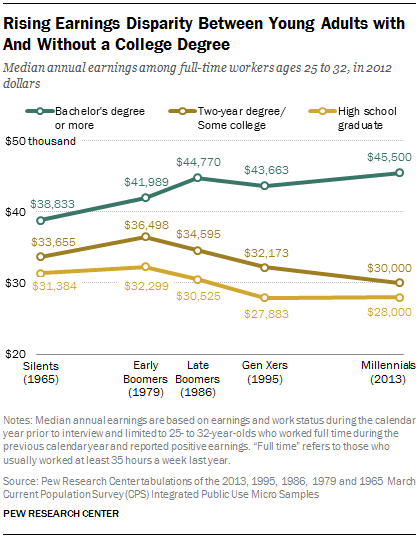
But, as I said, assume that it is possible and that Jonathan Chait’s premature declaration of social mobility comes true.  What awaits these students?  If current trends in economics do not begin to change soon, the answer to that question is not especially hopeful.  While there is still an discernible “college wage premium” for those who earn four year degrees, since the 1980s, a significant portion of that is more attributable to cratering wages among people without degrees than to significant wage growth among those with degrees:
Wage growth and decline by level of education

Wage growth and decline by level of education

While a Millennial with a college degree earns a wage that is $730 more than a late boomer with the same degree, the wage trends for those with either a two year degree and no degree have dropped precipitously since the early 80s compared with decades of modest but steady growth before.  A college degree may be necessary for a middle class career today, but more and more, it looks as if the degree is more a means to keep from falling into chronic income insecurity rather than as a genuine means of economic advancement.

If the middle class is increasingly a tenuous position in the American economy, it is even worse for the lower middle class, an economic stratum that has traditionally helped families transition from working class to more economically secure circumstances.  According the The Hamilton Project at the Brookings Institution, nearly half of American families live at 250 percent of the federal poverty level (FPL) or below, and 30 percent live between 100 percent and 250 percent of the FPL.  Unlike families below the poverty level, such lower middle class households are equally likely to be headed by a married couple or a single parent, and nearly half have a head of household who has attended at least some college.  The report on their economic struggles notes that, despite living above the poverty line, large percentages of these families rely upon a number of tax and transfer benefits such as SNAP and the Earned Income Tax Credit to remain above the FPL.  Indeed, without many of these programs, the number of families that would slip from an unsecured lower middle class to simple poverty is significant.  As a transition point from poverty to a more secure middle class, the lower middle class is faltering badly.

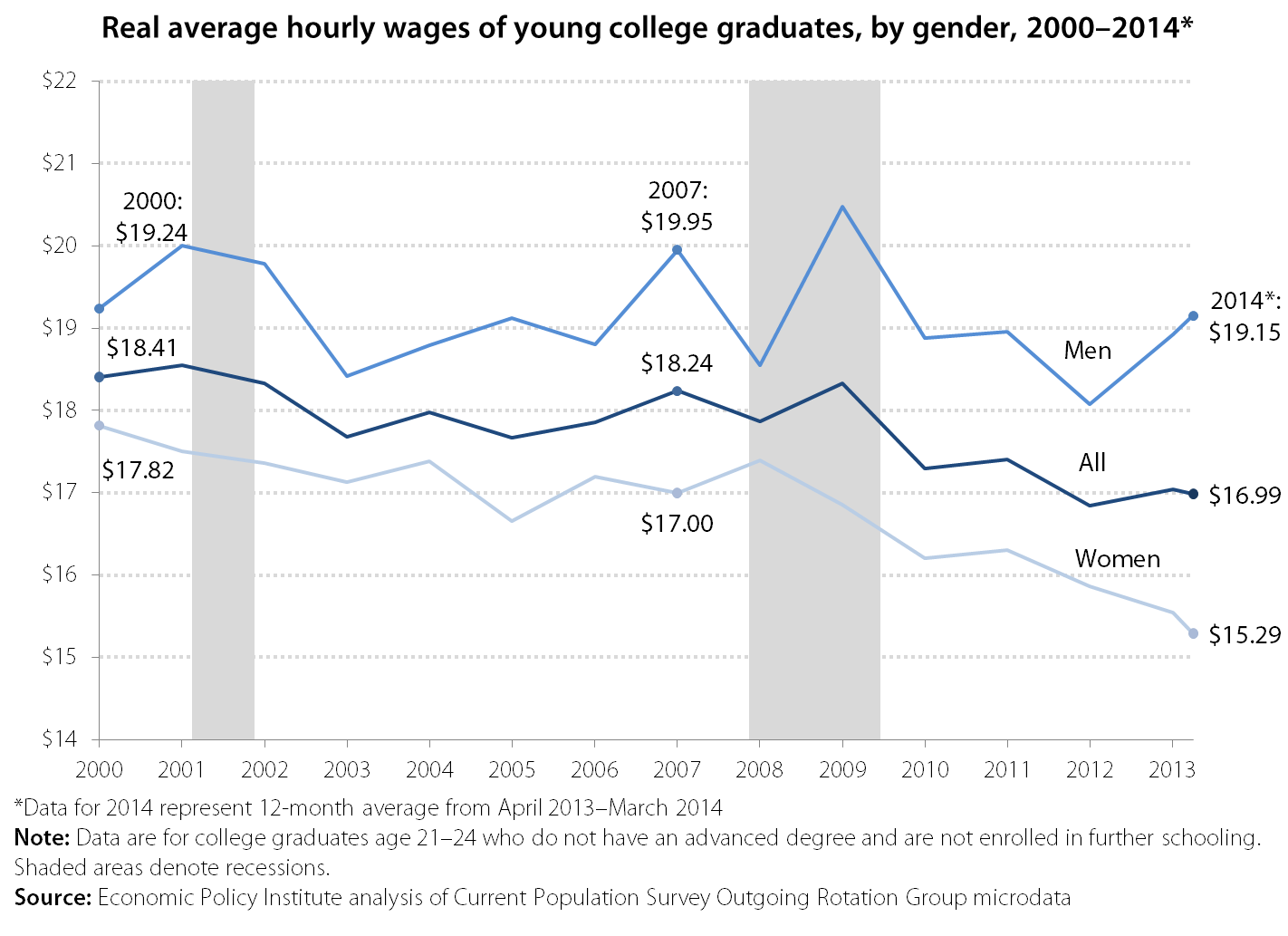
And where is the evidence that the economy is desperate for more workers with bachelors degrees?  It certainly is not in the wages earned by recent college graduates.  According to the Economic Policy Institute, wage growth adjusted for inflation has been nonexistent since 2000, and the downward trend has continued even as the economy has recovered from the Great Recession:
Wages for Recent College Graduates

Wages for Recent College Graduates

If college graduates were in short supply, basic labor economics dictates that businesses competing for them would have to offer higher wages, but even in the vaunted STEM fields, wages, while higher overall than in non-STEM fields, have not grown significantly for most of the 21st century.

Reality suggests that even if all education reform assumptions were true, graduates of a “properly reformed” school system would still graduate into an economy that is not equipped to lift them from poverty and that is barely equipped to maintain those in the middle class where they currently reside.  The recently published study by Karl Alexander of The Johns Hopkins University, The Long Shadow, illustrates just how complex and potentially unsuccessful the rise from poverty can be.  Out of 800 children studied from first grade to their late twenties, only 33 moved from the low income to the high income bracket.  While a good education is certainly a PART of a pathway out of poverty, it is by no means the ONLY way out, and with more and more workers in the economy struggling to keep pace, it is perverse to suggest that we bestow upon schools the sole responsibility for lifting children from poverty.

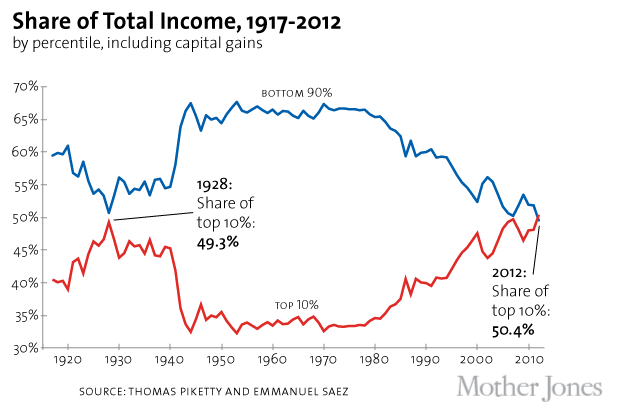
And yet that is exactly what is implicit and even explicit in reformers’ policy objectives and rhetoric.  When Jonathan Chait calls Success Academy a “triumph of upward mobility” he is expressly saying that equalizing standardized test scores through Moskowitz’s “no excuses” methodology will effectively raise the children in her schools to economic security.  But even if everything he says about her accomplishments is true, we cannot blithely assume that this academic accomplishment translates into mobility when the economy shows no indications of providing the kind of reward for work that would translate academic standing into economic standing.  Eva Moskowitz’s scholars still face a world where this trend shows no signs of abating:
Share of Total Income

And, of course, we know that we cannot grant the reformers that their agenda will work because much of it simply will not or is built upon faulty and deceptive claims.  Common standards are being implemented in 45 states simultaneously with virtually no field examination of whether or not they improved instruction at the classroom, school or district levels.  Evaluating teachers based on Value Added Models is problematic at best, statistically invalid at worse. There is scant to no evidence that the elimination of teacher tenure is going to significantly improve the teaching in urban schools, and, in fact, the states with the weakest teacher job protections tend to be states that perform very poorly on national assessments. Success Academy, despite claiming to teach similar high need populations as NYC district schools, has a very high attrition rate, and they do not replace students who leave.  This is a trait shared with many other “no excuses” charter schools who eventually have student populations with many fewer disabled students, English language learners and students on free and reduced lunch than their district counterparts.  They combine the selective attrition of the most difficult to teach students with an extreme emphasis on discipline for even minor infractions of the rules and, at Success Academy and elsewhere, a curriculum aimed at test preparation.  While there is little evidence yet that such test performance training will result in long term economic success, there is evidence that charter school expansion can make segregation actually worse.

And this is where reform advocacy devolves from being merely wrong-headed and into territory that is dangerously close to immoral.  America has one of the highest child poverty rates in the developed world.  It is well established that poverty and its deprivations have serious, often lifelong, impact on people in health, education and economic outcomes.  While improving educational opportunity for children in poverty is a necessary component of expanding opportunity, left to its own, education reform, ANY education reform, cannot make significant dents into the roadblocks that stand before our nation’s poor.  We do not have an economy where the lower middle class can survive on the wages offered for their work.  We do not have an economy where 90% of the wage earners possess more than 49 percent of the total income in the country, and we do not have an economy where the often expressed need for college educated workers has led to growth in income earned by college graduates.

Worse, we have accepted no society wide responsibility to address child poverty in any meaningful way that would lift more children into the economic circumstances more highly correlated with school success than any other factor.  In fact, as a society, we have responded to current economic circumstances with demands to cut discretionary programs in ways that can directly harm children, deepening the already woeful health, education and economic outcomes for children in poverty.  Matt Bruenig of Demos, estimates that with an investment of 1% of GDP in a straight transfer program, child poverty could be cut by 50 percent, almost instantly.  He further points out that our 24 percent of GDP taxation level is among the lowest in the developed world, and it is hard to argue that there is no room for an extra percentage point of GDP.

But there is no political will to discuss this or other direct approaches to lifting people out of poverty in our government.  More accurately, there is no willingness for the major political donors who effectively leverage significant portions of policy in America to do anything that changes either the economy or their taxation levels.  There is, however, significant interest in bypassing those discussions and placing all of the responsibility to both transforming our economy and for lifting disadvantaged children from poverty upon teachers and school.

It fits the meritocracy narrative, and it may tug at our cultural bias towards individualism in the face of daunting odds.

But it is immoral.

6 Comments

Filed under charter schools, Funding, politics, Social Justice

How to Spot a Fake Grassroots Education Reform Group

One problem with today’s education reform environment is that a number of groups exist that call themselves “grassroots” organizations, but which have expanded rapidly because of large infusions of cash from corporations and foundations invested in pushing charter schools, mass high stakes testing, data mining students and the Common Core standards.  These groups do not exist to represent the organically derived priorities and shared interests of students, teachers and parents; they exist to put a more credible face on the priorities and shared interests of a very narrow but astonishingly influential set of repeating characters.  Take Educators 4 Excellence as an example.  On their website, they tout that they began as “two teachers” and wanted to give teachers a voice in a system that imposed changes from the top down, and now they are growing into 10 of 1000s of teachers in multiple states. What don’t they mention?  That they are funded by The Gates Foundation, which is not really a surprise because a) Gates has been funding a lot of similar efforts and b) their “pledge” includes evaluating teachers by value-added testing models (something Gates really, really likes) and supporting “choice” which is reform jargon for charter schools (something hedge fund managers really, REALLY like).  The group was central in the not-entirely-successful #supportthecore  social media campaign, and former Connecticut legislator Jonathan Pelto writes here about more of their rather miraculous funding.

When I was in high school, soap actor Peter Bergman did television ads for Vicks cough syrup with the tag line “I’m not a doctor but I play one on TV.”  At least he was upfront about it.

A few days back, The Washington Post ran a story about the founding of “Education Post” which is claiming to be a new source of information about topics in education that will avoid the supposed rancor in current public conversations.  To her credit, reporter Lyndsey Layton did report that it is funded by the Broad Foundation, Bloomberg Philanthropies and the Walton Family Foundation and is headed by the former communications director for Arne Duncan, so we have some heads up as to how that “reporting” on “what works” will tilt.

Genuine grassroots organizations cannot just pop up out of nowhere, grow by 1000s of members practically overnight, afford slick web designs, afford Manhattan rent and big staffs.  But without knowing what to look for it can be difficult for the casual observer, or even a working teacher, to spot the signs of a group that is more AstroTurf than grassroots.  I would like to offer the following guide as assistance, and I have chosen, not entirely randomly, Students for Education Reform.  Sounds like a great thing, doesn’t it?  Students?  Education reform?  Who wouldn’t want to support that?

From the Students for Education Reform webpage:


What started as two students working for educational justice in their own communities eventually grew from one college campus to twenty, and from twenty to over 140 undergraduate chapters at two- and four-year colleges in over 30 states. Our founders launched Students for Education Reform as college freshmen, each bringing a different perspective to the fight for educational equity: Alexis Morin is a lifelong public school student and was a local school board member in her Massachusetts district, and Catharine Bellinger is an aspiring teacher from Washington, DC. Together, Alexis and Catharine created a platform for college students to share their stories on one campus; by working with peers across the country, they grew SFER nationally during their sophomore and junior years. SFER’s members now represent the diversity of the American K-12 education system: the vast majority of us attended local district schools, while many others attended schools of choice – charter schools, parochial schools, and private schools. Together, we know what’s true, and what’s possible.

Ms. Morin and Ms. Bellinger started SFER in 2009 while freshmen at Princeton, and it has grown to 136 chapters in 33 states.  According to this blurb in Forbes, both of them had to put off their studies for a year to assist with the astonishingly paced growth of the group.  Which brings me to my first clue for spotting fake grassroots groups:

Growth at a pace that only a corporation’s monetary resources could manage.  Perhaps SFER’s founders had sincere interests in growing a real movement that included a genuine array of student voices (although the prominent mention of KIPP charter schools and North Star charter in this interview makes me doubt they had any vision except current corporate backed reforms in mind), but their growth could not have happened this rapidly without a serious infusion of assistance from outside.  That assistance, of course, came in the form of cash and the expectation that such cash would influence the values of the activism.

And Students for Education Reform definitely have been given cash.  This is evident in their web design which is a slick and well-executed page oddly reminiscent of the “Educators 4 Excellence” site.  SFER also has a national office in New York City, specifically on West 38th Street in the Garment District and near the Empire State Building and Pennsylvania Station.  While not the priciest office district in Manhattan, rents for office space on this site range from $27 per square foot to over $100.  That’s per month.  I’ll go out on a limb and assume someone is putting up the money for that which brings me to the second clue:

Who is funding the group and for how much?  This is readily known for SFER, thankfully.  According to this article from The Nation, SFER has gotten a hefty infusion of at least some of $1.6 million from Education Reform Now, the non-PAC wing of Democrats for Education Reform, in 2010.  ERN’s 2010 990 IRS form is available for your pleasure here, and the relevant page is 21.  Keep in mind, SFER was barely a year old in 2010, and it was already being infused with cash from Education Reform Now.  Not bad work for a pair of sophomores even if they are in Princeton.

It will help readers to know more about Education Reform Now and the affiliated political action committee, Democrats for Education Reform.  ERN operates as a 501c3 organization, and DFER helps spread campaign cash.  While ERN claims to be non-partisan and DFER claims to be an organization of Democrats, both groups are essentially joined together around the familiar causes of charter school expansion, mass high stakes testing and evaluating teachers based upon controversial and statistically invalid value-added measures of effectiveness.  DFER was founded in part by hedge fund manager Whitney Tilson, and the main purpose of the PAC is to influence Democratic politicians to support charter schools and high stakes testing.  Education Reform Now receives annual donations from the Walton Family Foundation, getting $1.1 million in 2011 and more than $2.8 million in 2013.  DFER takes in a diverse range of donors, all from the privatization end of the reform spectrum.  According to this graphic assembled by the Alliance for Quality Education, DFER’s money and political alliances include the Koch brothers, conservative financier Rex Sinquefield, Rupert Murdoch, The Walton Family Foundation, and the American Federation for Children, which is a charter supporting organization. 

Suffice to say that when you see Students for Education Reform, you are seeing a group whose existence is at least partially owed to Education Reform Now channeling Walton money into their ledgers.  With ERN’s ties to DFER, you also know that the policies supported by SFER will align very well with the privatization advocates who want to break teacher unions and replace fully public schools with privately managed charters.  SFER has to, or the money will dry up.

With such funds come influential advisers, and for SFER, that is a board of directors that is a made up of some heavy hitting finance and reform personalities.  Which comes to the third clue:

Who is REALLY running the operation?  SFER is upfront about their boards of directors, which boasts some very familiar names and organizations.  Amy Chou is the chief growth officer of the KIPP charter school network.  KIPP, it should be noted, is one of the “miracle” charter chains that claims they have “proven” that high poverty populations can close achievement gaps by doing things their way.  What they don’t mention is how self-selection and high attrition without backfilling vacated seats influences their success rates.  In fact, Bruce Baker of Rutgers University provides a simple chart showing how various “miracle” and some non-miracle charter networks compare in populations relative to fully public schools in NYC:

I don’t mind various ways of doing business, but I really mind being told miracles are happening when the data suggests something much more mundane, and largely unethical.  As an added bonus, one of KIPP’s founders, Mike Feinberg, was asked if his children were going to attend a KIPP school.  His fumbling answer would have been amusing under other circumstances.

Also on the board?  Christy Chin of the Draper Richards Kaplan Foundation, which is the philanthropy arm of the venture capital firm, Draper Richards.  Adam Cioth, the founder of Rolling Hills Capital and former investment banker at Goldman Sachs.  Justin Cohen, the president of Mass Insight Education which is the education wing of Mass Insight Global Partnerships, a financial industry alliance and lobbying group supporting “market-driven solutions”.  Shavar Jeffries, former mayoral candidate in Newark whose campaign received a huge influx of Wall Street cash in the final weeks. Jon Sackler, who is listed as the President of the Bouncer Foundation, but who is also a player in finance and investment and is a trustee with a major charter school management firm. Chris Stewart is listed as the executive director of the African American Leadership Forum, but he will also be blogging for the recently announced Education Post, funded by the Waltons, Broads and Bloomberg.  The board is rounded out by the Deputy General Council of Unilever and a graduate student at Harvard Divinity School, Rebecca Ledley, who is married to ERN and DFER board member Charles Ledley, and who is herself on the board of a charter school management company.

But, you know, what she’s studying in graduate school is MUCH more interesting.

This kind of slight of hand brings up my final clue about a fake grassroots organization and that is:

Do its supposed grassroots members have even a clue what the organization is about?  I have done grassroots politics.  As part of the steering committee that formed the Graduate Employees Union at Michigan State University, I know first hand that real grassroots work is painstaking and slow, requiring a lot of time to meet, debate and educate a population.  Yes, we got help and networking connections from the Michigan Federation of Teachers, but the actual door to door conversations with the 1000s of teaching assistants at the university?  We did that ourselves and aimed to help every potential member of our collective bargaining unit to understand the issues we believed could be solved by forming the union.

While the central office of Students For Education Reform is deeply entrenched in an exact kind of reform that emphasizes charter schools, testing and union busting, it is not clear that all chapter members, the ones called upon to be the public face of SFER at rallies and meetings, know this.  In 2012, SFER mobilized students to take part in a rally demanding that the UFT and city reach an agreement to implement a teacher evaluation system that included controversial value-added measures of teachers using testing data because there was a $300 million dollar implementation grant at stake.  They carried signs emphasizing the money that was at stake, and got people to talk about how important that money would be for city schools.  But one would think that if SFER was really worried about school funding, they’d be far more concerned about what Bruce Baker demonstrates here:  that the NYC school budget is shorted $3.4 BILLION ANNUALLY by Albany.  SFER showed up to protest the UFT’s reticence to accept a deal that included teacher evaluations that do not stand up to ANY scientific scrutiny, but to date, they do not seem to have mobilized any placards to protest what Dr. Baker points out.

Do these “students for education reform” even have the slightest clue what they are protesting?  I doubt it matters to their board of directors who are happy to have a ready to deploy force of good optics for the press, and who are not as honest as a 1986 cough syrup ad:

The good news? We learned something from the #supportthecore day on Twitter.  Genuine grassroots work may not have a Manhattan office.  It may not have a steady flow of cash from the Waltons.  It may not have a slick website and be able to boast 100s of chapter offices in only 4 years.  But it does have an energy that derives from authenticity.  And that has staying power.  The hedge fund managers are treating all of what they want to accomplish as simply an advertising matter, but it is a democracy matter and people will have a say, one way or another.


12 Comments

Filed under Activism, charter schools, DFER, Funding, Gates Foundation, politics, Unions, VAMs

NYCPU to Campbell Brown: Curse Your Sudden but Inevitable Betrayal!

Mona Davids and the New York City Parents Union are disappointed in Campbell Brown.  Ms. Davids, whose causes as a parent activist in New York have been various and have led her to join or oppose other education advocates and “reformers” depending on the issue at hand, followed the Vergara decision in California with plans to file her own lawsuit in New York aimed at laws she claims protect incompetent educators.  While not as far reaching as the Vergara plaintiffs’ case, Ms. Davids aims to have injunctions issued against “last in, first out” and other dismissal rules.

Ms. Davids initially expected and received assistance from Campbell Brown’s “Partnership for Eduational Justice” that initiated its own, separate suit with a more Vergara-like profile than Ms. Davids’.  According to interviews given to Eclectablog, Ms. Brown contacted Ms. David’s and NYCPU Vice-President Sam Pirozzolo wanting to discuss and coordinate efforts, but that meeting was cancelled.  Concerned that PEJ would file a lawsuit first, NYCPU rushed to file in Staten Island on July 3, 2014.  Davids and Pirozzolo claim they were subsequently contacted by Brown again who praised them and offered help which initially manifested with input from Brown’s attorney on how to amend the NYCPU suit to improve it.  Meanwhile, Brown filed her own lawsuit in Albany in an emotionally orchestrated press conference.  The NYCPU lawsuit soon got support from “Students Matter,” the California group funded by technology entrepreneur David Welch which launched the Vergara suit, and legal representation was offered by law firm Gibson Dunn.  It certainly seemed as if the anti-tenure forces in New York were coordinating their efforts.

Given the similarities between Davids’ and Brown’s suits, New York Attorney General Eric Schneiderman filed a motion to have the suits combined in Staten Island, and a hearing with all parties was agreed to for September 3rd.

Davids and Pirozzolo allege that what happened next is the fault of Brown and her allies threatening parties supporting the NYCPU suit.  Officially, both Gibson Dunn and Students Matter have withdrawn their support and representation in the NYCPU lawsuit, and the New York Post reports “sources” saying Gibson Dunn had existing education clients not pleased with them representing Davids.  That doesn’t explain why Students Matter withdrew, and according to their interview with Electablog, both Davids and Pirozzolo claim they were told by their Gibson Dunn attorney that Brown had directly stirred up the trouble with the firm’s existing clients.  Brown, in keeping with her established practice of not disclosing very much about how Partnership for Educational Justice operates, had no comment for the NY Post story.  What this means is that the New York City Parents Union is slated to go into the September 3rd hearing with no effective legal representation, and Brown, who has told the press that she expects both suits to be merged, will likely find her organization in effective control of the whole deal.

Davids and her organization have been firing off Tweets and speaking to anyone who will listen about how they believe Brown has sought to hijack the entire cause for herself:

It is, of course, impossible to know exactly what is going on here.  It is entirely possible that Gibson Dunn, a 124 year-old firm with office in 18 cities across 4 continents, did not bother to check if Ms. Davids’ group had any negative experiences with their existing clients or had been involved in legal action with them.  It is entirely possible that Gibson Dunn found Ms. Davids’ group too difficult to work with or had irreconcilable ideas about how to proceed.  It is possible that Students Matter simply felt that Ms. Davids’ more modestly framed lawsuit was not aggressive enough to suit its own form of advocacy.

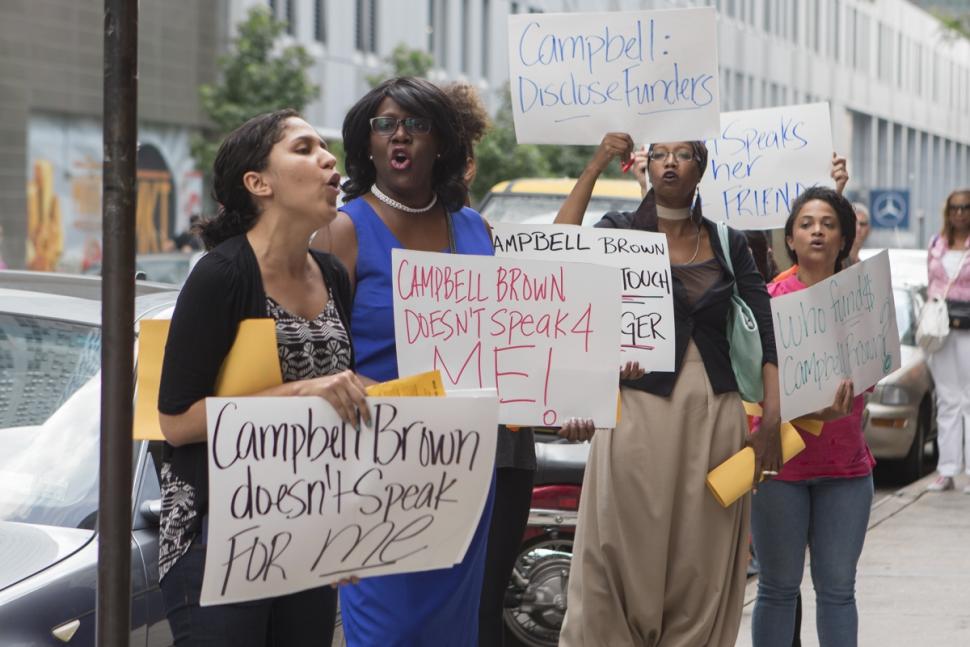
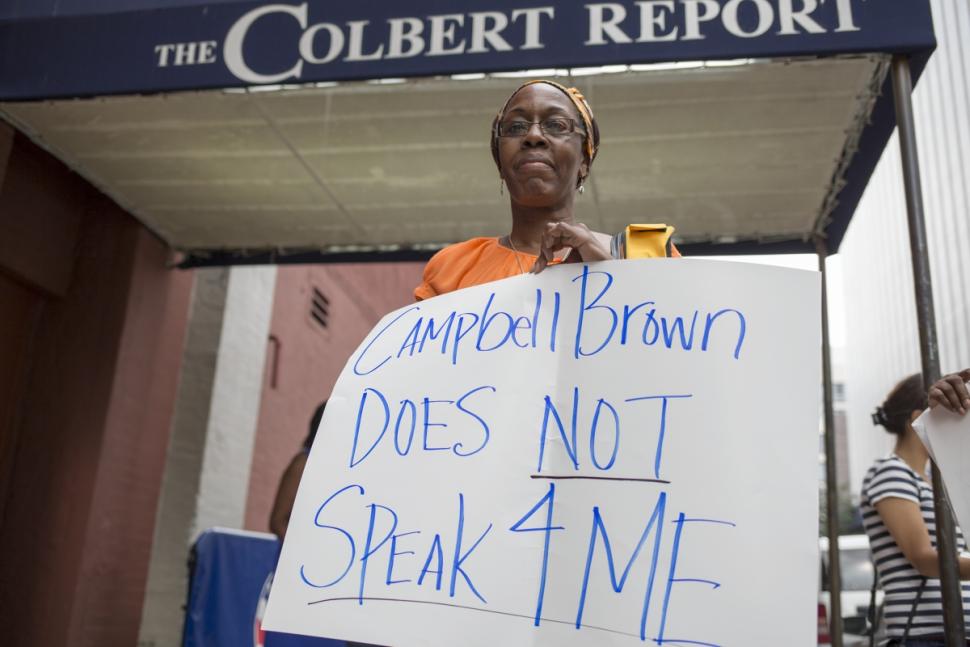
It is also entirely possible that Ms. Brown and her organization want full control of the agenda and have decided to sweep aside Ms. Davids by behind the scenes manipulation.  It certainly would fit Ms. Brown’s profile of secrecy.  She has steadfastly refused to discuss who is funding her organization, citing the ridiculous and anti-democratic notion that her funders deserve to have huge influence over the future of public education in this country without anyone knowing who they are.  When appearing on The Colbert Report, she even said she didn’t want “the people who are outside today” to “silence” the debate, so her funders should remain anonymous.  “The people” to which she was referring?  The ones who could “silence” Brown’s millionaire and billionaire financiers?  A handful of parents and teachers with home made signs:

colbert1n-2-web


So we probably cannot expect a clear explanation from Brown about how Gibson Dunn AND Students Matter yanked their support out from under Mona Davids, but we know one thing for certain:  These developments put Brown in the driver’s seat.

As for Ms. Davids and Mr. Pirozzolo  — it is probably unfair to suggest that they absolutely should have seen this coming, but I think it is fair to say they were quite naive in 1) trying to get in on the national drive to break teacher unions from their position as a local organization 2) trusting that Campbell Brown’s primary motivation is what is “best for children” while she deflects any attempt to get information on what interests are behind her efforts.  I do not always agree with NYC Parents Union, and I think that their efforts would have been far better spent on what the research tells us about how to retain great teachers — increase support for principal leadership, teacher collaboration and improvements to the workplace environment.

However, from the position of a Campbell Brown or a David Welch, NYCPU is also small potatoes.  Their executive board doesn’t even have a SINGLE hedge fund manager which is a requirement these days in education “reform” circles.  If they are going to insist upon having an opinion and input instead of simply providing parents to make for good optics at press conferences where Ms. Brown can cry about how “honored” she is to be near them, then they are more trouble than they are worth.  Campbell Brown has a mission to break up the workplace protections of the last large group of unionized middle class workers in the country, and this is her career now.  She’s got secret billionaires to please.  She’s got the efforts of former high level White House staffers to coordinate.  She’s got more legal coups to coordinate with famous legal scholars like Lawrence Tribe.  This is making her famous again, and if history is any judge about the career trajectories of education reformers, she is likely to get (more) rich doing so.

Did anyone REALLY think that New York City Parents Union was going to be an equal partner in this?  Does anyone doubt whether this is about what is “best for children” instead of what is “best” for breaking the backs of unions and keeping Campbell Brown in the news?

The betrayal may have been sudden, but it was probably inevitable.

5 Comments

Filed under Activism, Funding, Media, politics, Unions

Campbell Brown’s Brings the Anti-Tenure “Argument” to Stephen Colbert

As a former broadcast personality, Campbell Brown has some advantages when appearing on the media to discuss her campaign to end teachers’ workplace protections.  She has experience in interview techniques.  She understands what works well on camera and what does not.  She knows how to pitch her voice and use facial and body language to convey deep sincerity and earnestness regardless of what she really believes.  These served her well on Mr. Colbert’s program last week.

Campbell-Brown

Mr. Colbert is similarly skilled, but he plays a satirical representation of a right wing ideologue in order to lampoon a segment of the media and to keep his guests off balance.  I would argue that he did not level the full weight of his satirical talents upon Ms. Brown, but rather he waited until the end of the interview to present her with some serious challenges that she could not respond to adequately.  More on that later.

Valerie Strauss of the Washington Post provides a pretty thorough assessment of Ms. Brown’s many prevarications and reliance on talking points over evidence courtesy of Dr. Alyssa Hadley Dunn of Michigan State University.  Dr. Dunn makes it very clear that there simply isn’t a research base to support any of Ms. Brown’s assertions, and since she had made those assertions in the media prior to her appearance on The Colbert Report, I wish that Mr. Colbert had been more ready to take on some of the more stubborn and egregious talking points.  For example, Ms. Brown repeated her claim that New York State’s teachers cannot possible be as effective as job evaluations say they are because student test scores are too low:

SC: Okay, how’s the crisis in New York? What’s the problem here?

CB: So, if you look at, if you look at the, um, outcomes, student outcomes in New York, okay? So, 91 percent of teachers are around the state of New York are rated either “effective” or “highly effective,” and yet [SC: Sounds good.] 31 percent, [SC: Yep.] 31 percent of our kids are reading, writing, and doing math at grade level. How does that compute? I mean, how can you argue the status quo is okay with numbers like that??

SC: Well, I went to public school in South Carolina and 31 percent sounds like a majority to me.  (transcript is courtesy of Mercedes Schneider, teacher and author)

Mr. Colbert chose to lightly mock his own education, but there is a major, I would argue deliberate, flaw in Ms. Brown’s favored talking point.  First, the 31% figure does not measure students’ grade level performance; it measures the percentage of students who scored “proficient” or above on the new Common Core aligned testing piloted by the Pearson corporation in New York.  Second, the 31% proficiency rate was gamed by the process to determine the cut scores and openly predicted by New York State Education Commissioner John King before the tests were ever deployed.  From the Times-Union in 2013:

State Education Commissioner John King said he expected some push-back. At a Times Unioneditorial board meeting on Tuesday, he said the number of students considered proficient will likely drop by 30 points. He said, while that number is intimidating, it provides a more honest assessment of what New York’s students know. He acknowledged that makes for nervous educators, but said the state can’t afford to roll back the tougher new standards students will be expected to meet because just 35 percent of New York’s high school freshmen leave ready for college or a career four years later.

How could the commissioner so accurately predict the drop in test scores for the new examinations?  According to award-winning Principal Carol Burris, it is because his office deliberately sought to peg the cut scores between proficiency levels to markers that would leave just a third of New York students making the cut.  The condensed version of Burris’ analysis:  NY DOE sought information from the College Board on what SAT scores (widely considered only a loose predictor of college success) correlated to a successful first year in college, and set measures of that “success” that are clearly aimed at that 30% target.  Once in possession of the desired SAT scores in reading, writing and mathematics for a combined 1630 points, the state’s committee went about setting cut scores for each level of performance on the new CCSS aligned tests.  From Principal Burris again:

When the cut scores were set, the overall proficiency rate was 31 percent–close to the commissioner’s prediction.  The proportion of test takers who score 1630 on the SAT is 32 percent.  Coincidence?  Bet your sleeveless pineapple it’s not. Heck, the way I see it, the kids did not even need to show up for the test.

So is it honest for Ms. Brown to keep repeating that only 31% of NY students are at “grade level”? Absolutely not — first, because this is not a “grade level” measure and second, because the result was gamed from the beginning.

This also brings up another question.  If the goal of the “proficient” rating on the exams is “college and career ready” is a 31% proficiency rating actually wrong?  In 2013, 33.6% of the U.S. population aged 25-29 had a bachelors degree, which is up over 11 points from 22.5% in 1980 when the education “crisis” rhetoric began in earnest.  More of our young population is in possession of college degree today than ever before in our history, and the economic data does not suggest we are in a crisis of too few people with such degrees in the economy.  48% of recent college graduates are underemployed, and in 2010, over 5 million college graduates were employed in jobs requiring only a high school diploma.  Moreover, according to Pew Social Trends, today’s wage benefit for obtaining a college degree comes less from rising wages for college graduates than from cratering wages for those without college.

One could argue that more students need to be on path to be “college and career ready” by their third grade exams because college is increasingly necessary to keep from falling behind economically moreso than it is necessary to get ahead.  Something tells me that today’s reform advocates don’t want to emphasize that point.  We would do better to question if the distribution of students who qualify for and are successful at college are concentrated in specific communities and neighborhoods, but discussed honestly, that would require examining America’s rising Residential Income Segregation Index, another topic education reform advocates don’t like to discuss.

Mr. Colbert made a feint at this late in his interview with Ms. Brown:

SC: You can mention. I’ll edit it out, but you can mention it. [CB: Okay.] [Audience laughter.] All right, now, but, here’s, the thing is aren’t you opening a can of worms there, because [4:00] if you say the kids are entitled to e, equal education, if that’s your argument, doesn’t that mean eventually, you’re going to say, “Every child in the state of New York should have the same amount of money spent on their education”—rich community, poor community—pool it all in, split it all up among Bobby and Susie and Billy—everywhere. [Audience applause.] Because the argument is, everyone gets the same opportunity. [Audience applause.]

CB: But, but you, you’re suggesting that mon, that it’s all about the money, and I think it’s not about the money.

SC: Well, you’re suggesting it’s about equality, and money is one of the equations in equality, or have I just schooled you? [Audience laughter.]

Mr. Colbert did not let Ms. Brown duck the question of money and school funding entirely, but she quickly professed how she wants to “pay teachers more” AND treat them like “professionals” through evaluations.  Then she sidestepped to her “safe” territory by claiming it is almost impossible to fire a teacher with tenure.  As previously noted, Dr. Dunn of Michigan State makes it clear that these claims are completely problematic because first, new evaluations using student test scores focus on formulations of teachers’ impact that only accounts for 1-14% of variability between student performance and second, Ms. Brown’s information on the length of time needed to remove a tenured teacher is badly out of date and her assessment of that time is possibly off by more than a factor of four.  This all tied to her previous claims the “least effective” teachers are concentrated in schools with high levels of disadvantaged students, but her argument against tenure is not remotely related to that because measuring effectiveness via test scores automatically makes urban teachers less effective regardless of their experience and skill. Additionally, these school have far fewer tenured teachers because the turnover rate in many urban districts tops 50% in three years, resulting in a dearth of teachers with the skills that come from experience.

If tenure were truly the problem with teacher quality, then wealthy suburban districts with more stable and experienced teacher corps would not be the districts with high test scores and large percentages of college bound graduates.  In this sense, Ms. Brown’s fight against tenure resembles Republican led drives for voter ID laws that threaten to block 100s of 1000s of currently eligible voters in order to stop a “problem,’ voter impersonation, that occurs so rarely it does not statistically exist.

Mr. Colbert then pivoted to what appears to have been his most important question of the interview — what is the money involved in Ms. Brown’s lawsuit?

SC: Just trying to win, Campbell. Just trying to win, all right? Um, your organization, where does it’s money come from? That’s one of the things they asked me to ask you.

CB: I, I saw that on my Twitter feed today. The, the, who’s funding this effort?

SC: Yeah, who’s funding your, your effort, [CB: Kirkland Ellis.] your organization.

CB: The law firm…

SC: The law firm is funding it?

CB: Well, the law firm is doing this for free, so we haven’t gone out…

Ms. Brown’s point here appears to be that despite her fronting the organization that is facilitating the lawsuit, the efforts on behalf of that suit are, in essence, charitable.  This may be true as far as legal fees are concerned, but it is absurd on the face to even hint that there is no monetary value to the assistance Ms. Brown is giving the plaintiffs her organization recruited.  First, her connections and celebrity almost certainly played a role in obtaining the legal services.  Second, Ms. Brown is a media ready spokesperson who has been giving interviews and penning opinion articles on behalf of this cause, and such services would cost dearly if they came from a private consulting firm.  Further, Ms. Brown has managed to sign up the services of Incite Agency, led by former Obama administration alumni Robert Gibbs and Ben LaBolt to do publicity for the cause on a national level.  The plaintiffs in this case are enjoying pro bono legal services, Ms. Brown’s celebrity and public relations services from former White House personnel.  I think it is sufficient to say that those are no small levels of support.

Mr. Colbert pressed on about financial support and finally got Ms. Brown to admit to something which I find astonishing:

SC: So, the Partnership for Educational Justice [7:00] has not raised any money so far?

CB:Yeah, we are raising money.

SC: And who did you raise it from?

CB: I’m not gonna reveal who the donors are because the people (pointing toward window) are out…

SC: I’m going to respect that because I had a super PAC. [Audience applause.]

CB: I hear you. But, part of the reason is the people who are outside today, trying to protest, trying to silence our parents who want to have a voice in this debate…

SC: Exercising First Amendment rights…

CB: Absolutely, but they’re also going to go after people who are funding this, and I think this is a good cause and an important cause, and if someone wants to contribute to this cause without having to put their name on it so they can become a target of the people who were out there earlier today, then I respect that.


Ms. Brown is married to Dan Senor, who was the former spokesman for the Coalition Provisional Authority in Iraq following the fall of the Hussein Regime.  He sits on the board of of Michelle Rhee’s StudentsFirstNY, and he joined hedge fund Elliot Management before becoming a top adviser to Presidential candidate Mitt Romney.  Ms. Brown is on the Board of Directors of Eva Moskowitz’s Success Academy chain of charter schools, an organization that boasts massive financial support from Wall Street.  Her ties to people who have been pouring money into education “reform” in the interest of charter schools is not difficult to establish, as blogger Mother Crusader has demonstrated.  Suffice to say that these are incredibly wealthy and politically connected people who are the most likely donors to her organization.

And Ms. Brown wants us to believe that they need to be “protected”.  That if people want to know who is funding lawsuits to challenge laws that were passed by democratically elected governments and job protections that were subject to open and adversarial negotiations between unions and administrators, they cannot know because the donors seeking to overturn such laws could not abide potential criticism of themselves in the public sphere.

Wow.

Let’s be clear.  Who are “the people who are outside today” who Ms. Brown assumes will bully and intimidate her donors?  According to The Daily News:


colbert1n-1-web

colbert1n-2-web

I am sure that Eva Moskowitz’s donors are just quaking in their boots…right after they drop another $400,000 into Governor Cuomo’s pockets.

Mr. Colbert did not sneak a camera crew down to the street to make Ms. Brown look as ridiculous as she richly deserved at that moment, but the fact that he led her to make such a ludicrous statement is telling in an of itself.  Today, it is very hard to trust that major media outlets will take the time and effort to research and interview people trying to lead public debate via deception, and on issues that require a genuine understanding of complex social phenomena, that is even less likely.  I have written before how abysmally the New York Times’ editorial staff have failed in that regard, preferring to take the statements of advocates with wealth and connections at face value.

Mr. Colbert is not a journalist, yet he and his fellow comedians Jon Stewart and John Oliver have become almost guardians of truth in recent years.  It is often more likely that Mr. Colbert or Mr. Stewart or Mr. Oliver will highlight the absurd inanities, half truths and contradictions routinely offered by politicians, pundits and advocates.  In the case of Ms. Brown, Mr. Colbert got her to openly confess to a truth that is gaining greater and greater public awareness: American governance is increasingly oligarchical in nature whereby elected officials craft policy more to serve the interests of their very wealthy donors rather than the interests of the actual voters who put them in office.  Ms. Brown’s undisclosed donor list is a perfect example of this, and her refusal to disclose under the fiction that her donors could possibly be intimidated by moms and teachers with home made posters should be mocked loudly and frequently.

I am grateful to Mr. Colbert for organizing his interview to that point, but I am saddened that we rely almost exclusively on satirists to get to the heart of public affairs these days.

3 Comments

Filed under Activism, Funding, Media, politics, schools, Social Justice, Testing, Unions, VAMs

Asking Markets to Do What They Do Poorly — School Reform

Early in my graduate school experience, I took a class with Phil Cusick, author of “The Egalitarian Ideal and the American High School” and “The School System: Its Nature and Logic”  .  The class was a seminar on how school systems functions both philosophically and organizationally.  While the course had a number of profound insights, one of Dr. Cusick’s observations has remained at the forefront of my thinking ever since.  “In America,” he said, “we don’t redistribute that much income, so we give everyone a free school instead.”  What he meant was that, politics of taxation and the welfare state aside, America does comparatively little that sets a strict bottom on the deprivations that poverty can afflict upon individuals and communities.  This much is true as any examination of poverty and social expenditures in first world countries can attest:

social safety gap

The purpose of school, therefore, is to provide a forum where any person, regardless of personal circumstance, can fairly demonstrate both potential and accomplishment.  Schools, philosophically, are meant to drive opportunity that we do not provide via leveling the distribution of resources.

That is a weighty mission, and it resonates with certain themes that are popular among American society such as the absence of a titular aristocracy and the belief that merit is properly recognized and rewarded.  Getting Americans to agree on how to deliver the circumstances most likely to deliver meritocracy is another matter entirely.

When it comes to school reform, the movement with greatest momentum currently is dedicated to school choice and the uses of market based forces to improve the opportunities for students enrolled in public education.  School systems across the country, where possible, have changed the ways in which students enroll in schools to deemphasize reliance upon zoned schools within geographic boundaries and to have public schools seek out students across those zoned districts.  Various instantiations of voucher programs encourage parents to seek out even nonpublic schools that will be subsidized with public money.  Straying far from their original conception as temporary laboratories for experimentation on behalf of the most difficult to teach students, charter schools operate in direct competition with district zoned schools and many have become brands unto themselves, aggressively expanding operations.

These ideas originated some decades previously with free market economists like Milton Friedman who in 1955 openly advocated for public education to more closely resemble markets for goods and services that have driven consumer innovation in the past two centuries.  Intellectually, they gained support from the work of John E. Chubb of the Brookings Institution and Terry Moe of Stanford University in their 1990 book entitled “Politics, Markets and America’s Schools” where they concluded that the most important predictor of a school’s success was the locus of control between traditional school boards and privately controlled schools.  Their prescription included the creation of school choice districts where schools would have to compete with each other to attract and retain students.

Despite the omissions from Chubb and Moe’s work, such ideas found powerful patrons among conservative politicians who enthusiastically advocated for school choice and voucher programs as the solution to the school failure narrative that took root with the release of “A Nation At Risk” during the Reagan Administration.  While originating with conservatives, school choice became a growing theme among Democrats in both the Clinton and Obama administrations and for Democratic governors across the country.  Although less likely to support vouchers that take public school budgets and transfer them to entirely private entities, the growth of charter schools and support among Democratic politicians represents a strong toehold for choice as an engine of reform on both sides of the political aisle.  Choice, in various forms, is recognized as the powerful driver of improvement and innovation across the mainstream political spectrum.

But is that a good thing?

The question is far less clear than advocates would have us believe.  Markets are, undeniably, a powerful tool for innovation, but whether or not that does or can apply to public education is quite a different matter.  It is important to consider the ways in which markets work.  As a matter of record,  I am not an economist, but what follows is not controversial ground.  Most markets for goods and services function by supplying the market with a range of innovative products, yes, but also a range of similar products that are available at different levels of quality and expense.  Many people, wealthy, middle class and working class, can afford to purchase personal transportation because the market that provides vehicles such as the Rolls Royce Phantom also provides the Ford Focus and used Honda Civics.  The individual in need of an automobile can usually, within a relatively short distance from him or herself, find an option that takes into account both the need for the good AND the ability of the buyer to go above the most basic fulfillment of the need.  Markets are exceptionally efficient at doing this, so while every person participating in the market may not be able to afford the best it has to offer, most people can find something.

But what about where everyone needs the same thing?

In education that may seem counterintuitive because it is taken as a given that all children can learn, but that not all children learn the same way.  However, taken another way, it is true that all children need the same thing:  they need the resources and the opportunities to accomplish the curriculum to the best of their current abilities in the ways by which they most effectively learn.  In other words, students do not need equal opportunities so much as they need equitable opportunities.  Consider the following illustration:

Can everyone enjoy this?

The Difference Between Equality and Equity

In the picture on the left, all three people have an absolutely equal playing field, but only two of them can achieve the goal of watching the baseball game.  With some minor tinkering, however, the third member of the group can achieve that goal because his specific needs have been accommodated without taking away anyone else’s opportunity to enjoy the game.  In an educational context, this is the why equal is not always the appropriate circumstance when a student is fully capable of accomplishing a task but needs individualized attention.

This sounds like an argument then for the market based and competitive goals of educational choice and policies that break down district zoning in assigning a student to a school, and I can understand that.  After all, if individualized attention is a key to promoting equity, it would make intuitive sense for more choices to provide more setting where that is possible.  However, I am drawn again the observation that market innovation is powerful when it is providing different levels of quality for the consumer.  Innovation and competition has made many kinds of good available to all consumers, but nobody can honestly argue that all such good are of similar quality and durability.  The same observation applies to services provided as well where consumers able to pay more enjoy levels of amenities not provided to those who do not.

But we demand very different from our compulsory education.  There is no “used Honda Civic” or “economy class seating” when it comes to teaching a child how to read, and providing equitable opportunities means that education “consumers” sometimes need to utilize MORE resources regardless of their ability to pay.  In order for a market system of schooling to really provide for equitable opportunities, several conditions seem extremely important.  First, the number of choices available would have to be sufficient to the task of every family having a genuine ability to enroll in a school or schools that meet their needs.  Even in major metropolitan areas, this is unlikely as a selection of schools cannot simply be packed onto a display wall like a selection of shoes, and after a certain point, families would incur unacceptable costs simply to transport their children to the array of schools they need.  Second, families would have to be equally engaged and knowledgeable about what children need and how to evaluate the claims of different schools about their accomplishments.  That also seems doubtful because when one makes a mistaken choice in typical markets for goods and services, there are options for returning or foregoing use of the item which does not exist when it comes to schools.  Certainly, the high turnover rates among many of the more prominent charter school operators suggests that even in a limited market, families seek out schools that are either “poor fits” for their children or that are unwilling to adjust themselves to meet the needs of the children they have.  Without zoned schools, such children would be at risk of having to “return” their educational opportunity every year.  Third, school choices cannot become more stratified than they already are due to income segregation in our communities.  In a marketplace, it is fully acceptable to provide consumers in different income strata different quality goods, but this cannot be permitted in education without the system perversely betraying promised opportunities.  Finally, a market of educational choices has to demonstrate that it truly provides better outcomes for the vast majority of students, both quantitatively and qualitatively, than a system of zoned schools.  To date, such metrics have been extremely elusive in research on both vouchers and charter schools to the point that one can reasonably question just how much more expansion of such ventures is really warranted.

Jan Resseger, a former education advocate for the United Church of Christ, recently noted that one of the primary advocates of the “portfolio” strategy of school choice, a mix of zoned schools and choice options promoted by the Center on Reinventing Pubic Education at the University of Washington, had recently admitted that troubling outcomes in many districts that have tried the strategy.  While Ms. Lake did not suggest the cycle of disruption was actually failing to improve education for the most vulnerable, the CRPE report levels heavy criticism at the way such reforms have been implemented without strict oversight to ensure all students have excellent school choices.  What is missing is an admission that market based forces are not necessarily the way to improve our national commons which includes compulsory education.

It would be disingenuous to suggest that local control of zoned schools has resulted in excellent schools for all children.  But it is much more disingenuous to subsequently ignore the impacts of our deep levels of income segregation and modest state and federal spending to alleviate the conditions of poverty in communities.  Faced with depleted local revenues and populations struggling to maintain subsistence levels of income, many of our school districts operate under conditions that make their work vastly more difficult even as we lay upon them the nearly sole responsibility for lifting those same communities out of poverty.  As David Berliner notes:

It does take a whole village to raise a child, and we actually know a little bit about how to do that. What we seem not to know how to do in modern America is to raise the village, to promote communal values that insure that all our children will prosper. We need to face the fact that our whole society needs to be held as accountable for providing healthy children ready to learn, as our schools are for delivering quality instruction. One-way accountability, where we are always blaming the schools for the faults that we find, is neither just, nor likely to solve the problems we want to address.

So what does this mean?  My own suggestions center around reemphasizing public education as a common good for society, and bringing our emphasis back to improving zoned schools.  This would require renewed interest in fully funding schools regardless of their needs and improving curricula and teaching locally, a major campaign to improve the infrastructure of zoned schools that still enroll a vast majority of our children, and efforts to invigorate school and community ties by deeper connections to civic organizations and the placement of community services within schools themselves to broaden the number of people who see the school as essential to their neighborhoods.  However, as Berliner notes, the accountability for alleviating poverty has to be two directional, and we as a society need to admit that we cannot place the entire burden of children climbing out of inter-generational poverty within communities whose economic prospects are dismal at best entirely upon the backs of teachers and schools.  As long as we continue to pass that buck and believe that the same economic forces that allow us a wide and varied choice of breakfast cereals are equipped to provide excellent schools for everyone we will continue to be disappointed.

1 Comment

Filed under Funding, politics, schools, Social Justice

Campbell Brown — the next hero of corporate reform

Following the Vergara decision in California where a judge declared that teacher labor protections violated students’ rights to a quality education, former NBC news and CNN personality Campbell Brown announced she would help bring a similar suit to New York State.  This is not Ms. Brown’s first foray into anti-union activism aimed at teachers.  In 2012, she unleashed a series of tweets that attacked New York City’s United Federation of Teachers for allegedly placing protection of accused sexual predators over children, and she penned an editorial for the Wall Street Journal demanding that the New York City Chancellor of schools be given absolute authority to fire teachers so accused without the use of an independent panel. Brown provided no evidence for accusations that this was a significant and mounting problem as she portrayed it, preferring a classic line of argumentation that any outcome a large number of people can agree is potentially wrong must mean the entire system needs to be turned upside down.  In this case,  the UFT defended maintaining due process rights for teachers accused of misconduct, which prompted Brown to insist they wanted genuine sexual predators returned to the classroom — without Brown bothering to examine details such as what percentage of accused teachers were actually cleared of wrong doing or what percentage were fired and prosecuted.

Brown portrayed herself at the time as simply a mother of two who was concerned about the effects of union job protections on children, but other sources have demonstrated she has a deeply personal conflict of interest that may be influencing what causes she is championing.  Ms. Brown is married to Dan Senor who was the chief spokesman for the provisional authority following the invasion of Iraq, and in 2012, he was a senior adviser to Republican Presidential candidate Mitt Romney.  Further, Mr. Senor sits on the board of StudentsFirstNY which is a part of Michelle Rhee’s network that expressly fights against teacher unions.  In response to union supporters and other journalists noting her apparent personal stake in making teacher unions a source of public outrage (a Romney administration certainly would have helped Mr. Senor’s career), Brown took the pages of Slate.com to sarcastically express her surprise at the push back and to take a little dig at her critics.

It is two years later, and Campbell Brown is delighted at the Vergara decision, and she is now partnering with high profile former Obama administration officials to craft similar lawsuits elsewhere beginning in New York.  The outcome is uncertain even though the Vergara case was based on exceptionally poor reasoning: many of the plaintiffs could not demonstrate that they have had “grossly ineffective” teachers, the judge misused the expert testimony and relied upon highly controversial research findings to determine the scope of damage that can be tied to a student having a poor teacher.  Brown, now allied with Obama spokesmen Robert Gibbs and Ben LaBolt, given pro bono legal services from former Bush administration adviser Jay Lefkowitz and presumably bankrolled by Michelle Rhee and her corporate allies, will likely bring a sharper and slicker case to New York.

This case is the apotheosis of corporate reform of our schools.  Teacher unions, while not perfect, stand as a safeguard that the people closest to the children in the classroom can negotiate for fair compensation and work with knowledge that they have due process in employment despite the highly public and sometimes contentious nature of their work.  Moreover, the teachers who make up their unions are the people, after parents, most connected to the individuality of the children entrusted to their care.  But corporate reform insists that looking at individual factors and looking at community factors is “making excuses” and that what you need are common standards, high stakes testing associated with those standards, teacher evaluation based upon test scores and then firing the “right” teachers based on those measures.  Corporate reform is decidedly uninterested in discussions about poverty and rising income segregation and insists that every problem in school can be laid at the feet of “bad teachers”.

The only major, organized, groups in the way of that are unions.

Rhee’s “Students First” organization should really be renamed “Teachers Last” because the main purpose of its legislative and litigation strategy is to put parents against teachers and to capitalize on America’s 30 year labor decline to break the AFT and NEA.  Michelle Rhee is a formidable organizer and fund raiser, but she is also under scrutiny for lacking real substance behind her thinking and for the practical outcomes of her approach to school system management.  After her politically strained tenure as Chancellor of D.C. public schools that contributed to the defeat of the mayor who recruited her, Rhee is not a public face for corporate reform who can go to the cameras without getting scrutiny.

In steps Ms. Brown as a fresh face for corporate reformers.  By now, many of the players are well known.  If you are talking about attacking teacher unions, you are talking about Michelle Rhee.  If you are talking about Common Core State Standards, you are talking about Bill Gates.  If you are talking about standardized testing, you are talking about the Pearson Corporation.  If you are talking about mass data mining and technology, you are talking about Rupert Murdoch.  We know this by now, and even some mainstream media sources are making the connections.

Campbell Brown presents herself as a media savvy personality who is in this fight as a “concerned mother” while Rhee and other anti-union forces provide the strategy and financing.

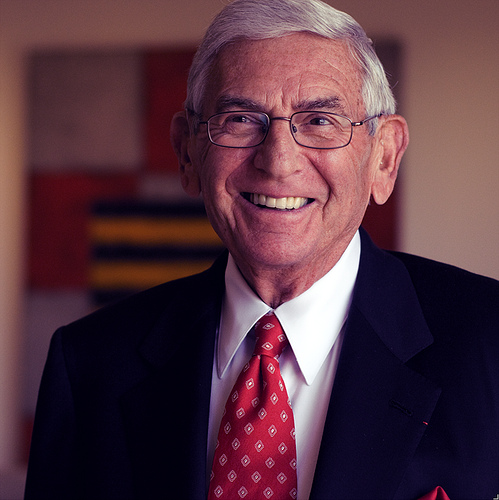
But when you see Campbell Brown, you see Michelle Rhee.  And when you see Michelle Rhee, you see Eli Broad.  And that just isn’t a pretty sight for teachers.


Campbell Brown

Campbell Brown

Michelle Rhee

Michelle Rhee

Eli Broad

Eli Broad

This gives me nightmares to be honest...

Brown-Rhee-Broad — This face keeps me up at night….

1 Comment

Filed under Activism, Funding, politics, Unions

Gates’ Money and Privacy Activism — Opposition to Ed. Reform Hits the Mainstream

A few stories caught a lot of eyes over the weekend.  None of that is good news for education reformers who have banked on stealth and little reporting.

The first is a major article and interview regarding the role Bill Gates’ money has played in the development of, promotion of and adoption of the Common Core State Standards in the Washington Post.  The story is not entirely complete.  For starters, it fails to disclose that David Coleman already had funding from the Gates Foundation for his Student Achievement Partners, so a meeting with Gates in 2008 is not their first intersection.  Also, it does not explore the heavy hand that Gates has also had in the push for more high stakes testing to evaluate teachers via his funding of the highly flawed Measures of Effective Teaching study, nor does it examine the role that Gates has played in enabling technology entrepreneurs to mine the data generated from those tests without parental consent.

Regardless, the article is both informative and important for several reasons.  First, it is one of the first times anyone in a major news outlet has provided a portrait of the diverse opposition to current reform efforts in education that doesn’t make it sound like mostly the work of Alex Jones style cranks.  The article even quotes academics who question whether the standards are based on sound research on how children learn or even if there is a connection between quality standards and learning.  Second, this is an article in a major outlet that does not equivocate in the slightest about how much influence one very rich man has had in trying to control the entire course of American public education.  While it does not editorialize on the question, it is hard to read how many federal, state, nonprofit, academic and corporate entities were lobbied by, influenced by or funded by Gates and not wonder what role democracy has anymore when it comes to our public schools.

Finally, Gates himself comes across as defensive and dismissive:

Gates is disdainful of the rhetoric from opponents. He sees himself as a technocrat trying to foster solutions to a profound social problem — gaping inequalities in U.S. public education — by investing in promising new ideas.

This would be more convincing if Gates displayed the slightest interest in testing new ideas before unveiling them in 45 states at once before parents and teachers have a chance to understand them, indeed, before anyone has a chance to understand if they are a net positive or not.  From Gates’ point of view and experience, this must make sense.  He has compared common standards to standardized electrical outlets and computer code as a means of allowing innovation, and certainly getting DOS on most desktop computers in the world led to a lot of software developers having a common platform.  But education is not consumer electronics, and bypassing the entirety of stakeholders who value public education for a variety of reasons was going to lead to push back, and even today, Bill Gates does not demonstrate awareness of that.

The second article appeared in Politico and was dedicated to parent activists working to protect their children from data mining operations tied to public education.  This represents another public airing of activities whose proponents would prefer to avoid being seen in the open.  The report quotes New York’s Leonie Haimson of Class Size Matters about how parents have reacted when informed about the plans of technology firms to use pretty much every bit of data they can get their hands on, and it quotes worried data entrepreneurs coming to grips with parental opposition:

Many said they had always assumed parents would support their vision: to mine vast quantities of data for insights into what’s working, and what’s not, for individual students and for the education system as a whole.

“People took for granted that parents would understand [the benefits], that it was self-evident,” said Michael Horn, a co-founder of the Clayton Christensen Institute, an education think tank.

Instead, legitimate questions about data security have mixed with alarmist rhetoric in a combustible brew that’s “spreading like wildfire” on social media, said Aimee Rogstad Guidera, executive director of the Data Quality Campaign, a nonprofit advocacy group for data-driven education.

That fear, Guidera said, “leads to people saying, ‘Shut it down. No more.’”

Guidera hopes to counter the protests by circulating videos and graphics emphasizing the value of data. But she acknowledges the outrage will be hard to rein in.

Could the parent lobby scuttle a data revolution that’s been championed by the White House, pushed by billionaire philanthropists and embraced by reformers of both parties as the best hope to improve public education? “I do have that concern,” Guidera said. “Absolutely.”

The article doesn’t go into detail about just how much money is thought to be at stake and takes the data mining firms at their word that they only want to help, but I came away from reading it with one resounding message: this damage is entirely self inflicted, but the data miners see the parent activists as the problem.  They did not want to do the hard marketing work of convincing people that they were doing something valuable, and they did not anticipate that parents might see the data generated by their children’s public educations as something they’d want to protect rather than just shovel over for free.  It is hard to sympathize here, especially when they have avoided openness from the beginning.

Which leads to the third article from today: a call from the Gates Foundation for a two year “moratorium” on high stakes decisions based upon Common Core aligned testing.  This is the first official wavering from the Gates camp since the standards and testing drive began in earnest, and it is highly significant as an indication of concern that the whole enterprise is in trouble.  It may also be a miscalculation — yes, teacher opposition to using value added measures of their effectiveness based on standardized tests is strong, and yes, teachers have barely had time to adjust to the new standards.  But two years will not fix the flaws in VAMs, and it will not assuage parental concerns about the role of testing and data mining.  It will potentially take a chunk out of testing companies and data mining companies who were making business plans based upon all Common Core states embarking on wide scale testing next year, and I find it interesting that the Gates Foundation is willing to have them cool their heels while the standards’ supporters try to do something they have avoided all along: talk in public.

Leave a comment

Filed under Activism, Common Core, Funding, Gates Foundation, Media, Privacy, Testing, VAMs

Of Greenbacks and Green Cards — Why Wall Street Likes Charter Schools

Yesterday, I contemplated why hedge fund manager and principle founder of Democrats for Education Reform, Whitney Tilson, would be quoted in the New York Times saying that “hedge funds are always looking for ways to turn a small amount of capital into a large amount of capital” as an explanation for financial support of charter schools by Wall Street.  Offering the benefit of the doubt, I considered that Tilson may have simply meant that relatively small cash investments could result in returns of human capital in the form of better educated students.

I no longer consider that.

It turns out that United States tax and immigration laws have created a healthy flow of money from the very wealthy into the charter school movement, possibly in ways not exactly imagined by the authors of those laws but which nevertheless have made charters a favored project of quite a few .1% movers and shakers in world capital.  The New York Times printed an article back in 2010 that reported the interest of the financial sector in promoting charter schools, but it did not examine the connection of that interest to actual returns on investment. While I cannot dispute claims that hedge fund managers like charters because many of them focus on test scores, are not unionized and they are seen as a way of polishing local philanthropic credentials, there is another reason that money flows into charters: it gives a return on investment.

In this piece on Forbes, financial analyst and author Addison Wiggins, explains the mechanism in the tax code that allows Wall Street to show a return on investment in charter schools:

In part, it’s the tax code that makes charter schools so lucrative: Under the federal “New Markets Tax Credit” program that became law toward the end of the Clinton presidency, firms that invest in charters and other projects located in “underserved” areas can collect a generous tax credit — up to 39% — to offset their costs.


So attractive is the math, according to a 2010 article by Juan Gonzalez in the New York Daily News, “that a lender who uses it can almost double his money in seven years.”

That isn’t sexy Gordon Gecko kind of money, but it is also guaranteed.  Put down money to fund the creation or expansion of a charter school, and a firm can double its money in a predictable time table and get to brag to the press about it is bringing new education options to urban areas.  The Gonzalez article in the New York Daily News also reported that JPMoragan Chase was setting up a more than 325 million dollar fund to invest in charter schools taking advantage of the tax credits.  This strategy is attractive enough that there are firms specifically devoted to connecting charter schools and financial backers.

To be fair, it is entirely possible that this is a more cost effective way of increasing the number of classrooms in some urban areas than traditional school construction projects funded by bonds; I do not currently possess the data to make such an analysis.  However, two very important considerations must also be made.  First, using the federal tax code in this way means that the cost to the public comes from potentially lost federal revenue instead of being paid in a predictable way at the local and state levels.  Second, when a city funds school construction traditionally, it is usually doing so to create schools that are obligated to educate and accommodate every student within its zone.  Many charter schools love to brag about their “awesome” results and make incredibly impressive claims about their test scores and graduation rates.  As Bruce Baker of Rutgers demonstrates here, such claims rarely can stand even moderate scrutiny.  North Star Academy in Newark, NJ, for example, claims that 100% of its seniors graduate, which is true — if you ignore that 50% of the students who enroll in 5th grade never make it to senior year.

So what we have are major charter school chains with deceptive or outright fraudulent marketing backed by the titans of finance who are making hefty returns on investment and are donating significant sums to politicians to keep the returns flowing.

In addition to onshore capital returns, investments in charter schools can be beneficial to foreign investors via the EB-5 visa program.  Under this program, foreign investors who spend at least $500,000 in the United States on a development project can earn a visa for himself and his family. According the Reuters article, this path is so attractive to foreign investors that Florida alone expected 90 million dollars for charter schools from foreign investors in 2013.  Much like the tax credits for domestic hedge funds, there is an industry developing to connect wealthy donors looking for EB-5 eligible projects to charter schools seeking capital.

To my knowledge none of these actors are channeling investments into neighborhood schools in need of infrastructure funds, estimated at over 250 billion dollars in 2008.  But the good news is that some hedge funds are getting a guaranteed return on investments and some foreign born multi-millionaires are getting green cards.

Al Shanker, the former head of the American Federation of Teachers, helped envision the idea of charter schools.  In a blog post from 2012, NYU’s Diane Ravitch wrote an open reminder to then New Jersey Commissioner of Education, Chris Cerf, about what Mr. Shanker thought charter schools should do. Charter schools, in Shanker’s vision, were meant to serve students who were most needy and had potentially failed already within other schools — instead, many of today’s charters deliberately avoid or push out those students.  Shanker also saw charters collaborating with other public schools.  As small laboratories of innovation, their goal should have been to translate what they had learned about working with students to the rest of the public school system.  Today, many charters aggressively compete with public schools and far from being a true part of the public education system, large numbers in some states are managed by for profit Educational Management Organizations who are responsible for their bottom lines.  According to Ravitch, Shanker turned against charters when he saw a pattern of corporate and for profit interests taking over the movement.

I have no doubt that with 1000s of charters operating across the country, that many of them embody the original vision to provide innovation and collaboration and truly dedicate themselves to serving the most needy of our students.  However, today, they are being greatly overshadowed by deceptively marketed brands of charter chains that rake in Wall Street and foreign investment, aggressively lobby state and federal officials for preferential treatment and build their reputations for success on the backs of students they refuse to serve and work to evict from their schools.  Eva Moskowitz of the Success Academy chain can summon 7.75 million dollars in donations in one evening while most states’ education spending remains below pre-recession levels.

But, again, the good news is that some hedge funds are getting a guaranteed return on investments and some foreign born multi-millionaires are getting green cards

2 Comments

Filed under charter schools, DFER, Funding, politics

Who are “Democrats for Education Reform”?

Jan Resseger is the former chair of the National Council of Churches Committee on Public Education, and she has a blog post linking to a very insightful infographic on the organization “Democrats for Education Reform,” the group behind the “Camp Philos” education reform meeting in Lake Placid this week.

The graphic can be found here, and it comes courtesy of Billy Easton of the Alliance for Quality Education.  The short version is that, far from being a genuine organization of members of the Democratic party with ideas about education reform, it is a lobbying group designed to influence the policy choices of Democratic party politicians and which has taken huge sums of money from the same interests that have lobbied for aggressive charter expansion, curtailing teacher unions and assessing teachers  based on test scores.  While Democrats such as California’s Gloria Romero and New York’s Joel Klein have been prominent in the organization, it is extremely clear that on education, they are firmly allied with the pro-testing and pro-privatization forces that have been trying to drive education “reform” further and further away from schools as a locally democratic institution.  DFER is largely the creation of Whitney Tilson, founder of hedge fund T2 Partners, who was quoted in this New York Times article about the tenure of Joel Klein:

Charter schools, explained Whitney Tilson, the founder of T2 Partners and one of their most ardent supporters, are the perfect philanthropy for results-oriented business executives. For one thing, they can change lives permanently, not just help people get by from day to day. For another, he said, “hedge funds are always looking for ways to turn a small amount of capital into a large amount of capital.”

I’ve looked at that quote from several different angles: And assuming that it only unfortunately suggests an effort to turn schools into a profit stream, it staggering misconstrues why education costs what it costs.  If Tilson meant that a hedge fund can take a small investment in a charter school and turn it into a “large amount of capital” in the form of educated adults, the idea still misses why non-charter schools often need to spend more money to be in compliance with offering an appropriate education to ALL students in their zoned schools.  Charter schools’ cost “savings” frequently come from refusing or simply weeding out students who need more intensive and expensive interventions to succeed at school.  That’s a bit like praising the economy of a car manufacturer who gets permission to build cars without seatbelts.

It is also emblematic of the age we live in: groups across the spectrum adopt “brands” that can pass a very cursory glance, but which fall apart after more scrutiny.  The lesson?  Always use more scrutiny – whether it is a chain of hedge fund backed charter schools claiming miraculous results or a supposedly grass roots sounding organization that fronts for those same interests.

2 Comments

Filed under Activism, charter schools, DFER, Funding

Education Week Blog Piece on Charter School Funding Research

This caught my eye yesterday….for several reasons.

The first is that we can expect the charter school movement to latch on to these findings and demand that more states impose upon cities and communities the sorts of “protections” that were recently added to the New York state budget, which amount to extraordinary favors to well connected and already well funded chains of charter schools.  I have no doubt that there are probably many small, individual charter schools that do excellent work and struggle for sufficient funding, but I also have no doubt that the biggest noise about so-called threats to charters are coming from chains like Success and KIPP that are lavishly funded and connected to hedge fund billionaire patrons.

The second reason is that the blogger actually raised important additional considerations about why charter funding may be lagging on a per pupil basis that is frequently overlooked by lofty news organizations that report on charter school claims.

The issue of charter funding and the disparities that exist may depend on the methods used to do the calculations, though.


“For me, this is not research that’s helping draw good policies,” said Gary Miron, a professor at Western Michigan University who researchers and evaluates school reforms and education policies.


Drawing on his own previous analyses, Miron contends that charter schools already have a cost advantage that may not be captured and explained by the data.


“Special education and student support services explains most of the difference in funding,” said Miron. “Charters can get a lot more funding, but it would require that they enroll more students with severe and moderate disabilities. They aren’t enrolling these students.”


Other categorical funding, such as that distributed for vocational education, would also bring more funding to charters, should they choose to provide it.


In fact, in his studies, Miron found that charters have a cost advantage, because charters do not have to provide the same services or have the same expenditures as traditional public schools.Transportation costs, for example, are an area in which charters have a funding advantage. Districts are required to provide student transportation while charters are not.

If charter schools do not enroll similar numbers of students on IEPs and English Language Learners, it is entirely reasonable for their funding to be less than entirely public schools that are required to fully serve those populations of students.  Without accounting for that, the report draws a very questionable conclusion using figures that have dogged public discussion of education for years but which are, bluntly, one of my biggest pet peeves.

Which is reason number three: per pupil allocations as a marker of funding and a tool for policy.  It is an easy number to come up with: take the total school budget, divide it by the number of students in the district and voila! You have a per pupil spending figure.

And you have absolutely no idea what that number could possibly mean.

Per pupil costs make for a simple talking point, but a very little thinking effort demonstrates that two children do not necessarily cost the same to educate.  A classroom full of AP students may cost more than a classroom of college preparatory students because the teacher may be a well compensated veteran with a smaller number of students.  A student with an IEP or in ESL classes will cost more than the per pupil average if the district is properly committed to providing them with all legal accommodations, including additional personnel.  A district that is top heavy with administrators will have a higher per pupil cost without necessarily having more resources for the classroom. A district that cannot budget capital improvements will have a higher per pupil cost to cover the price of additional heating fuel in the winter due to leaky windows — and kids will have a harder time concentrating if they remain cold from November to April.

Any policy or discussion of policy that ignores or glosses over these facts is both deceptive and possibly destructive.  Consider vouchers as an example.  Taking a child’s “per pupil” money and handing it over to a new school does not make the old school magically one child less expensive to run.  Until enough children leave that the school starts dismissing staff and faculty or perhaps shuttering a disused wing, the lost student just ups the per pupil average for those who remaining — while skimming money out of the budget.  Meanwhile, the school getting voucher money did not magically become exactly one more student more expensive to run.

Here’s a mantra to repeat to politicians and education reporters: An individual child’s public education is not a product.  It costs what it costs to most effectively assist that child to learn as much as he or she can…and to preserve that child’s joy for learning and curiosity about the world.

Practices that shunt aside students who are harder to accommodate or that cover content while crushing the spirit, may be good for the budget, but we don’t aspire to them for children. So when we are discussing whether or not a particular sector of education is being “underfunded” it is important to consider far more than the sum of money they receive.


Leave a comment

Filed under charter schools, Funding, Media, politics, schools