Category Archives: politics

Welcome to the Class of 2015 — We Need You

This week, our teacher preparation program welcomes the graduates of the Class of 2015 as our teacher colleagues.  These accomplished young teachers are joining the profession at a time of great challenges, but it is also at a time of great opportunities, and having worked with them closely for the past four years, I am convinced that they will do well with those opportunities.  These young people are intelligent; they are dedicated; they are talented; and they are prepared.  It has been an immense pleasure to see their professional journeys.

It would be a disservice to them to downplay the challenges they face as new members of the profession.  Today’s graduates were mostly born in 1993 which means that they were in third grade when the No Child Left Behind Act in 2001 mandated annual standardized testing for all children in all grades between three and eight and once again in high school.  They went through their formative elementary and secondary education as the high stakes attached to mandated testing was squeezing the curriculum into a narrower box with less art, music, social studies, and science.  While the impacts of Race to the Top, the Common Core State Standards, and PARCC and SBAC testing did not influence their education, they have done their clinical internships and student teaching within schools and with cooperating teachers who have had to grapple with these issues as well as the growing movement of parents who are denying schools the right to administer standardized tests to their children.

Now they leave their university preparation to enter teaching just as these matters are fully breaking upon our schools.  The CCSS are implemented in 43 states and the District of Columbia.  Mass standardized examinations aligned with the standards are now implemented in dozens of states, and they promise to find many fewer students proficient in mathematics and English than just a year ago.  States that won Race to the Top grants or were granted NCLB waivers from the USDOE are using growth measures based on standardized testing to evaluate teachers, despite the fact that the sum of research on growth measures demonstrates that they are unstable, unreliable, and have standard errors so large that even with 10 years of data, a teacher still has more than a 10% chance of being mislabeled.

If these challenges were not hard enough, the confluence of hastily implemented and ill-conceived policies comes amidst a rhetorical turn against teachers as the major culprits behind students whose test scores do not rise.  Today’s reform environment lavishes transformational power upon education, but it simultaneously measures that transformation via crudely designed standardized tests and then blames allegedly incompetent teachers when literally nothing else is done to improve the lives or communities of students who struggle.  A coordinated effort is underway to first assess teachers via standardized test results and then to remove any workplace protections teacher have to make it easier to fire them at will.  It is little wonder that the percentage of teachers who say they are highly satisfied on the job has dropped 30 percentage points to its lowest in a generation.

A distressing side effect of this environment are the number of more experienced teachers who appear ready to discourage our new colleagues from either entering the field altogether or from bothering to have hope on the job.  Peter Greene of Curmudgucation reminds us that this is a distressing and unethical practice, and he points out the specific work of the activists in the Young Teachers Collective who are directly asking their experienced colleagues to stop discouraging them.

I hope to G-d that my proud young graduates side with the activists at YTC.  We need them very badly.

Unlike Baby Boomers and my fellow Gen Xers who indulge in annual, graduation week denigration of the Millennials for their supposed faults, I am a fan of this generation.  Having worked closely with them for years now, I find this report on their outstanding and community oriented values to be absolutely correct.  Young adults today are more diverse than their predecessors, more open to diversity than any generation in history, better educated than anyone gives them credit for, and more desirous of being good parents and good neighbors than of the aggrandizement of self typified by generations who modeled our lives after Gordon Gekko.

So let me build on Peter’s plea for people to not be jerks to young teachers, and to add my own plea: young teachers, we need you.  We need you because you have been well-prepared.  We need you because if you do not stay we will have wasted the earned experience and skills you will gain in your first decade on the job, and that will harm future students.  We also need you because of those same values that typify your generation and which will serve as a tremendous asset to protect and preserve truly public education.

But if that is going to happen, we also need you to buck some typical trends in teaching and schooling.  It is very typical for teachers to simply keep their heads low, close the door, and wait for the current political tides to shift.  That is unlikely to work today; people are getting rich messing around with our schools, and they see our nation’s commitment to education for all as a $780 billion honeypot to monetize.  The good news in the midst of this is that the people still back our public schools, and while many have bought the relentless narrative that our schools writ large are failing, parents overwhelmingly support the schools their children attend.  You can generally count on the support of your students’ parents.

We need you, therefore, to be confident in that support and to help lend a voice, early in your careers, for certain truths that can reach the public only if they are amplified by many voices:

We need you to remind people that school and teachers cannot do it all alone.  Education is a likely component of most success stories in our country, but education did not play its role in those successes alone.  Education reform talks about education as key to overcoming poverty, but it spends very little time talking about how the advantage gap is overcome by much more than “grit” and “no excuses.”  We certainly see few reformers admit the severe funding gaps between our richest and poorest schools, and Governor Andrew Cuomo of New York has openly scoffed that funding has any role to play in educational inequities.

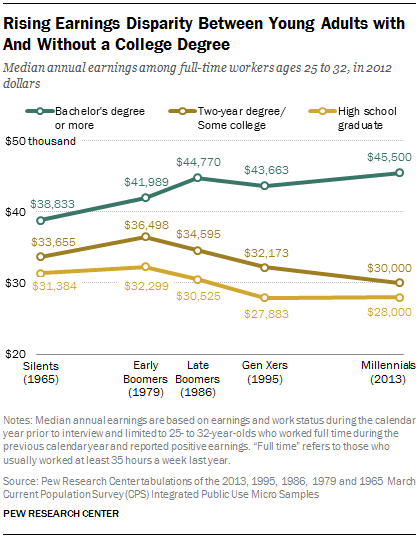
But even beyond that issue, there is a question about the central premise of education reform today; namely, if all students acquired more and better education, would they be able to leap over poverty in their careers?  The evidence for this is unclear because even though college degree holders greatly out earn non degree holders, that gap has grown because of cratering wages for less education rather than growing wages for more:

SDT-higher-education-02-11-2014-0-03

Increasing numbers of college degree holders will not magically create more middle class households unless the number of jobs genuinely requiring college education increase as well.  Education reformers who tout the power of standards and testing to prepare students who are “college and career ready” would do well to ask their billionaire backers to support middle class economics and actually be “job creators” if they really believe education will overcome poverty.  It won’t without fundamental changes in economic opportunity on the other side of education.

We need young teachers to speak up for fundamental truths about their children in communities of poverty. Grit and no excuses make for great bumper stickers and they can produce test practice mills that result in test scores.  But truly standing up for children is more than sloganeering and shutting down schools whose children are hungry and live in communities with few genuine opportunities.  The reality is that in many of our urban communities, black and brown children go to schools with inexperienced teachers, limited services, crumbling facilities, and over crowded classrooms and then go home to neighborhoods that have been in economic decline for decades.  None of the favored reforms today are doing anything to alleviate those conditions, and many of them are making them actively worse.

We need young teachers in such communities to have the bravery of Marylin Zuniga who has lost her job teaching third graders for a series of events based on her desire to embrace both action and compassion.  Ms. Zuniga had her students read and discuss a quote about justice from Mumia Abu-Jamal who was convicted of murdering a police officer in a 1981 trial that drew strong questions about the fairness of the trial and of the appeals court from Amnesty International.  Later in the year, Ms. Zuniga allowed her students to write get well letters to Mr. Abu-Jamal when she told them he was sick and they wanted to write to him.  While Mr. Abu-Jamal’s case stirs very strong emotion, especially among law enforcement, it is important to consider what Ms. Zuniga was doing with her students, most of whom are children of color in a poor neighborhood: she asked them to consider the legitimate voice of a black man in prison whose case raises difficult questions about the justice system, and on their own, the children showed and exercised compassion.  For young people whose lives are already disrupted by family members in trouble with the criminal justice system, this is a lesson with risks that are worth exploring.  And many in her community rushed to support her even though they were unsuccessful.

If we truly care about the children in poverty in our schools, we need more teachers willing to take such risks and to affirm their students’ desires to see humanity in everyone.  We need them to assert and to affirm their values of inclusiveness and human dignity even if it means taking a risk. Many decried Ms. Zuniga’s actions, but those who knew her the best affirmed the extraordinary stewardship she exercised for children who are already struggling.

We need young teachers to stand together.  There are many forces trying to fragment teachers from working together for their students’ true interests.  There are AstroTurf groups like “Educators 4 Excellence” who take large sums of money to act like a genuine grassroots group but whose pledge includes supporting discredited teacher evaluation methods favored by union busting corporate donors.  There is the “Education Post” headed by Peter Cunningham, formerly of the Obama Administration, and funded with millions of dollars from Eli Broad and the Walton Family Foundation to make a “better conversation” but mostly to pay people to respond to criticisms of education reform as if they have grassroots support.

So when I plead with young teachers to “stand together” I do not just mean to join your union and be active (although, yes, I do mean that too).  I also mean to do what your generation does better than any of us — maintain close and genuine bonds across distance via technology and to forge naturally occurring and completely authentic communities to support each other and to support your students.  Talk to each other.  Share ideas.  Plan.  Respond in the public sphere.  Magnify your voices.  Make stories of public school success go viral.  You have something that corporate reformers can never replicate:  you have authenticity.  Use it.

So, Class of 2015, welcome to our profession.  I am honored that you are my colleagues.  Please stay.  Please lead.

3 Comments

Filed under Activism, Funding, Media, Opt Out, politics, Social Justice, Unions

Have We Wasted Over a Decade?

A dominant narrative of the past decade and a half of education reform has been to highlight alleged persistent failures of our education system.  While this tale began long ago with the Reagan Administration report A Nation at Risk, it has been put into overdrive in the era of test based accountability that began with the No Child Left Behind Act.  That series of amendments to the Elementary and Secondary Education Act mandated annual standardized testing of all students in grades 3-8 and once in high school, set a target for 100% proficiency for all students in English and mathematics, and imposed consequences for schools and districts that either failed to reach proficiency targets or failed to test all students.  Under the Obama administration, the federal Department of Education has freed states from the most stringent requirements to meet those targets, but in return, states had to commit themselves to specific reforms such as the adoption of common standards, the use of standardized test data in the evaluation of teachers, and the expansion of charter schools.  All of these reforms are predicated on the constantly repeated belief that our citizens at all levels are falling behind international competitors, that our future workforce lacks the skills they will need in the 21st century, and that we have paid insufficient attention to the uneven distribution of equal opportunity in our nation.

But what if we’ve gotten the entire thing wrong the whole time?

Or, perhaps to be more accurate, what if the entire picture of American public education is simply far, far more complicated that the simplistic, even opportunistic, narrative of failure we’ve been hearing since 1983?  Two reports, noted in January of this year by Kay McSpadden of the Charlotte Observer, put the presumption of failure into question.   The first report was released by the National Center for Educational Statistics at the USDOE and was about the results of the Progress in International Reading Literacy Study (PIRLS).  According to the PIRL Study, the United States does very well compared to other nations and international cities, ranking below 4 other territories (Hong Kong, Russian Federation, Finland, Singapore) and not being significantly different than 7 others (Northern Ireland-GBR, Denmark, Croatia, Chinese Taipei-CHN, Ireland, England-GBR).  While PIRLS does not include all of the nations we typically see cited as outperforming the United States, the study evaluates whether or not students have learned the literacy skills likely to be taught in school, and in this category, students in the USA are doing quite well, with 56% of students achieving the “high” benchmark or greater.  In fact, when poverty characteristics are taken into account, the accomplishment of US students and schools is even more impressive.  Students in schools with between 10-25% of students eligible for free or reduced lunch scored 584, which is higher than the national average for top performing Singapore, a city state where roughly 1 in 10 households earns an income below the average monthly expenditure on basic needs and whose actual poverty rate may be higher.  At the same time, United States students whose schools have 75% or more students qualifying for free or reduced lunch, scored 520, roughly the same as African American students, and “tied” with France, 18 places behind the U.S. average.

The PIRLS data tells us something that we’ve known for some time.  United States testing data, much like United States educational funding, is tightly coupled with the poverty characteristics of the community tested.  Dr. Stephen Krashen, Professor Emeritus at University of Southern California, concluded that the unspectacular scores on U.S. students on the Program for International Student Assessment (PISA) are largely attributable to our 21% child poverty rate and the impact that has on communities and individual children.  PIRLS results tell a similar story, and the persistent connection between race and poverty in America similarly explains the score gap between African American students and other ethnic groups.

The second report cited by Ms. McSpadden was released by the Horace Mann League with the National Superintendent’s Roundtable, and is titled The Iceberg Effect, An International Look at Often Overlooked Education IndicatorsThe report compared the United States, Canada, China, Finland, France, Germany, Italy, Japan, and the United Kingdom on indicators of economic equity, social stress, support for young families, support for schools, student outcomes, and system outcomes.  Perhaps most interesting is that the United States ranked next to last or last on economic equity, social stress, and support for young families, ranked fourth in support for schools and fifth in student outcomes, but then ranked first in system outcomes.  In support for schools, the United States was well ranked in expenditures and class sizes, but U.S. teachers enjoy far less support than their international peers, clocking over 1000 hours in the classroom compared to the Finland and G7 average of 664 hours.  Student outcomes for the United States are very high in the fourth grade assessments but are brought down overall by high school assessments, and the report notes that gaps by SES exist in all countries.  Interestingly, in system outcomes, the U.S. leads the studied nations in the number of years of schooling completed, the portion of the population with high school diplomas and BA degrees, and has the largest proportion of high performing science students.

These results are actually quite astonishing when you consider the extremely low performance for the United States in indicators of economic stability and social support.  We ranked the just above China in terms of economic inequality, and our communities are subject to shockingly high levels of social stress in the form of violence and premature death from violence and drug use, which studies show have long lasting impact on health and brain development.  These indicators are not even offset in the U.S. by generous expenditures in support of families and children or access to preschool as we ranked only above China and below the G-7 and Finland.

One has to wonder if the individual student results would be closer to matching the U.S. system results if we had spent the past 13 years focusing on the first five indicators instead of upon test based accountability.

This is no idle speculation because since NCLB, our school system has been subjected largely to a federally imposed experiment in warped behavioral economics where first school districts and then individual teachers were incentivized by high stakes attached to standardized tests to improve themselves or be targeted, by those same test scores, for dire consequences.  However, in the absence of doing much of anything else to support teachers, schools, families, or communities, the tests have ceased to be a way to monitor performance and have become an object in and of themselves.  With the dominant theme of education reform being “Test – Label – Punish” we have crafted a “reform” environment that expects targets and incentives to pressure schools and teachers to close long known achievement gaps all by themselves with literally no other aspect of our political and economic infrastructure doing a thing — except close those schools and turn them over to privately run charter school operators who like to boast about their nearly miraculous test scores, but whose practices are entirely unlike what you would expect of a public education system that is designed to serve all students.

This is not a school accountability and improvement agenda so much as it is a system operating on the kind of incentive structures endemic at Enron before its collapse.  Little wonder, therefore, that Kevin G. Welner and William J. Mathis of University of Colorado at Boulder called for a sharp move away from test based accountability:

The ultimate question we should be asking isn’t whether test scores are good measures of learning, whether growth modeling captures what we want it to, or even whether test scores are increasing; it is whether the overall impact of the reform approach can improve or is improving education. Boosting test scores can, as we have all learned, be accomplished in lots of different ways, some of which focus on real learning but many of which do not. An incremental increase in reading or math scores means almost nothing, particularly if children’s engagement is decreased; if test-prep comes at a substantial cost to science, civics, and the arts; and if the focus of schooling as a whole shifts from learning to testing.

The way forward is not to tinker further with failed test-based accountability mechanisms; it is to learn from the best of our knowledge. We should not give up on reaching the Promised Land of equitable educational opportunities through substantially improved schooling, but we must study our maps and plan a wise path. This calls for a fundamental rebalancing —which requires a sustained, fair, adequate and equitable investment in all our children sufficient to provide them their educational birthright, and an evaluation system that focuses on the quality of the educational opportunities we provide to all of our children. As a nation, we made our greatest progress when we invested in all our children and in our society.

This call is incredibly important in no small part because education “reformers” are correct in one critical observation about American education even if their solutions are poorly constructed.  Educational opportunity is not evenly distributed in America in no small part because the known impacts of poverty on children tend to concentrated in specific zip codes due to rising levels of income segregation.  The upshot of this is that a school which serves a discernible number of children in poverty will tend to serve a large percentage of children in poverty while schools with students from economic advantage will have almost none.  We do not need standardized test based accountability to tell us that outcomes are different in Mt. Vernon than in Scarsdale, but we should demand action.

If not testing, labeling, and punishing, then what?  First, we have to recognize that community conditions directly impact schools, and if we expect schools to provide access to opportunities for their students, then we, as a society, need to accept responsibility for the lack of opportunities in many of our communities. 51% of today’s school children qualify for free or reduced lunch, meaning their families subsist  185% of the Federal Poverty Level or less, so I take it as a given that economic opportunities are not as abundant as they ought to be.

Second, we should recognize the support and capacity building we have completely failed to provide for schools by placing our focus on testing as more than system monitoring.  What could have been done differently if we had taken a different focus?

  • What if we had finally fulfilled federal promises to fund the Individuals With Disabilities in Education Act at 40% of average cost which has never been done?
  • What if we had taken seriously the 25% of schools with more than half of students eligible for free or reduced lunch that have physical facilities rated “fair” or “poor” and pledged to invest in school capital improvement needs across the nation estimated at $197 billion?
  • What if we had spent ten years expanding early childhood services and support for families?
  • What if we had pledged to get full wrap around services into all Title 1 schools?
  • What if we had recognized that working with high concentrations of high risk students requires a genuine commitment to resources and capacity building which has been nearly completely absent in the age of test based accountability?

By most measures, the past 14 years have been a completely wasted opportunity (except for the private charter school advocates who have been monetizing their school model and the corporations that have profited from testing).  It is time to stop.  It is time to make a commitment to education that is equal to the soaring rhetoric reformers have lavished upon testing.

Morpheus

11 Comments

Filed under charter schools, Common Core, Data, Funding, NCLB, Pearson, politics, Social Justice, Testing

Shoe Horning Opt Out into the Unions vs. Reformers Narrative

New York Times education reporters Kate Taylor and Motoko Rich published a story this week on the burgeoning Opt Out Movement.  As the oldest paper of record in the United States, the Times has been slow to report on what has been a largely local story that has now evolved into a statewide and even national phenomenon.  While this is understandable given its role in the national discourse, what is not understandable is the way the story was framed into something unrecognizable to most participants in Opt Out.  The article briefly mentioned parent led groups working with teacher unions, but a reader with no prior experience on the matter would easily leave the article entirely convinced that Opt Out is both union promoted and union generated.

Secky Fascione, director of organizing for the National Education Association, the largest nationwide teachers’ union, said reining in testing was the union’s top organizing priority. In the past month, Ms. Fascione said, chapters in 27 states have organized against testing, including holding rallies; petition drives; showings of “Standardized,” a documentary critical of testing; and sessions telling parents they have a right to keep their children from taking tests, as tens of thousands of parents around the country have done.

“Does it give us a platform?” said Karen E. Magee, the president of New York State United Teachers. “Absolutely.”

Ms. Taylor and Ms. Rich would be right to note that union leaders like Randi Weingarten of the American Federation of Teachers and Karen Magee of the New York State United Teachers have recently given vocal support to Opt Out.  It is also true that other union affiliates have taken action in the past several months to support parents who choose to opt their children out of taking the PARCC or Smarter Balance testing that are rolling out nationwide this year.  Further, it is true that many of the unions find themselves in deep conflict with state capitols and with the Federal DOE where policies using those tests for teacher evaluations have originated.

But it is singularly misleading to frame this conflict as one that originates with the unions.

Diane Ravitch of New York University reported on her blog that one of the founders of United Opt Out, Peggy Robertson, had this to say in response to the article in The Times:

When United Opt Out National began over four years ago we were simply a facebook page with a file for each state. Within hours our FB group page was flooded with opt out requests and now we have opt out leaders all over the country and grassroots opt out groups popping up everywhere. I think Florida has 25 at this point – probably more since I last checked – and mind you they did this all on their own. UOO has simply been a catalyst and a support. What is even more fascinating, and sad, is that UOO has reached out to the unions many times, and never received a response. You will notice that United Opt Out National is rarely mentioned in recent articles. I think that’s because we represent the people. The power of the people.

Sadly, it cannot be claimed by the reporters in question that they did not know the parent origins of the Opt Out movement, either:

https://twitter.com/BiancaTanis/status/590471826226184192

If the Opt Out story is only now growing of interest to the national education reporters of The New York Times because now national and state level unions, having seen where a significant portion of parental sentiment is heading, have begun to help amplify the message, that is fair, although perhaps short sighted depending upon your perspective.  However, to leave readers with the impression that a movement which has been growing for four years and which has resulted, this Spring, in over 175,000 test refusals in New York State alone, is working at the behest of the national teachers’ unions is not only disrespectful of parental leadership, but also it is disrespectful of facts.  While their voice and influence is welcome, union leadership followed the parents on this issue.

President Weingarten’s and President Magee’s support has been welcomed this Spring, but as Ms. Robertson pointed out, unions have been asked to assist before with much more tepid responses.  While disappointing, that is also not expected.  Union leaders generally have to preserve an ability to speak with policy makers, so a degree of caution in promoting a movement that aims to pull the rug out from under test based accountability and spark a confrontation with those implementing that policy is expected.  What has changed is that in New York, Governor Cuomo decided his reelection “mandated” was to charge like a mad bull through teaching as a profession, and nationwide, the Common Core aligned PARCC and Smarter Balance examinations are debuting — to not exactly glowing reviews.  Nationwide, increasing numbers of parents are tiring of annual standardized testing becoming a goal in and of itself instead of taking a proper role in monitoring the education system. No amount of condescending horse pucky from educational “leaders” will change that.

So the real story in Opt Out is that unions are coming around to support a parent led and developed movement.  While Ms. Taylor and Ms. Rich do acknowledge that some union leadership is not really on board, they missed the serious split within New York’s UFT — New Action Caucus may have put up a motion to support Opt Out, but that motion repeats an earlier attempt by the Movement of Rank and File Educators (MORE) Caucus to pass a similar resolution in March. Here’s Lauren Cohen of P.S. 321 raising the resolution. This is an ongoing and contentious debate within the UFT not presented in the article.

So why miss the back story and leave readers with the impression that parents are a vehicle for union grievances?  I have to agree with Bruce Baker of Rutgers who commented:

The real story of how we got to April of 2015 with hundreds of thousands of opt outs in New York and many thousands more across the country is a messy one.  It involved parental volunteers, activists from a wide variety of political affiliations, a growing body of research on the damage of test-based accountability and the unreliability of using tests to evaluate teachers, and, yes, growing union grievances.  It is a story that would have to include the reluctance of union leadership to be seen in front of the issue to the frustration of both parents and rank and file members.  It would be about the slow convergence of many forces at work in our education system, including the shadowy world of deep pocketed oligarchs who leverage astonishing sums of money into even more astonishing influence regardless of the people’s will.

But that isn’t neatly dualistic.  That isn’t the story certain influential people want to read.  So we get this.

5 Comments

Filed under Activism, Common Core, Media, Opt Out, politics

What if We Really Cared About Teacher Preparation?

Abstract

Efforts to reform teacher education in recent years have focused on demands for higher quality candidates and indicators of rigorous preparation without careful consideration of the total policy environment in which such preparation must take place.  In the era of test based accountability, efforts to recruit, prepare and induct qualified and passionate new teachers are severely hampered by contradictory and high stakes priorities enacted by state level policy makers.  In this article, I locate the different policy pressures that make thoughtful and effective teacher preparation less likely and explain what teacher preparation would look like if we took a systemic and developmental approach to teacher education that recognized how teachers learn.  Policy makers need to understand the interconnected nature of their decisions and offer policies aimed at support and growth of teachers at all experience levels and at development of capacity in universities, schools, school districts, and state offices.

###

It is, of course, easy to criticize the reform plans for teacher education that are in various stages of implementation in New Jersey.  Most proposed changes exist either as evidence-free assertions that “more is better” or as potentially defensible proposals whose consequences remain unexamined.  Perhaps most importantly, they exist in tandem with other policies in both teacher preparation and education in general that seem to contradict their central premises of attracting only the best students to teacher preparation and holding them to rigorous professional standards.  Demonstrating those contradictions is an exercise that lends itself to sarcastic wit and to taking potshots at those in authority, a two for one deal that is difficult to resist.

More daunting, however, is putting forth a positive vision of what teacher preparation ought to look like if we accept the premise that all involved would favor seeing passionate and able young teachers take to our classrooms after being strongly prepared to meet the challenges of teaching.  One does not have to seek out the poorly supported declarations of agenda-driven, self-appointed “teacher quality” watchdogs to find negative assessments of teacher preparation; they are deeply embedded in the popular culture which frequently asserts that teachers are “born” rather than made.  These assertions are expertly addressed here by David Berliner, past president of the American Educational Research Association.  However, it is important to note that a belief in teaching as a craft whose knowledge cannot be learned outside of experience is common among teachers themselves and strongly related to teacher education’s continued struggles to provide meaningful contexts for practice prior to teaching (and the reality that no controlled practice environment is fully sufficient to represent full time teaching under any circumstances).

Those of us who labor in good conscience for the preparation of tomorrow’s teachers need to articulate visions of that preparation focused upon the needs of teachers and their students.  My goal here is to detail concerns and priorities that should exist at three different stages of teachers’ professional preparation: recruitment, preparation, and induction.

Recruitment

Becoming a teacher is unlike training to join most other professions in no small part due to our apparent familiarity with teaching and teachers.  Dan Lortie, in his landmark 1975 work, Schoolteacher: A Sociological Study, observed that a typical student spends 13,000 hours observing teachers teaching during the course of a K-12 education.  That is a remarkable level of familiarity that does not exist for professions like law, psychology, medical doctors, or nurses, and, as Lortie notes, it takes place in fairly close quarters and frequently develops interpersonal relationships as well.  A strong theme among people seeking to become teachers is a desire for continuity in the experience of school; having enjoyed school themselves and having developed meaningful relationships with teachers during the long “Apprenticeship of Observation,” many teachers enter the profession desiring not to begin anew, but rather to continue.  While the apprenticeship is lengthy, it can also be deceptive because, as Lortie notes, the student’s vantage point is substantially different from the teacher’s, and it does not lend itself to viewing teaching via pedagogy and the goal-setting orientation that drives teachers’ decision making. Regardless of the limitations of student perspectives, they do matter for future teachers, many of whom seek a teaching career based upon those perceptions and the personal value derived from them.

If future teachers develop deep seated beliefs about teachers and teaching during their prolonged experience in school, we should want that experience to convey a powerful vision of meaningful learning upon them.  Our current policy environment of “test and punish” which was instituted under the No Child Left Behind act and placed into overdrive with Race to the Top has resulted in a more narrow curriculum focused upon tested subjects and a deep decline in teacher satisfaction with their jobs.  Between 2008 and 20012, teachers who are “very satisfied” on the job declined from 62 percent to 39 percent, a 25 year low, and the percentage of teachers who report that they are “under great stress” several days each week rose to 51%. A curtailed curriculum and dissatisfied teachers who cite lack of time for professional development and collaboration with their colleagues are not ingredients for P-12 schools that will nurture the next generation of teachers.  In fact, recent evidence from the United States Department of Education shows enrollment in teacher preparation programs, including alternate route programs, dropping 10% overall nationwide with several state, such as California where applicants for teacher preparation shrunk by 53%, showing steep declines.

Policy makers need to pay especially close attention to the working conditions of teachers not merely because those conditions impact teacher satisfaction and student learning, but also because it impacts the building of professional commitment by future teachers. The idea of future teachers building their commitment throughout their long apprenticeship in P-12 education is related to the concept of teaching as vocational work, a concept that has been unwisely disregarded in this era of high stakes accountability via measurement.  David Hansen of the University of Illinois at Chicago wrote in 1994 that teachers develop a sense of their work as vocational through dispositions and through their tight connection to the very specific social context of teaching and enacting teaching.  Hansen writes that seeing teaching as a vocation…

…suggests that the person regards teaching as more than simply a choice among the array of jobs available in society.  It may even mean for such a person that there is something false about describing the desire to teach as a choice at all.  An individual who is strongly inclined toward teaching seems to be a person who is not debating whether to teach but rather is contemplating how or under what circumstances to do so.  He or she may be considering teaching in schools, in institutions of higher education, or in one of the many other social setting – from military bases to visitors’ centers – in which teaching can occur.  But it may be years before such a person takes action.  He or she may work for a long time in other lines of endeavor – business, law, parenting, the medical field – before the right conditions materialize.  This posture in fact describes may persons who are entering teaching today. To describe the inclination to teach as a budding vocation also calls attention to the person’s sense of agency.  It implies that he or she knows something about him or herself, something important, valuable, worth acting upon.  One may have been drawn to teaching because of one’s own teachers or as a result of other outside influences. Still, the fact remains that now one has taken an interest oneself.  The idea of teaching “occupies” the person’s thoughts and imagination.  Again, this suggests that one conceives of teaching as more than a job, as more than a way to earn an income, although this consideration is obviously relevant.  Rather, one believes teaching to be potentially meaningful, as a the way to instantiate one’s desire to contribute to and engage with the world.  (pp. 266-267)

We would do well to remember this concept for several critical reasons.  If we want young people or career switchers to become teachers, we have to accept the variety of reasons why people make the decision to teach.  Lortie’s observation that many teachers seek continuity with an experience they themselves found desirable reminds us to enable working conditions that foster teacher satisfaction, student learning, and a positive disposition towards teaching among future teachers. Excessive test preparation, teachers without time to collaborate positively with colleagues, and general stress among teachers and students act as disincentives for otherwise interested students to consider teaching and may distort vocational aspirations.

It also should caution us about the type of person who becomes interested in teaching under such circumstances, as Lortie also noted that the desire to continue in school also contributed to teacher conservatism, the impulse to replicate existing practices.  Hansen’s vocational framework deepens this dilemma because for a person to act upon a sense of vocation in a particular field there must be a field where the individual’s desire to serve and to contribute can be enacted.  Jobs incentives such as pay and benefits matter, but they will be insufficient if a potential teacher sees a field dominated by distorting policy initiatives that focus work upon aspects that detract from the sense of motivating purpose.  When accountability ceases to be a monitoring activity that reflects upon teacher effectiveness and becomes a goal in and of itself as it has in test-based accountability, we risk undermining the critical sense of self which motivates students to become teachers.

In addition to attending to the school climate that shapes potential teachers and the sense of vocation they develop prior to teacher education, policy makers need to consider what they are looking for as requirements for prospective teachers.  Many policies are aimed at driving up the academic qualifications of students seeking to become teachers, and a frequently cited “fact” about why this is important is because high performing Finland supposedly only accepts the “top 10%” of students to become teachers. While it is true that only 10% of applicants for spots in teacher training programs are accepted at Finnish universities, it is not exactly true that they are all the “top 10%”.  In fact, according to Pasi Sahlberg, a Finnish educator and visiting professor at Harvard University, Finland’s teacher preparation programs seek applicants from across the academic spectrum in attendance at university, and they do this because “…successful education systems are more concerned about finding the right people to become career-long educators” and because the best students are not always the best teachers.  It is actually likely that students who have at least some experience struggling in school will be far more receptive to the need to differentiate their teaching and will know from experience that students can need a variety of supports in order to succeed with challenging material.  State policy makers and university based teacher preparation should look far beneath simple test scores to identify prospective teachers with genuine commitment and passion for teaching and learning.

Preparation

Situated between 13,000 hours of being a student in teachers’ classrooms and entering a profession of millions of fellow teachers are four, short, years for undergraduate teacher preparation.  Consider Lortie’s warnings about teacher sentiments.  If the long apprenticeship of observation leads prospective teachers to strong ideas about what teaching is, but those ideas cannot encompass all of the real work that makes teaching happen, and if the desire for continuity with previous school experiences leads teachers to conservatism by favoring smaller scale changes, if any, then a four year undergraduate teacher preparation experience is a necessary step to help prospective teachers enlarge not only their knowledge and teaching repertoire, but also to enlarge their vision of what teaching and learning actually are.  It stands in stark contrast to alternative pathways into teaching that rely upon teachers training on the job and without space and time to fully embrace what their work means.

Consider Maxine Greene’s warning in her 1978 essay Teaching: The Question of Personal Reality where she writes about teachers without self knowledge encountering the school system:

The problem is that, confronted with structural and political pressures, many teachers (even effectual ones) cope by becoming merely efficient, by functioning compliantly—like Kafkaesque clerks. There are many who protect themselves by remaining basically uninvolved; there are many who are so bored, so lacking in expectancy, they no longer care. I doubt that many teachers deliberately choose to act as accomplices in a system they themselves understand to be inequitable; but feelings of powerlessness, coupled with indifference, may permit the so-called “hidden curriculum” to be communicated uncritically to students. Alienated teachers, out of touch with their own existential reality, may contribute to the distancing and even to the manipulating that presumably take place in many schools….Looking back, recapturing their stories, teachers can recover their own standpoints on the social world. Reminded of the importance of biographical situation and the ways in which it conditions perspective, they may be able to understand the provisional character of their knowing, of all knowing. They may come to see that, like other living beings, they could only discern profiles, aspects of the world.

Greene’s argument points to a vital role for undergraduate teacher preparation in coaxing future teachers to understand themselves and others not merely for self reflection but also to understand that all knowledge is provisional and to value the perspectives their own students will bring with them, greatly expanding the possibilities of their own teaching. Andy Hargreaves argues that while Lortie and his successors have presented “conservatism” as a professional trait, it is actually best regarded as a “social and political ideology and power relationship,” so change “must first be needed, wanted and acknowledged” if any of the characteristics inhibiting change in teaching are to diminish.  Like Greene’s analysis, this is intensely personal and not an endeavor likely to be completed without significant time and space to challenge deeply rooted assumptions about how teachers teach and how students learn, especially students whose lives do not reflect the experiences of our mostly white, mostly middle class, teaching corps.

Gary Fenstermacher expands upon John Goodlad’s concept of teaching as practicing “stewardship” to include “a deep and thorough understanding of the nature and purpose of formal education in a free society.”   Learning to teach, then, requires a genuine commitment on the part of programs and participants to explore dispositions that allow prospective teachers to see their work not only as a continuation of their own school experience, but also as a set of experiences with potential transformative power for both their students and society.  Teacher education that does not lay that gauntlet at our students’ feet risks thoughtless replication instead of empowering improvement.

Undergraduate preparation is also an important, and sheltered, environment in which future teachers develop professional knowledge and repertoires to use in the classroom.  While popular sentiment, as mentioned previously, suggests that teachers only “know” what their students learn, that sentiment is uninformed by what it takes to transform content into something pedagogically powerful that lasts for students.  I actually sympathize with teachers who groan when someone comes along with a new “best way” to teach that is typically a repackaging of long-known ideas into a new textbook and professional development workshop series.  On the other hand, behind a lot of academic rhetoric are critically important concepts for teachers that can be effective frameworks for practice.  Linda Darling-Hammond notes that significant research demonstrates routes to teaching that lack significant pedagogical training and student teaching result in teachers who only have generic teaching skills of limited range.

Darling Hammond, however, cautions university programs against complacency, especially in critical aspects of preparation such as developing deep content and pedagogical knowledge as well as closely tying university and school based preparation together.  Many programs have extended preparation time, and a growing number of university based teacher preparation programs have expended the time and resources to develop school based partnerships where prospective teachers gain richer opportunities to practice what they are learning in environments that encourage them to learn from those experiences.  It is worth noting that when done well, such partnerships go far beyond developing teachers who can consistently check off the right ticky boxes on the Danielson framework.  Darling Hammond notes that the most promising teacher preparation practices “envision the professional teacher as one who learns from teaching rather than one who has finished learning how to teach…”  We are, in fact, talking about a stance towards professionalism as beginning with strong skills and continuously learning and developing rather than simply achieving specific point ranges on a rubric.

Sharon Feiman-Nemser characterized the central tasks of teacher preparation as “analyzing beliefs and forming new visions, developing subject matter knowledge for teaching, developing understanding of learners and learning, developing a beginning repertoire, and developing the tools to study teaching.”  To accomplish such tasks, teacher preparation programs need “conceptual coherence” meaning programs need to be organized around central principles that inform the structure, content, and assessment of courses and experiences and sequences them so that prospective teachers have the best possible chances to develop their abilities.  Articulating a conceptual vision is not simply slapping a “mission statement” on a website, then; rather, it is a core set of beliefs guiding decision making and how evidence is used for program development.

Programs also need “purposeful, integrated field experiences.”  This critical component to teacher preparation allows prospective teachers to gain practical experience applying their growing knowledge and teaching repertoire, and it allows them to test teaching theories in supported environments.  Feiman-Nemser notes that promising programs include a variety of activities for prospective teachers in the field that prompt them to think critically about their experience so that the traditional divide between theory and practice is lessened.  Kenneth Zeichner writes that the traditional disconnect can be diminished by programs creating “hybrid spaces” where the expertise and knowledge held by teachers is given equal footing with the academic knowledge housed at university campuses.  He further notes that a growing body of research demonstrates that teacher preparation programs that coordinate course activities and assignments with “carefully mentored” field experiences better prepare teachers who are able to “successfully enact complex teaching practices.”

Undergraduate programs further need to pay “attention to teachers as learners.”  Programs have to prompt their students to challenge and extend their existing assumptions about teaching and learning, and they have to actively help them challenge those assumptions “in response to students’ changing knowledge, skills, and beliefs.”  As Feiman-Nemser points out, this is not merely a disposition to be fostered in prospective teachers, but also it is one that should be modeled by program faculty who engage in teaching methods they expect of their students.  Such preparation to teach and to learn from teaching serves the interests of program graduates’ future students, and it gives the graduates skills they will need to make best use of their need to learn and develop when they enter the profession full time.

It should be noted that elements such as these in teacher preparation require more than program faculty who are conscious of these elements and conscientious about the need to make certain all teacher candidates enjoy preparation guided by these principles.  Elements of this work are entirely within the control of teacher education programs, and, notably, state level policies on the qualifications of teacher candidates have very little impact upon them except to narrow the pipeline of potential future teachers.  However, other elements depend heavily upon state and local policies, and they can be negatively impacted by them.  Zeichner notes that the kind of clinical work that is necessary for teacher education to be effective is still rarely valued at research universities, and that faculty who take the time and effort to foster genuine two-way ties with practicing teachers suffer detrimental consequences to their careers.  Further, in a time of continued cuts to state support for higher education, it is exceptionally hard for university programs to build and scale the kinds of meaningful partnerships in local schools needed to prepare prospective teachers.  If we expect teacher education to provide excellent preparation, policy makers need to facilitate the necessary elements of that preparation.

Also, we need policy makers to consider the environment that they are pushing into our public schools.  Teaching is a time consuming and demanding profession even under ideal circumstances; increased demands upon teachers with no changes in their other work requirements serves as a disincentive to accept novices in their classrooms.  The impacts of state policies on teachers is no small matter.  In New Jersey, all teachers have to submit Student Growth Objectives as part of their annual evaluation, and while the early explanation of SGOs suggested a potentially valuable process of self examination with the support of administrators, the reality is a time consuming mess for which teachers have received little training and even less time.  Page 16 of the state distributed SGO Guidebook is a textbook case of instructing people to create meaningless tables that resemble statistical analysis but bear absolutely no resemblance to statistics done with any integrity.  Teachers in subjects that are tested in the PARCC consortium exams are also evaluated using Student Growth Percentiles (SGPs) which have some advantage over value added models by being relatively stable but which are also statistically correlated with the percentage of children in poverty.  Bruce Baker of Rutgers sarcastically and correctly questions the validity of SGPs since they only seem to work if we assume that, somehow, the only truly effective teachers in the state of New Jersey ended up in wealthy school districts.

Given the demands to produce laborious yet meaningless statistical analyses of themselves and given the use of questionable measures of their teaching effectiveness via student test scores, it is perhaps miraculous that any teachers at all agree to work with inexperienced undergraduates in field placements and in student teaching.  However, we might all legitimately ask policy makers what conditions they envision enabling truly deep and risky work with novices in public schools?  Are teachers enabled with the time and support to mentor?  Are principals and other administrators given the chance to be instructional leaders who foster collaboration and professional growth?  Are there incentives and funding necessary to develop actual two-way collaboration between universities and schools?

Induction

The early career phase and its steep learning curve seems more and more like an abandoned concept in today’s policy environment, yet it remains critically important.  A simple reality is that regardless of the quality of teacher preparation, there is only just so much that can be done prior to actually teaching.  It is not that high quality programs do not prepare teachers more able to take on their full time responsibilities; it is that the mediated and supported environment of teacher education and mentored field experiences cannot fully replicate the reality of full time classroom teaching with the full range of both instructional responsibilities and demands to acculturate to a new school and community.  Teachers have been, traditionally, placed into their first classroom on the exact same footing as their experienced peers and expected to perform with only those supports either in place or absent from the schools in which they work.

This is no small matter because, far from the “crisis” of tenured teachers resting on their laurels as portrayed by anti-union activists like Campbell Brown, our schools face a far more serious problem with excessive turn over and the early exit of young teachers from the profession.  Richard Ingersoll demonstrates that teacher turnover is a significant phenomenon and a substantial factor in the need for new teachers each year.  Additional research by Dr. Ingersoll for the Alliance for Excellent Education calculates that the movement of teachers from one school to another and the replacement of teachers who leave the profession entirely costs upwards of $2.2 billion each year.  Dr. Helen Ladd of Duke University reports that in 2008, more than a quarter of our nation’s teachers had five years of experience or less, and that concentrations of teachers with limited experience are found in schools serving underprivileged children.  This is especially problematic given that teachers gain in effectiveness very rapidly in the early career with a general leveling off after 15 years of experience;  Dr. Ladd’s research found that teachers with that level of experience are generally twice as effective as teachers with only two years in the classroom.  Experienced teachers provide schools and students with other advantages as well, but the general point should be clear:  we can increase requirements on teacher preparation and upon graduates of teacher preparation all we want, but if the systemic ignoring of the early teaching career continues, those changes will yield nothing.

Researchers from Harvard’s Project on the Next Generation of Teachers have found that working conditions are the strongest predictor of why teachers leave a given school or the profession.  Among the school climate elements that impact teacher turnover are the level of trust and support apparent in administration, higher levels of order denoted by matters like student absenteeism and respect, and collegiality in the form of strong support and rapport among teachers.  Further, the researchers note that while policy makers can try to impact these aspects of the school environment, they are unlikely to succeed without careful attention to capacity building in the schools and in the district and state offices that seek positive change.  For example, expanded and positive collegial interaction requires serious consideration of teaching schedules and administrative duties, so that they can focus upon planning and collaboration with colleagues and curriculum experts, practices that are implemented in higher performing countries.  This is not work that can be accomplished on the cheap by rewriting regulations; it needs funding and direct support.

While such initiatives would benefit teachers across the experience levels, special attention should be paid to teachers in the early stage of their career.  Before test based accountability dominated the school landscape, we had good evidence that school culture and climate mattered significantly for the success and retention of new teachers.  According to Susan M. Kardos and associates, schools that were characterized as having “integrated” professional cultures had a blend of experience levels among teachers and new teachers found high levels of support and sustain collaboration across experience levels that was supported by administrators.  In such schools, new teachers were not expected to be polished veterans and found serious efforts taken to provide them with appropriate mentors and to regard them as learning and developing colleagues.  Making such environments work requires shared norms that are supported by administrators who work to provide the time and space necessary for productive collaboration across different experience levels of teachers with an expressed goal of improving teaching and learning.

While inspired leadership can build such environments, policy makers can assist by taking the induction period seriously and by seeing that mentoring of new teachers is not a haphazard add on to teachers’ existing work.  Feiman-Nemser makes clear that induction of new teachers will happen whether or not it is designed by policy because regardless of the quality of their preparation, new teachers must undertake the following tasks in their early career: gaining local knowledge of students, curriculum, and school context, designing responsive curriculum and instruction, enacting a beginning repertoire in purposeful ways, creating a classroom learning community, developing a professional identity, and learning in and from practice.  While quality teacher preparation can lay the groundwork for all of these tasks, they must be implemented within a specific school and community context for a new teacher to be successful, and that process can either be left to chance or policy can seek to increase the number of fruitful contexts for induction so novices are not left to rely upon luck for their specific needs to be recognized and addressed.

Formalizing induction can take different approaches, and policy makers need to carefully consider how they wish to support the matter.  Feiman-Nemser observes that promising induction policies seek mentors for new teachers who are appropriate given the context and people involved and allow reduced teaching loads so that novices and mentors can actually collaborate.  Strong induction programs also allow for novice development over a period of time, so policy should not confine mentoring and support to just the first year of teaching.  Mentors provide genuine and constructive feedback aimed at improving novice practice, and schools and districts provide regular development specific to the needs of novice teachers.  Effective mentoring and induction also embraces the dual role of assistance and assessment of novices, so mentors cannot simply confine themselves to a cheer leading role; their practice has to come with tools and dispositions aimed at improving novice teaching.  Just as we recognize that the very best students are not always destined to become the very best teachers, we recognize that the very best teachers are not always well-suited for mentoring.  Novices need “caring and competent mentors” who are well prepared for their role and given training to understand how to teach teachers.  Under ideal circumstances, the mentoring process is two way as mentor teachers, in the process of supporting and teaching novices, sharpen their abilities to observe, analyze, collaborate, assess, coach and other skills important to their improvement of teachers and schools.

It must be noted again that such work and policy does not come without cost.  Schools and districts coping with decreased state spending on education, are unlikely to afford resource and personnel intensive policies on their own.  If districts can find additional funding, it seems likely they will use it to make up for cuts to programs previously supported by the state (In New Jersey, for example, over 11,000 vulnerable students lost access to after school programs between the hours of 3 and 6pm in the 2011 budget cuts).  However, if policy makers are serious about the need for high quality teachers, and if they see the threats to teacher quality and student learning inherent in early career turnover, then they must consider legitimate efforts to create early career induction and mentoring within integrated professional cultures as the norm rather than as lucky exceptions.

###

Policy makers have to consider the kinds of school environments their efforts have developed.  Just as teacher stress and job dissatisfaction are serious impediments to recruiting prospective teachers to the field, and just as evaluation requirements that force teachers to create meaningless reports of their teaching and to increase the amount of time spent on test preparation stand in the way of experienced teachers opening their classrooms to novices, those same policies are inherent barriers to instituting deliberate policies of mentoring and induction.  Test based accountability and evaluation tasks with little inherent legitimacy but high time commitments are distorting elements in today’s schools.  They absorb time and priority from even the very best teachers in our schools, and they given nothing of value in return.  Worse, they serve as a disincentive for teachers who would be genuinely accomplished mentors of preservice and early career teachers to even consider taking on the role.

Policy needs a serious realignment to consider what practices can be instituted that would shift accountability from a test and punish focus and into a support and growth focus when it comes to teacher quality.  Recruitment of students into teacher preparation can only happen in an environment when the actual rewards of teaching are evident.  Most teachers would be unlikely to turn down an offer of better salaries across the board, but by overwhelming margins, teachers want to be able to work for the best of their students and they want more time and resources to do that well.  Current policies in most jurisdictions simply pile more work on teachers with fewer resources and demand growth in test scores as the main indicator of success.

Higher demands on teacher education are not made in a vacuum.  It may be defensible to seek higher entrance requirements into teacher education and to call for more work in the field by teacher candidates, but the development of genuinely quality partnerships between schools and universities is resource and time intensive work that is difficult to accomplish simply by fiat from state capitols.  Capacity must be built at all levels of the system, and resources in the form of money and development time have to be built into the changes for work to be genuinely meaningful.  Further, experienced teachers, even those disposed to mentoring, cannot be fairly expected to participate in increased responsibilities for teacher education under current circumstances.

In the era of test based accountability, little attention has been given to the needs of novice teachers during their induction period, and that has continued the long standing and increasingly unsustainable churn in early career teaching.  Our schools lose both money and valuable experience as the unique needs in induction remain met only by haphazard circumstance rather than by a systemic focus on novices as learners, colleagues as mentors, and teachers as growing throughout their careers.  While school climate cannot be commanded from afar, policy makers ignore the circumstances that they incentivize at the peril of both teachers and students.  Induction of novice teachers will happen whether we attend to it or not, and failing to do so in any systemic way perpetuates the current “system” that has no focus or operating principles.

Becoming a teacher is frequently a lengthy journey.  Our future teachers are in our public schools right now forming their earliest, and sometimes most enduring, ideals about what purposes are served by public education and what the work of teaching and learning entails.  This time period is absolutely essential to the formation of their sense of vocation and commitment to the best ideals of education.  Entry into teacher preparation, in many senses, begins with the first desire to be like a child’s favorite teacher, but the path laid before that prospective teacher is one within the influence of policy.  If we want that path to be both effective and purposeful, then we need to understand it and use policy to enable its best possibilities.

References:

Alexander, F. (2014, April 21). What Teachers Really Want. The WashingtoN Post. Retrieved April 19, 2015, from http://www.washingtonpost.com/blogs/answer-sheet/wp/2014/04/21/what-teachers-really-want/

Alliance for Excellent Education (2014). On the path to equity: Improving the effectiveness of beginning teachers. Washington, DC: Mariana Haynes.

Baker, B. (2014, January 30). An Update on New Jersey’s SGPs: Year 2 – Still not valid! Retrieved April 19, 2015, from https://schoolfinance101.wordpress.com/2014/01/31/an-update-on-new-jerseys-sgps-year-2-still-not-valid/

Berliner, D. (2000). A Personal Response to Those Who Bash Teacher Education. Journal of Teacher Education, 51(5), 358-371.

Cawelti, G. (2006). The Side Effects of NCLB. Educational Leadership, 64(3), 64-68.

Darling-Hammond, L. (2000). How Teacher Education Matters. Journal of Teacher Education, 51(3), 166-173.

Darling-Hammond, L. (2013, June 18). Why The NCTQ Teacher Prep Rating Are Nonsense. The Washington Post. Retrieved April 19, 2015, from http://www.washingtonpost.com/blogs/answer-sheet/wp/2013/06/18/why-the-nctq-teacher-prep-ratings-are-nonsense/

Day, T. (2005). Teachers’ Craft Knowledge: A Constant in Times of Change? Irish Educational Studies, 24(1), 21-30.

Feiman-Nemser, S. (2001). From Preparation to Practice: Designing a Continuum to Strengthen and Sustain Teaching. Teachers College Record, 103(6), 1013-1055.

Fenstermacher, G.D. (1999). Teaching on both sides of the classroom door. In K.A. Sirotnik & R. Soder (Eds.), The beat of a different drummer: Essays on educational renewal in honor of John Goodlad (pp. 186-196). New York: Peter Lang Publishing, Inc.

Greene, M. (1978). Teaching: The Question of Personal Reality. Teachers College Record, 80(1), 22-35. Retrieved April 19, 2015, from http://www.tcrecord.org/Content.asp?ContentId=1080

Hadley Dunn, A. (2014, August 3). Fact-Checking Campbell Brown: What she said, what research really shows. The Washington Post. Retrieved April 19, 2015, from http://www.washingtonpost.com/blogs/answer-sheet/wp/2014/08/03/fact-checking-campbell-brown-what-she-said-what-research-really-shows/

Hansen, D. (1994). Teaching and the Sense of Vocation. Educational Theory, 44(3), 259-275.

Hargreaves, A. (2009). Presentism, Conservatism, and Individualism: The Legacy of Dan Lortie’s “Schoolteacher: A Sociological Study” Curriculum Inquiry, 40(1), 143-155.

Ingersoll, R. (2001). Teacher Turnover and Teacher Shortages: An Organizational Analysis. American Educational Research Journal, 38(3), 499-534.

Johnson, N., Oliff, P., & Williams, E. (2011, February 9). Update on State Budget Cuts. Retrieved April 19, 2015, from http://www.cbpp.org/cms/?fa=view&id=1214

Kardos, S., Moore Johnson, S., Peske, H., Kauffman, D., & Liu, E. (2001). Counting of Colleagues: New Teachers Encounter the Professional Cultures of Their Schools. Educational Administration Quarterly, 37(2), 250-290.

Katz, D. (2015, March 27). Does Anyone in Education Reform Care If Teaching is a Profession? Retrieved April 19, 2015, from https://danielskatz.net/2015/03/27/does-anyone-in-education-reform-care-if-teaching-is-a-profession/.

Ladd, H. (2013, November 24). How Do We Stop the Revolving Door of New Teachers? Atlanta Journal Constitution. Retrieved April 19, 2015, from http://www.ajc.com/weblogs/get-schooled/2013/nov/24/how-do-we-stop-revolving-door-new-teachers/

Leachman, M., & Mai, C. (2014, May 20). Most State Funding Schools Less Than Before the Recession. Retrieved April 19, 2015, from http://www.cbpp.org/cms/?fa=view&id=4011

Lortie, D. (2002). Schoolteacher: A sociological study. Chicago: University of Chicago Press.

McGuire, K. (2015, February 23). As veteran teachers face more time demands, placing student teachers becomes more difficult. Star Tribune. Retrieved April 19, 2015, from http://www.startribune.com/local/west/293771361.html

MetLife, Inc. (2013). The Metlife Survey of the American Teacher: Challenges for School Leadership. New York, NY: Harris Interaction. Retrieved April 19, 2015, from https://www.metlife.com/assets/cao/foundation/MetLife-Teacher-Survey-2012.pdf.

Moore Johnson, S., Kraft, M., & Papay, J. (2012). How Context Matters in High Needs Schools: The Effects of Teachers’ Working Conditions on Their Professional Satisfaction and Their Students’ Achievement. Teachers College Record, 114(10), 1-39. Retrieved April 19, 2015, from http://www.tcrecord.org/content.asp?contentid=16685.

Ravitch, D. (2014, March 24). How New Jersey is Trying to Break its Teachers. Retrieved April 19, 2015, from http://dianeravitch.net/2014/03/28/teacher-how-new-jersey-is-trying-to-break-its-teachers/

Sahlberg, P. (2015, March 31). Q: What Makes Finnish Teachers So Special? A: It’s Not Brains. The Guardian. Retrieved April 19, 2015, from http://www.theguardian.com/education/2015/mar/31/finnish-teachers-special-train-teach

Sawchuck, S. (2014, October 21). Steep Drops Seen in Teacher-Prep Enrollment Numbers. Edweek. Retrieved April 19, 2015 from http://www.edweek.org/ew/articles/2014/10/22/09enroll.h34.html.

Simon, N., Moore Johnson, S. (2013). Teacher Turnover in High Poverty Schools: What We Know and Can Do. (Working Paper: Project on the Next Generation of Teachers). Retrieved April 19, 2015, from http://isites.harvard.edu/fs/docs/icb.topic1231814.files//Teacher%20Turnover%20in%20High-Poverty%20Schools.pdf.

Taylor, A. (2011, December 14). 26 Amazing Facts About Finland’s Unorthodox Education System. Retrieved April 19, 2015, from http://www.businessinsider.com/finland-education-school-2011-12#teachers-are-selected-from-the-top-10-of-graduates-19

Zeichner, K. (2010). Rethinking the Connections Between Campus Courses and Field Experiences in College- And University-Based Teacher Education. Journal of Teacher Education, 61(1-2), 89-99.
2 Comments

Filed under Funding, NCLB, politics, schools, teacher learning, teaching, Testing

Who Will be NYSED’s “Outside Evaluators”?

As more details emerge from the budget agreement hammered out between Assembly and Senate leadership and Governor Andrew Cuomo, more questions seem to need urgent answers.  The Governor got many of the education items that he wanted, especially regarding tenure and teacher evaluations.  His original proposal called for 50% of teacher evaluations to come from standardized testing, 35% from an “outside evaluator,” and only 15% from school principals.  All three of these elements are in the budget framework and potentially the budget bills being debated as the deadline looms, but the final weight of the different items will depend upon work done by the New York State Education Department between now and June 30th.  Regardless of the final weight given to these items, no teacher in the state will be found to be more than “developing” if the test score component is “ineffective,” and all teachers will be evaluated with an outside observer’s input.  Any district that does not submit and receive approval of an evaluation plan using these guidelines will get no increase in state aid for the coming year.

The outside observer component was of special interest to Governor Cuomo who called the current evaluations (that he fought to implement originally) “baloney” and who apparently does not trust that school principals are capable of evaluating their teachers.  Taken out of context, the idea of an additional set of eyes observing teachers using some kind of common metric is intriguing.  Kind of like giving every newborn child in the country a pony.  You like the idea until you start thinking about how it could possibly work.  In the end you realize that the most predictable result is that a lot of people are going to end up with pony poop in their kitchens.

Capital New York reports this morning that a few more details are emerging on the teacher evaluation system:

There will be two required observations, from a teacher’s principal or administrator and an “independent” evaluator, who could be a principal, administrator or “highly effective” teacher from another school or district. As Cuomo originally proposed, a college professor or retired educator could also serve as the independent evaluator. A peer observation will be optional.

The logistics of this will likely prove very daunting.  Who, exactly, will be the “outside evaluators” for all of the schools in New York State?  According to the governor and law makers, they will be a hodge podge of administrators, “highly effective” teachers, college professors, or retirees.  This, at least, is a more qualified proposed group than Pearson Corporation’s essay scorers who were recruited in part by advertising on Craig’s List, but what is the scale of this endeavor?

Classroom observations are currently done by school principals and other related district administrators who are already employed by districts to do a full range of duties, not just teacher evaluations.  There are 4,530 public schools across all of the school districts in New York State (not including charters), and 203,457 classroom teachers who work in those schools (not including paraprofessionals, etc.).  That means that in any given year, roughly 4500 principals are doing some or all of the observations for all of the teachers in their buildings.  This includes scheduling a classroom visit, doing the observation with appropriate notes, optimally having a pre and post observation discussion with the observed teacher, and writing up the evaluation report using the current scoring band system.  Now that work will have to be duplicated over 200,000 times by the outside evaluators who will be approved to observe and to evaluate teachers in the state.

So who will we get to do this?

Will school principals do this for teachers outside their districts? I have my doubts.  Principals are very busy people with a heavy load of time intensive and often politically sensitive work to accomplish.  If a principal is already observing and evaluating all teachers in his or her building, how much time will that person have to travel to other districts and replicate that work for a school system that does not employ him or her full time?

Will “highly effective” teachers do this for teachers outside their own districts?  First, the proposed system is not designed to find very many teachers “highly effective” to begin with, so this will be a limited pool that may change from year to year.  Second, it is highly doubtful that many teachers, regardless of skill level, will line up to undertake this role outside of their own schools.  There is some precedent for experienced and highly regarded teachers taking a role to assist and review peers within their own schools and districts, but such programs are costly and usually require release time from classroom teaching.  Will many of New York’s “highly effective” classroom teachers take on travel and cost their districts substitute teacher costs so they can travel outside of district to evaluate other teachers?  I would not hold my breath waiting for that.

Will college professors do this in addition to their scholarly and teaching pursuits?  For that matter, how many professors are actually qualified to do such work in the state?  The NYSED website says that over 100 university based undergraduate and graduate programs in the state lead to teacher certification, so there may, in fact, be qualified faculty in the state to take on some of the load.  However, recall that roughly 4500 school principals or assistant administrators are responsible for ALL of the teacher evaluations for over 203,000 classroom teachers.  Very few university faculty will likely consider taking on even a partial load of teacher evaluations if it inhibits their ability to teach on campus and to conduct research in their fields.  If the state were considering fostering many more deep university and school district partnerships it might be plausible to use faculty for some of this work, but it is highly unlikely if the call is simply for faculty to take on additional responsibilities that do not serve their professional goals.

Will retired teachers agree to do this work?  I do not know.  Maybe, but I kind of doubt it under current circumstances.  A retired teacher would likely not be qualified to evaluate too many teachers in a single school if it meant observing outside of his or her certification area.  As a teacher education program director, I know many retired teachers who have been willing to give of their time and wisdom to supervise our student teachers.  They do it because they love teaching and want to help mentor new young people into the profession.  Will Governor Cuomo and the NYSED be able to find large numbers of retired teachers who want to do work aimed at REMOVING many more teachers?  I have my doubts.

This will also be an expensive proposition.  Doing all of teacher evaluation twice every year will require a workforce large enough to do that portion of administrators’ work each and every year.  We will need a workforce of at least 1100 evaluators doing at least one evaluation a day during the school year to observe and evaluate every classroom teacher in the state (and, of course, every school day is not a day available for observations), and that assumes a nice, evenly distributed available pool of evaluators matched to teachers.  Unless there is a line item in the budget to pay for all of them, then it will likely be up to the districts to hire evaluators and pay them for their time and travel.  So which art or music teacher will your district have to cut this year to pay for the outside evaluators?

Come to think of it, the pony idea might be more feasible.  And cleaner.

9 Comments

Filed under Funding, New York Board of Regents, politics, schools, teaching, Testing

When “Evaluation” Means “Ruin Teaching”

Observers of the budget negotiation process in Albany, N.Y. had some reasons to be hopeful over the past week.  Various reports indicated that the new Assembly Speaker, Assemblyman Carl Heastie of the Bronx, was holding firm against various education proposals from Governor Andrew Cuomo.  Backed by polling showing the public in New York dead set against the Governor’s proposals by wide margins, it looked like much of the education agenda laid out in the January budget address was at risk.  And early reports from Sunday suggested that the Assembly representatives secured significant increases in education aid and managed to trim a number of the worst proposals from the budget framework.  An aid increase between $1.4-$1.6 billion dollars is in the agreement, and Governor Cuomo’s plans to lift the charter school cap and provide a new tax credit for donations to private schools are both absent from the framework.

Teacher evaluations and tenure, however, remained problematic.  The evaluation agreement still relies upon standardized testing, outside evaluations, and principal evaluations, but at unspecified weightings.  In a tenure process extended to four years, new teachers would have to have three years rated as “effective” to earn tenure, and teachers earning “ineffective” in consecutive years would face an expedited removal process of 90 days.  Reports of these proposals reaching the budget framework obviously concerned those hoping for relief from test based accountability and an evaluation process that recognized the mounting evidence against value-added models of teacher effectiveness based on standardized tests.

Oh, what a difference 12 hours has made.

Not only are the evaluation proposals worse than originally feared, but also the desperately needed increase in school aid is contingent upon cities and towns adopting the evaluation framework and having it approved by Albany before November.  According to the Capital New York report, Deputy Commissioner Ken Wagner explained the following details of the agreed upon evaluation framework in the budget negotiation:

  • Increase in state aid will not happen if a district fails to submit a new evaluation and have it approved by November 15th.
  • Tenure will be extended to a four year process, and a probationary teacher must have an “effective” or better rating for three of those four years.  A rating of “ineffective” in the fourth year will deny tenure.
  • The state Education Department will be tasked with creating a “matrix” based upon test scores, outside evaluators, and principal evaluations; districts may request an additional state examination to be developed by the NYSED, but it is unclear how many districts would want more testing in the current environment.

These conditions were on top of earlier reports that stated that the evaluation system would be designed so that a teacher who is found “ineffective” based on the testing portion of the matrix will not be able to be rated higher than “developing” overall regardless of the observation scores.  In essence, the state Education Department has until June to craft a teacher evaluation system where test scores will govern whether or not a teacher can be rated “effective,” and districts have until November to submit their plans to implement such a system or they will receive none of the budgeted aid increase.

This is not a plan to strengthen teaching.  This is a plan to use test scores to severely curtail the teaching profession in the state of New York.

The reasons not to use value-added models for teacher evaluation are numerous, but the most important ones are:

  1. Teacher input on the differences among student test scores is too low and the models used to locate that input are not reliable enough to be used to evaluate individual teachers.  This is the judgement of the American Statistical Association whose statement on using value-added models makes it clear the models have very large standard errors that make ranking teachers by them unstable.
  2. The instability of VAMs is considerable, and teachers who are deemed “irreplaceable” because of a VAM ranking in one year can be ranked very differently in subsequent years.
  3. Even teachers who are known to be excellent and teach advanced students can be found “ineffective” by VAM ranking.  Working in an excellent school with highly privileged students who score extremely well on tests is not a guarantee of an effective VAM ranking.
  4. Teachers who score well on VAM ranking do not necessarily score well when their students are tested on measures of critical thinking, suggesting that VAMs do a poor job of finding out which teachers are actually promoting meaningful learning with their students.

What possible outcome will be the result of the teacher evaluation proposals in Albany?  For starters, it will not only be much more difficult to obtain tenure, it may become impossible without converting significant portions of the curriculum into test preparation.  If teachers are held to a top ranking of “developing” if the test based portion of the evaluation is “ineffective” then it is distressingly possible that many new teachers will not be able to reach “effective” or better for three out of four years, and it will be through no fault of their own given the problems with VAM derived rankings.  Just as the No Child Left Behind act resulted in a narrowed curriculum due to pressure from high stakes testing, New York is poised to exacerbate that problem, and parents can expect their children to spend fewer hours with social studies, science, art, music, health, and physical education.  The final results of the budget negotiation may not be as bad as Governor Cuomo initially proposed, but there is still a hefty dose of poison in it that threatens to increase the replacement of our schools’ curricula with testing while gaining no actual improvement in the teacher workforce.

Noticeably absent from anyone in Albany who professes to care about the quality of teachers in the Empire State?  Support.  Meaningful professional development and education.  Mentoring and induction proposals.  While there is no “one size fits all” in helping teachers grow in their jobs, there are general principles that matter.  The Albany budget negotiations offer no support for schools to improve their working conditions and general environment, factors that research shows have impact on both teacher satisfaction and student learning independent of demographics of the school.  Supporting principals in being genuine instructional leaders within their schools and providing teachers with real opportunities to collaborate and to lead across experience levels would do far more to substantively improve student achievement than hanging yet one more Sword of Damocles over teachers’ heads.  Doing so would require an actual investment of funds and resources not tied to blackmail demands.

That might be a novel approach for Albany these days, but it is the only one that is right.

New York Assembly members can be found and contacted from this page.  Members of the Senate can be found here.  The New York State Allies for Public Education has a list of the important leaders’ offices here.  Every phone call, email, and Tweet makes a statement.

2 Comments

Filed under Corruption, Funding, NCLB, New York Board of Regents, politics, teacher learning, teaching, Testing

Mr. Petrilli Goes to Albany

Michael Petrilli is the President of the conservative education think tank, the Thomas B. Fordham Institute.  As such, he is a major voice in support of much of today’s education reform agenda, notably The Common Core State Standards, opposing teacher unions, and the expansion of charter schools and their networks.  It was surprising to some when he turned up as the invited keynote speaker at the New York State Council of School Superintendents Winter Institute.  Mr. Petrilli was himself aware of the potential controversy in his invitation to speak, and abruptly changed the title of his talk from “How to End the Education Reform Wars” to “How to Survive the Education Reform Wars.”  Diane Ravitch of New York University notes the irony of this reframing due to Mr. Petrilli’s prominent role in fomenting the “education reform wars” in the first place (Think of Dick Cheney giving advice on how to survive political and military turmoil in the Middle East).

Interestingly enough, there are some bright spots in Mr. Petrilli’s talk. The most notable was his declaration of Governor Andrew Cuomo’s plan to boost standardized testing to a full 50% of teacher evaluations as “insane” and citing that even other “reform leaders” are moving to using those measures less.  This is a positive statement from someone in Mr. Petrilli’s position, even if he gives it scant time in his speech, and hopefully it based on the body of research that plainly shows how value added measures of teacher effectiveness are pretty much bollocks.  It is also possible that someone sees the growing backlash against testing and the evaluation systems that encourage teaching to the test as threatening the entire reform agenda. Whatever his reason, it was notable that Mr. Petrilli chose this forum to condemn Governor Cuomo’s teacher evaluation plans. Mr. Petrilli also spent time critiquing some of his fellow reform-minded allies:

But on the other side, some of the reformers have equally extreme views. They say that public schools are failing unless each and everyone one of their graduates are college AND career ready. Each and every one.

Well.

Keep in mind that our highest performing state, Massachusetts, gets only fifty percent of students to that lofty standard. Should we aim to get more students college and career ready? Absolutely. Do I believe that the Common Core standards, if faithfully implemented, will help? Absolutely. Is a school failing if it doesn’t get every single student to that lofty standard? Of course not

I could spend time quibbling with Mr. Petrilli’s definition of “that lofty standard.” Massachusetts was using the MCAS in 2014, so I assume Mr. Petrilli is referring to the Bay State’s top in the nation National Assessment of Educational Progress (NAEP) results – which never mention “college and career readiness” because it is the NAEP, not Common Core.  Massachusetts was top of the nation in the 8th grade NAEP for 2013 with 48% of students reaching proficient and advanced in reading and 55% in mathematics — proficient represents solid academic performance and an ability to apply that knowledge in real world, analytic situations, so that is a heck on an accomplishment.  Given that 39.4% of Massachusetts adults over the age of 25 have a BA and that the Bay State economy seems to be picking up real momentum, it seems Massachusetts is poised to be a net exporter of college educated adults. Regardless, Mr. Petrilli is correct to note that reformers clinging to some kind of magical thinking that Common Core and a lofty enough set of expectations will get all kids ready to attend college are not playing in a world that resembles reality, so a sincere thanks for that.

Much of the rest of his address is complete bollocks, however.

Peter Greene does his usual indispensable review of the whole talk here, where he does an especially good job pointing out how Mr. Petrilli sets up some nice fantasy anti-reform activists who want to believe that poor kids cannot learn:

Petrilli uses the new fave talking point for reformsters in which he characterizes the pro-public-education folks (and name checks Diane Ravitch) as those who have given up, think that education is hopeless in the face of poverty, believe that schools cannot do any better. This is the new improved straw man version of dismissing reform critics because they “use poverty as an excuse.” It’s a snappy rhetorical point, but it’s a lie, a deliberate misreading of what folks in the pro-public-ed camp are saying.

It’s a particularly galling point coming from the man who has explained on more than one platform that the proper role of charters is to rescue those students who are deserving, snatching them from the midst of the undeserving mob. It’s galling from charter fans in general, as their whole point is that public schools are hopeless and we should not waste another cent trying to help them do better.

But it’s also insulting to the millions of teachers who are in the classroom day after day, doing the best they can with the resources they have. Hey, teachers– if you’re not succeeding with all of your students, it has nothing to do with obstacles and challenges in your path. You just don’t believe enough.

I can’t improve on that except to affirm how utterly disingenuous it is to take people who are trying to point out that our most most struggling schools typically try to work with populations that have heavy concentrations of poverty and that we have long known the lasting impacts of poverty and to portray that as saying “there is nothing schools can do.” Let’s clear this up:  Mr. Petrilli, when I and other critics of your version of education reform raise the issue of poverty and its demonstrable impact on children and the schools they attend, we do not do so to say that there is nothing that can be done.  We do so because if we as a society are truly concerned about whether a child in poverty can do her very best in school, then perhaps we should be concerned about whether or not she can EAT TODAY.  That means giving her school a lot more to work with in terms of special resources and staff, and that means the rest of society stepping up and taking responsibility for alleviating the deprivations she faces outside of school as well.  That’s why we resist your brand of “reform,” Mr. Petrilli.  It has to do with facts, not ideology.

Mr. Petrilli insists that Common Core is necessary because our standards were a joke before them:

Let me say a few words about this. As many of you know, I’m one of the strongest supporters of the Common Core out there. I’m the conservative they send to red states to testify and urge other Republicans not to drop these standards. And I support these standards because they are pegged to success for our young people—success in college or a good paying job.

That’s important because our earlier standards were set so low that they were sending false signals to kids and to parents that all was well, when it wasn’t. That kids were on track, when they weren’t. You know this. Those old standards and tests were set at such a low level that you could be reading or doing math at the 20th or 30th percentile nationally and be considered proficient.

The assertion that Common Core is “pegged to success” in terms of college and career readiness is one of the articles of faith among reformers, but it is also entirely unproven in practice as of today, and the opaque nature of their development does not provide evidence of how that confidence came about.  The statement also belies an odd faith in the seamlessness from standards to practice to achievement that is not so apparent in the world of education.  Consider Massachusetts again.  The top performing state on the 2013 NAEP was also recognized as having very high quality state standards before adopting the Common Core.  Now consider Texas.  According to Mr. Petrilli’s own organization, the Texas English standards from 2008 are of higher quality that the Common Core standards.  Yet in the 2013 NAEP, Texas, having remained with its own standards, was only above 7 other states in 8th grade reading.  Texas has made some improvement since the adoption of those standards, but it has hardly been dramatic.  Perhaps the teachers of Texas simply don’t believe enough, but my suspicion is that it takes a lot more than “high quality standards” to leverage change.

Mr. Petrilli pivoted his talk with a strangely insulting set of points for his audience:

But let me level with you: We’re frustrated with you too. For sure, we understand that your hands are often tied by union contracts, state regulations, and more. I’ll get to that in a bit. But we do see examples of areas where you are not taking advantage of the authority you DO have to do right by kids. My friend Rick Hess writes about Cage Busting Leaders. Some of those cages are of your own design.

The number-one example, of course, is around teacher evaluations. This whole national push for teacher evaluations came about because research showed that the vast majority of teachers were being given glowing evaluations. And it was clear that in many schools, those evaluations were not being treated seriously. Principals did a couple of fly-by observations a year, and that was it. It wasn’t enough to provide good feedback to teachers, and it sure wasn’t enough to identify teachers who might need to be encouraged to leave the classroom.

It is a fascinating approach to speak to an audience and tell them that they are essentially not doing their jobs, but perhaps the Superintendents were encouraged with the following words of sympathy:

Now, I have more sympathy for you than most reformers. As I see it, you’d have to be crazy as a principal in New York State to give your teachers bad evaluations. Because in New York State, it’s damn near impossible to actually fire a teacher. So if that’s the case, why make an enemy by giving a bad evaluation? It’s better to work the system to send that teacher somewhere else. Until and unless lawmakers here in Albany decide they want to make it significantly easier to fire a teacher, they better get used to seeing reports of lots of glowing evaluations.

Isn’t it nifty how this works out?  Superintendents and principals are not doing their jobs at all, but they get at least a little tea and sympathy because, after all, they may not be lazy — they may just be fearful of the mess that might happen if they did their jobs!

Captain-Picard-Facepalm

Let’s look at the claim that it is “impossible” to fire a teacher.  It is a common claim, one that anti-tenure activists like Campbell Brown like to repeat as if they are reading from the Gospel, but it is really true?  If your standard is the basic at will employment agreement that corporate managers and CEOs enjoy, then I suppose it is true.  Instead of simply calling an employee into the office and telling her to pack up her desk because security is escorting her off the property in ten minutes, school administrators actually have to employ a process and demonstrate cause to remove a tenured teacher.  That may take time and some effort, but it is hardly impossible.  Dr. Alyssa Hadley Dunn of Michigan State University examined Campbell Brown’s favorite claim that it takes over two calendar years to remove a tenured teacher in New York and found it wanting:

This statistic, which Ms. Brown peppers in all of her speeches, appears to be from a research brief of the New York State School Boards Association. This brief was based on the results of a self-report survey to which only 59% of districts responded and in which New York City (the largest district) was not even included. Jessica Glazer has written about whether or not the numbers are even accurate, and Bruce Baker points out, importantly, that quality may vary significantly between districts. Further, since the data was collected, after 2008, the state made efforts to reform tenure laws, changing the minimum years from two to three. Now, according to one report, only a slim majority of teachers receive tenure on the first attempt, and, in 2013, disciplinary cases took, on average, only 177 days statewide.

Considering the importance of teacher tenure for actually effective teachers — such as protecting them so they can speak out on behalf of their students and colleagues as documented in the link — the fact that removal takes effort should not be a point of contention, but Mr. Petrilli, and others like him, suffer from CEO envy in these matters.  CEOs have enormous power within the corporate world, overseen only by a board of directors.  So if you are the CEO of Apple, you can order everyone to focus like a laser on a handheld computer and release it even if the handwriting recognition software is not ready for prime time.  Then if you are the former CEO getting his job back, you can kill the whole project even though it has been greatly improved and will eventually provide you with the technology that will take over the phone market.  You can do all of this because you are the CEO and disruption by your will is in your tool kit.  School leaders work within organizations that are best characterized as “loosely coupled” which means that although organized hierarchically, schools allow significant autonomy among individuals, allow locally derived adaptations for changing conditions, and can have smaller parts of the system break down without damaging the entire system.  Leaders within such systems need different skill sets than corporate leaders, and simply imploring them to more aggressively remove ineffective probationary teachers, as Mr. Petrilli, does is insufficient to the task of being a real instructional leader within a school system, a role that requires significant rethinking of the role of principal from administrator to staff developer with resources coordinated and time allotted across the entire system.  “Fire them while they are young” just doesn’t cut it.

But is Mr. Petrilli’s contention even true?  Is it true that principals and superintendents don’t give tough evaluations because they know they cannot remove an ineffective teachers?  There’s a possible explanation that is left entirely unexplored in his talk: namely, the scoring bands for teacher evaluation in New York were set so that teachers who did not score as ineffective in any category could still be labeled as ineffective.  Principal Carol Burris explains that here as well as the different system that was imposed upon New York City by then Commissioner John King.  In the 2011-2013 scoring bands, it was possible for a teacher to get a low “developing” mark from the state test and the locally selected test measure, get 58 out of 60 points on the “other measures” and be labeled “ineffective.”  Not one score band in the ineffective range, but ineffective regardless.

So is it possible that principals and superintendents have not been vigorous enough in teacher evaluations because they dread the work of trying to remove an ineffective teacher as Mr. Petrilli contends?  Possibly – if you have a low opinion of their work ethic and professional pride.  It is equally possible that principals and superintendents know that the score bands are set up in a way that teachers can be found ineffective without having a single measure in a range that is labeled ineffective.  Cognizance of that inherent unfairness could easily skew observation scores upwards, especially for school leaders who have multiple and diverse other tasks to attend to.

Mr Petrilli’s biggest whopper comes near the end when he laments the assumed sea of red tape that holds back schools and claims the success of charter schools is attributable to their freedom from such requirements.  Then he tells superintendents to demand the same “freedom”:

The notion with charter schools is that the only way to cut this Gordian Knot is to start fresh, to opt out of the regulatory framework, and the union contract framework, entirely. And create a whole new paradigm.

And if you are frustrated by comparisons between your schools—your over regulated, hyper unionized schools,and the autonomous charter sector—you are right to be. But here’s my advice: Don’t fight em, join em. Ask for similar freedoms. Ask for similar autonomies. And if that fails, use chartering to advance your own goals. Stop fighting with one hand tied behind your back—tied up with red tape. Cut the ties. Come out swinging.

Here is CEO envy all over again, and it is wrong because someone’s (presumably, Petrilli’s) “red tape” is another person’s “Free And Appropriate Public Education” — just one of the many regulations that the “no excuses” brands of charter schools routinely opt themselves out of in pursuit of higher test scores.  Here we have Michael Petrilli, who has never been a teacher, a school administrator, or a qualified researcher, advising the superintendents of New York to push to free themselves from regulatory requirements that were put in place to protect vulnerable children in the first place.  And he tells them to seek this “freedom” to emulate a sector that he has openly and repeatedly said is right to restrict itself to “the strivers” and to rid itself of students who do not measure up.  We know what this looks like in practice — a Kindergarten child with manageable attention deficit throwing up in the morning because he is afraid he will be “fired” from school. 

Even without the emotional and ethical argument, we also know that charters as they are managed now in many urban areas make the local school system worse off for everyone else.  After the charter schools compete for space and other resources and after they effectively skim off the easiest to educate children and push out the ones who are not, you have district schools that have no say in how charters are managed and are left with demographics that are more disadvantaged, more disabled, and less able to speak English, all of whom need many more services from diminished remaining resources.

For Mr. Petrilli to come out and exhort his audience to demand allowance to act similarly and then to advocate, as he did on Twitter, that district public schools should be allowed to push out students as they see fit, is asking for a school system that is pathologically unwilling to work with anyone it doesn’t want to:

It would one thing for charter advocates like Mr. Petrilli to say the cream skimming is okay if he were to similarly advocate that the district public schools, working with the much higher needs students, had resources poured into them so they could accomplish the mission of educating the most needy.  Smaller class sizes, co-teaching, increased numbers of paraprofessionals, increased certified special education teachers, language programs, speech and physical therapy, social workers, health and nutrition programs, renovated facilities — tellingly, none of this made the list of things Mr. Petrilli told superintendents should go to bat for.

Because something else was missing from the speech — money.  Michael Petrilli was talking to a gathering of New York superintendents, a group of school system administrators who have seen their budgets plummet due to a state property tax cap and budget games in Albany that have cost the AVERAGE school district millions of dollars a year in state aid.  I do not know if the Superintendent of Hempstead was in the audience, but if she was, I do wonder if she feels like she needs to be a “cage busting” leader more than she needs Albany to not short her school district MORE THAN $6400 PER CHILD THIS YEAR.  It is something of a sick joke to talk to a group of district leaders about how to “survive the education reform wars” and offer no insight into how to fight to keep their school aid from being raided year after tedious year.  It is not remotely funny to advocate that they push for policies that, objectively, would require huge increases in local and state spending to make happen in a thoughtful and remotely helpful way and to still remain entirely mum about money.

I am sure Mr. Petrilli got polite applause. 

I would not be surprised if he got a significant number of eye rolls.