Category Archives: Social Justice

Spring Valley High School Assault: When “Moderation” is Violence

On Monday afternoon, video footage showing a School Resource Officer (SRO) in Columbia, South Carolina’s Spring Valley High School flipping over a seated female student and hurling her across the room began to go viral.  The video, of which there are now several versions from different classmates, shows the officer, Ben Fields, approaching the seated student, talking to her briefly, and then flipping her backwards in her desk before hurling her across the room while classmates and a school administrator look on passively:

https://twitter.com/ShaunKing/status/658746548076027904

Officer Fields, who has been the subject of lawsuits for excessive force and discrimination, has been fired according to Sheriff Leon Lott, and the federal Department of Justice has begun its own investigation.  Initial reports that the young woman is orphaned appear to be false, but her status in the foster care system is still in question.  Classmate Niya Kenny was arrested along with the other student and told local media that she was trying to stand up for her schoolmate:

“I know this girl don’t got nobody and I couldn’t believe this was happening,” Kenny explained. “I had never seen nothing like that in my life, a man use that much force on a little girl. A big man, like 300 pounds of full muscle. I was like ‘no way, no way.’ You can’t do nothing like that to a little girl. I’m talking about she’s like 5’6″.”

The story, as we know it now, unfolded when the young woman’s teacher caught her with her cell phone out and ended up requesting that she leave class.  When she did not, an administrator was brought in who called in Officer Fields.  There is no indication that the young woman did anything other than passively remain in the classroom when asked to leave. Another classmate, who took one of the videos currently circulating, said that the girl was apologetic about having her phone out and about not leaving.  He said the situation turned violent when the girl told Officer Fields that she did not know who he was:

“I’ve never seen anything so nasty looking, so sick to the point that you know, other students are turning away, don’t know what to do, and are just scared for their lives,” Robinson said. “That’s supposed to be somebody that’s going to protect us. Not somebody that we need to be scare off, or afraid.”

“That was wrong. There was no justifiable reason for why he did that to that girl.”

I am going to start with some premises that I consider to be undeniable.  I know that some people will deny them anyway, but in my mind, as an educator, as a parent, and as a citizen, these are not up for negotiation:

  • First: The grown ups in this classroom utterly failed this child.  Regardless of her behavior (or more accurately, her lack of behavior), the adults in the room are acting in loco parentis and have legal and moral obligations to treat every child in the room with the utmost care as if they were their own.  There were tools for deescalation that both the teacher and the administrator could have used before ever calling in Officer Fields.  If those had not worked, Officer Fields’ inexcusably went almost immediately to violent assault.
  • Second:  There is no excuse, no justification, no set of circumstances, no words spoken that can ever justify the level of violence that was inflicted upon this girl and the terror she and her classmates must have experienced as a result.  She was seated.  She was passive.  There was no threat of violence or harm to anyone in the room that warranted a physical response of any kind.  Officer Fields was not placing himself between fighting students to prevent harm to themselves or to others.  He flung a child across the room solely because she did not comply with an order.
  • Third: Whether or not the young woman in question is orphaned, in foster care, or not is entirely beside the point. Our desires to find good kid versus bad kid narratives is part of our misplaced desire to sympathize with an entirely innocent, pure, victim of brutality when the fact is that we should sympathize with any victim of brutality.  It clouds our judgement and distracts from the inexcusable choices made by the adults in the classroom.  Trayvon Martin was posthumously defamed for the “sin” of not being a “perfect victim.”  Eric Garner was blamed for his own death.  Ultimately, the demand for victims of institutionalized brutality to be “perfect” is a demand to rationalize their deaths and wounds as deserved and a demand to clear our own consciences for systems that benefit us and brutalize others.

As is typical in the age of social media, there is now a steady stream of fault finders declaring that the young woman deserved her treatment and looking frame by frame at her being hauled backwards in her desk for evidence that she “caused” the assault.  I have no time or patience for that, and I readily chalk it up to racism.  But there is also a call from many that I have seen to be “cautious,” to assess the girl’s behavior, and to “wait for all the facts” as if there is some hidden information that might balance to blame assessment.

I get the temptation.  As teachers, we are frequently called upon to moderate opposing sides, and we are trained to look for multiple points of view on a range of contentious issues.  The good teacher will sometimes have to defend a point of view that he or she disagrees with if it is unpopular and is being dismissed without consideration by our students.  But this is simply not one of those cases – a seated child, passively resisting an order to leave the classroom, and who poses no threat to anyone, simply cannot be hurled across a room, and it is not “moderation” to call for more information, or to call to see both sides, or to insist that the young woman’s behavior must occupy our attention as well.  It is, intentional or not, the perpetuation of violence.  It draws our attention away from the failures of the adults in the classroom to find a peaceful solution to a peaceful problem.

Writing for The New York Times, Roxane Grey asked, pointedly, “Where Are Black Children Safe?”

Time and again, in such situations, black people are asked, why don’t we mind our place? To be black in America is to exist with the presumption of guilt, burdened by an implacable demand to prove our innocence. We are asked impossible questions by people who completely ignore a reality where so many of the rules we are supposed to follow are expressly designed to subjugate and work against our best interests. We ignore the reality that we cannot just follow the rules and find our way to acceptance, equality or justice. Respectability politics are a delusion.

Far too little attention is being given to who the young girl is, or that, according to the lawyer representing her, she is in foster care. When that officer saw her, sitting quietly, defiantly, she was not allowed to be human. She was not allowed to have a complex story. She was held to a standard of absolute obedience. She was not given the opportunity to explain the why of her defiance because she was a black body that needed to be disciplined by any means necessary.

This reality, that so many children of color cannot even find refuge in school and are subjected to detrimental policies that we have long known do not work, strikes at the very heart of our moral responsibilities as teachers.  If students in our care face institutional violence, it is a massive failure of our role as stewards, and we must resist it on their behalf.  Allowing ourselves to become distracted by calls for “moderation” of viewpoint in response to that is another failure, and it makes us accomplices in a system that makes it impossible for a young person of color to ever not be at fault when assaulted.

I am reminded of Dr. Martin Luther King Jr. who wrote this in his Letter From a Birmingham Jail:

I must make two honest confessions to you, my Christian and Jewish brothers. First, I must confess that over the past few years I have been gravely disappointed with the white moderate. I have almost reached the regrettable conclusion that the Negro’s great stumbling block in his stride toward freedom is not the White Citizen’s Counciler or the Ku Klux Klanner, but the white moderate, who is more devoted to “order” than to justice; who prefers a negative peace which is the absence of tension to a positive peace which is the presence of justice; who constantly says: “I agree with you in the goal you seek, but I cannot agree with your methods of direct action”; who paternalistically believes he can set the timetable for another man’s freedom; who lives by a mythical concept of time and who constantly advises the Negro to wait for a “more convenient season.” Shallow understanding from people of good will is more frustrating than absolute misunderstanding from people of ill will. Lukewarm acceptance is much more bewildering than outright rejection.

I had hoped that the white moderate would understand that law and order exist for the purpose of establishing justice and that when they fail in this purpose they become the dangerously structured dams that block the flow of social progress. I had hoped that the white moderate would understand that the present tension in the South is a necessary phase of the transition from an obnoxious negative peace, in which the Negro passively accepted his unjust plight, to a substantive and positive peace, in which all men will respect the dignity and worth of human personality.

More than half a century later, even with the tangible progress that has been made in America, that same impulse to call for “moderation” and “balance” when presented with abject injustice is still with us.  It is a call that comes most frequently from a place of comfort and privilege that apparently cannot tolerate being made uncomfortable.  It is a call that shields enfranchised people from examining their own privilege and causes them to vote for leaders and policies that subject others far from them to injustice and violence.

And it is one of the most intractable problems that we face.

6 Comments

Filed under #blacklivesmatter, Activism, racism, Social Justice

“Families” For Excellent Schools Sets a New Bar for Chutzpah

“Families” For Excellent Schools, the hedge-fund and foundation backed advocacy group that has waged constant war on New York Mayor Bill DeBlasio on behalf of the charter school sector in general and Eva Moskowitz’s Success Academy brand in particular, has postponed a planned rally for September 30th due to weather concerns.  Ms. Moskowitz’s 34 schools had planned to cancel classes for the morning to boost attendance for the gathering in Cadman Plaza which was to feature Jennifer Hudson.  Organizers announced the rally will go ahead on October 7th, but it also comes in the wake of a controversial ad buy by FES in which they accuse Mayor DeBlasio of condemning African American children to inferior educations, presumably by merely failing to embrace 100% of what the charter sector in New York City wants and by not allowing Ms. Moskowitz to simply point at an existing school and say “gimme” any longer.

The ad, entitled “A Tale of Two Boys,” can be easily found, and goes like this: Two young boys, one white and one black, are being walked to school, passing each other on the street.  The ad declares that the white child lives in a wealthy neighborhood and has an excellent school and will probably go on to college.  The black child, however, lives in a poor neighborhood, is forced to attend a failing school and will not have a chance to go to college.  The ad ends by contrasting the two young boys with the white child reading happily in school and the black child looking morose and bored, and then it chides the Mayor for allowing this to happen and declaring that “half a million” children “need new schools”.

The ad, which is costing FES 100s of 1000s of dollars, drew immediate criticism from numerous sources for relying upon racial stereotypes and for using the circumstances of minority children to advocate “solutions” that serve the political agenda of conservative organizations (such as the Walton Family Foundation and the Broad Foundation) who have been pushing privatizing education and breaking teachers’ unions for years.  Bertha Lewis of the Black Institute flatly declared the ad racist, and Zakiyah Ansari of the Alliance for Quality Education said, “They are using a black face to push their political agenda, and they make the assumption that all black people are poor…They used our children in a race-baiting commercial.”

Criticism of FES is not limited to the new ad buy.  Writing for The Progressive, New York City teacher, activist, and author Jose Vilson notes about the now postponed rally:

Families for Excellent Schools (an awkward name since everyone wants excellent schools surely), prints “Don’t Steal Possible” on red shirts and hands them out across the city. When a whole host of inequitable conditions, including the stratification of rich and poor, steal possibilities (and lives) from children and adults of color on a daily basis, we won’t see similarly impassioned rallies for their rights. When parents have to take off work for a rally or risk their student getting transferred to a local public school that was stripped of funds for losing students to charter schools, that’s also stealing possible….

What’s most disenchanting about the upcoming rally, though, is that the rally doesn’t serve equal and equitable agency for school-aged children. It ultimately serves the agenda of a handful of people who won’t put their shoes to the cement alongside parents who just want their children to thrive in a good school. If the messaging comes from an unknown busybody and not from the very people affected by the schooling of their children, that’s another swindle our children cannot afford.

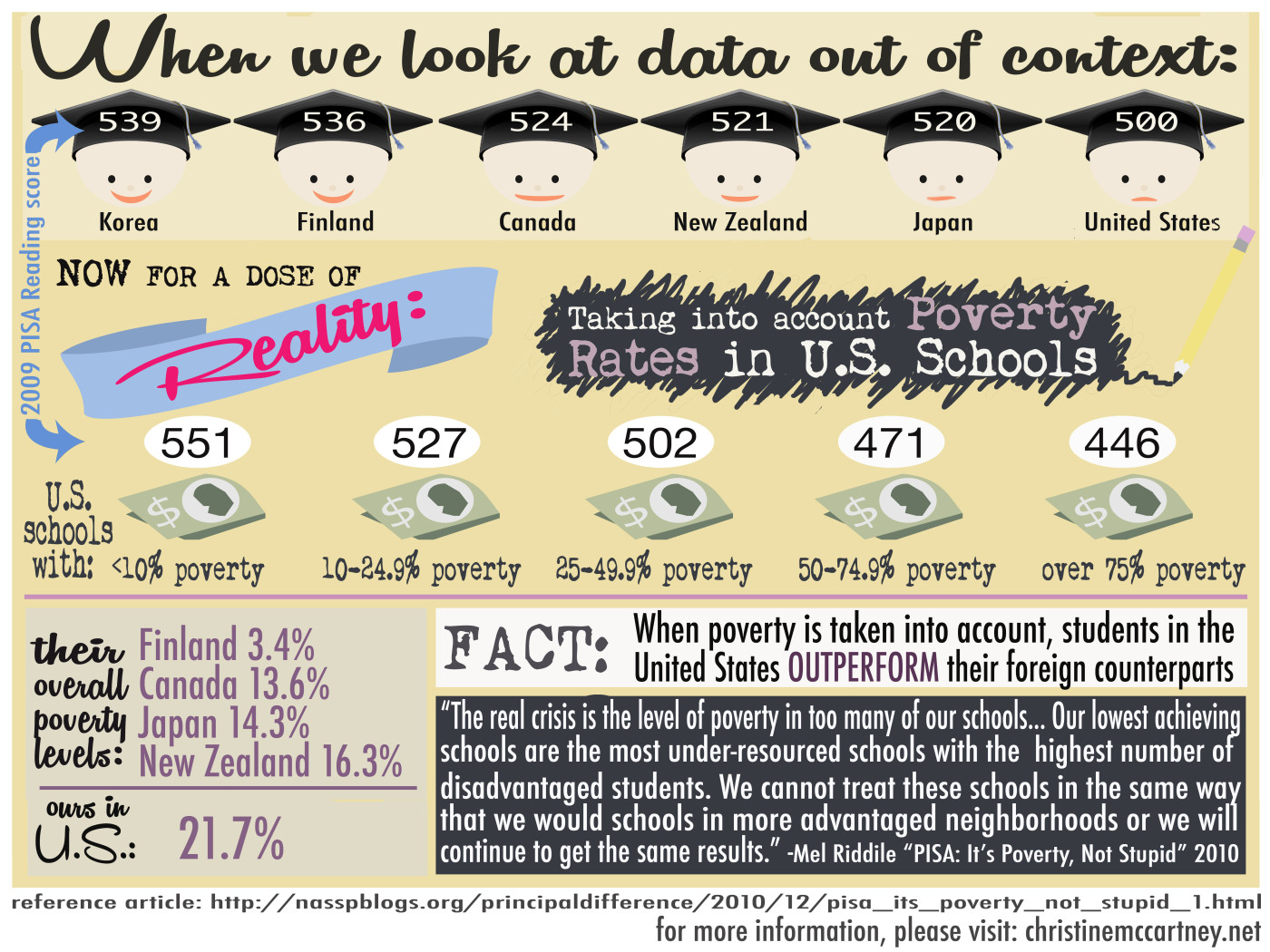
Allow me to grant FES a crumb of fact within all of this: educational opportunities are not equally or evenly distributed throughout this city, just as they are not within this country.  Our nation is deeply segregated by income which becomes in many cases a proxy for segregation by race.  A consequence of this is that communities with notable levels of poverty tend to have high levels of poverty, meaning that in order to function well their schools need substantial funding, funding which is denied to them by state and local sources.  Many such schools struggle to provide their students with what they need, leading to lower educational outcomes and diminished opportunities.  However, Jose Vilson rightly points out that many schools with high levels of poverty actually have excellent programs, skilled teachers, and involved PTAs, and they are unfairly deemed “failures” by groups like FES because of one measure only: standardized test scores.  If such schools were also fairly funded and given the resources and capacity to provide all of the services their students need, they could thrive even more.  This is hardly an isolated case.  The portrayal of schools serving mostly minority and mostly impoverished children as nightmares of uncaring and corrupt adults passing along children without concern is a vicious narrative used to justify poaching off as much as the public system into private hands as possible.  “Families” For Excellent Schools’ preferred solutions actually make matters worse for the majority of students.

FES has only a passing relationship with the truth, as demonstrated by Professor Bruce Baker of Rutgers University.  Dr. Baker thoroughly destroys the group’s argument that more money per pupil in fully public schools actually harms outcomes by demonstrating that the schools with the highest per pupil spending also have the highest concentrations of special education students and students qualifying for free lunch.  Unshockingly, schools with those populations of students need more money per student in general, and achieving higher value added as measured by tests absolutely takes more money.  Dr. Baker’s research further demonstrates that the charter school sector, as currently administered, acts in a parasitic manner, siphoning off students who have lower rates of high poverty, learning disabilities, and language learning needs and skimming the resources the fully public schools need to provide appropriate services for the children who remain.  While high need districts within New York are face serious underfunding by the state’s own formula for school aid, advocates for charter schools like FES simultaneously call for more resources to be funneled from those public schools and dare to call them “failures” for not thriving.
The nerve of FES running an ad accusing the mayor of allowing African American children to languish is failing schools should be obvious – and deeply offensive – to anyone informed on the issue.  There is no doubt that too many schools struggle, but “Families” For Excellent Schools has no actual interest in improving the educational outcomes for all students in New York City.  In fact, extending genuine opportunities to all students in New York City is completely antithetical to their operating principles and would damage their brand management strategies.
Nationwide, the charter school sector has well-crafted approaches to winnow down the families who even apply to enter open lotteries – even in states where they are mandated to use random lotteries to prevent them from cherry picking students.  While Stephanie Simon’s report for Reuters noted that well known charter operators such as KIPP and Success Academy use simple application forms, that does not mean they seek to retain all of the students who make it into their schools.  Success Academy is known, in particular for practices that drive away significant portions of their students as noted here by former New York high school principal and current Executive Director of the Network for Public Education, Carol Burris who noted how Success Academy 1 in Harlem opened with 127 first graders in 2009 but only 82 remained to begin 6th grade (Interestingly, Success CEO Eva Moskowitz denied the accusation of excessive attrition in the comments section, accusing Ms. Burris of ignoring data that showed charter retention was somewhat higher overall than in nearby schools within the city.  Of course, Ms. Moskowitz was citing data for the entire charter sector while Ms. Burris was looking at the original Success Academy, and Ms. Moskowitz consistently fails to acknowledge that district schools have to replace children who leave when new students arrive at any time and that every child who leaves her schools represents a family that sought out Success Academy deliberately.)
Families that do seek out and get to attend Ms. Moskowitz’s schools quickly learn what it takes to remain there.  A parent handbook for Success Academy obtained by FOIL requests shows that Success Academy requires weekend or additional “academy” sessions for repeat “violations” of its requirements.  Excused absences cannot be had for parental illness, transportation problems, or doctor appointments.  Parental reading is a daily requirement in K-2 with no exceptions as is parental oversight of homework – which is given only in English.  While parental involvement is an important aspect for many students’ achievement, Ms. Moskowitz is essentially mandating parents who are both competent in English and who are in work and family situations stable enough to meet those expectations.  A single parent working evenings and whose child care is a relative speaking limited English is going to be unable to fulfill these requirements.
 The Success Academy network is not precisely subtle that it neither has the time to work with students who need even minor behavioral accommodations nor is it willing to keep them.  Kevin Sprowal was a Kindergarten student in Success Academy who had never been in serious trouble for behavior in three years of pre-school was suddenly disciplined constantly to the point that he felt sick at the thought of going to school.  His mother, Katherine Sprowal, received a direct message from Ms. Moskowitz that she interpreted as a veiled urging to transfer, and the school psychologist flatly said her child should be in a different school.  It is hard to take the “open lottery” for Success Academy seriously when it immediately begins to filter out five year olds who turn out to have perfectly manageable attention deficit.
The network’s methods are plainly brutal in many respects. In a special report in April of this year (that, of course, drew indignant responses from Ms. Moskowtiz), The New York Times documented the extreme high pressure placed upon the network’s very young children, including practices that are, in turn, manipulative and plainly abusive:

But at Success Academy Harlem 4, one boy’s struggles were there for all to see: On two colored charts in the hallway, where the students’ performance on weekly spelling and math quizzes was tracked, his name was at the bottom, in a red zone denoting that he was below grade level….

Success has stringent rules about behavior, down to how students are supposed to sit in the classroom: their backs straight, and their feet on the floor if they are in a chair or legs crossed if they are sitting on the floor. The rationale is that good posture and not fidgeting make it easier to pay attention. Some teachers who had orderly classrooms and a record of good student performance said, after their first year, their school leaders allowed them to bend the rules somewhat, such as not requiring students to clasp their hands as long as their hands were still….

Success did not allow a reporter to observe test preparations, but teachers and students described a regimen that can sometimes be grueling.

To prepare for the reading tests, students spend up to 90 minutes each day working on “Close Reading Mastery” exercises, consisting of passages followed by multiple-choice questions. The last two Saturdays before the exams, students are required to go to school for practice tests.

Students who do well on practice tests can win prizes, such as remote-controlled cars, arts and crafts kits, and board games. Former teachers said that they were instructed to keep the prizes displayed in the front of their classroom to keep students motivated.

Students who are judged to not be trying hard enough are assigned to “effort academy.” While they redo their work, their classmates are getting a reward — like playing dodge ball against the teachers, throwing pies in the face of the principal or running through the hallways while the students in the lower grades cheer….

At one point, her leadership resident — what the network calls assistant principals — criticized her for not responding strongly enough when a student made a mistake. The leadership resident told her that she should have taken the student’s paper and ripped it up in front of her. Students were not supposed to go to the restroom during practice tests, she said, and she heard a leader from another school praise the dedication of a child who had wet his pants rather than take a break….

At Success Academy Harlem 1, as the original school is now called, 23 percent of the 896 students were suspended for at least one day in 2012-13, the last year for which the state has data. At Public School 149, a school in the same building, 3 percent of students were suspended during that same period. Statewide, the average suspension rate is 4 percent. (A spokeswoman for Success said that the suspension rate at Success Academy Harlem 1 has since declined to 14 percent, and that several of the newer schools had rates below 10 percent.)

Students who frequently got in trouble sometimes left the network, former staff members said, because their parents got frustrated with the repeated suspensions or with being called in constantly to sit with their children at school…

“We can NOT let up on them,” she continued. “Any scholar who is not using the plan of attack will go to effort academy, have their parent called, and will miss electives. This is serious business, and there has to be misery felt for the kids who are not doing what is expected of them.”

Public shaming.  Extremely narrow behavioral norms for children as low as five.  Extra school work as punishment for not meeting standardized testing goals.  Obsessive focus on standardized test preparation. Open and blatant bribes for children who excel on test based measures.  Children who can quickly adapt to this and perform on tests as expected are welcome at Success Academy.

Which brings us back to chutzpah.  “Families” For Excellent Schools will rally next week with Ms. Moskowitz’s students front and center providing the optics of minority children in need of great schools and opportunities.  They will claim to be there for the “half a million” children “trapped in failing schools” (last year, they claimed it was 143,000) and who need “new schools, now” – by which they mean charter schools in the Eva Moskowitz model.

But those charter schools – and Ms. Moskowitz’s schools in particular – do not want all of those children they will claim to speak for next week.  They want the children whose parents have stable enough work lives and English proficient enough that they can meet all of the out of school expectations without exception.  They want children who do not require any accommodations that would alter their extraordinarily rigid approach to early childhood behavior.  They want children who can immediately adapt at the age of five to excessive conformity, who can handle public shaming and extraordinary pressure, and who will emerge from that environment with high standardized scores.  Everyone else can go pound sand.  More specifically, everyone else can go back to their district schools which now have even higher concentrations of children in high poverty, with serious special learning needs, and with English language learning needs but which have fewer monetary and physical resources with which to help those children.  Far from speaking for half a million kids in need of great schools, “Families” For Excellent Schools will use 1000s of children as props to denigrate the work and efforts of 100s of schools and tens of 1000s of teachers and hundreds of 1000s of other children simply because of their test scores.  Worse, they will call for even more resources to be hoovered out of those schools – even though the “no excuses” charter sector in New York is 100% dependent upon having zoned schools that will take the children they refuse to accommodate.

“Families” For Excellent Schools does not give a damn about most of the children in New York.  Don’t let them get away with claiming they do.

2 Comments

Filed under "Families" For Excellent Schools, charter schools, Social Justice, Testing

The Hunger Strike Ended: The #FightForDyett Continues

A week ago, the hunger strike by community activists in the Bronzeville neighborhood of Chicago fighting to re-open Dyett High School as an open enrollment, neighborhood school with a focus on global leadership and green technology came to a close.  Two hunger strikers had already dropped their action due to growing health concerns, and the remaining members decided that their victories warranted living to fight on.  They have sent a ringing message about the importance of community schools and community voices. Despite the stubborn refusal of Chicago Public Schools to endorse their years in the making plan which included numerous Chicago institutions and thorough research and despite Mayor Rahm Emanuel’s petty refusal to acknowledge the hunger strikers without being forced, there are genuine victories that can be attributed to these activists.  Before the hunger strike, they forced CPS to commit to reopening the school.  During the hunger strike, CPS announced its idea of a “compromise” to make the school open enrollment but without the focus on global leadership and green technology.

Shortly after the hunger strike ended, Jitu Brown, spoke with Robin Hiller of the Network for Public EducationMr. Brown, who participated in the hunger strike, is a lifelong resident of Chicago’s south side, a long time community organizer with the Kenwood Oakland Community Organization, and the national director of the Journey for Justice Alliance.  After briefly describing what must have been the best bowl of soup in his life, Mr. Brown explained to Ms. Hiller what he saw as the strikers’ accomplishments:

“We’re very clear on the accomplishments that have come as the result of, not just the hunger strike, but the work of organized parents and students in Bronzeville. You know, last year we rallied together and we made the district commit to reopening it.  The district tried to run a runaround on us and make it a contract school.  And this year we won that fight, and it will be a public open enrollment neighborhood school. We are in conversation with the district because we will not, we will definitely be part of the infrastructure regarding how that school is developed.  There’s some agreement on using the green technology and global leadership as staples in the curriculum.  So we, at 34 days, as people began to get seriously ill, you had a number of people that had been hospitalized, and the response from the city let us know they would let us rot.  And the fight is bigger than this fight for Dyett High School. We are winning this fight, and we will continue to win it.”

It is important to note that among the dozens of schools closed under Rahm Emanuel’s watch, the Dyett High School campaign is unique in getting a closed school reopened and in preserving it as an open enrollment school governed by the Chicago Public Schools instead of turned over to private contractors seeking to earn profits off of public education.

Mr. Brown was also very clear about the central challenge in the fight for public education — inequity and the glaring examples of it within Chicago that reflect shameful national trends.  While the Bronzeville activists were starving for the sake of an open enrollment school, Mayor Emanuel, who has consistently claimed budget woes while closing schools in predominantly minority communities, unveiled the plans for a $21 million annex to relieve overcrowding at the Abraham Lincoln Elementary School and a $14 million dollar annex at Wildwood World Magnet School — both of which are majority white.  Mr. Brown noted how often it is that the greatest disruption and the greatest deprivation of resources are inflicted upon schools that serve the neediest children – schools that are then deemed failures and turned over to privatized operators:

“There’s a huge fight now that I hope this hunger strike has helped to energize and that is the fight for sustainable community schools not only in Chicago but around the country.  You shouldn’t have cities like New Orleans where the largest base of African American home owners in the United States are labeled as refugees and their city is taken from them. They lose their county hospital. They lose their schools and now virtually every school in New Orleans is run by a private company that makes a profit off of administering what is supposedly a human right.  Children in New Orleans have a perfectly good school across the street but they can’t go because they didn’t win the lottery to go.”

Mr. Brown also expounded upon the challenges that will face the community now that the hunger strike is over and that Chicago Public Schools will move ahead, having signaled they are not open to genuinely listening to the community itself:

“Where we go from here is we sent a message to the district is that you can no longer come into communities and snatch away the institutions that our taxes pay for and that you will respect community voice or you will meet community outrage. What we need to realize now is that the privatization movement needs to die…..There is no such thing as school choice in black communities. This should be a clear illustration of that to everyone. We chose a neighborhood school. We chose global leadership and green technology. And they fought back against it because they are not used to black people practicing self determination. But we have that right as any other community does to say this is what we want for our children.”

This work ahead is going to be difficult.  Already, CPS is signaling that while they moved ahead with Dyett as an open enrollment school, they have no intention of including the community in its operation.  On the 24th, CPS announced that the new principal of the re-opened school will be Bronzeville resident and current principal of Clark Magnet High School, Beulah McLoyd.  While Mr. Brown said that Ms. McLoyd is an excellent educator, he expressed concern that, yet again, the community members who have demonstrated unwavering commitment to the school were not included in any discussions about the school’s leadership.  The Chicago Sun Times also reported that local council elections to run the school will not be held for at least three years, meaning decision making can completely bypass the neighborhood.  As if to drive home this point, CPS held a hearing on the boundaries of the re-opened school, but they held it in the evening on Friday – at their downtown headquarters, almost 7 miles by I-94 from Walter Dyett High School.  From The Sun Times:

“They want to appear with this hearing that they gave the community an opportunity to speak out. But it’s 6 p.m. on a Friday night. This should have been held in the community,” said Bronzeville resident Anthony Travis. “This turnout is what they wanted so they can go back and say, ‘Oh, the community didn’t care.’ But that’s not true. People went on a hunger strike, went to jail for Dyett. I got arrested twice. For them to pull this shenanigan makes no sense.”

The “sense” is sadly the kind of sense all too prevalent in Rahm Emanuel’s Chicago and in many cities whose underfunded and sabotaged schools serve students in poverty: the “sense” of community silence where people from outside the community determine what is or is not available.  Mayor Emanuel’s CPS gave just enough to say to the press that they “met” the protestor’s “halfway” but it will shut them out of every other decision making process for as long as possible.

In the face of that, it is remarkable that Mr. Brown and his fellow activists remain positive, but the vision that drives the #FightForDyett is one that can energize an entire movement to maintain our public education system as a public good as well as an individual good.  Near the end of his interview, he said:

“My lived experience working with children – and I’ve worked with African American children, I’ve taught white children, I’ve taught Latino children – my experience is that all children need is consistency, love, and opportunity. And that consistency has to be constant opportunity, constant equity, constant belief that they can be anything. And that is demonstrated by the places we put them in, the opportunities we give them. Every child can excel. There is no group of people who is better than the others. We are different. You know, we have different cultures, but we all bring something…. and we should not stand for inequity.  Because an inequitable school system an inequitable system denies us the joy of knowing each other. It denies us the joy of building a country together. Building a community together. Building a system together. And we have for too long – I mean our white brothers and sisters, but I mean as Americans period — we’ve ignored the racism that flows through this country, that feeds it like food. We’ve ignored it.”

Constant opportunity. Constant equity.  Constant belief.  And a recognition that as a nation we have a long way to go before we can claim to be past the racist legacy of our history.  That’s a set of core beliefs we should all be able to acknowledge if we truly care about all children.

2 Comments

Filed under #blacklivesmatter, #FightForDyett, Activism, Corruption, Social Justice

Ahmed Mohamed’s Clock And Teachers Checking Themselves

Unless you were on an Internet and media blackout this week, you heard about Ahmed Mohamed, the 14 year old high school student in Irving, Texas whose homemade clock got him detained by police and suspended from school for making a “hoax bomb.”  Young Mr. Mohamed is an avid tinkerer and builder who is frequently photographed in a NASA t-shirt and whose fondest wish is apparently to attend the Massachusetts Institute of Technology, and his clock was one of his many home projects which he wished to share with his engineering teacher. Unfortunately, another of Mr. Mohamed’s teachers was suspicious of the clock, failing to understand that wires, circuit boards, and LED displays do not explode, called in administrators who called in police, and the result was Mr. Mohamed finding himself detained in handcuffs and then suspended from school:

Unfortunately, Irving Mayor Beth Van Duyne openly defended both the school and the police, and actually voiced  concern that the incident could deter police from investigating potential threats instead of showing the least concern that bright and inquisitive student inventors are already deterred from letting anyone know they love science and inventing.  Then again, Mayor Van Duyne is known for campaigning against imaginary threats of Sharia law, so we should not expect much.

The chief of police in Irving, Larry Boyd, also defended his officers, even while admitting that they determined quickly that the clock was not a bomb.  Given that information, Mr. Mohamed’s detention and suspension are even more outrageous, and the insistence of authorities that those actions were justified because they believed the clock was a “hoax bomb” looks like a pathetically thin cover for a series of prejudiced assumptions.  Mr. Mohamed never said that his clock was a bomb and demonstrated no interest in trying to trick people into thinking it was a bomb.  The school obviously concluded it was not a bomb very quickly since they took no actions to get students to safety.  To believe the “logic” of school officials and the Irving police, you have to believe that the word “hoax” requires only the ignorant assumptions of others rather than any intention to deceive on the part of the accused.

Mr. Mohamed's Next Invention?

Mr. Mohamed’s Next Invention?

From one perspective, Mr. Mohamed’s misfortune has yielded some positive results. As his story circulated, he gained positive feedback from national leaders and figures in technology and innovations.  President Obama’s twitter feed issued an invitation to take the clock to the White House:

Facebook CEO Mark Zuckerberg gave Mr. Mohamed a standing offer to visit the company headquarters and meet him:

As did Google:

https://twitter.com/googlescifair/status/644219471469629440

He got a shout out from NASA:

And, perhaps the icing on the cake, an astrophysics professor from MIT invited the young inventor to visit the campus, and said he was the kind of student the institution likes.

So – there’s a bit of lemonade from this.

Which is good because it is disgraceful that it came to a point where any of us have heard of Ahmed Mohamed.  Instead of being given the kudos and encouragement he deserved from those who knew him and were entrusted with his well being, he was humiliated and punished for nothing more than being a curious and inventive student.  Assume for a moment, that his English teacher’s confusion and suspicion of the clock was justified.  I don’t actually want to because it betrays a really staggering amount of STEM illiteracy to look at an LED display, a circuit board, some wiring, and a plug for a wall outlet…

Note the complete lack of explosives.

Note the complete lack of explosives.

…and fail to conclude that it is safe.  But fine, assume the English teacher was not reacting out of absurd and prejudiced impulses.  The entire issue could have been settled in less than a minute with the following conversation:

English Teacher: “Hi, Ahmed.  What’s that thing that beeped?”

Ahmed: “Oh, it’s a clock I made at home and brought to show my engineering teacher.”

English Teacher: “You made a clock at home? Yourself?”

Ahmed: “Uh-huh.”

English Teacher: “That’s pretty cool! Can you show us how it works?  Then maybe make sure it doesn’t interrupt class again, please?”

There, done. “Problem” solved. No national story, here.  Just a kid getting an appropriate level of recognition for doing something cool.   Instead, the sequence of events went like this: His English teacher KEPT the clock (despite claiming it looked like a bomb), Mr. Mohamed was pulled out of a later period by the principal and a police officer, he was queried about trying to make a bomb whereupon he repeated that he had made a clock, taken from school to the police station, handcuffed, fingerprinted, questioned without his parents where he said his last name was brought up repeatedly, and accused of bringing a “hoax bomb” to school with three teachers listed as complainants. The police claimed that Mr. Mohamed was being “passive aggressive” with them, and claimed “We attempted to question the juvenile about what it was and he would simply only say it was a clock. He didn’t offer any explanation as to what it was for, why he created this device, why he brought it to school.”

Here’s a little explanation for the officers: It’s a clock. It tells time.  If Mr. Mohamed made a clock and would “only say it was a clock” it is probably because it. is. a. clock.

Look, running a school is a difficult and uncertain business, constantly fraught with circumstances you never expected.  One of my favorite stories illustrating how hard it is to be school principal is from some years back when an elementary school in Montana had to make a new rule for show and tell after a student’s mother brought a dead bat in a shoe box — and 90 kids had to get rabies shots.  Imagine the poor school principal having to revamp the school rules in the wake of that.  The school probably had anticipated various things not appropriate for show and tell, but I am betting nobody had ever thought of a “please do not bring in diseased infested carrion you found in your barn”.  That’s the sort of thing that makes running a school and a classroom so unusual – you can think of every possible circumstance imaginable, but 25 kids and their parents and guardians can almost always confound your imagination.

So schools are charged with keeping everyone safe within their walls, and we live in an age where schools have tried to respond to real and imagined threats with especially harsh rules that have ugly consequences.  But what happened to Ahmed Mohamed had nothing to do with keeping the school safe. His teacher suggested the clock looked like a bomb despite what he told her, but she kept it instead of immediately evacuating the classroom. Mr. Mohamed was questioned by the principal and the police that the administration had summoned without asking for a bomb disposal specialist.  Mr. Mohamed repeatedly said to his teacher, to the administration, and to the police that he had made a clock, and yet he was finally accused of making a “hoax bomb” despite trying to to tell everyone and anyone who would listen that it was a clock – which it is – making the “hoax” accusation laughable.

At every stage of this disaster, the adults who had authority over Ahmed Mohamed and who had professional and ethical obligations to care for his rights and well being could have stepped back and stopped, but they did not.

It is impossible to escape looking at the very real likelihood that he was suspected of mischief because of prejudice against his name and his religion. None of the adults gave him the benefit of the doubt, and even though they had to have quickly concluded that the clock was entirely safe, they still could not entertain the notion that he had made it and brought it to school for the understandable reason that he wanted to show off what he could do for a teacher he hoped to impress.  Instead of backing off, they doubled down on their initial errors, compounding them with new ones.  Instead of acting to keep their students safe, they invented an entirely bogus reason to justify their initial prejudice, and violated the rights and trust of a young man who ought to have impressed them.

Teachers and administrators are not perfect people.  We have prejudices and irrational impulses, and it is impossible to banish all of them from our actions every single day.  But it is absolutely vital to pause and check yourself.  Ahmed Mohamed’s English teacher could have settled this with a simple and quick conversation.  If that teacher insisted on clearing that impression with an administrator, that person should have quickly recognized the innocuous nature of the clock and returned it.  At worst, the principal could have had a simple conversation with the young man and logically understood that when someone keeps calling a clock a clock, it is ridiculous to assume he intends to trick people into thinking it is a bomb.  Ideally, the educators involved should have been embarrassed by their initial assumptions and fears and what spawned them, but at a minimum, they should have recognized their responsibility to Ahmed Mohamed as soon as it was obvious that he had a clock.

Unchecked prejudices lead to unfounded fears, and in this case, they led to far worse.  Every teacher has to be aware of her or his personal flaws and prejudices, and has to constantly check her or his actions against them to strive for fair and ethical treatment of every student.  Nobody did that for Ahmed Mohamed.

12 Comments

Filed under Media, racism, Social Justice, teaching

#FightForDyett Puts Parents’ Actual Bodies on the Line for Fully Public Education

On August 17th, a group of 12 parents and community activists in the historic Bronzeville section of Chicago began a hunger strike to preserve the last open enrollment high school in their community.  Their fast, where they have consumed nothing but water and light liquids such as broth, is now in its third week, and even though they managed to get Chicago Mayor Rahm Emanuel to meet briefly with them after a contentious town hall style budget meeting yesterday, no commitments were made that satisfied their needs.  So they continue their hunger strike, despite the adverse effects on their health, and a public plea from a coalition of health professionals urging the Mayor to taking action on the strikers’ issues to prevent a tragedy.

Despite the insulting tone argument that The Chicago Tribune’s Eric Zorn recently offered, chiding the Dyett hunger strikers for their tactics, this action is not taken rashly and is the result of a true community coalition being rebuffed at every turn.  The Bronzeville neighborhood of Chicago is one of America’s most historic African American communities and was a major destination for African Americans seeking a better life during the Great Migration.  In 2012, Chicago Public Schools announced it would “phase out” and close Dyett High School which is the last open enrollment high school for Bronzeville, and this year the CPS accepted three proposals for a new school in the building, two from outside organizations and a proposal for a “Global Leadership and Green Technology” school submitted by the Coalition to Revitalize Walter H. Dyett High School.  The coalition, which has been advocating all along to keep the school open and to transform it into the leadership and green technology school based in the community, has played by every rule and procedure put in front of it by Mayor Emanuel’s school department, seeking to keep their voices and the voices of their neighbors heard.

The process, however, has been repeatedly delayed, most recently with an August meeting pushed out to September, which precipitated the decision to begin a hunger strike:

And the strikers remain there, outside a shuttered high school that, as Peter Greene rightfully points out, was actually improving before the central office decided to abandon it and where an entirely community based proposal for its future remains ignored and stalled by a city bureaucracy more interested in opportunities to gentrify than in building up communities. They are now in their third week without solid food, waiting for the city to answer them.

Especially significant is for what the Dyett hunger strikers have put their bodies on the line. Dr. Julian Vasquez Heilig details a timeline for Dyett High School since 1999 when it was converted from a middle school that seemed almost intentionally to court failure.  Nearby King High School was turned into a selective enrollment school, and CPS converted Dyett into a high school that opened with only 7 books in its library and unequipped science labs.  Community members worked to build up the school which is where students who do not qualify for King go, and then in 2006, CPS closed Englewood High School, sending an additional 125 students to Dyett with no additional resources.  Despite this, the community continued to invest in Dyett and its future and then in 2012, CPS announced plans to phase out and close the school.  At every point, community organizations and parents have worked together to help develop a school community within Dyett, and at every point, authorities outside of Bronzeville have hurled wrenches into those efforts.

If Walter H. Dyett remains closed or if it is replaced with schools that do not have open enrollment, there will be no high school in Bronzeville that is truly the responsibility of the entire community.  While education reform touts parental “choice” as a cure-all for urban education, it is far too often comprised of “any choice but a democratically organized and locally comprised school.”  The ideal of an open enrollment, neighborhood, school is not merely an organizational choice for school departments.  It is a profound expression of the democratic ideal and of communities’ investments in themselves.  A truly public school is open to everyone who lives in its zone with no exceptions, and it is bound by law and by professional morality to do its utmost for every child regardless of race, socioeconomic circumstances, or special needs.  Public schools cannot counsel out or harass students with special needs until they give up and transfer somewhere else, and while it would be incorrect to assert that our urban and predominantly minority public schools have always lived up to these ideals, when properly supported and given investments in facilities, staff development, and surrounding community development, they remain one of the truest expressions of democratic equality in our society and are bedrock for their neighborhoods.  Consider the stunning investment in architecture that was once expressed in Chicago’s public schools for a nice visual understanding of how important these ideals were and wonder at what children must have thought when brought to the doors of these buildings.

The point is not lost to note that as neighborhoods became more and more minority over decades such grand investment vanished.  Organizer and now hunger striker Jitu Brown expressed this eloquently last year as he questioned CPS’ plans for Dyett:

Why can’t we have public schools? Why do low-income minority students need to have their schools run by private contractors? We want this school to anchor the community for the next 75 years. We’re not interested in a short-term contract that can be broken.

And there may be more at stake than the consequences to Bronzeville if Dyett is not allowed to reopen as an open enrollment school.  Chicago teacher and activist Michelle Gunderson notes:

For those of us who have witnessed the privatization of our school systems, we know all too well what is at stake if Dyett High School no longer is in the hands of the community. Once we have one neighborhood without an open enrollment high school it will be all too easy for subsequent parts of our city to fall like dominoes, creating a system of privatized schools.

Perhaps that goal makes sense to people who only envision disruption and competition as vehicles of improvement over investment and cooperation, but to lose all fully public schools is to lose far more than a system of governance.  It is to lose community identity, shared responsibility for community youth, and institutions purposed for democratic equality.  Hunger striker Monique Smith told The Washington Post, ““This is really about the privatization of education, it’s about having sustainable community schools in every neighborhood…This is a much larger struggle.”

That this should happen in Bronzeville — which Eve Ewing reminds us is historically significant for its role in The Great Migration and for the African American intellectual, literary, and political leaders who have called it home — is an even more significant blow in a time when black activists have organized to highlight the violence state sanctioned actions have inflicted against their bodies.  It is not an exaggeration to observe that the deliberate neglect and subsequent closing of Walter H. Dyett High School is an act of state sanctioned violence against the community body of Bronzeville.

And now 12 brave activists have called upon a long tradition of direct action and placed their actual bodies on the line for the sake of their community and whether or not it will be deprived of a core democratic institution.  If you believe that Mayor Rahm Emanuel and Chicago Public Schools are long overdue to respond to that injustice, call (773) 533-1500 to leave a message for CPS CEO Forrest Claypool.  It is week three.  Enough is enough.

Leave a comment

Filed under #blacklivesmatter, #FightForDyett, Activism, charter schools, Social Justice

“The Fierce Urgency Of Now” – Social Justice Must Be Educators’ Mission

On June 17th, 2015, the 21 year-old Dylann Storm Roof, entered the historic Emanuel African Methodist Episcopal Church in Charleston, South Carolina.  The church, led by the Reverend Clementa Pickney who, in addition to his pulpit, was a state senator, is the oldest traditionally Black Church in the South and has long been a fixture of the struggle for emancipation and civil rights during its almost 200 year history.  According to witnesses, Roof sat down with the dozen people participating in weekly Bible study for nearly an hour before he stood up, took out his pistol and began shooting.  Before he was done, he had reloaded multiple times and left 9 people dead, including Reverend Pickney.  Survivors quickly reported that when his victims implored him to stop, Roof told them, “I have to do it.  You rape our women and you’re taking over our country.”

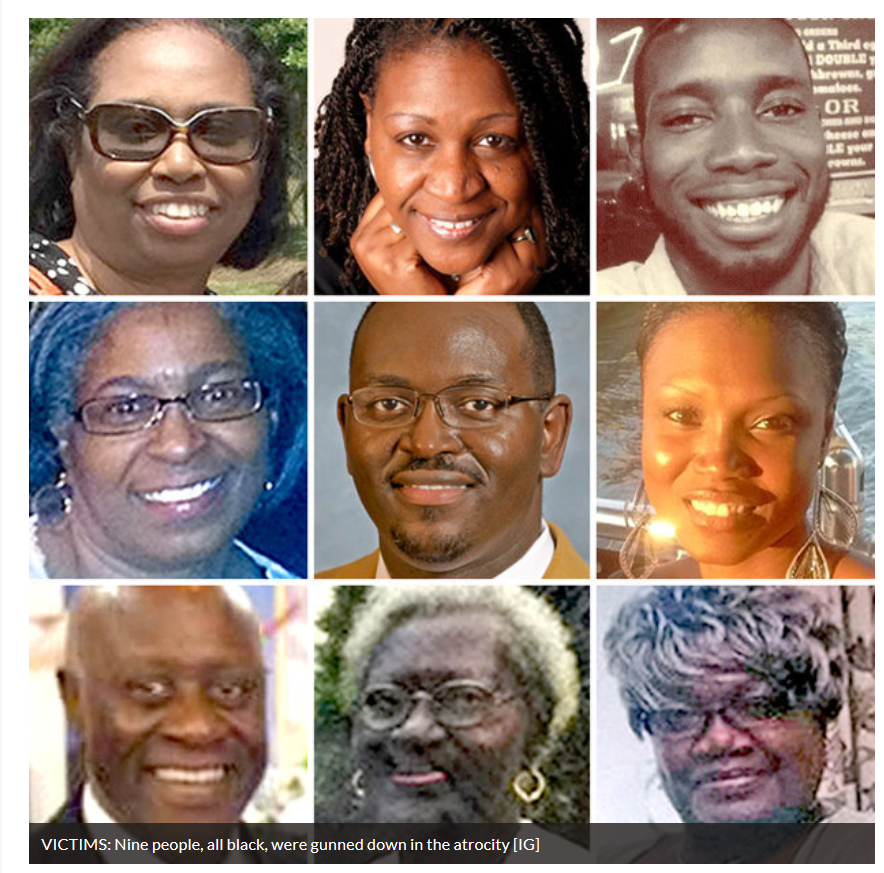
Roof’s victims are Tywanza Sanders, 26, who stood between Roof and his elderly aunt to try to convince him to put away his gun, Sharonda Coleman-Singleton, 45, a school speech therapist and girls track and field coach, Cynthia Hurd, 54, a librarian for over 3 decades, DePayne Middleton-Doctor, 49, admissions coordinator for Southern Wesleyan University, Ethel Lee Lance, 70, a sexton at Emanuel Church who had worked there for over 30 years, Susie Jackson, 87, Mr. Sanders’ aunt and longtime attendee at Emanuel Church, Myra Thompson, 59, a visitor from Holy Trinity Episcopal Church who had joined the evening’s Bible study, Reverend Daniel Lee Simmons, Sr., 74, also a visitor to Emanuel Church, and Reverend Clementa Pickney, 41, senior pastor of Emanuel Church and state senator in South Carolina.

The victims of Wednesday's racist terrorist attack.

The victims of Wednesday’s racist terrorist attack.

Dylann Roof, who is white, was captured by police on Thursday. Pieces of his story are emerging, but it was evident early in the case that deeply rooted racial hatred motivated him.  The survivors’ statements make that clear.  His selection of one of the most historic icons of the struggle to abolish slavery and to reach legal equality for African Americans makes it clear.  His own profile picture on Facebook where he is displaying the flags of Apartheid-era South Africa and Colonial Rhodesia, both nations where minority white populations governed to the exclusion of the black majority, makes that clear:

Roof Racist

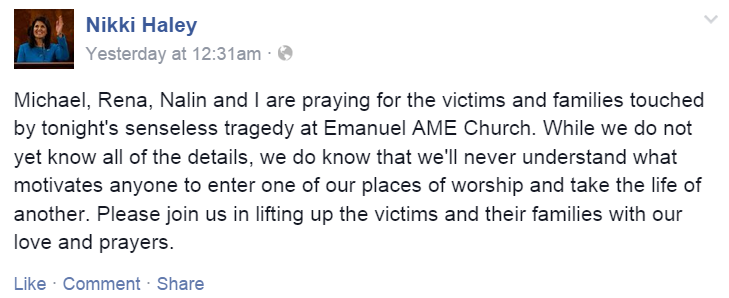
And yet, the next morning, when enough of the story was directly in our faces to know that racism and a desire to instill racial terror was front and center, a national media outlet and some political figures were attempting to obfuscate that truth.  South Carolina Governor Nikki Haley, the first woman elected to the governor’s office in South Carolina, and one of only two women of color elected to a governor’s office in American history, issued a statement stating “we’ll never understand what motivates anyone to enter one of our places of worship and take the life of another.”

Haley

South Carolina Senator and candidate for the Republican nomination for President, Lindsey Graham, when asked if the shooting was a hate crime or an act of mental illness, responded saying “Probably both. There are real people out there that are organized to kill people in religion and based on race. This guy is just whacked out…But it’s 2015, there are people out there looking for Christians to kill them.”  Senator Graham also defended the Confederate Battle Flag which, due to a quirk of South Carolina law, flies over a memorial adjacent to the state capitol and is the only flag not flying at half mast today.

As the story unfolded, more Republican candidates obfuscated Roof’s obvious intentions.  Former Florida Governor Jeb Bush initially danced around the question of whether or not Roof was motivated by racial hatred.  Former Pennsylvania Senator Rick Santorum declared the killings an “assault on our religious liberties” without apparently mentioning the racial component of the crime.  Former Texas Governor Rick Perry was more willing to attribute Roof’s murders to psychiatric drugs than to racial hatred.

On Thursday morning, Fox’s morning show, Fox & Friends, went out of its way to portray the murders as an attack on Christianity, deliberately setting aside the nature of the church that was attacked and what the survivors were already reporting.  Co-host Elisabeth Hasselbeck even went so far as to comment about how “we’re not safe in our own churches” as if Roof’s intention were not perfectly clear and he could have just as easily murdered people in Hasselbeck’s church.

Is someone confused here?

Is someone confused here?

The Wall Street Journal, in an editorial where they said that Roof’s murders were caused by “a problem that defies explanation” went on to state, categorically, that the institutional racism of the 1950s and 1960s that allowed acts of racist terrorism to go unprosecuted no longer exists.  While it is fair to say that the overt White Supremacy of the past is greatly diminished and the influence the Klan once held over elected officials and judicial proceedings is basically no more, it is a horrendous dismissal of reality to say institutional racism no longer exists, and to claim that Dylann Roof’s professed White Supremacist motivations have no explanation.  The disparate impact of policing policies of the past three decades on African Americans is not disputable, and we know that when individuals bring their racial prejudices into positions of institutional authority, that can lead to serious economic discrimination.  And in a very embarrassing example of the power that racism still holds, Earl Holt, the president of the Conservative Citizens Council, whose website apparently helped to radicalize Dylann Roof until he pledged himself to starting a race war, has been a generous donor to Republican politicians — many of whom are now returning his money or donating it to charity.

To their credit, many of the Presidential candidates who have waffled on Roof’s motivation, have now joined Governor Nikki Haley in stating that it is time for the Confederate Battle Flag to be taken down from the memorial adjacent to the state capitol building.

I wish to be very clear here.  What the hosts and producers at Fox & Friends did, and, to a lesser degree, what Senator Graham and Governor Haley, did is an act of erasure.  There is no doubt about what motivated Dylann Roof’s terrorism.  There was no doubt on Thursday morning even though the production team of a major morning program mightily tried to remove it from their “discussion.”  Hasselbeck said the attack happened at a “historic church” rather than a “historic BLACK church” and that omission could not have been more deliberate or more outrageous.  The 200 year history of the Emanuel African Methodist Episcopal Church is wrapped inextricably to the struggles and triumphs of the African American community in the South, and they did nothing less than try to erase that entire history out of some perverse desire to not name racist terrorism inspired by the very worst in our national heritage for what it is.

I do not know the true motivation behind those who cannot bring themselves to unequivocally state that racial hatred and White Supremacy is what drove Dylann Roof to his actions.  Perhaps they are racists themselves and sympathize with Roof’s seething hatred and fear of black people.  Perhaps they are cynical and see more political utility to casting this as an unknowable act of barbarity or as part of a larger script about religion being under attack.  Perhaps they know that a minor but potent part of the constituency and audience are sympathetic to Roof’s motives if not his actions and will respond negatively in the polls or ratings if they hear White Supremacy called out in public.  Whatever the reason, there is nothing admirable in failing to call Dylann Roof exactly what he is: a White Supremacist who deliberately chose one of the most iconic symbols of the African American community for an act of terrorism as devastating as any in the 1950s and 1960s.

Jon Stewart, setting aside his normal comedic monologue in favor of more sober reflection perhaps summed up that phenomenon perfectly:

I heard someone on the news say “Tragedy has visited this church.” This wasn’t a tornado. This was a racist. This was a guy with a Rhodesia badge on his sweater. You know, so the idea that — you know, I hate to even use this pun, but this one is black and white. There’s no nuance here.

And we’re going to keep pretending like, “I don’t get it. What happened? This one guy lost his mind.” But we are steeped in that culture in this country and we refuse to recognize it, and I cannot believe how hard people are working to discount it. In South Carolina, the roads that black people drive on are named for Confederate generals who fought to keep black people from being able to drive freely on that road. That’s insanity. That’s racial wallpaper. That’s — that’s — you can’t allow that, you know.

Nine people were shot in a black church by a white guy who hated them, who wanted to start some kind of civil war. The Confederate flag flies over South Carolina, and the roads are named for Confederate generals, and the white guy’s the one who feels like his country is being taken away from him. We’re bringing it on ourselves. And that’s the thing. Al-Qaeda, all those guys, ISIS, they’re not s— compared to the damage that we can apparently do to ourselves on a regular basis.

And this is where the role of educators has to be considered very seriously.  The victims of Dylann Roof are the latest in a long history of attacks against crucial landmarks in the lives of our African American countrymen and women and against their very lives themselves.  The Black Church has been a cornerstone of African American community and activism for centuries, and its role has subjected it to repeated and vicious attacks from the original Klu Klux Klan of Confederate General Nathan Bedford Forrest, through the rise of the Second Klan in the 1920s and the waves of riots and violence inflicted upon African American communities across the country, to the waves of violence against the Civil Rights movement in the 1950s and 1960s.  White Supremacy and Apartheid always defended itself through violence and terrorism, and while the struggles of the mid-20th Century may have legislatively defeated those institutions, we did not stamp them out of existence.  Roof’s attack on a historic Black Church was the first deadly attack since the 1963 Alabama bombing and 1964 murder of civil rights workers, but it was by no means the only attack on a Black Church in the past 52 years.

Americans may like to imagine that we left White Supremacy behind with the 1960s, but it is clear that the hatred still seethes within many of our countrymen, and it is very clear that it boiled over in Dylann Roof spurring him to annihilate members of the Charleston black community as they studied the Bible in one of the cornerstone institutions of that community.  And it happened in a state where a sitting United States Senator and Presidential candidate still feels the need to defend the state sponsored flying of a flag that led 100s of 1000s of men into battle to keep blacks in bondage.  There is no ambiguity here.  Roof is a vicious racist inspired to act by the still present legacies of White Supremacy which we refuse to confront boldly and bluntly.  He apparently self radicalized by immersing himself in an online world where White Power advocates work collectively to stir up racial hatred and to advocate for race war — an advocacy that Roof took to its next logical step.

The result is an act of abject terrorism meant to make people feel unsafe in their most precious institutions, which deprives the black community in Charleston of beloved mentors and family members, and which deprives the state of South Carolina of a remarkable, young spiritual and political leader whose potential for good seemed limitless a few days ago:

As a scholar, as an educator, and as a member of a community still seeking racial justice, it is my obligation to passionately denounce not merely Roof’s act of racist terrorism, but also to denounce those who want to strip it of its historical and social contexts and leave it “merely” as the act of one, lone, troubled young man for which none of the rest of us have any responsibility.  That is a lie.  And it can only be confronted by a passionate and genuine commitment to social justice and for speaking out in defense of social justice.  We cannot allow either the media or our leaders to murder both history and the truth when speaking about Charleston without hearing from us.

The martyrs in Charleston — The Honorable Clementa Pickney, 41, Tywanza Sanders, 26, Sharonda Coleman-Singleton, 45, Cynthia Hurd, 54, DePayne Middleton-Doctor, 49, Ethel Lee Lance, 70, Susie Jackson, 87,  Myra Thompson, 59, and Reverend Daniel Lee Simmons, Sr., 74 — deserve our resolve and our dedication to social justice.

6 Comments

Filed under #blacklivesmatter, Activism, racism, Social Justice

Dear Hillary – 2015 Version

Dear Secretary Clinton:

You have been a declared candidate for the Democratic nomination for President of the United States since April of this year. While your campaign for the nomination is quite new, many in the press treat your eventual victory as fait accompli, and have turned their attention to the growing Smorgasbord of candidates on the Republican side of the contest. Given the nature of Presidential politics today, this is probably good news for you as potential rivals for the Oval Office will now spend months of news cycles savaging each other and weakening the eventual Republican nominee.

It also gives you time to hone positions and messages while the national press endlessly opines on which Republican can win over the Tea Party and major donors simultaneously. I have a few modest proposals on education.

You enter this contest with some disadvantages on national education policy.  Having been a national figure for nearly a quarter century, you have spoken often, and often quite well, on the promise of public education and how we should support it.  However, your public career is also closely associated with neoliberal influences within the Democratic Party, and in education policy, that influence is typified by the John Podesta founded Center for American Progress which is a proponent of standards, standardized testing, evaluating teachers via standardized tests, expanding charter schools that take public money but are privately managed, and eliminating or significantly changing teacher workplace protections. Lately, a number of people have been circulating the 18 page missive you were sent in 1992 by Marc S. Tucker of the National Center on Education and the Economy which details a comprehensive and far more centrally controlled vision of education with now familiar emphasis on standards creating a “seamless system of unending skill development.”  Dubbed the “Dear Hillary” letter, Mr. Tucker’s vision is seen by many as a precursor of the current system of education “reform” which uses standards and testing to reduce variance among states, constantly talks about “college and career readiness” and making students meet nationally derived standards, holds teachers “accountable” to all students meeting standards, and reduces traditional governance and union influence to create “choice”.

Whether or not Mr. Tucker’s letter actually began the process to the 2015 school reform landscape or not isn’t germane to the fact that many connect his letter to you and ascribe its agenda to your candidacy.  This may be quite unfair, but it is also a reality in the national school reform debate into which you have entered as a candidate.  You must understand the degree to which we face a crisis in confidence among teachers and parents that has been growing for the past 14 years and which shows no signs of dying down by the general election campaign next year.  After years of struggling with the provisions of the No Child Left Behind Act, teachers had hoped that President Obama’s campaign rhetoric would result in recognition that unrealistic expectations and heavy emphasis on test-based accountability had damaged schools and teaching.  Instead, the new administration used the promise of funding and of waivers from NCLB’s most punishing provisions to rush the Common Core standards into adoption across the country and, far from reducing the influence of standardized, to use tests to evaluate teachers.  At the same time, a coordinated effort is underway across the country to challenge teachers’ workplace protections and to use campaign donations to influence politicians to join the fight against teachers’ unions and against traditional public schools.

Madame Secretary, you enter the campaign for the Presidency at a time when teacher morale has dropped precipitously, with those saying they are “highly satisfied” at work falling by 30 percentage points in the last six years.  The federal role in education will play a part in the upcoming election, and an unusual mix of our body politic opposes various aspects of that role for various reasons.  It would be a grievous mistake on your part to misread the criticism as solely the work of right wing activists or, as Secretary of Education Arne Duncan has done, the province of suburbanite mothers offended by the notion that their children are not brilliant. Among those opposed to or concerned with the past decade and a half of education reform are scholars warning that key elements of the reform agenda have little basis in research, parental and advocacy groups concerned about the detrimental influence of reform on curriculum, schools, and children, and a slowly increasing presence in civil rights and community justice groups recognizing that reform is tearing the heart out of communities and threatening equity without involving stakeholders in the process at all.

Your path to the nomination and to the Presidency probably does not require you to listen to these constituencies because deeply connected and extremely influential donors are tied to the reform movement, but your ability, if elected, to hit a “reset” button on our national education debate and to set a course forward that honors all stakeholders in our national education commons does require it. With respect, I would like to offer my own set of priorities for you to consider as you seek office, and I promise that it is briefer than Mr. Tucker’s.

Let states stay or go from the Common Core State Standards as they see fit.  Recently, you spoke with some dismay about how a “bipartisan” agreement to raise educational standards has now become political.  That take on the CCSS situation assumes that there was nothing political about the standards to begin with, and there I must disagree.  It is true that the National Governors Association agreed to take on the proposal to write a set of common standards and did so without falling along typical party lines.  But there are several aspects about the CCSS that were political from the very beginning and which are not made apolitical simply because they were not partisan.  First, the assumption that American education is in deep crisis and that we are “falling behind” other nations is a deeply political assumption that rests on a significant cherry picking of the available data and by concentrating on the worst possible reading of that data.  The “failure narrative” has been a central player in our education debate since the Reagan Administration released A Nation at Risk in 1983, but its underlying assumptions have been problematic from the beginning.  David Berliner and Gene Glass make it clear that the failure narrative is a deliberate lie that proposes that our entire school system is in crisis when when we have very specific problems with some of our schools and those problems are tightly coupled with concentrated poverty in communities.  The premise that we MUST have common standards if we are to not “fall behind” other nations is a premise steeped in a political agenda to require a massive change in how we administer one of the core institutions of our democracy.

Further, while the organizations that initiated the CCSS may have cut across political lines, politics at the federal level was essential to having 43 states and the District of Columbia adopt them.  When the Obama administration came into office, the CCSS project, already enjoying massive support from the Bill and Melinda Gates Foundation, received boosts from the Race to the Top program and offers of waivers from certain NCLB provisions.  How far would the Common Core State Standards have gone without these federal enticements? We will never know, but it is safe to assume that their adoption was given considerable velocity by these incentives which is staggering when you realize that the standards were proposed, allegedly researched, written, signed off on by various committees, and adopted in over 40 states in less than 4 years.  Advertising and political campaigns move that quickly — careful, deliberate, research-based overhauls to K-12 standards in English and mathematics do not, especially if they follow widely accepted processes for including a wide array of stakeholders and maximizing transparency.

How free are states to leave the the “state led” Common Core effort?  That’s an open question. Virginia, for example, never adopted the CCSS, and they have an NCLB waiver from Secretary Duncan’s DOE.  Washington state, however, lost its waiver for not being quick enough to implement another element of education reform — adding student growth on standardized tests to its teacher evaluation system.  How would the current USDOE respond to a state trying to back out of the Common Core?  I do not know, but I do know that if the standards have actual educative value, and many people sincerely believe that they do, then the federal leverage that has been used to put them in place, needs to be removed so that proponents and opponents can have the open and honest debate about common standards that never took place.  States should develop plans for careful implementation and development if they want to stay on board, and time must be given for the development of quality material aligned with the standards.  And states should be feel free to drop the CCSS and take a “wait and see” approach to study how other states’ implementation efforts are going.

But if you, as a candidate, like what you see in the Common Core, then your best way to get them unpoliticized is to recognize the politics that went into their development and adoption, and to give states absolute assurance that they can take their time in making them work or abandon them without consequence.

Reject teacher evaluations based upon student growth models.  The appeal of student growth models is obvious.  Using student testing data, growth models promise to free teacher evaluation from excessive subjectivity and local politics by using sophisticated statistical tools to isolate teachers’ input into the variation among student scores and properly rank teachers by their effectiveness.  Such a tool promises to leverage the power of data into making certain adults are accountable for the most crucial work of school — helping students reach their full potential.

Unfortunately, they don’t work.

Value added models (VAMs) and other related growth models are simply not up to the task of taking a snapshot of student performance in one year of school, completely isolating the teacher impact upon test scores, and producing a stable and reliable measure of teacher effectiveness.  The research body on this is growing and crystal clear: we should not be doing this, and by doing this we are only making it impossible for a teacher with an eye for survival to not teach to the test.

Despite this, Secretary Duncan has not only continued to support growth measures in teacher evaluation, he has proposed measuring the “effectiveness” of teacher preparation programs by the value added measures of their graduates.  In New York State, Governor Andrew Cuomo pushed for and got a revised teacher evaluation system where half of teacher effectiveness ratings are tied to standardized test scores.

If you want to restore balance and sanity to the education reform debate, you will pledge to appoint a Department of Education that backs off of growth measures and actually listens to the evidence that we do not have either the tests or the statistical tools to make this work, and that the consequences in the form of narrowed curricula and increasing the pressure associated with testing are unacceptable.

Praise innovation in education — but only from people telling the truth. Chicago Mayor Rahm Emanuel praised the Noble Charter School network for having found the “secret sauce” for improving academic performance — based on the schools’ test scores.  It turns out that an ingredient in that sauce is a system of cash fines for even small infractions to its strict disciplinary code, a practice that landed one unemployed single mother with a bill for $3000.

When the idea of a charter schools was first proposed to provide a system of small and innovative schools who would work with the most difficult children and feed their ideas to the system as a whole, it is doubtful that anyone expected schools that would turn its disciplinary code into a revenue stream, but the charter sector is sadly rife with schools claiming superior results while engaging in deceptive practices.  The “no excuses” brand of charters, to which Noble belongs, is especially guilty of this as they continuously compare their test scores to fully public schools in their districts, but then take their population of students, already skimmed via complex application processes for their lotteries, and further trim them with practices aimed at driving away students whose needs they refuse to accommodate.  Matthew Sprowal of New York City found this out when he won a lottery seat at Eva Mokowitz’s Success Academy but was quickly subjected to disciplinary practices that had the Kindergartener regularly throwing up and asking his mother if he would be “fired” from school.  His is not an isolated case in the network that is known for extremely strict discipline and an emphasis on test preparation that can overwhelm the rest of the curriculum.  They are hardly alone in this.  Dr. Bruce Baker of Rutgers University took a humorous look at the Uncommon Network school in Newark, New Jersey, North Star Academy, and he found that their claims of getting superior results from the same population of children as the district is completely deceptive.  It turns out that North Star has many fewer students who qualify for free lunch, they have half the population of students with disabilities and those they have are almost all low cost – with zero students with autism, emotional disturbance, or cognitive disabilities.  Even more shocking are the indications that those numbers may not simply represent a population that entered the lottery for admission, but it may be the result of selective attrition.  Historically, 50% of North Star student cohorts leave the school between 5th and 12th grade, and that goes up to 60% for African American boys in the school.

You must remember that these are students whose families sought out the school in the first place.

While a few advocates of the no excuses brand of schools admit that this kind of attrition is a feature rather than a bug, the general response from the sector is denial and silence.  This is not innovation.  It is a) the conflation of test scores with actual achievement and learning; b) the use of unethical disciplinary practices to induce an already self selected population to further self select; c) a distorted curriculum emphasizing test scores and specific training for standardized test.  It is likely that many of the surviving students do get a good education overall, but their school leaders should not try to favorably compare themselves to district schools, especially when their model of schooling requires them to have full public schools where students they drive away end up.  For an added insight, consider how KIPP co-founder Mike Feinberg struggled to find an adequate reason why he doesn’t send his own children to the school network that he established.

With over 6000 charter schools across the country, I am sure your campaign can find ones that genuinely innovate on behalf of children who have not been well served by their district schools and which take seriously the idea that charter schools are there to demonstrate innovative practices. (Dr. Julian Vasquez-Heilig has noted Making Waves and University of Texas Elementary as examples). Those schools do not have massive public relations campaigns, but if you are looking to praise schools outside the mainstream system, you should find them, and avoid the “no excuses” brands that routinely lie about their practices and the meaning of their results.

Money matters.  Governor Andrew Cuomo likes to opine that money is not an issue in New York State because of the size of the education budget.  That’s easy for him to say as his term in office has been an ongoing assault on state aid to education and a steadfast refusal to fund the Campaign for Fiscal Settlement settlement from 2007.  Governor Cuomo, who has never proposed an education budget that comes close to finding the still missing education aid, put in a cap on property taxes that limits municipalities from increasing local revenue, and continues to use the Gap Elimination Adjustment to remove promised aid to localities to the tune of nearly $3.1 million per district per year.  The resulting financial shenanigans leave many districts shorted thousands of dollars per pupil per year below the state’s already inadequate and unequal funding promises.

While the federal government funds only a small percent of local educational expenditures, there are promises you can make that will help districts cope with the fact that we fund education in this country by local property values and this takes a significant toll upon school districts with higher concentrations of poverty and devalued property. For example, when the federal government passed P.L. 94-142 in 1975, Congress promised that it would provide money that would cover 40% of the costs to districts for giving full services to children with disabilities.  Districts, schools, and teachers rose to that challenge and the percentage of children receiving special education services rose from 4.3% of students in the 1960s to 11.4% in 1989.  Congress did not, and it has never funded the federal disability law above 20% of costs to districts.

Our schools are estimated to need over $197 billion in infrastructure repairs and investments according to a study by the Institute of Education Sciences, and that figure is estimated at over $254 billion by the American Federation of Teachers.  The federal government provides grants for schools that offer wraparound services, a continuum of community based services frequently lacking in communities with deep poverty.  Such grants could be expanded and more funding added to Title I in order to support such schools and the efforts they undertake for our least served students.  Schools need additional funding to work on class size reductions which have strong support as means to improve academic achievement especially among disadvantaged students.  In fact, most changes that would significantly improve education for the disadvantaged students in our schools require funding increases, but most state are still funding education below 2008 levels.

President Obama used promises of federal funding to wedge in highly distorting education policies.  You should promise education funding to build capacity and growth.

Your money matters too.  In an age when unprecedented money is flowing into politics at every level, it is hard for any candidate to expressly shut off any source of cash, but if you want to be a candidate for public education and the children served by it, you must.  Consider the case of “Democrats for Education Reform (DFER)” and its companion organization “Education Reform Now (ERN).”  While these organizations influence and donate to Democratic candidates for office, both their funding and their intent are not rooted in the Democratic Party.  One of DFER’s principal founders is hedge fund manager Whitney Tilson, who described the rationale for his group’s name this way:

The real problem, politically, was not the Republican party, it was the Democratic party. So it dawned on us, over the course of six months or a year, that it had to be an inside job. The main obstacle to education reform was moving the Democratic party, and it had to be Democrats who did it, it had to be an inside job. So that was the thesis behind the organization. And the name – and the name was critical – we get a lot of flack for the name. You know, “Why are you Democrats for education reform? That’s very exclusionary. I mean, certainly there are Republicans in favor of education reform.” And we said, “We agree.” In fact, our natural allies, in many cases, are Republicans on this crusade, but the problem is not Republicans. We don’t need to convert the Republican party to our point of view…

DFER and ERN receive massive financial support from a cast of characters who are not traditional backers of Democrats: The Walton Family Foundation, Rupert Murdoch, Rex Sinquefield.  The causes they support include Koch funded campaigns against unions, vouchers, and privatization of education via the growth of privately managed charter school chains. If you want to see the influence of this kind of funding, look no further than Andrew Cuomo, who has gotten over $65,000 from ERN since 2010 and whose devotion to the cycle of using test scores as the only measure that matters, labeling schools as failing, closing schools, and turning them over to privately managed charters is without equal. This is hardly isolated to DFER,as a range of organizations funded by billionaires seek heavy influence over educational policy in New York. This fundamentally anti-democratic campaign by the hedge fund sector is not based on philanthropy as advertised as they have been figuring out ways to monetize support for charter schools for some time now, and this phenomenon is rampant in the charter sector nationwide.  Other aspects of today’s reforms generate massive revenue streams for publishing and testing giants like Pearson, and Rupert Murdoch himself called K-12 education a “$500 billion sector…that is waiting desperately to be transformed…” by technology.

These potential donors to your campaign are not in education reform because they primarily want to do good.  They are in it because they want to do well, and if you take their cash, you will be as bought and as compromised as Andrew Cuomo, Rahm Emanual, and President Obama.  You are perhaps better situated than any candidate in memory to forgo any single source of funding in favor of taking a stand.

Stand with our teachers. While the emphasis on testing and evaluating teachers with testing threatens our national teaching corps, a parallel campaign exists to remove teachers of the job protections and make it vastly easy to fire them at will. This campaign relies upon misunderstanding of what tenure is and expressly misrepresents the facts to the national media.  Worse, it thoroughly misses a far greater problem in our schools that serve high concentrations of disadvantaged students.  Far from being staffed with stereotypically jaded veterans uninterested in doing their jobs, our schools with high concentrations of children in poverty, are far more likely to have high numbers of first year teachers when compared to the suburban counterparts. Research shows that young teachers who leave such schools most frequently cite aspects of their working conditions – lack of support from administration, insufficient resources, no time to collaborate with co-workers – as the reasons why they leave.

Removing tenure from those teachers does absolutely nothing to stabilize the faculty in our most difficult schools, and it largely guarantees that such schools will continue to have a temporary workforce whose members never reach their full effectiveness on the job.  Further, removal of tenure protection disallows teachers who need to confront their administration on behalf of their students from doing so; it destroys teachers’ abilities to act as good stewards of their students.

Somehow, these facts do not stop the likes of Campbell Brown from framing the anti-tenure campaign as being for the “rights of students,” but the only logical conclusion from the misplaced effort is that they want teaching to become a far more temporary “career” than it currently is.  Teachers, having their effectiveness rated by invalid statistical measures, will be much more easily fired without the protections of tenure.  A perpetually young and more easily replaced teaching workforce will be both cheaper and easier to manage — a model embraced by the no excuses charter schools favored by many in today’s reform effort.  That breaking teachers’ union protections would also mean breaking the last large middle class unions in the country cannot be a coincidence either.

This is no way to build a profession based upon expertise and a sense of efficacy on behalf of our children.  Do not mince words on this.  Stand with our teachers.

It’s still the economy. Today’s education reform rhetoric calls upon us to adopt massively disruptive changes to how we deliver instruction, how we manage and administer public education for the entire country, and how we conceive of teaching as a profession.  The rationale given for this is very attractive, but it is entirely deceptive.  While reformers are correct that millions of American children, mostly minority, attend schools with low achievement records as measured by standardized tests, and that a great many of those children will not have realistic opportunities to pursue higher education and escape inter-generational poverty, reformers place nearly the entire requirement to lift those children upon their public schools and teachers. The reality is that while an education is likely to play a part in any personal narrative of financial success in America, there have to be genuine economic opportunities on the other side of that education for that narrative to come to fruition.

In 2015, this does not look likely without fundamental realignments in our economic and taxation policies that today’s reformers, backed and financed by billionaires, are loathe to discuss.  For most of the past 30 years, our nation’s workers have increased their productivity and created vast amounts of wealth without seeing any significant increases in their own wages.  The skewing of gains in wealth is so severe that the top 10% of earners currently make more than half of all the wages earned in the country. Will more college graduates make more opportunity?  That seems doubtful when you take into account that the wage benefit for going to college has increased only because wages for those with no college degree have collapsed since the early 1980s.  Even in the much touted STEM fields, entry level wages for qualified college graduates have remained flat for more than a decade.  If there is a significant skills shortage in the American workforce, basic labor economics cannot detect it.  I’ve argued this for several years, and this observation was recently affirmed by Paul Krugman at The New York Times:

Furthermore, there’s no evidence that a skills gap is holding back employment. After all, if businesses were desperate for workers with certain skills, they would presumably be offering premium wages to attract such workers. So where are these fortunate professions? You can find some examples here and there. Interestingly, some of the biggest recent wage gains are for skilled manual labor — sewing machine operators, boilermakers — as some manufacturing production moves back to America. But the notion that highly skilled workers are generally in demand is just false.

Finally, while the education/inequality story may once have seemed plausible, it hasn’t tracked reality for a long time. “The wages of the highest-skilled and highest-paid individuals have continued to increase steadily,” the Hamilton Project says. Actually, the inflation-adjusted earnings of highly educated Americans have gone nowhere since the late 1990s.

Our workforce today has more education than at any point in American history, but if that is still not enough, the labor market has apparently abandoned fundamental supply and demand.

Now one thing is absolutely clear on the education side of the equation.  Opportunity to gain a strong basic education and to pursue higher education is not equitably distributed, mostly to the detriment of minority children and the rural poor.  Further, education will play a likely role in those children’s success, but we cannot refuse to change anything about our economic assumptions and call upon schools to do all of the lifting out of poverty for children and families, especially at a time when the middle class is shrinking rapidly even as the population’s total education has increased. Your campaign can call for improvement to primary and secondary education, it can address soaring costs for higher education, and it can demand more from our nation’s teachers.  However, if it makes these demands absent any serious examination of our structural inequalities that prevent significant economic opportunities from reaching the vast majority of our children, then it will simply be more of what we have seen since 1983: dire rhetoric, false premises, testing, punishment, turning our public schools over to private operators and to a hidden investor class making money off of the system.

The next time the Whitney Tilsons of our education debate approach you for support of their programs in return for campaign cash, demand to know what they will promise to do to actually be “job creators” whose workers do not require public assistance simply to survive.  Demand to know what investments in our decaying infrastructure they will support via higher taxes on themselves.  Demand to know how they will compensate their workers for the increasing profitability of their ventures that depends upon labor.  Demand to know how they will support an economy that provides actual mobility for the rest of society rather than simply supporting their Gilded Age lifestyles. Demand to know how they will support the right of labor to organize and collectively bargain for wages and benefits, the decline of which accounts for up to a third of our increasing inequality.

I know many teachers, faculty, and school administrators who are willing to do their part for a better and more equitable future for our nation’s youth.  It is time for a national candidate to demand that education reform’s financial backers, who are reaping gains by privatizing our schools, do the same.
3 Comments

Filed under Activism, charter schools, Corruption, DFER, Funding, Gates Foundation, NCLB, schools, Social Justice

Welcome to the Class of 2015 — We Need You

This week, our teacher preparation program welcomes the graduates of the Class of 2015 as our teacher colleagues.  These accomplished young teachers are joining the profession at a time of great challenges, but it is also at a time of great opportunities, and having worked with them closely for the past four years, I am convinced that they will do well with those opportunities.  These young people are intelligent; they are dedicated; they are talented; and they are prepared.  It has been an immense pleasure to see their professional journeys.

It would be a disservice to them to downplay the challenges they face as new members of the profession.  Today’s graduates were mostly born in 1993 which means that they were in third grade when the No Child Left Behind Act in 2001 mandated annual standardized testing for all children in all grades between three and eight and once again in high school.  They went through their formative elementary and secondary education as the high stakes attached to mandated testing was squeezing the curriculum into a narrower box with less art, music, social studies, and science.  While the impacts of Race to the Top, the Common Core State Standards, and PARCC and SBAC testing did not influence their education, they have done their clinical internships and student teaching within schools and with cooperating teachers who have had to grapple with these issues as well as the growing movement of parents who are denying schools the right to administer standardized tests to their children.

Now they leave their university preparation to enter teaching just as these matters are fully breaking upon our schools.  The CCSS are implemented in 43 states and the District of Columbia.  Mass standardized examinations aligned with the standards are now implemented in dozens of states, and they promise to find many fewer students proficient in mathematics and English than just a year ago.  States that won Race to the Top grants or were granted NCLB waivers from the USDOE are using growth measures based on standardized testing to evaluate teachers, despite the fact that the sum of research on growth measures demonstrates that they are unstable, unreliable, and have standard errors so large that even with 10 years of data, a teacher still has more than a 10% chance of being mislabeled.

If these challenges were not hard enough, the confluence of hastily implemented and ill-conceived policies comes amidst a rhetorical turn against teachers as the major culprits behind students whose test scores do not rise.  Today’s reform environment lavishes transformational power upon education, but it simultaneously measures that transformation via crudely designed standardized tests and then blames allegedly incompetent teachers when literally nothing else is done to improve the lives or communities of students who struggle.  A coordinated effort is underway to first assess teachers via standardized test results and then to remove any workplace protections teacher have to make it easier to fire them at will.  It is little wonder that the percentage of teachers who say they are highly satisfied on the job has dropped 30 percentage points to its lowest in a generation.

A distressing side effect of this environment are the number of more experienced teachers who appear ready to discourage our new colleagues from either entering the field altogether or from bothering to have hope on the job.  Peter Greene of Curmudgucation reminds us that this is a distressing and unethical practice, and he points out the specific work of the activists in the Young Teachers Collective who are directly asking their experienced colleagues to stop discouraging them.

I hope to G-d that my proud young graduates side with the activists at YTC.  We need them very badly.

Unlike Baby Boomers and my fellow Gen Xers who indulge in annual, graduation week denigration of the Millennials for their supposed faults, I am a fan of this generation.  Having worked closely with them for years now, I find this report on their outstanding and community oriented values to be absolutely correct.  Young adults today are more diverse than their predecessors, more open to diversity than any generation in history, better educated than anyone gives them credit for, and more desirous of being good parents and good neighbors than of the aggrandizement of self typified by generations who modeled our lives after Gordon Gekko.

So let me build on Peter’s plea for people to not be jerks to young teachers, and to add my own plea: young teachers, we need you.  We need you because you have been well-prepared.  We need you because if you do not stay we will have wasted the earned experience and skills you will gain in your first decade on the job, and that will harm future students.  We also need you because of those same values that typify your generation and which will serve as a tremendous asset to protect and preserve truly public education.

But if that is going to happen, we also need you to buck some typical trends in teaching and schooling.  It is very typical for teachers to simply keep their heads low, close the door, and wait for the current political tides to shift.  That is unlikely to work today; people are getting rich messing around with our schools, and they see our nation’s commitment to education for all as a $780 billion honeypot to monetize.  The good news in the midst of this is that the people still back our public schools, and while many have bought the relentless narrative that our schools writ large are failing, parents overwhelmingly support the schools their children attend.  You can generally count on the support of your students’ parents.

We need you, therefore, to be confident in that support and to help lend a voice, early in your careers, for certain truths that can reach the public only if they are amplified by many voices:

We need you to remind people that school and teachers cannot do it all alone.  Education is a likely component of most success stories in our country, but education did not play its role in those successes alone.  Education reform talks about education as key to overcoming poverty, but it spends very little time talking about how the advantage gap is overcome by much more than “grit” and “no excuses.”  We certainly see few reformers admit the severe funding gaps between our richest and poorest schools, and Governor Andrew Cuomo of New York has openly scoffed that funding has any role to play in educational inequities.

But even beyond that issue, there is a question about the central premise of education reform today; namely, if all students acquired more and better education, would they be able to leap over poverty in their careers?  The evidence for this is unclear because even though college degree holders greatly out earn non degree holders, that gap has grown because of cratering wages for less education rather than growing wages for more:

SDT-higher-education-02-11-2014-0-03

Increasing numbers of college degree holders will not magically create more middle class households unless the number of jobs genuinely requiring college education increase as well.  Education reformers who tout the power of standards and testing to prepare students who are “college and career ready” would do well to ask their billionaire backers to support middle class economics and actually be “job creators” if they really believe education will overcome poverty.  It won’t without fundamental changes in economic opportunity on the other side of education.

We need young teachers to speak up for fundamental truths about their children in communities of poverty. Grit and no excuses make for great bumper stickers and they can produce test practice mills that result in test scores.  But truly standing up for children is more than sloganeering and shutting down schools whose children are hungry and live in communities with few genuine opportunities.  The reality is that in many of our urban communities, black and brown children go to schools with inexperienced teachers, limited services, crumbling facilities, and over crowded classrooms and then go home to neighborhoods that have been in economic decline for decades.  None of the favored reforms today are doing anything to alleviate those conditions, and many of them are making them actively worse.

We need young teachers in such communities to have the bravery of Marylin Zuniga who has lost her job teaching third graders for a series of events based on her desire to embrace both action and compassion.  Ms. Zuniga had her students read and discuss a quote about justice from Mumia Abu-Jamal who was convicted of murdering a police officer in a 1981 trial that drew strong questions about the fairness of the trial and of the appeals court from Amnesty International.  Later in the year, Ms. Zuniga allowed her students to write get well letters to Mr. Abu-Jamal when she told them he was sick and they wanted to write to him.  While Mr. Abu-Jamal’s case stirs very strong emotion, especially among law enforcement, it is important to consider what Ms. Zuniga was doing with her students, most of whom are children of color in a poor neighborhood: she asked them to consider the legitimate voice of a black man in prison whose case raises difficult questions about the justice system, and on their own, the children showed and exercised compassion.  For young people whose lives are already disrupted by family members in trouble with the criminal justice system, this is a lesson with risks that are worth exploring.  And many in her community rushed to support her even though they were unsuccessful.

If we truly care about the children in poverty in our schools, we need more teachers willing to take such risks and to affirm their students’ desires to see humanity in everyone.  We need them to assert and to affirm their values of inclusiveness and human dignity even if it means taking a risk. Many decried Ms. Zuniga’s actions, but those who knew her the best affirmed the extraordinary stewardship she exercised for children who are already struggling.

We need young teachers to stand together.  There are many forces trying to fragment teachers from working together for their students’ true interests.  There are AstroTurf groups like “Educators 4 Excellence” who take large sums of money to act like a genuine grassroots group but whose pledge includes supporting discredited teacher evaluation methods favored by union busting corporate donors.  There is the “Education Post” headed by Peter Cunningham, formerly of the Obama Administration, and funded with millions of dollars from Eli Broad and the Walton Family Foundation to make a “better conversation” but mostly to pay people to respond to criticisms of education reform as if they have grassroots support.

So when I plead with young teachers to “stand together” I do not just mean to join your union and be active (although, yes, I do mean that too).  I also mean to do what your generation does better than any of us — maintain close and genuine bonds across distance via technology and to forge naturally occurring and completely authentic communities to support each other and to support your students.  Talk to each other.  Share ideas.  Plan.  Respond in the public sphere.  Magnify your voices.  Make stories of public school success go viral.  You have something that corporate reformers can never replicate:  you have authenticity.  Use it.

So, Class of 2015, welcome to our profession.  I am honored that you are my colleagues.  Please stay.  Please lead.

3 Comments

Filed under Activism, Funding, Media, Opt Out, politics, Social Justice, Unions

Have We Wasted Over a Decade?

A dominant narrative of the past decade and a half of education reform has been to highlight alleged persistent failures of our education system.  While this tale began long ago with the Reagan Administration report A Nation at Risk, it has been put into overdrive in the era of test based accountability that began with the No Child Left Behind Act.  That series of amendments to the Elementary and Secondary Education Act mandated annual standardized testing of all students in grades 3-8 and once in high school, set a target for 100% proficiency for all students in English and mathematics, and imposed consequences for schools and districts that either failed to reach proficiency targets or failed to test all students.  Under the Obama administration, the federal Department of Education has freed states from the most stringent requirements to meet those targets, but in return, states had to commit themselves to specific reforms such as the adoption of common standards, the use of standardized test data in the evaluation of teachers, and the expansion of charter schools.  All of these reforms are predicated on the constantly repeated belief that our citizens at all levels are falling behind international competitors, that our future workforce lacks the skills they will need in the 21st century, and that we have paid insufficient attention to the uneven distribution of equal opportunity in our nation.

But what if we’ve gotten the entire thing wrong the whole time?

Or, perhaps to be more accurate, what if the entire picture of American public education is simply far, far more complicated that the simplistic, even opportunistic, narrative of failure we’ve been hearing since 1983?  Two reports, noted in January of this year by Kay McSpadden of the Charlotte Observer, put the presumption of failure into question.   The first report was released by the National Center for Educational Statistics at the USDOE and was about the results of the Progress in International Reading Literacy Study (PIRLS).  According to the PIRL Study, the United States does very well compared to other nations and international cities, ranking below 4 other territories (Hong Kong, Russian Federation, Finland, Singapore) and not being significantly different than 7 others (Northern Ireland-GBR, Denmark, Croatia, Chinese Taipei-CHN, Ireland, England-GBR).  While PIRLS does not include all of the nations we typically see cited as outperforming the United States, the study evaluates whether or not students have learned the literacy skills likely to be taught in school, and in this category, students in the USA are doing quite well, with 56% of students achieving the “high” benchmark or greater.  In fact, when poverty characteristics are taken into account, the accomplishment of US students and schools is even more impressive.  Students in schools with between 10-25% of students eligible for free or reduced lunch scored 584, which is higher than the national average for top performing Singapore, a city state where roughly 1 in 10 households earns an income below the average monthly expenditure on basic needs and whose actual poverty rate may be higher.  At the same time, United States students whose schools have 75% or more students qualifying for free or reduced lunch, scored 520, roughly the same as African American students, and “tied” with France, 18 places behind the U.S. average.

The PIRLS data tells us something that we’ve known for some time.  United States testing data, much like United States educational funding, is tightly coupled with the poverty characteristics of the community tested.  Dr. Stephen Krashen, Professor Emeritus at University of Southern California, concluded that the unspectacular scores on U.S. students on the Program for International Student Assessment (PISA) are largely attributable to our 21% child poverty rate and the impact that has on communities and individual children.  PIRLS results tell a similar story, and the persistent connection between race and poverty in America similarly explains the score gap between African American students and other ethnic groups.

The second report cited by Ms. McSpadden was released by the Horace Mann League with the National Superintendent’s Roundtable, and is titled The Iceberg Effect, An International Look at Often Overlooked Education IndicatorsThe report compared the United States, Canada, China, Finland, France, Germany, Italy, Japan, and the United Kingdom on indicators of economic equity, social stress, support for young families, support for schools, student outcomes, and system outcomes.  Perhaps most interesting is that the United States ranked next to last or last on economic equity, social stress, and support for young families, ranked fourth in support for schools and fifth in student outcomes, but then ranked first in system outcomes.  In support for schools, the United States was well ranked in expenditures and class sizes, but U.S. teachers enjoy far less support than their international peers, clocking over 1000 hours in the classroom compared to the Finland and G7 average of 664 hours.  Student outcomes for the United States are very high in the fourth grade assessments but are brought down overall by high school assessments, and the report notes that gaps by SES exist in all countries.  Interestingly, in system outcomes, the U.S. leads the studied nations in the number of years of schooling completed, the portion of the population with high school diplomas and BA degrees, and has the largest proportion of high performing science students.

These results are actually quite astonishing when you consider the extremely low performance for the United States in indicators of economic stability and social support.  We ranked the just above China in terms of economic inequality, and our communities are subject to shockingly high levels of social stress in the form of violence and premature death from violence and drug use, which studies show have long lasting impact on health and brain development.  These indicators are not even offset in the U.S. by generous expenditures in support of families and children or access to preschool as we ranked only above China and below the G-7 and Finland.

One has to wonder if the individual student results would be closer to matching the U.S. system results if we had spent the past 13 years focusing on the first five indicators instead of upon test based accountability.

This is no idle speculation because since NCLB, our school system has been subjected largely to a federally imposed experiment in warped behavioral economics where first school districts and then individual teachers were incentivized by high stakes attached to standardized tests to improve themselves or be targeted, by those same test scores, for dire consequences.  However, in the absence of doing much of anything else to support teachers, schools, families, or communities, the tests have ceased to be a way to monitor performance and have become an object in and of themselves.  With the dominant theme of education reform being “Test – Label – Punish” we have crafted a “reform” environment that expects targets and incentives to pressure schools and teachers to close long known achievement gaps all by themselves with literally no other aspect of our political and economic infrastructure doing a thing — except close those schools and turn them over to privately run charter school operators who like to boast about their nearly miraculous test scores, but whose practices are entirely unlike what you would expect of a public education system that is designed to serve all students.

This is not a school accountability and improvement agenda so much as it is a system operating on the kind of incentive structures endemic at Enron before its collapse.  Little wonder, therefore, that Kevin G. Welner and William J. Mathis of University of Colorado at Boulder called for a sharp move away from test based accountability:

The ultimate question we should be asking isn’t whether test scores are good measures of learning, whether growth modeling captures what we want it to, or even whether test scores are increasing; it is whether the overall impact of the reform approach can improve or is improving education. Boosting test scores can, as we have all learned, be accomplished in lots of different ways, some of which focus on real learning but many of which do not. An incremental increase in reading or math scores means almost nothing, particularly if children’s engagement is decreased; if test-prep comes at a substantial cost to science, civics, and the arts; and if the focus of schooling as a whole shifts from learning to testing.

The way forward is not to tinker further with failed test-based accountability mechanisms; it is to learn from the best of our knowledge. We should not give up on reaching the Promised Land of equitable educational opportunities through substantially improved schooling, but we must study our maps and plan a wise path. This calls for a fundamental rebalancing —which requires a sustained, fair, adequate and equitable investment in all our children sufficient to provide them their educational birthright, and an evaluation system that focuses on the quality of the educational opportunities we provide to all of our children. As a nation, we made our greatest progress when we invested in all our children and in our society.

This call is incredibly important in no small part because education “reformers” are correct in one critical observation about American education even if their solutions are poorly constructed.  Educational opportunity is not evenly distributed in America in no small part because the known impacts of poverty on children tend to concentrated in specific zip codes due to rising levels of income segregation.  The upshot of this is that a school which serves a discernible number of children in poverty will tend to serve a large percentage of children in poverty while schools with students from economic advantage will have almost none.  We do not need standardized test based accountability to tell us that outcomes are different in Mt. Vernon than in Scarsdale, but we should demand action.

If not testing, labeling, and punishing, then what?  First, we have to recognize that community conditions directly impact schools, and if we expect schools to provide access to opportunities for their students, then we, as a society, need to accept responsibility for the lack of opportunities in many of our communities. 51% of today’s school children qualify for free or reduced lunch, meaning their families subsist  185% of the Federal Poverty Level or less, so I take it as a given that economic opportunities are not as abundant as they ought to be.

Second, we should recognize the support and capacity building we have completely failed to provide for schools by placing our focus on testing as more than system monitoring.  What could have been done differently if we had taken a different focus?

  • What if we had finally fulfilled federal promises to fund the Individuals With Disabilities in Education Act at 40% of average cost which has never been done?
  • What if we had taken seriously the 25% of schools with more than half of students eligible for free or reduced lunch that have physical facilities rated “fair” or “poor” and pledged to invest in school capital improvement needs across the nation estimated at $197 billion?
  • What if we had spent ten years expanding early childhood services and support for families?
  • What if we had pledged to get full wrap around services into all Title 1 schools?
  • What if we had recognized that working with high concentrations of high risk students requires a genuine commitment to resources and capacity building which has been nearly completely absent in the age of test based accountability?

By most measures, the past 14 years have been a completely wasted opportunity (except for the private charter school advocates who have been monetizing their school model and the corporations that have profited from testing).  It is time to stop.  It is time to make a commitment to education that is equal to the soaring rhetoric reformers have lavished upon testing.

Morpheus

11 Comments

Filed under charter schools, Common Core, Data, Funding, NCLB, Pearson, politics, Social Justice, Testing

Dear Opt Out: Won’t Somebody PLEASE Think of the Property Values??

USA Today ran a story last week from the Journal News of Westchester County about the growing Opt Out movement.  The article was fairly mild in tone, cited numbers about the unprecedented size of the current testing boycott, and gave time to proponents of the testing mandates and the information generated by the tests.  One quote, however, really stood out from out the rest.  It was from Nicole Brisbane, the New York state director for “Democrats for Education Reform,” who said:

“Schools are one of the biggest differentiators of value in the suburbs. How valuable will a house be in Scarsdale when it isn’t clear that Scarsdale schools are doing any better than the rest of Westchester or even the state? Opting out of tests only robs parents of that crucial data. “

Wow.

For those who are not in the know, DFER is an organization that is not actually made up of grassroots Democrats working for education reform so much as it is a front group for very large, mainly conservative, donors to influence Democratic politicians to support what passes for education “reform” these days.  While DFER has certainly influenced a number of Democratic politicians by funneling campaign contributions made possible by DFER’s funding sources (The Walton Family Foundation, Rupert Murdoch, Rex Sinquefield, etc), it’s stated purpose is to change the positions of Democrats on questions like charter schools and tying teacher evaluations to test scores to those more likely found in the Republican Party.

Whitney Tilson, the billionaire hedge fund manager at the heart of DFER, was actually quite upfront about this:

“The real problem, politically, was not the Republican party, it was the Democratic party. So it dawned on us, over the course of six months or a year, that it had to be an inside job. The main obstacle to education reform was moving the Democratic party, and it had to be Democrats who did it, it had to be an inside job. So that was the thesis behind the organization. And the name – and the name was critical – we get a lot of flack for the name. You know, “Why are you Democrats for education reform? That’s very exclusionary. I mean, certainly there are Republicans in favor of education reform.” And we said, “We agree.” In fact, our natural allies, in many cases, are Republicans on this crusade, but the problem is not Republicans. We don’t need to convert the Republican party to our point of view…”

So DFER is not REALLY “Democrats for Education Reform” so much as it is “Billionaires For Education Reform Bribing Democrats to Wreck Public Education,” but BFERBDWPE is hard to make look snappy on a flyer.  That is, however, exactly how NY Governor Andrew Cuomo got to be the poster child for destroying public schools from the Democratic Party side of things.

Peter Greene of the Curmudgucation blog was especially insightful in his take on Ms. Brisbane’s bizarre set of priorities:

But at least we have a great new reason that all students need to take those tests– without them, the Betters would have one less badge of their Betterness. Testing will help us put Those People in their place. Don’t let your class down! Don’t let the property values drop! Get in there and take a test for the team.

Yup — the NY State Director for the hedge funded political bribery outfit PAC most devoted to high stakes testing essentially told parents in the suburbs to have their children lie back, close their eyes, and think of Scarsdale.  Especially their property values.

While that “reasoning,” and I use the term loosely, is bizarre enough, I’d like to take it just a little bit further.  Ms. Brisbane is, of course, correct that the value of property in a community has links to the perceived quality of the schools in that community.  Towns with school systems that have reputations for excellence and with high percentages of students moving on to desirable colleges do see increases in assessed property values.  Of course, this phenomenon predates not only the Common Aligned state examinations, it predates the entire period of test based accountability introduced with No Child Left Behind.  One has to wonder how the parents of Scarsdale could have ever known anything about their community’s schools before they got the state issued two page report that includes no item analysis whatsoever?

It is interesting that Ms. Brisbane chose Scarsdale as her example, given its long standing reputation as one of the wealthiest communities in the country.  However, you do not have to take my word for that.  The United States Census Bureau curates census data by community, so we can look directly at some key indicators for Scarsdale.  The Village of Scarsdale is 82.7% white compared with NY state which is 65.7% white, and it is 13% Asian with African American and Hispanic populations of 1.5% and 3.9% respectively.  Scarsdale’s population of people speaking a language other than English at home is actually closer to the state average than it’s racial make up with 21.5% of the population.

A staggering 85.7% of the population over 25 has at least a bachelors degree compared with a state average of 33.2%.  Per capita income is $109,044 and household income is $233,311 compared to the state averages of $32,382 and $58,003 respectively.  In NY state, the median value of a home is $288,200, and while the table does not have a specific median value in Scarsdale, the footnote says that it is over $1 million.  Scarsdale’s population living below the poverty level is 1.7% compared to a state average of 15.3%.

A family considering sending its children to Scarsdale schools will likely know something about the village’s school system just because they can afford to live there in the first place. I should also be clear:  I do not believe that someone living in Scarsdale is living there so that he does not have to live with people who are poor or minority.  However, the fact that he can afford to live there means that he does not live with very many people who are poor or minority by default.

Ms. Brisbane, however, wanted to know how parents in Scarsdale will COMPARE themselves to other communities, even in Westchester county.  Fair enough.  Westchester has had historic problems with integrating lower income and minority families within the county, so let’s look at the nearby city of Mt. Vernon next.  Mt. Vernon is 63.4% African American and 14.3% Hispanic.  23.1% of people over the age of 5 speak a language other than English at home, and the percentage of people over 25 years of age with a bachelor’s degree is below the state average at 26.4%.  Per capita income is $27,454 and household income is $49,328. While the median home price is $392,300, only 37.7% of the population are home owners. 16% of the population lives below the poverty line.

Demographic information from the New York State Education Department shows some stark contrasts that match or actually amplify the census data.  Scarsdale High School is 89% white or Asian while only 1% of the school is of Limited English Proficiency and there are so few economically disadvantaged students that the data is suppressed to prevent them (him? her?) from being personally identified.  Mt. Vernon High School is 79% African American and 17% Hispanic, higher than the averages for the city overall.  While only 4% of the school is LEP, 65% of the students in the school are economically disadvantaged, meaning their family qualifies for public assistance programs such as free and reduced price lunch. A family of four qualifies for reduced price lunch at 185% of the federal poverty level or $44,863.

The same NYSED web site reports school data on student graduation rates and on the Regents exam.  (Yes, Ms. Brisbane, I am relying on a test-based comparison, using a long established EXIT examination used in the state of New York that predates the additional annual testing required by NCLB.  I will admit that your hypothetical home owner or potential buyer would have some interest in how certain school performance markers compare in different communities — I am also pointing out that these markers already exist).  In Scarsdale, graduation rates are essentially 100%, and the percentage of students who earned 75 or higher on the English Regents exam and scored 80 or higher on a math Regents examination was 81% in 2014; the state average was 38%.  In Mt. Vernon, the 2014 graduation rate was 47%, down from 54% the prior year.  In 2014, only 3% of the graduating cohort reached the English and math scores of 75 and 80 or higher, down from 8% the prior year.  Interestingly, Scarsdale’s very small African American and Hispanic populations do not score as high as their white and Asian classmates on the Regents examination with only 60% of African American and 65% of Hispanic students reaching the “aspirational” levels.

It is worth noting that I began by looking at the race and income characteristics of these communities, but since the negative impacts of poverty on educational outcomes is well known, the fact that Mt. Vernon has a school population that is much poorer than Scarsdale’s means the diminished graduation outcomes are not unexpected.  In fact, it mirrors a national phenomenon that finds when there are greater concentrations of students in poverty, testable outcomes are much lower than in communities with few students in poverty.

poverty stupid

This is where education reform advocates like to accuse their critics of fatalism and saying that there is “nothing we can do” to get better educational outcomes for children in impoverished communities.  I will agree with the premise that geographic location and income level should not be seen as determinative, and the comparison between Scarsdale and Mt. Vernon should not be taken to mean the graduation rates and diminished achievement data in Mt. Vernon should be acceptable.  However, the point of this blog is to demonstrate that there is quite a lot of data available with which one can compare Scarsdale and another community in Westchester County, and that such data has been available for many years before the Common Core aligned examinations came along.  There is, in fact, very little that these tests will tell us in community by community comparison that we do not already know.

There is something that we do know, however, and it is something that Governor Cuomo continues to do far too little to address.  Namely, the Mt. Vernon school district was shorted almost $2300 per student in state foundational school aid in the 2014-2015 school year.  So while it is all nice and well that Ms. Brisbane and her bosses at BFERBDWPE want to be able to tell a tale of communities whose homes are made more valuable by student test scores, there is another tale they fail to acknowledge: that of schools populated with students in poverty whose budgets have been repeatedly starved.

Meanwhile, Ms. Brisbane’s Scarsdale parents can take comfort in the knowledge that six residents in the Class of 2013 alone got into Harvard University.  They could have found that out without the Common Core tests too.

5 Comments

Filed under Common Core, Corruption, DFER, Funding, Social Justice, Testing