Category Archives: Testing

The New York Times Ponders An Emerging Teacher Shortage

Motoko Rich of The New York Times wrote a feature article for today’s print edition on the looming teacher shortage and the nationwide scramble to fill available teaching positions.  Predictions of a future teacher shortage are hardly new.  Consider this Senate hearing in 1997 where the then frequently made prediction that we would need “2 million new teachers over the next 10 years” was repeated by Senator Edward Kennedy of Massachusetts:

This chart is a good summation as to what the current conditions are. This year, K-12 enrollment reached an all-time high and will continue to rise over the next 7 years. 6,000 new public schools will be needed by the year 2006 just to maintain current class sizes. We will also need to hire 2 million teachers over the next decade to accommodate rising student enrollments and massive teacher requirements. And because of the overcrowding, schools are using trailers for classrooms and teaching students in former hallways, closets, and bathrooms. Overcrowded classrooms undermine discipline and decrease student morale.

The prediction seemed a lot less dire when compared to the fact that, at the time, we credentialed about 200,000 new teachers every year — or roughly 2 million over 10 years. This time, however, it might be different.

Ms. Rich’s article cites that budget cuts following the Great Recession led to dismissals across the country, which may have led to fewer college students willing to accumulate debt for uncertain job prospects.  Further, with the economic recovery showing sustained growth over the past few years, there may be a larger array of more attractive job prospects for the college educated.  Whatever the cause, the result is that school districts are having to dig deeper into the labor barrel to find people people willing to teach or even to find people with the appropriate credential to teach.  Ms. Rich’s article pays special attention to California which had 45,000 teaching candidates seeking credentials as the recession came on in 2008, but since then the number of candidates in programs has dropped more than 50% to barely 20,000 in 2012.  The Golden State used to issue roughly 20,000 credentials a year, but by 2012 that number was 15,000 – there are currently 21,500 spots open this year.  Ms. Rich cites federal data showing a 30% decline nationwide in the number of people seeking to become teachers.

This fact, and the potential reasons behind it, makes this teacher shortage potentially very different and one to which we should pay close attention.  While it may indeed be true that we had a hiccup due to uncertain job prospects during the Great Recession and that competition from growing technology fields could be factors in this shortage, Ms. Rich did not examine another possibility that might make this shortage far harder to overcome with typical labor market responses:

We’ve made teaching suck the past 15 years.

I just wrote about the groundbreaking collaboration between the Badass Teachers Association and the American Federation of teachers on the Quality of Workplace Life survey released this Spring.  While the 30,000 respondents to the 80 question survey were not statistically sampled, their input is an important first step towards understanding the consequences of our current education reform environment.  From physical and mental health to support and respect from policy makers and administrators to workplace bullying and harassment to time and training for new curriculum demands to over testing to their general enthusiasm for their profession, teachers sent loud and clear warnings that there is a crisis in teachers’ working conditions.

It isn’t hard to imagine why.  For two 8 year Presidencies, we have, via legislation and policy, made increasing demands that our schools and school teachers raise their students to overcome inter-generational poverty with practically no additional help whatsoever and under the threat of punitive school and job level sanctions.  We have narrowed the curriculum so that non tested subjects play a smaller role in our children’s education.  We have a counter factual but extremely well funded by dark money campaign to sue away teachers’ modest workplace protections and weaken their unions.  We have state after state in the Union insisting on using value added modeling of student standardized test scores for teacher evaluation and retention despite the long known fundamental flaws with that approach.  We have prominent governors of both major political parties declaring open warfare on teachers and calling public education a “monopoly” that needs to be broken up or going on national cable news to declare that the “national teachers union” needs a “punch in the face.”

Can I say for certain that there is a causal link between these phenomena and the growing claims of a teacher shortage? Not at this time.  But the possibility did not escape journalist David Sirota:

https://twitter.com/davidsirota/status/630474730433220608http://

What is especially worrying is how this time, talk of a teacher shortage could potentially become very long term unless we pivot quickly on school policy.  We have had more a full generation of students K-12 who have grown up in schools under No Child Left Behind and Race to the Top.  These students are the most tested and potentially test exhausted students in our nation’s history.  The BAT/AFT survey shows that their teachers may be facing unprecedented workplace expectations and stress at a time when school budgets are only beginning to recover, if at all, from cuts made during the Great Recession.  And no matter how professional and upbeat a manner teachers strive to portray for their students, nobody can keep that up every day without fail.

We know that the decision to become a teacher is historically one that is deeply tied to a student’s experiences in school itself. A prospective teacher learns to appreciate school and develops early, usually very incomplete, ideas and ideals about what it means to be a teacher from over 13,000 hours spent with teachers teaching from Kindergarten until the end of high school.  David Hansen explains teaching as vocational work, deeply rooted the individual seeking to become a teacher:

It implies that he or she knows something about him or herself, something important, valuable, worth acting upon.  One may have been drawn to teaching because of one’s own teachers or as a result of other outside influences. Still, the fact remains that now one has taken an interest oneself.  The idea of teaching “occupies” the person’s thoughts and imagination.  Again, this suggests that one conceives of teaching as more than a job, as more than a way to earn an income, although this consideration is obviously relevant.  Rather, one believes teaching to be potentially meaningful, as a the way to instantiate one’s desire to contribute to and engage with the world.

What kind of positive vocational sense can we expect young people considering teaching to develop in a school system beset by narrowed curricula and diminished teacher autonomy, by calls to eliminate poverty without any assistance whatsoever, by dishonest campaigns to break their unions, and by national politicians insulting them at every turn?

In 2006, David Berliner wrote eloquently on “Our Impoverished View of Education Reform” where he strongly questioned the “one way accountability” system set up via high stakes standardized testing:

All I am saying in this essay is that I am tired of acting like the schools, all alone, can do what is needed to help more people achieve higher levels of academic performance in our society. As Jean Anyon (1997, p. 168) put it “Attempting to fix inner city schools without fixing the city in which they are embedded is like trying to clean the air on one side of a screen door.”

To clean the air on both sides of the screen door we need to begin thinking about building a two-way system of accountability for contemporary America. The obligation that we educators have accepted to be accountable to our communities must become reciprocal. Our communities must also be accountable to those of us who work in the schools, and they can do this by creating social conditions for our nation that allow us to do our jobs well. Accountability is a two way process, it requires a principal and an agent. For too long schools have thought of themselves only as agents who must meet the demands of the principal, often the local community, state, or federal government. It is time for principals (and other school leaders) to become principals. That is, school people need to see communities as agents as well as principals and hold communities to standards that insure all our children are accorded the opportunities necessary for growing well.

Our consistent failure to heed Dr. Berliner’s warning may now be resulting in a genuine shortage of teachers, not merely of teachers being credentialed but of potential teachers in the pipeline eager to join the ranks.  Things need to change.  Now.
3 Comments

Filed under Chris Christie, Funding, teacher learning, teacher professsionalism, teaching, Testing, Unions

The Teaching Workplace: Missing the Forest for the Bathroom Stalls

In May of this year, the American Federation of Teachers released the results of a survey on teacher workplace stress conducted in collaboration with the Badass Teachers Association (BAT), a grassroots network of teachers across the country dedicated to pushing back “against so-called corporate education reform, or the Educational-Industrial Complex, and the damage it has done to students, schools, teachers, and communities.”  The survey focused on the quality of workplace life for teachers, and was comprised of 80 questions answered by over 30,000 participants. Results, presented in brief in this document, show a wide variety of issues that impact how teachers perceive their working conditions, including respect from politicians, the media, administrators, parents, and colleagues, frequency of workplace stress, major sources of stress, and frequency of bullying and negative health consequences within the workplace.  With so many participants, the survey is a notable first step to gaining major research and policy leverage for issues that have been impacting teachers for years, and it has already led to a meeting between the USDOE and the survey team of AFT and BAT representatives.

So it is somewhat disappointing that The Atlantic magazine decided to reduce the story to a tale of inadequate bathroom breaks.

To be fair, the article does discuss other workplace issues for teachers, and in a section of the survey report that also cites time pressure, disciplinary issues, and student aggression as everyday stressors for teachers, “lack of opportunity to use restroom” does stand out.  Further, the author, Alia Wong, makes very clear note of the health risks associated with inadequate hydration and use of the bathroom and quotes teachers in discussion forums noting the degradation of not being allowed basic sanitary needs.

However, the article missed a massive opportunity to take a substantive look at broader issues of workplace stress for teachers, potential reasons why it has been increasing in recent years, and how it contributes to the real staffing problem in our nation’s schools: the high percentage of teachers across the nation with fewer than 5 years of experience and the greater likelihood of schools with high percentages of students who are poor and ethnic minorities to have beginning teachers.  Research has shown that schools with blended cultures of experienced teachers able to mentor novices are best suited for teacher learning and professional development at all experience levels, and teachers in high poverty schools report that they leave either their schools or the profession entirely because of working conditions above any other factor.  The AFT and BAT collaboration on workplace stress opens the door to an incredibly important discussion that has, in recent years, been entirely shoved aside by anti-union activists who have declared, absent evidence, that experienced teachers protected by tenure are a central cause of school failure.

I was therefore disappointed that Ms. Wong’s article decided that, of all the issues reported in the public release of the survey, bathroom breaks warranted a lengthy treatment without pushing further on how workplace stress contributes to teacher turnover and the costs to students that come from high percentages of novice teachers who are often “on their own and presumed expert“.

Jamy Brice Hyde is a teacher in upstate New York, a member of the Badass Teachers Association, and a participant in the survey team that collaborated with the American Federation of Teachers.  According to Ms. Brice Hyde, The Atlantic “missed a tremendous opportunity to tell an incredible story about the crisis in public education. Because a teacher’s work environment is a student’s learning environment. They missed that.”  She spoke with me directly, and I learned that the survey has 31,342 respondents who answered the 80 questions online over a period of only 10 days at the end of April this year.  Ms. Brice Hyde explained that people had warned the team to only expect a few 1000 respondents given the general reach of such surveys, but the response rate was beyond anyone’s expectations.

Ms. Brice Hyde also confirmed that the survey results are not statistically weighted, and that the survey was solicited by a general call to AFT members rather than by statistical sampling.  As such, the results are only a beginning examination of the issue rather than a finished statistical analysis.  However, she confirmed that the raw data is currently being studied by qualified, university-based, researchers who are determining what can be validly inferred, so the process of learning from the survey will continue.

The survey itself was born from genuine grassroots discussions among members of the BAT group about conditions in the workplace, increase in teacher stress, and the very serious consequences many members have felt personally or seen among their colleagues, including recent suicides.  Contact with the AFT led to a conference call meeting with President Randi Weingarten, who Ms. Brice Hyde described as deeply impacted by the stories brought to the meeting and who immediately offered the teachers support to construct and disseminate the survey. President Weingarten, who spoke to me in a separate call, explained the impact of the phone conversation: “The level of need was so intense, and the level of disenfranchisement (of classroom teachers) was just so intense.”

Once the results were in and clear patterns in the responses were evident, the AFT lobbying team convinced Senator Booker of New Jersey and Senator Bennet of Colorado to author an amendment to Title 2 of the Elementary and Secondary Education Act to examine workplace stress for teachers.  President Weingarten was enthusiastic about both the collaboration with the BAT group and with its impact. “This time the process was as important as the product,” she said, “Because the process empowered people.”

The published survey results provide some stark highlights of what respondents believe to be the status of their profession and their working conditions.  While 89% strongly agreed that they were enthusiastic about their profession when they began their careers, only 15% could strongly agree now with another 38% somewhat agreeing.  A staggering 79% disagreed or strongly disagreed that they were “treated with respect” by elected officials, and 77% felt similarly about the media.  On the other hand, only 24% of respondents said the same thing about their students and their students’ parents, a result that reflects the annual KDP/Gallup poll which consistently shows that parents with children in public school hold those schools in high regard.

73% of teachers in the survey said they often find their workplace stressful, citing factors such as new initiatives being adopted without adequate support or professional development, negative portrayals of teachers and teaching in the media, uncertain job expectations, salary, and lack of participation in decision making as major sources of that stress.  Further, teachers said that mandated curricula, large class sizes, standardized testing, and lack of support for student discipline were daily sources of stress in the classroom.

Perhaps most alarming is the section reporting workplace bullying and health.  30% of all respondents reported having been bullied in the workplace, and 58% identified an administrator as a bully with 38% saying a coworker was a bully and 34% and 30% respectively identifying a student or a parent as a bully.  While 70% of respondents said their schools had a harassment and bullying in the workplace policy, only 42% said they got regular training on it.  45% of teachers in the survey did say they did not get adequate bathroom breaks, but it is possibly more disturbing to read that only half of teachers said their districts encourage them to use sick days when actually ill, and 26% said that in the past month their mental health was was not good for 9 or more days.

Jamy Brice Hyde informed me that the rest of the data set gave even more nuance to some of these problems.  Of the nearly one third of the respondents who had experienced harassment and bullying in the workplace, 64% believed it was not handled properly, and 38% of them did not report the experience to either a supervisor or a union representative.  84% said that they had not gotten union training on workplace harassment and bullying.  49% of the teachers responding said they had been treated for anxiety or depression at some point during their careers.

From the standpoint of professionalism, many of the responses should raise serious concerns as well.  Ms. Brice Hyde added that 45% of respondents disagreed with the idea that they can count upon support from their supervisor, and 52% disagreed that teaching allows they to make decisions on their own.  43% of the teachers said that they rarely or never have opportunities to make decisions that impact their work, and 45% said that their job interferes with family life. Structured support for new teachers is not the norm with 62% noting that their schools have no mentoring program for novices.

While 86% of survey respondents said that their feelings about teaching have changed in the past 2-3 years, Ms. Brice Hyde is hopeful that the data gathered by the BAT/AFT collaboration will lead to positive changes.  “The biggest thing we came away from this with is how to get local unions to be better as first responders to our teachers in need,” she said, “And to get the federal government to do a scientific study of teacher work conditions.”  I can certainly see her point, and I think she also correct to say that the survey has happened now “because it is relevant.”  Over 30,000 teachers took the opportunity to make their feelings about their workplaces known in only a 10 day period, and the results have already led to legislative change with the ESEA amendment by Senators Booker and Bennet.

This moment is, indeed, crucial. Research supports that working conditions are a central feature in teachers’ decisions to leave either a school or the profession.  Helen Ladd of Duke University found that more than 1 in 4 teachers in America had fewer than five years of experience in 2008, and her research further demonstrates that when it comes to teacher effectiveness, experience counts.  Harvard’s Project on the Next Generation of Teachers confirmed that working conditions is the number one reason why new teachers leave high poverty schools with no student factor even close in significance.  Recent research from the National Center for Educational Statistics suggests that national new teacher attrition over 5 years may be 17% which is much lower than previous estimates, but there may be flaws in comparing the new data with older research.  While this data does come from actually tracking a cohort of new teachers, it stopped after the fourth year while previous research by Richard Ingersoll of University of Pennsylvania drew estimates through 5 years in the classroom, and his estimates included teachers in private schools as well as public schools.  Also, the NCES study began tracking its cohort of teachers just when the Great Recession hit, so it is possible the attrition of this group of teachers was kept artificially lower than historic averages.

The NCES data, however, also speaks to the need to address the workplace.  First year teachers with mentors were far more likely to be teaching in their second year than those without.  Teachers who are better compensated tended to stay in teaching longer.  Teachers who began teaching in high poverty schools were slightly more likely to leave the profession entirely, but the data did not address the teachers who leave high poverty schools for more affluent schools, a significant source of staff turnover at such schools who pay a high price for such turnover.

The Badass Teachers Association’s collaboration with the American Federation of Teachers’ has provided valuable insights into which workplace conditions most seriously impact teachers and result in high levels of stress.  Our nation’s policymakers have made unprecedented demands on teacher accountability.  It is past time to hold the policymakers accountable for giving teachers the support and environment most conducive to their students’ learning.

That is a real story worth national attention.

11 Comments

Filed under Activism, Media, teacher professsionalism, teaching, Testing, Unions

Dear Senator Gillibrand: Public Schools Need Advocates, Not More Punishments

Dear Senator Gillibrand:

I am writing to you today wearing a number of different hats that I hope you will respect.  First, I am a constituent living in New York City who has been pleased to vote for you in the past.  Second, I am a life long educator, having studied education at our mutual alma mater, Dartmouth College and having taught at every level of school from junior high school to graduate school since 1993.  Third, I am a scholar of public education, having earned my doctorate in 2002 and currently serving as the director of secondary education preparation programs at Seton Hall University.  Fourth, and most importantly, I am the father of two public school students whose future education depends heavily upon the incentive systems that you and your fellow lawmakers vote upon in Washington, D.C.

I am writing to you for two reasons in particular.  As Jon Stewart noted on your recent appearance on The Daily Show, you have a reputation for working across the aisle on various issues and an ability to find common ground where few believe it exists.  I am also writing because you recently voted, along with almost all other Democrats, for Amendment 2241 to the “Every Child Achieves Act” introduced by Senators Coons, Murphy, Booker, Warren, and Durbin.  According to Senator Coons’ announcement of the amendment:

Specifically, the amendment would require state accountability systems to provide additional resources and support to local schools identified as any of the following:

  • In the bottom five percent of public schools as according to the state accountability system

  • A public high school where two-thirds or fewer students are graduating on time

  • Any public school where economically disadvantaged, disabled, minority, or English Language Learner students are not meeting state-set goals for achievement.

The sponsors asserted that the amendment was a “serious departure” from the No Child Left Behind accountability system as it mandated no federal consequences and left it to states to determine the interventions and consequences for schools that continue to struggle.  Despite these assurances, there remained significant reasons to oppose the amendment, reasons that nearly every member of the Democratic Caucus appeared to discount.

1. The amendment baked test and punish into the ESEA re-authorization.  While the announcement made a big deal about about states determining their accountability systems and interventions, the language of the amendment continued to emphasize test based systems and even echoed the “college and career readiness” language that is emblematic of the Common Core State Standards and their accompanying tests.  So while the amendment may have been presented as increasing state control of education and accountability, the actual language had significant emphasis on standardized testing, student growth measures, and statewide (standardized) measure(s) “which is consistent with progress toward readiness for postsecondary education or the workforce without the need for postsecondary remediation.”  Informed readers of the amendment recognize a continuation of the Common Core State Standards and annual testing with the state’s required to base their accountability upon such testing.

The emphasis on quantified measures is also present in the language requiring states to create interventions for schools in the “bottom 5 percent”.  While there is little doubt that many states have significant numbers of schools that struggle and which struggle for years at a time, the need to identify the “bottom 5 percent” each and every year is a kind of trap that means no matter how well a state manages to improve its schools, there will always be a portion of them labeled as failures in need of extra interventions.  Further, by emphasizing the quantity, the amendment would have guaranteed the further primacy of testing in accountability.

It may be well-intentioned for you and your Democratic colleagues to insist that states not neglect their most distressed schools and student populations, but it is well past time to move away from annual standardized testing.  We are almost a decade and a half in the No Child Left Behind era, and the data could not be clearer: high stakes testing and consequences do not work to substantively improve schools.  Kevin Welner and William Mathis of University of Colorado at Boulder brilliantly called for a sharp move away from test based accountability:

The ultimate question we should be asking isn’t whether test scores are good measures of learning, whether growth modeling captures what we want it to, or even whether test scores are increasing; it is whether the overall impact of the reform approach can improve or is improving education. Boosting test scores can, as we have all learned, be accomplished in lots of different ways, some of which focus on real learning but many of which do not. An incremental increase in reading or math scores means almost nothing, particularly if children’s engagement is decreased; if test-prep comes at a substantial cost to science, civics, and the arts; and if the focus of schooling as a whole shifts from learning to testing.

The way forward is not to tinker further with failed test-based accountability mechanisms; it is to learn from the best of our knowledge. We should not give up on reaching the Promised Land of equitable educational opportunities through substantially improved schooling, but we must study our maps and plan a wise path. This calls for a fundamental rebalancing —which requires a sustained, fair, adequate and equitable investment in all our children sufficient to provide them their educational birthright, and an evaluation system that focuses on the quality of the educational opportunities we provide to all of our children. As a nation, we made our greatest progress when we invested in all our children and in our society.

2. We don’t need annual testing of all children to find the problems we know are there.  Bruce Baker of Rutgers University makes it very clear that testing for accountability does not need to be a disruptive or annual affair.  Using sampling methods it is entirely possible for states to get a very accurate view of what is going on in their schools, and the insistence that we need to test everyone in every school every year, is based upon false premises of how our students are distributed and about how accurately testing can reflect upon individual classrooms.  Worse, we already know how tightly coupled test results and the demographic characteristics of a community are so that we likely do not need to test in order to know which schools are likely in need of more assistance.  My colleague, Dr. Chris Tienken of Seton Hall University, very neatly demonstrated this recently with a sophisticated regression analysis of different social capital indicators that accurately predicted test scores.

Standardized testing, then, is an endeavor that is best done is the least intrusive ways possible to keep one very broad eye on the community and to use the results to see if further, more detailed, analysis is necessary or not.  By attempting to retain them as a tool of high stakes accountability, Senate Democrats sought to maintain a lever which has failed to create significant results for an entire generation of students.

3. Resources matters — Democrats’ language on that was weak.  Just as we know that schools with high percentages of students in poverty indicate schools likely to struggle, we also know that our communities with poor families tend to have large percentages of them and lack community resources as well.  The language of the amendment called for states to identify struggling schools and to ensure “identified schools have access to resources, such as adequate facilities, funding, and technology” but the federal role in assisting this remains weak even as the federal government makes requirements upon states and municipalities.  While the amendment had references to many grant programs, it lay primary responsibility with the states while leaving one of the core inequalities in American education intact: how we fund schools and distribute resources.

Local funding by property taxation is an inherently unequal form of funding, and we rely upon state aid to provide additional funding, aid that is inadequate to the task.  Consider our home state of New York.  Commissioner Elia has identified 144 schools statewide that are struggling or persistently struggling as measured by state test scores.  These include schools in Albany, Buffalo, Hempstead, Mount Vernon, New York City, Rochester, Utica, and Yonkers.  It should come as no surprise that all of these districts are on the list of our most underfunded high need school districts in the state.  Based on the state’s own, inadequate, foundational aid formula, Hempstead should be getting $6,426 per pupil MORE this year than it is getting, and such accounting trickery has been played on every district in the state for years.

If the federal government were truly interested in helping our schools by holding states accountable, it would do better to focus upon how the different 50 states raise and distribute funds to our highest needs schools.

4. Test based accountability misses the real issues.  We can test and test and test some more.  We can gather as much data from those tests as we like.  But they will never tell us the underlying reasons for the gaps in test performance among our population.  Assuming that the tests are measuring worthwhile skills and knowledge, the existence of a gap in test measured performance tells us nothing about why it exists.  At its best, testing gives us an idea of where to examine more closely, but when raising the test score become a paramount concern for schools and districts, the consequences are not inherently desirable.

Can the federal government assist states and municipalities in the pursuit of an equitable education for all?  Certainly, but it would mean shifting the focus to resources and funding and away from test scores.  For example, the federal government could finally fulfill its promise of providing 40% of the cost to implement the Individuals With Disabilities in Education Act which it has never done.  The federal government could listen to its own data that suggests our nation’s schools need $197 billion in capital improvements and that a full quarter of schools with more than half of students qualifying for free and reduced lunch are in either fair or poor condition.  The federal government could focus improvement efforts on questions of teacher retention in our most struggling schools which, contrary to the rhetoric of those opposing teacher tenure, is a much greater problem than teachers staying too long.

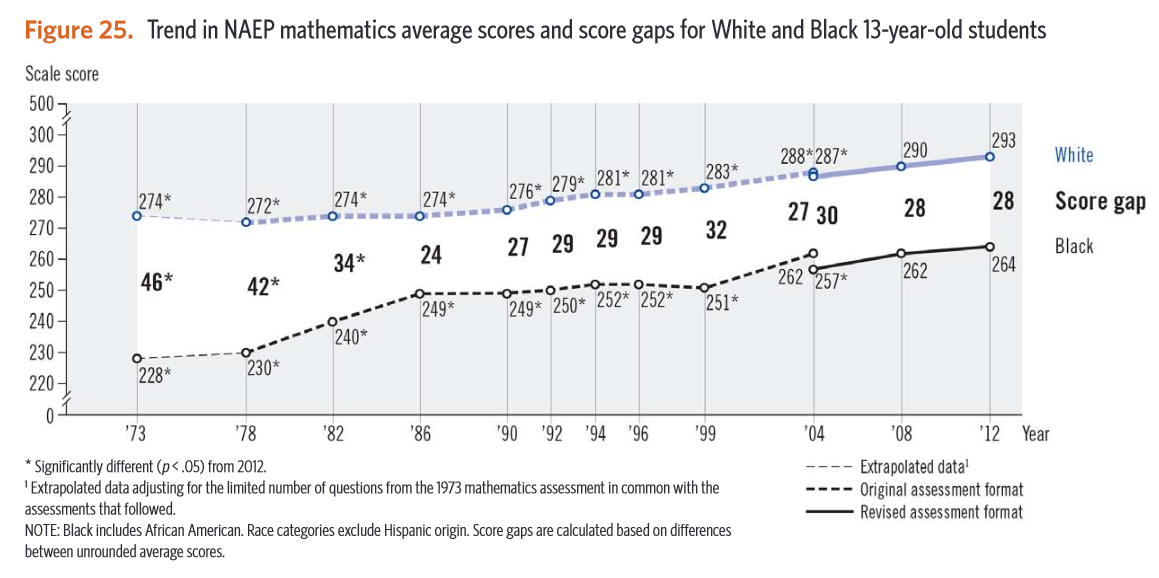
The federal government could also learn from history.  After 14 years of testing and punishment, some tiny gains in the National Assessment of Educational Progress can be seen, but those gains are dwarfed by the closing of the student achievement gap measured through the 1970s and into the early 1980s:13 year old math NAEP

As you can see, from 1973 until 1986, the gap between White and Black 13 year-olds in mathematics shrank by 22 percentage points, at which point it began to rise again, slowly over the next decade, then decreased slightly after the passage of NCLB but at nowhere near the rate we saw from 1978 until 1986.  What explains this?  There are, of course, many possible reasons, but one that stands out in policy is that by the early 1980s we largely abandoned efforts to integrate our schools and to integrate our communities via fair housing policies.  Since the 1980s, our communities have become even more segregated by income levels, and our schools have re-segregated as well so that today, a typical African American student in 2007 attended a school where 59% of his peers were low income, up from 43% in 1989.

For almost 4 decades we have increasingly concentrated children with very great needs within communities that struggle to provide basic services and in schools that are consistently deprived to the resources and personnel they need to give the children in their care what they need to thrive. We do not need more federal accountability measures of this.  We require action aimed at the opportunity gap.

You have a deserved reputation for fairness and for finding ways to work with colleagues when others prefer to fight.  I challenge you to research these issues and bring them to your fellow lawmakers in bipartisan fashion.  I challenge to craft a federal education policy that emphasizes support and growth over test and punish. Use federal leverage with states to make sure state aid to local schools is up to their needs.  Propose the full funding of IDEA for the first time in its history.  Challenge colleagues to invest in the capital improvement needed so our children learn in buildings that are well equipped and safe.  Find federal resources that will help urban schools with recruitment, development, and retention of teachers.

And recognize that threatening schools with standardized test results cannot overcome our society-wide abandonment of integrated schools and communities.  Our public schools need advocates in Washington, not an entire caucus ready to reassert policies that distort education’s focus and ignore the real funding needs of our children’s schools.

Sincerely,

Daniel Katz, Ph.D.

2 Comments

Filed under Common Core, Funding, NCLB, politics, Testing

Teaching: A Profession Unlike Most Others

Sarah Blaine is the author at the excellent and thoughtful Parenting the Core blog.  She recently explored the question of whether or not teaching is a profession, recounting a law professor who argued teaching was not a profession because teachers did not control entry to the profession as doctors and lawyers do.  Ms. Blaine took that observation to a very intriguing and, I think, valuable discussion of how teachers could play a bigger and, consequently, far more informed than current regulators role in how people enter teaching.  It is worth your time to read the whole piece.

It also has spurred me to ponder the ways in which teaching is a profession, but a profession unlike most others that have high status in society.  Further, I have to wonder to what degree the efforts of the late 1980s and 1990s to construct a vision of teacher professionalism that is similar to those in medicine and law has contributed, at least indirectly, to some of our current dilemmas in what passes today for education “reform.”  Beginning with the A Nation At Risk report, teacher organizations and teacher research cast for ways by which the profession can embody the elements of professionalism and professionalization that define other fields of endeavor, but in doing so, we have opened ourselves to reforms that actually debilitate teaching and learning.

The status of teaching in general and of the teaching as a discipline for study is not a new problem.  David Labaree, in his collection of essays, The Trouble With Ed Schools, traces teaching and teacher preparation’s status anxiety back to the establishment of normal schools which were under pressure to turn out large numbers of mostly working class women to teach in the growing compulsory school systems of the 1800s.  When normal schools evolved into state colleges and universities, the new education schools with their teacher training missions were marginalized by the more established and prestigious fields of classical studies who relied on education schools to bring students to the universities but who did not respect teaching as a discipline of study and who did not respect the largely female population studying it.

The public’s familiarity with teaching and with teachers also complicates questions of professional status.  Unlike most other fields with professional expertise nearly every adult in society has extensive and intensive contact with teachers practicing their profession.  Doctors and lawyers are capable of enshrouding their professions in mystery because the average citizen, thankfully, has only periodic and limited needs of their services.  The average citizen, in contrast, spends more than 13,000 hours in teachers’ classrooms during what Dan Lortie called the “apprenticeship of observation” through which most people conclude that they are entirely familiar with the work of teachers and develop very strong assumptions about what it is that teachers know and do.  However, this familiarity is facile.  Students are not privy to the preparation that goes into teaching, nor do they understand what it is like to enact teaching while maintaining attention on each and every learner in the classroom, adjusting and pivoting as necessary, and taking effective opportunities when they present themselves. The result is that despite the enormous amount of time spent with teachers, very few former students see teaching as a highly complex practice that requires expertise and substantial experience.

The search for a definition of teacher professionalism may not be new, but it  began in earnest with the devastating rhetoric of the 1983 Reagan administration report A Nation At Risk which reported:

  • Too many teachers are being drawn from the bottom quarter of graduating high school and college students.

  • The teacher preparation curriculum is weighted heavily with courses in “educational methods” at the expense of courses in subjects to be taught. A survey of 1,350 institutions training teachers indicated that 41 percent of the time of elementary school teacher candidates is spent in education courses, which reduces the amount of time available for subject matter courses.

  • The average salary after 12 years of teaching is only $17,000 per year, and many teachers are required to supplement their income with part-time and summer employment. In addition, individual teachers have little influence in such critical professional decisions as, for example, textbook selection.

  • Despite widespread publicity about an overpopulation of teachers, severe shortages of certain kinds of teachers exist: in the fields of mathematics, science, and foreign languages; and among specialists in education for gifted and talented, language minority, and handicapped students.

  • The shortage of teachers in mathematics and science is particularly severe. A 1981 survey of 45 States revealed shortages of mathematics teachers in 43 States, critical shortages of earth sciences teachers in 33 States, and of physics teachers everywhere.

  • Half of the newly employed mathematics, science, and English teachers are not qualified to teach these subjects; fewer than one-third of U. S. high schools offer physics taught by qualified teachers.

Education leaders and policy makers rushed to respond to these criticisms. Teachers and teacher educators are familiar with the Carnegie Forum on Education and the Economy report A Nation Prepared, the various reports of the Holmes Group, John Goodlad’s Teachers for Our Nation’s Schools, the National Commission on Teaching and America’s Future report What Matters Most, the development of the Interstate Teacher Assessment and Support Consortium model teaching standards, increasing influence of organizations such as the Council for the Accreditation of Educator Preparation (formerly NCATE) and the National Board for Professional Teaching Standards, and with a growing industry of educational consultants such as Charlotte Danielson providing standards based rubrics and frameworks for teacher evaluation.

This mass body of work and effort and the attending changes in state and national policies that have flowed from them work on a vision not merely of teacher professionalism, the knowledge, skills, actions, and dispositions of professional teachers, but also of teacher professionalization, efforts to more closely align teaching and teacher preparation with the standards and technical rationales of high status professions such as medicine and law.  Such efforts appeal on two fronts.  First, they attend to concerns that teachers need more rigorous preparation for the difficult work of teaching and that teachers who complete their education with strong content knowledge, deep pedagogical knowledge, substantial understanding of learning and motivation, and who have meaningful experiences in the classroom prior to student teaching will have easier transitions into the world of full time teaching and begin their careers more able to help students learn.  Second, this reconfiguration of teacher preparation and conceptualizing of teaching as a profession akin to medicine and law attempted to instill higher status upon the profession in general.  Terms like “clinical experience” and “professional development school” and “master teacher” all convey a message that learning to teach is a rational experience with technical components that can be measured and that teachers should have ongoing and mediated entry into the professional roles much doctors who master a complex body of knowledge and then move into increasingly responsible roles within practice over time.  By adopting the preparation and learning structure of high status professions, teaching was envisioned to occupy a greater level of respect more commensurate with the importance of its mission.

There is much to recommend in this approach, and such efforts have spurred genuine innovations to improve how teachers are prepared.  It is important to acknowledge that contrary to many popular beliefs teachers possess specialized knowledge far beyond their understanding of the content that they teach.  Further, much as the technical knowledge of medicine and law must be put into practice, knowledge of content, theory, and pedagogy must be practiced in order to become skilled and it must slowly improve over time with the accumulation of experience.  Perhaps the most important aspect of the teacher professionalization discussion has been the continued focus upon moving from theory to practice in a controlled and mediated fashion, allowing prospective teachers to practice and to learn from practice long before they undertake full time teaching duties.

However, while moves to make learning to teach more clinical have opened valuable efforts to increase time teaching before licensure, it is vital that teachers, teacher educators, and policy makers understand the ways in which teaching is not like those high status professions professionalization has attempted to imitate.  To begin with, while there is an important knowledge base for teaching, it is a much softer knowledge than that held by high status professions.  Before moving into technical practice of medicine, medical students learn a tremendous amount of knowledge that is well-defined and clearly delineated.  This does not mean that medical knowledge is never changing; obviously, it is.  However, those changes take place through pain-staking research and replication before it can become part of the body of knowledge for practice.  When compared to this, teachers’ knowledge is less defined, more subject to change, and subject to particular circumstances that vary day to day and class to class.  Experienced teachers know that a “best practices” teaching strategy may not be a “best practice” for a particular bit of content or with a particular group of students, and because teaching has to be enacted authentically by individual teachers, different practitioners can find that so-called “best practices” are not “best practices” for them. Teachers are constantly experimenting and tinkering with their practice, often within the act of practice itself.

Lawyers can rely upon volumes of case law, and doctors have mountains of medical research backing their choices, but there is no laparoscopic appendectomy for teaching a room of 6 year olds how to read.

This should greatly complicate our desires to present teaching as a profession that can be mapped onto the professional education of fields that employ a more technical/rational approach.  Standards based preparation and evaluation can provide important starting points and frameworks for discussing, assessing, and improving teaching, but the rubrics and evaluation scores cannot become ends unto themselves.  Preparation and evaluation do a great disservice to teachers and teaching when rubric scores become more important than discussions about students and their learning that can be prompted by the categories on the rubric.  Too much of a focus on the technical at the expense of developmental understanding of learners and their needs reduces teachers’ teaching and students’ learning to outcomes which can be superficially inflated without substance.

It is possible that the teacher professionalization movement’s efforts, as well intentioned as they have been, are responsible for some of the mess that education “reform” has made of the teacher evaluation and testing environment.  After all, if teaching is a technical/rational activity whose practices result in observable and measurable outcomes, then it was not a big sell to policy makers for figures like Michelle Rhee and organizations like the Bill and Melinda Gates Foundation to suggest that teachers should be evaluated using supposedly “objective” results like standardized test scores.  Run through statistical formulas that claim to account for a vast number of variables that can impact students’ test score gains, reformers promise that test data, as a component of teacher evaluation, offers a fully objective view of teacher effectiveness. This slots nicely with the view of teacher professionalization that emphasizes measurement of teacher practice — even though the bulk of the evidence now says that such modeling does not work.

There are other reasons to question the teacher professionalization models or at least to insist that they be made more complex and nuanced.  To begin with, unlike high status professions, teaching is, by necessity, a vast field.  Doctors and lawyers maintain careful control on their supply and high skill specialties are even tighter, but the reality of compulsory, public, free education means that we need enough teachers, teaching specialists, and paraprofessionals to teach 50 million students in public elementary and secondary schools.  In any labor market, that means that teaching cannot claim a high status simply because supply has to be high compared to other professions requiring college education and certification.  We may value, or at least claim to value, teachers and the work they do for our society, but from the standpoint of scarcity, we cannot compare the field to others, and it would take a significant change in our society’s values to do so.  Further, the long history of low status associated with fields that are predominantly female is still with teaching, which remains a profession dominated by female practitioners.

Teacher professionalization is also complicated by the previously mentioned apprenticeship of observation.  While the long contact time with teachers and schools does not actually instruct the public about the fullness and the complexities of teaching, it does lend an extreme familiarity with teachers themselves and with the visible aspects of their practice that no other profession really has.  Hard knowledge professions carefully guard their knowledge within specialized preparation and language, effectively blocking outsiders from access without the mediation of the professional.  Teachers, from the public’s view, are in the business of giving knowledge away and making it more accessible.  While pedagogical knowledge is not readily available to non-teachers, the practice of it is visible in thousands of hours spent in teachers’ classrooms, the best of which result in students able to learn on their own.  The public may not really understand teaching, but there would be little value in the profession cloaking itself in the mystique conferred upon lawyers and doctors whose practice depends almost entirely upon their clients and patients being unable to practice for themselves.

The aura of mystery about knowledge and professional language in other fields is often accompanied by a general obligation to be distant and to minimize personal involvement with clients and patients.  Teachers, however, sit in an unusual place in terms of relationships with their “clients” and frequently need to cultivate professional but close relationships with individuals and groups of students that foster motivation and provide the affective support students need to succeed.  Many conceive of this as a mentoring relationship that helps students not only academically but also with social and emotional needs.  This stance both helps students and also comprises a significant portion of the “psychic rewards” that teachers historically report among the most gratifying aspects of their jobs.  Much like the deployment of pedagogy, such relationships and their attendant rewards will remain particular and impossible to measure in any rational sense, yet they remain among the core practices of teaching.

During the height of the teacher professionalization literature, David Hansen wrote cogently about teaching as a vocation and what that means to practitioners:

To describe the inclination to teach as a budding vocation also calls attention to the person’s sense of agency.  It implies that he or she knows something about him or herself, something important, valuable, worth acting upon.  One may have been drawn to teaching because of one’s own teachers or as a result of other outside influences. Still, the fact remains that now one has taken an interest oneself.  The idea of teaching “occupies” the person’s thoughts and imagination.  Again, this suggests that one conceives of teaching as more than a job, as more than a way to earn an income, although this consideration is obviously relevant.  Rather, one believes teaching to be potentially meaningful, as a the way to instantiate one’s desire to contribute to and engage with the world.

This is extremely important as we continue to discuss and debate what teaching as a profession means and what it looks like in practice.  I would not suggest abandoning all of the elements of teacher professionalization as we work to develop a rich view of teachers as professionals, but it is important to recognize the limits of standards and measurement.  Standards and rubrics for evaluation should be used as means to focus conversation on practice and its continued development rather than to focus on specific score bands on evaluations themselves.  We should flatly reject continued efforts to reduce teachers’ impact to fully rational statistical outcomes that have no proper basis in research.  And we should passionately embrace those aspects of teachers’ professionalism that is immeasurable and defend them as essential to teachers’ work.  Maybe we cannot measure inspiration and passion for children and their intellectual, social, and emotional development, but without those qualities, performances on professional standards rubrics are probably meaningless.

5 Comments

Filed under Data, standards, teacher learning, teacher professsionalism, teaching, Testing

“SGPs Are Not Test Scores” And Other Tales From Trenton

Last week, I got to attend a talk by a high level representative of the New Jersey Department of Education who explained where we are going regarding the Partnership for Assessment of Readiness for College and Careers (PARCC) assessments administered in the Spring.  Little was said that was especially new or interesting.  We heard an enthusiastic appraisal of the computer interface and the “success” of the computer administered exams.  Next steps include how the state will disseminate and interpret data when it eventually comes back with hopes that everyone will find it very useful and very granular.  A talking point expressly did not rule out using PARCC results for grade level promotion or graduation in the future, but it was not emphasized.  Time was spent lamenting what teachers have been saying about the PARCC as if they were simply misinformed about how good the examinations are and how useful the data will be.

And at one point, the DOE representative said, in response to a question, that “SGPs (student growth percentiles) are not test scores.”

Let that sink in for a minute.  “SGPs are not test scores.”

This is one of those incredible moments in time when an actually true statement is, in fact, entirely misleading.  It is absolutely true that SGPs are not raw test scores, and it would incorrect to simply say that New Jersey teachers are evaluated using test scores.  A Student Growth Percentile is a computation that compares a student to other students with similar previous year scores and predicts how much that student should “grow” as measured on an annual standardized test.  When used in teacher evaluation, the difference between a student’s anticipated growth and the actual scores, either positive or negative, are attributed to the teacher.  Proponents of manipulating test data this way believe that these measures are more “objective” than standard administrator observations of teachers because they are tied to students’ actual performance on a measure of their learning.

So, it is technically true that “SGPs are not test scores.”  In much the same way that a houses are not trees.  However, if you want to make a house and have no idea from where you will get the lumber, you won’t get very far.  In the same vein, without standardized tests to feed into their calculations, SGPs and other related growth scores used to evaluate teachers would not exist.

Of course, planning to make your SGP out of test scores the way it has been done in New Jersey might very well be a wasted exercise.  Bruce Baker of Rutgers University and Joseph Oluwole of Montclair State University discussed the many problems underlying New Jersey Student Growth Percentiles in this 2013 NJ Education Policy Forum discussion:

…since student growth percentiles make no attempt (by design) to consider other factors that contribute to student achievement growth, the measures have significant potential for omitted variables bias.  SGPs leave the interpreter of the data to naively infer (by omission) that all growth among students in the classroom of a given teacher must be associated with that teacher. Research on VAMs indicates that even subtle changes to explanatory variables in value-added models change substantively the ratings of individual.Omitting key variables can lead to bias and including them can reduce that bias.  Excluding all potential explanatory variables, as do SGPs, takes this problem to the extreme by simply ignoring the possibility of omitted variables bias while omitting a plethora of widely used explanatory variables.

The authors explain how the state’s claim that using the same starting points for students “fully accounts” for variables such as poverty is unsupported by research or methodology. Further, there are multiple potential reasons why schools’ average proficiency scores correlate to their growth percentiles, but the SGP model makes it impossible to say which is correct.

Dr. Baker revisited this topic a year later on his personal blog.  With an additional year of data, he noted that SGPs were almost as closely correlated with the poverty characteristics of a school as they were with themselves and were also as related to prior performance as they were to themselves.  So while the SGPs were relatively “reliable,” meaning that they produced consistent results over time, there is no reason to believe that they are valid, meaning that they are actually measuring what they are said to measure.  Taking the growth percentiles as a valid measure of teaching would have you  believe that the distribution of ineffective teachers in New Jersey just happens to directly concentrate into schools with high percentages of students in poverty and low overall proficiency levels on standardized tests. You would have to believe this even though SGPs were never actually designed to statistically isolate teacher input into student test scores.

So, yes — “SGPs are not test scores.”  They are just a lousy thing to do WITH test scores and to put into teachers’ evaluations and tenure decisions.

Perhaps the most frustrating aspect of this is not the even the sleight of hand explanation of SGPs and their relationship with test scores.  It is the wasted time and opportunity that could have been spent developing and implementing teacher evaluations that were aimed at support and improvement rather than at ranking and removing.  Linda Darling Hammond, writing for the Stanford Center for Opportunity Policy in Education, proposed a comprehensive system of teacher evaluation that incorporates truly thoughtful and research supported policies.  Her proposal begins the process with standards and locally designed standards-based evaluation, incorporates genuine performance assessments, builds capacity and structures to actually support fair standards-based evaluation, and provides ongoing and meaningful learning opportunities for all teachers.  Most importantly, Dr. Darling-Hammond states that evaluation should include evidence of student learning but from sources other than standardized tests, and she rejects growth measures such as SGPs and Value-Added Models because of the ever increasing research base that says they are unreliable and create poor incentives in education.  Dedicated teachers know that they are constantly generating evidence of student learning, but to date, policy makers have only shown interest in the most broadly implemented and facile demonstrations.

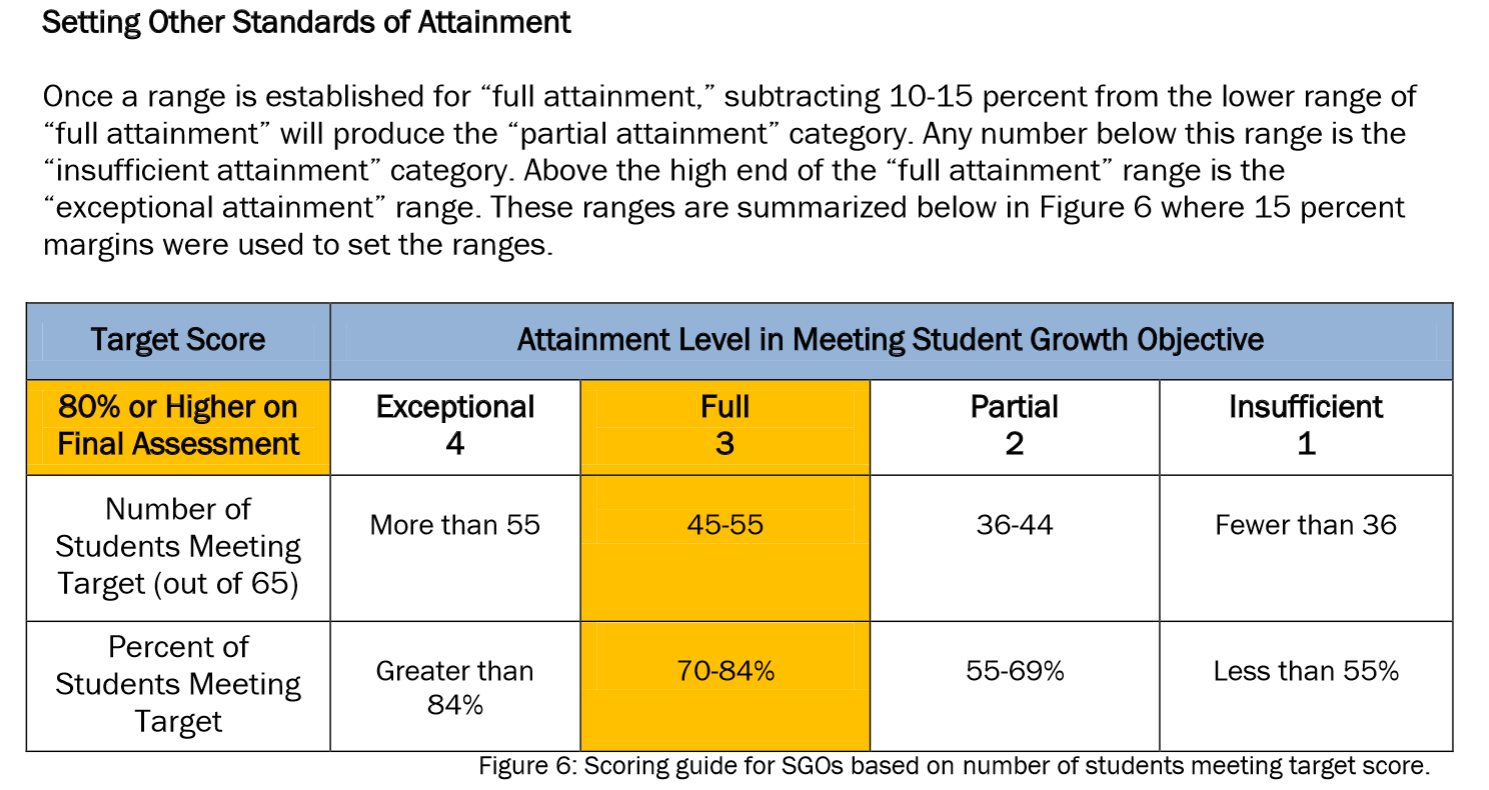
Taking Darling-Hammond’s vision seriously would mean admitting failure and hitting a reset button all the way back to the drawing board in New Jersey.  Trenton would need to admit that Student Growth Percentiles cannot be fairly attributed to teacher input when they were never designed to find that in the first place, and the problems with Value-Added Models in other states mean that growth measures in general should be rejected.  Further, if the state were to become serious about teachers actually demonstrating student learning in meaningful ways, the DOE would need to reject the “Student Growth Objective” (SGO) process that it has established as a second leg of the evaluation process. While the concept of the SGO sounded promising when first proposed, the state guidebook makes it an exercise in accounting mostly.  Teachers are instructed to only select objectives that are measured by data, they are told to select a level of performance demonstrating “considerable learning” with no guidance on how to make that determination via data, they are required to determine how many students could meet that level with no explanation of how to project that based on existing data, and then they are told to set an entirely arbitrary 10-15 percent range below that for partial obtainment of the objective.

From page 16 of the SGO manual:

page 16

These are not instructions to help teachers conduct meaningful self study of their teaching effectiveness.  These are instructions designed to create easy to read tables.

Teaching, teacher evaluation, and providing meaningful support for teachers to grow in an environment that is both supportive and focused on student learning is a serious endeavor.  It requires a systemic approach, real capacity, and the development of tools sensitive to and responsive to context.  It cannot be forced by incentives that distract from the most important work teachers do with students: fostering genuine curiosity and love of learning around rich content and meaningful tasks with that content.

It certainly cannot be made out of standardized test scores.

6 Comments

Filed under Common Core, Data, PARCC, Testing, VAMs

Chester Finn and the Death of Kindergarten

Chester E. Finn, Jr. has been an influential figure in American education reform for a long time now.  President Emeritus of the Thomas B. Fordham Institute, a conservative think tank supporting most elements of today’s reform environment, former fellow at the Manhattan and Hudson Institutes, founding partner with the for profit school turned for profit school management organization Edison Project, former Assistant Secretary of Education for Presidents Ronald Reagan and George H.W. Bush, former Professor of Education at Vanderbilt University, and former chair of the National Assessment of Education Progress (NAEP) governing board, Dr. Finn has been a staple of the education reform landscape for decades.  According to his former colleague, Dr. Diane Ravitch of New York University, Dr. Finn has long held a low opinion of the quality of achievement in American education and has long wanted Americans to realize how poorly educated our children are.

And now it is Kindergarten’s turn.

Writing for the Fordham commentary website, Dr. Finn reports on the results of Maryland’s new “Kindergarten readiness” test administered individually by teachers and now available for the general public.  Dr. Finn, recently appointed to the Maryland State Board of Education, describes the results as “revealing and sobering”:

The assessment is individually administered by kindergarten teachers and was given this year to all of the Old Line State’s sixty-seven thousand kindergartners. The results are sorted into three bands, politely labeled “demonstrating readiness,” “developing readiness,” and “emerging readiness.” But only the first of these means actually ready to succeed in kindergarten—and slightly fewer than half of Maryland’s entering kindergartners met that standard.

Which is to say that more than half are not ready. This report candidly displays the results not just for the state as a whole, but also for each of Maryland’s twenty-four local districts—and further disaggregated in all the ways we have come to expect and demand in the NCLB era.

Every which way you look, you see gaps. And often the gaps are alarmingly wide—by district, by race, by income, and more. You may not be surprised, but you ought to be alarmed and energized. Children who enter school without what they need to succeed in kindergarten are destined to have great difficulty catching up, even in schools that do their utmost. It’s not impossible, but it’s very hard.

Allow me to give Dr. Finn half of a loaf here.  Early advantages matter for long term educational outcomes, although many critics have written about whether that is because of specific deficits in certain student populations or because schools systemically valorize  the cultural capital already possessed by society’s elites.  It is curious to me that Dr. Finn calls the results of the Kindergarten readiness test “revealing” because the finding of gaps between subgroups of students is entirely predictable based on what we know about poverty and its long lasting impacts.  Maryland has a total poverty rate under 10%, but 14% of its children live below the poverty line and another 17% live between the Federal Poverty Level and 200% of the Federal Poverty Level ($47,700 for a family of four).  So that is 31% of the children in Maryland living either below the poverty line or within striking distance of it.  The 1997 Princeton Study, The Effects of Poverty on Children, clearly documented how poverty in early childhood has long lasting impacts on physical, cognitive, school achievement, and emotional/behavioral development, so for Dr. Finn to say the results of the new Maryland assessment are “revealing” rather “confirming what we already know” is rhetorically nonsensical.

It is also nonsensical for Dr. Finn to say that HALF of Maryland’s children are not “ready” for Kindergarten (a term that is not actually defined or defended in his article), when the scale as reported is “demonstrating readiness” – “developing readiness” – “emerging readiness”.  According to the actual state report, not provided by Dr. Finn, 47% of Kindergarten students were found to be “demonstrating readiness”, 36% were “developing readiness”, and 17% were only at “emerging readiness”.  These terms are defined in the report as follows:

Demonstrating Readiness – a child demonstrates the foundational skills and behaviors that prepare him/her for curriculum based on the Kindergarten standards.

Developing Readiness – a child exhibits some of the foundational skills and behaviors that prepare him/her for curriculum based on the Kindergarten standards.

Emerging Readiness – a child displays minimal foundational skills and behaviors that prepare him/her for curriculum based on the Kindergarten standards.

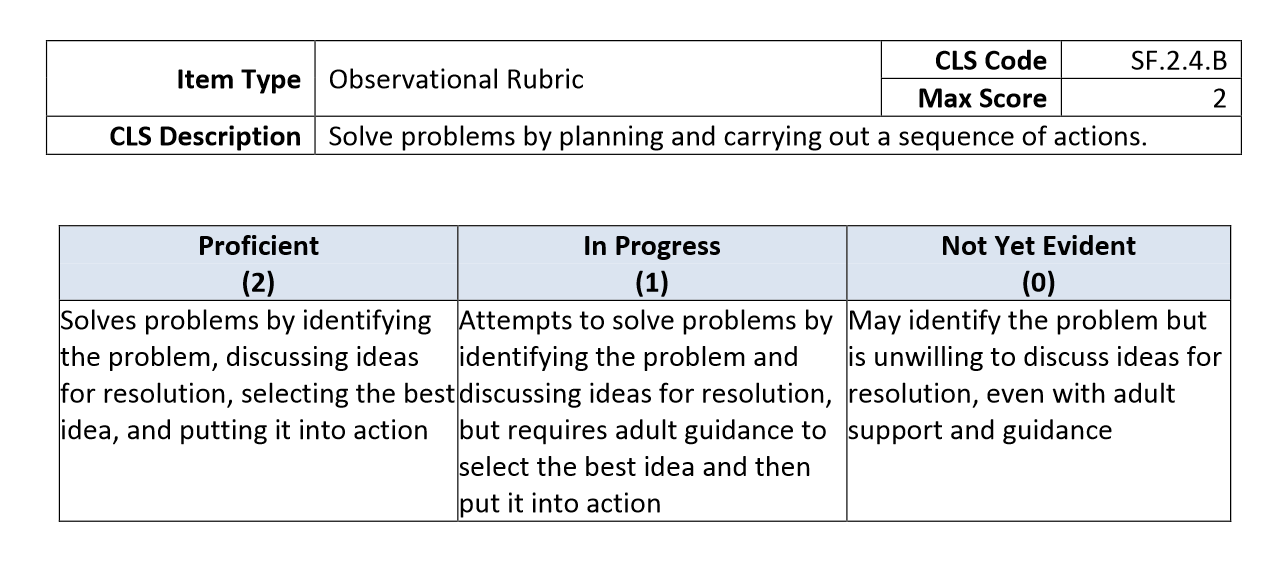
And how does a teacher giving this assessment determine that?  Maryland provides a vague and unhelpful website for the public, but there are a few sample rubrics. Here is one for an observational item:

K rubric

So, a five year-old child “requires adult guidance to select the best idea and then put it into action” and to Dr. Chester Finn, THAT is evidence that the child is “not ready” for Kindergarten – rather than just normal evidence of a 5 year-old.

Interestingly, just one year ago, 83% of Maryland Kindergarten children were found to be “ready,” the precise sum of this year’s combined “demonstrating readiness” and “developing readiness.”  I’m sure THAT wasn’t deliberate at all.

And that’s the crux of the matter.  It would be one thing to develop high quality individualized assessment instruments that Maryland Kindergarten teachers could use to get snapshots of their incoming students and to fully individualize instruction or to use targeted interventions for some students.  It is an entirely different thing to redefine “Kindergarten readiness” to mean that 5 year-olds must engage in complex problem solving with no adult assistance and select “the best idea” (note the use of a definite article which narrows the number of correct ideas down to one) and then to publicize this as “evidence” that over half of our 5 year-olds are deficient.  In the pursuit of observing “the best idea” to solve a problem, how many entirely appropriate but fanciful ideas were set aside as evidence that a child was “developing readiness” rather than “demonstrating readiness”?  How many teachers will now use the results of this assessment to take the Kindergarten curriculum and try to push children into very narrow boxes of “correct” and “incorrect” ideas that stifle the kind of play based learning and experimentation that is entirely appropriate and healthy for very young children?

Professor of physics at Loyola University Maryland Joseph Ganem took the results of the Kindergarten assessment to task in the pages of The Baltimore Sun, faulting unrealistic and narrow expectations of the Common Core State Standards for the redefinition of readiness:

However, for skills in what Bloom calls the “cognitive domain,” the school curriculum has become blind not only to the progression of normal child development but also to natural variations in the rate that children develop. It is now expected that pre-school children should be able to grasp sophisticated concepts in mathematics and written language. In addition, it is expected that all children should be at the same cognitive level when they enter kindergarten, and proceed through the entire grade-school curriculum in lock step with one another. People, who think that all children can learn in unison, have obviously never worked with special needs children or the gifted and talented.

I agree with Dr. Ganem, and I will add that Dr. Finn’s attempt to portray these results as widely dire, rather than as indicating a specific population of children in poverty may need additional services, risks a deeper erosion of Kindergarten and early childhood education into narrow and unimaginative academics.  In their 1995 history of education reform, Tinkering Toward Utopia, David Tyack and Larry Cuban noted how the ideal of the “Children’s Garden” was quickly subsumed into preparation for the academic curriculum of grade school:

A much more modest bureaucratic rationale became central: that the kindergarten would prepare five year-olds for the first grade in a scientifically determined developmental way. Some of the features that had made the kindergarten exotic were slowly trimmed away or changed to fit the institutional character of the elementary school. (p. 69)

Dr. Finn proposes that we once again double down on this.  His solution to the problem created by rewriting the meaning of Kindergarten is “intensive, targeted early-childhood education for the kids who need it the most” which almost certainly means further pushing academic skills development to children as young as three. While I am a proponent of universal pre-K, I am mindful that “high quality” programs are far more than academic preparation and will often cloak such preparation in a focus upon learning via play.  In communities with high poverty, a focus on the family and whole child requires the existence of robust community-based social services that blunt the negative impacts of poverty on child development.  But if Dr. Finn believes that a 5 year-old who needs some adult guidance to select the ONE “best idea” in problem solving is not “ready” for Kindergarten, then I have little hope that an accompanying push for more early childhood education will preserve learning by play and attend to what we actually know children need.

For fifty years, we have continuously strangled the idea of free time and free play out of childhood in an academic arms race with our neighbors and other nations.  The consequences have been negative.  While we do have children who have needs that require specific interventions and resources, all of our children need time to grow and explore in their earliest education.

Turning pre-K into the new first grade the way we have already done to Kindergarten is not the answer.

10 Comments

Filed under child development, Common Core, Funding, politics, teaching, Testing

Look Out, NY Opt Out: Here Comes the Pro-Testing Charm Offensive

The University of the State of New York (USNY) has a new Commissioner of Education.  By a unanimous vote, the Board of Regents selected MaryEllen Elia, the recently fired superintendent of Hillsborough County, Florida,  to head the New York State Education Department (NYSED) and serve as President of USNY which, in addition to overseeing the entire public K-12 education system of 7000 schools, oversees more than 240 public and private universities, 7000 libraries, the state archives, special schools for the hearing and visually impaired, over 750,000 licensed professionals, and over 200,000 certified public school teachers.  She replaces former Commissioner, John King, Jr., and unlike her predecessor, she brings significant experience with public education, including a decade leading the 8th largest school district in the country where she was awarded 2015 Superintendent of the Year for Florida just a few weeks before a series of conflicts with the school boiled over in her early dismissal.  Under her leadership, her district was given a $100 million grant from the Bill and Melinda Gates Foundation to tie teacher evaluation and compensation to student performance.  While the grant program includes mentoring, principal evaluation, and peer evaluation, the district was also tasked to “develop fair and accurate measures of effective teaching” — for the Gates Foundation, this almost always means including at least some growth measures based upon student test scores.

Ms. Elia is certainly a change from former Commissioner Dr. John King Jr. whose impressive academic credentials were never matched with an equally impressive ability to listen to stakeholders and whose lack of experience at any level of public education was painfully obvious.  From her recent statements, Commissioner Elia is aware of what undid her predecessor:

“I think it is important for us to communicate with all of those people who have the stake in what’s happening in education,” said Elia, who most recently led the nation’s eighth largest school district, Hillsborough County, Florida, a racially and socioeconomically varied area that includes the city of Tampa. “So, yes, my plan is to be out in the state, listening to various groups and getting feedback and making sure that there is a response when that feedback is brought back to the department.”

Whether or not she is genuinely capable of do so remains to be seen.  Although she ran Hillsborough for an impressive ten years and was successful in securing the Gates Foundation grant, her removal represented long standing frustration with her leadership style which critics described as consistently uninterested in communicating with people she deemed as opponents.  More pronounced criticism described a workforce under Ms. Elia that was “cowed” and afraid to speak up about concerns for fear of retaliation, and board members complained they often did not get information they needed from her — even when a 7 yearpold stopped breathing and later died during a school bus ride.  Commissioner Elia had strong and loyal defenders as well, especially among the business community, but if her primary role coming back to New York is to lead a charm offensive that Dr. King was never able to do, watchdog organizations in the Empire State will need to keep a close eye on the substance behind the style.

While our new Commissioner is preparing to go on a speaking and listening tour of the state, she would do well to try to understand exactly why New York is the current leader in the nationwide Opt Out movement against today’s standardized testing policies, having seen test refusals jump from nearly 60,000 in 2014 to 200,000 in 2015.  In comments to the New York State Council of School Superintendents, Board of Regents Chancellor Dr. Merryl Tisch, lamented parents who opt their children out of standardized examinations, compared them to people refusing vaccination for their children, and pledged that “…we are going to continue to help students and parents understand that it is a terrible mistake to refuse the right to know.”  In April, Chancellor Tisch insinuated that the growth of the opt out movement was the fault of the dispute between New York Governor Andrew Cuomo and the state teachers’ union, making roughly 200,000 families pawns in a labor dispute.

So let’s just say that if Commissioner Elia is going to travel the state to understand the concerns of families and teachers, she needs to genuinely listen because NYSED has had cotton stuffed in its ears for some time now.

The first thing she needs to understand is that simply explaining why we test as suggested by Dr. Tisch is not going to be sufficient.  The still growing discontent in New York is not simply because nobody has bothered to explain the vision behind education policy in the state – to the degree that such a vision exists.  The reality that nobody at NYSED appears willing to examine is that parents understand that there are very real and actually tangible costs to making standardized testing as high stakes as it has become in the No Child Left Behind era, and, worse, they are increasingly aware that those policies do not work and should be set aside.  What has happened in the past decade and a half is a classic example of ever increasing perverse incentives that have taken standardized tests and converted them from an occasional check on the system into an increasingly important end unto themselves by which entire schools and individual teachers’ lives depend.  Since little has been done concurrent with high stakes accountability to actually support and improve schools with resources and innovative services, the result has been a policy environment where the tests have consumed more and more of the curriculum.  If you do not understand that parents are increasingly fed up with these phenomena and if you do not have a reasonable set of answers for them, then it is not likely that they will be swayed by mere explanations of why NYSED does what it does.  Parents want change, not platitudes.

It is unclear to me if Ms. Elias is suited for that task.

While New York’s new commissioner is clearly far more experienced and far more understanding of how education consists of intersecting and overlapping stakeholders that policy must consider, her record is no less devoted to the core elements of “reform” — Common Core Standards, standardized testing, use of testing to rank and sort schools and teachers — than her predecessor’s or her new Chancellor’s.  In the application for the $100 million grant from the Bill and Melinda Gates Foundation, Hillsborough predicted they would fire at least 5% of the districts tenured teachers for “poor performance,”  and the grant work led her to develop, with collaboration from the teachers’ union, an evaluation system that uses test scores for 40% of teachers’ ratings.

All but guaranteeing the percentage of teachers you will fire in an application to revamp your teacher evaluation and reward system should raise any serious thinker’s eyebrows.  It smacks of the kind of stack ranking of employees that, ironically, the Gates founded Microsoft finally ditched after a disastrous decade of evaluating employees that way destroyed effective collaboration.   If the Hillsborough application was taken seriously in the early years, teachers with low growth scores had to be constantly concerned if they would hit that bottom 5% in combination with other measures and be in danger of losing their jobs.  While not as daft as the Microsoft system that required every employee in every unit to be placed on a normal curve, the five percent prediction amounted to over 420 teachers a year.  As it turns out, the district came nowhere near that number by 2012, but it did manage to make a significant number of employees jittery.

Of greater concern is Commissioner Elia’s comments on how to incorporate test scores into evaluations as she enters a state with a new evaluation matrix that gives those scores an entire axis:

“The research is very unclear on any weight at all,” she said, when asked about Governor Andrew Cuomo’s proposal to base evaluations 50 percent on tests. “There have not been any studies that indicate that 50 percent is better than 40 percent is better than 20 or 30. And so I think what we need to do is get out there, work together collaboratively to come up with what we believe is a reasonable approach to evaluation, and constantly be getting feedback. And when it needs to shift, we need to shift it.”

I’d like to offer a suggestion on what weight to give standardized test scores in the evaluation of teachers:

None. Zip. Nada. Bupkas.

The destructive nature of including standardized testing data in teacher evaluation is discussed above.  It narrows the curriculum.  It incentivizes schools and teachers to make the test itself the curriculum. It consumes instructional time and resources that could be better used.  It focuses learning on the least interesting skills and diminishes actual love of learning.  It serves as a disincentive for both teachers and students to take risks that might diminish test scores.  But there is an even more important reason to reduce the role of standardized testing data in teacher evaluation.

It doesn’t work.

Maybe one could have pretended otherwise in 2009-2010, but this should not even be controversial anymore.  Growth models for teacher evaluation based upon standardized testing data do not work.  In order for a growth measure to work, it has to be be able to peel away every factor that accounts for the differences among student test scores that is not attributable to the teacher, and we simply do not have statistical models that do this reliably.  Commonly used models have standard errors as high as 36% for a single year of data, and they would require a decade of data to reduce the likelihood of mislabeling a teacher to 12%.  Growth models are unstable, and ones that tend to produce stable results tend to be poorly designed. The models have a strange ability to label even teachers who are locally known to be excellent working with advanced students as ineffective because of how little room there is for students to not hit the model’s predicted scores.

No wonder then that the American Statistical Association released a statement in 2014 saying that Value Added Models should not be use for teacher evaluation.  Yet here we are in 2015 with Governor Cuomo having successfully browbeaten the state Assembly and Senate into passing a budget that makes value added measures based on test scores effectively half of the evaluation system for teachers, and with a new Commissioner who is pondering what percentage is “correct” for such measures. This all but guarantees that the tests will continue to have both a disruptive and distorting effect on schools and classrooms, threatening teachers who are good at what they do and diminishing the depth and breadth of the curriculum students experience.

It also means that the reasons for the Opt Out movement to both exist and grow remain firmly in place.

Education reformers today seem to treat any resistance to their favored policies as simple matters of marketing — throw a lot of money at consistent messaging and people will come around to realize that they actually love what you are selling.  That approach can work in the world of innovative technology where people need to learn how it can change their daily lives. Education reform is not like that, however.  First, we are pretty familiar with how standardized testing is overwhelming education as we well into the second decade of test based accountability.  Second, people do not favor using those tests to evaluate teachers; while over 60% strongly agree that evaluation should help remove ineffective teachers, 61% oppose using tests scores to do that, up from 47% in 2012. Third, in the same PDK/Gallup Poll, parents with children in school reported something they have consistently said over decades: they like the schools their children attend. For 30 years, the percentage of parents giving their children’s schools grades of A or B has hovered near or above 70%.  It has dipped lately, but that is as likely connected to the disruptive impacts of Common Core and associated testing as it is connected to parents agreeing with reformers.

So reformers may want to believe they need to sell families on a new iPhone.  In reality, they are peddling New Coke: messing fundamentally with something people like without giving them a substantial benefit in return.

This is the challenge Commissioner Elia faces as she considers how to mount a defense of New York state policy to an increasingly restive population.  If she continues to try to convince parents that they really love the taste of New Coke instead of laying the groundwork for the NYSED to walk back its disastrous policies, this will not go well.

4 Comments

Filed under Gates Foundation, NCLB, New York Board of Regents, Opt Out, Testing

Being an Education Reformer Means Never Having to Say You’re Sorry

If you’ve been the least bit of attention to the growing movement against standardized testing, you’ve probably sought out, seen, or read a summary of John Oliver’s Epic Take Down of both testing policy and the testing industry.  In the odd chance that you are not among the 3.5 million to have watched it on Youtube alone, find yourself a nice spot, pour yourself a lovely beverage, and enjoy:

Mercy.

John Oliver’s tour de force went viral for a number of reasons.  A lot of participants and advocates in the growing Opt Out movement, having been insulted by our current Secretary of Education Arne Duncan for being whiny suburban moms who are upset that their children are not brilliant and by the Chancellor of the New York State Board of Regents Merryl Tisch who compared them to people forgoing measles vaccination, were delighted that a figure with a national audience correctly addressed their concerns about how testing is driving education and education policy.  Further, Mr. Oliver’s monologue and exegesis of pro-testing dogma hit a huge number of entirely accurate points that fully deserve the mocking he heaped upon them: the pandering promises made by candidates to ease testing burdens, the proliferation of testing at the federal and state levels, the difficulty in making an accountability system work, the shift of testing from a tool to an ends unto itself, the ridiculous lengths districts now go to make testing the raison d’etre of the school year, the use of statistical models to assess teachers that originated with the analysis of cattle breeding, the quality of the assessments themselves, and the Kraken of Educational Testing and Publishing: Pearson Education.  Mr. Oliver even highlighted Pearson’s innumerable errors, the gag orders that prevent people from discussing those errors, and their search for test scorers on Craigslist.  His closing gave voice to sentiment that is increasingly shared among parents, teachers, and researchers:

Look, we’ve had more than a decade of standardized testing now, and maybe it is time to put the test to the test. The original goal was to narrow the achievement gap and to boost our scores relative to the rest of the world. Well, a 2013 study found no support for the idea that No Child Left Behind has narrowed the achievement gap, and our schools on the international tests have not only failed to rise, they’re slightly down. And I do not want to hear what that French kid thinks of those results: Oh, all this time and all this money and your Race to the Top has been, how you say, a meandering jog on a treadmill. All of this for a little of what both Presidents asked for when selling their reforms…Right, so let’s look at that: because as far as I can see, this is a system that has enriched multiple companies and which pays and fires teachers with a cattle birthing formula, confuses children with talking pineapples, and has the same kinds of rules for transparency that Brad Pitt had for Fight Club. So for Pearson, the other companies, and all the lawmakers who have supported this system, the true test is going to be either convincing everyone that it works or accepting it doesn’t work and fixing it. Because at the risk of sounding like a standardized test scorer, your numbers are not good.  And if it seems unfair to have your fates riding on a complicated metric that failed to take institutional factors into account and might not even tell the whole story, well, you’re not wrong about that but YOU do not get to complain about it.

Mercy.

Of course, even as individual teachers and parents were making this episode go viral, proponents were sulking that the testing system that is central to the entire enterprise of measurement and punishment running reform today was being attacked so effectively.  Peter Cunningham is a former official in the Obama Department of Education who is currently running an outfit called The Education Post which was funded with over $12 million from the Eli Broad Foundation, the Walton Family Foundation, Michael Bloomberg, and an anonymous donor to create a “better conversation” about education reform.  In a recent interview with freelance journalist Jennifer Berkshire, Mr. Cunningham explained that he and fellow reform advocates felt like they were being “swarmed” whenever they went into public, and his non-profit was supposed to “rise to the defense” of people advocating for reform.  The implication here, by the way, is hilarious.  Reform outfits are richly funded by the Gates Foundation, Broad, the Waltons, Whitney Tilson, and a host of other organizations funneling huge sums of cash into promoting our current reform environment — but teacher and parents with Twitter accounts are a force that needs another multi-million dollar effort to counter, presumably because there aren’t 10s of 1000s of teachers and parents willing to band together and say, “You know, what we really need in school is even MORE pressure to make the test the curriculum.”  So Peter Cunningham, armed with millions in cash is there to “…hire bloggers and…subsidize bloggers who are already out there and who we want to support or give more lift. I think it’s fine. As you know, I have all this money. I have to spend it.”

Mercy.

Of course, the stated purpose of The Education Post is create a “better conversation,” so given that John Oliver had ripped a sizable, factually accurate, hole in one of education reform’s most important tools — mass, annual testing — how did Peter Cunningham contribute to “a better conversation”?  He called Mr. Oliver’s piece “tedious” and accused him of “throwing poor children under the bus” — because in reform circles, it is a matter of faith that only testing every child every year will force schools to close the achievement gap even though, as Mr. Oliver noted, there is scant evidence that it is working out like that.  While Mr. Cunningham was repeating a standard line in education reform about the moral imperative of standardized testing, his colleague, Valentina Korkes, took a more plaintive approach as a supposed fan of John Oliver’s whose heart was broken over his takedown of testing.  Ms. Korkes’ piece also covered familiar ground.  First, she chided John Oliver for not mentioning that the current strongest centers of test resistance are in communities that are wealthier than average and in the suburbs.  She claimed that the proliferation of testing at all levels — which reformers are recently lining up to decry — has nothing to do with federal policy that only mandates 17 tests.  And finally, she claims that No Child Left Behind has seen gains in the achievement gap on measures like the National Assessment of Educational Progress (NAEP), so John Oliver could not say the tests did nobody any good.  What does Ms. Korkes leave out?  First, while she is correct that test resistance numbers are greatest in wealthier communities, there is the inconvenient fact that toeholds are showing up in the communities she and her fellow testing advocates claim to support, and there is no reason to discount the likelihood that these will grow in following years as the compelling reasons for them to do so are rooted in history and research.  Similarly, while there have been very slight gains in NAEP scores during the life of NCLB, these are dwarfed by the gains that were made when federal policy in the 1970s and early 1980s was focused on equity and integration.

In fact, Ms. Korkes’ affinity for the current testing regime in our schools is indicative of a chain of thought that is pretty well discredited by now.  Reformers claim over and over that without annual testing of all children then we will never know how individual children are doing and we will hide achievement gaps from the public as schools are alleged to have done prior to NCLB.  However, Dr. Bruce Baker of Rutgers University lays out pretty clearly that we have much more promising tools for ongoing formative assessment of individual students, and we have far less disruptive means of doing meaningful assessment of the entire system that do not require all children to be tested each year.  Further, Dr. Julian Vazquez Heilig of California State University, Sacramento, has laid out a compelling vision of accountability for education that uses data as one of its tools but which is community based and sensitive to locally understood needs. It is simply a deliberate lack of imagination from reform advocates to profess that our current system is the only means we have available to improve education.

The simple truth of our landscape today is that our testing system is far too disruptive, and it is tied to an accountability system that warps the high stakes examinations into goals unto themselves.  Ms. Korkes, like many reform advocates, is mindful that testing has increased dramatically, but she is unwilling to entertain the role that reformers have had in bringing us to this point.  She accuses John Oliver of misleading people on the state a federal policies related to testing by not emphasizing that of the 113 standardized tests taken by the average student by 12th grade, 96 of them are not mandated by the federal government.  This is an accurate point, but it is also a point that involves significant sleight of hand, and an effort to race past the fact that it was the federal government which put such high stakes on standardized testing that states and localities followed suit to prepare their students for The Annual Big One. No Child Left Behind required that all schools in all districts in all states have 100% of their students testing as “proficient” in math and English in 2014, and NCLB required all schools to make annual yearly progress (AYP) in standardized test scores or face an increasing series of interventions leading to complete restructuring (often closing the school and turning it over to a charter operator).  With such stakes attached the end of year tests mandated by NCLB, it is beyond disingenuous for testing advocates to wash their hands of states and districts requiring additional tests to benchmark students throughout the year.

While the Obama administration promised to curb the growth of testing through NCLB, their key initiatives have made matters even worse. States may have gotten waivers from the most unrealistic expectations of 100% proficiency and AYP, but to get those waivers they had to agree to make testing a significant portion of teachers’ evaluations and to evaluate all teachers in all grades using data.  Since the federally mandated tests are only in English and mathematics, this requires the use of more tests — or states can find themselves subjected to the original provisions of NCLB.  So let’s be clear about the chain of cause and effect here:  The federal government mandated both unrealistic goals and harsh consequences based upon student scores on standardized tests, resulting in states and districts adopting more benchmarking assessments so they were not taken by surprise with the federally mandated assessments.  A new administration enters and “relieves” schools from some of those provisions, but only if states and districts agree to use data for evaluation of all teachers and the most common means of using data is value added modeling, which is shockingly unreliable but mandated anyway. This moves the dire consequences of students not doing well on the examinations directly on to the shoulders of individual teachers who are not only faced with increasing time spent testing, but also who are faced with powerful incentives to narrow their curriculum into direct test preparation.

But Ms. Korkes wants you to believe that federal requirements have nothing to do with that, which is something like a car manufacturer signalling its employees that cost is the only thing that matters and then being shocked when safety related recalls become more common. Today, over testing is not a problem because of the mandated tests but because of the incentive structure that has been tied to them which make them the most important goal in the entire system.  Claiming shock at the degree to which testing is consuming time and curriculum is a new turn for reformers, but it rings hollow when they try to foist blame for over testing on those pesky states and school districts — which are responding to incentives entirely outside of their control.  Secretary of Education Arne Duncan, in an opinion piece in The Washington Post last year tried to acknowledge the problem while trying to distribute the blame across the entire system:

However, many have expressed concern about low-quality and redundant tests. And in some places, tests — and preparation for them — dominate the calendar and culture of schools, causing undue stress.

Policymakers at every level bear responsibility here — and that includes me and my department. We will support state and district leaders in taking on this issue and provide technical assistance to those who seek it.

Has such assistance come in the form of revisiting federal policy to decouple twisted incentives from monitoring education?  Has such assistance come in the form of listening to what research says about value added modeling and dropping it as a favored policy?  Has such assistance come as recognition that growth and support is a more viable policy for struggling schools than test and punish?  Has such assistance come even in the form of an apology from Secretary Duncan and other testing advocates for having made testing so dominant that we have lost any focus on how lack of equity in education rests with policymakers trying to make school their sole anti-poverty program?

Don’t count on it.

Arne Duncan is terribly concerned about all this over testing

Arne Duncan is terribly concerned about all this over testing

2 Comments

Filed under Common Core, Data, Gates Foundation, Opt Out, Pearson, Testing

Have We Wasted Over a Decade?

A dominant narrative of the past decade and a half of education reform has been to highlight alleged persistent failures of our education system.  While this tale began long ago with the Reagan Administration report A Nation at Risk, it has been put into overdrive in the era of test based accountability that began with the No Child Left Behind Act.  That series of amendments to the Elementary and Secondary Education Act mandated annual standardized testing of all students in grades 3-8 and once in high school, set a target for 100% proficiency for all students in English and mathematics, and imposed consequences for schools and districts that either failed to reach proficiency targets or failed to test all students.  Under the Obama administration, the federal Department of Education has freed states from the most stringent requirements to meet those targets, but in return, states had to commit themselves to specific reforms such as the adoption of common standards, the use of standardized test data in the evaluation of teachers, and the expansion of charter schools.  All of these reforms are predicated on the constantly repeated belief that our citizens at all levels are falling behind international competitors, that our future workforce lacks the skills they will need in the 21st century, and that we have paid insufficient attention to the uneven distribution of equal opportunity in our nation.

But what if we’ve gotten the entire thing wrong the whole time?

Or, perhaps to be more accurate, what if the entire picture of American public education is simply far, far more complicated that the simplistic, even opportunistic, narrative of failure we’ve been hearing since 1983?  Two reports, noted in January of this year by Kay McSpadden of the Charlotte Observer, put the presumption of failure into question.   The first report was released by the National Center for Educational Statistics at the USDOE and was about the results of the Progress in International Reading Literacy Study (PIRLS).  According to the PIRL Study, the United States does very well compared to other nations and international cities, ranking below 4 other territories (Hong Kong, Russian Federation, Finland, Singapore) and not being significantly different than 7 others (Northern Ireland-GBR, Denmark, Croatia, Chinese Taipei-CHN, Ireland, England-GBR).  While PIRLS does not include all of the nations we typically see cited as outperforming the United States, the study evaluates whether or not students have learned the literacy skills likely to be taught in school, and in this category, students in the USA are doing quite well, with 56% of students achieving the “high” benchmark or greater.  In fact, when poverty characteristics are taken into account, the accomplishment of US students and schools is even more impressive.  Students in schools with between 10-25% of students eligible for free or reduced lunch scored 584, which is higher than the national average for top performing Singapore, a city state where roughly 1 in 10 households earns an income below the average monthly expenditure on basic needs and whose actual poverty rate may be higher.  At the same time, United States students whose schools have 75% or more students qualifying for free or reduced lunch, scored 520, roughly the same as African American students, and “tied” with France, 18 places behind the U.S. average.

The PIRLS data tells us something that we’ve known for some time.  United States testing data, much like United States educational funding, is tightly coupled with the poverty characteristics of the community tested.  Dr. Stephen Krashen, Professor Emeritus at University of Southern California, concluded that the unspectacular scores on U.S. students on the Program for International Student Assessment (PISA) are largely attributable to our 21% child poverty rate and the impact that has on communities and individual children.  PIRLS results tell a similar story, and the persistent connection between race and poverty in America similarly explains the score gap between African American students and other ethnic groups.

The second report cited by Ms. McSpadden was released by the Horace Mann League with the National Superintendent’s Roundtable, and is titled The Iceberg Effect, An International Look at Often Overlooked Education IndicatorsThe report compared the United States, Canada, China, Finland, France, Germany, Italy, Japan, and the United Kingdom on indicators of economic equity, social stress, support for young families, support for schools, student outcomes, and system outcomes.  Perhaps most interesting is that the United States ranked next to last or last on economic equity, social stress, and support for young families, ranked fourth in support for schools and fifth in student outcomes, but then ranked first in system outcomes.  In support for schools, the United States was well ranked in expenditures and class sizes, but U.S. teachers enjoy far less support than their international peers, clocking over 1000 hours in the classroom compared to the Finland and G7 average of 664 hours.  Student outcomes for the United States are very high in the fourth grade assessments but are brought down overall by high school assessments, and the report notes that gaps by SES exist in all countries.  Interestingly, in system outcomes, the U.S. leads the studied nations in the number of years of schooling completed, the portion of the population with high school diplomas and BA degrees, and has the largest proportion of high performing science students.

These results are actually quite astonishing when you consider the extremely low performance for the United States in indicators of economic stability and social support.  We ranked the just above China in terms of economic inequality, and our communities are subject to shockingly high levels of social stress in the form of violence and premature death from violence and drug use, which studies show have long lasting impact on health and brain development.  These indicators are not even offset in the U.S. by generous expenditures in support of families and children or access to preschool as we ranked only above China and below the G-7 and Finland.

One has to wonder if the individual student results would be closer to matching the U.S. system results if we had spent the past 13 years focusing on the first five indicators instead of upon test based accountability.

This is no idle speculation because since NCLB, our school system has been subjected largely to a federally imposed experiment in warped behavioral economics where first school districts and then individual teachers were incentivized by high stakes attached to standardized tests to improve themselves or be targeted, by those same test scores, for dire consequences.  However, in the absence of doing much of anything else to support teachers, schools, families, or communities, the tests have ceased to be a way to monitor performance and have become an object in and of themselves.  With the dominant theme of education reform being “Test – Label – Punish” we have crafted a “reform” environment that expects targets and incentives to pressure schools and teachers to close long known achievement gaps all by themselves with literally no other aspect of our political and economic infrastructure doing a thing — except close those schools and turn them over to privately run charter school operators who like to boast about their nearly miraculous test scores, but whose practices are entirely unlike what you would expect of a public education system that is designed to serve all students.

This is not a school accountability and improvement agenda so much as it is a system operating on the kind of incentive structures endemic at Enron before its collapse.  Little wonder, therefore, that Kevin G. Welner and William J. Mathis of University of Colorado at Boulder called for a sharp move away from test based accountability:

The ultimate question we should be asking isn’t whether test scores are good measures of learning, whether growth modeling captures what we want it to, or even whether test scores are increasing; it is whether the overall impact of the reform approach can improve or is improving education. Boosting test scores can, as we have all learned, be accomplished in lots of different ways, some of which focus on real learning but many of which do not. An incremental increase in reading or math scores means almost nothing, particularly if children’s engagement is decreased; if test-prep comes at a substantial cost to science, civics, and the arts; and if the focus of schooling as a whole shifts from learning to testing.

The way forward is not to tinker further with failed test-based accountability mechanisms; it is to learn from the best of our knowledge. We should not give up on reaching the Promised Land of equitable educational opportunities through substantially improved schooling, but we must study our maps and plan a wise path. This calls for a fundamental rebalancing —which requires a sustained, fair, adequate and equitable investment in all our children sufficient to provide them their educational birthright, and an evaluation system that focuses on the quality of the educational opportunities we provide to all of our children. As a nation, we made our greatest progress when we invested in all our children and in our society.

This call is incredibly important in no small part because education “reformers” are correct in one critical observation about American education even if their solutions are poorly constructed.  Educational opportunity is not evenly distributed in America in no small part because the known impacts of poverty on children tend to concentrated in specific zip codes due to rising levels of income segregation.  The upshot of this is that a school which serves a discernible number of children in poverty will tend to serve a large percentage of children in poverty while schools with students from economic advantage will have almost none.  We do not need standardized test based accountability to tell us that outcomes are different in Mt. Vernon than in Scarsdale, but we should demand action.

If not testing, labeling, and punishing, then what?  First, we have to recognize that community conditions directly impact schools, and if we expect schools to provide access to opportunities for their students, then we, as a society, need to accept responsibility for the lack of opportunities in many of our communities. 51% of today’s school children qualify for free or reduced lunch, meaning their families subsist  185% of the Federal Poverty Level or less, so I take it as a given that economic opportunities are not as abundant as they ought to be.

Second, we should recognize the support and capacity building we have completely failed to provide for schools by placing our focus on testing as more than system monitoring.  What could have been done differently if we had taken a different focus?

  • What if we had finally fulfilled federal promises to fund the Individuals With Disabilities in Education Act at 40% of average cost which has never been done?
  • What if we had taken seriously the 25% of schools with more than half of students eligible for free or reduced lunch that have physical facilities rated “fair” or “poor” and pledged to invest in school capital improvement needs across the nation estimated at $197 billion?
  • What if we had spent ten years expanding early childhood services and support for families?
  • What if we had pledged to get full wrap around services into all Title 1 schools?
  • What if we had recognized that working with high concentrations of high risk students requires a genuine commitment to resources and capacity building which has been nearly completely absent in the age of test based accountability?

By most measures, the past 14 years have been a completely wasted opportunity (except for the private charter school advocates who have been monetizing their school model and the corporations that have profited from testing).  It is time to stop.  It is time to make a commitment to education that is equal to the soaring rhetoric reformers have lavished upon testing.

Morpheus

11 Comments

Filed under charter schools, Common Core, Data, Funding, NCLB, Pearson, politics, Social Justice, Testing

Was Arne Duncan Ever a Child?

Secretary of Education Arne Duncan appears displeased with the national Opt Out movement.  In an interview with New York Times reporter Motoko Rich at the Education Writers Association national seminar in Chicago this week, Secretary Duncan stated that the federal Department of Education might have to “step in” if states do not make sure districts have enough students who take the federally mandated annual tests. States are required to have at least 95% of students in all schools be tested in each year from grades 3 to 8 and once in high school under the current provisions of No Child Left Behind, and in most states those tests are currently being aligned with the Common Core State Standards whose adoption was encouraged by Secretary Duncan’s DOE via the Race to the Top grant competition and the offer of federal waivers from the most punishing provisions of NCLB.  Secretary Duncan gave some acknowledgement that some students may be over tested, but he also went on to say:

 …the tests are “just not a traumatic event” for his children, who attend public school in Virginia.

“It’s just part of most kids’ education growing up,” he said. “Sometimes the adults make a big deal and that creates some trauma for the kids.”

Where to start?

Peter Greene of the Curmudgucation blog took on the broader set of Secretary Duncan’s comments earlier this week, and coined the term “Duncanswer” whereby the Secretary gives a response to a question that is entirely canned and skillfully uses ideas from the question itself to cover that he has no real understanding of the issue.  I’d like to offer an additional feature of a “Duncanswer”: utter refusal to accept responsibility for any negative outcome of your choices.

The Secretary of Education essentially told the parents of nearly 200,000 students in New York state alone that if any children are traumatized by the Common Core aligned testing it is their own damn fault.  His statement indicates that he views annual testing, particularly THIS annual testing, as simply an aspect of childhood, perhaps inconvenient, but not really a big deal.  But the important thing to remember is that if children leave the testing crying or sick to their stomachs, then it is their parents’ and teachers’ fault for being so dramatic.

Perhaps a review of recent history is necessary.  While Bill Gates may have been central to funding the development of the Common Core State Standards, we simply would not see them in classrooms across the country with standardized testing rolled out already and teachers’ evaluations connected to those tests without Secretary of Education Arne Duncan and his signature initiatives.  In the midst of the financial crisis, the federal DOE enticed states with promises of funding via the Race to the Top grant competition.  Even states who did not get grants were encouraged to adopt signature reforms with the offer of waivers from the most punitive provisions of NCLB.  States seeking grants or waivers agreed to adopt common standards to prepare students for “college and careers” and to use accountability systems based on “student growth.”  It was, of course, just a coincidence that “college and career readiness” is the catchphrase of the Common Core State Standards which were less than a year old in 2011, but which had already been adopted, often sight unseen, by dozens of states climbing over each other for grants or waivers.  Since states would soon need new standardized tests aligned to the CCSS standards for use in teacher evaluations, it must have been a coincidence that Secretary Duncan had already awarded over $300 million to the Partnership for Assessment of Readiness for College and Careers (PARCC) and Smarter Balanced Assessment Consortium (SBAC) in 2010 to develop shared assessments for the standards that had been completed in June of that year.

So from an idea among some ambitious people with no actual experience in teaching and no expertise in child development and learning in 2008 to the development of completed and copyrighted K-12 standards in both English and mathematics in 2010 to adoption by dozens of states before the standards were finished to full scale roll out of aligned examinations with connection to teacher assessments in 2015, the entire system that we have today is fully the responsibility of Secretary Duncan and the Obama administration.  Others may have provided monetary support, may have glad handed various stake holders, and may have taken on the development process themselves, but none of that work would be guiding education in 43 states and the District of Columbia without Arne Duncan’s efforts.

And let’s be perfectly clear: nothing in education does or should move this quickly.  As Diane Ravitch of New York University notes, following “due process” guidelines for the development of standards of this scale and nature is important to ensure they are developed thoughtfully and that they are developed in a manner that is responsive to the numerous stakeholders in the policy.  In the time spent writing the standards, a more legitimate process would have possibly begun to compile the research base on content and learning necessary to begin the drafting process, but the backers of the standards, including Secretary Duncan, had a priority to move quickly before input could bog down the process.  If Secretary Duncan is irritated that so many people are now opposing the standards and the accompanying testing, he might want to learn that, in general, people do not like turning around and finding out that the entire basis upon which they thought their children’s education rests has been changed without public discussion.

And if the dissatisfaction is growing, it is because although parents did not know about the Common Core standards (as 55% did not in a 2013 survey), they have little chance to avoid learning about the examinations now.  While many parents are not well informed about them, that will certainly change over time as PARCC and SBAC exams continue in subsequent years. Parental discontent in New York has grown since the Pearson designed Common Core exams debuted here in 2013, and parents’ reasons are not baseless or simple whims. Multiple sources document known reading passages in the New York exams that are substantially above grade level and requiring students to answers questions on a standardized exam that objectively have multiple correct answers.  Elementary school students are sitting for examinations that take longer overall to complete than the bar exam.  With high stakes testing already having narrowed school curricula nationwide, parents would be correct to worry that teachers, faced with evaluations based on statistically invalid measures of their effectiveness from those tests, will face more pressure to devote time to test preparation.

Secretary Duncan, is it ” just part of most kids’ education” for kids to sit in tests that are longer than the bar exam, with reading passages years above their grade in complexity and interest level, ever single year?

Or is it the result of a set of choices that you helped set in motion?  One has to wonder what Secretary Duncan recalls about being a child if he thinks this system is “just part of most kids’ education” and not a rather extraordinary set of circumstances that is reaping some very sour fruit.  These exams are not magic.  By most reports they are not even all that good.  And they are far more disruptive than a basic accountability system needs to be.  But, boy howdy, the Secretary of Education is making them high stakes.  Just consider what Secretary Duncan did to Washington State when they had the nerve to allow districts to choose between state and local assessment in evaluating teachers.

These-arent-the-droids

But what can we make of the Secretary’s threat that the federal government may have to “step in” if parents opting children out of exams continues to grow?  Parental refusal to allow a child to take the exam is not a state policy violating an agreement between the USDOE and the state government.  States are not orchestrating opt outs, and in many cases, parents are given dubious information about the legality of their choice.  Can Secretary Duncan threaten states where opt out numbers mean many schools are not reaching the 95% testing threshold?

Dr. Christopher Tienken of Seton Hall University and Dr. Julia Sass Rubin of Rutgers University say the matter is hardly cut and dry.  First, the federal mandate for 95% testing exists so that schools cannot deliberately hide subgroups of students from accountability.  There is nothing in the law or in the intent of the law that prevents parents from refusing a child’s participation, and it is not the schools that are organizing test refusal.  Further, they note that the waiver agreement between states and the USDOE can override that testing requirement; in New Jersey, for example, only 250 schools are actually held to the 95% testing requirement and if they do not make it, up to 30% of their Title I money can be used by the state for specific interventions.  That doesn’t take money away, however; it allows the NJDOE control over money that it technically has control over anyway.

Drs. Tienken and Sass Rubin additionally note that if the USDOE has to sanction districts and schools for missing the 95% testing target they have missed the boat already.  In New Jersey alone, 175 schools missed the 95% target in 2014 without penalty, and, in fact, no school has ever been treated punitively by the USDOE for not having 95% of its students tested.  Can Secretary Duncan suddenly drop his agency on states and districts not for any actions taken by those governments but because their parents have gotten unruly?  How does he propose those communities seek compliance when his entrance into the matter can only make more people angry at the direction of educational policy?

For that matter, does he think he can long maintain his ability to coerce the states if the re-authorization of the Elementary and Secondary Education Act makes it out of Congress in its current form?

However this plays out, we can likely guarantee one thing: Arne Duncan will accept responsibility for absolutely none of it.  Maybe he just never stopped being a child.

8 Comments

Filed under Common Core, NCLB, Opt Out, PARCC, Pearson, Testing