Category Archives: Testing

Common Core Reading – What You See is What You’ll Likely Get

Robert Pondiscio, senior fellow at the Thomas B. Fordham Institute, is concerned about reading instruction in the Common Core State Standards.  More specifically, he is concerned that the standards will be perceived as demanding exclusivity of close reading in the classroom which will lead  to damage both to the standards and to reading achievement.  Mr. Pondiscio does not seem to hold the criticisms of the standards in much esteem, but he is sensitive to the potential for close reading to be overused in classrooms trying to align themselves with the CCSS English Language Arts standards.  Teachers who try to use the standards to stamp out students’ prior knowledge, experiences and preferences are on a fool’s errand.  Mr Pondiscio writes:

In a recent piece on RealClearEducation, University of Virginia cognitive scientist Dan Willingham rightly takes exception to a common interpretation of close reading. “We will read the text as though we know nothing about the subject at hand; the author’s words will be not only necessary for our interpretation, we’ll consider them sufficient.” Says Willingham, “That seems crazy to me.”

It doesn’t just seem crazy. It is crazy. It’s impossible not to bring your prior knowledge to reading. It’s like being told, “Don’t think of a pink elephant!” It’s suddenly hard to think of anything else.

Writing is not interpretive dance. When authors commit words to paper, they do so expressly to create associations in the reader’s mind. As Willingham notes, “Writers count on their audience to bring knowledge to bear on the text.” Students may lack background knowledge to fully appreciate a work of literature or an historical document. But it does no good whatsoever to keep them in a state of ignorance on purpose, let alone make a virtue of it. If teachers are being told that close reading means telling students to disregard all their prior knowledge, they’re being given bad advice.

Now let me state very clearly, that Mr. Pondiscio is quite correct on this (although I am unsure about the interpretive dance metaphor).  It is impossible to read without reliance on prior knowledge, personal experience, and personal preferences.  Literacy is a rich and often unpredictable interplay between the reader and the text, and within classroom settings, a range of other readers and a teacher mediator.  When a reader approaches a text, the ensuing transaction incorporates the reader’s knowledge of genre, audience, and textual features, the reader’s knowledge of other texts, the reader’s knowledge of society, culture, and history, the reader’s experiences in the world, the reader’s aesthetics preferences, and the reader’s sense of an author’s purpose in having written.  Further, readers do not merely set about the task of understanding and interpreting a text.  Readers create personal relationships with texts of widely various qualities.  Does my daughter see qualities of herself in Hermione Granger?  Does she fear for Harry Potter’s safety as he breaks the school rules trying to help his friends?  Does she empathize with Ron Weasley’s insecurities as he compares himself to others?  The answers to these questions (largely affirmative, by the way) impact not only how she understands the story, but also it impacts how she responds emotionally to it.

So yes, students will have to bring a variety of resources to their reading in a Common Core aligned curriculum just as all readers do with or without a curriculum.

But I am afraid that the standards, despite Mr. Pondiscio’s assurances that they do not intend this, provide so little room for anything other than close, textual reading that far too few classes will find the space and time to make reading more than exercises in close reading.  I have written on this at length before, and I stand by the concerns I laid out last month.  As written, the CCSS ELA standards purpose reading literature towards the textual analysis skills necessary for writing a successful piece of literary criticism in a college level English class, and then the standards backwards engineer that goal all the way to Kindergarten.  While this goal is not bad on its own, it is the exclusive goal embodied in the standards.  From grade 12 to Kindergarten, students are set about the read closely and to determine meaning from the text with no overt recognition of what resources students bring to their reading or to what purposes one might read other than to pry meaning from the text.  While I believe that Mr. Pondiscio is correct that reading so narrowly is impossible for lay readers, I cannot find overt room for readers to bring to bear all of their knowledge and dispositions to texts within the standards.  Mr. Pondiscio is concerned that an over emphasis on close, textual reading will harm the standards and will harm reading achievement.  I am concerned that such an over emphasis is baked right into the standards themselves.

Interestingly enough, the likelihood that the standards were written to embody a single perspective on literary analysis was one that I postulated based upon what I know about the standards’ chief architect, David Coleman and his likely literary interests based upon how the standards turned out.  This was, inadvertently, confirmed by Michael Petrilli, President of the Fordham Institute, in a Twitter discussion with New York Principal Carol Burris:

On their own, however, this narrow perspective would merely mean that the CCSS ELA standards are woefully narrow in how they envision students’ reading, but that would not necessitate the dreaded “over emphasis” on textual reading without attention to experience, culture or history.

However, the Common Core State Standards did not come to classrooms on their own.  They were super glued to a set of accountability measures and incentives that take the form of Common Core aligned mass standardized testing and teacher evaluations tied to students’ yearly progress in those tests.  Setting aside questions about the developmental appropriateness of the early grade standards and tests (of which there are many), the Partnership for Assessment of Readiness for College and Career (PARCC) provides sample questions of reading items at different grade levels, and they are, unsurprisingly, aligned with the standards’ intense focus on digging through a text for specific evidence of meaning contained within the text itself.  Left to its own devices, even the PARCC examinations would be a lengthy exercise in testing a relatively narrow band of reading skills that most middle and high schoolers will find uninteresting.  However, when coupled with value added measures of teacher effectiveness and when coupled to the tests and the accompanying drops in student proficiency, teachers have legitimate and compelling reasons to focus their instruction on the skills validated by the tests.

The Common Core reading standards have two powerful problems from the perspective of teaching children to appreciate a rich and multifaceted approach to reading, enjoying, and interpreting texts.  The first is the tightly delineated null curriculum embedded in the reading standards.  What is left out of the standards is powerful precisely because they make absolutely no mention of them, and because they repeatedly draw readers back to close textual reading in standard after standard.  A teacher conversant in literacy theories (not to mention literary critical perspectives less dependent on restricting oneself to the text) has no choice but to notice this absence and to conclude the standards privilege training students to be literary critics first.

Most English teachers that I know have something of a subversive side to them, and I fully expect that they will go beyond the strictures of the CCSS when possible.  “When possible” is a giant question mark, however, given the Sword of Damocles that accompanies the standards and aligned testing: value-added models of teacher effectiveness.  When rated as ineffective, a teacher can be denied promotion and tenure or can be removed from teaching regardless of tenure.  Given that even the American Statistical Association has warned that VAMs are unreliable and that teacher input explains only a small percentage of student variability on tests, the time that teachers may feel free to go beyond the standards’ narrowness could easily be “never.”  Even working with advanced students is not necessarily a guarantee of a favorable VAM assessment as was demonstrated by the experiences of Carolyn Abbott in New York City, whose gifted seventh and eighth grade math students got standardized test scores that labeled her as the LEAST effective teacher in New York City in 2011, even though all of her students who took the Regents Integrated Algebra exam, a high school level examination, in January of that year passed, a third of those passing with 100%.

Reading well and with passion, anywhere, requires everything that Mr. Pondiscio notes, and more.  However, if he wants to save the Common Core reading standards, he needs to do more than advocate for not forgetting everything that goes into genuine reading.  He needs to advocate that the standards be permanently decoupled from the toxic mix of testing and teacher evaluations that take their inherently narrow focus and demand that teachers produce students who can perform within that focus — or else.

3 Comments

Filed under Common Core, Pearson, Testing, VAMs

Dear Common Core English Standards: Can we talk?

Back in 1993, when I had barely been teaching in my own high school English classroom for a month, I had an epiphany.  I looked around my classroom of ninth graders and realized, consciously, that they were not all going to become high school English teachers.  As epiphanies go, I admit that does not sound exceptional, but it was actually foundational for the rest of my career in education.  The reason for this was that I simultaneously realized that I was teaching English because of the lifelong qualitative relationship that I had with reading and writing in English.  My father probably read “Oscar the Otter” to me every night for a month when I was four.  As a young reader, I often wondered if I would ever have a friend as cool as Encyclopedia Brown’s sidekick, Sally Kimball.  Later, I was positive that I found a lifelong friend in Charles Wallace Murray, and my copies of “A Wrinkle in Time” and  “A Wind in the Door” were shortly falling apart from their spines.  Bilbo Baggins’ fate trading riddles in the dark is still a matter of tense anticipation, and what I remember most about a bout of chickenpox was that it gave me an opportunity to read all three existing “Hitchhiker’s Guide to the Galaxy” books in one afternoon.  Why was I a high school English teacher?  Because of the transformative power of reading to develop relationships over distance and centuries, to teach about cultures and ideals, to illuminate human nature, to amuse and to challenge.  I am a better person because of books, and I wanted students to discover similar experiences and to build skills that would allow them to both read and to write powerfully.

That most of my students would not seek the same path did not mean that they were incapable of such reading and writing, but it did mean that I could not ignore that they had their own reasons for being where they were, and that I had to allow them to find reasons for reading and writing that mattered to them.  In other words: You cannot be an English teacher and aim your instruction at the students who most remind you of yourself.

Common Core English Standards, you really need to learn that lesson.

I have read the standards, many times.  I have introduced them in foundations classes.  I am now working with teacher candidates in an English language arts methods class with the standards used for planning.  In this class, candidates not only are learning classroom methods for teaching English, but also they are learning the theoretical basis for adolescent literacy.  I have told them that if they squeeze the standards really hard and shake them a lot, it is possible to get something other than close textual reading out of them.

Common Core English Standards, you are making me a liar.

It is not that the Common Core English Standards do not describe aspects of reading and interpretation.  It is that they describe them from a single literary perspective, and then they backwards engineer them from high school all the way down to Kindergarten.  But don’t take my word on it, let’s look at the Reading Literature Standards themselves.

The Reading Literature Standards are laid out by what they call “College and Career Readiness” anchor standards that are iterated in each grade level.  Those ten anchor standards are organized in groups by Key Ideas and Details, Craft and Structure, Integration of Knowledge and Ideas, and Range of Reading and Text Complexity.  For the purpose of this exercise, I am going to select one standard under each of these groups to present at different levels.

From the grade 11-12 Reading Literature Standards:

Key Ideas and Details:

CCSS.ELA-Literacy.RL.11-12.1: Cite strong and thorough textual evidence to support analysis of what the text says explicitly as well as inferences drawn from the text, including determining where the text leaves matters uncertain.
Craft and Structure:

CCSS.ELA-Literacy.RL.11-12.5: Analyze how an author’s choices concerning how to structure specific parts of a text (e.g., the choice of where to begin or end a story, the choice to provide a comedic or tragic resolution) contribute to its overall structure and meaning as well as its aesthetic impact.

Integration of Knowledge and Ideas:

CCSS.ELA-Literacy.RL.11-12.7: Analyze multiple interpretations of a story, drama, or poem (e.g., recorded or live production of a play or recorded novel or poetry), evaluating how each version interprets the source text. (Include at least one play by Shakespeare and one play by an American dramatist.)

Range of Reading and Text Complexity:

CCSS.ELA-Literacy.RL.11-12.10: By the end of grade 11, read and comprehend literature, including stories, dramas, and poems, in the grades 11-CCR text complexity band proficiently, with scaffolding as needed at the high end of the range.

If you have graduated from a 4 year liberal arts college or university, odds are good that this sounds familiar regardless of your major.  The selected standards in Reading Literature represent a description of the close textual reading you were required to do as part of your introductory English coursework, possibly taught by an enthusiast of the New Criticism school of literary analysis from the mid-twentieth century.  For college bound students, this is not off the mark as far as a portion of their work with literature is concerned.  However, reading the entirety of the reading literature standards demonstrates that close textual reading is pretty much ALL that they contain.  Each of the anchor standard descriptors reiterates the anchors’ focus on the text — to the exclusion of the reader.

As mentioned, these standards then move down to Kindergarten, largely describing simpler tasks for less experienced readers.  From 6th grade:

CCSS.ELA-Literacy.RL.6.1: Cite textual evidence to support analysis of what the text says explicitly as well as inferences drawn from the text.

CCSS.ELA-Literacy.RL.6.5: Analyze how a particular sentence, chapter, scene, or stanza fits into the overall structure of a text and contributes to the development of the theme, setting, or plot.

CCSS.ELA-Literacy.RL.6.7: Compare and contrast the experience of reading a story, drama, or poem to listening to or viewing an audio, video, or live version of the text, including contrasting what they “see” and “hear” when reading the text to what they perceive when they listen or watch.

CCSS.ELA-Literacy.RL.6.10: By the end of the year, read and comprehend literature, including stories, dramas, and poems, in the grades 6-8 text complexity band proficiently, with scaffolding as needed at the high end of the range.

From 3rd grade:

CCSS.ELA-Literacy.RL.3.1: Ask and answer questions to demonstrate understanding of a text, referring explicitly to the text as the basis for the answers.

CCSS.ELA-Literacy.RL.3.5: Refer to parts of stories, dramas, and poems when writing or speaking about a text, using terms such as chapter, scene, and stanza; describe how each successive part builds on earlier sections.

CCSS.ELA-Literacy.RL.3.7: Explain how specific aspects of a text’s illustrations contribute to what is conveyed by the words in a story (e.g., create mood, emphasize aspects of a character or setting)

CCSS.ELA-Literacy.RL.3.10: By the end of the year, read and comprehend literature, including stories, dramas, and poetry, at the high end of the grades 2-3 text complexity band independently and proficiently.

From Kindergarten:

CCSS.ELA-Literacy.RL.K.1: With prompting and support, ask and answer questions about key details in a text.

CCSS.ELA-Literacy.RL.K.5: Recognize common types of texts (e.g., storybooks, poems).

CCSS.ELA-Literacy.RL.K.7: With prompting and support, describe the relationship between illustrations and the story in which they appear (e.g., what moment in a story an illustration depicts).

CCSS.ELA-Literacy.RL.K.10: Actively engage in group reading activities with purpose and understanding.

So what is wrong with this?  It represents a very specific purpose of reading literature, a purpose that does not serve the reasons why all children read, not even all children destined to become college English majors, and it is backwards engineered to grade levels when students cannot be expected to have full fluency.  What Common Core does is take reading literature and purpose it entirely to close textual reading, which is a tool of literary criticism, especially for the New Criticism school of analysis.  In New Criticism, the text is treated as self-contained, and it is the job of the reader to investigate it as an object to be understood via the structure of the text and without reference to external resources such as history, culture, psychology or the experiences of the reader.

This stands in stark opposition to Reader Response criticism where the role of the reader in creating meaning not only cannot be set aside, but also is absolutely essential for the words on the page to have any meaning whatsoever.  Louise Rosenblatt informed this school of thought by demonstrating that the process of reading is best understood as a transaction between the text and the individual readers who approach the task of reading it:

The transaction involving a reader and a printed text thus can be viewed as an event occurring at a particular time in a particular environment at a particular moment in the life history of the reader. The transaction will involve not only the past experience but also the present state and present interests or preoccupations of the reader. It stresses the possibility that printed marks on a page will become different linguistic symbols by virtue of transactions with different readers….

Does not the transactional point of view suggest that we should pay more attention to the experiential framework of any reading transaction? Is it not extraordinary that major social upheavals seem to have been required to disclose the fact that schools have consistently attempted to teach reading without looking at the language and life experience, the cognitive habits, that the child brought to the text? And should not this same concern be brought to bear on more than the problem of the language or dialect that the child brings? Should not a similar concern for reading as an event in a particular cultural and life situation be recognized as pertinent to all reading, for all children at all phases of their development as readers, from the simplest to the most sophisti­cated levels? (pp. 15-16)

Reader Response does not deny that there is a text with a structure that readers must encounter in order to make meaning, but it also recognizes the robust and essential elements brought by each individual reader in the meaning making process.  Instead of the text containing a single meaning to be derived by close textual analysis, the text is brought to many different meanings because of the histories, cultures, dispositions and experiences of the multitude of readers who transact with that text.

At this point, some advocates of the Common Core standards may protest that the Reading Literature standards are not trying to shoehorn all readers into New Criticism, and that with the tools of close textual reading, students and teachers could possibly engage in any number of reading experiences incorporating social, cultural, historical, psychological and personal knowledge.  To some degree, it is upon this that I have been hanging my promise to my own students that you can shake a social reading out of the CCSS if you just shake hard enough.  The problem is that I am not really convinced of that myself.  To begin with, even when the standards suggest some form of reading that is connected to something other than the text, it circles right back to close textual analysis. From the third grade standards:

CCSS.ELA-Literacy.RL.3.2
Recount stories, including fables, folktales, and myths from diverse cultures; determine the central message, lesson, or moral and explain how it is conveyed through key details in the text.
CCSS.ELA-Literacy.RL.3.3
Describe characters in a story (e.g., their traits, motivations, or feelings) and explain how their actions contribute to the sequence of events

Looking at these, I get somewhat hopeful.  RL3.2 states that students will recall some rich literature such as fables, folktales and myths which could become a great basis for comparing current and past societies, understanding the concept of a the heroic figure and how it relates to the child’s life.  But the standard quickly segues right back to picking out “key details in the text” in service of determining “the central message, lesson, or moral.” (emphasis added) Similarly, RL3.3 begins with some hope that students might develop personal relationships with the characters in the story and use those character traits to better understand themselves.  Then the standard immediately purposes their understanding to “explain how their actions contribute to the sequence of events.”  In Common Core, all literary roads lead to close textual analysis.  The reader is a bit player.

This shouldn’t come entirely as a surprise.  After all, one of the key players in the creation of the English Language Arts standards is David Coleman, current president of the College Board, philosophy graduate from Yale and Rhodes Scholar in English literature at Oxford University.  He is, plainly, a man of great intelligence and of sincere interest in the classical liberal arts.  What he is not, however, is a person with even the slightest credentials in literacy acquisition, elementary literacy or adolescent literacy.  As a student of classical philosophy and literature, he is no doubt quite familiar with literary criticism, but to infuse common standards in the English Language Arts with tools for literary criticism to the exclusion of all other ways to interact with texts all the way down to Kindergarten is a thoroughly strangled view of the role literature plays in the classroom.  This seems entirely unproblematic to Mr. Coleman, and while I have not read his thesis from Oxford, I have little reason to doubt that he is an enthusiast of New Criticism and other formalist schools of thought.  When presenting on the Common Core standards, Mr. Coleman derided what he described as a heavy emphasis on personal writing in most school curricula, thus:

When you add together the structure of the standards with the heavy testing regimen that have been tied to them and actual career consequences for teachers tied to those exams that were simultaneously put in place with the adoption of the CCSS, I find it hard to believe that very many teachers, on their own, are going to be able to use these standards to promote children’s love of literature from any social or experiential angle.  There is also extremely limited room for states to maneuver around the standards, as Mercedes Schneider reminds us here because the Memorandum of Understanding that states signed before adopting the CCSS only allows 15% of states standards to differ

If children in classrooms using the CCSS English standards learn to love reading on a deeply personal and affective level and develop a life long relationship with reading as a means of self exploration, it will be in spite of those standards, not because of them.

Did anyone have anything better for children before Common Core?  That’s difficult to answer because while states have been held to progress in examinations since the No Child Left Behind act of 2001, this is the first time that nearly nationwide assessments are going to be aligned with a single set of standards.  However, it is possible to speak about how states with standards different from Common Core did on nationally administered assessments prior to this endeavor.  For example, Massachusetts has long been recognized as a high performing state on the National Assessment of Educational Progress (NAEP).  In 2009, when Common Core was still twinkling in its authors’ eyes, Massachusetts’ 4th grade NAEP reading scores were higher than any other state in the nation.  At the time, Massachusetts was still using its own English Language Arts framework, adopted in 2001.  I would like to draw attention to Standard 9: Making Connections:

Students will deepen their understanding of a literary or non-literary work by relating it to its contemporary context or historical background.
By including supplementary reading selections that provide relevant historical and artistic background, teachers deepen students’ understanding of individual literary works and broaden their capacity to connect literature to other manifestations of the creative impulse.

The standard is then extrapolated forward, requiring that students examine works as related to the life and experiences of the author and in relationship to key concepts, ideas and controversies that existed in the society that produced the work itself.  Examinations such as these are fruitful grounds for personal experiences and comparisons of current society and events as well.  This is similar to principles articulated by the National Council of Teachers of English and the International Reading Association (NCTE/IRA) in the standards for the English Language Arts that they released in the 1990s.  Standards 1-3, in particular, articulate a broad vision of what reading is for and how readers go about doing it:

  1. Students read a wide range of print and non-print texts to build an understanding of texts, of themselves, and of the cultures of the United States and the world; to acquire new information; to respond to the needs and demands of society and the workplace; and for personal fulfillment. Among these texts are fiction and nonfiction, classic and contemporary works.
  2. Students read a wide range of literature from many periods in many genres to build an understanding of the many dimensions (e.g., philosophical, ethical, aesthetic) of human experience.
  3. Students apply a wide range of strategies to comprehend, interpret, evaluate, and appreciate texts. They draw on their prior experience, their interactions with other readers and writers, their knowledge of word meaning and of other texts, their word identification strategies, and their understanding of textual features (e.g., sound-letter correspondence, sentence structure, context, graphics).

Neither of these documents rules out close textual reading, nor do they dismiss the need for students to develop skills in creating sophisticated analyses using the tools of text.  Common Core, however, provides no explicit space for any other kind of reading or analysis, and it appears entirely uninformed by any framework of reading as a process that includes the reader in any capacity other than as faithful seeker of the text’s internally constructed meaning.  Readers who want to understand society and history via the text?  Readers who want to explore their own humanity across space and time with characters who live and breathe after centuries?  Readers who want to enjoy the feelings of a work of art without picking it apart into its component parts?

People don’t give a shit about what you feel or what you think.

66 Comments

Filed under Common Core, schools, Stories, teacher learning, teaching, Testing

Welcoming a New Generation of Teachers

My university welcomes the Class of 2018 this week which means that I will begin teaching a new class of first year students enrolled in our secondary education and secondary/special education programs.  It goes without saying that I am consistently impressed with the caliber of young person I meet each year.  They have committed themselves to a program requiring hard work from them early in their college careers, and they have committed their talents and futures to a profession that is intellectually and emotionally demanding.  These are the types of young people I have admired since I began my work in teacher education in 1997 at the beginning of graduate school, and it is genuinely exciting to know how many of them over the years have stayed in teaching, honing their craft, becoming leaders and teaching many 1000s of young people over the years. This is incredible work.

My first year students were born in 1996, when I was still a high school English teacher, and they began Kindergarten in 2001.  This means that among the myriad of things the media likes to remind us that Millennials have “never known”, this class of Millennials has never known a school system without the Elementary and Secondary Education Reauthorization of 2001, popularly known as the No Child Left Behind Act (NCLB).  Hailed by President George W. Bush as refusing “the soft bigotry of low expectations,” NCLB ushered in an age when school districts, schools and teachers were to be held accountable by student results on mass standardized tests.  While President Barack Obama’s “Race to the Top” (RTTT) program was billed as loosening the punitive measures of NCLB, it has further entrenched mass test-based accountability by pushing states to adopt common standards and to include the results of students’ standardized test scores into teacher evaluation.  Any current hot potato issue in elementary and secondary education, from the Common Core State Standards, to the mass standardized testing and the use of those tests to evaluate can be traced back to the premise of both of these laws:  accountability of schools for students’ annual “progress” on mass testing is an appropriate lever to effect positive school change.

The cumulative impacts of these reforms on teachers, teacher morale and schools is a subject for another blog, but suffice to say that despite recent efforts to paint the picture more rosily, overall teacher morale has suffered and has suffered more in our schools that need help the most.  It hardly helps that most high profile efforts to “improve” teaching focus solely on weeding out teachers deemed to be ineffective and placing pressure on all teachers to demonstrate effectiveness via standardized test scores.  Absent in those reforms?  Improving school working conditions, increasing teacher collaboration and leadership, emphasis on markers of student learning and accomplishment outside of mass testing, addressing community poverty impacts and looking at what opportunities actually exist in our economy.

Despite all of this, I will meet a group of young people who want to teach.  Experience tells me that all of them, despite the environment in which they grew up, believe in the transformative potential of education and are genuinely committed to inspiring future generations of students.  

But this is also where a cautionary note must be sounded.  The process of becoming a teacher is not one that actually begins with university classes.  Most people begin to make the commitment to teach many years earlier.  Talk to an elementary school teacher, and you will frequently find someone who began with make believe games set in an imaginary classroom.  Talk to a secondary school teacher, and you will often find someone whose love of subject matter set her apart from peers from middle school forward.  During their long “careers” as K-12 students, future teachers observe upwards of 15,000 hours of teachers teaching which forms the backbone of what Dan Lortie called “the apprenticeship of observation” with which all teachers enter their formal preparation.  Unlike professionals in medicine and law, most students of teaching are intimately familiar with being the recipients of teachers’ practice, and it is that familiarity that largely inspires them to enter the field and informs their deeply personal visions of what it means to teach.

Many researchers have noted to much of what future teachers learn from this apprenticeship is incomplete and fails to capture all of the work that goes on beyond teachers’ in classroom performances.  Regardless, it is a beginning, and an important one to people who want to teach — it is our job in teacher education to layer upon it, making elements of it problematic so they can be revised and adding to it the hidden pedagogical skills of teachers that are not generally learned before teacher education.

If learning to teach, if the very commitment to learning to teach begins with the process of one’s own K-12 education, then it is vitally important to the profession and its future that we are mindful of the kinds of schools in which the future’s teachers are currently enrolled.  I would argue that we have done a poor job historically, but especially in the past 15 years, of listening to what teachers themselves believe will help them be better at their profession.  According to Francie Alexander of Scholastic, INC., a survey conducted for a joint Scholastic-Gates Foundation study by the Harrison Group found the following

  1. Most teachers feel heard in their own schools, but 69% do not believe they are listened to by district, state and federal players.
  2. 71% believe they need more time to study and understand the Common Core State Standards before implementing them.
  3. Teachers value collaboration, but 51% cite a lack of time for collaboration as a challenge.
  4. 99% of teachers believe their work goes beyond academics.
  5. 88% of teachers believe the rewards of teaching outweigh the challenges.

While that survey cited high levels of teachers “enthusiastic” about the Common Core standards, more recent surveys have shown significant cratering in teacher support.  Further, the overall satisfaction reported in this survey has to be weighed in contrast with the 2013 findings of the 29th annual Metlife Survey of Teachers which found only 39% of teachers said they were “very satisfied”.

There is a lot of “churn” in the waters of education today, and it is beyond admirable that so many teachers are able to take professional satisfaction in the concept of the “small victories” many of them routinely see in their work with students and community.  It is equally admirable that young people with exceptional talents and skills seek to join the profession.

But we must be careful that reforms are not allowed to alter the aspects of schooling that make it such rewarding work.  Mass test-based accountability that reduces teachers’ work to an “effectiveness rating” tied primarily to test scores is a toxic approach.  Not only does it disrespect the fullness of the work teachers know that they do, but also it over emphasizes what can even been learned from such tests, and few current reform advocates put their efforts behind better support, collaboration and leadership.  Schools must remain humane places where teachers and students can meet as far more than average annual progress calculations, or we will lose those who wish to become teachers because they want to do good in the world.  If our vision of school tilts too heavily towards the technical/rational aspects of measurement in learning and ignores the humanistic development side, we will end up with future teachers who lack a rich and full vision of their profession.

Think of it this way:  If you have a baby born this year, she will be ready to enter high school in 2028.  Many of her potential ninth grade teachers were born in 2006 and are beginning 3rd grade this Fall, the grade where most high stakes testing begins in earnest.

What kinds of school experience do you want your child’s teachers to have?

Leave a comment

Filed under Common Core, Data, teacher learning, teaching, Testing, Uncategorized

Campbell Brown’s Brings the Anti-Tenure “Argument” to Stephen Colbert

As a former broadcast personality, Campbell Brown has some advantages when appearing on the media to discuss her campaign to end teachers’ workplace protections.  She has experience in interview techniques.  She understands what works well on camera and what does not.  She knows how to pitch her voice and use facial and body language to convey deep sincerity and earnestness regardless of what she really believes.  These served her well on Mr. Colbert’s program last week.

Campbell-Brown

Mr. Colbert is similarly skilled, but he plays a satirical representation of a right wing ideologue in order to lampoon a segment of the media and to keep his guests off balance.  I would argue that he did not level the full weight of his satirical talents upon Ms. Brown, but rather he waited until the end of the interview to present her with some serious challenges that she could not respond to adequately.  More on that later.

Valerie Strauss of the Washington Post provides a pretty thorough assessment of Ms. Brown’s many prevarications and reliance on talking points over evidence courtesy of Dr. Alyssa Hadley Dunn of Michigan State University.  Dr. Dunn makes it very clear that there simply isn’t a research base to support any of Ms. Brown’s assertions, and since she had made those assertions in the media prior to her appearance on The Colbert Report, I wish that Mr. Colbert had been more ready to take on some of the more stubborn and egregious talking points.  For example, Ms. Brown repeated her claim that New York State’s teachers cannot possible be as effective as job evaluations say they are because student test scores are too low:

SC: Okay, how’s the crisis in New York? What’s the problem here?

CB: So, if you look at, if you look at the, um, outcomes, student outcomes in New York, okay? So, 91 percent of teachers are around the state of New York are rated either “effective” or “highly effective,” and yet [SC: Sounds good.] 31 percent, [SC: Yep.] 31 percent of our kids are reading, writing, and doing math at grade level. How does that compute? I mean, how can you argue the status quo is okay with numbers like that??

SC: Well, I went to public school in South Carolina and 31 percent sounds like a majority to me.  (transcript is courtesy of Mercedes Schneider, teacher and author)

Mr. Colbert chose to lightly mock his own education, but there is a major, I would argue deliberate, flaw in Ms. Brown’s favored talking point.  First, the 31% figure does not measure students’ grade level performance; it measures the percentage of students who scored “proficient” or above on the new Common Core aligned testing piloted by the Pearson corporation in New York.  Second, the 31% proficiency rate was gamed by the process to determine the cut scores and openly predicted by New York State Education Commissioner John King before the tests were ever deployed.  From the Times-Union in 2013:

State Education Commissioner John King said he expected some push-back. At a Times Unioneditorial board meeting on Tuesday, he said the number of students considered proficient will likely drop by 30 points. He said, while that number is intimidating, it provides a more honest assessment of what New York’s students know. He acknowledged that makes for nervous educators, but said the state can’t afford to roll back the tougher new standards students will be expected to meet because just 35 percent of New York’s high school freshmen leave ready for college or a career four years later.

How could the commissioner so accurately predict the drop in test scores for the new examinations?  According to award-winning Principal Carol Burris, it is because his office deliberately sought to peg the cut scores between proficiency levels to markers that would leave just a third of New York students making the cut.  The condensed version of Burris’ analysis:  NY DOE sought information from the College Board on what SAT scores (widely considered only a loose predictor of college success) correlated to a successful first year in college, and set measures of that “success” that are clearly aimed at that 30% target.  Once in possession of the desired SAT scores in reading, writing and mathematics for a combined 1630 points, the state’s committee went about setting cut scores for each level of performance on the new CCSS aligned tests.  From Principal Burris again:

When the cut scores were set, the overall proficiency rate was 31 percent–close to the commissioner’s prediction.  The proportion of test takers who score 1630 on the SAT is 32 percent.  Coincidence?  Bet your sleeveless pineapple it’s not. Heck, the way I see it, the kids did not even need to show up for the test.

So is it honest for Ms. Brown to keep repeating that only 31% of NY students are at “grade level”? Absolutely not — first, because this is not a “grade level” measure and second, because the result was gamed from the beginning.

This also brings up another question.  If the goal of the “proficient” rating on the exams is “college and career ready” is a 31% proficiency rating actually wrong?  In 2013, 33.6% of the U.S. population aged 25-29 had a bachelors degree, which is up over 11 points from 22.5% in 1980 when the education “crisis” rhetoric began in earnest.  More of our young population is in possession of college degree today than ever before in our history, and the economic data does not suggest we are in a crisis of too few people with such degrees in the economy.  48% of recent college graduates are underemployed, and in 2010, over 5 million college graduates were employed in jobs requiring only a high school diploma.  Moreover, according to Pew Social Trends, today’s wage benefit for obtaining a college degree comes less from rising wages for college graduates than from cratering wages for those without college.

One could argue that more students need to be on path to be “college and career ready” by their third grade exams because college is increasingly necessary to keep from falling behind economically moreso than it is necessary to get ahead.  Something tells me that today’s reform advocates don’t want to emphasize that point.  We would do better to question if the distribution of students who qualify for and are successful at college are concentrated in specific communities and neighborhoods, but discussed honestly, that would require examining America’s rising Residential Income Segregation Index, another topic education reform advocates don’t like to discuss.

Mr. Colbert made a feint at this late in his interview with Ms. Brown:

SC: You can mention. I’ll edit it out, but you can mention it. [CB: Okay.] [Audience laughter.] All right, now, but, here’s, the thing is aren’t you opening a can of worms there, because [4:00] if you say the kids are entitled to e, equal education, if that’s your argument, doesn’t that mean eventually, you’re going to say, “Every child in the state of New York should have the same amount of money spent on their education”—rich community, poor community—pool it all in, split it all up among Bobby and Susie and Billy—everywhere. [Audience applause.] Because the argument is, everyone gets the same opportunity. [Audience applause.]

CB: But, but you, you’re suggesting that mon, that it’s all about the money, and I think it’s not about the money.

SC: Well, you’re suggesting it’s about equality, and money is one of the equations in equality, or have I just schooled you? [Audience laughter.]

Mr. Colbert did not let Ms. Brown duck the question of money and school funding entirely, but she quickly professed how she wants to “pay teachers more” AND treat them like “professionals” through evaluations.  Then she sidestepped to her “safe” territory by claiming it is almost impossible to fire a teacher with tenure.  As previously noted, Dr. Dunn of Michigan State makes it clear that these claims are completely problematic because first, new evaluations using student test scores focus on formulations of teachers’ impact that only accounts for 1-14% of variability between student performance and second, Ms. Brown’s information on the length of time needed to remove a tenured teacher is badly out of date and her assessment of that time is possibly off by more than a factor of four.  This all tied to her previous claims the “least effective” teachers are concentrated in schools with high levels of disadvantaged students, but her argument against tenure is not remotely related to that because measuring effectiveness via test scores automatically makes urban teachers less effective regardless of their experience and skill. Additionally, these school have far fewer tenured teachers because the turnover rate in many urban districts tops 50% in three years, resulting in a dearth of teachers with the skills that come from experience.

If tenure were truly the problem with teacher quality, then wealthy suburban districts with more stable and experienced teacher corps would not be the districts with high test scores and large percentages of college bound graduates.  In this sense, Ms. Brown’s fight against tenure resembles Republican led drives for voter ID laws that threaten to block 100s of 1000s of currently eligible voters in order to stop a “problem,’ voter impersonation, that occurs so rarely it does not statistically exist.

Mr. Colbert then pivoted to what appears to have been his most important question of the interview — what is the money involved in Ms. Brown’s lawsuit?

SC: Just trying to win, Campbell. Just trying to win, all right? Um, your organization, where does it’s money come from? That’s one of the things they asked me to ask you.

CB: I, I saw that on my Twitter feed today. The, the, who’s funding this effort?

SC: Yeah, who’s funding your, your effort, [CB: Kirkland Ellis.] your organization.

CB: The law firm…

SC: The law firm is funding it?

CB: Well, the law firm is doing this for free, so we haven’t gone out…

Ms. Brown’s point here appears to be that despite her fronting the organization that is facilitating the lawsuit, the efforts on behalf of that suit are, in essence, charitable.  This may be true as far as legal fees are concerned, but it is absurd on the face to even hint that there is no monetary value to the assistance Ms. Brown is giving the plaintiffs her organization recruited.  First, her connections and celebrity almost certainly played a role in obtaining the legal services.  Second, Ms. Brown is a media ready spokesperson who has been giving interviews and penning opinion articles on behalf of this cause, and such services would cost dearly if they came from a private consulting firm.  Further, Ms. Brown has managed to sign up the services of Incite Agency, led by former Obama administration alumni Robert Gibbs and Ben LaBolt to do publicity for the cause on a national level.  The plaintiffs in this case are enjoying pro bono legal services, Ms. Brown’s celebrity and public relations services from former White House personnel.  I think it is sufficient to say that those are no small levels of support.

Mr. Colbert pressed on about financial support and finally got Ms. Brown to admit to something which I find astonishing:

SC: So, the Partnership for Educational Justice [7:00] has not raised any money so far?

CB:Yeah, we are raising money.

SC: And who did you raise it from?

CB: I’m not gonna reveal who the donors are because the people (pointing toward window) are out…

SC: I’m going to respect that because I had a super PAC. [Audience applause.]

CB: I hear you. But, part of the reason is the people who are outside today, trying to protest, trying to silence our parents who want to have a voice in this debate…

SC: Exercising First Amendment rights…

CB: Absolutely, but they’re also going to go after people who are funding this, and I think this is a good cause and an important cause, and if someone wants to contribute to this cause without having to put their name on it so they can become a target of the people who were out there earlier today, then I respect that.


Ms. Brown is married to Dan Senor, who was the former spokesman for the Coalition Provisional Authority in Iraq following the fall of the Hussein Regime.  He sits on the board of of Michelle Rhee’s StudentsFirstNY, and he joined hedge fund Elliot Management before becoming a top adviser to Presidential candidate Mitt Romney.  Ms. Brown is on the Board of Directors of Eva Moskowitz’s Success Academy chain of charter schools, an organization that boasts massive financial support from Wall Street.  Her ties to people who have been pouring money into education “reform” in the interest of charter schools is not difficult to establish, as blogger Mother Crusader has demonstrated.  Suffice to say that these are incredibly wealthy and politically connected people who are the most likely donors to her organization.

And Ms. Brown wants us to believe that they need to be “protected”.  That if people want to know who is funding lawsuits to challenge laws that were passed by democratically elected governments and job protections that were subject to open and adversarial negotiations between unions and administrators, they cannot know because the donors seeking to overturn such laws could not abide potential criticism of themselves in the public sphere.

Wow.

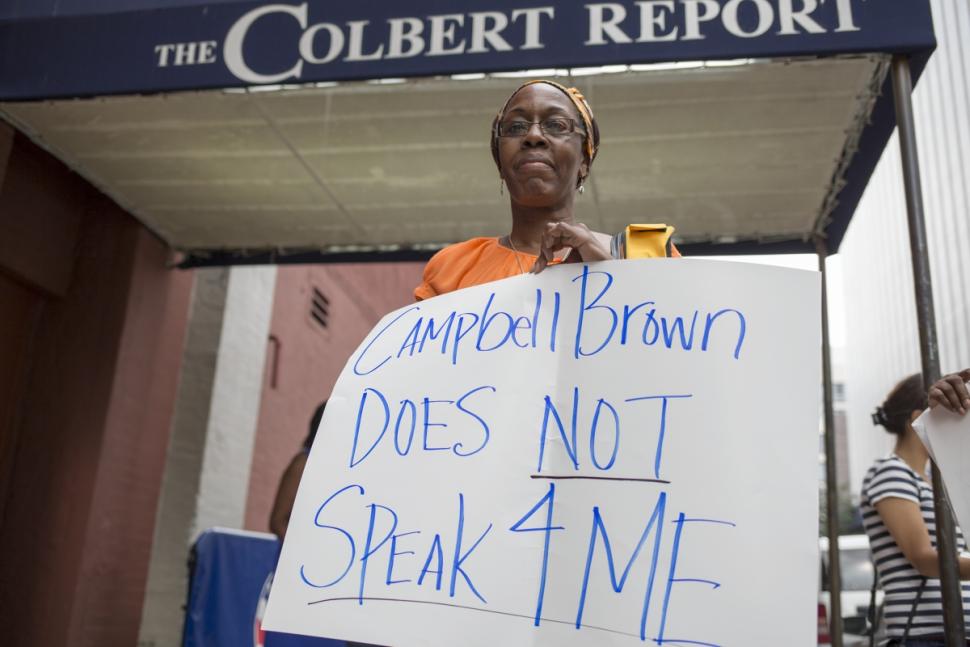
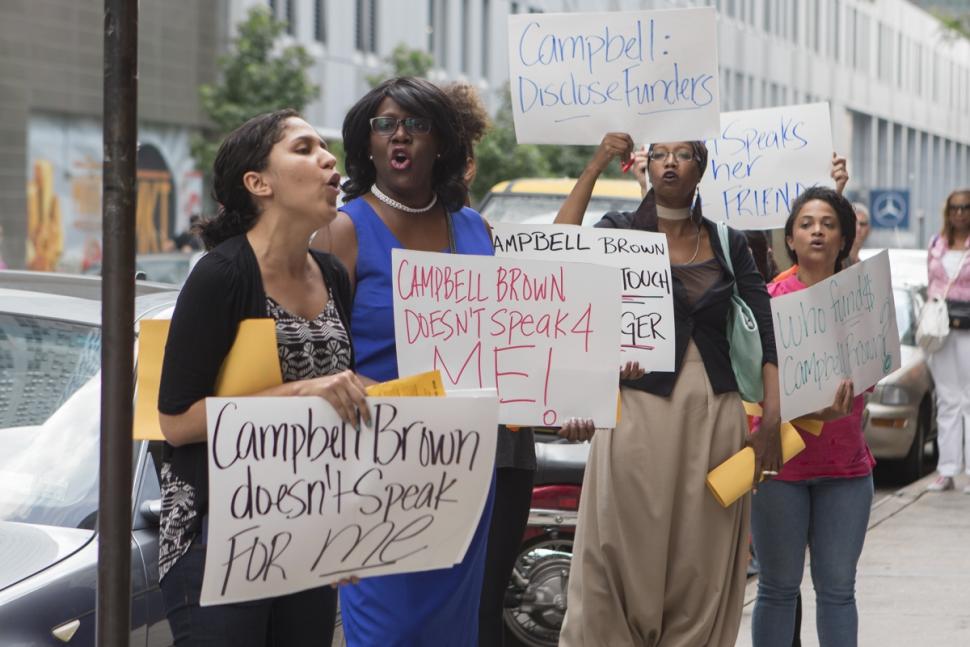
Let’s be clear.  Who are “the people who are outside today” who Ms. Brown assumes will bully and intimidate her donors?  According to The Daily News:


colbert1n-1-web

colbert1n-2-web

I am sure that Eva Moskowitz’s donors are just quaking in their boots…right after they drop another $400,000 into Governor Cuomo’s pockets.

Mr. Colbert did not sneak a camera crew down to the street to make Ms. Brown look as ridiculous as she richly deserved at that moment, but the fact that he led her to make such a ludicrous statement is telling in an of itself.  Today, it is very hard to trust that major media outlets will take the time and effort to research and interview people trying to lead public debate via deception, and on issues that require a genuine understanding of complex social phenomena, that is even less likely.  I have written before how abysmally the New York Times’ editorial staff have failed in that regard, preferring to take the statements of advocates with wealth and connections at face value.

Mr. Colbert is not a journalist, yet he and his fellow comedians Jon Stewart and John Oliver have become almost guardians of truth in recent years.  It is often more likely that Mr. Colbert or Mr. Stewart or Mr. Oliver will highlight the absurd inanities, half truths and contradictions routinely offered by politicians, pundits and advocates.  In the case of Ms. Brown, Mr. Colbert got her to openly confess to a truth that is gaining greater and greater public awareness: American governance is increasingly oligarchical in nature whereby elected officials craft policy more to serve the interests of their very wealthy donors rather than the interests of the actual voters who put them in office.  Ms. Brown’s undisclosed donor list is a perfect example of this, and her refusal to disclose under the fiction that her donors could possibly be intimidated by moms and teachers with home made posters should be mocked loudly and frequently.

I am grateful to Mr. Colbert for organizing his interview to that point, but I am saddened that we rely almost exclusively on satirists to get to the heart of public affairs these days.

3 Comments

Filed under Activism, Funding, Media, politics, schools, Social Justice, Testing, Unions, VAMs

Four More Things To Tell President Obama

Valerie Strauss of the Washington Post wrote last week that President Obama and Secretary of Education Arne Duncan had a meeting with teachers over lunch.  Her column provided space for the 2007 Arkansas Teacher of the Year, Justin Minkel, to offer his insights into how the meeting went and what the President and Secretary heard from the teachers present.  Mr. Minkel, who is a member of both the National Network of State Teachers of the Year and the Center for Teacher Quality and who blogs for Education Week and for CTQ, wrote cogently and intelligently about four key points:

1. There’s Nothing Wrong With the Kids

2. “Responsibility and Delight Can Co-exist”

3. It’s not about good and bad teachers.  It is about good and bad teaching.

4. If we want students to innovate, collaborate, and solve real-world problems, we need to make it possible for teachers to do the same things.

These are outstanding points, and I thank Mr. Minkel and his fellow teachers for communicating them directly at such a high level.  There are, of course, many other points that the President and his Secretary of Education need to genuinely hear and know.  I would like to offer my own four points to build upon these:

1. You are looking for teacher effectiveness in all the wrong places

Teachers matter.  Nobody should ever suggest otherwise.  But No Child Left Behind and Race to the Top both represent sustained efforts to locate how teachers matter in standardized test scores, and since Race to the Top, the strongest proxy for teacher effectiveness written into state and federal policy has been annual student progress on standardized testing. This is a flawed approach for several reasons.  To begin with, the tests that are designed to demonstrate if a student has mastered a body of knowledge or a set of skills are designed for that purpose and that purpose only.  As Dr. Nunoz of Concordia University Chicago notes, testing and measurement is a precise field and it is improper and inaccurate to use an examination for a different purpose because it would not be designed the same way.  The American Statistical Association released a statement on value added measurements earlier this year that clearly stated that the association does not believe any examination currently used to measure teacher effectiveness meets the strict criteria necessary for such a test, and they noted that most studies on VAMs find that teachers’ input only accounts for between 1-14% of the variability among student results on such tests.  Looking for teacher effectiveness in the results of standardized examinations is essentially playing dice with teachers’ futures.

Even the research that claims such models are useful is suspect.  As Dr. Jesse Rothstein of U.C. Berkeley found, even the Gates Foundation funded research on “Measures of Effective Teaching” makes claims that are poorly supported by their own data. Despite the MET study’s endorsement of VAMs, Dr. Rothstein notes that “teacher evaluations based on observed state test outcomes are only slightly better than coin tosses at identifying teachers whose students perform unusually well or badly  on assessments of conceptual understanding (p. 5),” and goes on to note that teachers whose students did well on standardized exams did far less well on measurements of critical thinking.  Using standardized examinations as a measure of teacher effectiveness can reward a weak teacher who focuses on test preparation and punish a highly skilled teacher who emphasizes higher order thinking and creative problem solving.

Teachers, of course, do make a difference for students.  And there are teachers who do not teach well, and there are teachers who excel at the work.  But the impact of that teaching is simply poorly represented in paper and pencil standardized examinations.  It can be found in student produced artifacts that explore rich content in creative and insightful ways.  It can be found in a classroom that “buzzes” with the constant hum of excited work.  It can be found in the individual lives of children who are inspired to explore a field they never knew held interest before.  It can be found in the children who find a mentor and reliable adult among the body of teachers in a school and stick with their education when nobody thought they could.  It can be found the eyes of a student whose talents and passions are affirmed for the first time in his or her young life.  This is what happens in millions of classrooms across the country on a daily basis that cannot be captured on a standardized examination.

Taylor Mali, teacher and poet, captures quite a lot of that nicely in this poetry performance:

2. It’s the poverty

You’ve been told by a lot of current reformers that talking about the extraordinary difficulties of educating children born into poverty is just “making excuses” for “bad teachers”.  I cannot say not only how much this refrain hurts  teachers who have dedicated themselves to working with our most needy students, but also how much it hurts those very same students.  It places upon the teachers a burden to, on their own, lift children of poverty to a level playing field with their more advantaged peers.  It thrusts upon those children schools that keep cutting out critical thinking and aesthetic enrichment in favor of test preparation because of draconian  layoff and reorganization threats while offering the students a brutally unlevel playing field if they graduate. I can think of few practical jokes more cruel than this.

Poverty is not an “excuse”; it is a fact that broadly impacts the earliest childhood of 22% of our young people.  It is a fact that we do much less to alleviate poverty’s deprivations than our peer democracies in the West.  And because our residential income segregation is very high and has risen by over a third since 1980, it is a fact that poverty disproportionately impacts specific schools and school systems.

And it is not a fact that is fully constrained to those meeting the federal definition of poverty.  Income, housing and food insecurity impact the lower middle class, many of whom are clinging to that status solely because of federal assistance programs and the Earned Income Tax Credit.  In 2011, only North Dakota and New Hampshire had child food insecurity rates below 15%.   The Hamilton Project report also notes that food insecurity can have potentially life long consequences in both educational outcomes and economic security, but teachers are going to be held accountable for children who will suffer lower birth weights, worse lifetime health outcomes and lower economic outcomes because Congress refuses to fund expanded SNAP benefits that amount to less than half of the cost of USS Gerald Ford.

This is not meant to “excuse” those teachers and administrators who give up on children in poverty or near poverty and do not do their utmost to educate, inspire and mentor those in their care.  However, it is intellectually and morally bankrupt to ignore that our much lamented gap in PISA can be located almost entirely within our poverty level, and to blame teachers and schools for failing to single-handedly overcome a phenomenon much larger than our schools and about which the billionaires driving today’s “reforms” refuse to discuss.

3. There is no “secret sauce” for educating our most struggling children

Former White House Chief of Staff and current Chicago Mayor Rahm Emanuel opined that Noble Network of charter schools in Chicago had the “secret sauce” for motivating students to perform.  An element of that recipe?  Collecting $400,000 in disciplinary “fines” from its students since 2008.  Advocates of the rapidly expanding charter sector of education like to paper over such practices, but it is vitally important to expose them because while their sponsors and leaders like to hype test performance, they often achieve those results at the expense of up to half of their students.

This should be absolutely clear: with 1000s of charter schools across the country, there must be many schools and teachers who do a genuinely great job with the students in their care.  Unfortunately, they are overshadowed by the high profile charter schools that are essentially corporate entities and that tout themselves as miracle factories based upon high test scores.  They consume public dollars, refuse public accountability, have astonishing attrition rates usually at the expense of the neediest children enrolled in them, and have formed powerful lobbies to influence politicians to continue to favor charter schools over fully public schools.

This is not to say that none of these schools do a good job of educating the students that they do accommodate and that there are not students and families who are sincerely grateful to be in those schools.  But it does mean that they cannot legitimately claim to have found any “secret sauce” for educating our neediest students when they engage in extreme cream skimming, refuse to let the public examine their finances and rely upon their extremely wealthy patrons to strong arm politicians on their behalf.  To put this in perspective:  In 2012, the NEA spent $13 million in campaign contributions total across the country, and the AFT spent $5.9 million.  Success Academy Charter’s supporters spent $3.6 million in THREE WEEKS just because Mayor de Blasio slowed down the expansion of the network.

Truly working with our neediest takes far more than advertising and cherry-picked student bodies.

4. Arts and the humanities matter

Despite very shaky evidence to back up the claim, we have been treated to nonstop rhetoric about our “crisis” in graduates with STEM degrees, and policy has pushed hard to create more pipelines for people to enter such fields regardless of the actual employment picture for them.  There is, however, evidence that in the age of test based accountability, we have marginalized endeavors that are critical to both our civic life and our general well being.  Social studies instruction has shrunk from 9.5% of instructional time to 7.6%, meaning that our students spend less time today learning history and engaging in critical thinking about their civic life.  While instruction in the English Language Arts has increased because of its status as a tested subject, there are legitimate concerns that the emphasis on reading informational texts in the Common Core State Standards and associated testing, will drive more classrooms away from reading great works of literary fiction and poetry.

And then there is the long term and precipitous decline in arts education which fell below 50% for 18 year olds in their childhood education in 2008.  That means that half of the children in America born in 1990 received no arts education in their entire education K-12.  Research is very clear that participation in the arts has a wide range of academic benefits from higher test scores to higher rates of college completion among low income students.  Eliot Eisner of Stanford University notes the lessons that the arts teach such as: making judgments about relationships, seeing multiple answers to problems, accepting multiple perspectives, complex problem solving, learning that cognition is not limited by language, seeing large effects from small differences, and thinking through materials to fruition of an idea.  It is not hard at all to see the connection between these capacities and the capacities that lead not simply to STEM competencies but also to STEM understanding and innovation.  No wonder, then, that there is a small but growing movement to “move from STEM to STEAM” and place arts at the center of our drive for more STEM education.

While this is admirable, it is also not enough to envision the importance of the arts and humanities as a partner to scientific and technological advancement because they possess their own warrants.  Eisner’s “ten lessons” also include:  teaching children how to say what “cannot be said” via “poetic capacities,” experiencing things that cannot be experienced in any other way and exploring one’s capacity for feeling, symbolizing what is important in society.  The arts and humanities, therefore, enrich us in ways that cannot be measured via test based accountability but which are part of our essential humanity.  That 50% of our young people experience no arts education means that their education was fundamentally inattentive to their humanity.  As we advocate for literature, poetry, music, visual and performing arts for all children, we must remember this — the arts and humanities cannot become yet another preserve of the wealthy and we cannot allow test based accountability to squeeze what is left of them from our public schools.

1 Comment

Filed under charter schools, Common Core, DFER, politics, schools, Social Justice, Testing, Unions, VAMs

Jamming Square Pegs into Round Holes: Arne Duncan Sets Sights on Special Education

United States Secretary of Education Arne Duncan announced a new focus on special education on Tuesday of this week.  The federal government will shift its resources for monitoring state compliance with the Individual’s with Disabilities in Education Act (IDEA) from examining procedural compliance and begin looking at “outcomes” for students with disabilities using a new framework called “Results-Driven Accountability (RDA).  This new framework will include participation in state curriculum assessments and data on reading and mathematics achievement for disabled students using the National Assessment of Educational Progress (NAEP) the examination sponsored by the DOE every two years to gather a snapshot of national trends in education.  According to the Washington Post:

To calculate how states stack up under the new criteria, the department is using a complex matrix that weighs several factors, including how well students with disabilities perform on the National Assessment of Educational Progress, or NAEP, a test the federal government gives to a sampling of students in every state every two years.

NAEP is designed to offer a snapshot of academic performance. This marks the first time the government has tied NAEP scores to consequences.

Duncan brushed aside the suggestion that the new approach adds to a climate of high-stakes standardized testing. “I wouldn’t call it high-stakes,” he said.

Given that the federal government allocates 11.5 billion dollars a year to the states to assist with special education, that assurance is likely to ring hollow to state and local officials charged with compliance.

I will give Secretary Duncan credit for one factual observation in his conference call with reporters;  most students who qualify for an individualized education plan (IEP) do not have cognitive disabilities that severely limit their ability to engage with a challenging curriculum.  But pretty much every other underlying assumption of this shift to an RDA compliance system is problematic.

Let’s start with the existing compliance of states under previous federal guidelines.  The DOE notes that under previous compliance guidelines, 38 states were in compliance with IDEA and under the new guidelines that number will drop to 15. I would suggest that if previous compliance standards which focused upon procedural compliance told the federal DOE that 38 states were in compliance with no need of assistance or intervention then those procedural guidelines were hideously flawed.  The Bay Area NBC station found over 10,000 families in California went to court over disputes with districts over special education services, and that number represents only the fraction of families that had the resources to pursue their dispute to that level.  Even Massachusetts, a state that pioneered services for disabled students and which meets the new requirements, is not precisely immune from being sued for noncompliance.  While states are rated on their compliance, it is up to actual districts and schools to implement the provisions of special education law, and many districts, suffering from budget restraints and state aid cuts, have to be sued in order to even begin an evaluation process for a potential special needs learner. Secretary Duncan made some deal about the DOE’s 11.5 billion dollar commitment to special education in the country, but with 6.5 million students eligible for services, that amounts to an underwhelming $1,769.23 per student nationwide, and the Council of Exceptional Children (CEC) notes that in 40 years, the federal government has NEVER fulfilled its promise to fully fund IDEA.

If Secretary Duncan wants to improve services for special education students, he could start by endorsing full funding of IDEA and actually determine if states are even in procedural compliance with far better measures than currently employed.

Another flaw of this plan resides directly in the use of state assessments and the NAEP for purposes of assessing state compliance and, eventually, adding punitive measures for states whose disabled students do not make regular improvement on those exams.  Placing this requirement on the NAEP would be tremendous mistake for several reasons.  NAEP is designed to provide a snapshot of the educational landscape in the United States, and part of its usefulness is tied the lack of any significant stakes attached to it.  By potentially tying special education compliance to the NAEP, the incentive will exist for states and districts to make special education students’ education consist of test preparation.  Mr. Duncan can breezily dismiss that concern all he wants, but the best way to assure that special education students across the students find themselves in self contained classrooms aimed at test preparation is to measure compliance this way.  We have some idea about how this unfolds from NCLB already.

Secretary Duncan also made major mistakes in his assessment of special education students’ “rising to the challenge.”  I must emphasize again that he is partially correct:  classified students CAN and, in fact, DO achieve within materials similar to or identical to their general education peers.  Very few of the students who qualify for IEPs under federal law are significantly cognitively disabled, and it is an article of faith among professional teachers that “all children can learn”.

BUT — that article of faith comes with an important caveat: All children can learn to the degree of their ability when provided with appropriate accommodations and when measured in a manner that allows them to demonstrate their understanding.  In a way, this corollary applies to all children, but general education students are more likely to cluster around a set of skills and capacities that distribute normally on a standardized examination.  By definition, many students with disabilities do not, and this does not mean that they are incapable of learning.

It means we are often incapable of measuring their learning in a fair and accurate way via a paper and pencil standardized test.

This does not require a lot of imagination.  Picture a child with severe dyslexia or ADHD.  This is certainly a child who is capable of learning, and a skilled general education teacher working with a child study team and following a well designed IEP can create assessments of learning and supplemental experiences in the classroom where that child demonstrates substantial learning.  That same learning may not be on display during a paper and pencil standardized examination that requires hours of time in a seat.  This can apply to a child with sensory issues or a behavioral disorder.  It is not that schools should or do abandon such a child to not learn within the goals of a general education curriculum: it is that the entire process of special education is meant to serve accommodations that allow the child to engage the material and demonstrate learning in appropriate ways with input from experts on learning.

Mr. Duncan, do you have a standardized exam that does this?

But this is the problem with the federal DOE under Secretary Duncan.  Having committed to big data sets as the be all and end all of understanding what is going on in education and having determined that standardized test scores are the most important measure of educational accomplishment, we now have a special education compliance policy that is going to try to force the most square of pegs into Secretary Duncan’s round hole of test based accountability.

Image from Toothpaste for Dinner: http://toothpastefordinner.com/archives/2011/Jun/

Image from Toothpaste for Dinner: http://toothpastefordinner.com/archives/2011/Jun/

Before ramming 6.5 million special education students into test based accountability, I would suggest several alternative approaches:

1) Vigorously advocate for the CEC’s proposal to FULLY fund the Individuals with Disabilities in Education Act.

2) Monitor GENUINE procedural compliance with the provisions of IDEA.

3) Add new compliance measures such as parental satisfaction surveys with special education services provided.

4) Assist states with creation of qualitative measures of special education students’ progress.

5) Add federal assistance to community agencies that help connect families in poverty to special education services

NAEP data can remain what it ought to be: a snapshot of student skills that can inform the creation of further policy, but not be linked to consequences.

Leave a comment

Filed under Data, politics, schools, teaching, Testing

What Really Worries Me About the Vergara Decision

On June 10th, California Judge Rolf M. Treu declared that teacher tenure laws in California deprive students of their right to an education and declared them unconstitutional.  The provisions that were specifically targeted were the time frame for awarding tenure to California teachers, seniority rules on firing of teachers colloquially known as “last in, first out” and rules for due process before removing a teacher after the initial probationary period.  Judge Treu grandly compared his decision to Brown v. Board of Education and sent shock waves through the mainstream teacher community.

I do not think the ruling is likely to survive a challenge.

First, the evidence that Judge Treu said “shocks the conscience” and was presented by the plaintiffs is not precisely rock solid.  Relying heavily upon the work of Professor Raj Chetty of Harvard University, the plaintiffs claimed that even one “grossly ineffective” teacher had long term lasting harm on student’s achievement and future economic success, and they claimed California’s tenure laws subjected students to such “grossly ineffective” teachers.  The problem here is not that there are not a discernible portion of teachers who ought to be removed, but that the Chetty research, indeed most of the research used by the plaintiffs is, to put it mildly, disputed.

Dr. Audrey Amrein-Beardsley of Arizona State University writes the blog Vamboozled to discuss research and policy around the use of value added measures of teacher performance (VAMs), and she has taken on the flaws of Dr, Chetty’s work on numerous occasions, notably here and here. Dr. Amrein-Beardsley links to critiques from other scholars as well, and the obvious message that Judge Treu missed is that this scholarship “shocks the conscience” most powerfully when one thoroughly ignores that does not represent a professional consensus among education researchers.  Indeed, it is easy to portray the handful of researchers who insist that single teacher impacts can be measured this way as outliers.  So with appeals in the works, it is hard to believe that Judge Treu’s wholesale ignoring of contrary evidence will be replicated by every judge who reviews the evidence.

Second, as Dr. Diane Ravitch of New York University explains here, the plaintiffs in the Vergara case are of questionable standing.  If the argument is that “grossly ineffective” teachers have damaging lifelong impacts on students, it would stand to reason that the plaintiffs could clearly demonstrate that they had been subjected to such teachers.  Not so much.  In fact, some of them apparently claimed that a given teacher was bad at teaching when those same teachers were widely recognized as excellent:

One of the plaintiffs (Monterroza) said that her teacher, Christine McLaughlin was a very bad teacher, but McLaughlin was Pasadena teacher of the year and has received many awards for excellent teaching (google her).

Dr. Ravitch refers to briefs by the defense that go on to note how none of the plaintiffs could tie any of the supposedly poor teachers to the specific statutes that were challenged in the lawsuit.  Appeals attorneys were certainly make use of this, and given judges more inclined to consider all the evidence, they may have successes.

I am, therefore, tentatively hopeful that this case will die or be substantively altered on appeal.  But I am still worried, and the reason is that the case provides a much desired legal win for a coordinated set of interests that have teacher unions firmly in their sights.  The plaintiffs were sponsored by the group “Students Matter” which is funded by Silicon Valley technology entrepreneur David Welch and is financially allied with charter school funders and Michelle Rhee’s “Students First” organization that similarly attacks teachers’ union protections.  Given the partisan position of the lawsuit’s backers, it was extremely troubling, if not surprising, to see Secretary of Education Arne Duncan welcome a decision that greatly undermines teachers’ workplace protections:

With strong financial backers like Welch, Rhee and organizations like the Walton Family Foundation and tacit approval from the administration, we can expect similar lawsuits in pretty much every state over the next few years.  It fits one of the favorite narratives of the education “reform” camp:  that everything hinges on teachers and if we only fire the right teachers, schools, everywhere, will improve dramatically

brace yourself

This is pernicious for a number of reasons.  First, it relies of the very shaky and often laughable claim that all it takes to close the achievement gap is enough “great teachers” in a row.  Michelle Rhee loves to repeat this claim, but the claim does not stand up to very strong scrutiny, most notably that the research basis for the claim merely extrapolated from one year gains in classrooms with an identified effective teacher instead of studying students over time.

Further, we should question the value of the metrics used to rate teacher effectiveness in the first place.  As I have written previously, the American Statistical Association’s statement on the use of VAMs warns that only 1% to 14% of student variation on test scores can be attributed to variation in teacher quality. The does not mean, by the way, that teachers have no effect, but that statistically tying the achievement gap among students as measured by standardized testing to variability in teacher quality is looking at a very narrow slice of that gap’s origins.  What else can account for persistent gaps in student test scores?  Los Angles has a Residential Income Segregation Index of 51. 54% of children in the central city live in povertyThe impacts of poverty on children are by now well documented and cannot be excluded when considering school performance. Classrooms in Los Angeles are overcrowded, sometimes to a shocking extreme. California’s woeful education expenditures place it in the company of Arkansas and below West Virginia.  But according to the proponents of the Vergara case, the only thing that matters is teacher effectiveness as rated by the test score gains made by their students, regardless of all of the other factors that may effect those scores.

And this is painful ground for teacher and student advocates.  It sounds like I am saying that teachers have little impact, but what I mean to say is that teachers matter, but not in ways that are effectively measured by the value added models based on standardized testing.  Professor Jesse Rothstein’s review of the Measures of Effective Teaching study funded by the Gates Foundation demonstrated that teachers who did very well in their value added measures did far less well in measures of students gaining higher order thinking skills, so it is highly possible that the measures favored by Vergara’s so-called expert witnesses improperly favor the wrong teachers.  Anecdotally, such measures of effectiveness miss the realities of how teachers work with students.  The worst teacher of my entire life was my seventh grade mathematics teacher who was a bully and the most demotivating individual I have ever known in my life.  However, in a community where 95% of high school graduates went on to four year colleges and universities, the depths of his ineffectiveness would have been masked by the external advantages of his students.  Influence and impact upon students can frequently be hard to see in any numbers, but they are real regardless.  I have had former students contact me via social media to express appreciation for the role I played in their development towards adulthood, and not all of those students were long term academic successes (they are, however, remarkable people…testing misses that).

That is because an effective teacher is not merely a person who extracts a pre-determined gain in a standardized test over the course of one year.  Effective teachers inspire students to take risks that may result in messy but instructive failures.  Effective teachers help student manage social and emotional challenges to become more skilled at collaboration and leadership.  Effective teachers challenge students to, as Maxine Greene phrased it, “stir” themselves and see the world in different and transformative ways.  Effective teachers may simply convince a struggling student to stay in school for the stability it provides in his or her life.

As we prepare to challenge the Vergara decision and to brace ourselves for the flood of similar suits that the likes of Michelle Rhee are undoubtedly planning, it is vital that we not only confront the highly flawed assumptions of test based teacher competence, but also that we uplift a better vision of the importance of skilled and experienced teachers.

4 Comments

Filed under Media, politics, schools, Social Justice, Testing, VAMs

Gates’ Money and Privacy Activism — Opposition to Ed. Reform Hits the Mainstream

A few stories caught a lot of eyes over the weekend.  None of that is good news for education reformers who have banked on stealth and little reporting.

The first is a major article and interview regarding the role Bill Gates’ money has played in the development of, promotion of and adoption of the Common Core State Standards in the Washington Post.  The story is not entirely complete.  For starters, it fails to disclose that David Coleman already had funding from the Gates Foundation for his Student Achievement Partners, so a meeting with Gates in 2008 is not their first intersection.  Also, it does not explore the heavy hand that Gates has also had in the push for more high stakes testing to evaluate teachers via his funding of the highly flawed Measures of Effective Teaching study, nor does it examine the role that Gates has played in enabling technology entrepreneurs to mine the data generated from those tests without parental consent.

Regardless, the article is both informative and important for several reasons.  First, it is one of the first times anyone in a major news outlet has provided a portrait of the diverse opposition to current reform efforts in education that doesn’t make it sound like mostly the work of Alex Jones style cranks.  The article even quotes academics who question whether the standards are based on sound research on how children learn or even if there is a connection between quality standards and learning.  Second, this is an article in a major outlet that does not equivocate in the slightest about how much influence one very rich man has had in trying to control the entire course of American public education.  While it does not editorialize on the question, it is hard to read how many federal, state, nonprofit, academic and corporate entities were lobbied by, influenced by or funded by Gates and not wonder what role democracy has anymore when it comes to our public schools.

Finally, Gates himself comes across as defensive and dismissive:

Gates is disdainful of the rhetoric from opponents. He sees himself as a technocrat trying to foster solutions to a profound social problem — gaping inequalities in U.S. public education — by investing in promising new ideas.

This would be more convincing if Gates displayed the slightest interest in testing new ideas before unveiling them in 45 states at once before parents and teachers have a chance to understand them, indeed, before anyone has a chance to understand if they are a net positive or not.  From Gates’ point of view and experience, this must make sense.  He has compared common standards to standardized electrical outlets and computer code as a means of allowing innovation, and certainly getting DOS on most desktop computers in the world led to a lot of software developers having a common platform.  But education is not consumer electronics, and bypassing the entirety of stakeholders who value public education for a variety of reasons was going to lead to push back, and even today, Bill Gates does not demonstrate awareness of that.

The second article appeared in Politico and was dedicated to parent activists working to protect their children from data mining operations tied to public education.  This represents another public airing of activities whose proponents would prefer to avoid being seen in the open.  The report quotes New York’s Leonie Haimson of Class Size Matters about how parents have reacted when informed about the plans of technology firms to use pretty much every bit of data they can get their hands on, and it quotes worried data entrepreneurs coming to grips with parental opposition:

Many said they had always assumed parents would support their vision: to mine vast quantities of data for insights into what’s working, and what’s not, for individual students and for the education system as a whole.

“People took for granted that parents would understand [the benefits], that it was self-evident,” said Michael Horn, a co-founder of the Clayton Christensen Institute, an education think tank.

Instead, legitimate questions about data security have mixed with alarmist rhetoric in a combustible brew that’s “spreading like wildfire” on social media, said Aimee Rogstad Guidera, executive director of the Data Quality Campaign, a nonprofit advocacy group for data-driven education.

That fear, Guidera said, “leads to people saying, ‘Shut it down. No more.’”

Guidera hopes to counter the protests by circulating videos and graphics emphasizing the value of data. But she acknowledges the outrage will be hard to rein in.

Could the parent lobby scuttle a data revolution that’s been championed by the White House, pushed by billionaire philanthropists and embraced by reformers of both parties as the best hope to improve public education? “I do have that concern,” Guidera said. “Absolutely.”

The article doesn’t go into detail about just how much money is thought to be at stake and takes the data mining firms at their word that they only want to help, but I came away from reading it with one resounding message: this damage is entirely self inflicted, but the data miners see the parent activists as the problem.  They did not want to do the hard marketing work of convincing people that they were doing something valuable, and they did not anticipate that parents might see the data generated by their children’s public educations as something they’d want to protect rather than just shovel over for free.  It is hard to sympathize here, especially when they have avoided openness from the beginning.

Which leads to the third article from today: a call from the Gates Foundation for a two year “moratorium” on high stakes decisions based upon Common Core aligned testing.  This is the first official wavering from the Gates camp since the standards and testing drive began in earnest, and it is highly significant as an indication of concern that the whole enterprise is in trouble.  It may also be a miscalculation — yes, teacher opposition to using value added measures of their effectiveness based on standardized tests is strong, and yes, teachers have barely had time to adjust to the new standards.  But two years will not fix the flaws in VAMs, and it will not assuage parental concerns about the role of testing and data mining.  It will potentially take a chunk out of testing companies and data mining companies who were making business plans based upon all Common Core states embarking on wide scale testing next year, and I find it interesting that the Gates Foundation is willing to have them cool their heels while the standards’ supporters try to do something they have avoided all along: talk in public.

Leave a comment

Filed under Activism, Common Core, Funding, Gates Foundation, Media, Privacy, Testing, VAMs

Who is more important? Pearson? Or our children?

Some background:

My wife and I have two children who are public school students in New York City.  We, as many other parents do, had our eldest tested for admission to the city’s gifted and talented program.  I’ll be honest – this child is exceptionally bright, but creative use of verbal language, imagination, story telling (our eldest’s strengths), are not really part of the tests used to qualify.  Regardless, the score was high enough to qualify for a seat which was assigned by lottery.

Our youngest sat for this year’s examinations in January. Sibling preference in admission at the G&T programs meant that if that score had qualified as well both our children would be in the same school next year.

Our youngest missed by the smallest margin.

Now I must be clear about this.  Our family does not deserve anyone’s sympathy.  It was by sheer luck of a random drawing among the many children who qualified that got our eldest a seat.  Our youngest was not owed a seat, and our zoned school is another one of the highest regarded schools in the city and is very close to the other school.  We know families who schlep across town to three different schools in pursuit of the cherry that the NYC Department of Education has placed on top the public school system.  Then there are the families whose kids qualify but for whom there are no seats because they’ve greatly overpromised what they can deliver.  Then there is the entire issue of how so many of the qualifying students are concentrated in affluent districts in the city.

So we will be fine, but since we would prefer our family’s attention to concentrate on one school for as long as possible, we took the opportunity to make an appointment with the DOE to review our youngest’s test.  That appointment was today, and we were given twenty minutes to sit with the exam and the answer key under the supervision of a DOE employee.  It was actually a more helpful experience than I anticipated, and our DOE representative was really quite delightful and very skilled at explaining the tests and how they were administered.  I can tell you the following:  We found that our child was prone to picking distractors, especially as each section of the exam progressed. We found one indisputably incorrectly scored item which means the exam is flagged for an immediate rescore.  We also found a handful of items that I strongly suspect would make my friends in measurement and quantitative methods cringe.

And that’s all that I can tell you.

You see, our child was assessed using the Otis-Lennon School Ability Test (OLSAT) and the Naglieri Nonverbal Ability Test (NNAT-2), both of which are products of Pearson, and in order to get a look at the examinations, I had to sign a non-disclosure form.  Chew on that for a minute.  An official of the New York Department of Education had me and my wife sign a form promising that we would not specifically or generally disclose the contents of an examination that was administered to our child for the purpose of selecting a public school.  The contents of that examination, several of which arguably violate principles of good test design for young children, must be kept secret even though, of course, it will be redesigned for the next year’s exams and even though I can purchase any number of OLSAT related materials directly from Pearson.

I cannot even really blame Pearson here.  They have developed the examination, and there is significant money at stake for them in a) keeping too much of their material from being seen by competitors and 2) making certain that people have to purchase exam related materials from them.

On the other hand, I have no trouble blaming craven politicians and bureaucrats who contracted Pearson and agreed to terms like this which are good for business, but bad for public discussion of education policy.  What we did today allows my family to pursue our interests as a household, but it disallows any informed discussion with the broader community about the nature of measurements that determine substantial educational opportunities.  And there are real discussions that ought to be had.  This year, three times as many children qualified for seats in the coveted citywide G&T programs as there were seats available, but these qualified children are not randomly distributed across the city.  Districts 2 and 3 in Manhattan combined for 623 of those Kindergarten aged children qualified for entry to citywide programs while districts 7,8, 9, 12 (The Bronx), 16, 23, 32 (Brooklyn), and 29 (Queens) had none.  With an income segregation index of 57 in New York City, there is an important discussion to be had about the nature of these tests and whether they identify gifted or privileged children.  But Pearson’s intellectual property is more important than that discussion.

NYRISI

Which is ironic given how eager New York was to join with InBloom, the data storage cloud service that was going to provide storage for student records and allow technology and publishing companies to mine that data to create products for sale.  It was only the vigorous activism by advocates like Leonie Haimson on Class Size Matters that put enough pressure on Albany to halt the project, but it is by no means the only one that sees student data as a commodity.

What does it say that your child’s school records are able to be used without your consent for private purposes but that private materials with profound impact upon public school children and their opportunity must be protected?

1 Comment

Filed under Pearson, Privacy, Stories, Testing

Open Letter to President Obama — You Are Listening to the Wrong People

Dear Mr. President:

I am writing to you with three different roles.  First, I am the director of secondary education and secondary/special education teacher preparation at Seton Hall University where I have been on the faculty since 2002.  Second, I am a lifelong educator whose teaching experience at levels from seventh grade to graduate school courses stretches back to 1993. Finally and most importantly, sir, I am the father of two school aged children enrolled in the public schools of New York City.  All three of those roles in life have prompted me to write to you, and it is my hope that you will seriously consider what I have to say, for it is based upon my devotion to my children, my experience as a teacher and upon the data that is readily available about what is being done to schools during your administration.

With respect, Mr. President, you are listening to all the wrong people about our nation’s schools.

When you were inaugurated, many of us in education had hoped that your administration would urge Congress to roll back the detrimental aspects of the No Child Left Behind act, which had taken the previous two decades of educational failure rhetoric and placed a punishing regimen of unreasonable expectations, high stakes testing and punishment into effect that left schools and schools systems under threat of a “failure” label if they did not achieve near miraculous score gains in standardized examinations.  Instead, we got the Race to the Top program which has taken the worst elements of NCLB and made them even worse.  Your signature education initiative incentivized participating states to enroll in rushed and unproven common standards, increases the amount of high stakes testing at all levels of public education, subjects teachers to invalid measures of job performance and creates preferential treatment for charter schools that cynically manipulate data on their enrollment and achievements, sue to prevent public oversight of the public moneys they receive and whose expansion provides new investment vehicles for the very wealthy.  All of these results have rich and powerful advocates, and all of them are damaging to our nation’s public schools.

The Common Core State Standards have been described as a state led effort because of the role of the National Governors Association in their creation, but the work of a very few people is far more directly responsible for them.  David Coleman, now President of the College Board, Jason Zimba and Susan Pimentel of Student Achievement Incorporated worked with a small group of core writers that were largely representative of the testing and publishing industries to produce K-12 standards in English Language Arts and Mathematics in less than two years.  This is a staggering pace for such a complex project, and it was conducted in clear violation of highly regarded and accepted processes for the creation of standards.  Dr. Sandra Stotsky of the University of Arkansas was a member of the validation committee that was convened, in theory, to validate the quality of the standards, but she refused to signed off on them when, by her own account, repeated efforts to have the research basis for the standards produced by the writing committees went unanswered.  Once written, the standards were rapidly adopted by states due to the incentives of Race to the Top and aggressive spending of the Bill and Melinda Gates Foundation.  Diane Ravitch of New York University has repeatedly pointed out that this process was staggeringly flawed, and even more flawed than the opaque writing and promotion efforts has been the race to roll out the standards in nearly all states simultaneously with no small scale field testing and no known way for data from the implementation to be fed back to any body that is tasked with revising the standards based on such data.

Mr. Bill Gates seems enormously confident, absent any defensible evidence, that this is the correct path.  He provided funding to Student Achievement Incorporated and the National Governors Association, and has been spending lavishly since 2010 to make certain all forms of organizations continue to boost the standards.  Mr. Gates spoke this year at the Teaching and Learning Conference hosted by the National Board for Professional Teaching Standards (an organization he has given grants to recently), and his defense of national standards was telling.  According to the Washington Post:

Standardization is especially important to allow for innovation in the classroom, said Gates, who used an analogy of electrical outlets.

“If you have 50 different plug types, appliances wouldn’t be available and would be very expensive,” he said. But once an electric outlet becomes standardized, many companies can design appliances and competition ensues, creating variety and better prices for consumers, he said.

The version posted to the Gates Foundation website offers a more explanatory framing of the metaphor, but Mr. President, I hope the flaw in his thinking is evident.  Multi-state standards are not, inherently, a bad thing, primarily if used like the National Assessment of Educational Progress as a NO STAKES diagnostic tool, and Mr. Gates is correct that a variety of INDUSTRY standards have led to consumer innovations.  However, even after we accept a standard for early literacy acquisition to be age appropriate and based on research into how children learn to read, the process by which any given child meets that standard is vastly more complex than the process of attaching an electric motor to a hand blender; worse, it does not demonstrate an understanding that children develop at very varied rates, and that an age appropriate target for one child may be entirely inappropriate for a peer in the same classroom.

Even assuming that Mr. Gates is correct and that CCSS would allow teachers to innovate, Race to the Top and Mr. Gates’ own advocacy have worked to tie the CCSS to a regimen of high stakes testing the likes of which we have never seen and which are already incentivizing teachers and school districts to vastly narrow their teaching in response.  Mr. President, policy analysts refer to perverse incentives as those elements of policy that incentivize behavior in such a way that people can obtain the incentive while engaging in practices that are damaging or undesirable.  In this case, Race to the Top is the Mother of All Perverse Incentives.  Your administration required states to adopt test-based evaluation of teachers in addition to adoption of common standards.  This has resulted in states both enrolling in the CCSS testing consortia, and adopting Value Added Models (VAM) of teacher effectiveness as part of teacher assessment and retention.  Mr. President, you recently remarked that schools should not be teaching to the test even while your administration was stripping Washington State of its NCLB waiver over its desire to not use high stakes testing to evaluate teachers, but you could do little that incentivizes teaching to the test more than this.  Michelle Rhee’s tenure as D.C. Schools Chancellor provides an instructive anecdote.  Despite her denials and cursory investigation, it is very clear that her “raise test scores or be fired” approach spawned widespread cheating. That behavior is not excusable, but it is evidence of how far some people placed in extraordinarily difficult circumstances will go when subject to such incentives, and it is simply inevitable that short of cheating, the use of VAMs in teacher evaluation will result in more teaching to the test.

And VAMs themselves are invalid, Mr. President.  The American Statistical Association is quite clear on this in its recent statement on the use of VAMs for teacher evaluation.

The measure of student achievement is typically a score on a standardized test, and VAMs are only as good as the data fed into them. Ideally, tests should fully measure student achievement with respect to the curriculum objectives and content standards adopted by the state, in both breadth and depth. In practice, no test meets this stringent standard, and it needs to be recognized that, at best, most VAMs predict only performance on the test and not necessarily long-range learning outcomes. Other student outcomes are predicted only to the extent that they are correlated with test scores. A teacher’s efforts to encourage students’ creativity or help colleagues improve their instruction, for example, are not explicitly recognized in VAMs…

It is unknown how full implementation of an accountability system incorporating test-based indicators, such as those derived from VAMs, will affect the actions and dispositions of teachers, principals and other educators. Perceptions of transparency, fairness and credibility will be crucial in determining the degree of success of the system as a whole in achieving its goals of improving the quality of teaching. Given the unpredictability of such complex interacting forces, it is difficult to anticipate how the education system as a whole will be affected and how the educator labor market will respond.

This is clear-cut, sir.  There are no current high stakes tests that meet the requirements of a well developed VAM, and there is no evidence about how VAMs will influence the schools in which they are deployed, but your signature education program is incentivizing them anyway.

To date, no study reliably shows that current VAMs can be used the way they are going to be used over the next few years, but that has not stopped the Gates Foundation from being front and center in this issue as well.  The Gates commissioned “Measures of Effective Teaching” study concluded that VAMs can be effectively used to evaluate teachers, but Jesse Rothstein of the University of California at Berkeley demonstrated clearly how flawed the study was, especially how it drew conclusions only weakly supported by its own data:

The results presented in the report do not support the conclusions drawn from them. This is especially troubling because the Gates Foundation has widely circulated a stand-alone policy brief (with the same title as the research report) that omits the full analysis, so even careful readers will be unaware of the weak evidentiary basis for its conclusions…

Hence, while the report’s conclusion that teachers who perform well on one measure “tend to” do well on the other is technically correct, the tendency is shockingly weak.  As discussed below (and in contrast to many media summaries of the MET study), this important result casts substantial doubt on the utility of student test score gains as a measure of teacher effectiveness.  Moreover, the focus on the stable components – which cannot be observed directly but whose properties are inferred by researchers based on comparisons between classes taught be the same teacher – inflates the correlations among measures.  Around 45% of teacher who appear based on the actually-observed scores to be at the 80th percentile on one measure are in fact below average on the other. Although this problem would decrease if information from multiple years (or multiple courses in the same year) were averaged, in realistic settings misclassification rates would remain much higher than the already high rates inferred for the stable components.

It is almost inconceivable how it is that our nation is rushing forward with a package of reforms that are being implemented at breakneck speed with such damaging potential and with so little evidence to suggest that they will do anyone any good, and with mounting evidence that they are objectively harmful.  But one thing is actually very certain: these “reforms” and their attendant policies are making some people a substantial profit.

Three years ago, education writer and consultant and former National Board Certified Teacher Nancy Flanagan noted that the rush for CCSS implementation meant that a publishing bonanza was on the horizon.   Certainly, their implementation with the coming testing requirements has been a bonanza for Pearson who landed the contract to write and implement the Partnership for Assessment of Readiness for College and Careers (PARCC)  testing consortium.  At a predicted cost of 24 dollars for a set of tests as the math and ELA testing comes on line, Pearson is guaranteed a huge new income stream from the more than 10 million students currently in PARCC states.  But Pearson is only the most public face of making money off of the reforms put in place by your administration.  Common standards and mass testing generate vast amount of data, and technology companies are starting up all intending to mine that data for profit.  This is ground that has been ploughed by Rupert Murdoch who, when he began acquiring education technology firms, identified a “500 billion dollar sector” waiting for “big breakthroughs”.  Bill Gates has also been involved in this sector, setting up the data cloud storage firm InBloom for 100 million dollars, and watching it close when parental concerns over data security and the plan to allow vendors to access the data could not be overcome.  But other firms such as Knewton intend to continue data mining and creating products based upon that analysis, and none of them, regardless of how intriguing their products might be, demonstrate sufficient care about the need to explain their services to parents, the need to allow parents and guardians to opt their children out of the data pool or the need to build real support among the people whose children are being transformed into revenue.

I am asking you as a father, sir: would this be acceptable to you?  I regret to inform you, Mr. President, that your own administration has abetted this by changing the regulations that implement the Federal Education Rights and Privacy Act.

Publishers, testing companies and technology firms are not the only ones who are reaping new windfalls from your education policies, Mr. President.  It turns out that Wall Street investors are eager to see another aspect of Race to the Top, charter school expansion, continue as rapidly as everything else, and while many of them proclaim to be fans of the charter schools’ alleged “successes” it is also clear that many of them have also figured out how to make guaranteed money from supporting charter schools.  Hedge fund billionaires can use a combination of federal tax credits to make investing in charter school construction a vehicle that can guarantee a doubled return within 7 years.  This is entirely unlike traditional school construction funding via bond issues because such bond issues are done in the open and for a public with a vote for or against the responsible school boards.  This is done entirely in private and with no oversight and precious little public knowledge.  It is little wonder then that Wall Street interests are not only investing in charter school construction, they are also organizing PACs such as Democrats for Education Reform specifically to keep state governments granting more and more charters, something else that you enabled with the provisions of Race to the Top.

You might be able to justify this, Mr. President if you could claim that charter schools are actually the solution to American education, but to make that claim you would have to ignore evidence.  Many charters are excellent schools.  Many are terrible.  But there is no evidence that the charter school segment is consistently outperforming fully public schools.  There is, however, evidence that charter schools do not educate children with disabilities at comparable levels as fully public schools.  There is evidence that charter schools do not serve students who are English Language Learners like their fully public peer schools do.  There is evidence that one of the most prominent charter operators in New York City, Eva Moskowitz of Success Academy, is not telling the truth about the number of children in poverty that she serves, the real achievements of her schools test scores, or the rate of attrition for students with disabilities and language learning issues.

These schools are not miracle factories, Mr. President, but supporting their expansion is making people money.  Your Secretary of Education, Arne Duncan, once opined that Hurricane Katrina was the “best thing” ever for New Orleans Schools because it shook up the status quo and got people “serious” about reform.  That “reform” has meant that this week, the last public school in New Orleans has closed for good, and the city school system in entirely comprised of charter schools.  Amidst growing evidence that many prominent charter operators are not equally educating students and amidst disturbing studies about rising segregation in the charter sector, I cannot help but wonder how Secretary Duncan justifies his statement today.

No wonder teacher morale is at an all time low.

Your public voice in these issues has been a disaster for you, Mr. President.  Secretary Duncan may be the most controversial person to hold that office since its creation, and he has repeatedly demonstrated that he is both insensitive to teacher and parental concerns and fully vested in a false narrative about American education.  Mr. Duncan has frequently repeated to charges from corporate reformers and privatizers that American education is stagnant and that we can infer a need for their favored reforms from international testing data.  This is part of a narrative of deepening failure which thoroughly ignores how American students have never fared well on such measures and how these scores and our economic health have little connection.  Mr. Duncan has observed that he believes our teachers are not educated enough and we should be more like South Korea, despite the fact that South Korea’s educational “success” comes with high costs:  20% of family income on average spent on private “cram” classes, focus on drill and rote learning that leads to high test scores, and wide recognition that South Korean children face too much pressure, leading to an alarming youth suicide rate.  This is hardly praise worthy, sir.

Secretary Duncan’s misunderstanding extends to why people are criticizing the CCSS and other Race to the Top reforms.  I am sure that you know how he said that Common Core opponents are often “white suburban moms” who are upset to find out their children are not “as brilliant as they thought they were”.  Mr. Duncan apologized for the remark, but his insinuation that any opposition to CCSS is unreasonable betrays that he really does not understand the issue.  Mr. President, American parents, by wide margins, believe that the schools their children attend are doing very good work, and despite three decades of an unrelenting failure narrative, that percentage, over 70%, has remained stable.  What parents are saying is that Common Core, evaluating teachers by tests and the increase in high stakes testing and heavy pressure on schools to raise test scores at all costs have come too rapidly, with too little transparency, and with extreme negatives vis-a-vis how children experience school.  Mr. Duncan does not understand that as evidenced by his remarks in April with NY Commissioner John King where he called parental protests “drama and noise.”  Mr. Duncan may call the 10s of 1000s of families who have opted out of Pearson’s testing and the list of districts refusing to field test the exams “drama and noise”.  Many, myself included, call it a movement that is ignored and dismissed at peril.  I do not know if your Secretary of Education has told you that most opposition to reform comes from Glenn Beck styled cranks and spoiled suburbanites, but if he has, you have been sorely misinformed.

Mr. President, in 1999 Congress passed the Gramm-Leach-Bliley Act, also known as the Financial Services Modernization Act, and President Clinton signed it into law.  Although the trends in mortgage lending and investment products that led to the financial crisis had begun long before 1999, the removal of regulations that prevented commercial and investment banks and insurance firms from blending their businesses greatly accelerated the damage being done to our financial industry.

Mr. President, I am afraid that history will look upon Race to the Top as your Financial Services Modernization Act, a tool crafted to be cynically misappropriated by interests with no concern for the public good.

And what is so frustrating, Mr. President, is how entirely unnecessary this judgment of history will be.  Our schools need help, sir, but it is not help that will be found by racing to implement new standards, layering on more high stakes tests, threatening teachers’ livelihoods with invalid statistical models or by turning more and more of our urban school districts over to for profit charter school corporations.  Our schools are afflicted by the same thing that afflicts our society: rising poverty and constant cuts to assistance for the poor.  16 million children in the United States live in poverty; that is 22% of all children, 38.2% of all African American children and 35% of Hispanic children.  Our schools serve communities, and our segregation by income has increased over the past 30 years, meaning that both rich and poor increasingly live in communities with people mostly of their own income level.  The Residential Income Segregation Index (RISI) scores for Houston, Dallas, New York, Los Angeles and Philadelphia are all above 50, and the RISI has gone up in every region of the country since 1980.  Nationally, it is 46, an increase of 39% since 1980.

We see this when we look at our PISA scores broken down by the income characteristics of communities.  According to USC Professor Emeritus Stephen Krashen, the portrait of America’s schools look very different when poverty characteristics are considered.  In schools where less than 10% of the students qualify for free and reduced lunch, our PISA scores are higher than the average for any OECD nation, but where 75% or more of students are in poverty, the PISA scores are second to last.  Given that our communities are increasingly segregated by income, Mr. President, it is inevitable that test score data compared nation to nation will be misleading.

It is at this point that Arne Duncan, Michelle Rhee, Joel Klein, Eva Moskowitz, Andrew Cuomo, Bill Gates, Whitney Tilson, and a host of other corporate “reformers” will line up to accuse me of making “excuses” for “bad schools”.  They will insist, absent any evidence, that “great teachers” can close the achievement gap even if we completely fail to address poverty in our communities.  But it is not “making excuses” to insist that if we want a child living in poverty to succeed in school that we cannot ignore whether or not she knows if she is going to eat tonight, or if she will have a place to sleep, or if her parents will continue to work or any of the host of other matters that afflict children in poverty in ways that negatively impact their formal education.  Mr. President, we have known the long term impacts of poverty on children for some time now just as we have known that it has been growing and deepening, and we spend far less than our peer nations on helping to alleviate the detrimental impacts of poverty.  Nothing in education policy in the past three decades has done anything to address that.

That is not “excuse making,” Mr. President, that is aiming the analysis at the actual problem, whether or not addressing the problem will make anyone a profit.

You have an advantage that few of your predecessors had, Mr. President, and it is your demonstrated interest in and ability to genuinely listen to others.  Joshua Dubois wrote about your meetings with the families at Sandy Hook Elementary School, and how for hours, you sat, embraced, asked questions and listened to them. What strikes me, sir, is how, despite an election year warming up, you never once mentioned this to the press and never once used this remarkable testament to your character for political gain.  I urge you, Mr. President, to visit teachers, parents and children in the same manner, without cameras or vetting, and just ask them what they want our schools to be.  You will not find their answers easily mapped onto your education policies.

It is not too late for you to have a transformational impact on America’s schools, Mr. President, but it will take a number of immediate actions to have a chance.  I ask you to consider the following, badly needed, steps:

  1. Scrap Race to the Top: Your signature education policy is detrimental to children, teachers, schools and communities.  Ending it will not do away with the Common Core State Standards, testing or charter schools, but it will free states and districts to look truly reflectively at these initiatives and to voluntarily engage in as little or as much of them as they deem necessary and beneficial.  It will require proponents of these policies to make their cases in full view of the public in all 50 states instead of hiding behind coercive requirements for federal funding.
  2. Restore Federal Privacy Protections: Technology entrepreneurs may have truly powerful learning tools in development, but to make them work, they need student records deemed private under federal law.  Instead of engaging teachers and parents about these tools, they got your administration to revise regulations and are now mining those records without any meaningful consent.  This is unacceptable, and it must stop.  Our children are not sent to public school to be monetized without our consent.  Parents will listen to open and honest efforts to describe how these tools can benefit their children, but they will oppose efforts to bypass them.
  3. Be Serious About Holding Charter Schools Accountable to Civil Rights Legislation: Your administration recently expressed interest in making certain that charter schools meet federal civil rights requirements.  This is a good first step.  It must be applied vigorously, especially given how poorly many high profile charter operators do in serving students with disabilities, educating English Language Learners and retaining students of color after admission.  Your administration has granted enormous favoritism to charter schools, and they must be made fully accountable.
  4. Demand a Marshall Plan for School Aid and Construction:  Nearly all states are spending less money per pupil today than in 2008. In New York State, the average school district still receives $3.1 million less in state aid than they would have without budgetary tricks like the Gap Elimination Adjustment.  All across the country, our public schools are being told to implement a complex new curriculum, meet unrealistic testing requirements and to do so while having their budgets cut to the bone.  Further, in 2008, the AFT commissioned a study that estimated a need for over $250 billion in school infrastructure spending nationwide, a need that remains unmet.  It adds insult to injury that students come from homes that suffer from the deprivations of poverty and arrive in schools that are cold in the winter, hot in the summer and wet when it rains.  Our nation must do something about this.  At the same time, you must highlight schools where children in poverty thrive, not merely where they get good test scores.
  5. Replace Secretary Duncan: Mr. Duncan is entwined so deeply in the Race to the Top approach to reform that he is incapable of moving away from it.  Your Secretary of Education demonstrates no understanding of why people oppose current reforms, little willingness to see his mistakes as more than verbal slip ups, and he consistently misuses international test data to denigrate the quality of our schools and teachers.  If you want to protect our schools from the forces of corporate reform, Secretary Duncan cannot lead.

You have an opportunity, Mr. President, to retask the federal Department of Education with protecting our national Commons, our history of 200 years of seeing public education as a public good for communities and a private good for individuals.  Your administration has abetted the use of our public schools by private and corporate interests in ways that are actually detrimental to education.  If you wish that to not be your legacy, you must act now.

Sincerely,

Daniel S. Katz, Ph.D.

Director, Secondary and Secondary/Special Education Teacher Preparation, Seton Hall University

Career Educator

Father of Two Public School Children



Leave a comment

Filed under Activism, charter schools, Common Core, DFER, Gates Foundation, politics, Privacy, schools, Social Justice, Stories, teaching, Testing, VAMs