Category Archives: VAMs

#SupportTheCore: How Not To Do a Social Media Campaign

Michael Petrilli is not happy. The President of the Thomas B. Fordham Institute and leading supporter of the Common Core State Standards wanted Tuesday, August 12th to be a social media event.  With the standards becoming politically volatile, Petrilli concluded that CCSS backers needed to become “emotional” in order to shore up support:

So, backed with fresh funding from philanthropic supporters, including a $10.3 million grant awarded in May from the Bill & Melinda Gates Foundation, supporters are gearing up for a major reboot of the Common Core campaign. “We’ve been fighting emotion with talking points, and it doesn’t work,” said Mike Petrilli, executive vice president of the Fordham Institute, a leading supporter of the standards. “There’s got to be a way to get more emotional with our arguments if we want to win this thing. That means we have a lot more work to do.”

This, of course, implies that the only opposition to CCSS is based upon raw appeals to emotions and that there are no fact based reasons to oppose or question the standards.  To be fair to core supporters, with outfits like Breitbart, Glenn Beck and Michelle Malkin agitating their followers against the CCSS, opposition to the core has a strong group of low information and high paranoia types in the fold:

I try to keep people like that at about 1000 arm lengths at all times. On every issue, not just CCSS.

Regardless of the disposition of some CCSS opponents, it is disingenuous to act as if there is no fact-based and legitimate concern about the project.  For example, it is entirely reasonable to be concerned that the project was constructed with a narrow range of interests represented, that the standards were researched, written and disseminated with unprecedented haste, that there is no known mechanism for review and revision of the standards when feedback from the classroom is generated, that the standards are being pushed into classrooms nationwide without having been tested in representative sample sites first, that materials “aligned” with the CCSS have been created so quickly that there is no time to evaluate them for actual usefulness, that the testing consortia producing tests for the CCSS are secretive and the tests themselves are of questionable quality, that the mass of data generated by those tests create privacy and legitimate use concerns that have not been addressed, that the Core aligned testing will be used for questionable teacher evaluation purposes, that — well, you get the idea.  These are legitimate points of debates that require CCSS proponents to actually discuss openly and fairly in the public sphere, a debate this new tactic still eschews.

Mr. Petrilli and supporters hoped that August 12th would be a good day on social media for CCSS proponents using #SupportTheCore in their tweets.  There was even a “social media toolkit” distributed by the group “Educators 4 Excellence” that gave suggested formats for posts on different media.  The kit has recently been taken down from their site, but this post of “top tweets” demonstrates ones that followed their suggested formats.  (Educators 4 Excellence is a Gates Foundation funded group that focuses on recruiting young educators to the “reform” agenda, and which requires all new members to sign a pledge to support, among other ideas, the use of value-added models of teacher evaluation.  These are the same VAMs which the American Statistical Association warns are not valid for the evaluation of teachers, but for which the Gates Foundation funded a major study that concluded they could be used that way.)

August 12th arrived, and as linked above, Twitter had a number of people declaring support for the Core.  And then things changed a bit.  While a fair amount of people declaring that they DO NOT #SupportTheCore came from Breitbart and Malkin’s efforts, a large number of grassroots teacher groups took to Twitter to provide their own take on the issue:

https://twitter.com/KatieOsgood_/status/499201997057585152

It went on like that, and after a while Mr. Petrilli could not contain his displeasure:

Now my Twitter feed is full of rank and file teachers and researchers, so I do not know exactly what the Breitbart and Malkin set did on Twitter, but Mr. Petrilli needs to understand a basic Law of Social Media: once you put it out there, it is out of your control.  CCSS may have well-funded allegedly “grassroots” groups like Educators 4 Excellence on its side, but genuine grassroots action and activists have an energy that mere funding cannot match.  Taking to Twitter and denouncing all criticism as coming from “bullies” instead of taking their criticism as an invitation to open a dialogue?  Petulant.  And not precisely sincere from someone who has been using millions of dollars and an influential position in society to wedge in “reforms” without a real debate with both teachers and communities.

Twitter, Mr. Petrilli, is not a private retreat in the woods with hedge fund managers and fellow think tankers.  It is a scrum, and everyone with Internet access is invited.  Complaining about that makes you look ill-prepared to have any form of public discussion, as was pointed out by Principal Carol Burris of South Side High School in Rockville Centre, NY:

Mr. Petrilli points out that in polls, a majority of teachers support the Common Core, and based upon 2013 data, he is correct up to a point.  The National Education Association polled teachers and found that 26% support them “whole heartedly” while another 50% support them with “reservations”.  That is solid support, and some of it is no doubt based upon substance.  Deborah Lowenberg Ball of University of Michigan has written positively about the Common Core math standards as has Jo Boaler of Stanford University, and I certainly trust their judgement.  As for the English Language Arts standards?  I have personal concerns that the standards unnecessarily emphasize informational reading for upper grades based upon the framework of the National Assessment of Educational Progress (NAEP).  This flawed on two fronts: first, the NAEP is a no stakes assessment of the national educational landscape, and its targets for assessment are not meant to be translated into curriculum structures.  Second, David Coleman, now of the College Board, claims the 70% target was meant to be across the entire curriculum, but that was made clear nowhere in the standards themselves and since there are currently only math and ELA core standards, there is no guidance about how the task of teaching informational reading will be distributed.  Beyond the upper grade concerns, I am concerned that the early grade ELA standards rely upon an expectation that students’ skill levels will converge far too early, as if the authors wrote graduation standards for 12th grade and worked backwards from there without accounting for how early childhood development is high divergent.

But beyond this discussion (which is not happening among supporters of CCSS that I can tell) is the fact that Mr. Petrilli’s poll numbers get dicier the further down the path of education “reform” related to CCSS you get.  According to the same NEA poll, 55% of teachers say their districts are preparing to use standardized tests to evaluate them, 81% favor at least a 2-5 year long moratorium on those measures, only 26% of the 65% of teachers who have participated in CCSS training found it helpful and 67% have had to look for resources outside of school.  Among other changes teachers believe would assist students?  43% said smaller class sizes, 39% want more parental involvement and 22% said their students need up to date materials.  Reforms addressing those concerns have not been on the radar screen.

And this is the crux of the matter: Mr. Petrilli may be able to cite strong support or support with reservations from three quarters of teachers, but the reservations of 50% of those polled encompass the testing and teacher evaluations that are glued to the Common Core State Standards and have been from the beginning.  The standards were written by a group that heavily represented the testing industry, and they were adopted by states seeking grant money from the federal Race to the Top program – which required states to adopt common standards and tie teacher evaluations to student scores.  The Gates Foundation has spent heavily promoting the standards, and the foundation has a strong interest in evaluating teachers by student test scores as noted above. By now, the standards have been monetized and very well-connected interests have a stake in the testing system remaining in place, both technology entrepreneurs hoping to mine big data pools and the testing companies themselves.  At $24 dollars per student, Pearson looks to make over $20 million from New York City alone each time a Common Core aligned test is deployed.

Big interests both in private and public venues may be vested in the testing and evaluation of teachers tied to Common Core, but those reforms are driving a huge amount of the informed backlash.  While the standards themselves have flaws and controversies, the very teachers Mr. Petrilli has cited as supporting CCSS do not support either the heavy testing regimen coming with them or the flawed VAM evaluations tied to the testing.  Instead of trying to manufacture “emotion” among supporters of the standards, Mr. Petrilli would do better to try to disentangle them from the toxic mix of high stakes testing and evaluations that accompany them.  I have trouble picturing him doing so because both he and his allies are not simply supporting the standards — they are supporting the whole package the standards were designed to promote.

But until that happens, I cannot even consider saying that I #SupportTheCore — and I bet most teachers won’t either.

5 Comments

Filed under Common Core, Gates Foundation, Media, Pearson, politics, VAMs

Campbell Brown’s Brings the Anti-Tenure “Argument” to Stephen Colbert

As a former broadcast personality, Campbell Brown has some advantages when appearing on the media to discuss her campaign to end teachers’ workplace protections.  She has experience in interview techniques.  She understands what works well on camera and what does not.  She knows how to pitch her voice and use facial and body language to convey deep sincerity and earnestness regardless of what she really believes.  These served her well on Mr. Colbert’s program last week.

Campbell-Brown

Mr. Colbert is similarly skilled, but he plays a satirical representation of a right wing ideologue in order to lampoon a segment of the media and to keep his guests off balance.  I would argue that he did not level the full weight of his satirical talents upon Ms. Brown, but rather he waited until the end of the interview to present her with some serious challenges that she could not respond to adequately.  More on that later.

Valerie Strauss of the Washington Post provides a pretty thorough assessment of Ms. Brown’s many prevarications and reliance on talking points over evidence courtesy of Dr. Alyssa Hadley Dunn of Michigan State University.  Dr. Dunn makes it very clear that there simply isn’t a research base to support any of Ms. Brown’s assertions, and since she had made those assertions in the media prior to her appearance on The Colbert Report, I wish that Mr. Colbert had been more ready to take on some of the more stubborn and egregious talking points.  For example, Ms. Brown repeated her claim that New York State’s teachers cannot possible be as effective as job evaluations say they are because student test scores are too low:

SC: Okay, how’s the crisis in New York? What’s the problem here?

CB: So, if you look at, if you look at the, um, outcomes, student outcomes in New York, okay? So, 91 percent of teachers are around the state of New York are rated either “effective” or “highly effective,” and yet [SC: Sounds good.] 31 percent, [SC: Yep.] 31 percent of our kids are reading, writing, and doing math at grade level. How does that compute? I mean, how can you argue the status quo is okay with numbers like that??

SC: Well, I went to public school in South Carolina and 31 percent sounds like a majority to me.  (transcript is courtesy of Mercedes Schneider, teacher and author)

Mr. Colbert chose to lightly mock his own education, but there is a major, I would argue deliberate, flaw in Ms. Brown’s favored talking point.  First, the 31% figure does not measure students’ grade level performance; it measures the percentage of students who scored “proficient” or above on the new Common Core aligned testing piloted by the Pearson corporation in New York.  Second, the 31% proficiency rate was gamed by the process to determine the cut scores and openly predicted by New York State Education Commissioner John King before the tests were ever deployed.  From the Times-Union in 2013:

State Education Commissioner John King said he expected some push-back. At a Times Unioneditorial board meeting on Tuesday, he said the number of students considered proficient will likely drop by 30 points. He said, while that number is intimidating, it provides a more honest assessment of what New York’s students know. He acknowledged that makes for nervous educators, but said the state can’t afford to roll back the tougher new standards students will be expected to meet because just 35 percent of New York’s high school freshmen leave ready for college or a career four years later.

How could the commissioner so accurately predict the drop in test scores for the new examinations?  According to award-winning Principal Carol Burris, it is because his office deliberately sought to peg the cut scores between proficiency levels to markers that would leave just a third of New York students making the cut.  The condensed version of Burris’ analysis:  NY DOE sought information from the College Board on what SAT scores (widely considered only a loose predictor of college success) correlated to a successful first year in college, and set measures of that “success” that are clearly aimed at that 30% target.  Once in possession of the desired SAT scores in reading, writing and mathematics for a combined 1630 points, the state’s committee went about setting cut scores for each level of performance on the new CCSS aligned tests.  From Principal Burris again:

When the cut scores were set, the overall proficiency rate was 31 percent–close to the commissioner’s prediction.  The proportion of test takers who score 1630 on the SAT is 32 percent.  Coincidence?  Bet your sleeveless pineapple it’s not. Heck, the way I see it, the kids did not even need to show up for the test.

So is it honest for Ms. Brown to keep repeating that only 31% of NY students are at “grade level”? Absolutely not — first, because this is not a “grade level” measure and second, because the result was gamed from the beginning.

This also brings up another question.  If the goal of the “proficient” rating on the exams is “college and career ready” is a 31% proficiency rating actually wrong?  In 2013, 33.6% of the U.S. population aged 25-29 had a bachelors degree, which is up over 11 points from 22.5% in 1980 when the education “crisis” rhetoric began in earnest.  More of our young population is in possession of college degree today than ever before in our history, and the economic data does not suggest we are in a crisis of too few people with such degrees in the economy.  48% of recent college graduates are underemployed, and in 2010, over 5 million college graduates were employed in jobs requiring only a high school diploma.  Moreover, according to Pew Social Trends, today’s wage benefit for obtaining a college degree comes less from rising wages for college graduates than from cratering wages for those without college.

One could argue that more students need to be on path to be “college and career ready” by their third grade exams because college is increasingly necessary to keep from falling behind economically moreso than it is necessary to get ahead.  Something tells me that today’s reform advocates don’t want to emphasize that point.  We would do better to question if the distribution of students who qualify for and are successful at college are concentrated in specific communities and neighborhoods, but discussed honestly, that would require examining America’s rising Residential Income Segregation Index, another topic education reform advocates don’t like to discuss.

Mr. Colbert made a feint at this late in his interview with Ms. Brown:

SC: You can mention. I’ll edit it out, but you can mention it. [CB: Okay.] [Audience laughter.] All right, now, but, here’s, the thing is aren’t you opening a can of worms there, because [4:00] if you say the kids are entitled to e, equal education, if that’s your argument, doesn’t that mean eventually, you’re going to say, “Every child in the state of New York should have the same amount of money spent on their education”—rich community, poor community—pool it all in, split it all up among Bobby and Susie and Billy—everywhere. [Audience applause.] Because the argument is, everyone gets the same opportunity. [Audience applause.]

CB: But, but you, you’re suggesting that mon, that it’s all about the money, and I think it’s not about the money.

SC: Well, you’re suggesting it’s about equality, and money is one of the equations in equality, or have I just schooled you? [Audience laughter.]

Mr. Colbert did not let Ms. Brown duck the question of money and school funding entirely, but she quickly professed how she wants to “pay teachers more” AND treat them like “professionals” through evaluations.  Then she sidestepped to her “safe” territory by claiming it is almost impossible to fire a teacher with tenure.  As previously noted, Dr. Dunn of Michigan State makes it clear that these claims are completely problematic because first, new evaluations using student test scores focus on formulations of teachers’ impact that only accounts for 1-14% of variability between student performance and second, Ms. Brown’s information on the length of time needed to remove a tenured teacher is badly out of date and her assessment of that time is possibly off by more than a factor of four.  This all tied to her previous claims the “least effective” teachers are concentrated in schools with high levels of disadvantaged students, but her argument against tenure is not remotely related to that because measuring effectiveness via test scores automatically makes urban teachers less effective regardless of their experience and skill. Additionally, these school have far fewer tenured teachers because the turnover rate in many urban districts tops 50% in three years, resulting in a dearth of teachers with the skills that come from experience.

If tenure were truly the problem with teacher quality, then wealthy suburban districts with more stable and experienced teacher corps would not be the districts with high test scores and large percentages of college bound graduates.  In this sense, Ms. Brown’s fight against tenure resembles Republican led drives for voter ID laws that threaten to block 100s of 1000s of currently eligible voters in order to stop a “problem,’ voter impersonation, that occurs so rarely it does not statistically exist.

Mr. Colbert then pivoted to what appears to have been his most important question of the interview — what is the money involved in Ms. Brown’s lawsuit?

SC: Just trying to win, Campbell. Just trying to win, all right? Um, your organization, where does it’s money come from? That’s one of the things they asked me to ask you.

CB: I, I saw that on my Twitter feed today. The, the, who’s funding this effort?

SC: Yeah, who’s funding your, your effort, [CB: Kirkland Ellis.] your organization.

CB: The law firm…

SC: The law firm is funding it?

CB: Well, the law firm is doing this for free, so we haven’t gone out…

Ms. Brown’s point here appears to be that despite her fronting the organization that is facilitating the lawsuit, the efforts on behalf of that suit are, in essence, charitable.  This may be true as far as legal fees are concerned, but it is absurd on the face to even hint that there is no monetary value to the assistance Ms. Brown is giving the plaintiffs her organization recruited.  First, her connections and celebrity almost certainly played a role in obtaining the legal services.  Second, Ms. Brown is a media ready spokesperson who has been giving interviews and penning opinion articles on behalf of this cause, and such services would cost dearly if they came from a private consulting firm.  Further, Ms. Brown has managed to sign up the services of Incite Agency, led by former Obama administration alumni Robert Gibbs and Ben LaBolt to do publicity for the cause on a national level.  The plaintiffs in this case are enjoying pro bono legal services, Ms. Brown’s celebrity and public relations services from former White House personnel.  I think it is sufficient to say that those are no small levels of support.

Mr. Colbert pressed on about financial support and finally got Ms. Brown to admit to something which I find astonishing:

SC: So, the Partnership for Educational Justice [7:00] has not raised any money so far?

CB:Yeah, we are raising money.

SC: And who did you raise it from?

CB: I’m not gonna reveal who the donors are because the people (pointing toward window) are out…

SC: I’m going to respect that because I had a super PAC. [Audience applause.]

CB: I hear you. But, part of the reason is the people who are outside today, trying to protest, trying to silence our parents who want to have a voice in this debate…

SC: Exercising First Amendment rights…

CB: Absolutely, but they’re also going to go after people who are funding this, and I think this is a good cause and an important cause, and if someone wants to contribute to this cause without having to put their name on it so they can become a target of the people who were out there earlier today, then I respect that.


Ms. Brown is married to Dan Senor, who was the former spokesman for the Coalition Provisional Authority in Iraq following the fall of the Hussein Regime.  He sits on the board of of Michelle Rhee’s StudentsFirstNY, and he joined hedge fund Elliot Management before becoming a top adviser to Presidential candidate Mitt Romney.  Ms. Brown is on the Board of Directors of Eva Moskowitz’s Success Academy chain of charter schools, an organization that boasts massive financial support from Wall Street.  Her ties to people who have been pouring money into education “reform” in the interest of charter schools is not difficult to establish, as blogger Mother Crusader has demonstrated.  Suffice to say that these are incredibly wealthy and politically connected people who are the most likely donors to her organization.

And Ms. Brown wants us to believe that they need to be “protected”.  That if people want to know who is funding lawsuits to challenge laws that were passed by democratically elected governments and job protections that were subject to open and adversarial negotiations between unions and administrators, they cannot know because the donors seeking to overturn such laws could not abide potential criticism of themselves in the public sphere.

Wow.

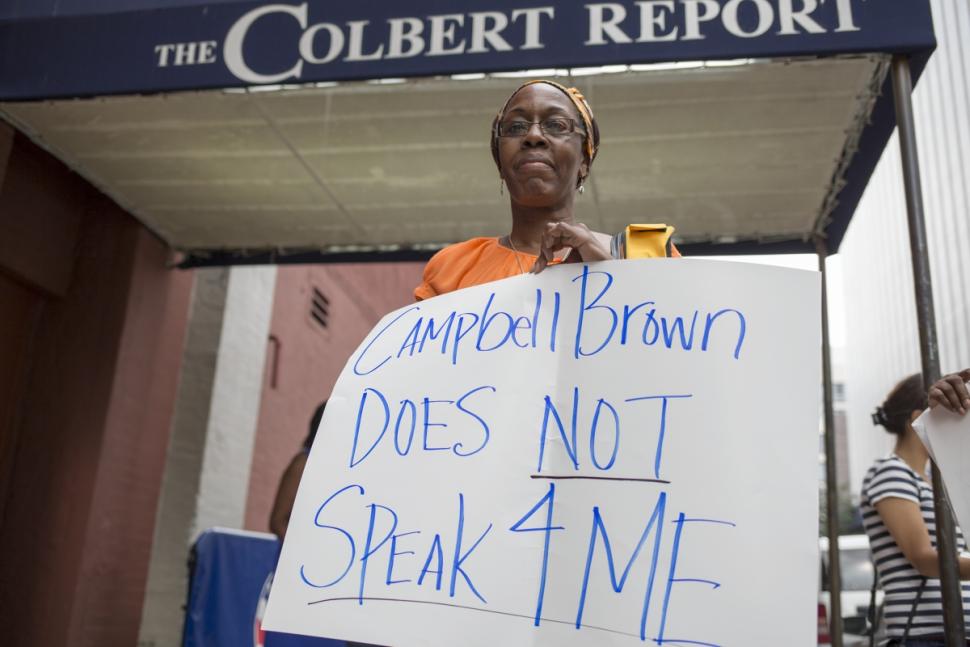
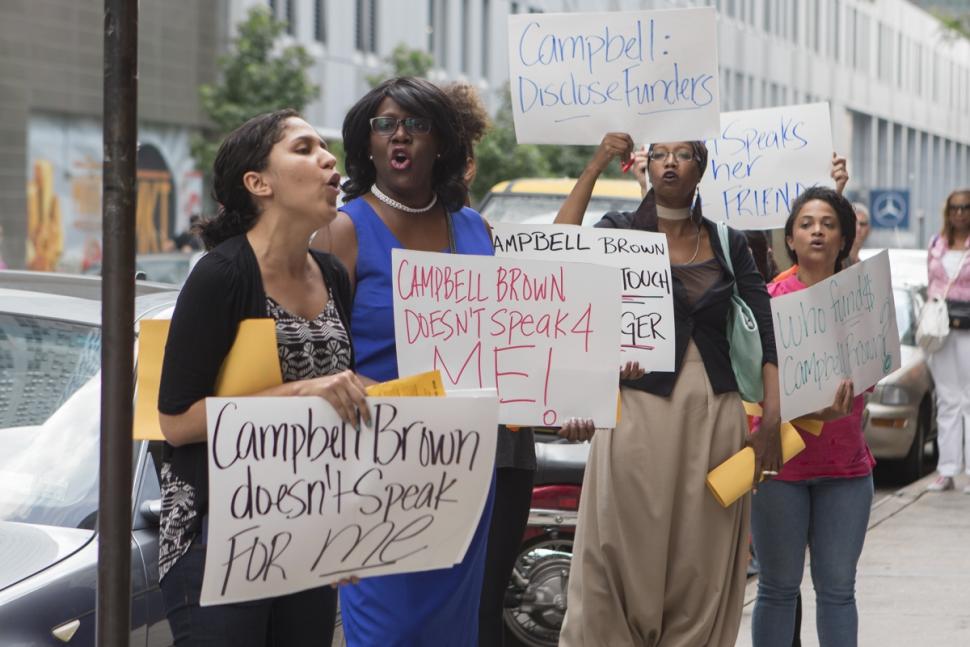
Let’s be clear.  Who are “the people who are outside today” who Ms. Brown assumes will bully and intimidate her donors?  According to The Daily News:


colbert1n-1-web

colbert1n-2-web

I am sure that Eva Moskowitz’s donors are just quaking in their boots…right after they drop another $400,000 into Governor Cuomo’s pockets.

Mr. Colbert did not sneak a camera crew down to the street to make Ms. Brown look as ridiculous as she richly deserved at that moment, but the fact that he led her to make such a ludicrous statement is telling in an of itself.  Today, it is very hard to trust that major media outlets will take the time and effort to research and interview people trying to lead public debate via deception, and on issues that require a genuine understanding of complex social phenomena, that is even less likely.  I have written before how abysmally the New York Times’ editorial staff have failed in that regard, preferring to take the statements of advocates with wealth and connections at face value.

Mr. Colbert is not a journalist, yet he and his fellow comedians Jon Stewart and John Oliver have become almost guardians of truth in recent years.  It is often more likely that Mr. Colbert or Mr. Stewart or Mr. Oliver will highlight the absurd inanities, half truths and contradictions routinely offered by politicians, pundits and advocates.  In the case of Ms. Brown, Mr. Colbert got her to openly confess to a truth that is gaining greater and greater public awareness: American governance is increasingly oligarchical in nature whereby elected officials craft policy more to serve the interests of their very wealthy donors rather than the interests of the actual voters who put them in office.  Ms. Brown’s undisclosed donor list is a perfect example of this, and her refusal to disclose under the fiction that her donors could possibly be intimidated by moms and teachers with home made posters should be mocked loudly and frequently.

I am grateful to Mr. Colbert for organizing his interview to that point, but I am saddened that we rely almost exclusively on satirists to get to the heart of public affairs these days.

3 Comments

Filed under Activism, Funding, Media, politics, schools, Social Justice, Testing, Unions, VAMs

Four More Things To Tell President Obama

Valerie Strauss of the Washington Post wrote last week that President Obama and Secretary of Education Arne Duncan had a meeting with teachers over lunch.  Her column provided space for the 2007 Arkansas Teacher of the Year, Justin Minkel, to offer his insights into how the meeting went and what the President and Secretary heard from the teachers present.  Mr. Minkel, who is a member of both the National Network of State Teachers of the Year and the Center for Teacher Quality and who blogs for Education Week and for CTQ, wrote cogently and intelligently about four key points:

1. There’s Nothing Wrong With the Kids

2. “Responsibility and Delight Can Co-exist”

3. It’s not about good and bad teachers.  It is about good and bad teaching.

4. If we want students to innovate, collaborate, and solve real-world problems, we need to make it possible for teachers to do the same things.

These are outstanding points, and I thank Mr. Minkel and his fellow teachers for communicating them directly at such a high level.  There are, of course, many other points that the President and his Secretary of Education need to genuinely hear and know.  I would like to offer my own four points to build upon these:

1. You are looking for teacher effectiveness in all the wrong places

Teachers matter.  Nobody should ever suggest otherwise.  But No Child Left Behind and Race to the Top both represent sustained efforts to locate how teachers matter in standardized test scores, and since Race to the Top, the strongest proxy for teacher effectiveness written into state and federal policy has been annual student progress on standardized testing. This is a flawed approach for several reasons.  To begin with, the tests that are designed to demonstrate if a student has mastered a body of knowledge or a set of skills are designed for that purpose and that purpose only.  As Dr. Nunoz of Concordia University Chicago notes, testing and measurement is a precise field and it is improper and inaccurate to use an examination for a different purpose because it would not be designed the same way.  The American Statistical Association released a statement on value added measurements earlier this year that clearly stated that the association does not believe any examination currently used to measure teacher effectiveness meets the strict criteria necessary for such a test, and they noted that most studies on VAMs find that teachers’ input only accounts for between 1-14% of the variability among student results on such tests.  Looking for teacher effectiveness in the results of standardized examinations is essentially playing dice with teachers’ futures.

Even the research that claims such models are useful is suspect.  As Dr. Jesse Rothstein of U.C. Berkeley found, even the Gates Foundation funded research on “Measures of Effective Teaching” makes claims that are poorly supported by their own data. Despite the MET study’s endorsement of VAMs, Dr. Rothstein notes that “teacher evaluations based on observed state test outcomes are only slightly better than coin tosses at identifying teachers whose students perform unusually well or badly  on assessments of conceptual understanding (p. 5),” and goes on to note that teachers whose students did well on standardized exams did far less well on measurements of critical thinking.  Using standardized examinations as a measure of teacher effectiveness can reward a weak teacher who focuses on test preparation and punish a highly skilled teacher who emphasizes higher order thinking and creative problem solving.

Teachers, of course, do make a difference for students.  And there are teachers who do not teach well, and there are teachers who excel at the work.  But the impact of that teaching is simply poorly represented in paper and pencil standardized examinations.  It can be found in student produced artifacts that explore rich content in creative and insightful ways.  It can be found in a classroom that “buzzes” with the constant hum of excited work.  It can be found in the individual lives of children who are inspired to explore a field they never knew held interest before.  It can be found in the children who find a mentor and reliable adult among the body of teachers in a school and stick with their education when nobody thought they could.  It can be found the eyes of a student whose talents and passions are affirmed for the first time in his or her young life.  This is what happens in millions of classrooms across the country on a daily basis that cannot be captured on a standardized examination.

Taylor Mali, teacher and poet, captures quite a lot of that nicely in this poetry performance:

2. It’s the poverty

You’ve been told by a lot of current reformers that talking about the extraordinary difficulties of educating children born into poverty is just “making excuses” for “bad teachers”.  I cannot say not only how much this refrain hurts  teachers who have dedicated themselves to working with our most needy students, but also how much it hurts those very same students.  It places upon the teachers a burden to, on their own, lift children of poverty to a level playing field with their more advantaged peers.  It thrusts upon those children schools that keep cutting out critical thinking and aesthetic enrichment in favor of test preparation because of draconian  layoff and reorganization threats while offering the students a brutally unlevel playing field if they graduate. I can think of few practical jokes more cruel than this.

Poverty is not an “excuse”; it is a fact that broadly impacts the earliest childhood of 22% of our young people.  It is a fact that we do much less to alleviate poverty’s deprivations than our peer democracies in the West.  And because our residential income segregation is very high and has risen by over a third since 1980, it is a fact that poverty disproportionately impacts specific schools and school systems.

And it is not a fact that is fully constrained to those meeting the federal definition of poverty.  Income, housing and food insecurity impact the lower middle class, many of whom are clinging to that status solely because of federal assistance programs and the Earned Income Tax Credit.  In 2011, only North Dakota and New Hampshire had child food insecurity rates below 15%.   The Hamilton Project report also notes that food insecurity can have potentially life long consequences in both educational outcomes and economic security, but teachers are going to be held accountable for children who will suffer lower birth weights, worse lifetime health outcomes and lower economic outcomes because Congress refuses to fund expanded SNAP benefits that amount to less than half of the cost of USS Gerald Ford.

This is not meant to “excuse” those teachers and administrators who give up on children in poverty or near poverty and do not do their utmost to educate, inspire and mentor those in their care.  However, it is intellectually and morally bankrupt to ignore that our much lamented gap in PISA can be located almost entirely within our poverty level, and to blame teachers and schools for failing to single-handedly overcome a phenomenon much larger than our schools and about which the billionaires driving today’s “reforms” refuse to discuss.

3. There is no “secret sauce” for educating our most struggling children

Former White House Chief of Staff and current Chicago Mayor Rahm Emanuel opined that Noble Network of charter schools in Chicago had the “secret sauce” for motivating students to perform.  An element of that recipe?  Collecting $400,000 in disciplinary “fines” from its students since 2008.  Advocates of the rapidly expanding charter sector of education like to paper over such practices, but it is vitally important to expose them because while their sponsors and leaders like to hype test performance, they often achieve those results at the expense of up to half of their students.

This should be absolutely clear: with 1000s of charter schools across the country, there must be many schools and teachers who do a genuinely great job with the students in their care.  Unfortunately, they are overshadowed by the high profile charter schools that are essentially corporate entities and that tout themselves as miracle factories based upon high test scores.  They consume public dollars, refuse public accountability, have astonishing attrition rates usually at the expense of the neediest children enrolled in them, and have formed powerful lobbies to influence politicians to continue to favor charter schools over fully public schools.

This is not to say that none of these schools do a good job of educating the students that they do accommodate and that there are not students and families who are sincerely grateful to be in those schools.  But it does mean that they cannot legitimately claim to have found any “secret sauce” for educating our neediest students when they engage in extreme cream skimming, refuse to let the public examine their finances and rely upon their extremely wealthy patrons to strong arm politicians on their behalf.  To put this in perspective:  In 2012, the NEA spent $13 million in campaign contributions total across the country, and the AFT spent $5.9 million.  Success Academy Charter’s supporters spent $3.6 million in THREE WEEKS just because Mayor de Blasio slowed down the expansion of the network.

Truly working with our neediest takes far more than advertising and cherry-picked student bodies.

4. Arts and the humanities matter

Despite very shaky evidence to back up the claim, we have been treated to nonstop rhetoric about our “crisis” in graduates with STEM degrees, and policy has pushed hard to create more pipelines for people to enter such fields regardless of the actual employment picture for them.  There is, however, evidence that in the age of test based accountability, we have marginalized endeavors that are critical to both our civic life and our general well being.  Social studies instruction has shrunk from 9.5% of instructional time to 7.6%, meaning that our students spend less time today learning history and engaging in critical thinking about their civic life.  While instruction in the English Language Arts has increased because of its status as a tested subject, there are legitimate concerns that the emphasis on reading informational texts in the Common Core State Standards and associated testing, will drive more classrooms away from reading great works of literary fiction and poetry.

And then there is the long term and precipitous decline in arts education which fell below 50% for 18 year olds in their childhood education in 2008.  That means that half of the children in America born in 1990 received no arts education in their entire education K-12.  Research is very clear that participation in the arts has a wide range of academic benefits from higher test scores to higher rates of college completion among low income students.  Eliot Eisner of Stanford University notes the lessons that the arts teach such as: making judgments about relationships, seeing multiple answers to problems, accepting multiple perspectives, complex problem solving, learning that cognition is not limited by language, seeing large effects from small differences, and thinking through materials to fruition of an idea.  It is not hard at all to see the connection between these capacities and the capacities that lead not simply to STEM competencies but also to STEM understanding and innovation.  No wonder, then, that there is a small but growing movement to “move from STEM to STEAM” and place arts at the center of our drive for more STEM education.

While this is admirable, it is also not enough to envision the importance of the arts and humanities as a partner to scientific and technological advancement because they possess their own warrants.  Eisner’s “ten lessons” also include:  teaching children how to say what “cannot be said” via “poetic capacities,” experiencing things that cannot be experienced in any other way and exploring one’s capacity for feeling, symbolizing what is important in society.  The arts and humanities, therefore, enrich us in ways that cannot be measured via test based accountability but which are part of our essential humanity.  That 50% of our young people experience no arts education means that their education was fundamentally inattentive to their humanity.  As we advocate for literature, poetry, music, visual and performing arts for all children, we must remember this — the arts and humanities cannot become yet another preserve of the wealthy and we cannot allow test based accountability to squeeze what is left of them from our public schools.

1 Comment

Filed under charter schools, Common Core, DFER, politics, schools, Social Justice, Testing, Unions, VAMs

What Really Worries Me About the Vergara Decision

On June 10th, California Judge Rolf M. Treu declared that teacher tenure laws in California deprive students of their right to an education and declared them unconstitutional.  The provisions that were specifically targeted were the time frame for awarding tenure to California teachers, seniority rules on firing of teachers colloquially known as “last in, first out” and rules for due process before removing a teacher after the initial probationary period.  Judge Treu grandly compared his decision to Brown v. Board of Education and sent shock waves through the mainstream teacher community.

I do not think the ruling is likely to survive a challenge.

First, the evidence that Judge Treu said “shocks the conscience” and was presented by the plaintiffs is not precisely rock solid.  Relying heavily upon the work of Professor Raj Chetty of Harvard University, the plaintiffs claimed that even one “grossly ineffective” teacher had long term lasting harm on student’s achievement and future economic success, and they claimed California’s tenure laws subjected students to such “grossly ineffective” teachers.  The problem here is not that there are not a discernible portion of teachers who ought to be removed, but that the Chetty research, indeed most of the research used by the plaintiffs is, to put it mildly, disputed.

Dr. Audrey Amrein-Beardsley of Arizona State University writes the blog Vamboozled to discuss research and policy around the use of value added measures of teacher performance (VAMs), and she has taken on the flaws of Dr, Chetty’s work on numerous occasions, notably here and here. Dr. Amrein-Beardsley links to critiques from other scholars as well, and the obvious message that Judge Treu missed is that this scholarship “shocks the conscience” most powerfully when one thoroughly ignores that does not represent a professional consensus among education researchers.  Indeed, it is easy to portray the handful of researchers who insist that single teacher impacts can be measured this way as outliers.  So with appeals in the works, it is hard to believe that Judge Treu’s wholesale ignoring of contrary evidence will be replicated by every judge who reviews the evidence.

Second, as Dr. Diane Ravitch of New York University explains here, the plaintiffs in the Vergara case are of questionable standing.  If the argument is that “grossly ineffective” teachers have damaging lifelong impacts on students, it would stand to reason that the plaintiffs could clearly demonstrate that they had been subjected to such teachers.  Not so much.  In fact, some of them apparently claimed that a given teacher was bad at teaching when those same teachers were widely recognized as excellent:

One of the plaintiffs (Monterroza) said that her teacher, Christine McLaughlin was a very bad teacher, but McLaughlin was Pasadena teacher of the year and has received many awards for excellent teaching (google her).

Dr. Ravitch refers to briefs by the defense that go on to note how none of the plaintiffs could tie any of the supposedly poor teachers to the specific statutes that were challenged in the lawsuit.  Appeals attorneys were certainly make use of this, and given judges more inclined to consider all the evidence, they may have successes.

I am, therefore, tentatively hopeful that this case will die or be substantively altered on appeal.  But I am still worried, and the reason is that the case provides a much desired legal win for a coordinated set of interests that have teacher unions firmly in their sights.  The plaintiffs were sponsored by the group “Students Matter” which is funded by Silicon Valley technology entrepreneur David Welch and is financially allied with charter school funders and Michelle Rhee’s “Students First” organization that similarly attacks teachers’ union protections.  Given the partisan position of the lawsuit’s backers, it was extremely troubling, if not surprising, to see Secretary of Education Arne Duncan welcome a decision that greatly undermines teachers’ workplace protections:

With strong financial backers like Welch, Rhee and organizations like the Walton Family Foundation and tacit approval from the administration, we can expect similar lawsuits in pretty much every state over the next few years.  It fits one of the favorite narratives of the education “reform” camp:  that everything hinges on teachers and if we only fire the right teachers, schools, everywhere, will improve dramatically

brace yourself

This is pernicious for a number of reasons.  First, it relies of the very shaky and often laughable claim that all it takes to close the achievement gap is enough “great teachers” in a row.  Michelle Rhee loves to repeat this claim, but the claim does not stand up to very strong scrutiny, most notably that the research basis for the claim merely extrapolated from one year gains in classrooms with an identified effective teacher instead of studying students over time.

Further, we should question the value of the metrics used to rate teacher effectiveness in the first place.  As I have written previously, the American Statistical Association’s statement on the use of VAMs warns that only 1% to 14% of student variation on test scores can be attributed to variation in teacher quality. The does not mean, by the way, that teachers have no effect, but that statistically tying the achievement gap among students as measured by standardized testing to variability in teacher quality is looking at a very narrow slice of that gap’s origins.  What else can account for persistent gaps in student test scores?  Los Angles has a Residential Income Segregation Index of 51. 54% of children in the central city live in povertyThe impacts of poverty on children are by now well documented and cannot be excluded when considering school performance. Classrooms in Los Angeles are overcrowded, sometimes to a shocking extreme. California’s woeful education expenditures place it in the company of Arkansas and below West Virginia.  But according to the proponents of the Vergara case, the only thing that matters is teacher effectiveness as rated by the test score gains made by their students, regardless of all of the other factors that may effect those scores.

And this is painful ground for teacher and student advocates.  It sounds like I am saying that teachers have little impact, but what I mean to say is that teachers matter, but not in ways that are effectively measured by the value added models based on standardized testing.  Professor Jesse Rothstein’s review of the Measures of Effective Teaching study funded by the Gates Foundation demonstrated that teachers who did very well in their value added measures did far less well in measures of students gaining higher order thinking skills, so it is highly possible that the measures favored by Vergara’s so-called expert witnesses improperly favor the wrong teachers.  Anecdotally, such measures of effectiveness miss the realities of how teachers work with students.  The worst teacher of my entire life was my seventh grade mathematics teacher who was a bully and the most demotivating individual I have ever known in my life.  However, in a community where 95% of high school graduates went on to four year colleges and universities, the depths of his ineffectiveness would have been masked by the external advantages of his students.  Influence and impact upon students can frequently be hard to see in any numbers, but they are real regardless.  I have had former students contact me via social media to express appreciation for the role I played in their development towards adulthood, and not all of those students were long term academic successes (they are, however, remarkable people…testing misses that).

That is because an effective teacher is not merely a person who extracts a pre-determined gain in a standardized test over the course of one year.  Effective teachers inspire students to take risks that may result in messy but instructive failures.  Effective teachers help student manage social and emotional challenges to become more skilled at collaboration and leadership.  Effective teachers challenge students to, as Maxine Greene phrased it, “stir” themselves and see the world in different and transformative ways.  Effective teachers may simply convince a struggling student to stay in school for the stability it provides in his or her life.

As we prepare to challenge the Vergara decision and to brace ourselves for the flood of similar suits that the likes of Michelle Rhee are undoubtedly planning, it is vital that we not only confront the highly flawed assumptions of test based teacher competence, but also that we uplift a better vision of the importance of skilled and experienced teachers.

4 Comments

Filed under Media, politics, schools, Social Justice, Testing, VAMs

Gates’ Money and Privacy Activism — Opposition to Ed. Reform Hits the Mainstream

A few stories caught a lot of eyes over the weekend.  None of that is good news for education reformers who have banked on stealth and little reporting.

The first is a major article and interview regarding the role Bill Gates’ money has played in the development of, promotion of and adoption of the Common Core State Standards in the Washington Post.  The story is not entirely complete.  For starters, it fails to disclose that David Coleman already had funding from the Gates Foundation for his Student Achievement Partners, so a meeting with Gates in 2008 is not their first intersection.  Also, it does not explore the heavy hand that Gates has also had in the push for more high stakes testing to evaluate teachers via his funding of the highly flawed Measures of Effective Teaching study, nor does it examine the role that Gates has played in enabling technology entrepreneurs to mine the data generated from those tests without parental consent.

Regardless, the article is both informative and important for several reasons.  First, it is one of the first times anyone in a major news outlet has provided a portrait of the diverse opposition to current reform efforts in education that doesn’t make it sound like mostly the work of Alex Jones style cranks.  The article even quotes academics who question whether the standards are based on sound research on how children learn or even if there is a connection between quality standards and learning.  Second, this is an article in a major outlet that does not equivocate in the slightest about how much influence one very rich man has had in trying to control the entire course of American public education.  While it does not editorialize on the question, it is hard to read how many federal, state, nonprofit, academic and corporate entities were lobbied by, influenced by or funded by Gates and not wonder what role democracy has anymore when it comes to our public schools.

Finally, Gates himself comes across as defensive and dismissive:

Gates is disdainful of the rhetoric from opponents. He sees himself as a technocrat trying to foster solutions to a profound social problem — gaping inequalities in U.S. public education — by investing in promising new ideas.

This would be more convincing if Gates displayed the slightest interest in testing new ideas before unveiling them in 45 states at once before parents and teachers have a chance to understand them, indeed, before anyone has a chance to understand if they are a net positive or not.  From Gates’ point of view and experience, this must make sense.  He has compared common standards to standardized electrical outlets and computer code as a means of allowing innovation, and certainly getting DOS on most desktop computers in the world led to a lot of software developers having a common platform.  But education is not consumer electronics, and bypassing the entirety of stakeholders who value public education for a variety of reasons was going to lead to push back, and even today, Bill Gates does not demonstrate awareness of that.

The second article appeared in Politico and was dedicated to parent activists working to protect their children from data mining operations tied to public education.  This represents another public airing of activities whose proponents would prefer to avoid being seen in the open.  The report quotes New York’s Leonie Haimson of Class Size Matters about how parents have reacted when informed about the plans of technology firms to use pretty much every bit of data they can get their hands on, and it quotes worried data entrepreneurs coming to grips with parental opposition:

Many said they had always assumed parents would support their vision: to mine vast quantities of data for insights into what’s working, and what’s not, for individual students and for the education system as a whole.

“People took for granted that parents would understand [the benefits], that it was self-evident,” said Michael Horn, a co-founder of the Clayton Christensen Institute, an education think tank.

Instead, legitimate questions about data security have mixed with alarmist rhetoric in a combustible brew that’s “spreading like wildfire” on social media, said Aimee Rogstad Guidera, executive director of the Data Quality Campaign, a nonprofit advocacy group for data-driven education.

That fear, Guidera said, “leads to people saying, ‘Shut it down. No more.’”

Guidera hopes to counter the protests by circulating videos and graphics emphasizing the value of data. But she acknowledges the outrage will be hard to rein in.

Could the parent lobby scuttle a data revolution that’s been championed by the White House, pushed by billionaire philanthropists and embraced by reformers of both parties as the best hope to improve public education? “I do have that concern,” Guidera said. “Absolutely.”

The article doesn’t go into detail about just how much money is thought to be at stake and takes the data mining firms at their word that they only want to help, but I came away from reading it with one resounding message: this damage is entirely self inflicted, but the data miners see the parent activists as the problem.  They did not want to do the hard marketing work of convincing people that they were doing something valuable, and they did not anticipate that parents might see the data generated by their children’s public educations as something they’d want to protect rather than just shovel over for free.  It is hard to sympathize here, especially when they have avoided openness from the beginning.

Which leads to the third article from today: a call from the Gates Foundation for a two year “moratorium” on high stakes decisions based upon Common Core aligned testing.  This is the first official wavering from the Gates camp since the standards and testing drive began in earnest, and it is highly significant as an indication of concern that the whole enterprise is in trouble.  It may also be a miscalculation — yes, teacher opposition to using value added measures of their effectiveness based on standardized tests is strong, and yes, teachers have barely had time to adjust to the new standards.  But two years will not fix the flaws in VAMs, and it will not assuage parental concerns about the role of testing and data mining.  It will potentially take a chunk out of testing companies and data mining companies who were making business plans based upon all Common Core states embarking on wide scale testing next year, and I find it interesting that the Gates Foundation is willing to have them cool their heels while the standards’ supporters try to do something they have avoided all along: talk in public.

Leave a comment

Filed under Activism, Common Core, Funding, Gates Foundation, Media, Privacy, Testing, VAMs

Open Letter to President Obama — You Are Listening to the Wrong People

Dear Mr. President:

I am writing to you with three different roles.  First, I am the director of secondary education and secondary/special education teacher preparation at Seton Hall University where I have been on the faculty since 2002.  Second, I am a lifelong educator whose teaching experience at levels from seventh grade to graduate school courses stretches back to 1993. Finally and most importantly, sir, I am the father of two school aged children enrolled in the public schools of New York City.  All three of those roles in life have prompted me to write to you, and it is my hope that you will seriously consider what I have to say, for it is based upon my devotion to my children, my experience as a teacher and upon the data that is readily available about what is being done to schools during your administration.

With respect, Mr. President, you are listening to all the wrong people about our nation’s schools.

When you were inaugurated, many of us in education had hoped that your administration would urge Congress to roll back the detrimental aspects of the No Child Left Behind act, which had taken the previous two decades of educational failure rhetoric and placed a punishing regimen of unreasonable expectations, high stakes testing and punishment into effect that left schools and schools systems under threat of a “failure” label if they did not achieve near miraculous score gains in standardized examinations.  Instead, we got the Race to the Top program which has taken the worst elements of NCLB and made them even worse.  Your signature education initiative incentivized participating states to enroll in rushed and unproven common standards, increases the amount of high stakes testing at all levels of public education, subjects teachers to invalid measures of job performance and creates preferential treatment for charter schools that cynically manipulate data on their enrollment and achievements, sue to prevent public oversight of the public moneys they receive and whose expansion provides new investment vehicles for the very wealthy.  All of these results have rich and powerful advocates, and all of them are damaging to our nation’s public schools.

The Common Core State Standards have been described as a state led effort because of the role of the National Governors Association in their creation, but the work of a very few people is far more directly responsible for them.  David Coleman, now President of the College Board, Jason Zimba and Susan Pimentel of Student Achievement Incorporated worked with a small group of core writers that were largely representative of the testing and publishing industries to produce K-12 standards in English Language Arts and Mathematics in less than two years.  This is a staggering pace for such a complex project, and it was conducted in clear violation of highly regarded and accepted processes for the creation of standards.  Dr. Sandra Stotsky of the University of Arkansas was a member of the validation committee that was convened, in theory, to validate the quality of the standards, but she refused to signed off on them when, by her own account, repeated efforts to have the research basis for the standards produced by the writing committees went unanswered.  Once written, the standards were rapidly adopted by states due to the incentives of Race to the Top and aggressive spending of the Bill and Melinda Gates Foundation.  Diane Ravitch of New York University has repeatedly pointed out that this process was staggeringly flawed, and even more flawed than the opaque writing and promotion efforts has been the race to roll out the standards in nearly all states simultaneously with no small scale field testing and no known way for data from the implementation to be fed back to any body that is tasked with revising the standards based on such data.

Mr. Bill Gates seems enormously confident, absent any defensible evidence, that this is the correct path.  He provided funding to Student Achievement Incorporated and the National Governors Association, and has been spending lavishly since 2010 to make certain all forms of organizations continue to boost the standards.  Mr. Gates spoke this year at the Teaching and Learning Conference hosted by the National Board for Professional Teaching Standards (an organization he has given grants to recently), and his defense of national standards was telling.  According to the Washington Post:

Standardization is especially important to allow for innovation in the classroom, said Gates, who used an analogy of electrical outlets.

“If you have 50 different plug types, appliances wouldn’t be available and would be very expensive,” he said. But once an electric outlet becomes standardized, many companies can design appliances and competition ensues, creating variety and better prices for consumers, he said.

The version posted to the Gates Foundation website offers a more explanatory framing of the metaphor, but Mr. President, I hope the flaw in his thinking is evident.  Multi-state standards are not, inherently, a bad thing, primarily if used like the National Assessment of Educational Progress as a NO STAKES diagnostic tool, and Mr. Gates is correct that a variety of INDUSTRY standards have led to consumer innovations.  However, even after we accept a standard for early literacy acquisition to be age appropriate and based on research into how children learn to read, the process by which any given child meets that standard is vastly more complex than the process of attaching an electric motor to a hand blender; worse, it does not demonstrate an understanding that children develop at very varied rates, and that an age appropriate target for one child may be entirely inappropriate for a peer in the same classroom.

Even assuming that Mr. Gates is correct and that CCSS would allow teachers to innovate, Race to the Top and Mr. Gates’ own advocacy have worked to tie the CCSS to a regimen of high stakes testing the likes of which we have never seen and which are already incentivizing teachers and school districts to vastly narrow their teaching in response.  Mr. President, policy analysts refer to perverse incentives as those elements of policy that incentivize behavior in such a way that people can obtain the incentive while engaging in practices that are damaging or undesirable.  In this case, Race to the Top is the Mother of All Perverse Incentives.  Your administration required states to adopt test-based evaluation of teachers in addition to adoption of common standards.  This has resulted in states both enrolling in the CCSS testing consortia, and adopting Value Added Models (VAM) of teacher effectiveness as part of teacher assessment and retention.  Mr. President, you recently remarked that schools should not be teaching to the test even while your administration was stripping Washington State of its NCLB waiver over its desire to not use high stakes testing to evaluate teachers, but you could do little that incentivizes teaching to the test more than this.  Michelle Rhee’s tenure as D.C. Schools Chancellor provides an instructive anecdote.  Despite her denials and cursory investigation, it is very clear that her “raise test scores or be fired” approach spawned widespread cheating. That behavior is not excusable, but it is evidence of how far some people placed in extraordinarily difficult circumstances will go when subject to such incentives, and it is simply inevitable that short of cheating, the use of VAMs in teacher evaluation will result in more teaching to the test.

And VAMs themselves are invalid, Mr. President.  The American Statistical Association is quite clear on this in its recent statement on the use of VAMs for teacher evaluation.

The measure of student achievement is typically a score on a standardized test, and VAMs are only as good as the data fed into them. Ideally, tests should fully measure student achievement with respect to the curriculum objectives and content standards adopted by the state, in both breadth and depth. In practice, no test meets this stringent standard, and it needs to be recognized that, at best, most VAMs predict only performance on the test and not necessarily long-range learning outcomes. Other student outcomes are predicted only to the extent that they are correlated with test scores. A teacher’s efforts to encourage students’ creativity or help colleagues improve their instruction, for example, are not explicitly recognized in VAMs…

It is unknown how full implementation of an accountability system incorporating test-based indicators, such as those derived from VAMs, will affect the actions and dispositions of teachers, principals and other educators. Perceptions of transparency, fairness and credibility will be crucial in determining the degree of success of the system as a whole in achieving its goals of improving the quality of teaching. Given the unpredictability of such complex interacting forces, it is difficult to anticipate how the education system as a whole will be affected and how the educator labor market will respond.

This is clear-cut, sir.  There are no current high stakes tests that meet the requirements of a well developed VAM, and there is no evidence about how VAMs will influence the schools in which they are deployed, but your signature education program is incentivizing them anyway.

To date, no study reliably shows that current VAMs can be used the way they are going to be used over the next few years, but that has not stopped the Gates Foundation from being front and center in this issue as well.  The Gates commissioned “Measures of Effective Teaching” study concluded that VAMs can be effectively used to evaluate teachers, but Jesse Rothstein of the University of California at Berkeley demonstrated clearly how flawed the study was, especially how it drew conclusions only weakly supported by its own data:

The results presented in the report do not support the conclusions drawn from them. This is especially troubling because the Gates Foundation has widely circulated a stand-alone policy brief (with the same title as the research report) that omits the full analysis, so even careful readers will be unaware of the weak evidentiary basis for its conclusions…

Hence, while the report’s conclusion that teachers who perform well on one measure “tend to” do well on the other is technically correct, the tendency is shockingly weak.  As discussed below (and in contrast to many media summaries of the MET study), this important result casts substantial doubt on the utility of student test score gains as a measure of teacher effectiveness.  Moreover, the focus on the stable components – which cannot be observed directly but whose properties are inferred by researchers based on comparisons between classes taught be the same teacher – inflates the correlations among measures.  Around 45% of teacher who appear based on the actually-observed scores to be at the 80th percentile on one measure are in fact below average on the other. Although this problem would decrease if information from multiple years (or multiple courses in the same year) were averaged, in realistic settings misclassification rates would remain much higher than the already high rates inferred for the stable components.

It is almost inconceivable how it is that our nation is rushing forward with a package of reforms that are being implemented at breakneck speed with such damaging potential and with so little evidence to suggest that they will do anyone any good, and with mounting evidence that they are objectively harmful.  But one thing is actually very certain: these “reforms” and their attendant policies are making some people a substantial profit.

Three years ago, education writer and consultant and former National Board Certified Teacher Nancy Flanagan noted that the rush for CCSS implementation meant that a publishing bonanza was on the horizon.   Certainly, their implementation with the coming testing requirements has been a bonanza for Pearson who landed the contract to write and implement the Partnership for Assessment of Readiness for College and Careers (PARCC)  testing consortium.  At a predicted cost of 24 dollars for a set of tests as the math and ELA testing comes on line, Pearson is guaranteed a huge new income stream from the more than 10 million students currently in PARCC states.  But Pearson is only the most public face of making money off of the reforms put in place by your administration.  Common standards and mass testing generate vast amount of data, and technology companies are starting up all intending to mine that data for profit.  This is ground that has been ploughed by Rupert Murdoch who, when he began acquiring education technology firms, identified a “500 billion dollar sector” waiting for “big breakthroughs”.  Bill Gates has also been involved in this sector, setting up the data cloud storage firm InBloom for 100 million dollars, and watching it close when parental concerns over data security and the plan to allow vendors to access the data could not be overcome.  But other firms such as Knewton intend to continue data mining and creating products based upon that analysis, and none of them, regardless of how intriguing their products might be, demonstrate sufficient care about the need to explain their services to parents, the need to allow parents and guardians to opt their children out of the data pool or the need to build real support among the people whose children are being transformed into revenue.

I am asking you as a father, sir: would this be acceptable to you?  I regret to inform you, Mr. President, that your own administration has abetted this by changing the regulations that implement the Federal Education Rights and Privacy Act.

Publishers, testing companies and technology firms are not the only ones who are reaping new windfalls from your education policies, Mr. President.  It turns out that Wall Street investors are eager to see another aspect of Race to the Top, charter school expansion, continue as rapidly as everything else, and while many of them proclaim to be fans of the charter schools’ alleged “successes” it is also clear that many of them have also figured out how to make guaranteed money from supporting charter schools.  Hedge fund billionaires can use a combination of federal tax credits to make investing in charter school construction a vehicle that can guarantee a doubled return within 7 years.  This is entirely unlike traditional school construction funding via bond issues because such bond issues are done in the open and for a public with a vote for or against the responsible school boards.  This is done entirely in private and with no oversight and precious little public knowledge.  It is little wonder then that Wall Street interests are not only investing in charter school construction, they are also organizing PACs such as Democrats for Education Reform specifically to keep state governments granting more and more charters, something else that you enabled with the provisions of Race to the Top.

You might be able to justify this, Mr. President if you could claim that charter schools are actually the solution to American education, but to make that claim you would have to ignore evidence.  Many charters are excellent schools.  Many are terrible.  But there is no evidence that the charter school segment is consistently outperforming fully public schools.  There is, however, evidence that charter schools do not educate children with disabilities at comparable levels as fully public schools.  There is evidence that charter schools do not serve students who are English Language Learners like their fully public peer schools do.  There is evidence that one of the most prominent charter operators in New York City, Eva Moskowitz of Success Academy, is not telling the truth about the number of children in poverty that she serves, the real achievements of her schools test scores, or the rate of attrition for students with disabilities and language learning issues.

These schools are not miracle factories, Mr. President, but supporting their expansion is making people money.  Your Secretary of Education, Arne Duncan, once opined that Hurricane Katrina was the “best thing” ever for New Orleans Schools because it shook up the status quo and got people “serious” about reform.  That “reform” has meant that this week, the last public school in New Orleans has closed for good, and the city school system in entirely comprised of charter schools.  Amidst growing evidence that many prominent charter operators are not equally educating students and amidst disturbing studies about rising segregation in the charter sector, I cannot help but wonder how Secretary Duncan justifies his statement today.

No wonder teacher morale is at an all time low.

Your public voice in these issues has been a disaster for you, Mr. President.  Secretary Duncan may be the most controversial person to hold that office since its creation, and he has repeatedly demonstrated that he is both insensitive to teacher and parental concerns and fully vested in a false narrative about American education.  Mr. Duncan has frequently repeated to charges from corporate reformers and privatizers that American education is stagnant and that we can infer a need for their favored reforms from international testing data.  This is part of a narrative of deepening failure which thoroughly ignores how American students have never fared well on such measures and how these scores and our economic health have little connection.  Mr. Duncan has observed that he believes our teachers are not educated enough and we should be more like South Korea, despite the fact that South Korea’s educational “success” comes with high costs:  20% of family income on average spent on private “cram” classes, focus on drill and rote learning that leads to high test scores, and wide recognition that South Korean children face too much pressure, leading to an alarming youth suicide rate.  This is hardly praise worthy, sir.

Secretary Duncan’s misunderstanding extends to why people are criticizing the CCSS and other Race to the Top reforms.  I am sure that you know how he said that Common Core opponents are often “white suburban moms” who are upset to find out their children are not “as brilliant as they thought they were”.  Mr. Duncan apologized for the remark, but his insinuation that any opposition to CCSS is unreasonable betrays that he really does not understand the issue.  Mr. President, American parents, by wide margins, believe that the schools their children attend are doing very good work, and despite three decades of an unrelenting failure narrative, that percentage, over 70%, has remained stable.  What parents are saying is that Common Core, evaluating teachers by tests and the increase in high stakes testing and heavy pressure on schools to raise test scores at all costs have come too rapidly, with too little transparency, and with extreme negatives vis-a-vis how children experience school.  Mr. Duncan does not understand that as evidenced by his remarks in April with NY Commissioner John King where he called parental protests “drama and noise.”  Mr. Duncan may call the 10s of 1000s of families who have opted out of Pearson’s testing and the list of districts refusing to field test the exams “drama and noise”.  Many, myself included, call it a movement that is ignored and dismissed at peril.  I do not know if your Secretary of Education has told you that most opposition to reform comes from Glenn Beck styled cranks and spoiled suburbanites, but if he has, you have been sorely misinformed.

Mr. President, in 1999 Congress passed the Gramm-Leach-Bliley Act, also known as the Financial Services Modernization Act, and President Clinton signed it into law.  Although the trends in mortgage lending and investment products that led to the financial crisis had begun long before 1999, the removal of regulations that prevented commercial and investment banks and insurance firms from blending their businesses greatly accelerated the damage being done to our financial industry.

Mr. President, I am afraid that history will look upon Race to the Top as your Financial Services Modernization Act, a tool crafted to be cynically misappropriated by interests with no concern for the public good.

And what is so frustrating, Mr. President, is how entirely unnecessary this judgment of history will be.  Our schools need help, sir, but it is not help that will be found by racing to implement new standards, layering on more high stakes tests, threatening teachers’ livelihoods with invalid statistical models or by turning more and more of our urban school districts over to for profit charter school corporations.  Our schools are afflicted by the same thing that afflicts our society: rising poverty and constant cuts to assistance for the poor.  16 million children in the United States live in poverty; that is 22% of all children, 38.2% of all African American children and 35% of Hispanic children.  Our schools serve communities, and our segregation by income has increased over the past 30 years, meaning that both rich and poor increasingly live in communities with people mostly of their own income level.  The Residential Income Segregation Index (RISI) scores for Houston, Dallas, New York, Los Angeles and Philadelphia are all above 50, and the RISI has gone up in every region of the country since 1980.  Nationally, it is 46, an increase of 39% since 1980.

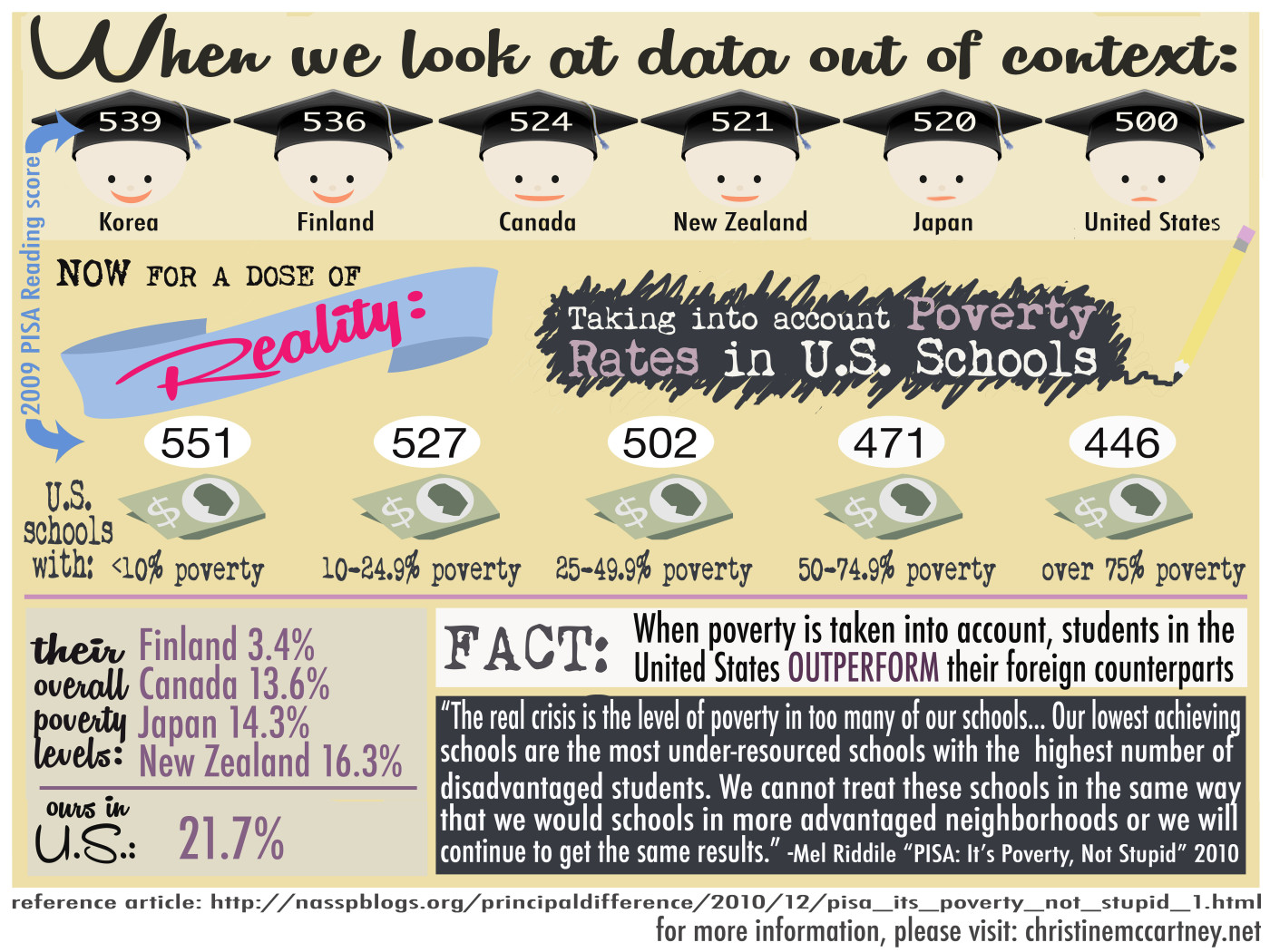
We see this when we look at our PISA scores broken down by the income characteristics of communities.  According to USC Professor Emeritus Stephen Krashen, the portrait of America’s schools look very different when poverty characteristics are considered.  In schools where less than 10% of the students qualify for free and reduced lunch, our PISA scores are higher than the average for any OECD nation, but where 75% or more of students are in poverty, the PISA scores are second to last.  Given that our communities are increasingly segregated by income, Mr. President, it is inevitable that test score data compared nation to nation will be misleading.

It is at this point that Arne Duncan, Michelle Rhee, Joel Klein, Eva Moskowitz, Andrew Cuomo, Bill Gates, Whitney Tilson, and a host of other corporate “reformers” will line up to accuse me of making “excuses” for “bad schools”.  They will insist, absent any evidence, that “great teachers” can close the achievement gap even if we completely fail to address poverty in our communities.  But it is not “making excuses” to insist that if we want a child living in poverty to succeed in school that we cannot ignore whether or not she knows if she is going to eat tonight, or if she will have a place to sleep, or if her parents will continue to work or any of the host of other matters that afflict children in poverty in ways that negatively impact their formal education.  Mr. President, we have known the long term impacts of poverty on children for some time now just as we have known that it has been growing and deepening, and we spend far less than our peer nations on helping to alleviate the detrimental impacts of poverty.  Nothing in education policy in the past three decades has done anything to address that.

That is not “excuse making,” Mr. President, that is aiming the analysis at the actual problem, whether or not addressing the problem will make anyone a profit.

You have an advantage that few of your predecessors had, Mr. President, and it is your demonstrated interest in and ability to genuinely listen to others.  Joshua Dubois wrote about your meetings with the families at Sandy Hook Elementary School, and how for hours, you sat, embraced, asked questions and listened to them. What strikes me, sir, is how, despite an election year warming up, you never once mentioned this to the press and never once used this remarkable testament to your character for political gain.  I urge you, Mr. President, to visit teachers, parents and children in the same manner, without cameras or vetting, and just ask them what they want our schools to be.  You will not find their answers easily mapped onto your education policies.

It is not too late for you to have a transformational impact on America’s schools, Mr. President, but it will take a number of immediate actions to have a chance.  I ask you to consider the following, badly needed, steps:

  1. Scrap Race to the Top: Your signature education policy is detrimental to children, teachers, schools and communities.  Ending it will not do away with the Common Core State Standards, testing or charter schools, but it will free states and districts to look truly reflectively at these initiatives and to voluntarily engage in as little or as much of them as they deem necessary and beneficial.  It will require proponents of these policies to make their cases in full view of the public in all 50 states instead of hiding behind coercive requirements for federal funding.
  2. Restore Federal Privacy Protections: Technology entrepreneurs may have truly powerful learning tools in development, but to make them work, they need student records deemed private under federal law.  Instead of engaging teachers and parents about these tools, they got your administration to revise regulations and are now mining those records without any meaningful consent.  This is unacceptable, and it must stop.  Our children are not sent to public school to be monetized without our consent.  Parents will listen to open and honest efforts to describe how these tools can benefit their children, but they will oppose efforts to bypass them.
  3. Be Serious About Holding Charter Schools Accountable to Civil Rights Legislation: Your administration recently expressed interest in making certain that charter schools meet federal civil rights requirements.  This is a good first step.  It must be applied vigorously, especially given how poorly many high profile charter operators do in serving students with disabilities, educating English Language Learners and retaining students of color after admission.  Your administration has granted enormous favoritism to charter schools, and they must be made fully accountable.
  4. Demand a Marshall Plan for School Aid and Construction:  Nearly all states are spending less money per pupil today than in 2008. In New York State, the average school district still receives $3.1 million less in state aid than they would have without budgetary tricks like the Gap Elimination Adjustment.  All across the country, our public schools are being told to implement a complex new curriculum, meet unrealistic testing requirements and to do so while having their budgets cut to the bone.  Further, in 2008, the AFT commissioned a study that estimated a need for over $250 billion in school infrastructure spending nationwide, a need that remains unmet.  It adds insult to injury that students come from homes that suffer from the deprivations of poverty and arrive in schools that are cold in the winter, hot in the summer and wet when it rains.  Our nation must do something about this.  At the same time, you must highlight schools where children in poverty thrive, not merely where they get good test scores.
  5. Replace Secretary Duncan: Mr. Duncan is entwined so deeply in the Race to the Top approach to reform that he is incapable of moving away from it.  Your Secretary of Education demonstrates no understanding of why people oppose current reforms, little willingness to see his mistakes as more than verbal slip ups, and he consistently misuses international test data to denigrate the quality of our schools and teachers.  If you want to protect our schools from the forces of corporate reform, Secretary Duncan cannot lead.

You have an opportunity, Mr. President, to retask the federal Department of Education with protecting our national Commons, our history of 200 years of seeing public education as a public good for communities and a private good for individuals.  Your administration has abetted the use of our public schools by private and corporate interests in ways that are actually detrimental to education.  If you wish that to not be your legacy, you must act now.

Sincerely,

Daniel S. Katz, Ph.D.

Director, Secondary and Secondary/Special Education Teacher Preparation, Seton Hall University

Career Educator

Father of Two Public School Children



Leave a comment

Filed under Activism, charter schools, Common Core, DFER, Gates Foundation, politics, Privacy, schools, Social Justice, Stories, teaching, Testing, VAMs

Can We Talk About Poverty And Violence NOW?

I became aware of this via a graduate school colleague.  Research from the CDC and Harvard University identifies that as much as 30% of young people in our urban areas suffer from Post Traumatic Stress Disorder as the result of living in communities afflicted by violence, a rate higher than soldiers returning from Iraq and Afghanistan.  This citation recently went viral because of report on a San Francisco CBS affiliate that mentioned the research — while deciding to coin the phrase “hood disease” to describe the phenomenon.  Response to that polarizing and sensationalist turn of phrase was swift, and it was well earned.  Hopefully, it will not obscure a chance to focus on a conversation that is desperately missing from today’s education conversation — the impact of poverty and violence on children and what it means to provide meaningful education for those children.

I am not optimistic, unfortunately.  Discussing the impacts of poverty and community violence on children would mean taking a good hard look at American society as a whole, how segregated we remain as a society (and how it is getting worse since 1980), how poorly we do as a country at helping families in poverty and how we largely ignore problems that are clustered in communities that are predominantly of color. I find it hard to believe that we are ready for a conversation today.  It would require more willingness for painful introspection and confrontation of racism that many prefer to believe does not exist.

Optimism is further undercut by the fact that the impacts of poverty on all sorts of outcomes for young people is not precisely news, although the PTSD estimates for community violence should cause more people to take notice.  “Effects of Poverty on Children” was published in 1997 and found vast differences in physical, cognitive, school achievement, and emotional and behavioral outcomes for children living in poverty, and it described the ways in which poverty influences these outcomes.  They recommended community health, parental education, in home interventions, and renewed efforts to eliminate deep, sustained poverty.  Not one of these recommendations found their way into the Bush era No Child Left Behind education reform bill nor into its Obama administration successor, Race to the Top.  Arizona State University Regents’ Professor Emeritus David Berliner delivered the Presidential Invited Speech at the 2005 meeting of the American Educational Research Association, and he titled in “Our Impoverished View of Education Reform.”  Among his conclusions:

All I am saying in this essay is that I am tired of acting like the schools, all alone, can do what is needed to help more people achieve higher levels of academic performance in our society. As Jean Anyon (1997, p. 168) put it “Attempting to fix inner city schools without fixing the city in which they are embedded is like trying to clean the air on one side of a screen door.”

To clean the air on both sides of the screen door we need to begin thinking about building a two-way system of accountability for contemporary America. The obligation that we educators have accepted to be accountable to our communities must become reciprocal. Our communities must also be accountable to those of us who work in the schools, and they can do this by creating social conditions for our nation that allow us to do our jobs well. Accountability is a two way process, it requires a principal and an agent. For too long schools have thought of themselves only as agents who must meet the demands of the principal, often the local community, state, or federal government. It is time for principals (and other school leaders) to become principals. That is, school people need to see communities as agents as well as principals and hold communities to standards that insure all our children are accorded the opportunities necessary for growing well.

It does take a whole village to raise a child, and we actually know a little bit about how to do that. What we seem not to know how to do in modern America is to raise the village, to promote communal values that insure that all our children will prosper. We need to face the fact that our whole society needs to be held as accountable for providing healthy children ready to learn, as our schools are for delivering quality instruction. One-way accountability, where we are always blaming the schools for the faults that we find, is neither just, nor likely to solve the problems we want to address.

But since that address in 2005, “one-way accountability” has not only dominated policy, it has actually spawned an entire industrial scaled investment in testing and data, entrenching it even deeper.  Even though it has very little to do with the issues that plague impoverished communities in our country and the schools that try to serve them.

Most of what you’ve read about our “failing” national schools is based on flawed data.  Even using the preferred tool of accountability advocates, standardized tests, the crisis in our public schools is one of community poverty.  This graphic comes courtesy of Christine McCarthy, a New York City public school teacher and recipient of a Distinguished Fullbright Award in Teaching:

Image

Stephen Krashen, professor emeritus at USC provides the data for this chart which should make it crystal clear that the constant doubling down on standards and testing will have no serious impact on the international testing gaps that produce such gnashing on the teeth in the media and in Washington.  A test does not alleviate the well documented impacts of poverty.  Firing a teacher whose students are performing poorly on a test does not alleviate the well documented impacts of poverty.

It is at this junction, that a Michelle Rhee or Joel Klein comes along, sometimes on a talk show, to say that there should be “no excuses” for even a school with a 75% or higher poverty rate.  Their preferred “no excuses” methods involve firing as many people as they can, closing down schools and turning more and more children over to charter school operators.  Certainly, many of those operators like to claim that they’ve found the “secret sauce” to educating within communities afflicted by high rates of poverty.  Eva Moskowitz’s “Success Academy” empire claims that it is educating the exact same students as the neighborhood schools in Harlem, but that claim is simply false, and a parent at Upper West Side Success documented on tape how administrators have tried to counsel out her son who has an IEP, something no neighborhood school could do.  Northstar Academy in Newark loves to claim at 100% graduation rate for seniors, but it fails to report its 50% attrition rate prior to senior year.

The lesson here is that there is no “special sauce” and “Superman” is a comic book hero.  We, as a society, have never figured out a way to provide large scale, genuine, educational opportunity to children growing up in communities with deep and persistent poverty.  We, as a society, are woefully uncommitted to alleviating poverty and have even come to accept the terrifying 20% rate of childhood poverty as normal and perhaps inevitable.  But absent those two commitments, no amount of firing teachers or testing students until they cry is going to “fix” American education.

And this is where I worry for the future again:  I think it is very likely that a combination of suburban parental outrage and teacher activism is going to push back hard on current reforms.  If Common Core survives, it will be substantially modified with fewer tests and less emphasis on value added models of teacher evaluation.  The fact is that pushing the punishment narrative that has been the burden of urban schools for so long to communities that generally like their schools is going to create a backlash.  But once those parents have pushed back and changed these systems, we will still be left with communities rife with damaging poverty and violence, and we will most likely go back to ignoring those facts.

And the next cycle of “reform” will ignore it too.

Leave a comment

Filed under charter schools, politics, schools, Social Justice, teaching, Testing, VAMs

Vamboozled on the ASA Statement on Value Added Models

Audrey Amrein-Beardsley of Vamboozled just added the official statement from the American Statistical Association to her list of top articles on Value Added Models (VAMs) for education assessment.  The full statement can be found here, and it is a doozy.  Well, I say “doozy” because I know quite a few people who specialize in quantitative analysis and quotes like this count as pretty harsh condemnation:

VAMs are generally based on standardized test scores, and do not directly measure potential teacher contributions toward other student outcomes.

That means VAMs are limited.

VAMs typically measure correlation, not causation: Effects – positive or negative – attributed to a teacher may actually be caused by other factors that are not captured inthe model.

That means that VAMs used as the main means of teacher assessment are missing things…potentially very important things.

Under some conditions, VAM scores and rankings can change substantially when a different model or test is used, and a thorough analysis should be undertaken to evaluate the sensitivity of estimates to different models.

That means some VAMs are not exactly reliable. Page four lays it out in pretty clear language to me:

The measure of student achievement is typically a score on a standardized test, and VAMs are only as good as the data fed into them. Ideally, tests should fully measure student achievement with respect to the curriculum objectives and content standards adopted by the state, in both breadth and depth. In practice, no test meets this stringent standard, and it needs to be recognized that, at best, most VAMs predict only performance on the test and not necessarily long-range learning outcomes. Other student outcomes are predicted only to the extent that they are correlated with test scores. A teacher’s efforts to encourage students’ creativity or help colleagues improve their instruction, for example, are not explicitly recognized in VAMs.

VAM scores are calculated from classroom-level heterogeneity that is not explained by the background variables in the regression model. Those classroom-level differences may be due in part to other factors that are not included in the model (for example, class size, teaching “high-need” students, or having students who receive extracurricular tutoring). The validity of the VAM scores as a measure of teacher contributions depends on how well the particular regression model adopted adjusts for other factors that might systematically affect, or bias, a teacher’s VAM score.

“In practice, no test meets this stringent standard.”  Keep in mind, EVERY state that accepted “Race to the Top” grants HAD to agree to use these tests to evaluate teachers. And from page five:

When used appropriately, VAMs may provide quantitative information that is relevant for improving education processes. For example, the models can provide information on important sources of variability, and they can allow teachers and schools to see how their students have performed on the assessment instruments relative to students with similar prior test scores.

Teachers and schools can then explore targeted new teaching techniques or professional development activities, while building on their strengths.

There is a key difference between this observation from the ASA and what is happening in schools:  VAMs are NOT being used to provide data “relevant for improving education processes.”  They are being used to label teachers as effective or not effective.  They are being used to label schools failures or successes.  So when the ASA says on page seven:

Statistical science has an important role to play in raising the quality of education, through developing and refining statistical models for use in education, providing guidance on designing experiments and interpreting statistical results, and applying quality and process improvement expertise to help guide judgments in the presence of uncertainty. The ASA promotes sound use of statistical methodology for improving education.

You know that they think this is NOT what is happening.

And just remember: if you live in a “Race to the Top” state, this is happening to your children’s teachers.

Leave a comment

Filed under Testing, VAMs