What Really Worries Me About the Vergara Decision

On June 10th, California Judge Rolf M. Treu declared that teacher tenure laws in California deprive students of their right to an education and declared them unconstitutional.  The provisions that were specifically targeted were the time frame for awarding tenure to California teachers, seniority rules on firing of teachers colloquially known as “last in, first out” and rules for due process before removing a teacher after the initial probationary period.  Judge Treu grandly compared his decision to Brown v. Board of Education and sent shock waves through the mainstream teacher community.

I do not think the ruling is likely to survive a challenge.

First, the evidence that Judge Treu said “shocks the conscience” and was presented by the plaintiffs is not precisely rock solid.  Relying heavily upon the work of Professor Raj Chetty of Harvard University, the plaintiffs claimed that even one “grossly ineffective” teacher had long term lasting harm on student’s achievement and future economic success, and they claimed California’s tenure laws subjected students to such “grossly ineffective” teachers.  The problem here is not that there are not a discernible portion of teachers who ought to be removed, but that the Chetty research, indeed most of the research used by the plaintiffs is, to put it mildly, disputed.

Dr. Audrey Amrein-Beardsley of Arizona State University writes the blog Vamboozled to discuss research and policy around the use of value added measures of teacher performance (VAMs), and she has taken on the flaws of Dr, Chetty’s work on numerous occasions, notably here and here. Dr. Amrein-Beardsley links to critiques from other scholars as well, and the obvious message that Judge Treu missed is that this scholarship “shocks the conscience” most powerfully when one thoroughly ignores that does not represent a professional consensus among education researchers.  Indeed, it is easy to portray the handful of researchers who insist that single teacher impacts can be measured this way as outliers.  So with appeals in the works, it is hard to believe that Judge Treu’s wholesale ignoring of contrary evidence will be replicated by every judge who reviews the evidence.

Second, as Dr. Diane Ravitch of New York University explains here, the plaintiffs in the Vergara case are of questionable standing.  If the argument is that “grossly ineffective” teachers have damaging lifelong impacts on students, it would stand to reason that the plaintiffs could clearly demonstrate that they had been subjected to such teachers.  Not so much.  In fact, some of them apparently claimed that a given teacher was bad at teaching when those same teachers were widely recognized as excellent:

One of the plaintiffs (Monterroza) said that her teacher, Christine McLaughlin was a very bad teacher, but McLaughlin was Pasadena teacher of the year and has received many awards for excellent teaching (google her).

Dr. Ravitch refers to briefs by the defense that go on to note how none of the plaintiffs could tie any of the supposedly poor teachers to the specific statutes that were challenged in the lawsuit.  Appeals attorneys were certainly make use of this, and given judges more inclined to consider all the evidence, they may have successes.

I am, therefore, tentatively hopeful that this case will die or be substantively altered on appeal.  But I am still worried, and the reason is that the case provides a much desired legal win for a coordinated set of interests that have teacher unions firmly in their sights.  The plaintiffs were sponsored by the group “Students Matter” which is funded by Silicon Valley technology entrepreneur David Welch and is financially allied with charter school funders and Michelle Rhee’s “Students First” organization that similarly attacks teachers’ union protections.  Given the partisan position of the lawsuit’s backers, it was extremely troubling, if not surprising, to see Secretary of Education Arne Duncan welcome a decision that greatly undermines teachers’ workplace protections:

With strong financial backers like Welch, Rhee and organizations like the Walton Family Foundation and tacit approval from the administration, we can expect similar lawsuits in pretty much every state over the next few years.  It fits one of the favorite narratives of the education “reform” camp:  that everything hinges on teachers and if we only fire the right teachers, schools, everywhere, will improve dramatically

brace yourself

This is pernicious for a number of reasons.  First, it relies of the very shaky and often laughable claim that all it takes to close the achievement gap is enough “great teachers” in a row.  Michelle Rhee loves to repeat this claim, but the claim does not stand up to very strong scrutiny, most notably that the research basis for the claim merely extrapolated from one year gains in classrooms with an identified effective teacher instead of studying students over time.

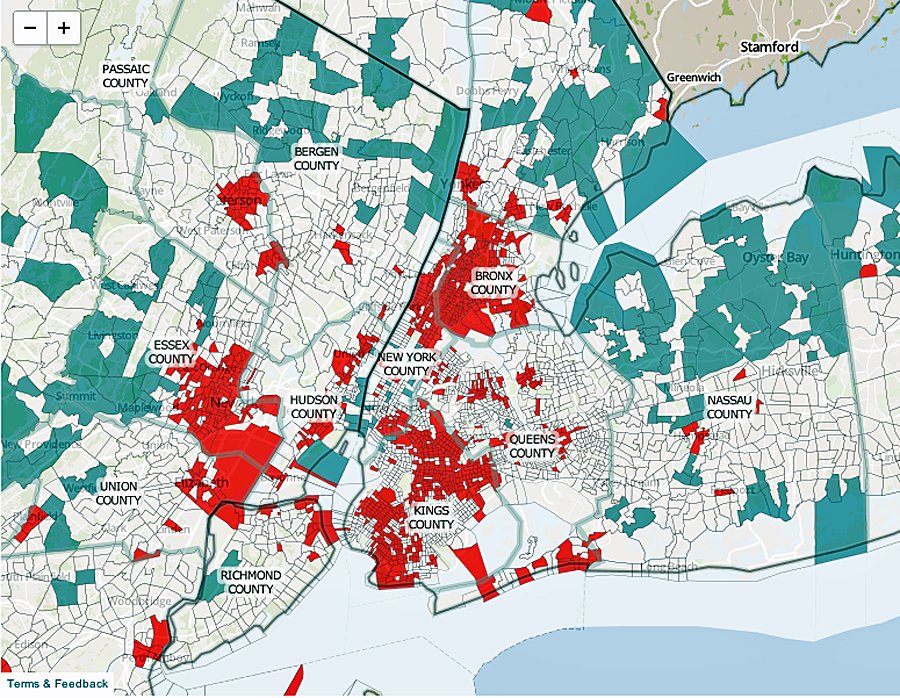
Further, we should question the value of the metrics used to rate teacher effectiveness in the first place.  As I have written previously, the American Statistical Association’s statement on the use of VAMs warns that only 1% to 14% of student variation on test scores can be attributed to variation in teacher quality. The does not mean, by the way, that teachers have no effect, but that statistically tying the achievement gap among students as measured by standardized testing to variability in teacher quality is looking at a very narrow slice of that gap’s origins.  What else can account for persistent gaps in student test scores?  Los Angles has a Residential Income Segregation Index of 51. 54% of children in the central city live in povertyThe impacts of poverty on children are by now well documented and cannot be excluded when considering school performance. Classrooms in Los Angeles are overcrowded, sometimes to a shocking extreme. California’s woeful education expenditures place it in the company of Arkansas and below West Virginia.  But according to the proponents of the Vergara case, the only thing that matters is teacher effectiveness as rated by the test score gains made by their students, regardless of all of the other factors that may effect those scores.

And this is painful ground for teacher and student advocates.  It sounds like I am saying that teachers have little impact, but what I mean to say is that teachers matter, but not in ways that are effectively measured by the value added models based on standardized testing.  Professor Jesse Rothstein’s review of the Measures of Effective Teaching study funded by the Gates Foundation demonstrated that teachers who did very well in their value added measures did far less well in measures of students gaining higher order thinking skills, so it is highly possible that the measures favored by Vergara’s so-called expert witnesses improperly favor the wrong teachers.  Anecdotally, such measures of effectiveness miss the realities of how teachers work with students.  The worst teacher of my entire life was my seventh grade mathematics teacher who was a bully and the most demotivating individual I have ever known in my life.  However, in a community where 95% of high school graduates went on to four year colleges and universities, the depths of his ineffectiveness would have been masked by the external advantages of his students.  Influence and impact upon students can frequently be hard to see in any numbers, but they are real regardless.  I have had former students contact me via social media to express appreciation for the role I played in their development towards adulthood, and not all of those students were long term academic successes (they are, however, remarkable people…testing misses that).

That is because an effective teacher is not merely a person who extracts a pre-determined gain in a standardized test over the course of one year.  Effective teachers inspire students to take risks that may result in messy but instructive failures.  Effective teachers help student manage social and emotional challenges to become more skilled at collaboration and leadership.  Effective teachers challenge students to, as Maxine Greene phrased it, “stir” themselves and see the world in different and transformative ways.  Effective teachers may simply convince a struggling student to stay in school for the stability it provides in his or her life.

As we prepare to challenge the Vergara decision and to brace ourselves for the flood of similar suits that the likes of Michelle Rhee are undoubtedly planning, it is vital that we not only confront the highly flawed assumptions of test based teacher competence, but also that we uplift a better vision of the importance of skilled and experienced teachers.

4 Comments

Filed under Media, politics, schools, Social Justice, Testing, VAMs

Gates’ Money and Privacy Activism — Opposition to Ed. Reform Hits the Mainstream

A few stories caught a lot of eyes over the weekend.  None of that is good news for education reformers who have banked on stealth and little reporting.

The first is a major article and interview regarding the role Bill Gates’ money has played in the development of, promotion of and adoption of the Common Core State Standards in the Washington Post.  The story is not entirely complete.  For starters, it fails to disclose that David Coleman already had funding from the Gates Foundation for his Student Achievement Partners, so a meeting with Gates in 2008 is not their first intersection.  Also, it does not explore the heavy hand that Gates has also had in the push for more high stakes testing to evaluate teachers via his funding of the highly flawed Measures of Effective Teaching study, nor does it examine the role that Gates has played in enabling technology entrepreneurs to mine the data generated from those tests without parental consent.

Regardless, the article is both informative and important for several reasons.  First, it is one of the first times anyone in a major news outlet has provided a portrait of the diverse opposition to current reform efforts in education that doesn’t make it sound like mostly the work of Alex Jones style cranks.  The article even quotes academics who question whether the standards are based on sound research on how children learn or even if there is a connection between quality standards and learning.  Second, this is an article in a major outlet that does not equivocate in the slightest about how much influence one very rich man has had in trying to control the entire course of American public education.  While it does not editorialize on the question, it is hard to read how many federal, state, nonprofit, academic and corporate entities were lobbied by, influenced by or funded by Gates and not wonder what role democracy has anymore when it comes to our public schools.

Finally, Gates himself comes across as defensive and dismissive:

Gates is disdainful of the rhetoric from opponents. He sees himself as a technocrat trying to foster solutions to a profound social problem — gaping inequalities in U.S. public education — by investing in promising new ideas.

This would be more convincing if Gates displayed the slightest interest in testing new ideas before unveiling them in 45 states at once before parents and teachers have a chance to understand them, indeed, before anyone has a chance to understand if they are a net positive or not.  From Gates’ point of view and experience, this must make sense.  He has compared common standards to standardized electrical outlets and computer code as a means of allowing innovation, and certainly getting DOS on most desktop computers in the world led to a lot of software developers having a common platform.  But education is not consumer electronics, and bypassing the entirety of stakeholders who value public education for a variety of reasons was going to lead to push back, and even today, Bill Gates does not demonstrate awareness of that.

The second article appeared in Politico and was dedicated to parent activists working to protect their children from data mining operations tied to public education.  This represents another public airing of activities whose proponents would prefer to avoid being seen in the open.  The report quotes New York’s Leonie Haimson of Class Size Matters about how parents have reacted when informed about the plans of technology firms to use pretty much every bit of data they can get their hands on, and it quotes worried data entrepreneurs coming to grips with parental opposition:

Many said they had always assumed parents would support their vision: to mine vast quantities of data for insights into what’s working, and what’s not, for individual students and for the education system as a whole.

“People took for granted that parents would understand [the benefits], that it was self-evident,” said Michael Horn, a co-founder of the Clayton Christensen Institute, an education think tank.

Instead, legitimate questions about data security have mixed with alarmist rhetoric in a combustible brew that’s “spreading like wildfire” on social media, said Aimee Rogstad Guidera, executive director of the Data Quality Campaign, a nonprofit advocacy group for data-driven education.

That fear, Guidera said, “leads to people saying, ‘Shut it down. No more.’”

Guidera hopes to counter the protests by circulating videos and graphics emphasizing the value of data. But she acknowledges the outrage will be hard to rein in.

Could the parent lobby scuttle a data revolution that’s been championed by the White House, pushed by billionaire philanthropists and embraced by reformers of both parties as the best hope to improve public education? “I do have that concern,” Guidera said. “Absolutely.”

The article doesn’t go into detail about just how much money is thought to be at stake and takes the data mining firms at their word that they only want to help, but I came away from reading it with one resounding message: this damage is entirely self inflicted, but the data miners see the parent activists as the problem.  They did not want to do the hard marketing work of convincing people that they were doing something valuable, and they did not anticipate that parents might see the data generated by their children’s public educations as something they’d want to protect rather than just shovel over for free.  It is hard to sympathize here, especially when they have avoided openness from the beginning.

Which leads to the third article from today: a call from the Gates Foundation for a two year “moratorium” on high stakes decisions based upon Common Core aligned testing.  This is the first official wavering from the Gates camp since the standards and testing drive began in earnest, and it is highly significant as an indication of concern that the whole enterprise is in trouble.  It may also be a miscalculation — yes, teacher opposition to using value added measures of their effectiveness based on standardized tests is strong, and yes, teachers have barely had time to adjust to the new standards.  But two years will not fix the flaws in VAMs, and it will not assuage parental concerns about the role of testing and data mining.  It will potentially take a chunk out of testing companies and data mining companies who were making business plans based upon all Common Core states embarking on wide scale testing next year, and I find it interesting that the Gates Foundation is willing to have them cool their heels while the standards’ supporters try to do something they have avoided all along: talk in public.

Leave a comment

Filed under Activism, Common Core, Funding, Gates Foundation, Media, Privacy, Testing, VAMs

A Few Thoughts on the Passing of Maxine Greene

If you missed the news that Maxine Greene, reigning philosopher of Teachers College at Columbia, died at the age of 96 last week, I do not blame you.  However, if you are a teacher or have been a student at any time in the past 50 years, the odds are very good that you have been influenced by her work.  I think it is safe to say that future generations of teachers and scholars of education will regard Dr. Greene’s work in the same way they regard John Dewey; many, myself included, already do.  In an age when technocratic forces seem more and more in control of our public discourse, a rediscovery of Maxine Greene’s focus on aesthetics seems more vital than ever.

I did not discover Dr. Greene’s work until I was in graduate school, but I could recognize its echoes in what had mattered most in my own education and teaching up to that point.  In an interesting way, reading her work after having been a student through the college level and having been a teacher was like discovering someone who had always been immensely important to you but who you had, paradoxically, never met yet.  It is certainly empowering to discover a voice that has been articulating for decades many of the ideas you hold dear, and to discover that it is very likely that the very teachers who encouraged you to explore those ideas were probably influenced themselves by the same voice.

Dr. Greene explored the power of “aesthetic education” throughout her career as central in the picture of education, not as some extra to be provided on the fringes of learning and only if the budget allows for it.  From her 1977 essay, “Toward Wide-Awakeness: An Argument for the Arts and Humanities in Education”:

I believe this may be said, in essence, about all the arts. Liberating those who come attentively to them, they permit confrontations with the world as individuals are conscious of it, personally conscious, apart from “the Crowd.” I would want to see one or another art form taught in all pedagogical contexts, because of the way in which aesthetic experiences provide a ground for the questioning that launches sense-making and the understanding of what it is to exist in a world. If the arts are given such a central place, and if the disciplines that compose the humanities are at the core of the curriculum, all kinds of reaching out are likely. The situated person, conscious of his or her freedom, can move outwards to empirical study, analytic study, quantitative study of all kinds. Being grounded, he or she will be far less likely to confuse abstraction with concreteness, formalized and schematized reality with what is “real.” Made aware of the multiplicity of possible perspectives, made aware of incompleteness and of a human reality to be pursued, the individual may reach “a plane of consciousness of highest tension.” Difficulties will be created everywhere, and the arts and humanities will come into their own.

What is striking to me here is how unencumbered this explanation is from the tedious necessity imposed upon all avenues of study to justify itself for immediate practical aims.  The warrant is that arts provide individuals with genuine opportunities to explore, challenge, be challenged and to explore the nature of reality and meaning in existence.  How devoid of the language of “college and career readiness” is this framework, and yet who could possibly be MORE “college and career ready” than a learner who has fully engaged in the “wide awakeness” that Dr. Greene speaks of in this essay?  It is almost as if the process of becoming a thinking, reflective and “awake” individual is not a process that can be tidily mapped into proficiencies.

In a 1978 essay, “Teaching: The Question of Personal Reality”, Dr. Greene observes about the problem of teachers who encounter the political and bureaucratic demands upon teaching:

The problem is that, confronted with structural and political pressures, many teachers (even effectual ones) cope by becoming merely efficient, by functioning compliantly—like Kafkaesque clerks. There are many who protect themselves by remaining basically uninvolved; there are many who are so bored, so lacking in expectancy, they no longer care. I doubt that many teachers deliberately choose to act as accomplices in a system they themselves understand to be inequitable; but feelings of powerlessness, coupled with indifference, may permit the so-called “hidden curriculum” to be communicated uncritically to students. Alienated teachers, out of touch with their own existential reality, may contribute to the distancing and even to the manipulating that presumably take place in many schools. This is because, estranged from themselves as they are, they may well treat whatever they imagine to be selfhood as a kind of commodity, a possession they carry within, impervious to organizational demand and impervious to control. Such people are not personally present to others or in the situations of their lives. They can, even without intending it, treat others as objects or things. This is because human beings who lack an awareness of their own personal reality (which is futuring, questing) cannot exist in a “we-relation” with other human beings.

She goes on to suggest that such teachers need to rediscover themselves and their stories as a vital part of their work:

Looking back, recapturing their stories, teachers can recover their own standpoints on the social world. Reminded of the importance of biographical situation and the ways in which it conditions perspective, they may be able to understand the provisional character of their knowing, of all knowing. They may come to see that, like other living beings, they could only discern profiles, aspects of the world. Making an effort to interpret the texts of their life stories, listening to others’ stories in whatever “web of relationships”29 they find themselves, they may be able to multiply the perspectives through which they look upon the realities of teaching; they may be able to choose themselves anew in the light of an expanded interest, an enriched sense of reality. Those who wished to become nurturant beings may (having entered new “provinces of meaning,”30 looked from different vantage points) come to see that nurturing too can only be undertaken within social situations, and that the social situation in the school must be seen in relation to other situations lived by the young. Those who chose themselves as keepers of the academic disciplines may come to realize that the perspectives made possible by the disciplines are meaningful when they illuminate the experience of the learner, when they enable him or her to order the materials of his/her own lived world. Those who focused primarily on the social process may come to see that existing individuals, each in his/her own “here” and own “now,” act in their intersubjectivity to bring the social reality into being, and that attention must be paid to the person in his/her uniqueness even as it is paid to the community. Seeing more, each one may be more likely to become “a network of relationships”31 and perhaps be more likely to act in his or her achieved freedom to cut loose from anchorage and choose anew.

It is striking how relevant this perspective is today in 2014 as education policy has placed layer after layer of technical rationality upon teachers and seeks to hold them accountable to poor markers of their own effectiveness and influence upon learners.  Today, teachers are more in need than ever of ways to keep their focus upon the real and authentic nature of their work, and I am struck by how timely Dr. Greene’s observations are for teachers in 2014.  In danger of becoming “Kafkaesque clerks”, teachers need to rediscover their own stories and thus rediscover their purposes.

In a 1989 article in “Education and Culture” called “Reflection and Passion in Teaching”, Dr. Greene took on the current trends in education policy in the nation (trends that today have yielded us the Common Core State Standards, PARCC and Smarter Balanced testing consortia, value added measures of teacher effectiveness and labeling all children as either proficient or not proficient):

I am concerned, certainly, about competent practice and about what Schon calls “reflection-in-action” as an alternative to technological rationality. But I need to say that I am concerned about something in addition to competent action, important as that is for us to define and understand. We ought to talk more readily about what that practice is for about the purposes we define for ourselves at this peculiar moment of our history.

These words ring especially importantly today:

For educators, this is not a narrowly partisan position, I would insist, because teaching, as many have viewed the activity, is an undertaking oriented to empowering persons to become different, to think critically and creatively, to pursue meanings, to make increasing sense of their actually lived worlds. Wholly unlike “selling” or drilling or training, teaching is oriented to provoking persons to care about what they are coming to understand, to attend to their situations with solicitude, to be mindful, to be concerned, to be fully present and alive. Democratic education, certainly, involves provoking persons to get up from their seats, not to come to Christ or to be magically cured, but to say something in their own voices, against their own biographies and in terms of what they cherish in their shared lives, what they authentically hold dear. It involves getting them to leave their assigned places in the crowds and even in the marches, and to come together freely in their plurality. It means creating an “in-between” among them, a space where they can continue appearing as authentic individuals, each with a distinctive perspective on what they have come to hold in common, a space where something new can find expression and be explored and elaborated on, where it can grow. It is when people become challengers, when they take initiatives, that they begin to create the kinds of spaces where dialogue can take place and freedom can appear. And it is then, and probably only then, that people begin thinking about working together to bring into being a better, fairer, more humane state of things.

Dr. Greene not only challenged technical rationality as a basis for teaching and learning, she also challenged what she saw as insufficiently alternative view of reflective practice proposed by Donald Schon:

If it is indeed the case that, in a period like this, we ought to be making particular efforts to provoke students to think and speak for themselves, the approach to teaching outlined (but not endorsed) by Schon is entirely antithetical to the kind of practice we ought to be considering. For one thing, it is extraordinarily difficult to justify any knowledge as “privileged,” now that we know as much as we do about the diverse approaches even within the various specialties, and now that so many recognize the importance of the kind of perspectival and interpretative knowing of which Eco’s blind monk was so afraid. Moreover, many professionals now realize that their practice is almost always situation-specific. To depend upon generalized formulas and quantitative measures, to limit our concern to student success and failure in the assimilation of curriculum materials and the mastery of skills, is (more often than not) to distance the particularities of classroom life. It is to act as if the classroom were indeed an “object-in-general,” not an unstable, unpredictable human situation identical to no other in the world.

Dr. Greene’s vision was much more compelling and goes far beyond offering an alternative perspective to technical rationality:

My adversary point in this moment of “reform” concerns the significance of empowering diverse individuals to think, to be mindful, to make sense, and to reach beyond. I am not suggesting that we set aside subject matters or the disciplines, which obviously provide perspectives, modes of ordering and symbolizing and articulating experience. Nor am I arguing against the kind of professional education that introduces teachers-to-be to the human sciences, the natural sciences, the arts and humanities, and the technical literacy that can inform situations of practice as well…This is quite different from the application of technical or scientific constructs to fluid situations where they frequently do not apply; it is quite different from the application of conclusions from research external to the actual concerns, the unease of teachers and students immediately involved. I am not sure but that one of the unwanted consequences of technical rationality and a skills orientation has been the desire for the folding screen, the submission to kitsch, or the hidden fear. But if we are the kinds of educators who want to provoke, to motivate persons to move and become challengers, I believe we have to reconceive.

And to stir ourselves, to disturb, to transform. An emotion, a passion can be a transformation of the world. It can break through the fixities; it can open to the power of possibility. It may even render practice more reflective. We need to open spaces for this in education at this time in history, to renew as we reform


We are, as then, in a moment where such visions of teaching and learning and the very purposes for why we have pursued them over a 200 year history of common schooling are vitally important.  Education lost Maxine Greene last week, but her writings will continue to speak about what really matters and to what those who want to improve our schools should truly pay attention.  There is much more to this work than can be captured in a standards document or in a standardized examination or in a teacher effectiveness score derived from those exams, but those are the matters that have dominated our conversation about schools for far too long.  It is past time to consider what it means to “stir ourselves, to disturb, to transform”.


1 Comment

Filed under politics, schools, Social Justice, teaching

Who is more important? Pearson? Or our children?

Some background:

My wife and I have two children who are public school students in New York City.  We, as many other parents do, had our eldest tested for admission to the city’s gifted and talented program.  I’ll be honest – this child is exceptionally bright, but creative use of verbal language, imagination, story telling (our eldest’s strengths), are not really part of the tests used to qualify.  Regardless, the score was high enough to qualify for a seat which was assigned by lottery.

Our youngest sat for this year’s examinations in January. Sibling preference in admission at the G&T programs meant that if that score had qualified as well both our children would be in the same school next year.

Our youngest missed by the smallest margin.

Now I must be clear about this.  Our family does not deserve anyone’s sympathy.  It was by sheer luck of a random drawing among the many children who qualified that got our eldest a seat.  Our youngest was not owed a seat, and our zoned school is another one of the highest regarded schools in the city and is very close to the other school.  We know families who schlep across town to three different schools in pursuit of the cherry that the NYC Department of Education has placed on top the public school system.  Then there are the families whose kids qualify but for whom there are no seats because they’ve greatly overpromised what they can deliver.  Then there is the entire issue of how so many of the qualifying students are concentrated in affluent districts in the city.

So we will be fine, but since we would prefer our family’s attention to concentrate on one school for as long as possible, we took the opportunity to make an appointment with the DOE to review our youngest’s test.  That appointment was today, and we were given twenty minutes to sit with the exam and the answer key under the supervision of a DOE employee.  It was actually a more helpful experience than I anticipated, and our DOE representative was really quite delightful and very skilled at explaining the tests and how they were administered.  I can tell you the following:  We found that our child was prone to picking distractors, especially as each section of the exam progressed. We found one indisputably incorrectly scored item which means the exam is flagged for an immediate rescore.  We also found a handful of items that I strongly suspect would make my friends in measurement and quantitative methods cringe.

And that’s all that I can tell you.

You see, our child was assessed using the Otis-Lennon School Ability Test (OLSAT) and the Naglieri Nonverbal Ability Test (NNAT-2), both of which are products of Pearson, and in order to get a look at the examinations, I had to sign a non-disclosure form.  Chew on that for a minute.  An official of the New York Department of Education had me and my wife sign a form promising that we would not specifically or generally disclose the contents of an examination that was administered to our child for the purpose of selecting a public school.  The contents of that examination, several of which arguably violate principles of good test design for young children, must be kept secret even though, of course, it will be redesigned for the next year’s exams and even though I can purchase any number of OLSAT related materials directly from Pearson.

I cannot even really blame Pearson here.  They have developed the examination, and there is significant money at stake for them in a) keeping too much of their material from being seen by competitors and 2) making certain that people have to purchase exam related materials from them.

On the other hand, I have no trouble blaming craven politicians and bureaucrats who contracted Pearson and agreed to terms like this which are good for business, but bad for public discussion of education policy.  What we did today allows my family to pursue our interests as a household, but it disallows any informed discussion with the broader community about the nature of measurements that determine substantial educational opportunities.  And there are real discussions that ought to be had.  This year, three times as many children qualified for seats in the coveted citywide G&T programs as there were seats available, but these qualified children are not randomly distributed across the city.  Districts 2 and 3 in Manhattan combined for 623 of those Kindergarten aged children qualified for entry to citywide programs while districts 7,8, 9, 12 (The Bronx), 16, 23, 32 (Brooklyn), and 29 (Queens) had none.  With an income segregation index of 57 in New York City, there is an important discussion to be had about the nature of these tests and whether they identify gifted or privileged children.  But Pearson’s intellectual property is more important than that discussion.

NYRISI

Which is ironic given how eager New York was to join with InBloom, the data storage cloud service that was going to provide storage for student records and allow technology and publishing companies to mine that data to create products for sale.  It was only the vigorous activism by advocates like Leonie Haimson on Class Size Matters that put enough pressure on Albany to halt the project, but it is by no means the only one that sees student data as a commodity.

What does it say that your child’s school records are able to be used without your consent for private purposes but that private materials with profound impact upon public school children and their opportunity must be protected?

1 Comment

Filed under Pearson, Privacy, Stories, Testing

Open Letter to President Obama — You Are Listening to the Wrong People

Dear Mr. President:

I am writing to you with three different roles.  First, I am the director of secondary education and secondary/special education teacher preparation at Seton Hall University where I have been on the faculty since 2002.  Second, I am a lifelong educator whose teaching experience at levels from seventh grade to graduate school courses stretches back to 1993. Finally and most importantly, sir, I am the father of two school aged children enrolled in the public schools of New York City.  All three of those roles in life have prompted me to write to you, and it is my hope that you will seriously consider what I have to say, for it is based upon my devotion to my children, my experience as a teacher and upon the data that is readily available about what is being done to schools during your administration.

With respect, Mr. President, you are listening to all the wrong people about our nation’s schools.

When you were inaugurated, many of us in education had hoped that your administration would urge Congress to roll back the detrimental aspects of the No Child Left Behind act, which had taken the previous two decades of educational failure rhetoric and placed a punishing regimen of unreasonable expectations, high stakes testing and punishment into effect that left schools and schools systems under threat of a “failure” label if they did not achieve near miraculous score gains in standardized examinations.  Instead, we got the Race to the Top program which has taken the worst elements of NCLB and made them even worse.  Your signature education initiative incentivized participating states to enroll in rushed and unproven common standards, increases the amount of high stakes testing at all levels of public education, subjects teachers to invalid measures of job performance and creates preferential treatment for charter schools that cynically manipulate data on their enrollment and achievements, sue to prevent public oversight of the public moneys they receive and whose expansion provides new investment vehicles for the very wealthy.  All of these results have rich and powerful advocates, and all of them are damaging to our nation’s public schools.

The Common Core State Standards have been described as a state led effort because of the role of the National Governors Association in their creation, but the work of a very few people is far more directly responsible for them.  David Coleman, now President of the College Board, Jason Zimba and Susan Pimentel of Student Achievement Incorporated worked with a small group of core writers that were largely representative of the testing and publishing industries to produce K-12 standards in English Language Arts and Mathematics in less than two years.  This is a staggering pace for such a complex project, and it was conducted in clear violation of highly regarded and accepted processes for the creation of standards.  Dr. Sandra Stotsky of the University of Arkansas was a member of the validation committee that was convened, in theory, to validate the quality of the standards, but she refused to signed off on them when, by her own account, repeated efforts to have the research basis for the standards produced by the writing committees went unanswered.  Once written, the standards were rapidly adopted by states due to the incentives of Race to the Top and aggressive spending of the Bill and Melinda Gates Foundation.  Diane Ravitch of New York University has repeatedly pointed out that this process was staggeringly flawed, and even more flawed than the opaque writing and promotion efforts has been the race to roll out the standards in nearly all states simultaneously with no small scale field testing and no known way for data from the implementation to be fed back to any body that is tasked with revising the standards based on such data.

Mr. Bill Gates seems enormously confident, absent any defensible evidence, that this is the correct path.  He provided funding to Student Achievement Incorporated and the National Governors Association, and has been spending lavishly since 2010 to make certain all forms of organizations continue to boost the standards.  Mr. Gates spoke this year at the Teaching and Learning Conference hosted by the National Board for Professional Teaching Standards (an organization he has given grants to recently), and his defense of national standards was telling.  According to the Washington Post:

Standardization is especially important to allow for innovation in the classroom, said Gates, who used an analogy of electrical outlets.

“If you have 50 different plug types, appliances wouldn’t be available and would be very expensive,” he said. But once an electric outlet becomes standardized, many companies can design appliances and competition ensues, creating variety and better prices for consumers, he said.

The version posted to the Gates Foundation website offers a more explanatory framing of the metaphor, but Mr. President, I hope the flaw in his thinking is evident.  Multi-state standards are not, inherently, a bad thing, primarily if used like the National Assessment of Educational Progress as a NO STAKES diagnostic tool, and Mr. Gates is correct that a variety of INDUSTRY standards have led to consumer innovations.  However, even after we accept a standard for early literacy acquisition to be age appropriate and based on research into how children learn to read, the process by which any given child meets that standard is vastly more complex than the process of attaching an electric motor to a hand blender; worse, it does not demonstrate an understanding that children develop at very varied rates, and that an age appropriate target for one child may be entirely inappropriate for a peer in the same classroom.

Even assuming that Mr. Gates is correct and that CCSS would allow teachers to innovate, Race to the Top and Mr. Gates’ own advocacy have worked to tie the CCSS to a regimen of high stakes testing the likes of which we have never seen and which are already incentivizing teachers and school districts to vastly narrow their teaching in response.  Mr. President, policy analysts refer to perverse incentives as those elements of policy that incentivize behavior in such a way that people can obtain the incentive while engaging in practices that are damaging or undesirable.  In this case, Race to the Top is the Mother of All Perverse Incentives.  Your administration required states to adopt test-based evaluation of teachers in addition to adoption of common standards.  This has resulted in states both enrolling in the CCSS testing consortia, and adopting Value Added Models (VAM) of teacher effectiveness as part of teacher assessment and retention.  Mr. President, you recently remarked that schools should not be teaching to the test even while your administration was stripping Washington State of its NCLB waiver over its desire to not use high stakes testing to evaluate teachers, but you could do little that incentivizes teaching to the test more than this.  Michelle Rhee’s tenure as D.C. Schools Chancellor provides an instructive anecdote.  Despite her denials and cursory investigation, it is very clear that her “raise test scores or be fired” approach spawned widespread cheating. That behavior is not excusable, but it is evidence of how far some people placed in extraordinarily difficult circumstances will go when subject to such incentives, and it is simply inevitable that short of cheating, the use of VAMs in teacher evaluation will result in more teaching to the test.

And VAMs themselves are invalid, Mr. President.  The American Statistical Association is quite clear on this in its recent statement on the use of VAMs for teacher evaluation.

The measure of student achievement is typically a score on a standardized test, and VAMs are only as good as the data fed into them. Ideally, tests should fully measure student achievement with respect to the curriculum objectives and content standards adopted by the state, in both breadth and depth. In practice, no test meets this stringent standard, and it needs to be recognized that, at best, most VAMs predict only performance on the test and not necessarily long-range learning outcomes. Other student outcomes are predicted only to the extent that they are correlated with test scores. A teacher’s efforts to encourage students’ creativity or help colleagues improve their instruction, for example, are not explicitly recognized in VAMs…

It is unknown how full implementation of an accountability system incorporating test-based indicators, such as those derived from VAMs, will affect the actions and dispositions of teachers, principals and other educators. Perceptions of transparency, fairness and credibility will be crucial in determining the degree of success of the system as a whole in achieving its goals of improving the quality of teaching. Given the unpredictability of such complex interacting forces, it is difficult to anticipate how the education system as a whole will be affected and how the educator labor market will respond.

This is clear-cut, sir.  There are no current high stakes tests that meet the requirements of a well developed VAM, and there is no evidence about how VAMs will influence the schools in which they are deployed, but your signature education program is incentivizing them anyway.

To date, no study reliably shows that current VAMs can be used the way they are going to be used over the next few years, but that has not stopped the Gates Foundation from being front and center in this issue as well.  The Gates commissioned “Measures of Effective Teaching” study concluded that VAMs can be effectively used to evaluate teachers, but Jesse Rothstein of the University of California at Berkeley demonstrated clearly how flawed the study was, especially how it drew conclusions only weakly supported by its own data:

The results presented in the report do not support the conclusions drawn from them. This is especially troubling because the Gates Foundation has widely circulated a stand-alone policy brief (with the same title as the research report) that omits the full analysis, so even careful readers will be unaware of the weak evidentiary basis for its conclusions…

Hence, while the report’s conclusion that teachers who perform well on one measure “tend to” do well on the other is technically correct, the tendency is shockingly weak.  As discussed below (and in contrast to many media summaries of the MET study), this important result casts substantial doubt on the utility of student test score gains as a measure of teacher effectiveness.  Moreover, the focus on the stable components – which cannot be observed directly but whose properties are inferred by researchers based on comparisons between classes taught be the same teacher – inflates the correlations among measures.  Around 45% of teacher who appear based on the actually-observed scores to be at the 80th percentile on one measure are in fact below average on the other. Although this problem would decrease if information from multiple years (or multiple courses in the same year) were averaged, in realistic settings misclassification rates would remain much higher than the already high rates inferred for the stable components.

It is almost inconceivable how it is that our nation is rushing forward with a package of reforms that are being implemented at breakneck speed with such damaging potential and with so little evidence to suggest that they will do anyone any good, and with mounting evidence that they are objectively harmful.  But one thing is actually very certain: these “reforms” and their attendant policies are making some people a substantial profit.

Three years ago, education writer and consultant and former National Board Certified Teacher Nancy Flanagan noted that the rush for CCSS implementation meant that a publishing bonanza was on the horizon.   Certainly, their implementation with the coming testing requirements has been a bonanza for Pearson who landed the contract to write and implement the Partnership for Assessment of Readiness for College and Careers (PARCC)  testing consortium.  At a predicted cost of 24 dollars for a set of tests as the math and ELA testing comes on line, Pearson is guaranteed a huge new income stream from the more than 10 million students currently in PARCC states.  But Pearson is only the most public face of making money off of the reforms put in place by your administration.  Common standards and mass testing generate vast amount of data, and technology companies are starting up all intending to mine that data for profit.  This is ground that has been ploughed by Rupert Murdoch who, when he began acquiring education technology firms, identified a “500 billion dollar sector” waiting for “big breakthroughs”.  Bill Gates has also been involved in this sector, setting up the data cloud storage firm InBloom for 100 million dollars, and watching it close when parental concerns over data security and the plan to allow vendors to access the data could not be overcome.  But other firms such as Knewton intend to continue data mining and creating products based upon that analysis, and none of them, regardless of how intriguing their products might be, demonstrate sufficient care about the need to explain their services to parents, the need to allow parents and guardians to opt their children out of the data pool or the need to build real support among the people whose children are being transformed into revenue.

I am asking you as a father, sir: would this be acceptable to you?  I regret to inform you, Mr. President, that your own administration has abetted this by changing the regulations that implement the Federal Education Rights and Privacy Act.

Publishers, testing companies and technology firms are not the only ones who are reaping new windfalls from your education policies, Mr. President.  It turns out that Wall Street investors are eager to see another aspect of Race to the Top, charter school expansion, continue as rapidly as everything else, and while many of them proclaim to be fans of the charter schools’ alleged “successes” it is also clear that many of them have also figured out how to make guaranteed money from supporting charter schools.  Hedge fund billionaires can use a combination of federal tax credits to make investing in charter school construction a vehicle that can guarantee a doubled return within 7 years.  This is entirely unlike traditional school construction funding via bond issues because such bond issues are done in the open and for a public with a vote for or against the responsible school boards.  This is done entirely in private and with no oversight and precious little public knowledge.  It is little wonder then that Wall Street interests are not only investing in charter school construction, they are also organizing PACs such as Democrats for Education Reform specifically to keep state governments granting more and more charters, something else that you enabled with the provisions of Race to the Top.

You might be able to justify this, Mr. President if you could claim that charter schools are actually the solution to American education, but to make that claim you would have to ignore evidence.  Many charters are excellent schools.  Many are terrible.  But there is no evidence that the charter school segment is consistently outperforming fully public schools.  There is, however, evidence that charter schools do not educate children with disabilities at comparable levels as fully public schools.  There is evidence that charter schools do not serve students who are English Language Learners like their fully public peer schools do.  There is evidence that one of the most prominent charter operators in New York City, Eva Moskowitz of Success Academy, is not telling the truth about the number of children in poverty that she serves, the real achievements of her schools test scores, or the rate of attrition for students with disabilities and language learning issues.

These schools are not miracle factories, Mr. President, but supporting their expansion is making people money.  Your Secretary of Education, Arne Duncan, once opined that Hurricane Katrina was the “best thing” ever for New Orleans Schools because it shook up the status quo and got people “serious” about reform.  That “reform” has meant that this week, the last public school in New Orleans has closed for good, and the city school system in entirely comprised of charter schools.  Amidst growing evidence that many prominent charter operators are not equally educating students and amidst disturbing studies about rising segregation in the charter sector, I cannot help but wonder how Secretary Duncan justifies his statement today.

No wonder teacher morale is at an all time low.

Your public voice in these issues has been a disaster for you, Mr. President.  Secretary Duncan may be the most controversial person to hold that office since its creation, and he has repeatedly demonstrated that he is both insensitive to teacher and parental concerns and fully vested in a false narrative about American education.  Mr. Duncan has frequently repeated to charges from corporate reformers and privatizers that American education is stagnant and that we can infer a need for their favored reforms from international testing data.  This is part of a narrative of deepening failure which thoroughly ignores how American students have never fared well on such measures and how these scores and our economic health have little connection.  Mr. Duncan has observed that he believes our teachers are not educated enough and we should be more like South Korea, despite the fact that South Korea’s educational “success” comes with high costs:  20% of family income on average spent on private “cram” classes, focus on drill and rote learning that leads to high test scores, and wide recognition that South Korean children face too much pressure, leading to an alarming youth suicide rate.  This is hardly praise worthy, sir.

Secretary Duncan’s misunderstanding extends to why people are criticizing the CCSS and other Race to the Top reforms.  I am sure that you know how he said that Common Core opponents are often “white suburban moms” who are upset to find out their children are not “as brilliant as they thought they were”.  Mr. Duncan apologized for the remark, but his insinuation that any opposition to CCSS is unreasonable betrays that he really does not understand the issue.  Mr. President, American parents, by wide margins, believe that the schools their children attend are doing very good work, and despite three decades of an unrelenting failure narrative, that percentage, over 70%, has remained stable.  What parents are saying is that Common Core, evaluating teachers by tests and the increase in high stakes testing and heavy pressure on schools to raise test scores at all costs have come too rapidly, with too little transparency, and with extreme negatives vis-a-vis how children experience school.  Mr. Duncan does not understand that as evidenced by his remarks in April with NY Commissioner John King where he called parental protests “drama and noise.”  Mr. Duncan may call the 10s of 1000s of families who have opted out of Pearson’s testing and the list of districts refusing to field test the exams “drama and noise”.  Many, myself included, call it a movement that is ignored and dismissed at peril.  I do not know if your Secretary of Education has told you that most opposition to reform comes from Glenn Beck styled cranks and spoiled suburbanites, but if he has, you have been sorely misinformed.

Mr. President, in 1999 Congress passed the Gramm-Leach-Bliley Act, also known as the Financial Services Modernization Act, and President Clinton signed it into law.  Although the trends in mortgage lending and investment products that led to the financial crisis had begun long before 1999, the removal of regulations that prevented commercial and investment banks and insurance firms from blending their businesses greatly accelerated the damage being done to our financial industry.

Mr. President, I am afraid that history will look upon Race to the Top as your Financial Services Modernization Act, a tool crafted to be cynically misappropriated by interests with no concern for the public good.

And what is so frustrating, Mr. President, is how entirely unnecessary this judgment of history will be.  Our schools need help, sir, but it is not help that will be found by racing to implement new standards, layering on more high stakes tests, threatening teachers’ livelihoods with invalid statistical models or by turning more and more of our urban school districts over to for profit charter school corporations.  Our schools are afflicted by the same thing that afflicts our society: rising poverty and constant cuts to assistance for the poor.  16 million children in the United States live in poverty; that is 22% of all children, 38.2% of all African American children and 35% of Hispanic children.  Our schools serve communities, and our segregation by income has increased over the past 30 years, meaning that both rich and poor increasingly live in communities with people mostly of their own income level.  The Residential Income Segregation Index (RISI) scores for Houston, Dallas, New York, Los Angeles and Philadelphia are all above 50, and the RISI has gone up in every region of the country since 1980.  Nationally, it is 46, an increase of 39% since 1980.

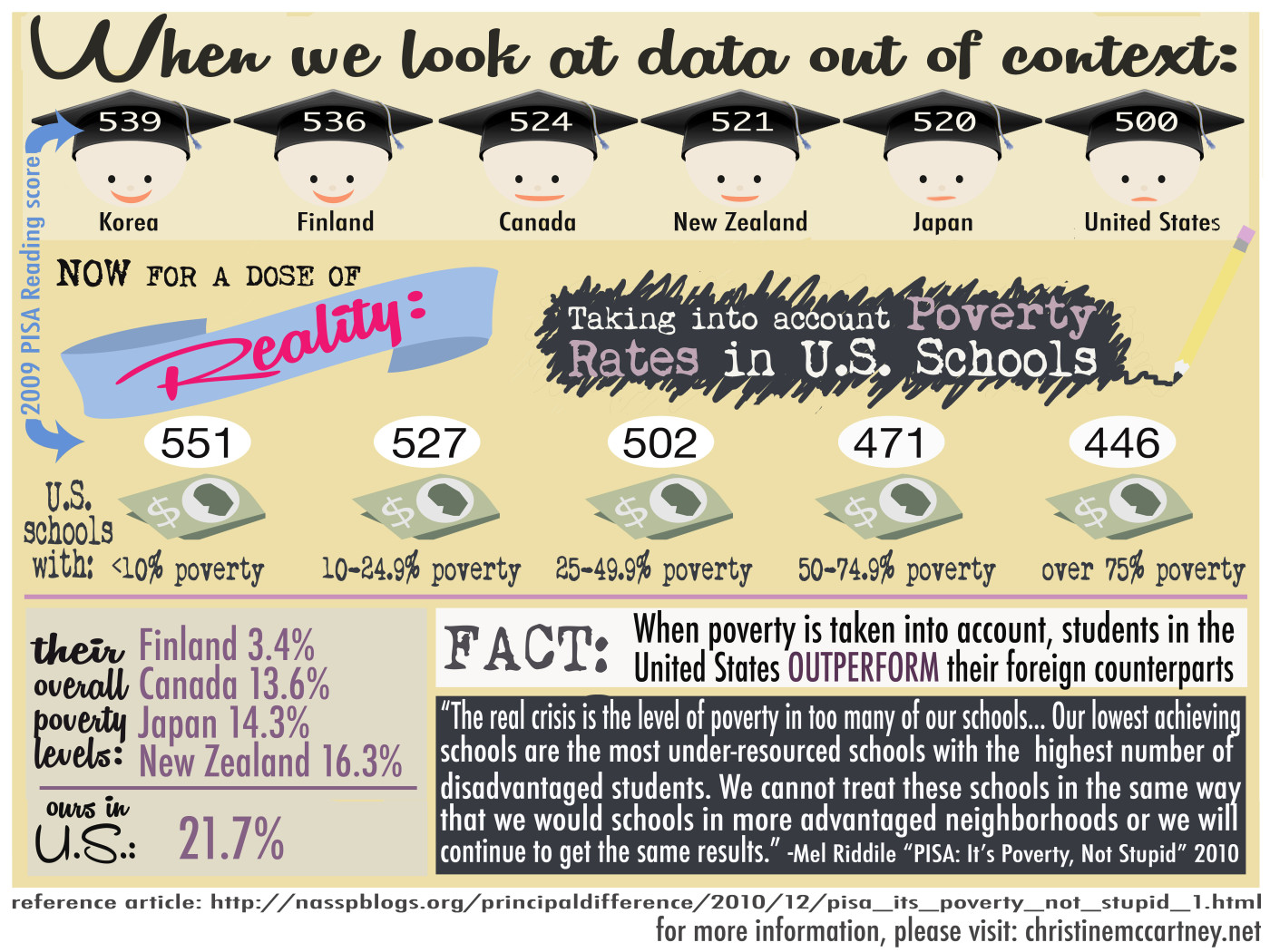
We see this when we look at our PISA scores broken down by the income characteristics of communities.  According to USC Professor Emeritus Stephen Krashen, the portrait of America’s schools look very different when poverty characteristics are considered.  In schools where less than 10% of the students qualify for free and reduced lunch, our PISA scores are higher than the average for any OECD nation, but where 75% or more of students are in poverty, the PISA scores are second to last.  Given that our communities are increasingly segregated by income, Mr. President, it is inevitable that test score data compared nation to nation will be misleading.

It is at this point that Arne Duncan, Michelle Rhee, Joel Klein, Eva Moskowitz, Andrew Cuomo, Bill Gates, Whitney Tilson, and a host of other corporate “reformers” will line up to accuse me of making “excuses” for “bad schools”.  They will insist, absent any evidence, that “great teachers” can close the achievement gap even if we completely fail to address poverty in our communities.  But it is not “making excuses” to insist that if we want a child living in poverty to succeed in school that we cannot ignore whether or not she knows if she is going to eat tonight, or if she will have a place to sleep, or if her parents will continue to work or any of the host of other matters that afflict children in poverty in ways that negatively impact their formal education.  Mr. President, we have known the long term impacts of poverty on children for some time now just as we have known that it has been growing and deepening, and we spend far less than our peer nations on helping to alleviate the detrimental impacts of poverty.  Nothing in education policy in the past three decades has done anything to address that.

That is not “excuse making,” Mr. President, that is aiming the analysis at the actual problem, whether or not addressing the problem will make anyone a profit.

You have an advantage that few of your predecessors had, Mr. President, and it is your demonstrated interest in and ability to genuinely listen to others.  Joshua Dubois wrote about your meetings with the families at Sandy Hook Elementary School, and how for hours, you sat, embraced, asked questions and listened to them. What strikes me, sir, is how, despite an election year warming up, you never once mentioned this to the press and never once used this remarkable testament to your character for political gain.  I urge you, Mr. President, to visit teachers, parents and children in the same manner, without cameras or vetting, and just ask them what they want our schools to be.  You will not find their answers easily mapped onto your education policies.

It is not too late for you to have a transformational impact on America’s schools, Mr. President, but it will take a number of immediate actions to have a chance.  I ask you to consider the following, badly needed, steps:

  1. Scrap Race to the Top: Your signature education policy is detrimental to children, teachers, schools and communities.  Ending it will not do away with the Common Core State Standards, testing or charter schools, but it will free states and districts to look truly reflectively at these initiatives and to voluntarily engage in as little or as much of them as they deem necessary and beneficial.  It will require proponents of these policies to make their cases in full view of the public in all 50 states instead of hiding behind coercive requirements for federal funding.
  2. Restore Federal Privacy Protections: Technology entrepreneurs may have truly powerful learning tools in development, but to make them work, they need student records deemed private under federal law.  Instead of engaging teachers and parents about these tools, they got your administration to revise regulations and are now mining those records without any meaningful consent.  This is unacceptable, and it must stop.  Our children are not sent to public school to be monetized without our consent.  Parents will listen to open and honest efforts to describe how these tools can benefit their children, but they will oppose efforts to bypass them.
  3. Be Serious About Holding Charter Schools Accountable to Civil Rights Legislation: Your administration recently expressed interest in making certain that charter schools meet federal civil rights requirements.  This is a good first step.  It must be applied vigorously, especially given how poorly many high profile charter operators do in serving students with disabilities, educating English Language Learners and retaining students of color after admission.  Your administration has granted enormous favoritism to charter schools, and they must be made fully accountable.
  4. Demand a Marshall Plan for School Aid and Construction:  Nearly all states are spending less money per pupil today than in 2008. In New York State, the average school district still receives $3.1 million less in state aid than they would have without budgetary tricks like the Gap Elimination Adjustment.  All across the country, our public schools are being told to implement a complex new curriculum, meet unrealistic testing requirements and to do so while having their budgets cut to the bone.  Further, in 2008, the AFT commissioned a study that estimated a need for over $250 billion in school infrastructure spending nationwide, a need that remains unmet.  It adds insult to injury that students come from homes that suffer from the deprivations of poverty and arrive in schools that are cold in the winter, hot in the summer and wet when it rains.  Our nation must do something about this.  At the same time, you must highlight schools where children in poverty thrive, not merely where they get good test scores.
  5. Replace Secretary Duncan: Mr. Duncan is entwined so deeply in the Race to the Top approach to reform that he is incapable of moving away from it.  Your Secretary of Education demonstrates no understanding of why people oppose current reforms, little willingness to see his mistakes as more than verbal slip ups, and he consistently misuses international test data to denigrate the quality of our schools and teachers.  If you want to protect our schools from the forces of corporate reform, Secretary Duncan cannot lead.

You have an opportunity, Mr. President, to retask the federal Department of Education with protecting our national Commons, our history of 200 years of seeing public education as a public good for communities and a private good for individuals.  Your administration has abetted the use of our public schools by private and corporate interests in ways that are actually detrimental to education.  If you wish that to not be your legacy, you must act now.

Sincerely,

Daniel S. Katz, Ph.D.

Director, Secondary and Secondary/Special Education Teacher Preparation, Seton Hall University

Career Educator

Father of Two Public School Children


Leave a comment

Filed under Activism, charter schools, Common Core, DFER, Gates Foundation, politics, Privacy, schools, Social Justice, Stories, teaching, Testing, VAMs

A Short Story on Falling for Education Narratives

When I was in 7th grade, my junior high school had just set up a “computer lab” with Tandy/RadioShack 80s known as TRaSh80s by classmates who were already personal computing buffs.  My own computing experience was limited to a Commodore 64 system which I remember fondly today but mostly used to play Zork back in 1982.  The lab in school was set up as part of a new curriculum meant to ensure that we all learned how to program – in BASIC.

This being the early Reagan administration, there were two social trends at work.  First, a deep and hurtful recession at home and international anxiety about the rising star of Japan on the world economic stage.  Competition from Japanese manufactured automobiles and consumer electronics were damaging American industry, and an increasingly anxious public worried about our national future.  In a year’s time, “A Nation at Risk” would be unleashed on the public arena and a 30 year narrative of how our schools have failed us as a nation would take off.  Learning computer programming was adopted by our suburban school district as response to that.

As I sat in front of a TRS-80, unhappily learning how to write lines of code that code could make my name scroll diagonally across the screen (I would have much rather have been in study hall re-reading “The Hobbit”), I commented to our teacher how useless this seemed.  I was then given a short lecture on how in the future EVERYONE who HAVE to know how to program computers.  If I wanted any chance at a productive life I would have to learn as well.  In fact, it was my patriotic DUTY to learn how to make my name scroll diagonally across the computer screen.  For a final rhetorical flare, I was asked if I really wanted Japan to take over everything?

I gave my teacher a good hard look.  Then I looked around the lab, and I could see that a few of my classmates were intensely interested in what they were doing and appeared to be, absent his guidance, experimenting with their programs to see what they could make them do.  I looked at him again.

“That’s not true,” I said. “In the future, there will be people who program computers and people who use computers, and they don’t all have to be the same person.”

We didn’t get along.  Luckily, it was only a half year class.  Ironically, the argument for more people learning to program is finally making a bit more sense with the advent of mobile computing platforms that allow people to design their own apps.  Assuming that they want to.  I’d still rather reread “The Hobbit”.

But the moral sticks with me today:  be on the lookout for people telling you what “everyone” will need to do in the “future”.  The odds are very good that they are trying to sell you something today.

Leave a comment

Filed under schools, Stories, teaching

Can We Talk About Poverty And Violence NOW?

I became aware of this via a graduate school colleague.  Research from the CDC and Harvard University identifies that as much as 30% of young people in our urban areas suffer from Post Traumatic Stress Disorder as the result of living in communities afflicted by violence, a rate higher than soldiers returning from Iraq and Afghanistan.  This citation recently went viral because of report on a San Francisco CBS affiliate that mentioned the research — while deciding to coin the phrase “hood disease” to describe the phenomenon.  Response to that polarizing and sensationalist turn of phrase was swift, and it was well earned.  Hopefully, it will not obscure a chance to focus on a conversation that is desperately missing from today’s education conversation — the impact of poverty and violence on children and what it means to provide meaningful education for those children.

I am not optimistic, unfortunately.  Discussing the impacts of poverty and community violence on children would mean taking a good hard look at American society as a whole, how segregated we remain as a society (and how it is getting worse since 1980), how poorly we do as a country at helping families in poverty and how we largely ignore problems that are clustered in communities that are predominantly of color. I find it hard to believe that we are ready for a conversation today.  It would require more willingness for painful introspection and confrontation of racism that many prefer to believe does not exist.

Optimism is further undercut by the fact that the impacts of poverty on all sorts of outcomes for young people is not precisely news, although the PTSD estimates for community violence should cause more people to take notice.  “Effects of Poverty on Children” was published in 1997 and found vast differences in physical, cognitive, school achievement, and emotional and behavioral outcomes for children living in poverty, and it described the ways in which poverty influences these outcomes.  They recommended community health, parental education, in home interventions, and renewed efforts to eliminate deep, sustained poverty.  Not one of these recommendations found their way into the Bush era No Child Left Behind education reform bill nor into its Obama administration successor, Race to the Top.  Arizona State University Regents’ Professor Emeritus David Berliner delivered the Presidential Invited Speech at the 2005 meeting of the American Educational Research Association, and he titled in “Our Impoverished View of Education Reform.”  Among his conclusions:

All I am saying in this essay is that I am tired of acting like the schools, all alone, can do what is needed to help more people achieve higher levels of academic performance in our society. As Jean Anyon (1997, p. 168) put it “Attempting to fix inner city schools without fixing the city in which they are embedded is like trying to clean the air on one side of a screen door.”

To clean the air on both sides of the screen door we need to begin thinking about building a two-way system of accountability for contemporary America. The obligation that we educators have accepted to be accountable to our communities must become reciprocal. Our communities must also be accountable to those of us who work in the schools, and they can do this by creating social conditions for our nation that allow us to do our jobs well. Accountability is a two way process, it requires a principal and an agent. For too long schools have thought of themselves only as agents who must meet the demands of the principal, often the local community, state, or federal government. It is time for principals (and other school leaders) to become principals. That is, school people need to see communities as agents as well as principals and hold communities to standards that insure all our children are accorded the opportunities necessary for growing well.

It does take a whole village to raise a child, and we actually know a little bit about how to do that. What we seem not to know how to do in modern America is to raise the village, to promote communal values that insure that all our children will prosper. We need to face the fact that our whole society needs to be held as accountable for providing healthy children ready to learn, as our schools are for delivering quality instruction. One-way accountability, where we are always blaming the schools for the faults that we find, is neither just, nor likely to solve the problems we want to address.

But since that address in 2005, “one-way accountability” has not only dominated policy, it has actually spawned an entire industrial scaled investment in testing and data, entrenching it even deeper.  Even though it has very little to do with the issues that plague impoverished communities in our country and the schools that try to serve them.

Most of what you’ve read about our “failing” national schools is based on flawed data.  Even using the preferred tool of accountability advocates, standardized tests, the crisis in our public schools is one of community poverty.  This graphic comes courtesy of Christine McCarthy, a New York City public school teacher and recipient of a Distinguished Fullbright Award in Teaching:

Image

Stephen Krashen, professor emeritus at USC provides the data for this chart which should make it crystal clear that the constant doubling down on standards and testing will have no serious impact on the international testing gaps that produce such gnashing on the teeth in the media and in Washington.  A test does not alleviate the well documented impacts of poverty.  Firing a teacher whose students are performing poorly on a test does not alleviate the well documented impacts of poverty.

It is at this junction, that a Michelle Rhee or Joel Klein comes along, sometimes on a talk show, to say that there should be “no excuses” for even a school with a 75% or higher poverty rate.  Their preferred “no excuses” methods involve firing as many people as they can, closing down schools and turning more and more children over to charter school operators.  Certainly, many of those operators like to claim that they’ve found the “secret sauce” to educating within communities afflicted by high rates of poverty.  Eva Moskowitz’s “Success Academy” empire claims that it is educating the exact same students as the neighborhood schools in Harlem, but that claim is simply false, and a parent at Upper West Side Success documented on tape how administrators have tried to counsel out her son who has an IEP, something no neighborhood school could do.  Northstar Academy in Newark loves to claim at 100% graduation rate for seniors, but it fails to report its 50% attrition rate prior to senior year.

The lesson here is that there is no “special sauce” and “Superman” is a comic book hero.  We, as a society, have never figured out a way to provide large scale, genuine, educational opportunity to children growing up in communities with deep and persistent poverty.  We, as a society, are woefully uncommitted to alleviating poverty and have even come to accept the terrifying 20% rate of childhood poverty as normal and perhaps inevitable.  But absent those two commitments, no amount of firing teachers or testing students until they cry is going to “fix” American education.

And this is where I worry for the future again:  I think it is very likely that a combination of suburban parental outrage and teacher activism is going to push back hard on current reforms.  If Common Core survives, it will be substantially modified with fewer tests and less emphasis on value added models of teacher evaluation.  The fact is that pushing the punishment narrative that has been the burden of urban schools for so long to communities that generally like their schools is going to create a backlash.  But once those parents have pushed back and changed these systems, we will still be left with communities rife with damaging poverty and violence, and we will most likely go back to ignoring those facts.

And the next cycle of “reform” will ignore it too.

Leave a comment

Filed under charter schools, politics, schools, Social Justice, teaching, Testing, VAMs

Newark Student Union — Standing Up for Their Schools

I’ve mentioned several times how much I believe young people today need to become active and to become advocates.  It is with a great deal of admiration that I noted this story this week.  Their message was clear: radical changes forced upon their city from powerful private and public forces must be slowed down or stopped.  Public schools, whatever their faults, are a matter of public interest and plans for change that shut out students, parents and teachers are not acceptable.

Their efforts have certainly caught someone’s attention.  New Jersey’s acting Commissioner of Education, David Hespe, will reportedly meet with them.  Such a meeting, if it indeed happens, does not guarantee that Mr. Hespe will arrive with open ears and a willingness to include all of Newark’s stakeholders, but just announcing the desire to meet is a major change for a city that has been subjected to rapid paced, outside imposed changes that are aimed to provide massively preferential treatment to charter school operators. Little signs of listening at any level has been evident so far.

I absolutely applaud students in Newark for taking action.  Hopefully, they are being heard by people who understand how to listen.


Leave a comment

Filed under Activism, charter schools, Newark

My Entirely Unofficial Commencement Address to the Class of 2014

My university bid farewell to the class of 2014 yesterday.  Commencement exercises are a curious thing.  They are rightfully celebratory of the graduates’ accomplishments, but often overly reliant on pomp and ceremony for the tastes of those attending.  They are also long, sometimes painfully so and commencement addresses are oddly situated.  Supposedly meant to honor the graduates and the world of high education and accomplishment that they have entered, many bore or confuse those in attendance.  When delivered by a lofty persona, that person’s position and importance overshadows the graduates.  When delivered by someone with a lofty opinion of himself regardless of position and importance, the result is the same.  Far too few actually address the soon to be minted graduates with much more than pabulum about how accomplished they are.

Naturally, I have a few ideas of my own that I’d like to share with the Class of 2014.  And, consequently, this is why I expect to never be asked to address a commencement.

Dear Class of 2014.  The world you are about to enter is messy, perplexing, infuriating and the pathways to success in it are harder to find and to navigate than in any time since the end of World War II and almost none of the adults in your life to this point have been upfront to you about it.

I’m sorry.

I also suspect that you have figured it out on your own by now.  One of the funny things about people who are facing complex and anxiety producing situations is that they are fully aware of the ways in which they have been lied to far more so than the people who have done the lying.  Today’s youth employment market is perhaps better than it has been since 2008, but that is damning it with very faint praise.  Overall unemployment among people under the age of 25 is 14.5 percent.  For college graduates under 25, it is 8.5 percent, and the underemployment rate is 16.8 percent.  You can be thankful that you have a college degree in this respect: among your age peers with only a high school diploma, those numbers are 22.9 and 41.5 percent respectively.  And for those of you with jobs, well, they are paying less than they used to.  According to the Federal Reserve, 44 percent of recent graduates between 22-27 years old have jobs that do not require a B.A., and while that is not entirely unusual, those jobs are far less likely to pay a decent annual wage than in previous decades.

What is even more galling than those numbers is the insistence at policy levels that it is necessary for everyone to, in President Obama’s words, “eat our peas” — except the very movers and shakers who played Russian Roulette with the nation’s banking system and precipitated the economic wasteland you are looking to inhabit.  Austerity is not merely being imposed upon the assistance programs offered to the poor and ill in America.  In New York State, administrators estimate that the average school district  has had to make do with 3 million dollars less in state aid per year since 2010.  Nationwide, state spending per pupil in higher education is down 28 percent compared to 2008. Gross public capital investment in is now at its lowest level since the end of World War II, meaning that investment in schools and infrastructure spending, important drivers of economic growth and opportunity, are at a 6 decade low.

Some of this is not simply the result of the Great Recession.  The America you were born into was an America that was already well on its way to critical lack of investment in public capital in favor of private capital.  From 1950-1970, America spent 3 percent of GDP on infrastructure.  Since 1980, that has fallen by a third, and the result are transportation, sanitation and energy infrastructures from the middle of the last century and the diminished economic potential from that.

And what have you heard from the people who should have known better?  Who stewarded this reality into being?  Largely, they tell you “This is life, kid” instead of “This is the life we decided to give you.”

And let’s be clear — your generation of college graduates did what was asked of you.  When people demanded that our schools get “more rigorous,” you sacrificed swaths of your childhood to meaningless increases in homework for early grades.  When you got to the higher grades, you did hours of homework a night that had little connection to actually scaffolding your learning but for which your schools could tell the community and the state that they were “raising standards”.  You were born in 1992-1993 which means that you were not out of elementary school when No Child Left Behind demanded constant high stakes testing.  You are the most tested generation in American history.  In order to be competitive for college admissions, your generation took on more activities that, combined with homework and testing, meant very few of you had significant free time to manage.

You did all of that.  You got into college.  You quickly realized how different college was from a world where everyone chose your activities for you and gave you work that required little long term planning.  You succeeded here as well.

And now the world is giving you another “gotchya” moment in the form of diminished career and financial prospects.  By the way, your loan payments come due in 6 months.  If you concluded that every adult in your life, parents, teachers, principals, professors had little clue about the way the world works for your generation, I wouldn’t blame you.

The facts of this world you are entering means that you will have to downgrade expectations about career and financial success, but how you respond and move ahead from those expectations is a different matter.  When I began my career as a classroom teacher, I quickly discovered a set of students who were, for lack of any better words, school resisters.  They came from more impoverished neighborhoods.  Many of them had families struggling to make ends meet, and they had few close examples of people they knew who had used success in school to step ahead economically.  It was not uncommon for them to face forces of institutional racism and sexism that simply expected they would fail because of who they were.  Some of my colleagues were less than enthusiastic about their potential as well, but I made a habit early on of sitting down one on one with a student who was failing to turn in assignments and acting disengaged from our work and asking her who she thought she was hurting.  Such conversations invariably hinged on my acknowledging that student’s very valid reasons for doubting school and affirming what she already knew — that life was unfair and people expected her to screw up.

So why give them the satisfaction of seeing you do just that, I’d ask?   Yes, you have to work twice as hard for less, but in the end you can rub it in the faces of the people who expect you to fail and just maybe build something for your own children in the process.  My goal wasn’t to let a student’s resentment and anger go away.  It was to redirect it for her own benefit.

I challenge graduates of college in 2014 to do the same.  My generation made a half hearted affectation at being worldly and ironic slackers before a large portion of us went on and exploded the world economy and handed it to you.  Your generation has a real chance of showing Generation X and the Baby Boomers that you did not make this mess, but that you are capable of setting it straight.  You can become innovators and entrepreneurs, teachers and scientists, service leaders and public servants, artists and entertainers — and with the world changing as rapidly as it is and with gate keepers of industry, finance and content becoming outmoded, you can become leaders in all of these areas faster than your predecessors ever did.  You can show the endless parade of elder naysayers who make fun of your tastes and your alleged work ethics what you really are.

And I have little doubt that you can do it.  Your generation is vast and it is interesting.  You are more sincerely dedicated to the ideal of acceptance and a diverse society than anyone before you.  You are generous; most of you have already given to charity despite being young and in school.  You may have taken on loan debt to pay for college, but you are the most educated generation in history.  Your priorities are strong — far more of you value being good parents and spouses than value extremely high pay and fame.  You care about the environment and the future.

And there are a lot of you — the population aged 12-34 number at over 90 million.

So Class of 2014, this is my challenge to you: You have entered an unfair and vexing world not of your own making and that few adults in your lives have recognized as such.  But you need to take any anger you have about that and turn it productive — work, vote, lead.  Lord knows, we need you even if most people my age and older won’t admit it yet.

Leave a comment

Filed under schools, Stories

Data Mining in Education — Incredible Potential, Incredible Arrogance

When inBloom fell apart, I expected that the argument would continuePolitico reported yesterday on the scope of data mining in education — and the stunning arrogance of some technology entrepreneurs.  According to the report, some analysts expect that data mining in education could lead to 300 billion a year in economic growth, and I find that credible.  I already use “small data” in my classroom via social media feeds that let me know what my students are thinking about as they read and to craft my planning around that input.  The potential of “big data” to craft learning tools for use by teachers and students is likely incredible.

And it will be thoroughly undermined by the secrecy and arrogance of its proponents.

Jose Ferreira, the CEO of Knewton, a leading “adaptive education” firm, is portrayed as frustrated and dismissive:

When parents protest that they don’t want their children data-mined, Ferreira wishes he could ask them why: Is it simply that they don’t want a for-profit company to map their kids’ minds? If not, why not? “They’d rather the NSA have it?” he asked. “What, you trust the government?”

Ferreira said he often hears parents angrily declaring that their children cannot be reduced to data points. “That’s not an argument,” Ferreira said. “I’m not calling your child a bundle of data. I’m just helping her learn.”

He goes on to say:

“It just helps children,” Ferreira said. “That’s all it does.”

But Ferreira misses the point by acting as if all he is facing is knee-jerk and reactionary parents misconstruing his work.  Data analytics may be powerful, but the firms involved in it have not be upfront or informative to either school districts or parents and guardians of school aged children.  While it is true that businesses have always made money via our public schools,  I can walk into my daughter’s first grade classroom and I see the publishers of her textbooks and other classroom materials.  The money spent is part of a public budget. I can engage in her curriculum, and I can consult with her teachers about her strengths and struggles.  Even more to the point, I get to know the teachers who know her school work the best and my voice and perspectives are heard.

But when the federal government alters education privacy law to suit the interests of data mining and when the firms themselves are unclear even to school districts how data is safeguarded and used, parents have legitimate concerns that cannot be dismissed.  With the rush to implement Common Core and the accompanying testing poised to create vast amounts of data from 10s of millions of students, it is even more important for technology entrepreneurs to spend time actually engaging parents and teachers about the potential of these tools and the safeguards on student privacy they intend to use.  If they are unwilling to do that, and Mr. Ferreira’s statements are not encouraging on that front, then the pushback is both inevitable and deserved.

They are not selling iPhones to adult consumers.  If I purchase a smart phone that has the potential to generate data about myself, I am capable of wrestling with the implications of that both legally and morally.  My two public school children, however, are legally obligated to be in school, and their public education is matter of concern for both our family and society as a whole. inBloom’s major error was only engaging state level DOEs when setting up a system that would have effected 10s of millions of children.  It looks like the big data firms that are eager to get in on the 8 billion dollar market in software and digital materials are not learning from that.

These are my children.  They are my responsibility. You need to sell these products to me.  You need to give me an opportunity to opt my children out of your system.

Leave a comment

Filed under Privacy, Uncategorized