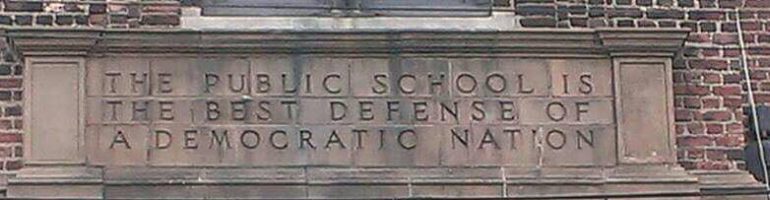

Ras Baraka, high school principal and son of poet Amiri Barak, won the Newark mayor’s race yesterday, on a campaign that heavily emphasized the influence of outside reformers who have rushed to impose massive change on Newark’s school system. According to Bob Braun, 50 year veteran of the Star Ledger, Wall Street interests rushed in the waning days of the campaign with 3 million dollars to try to get Shavar Jeffries over the top. It will remain to be seen if the new mayor has the ability to do anything to slow down or stop Trenton appointed school chief Cami Anderson and her controversial “One Newark” plan, but Mr. Baraka’s victory is instructive.
School reformers will undoubtedly decry this as a set back for “the children” as they often do when people question the endless emphasis on standards, high stakes testing, firing teachers, closing schools and turning them over to charter operators, but we have known for many years now the detrimental effects of poverty in childhood and not one of the corporate reformers’ ideas has any answer for that. Pointing out that placing unrealistic demands on schools, essentially setting them up to fail, and then turning them over to charter operators who have become an investment vehicle for Wall Street is unfair and anti-democratic is not making excuses — it is demanding that “reformers” be upfront about how they have been monetizing public education.
The Newark race is also instructive because it represents a voter backlash against the general pace of change being placed upon public education from outside the democratic process. Newark was placed under an astonishingly rapid pace for wholesale reform by former Mayor Cory Booker and Governor Chris Christie who had gained massive funding pledges from financial interests. Booker himself is quoted in the New Yorker article as urgently pushing “reform” ahead regardless of what anyone in the path of it might think. Now I doubt that anyone who is being honest would question that Newark needs change — administrative overhead is astonishingly high just as an example. (I would like to thank Leonie Haimson of Class Size Matters who sent me a fact check from Bruce Baker of Rutgers University. I sourced the observation of administration costs in Newark from The New Yorker article, but Professor Baker points out that Newark’s administration ranks 24th out of 103 K-12 districts in New Jersey school systems with over 3500 students. Data from the state DOE can be found here.)
But Booker and Christie’s race to push reform from the top down absent any real effort to build a grassroots coalition for change is illustrative of the entire approach to “reform” that we have seen since No Child Left Behind raised the stakes on public education in the Bush administration. Everything — from Common Core, to assessments, to value-added teacher evaluation, to tenure reform, to charter school expansion, to creating vast data clouds for vendors to mine — has come at a break neck clip without meaningful involvement of parents and teachers.
Public education is a part of our national “Commons” — our collective cultural and economic resources. What has been going on in the past 15 years has been a cynical exploitation reminiscent of Garrett Hardin’s essay “The Tragedy of the Commons” where individuals pursuing rational self interest deplete or even destroy that resource. It is certain that many involved in the Newark story sincerely believed they were working to improve Newark’s schools, but it is equally certain that many others were urging that process forward without democratic input because they saw many millions to be made regardless of whether or not the schools became great.
Yesterday, the voters of Newark said “enough” to that. It is up to the new mayor to bring change for all of Newark’s children and to do so with the input of parents and teachers.
Filed under Activism, charter schools, Newark, politics
Yesterday, I contemplated why hedge fund manager and principle founder of Democrats for Education Reform, Whitney Tilson, would be quoted in the New York Times saying that “hedge funds are always looking for ways to turn a small amount of capital into a large amount of capital” as an explanation for financial support of charter schools by Wall Street. Offering the benefit of the doubt, I considered that Tilson may have simply meant that relatively small cash investments could result in returns of human capital in the form of better educated students.
I no longer consider that.
It turns out that United States tax and immigration laws have created a healthy flow of money from the very wealthy into the charter school movement, possibly in ways not exactly imagined by the authors of those laws but which nevertheless have made charters a favored project of quite a few .1% movers and shakers in world capital. The New York Times printed an article back in 2010 that reported the interest of the financial sector in promoting charter schools, but it did not examine the connection of that interest to actual returns on investment. While I cannot dispute claims that hedge fund managers like charters because many of them focus on test scores, are not unionized and they are seen as a way of polishing local philanthropic credentials, there is another reason that money flows into charters: it gives a return on investment.
In this piece on Forbes, financial analyst and author Addison Wiggins, explains the mechanism in the tax code that allows Wall Street to show a return on investment in charter schools:
In part, it’s the tax code that makes charter schools so lucrative: Under the federal “New Markets Tax Credit” program that became law toward the end of the Clinton presidency, firms that invest in charters and other projects located in “underserved” areas can collect a generous tax credit — up to 39% — to offset their costs.
So attractive is the math, according to a 2010 article by Juan Gonzalez in the New York Daily News, “that a lender who uses it can almost double his money in seven years.”
That isn’t sexy Gordon Gecko kind of money, but it is also guaranteed. Put down money to fund the creation or expansion of a charter school, and a firm can double its money in a predictable time table and get to brag to the press about it is bringing new education options to urban areas. The Gonzalez article in the New York Daily News also reported that JPMoragan Chase was setting up a more than 325 million dollar fund to invest in charter schools taking advantage of the tax credits. This strategy is attractive enough that there are firms specifically devoted to connecting charter schools and financial backers.
To be fair, it is entirely possible that this is a more cost effective way of increasing the number of classrooms in some urban areas than traditional school construction projects funded by bonds; I do not currently possess the data to make such an analysis. However, two very important considerations must also be made. First, using the federal tax code in this way means that the cost to the public comes from potentially lost federal revenue instead of being paid in a predictable way at the local and state levels. Second, when a city funds school construction traditionally, it is usually doing so to create schools that are obligated to educate and accommodate every student within its zone. Many charter schools love to brag about their “awesome” results and make incredibly impressive claims about their test scores and graduation rates. As Bruce Baker of Rutgers demonstrates here, such claims rarely can stand even moderate scrutiny. North Star Academy in Newark, NJ, for example, claims that 100% of its seniors graduate, which is true — if you ignore that 50% of the students who enroll in 5th grade never make it to senior year.
So what we have are major charter school chains with deceptive or outright fraudulent marketing backed by the titans of finance who are making hefty returns on investment and are donating significant sums to politicians to keep the returns flowing.
In addition to onshore capital returns, investments in charter schools can be beneficial to foreign investors via the EB-5 visa program. Under this program, foreign investors who spend at least $500,000 in the United States on a development project can earn a visa for himself and his family. According the Reuters article, this path is so attractive to foreign investors that Florida alone expected 90 million dollars for charter schools from foreign investors in 2013. Much like the tax credits for domestic hedge funds, there is an industry developing to connect wealthy donors looking for EB-5 eligible projects to charter schools seeking capital.
To my knowledge none of these actors are channeling investments into neighborhood schools in need of infrastructure funds, estimated at over 250 billion dollars in 2008. But the good news is that some hedge funds are getting a guaranteed return on investments and some foreign born multi-millionaires are getting green cards.
Al Shanker, the former head of the American Federation of Teachers, helped envision the idea of charter schools. In a blog post from 2012, NYU’s Diane Ravitch wrote an open reminder to then New Jersey Commissioner of Education, Chris Cerf, about what Mr. Shanker thought charter schools should do. Charter schools, in Shanker’s vision, were meant to serve students who were most needy and had potentially failed already within other schools — instead, many of today’s charters deliberately avoid or push out those students. Shanker also saw charters collaborating with other public schools. As small laboratories of innovation, their goal should have been to translate what they had learned about working with students to the rest of the public school system. Today, many charters aggressively compete with public schools and far from being a true part of the public education system, large numbers in some states are managed by for profit Educational Management Organizations who are responsible for their bottom lines. According to Ravitch, Shanker turned against charters when he saw a pattern of corporate and for profit interests taking over the movement.
I have no doubt that with 1000s of charters operating across the country, that many of them embody the original vision to provide innovation and collaboration and truly dedicate themselves to serving the most needy of our students. However, today, they are being greatly overshadowed by deceptively marketed brands of charter chains that rake in Wall Street and foreign investment, aggressively lobby state and federal officials for preferential treatment and build their reputations for success on the backs of students they refuse to serve and work to evict from their schools. Eva Moskowitz of the Success Academy chain can summon 7.75 million dollars in donations in one evening while most states’ education spending remains below pre-recession levels.
But, again, the good news is that some hedge funds are getting a guaranteed return on investments and some foreign born multi-millionaires are getting green cards
Filed under charter schools, DFER, Funding, politics
Jan Resseger is the former chair of the National Council of Churches Committee on Public Education, and she has a blog post linking to a very insightful infographic on the organization “Democrats for Education Reform,” the group behind the “Camp Philos” education reform meeting in Lake Placid this week.
The graphic can be found here, and it comes courtesy of Billy Easton of the Alliance for Quality Education. The short version is that, far from being a genuine organization of members of the Democratic party with ideas about education reform, it is a lobbying group designed to influence the policy choices of Democratic party politicians and which has taken huge sums of money from the same interests that have lobbied for aggressive charter expansion, curtailing teacher unions and assessing teachers based on test scores. While Democrats such as California’s Gloria Romero and New York’s Joel Klein have been prominent in the organization, it is extremely clear that on education, they are firmly allied with the pro-testing and pro-privatization forces that have been trying to drive education “reform” further and further away from schools as a locally democratic institution. DFER is largely the creation of Whitney Tilson, founder of hedge fund T2 Partners, who was quoted in this New York Times article about the tenure of Joel Klein:
Charter schools, explained Whitney Tilson, the founder of T2 Partners and one of their most ardent supporters, are the perfect philanthropy for results-oriented business executives. For one thing, they can change lives permanently, not just help people get by from day to day. For another, he said, “hedge funds are always looking for ways to turn a small amount of capital into a large amount of capital.”
I’ve looked at that quote from several different angles: And assuming that it only unfortunately suggests an effort to turn schools into a profit stream, it staggering misconstrues why education costs what it costs. If Tilson meant that a hedge fund can take a small investment in a charter school and turn it into a “large amount of capital” in the form of educated adults, the idea still misses why non-charter schools often need to spend more money to be in compliance with offering an appropriate education to ALL students in their zoned schools. Charter schools’ cost “savings” frequently come from refusing or simply weeding out students who need more intensive and expensive interventions to succeed at school. That’s a bit like praising the economy of a car manufacturer who gets permission to build cars without seatbelts.
It is also emblematic of the age we live in: groups across the spectrum adopt “brands” that can pass a very cursory glance, but which fall apart after more scrutiny. The lesson? Always use more scrutiny – whether it is a chain of hedge fund backed charter schools claiming miraculous results or a supposedly grass roots sounding organization that fronts for those same interests.
Filed under Activism, charter schools, DFER, Funding
If you considered yourself well-informed but have not heard of “Camp Philos,” the education reform retreat in the Lake Placid which is opening today, don’t worry. Its organizers really are not interested in you, but they have wrapped themselves in some very intellectual and romantic imagery. Billing itself as a “philosopher’s retreat” modeled after the 19th century meetings of Ralph Waldo Emerson, Russell Lowell, with Horatio Woodman, the website claims that the nation’s “thought leaders in education reform” will convene for “fun, fellowship and strategy.” Governor Andrew Cuomo is the honorary chair of the event where he will be joined by Joe Williams of “Education Reform Now,” a “reform” group mostly dedicated to the spread of charter schools and test based teacher evaluations and with a board populated by hedge fund managers.
ERN has also donated $65,000 to Cuomo’s campaign fund and individual members of its board have donated on their own. Quelle surprise.
For an entry price of $1000 to $2500 dollars, participants have the advertised opportunity to speak with Louisiana Senator Mary Ladrieu, Sacramento Mayor Kevin Johnson and Assistant Education Secretary for Civil Rights Russlynn Ali. Other reports mentioned that film director turned education “thought leader” M. Night Shyamalan would be present as well. A registered guest list is not available as far as I can determine.
However, the schedule of events is available. A session such as “Living to Tell the Tale: Changing Third-Rail Teacher Policies,” given the known participants, is likely to focus on taking away tenure protections and subjecting teachers to test based evaluations. Governor Cuomo can certainly address his take on “Adequacy, Fairness and Equity: School Finance in the Age of Austerity” given how his administration has systematically strangled school aid.
While my geeky side is offended by tomorrow morning’s session entitled “Rocketships, Klingons and Tribbles: Charters’ Course to Where No Schools Have Gone Before” (somehow I think Gene Roddenberry would disapprove of being associated with this), I wish I had the money or the connections to be present at “The Next Big Thing: Groundbreaking Approaches to Teacher Preparation”. This is a subject directly connected to my own work and current livelihood. So surely, if the “thought leaders” of the country are present to discuss teacher preparation, that must mean the list of invited panelists and discussants will include some lofty names, right? They must have sought out Sharon Feiman-Nemser. It would make little sense to host this session of “thought leaders” without the input of Linda Darling-Hammond, obviously. It would be an appalling oversight for such an event to overlook inviting John I. Goodlad. The nation’s “thought leaders” in education reform in a self-style philosopher’s retreat talking about teacher preparation without the input of our leading experts on what it takes to learn to teach? That could never happen.
Even if I had the money to attend, there is a good question if I would even be allowed in. Diane Ravitch of NYU reported on her blog that three public school teachers and parents from New York tried to sign up for the event and initially were told that there were some openings available. That changed almost immediately. One of them, Bianca Tanis of NYS Allies for Public Education, spoke to a retired teacher who reported that she had successfully registered for the event — only to have her registration refunded without explanation. I am having great doubts that Ralph Waldo Emerson would appreciate having his status utilized for a gathering that has shaped up to be as unpromising as this one.
NYSUT will be present today — on the outside, of course, but at least there will be actual teachers with them.
Filed under Activism, charter schools, politics, schools
This caught my eye yesterday….for several reasons.
The first is that we can expect the charter school movement to latch on to these findings and demand that more states impose upon cities and communities the sorts of “protections” that were recently added to the New York state budget, which amount to extraordinary favors to well connected and already well funded chains of charter schools. I have no doubt that there are probably many small, individual charter schools that do excellent work and struggle for sufficient funding, but I also have no doubt that the biggest noise about so-called threats to charters are coming from chains like Success and KIPP that are lavishly funded and connected to hedge fund billionaire patrons.
The second reason is that the blogger actually raised important additional considerations about why charter funding may be lagging on a per pupil basis that is frequently overlooked by lofty news organizations that report on charter school claims.
The issue of charter funding and the disparities that exist may depend on the methods used to do the calculations, though.
“For me, this is not research that’s helping draw good policies,” said Gary Miron, a professor at Western Michigan University who researchers and evaluates school reforms and education policies.
Drawing on his own previous analyses, Miron contends that charter schools already have a cost advantage that may not be captured and explained by the data.
“Special education and student support services explains most of the difference in funding,” said Miron. “Charters can get a lot more funding, but it would require that they enroll more students with severe and moderate disabilities. They aren’t enrolling these students.”
Other categorical funding, such as that distributed for vocational education, would also bring more funding to charters, should they choose to provide it.
In fact, in his studies, Miron found that charters have a cost advantage, because charters do not have to provide the same services or have the same expenditures as traditional public schools.Transportation costs, for example, are an area in which charters have a funding advantage. Districts are required to provide student transportation while charters are not.
If charter schools do not enroll similar numbers of students on IEPs and English Language Learners, it is entirely reasonable for their funding to be less than entirely public schools that are required to fully serve those populations of students. Without accounting for that, the report draws a very questionable conclusion using figures that have dogged public discussion of education for years but which are, bluntly, one of my biggest pet peeves.
Which is reason number three: per pupil allocations as a marker of funding and a tool for policy. It is an easy number to come up with: take the total school budget, divide it by the number of students in the district and voila! You have a per pupil spending figure.
And you have absolutely no idea what that number could possibly mean.
Per pupil costs make for a simple talking point, but a very little thinking effort demonstrates that two children do not necessarily cost the same to educate. A classroom full of AP students may cost more than a classroom of college preparatory students because the teacher may be a well compensated veteran with a smaller number of students. A student with an IEP or in ESL classes will cost more than the per pupil average if the district is properly committed to providing them with all legal accommodations, including additional personnel. A district that is top heavy with administrators will have a higher per pupil cost without necessarily having more resources for the classroom. A district that cannot budget capital improvements will have a higher per pupil cost to cover the price of additional heating fuel in the winter due to leaky windows — and kids will have a harder time concentrating if they remain cold from November to April.
Any policy or discussion of policy that ignores or glosses over these facts is both deceptive and possibly destructive. Consider vouchers as an example. Taking a child’s “per pupil” money and handing it over to a new school does not make the old school magically one child less expensive to run. Until enough children leave that the school starts dismissing staff and faculty or perhaps shuttering a disused wing, the lost student just ups the per pupil average for those who remaining — while skimming money out of the budget. Meanwhile, the school getting voucher money did not magically become exactly one more student more expensive to run.
Here’s a mantra to repeat to politicians and education reporters: An individual child’s public education is not a product. It costs what it costs to most effectively assist that child to learn as much as he or she can…and to preserve that child’s joy for learning and curiosity about the world.
Practices that shunt aside students who are harder to accommodate or that cover content while crushing the spirit, may be good for the budget, but we don’t aspire to them for children. So when we are discussing whether or not a particular sector of education is being “underfunded” it is important to consider far more than the sum of money they receive.
Filed under charter schools, Funding, Media, politics, schools
President of the American Federation of Teachers, Randi Weingarten, has taken some criticism for her support of the Common Core State Standards. She still believes that they have potential to be beneficial, but in an interview with Salon.com yesterday, she also admitted that they might fail. Weingarten leveled a substantial amount of her criticism at the testing and evaluation policies that have come coupled to the CCSS, especially the secrecy that testing giant Pearson has tied to its contracts for CCSS tests. Five of the union president’s points:
These standards were done by the states — the governors and the state chiefs — in a very rapid fashion, and there was not enough conversation and discussion about what they were, and how they would be implemented. Number 1.
Number 2, as a result, there are problems in the standards, particularly as applied to [grades] K through 2 … They seem to be developmentally inappropriate for the earliest of kids …
Number 3: … The state tried to copyright the standards. [There’s] one thing about education that’s absolutely imperative, which is that you try things, and you adjust, and you have a continuous learning process. The copyright suggests they’re fixed in slate, and that’s just wrong …
Number 4: There was more work that was done about testing of the standards and the assessment process, than actually the implementation. And that’s why many people believe that this is about a testing process, not about a learning process.
And so — Number 5 — you get to what happened in New York and other places, where all of the sudden, the state commissioner last year said the scores will go down 30 points – and then magically the scores went down 30 points. So most people then distrusted what was going on here. Was this about actually helping kids get higher standards? Or was this about trying to create a sense of failure in the public system?
If, as Weingarten states several time, implementation of standards is “90-95%” of what matters, then these criticisms are welcome but also overdue. All five of those concerns have been evident for some time as the Obama administration and CCSS boosters outside of government have been rushing this implementation and rushing the linkage to high stakes testing for teacher evaluation ahead at a truly breakneck pace. Weingarten is absolutely correct when she asserts:
I think the teachers, the parents … have become so frustrated with standardization, and with top-down accountability and being told what to do without being given the resources to do it, and having testing before teaching, that they’ve gotten so frustrated that they just don’t trust the transition to standards anymore.
But the thing is that anyone with an understanding of American education, as she has, should have seen that frustration coming years away. That frustration was built into the Race to the Top grants which pressured states to adopt valued added models of teacher evaluation using common assessments. Since then, almost all work around Common Core has been to essentially monetize it either via testing, curriculum or technology materials while teachers and students across the country struggle with staff cut backs and delayed school improvement budgets. Parents and guardians, who by wide margins approve of and appreciate what their children’s teachers do, were bound to notice.
Regardless, I do welcome Randi Weingarten sounding this alarm. That she believes the standards have potential to do good is not an opinion she is alone in having, but what really stands out is that she is the first high level supporter of the CCSS who is publically willing to admit that they are in trouble and that they are in trouble because the implementation is running roughshod over teachers and students. Who else is willing to admit to this? Certainly not Arne Duncan. Absolutely not John King. Not Bill Gates.
But they should.
Filed under Common Core, Gates Foundation, Media, politics, Testing
This will be VERY important for the future of NYC public education!

Filed under Activism, politics, Shared Posts, Testing
Leonie Haimson and other activists at Class Size Matters sent a letter to Chalkbeat.org pointing out the evident bias in their reporting of recent charter school controversies in New York. In it, they note how much coverage has been devoted to the activities of pro-charter advocates compared to the coverage given to a citywide rally organized by the Community Education Councils.
Rather than sending one of your reporters to cover this event, you only posted a short blurb clearly taken from the press release after the fact. Chalkbeat’s failure to assign a reporter to the event glaringly contrasts with your close and detailed coverage of every move made by the charter operators and their backers. Indeed, you published two different stories on the charter march across the Brooklyn Bridge, three different stories on the Albany rally for charters (though you failed to disclose that Gov. Cuomo was actually behind it) , and on March 29 you ran two stories on reactions to the budget bills, BOTH from the point of view of the charter operators.
Even more importantly, you have failed to cover any of the substantive issues and reasons behind our anger, including how unprecedented these charter provisions are, how they apply only to NYC, how they will detract from the city’s already underfunded capital plan and cost the taxpayers millions of dollars, while thousands of public school students will continue sit in trailers or in overcrowded classrooms, without art, music, science or therapy and counseling rooms, or on waiting lists for Kindergarten.
The letter further noted how Chalkbeat’s expansion from the now defunct Gothamschools site was made possible with funding from the Gates Foundation and the Walton Family Foundation, both strong advocates for charter schools.
Chalkbeat’s very brief reply stated:
The bottom line is that the protest was clearly well-attended and unique in its CEC-wide organization, and we wish we had been there.
We make decisions about coverage every day based on the fact that we can’t be at every relevant event in the city or it would be impossible for us to provide any deeper coverage of these issues. We regularly attend, and skip, events that reflect a variety of viewpoints. That’s why we work to keep readers informed about events we don’t make it to with posts like the one we wrote about this protest.
They also swore that their coverage choices merely reflect their best judgment on how to contribute to the conversation in New York City and not the political bias of their funders.
Uh-huh. The response would have been more honest with an Alfred E. Neuman cartoon.
Filed under Activism, Gates Foundation, Media, politics

The place for thinking Black folks
Florida women take on culture and stuff.
What They Don't Teach You in Teacher Ed
2026 is the End of the Line ~ The No Bullshit Tour
A site to discuss education and democracy
The blog of Academe magazine
Scholar/ Practitioner's thoughts on education
Supporting public schools and the children they serve
Redefine Excellence & Interrupt Inequity in Education
A website focused on education and social justice research
A Collaborative Effort of NJ Education Policy Scholars
I am a reader, a teacher, a writer, a thinker, a reviewer, and a dreamer of dreams.
a site dedicated to the United States’ public school system: examining the impact of the Common Core, the free market, and privatization on education
and they're not the only ones...
because founder shouldn't have to be a death sentence.
Yinzer Nation + Education = Yinzercation
A Grassroots Education Movement and Real Reform Studios Production
The Lakeland Federation of Teachers is a union representing the teachers, nurses, and therapist in Westchester County’s largest suburban school district
notes from a teacher educator
A group for future teachers with a common radical vision for the future of education.
A Parent's Thoughts on Education in the Era of Reform
Dedicated to truth-telling for democracy.
A site devoted to opening and changing our minds about public education
Smile! You’re at the best WordPress.com site ever
An insider's look at education, teaching, parenting and coming of age.
educator, public scholar, poet&writer - academic freedom isn't free
A Public Access Television Show, Princeton Community TV
thoughts on education by Grant Wiggins
An indie authors website and blog
The musings of a sarcastic, low-maintenance mom/wife/former teacher/writer
By L. Beth Brady, Ph.D. Special Education
A blog about education by a math teacher
a project of the curmudgucation institute
The intersection of education and politics
Exploring and venting about quantitative issues
Education as it should be - passion-based.
the blog of Carol Burris
"To sting people and whip them into a fury, all in the service of truth."
All truths are easy to understand once they are discovered; the point is to discover them. Galileo Galilei
A Teacher Speaks

 Daniel Katz, Ph.D.