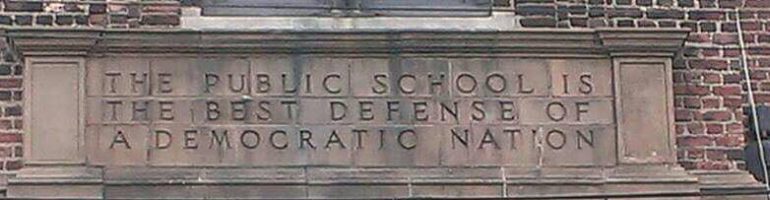
Kansas Has Had Just About Enough of This Public Education Nonsense

Like many states from the former American frontier, Kansas has a long, and often proud, history of offering free public education for its citizens.  The territory’s  first free public school in Council Grove was established in 1851 for the children of white government workers and others who traveled along the Sante Fe trail.  In 1858, the Territorial Legislature authorized the office of Territorial Superintendent of Common Schools and County Superintendents, beginning the process of opening common schools within walking distance of most eligible students. The 1861 Constitution of the new state of Kansas recognized the need for a uniform system of Common Schools and schools for higher grades as well.

By the 1870s, so-called “log schools” were established across Kansas, and in 1874 the first compulsory school attendance law was passed requiring students between the ages of 8-14 years old attend a 3-4 month school year.  The state wanted to promote more than a primary education by 1885, and public county high schools were developed.  Like many states, the earliest teacher credentials merely required a demonstration of basic literacy, but Kansas followed national trends in the late 1800s to implement more stringent requirements for acquiring a teaching certificate, and the state board began accrediting teacher education programs in 1893.

Kansas was at the center of the fight to overturn school segregation when the Topeka Board of Education fought to maintain its segregated school system all the way to the Supreme Court in the landmark Brown v. Board of Education in 1954.  Although the Topeka Board of Education was on the wrong side of the case, that loss paved the way for active integration efforts that continued throughout the 1950s, 1960s, and 1970s until efforts stalled after Ronald Reagan’s election.  In many respects, the story of public education in Kansas reflects the story of public education across many of our nation’s states: progress, both voluntary and compelled, slowly ensuring that the scope and promise of public education reaches more and more citizens.

Kansas may just be done with all of that nonsense.

Governor Samuel Brownback’s pledge to turn Kansas into a laboratory of conservative, small government experimentation is certainly well known by now – as is the havoc that it has unleashed upon tax revenue and economic growth.  Governor Brownback’s budgets have slashed deeply into Kansas primary, secondary, and higher education on multiple occasions, and his 2015 budget hacked another $44.5 million, and cuts amounting to another $57 million are on the table for this year.  Spending on public schools has been so inadequate that in 2014, the Kansas Supreme Court ordered the legislature to increase spending and to use that money to alleviate funding disparities between districts.  While the highest court asked a lower court to reconsider its order that spending increase statewide by an eye watering $400 million a year, legislators were essentially ordered to get adequate funding to poorer districts.  Lawmakers and the Governor failed so spectacularly at that task that the Kansas Supreme Court ordered them in February of this year to fix the matter by June 30th.

One might think that after years of self-imposed budget shortfalls standing between Kansas legislators and their Constitutional obligation to fund schools, that someone in Topeka might take a moment to reflect upon the sustainability of their desire to cut government to the bone.  Someone, you might expect, might ask that if they cannot find the money to provide the most widely agreed upon functions of government – a functioning common school system – then what are they doing to the future of Kansas?

Not a chance.

Kansas legislators would prefer to impeach judges than actually fund their schools. Instead of impeaching judges for misconduct, the proposed law, which had the immediate support of half of the state Senate upon introduction, would allow for impeachment over attempting to “usurp the power” of law makers or the governor.  The bill passed the Kansas Senate and now sits in the judiciary committee in the House where it is unlikely to meet much opposition.  The message Kansas law makers are sending?  Don’t tell us when we are violating our Constitutional obligations to fund an appropriate education for all children in Kansas — shut up and let us keep cutting taxes.

If you think it could not get possibly worse, you lack the destructive imagination of some Kansas lawmakers.  Introduced in House Bill 2741, which was filed just before a month long recess, is the Kansas Education Freedom Act – a potential final nail in the coffin of public education in the Sunflower State.  Under this plan, parents would be able to take 70% of the funds allocated for per pupil aid in their district and use it to pay for private schools, online schools, homeschooling, or private tutors.  While the legislation would require education in certain core subjects, oversight of that would fall to the State Treasurer instead of the Department of Education, and students educated under these funds would not be subject to the state tests used to assess district schools.  And just to rub a little more salt in the wounds of public schools, the legislation restricts spending of state funds so severely that it cannot be used for school meal programs and even extracurricular activities such as band that have courses connected to them might not be able to use state money.

70% of per pupil funds – gone. The moment a family selects to pursue an option, basically any option, other than the district school.

Vouchers have been tried in several major cities over the past few decades, and their record – on increasing access to additional options, on improving student outcomes, on improving public schools via competition, and on general school finances – is nothing to brag about.  The Kansas legislation proposes opening the door for public school funds to be sent to online charter schools even though recent studies demonstrate that such schools have “an overwhelmingly negative impact.”  Even the pro-charter school organization The National Alliance for Public Charter Schools found the results so disturbing that they said they were “a call to action” for policy makers.  It also seems odd that a state desperately trying to slash its education costs would propose sending money to students and families who would normally cost the system very little – students attending private schools or being home schooled.  If this passes, each one of those students will cost the state 70% of a student attending a local school.

But beyond these alarming cautions is another, even more disturbing, implication of the bill: the complete abandonment of public education as a PUBLIC endeavor premised on equity and pluralism.  The scheme worked out in the “Kansas Education Freedom Act” is to essentially tell families that the only purpose of an education is to maximize what they can individually get out a marketplace.  In the long history of public education in America, it is very hard to find examples of completely abandoning the public purposes of compulsory education such as civic education and community based ideals such as pluralism and equity.  H.B. 2741 basically chucks that in favor of a mad dash to grab resources for individuals instead of making sure that all individuals live near quality resources.  It is not difficult to predict how parents with means at their disposals will use this legislation to elbow others out of their way.

Voucher proponents have always papered over concerns about access and equity in their schemes largely because their favored mechanisms – marketplaces – are designed specifically to provide great variation in quality based on ability to pay.  But it is very different to say that it is okay that the car marketplace allows some people to buy Bentleys while others buy used cars; it is entirely another to say that someone should seek out the equivalent of a 1987 Yugo for a child’s education. Since vouchers have not historically opened a wide range of options for poorer families, let alone a wide range of quality options, the likely outcome of H.B. 2741 will be to simply transfer public money to people already seeking private education, decreasing community stakes in local schools and, by extension, local communities.

Kansas wrote its commitment to public education directly into its Constitution in 1861.  Is 2016 the year that it says it is done bothering with it altogether?

toto

3 Comments

Filed under charter schools, Funding, politics, Social Justice

Can Teachers Talk About Opt Out?

New York City teachers Jia Lee, Lauren Cohen, and Kristin Taylor risked disciplinary action recently to speak with NBC news about their opposition to the state testing system and their support of the Opt Out movement.

bats

This was no small act on their part because the NYC DOE has sent multiple signals that it does not tolerate classroom teachers speaking against the tests which have been occupying schools’ time and attention this month.  District 15 Superintendent Anita Skop stated her belief that any teacher encouraging opt outs was engaging in political speech and that such acts were not permissible for teachers speaking as teachers. A spokeswoman for the Department of Education said that teachers are free to speak as private citizens but not to speak as “representatives of the department,” and New York City Schools Chancellor Carmen Farina said “I don’t think that the teachers’ putting themselves in the middle of it is a good idea.”  None of these figures have specified what possible consequences could befall teachers for speaking in favor of opt out and against the state standardized tests – but the ambiguous statements alone are sufficient to deter many city teachers from speaking their mind.  Add in the history of “gag orders” that prevent teachers from discussing the contents of the examinations – even as professionals seeking to improve tests after they have been used – and speaking to the media as these teachers did is an act of exceptional bravery.

Walking the line between teacher and “private citizen” is exceptionally ambiguous.  Ms. Lee, Ms. Cohen, and Ms. Taylor were all identified as New York City teachers by the reporter in the story, but does that automatically make them not private citizens?  Most members of our society are not required to hide their professions when speaking on political matters within the public sphere, and in many communities, teachers’ identities are well known to parents, making the distinction between their professional and private selves far less distinct.  Furthermore, as professionals in a school system governed by different political systems, teachers have legitimate observations and, yes, criticism to make about policies that impact their work and, therefore, their students.  Simply saying teachers cannot be “political” as teachers is plainly too simplistic.

However, this cannot be only a matter of saying teachers have free speech rights in their role as teachers.  There are legal and legitimate limitations on what teachers can say. For example, federal law protects the privacy of students’ academic records and while a teacher can discuss a child’s performance with both parents and involved professionals in pursuit of helping that child, the law prevents that same teacher from discussing the child’s academic record outside of that context.  Teachers also possess academic freedom within the classroom, but that is not well defined, subject to significant limitations and considerations of the interests of school boards, communities, parents, and children.  Generally, teachers have to balance their rights with their significant responsibilities within the classroom, including their responsibility to the adopted curriculum in a district.

Outside of the classroom, teachers also have limits on what they can say and for good reasons.  The 3rd Circuit Court of Appeals ruled against a teacher who claimed her free speech rights were violated when she was fired for keeping a public blog full of insults about students and parents in her school.  This is fundamentally different than writing about politics or using a public forum like letters to the editor to speak about “matters of public concern” as a citizen — her speech gave parents legitimate reasons to demand that she not teach their children.  The Washington branch of the ACLU maintains a page with various examples of speech scenarios in which a teacher may or may not be protected from job consequences, and the examples demonstrate that teachers often have additional constraints on their speech related to their ability to perform their responsibilities.  On the other hand, purely political speech, even related to education issues, can be strongly protected outside of the classroom.

Consider the case of Boston long term substitute teacher Jeffrey Herman who testified at a Boston City Council meeting against the expense of maintaining a Junior ROTC program in the city and advocating what he believed was a better use of those funds – and who was screamed at by the head of Boston English High School and essentially blacklisted from working there.  While that case was settled with no admission of wrongdoing by the city, the implication is clear enough:  Mr. Herman was entirely within his rights to speak in the public sphere on a matter of public concern.  A staff attorney for the ACLU made this obvious:  “Teachers are entitled to political opinions just like everyone else…We need them to feel free to share those opinions with public and elected officials, outside the school, without fear of losing their jobs for doing so. Jeff Herman had a right to speak out at City Hall about Boston spending over a million dollars on JROTC…”

This would seem to neatly point towards a general right for teachers to speak critically of standardized testing and in favor of opt out as long as they do not suggest that they are speaking for district and school administrations in the process.  While teachers are obligated to teach the adopted curriculum of the school and to participate in duties such as test administration, critiques of both the curriculum and testing are matters of public concern.  Administrators can probably restrict teachers from proactively soliciting opt outs on the school grounds, but they would be beyond bounds to restrict teachers from speaking elsewhere – even if their audience knows that they are teachers. Further, if asked by parents about the tests, it is very plausible that teachers have the right to offer an informed and critical perspective. Grumbling from Tweed Courthouse notwithstanding, Ms. Lee, Ms. Cohen, and Ms Taylor should be secure in their advocacy and their speaking with reporters.

But perhaps this should not merely be a matter of whether or not teachers disciplined for speaking against testing could win a civil rights suit.  Perhaps this needs to be framed as a matter of professionalism and professional judgement because while teachers have responsibilities and rights in the performance of their work, they also have professional obligations and norms that define what it means to be a teacher.  Among those is the need to speak up when children are being ill served or harmed by what is going on within school.  John Goodlad referred to practicing “good moral stewardship of schools” and this principle is as important to teaching as “do no harm” is for medicine or being a zealous advocate is for law.  Teachers are given an awesome and sacred trust – the intellectual, social, and emotional well being and growth of other people’s children.  Speaking out when that trust is in jeopardy is not simply a question of Constitutional rights.  It is a moral obligation.

Do teachers have good reason for concern about how these tests impact their stewardship?   New York City teacher Katie Lapham certainly makes a compelling case:

The reading passages were excerpts and articles from authentic texts (magazines and books).  Pearson, the NYSED or Questar did a poor job of selecting and contextualizing the excerpts in the student test booklets.  How many students actually read the one-to-two sentence summaries that appeared at the beginning of the stories? One excerpt in particular contained numerous characters and settings and no clear story focus.  The vocabulary in the non-fiction passages was very technical and specific to topics largely unfamiliar to the average third grader.  In other words, the passages were not meaningful. Many students could not connect the text-to-self nor could they tap into prior knowledge to facilitate comprehension.

The questions were confusing.  They were so sophisticated that it appeared incongruous to me to watch a third grader wiggle her tooth while simultaneously struggle to answer high school-level questions. How does one paragraph relate to another?, for example. Unfortunately, I can’t disclose more.  The multiple-choice answer choices were tricky, too. Students had to figure out the best answer among four answer choices, one of which was perfectly reasonable but not the best answer.

NYSED claims they removed time limits from the test in order to remove performance pressure from very young children, but there are documented cases of this actually matter the exams worse for students.  A Brooklyn teacher blogging anonymously notes:

This afternoon I saw one of my former students still working on her ELA test at 2:45 pm. Her face was pained and she looked exhausted. She had worked on her test until dismissal for the first two days of testing as well. 18 hours. She’s 9.

This is a student who is far above grade level in reading, writing and every measurable area imaginable. She definitely got a 3 or 4 on this test. She is a hard worker and powers through challenges with quiet strength and determination. She is not “coddled.” She is sweet, brilliant and creative and as far as I know she has always loved school. She is also shy and a perfectionist.

After 18 hours of testing over 3 days, she emerged from the classroom in a daze. I asked her if she was ok, and offered her a hug. She actually fell into my arms and burst into tears. I tried to cheer her up but my heart was breaking. She asked if she could draw for a while in my room to calm down and then cried over her drawing for the next 20 minutes.

New York City education advocate Leonie Haimson reported on numerous items of test content that she was able to glean from various sources.  They included a sixth grade test including a 17th century poem often studied in college, obscure vocabulary in the 8th grade exam, disturbing product placements within reading passages, and missing prep pages without adequate instructions on how to assist students.

Beyond these specific examples, teachers can be rightly concerned about the entire environment within which these exams take place.  Since No Child Left Behind was passed in 2001, testing and test preparation have become more and more ends unto themselves instead of quiet background monitoring of the school system.  We have spent more than a decade now in a policy cycle based upon “test-label-punish” without considering how to give schools teaching our most vulnerable students the resources and supports needed to do right by those children, their families, and communities.  And we have very, very little to show for it except a narrowing curriculum in communities across the country and a crushing increase of academic work at younger and younger ages despite the abject harm it inflicts upon children who need play to learn and to be healthy.  Practicing “good stewardship” as a professional teacher clearly embraces openly objecting to these harmful practices.

Ms. Lee told NBC, ““Parents should definitely opt out. Refuse. Boycott these tests because change will not happen with compliance.”  She went on to call herself a “conscientious objector.”

She is also a true professional, guarding the well being of the children entrusted to her.


7 Comments

Filed under classrooms, NCLB, Opt Out, politics, schools, Social Justice, standards, teacher professsionalism, Testing

NYC Hasn’t Gotten the Opt Out Memo

Let’s begin with one simple premise: nobody at the New York State Education Department wants to see Opt Out continue to be a significant factor in the Empire State.  The United States Department of Education sent a variety of states letters explaining they had an obligation to test 95% of all student in all subgroups without fail, even offering various measures from cajoling to threatening that the states could take to get all of those students to sit down and be tested. After some initial stumbles, NYSED settled on a “kinder and gentler” approach, trying to coax the 20% of eligible families to opt back in to the tests.  Regents Chancellor Merryl Tisch and Governor Andrew Cuomo quickly ran away from NYSED Commissioner Elia’s suggestion that districts with high opt out might lose funding.  In short order, Commissioner Elia affirmed that her office had no intention of withholding funds and admitted that parents had the legal right to refuse to submit their child for the state exams.  In the following months, Albany introduced a series of changes to the exams – such as reducing them by a few question and removing time limits – that they hoped with allay parental concerns, and Commissioner Elia’s office put together a “tool kit” for district and schools to use to explain the exams to parents.  The information provided for both letters and presentations emphasizes what NYSED sees as positive and necessary aspects of the tests instead of negative consequences for low test participation rates.

Parents and educators may disagree about the significance of the changes and about the accuracy of the information in the state materials, but the strategy was obvious: Gently persuade parents and communities back into the fold.  This was certainly a sensible approach considering the pasting Albany took not only on state testing but also on the entire education agenda championed by Governor Cuomo throughout 2015.  Even before he managed to bully his plans to use state tests as 50% of teacher evaluations through the Assembly, voters disapproved of his education agenda by extremely wide margins.  The Governor took such a pummeling in the polls on education in 2015, that his 2016 budget address only had 364 words on P-12 education that more or less reduced his entire platform to “yadda yadda yadda…teachers are swell.”  When it comes to public education in the Empire State, our leaders in Albany have spent most of 2016 trying to pour gallons of honey on their plate full of vinegar.

Someone in New York City did not get the memo, apparently.

Test refusal was not a significant issue in New York City last year, although a handful of schools saw much higher opt out rates than the city in general. But the office of New York City Schools Chancellor Carmen Farina apparently wants to take no chances of it gaining more than a toehold.  Pro-testing forces upstate seem happy to rely upon outside groups to carry the “opt in” message and to focus on emphasizing what they see as meeting test protesters part way, but the offices in Tweed aren’t taking any risks that opt out can grow and thrive in the Big Apple. In the run up to the tests, The New York Times reported ongoing and serious negative talk about teachers who spoke out against the tests and in favor of opting out:

At a forum in December, Anita Skop, the superintendent of District 15 in Brooklyn, which had the highest rate of test refusals in the city last year, said that for an educator to encourage opting out was a political act and that public employees were barred from using their positions to make political statements.

On March 7, the teachers at Public School 234 in TriBeCa, where only two students opted out last year, emailed the school’s parents a broadside against the tests. The email said the exams hurt “every single class of students across the school” because of the resources they consumed.

But 10 days later, when dozens of parents showed up for a PTA meeting where they expected to hear more about the tests, the teachers were nowhere to be seen. The school’s principal explained that “it didn’t feel safe” for them to speak, adding that their union had informed them that their email could be considered insubordination. The principal, Lisa Ripperger, introduced an official from the Education Department who was there to “help oversee our meeting.”

Several principals said they had been told by either the schools chancellor, Carmen Fariña, or their superintendents that they and their teachers should not encourage opting out. There were no specific consequences mentioned, but the warnings were enough to deter some educators.

One could possibly claim teachers speaking against the tests are engaging in political speech against contract rule – or one could argue they are expressing a professional opinion on the negative impact of testing they see with their own eyes in their own classrooms.  Certainly, the letter from PS234 teachers, as described, focuses on the consequences to students’ learning conditions rather than on any political outcome, but DOE is clearly trying to back channel messages to principals and teachers that negative comments about the test are off limits.  That would certainly explain an incident at PS 84 in Williamsburg where a principal chastised a fifth grader handing out Opt Out information until the child cried and then herded all third through fifth grade into an impromptu assembly to tell them to “get this opt out stuff out of your head.”  The principal went on to tell students not to listen to their parents and that the state exams would make them smarter.

That was not the behavior of a professional educational leader who feels free to allow open discussion of an important issue within the school.  For that matter, the principal’s behavior was arguably in violation of long standing case law on students’ first amendment rights within school.

Susan Trout, a Manhattan parent, forwarded a letter that her child’s middle school principal sent to all 8th grade parents, warning them about the consequences of a large number of opt outs:

This is a “low stakes year” for the eighth graders. Their performance on the exams will not be used by the high schools for placement or for admissions. It is not, however, a “low stakes year” for *******. If we do not test 95% of our students, the school will automatically be categorized as a School Under Review by New York State. This will result in a series of measures which may force us to change our curriculum, our staffing decisions and our program. It most certainly comes with close review of the school by the state, along with the paperwork to defend the school’s performance. This may negatively affect the students who will be at ***** for the next couple of years.

According to Ms. Trout, parents in her school who wrote to the principal expressing their desire to opt out of the test were then contacted individually by the school’s parent coordinator with the following message:

Hello.  By refusing to participate, you are putting us in jeopardy of no longer being considered a school in good standing.  We must have 95% participation to keep our school grade as is.  I would ask you to reconsider having your children take the test.  It is actually good practice for  their high school career since they will be tested a great deal in the college application process!

She then contacted the office of the Public Advocate in New York City for clarification, and got quite a different answer:

Regulations state that if a district has 3 consecutive years failing a SPECIFIC category, then they can be identified. If one year it’s because of special Ed scores, next year participation rates, the next was a whole other category, then no changes. Has to be failure of the SAME category 3 years running.  Even the handful of districts that fell below 95% for 4 years in a row (handful in NYS) were still not penalized or labeled. The label forces a plan put in place to fix the category/reason for failure, in this case, a parent boycott. The state knew better than to go forward with any consequence. 

Districts that were focus districts last year AND had less than 95% were taken off the list. Doesn’t make sense that % alone would cause them to be labeled. I realize all of the above specifies districts, not schools. However,confirmed by DOE staffer: there is absolutely NO POLICY that says one instance of <95% participation would result in “automatic characterization” of anything by NYS. It’s not an “automatic” process and is in fact based upon the previous 2-3 years in the event that a school falls below 95% in one year.

The information given by DOE to the Public Advocate’s office is diametrically opposed to the information a middle school administration circulated to parents.  Ms. Trout asked her parent coordinator about this discrepancy and was told that the information was from a “directive” from the district superintendent. Again, this is completely out of proportion to what any other level of education governance in the state is saying right now, and it is vexing, not because the city administration believes in testing, but because it is relying on incomplete and often misleading means to support the tests.

There was a brief moment, when it looked like the NYC educational bureaucracy was softening a bit.  Chancellor Farina was reported as having said in a private meeting that she would consider opting out a child if that child had a certain kind of Individualized Education Plan or was a new arrival in the country with very limited English, and Mayor Bill de Blasio met with opt out advocates in order to hear their views, clarifying that he still thought the tests were important.

Any hope that there was room for openness at Tweed, however, was shut down rapidly as the tests began this week.  Chancellor Farina said that her earlier comments were taken “out of context” and she further chastised parents who opt out, saying: “I believe students go to school to be held accountable for their work…What are you saying about your child?  What are you saying about your belief in them to do something that they’ve been gearing for all year?” This statement is fairly breathtaking.  It is one thing to believe in a system of school accountability that includes standardized testing, although the history of the No Child Left Behind era is pretty clear on this: test based accountability has had 15 years for results and it does not have themBut the Chancellor’s statement frames the accountability tests as objectives of the school year unto themselves.  The tests hold students “accountable for their work”?  The state standardized accountability test is “something they’ve been gearing for all year”?  I can honestly think of few ways of framing this worse than Chancellor Farina just did.  My children are preparing for many important things in their education this year – sitting in a standardized exam that takes longer to finish than the LSAT or the MCAT is just about the least important thing they could do.

I suppose — I just suppose — that we could be at least a little grateful for the wild spinning and random lashing out from the Chancellor’s office.  NYSED has tinkered a smidgen around the edges of the tests and they’ve taken a softer tone with the public.  But there can be no doubt – they want Opt Out to go away so they can keep these tests as the status quo.  Chancellor Farina, on the other hand, is being aggressive about her dislike for Opting Out, leading to repeated situations where parents are being told information that is flatly contrary to NYSED’s stated policies. History suggests that this level of overreaction and misdirection aimed at parents backfires.  If Opt Out grows in NYC, we might just have the Chancellor to thank for it.

Opting Out


4 Comments

Filed under Activism, MaryEllen Elia, NCLB, Opt Out, Testing

Chicago is Everytown, USA


The Chicago Teachers Union took to the picket lines on the morning of April 1 for a one day strike, highlighting the dire financial conditions of their schools because of the state budget impasse caused by Illinois Governor Bruce Rauner and contract disputes caused by Chicago Mayor Rahm Emanuel.  Teachers and supporters marched in front of public schools before shifting their protests to state universities facing financial catastrophe because of the budget crisis in Springfield.  In typical fashion, no politician took responsibility for the continued stress facing public schools and universities.  Mayor Emanuel protested that he is doing all that he can with what the state government is willing to give, and Governor Rauner issued a boiler plate statement claiming the teachers were victimizing students and their families with a display of “arrogance.”  These statements are rich coming from the mayor who has made closing public schools the centerpiece of education agenda and from the governor who has kept the entire state without a budget for nine months because lawmakers won’t fully endorse his plan to break unions — resulting in a crisis in higher education funding that makes many Illinois families reconsider attending state universities — and whose idea of getting desperately needed funding to urban schools involves “re-purposing” $300 million of special education money for general education funding.

CTU’s action is welcome both for its clarity and for its signal that organized teachers are not going to go along with a governor who holds all of a state hostage to get his anti-labor priorities passed — or with a mayor whose school improvement ideas begin and end with privatization.  The only real question is not why Chicago’s teachers took to the picket lines but rather why a hell of a lot more teachers have not done so across the nation?

President of the Americans Federation of Teachers Randi Weingarten said, ““This governor is bankrupting public schools so they won’t effectively function for kids….If you can’t solve things through the normal processes, if you have exhausted every advocacy avenue in a democracy, you then step it up — and that’s what they’re doing.”  Chicago Teachers Union President Karen Lewis tied the strike to larger labor issues across Illinois, “For every single working person in this entire state, somebody’s got to lead the way. It happened to fall to CTU.” She could have easily been talking about several dozen states and the assault on public education that has unfolded across the country.

Let’s review only part of the national roll call:

Attacks on public K-12 and university education are not limited to these examples. Total per pupil funding for elementary and secondary schools remains, adjusted for inflation, below 2008 levels in all but 13 states because of both state aid cuts and loss of local revenue from property taxes.  In 27 states, local funding for K-12 schools rose but could not make up for continued cuts in state aid.  25 states continue to provide less money per pupil today than they did before the Great Recession, and 12 states cut general education funding just in this past year.  Higher education has done no better with all but three states funding their public universities below 2008 levels, both on a percentage of previous funding and on a per pupil basis.  Although 37 states spent more per pupil in the 2014-2015 school year than before, the national average increase was only $268 per student.  Perversely, state schools have had to increase tuition while cutting programs and staff, and now, for the first time, tuition makes up a larger percentage of public university revenue than state grants.  Attacks on teachers’ workplace protections have gone nationwide, hitting courtrooms with dark money funded campaigns where they cannot gain traction among lawmakers, and it appears that only the untimely death of Associate Justice Scalia prevented the Supreme Court from gutting decades of precedent on public union funding.

Once again, the question must be asked:  Why aren’t many, many more teachers across the country joining their sisters and brothers in Chicago in demonstrating that their voices are still there and can speak loudly when they speak together?  It isn’t just the future of their work that is still clearly at stake – it is the future of every child they teach. President Weingarten said, “….if you have exhausted every advocacy avenue in a democracy, you then step it up — and that’s what they’re doing.”

Chicago is Everytown, USA.

8 Comments

Filed under #FightForDyett, Activism, Cami Anderson, charter schools, Chris Christie, Corruption, Dannel Malloy, Funding, One Newark, politics, Social Justice, Unions

Why We Need the “Public” in Public Education

Without undervaluing any other human agency, it may be safely affirmed that the Common School, improved and energized, as it can easily be, may become the most effective and benignant of all the forces of civilization. Two reasons sustain this position. In the first place, there is a universality in its operation, which can be affirmed of no other institution whatever. If administered in the spirit of justice and conciliation, all the rising generation may be brought within the circle of its reformatory and elevating influences. And, in the second place, the materials upon which it operates are so pliant and ductile as to be susceptible of assuming a greater variety of forms than any other earthly work of the Creator.

– Horace Mann, Twelfth Annual Report to the Secretary of the Massachusetts State Board of Education, 1848

It is perhaps difficult to remember, in 2016, that the original purposes of the American common school movement lay in ideals about the public good as well as goals for individual advancement.  Since the publication of A Nation at Risk in 1983, politicians and policy makers have emphasized accountability as the primary goal of school law with an increasing emphasis on accountability for individual student outcomes.  Often supported by parents who saw the purpose of their children’s education in the accumulation of credentials, accountability as a framework for school success gives special importance to whether or not schools boost students’ seeking to improve their financial and social situations.  School is doing its job, we are told, in those places where the enterprise of personal advancement works as anticipated, and school is a failure when too many students remain locked generation by generation in the same economic circumstances as their parents.

The appeal of this is understandable, but it is also perilous.  David Labaree of Stanford University warned in 1997 that our concept of school’s purpose was already significantly out of balance.  Arguing that the rise of standards and accountability emphasized social efficiency goals for the labor force, Labaree also noted the significant rise of social mobility  for individuals as a key goal for public education:

Instead, the main threat comes from the growing dominance of the social mobility goal over the others. Although this goal (in coalition with the democratic equality goal) has been a major factor in motivating a progressive politics of education over the years, the increasing hegemony of the mobility goal and its narrow consumer-based approach to education have led to the reconceptualization of education as a purely private good.

We are now, in the late 1990s, experiencing the sobering consequences of this ideological shift. We find credentialism triumphing over learning in our schools, with a commodified form of education winning an edge over useful substance. We find public schools under attack, not just because they are deemed ineffective but also because they are public. After all, if education is indeed a private good, then the next step (according to the influential right wing in today’s educational politics) is to withdraw public control entirely and move toward a fully privatized system of education.

We are almost twenty years later and these forces have been driving education policy for most of that time.  Accountability measures set up under No Child Left Behind demanded that schools show consistent progress in increasing students’ standardized test scores, and the Obama administration’s Race to the Top Program moved accountability down to the individual classroom level – with the expectation that teachers would oversee constant student growth absent any other considerations.  Advocates of the Common Core State Standards wrapped themselves in the language of social efficiency by constantly emphasizing American competitiveness in the international economy and in the language of social mobility by claiming the standards would lead all students to become ready for “college and careers”.  Meanwhile, Common Core aligned testing systems have promised American parents that score reportscan  inform them whether or not their individual children are “on track” for college and career readiness, and no less a figure than former Secretary of Education Arne Duncan declared that our educational goal should be to be “able to look every second grader in the eye and say, ‘You’re on track, you’re going to be able to go to a good college, or you’re not…'”

As Labaree noted, there is nothing wrong, per se, in the goals of social efficiency and social mobility.  They have, in various instantiations, been significant forces in American public education and provided legitimate rationales for our national investment in universal, compulsory education.  We have long called upon schools to provide the economy with workers prepared for the ages in which they lived, and our constant expansion of education’s reach is at least partially premised on the belief that all children, regardless of circumstances, should have an equal chance to succeed in school and therefore achieve economically.  In his Twelfth Annual Report to the Secretary of the Massachusetts State Board of Education, Horace Mann stated:

Education, then, beyond all other devices of human origin, is the great equalizer of the conditions of men – the balance-wheel of the social machinery. I do not here mean that it so elevates the moral nature as to make men disdain and abhor the oppression of their fellow-men. This idea pertains to another of its attributes. But I mean that it gives each man the independence and the means, by which he can resist the selfishness of other men. It does better than to disarm the poor of their hostility towards the rich; it prevents being poor.

Mann embraced the power of education not merely to fairly distribute existing wealth, but also to create new wealth, adding both individuals and the nation itself.  However, Mann’s vision of the developing common school did not end with these purposes, and, as the opening quote demonstrates, he devoted great significance for the role of a public school system in promoting the very values necessary for the health and vitality of a democracy.  The common school ideally welcomes all the children of a community, creating a truly shared space without regard to economic and social stratification, and Mann recognized that children could be greatly influenced at a very young age by their education.  By educating those normally considered outcast by society – described in Mann’s 19th century language “in teaching the blind, and the deaf and dumb, in kindling the latent spark of intelligence that lurks in an idiot’s mind, and in the more holy work of reforming abandoned and outcast children” – society can save itself “against intemperance, avarice, war, slavery, bigotry, the woes of want and the wickedness of waste.”

Further, Mann envisioned a strong role for education in preparing all citizens to both embrace and cherish their franchise:

If the responsibleness and value of the elective franchise were duly appreciated, the day of our State and National elections would be among the most solemn and religious days in the calendar. Men would approach them, not only with preparation and solicitude, but with the sobriety and solemnity, with which discreet and religious-minded men meet the great crises of life. No man would throw away his vote, through caprice or wantonness, any more than he would throw away his estate, or sell his family into bondage. No man would cast his vote through malice or revenge, any more than a good surgeon would amputate a limb, or a good navigator sail through perilous straits, under the same criminal passions.

The contrasts with preparing children for jobs and for individual advancement are obvious and critical.  The “public” in public education refers to truly public purposes not merely to sources of funding, and those purposes are related to foundational aspirations of the American Republic.  Public education must be pluralistic by welcoming the children of all community members within its reach.  Public education must be equitable in assuring all children in attendance are provided with what they need to learn.  Public education must support a healthy and vigorous democracy by educating all in our system of government and promoting our admiration of the voting franchise.  It is absolutely and shamefully true that our public schools, like our society, have frequently failed these ideals.  School and society enforced a legal apartheid system for generations, and when the legal edifices of segregation fell, people with means fled integration.  Our system of school funding frequently betrays equity by leaving communities with low property values struggling to meet the needs of their students.  However, it is also true that our schools have steadily grown more inclusive over time, mirroring the slow but usually consistent progress of our society.

Mann was keenly aware that the democratic mission of school could be perilous.  After lengthy discussion of the keys problems that politics and political controversy could visit upon schools, leading to withdrawal of public support, Mann proposes a largely common sense position for schools in the civic curriculum:

Surely, between these extremes, there must be a medium not difficult to be found. And is not this the middle course, which all sensible and judicious men, all patriots, and all genuine republicans, must approve?–namely, that those articles in the creed of republicanism, which are accepted by all, believed in by all, and which form the common basis of our political faith, shall be taught to all. But when the teacher, in the course of his lessons or lectures on the fundamental law, arrives at a controverted text, he is either to read it without comment or remark; or, at most, he is only to say that the passage is the subject of disputation, and that the schoolroom is neither the tribunal to adjudicate, nor the forum to discuss it.

Mann’s proposal is for a studied neutrality that should be familiar to many teachers of civics.  In a modern classroom, teachers are frequently called upon to be moderators of contentious political topics rather than to be advocates, and by declining to take sides while ideally allowing open and full discussion, teachers can avoid exerting undue influence on matters of political conscience.  This is certainly a sensible position given the role teachers must take upon being fair and politically inclusive, and it is not hard to understand that in most situations, it is necessary for teachers to approach politics with caution and neutrality.

Under most situations.  But not under all situations.

There are times when situations in politics do not merely involve passionate partisan division,  but actually call into question values such as pluralism, equity, and democracy that are essential for truly public education.  There was no virtue, for example, for school and school leaders to treat Bull Connor as merely another citizen who held a passionate opinion.  Connor’s vicious racism and willingness to use violence to defend White Supremacy had a constituency, but no ethical validity.  So while school leaders in his time may have risked some of the political chaos that Horace Mann feared, speaking and, yes, teaching against Connor would have been the correct stance in defense of the values that make education public.

We are witnessing something akin to Bull Connor play out in the nomination contest for the Presidency of the Republican Party.  As hard as it is to imagine, the nomination for President of the United States is plausibly within reach of real estate developer Donald Trump who has run a campaign based upon plans to mass deport over 11 million people within two year, unleashing havoc upon the entire country and likely requiring a network of concentration camps to hold people being “processed,” a blanket ban upon over a billion people in the world from entering the country based on their religion, promises that he can force a sovereign nation to pay us billions of dollars to build a wall on their border, promises to make torture legal, has promised to order the military to commit war crimes, relishes the idea of setting off a global trade war, doesn’t possess even a casual relationship with truth, happily repeats racist mythology about African Americans and crime and about Muslims and September 11, is a lifelong misogynist, finds it unusually difficult to turn down the support of avowed White Supremacists, at a minimum flirts with fascist imagery and ideasis obsessed with “strong leaders” even when they are autocratic thugs, and, temporarily, turned the Presidential race into a conversation about this size of his penis.

If it is possible to be worse than the candidate’s avowed policies, many among his supporters come close.  While all of Donald Trump’s supporters are not racists, some of the worst racists in the country have identified his positions and rhetoric as their own. Consider white supremacist Matthew Heimbach, who was caught on camera in early march violently pushing and shoving an African American woman as she was ejected from a Trump rally in Louisville, Kentucky.  In fact, Trump supporters have a history of violently reacting the presence of protestors, even ones being entirely peaceful.  Despite his weak denials, the candidate has long encouraged and incited violence, expressing his desire to beat protestors and his promises to pay legal bills for supporters who engage in violence.  And just to make things even better, a group of Trump’s supporters have started organizing themselves to “expose” “plots” to disrupt campaign events and to use social media to encourage rally attendees to identify specific people at Mr. Trump’s rallies. Because in the past century, devotees of strongman ideology organizing to intimidate others has never gone horribly wrong.

While American politics possesses many backwaters that are, at a minimum, distressing, this campaign goes well beyond them in its reach if not in its ugliness.  If Donald Trump wins the nomination of the Republican Party, then one of our two historic great parties will have endorsed a platform of exclusion and violence that has energized and emboldened some of the very worst people in our nation.  Consider the implications: a political party that issued the Emancipation Proclamation under Abraham Lincoln, that forcibly integrated public schools over the violent objections of White Supremacists under Dwight Eisenhower, and that expanded educational opportunity to children with disabilities under Gerald Ford will put up for President a man whose major policy proposals center on narrowing America.  At its core, the Trump campaign is against pluralism and inclusion – and it is willing to employ violent rhetoric that stirs up actual violence in its pursuit.

This is far beyond mere partisan politics, for it threatens the very values that make public education possible. There is no “public” in public education if we do not, even with our manifest flaws, strive towards greater pluralism and greater equity within those schools, and how can we strive towards those goals if our electorate rejects them for the highest office in the land – and tacitly endorses Trump’s racism, sexism, nativism, and affection for strongman rhetoric and violence?  The normal political season role for schools and for teachers is to arbitrate among competing ideals for the future of our democracy, but a normal political season does not typically feature a campaign that actually threatens the core values needed to have a democracy.  Schools and, especially, school leaders cannot be on the sidelines under circumstances where vast portions of the public are actually threatened. Truly public education cannot be silent this time.


4 Comments

Filed under Activism, Drumpf, Media, politics, racism, Social Justice

What The Election Taught Me About Ed Reformers

It is March, and one of our nation’s historically great political parties is still on track to nominate a lying, bloviating vulgarian with authoritarian policy proposals, a penchant for re-tweeting quotes from Italian Fascist Benito Mussolini , and a reluctance to condemn the Ku Klux Klan.  For many months, political pundits have consistently predicted his campaign’s demise, and his campaign has consistently refused to match their predictions.  What has been truly astonishing has been the silence of the Republican donor class, a group of billionaires who have, until this race, been able to command the obsequiousness of politicians seeking the Republican nomination.   The New York Times recently reported that as long ago as the last Fall, when Mr. Trump’s candidacy was showing far more staying power than was assumed possible, that an anti-Trump super PAC was proposed to help make the candidate unpalatable to voters – but not a single donor stepped forward.

To be sure, getting caught in the line of Mr. Trump’s fire can be catastrophic for regular people.  The Times also highlighted how Trump’s prolific use of Twitter focuses his ire on targets at all levels.  Cheri Jacobus is a Republican strategist and contributor to a number of media outlets, and when she criticized Donald Trump for failing to participate in the last debate before Iowa, he unloaded on her – and was quickly followed by a swarm of his followers who relentlessly attacked her for days.  In the same report, editor of The National Review, Rich Lowry, admitted that even the top Republican donors are afraid to take on Mr. Trump out of fear of his ability to send a tidal wave of negative publicity at them.

It would appear that the donor class, by and large, are cowards.

I can sympathize with a figure like Ms. Jacobus who, despite her reasonably influential political perch, has to fend off social media attacks on her own.  That is no doubt time consuming, highly disruptive, and, worse, stressful given the attacks ranged from merely nasty to outright sexist and vulgar.  But what, exactly, does a man like Sheldon Adelson fear?  Or the Koch brothers?  Or Paul Singer?  People like this have spokesmen for their spokesmen, yet the fear of being mocked on Twitter drove them away from even trying to oppose a man whose influence on the Republican Party they loathe?  More likely, they fear too much attention focused on their quiet, behind the scenes, roles as Kingmakers and agenda setters within the political system.  Daniel Shulman, who has documented the nearly 40 year long effort by the Koch brothers to change American politics via foundations, grants, and backing candidates for office, wrote in Vanity Fair:

One thing that has held the Koch network back so far, in addition to the Trump backers within their ranks, is the concern that taking on Trump would inevitably draw the thin-skinned tycoon’s legendary invective, which it almost certainly would. If the Kochs go after Trump, rest assured that he will take every opportunity to highlight how he’s being attacked by a cabal of billionaires seeking to control the outcome of the election. And this more or less explains their caution to this point. By taking on Trump, the Kochs risk lending credence to his claims of being an outsider who is battling against a corrupt political system rigged by the elites.

Does this sound familiar to supporters of public education today?

It certainly should.  While education reform has been played out in public, the financiers of those efforts have been less fond of the limelight on the whole.  Dr. Diane Ravitch of New York University has frequently called them as “The Billionaire Boys Club” originally referring to the Bill and Melinda Gates Foundation, the Eli and Edith Broad Foundation, and the Walton Family Foundations whose efforts coincided over various aspects of education reform in the past 15 years.  That “club” has many more members now, all working in various efforts to transform school via a combination of common standards and high stakes testing, breaking workplace protections for unionized teachers, and pushing for the expansion of school privatization via vouchers and charter schools.  While some journalism has examined the role of big money in education reform, most of these “reformers” prefer to stay out of the spotlight, channeling money through foundations and 501(c) 3 groups, creating astroturf organizations to pose as teachers genuinely interested in corporate reform, buying politicians who force through laws and budgets favorable to their agenda, and hiring public spokespeople to launch splashy legal and web based campaigns to break teachers’ unions.

But the billionaires backing all of this and using the leverage of tremendous wealth to circumvent democratic processes do not, generally speaking, care to do all of this for themselves and go well out of their way to shield their efforts from public scrutiny.  It is hard to forget the scene of former CNN anchor Campbell Brown going to Stephen Colbert’s Comedy Central show to tout her campaign against teacher tenure – and steadfastly refusing to even hint at who was funding her efforts.  Her rationale?  Protesters might bother her benefactors:

CB:Yeah, we are raising money.

SC: And who did you raise it from?

CB: I’m not gonna reveal who the donors are because the people (pointing toward window) are out…

SC: I’m going to respect that because I had a super PAC. [Audience applause.]

CB: I hear you. But, part of the reason is the people who are outside today, trying to protest, trying to silence our parents who want to have a voice in this debate…

SC: Exercising First Amendment rights…

CB: Absolutely, but they’re also going to go after people who are funding this, and I think this is a good cause and an important cause, and if someone wants to contribute to this cause without having to put their name on it so they can become a target of the people who were out there earlier today, then I respect that.

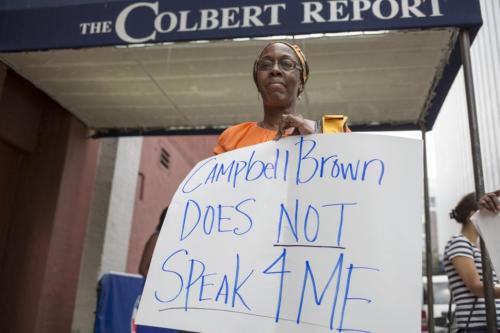
Just to be clear the “people who were out there earlier today” was a small group of mothers and teachers with hand made signs:

colbert1n-1-web

colbert1n-2-web

This pattern is hardly isolated to Campbell Brown’s efforts either.  While hedge fund manager Whitney Tilson is less shy than most about openly explaining his goals of influencing Democratic politicians to adopt privatization goals, his organization, “Democrats” for Education Reform funnels large sums of cash and influence from a variety of sources, mostly groups like the Walton Family Foundation.  When education reform’s paid advocates found that they had trouble responding to public education supporters on social media, former Obama administration DOE official Peter Cunningham was simply granted $12 million dollars to found the “Education Post” to “create a better conversation” but also, in his own words, to create “the ability to swarm” on social media and to “hire” and “subsidize” bloggers. While Bill Gates is far more visible than most financiers of education reform, one of his biggest efforts to date was managing to organize 45 states and D.C. to adopt the Common Core State Standards without most parents or teachers realizing it was happening – by aiming almost entirely at power brokers and foundations in between election cycles.

Wherever you turn in education reform today, you find a think tank, or 501(c)3, or astroturf group, or pseudo-media outlet being paid handsomely to create the public impression of organic support for reformers’ ideas.  Direct and natural engagement with the public is not one of their stronger skill sets.  Which loops back to Republican donors and their unwillingness to confront Donald Trump.  On the one hand, it looks ridiculous that some of the nation’s wealthiest and most influential individuals are so afraid of negative public attention that they dithered for months, but on the other hand given how successfully they have influenced public policy without having to bother with actual democracy and given how bipartisan majorities of American voters already think the system is rigged in favor the ultra-wealthy, it makes sense that those most blatantly manipulating the system would hesitate to step out of the back rooms and into the public’s view.

The good news for advocates of public education is that Trump’s level of ignorant bullying and outright vulgar bigotry is hardly necessary to make education reformers uneasy about scrutiny.  For Campbell Brown, a few teachers and mothers with Sharpies rattled her ability to lie about teachers’ workplace protections on behalf of her donors. Peter Cunningham needed $12 million in foundation cash to pay bloggers to counter the efforts of working teachers with blogs and on social media who are defending their profession for free.  The vast sums of money spent by Bill Gates to prop up and support the Common Core State Standards have not prevented dwindling support among parents and teachers as they grow more familiar with its impact on schools.  Helping to keep light shining on how the donor class is pushing policy without the public’s consent goes hand in hand with the how harmful those policies have been.  They’ve repeatedly shown that they dislike scrutiny.

We have no reason to oblige them.

3 Comments

Filed under Activism, Common Core, Corruption, DFER, Gates Foundation, politics

No, You Cannot Test My Child

Dear Local Education Authority (LEA), State Education Authority (SEA), and Federal Education Bureaucrat (FEB?),

We are rapidly approaching the annual state mandated testing ritual in public school, and it has become evident that all of you are a little nervous about that.  I know this because you keep sending letters to each other about how important it is that every LEA test 95% of all children in every school and that every SEA make certain that LEAs know just how important this is.  Last Fall, FEB Ann Whalen sent a dozen SEAs letters explaining to them just how important it is that they meet their testing requirements and suggesting a range of measures, both persuasive and punitive, if LEAs did not make their testing goals.  This was followed by another letter to all states essentially reiterating the point. SEAs have been busy trying to impress upon their LEAs how seriously they take the federal requirement to test 95% of all students in all schools although with different approaches.  In Connecticut, state officials have more or less threatened LEAs, while New York, home of the largest test refusal movement in the country, has tried to woo back refusing parents to the wonderful world of testing with a series of concessions on the use of tests for teacher assessment and the timed nature of the tests and a nifty “tool kit” to explain how awesome testing can be.

So, okay, I get it: A lot of you SEAs have been nervous about what the FEBs are saying, and you are pressuring your LEAs to use both honey and vinegar to convince parents to just up and let their kids be tested already.

cat on leash

You still can’t test my kid.

I know that you are supposed to try to convince me, otherwise, and it is probably too much to ask you to save yourself the time.  However, if you do feel the need to persuade me that the testing ritual is excellent and worthwhile, you should know that I have heard most of your arguments, and, frankly, you need new ones.

To begin with, I am actually aware that my children will take tests during their lives, and it is not my intention to keep them from ever experiencing a standardized test.  The thing is that most of those tests will actually serve some purpose for their lives if and when they take them.  While standardized test measures are of questionable quality for college, graduate school, or professional school admission, where they are required to pursue those goals, my children will take them at the appropriate time.  You should also know that I expect my children to take teacher made tests throughout their education.  Tests and other assessments are part of an education, and professional teachers know how to use all kinds of tools to see how well their students are learning.

But when tests used for a state accountability system take nine hours – 6 hours LONGER than the LSAT and and an hour and half longer than the MCAT – and when the tests have to be taken every.single.year – something is seriously out of whack.  Of course, the tests themselves are not the only issue.  Because of the incentives attached to these tests, districts and schools across the country spend far more time preparing for and practicing test taking that any scheme for school accountability can justify.  Robert Pondiscio, Vice President of External Affairs for the pro-education reform Thomas B. Fordham Institute, gets this and has urged federal officials to back off the warped incentive systems that make standardized tests end unto themselves.  He’s argued that as long as punishing consequences for schools and teachers are attached to testing, we will have this problem.  So far, he hasn’t been listened to much.

So I expect that my children will taken standardized tests – possibly many over the course of their lives.  But when a state accountability test consumes so much time and is attached to stakes that warp my children’s education, well, the cart is definitely in front of the horse.

cart_before_horse

Further, I already know that it is a matter of faith at the Federal DOE that without testing we can never look a second grader in the eye and tell her ‘You’re on track, you’re going to be able to go to a good college, or you’re not.’ Frankly, if that is your goal for a conversation with a 7 year old child, then I’d kindly ask you to never visit a school, thanks, but beyond that, it remains a horrible failure of imagination to think that a state accountability test is our best and essential way to check whether or not an individual child is learning.  If you really want to increase the ability of parents to understand how well their children are doing, there are tools with far greater sophistication that teachers could actually use in their classrooms than an accountability test given in April whose results don’t come back until the next school year is well underway.  In fact, considering the amount of time in the school year spent scrambling to prepare for and to administer state tests, it is entirely counter-intuitive to think these tests are really good for telling me how my children are doing.  And if we need to increase parental engagement with their children’s education in all of our communities, what makes more sense?  Investing in strategies and programs that are proven to help parents and guardians connect with school? Or a two page score report that doesn’t include the slightest hint of what kind of test questions the test taker got wrong or how to learn from them?

The question was rhetorical, by the way.

tests-human-resources-cartoon-400px

I also understand that you want me to know that without a system of annual standardized testing with full participation then there will be no accountability for my local schools and they will be free to ignore the needs of minority children at will.  This is certainly an argument that has been made with vigor, and it is one our friends the FEBs have insisted is the primary reason for testing every child in every year.  I will admit there is something to this argument – not because annual testing has been a great force for making education for all students equitable.  Fifteen years in and test-based accountability has been pretty wretched at that goal.  It is, however, true that our school system has nowhere near the distribution of opportunity that would make the promise of a democratic school system a reality.

But test-based accountability has the whole thing reversed.  We have a test-based “achievement gap” which reflects the opportunity gap that exists across communities all over the country.  To suggest that the test measured gaps result in the economic gaps ignores every bit of nuance and complexity that we know about both poverty’s impacts and how segregation by income concentrates large percentages of children from poor households into specific neighborhoods.  The connection between poverty and tested results is so tight that Dr. Christopher Tienken and colleagues of Seton Hall University were able to use census data to accurately predict student proficiency scores on state tests in different communities.  State accountability testing is telling us very little that we do not already know.

On the other hand, those same tests have been giving ammunition to policies that insist upon educational “improvement” without focusing upon the resources necessary to work successfully with high need students: smaller class sizes, wrap around services, teacher retention policies, facility improvements, extended programs and after school supervision – none of it is free and very little of it has been offered to schools and districts under threat because of lagging test scores.  Instead of genuine investment in their schools and communities, these neighborhoods are offered the “creative disruption” of school privatization that saps resources from fully public schools without accountability – all justified by test scores.  No wonder then that there is a small but significant and growing conversation among civil rights activists about whether or not annual testing is the tool it was presented to be in NCLB.

charter

My family does understand the pressure you are under, LEA.  The SEA, under a lot of heat from the FEBs, has been issuing dire warnings if 95% of all students are not tested.  Most of that is just hot air, however, and as long as you do actually test the children whose families do not opt out, you have done what you can reasonably be expected to do.  We’ve spoken as a family all together, adults and children, and we simply do not think that any of the arguments you have made or are likely to make in favor of annual testing are going to sway us.  When there is a state accountability system that is rational and used as the basis for helping schools, teachers, and students, when we accept that community and school improvement have to happen together, and when we recognize that we cannot improve schools without committing the necessary resources, then we’ll reconsider our decision.

Until then, no, you cannot test my child.


14 Comments

Filed under Data, ESSA, Funding, NCLB, Opt Out, schools, Testing

“Successification”

Another month, another Success Academy scandal.

This time it involves an undercover video of a first grade teacher in Success Academy Cobble Hill in Brooklyn that was shot by an assistant teacher who was unnerved by the ongoing abusive behavior of the lead teacher, one of the networks “exemplar teachers” who is considered so effective she trains her colleagues.  The video, submitted to the New York Times, was shot in 2014 and was given to reporters when the assistant teacher left the Success Academy network last year.  The video is hard to watch by anyone with a hint of empathy for very young children struggling with instructions and a challenging concept.  It begins with a room of Success Academy students sitting cross-legged around the classroom rug, hands folded, backs in fully upright posture.  The teacher instructs a little girl to “count it again, making sure you are counting correctly.”  The girl pauses, apparently confused, and the teacher commands her to “count” in a quiet but stern voice.  The girl begins to count and then looks at the teacher who immediately rips her paper in half, throws it at the child, and points sharply to a corner of the room:

Go to the calm down chair and sit.  There is nothing that infuriates me more than when you don’t do what’s on your paper. Somebody come up and show me how she should have counted to get her answer done with one and a split. Show my friends and teach them. (a child does as she says)  Thank you. Do NOT go back to your seat and show me one thing and then don’t do it here.  You’re confusing everybody. Very upset and very disappointed.

Every bit of that was delivered in a loud and angry tone of voice.

Kate Taylor, who wrote the story for the Times, reported that a Success Academy spokesperson said the teacher’s behavior was “shocking” and had been suspended from teaching, but was then back only a week and half later and still in the role of “exemplar” teacher.  Success Academy CEO Eva Moskowitz cited network manuals that say teachers should never use sarcastic tones or humiliate students, and, as is typical, dismissed the video as an “anomaly,” telling Ms. Taylor that the teacher reacted emotionally because she “so desperately wants her kids to succeed and to fulfill their potential.”  Ms. Moskowitz went on to insist that the video meant nothing and questioned the motives of the former assistant teacher who took it.

This video is not an accident.  It was taken because the assistant teacher had become concerned about daily occurrences of abusive behavior and did not merely get lucky to begin filming the lead teacher at the precise moment when she anomalously lit into a very young child for a simple mistake.  While the network defended itself, Ms. Taylor interviewed 20 current and former teachers whose statements indicate the behavior caught on the video is far more widespread in Success Academy than Ms. Moskowitz and her defenders admit.  One teacher, Jessica Reid Sliwerski, who worked for three years as both a teacher and as an assistant principal said that embarrassing children for “slipshod” work is both common and often encouraged: “It’s this culture of, ‘If you’ve made them cry, you’ve succeeded in getting your point across.”   New York University education professor Joseph P. McDonald said he would hardly be surprised if the classroom was one where children were often afraid. “The fear is likely not only about whether my teacher may at any time erupt with anger and punish me dramatically, but also whether I can ever be safe making mistakes.”  This was confirmed by another former Success Academy teacher, Carly Ginsberg, who said she witnessed papers torn up in front of children as young as kindergarten, an assistant principal openly mocking a low test score in front of the child, and a lead kindergarten teacher who made a little girl cry so hard that she vomited.

None of this is surprising to observers who have long known how Success Academy uses staggering pressure and laser-like focus on standardized test scores to get their results and to drive away children who cannot quickly and totally conform.  Kate Taylor’s lengthy examination of the culture of the school last summer documents it,  John Merrow’s story on Success Academy’s hefty use of out of school suspensions confirms it, and the network’s scramble to explain away a principal who compiled a “got to go” list of children to drive out of the school pretty much sealed it.  Success Academy does not merely have high expectations and sets lofty goals; it single-mindedly pursues them with a near zero tolerance for mistakes and for any behavior outside its rigidly defined norms.  Children, and teachers for that matter, who cannot swiftly comply are subjected to mounting pressure until they either break or go away.

I’ve written previously that Eva Moskowitz and Success Academy are likely to continue to have bad press for the simple reason that there are too many former Success Academy families and teachers to keep the kind of message discipline and information control that the network has employed until recently.  If Success Academy were merely an extreme anomaly in our education system, it would be possible to indulge in a bit of schadenfreude over Ms. Moskowitz’s obvious discomfort and inability to keep up the convincing arrogance that has typified her tenure as an education leader.  The trouble is that while Success Academy may be an extreme instantiation of disturbing and unethical priorities in our education system, it is by no means alone.  To varying degrees (and predating the founding of Ms. Moskowtiz’s network), huge swaths of American education have fallen victim to Successification: creeping emphasis on the shallowest of measures as ends unto themselves, the steady assault on childhood as a time of play and exploration, growing intolerance for error in both answers and behavior.  We are doing this to ourselves and to our children.

Children of color have long known that schools in many cities show almost fanatical intolerance for misbehavior.  The proliferation of “zero-tolerance” policies has lead to a “school to prison pipeline” where minor infractions of rules are criminalized and school discipline is routinely farmed out to police enforcement.  In this video by the New York Civil Liberties Union’s Project Liberty, New York City students describe their experiences with these policies and the impact it has on their ability to even think about school success and their future:

Success Academy may be a pioneer in subjecting very young students to out of school suspensions and extreme levels of behavioral conformity, but schools throughout our vast education system subject students to direct contact with police and arrest for rules violations that should be treated vastly differently.  The cycle here is especially vicious as suspended students often have home environments that cannot provide structure and supervision while they are out of school, leading to far greater risk of dropping out and ending up within the criminal justice system.

Schools that serve students from economically and racially privileged backgrounds place their own forms of pressure on students.  Writing in The Atlantic magazine, Erika Chistakis explained how research is now showing that the increasing emphasis on academics at younger and younger ages, even to preschool children, is actually harmful:

New research sounds a particularly disquieting note. A major evaluation of Tennessee’s publicly funded preschool system, published in September, found that although children who had attended preschool initially exhibited more “school readiness” skills when they entered kindergarten than did their non-preschool-attending peers, by the time they were in first grade their attitudes toward school were deteriorating. And by second grade they performed worse on tests measuring literacy, language, and math skills. The researchers told New York magazine that overreliance on direct instruction and repetitive, poorly structured pedagogy were likely culprits; children who’d been subjected to the same insipid tasks year after year after year were understandably losing their enthusiasm for learning.

That’s right. The same educational policies that are pushing academic goals down to ever earlier levels seem to be contributing to—while at the same time obscuring—the fact that young children are gaining fewer skills, not more.

Ms. Christakis also noted that many parents of preschool aged children approved of the new approaches because of palpable fear that their children would fall behind others and that an early stumble could have life altering consequences.  Peter Greene, a Pennsylvania teacher and blogger, notes a similar theme among his own students in this very important essay entitled “One Wrong Move.”   He describes a class of honors students in his small town school completely paralyzed by the fear of making errors that they could never do anything without complete assurance they would get it completely correct, all because of the outsized risks associated with ever being wrong.  It reminds me very much of my own college students who are bright, caring, eager, passionate – and who are geniuses at  completing four hours of homework assigned on a Monday and due on Tuesday, but who, by their own admission have very little experience with high risk work that requires them to embrace uncertainty and the possibility of instructive failure.

I was recently walking my own children to school in our New York City neighborhood when we were passed by a father and son walking together.  The child looked to be about in 4th or 5th grade and was saying to his father, “You know in my school a one or a two are really not looked at as something good.”  It took me a moment, and then I realized he was talking about the level indicators on the New York State assessment system that are baked into elementary school report cards as the numbers 1 through 4.  At what point does it become painfully absurd for an elementary school student to have internalized the language of academic standards performance levels, and at what point does it become unethical for him to know what is or is not approved of in his school?  But this is just another example for where we have come in our education system by making performance to cut levels on standardized exams more important than actual learning.  We have normalized this, and our children know it.

As is typical for Eva Moskowitz, the Success Academy leader lashed out at The New York Times in an email circulated to all of her employees where she claimed the newspaper has a “vendetta” against her and called her critics “haters” who are trying to “bully” the network.  While it may be desirable, even necessary, to deflate the self aggrandizing mythology of Success Academy by documenting reality, it is also important to remember that the charter network is not actually the illness.  It is merely an extreme rash that has broken on the surface.  Looking deeper, it is evident that much of our schooling today suffers from “Successification”.  Whether it is black and brown children subjected to zero tolerance policies that send them on a collision course with the criminal justice system or it is students terrified of making errors because their education has no time for learning from mistakes and genuine discovery, we are slowly building a school system where the worst priorities are granted full control.

It is time for a good, long, hard look in the mirror to see if Eva Moskowitz is staring back at us.

11 Comments

Filed under charter schools, child development, Media, racism, schools, Social Justice, teaching, Testing

“Education Next” Discovers That Water is Wet

Education Next is a reliable source of pro-education reform content.  Published by Stanford University’s libertarian leaning Hoover Institution which “seeks to secure and safeguard peace, improve the human condition, and limit government intrusion into the lives of individuals,” the magazine/journal is also sponsored by Kennedy School of Government’s Program on Education Policy and Governance (affiliated with reliably pro-reform organizations like the Heritage Foundation, the Alliance for School Choice,  Center for Education Reform, and the Heartland Institute) and the conservative Thomas B. Fordham Institute, dedicated to the premise that pretty much our entire education system is dysfunctional or dumbed down.  Education Next blends characteristics of magazine publishing and peer reviewed journals in a quarterly publication that occasionally has tastes towards provocations that few purely academic journals would attempt.  Michael Petrilli, the President of Fordham, is both a research fellow at Hoover and an editor at Education Next, and, by his own admission, loves “to mix it up” – which can put the publication in controversial spots even within the pro-reform community.

For the Summer 2016 issue, the publication is not courting controversy so much as it is stating the obvious and begging the question.  Editor-in-Chief and Henry Lee Shattuck Professor of Government at Harvard University Paul Peterson and Harvard post-doctoral candidates Samuel Barrows and Thomas Gift offer us the “good news” that in the wake of Common Core, states are setting “rigorous standards.”  I say this with a degree of tongue-in-cheek because the article’s conclusion are fairly obvious – if you start with the premise that everything education reform has been saying for the past decade and a half is pretty much entirely true.  Raise questions or complications to the exercise of standards, high stakes accountability testing, and their utility as policy levers and the entire exercise gets a lot less laudatory.

Dr. Peterson and his associates lay out their case like this:

  • Most states and the District of Columbia adopted the Common Core State Standards or some variation of the standards.  To their credit, the authors do not avoid the major role of the Gates Foundation in financially supporting the CCSS and of the Obama administration in creating incentives for states to adopt the standards, and they provide some insight into the opposition to the standards from both liberal and conservative sides of the issue (although they greatly oversimplify liberal concerns to union politics – even though both major national teacher unions signed on the Common Core experiment).
  • Since 2005, Education Next has used a grade scale for state proficiency standards developed by the Program on Education Policy and Governance where Dr. Peterson works (and which is a sponsor of Education Next).  According to this scale “state standards have suddenly skyrocketed.”
  • The authors also infer that if results from NCLB mandated annual proficiency examinations are close to state results on the National Assessment of Educational Progress (NAEP) then the state proficiency standard is as strict as the NAEP.  The authors refer to their assessment of states as “truth in advertising” about how well states tell parents how their children are actually doing.  This is another variation of the “honesty gap” argument that has was featured prominently by education reformers as states and communities got ready to receive the results of Common Core aligned testing.
  • According to the “size of the difference between the percentages of students identified as proficient by state and by NAEP exams in 4th and 8th grade math and reading,” “the last two years have witnessed the largest jump in state standards since they were established as part of the federal accountability program.”  The authors report that 36 states have “strengthened their standards,” and they further declare “the Common Core consortium has achieved one of its key policy objectives: the raising of state proficiency standards throughout much of the United States.”
  • The authors admit that the opt out rates in some states may complicate these scores; to whatever degree students who refuse the tests would have been high scorers, this would artificially lower the percentage of students scoring proficient.  Further, Massachusetts allowed districts to select between the state’s original MCAS exams or the new PARCC exams, but there is no way as of yet to know if higher performing districts kept the MCAS.
  • The authors also observe that states’ standards performance has narrowed recently with 80% of state proficiency rates being within 15 points of their NAEP results.

So to sum up: The federal government provided incentives and policy pressure for states to sign on to the Common Core State Standards.  States are now administering federally mandated accountability testing aligned with those standards (28 of them with either the PARCC or SBAC testing groups specifically chartered to write CCSS aligned exams).  The percentage of students who rank proficient in these exams is much closer to the percentage of students who rank proficient on the NAEP in those same states.  Education Next handed out a bunch of As to states because they “raised their standards.”

In other news: Water is wet.

water is wet

Dr. Peterson’s argument here is a little bit as if I took up alpaca ranching and then two years later praised myself for all of the timid, wooly, camelids on my property.  Education Next may give states enormous credit for decreasing the percentage of students who are deemed proficient in their state tests and bringing those percentages closer to the results of the NAEP, but the desirability of this is unexamined as is why doing so raises a state in the authors’ estimation.

This is no small question because it is hardly a given that a decrease in the gap between state exam proficiency percentages and those on NAEP indicates actual educational improvement or even that standards are actually “rigorous” as the Education Next headline claims.  New Jersey, for example, scored very well in the authors’ rating with 2.1% fewer students ranked as proficient in state testing compared to the last NAEP.  According to Education Next, New Jersey earned only a C in 2005 well before the Common Core State Standards, but research by Dr. Chris Tienken and Dr. Eunyoung Kim of Seton Hall University with Dr. Dario Sforza, Principal of Henry B. Pecton Regional High School, found that, using Webb’s Depth of Knowledge framework, New Jersey’s pre-Common Core Standards required more creative and strategic thinking in English Language Arts.  New Jersey may have scored higher on Education Next’s metric, but the standards being used in K-12 English arguably demand less higher order thinking.

Dr. Peterson and his associates also leave the desirability of getting state proficiency levels closer to NAEP’s entirely unexamined and simply assume that it is a good thing.  This, too, is no small question because the NAEP’s proficiency targets are deliberately set very high.  Dr. Diane Ravitch of New York University sat on the NAEP Board of Governors for seven years and explains here that proficient and highly proficient in the NAEP are pegged to very high level work in the A range for most students.  Further, she explains here that this was done deliberately because Dr. Chester Finn, who chaired the NAEP Board, is not impressed with the quality of American education in general and wanted the proficiency levels in NAEP to reflect that.  The PARCC consortium consulted NAEP heavily in the creation of its test while SBAC used far less from the NAEP, but as of last May, SBAC did not expect scores to vary that much from the national program.  Even outside the consortia, states looked very deliberately to decrease the number of students labeled proficient.  New York State linked its proficiency levels to performance on the test that an ETS study said was predictive of SAT scores only a third of students obtain; lo and behold, the number of students labeled proficient dropped to about a third.  This was also roughly the same as New York’s eighth grade NAEP English results which have been 33% or 35% at proficient or above since 2003.  Just for good measure, 33.2% of New Yorkers over the age of 25 have a Bachelor’s degree or higher.

None of this, however, changes a simple fact: the setting of cut scores for different levels of proficiency is a choice independent of how the scale scores from the exams are distributed.  New Jersey teacher, Rutgers graduate student, and blogger Jersey Jazzman deftly explains that even when New York set its cut scores to a very high level, the distribution of scale scores on the state exam barely moved, and that is because the decision to place cut scores is independent of how students do on the test itself and of how schools and districts and states compare to each other.  Gaps between subgroups and communities still exist and students’ performance on the test itself remains largely unchanged whether “proficient” is set to capture 60% of all test takes or 30%.  It should be noted that based on the authors’ descriptions, a state could probably have changed nothing about their standards or their accountability exam, set their cut scores to label fewer kids as proficient, and gotten a high grade in their report.

Left undiscussed is whether or not this is remotely desirable for a state system of accountability testing.  If “proficient” and “highly proficient” are achievement labels that should be reserved for students likely to go to a four year college or university, then education reform advocates have never effectively made that case to the public, preferring instead to point to the results on state testing that have been designed with this specific result in mind and declaring themselves correct about how poor a job our nation’s schools are doing. On the other hand, even if these cut score level are correct, what is the argument that we need vastly more children scoring at these levels?  I’ve argued repeatedly on these pages that there is little economic evidence that the nation’s economy is in need of more Bachelor’s degrees and that the inability of people to get ahead with a college education or to live above a subsistence level without one is a much greater crisis needing vastly more widespread action than can be achieved by schools alone.  While it is absolutely true that educational opportunity, like economic opportunity, is unequally distributed by race and class, the solutions for that are not going to be found by rigging cut scores but rather by substantially addressing something education reformers today generally discount: inequitable and inadequate school funding.

Ultimately, a lot of education reform, this report included, is a giant exercise of begging the question where a conclusion is presumed to be true without ever having been argued:

“These test results show that states have made their proficiency standards more rigorous.”

“Why do they show that?”

“The percentages of students scoring ‘proficient’ is closer to the NAEP than on prior tests.”

“Why does that show that the state standards are more rigorous?”

“Because NAEP is a rigorous exam.”

hermione_eye_roll

4 Comments

Filed under Common Core, Data, Gates Foundation, NCLB, PARCC, standards, Testing

New York Testing Gets a Bit Weird

I cannot imagine that it is easy being New York Stated Education Department Commissioner MaryEllen Elia.  Brought to Albany in May of last year, she came to a post where her predecessor, Dr. John King Jr., had strained relationships with many parents and communities to the breaking point.  Commissioner Elia arrived in the wake of record breaking test refusal in her new state, and her obvious job was to mend fences between NYSED and school districts and parents while not backing off of the Common Core Standards, the accompanying testing, and plans to use test data in the evaluation of districts, schools, and teachers.  In most respects, she was an ideal pick for the job.  She is clearly a believer in today’s reform environment, having taken on a $100 million grant for Florida’s sprawling Hillsborough district from the Bill and Melinda Gates Foundation  to implement the foundation’s vision of teacher effectiveness (a vision that turned out to be an expensive bust that lost funding and was ultimately abandoned by the district).  More importantly, Commissioner Elia is a lifelong educator with thorough knowledge of how complicated the stakeholders in education can be, knowledge that seemed to elude her predecessor whose actual school experience was mostly limited to no excuses charter schools.  Regardless of one’s opinions about Common Core or state testing, Commissioner Elia seemed well positioned to ease tensions in the Empire State.

That was the theory, anyway.

Commissioner Elia began her tenure with a “listening tour” where she visited districts across the state to hear concerns and make the case that the state was heading in the correct direction – even if that direction was causing widespread concerns.  This was meant to distinguish herself from Commissioner John King who was widely regarded as unwilling or unable to listen, and to present herself as an NYSED Commissioner eager to discuss with the public.  One can probably give Commissioner Elia credit for both speaking to the public and for sticking with her belief in the importance of annual testing.  In a talk at Sweet Home Middle School in the Erie County school district where Commissioner Elia began her teaching career, she told attendees that “Life is one big test.  We have go to get to the point where people are at peace with that.”

Commissioner Elia’s tone took a turn by the end of the summer, however, when both she and representatives from the federal DOE discussed the need for plans to reduce opt outs in New York.  The Commissioner probably felt that she would have some support from both Governor Andrew Cuomo and Chancellor of the Board of Regents Merryl Tisch.  After all, Governor Cuomo unleashed a torrent of harsh measures using annual testing in his 2015 budget address, and Chancellor Tisch, speaking to the New York State Council of School Superintendents, compared opting out of state tests with refusing to vaccinate your child.  Commissioner Elia probably felt she had plenty of back up when she followed her conversations with Washington on possible consequences for districts with high opt out numbers with her own opinion that the movement was “not reasonable” and that any educators who supported it were “unethical”.

In short order, however, the Commissioner found herself standing alone with both Chancellor Tisch and Governor Cuomo emphatically denying any plans to threaten school districts with loss of funding if they had high opt out rates.  Commissioner Elia quickly admitted that parents have the right to opt their children out of the state exams, although she also emphasized that she hoped to convince them otherwise.  Governor Cuomo followed this in September by announcing a commission to review the Common Core standards and their implementation in New York.  The Regents, meanwhile, after giving districts more time to work out how to use state tests in teacher evaluation, announced a two year moratorium on the use of the state tests for those evaluations – although local tests will still need to be used.

Then last week, Commissioner Elia announced the latest changes to testing in the Empire State – removal of time limits on the state examinations:

“I heard from parents across this state and from teachers that part of the stresses that we had on our kids was that they were timed, and particularly younger children,” the commissioner said in a question-and-answer period following her testimony on Gov. Cuomo’s $145 billion budget proposal.

“So if they are working productively, then they will be able to continue the assessment in a setting where they can read, comprehend and respond to the questions that correspond,” Elia said of students who will be taking the tests this year.

Interestingly enough, it is possible for standardized tests, especially criterion referenced tests, to be administered without time limits.  After all, if the purpose of a test is to see if a child knows a specific bit of content or skill, the ability to do it in 5 minutes versus 10 minutes is not as significant as actually knowing it.  And I will go out on the limb and simply acknowledge that anything which reduces the likelihood that 8 year olds will vomit and wet themselves during testing is a move in the right direction.  That’s the good news.

On the other hand, one does have to wonder how this move reduces the amount of time consumed by state testing, and the logistic challenges with schools potentially having to proctor students for very various lengths of time will be interesting.  Moreover, will all of these moves by high authorities in Albany – increasing the length of time to modify and implement Common Core Standards, a temporary moratorium on high stakes purposes for the state standardized exams, removing time limits from the exams themselves – do anything to make a dent in the state’s nation leading opt out numbers?  All of these options were available a year ago, but Governor Cuomo and Chancellor Tisch chose to pursue a punishing agenda on teacher and school evaluation, only backing off when the governor’s approval ratings plunged and the scale of test refusal became clear over the summer.  With the federal government strongly urging state education authorities to get a handle on their test refusal situations (or risk sanctions from the USDOE), it seems most likely that all of these moves are designed to keep opt outs from increasing this year and to convince parents who refused the tests last year to come back.  After all, visibly beating up on schools and teachers got them where they are now.  Maybe a velvet glove will help.

Opt Out leaders are not buying it.  Former New York school principal and current director of the Network for Public Education Carol Burris sees Opt Out as permanent fixture in education unless more dramatic changes are made.  According to Ms. Burris, leaders in the movement remain unconvinced and are energized by USDOE moves to convinced states to lower the boom on test refusal:

Jeanette Deutermann, lead of the Long Island, New York Opt Out, agrees. And she is furious with what she sees as the scare tactics being spread by the media based on the threatening letter issued by Acting Secretary of Education John King.

“As opt outs take root in NY and spread across the country, the federal and state governments continue to play a bizarre game of “yes we will, no we won’t” concerning funding threats. This year the threat took a different spin. The Feds gave the states a great little ‘bullying toolkit’ which basically says, ‘these parents aren’t afraid of us. Make sure they’re afraid of YOU.’ They came up short on one key fact: the USDOE and the SED have no authority to strip our schools of funding for a parent-led action. Our schools are in compliance. Our children are administered the test. We, the parents, direct our children not to take it. There is no law or regulation in NY that affords the SED the right to arbitrarily decide to withhold funds from our local districts.”

Other leaders in test refusal agree, citing the efforts from Albany as entirely missing the point of their concerns over the tests and accompanying policies.  President of Community Education Council 31, Michael Reilly, told Chalkbeat: “I think she’s trying to put a bandaid on the issues that parents and educators have raised…This is one attempt to appease parents. Unfortunately, I don’t think it’s well thought out.”  Lisa Rudley of New York Allies for Public Education was dismissive and said that Commissioner Elia was still treating the tests as more misunderstood than in need of major changes.  Time, of course, will tell, but New York’s strongest opponents of the current testing environment are thoroughly unconvinced and confident that test refusals will continue.

Maybe next year, Governor Cuomo can propose a new iPhone for every family that opts in.


cat on leash

NYSED Trying To Convince Opt Out To Just Take The Test Already….

10 Comments

Filed under Common Core, John King, MaryEllen Elia, NCLB, New York Board of Regents, Opt Out, Testing