Tag Archives: Activism

More than Half of America’s School Children Qualify for Free or Reduced Lunch

I want to say to you as I move to my conclusion, as we talk about “Where do we go from here?” that we must honestly face the fact that the movement must address itself to the question of restructuring the whole of American society. (Yes) There are forty million poor people here, and one day we must ask the question, “Why are there forty million poor people in America?” And when you begin to ask that question, you are raising a question about the economic system, about a broader distribution of wealth. When you ask that question, you begin to question the capitalistic economy. (Yes) And I’m simply saying that more and more, we’ve got to begin to ask questions about the whole society. We are called upon to help the discouraged beggars in life’s marketplace. (Yes) But one day we must come to see that an edifice which produces beggars needs restructuring. (All right) It means that questions must be raised. And you see, my friends, when you deal with this you begin to ask the question, “Who owns the oil?” (Yes) You begin to ask the question, “Who owns the iron ore?” (Yes) You begin to ask the question, “Why is it that people have to pay water bills in a world that’s two-thirds water?” (All right) These are words that must be said. (All right)

Dr. Martin Luther King, Jr. August 16, 1967 “Where Do We Go From Here?”

On January 16th, The Washington Post ran a story by Lyndsey Layton about a new report finding that slightly more than half of all American public school students now come from officially low income families. The headline stating those children come from “poor” families was slightly misleading as qualifying for reduced lunch does not require that a family be at the Federal Poverty Level (FPL) which is $23,850 for a family of four. Families qualify for free meals at school at 130% of the FPL ($31,005 for a family of 4), and they qualify for reduced lunch at 185% of the FPL ($44,123 for a family of 4).  However, the reality is that almost half of our public school students live in poverty, near poverty, and low income conditions.  This has dramatic implications for them and for the schools in which they study.

Poverty acts as a third rail in American policy discussions, and it often feels that recognizing the reality for people who live in poverty or near poverty is immediately treated as an attack on American ideals of a meritocratic society.  Reality, however, remains reality, and the deep impacts of poverty upon young people are known.  The 1997 Princeton Study is nearly 20 years old and clearly demonstrated the health, cognitive, educational, and behavioral differences that can be attributed to growing up in poverty.  More recently, the  30 year long Baltimore study reported how intensely stubborn poverty is and how unlikely it is for a child born into poverty to move into the middle class or higher.  Recent research also notes that in addition to long known advantages of higher income families such as educational resources, a poor child who does “everything right” is still barely MORE likely to be economically successful that a rich child who drops out of school – and both are equally likely to be in the lowest quintile of income earners:

Poor-Grads-Rich-Dropouts

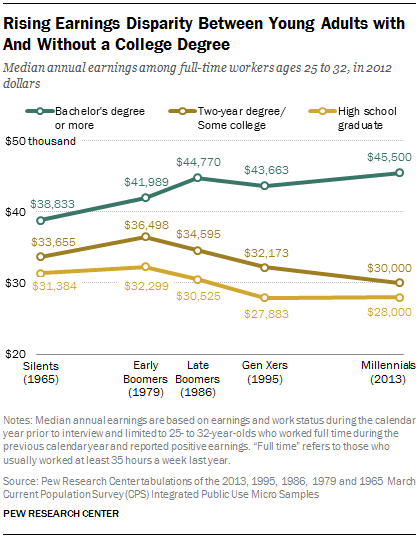
As equally troubling as these findings is the difficulty in any prospect of fixing them by current opportunities.  While going to college remains a viable way to maintain economic position for most attendees, it is not because wages for such graduates have been rising to meet inflation or a job market demand for such workers.  Wages for current college graduates is not much higher than it was in the mid-1980s, but the wage premium for a college degree has grown because of the collapse of wages for workers without a college education:

SDT-higher-education-02-11-2014-0-03

In addition, the lower middle class, historically an important rung on the economic ladder, is not merely struggling; iis largely stay afloat only because of federal transfer programs that take the edge off of their stagnant and falling wages — even as they tend to pay the largest marginal tax rates of all income groups.  The conclusion here is one that has only recently pushed into margins of the mainstream:  it is extremely difficult for individuals and families to move up the economic ladder when several rungs have been sawn off…and individuals and families who slip from the lower middle rung to the bottom have few opportunities to regain security.

All of which makes our current educational “reforms” staggeringly galling, immoral even.  Reformers have been touting for years now changes to our educational commons that involve turning as many neighborhood public schools in charter schools as possible, measuring all success and failures in school by standardized test scores, and attacking the workplace protections of teachers as the only way to “guarantee” that every child has an excellent teacher.  In doing so they literally ignore all the ways in which poverty’s deprivations impact school, and they place upon public school all of the responsibility to boost students’ economic fortunes.  Unexamined?  Tax and trade policies that make it possible for just 4 hedge fund managers to earn more income in a single year than every single Kindergarten teacher in America combined.  Corporations whose business models do not include paying full time employees enough money to avoid going on public assistance.  Wages for most workers that have barely moved in real purchasing power since the mid-1960s. That concentration of income means that 10% of income earners now make more than half of all income in America.  Education “reformers” demand that “fixing” that should rest entirely upon America’s education system — even as their allies in state capitols around the country have played budget games to keep from raising taxes on the wealthy.  In New York State, that amounts to billions of dollars of year that Albany pledged but never delivered to local public schools.

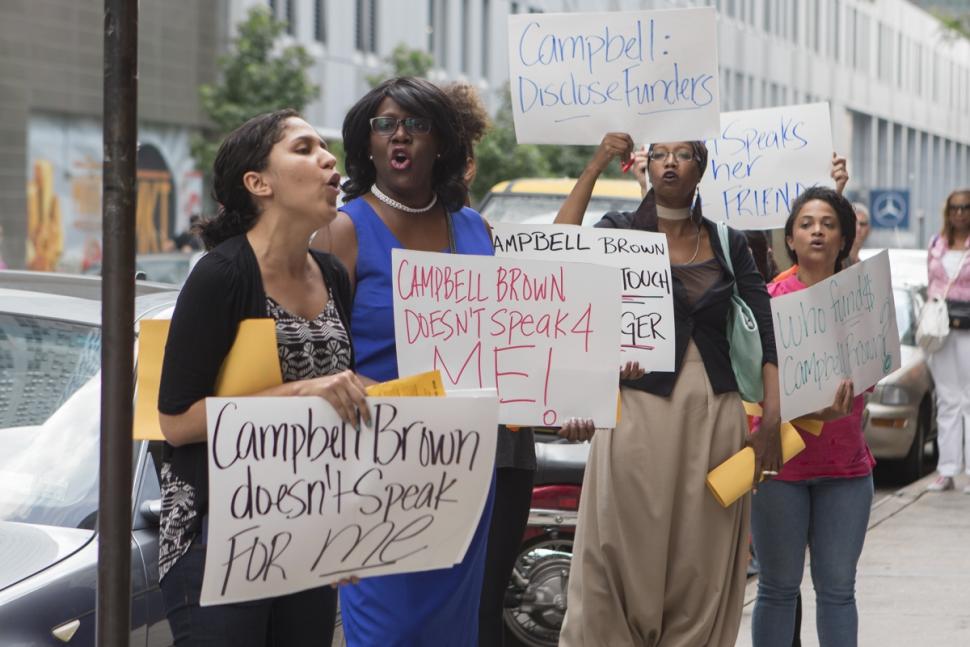
Only in America would education “reform” be millionaires (Campbell Brown, Michelle Rhee, Joel Klein) working for billionaires (Whitney Tilson, Rupert Murdoch, Eli Broad, the Walton family, Bill Gates) to convince poor and lower middle class communities that the problems in education and economic opportunity for their children rest entirely upon the barely middle class teachers in their local schools.

Professor Yohuru Williams of Fairfield University notes that those same “reformers” have taken up the mantle of civil rights in their demands that school be responsible for providing all the opportunity for children in poverty — usually as cover for schemes that privatize more and more of our educational commons.  Dr. Williams takes issue with their adoption of Dr. King for their cause:

For King, the Beloved Community was a global vision of human cooperation and understanding where all peoples could share in the abundant resources of the planet. He believed that universal standards of human decency could be used to challenge the existence of poverty, famine, and economic displacement in all of its forms. A celebration of achievement and an appreciation of fraternity would blot out racism, discrimination, and distinctions of any kind that sought to divide rather than elevate people—no matter what race, religion, or test score. The Beloved Community promoted international cooperation over competition. The goal of education should be not to measure our progress against the world but to harness our combined intelligence to triumph over the great social, scientific, humanistic, and environmental issues of our time.

While it seeks to claim the mantle of the movement and Dr. King’s legacy, corporate education reform is rooted in fear, fired by competition and driven by division. It seeks to undermine community rather than build it and, for this reason, it is the ultimate betrayal of the goals and values of the movement.

This observation is especially important today on the date set aside for reflection on the legacy of Dr. Martin Luther King Jr. and on the work that is left unfinished from his movement.  One of the most glaring unfinished task today is the poverty and near poverty that afflicts over half of our students in public education.  Accompanying that is the coordinated campaign of deflection and misdirection by our current generation of education “reformers” who want to pitch community members against each and against public education while the policy makers and the oligarchs who influence them most heavily continue to ignore the wishes of bi-partisan majorities in the electorate.

It is well past time that we revoked their appropriation of Dr. King’s mantle.  It belongs with those who want our nation to finally confront poverty, not with those who blame public school for the decisions of the powerful.

1 Comment

Filed under Activism, Corruption, politics, Social Justice

New York’s Public Schools Need Some Friends in Albany

This is the text of a detailed letter I am sending to my representatives and other leaders in Albany.  I invite anyone to use any portion of it and the resources in the notes to write your own.  However, the New York State Allies for Public Education has a convenient web form that will generate a letter to your representatives as well.  It can be found here.  The agenda has been set by Governor Cuomo and Chancellor Tisch — it will make our schools objectively worse in every way and it will sweep up all teachers regardless of their capabilities.  We need parents, community members, and teachers to band together to say that this must be stopped.  Let’s dare our representatives in Albany to become friends of public education.

The Honorable Linda Rosenthal
LOB 741
Albany, NY 12248

Senator Jose Serrano
181 State Street Room 406
Legislative Office Building
Albany, NY 12247

Dear Assemblywoman Rosenthal and Senator Serrano:

The public schools of New York need some friends in Albany.

I wish I could say that the parents, children, and teachers of this state could count upon friendship in the Governor’s office or at the Regents Chancellor’s office, but both Governor Cuomo and Chancellor Tisch have made it very clear that they intend great harm to our public education system.  They have powerful backers among Wall Street and private foundations, and they have the encouragement of the United States Department of Education, but regardless, what they say they intend to do will not only harm the 600,000 public school teachers of New York, but also it will degrade the quality of education enjoyed by millions of school aged children and counted upon by their parents and communities.

Governor Cuomo vetoed a bill on December 29th that his own office drafted (1) and which would have given teachers and principals a two year grace period from suffering professional consequences due to the results of the new Common Core aligned state examinations.  The Governor justifies this by claiming that the current teacher evaluation system finds too few teachers incompetent and that student scores of the new exams demonstrates that this is untrue.  Chancellor Tisch has joined the Governor in calling for far more rigid teacher evaluations, responding to a December letter from the State Director of Operations with her own priorities. (2) Chancellor Tisch backs changing teacher evaluations so that the 20% currently set aside for local measures of teacher performance be eliminated and that the portion assigned to student growth in standardized tests be raised to 40% overall.  In addition, Chancellor Tisch proposes that a teacher found “ineffective” by the standardized tests be determined to be ineffective overall, and she believes that two such evaluations should lead to a teacher’s removal.

There are few proposals that could be so immediately harmful to students regardless of Governor Cuomo’s declaration that he is looking out for them and that the NYSUT only wants to protect bad teachers.  This change to teacher evaluation rests upon a flawed premise about student achievement in New York, will subject teachers to an evaluation system with no basis in research, and will dramatically harm the quality of curriculum and instruction across the state in both affluent and impoverished districts.

Governor Cuomo and Chancellor Tisch apparently believe that because the student proficiency levels on the new Common Core aligned examinations are in the 30-35% range then it is “obvious” that many more New York teachers must be incompetent and deserve to be removed from the classroom.  This is a flawed premise and deliberately misleading. Both the Governor and Chancellor know full well that the cut scores for proficiency were set deliberately to match SAT scores (3) linked to specific grades in first year college courses.  The percentage of New Yorkers over 25 with a bachelor’s degree is 32.8 (4),so the argument that THESE proficiency levels on THESE exams mean that many New York teachers are incompetent only works if you assume that there is a demand for college educated workers not being met currently.  The economic evidence for that assumption is weak, however, because while a college wage premium exists, its growth has shrunk dramatically in recent decades (5) and much of that small growth is coming from falling wages for non-college graduates.  It would be worthwhile to question the uneven distribution of college opportunity among racial, ethnic, and economic lines, but it would also be worthwhile to discuss the loss of opportunities for families to move from poverty to the lower middle class (6), losses that keep many more families in poverty than can be lifted by more college degrees.

From that flawed premise, Governor Cuomo and Chancellor Tisch assume that teachers can be accurately measured as ineffective based upon standardized test scores.  Nothing could be further from the truth.  Value Added Models (VAMs) are not widely accepted as valid for teacher evaluation, and the evidence against using them that way led the American Statistical Association to issue a statement warning about the limitations of VAMs (7).  Teacher ratings using VAMs can be highly unstable.  Dr. Bruce Baker of Rutgers notes that teachers who ranked in the top 20% of teachers using value added modeling were likely to shift in subsequent years (8), some even to the lowest quintile and then back to the top, demonstrating how unreliable these methods are.  VAMs take their toll on excellent teachers in excellent schools as well, as demonstrated by the case of the “worst 8th grade math teacher in New York City” in 2012 (9).  This teacher taught at a citywide gifted and talented school, and all of her students passed the challenging Regents algebra exam, but her VAM, based upon an exam testing material her students had learned several years earlier, placed her at the absolute bottom of all 8th grade math teachers.  Hers is not an isolated case, and if Governor Cuomo and Chancellor Tisch have their way, there will be no locally derived measure sufficient to have saved her job.

The tragic impact this will have upon classrooms everywhere should be obvious.  With such dire consequences tied to a single set of standardized examinations and with no other measure mattering, teachers, even in successful schools, will have to teach to the test.  Narrow and relentless test preparation can increase student scores, but it comes at the expense of creativity and subjects not tested.  Research since the passage of No Child Left Behind demonstrates that subjects such as science, social studies, art, music, and physical education have all been reduced because of the consequences attached to low test scores (10).  The Cuomo/Tisch proposals for teacher evaluation will inevitably accelerate this, leading to less time spent in a well rounded curriculum and more time in didactic instruction and seat work.

Meanwhile, the New York Times recognized this week that fiscal inequity is “the central crisis” in New York’s schools, and that Albany is over $5.6 billion dollars short annually of commitments made in 2007 (11).  The New York State School Boards Association estimates that the average district in New York has lost $3.1 million a year in state aid due to the continued use of the gap elimination adjustment (12), and Dr. Baker of Rutgers calculated that New York City alone has lost between $3-4000 per pupil per year through Albany’s refusal to fully fund its own aid formula (13).

In a time when teachers are being told to do far more with their students, Governor Cuomo has consistently starved local districts of funds, and now he and Chancellor Tisch demand that these same teachers produce test results or be fired using statistical models with no foundation in research.

Enough is enough.  The New York State Allies for Public Education has responded to Governor Cuomo and Chancellor Tisch (14), and I implore you to join them in opposing this damaging agenda. It has no basis in fact, it will severely harm all of our schools in every community, and it fully ignores the ongoing failure of Albany to equitably fund our state’s schools.

Our public schools need friends in Albany.  I hope that you will be among them.

Sincerely,

Daniel S. Katz, Ph.D.
Director of Secondary Education and Secondary/Special Education, Seton Hall University
Father of Two New York Public School Students

Notes:

1. Taylor, K. (2014, December 29). Cuomo Vetoes Bill That Would Protect Teachers From Low Ratings. The New York Times. Retrieved January 6, 2015, from http://www.nytimes.com/2014/12/30/nyregion/cuomo-in-reversal-vetoes-bill-that-would-have-protected-teachers-from-low-ratings.html

2. Burris, C. (2015, January 1). Teacher Evaluation: Going from Bad to Worse? The Washington Post. Retrieved January 6, 2015, from http://www.washingtonpost.com/blogs/answer-sheet/wp/2015/01/01/teacher-evaluation-going-from-bad-to-worse/

3. Burris, C. (2014, April 29). The Scary Way Common Core Test “Cut Scores” Are Selected. The Washington Post. Retrieved January 5, 2015, from http://www.washingtonpost.com/blogs/answer-sheet/wp/2014/04/29/the-scary-way-common-core-test-cut-scores-are-selected/

4. United States Census Bureau. (n.d.). Retrieved January 7, 2015, from http://quickfacts.census.gov/qfd/states/36000.html

5. Shierholz, H., & Mishel, L. (2013, August 21). A Decade of Flat Wages: The Key Barrier to Shared Prosperity and a Rising Middle Class. Retrieved January 7, 2015, from http://www.epi.org/publication/a-decade-of-flat-wages-the-key-barrier-to-shared-prosperity-and-a-rising-middle-class/

6. Harris, B., & Kearney, M. (2013, December 4). A Dozen Facts about America’s Struggling Lower-Middle-Class. Retrieved January 7, 2015, from http://www.brookings.edu/research/reports/2013/12/12-facts-lower-middle-class

7. ASA Statement on Using Value-Added Models for Educational Assessment. (2014, April 8). Retrieved January 7, 2015, from https://www.amstat.org/policy/pdfs/ASA_VAM_Statement.pdf

8. Baker, B. (2012, November 17). On the Stability (or not) of Being Irreplaceable. Retrieved January 7, 2015, from http://schoolfinance101.wordpress.com/2012/11/17/on-the-stability-or-not-of-being-irreplaceable/

9. Pallas, A. (2012, May 16). Meet the “Worst” 8th Grade Math Teacher in New York City. The Washington Post. Retrieved January 6, 2015, from http://www.washingtonpost.com/blogs/answer-sheet/post/meet-the-worst-8th-grade-math-teacher-in-nyc/2012/05/15/gIQArmlbSU_blog.html

10. David, J. (2011). High Stakes Testing Narrows the Curriculum. Educational Leadersip, 68(6), 78-80. Retrieved January 6, 2015, from http://www.ascd.org/publications/educational_leadership/mar11/vol68/num06/High-Stakes_Testing_Narrows_the_Curriculum.aspx

11. The Central Crisis in New York Education. (2015, January 4). The New York Times. Retrieved January 6, 2015, from http://www.nytimes.com/2015/01/05/opinion/the-central-crisis-in-new-york-education.html?_r=1

12. Q&A: New York State’s Gap Elimination Adjustment. (n.d.). Retrieved January 7, 2015, from http://www.nyssba.org/clientuploads/nyssba_pdf/Q&A/Q&A-Gap-Elimination.pdf

13. Baker, B. (2012, December 7). Forget the $300m Deal! Let’s talk $3.4 billion (or more)! Retrieved January 7, 2015, from http://schoolfinance101.wordpress.com/2012/12/07/forget-the-300m-deal-lets-talk-3-4-billion-or-more/

14. NYSAPE Response Letter to Governor on Public Education. (2015, January 5). Retrieved January 7, 2015, from http://www.nysape.org/nysape-response-letter-to-governor-on-public-education.html

3 Comments

Filed under Activism, New York Board of Regents, politics, schools, Social Justice, teaching, Testing

Explaining Eric Garner to My Children

Very often, I encounter people who wonder how to explain very difficult and supposedly adult matters to young children.  Readers should know that I am not an early childhood expert; mostly, I am a parent of young children whose professional work and studies for the past 21 years has significant overlap and contact with the work of experts in early childhood development.  That gives me a slight advantage, but I would not claim expertise in this subject area.  This is how my wife and I approached explaining to our very young children, Eric Garner and the problems too many of our fellow New Yorkers have with the police department.

Our first premise from a very early age has been to be honest with our children but to seek framing that is within their actual experiences.  Cultural conservatives often seem convinced that same sex relationships and families are fully beyond the understanding of young children, but that seems far more tied to their unwillingness to call such families, well, families.  This was easy for us;  my uncle and his husband are raising three of our children’s cousins, and we traveled to Vermont for their wedding.  For several years, the apartment next door to ours was home to a gay couple raising three children.  It was simple enough to explain to our children that some families have a mommy and a daddy like ours while other families have a daddy and a daddy and others have a mommy and a mommy.  Other families may have a mommy or a daddy, and others still have grandparents, aunties and uncles helping — there are all sorts of families.  When our daughter was old enough to want to know where babies come from, we added that understanding to our explanation of families.  Not so difficult.

Explaining death was actually harder.  When our daughter was almost 4, my wife’s grandmother died.  Unsure of what our daughter could comprehend on the subject, we decided that she had to know, but that we would rely upon the wisdom of Sesame Street whose production team decided to take the death of actor Will Lee to teach children about death through the eyes of Big Bird.  In the scene, the adults have to explain to Big Bird that Mr. Hooper had died and that he could never come back.  They assured Big Bird that the other grown ups would still be there to take care of him, that they were lucky to have known and loved their friend, and when Big Bird demanded to know why things have to be this way, Gordon tells him “Because.”  We talked in terms very much like these to our daughter to explain to her that her great grandmother had just died.  At first, we were not sure if she had understood, but the next day, she took the large stuffed toy goose that her great grandmother had made for her when she was born and carried it with her for the next week.  She understood.

So there is a principle at work here — when faced with difficult situations and concepts that may be hard to comprehend even as adults, talk with very young children honestly and in terms they can comprehend within their own experiences.

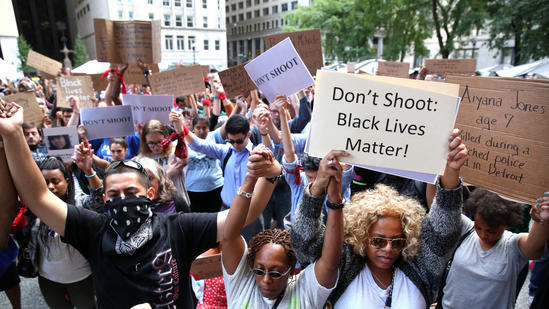
The news of the past two weeks has provided another opportunity.  With protests against the grand jury decisions in both the Michael Brown and Eric Garner cases continuing, our children, now in early elementary school, have encountered another difficult to understand situation regarding justice and racial profiling.  Both my wife and I are contemplating whether planned marches this upcoming weekend are events we want to go to as a family (my wife already went to a protest at Foley Square on the second day of protests).  And on Sunday, I was walking the children home from having gotten haircuts when we saw this:

I fumbled a bit as I tried to explain why that small group of people were singing hymns as they walked up the sidewalk — and why there were 3 police cruisers tailing what was likely a group of Unitarians who had just gotten out of church as several religious leaders across New York City had pledged to do.  So we sat the four members of our family, myself, my wife, our older daughter, and younger son, around our dining room table to discuss the situation.  I did not keep a verbatim record, so this is from memory.

I began by asking my daughter if she remembered anything about Dr. Martin Luther King Jr. from her MLK Day class last year.  She thought for a moment, and she told us that he had fought to change bad laws and that he wanted all people to be able to sit “at the front of the bus” so he organized people to not use the buses anymore until that changed.  We told her that she was correct, and that that was the Montgomery bus boycott which was part of a whole movement to change laws that were unfair to people.

The next part of the conversation was difficult.  Our children go to public school in New York City, and they have classmates who are African American, but while we have told them about Dr. King and his work, we never framed it as an issue of racism.  To break down their “innocence” on the existence of racism was hard to do, and I was reminded of the characters of Scout and Jem from “To Kill a Mockingbird” coming to realize that they lived in an unjust society.  I’ve always liked Atticus Finch, so I jumped in.

“Honey, what we’ve never told you is why Dr. King had to do what he did.  Have you ever noticed that some people you know have darker skin and others have lighter skin?”

They both said yes.

“The laws Dr. King fought against were ones that said that if you had dark skin, you had to sit in the back of the bus, or you could not go to the same schools as other children, or go to the same hospital, or shop at the same stores.  A lot of people back then thought that people with dark skin were bad and should not be able to live with people with light skin, and they passed laws to force people to live like that.  And a lot of people came together and fought those laws and changed them, and that’s why we honor Dr. King today — because he worked so hard to make our country a more just place.”

Our daughter asked if certain classmates of hers might have skin dark enough to be treated badly by those laws.  We told her that was probably true — but then warned her she could not talk to them about it because it was up to their families to explain this to them when they think they were ready.  We also explained that people whose ancestors came from European countries were often called “white” and that people whose ancestors came from Africa were often called “black.”  Our son was perplexed by this and held up  cup of milk and said “But THIS is white!” Pointing to his own skin, he said “This is kind of peach.”  My wife very lovingly affirmed his observation, but tried to explain that was how people talked even if it wasn’t exactly accurate.

We still had to explain the march we had just seen, however.  “Even though Dr. King changed a lot, everything isn’t all better.  Last summer, there was a man named Eric Garner — you should remember his name, kids.  He was approached by some police officers because they thought he was doing something he should not have done.”  Our kids asked what that was.  “They say he was selling cigarettes on the street, and you aren’t allowed to sell cigarettes unless you are a store, and he wasn’t allowed to do that.  The police wanted to arrest him, but they were too rough with him, they used too much force, and this is very sad, kids, but Mr. Garner died even though he wasn’t fighting the police.  And a lot of people, a lot of people, think the police should not have done that, and your mommy and daddy agree with them.”

At this point, our daughter began to look very sad, but we kept explaining.

“And just this week, it was decided that the police who were there when Mr. Garner died won’t have to have a trial in court to answer for what happened to him.  And that’s made a lot of people even more upset and angry, and they have been protesting this all over the city.”  I felt like I was stumbling, but decided to explain why this case was so difficult for so many people.  “The reason why this is all related to Dr. King is that a lot of times, some police are not very nice to the people with darker skin that they meet.  In neighborhoods were a lot of black people live, some police are too rough and stop a lot of people who are just going about their day and that’s wrong.  So people are saying that those police need to change, and that it isn’t good that a lot of people feel like they cannot trust the police.  Do you remember how we’ve always told you that if you are lost or in trouble you can go into a store or up to a police officer and ask for help?  Well, you still can, but there are a lot of parents in this city and all over the country who wonder if they can because they don’t think the police will help them.  We need that to change.”

I could tell that our daughter was wondering if any friends of hers were affected by this.  Our son was dumbfounded.  He told us that “Some police officers have dark skin. How can they treat people with dark skin badly?”

My wife affirmed his observation, and she agreed with him that it “didn’t make sense.”  She also told both of them that most police “are good people who took the job because they wanted to help people, and they do help people every day. But some of them do the wrong thing and we should not let them do that, so it is important to say something when wrong things happen.”

I also told the children that it was okay for them to still trust police, and that they should trust police and listen to them.  But at the same time they had to understand that “not everyone is going to have the same experiences that you have.  You have to know that because you live in the same city and the same country as people who really do wonder when they can trust that police will protect them.  And we should all make certain that we do whatever we can so people aren’t treated badly because of their skin color.”

Our daughter agreed and said that the mayor should do something about it.  My wife agreed with her, and explained that he was trying to do something about it.  “Did you know the mayor’s wife is black, so their children have dark skin.  The mayor was talking to the city about how he and his wife have had to talk to their children about what to do if a police officer ever treats them badly, and there are a lot of other parents in the city who have the same talk with their children.  All the protesters this week are saying it shouldn’t be that way — no parents should have to have that conversation with their children.”

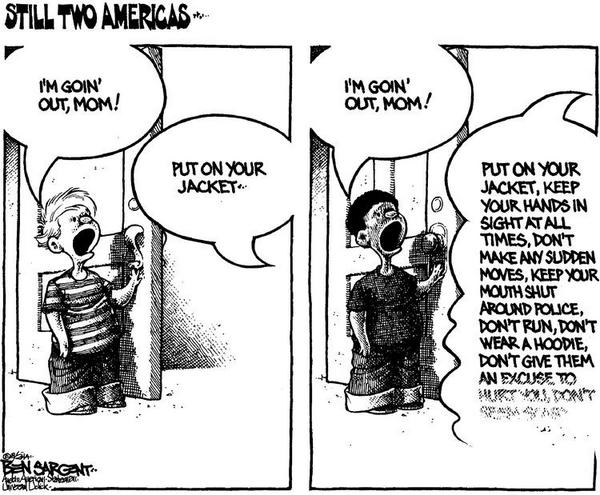
So our children have their blinders to racism removed, and time will tell just how much it impacts their thinking, but we cannot pretend they are innocent of it anymore.  And while it is painful as a parent to feel obligated to do so, it is far, far more painful for the 100s of 1000s of children of color in this city who grow up not knowing if they can trust the police to protect them or to persecute them…and for their parents who have to teach them the world is thus.  We discussed it with our children so that they can begin to understand the unjust differences between their expectations in life and the expectations of their schoolmates.  We discussed it because this cartoon by Ben Sargent describes those differences far too well:

still two americas

And if our children are going to ever help change that, they need to know about it.  They can understand it.  We need to know how to talk to them about it.

Which is a lesson, as a teacher educator, I need to be more active in promoting among my own students who will some day be teachers and whose practice of good stewardship will be vital for their future students.  Thinking about their own experiences, how they differ from so many of the young people in their care, and preparing to stand up for the dignity of those students inside and outside of school?  I have read many over the years who argue this is not the job of teachers, much like many argue young children cannot understand such complex issues.  Young children can — and teachers’ defense of their students is one of the most important tasks they can undertake.  It is all vital, and it is all related.

4 Comments

Filed under #blacklivesmatter, Activism, politics, Social Justice, Stories

What Does It Take For Justice?

For the second time in ten days, a grand jury convened to consider criminal charges in deaths of unarmed black men killed by police officers.  Last week, it was the St. Louis county grand jury that declined to indict Officer Darren Wilson who shot Michael Brown in Ferguson, Missouri.  This week, it was a Staten Island grand jury that did not indict Officer Daniel Pantaleo who put Eric Garner into a choke hold during an arrest for selling loose cigarettes.  Mr. Garner, who suffered from asthma and diabetes, repeated that he could not breath eleven times as the Officer Pantaleo continued to hold him around the neck and other officers pressed him against the sidewalk.  He died minutes later.  The entire incident was recorded on a cell phone camera.

Protests are going on in New York City right now as I write this, and protests are planned for tomorrow.  The back to back decisions by separate grand juries to not press any criminal charges against two different police officers in deadly confrontations with unarmed black men leads me to wonder what could it possibly take for an officer today to be held accountable for unjustified force and why these events keep happening to unarmed African American men.  It reminds me of a panel discussion hosted on NPR by Michel Martin on her show “Tell Me More” following the death of Trayvon Martin in Florida.  Her panel of African American men in broadcasting and journalism all discussed “The Talk,” a very specific conversation African American parents have with their sons about behaviors they have to avoid in public in order to avoid getting in trouble with the law.  The panelists wondered what could that talk say now in the wake of Mr. Martin’s death.  I can only imagine what they would say today.

I got the news on my way home from work, and for much of the evening, I kept finding myself looking at our kids, especially our son.  I kept thinking about the experiences that they will NOT have because of their skin color, and the momentary sense of of relief at that was repeatedly overwhelmed by unspeakable sadness and welling anger at the 100s of 1000s of parents in this city who cannot ever look at their own children with the same assurance.

It is past time to admit that the “broken windows” philosophy of policing has been a failure.  Communities that did not practice it saw similar drops in crime since the 1970s, but where it has been practiced, it has led to two generations of police trained to be aggressive and confrontational in the very communities they are meant to serve.  It has led to the vast majority of people in those communities to not be able to see police as allies in keeping the peace but as antagonists who confront and harass people abide by the law.  It violates their rights.  It puts them in danger.  And it makes police work harder and more dangerous — when police are trained to treat entire communities as suspects then how can cooperation and trust ever happen?  And when police departments nearly everywhere have become increasingly militarized, how can we avoid more and more tragedies born of tactics designed for war zones?

This isn’t a problem solely of how police have been trained to work in communities with higher crime rates.  It is a problem of what we who live in communities and neighborhoods not impacted by significant crime have demanded in order to feel “safe” from crimes that we have rarely ever been subjected to.  Our politics consistently rewards candidates who vow to be ever “tougher on crime,” leading to broken windows policing, mass incarceration, and vastly disparate incarceration and sentencing by race.  This has made a lot of people in low crime communities feel “safe” at the expense of the civil rights and hope for all elsewhere. And it has allowed opportunistic politicians to make bank bragging about how their brutal methods reduced crime while blaming communities victimized by those policies for any injustices they have suffered.

We are complicit in these injustices, especially if we keep mistaking grinding communities into submission with making society safe.

I have repeatedly written in this blog that education is a hope based enterprise.  It is exceedingly difficult to help a student learn if he or she has trouble having faith in a future where that learning will be respected and rewarded.  I can only think of two things this week that might provide some lift for those hopes.  Children and their communities need to believe that their anger is both justified and that it can become productively aimed at injustice.  And those of us not directly suffering those injustices need to start rewarding a different kind of leadership than we have for over 4 decades.

And those of us who teach? It is time to think about what it truly means to be stewards of the children in our care.  Will we challenge to comfortable?  Will we raise up the afflicted?  Will we be moral?

5 Comments

Filed under #blacklivesmatter, Activism, politics, Social Justice

Asking Hard Questions of Our Privileges After the Ferguson Grand Jury

Last week, the grand jury convened by St. Louis county prosecutor Robert McCulloch declined to indict police officer Darren Wilson who fatally shot 18 year-old Michael Brown in Ferguson, Missouri on August 9th of this year.  The decision, delivered after nightfall in a lengthy statement by Mr. McCulloch set off immediate, sometimes violent, protests in Ferguson, and has spawned protests in 170 cities across the country.  To many protestors, the grand jury failing to indict Officer Wilson confirmed a belief that our legal system is critically stacked against people of color in general and African American men in particular.  As the grand jury testimony and evidence has become public, a number of commentators and analysts have noted that Prosecutor McCulloch’s presentation to the grand jury, far from the normal conduct of a prosecutor seeking an indictment, appears specifically tailored to relieve Officer Wilson of any charges.  As a matter of record, I find those observations credible.

Prosecutors usually present a case to a grand jury to seek an indictment and tailor the presentation towards that result.  Prosecutor McCulloch instead declared that the case was too contentious, so he intended to present the grand jury with “all of the evidence” and allow them to sift through it on their own.  Such an intent plays well to popular prejudices towards even-handedness, but it is usually in a criminal trial, not a grand jury, where jurors get to hear “both sides” as presented by zealous advocates.  For a grand jury to be presented with “all of the evidence” absent any advocate for an indictment is extremely unusual.  Further, Prosecutor McCulloch’s statement on the grand jury decision raised serious questions about how hands off he actually was, and his apparent decision to let Officer Wilson tell his version of events to the jurors without any cross examination whatsoever characterizes Mr. McCulloch as giving the officer a friendly forum in which to tell his story.  That story, described by CNN legal analyst Sunny Hostin as “fanciful and not credible”, is contrasted by many of the witness accounts, but Prosecutor McCulloch’s statement to the press only mentions one witness who has offered contradictory accounts.

A week later, it seems very likely that Prosecutor McCulloch went into the grand jury with no desire to prosecute Darren Wilson, but instead of having the courage to state publicly that he would not seek an indictment, he decided to use the grand jury process to get that result with a veneer of due process.

Prosecutor McCulloch’s conduct of the grand jury fits into a larger pattern of both policing and the criminal justice system being antagonistic to people of color, and especially in communities that are predominantly of color.  The reactions that I have seen outside of the street protests, however, are indicative of a wider spread societal problem.  In a wide variety of fora, including ones that typically host reasonable conversations, responses to reporting, analysis, and personal discussions of the troubles with Michael Brown’s death, the larger phenomena that it represents, and the conduct of the criminal justice system ranged from the shockingly hateful to the naively hopeful but ultimately unhelpful.  The hateful reactions are immediately identifiable, and they seem to take the grand jury decision  as justification for something that they have believed all along: that Michael Brown was a “thug,” that he undeniably provoked the lethal confrontation, and that, ultimately, he is solely culpable for his own death.  Such sentiments frequently arise in cases like Michael Brown’s and Trayvon Martin’s, and it is painfully clear that a segment of our population will not accept anything less than a cartoonishly angelic victim before they will concede the least ground on justifying the death of an unarmed black man.

Naively hopeful but unhelpful is a more difficult nut to crack.  These often take forms of laments that race has to “enter the conversation” at all and express wishes that we could be a “color blind” or “post-racial” society where events like Michael Brown’s death at Darren Wilson’s hands are examined without having to consider what role race and racism may have played in it.  I see this wish in New York Times columnist Ross Douthat’s most recent column, where he observes that as the evidence in the Michael Brown case grew more complex that people “retreated” into racial divisions.  He front loaded his column with an assumption that America needs “color blind” politics:

Ultimately, being optimistic about race requires being optimistic about the ability of our political coalitions to offer colorblind visions of the American dream — the left’s vision stressing economics more heavily, the right leaning more on family and community, but both promising gains and goods and benefits that can be shared by Americans of every racial background.

I do not think that Douthat is malicious in this wish, but I do think that his sentiment is harmful, and that, for very good reasons, the question of whether or not we can look at our politics and power systems in America and be “blind” to color is only answerable with a hearty and emphatic, “No, we cannot.”

The wish for politics and policy that are “color blind” is a wish that negates the realities of how many of our citizens live on a very routine basis.  While aspiring to visions of our society where all benefit equally is admirable and desirable, to discuss it without affirming that there are existing social and institutional barriers to how millions can enjoy both equality of opportunity and equity in what they need to thrive is to ignore any possible paths towards that future.  In other words, Douthat’s wish for a “colorblind vision of the American dream” will do little good without a color conscious discussion of what exists today.  Professor Denisha Jones of Howard University offers incredibly salient advice on this and many other issues related to discussions of race and racism that are prompted by Michael Brown’s death.  Her comments on the pitfalls of “color blindness” should be taken very serious by people who mean well, but largely do not understand:

I am not sure when it began but at some point in our history colorblindness was created as the solution for dealing with racism. Some have believed that the best way to deal with racism was to be colorblind. If we were blind to race then we would not judge people based on the color of their skin. If we were blind to race then racism would not exist. As I mentioned before I used to subscribe to this belief and remember I am black (very black). I grew up in predominantly white communities and I thought the best way to fit in was to ignore the fact that I was black. But what I learned is that being black is not something I can ignore, it’s not something others can ignore, and it’s not something we should try to ignore.

Being born or raised in America means that we are acculturated to be aware of race. Young children notice racial differences and make assumptions based on those observations. They are aware that their community might not include any people of color. They are aware that only people who look like them attend their school. They are not colorblind. And neither are most adults in society. We notice the color of someone’s skin the same way we notice their gender. And noticing color, just like noticing gender is not a bad thing. Making judgments (prejudice) about someone based on their skin color is a bad thing but simply being aware that I am black is not something we should be blind to. Because it means something to be black in America. It means that I am a member of a group that has historically been disadvantaged simply because I am black. It means that I inherit a legacy of slavery, Jim Crow, and civil rights simply because I am black. So to be colorblind to my blackness is not the solution, it is the problem.

Trying to look at Darren Wilson’s encounter with Michael Brown absent any consideration of race ignores the daily reality many young men of color live with in their communities where being treated as if they are legitimately suspected of criminal wrongdoing while minding their own business is a common occurrence.  The peak year for “stop and frisk” in New York City was 2011, and according to the New York Civil Liberties Union, police conducted 685,724 stops that year, 87% of those stopped were black or Latino, and 88% of those stopped were entirely innocent of even misdemeanors.  So in 2012,  NYC police stopped mostly black and Latino men 605,328 times, found absolutely no wrong doing at all, but affronted the dignity and rights of citizens obeying the law.  Combine this with the appalling consequences of our increasingly militarized police tactics, and it is clear that our policy makers have long pursued policies that needlessly exacerbate and create tensions between police and the communities they are supposed to serve.  Largely, I believe, to play upon prejudicial fears of constituents who live in communities that are safe from most violent crimes, and who believe being this “tough on crime” is needed to keep them safe.

I suspect there is another reason, also discussed by Professor Jones’ article, that is behind the call to not consider race, and it is a desire to look away from the concept of privilege and the many ways that people possess a variety of advantages that exist, or do not exist, based upon who they are rather than upon what they have done.  Professor Jones notes how defensive many become when asked to consider privilege:

It also does not mean that you cannot be privileged in one area and disadvantaged in others. You can be a rich white male but also be gay. You can be a black woman but also come from a wealthy family. And you can be a poor white person and still experience white privilege.  So when someone tells you to  “check your privilege” what they are saying is to see how your privilege might blind you to the realities of others. I can be told to check my American privilege when I assume that the American point of view is the one only correct point of view. Or I can be told to check my education privilege when I assume that others who do not think like me or not as smart as I am. And when a white person is told to check their privilege they are being asked to remember that their reality is not the reality shared by many people of color.

It can be difficult to come to terms with privilege for many reasons.  As Professor Jones explains one can mistake the idea of having privilege based on race as an attempt to negate a disadvantage based upon economics or gender.  More troubling, recognizing how one exists in a system of privileges means having to increase awareness of how one might, even inadvertently, perpetuate injustice.  I have often heard the idea of racial privilege being countered by the claim that anyone can be racist, regardless of race, and so the idea of racial privilege is not valid.

I’d like to offer a personal anecdote that, I believe, illustrates the problems with that counterpoint.  It was a few days before the Presidential election in 2008, and I was pulling into a gas station on my way to work.  I usually drive through a predominantly African American small city, and the gas station was on a main street in that town.  As I pulled up to the gas pump, I heard a loud car horn, and I looked up to see a car with an African American gentleman in the driver seat gesturing angrily at me from about 20 feet away from the pump.  Apparently, he was preparing to pull up to the pump from the opposite direction, and I had not noticed as I began to pull in. I put my car into reverse and backed out of the space to let him pull his car in and expected that would be the end of the situation. Unfortunately, the gentleman was not satisfied, and he got out of his car and continued to yell at me, making sure that I knew the “We’re getting a new President next week and we’ll take care of people like you.”  His animosity struck me as rooted in something much deeper that the assumption that I was trying to take his space at a gas pump.

Describing the encounter, I have had more than one person opine that the gentleman’s “racism” was unfortunate, but this is where the concept of privilege is salient.  His anger at me was certainly unpleasant, even unsettling.  His apparent assumption that an African American President would “take care of” people like me was problematic.  I did not like the way I felt immediately after that confrontation.  But his anger and potential animosity based upon my race did not and has not cost me anything.  There were no long term consequences to his assumptions about me.  I have been denied no professional or social advantages.  There was no personal or systemic power that gave this man’s anger any ability to do more to me than make my morning unpleasant.

I, on the other hand, have some substantial power within my professional environment.  I am a professor of education.  I am tenured.  I am a program director at my university.  In order for students at our university to become credentialed high school teachers, they have to take at least two courses that I teach.  If I have unexamined prejudices, those can potentially stand in the way of a young person and his or her chosen career because those prejudices would be backstopped by the power of my institution and validated by the state Department of Education and national accrediting bodies that recognize our programs as valid paths towards becoming a teacher.  Now I have worked hard to have the position at a university that I have, but that hard work does not negate the very troubling reality that I am in a position to keep someone from having a career – and that any prejudices that I leave unexamined and unchallenged can transform from biases to injustice.

Further, and this can be difficult to remember and to confront, despite my hard work to be where I am today, various kinds of privilege assisted me along the way, especially in school.  I am white, so I have never had to convince teachers that I am academically capable despite my race, nor have I been subject to unequal application of near zero tolerance for any rule breaking potentially as early as preschool.  I am male, so I have not had people or cultural stereotypes actively or passively discourage me from considering entire fields of study, discouragement that I actually witnessed applied to female classmates of mine in high school.  I grew up in an upper middle class suburb, so the schools I attended were adequately funded with fully maintained facilities and good class sizes, and my family’s position in the middle class means that a multitude of institutional and social barriers children in poverty face simply did not exist in my life.

None of this means that I did not work hard or genuinely achieve in school, but it does mean that I cannot credit my success solely to that work, and, more importantly, it means that as an educator, I cannot do proper justice by my students by being “color blind” or “gender blind” or “poverty blind”.  Doing so would mean ignoring the real challenges to equity and opportunity that exist in every classroom in every community in the country.  Doing so would increase the chance that I leave my own biases and prejudices unexamined and unchallenged.  Educators have a special professional and ethical obligation to recognize and to confront these issues in our own teaching and in the institutions in which we work.  Anything less is an abdication of our responsibilities.

If we learn only one thing from what we have witnessed in the Ferguson case, that would be a good start.

3 Comments

Filed under #blacklivesmatter, Media, politics, schools, Social Justice, Stories

Dear Randi

Dear Randi Weingarten,

You do not know me, but we have crossed paths on Twitter and education blogging circles.  In fact, I think you have kindly retweeted some of my writings to your followers on a few occasions.  I am writing because I have been following your political actions for some time in this election cycle, and while I think I understand what is motivating a great deal, I am concerned that as the leader of the American Federation of Teachers’ 1.6 million members you have been too willing to accept a “seat at the table” with politicians and foundations, a seat that has come at the expense of the rank and file.  I do not believe this has been your intention, but I also think that it is necessary to question whether or not politics as usual has broken down, whether or not having a seat at the table is worth the comprises necessary to get there. I respectfully suggest that this is one of those times.

Many of the bloggers and education activists I read have been very harsh towards you in their assessments.  Those assessments are based upon what they see as a long series of actions demonstrating a willingness to play ball with so-called reformers and to negotiate for changes in matters like teacher assessment and compensation and the Common Core State Standards.  Mercedes Schneider pulls few punches in this piece detailing cooperation with Eli Broad, the Gates Foundation, and other forces in education reform who have sought to weaken unions, pushed for unregulated charter schools, advocated evaluating teachers using standardized test scores based on the CCSS, and advocated to institute performance pay using those same measures. Blogger Jersey Jazzman wrote you an open letter in 2012 about the Newark contract, making predictions that have pretty much come true.  I know other bloggers and activists who’ve openly pondered nefarious reasons for your willingness to cooperate with people and institutions that have been demonstrably disruptive forces in ways that have rarely been beneficial for schools.

I’d like to make it clear that I do not share that negative assessment.

There are two polar opposed views of how unions ought to deal with efforts like the current reform movements.  The first, which is certainly familiar to many, is best described as following the maxim that if “you let the camel’s nose under the tent, the rest of the body will follow.”  In this view, any concession given to reformers means that a constant wave of detrimental ideas will follow, so union leaders should fight tooth and nail to keep them from happening.  It probably will not work 100%, and the public relations will be difficult to manage, but if reformers keep getting bloody noses, fewer of their ideas will come to fruition.  The other perspective, perhaps more popular in the post-World War II period, believes that having a “seat at the table” is important and more valuable in the long term than constant brawling.  In this view, trade offs have to be made so that policy can be guided into less harmful directions because policy makers only listen to insiders and policy will be made with or without your input.  The stance is less viscerally satisfying, but if the seat at the table is genuine, there is potential to have actual impact without subjecting rank and file and their students to constant turmoil.

I will admit that I see the wisdom of the less confrontational stance.  Policy will be made, and we live in an era when union power has been greatly diminished by loss of membership and political figures willing to attack unions.  If the union leadership is fully shut out of the inside of the political process, then the people who will be left will be lobbyists representing corporate interests and a growing cadre of the super wealthy who have discovered that they enjoy bending politicians to their will far more than they enjoy endowing hospitals and art museums.  In the absence of union leadership with any insider capacity, politicians and plutocrats will bend everything to their will without a voice representing the rank and file even within earshot.  This is not a position of purity, but it promises to keep balance.

There’s just one problem with this perspective.  It only is operable when the place offered at the table is genuine.  If the owners of the table only plan to shoot you underneath it, then preserving your seat can no longer be a viable priority. I respectfully suggest that today is such a time, and that the only move that truly serves your members is to walk away from the table that is populated by people acting in bad faith.

The first evidence of this is the absurd and personal campaign against you by Richard Berman.  As you know, Berman is a political consultant whose preferred tactics are so bottom feeding and vicious that an oil industry executive listening to him talk felt the need to expose him for type of operative that he is.  Berman has spent most of the past year coordinating a direct assault on teacher unions generally and you specifically, relying on hyperbolic tone, misleading information, and a staggeringly personal content.  I must note that you have been dignified, forceful, and inspiring in the responses I have seen to Berman’s attacks, but I also must note that there is a lesson in the mere existence of his campaign.

Berman works for corporate interests, and although he will not disclose his donors, it is not hard to guess the kinds of people behind him.  After your cooperation with Eli Broad on some issues and after your personal efforts to support the standards side of the Common Core, it would be atrocious for his funding to be coming from Broad or Gates, but there is no lack of other corporate interests from the Walton Family Foundation to the Koch Brothers to the Rupert Murdoch to Michelle Rhee’s Students First who would be more than happy to take up the cause.  And why would any of these people and foundations be eager to engage in such a puerile attack on you?  Well, you’ve stepped out of line.  You’ve warned reformers that their obsession with testing and evaluating teachers by tests have put the Common Core State Standards in trouble with teachers and parents.  To me, this was overdue because Race to the Top had super glued testing the standards from the get go, but for your supposed friends in reform, this kind of talk about the obvious is a betrayal.  Worse from their perspective?  You have defended teachers and their union won workplace protections from the lawsuits seeking to strip them from all of our nation’s teachers, and you have been willing to criticize supporters of the suits in public.

I’ve heard and read your defenses of tenure.  They have been eloquent.  They have been factual.  They have been passionate.  And they must be unforgivable to the types of people who hire the likes of Berman. It is fairly obvious that he was hired to “soften you up” prior to the Vergara lawsuit ramping up, and he has been charged with keeping up his attacks as you’ve defended teachers since then.  What’s the lesson here?  You are only favored by corporate reformers and their political allies as long as you stay entirely within the ranks.  Take a step out of line, and well, you are on billboards as the enemy of America’s children and subject to junior high pranking on social media.

More egregious, however, has been the steady stream of betrayals of teachers and schools by politicians who have been wooed by steady infusions of corporate cash and have participated in starving public schools of funds, forcing the CCSS, testing and test based evaluations into schools, and who have promoted charter school policies that concentrate high levels of disadvantaged students into the same district schools they have starved of funds.  Worse, these betrayals have come from Democratic politicians who have traditionally enjoyed strong labor support, and who, in public, claim to be allies of school and labor.  Republican Governors like Chris Christie of New Jersey and Scott Walker of Wisconsin have been incredibly hostile towards teachers and their unions, but they have also been forthright about their oppositional stance.  Meanwhile governors like New York’s Andrew Cuomo and Connecticut’s Dannel Malloy and mayors like Chicago’s Rahm Emanuel, Newark’s Cory Booker (now U.S. Senator from New Jersey), and Kevin Johnson of Sacramento have pursued public school policies harmful to teachers and students — even if some of them go through the motions of courting traditionally Democratic Party constituencies.

Governor Andrew Cuomo of New York has perhaps been the worst.  Governor Cuomo has continued to use the Gap Elimination Adjustment to balance his budget on the back of our schools.  Districts cannot make up the difference in lost school aid with local funds due to his property tax cap.  Governor Cuomo plays favorites with charter school operations that further disadvantage local schools and then attacks those local schools and teachers for poor test performance. Governor Cuomo’s education commissioner went out of his way to set the cut scores on state exams so that only 30% of students would be rated as proficient.  His record has been so damaging that the UFT took the extraordinary step of not making an endorsement in the 2014 gubernatorial election, and while many rank and file members would have preferred a stronger stance to endorse an opponent, it was an important step to publicly acknowledge that teachers in New York have no friend in the Governor’s Mansion.

It is because of these reasons that myself, and many others, were sorely disappointed by your tepid public response to Governor Cuomo’s latest outrage that he sees our system of free common schooling as a “public monopoly” that he wants to “break” and that he believes our state’s hard working teachers do not want to be evaluated.  He signaled not only his plans to double down on the destructive path of privatizing and testing, but also his utter disregard for teachers and the public purposes of education itself.  In response, you told reporters that his statements were most likely “campaign rhetoric” and that you had sent him a private letter explaining his errors.  To call the governor’s statements “campaign rhetoric” is to suggest that he is not entirely sincere in those statements and has tailored them for a political purpose, but I have to ask what in this man’s record suggests that he does not fully believe everything he has said?

Your statement reminded me of segment on WNYC’s Brian Lehrer show on October 31st.  On it, Working Families Party co-chair Karen Scharff and actress and activist Cynthia Nixon made the case for people to vote on the W.F.P. line even as the Governor had appeared in the hour before them, implicitly insulting the Working Families Party in favor of his newly created Women’s Equality Party line on the ballot:

“We’ve formed every kind of fringe party for every kind of reason,” the governor said. “We have Democrat, Republican, Green, red, white, blue, working people, working short people, working tall people. We’ve never had a women’s party.”

Many observers believe that the Governor created the W.E.P. line for no other reason than to siphon off votes from the progressive W.F.P. and possibly lead them to lose their ballot line in the future, and they believe he did this because the party made him fight for his spot on their line.  Karen Scharff and Cynthia Nixon made the case that if people voted on the W.F.P. line, they would remain a force in state politics and keep pressure on Governor Cuomo to be the “better Cuomo that we know is lurking inside…”

The thing is that I do not “know” that there is a “better Cuomo,” and I do not believe that anyone can make such a Cuomo show up.  When he has stood for traditional Democratic Party issues they have been issues that carry almost no political risk in this state: gun control, abortion rights, and marriage equality.  While those are significant, it is very clear that when it comes to fiscal policy and our public education system, he is taking his cues entirely from the corporate financiers of his campaigns. When a sitting governor takes 100s of 1000s of dollars from the backers of a single charter school chain, then manipulates circumstances to humiliate a mayor seeking funding and support for universal pre-K, and then enshrines forcing New York City to pay the rent for those schools right into the state budget — then we know full well that he has no intention of playing fair with our schools, our teachers, and our children.

I have seen you on Twitter stating that elections are “about choices,” and perhaps you believe that the Republican opponents to these Democratic Party privatizers are even worse.  You might be right — in the short term.  In the long term, however, it will be even worse if the Democratic Party continues its head first slide down the path of mass standardized testing, invalid teacher evaluations, mass teacher firing and school closings, selling off our educational commons to charter school corporations, and the breaking of one of the last unionized middle class professions in the country.  A Republican candidate may be hostile to teacher unions as well, and may deny teachers and their representatives a seat at the reform table, but I have to ask how is that any worse than being invited to that table only to be betrayed again and again?

Elections are, indeed, about choices, and perhaps 2014 and forward is the time to choose better candidates and to actively oppose those who are eager to sell off our educational commons no matter their party and no matter how they will respond if they make into office over our opposition.  The vote is one of the remaining democratic mechanisms that can still work in an age of dark money elections and politics.  Influential billionaires may own politicians’ ears in between elections, but those same politicians have to get past the voters, and we need strong voices to roundly condemn those who have betrayed public education to forces that seek to profit from it instead of nurturing it for the benefit of all.

When the seat at the table is a farce, we still have the ballot box and the picket line.  I urge you to consider what roles they have in the years ahead.

Sincerely,

Daniel S. Katz, Ph.D.

Public School Graduate

Lifetime Educator

Father of Two Public School Children

Addendum: After I published this piece, Randi Weingarten, after a day of travel, posted this piece on the AFT web page about the “difficult choices” facing New York voters.  The statement insinuates that Ms. Weingarten will not be voting for sitting Governor Andrew Cuomo, and while she describes the problems with the Republican challenger Rob Astorino, she is very firm with the Democrat:

It’s heartbreaking to see what’s happening in New York, especially after campaigning across the country for gubernatorial candidates who unequivocally support public education, respect teachers and will fight for the investment our schools need.

But in New York, the decision is painful. I am deeply disappointed and appalled by Gov. Cuomo’s recent statement that public education is a “monopoly” that needs to be busted up. (Frankly, it’s only hedge fund millionaires, right-wing privatizers and tea partiers who would use that terminology.) Public education is a public good and an anchor of democracy that is enshrined in our state constitution. Public education needs to be nurtured and reclaimed.

Ms. Weingarten concludes her statement by saying, “It’s well past time to fund our schools, care for our children, support our teachers, and stand up for workers and working families everywhere in our state.”

I wholeheartedly agree, and I sincerely hope that this signals a willingness to challenge Mr. Cuomo much more vigorously.

8 Comments

Filed under Activism, charter schools, Cory Booker, Gates Foundation, politics, schools, Unions

New York Times Ignored Teacher Input on Eva Moskowitz

The September 7th New York Times Magazine ran a story by Daniel Bergner called “The Battle for New York Schools: Eva Moskowitz vs. Mayor Bill de Blasio”.  Bergner’s piece reads as an astonishing piece of hagiography to appear in the paper of record, ignoring any substantive argument about Ms. Moskowitz’s schools and repeating without critique her organization’s point of view.  Mr. Bergner did make note that he had spoken to critics of Ms. Moskowitz’s approach, notably Dr. Diane Ravitch of New York University whose input he represents thusly:

When I talked with her, Ravitch indicted the hedge-fund titans and business moguls — including Kenneth Langone, a founder of Home Depot, and the Walton family of Walmart — who put their weight behind promising charter schools, leading their boards and lending political clout. “When they call themselves reformers,” she says, “it’s something I gag on.” What these philanthropists are all about, Ravitch says, is making themselves feel good while using charters as a halfway step in a covert effort to pull the country toward the privatization of education. For charter opponents, liberalism is in jeopardy. And from this perspective, Moskowitz, with her results and her readiness to trumpet them, poses the greatest risk.

Knowing something of Dr. Ravitch’s criticisms of charters schools generally and of Ms. Moskowitz specifically, this struck me as an odd and likely incomplete representation of her input.  Sure enough, several days after publication, Dr. Ravitch responded in her own blog at some length. According to Dr. Ravitch, her conversation with Mr. Bergner was not represented in the published article:

I spent a lot of time on the phone with the author, Daniel Bergner. When he asked why I was critical of Moskowitz, I said that what she does to get high test scores is not a model for public education or even for other charters. The high scores of her students is due to intensive test prep and attrition. She gets her initial group of students by holding a lottery, which in itself is a selection process because the least functional families don’t apply. She enrolls small proportions of students with disabilities and English language learners as compared to the neighborhood public school. And as time goes by, many students leave.

The only Success Academy school that has fully grown to grades 3-8 tested 116 3rd graders but only 32 8th graders. Three other Success Academy schools have grown to 6th grade. One tested 121 3rd graders but only 55 6th graders, another 106 3rd graders but only 68 6th graders, and the last 83 3rd graders but only 54 6th graders. Why the shrinking student body? When students left the school, they were not replaced by other incoming students. When the eighth grade students who scored well on the state test took the admissions test for the specialized high schools like Stuyvesant and Bronx Science, not one of them passed the test.

She goes on to note that in addition to the phenomenon of selective attrition, she also discussed high rates of teacher attrition at network schools, but that Mr. Bergner argued with her instead of interviewing her.  Dr. Ravitch also notes that Mr. Bergner used different language than she did when discussing the issues with him, and all of her points about selective attrition were either ignored or glossed over with talking points that reflect Success Academy’s standard public statements.

While Dr. Ravitch has a platform to illuminate the distressing puffery that made it to the New York Times magazine posing as a multi-sided examination of a contentious public issue, a reader would be hard pressed to know that Mr. Bergner actually spoke to public school teachers who work in fully public schools that are co-located with Success Academy schools.  The sole hint of input is presented here:

That attitude (Moskowitz’s)  infuriates many teachers at regular schools. When I spoke with a handful, they used words like “metastasize” and “venal” to describe Success Academy’s proliferation. That Moskowitz’s wealthy board members choose to highly reward her track record — her salary and bonus for the 2012-13 school year totaled $567,500 — only adds to the union’s fury.

What is astonishing about that brief mention focused entirely upon a few potential epithets and alleged jealousy of Ms. Moskowitz’s salray is that Mr. Bergner DID speak with teachers who work in co-locations with Success Academy schools.  In fact, he spoke at length and clearly decided to disregard their input almost entirely. I am fortunate to know one of those teachers through local teacher advocacy groups, and she agreed to inform me about her discussions with Mr. Bergner and to share what it is like to be a teacher at a school where Ms. Moskowitz has claimed classroom space for her students.  Her name is Ms. Mindy Rosier, and she is a teacher at P.S. 811, the Mickey Mantle School, a special needs school within P.S. 149 in District 75.  They have been co-located with Success Academy since 2006, and this Spring, she and her colleagues found themselves in the center of the storm when Mayor de Blasio decided to not allow three previously agreed upon co-locations for Success Academy expansions.  The resulting highly public battle resulted in a 6 million dollar ad campaign accusing the mayor of throwing Success Academy students out of their schools, all funded by Ms. Moskowitz’s Wall Street supporters, and it culminated in Governor Andrew Cuomo helping coordinate a pro-Moskowitz rally in Albany that resulted in the city of New York being bound by the state budget to provide co-locations or pay rent for all charter schools.

Ms. Rosier was kind enough to answer my questions about what she thinks people in NYC need to know about the consequences of charter school co-locations awarded to Success Academy.  Much of this was what she told Mr. Bergner in a 45 minute long conversation whose content never made it to the New York Times Magazine:

Can you explain the school where you work?  Who are your students and what is the mission of your school?  

My school is PS811 at PS149. We are an additional site to the Mickey Mantle School family and we are also a part of District 75. My school site serves over 100 children with autism, learning disabilities, emotional and psychiatric disorders in a low income area in Harlem. Harlem Gems also have some rooms in our building. We all get along really well, with the exception of Success Academy.

The following is our mission statement;

The core values of P811M are articulated and expressed by a family of dedicated professionals committed to educating the whole child with integrity, compassion and respect. Our collective community effectively implements instructional practices geared to the individualized achievement of students’ social, emotional and academic goals. Each child’s individual assessment data informs this instruction. It is our goal to lead students towards maximum independence. With this independence, disabilities are turned into abilities.”

How did the co-location with Success Academy happen?  Were there discussions with parents and faculty/staff?  Do you know how it was decided to co-locate at your school?

Our site opened the same time as Success Academy began. It is my understanding that at that time, space for all was agreed upon. They had a certain amount of classes on one floor in one side of the building. I was hired at that school during the same time, so I am unaware of any other previous discussions with faculty/staff and parents. I don’t think anyone had a problem with that co-location then, but then again we had no idea what was to come.

How did the co-location process work?  Did you have any input into how the building would be divided between your school and Success Academy? 

At first, everything was fine. Then, over the next several years, they have requested more and more space from us. Up until last year, I did not know what the process was. I know our teachers did not have a say in this, and I really don’t know what the involvement of my admins were. I do know that just for one year, our former Chapter Leader (who now works for the UFT division for District 75 schools) was able to prevent more expansion on her part. Overall, we lost two floors that included classrooms, our library, our music room, our art room, our science room, and as a matter of making up one classroom, we lost our technology room as well. P.S.149 was so nice and offered us some available rooms at that time. Since, Success Academy has also expanded on their side and they lost an entire floor. So by last year, we had NO free space and P.S.149 was and is crunched for space as well.

Do the schools ever share any parts of the facilities?  If yes, how does that work out most of the time?  If not, do you know why?

We are NOT allowed on their floors. However, they always go through our hallways. Because of overcrowding and for safety reasons, they were told not to walk through a certain hallway during our dismissal times. My understanding was that they were not too happy about it and I have observed this still happening a couple of times over the years. All schools share the auditorium. In order to reserve time, coordination needs to be done. When Success Academy is using the auditorium, it is usually closed off to all others. Since our building is of a decent size, many of us cut through the back of the auditorium to the other exit to get to the P.S 149 side. (We have 3 classes on their second floor as well as a speech room and a resolution room.) So many times, when SA puts on a show or an event, it is very loud! There are two sets of doors that lead to the auditorium from our hallway. We have several rooms including classrooms close by. They have no problem keeping those doors open, disturbing our classrooms and other rooms. My office happens to be near there as well. So many times I have gotten up to close those two sets of doors. Sometimes I got looks doing so, but I didn’t care. We were all being disturbed. Noise levels do not have to be that loud. Even with the two doors shut, you still can here them. We just make do, like every other time. We do share the lunch room. In the mornings, SA has their breakfast first and then we do. There is another lunchroom on the P.S.149 side and also because of scheduling, their lunch begins around 10:40. On our side it is 11:30. Whether or not lunch staff starts on time, we have to be out of there just shy of 12. Our standardized students then have recess for a half hour, and then our alternative students have the next half hour. On Wednesdays, Success Academy has early dismissal. They are supposed to come out at 12:30. They exit through our playground. For the most part, they are already lined up to leave as we are heading back in from recess. There have been some occasions where at least one of their classes had come out really early. It was about 12:15 and my assigned class were in the middle of a kickball game. I yelled out several times to that teacher to please hold off, it is still our time. I know I was loud (that’s the Brooklyn in me) so I am pretty confident she heard me but chose to ignore me. My students LOVE recess and when they saw they had to end the game early they got upset very quickly and behaviors escalated. Me and one other para(professional) were trying our best to calm them down. There was another para who had gone inside earlier with another student because of a separate issue. When I saw that para come out, I yelled to him to get help which he did. This was a 4th grade class of about 12 who are all emotionally disturbed and learning disabled.  It was such a difficult situation. Some students had to be separated because their anger looked like it was going to lead to some fights. My lunch was next period, and I immediately informed my Assistant Principal. In front of me, she called their principal. I also had to write up several incident reports.

Now back to our lunchroom….our lunchroom is also our gym. Right after breakfast, it is cleaned up and the tables are folded and pushed to the sides. We have access to this space all mornings. Now the afternoon is a different story.  SA uses the the lunchroom in the afternoons. If P.S.149’s gym is available, they have been nice enough to let us share it. Otherwise adapted phys ed is done in the classrooms. Our gym teacher is wonderful and he has been great adapting to this situation. However, these are kids, kids with special needs, and they need to run a bit.

What changes have you seen in your work and your students’ educations since co-locating with Success Academy?  What do you think accounts for that?

We have done our best over the years to make sure that our students’ education has not been compromised in  any way. However, our students as well as those in P.S.149 have picked up on the fact that we are all treated differently from them by them.  Their teachers sometimes very obviously, have always looked down at our students even us teachers. I have tried to give them the benefit of the doubt that they are new teachers and they may just not understand what our students are going through. However, that is no excuse to give us looks or ignore us for simply saying “good morning.” There have also been some times where as I was passing, some of the kids have said “hi” to me. I love all children and without even realizing it I always acknowledge their presence even if it just a smile. I remember one time in particular those kids seemed so happy that I made their eye gaze, so I quickly said “hi” to them and slowly kept on walking by. A few of them said “hi” back and proudly told me how old they were. I would have loved to engage with them but they are not our students. Their teacher snapped at them to be quiet and to stand correctly on line. I felt so bad and I did look back. I didn’t want anyone in trouble for me simply saying “hi.”

Could you explain any changes to the environment/culture/feeling of the building during that time?  What do you think accounts for that?

There is definitely and us vs. them feeling in the air. I’ve been told that they have shiny clean floors, new doors, fancy bathrooms, etc. Meanwhile, we have teachers who have bought mops and even a vacuum cleaner to clean their rooms for they feel what is done is not efficient enough. Near our entrance, we have an adult bathroom. It is for staff and our parents. Success Academy parents as well have used it. For many months that bathroom went out of order. Honestly, I am not even sure it is fixed yet, but after all this time, I really hope so. So we would have to either use the closet of a bathroom in the staff lunch area or use one of the kids’ bathroom when it is not in use. You and I know that had that been an SA bathroom, it would have been fixed by the next day. SA also throws out tons of new or practically new materials often. At first, some of their teachers would sneak us some materials thinking we could benefit from it. They stopped out of fear. With all the great stuff that they have thrown out, they got angry when they found out that teachers from P.S.149 and I believe some of our teachers too would go through the piles and take what we could use. Well, now they only throw out their garbage shortly before pick up so that no one could get at it. Nice, right?

We have all seen them get Fresh Direct deliveries. Our kids too. Our students have a general feeling that SA students are special based on how they walk around and how they are personally treated either by looks or sometimes comments. Our students may be special needs, but they understand to a point that feeling of us vs. them. We do not at all refer to things that way at all.

It truly is sad. We are a school with teachers, other staff, and students. We are all supposed to be here for a reason. It is beyond me that this has been such a battle.

This past year teachers and other faculty were very angry. Once I heard about SA’s plan to take over last September, that’s when I started to get involved. Enough was enough. In October, I attended a hearing in my school building, I went to that Panel for Education Policy (PEP) in Brooklyn a week later, and subsequent to that, I have been a part of rallies and press conferences, etc. as I have detailed in my email. All of what happened at my school has led to my educational activism. I have read so much over the years. The more and more I read, the angrier I got. The Alliance For Quality Education has done so much for our school in order to save it and for that I am very thankfully to them and I still maintain a very good relationship with them. I was introduced to MORE (Movement of Rank and File Educators) in late April, and I now sit on its Steering Committee, committed to do right by our teachers and students. Instead of just being angry as I have been for so long, I finally did something about it by being proactive. I do have to say, since my activism began, I have made tons of new like-minded friend and I am grateful of that too.

Why do you think Eva Moskowitz and Mayor Bloomberg agreed to further expansion of Success Academy in your building?  What would you say to them about that if you could?

Oh, boy! I believe they are friends and that they run in same circles. They did not care, never did. When we went to that PEP in October, about putting through those charter locations, it was like nothing I have ever seen before. It was my first one. The room was packed with teachers from so many different schools. There were parents, students, and various community leaders including Letitia James and Noah Gotbaum. People were ANGRY. So many plead their case for two minutes at the mic, some with heart wrenching stories, and all the while the panel was very busy playing on their phones, looking bored and disinterested. It was disgusting. You could hear so many people yelling, “Get off your phones!” I did not speak at this PEP ,but a dear coworker did.  I hadn’t found my voice just yet at that time. She tried to give an impassioned speech and when they did not even look at her, she called them out on it and was STILL ignored. It sure seemed to us that the fix was in. Money and power talks and all else suffers.

How could you be so heartless? How can you say you are for all children when you have thought nothing about our community’s most vulnerable children, just willing to toss them aside like trash? A population that you refuse to educate and have sent as cast-offs our way? Knowing our building did NOT have any free space, why did you purposely choose to expand here? Why were parents lied to? Why did you perpetuate lies in the media and to the general public?  These are just some of the questions I would ask her (Eva Moskowitz) based solely on what she tried to do to my school. Trust me, there are so many more that we all have been asking her for a long time.

On the Families 4 Excellent Schools’ page on Facebook, I have gone back and forth with many, and most of those were parents. They had no clue as to what the truth was. So instead of them doing their homework, it was easier to call me a liar, a racist, clueless myself, etc., etc. I didn’t go on there to bash Success Academy. I went on there to inform them of the truth that was completely hidden to them and the general public.  After a while, I just had to stop. It was like beating my head against the wall. Moskowitz seems to be this cult-like figure to parents and they adore her. I have even heard her be called a savior!

As for Bloomberg, I used to like him, but that obviously changed.  Apparently, he came to our building several times to visit SA but never us. We never said “boo.” However when Farina came to our school for a quick walk through to see our space situation during this whole debacle, it became front page news in the NY Daily News with Farina’s big picture and bold letters SNUBBED.  Something to that affect, I don’t remember exactly. SA was pissed that even though she had a specific purpose for her visit to us, she did not go to visit them. She “snubbed” them and that made the front page! Honestly, I think I would simply ask him, “Why did you put money, politics, and power over the welfare of our beautiful special needs children?”

What do you think about the presentation of your concerns in the New York Times article that ran in the September 7th magazine?  Is there anything you think the reporter ought to explain to you and your fellow teachers?

I was beyond angry. I have no problem taking time out to talk about concerns I have, and on those things that I am passionate. I spent a considerable amount giving very specific facts, and they were all ignored. Other teachers were ignored. Parents were ignored. We all gave verifiable facts, but that did not matter. I personally feel that a good reporter should report both sides of the story. Way too many reporters and various mass media outlets have failed us, our school. our students, their parents, and the general public. I want to know why he blatantly ignored all of us and deceived the general public? Important information that I feel everyone should know, instead of blindly praising a woman with obvious deceitful tendencies simply because they have higher scores. There is a reason for that and the public needs to know the actual truth. Isn’t writing about and printing the truth Reporting 101? We ALL deserve a public apology with answers to the questions I have mentioned.

We need more reporters like Juan Gonzalez who is not afraid to tell the truth. He has posted several articles on SA, even one that had a focus on our school. He is one out of how many? AND because of all the faulty and biased information out there, when he does write something, he does not get any respect and he has been bashed.  “How do you say such things about Moskowitz and her schools?”

I’m mad as hell, and I’m not going to take it anymore!

###

Ms. Rosier has also written to the New York Times and Daniel Bergner to express her surprise that none of her conversation made it into the article, and to remind Mr. Bergner what she had said to him.  As of today, the letter has not appeared in the Times, but Ms. Rosier provides the text of it here.
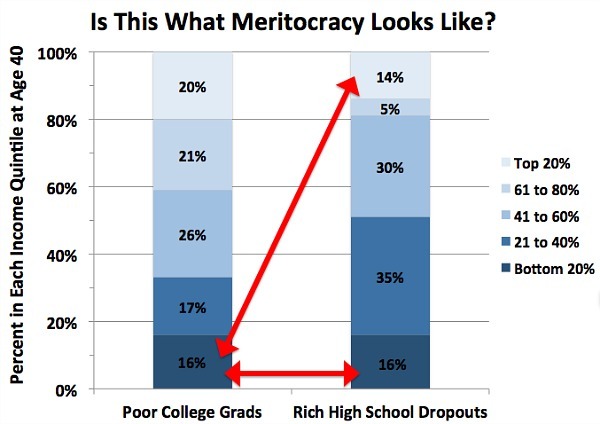
26 Comments

Filed under Activism, charter schools, Media, Stories, Unions

How to Spot a Fake Grassroots Education Reform Group

One problem with today’s education reform environment is that a number of groups exist that call themselves “grassroots” organizations, but which have expanded rapidly because of large infusions of cash from corporations and foundations invested in pushing charter schools, mass high stakes testing, data mining students and the Common Core standards.  These groups do not exist to represent the organically derived priorities and shared interests of students, teachers and parents; they exist to put a more credible face on the priorities and shared interests of a very narrow but astonishingly influential set of repeating characters.  Take Educators 4 Excellence as an example.  On their website, they tout that they began as “two teachers” and wanted to give teachers a voice in a system that imposed changes from the top down, and now they are growing into 10 of 1000s of teachers in multiple states. What don’t they mention?  That they are funded by The Gates Foundation, which is not really a surprise because a) Gates has been funding a lot of similar efforts and b) their “pledge” includes evaluating teachers by value-added testing models (something Gates really, really likes) and supporting “choice” which is reform jargon for charter schools (something hedge fund managers really, REALLY like).  The group was central in the not-entirely-successful #supportthecore  social media campaign, and former Connecticut legislator Jonathan Pelto writes here about more of their rather miraculous funding.

When I was in high school, soap actor Peter Bergman did television ads for Vicks cough syrup with the tag line “I’m not a doctor but I play one on TV.”  At least he was upfront about it.

A few days back, The Washington Post ran a story about the founding of “Education Post” which is claiming to be a new source of information about topics in education that will avoid the supposed rancor in current public conversations.  To her credit, reporter Lyndsey Layton did report that it is funded by the Broad Foundation, Bloomberg Philanthropies and the Walton Family Foundation and is headed by the former communications director for Arne Duncan, so we have some heads up as to how that “reporting” on “what works” will tilt.

Genuine grassroots organizations cannot just pop up out of nowhere, grow by 1000s of members practically overnight, afford slick web designs, afford Manhattan rent and big staffs.  But without knowing what to look for it can be difficult for the casual observer, or even a working teacher, to spot the signs of a group that is more AstroTurf than grassroots.  I would like to offer the following guide as assistance, and I have chosen, not entirely randomly, Students for Education Reform.  Sounds like a great thing, doesn’t it?  Students?  Education reform?  Who wouldn’t want to support that?

From the Students for Education Reform webpage:


What started as two students working for educational justice in their own communities eventually grew from one college campus to twenty, and from twenty to over 140 undergraduate chapters at two- and four-year colleges in over 30 states. Our founders launched Students for Education Reform as college freshmen, each bringing a different perspective to the fight for educational equity: Alexis Morin is a lifelong public school student and was a local school board member in her Massachusetts district, and Catharine Bellinger is an aspiring teacher from Washington, DC. Together, Alexis and Catharine created a platform for college students to share their stories on one campus; by working with peers across the country, they grew SFER nationally during their sophomore and junior years. SFER’s members now represent the diversity of the American K-12 education system: the vast majority of us attended local district schools, while many others attended schools of choice – charter schools, parochial schools, and private schools. Together, we know what’s true, and what’s possible.

Ms. Morin and Ms. Bellinger started SFER in 2009 while freshmen at Princeton, and it has grown to 136 chapters in 33 states.  According to this blurb in Forbes, both of them had to put off their studies for a year to assist with the astonishingly paced growth of the group.  Which brings me to my first clue for spotting fake grassroots groups:

Growth at a pace that only a corporation’s monetary resources could manage.  Perhaps SFER’s founders had sincere interests in growing a real movement that included a genuine array of student voices (although the prominent mention of KIPP charter schools and North Star charter in this interview makes me doubt they had any vision except current corporate backed reforms in mind), but their growth could not have happened this rapidly without a serious infusion of assistance from outside.  That assistance, of course, came in the form of cash and the expectation that such cash would influence the values of the activism.

And Students for Education Reform definitely have been given cash.  This is evident in their web design which is a slick and well-executed page oddly reminiscent of the “Educators 4 Excellence” site.  SFER also has a national office in New York City, specifically on West 38th Street in the Garment District and near the Empire State Building and Pennsylvania Station.  While not the priciest office district in Manhattan, rents for office space on this site range from $27 per square foot to over $100.  That’s per month.  I’ll go out on a limb and assume someone is putting up the money for that which brings me to the second clue:

Who is funding the group and for how much?  This is readily known for SFER, thankfully.  According to this article from The Nation, SFER has gotten a hefty infusion of at least some of $1.6 million from Education Reform Now, the non-PAC wing of Democrats for Education Reform, in 2010.  ERN’s 2010 990 IRS form is available for your pleasure here, and the relevant page is 21.  Keep in mind, SFER was barely a year old in 2010, and it was already being infused with cash from Education Reform Now.  Not bad work for a pair of sophomores even if they are in Princeton.

It will help readers to know more about Education Reform Now and the affiliated political action committee, Democrats for Education Reform.  ERN operates as a 501c3 organization, and DFER helps spread campaign cash.  While ERN claims to be non-partisan and DFER claims to be an organization of Democrats, both groups are essentially joined together around the familiar causes of charter school expansion, mass high stakes testing and evaluating teachers based upon controversial and statistically invalid value-added measures of effectiveness.  DFER was founded in part by hedge fund manager Whitney Tilson, and the main purpose of the PAC is to influence Democratic politicians to support charter schools and high stakes testing.  Education Reform Now receives annual donations from the Walton Family Foundation, getting $1.1 million in 2011 and more than $2.8 million in 2013.  DFER takes in a diverse range of donors, all from the privatization end of the reform spectrum.  According to this graphic assembled by the Alliance for Quality Education, DFER’s money and political alliances include the Koch brothers, conservative financier Rex Sinquefield, Rupert Murdoch, The Walton Family Foundation, and the American Federation for Children, which is a charter supporting organization. 

Suffice to say that when you see Students for Education Reform, you are seeing a group whose existence is at least partially owed to Education Reform Now channeling Walton money into their ledgers.  With ERN’s ties to DFER, you also know that the policies supported by SFER will align very well with the privatization advocates who want to break teacher unions and replace fully public schools with privately managed charters.  SFER has to, or the money will dry up.

With such funds come influential advisers, and for SFER, that is a board of directors that is a made up of some heavy hitting finance and reform personalities.  Which comes to the third clue:

Who is REALLY running the operation?  SFER is upfront about their boards of directors, which boasts some very familiar names and organizations.  Amy Chou is the chief growth officer of the KIPP charter school network.  KIPP, it should be noted, is one of the “miracle” charter chains that claims they have “proven” that high poverty populations can close achievement gaps by doing things their way.  What they don’t mention is how self-selection and high attrition without backfilling vacated seats influences their success rates.  In fact, Bruce Baker of Rutgers University provides a simple chart showing how various “miracle” and some non-miracle charter networks compare in populations relative to fully public schools in NYC:

I don’t mind various ways of doing business, but I really mind being told miracles are happening when the data suggests something much more mundane, and largely unethical.  As an added bonus, one of KIPP’s founders, Mike Feinberg, was asked if his children were going to attend a KIPP school.  His fumbling answer would have been amusing under other circumstances.

Also on the board?  Christy Chin of the Draper Richards Kaplan Foundation, which is the philanthropy arm of the venture capital firm, Draper Richards.  Adam Cioth, the founder of Rolling Hills Capital and former investment banker at Goldman Sachs.  Justin Cohen, the president of Mass Insight Education which is the education wing of Mass Insight Global Partnerships, a financial industry alliance and lobbying group supporting “market-driven solutions”.  Shavar Jeffries, former mayoral candidate in Newark whose campaign received a huge influx of Wall Street cash in the final weeks. Jon Sackler, who is listed as the President of the Bouncer Foundation, but who is also a player in finance and investment and is a trustee with a major charter school management firm. Chris Stewart is listed as the executive director of the African American Leadership Forum, but he will also be blogging for the recently announced Education Post, funded by the Waltons, Broads and Bloomberg.  The board is rounded out by the Deputy General Council of Unilever and a graduate student at Harvard Divinity School, Rebecca Ledley, who is married to ERN and DFER board member Charles Ledley, and who is herself on the board of a charter school management company.

But, you know, what she’s studying in graduate school is MUCH more interesting.

This kind of slight of hand brings up my final clue about a fake grassroots organization and that is:

Do its supposed grassroots members have even a clue what the organization is about?  I have done grassroots politics.  As part of the steering committee that formed the Graduate Employees Union at Michigan State University, I know first hand that real grassroots work is painstaking and slow, requiring a lot of time to meet, debate and educate a population.  Yes, we got help and networking connections from the Michigan Federation of Teachers, but the actual door to door conversations with the 1000s of teaching assistants at the university?  We did that ourselves and aimed to help every potential member of our collective bargaining unit to understand the issues we believed could be solved by forming the union.

While the central office of Students For Education Reform is deeply entrenched in an exact kind of reform that emphasizes charter schools, testing and union busting, it is not clear that all chapter members, the ones called upon to be the public face of SFER at rallies and meetings, know this.  In 2012, SFER mobilized students to take part in a rally demanding that the UFT and city reach an agreement to implement a teacher evaluation system that included controversial value-added measures of teachers using testing data because there was a $300 million dollar implementation grant at stake.  They carried signs emphasizing the money that was at stake, and got people to talk about how important that money would be for city schools.  But one would think that if SFER was really worried about school funding, they’d be far more concerned about what Bruce Baker demonstrates here:  that the NYC school budget is shorted $3.4 BILLION ANNUALLY by Albany.  SFER showed up to protest the UFT’s reticence to accept a deal that included teacher evaluations that do not stand up to ANY scientific scrutiny, but to date, they do not seem to have mobilized any placards to protest what Dr. Baker points out.

Do these “students for education reform” even have the slightest clue what they are protesting?  I doubt it matters to their board of directors who are happy to have a ready to deploy force of good optics for the press, and who are not as honest as a 1986 cough syrup ad:

The good news? We learned something from the #supportthecore day on Twitter.  Genuine grassroots work may not have a Manhattan office.  It may not have a steady flow of cash from the Waltons.  It may not have a slick website and be able to boast 100s of chapter offices in only 4 years.  But it does have an energy that derives from authenticity.  And that has staying power.  The hedge fund managers are treating all of what they want to accomplish as simply an advertising matter, but it is a democracy matter and people will have a say, one way or another.


12 Comments

Filed under Activism, charter schools, DFER, Funding, Gates Foundation, politics, Unions, VAMs

NYCPU to Campbell Brown: Curse Your Sudden but Inevitable Betrayal!

Mona Davids and the New York City Parents Union are disappointed in Campbell Brown.  Ms. Davids, whose causes as a parent activist in New York have been various and have led her to join or oppose other education advocates and “reformers” depending on the issue at hand, followed the Vergara decision in California with plans to file her own lawsuit in New York aimed at laws she claims protect incompetent educators.  While not as far reaching as the Vergara plaintiffs’ case, Ms. Davids aims to have injunctions issued against “last in, first out” and other dismissal rules.

Ms. Davids initially expected and received assistance from Campbell Brown’s “Partnership for Eduational Justice” that initiated its own, separate suit with a more Vergara-like profile than Ms. Davids’.  According to interviews given to Eclectablog, Ms. Brown contacted Ms. David’s and NYCPU Vice-President Sam Pirozzolo wanting to discuss and coordinate efforts, but that meeting was cancelled.  Concerned that PEJ would file a lawsuit first, NYCPU rushed to file in Staten Island on July 3, 2014.  Davids and Pirozzolo claim they were subsequently contacted by Brown again who praised them and offered help which initially manifested with input from Brown’s attorney on how to amend the NYCPU suit to improve it.  Meanwhile, Brown filed her own lawsuit in Albany in an emotionally orchestrated press conference.  The NYCPU lawsuit soon got support from “Students Matter,” the California group funded by technology entrepreneur David Welch which launched the Vergara suit, and legal representation was offered by law firm Gibson Dunn.  It certainly seemed as if the anti-tenure forces in New York were coordinating their efforts.

Given the similarities between Davids’ and Brown’s suits, New York Attorney General Eric Schneiderman filed a motion to have the suits combined in Staten Island, and a hearing with all parties was agreed to for September 3rd.

Davids and Pirozzolo allege that what happened next is the fault of Brown and her allies threatening parties supporting the NYCPU suit.  Officially, both Gibson Dunn and Students Matter have withdrawn their support and representation in the NYCPU lawsuit, and the New York Post reports “sources” saying Gibson Dunn had existing education clients not pleased with them representing Davids.  That doesn’t explain why Students Matter withdrew, and according to their interview with Electablog, both Davids and Pirozzolo claim they were told by their Gibson Dunn attorney that Brown had directly stirred up the trouble with the firm’s existing clients.  Brown, in keeping with her established practice of not disclosing very much about how Partnership for Educational Justice operates, had no comment for the NY Post story.  What this means is that the New York City Parents Union is slated to go into the September 3rd hearing with no effective legal representation, and Brown, who has told the press that she expects both suits to be merged, will likely find her organization in effective control of the whole deal.

Davids and her organization have been firing off Tweets and speaking to anyone who will listen about how they believe Brown has sought to hijack the entire cause for herself:

It is, of course, impossible to know exactly what is going on here.  It is entirely possible that Gibson Dunn, a 124 year-old firm with office in 18 cities across 4 continents, did not bother to check if Ms. Davids’ group had any negative experiences with their existing clients or had been involved in legal action with them.  It is entirely possible that Gibson Dunn found Ms. Davids’ group too difficult to work with or had irreconcilable ideas about how to proceed.  It is possible that Students Matter simply felt that Ms. Davids’ more modestly framed lawsuit was not aggressive enough to suit its own form of advocacy.

It is also entirely possible that Ms. Brown and her organization want full control of the agenda and have decided to sweep aside Ms. Davids by behind the scenes manipulation.  It certainly would fit Ms. Brown’s profile of secrecy.  She has steadfastly refused to discuss who is funding her organization, citing the ridiculous and anti-democratic notion that her funders deserve to have huge influence over the future of public education in this country without anyone knowing who they are.  When appearing on The Colbert Report, she even said she didn’t want “the people who are outside today” to “silence” the debate, so her funders should remain anonymous.  “The people” to which she was referring?  The ones who could “silence” Brown’s millionaire and billionaire financiers?  A handful of parents and teachers with home made signs:

colbert1n-2-web


So we probably cannot expect a clear explanation from Brown about how Gibson Dunn AND Students Matter yanked their support out from under Mona Davids, but we know one thing for certain:  These developments put Brown in the driver’s seat.

As for Ms. Davids and Mr. Pirozzolo  — it is probably unfair to suggest that they absolutely should have seen this coming, but I think it is fair to say they were quite naive in 1) trying to get in on the national drive to break teacher unions from their position as a local organization 2) trusting that Campbell Brown’s primary motivation is what is “best for children” while she deflects any attempt to get information on what interests are behind her efforts.  I do not always agree with NYC Parents Union, and I think that their efforts would have been far better spent on what the research tells us about how to retain great teachers — increase support for principal leadership, teacher collaboration and improvements to the workplace environment.

However, from the position of a Campbell Brown or a David Welch, NYCPU is also small potatoes.  Their executive board doesn’t even have a SINGLE hedge fund manager which is a requirement these days in education “reform” circles.  If they are going to insist upon having an opinion and input instead of simply providing parents to make for good optics at press conferences where Ms. Brown can cry about how “honored” she is to be near them, then they are more trouble than they are worth.  Campbell Brown has a mission to break up the workplace protections of the last large group of unionized middle class workers in the country, and this is her career now.  She’s got secret billionaires to please.  She’s got the efforts of former high level White House staffers to coordinate.  She’s got more legal coups to coordinate with famous legal scholars like Lawrence Tribe.  This is making her famous again, and if history is any judge about the career trajectories of education reformers, she is likely to get (more) rich doing so.

Did anyone REALLY think that New York City Parents Union was going to be an equal partner in this?  Does anyone doubt whether this is about what is “best for children” instead of what is “best” for breaking the backs of unions and keeping Campbell Brown in the news?

The betrayal may have been sudden, but it was probably inevitable.

https://www.youtube.com/watch?v=znxFrgql5dc

5 Comments

Filed under Activism, Funding, Media, politics, Unions

Reflections on Ferguson — What does education mean in a world like this?

On August 9th, 2014, Michael Brown, an 18 year-old African American, was shot dead in the middle of the afternoon by police officer Darren Wilson in Ferguson, Missouri, a suburb of St. Louis.  Eye witness and police accounts of how the fatal encounter began differ, but three different witnesses reported that Mr. Brown had his hands in the air when Officer Wilson fired the shots that killed him.  As news of the killing and its circumstances spread, Ferguson, a community of 20,000 that is two thirds African American, saw protesters take to the streets where, on the first night, some looting occurred leading the police force to use tear gas to disperse crowds.  On the next several days, different protests were met with similar tactics, and then on August 13th, this happened:

ferguson1ferguson 2 ferguson 3

The Ferguson Police Department, a force on 53 officers, only 3 of whom are African American, made a demonstration of military power at their disposal that shocked many across the nation.  Combat body armor, military fatigues, armored vehicles, high powered weapons and police snipers were deployed to “control” a crowd of protesters that were peacefully assembled.  As night came on, the police decided to disperse the crowd again, and these were scenes that the nation saw:

ferguson 4

Police did not limit their use of force and intimidation to protesters: journalists were harassed and arrested in a McDonald’s for not leaving, and a camera crew from Al-Jazeera that was working behind the police barricades and easily identifiable as reporters was tear gassed:

In response to the events in Ferguson, MO, solidarity protests have happened across the country with protesters displaying the “Don’t Shoot” posture that has become symbolic of the circumstances surrounding Mr. Brown’s death:

solidaritysolidarity 2 solidarity 3 solidarity 4

Michael Brown’s death itself and the militarized police response to the following protests raise troubling questions about what it means to educate marginalized populations in the United States today.  Despite legal and legislative victories in the 1950s and 1960s that dismantled America’s legal apartheid state and despite efforts to take White Supremacism out of the mainstream of American social and political thought, it is plainly clear that the lives of minorities, and especially of African American and Latino men, remain in crisis.  This is not to downplay the realities of other racial groups and of women minorities, but it is to highlight a specific set of circumstances that make hope difficult to muster and maintain.  For example, Michael Brown did not have a criminal record.  He was a recent high school graduate, and he was supposed to begin attending college this month.  That didn’t matter, and he was treated as a person of suspect character and potential criminality when Officer Wilson made contact with him for no better reason than he and his friend were walking on the street rather than the sidewalk.  Mr. Brown’s friend and Officer Wilson give very different accounts of how that encounter unfolded (although Mr. Brown’s friend gives a similar accounting of his friend’s final moments as other witnesses), but there never would have been an encounter without Mr. Brown having been approached with suspicion in the first place. This demonstrates a real crisis in American society: to a large portion of the majority population, black men’s dignity and even their lives, do not matter.  It does not matter if Mr. Brown’s life can be shoehorned into a “good kid” narrative, because his presence as a black man on the street was enough to justify suspicion.

Following Trayvon Martin’s death in Florida, NPR host Michel Martin of “Tell Me More” hosted a conversation among a panel of African American reporters and commentators.  One of the most striking segments in the discussion was the concept of “The Talk,” a conversation that many African American parents of all social classes have with their sons.  “The Talk” is so specialized a conversation that many young men’s own sisters are unaware that this is advice that their brothers have received, but it was treated by the panelists as largely common knowledge.  In “The Talk,” parents advise their sons about how to behave if approached by the police, how to conduct oneself in a store so as to avoid accusations of theft (always take a receipt and a bag), how to speak to those in positions of authority.  The gist for general consumption is that it is, even in 2014, not good enough for a black or Latino male to be AS good as his white peers; he has to be absolutely beyond reproach, and, even then, he has to prepare himself for how he will act when, not if, he comes under suspicion merely because he is male and of color.

This is not advice that has a duplicate among white parents in the United States.  Racial hatred in the United States may no longer wear the snarling face of Bull Connor and it may not legally enforce segregation, but it still manifests itself in the daily indignities visited upon men of color and in the knowledge that one can always be suspected of criminality simply by minding one’s own business.  A death by a thousand cuts is still deadly.

While the Civil Rights Movement abolished legal apartheid in the United States, segregation remains a persistent problem because income segregation has been rising ever since we abandoned aggressive integration of schools and communities as a matter of policy. Since 1980, the Residential Income Segregation Index (RISI) has climbed to worrisome levels, and because income and race are proxies, especially in urban communities, communities that are segregated by income are defacto segregated by race.  Mr. Brown’s high school, for example, had only two graduation gowns for the entire senior class to share for photographs.  Young men like Michael Brown are born into communities starved of resources, in possession of crumbling institutions, and segregated from political constituencies that wield influence over decision makers, and when they, through strength of will, talent and with support of responsible adults in their lives, succeed, they are still entitled to be treated as criminal suspects first.

In addition to the individual and collective slights of institutionalized racism, the entire community of Ferguson was given first-hand account of what can happen when people protest such treatment, especially in marginalized communities.  While the militarization of the police in America is not a new subject, it has rarely been on display as obviously and shockingly as in Ferguson, Missouri on August 13th.  Such equipment used to intimidate and harass protesters and journalists in a community of barely 20,000 highlights the disturbing ways in which police forces across the country have been turned into para-military forces and are aided and abetted by federal programs designed to get surplus military hardware into the hands of even small town police departments.  While these resources have most commonly been used, unnecessarily, in drug related raids, the police in Ferguson decided to put them in full view of the nation, making visible the military style police tactics that have afflicted high poverty communities for some time.  It is not merely the presence of such arsenals and their potential use that is worrying, it is the fact that such arsenals represent a tragic shift away from the proper role of policing as serving and protecting a community to the role of occupying that same community.  Officers expected to use and deploy these tactics are themselves transformed via training and experience into a force tasked with putting down disorder; hence, police snipers on armed vehicles taking aim at lawfully assembled protesters and police harassing, arresting and tear gassing journalists.

What has changed is not the treatment of communities (the ACLU made it very clear that militarized police forces take heavy tolls on communities of color), but we can no longer pretend that we do not know.  Even a police department of 53 officers has high powered weaponry and armored vehicles, and they are willing to use them.  The consequences are appalling, and the fact that a democratic society tolerates those consequences is even worse.

Which is what brings up the question of education and what it means to appeal to schooling this society.  School is an enterprise that is premised around hope and purpose.  In order to truly engage with the operation of school, a child has to believe that there are reasons and purposes that make sense and has to have hope that school will lead somewhere desirable.  For very young children, it is possible to appeal to their need for connection and to their desire for adult approval, and, even then, deprivations from extreme poverty and lack of familial resources and stability can greatly complicate teachers’ work.  For adolescents, however, those complications are layered with the child’s own awareness of how the world has worked around him.  Seeing and believing that education holds promise when one has been subjected to “stop and frisk” policies while simply talking to friends on the street or when one’s neighbors have been subjected to military styled raids by the police takes extraordinary optimism and an ability to project a future that is not based on local experience of family and friends.

Such matters are made even harder when an unarmed teen is killed in the streets and when the protests in response are put down with a show of military power in a town of only 20,000.

That we blame young men raised within and conscious of such injustice for having trouble with optimism is one of our country’s cruelest jokes.  Education in this context is necessarily a complex enterprise with no easily scaled solutions, requiring a lot of hard work with each student as an individual.

But a growing amount of our attention in urban education is being consumed by charter school chains who claim, in essence, to be miracle factories.  As proof, they point to student populations that are largely minority and to scores on standardized tests that match or exceed suburban school systems.  Praised by politicians and recipients of lavish funding from venture philanthropists, such schools often enjoy well-appointed facilities and offer well-crafted optics of minority students in well-disciplined classrooms.  On the surface, their claims of having “figured out” urban education look plausible, but the reality is much less miraculous than that.

First, while students in most states are awarded seats in charter schools by lottery, it is not true that the population applying is identical to the general population in the school district.  At a minimum, such students have parents and/or guardians who are aware of and desirous of the promise of a charter school.  Second, student attrition at the charter school networks that claim such miraculous results is typically higher than in district schools, sometimes shockingly so, and the patterns of attrition are not random leading to classes with significantly fewer students who qualify for free and reduced lunch, who have learning disabilities and who are English language learners.  Third, many such schools do not “backfill” vacated seats which means that, paired with non-random attrition, the remaining classes of students are those who entered the school more likely to perform well on standardized tests.  Fourth, many of these schools dedicate substantial time to test preparation and to creating a culture where standardized test performance is the sine qua non of their mission.  In New York State, fully public schools are not allowed to spend more than 1-2% of the academic year in test preparation, but no such limit exists for charter schools.  These are all matters I tried to remind former New York City Schools Chancellor Joel Klein of when he enthused about Success Academy’s recent test scores on Twitter:

Mr. Klein is intelligent enough to know the meaning of the figures and reporting that I put in front of him.  He also knows that “replicating” the results of Success Academy is an inherently limited prospect because even if the charter school chain expanded to take in all of the children that it is willing to enroll and keep, that will leave all of the students Ms. Moskowitz’s schools have pushed out over the years.  Mr. Klein’s call to “replicate” this model is a call that will leave fully public schools full of students who are MORE poor, MORE disabled and LESS proficient in English than they are now even with New York City’s shockingly high RISI.  And I have never known Mr. Klein or his allies to advocate for funneling more academic resources, better teacher support or upgraded facilities to the district schools that would remain in such a system.  Indeed, as Bruce Baker of Rutgers University demonstrates, Governor Cuomo has made funding for fully public schools worse across the board without a peep of protest from Mr. Klein.

And it is important  also to consider what is being praised as a “remarkable” accomplishment.  The Success Academy chain does have noteworthy test scores, but those are inherently limited markers of student achievement and capabilities.  According to my colleague Dr. Christopher Tienken at Seton Hall University, for a multiple choice standardized test to thoroughly measure a SINGLE discrete skill, it takes twenty-five questions:

Either a test is thoroughly-designed and covers very few skills, or it covers many skills poorly. While students in the “miracle” charter schools gain very high test scores on the standardized tests, the more time in school that is aimed at preparing for the test formats, the less time is spent on creative, critical and flexible thinking.

What is galling, therefore, is not that such schools demonstrate achievement in standardized testing measures.  What is galling is that they are touted as having found “THE” answer when it comes to educating students who live within urban poverty, and that they have received both political and philanthropic favoritism even as their models for accomplishment push more and more disadvantaged students into zoned schools that are starved for resources and community.  Meanwhile, so long as these schools are touted as having found “the secret sauce” society at large continues to ignore the deprivations of poverty, insisting that with enough “grit” ANYONE can climb out of poverty.  Taxes don’t get raised on the wealthy.  We ignore how wages have stagnated for decades, the near destruction of the lower middle class and how a college education is more a means of not falling into chronic economic insecurity than a way to get ahead.

Most importantly, we can continue to ignore how income segregation results in racial segregation.  We can pretend that communities which are predominantly minority are not routinely treated as if everyone in them is a criminal suspect.  We can convince ourselves that there is no society wide responsibility to expand opportunity, alleviate the deprivations of poverty, fully fund our education system or directly confront the racism that still plagues how our institutions interact with people of color. In the minds of today’s education “reformers” none of that matters – schools and teachers and kids are supposed to climb up from underneath all of it with nothing more than a tough attitude and a battery of standardized tests.  And throughout all of this, teachers and students are offered no additional support, just more testing and more responsibility, and when the results do not happen quickly, teachers and students are labeled as failures.  It is like adding extra weight to Sisyphus’ burden and then blaming him for the existence of the stone.

Education is a hope-based enterprise.  The most dedicated and talented teachers can inspire hope in the young people under their care, but if society shares no responsibility for that hope, it cannot last.  Michael Brown is dead because he lived in a society that demanded he, and every man with his skin color, prove his innocence at all times.  The community that rose up to protest that fact and to insist that his life had value because ALL lives have value, was subject to militarized police brutality. Until we demand that the powerful in this country stop pushing comic book narratives and stop insisting that all we need for our urban youth is a “no excuses” school, until we value the lives of all of our children, until we admit to collective responsibility, in partnership with teachers and schools, for children, and until we pry racism out of our common institutions, this will not get better.

Those who look for simple answers that demand nothing of themselves and everything of teachers and students perpetuate this cycle.

4 Comments

Filed under #blacklivesmatter, Activism, charter schools, politics, schools, Social Justice, Uncategorized