Tag Archives: bias

Frank Bruni and the Failure of the New York Times

For more than a year now, I have despaired of the New York Times’ editorial page whenever the topic of education reform has come up.  It is not because those pages have disagreed with me, although it would be pleasant to occasionally see representation of lively and vital debate make it on to those pages.  It is because the editorialists who have opined on the reform efforts now engulfing America’s public education have appeared so ill-informed that there even is a debate to be had, writing pieces that have graced the pages of America’s “Gray Lady” of journalism with what could have been submitted to them as brochures from Bill Gates and Michelle Rhee.  On topics from the Common Core State Standards to the issues and concerns with teacher preparation, columnists such as David Brooks, Joe Nocera, Frank Bruni and Bill Keller have provided staggeringly limited perspectives and have even taken effectively discredited organizations and reports at face value.  Again, it is not that these columnists do not see things my way that is the problem, but by entirely failing to engage the arguments even in passing, they have acted as if those arguments do not exist.

Today, Frank Bruni entered the fray again with a remarkably one-sided piece about teacher tenure.  I will not dissect all of its problematic assumptions here, but I will point out that Bruni’s source on the “problems” with tenure is ONE individual, a former TFA teacher and current state senator in Colorado who was central to efforts that tied teachers’ contract renewals to multiple years of student gains in, you guessed it, standardized testing.  For his take on an issue that effects the working conditions and workplace protections of the millions of public school teachers in America to be limited to one source is staggering. Mr. Bruni also directly quotes the judge in the California Vergara lawsuit as if there were not reams of critiques of the judge’s legal reasoning and use of controversial research.

And thanks to some Internet sleuthing on Twitter, it also demonstrates an apparent flaw in how the OpEd page of the New York Times operates today.  Mr. Bruni may not come to the issue of teacher tenure entirely out of natural interest:

https://twitter.com/rratto/status/501704832609431552

According to this People Magazine article located by teachers and posted to Twitter, Mr. Bruni is a personal friend of Campbell Brown, the former NBC and CNN news personality who has dedicated herself to suing teacher tenure out of existence first in New York and then elsewhere.

Mr. Bruni is, of course, entitled to the friends he wishes, but the operation of the flagship newspaper of the world’s oldest continuous democracy ought to be better than this.  Given the thoroughly one-sided and completely unresearched positions staked out by David Brooks, Joe Nocera, Bill Keller and Frank Bruni, it is easy to postulate how Mr. Bruni’s wading into the Tenure Wars took place.  A personal phone call from a personal friend is made.  It is suggested that he ought to turn his talents upon this very important issue that is “for the kids”.  He is even given the name of an impressive person to contact and an offer of an introduction.  Voila.  “Partnership For Educational Justice” gets free replication of their talking points against teacher tenure on the OpEd page of the New York Times.

The position of opinion writer on the New York Times is a highly privileged one.  I suspect that those who hold that position are frequently contacted by the influential in society with suggestions towards what they should aim their pens.  It should come, therefore, with great sense of responsibility for recognizing when there are areas in our society with dynamic and complex debates, and, when taking a position, demonstrating an understanding of those complexities.

Mr. Bruni and his esteemed colleagues at the Times have repeatedly demonstrated no such understanding.  It is well past time for the editorial board to either seek out additional voices on these issues or to provide their opinion writers with remedial instruction on how to acknowledge and engage arguments without simply bypassing them in favor of one-sided talking points.

Alternately, Mr. Bruni and his colleagues could meet more people.  I know quite a few who would be happy to provide more information.

1 Comment

Filed under Media, politics, teaching, Unions

#SupportTheCore: How Not To Do a Social Media Campaign

Michael Petrilli is not happy. The President of the Thomas B. Fordham Institute and leading supporter of the Common Core State Standards wanted Tuesday, August 12th to be a social media event.  With the standards becoming politically volatile, Petrilli concluded that CCSS backers needed to become “emotional” in order to shore up support:

So, backed with fresh funding from philanthropic supporters, including a $10.3 million grant awarded in May from the Bill & Melinda Gates Foundation, supporters are gearing up for a major reboot of the Common Core campaign. “We’ve been fighting emotion with talking points, and it doesn’t work,” said Mike Petrilli, executive vice president of the Fordham Institute, a leading supporter of the standards. “There’s got to be a way to get more emotional with our arguments if we want to win this thing. That means we have a lot more work to do.”

This, of course, implies that the only opposition to CCSS is based upon raw appeals to emotions and that there are no fact based reasons to oppose or question the standards.  To be fair to core supporters, with outfits like Breitbart, Glenn Beck and Michelle Malkin agitating their followers against the CCSS, opposition to the core has a strong group of low information and high paranoia types in the fold:

I try to keep people like that at about 1000 arm lengths at all times. On every issue, not just CCSS.

Regardless of the disposition of some CCSS opponents, it is disingenuous to act as if there is no fact-based and legitimate concern about the project.  For example, it is entirely reasonable to be concerned that the project was constructed with a narrow range of interests represented, that the standards were researched, written and disseminated with unprecedented haste, that there is no known mechanism for review and revision of the standards when feedback from the classroom is generated, that the standards are being pushed into classrooms nationwide without having been tested in representative sample sites first, that materials “aligned” with the CCSS have been created so quickly that there is no time to evaluate them for actual usefulness, that the testing consortia producing tests for the CCSS are secretive and the tests themselves are of questionable quality, that the mass of data generated by those tests create privacy and legitimate use concerns that have not been addressed, that the Core aligned testing will be used for questionable teacher evaluation purposes, that — well, you get the idea.  These are legitimate points of debates that require CCSS proponents to actually discuss openly and fairly in the public sphere, a debate this new tactic still eschews.

Mr. Petrilli and supporters hoped that August 12th would be a good day on social media for CCSS proponents using #SupportTheCore in their tweets.  There was even a “social media toolkit” distributed by the group “Educators 4 Excellence” that gave suggested formats for posts on different media.  The kit has recently been taken down from their site, but this post of “top tweets” demonstrates ones that followed their suggested formats.  (Educators 4 Excellence is a Gates Foundation funded group that focuses on recruiting young educators to the “reform” agenda, and which requires all new members to sign a pledge to support, among other ideas, the use of value-added models of teacher evaluation.  These are the same VAMs which the American Statistical Association warns are not valid for the evaluation of teachers, but for which the Gates Foundation funded a major study that concluded they could be used that way.)

August 12th arrived, and as linked above, Twitter had a number of people declaring support for the Core.  And then things changed a bit.  While a fair amount of people declaring that they DO NOT #SupportTheCore came from Breitbart and Malkin’s efforts, a large number of grassroots teacher groups took to Twitter to provide their own take on the issue:

https://twitter.com/KatieOsgood_/status/499201997057585152

It went on like that, and after a while Mr. Petrilli could not contain his displeasure:

Now my Twitter feed is full of rank and file teachers and researchers, so I do not know exactly what the Breitbart and Malkin set did on Twitter, but Mr. Petrilli needs to understand a basic Law of Social Media: once you put it out there, it is out of your control.  CCSS may have well-funded allegedly “grassroots” groups like Educators 4 Excellence on its side, but genuine grassroots action and activists have an energy that mere funding cannot match.  Taking to Twitter and denouncing all criticism as coming from “bullies” instead of taking their criticism as an invitation to open a dialogue?  Petulant.  And not precisely sincere from someone who has been using millions of dollars and an influential position in society to wedge in “reforms” without a real debate with both teachers and communities.

Twitter, Mr. Petrilli, is not a private retreat in the woods with hedge fund managers and fellow think tankers.  It is a scrum, and everyone with Internet access is invited.  Complaining about that makes you look ill-prepared to have any form of public discussion, as was pointed out by Principal Carol Burris of South Side High School in Rockville Centre, NY:

Mr. Petrilli points out that in polls, a majority of teachers support the Common Core, and based upon 2013 data, he is correct up to a point.  The National Education Association polled teachers and found that 26% support them “whole heartedly” while another 50% support them with “reservations”.  That is solid support, and some of it is no doubt based upon substance.  Deborah Lowenberg Ball of University of Michigan has written positively about the Common Core math standards as has Jo Boaler of Stanford University, and I certainly trust their judgement.  As for the English Language Arts standards?  I have personal concerns that the standards unnecessarily emphasize informational reading for upper grades based upon the framework of the National Assessment of Educational Progress (NAEP).  This flawed on two fronts: first, the NAEP is a no stakes assessment of the national educational landscape, and its targets for assessment are not meant to be translated into curriculum structures.  Second, David Coleman, now of the College Board, claims the 70% target was meant to be across the entire curriculum, but that was made clear nowhere in the standards themselves and since there are currently only math and ELA core standards, there is no guidance about how the task of teaching informational reading will be distributed.  Beyond the upper grade concerns, I am concerned that the early grade ELA standards rely upon an expectation that students’ skill levels will converge far too early, as if the authors wrote graduation standards for 12th grade and worked backwards from there without accounting for how early childhood development is high divergent.

But beyond this discussion (which is not happening among supporters of CCSS that I can tell) is the fact that Mr. Petrilli’s poll numbers get dicier the further down the path of education “reform” related to CCSS you get.  According to the same NEA poll, 55% of teachers say their districts are preparing to use standardized tests to evaluate them, 81% favor at least a 2-5 year long moratorium on those measures, only 26% of the 65% of teachers who have participated in CCSS training found it helpful and 67% have had to look for resources outside of school.  Among other changes teachers believe would assist students?  43% said smaller class sizes, 39% want more parental involvement and 22% said their students need up to date materials.  Reforms addressing those concerns have not been on the radar screen.

And this is the crux of the matter: Mr. Petrilli may be able to cite strong support or support with reservations from three quarters of teachers, but the reservations of 50% of those polled encompass the testing and teacher evaluations that are glued to the Common Core State Standards and have been from the beginning.  The standards were written by a group that heavily represented the testing industry, and they were adopted by states seeking grant money from the federal Race to the Top program – which required states to adopt common standards and tie teacher evaluations to student scores.  The Gates Foundation has spent heavily promoting the standards, and the foundation has a strong interest in evaluating teachers by student test scores as noted above. By now, the standards have been monetized and very well-connected interests have a stake in the testing system remaining in place, both technology entrepreneurs hoping to mine big data pools and the testing companies themselves.  At $24 dollars per student, Pearson looks to make over $20 million from New York City alone each time a Common Core aligned test is deployed.

Big interests both in private and public venues may be vested in the testing and evaluation of teachers tied to Common Core, but those reforms are driving a huge amount of the informed backlash.  While the standards themselves have flaws and controversies, the very teachers Mr. Petrilli has cited as supporting CCSS do not support either the heavy testing regimen coming with them or the flawed VAM evaluations tied to the testing.  Instead of trying to manufacture “emotion” among supporters of the standards, Mr. Petrilli would do better to try to disentangle them from the toxic mix of high stakes testing and evaluations that accompany them.  I have trouble picturing him doing so because both he and his allies are not simply supporting the standards — they are supporting the whole package the standards were designed to promote.

But until that happens, I cannot even consider saying that I #SupportTheCore — and I bet most teachers won’t either.

5 Comments

Filed under Common Core, Gates Foundation, Media, Pearson, politics, VAMs

Campbell Brown’s Brings the Anti-Tenure “Argument” to Stephen Colbert

As a former broadcast personality, Campbell Brown has some advantages when appearing on the media to discuss her campaign to end teachers’ workplace protections.  She has experience in interview techniques.  She understands what works well on camera and what does not.  She knows how to pitch her voice and use facial and body language to convey deep sincerity and earnestness regardless of what she really believes.  These served her well on Mr. Colbert’s program last week.

Campbell-Brown

Mr. Colbert is similarly skilled, but he plays a satirical representation of a right wing ideologue in order to lampoon a segment of the media and to keep his guests off balance.  I would argue that he did not level the full weight of his satirical talents upon Ms. Brown, but rather he waited until the end of the interview to present her with some serious challenges that she could not respond to adequately.  More on that later.

Valerie Strauss of the Washington Post provides a pretty thorough assessment of Ms. Brown’s many prevarications and reliance on talking points over evidence courtesy of Dr. Alyssa Hadley Dunn of Michigan State University.  Dr. Dunn makes it very clear that there simply isn’t a research base to support any of Ms. Brown’s assertions, and since she had made those assertions in the media prior to her appearance on The Colbert Report, I wish that Mr. Colbert had been more ready to take on some of the more stubborn and egregious talking points.  For example, Ms. Brown repeated her claim that New York State’s teachers cannot possible be as effective as job evaluations say they are because student test scores are too low:

SC: Okay, how’s the crisis in New York? What’s the problem here?

CB: So, if you look at, if you look at the, um, outcomes, student outcomes in New York, okay? So, 91 percent of teachers are around the state of New York are rated either “effective” or “highly effective,” and yet [SC: Sounds good.] 31 percent, [SC: Yep.] 31 percent of our kids are reading, writing, and doing math at grade level. How does that compute? I mean, how can you argue the status quo is okay with numbers like that??

SC: Well, I went to public school in South Carolina and 31 percent sounds like a majority to me.  (transcript is courtesy of Mercedes Schneider, teacher and author)

Mr. Colbert chose to lightly mock his own education, but there is a major, I would argue deliberate, flaw in Ms. Brown’s favored talking point.  First, the 31% figure does not measure students’ grade level performance; it measures the percentage of students who scored “proficient” or above on the new Common Core aligned testing piloted by the Pearson corporation in New York.  Second, the 31% proficiency rate was gamed by the process to determine the cut scores and openly predicted by New York State Education Commissioner John King before the tests were ever deployed.  From the Times-Union in 2013:

State Education Commissioner John King said he expected some push-back. At a Times Unioneditorial board meeting on Tuesday, he said the number of students considered proficient will likely drop by 30 points. He said, while that number is intimidating, it provides a more honest assessment of what New York’s students know. He acknowledged that makes for nervous educators, but said the state can’t afford to roll back the tougher new standards students will be expected to meet because just 35 percent of New York’s high school freshmen leave ready for college or a career four years later.

How could the commissioner so accurately predict the drop in test scores for the new examinations?  According to award-winning Principal Carol Burris, it is because his office deliberately sought to peg the cut scores between proficiency levels to markers that would leave just a third of New York students making the cut.  The condensed version of Burris’ analysis:  NY DOE sought information from the College Board on what SAT scores (widely considered only a loose predictor of college success) correlated to a successful first year in college, and set measures of that “success” that are clearly aimed at that 30% target.  Once in possession of the desired SAT scores in reading, writing and mathematics for a combined 1630 points, the state’s committee went about setting cut scores for each level of performance on the new CCSS aligned tests.  From Principal Burris again:

When the cut scores were set, the overall proficiency rate was 31 percent–close to the commissioner’s prediction.  The proportion of test takers who score 1630 on the SAT is 32 percent.  Coincidence?  Bet your sleeveless pineapple it’s not. Heck, the way I see it, the kids did not even need to show up for the test.

So is it honest for Ms. Brown to keep repeating that only 31% of NY students are at “grade level”? Absolutely not — first, because this is not a “grade level” measure and second, because the result was gamed from the beginning.

This also brings up another question.  If the goal of the “proficient” rating on the exams is “college and career ready” is a 31% proficiency rating actually wrong?  In 2013, 33.6% of the U.S. population aged 25-29 had a bachelors degree, which is up over 11 points from 22.5% in 1980 when the education “crisis” rhetoric began in earnest.  More of our young population is in possession of college degree today than ever before in our history, and the economic data does not suggest we are in a crisis of too few people with such degrees in the economy.  48% of recent college graduates are underemployed, and in 2010, over 5 million college graduates were employed in jobs requiring only a high school diploma.  Moreover, according to Pew Social Trends, today’s wage benefit for obtaining a college degree comes less from rising wages for college graduates than from cratering wages for those without college.

One could argue that more students need to be on path to be “college and career ready” by their third grade exams because college is increasingly necessary to keep from falling behind economically moreso than it is necessary to get ahead.  Something tells me that today’s reform advocates don’t want to emphasize that point.  We would do better to question if the distribution of students who qualify for and are successful at college are concentrated in specific communities and neighborhoods, but discussed honestly, that would require examining America’s rising Residential Income Segregation Index, another topic education reform advocates don’t like to discuss.

Mr. Colbert made a feint at this late in his interview with Ms. Brown:

SC: You can mention. I’ll edit it out, but you can mention it. [CB: Okay.] [Audience laughter.] All right, now, but, here’s, the thing is aren’t you opening a can of worms there, because [4:00] if you say the kids are entitled to e, equal education, if that’s your argument, doesn’t that mean eventually, you’re going to say, “Every child in the state of New York should have the same amount of money spent on their education”—rich community, poor community—pool it all in, split it all up among Bobby and Susie and Billy—everywhere. [Audience applause.] Because the argument is, everyone gets the same opportunity. [Audience applause.]

CB: But, but you, you’re suggesting that mon, that it’s all about the money, and I think it’s not about the money.

SC: Well, you’re suggesting it’s about equality, and money is one of the equations in equality, or have I just schooled you? [Audience laughter.]

Mr. Colbert did not let Ms. Brown duck the question of money and school funding entirely, but she quickly professed how she wants to “pay teachers more” AND treat them like “professionals” through evaluations.  Then she sidestepped to her “safe” territory by claiming it is almost impossible to fire a teacher with tenure.  As previously noted, Dr. Dunn of Michigan State makes it clear that these claims are completely problematic because first, new evaluations using student test scores focus on formulations of teachers’ impact that only accounts for 1-14% of variability between student performance and second, Ms. Brown’s information on the length of time needed to remove a tenured teacher is badly out of date and her assessment of that time is possibly off by more than a factor of four.  This all tied to her previous claims the “least effective” teachers are concentrated in schools with high levels of disadvantaged students, but her argument against tenure is not remotely related to that because measuring effectiveness via test scores automatically makes urban teachers less effective regardless of their experience and skill. Additionally, these school have far fewer tenured teachers because the turnover rate in many urban districts tops 50% in three years, resulting in a dearth of teachers with the skills that come from experience.

If tenure were truly the problem with teacher quality, then wealthy suburban districts with more stable and experienced teacher corps would not be the districts with high test scores and large percentages of college bound graduates.  In this sense, Ms. Brown’s fight against tenure resembles Republican led drives for voter ID laws that threaten to block 100s of 1000s of currently eligible voters in order to stop a “problem,’ voter impersonation, that occurs so rarely it does not statistically exist.

Mr. Colbert then pivoted to what appears to have been his most important question of the interview — what is the money involved in Ms. Brown’s lawsuit?

SC: Just trying to win, Campbell. Just trying to win, all right? Um, your organization, where does it’s money come from? That’s one of the things they asked me to ask you.

CB: I, I saw that on my Twitter feed today. The, the, who’s funding this effort?

SC: Yeah, who’s funding your, your effort, [CB: Kirkland Ellis.] your organization.

CB: The law firm…

SC: The law firm is funding it?

CB: Well, the law firm is doing this for free, so we haven’t gone out…

Ms. Brown’s point here appears to be that despite her fronting the organization that is facilitating the lawsuit, the efforts on behalf of that suit are, in essence, charitable.  This may be true as far as legal fees are concerned, but it is absurd on the face to even hint that there is no monetary value to the assistance Ms. Brown is giving the plaintiffs her organization recruited.  First, her connections and celebrity almost certainly played a role in obtaining the legal services.  Second, Ms. Brown is a media ready spokesperson who has been giving interviews and penning opinion articles on behalf of this cause, and such services would cost dearly if they came from a private consulting firm.  Further, Ms. Brown has managed to sign up the services of Incite Agency, led by former Obama administration alumni Robert Gibbs and Ben LaBolt to do publicity for the cause on a national level.  The plaintiffs in this case are enjoying pro bono legal services, Ms. Brown’s celebrity and public relations services from former White House personnel.  I think it is sufficient to say that those are no small levels of support.

Mr. Colbert pressed on about financial support and finally got Ms. Brown to admit to something which I find astonishing:

SC: So, the Partnership for Educational Justice [7:00] has not raised any money so far?

CB:Yeah, we are raising money.

SC: And who did you raise it from?

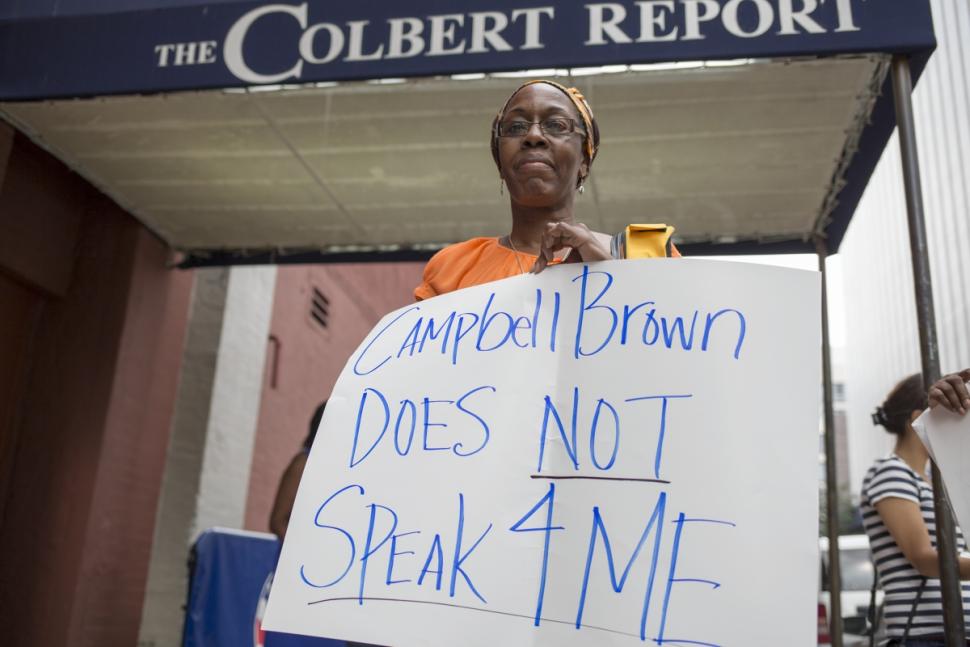
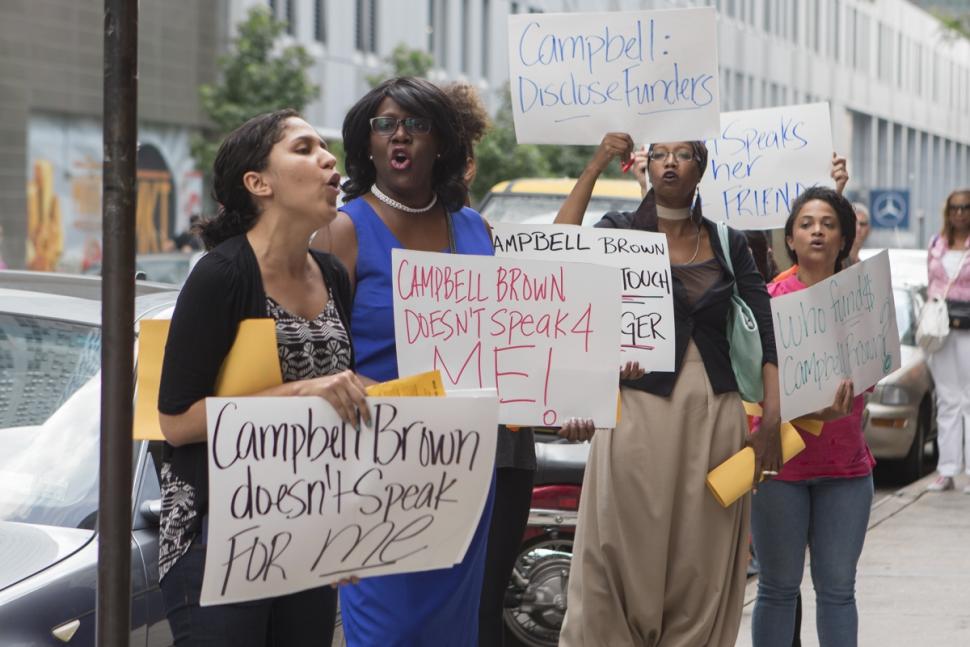
CB: I’m not gonna reveal who the donors are because the people (pointing toward window) are out…

SC: I’m going to respect that because I had a super PAC. [Audience applause.]

CB: I hear you. But, part of the reason is the people who are outside today, trying to protest, trying to silence our parents who want to have a voice in this debate…

SC: Exercising First Amendment rights…

CB: Absolutely, but they’re also going to go after people who are funding this, and I think this is a good cause and an important cause, and if someone wants to contribute to this cause without having to put their name on it so they can become a target of the people who were out there earlier today, then I respect that.


Ms. Brown is married to Dan Senor, who was the former spokesman for the Coalition Provisional Authority in Iraq following the fall of the Hussein Regime.  He sits on the board of of Michelle Rhee’s StudentsFirstNY, and he joined hedge fund Elliot Management before becoming a top adviser to Presidential candidate Mitt Romney.  Ms. Brown is on the Board of Directors of Eva Moskowitz’s Success Academy chain of charter schools, an organization that boasts massive financial support from Wall Street.  Her ties to people who have been pouring money into education “reform” in the interest of charter schools is not difficult to establish, as blogger Mother Crusader has demonstrated.  Suffice to say that these are incredibly wealthy and politically connected people who are the most likely donors to her organization.

And Ms. Brown wants us to believe that they need to be “protected”.  That if people want to know who is funding lawsuits to challenge laws that were passed by democratically elected governments and job protections that were subject to open and adversarial negotiations between unions and administrators, they cannot know because the donors seeking to overturn such laws could not abide potential criticism of themselves in the public sphere.

Wow.

Let’s be clear.  Who are “the people who are outside today” who Ms. Brown assumes will bully and intimidate her donors?  According to The Daily News:

 

colbert1n-1-web

colbert1n-2-web

I am sure that Eva Moskowitz’s donors are just quaking in their boots…right after they drop another $400,000 into Governor Cuomo’s pockets.

Mr. Colbert did not sneak a camera crew down to the street to make Ms. Brown look as ridiculous as she richly deserved at that moment, but the fact that he led her to make such a ludicrous statement is telling in an of itself.  Today, it is very hard to trust that major media outlets will take the time and effort to research and interview people trying to lead public debate via deception, and on issues that require a genuine understanding of complex social phenomena, that is even less likely.  I have written before how abysmally the New York Times’ editorial staff have failed in that regard, preferring to take the statements of advocates with wealth and connections at face value.

Mr. Colbert is not a journalist, yet he and his fellow comedians Jon Stewart and John Oliver have become almost guardians of truth in recent years.  It is often more likely that Mr. Colbert or Mr. Stewart or Mr. Oliver will highlight the absurd inanities, half truths and contradictions routinely offered by politicians, pundits and advocates.  In the case of Ms. Brown, Mr. Colbert got her to openly confess to a truth that is gaining greater and greater public awareness: American governance is increasingly oligarchical in nature whereby elected officials craft policy more to serve the interests of their very wealthy donors rather than the interests of the actual voters who put them in office.  Ms. Brown’s undisclosed donor list is a perfect example of this, and her refusal to disclose under the fiction that her donors could possibly be intimidated by moms and teachers with home made posters should be mocked loudly and frequently.

I am grateful to Mr. Colbert for organizing his interview to that point, but I am saddened that we rely almost exclusively on satirists to get to the heart of public affairs these days.

3 Comments

Filed under Activism, Funding, Media, politics, schools, Social Justice, Testing, Unions, VAMs

Donna Brazile, Ted Strickland and Jennifer Granholm To Defend Public Education

Opponents of current reform trends in education (and even just those with some skepticism) have had few ways to get their messages out in the past decade.  While charter school chains have found wealthy investors and enthusiastic politicians, public school teachers have traditionally relied upon their unions to publicly advocate on their behalf.  However, until very recently both the AFT and the NEA have openly supported reforms such as the Common Core State Standards despite rank and file concerns, and both unions offered endorsements to Democratic candidates who have openly courted the same money that has backed charter school expansion, CCSS and evaluating teachers by high stakes tests, many teacher concerns have had limited means to reach the public.  Add to that a media that has seemed completely incapable of asking a single teacher about the combination of reform forces that have potential to greatly damage public education, it has been lonely work to try to raise alarms.

That may be changing.

First, there are some in the media actually asking hard questions about how such a narrow slate of characters have managed to push nearly all 50 states in the same curriculum direction without having a robust public debate.  The luster of charter schools as the proposed cure all for urban education is coming under question with more and more reporting of the opportunists who have rushed into the poorly regulated sector of education.  As Common Core has begun to reach classrooms with plans to begin mass testing of students and to implement value added measures for teacher evaluations, union leaders have backed away from initial support of the standards themselves.  They are joined by a small but growing movement of parents at the grassroots who are choosing to “opt out” their children from the increasing testing regimen that has characterized education reform of the past decade and a half.

These are all developments that promise to change the direction of our education reform discourse.  But it is likely not enough.  Proponents of Common Core, mass testing, test-based teacher evaluations and the rapid expansion of charter schools have the ears of major media figures, federal and state governments and are able to call upon deep pocketed allies to pummel those who try to slow down their goals.  Eva Moskowitz’s allies unleashed more than 3 million dollars in a 3 week advertising blitz against New York Mayor Bill de Blasio when he dared give her only 80 percent of what she wanted.  They also seem to recruit new front people easily — former NBC and CNN personality Campbell Brown has joined Michelle Rhee’s campaign against teacher job protections by taking the Vergara lawsuit on its first cross country tour to New York.

The balance of voices is changing.

The AFT announced the formation of a new lobbying group, Democrats for Public Education that will be chaired by former Ohio Governor Ted Strickland, former Michigan Governor Jennifer Granholm and DNC vice-chair Donna Brazile.  Ms. Brazile addressed the AFT convention:

Why does this change the balance?  For starters, it says that the leadership of America’s teacher unions is pivoting from hoping that reforms will be both disruptive AND productive to realizing that many reforms threaten the very nature of public education.  More importantly?  It provides media allies for defending public schools and their students and teachers.  Although the research on many reform efforts’ problematic outcomes is solid and growing, voice and access has been much slower.  What does Donna Brazile bring that academic research and the concerns of parents and classroom teachers does not?  Access.  Ms. Brazile’s phone calls get returned.  Mr. Strickland and Ms. Granholm are known in all 50 state capitols and Washington.  While Bill Gates, Michelle Rhee, Joel Klein and pro-reform politicians have had the media’s ears all to themselves and have, to date, successfully portrayed their opponents as not caring about kids, now there is an organization headlined by well-connected and well-known allies to provide the alternative perspective.  In an age of media driven by sound bites 24/7, that matters.

How did Democrats for Education Reform, the hedge-fund financed group that has donated to numerous Democrats in exchange for support of charter school expansion, respond to the announcement?  “Welcome to the jungle, baby” was it.

Think about that for a second.  They could have written about welcoming a public debate.  They could have written about their “disappointment” that such prominent people could not see the value of their ideas, but that they look forward to engaging the public.  They could have written a spirited defense of charter school innovation for students.

Instead, they offer what could be Gordon Gekko’s back-up tag phrase.  Someone is either arrogant or worried — and someone is not thinking about the kids first and foremost.

Leave a comment

Filed under Activism, charter schools, Common Core, DFER, Media, politics, Unions

Jonathan Chait Joins His Esteemed Colleagues at the New York Times in Not Understanding a Thing About Teachers

I was reading my news feed yesterday morning, when I saw that Chalkbeat had retweeted an article from New York Magazine entitled “Teachers Unions Turn Against Democrats.”  Having noted that NEA members voted to call for Secretary of Education Arne Duncan’s resignation, and knowing that a significant factor in Fordham Law School professor Zephyr Teachout’s campaign to challenge sitting Governor Andrew Cuomo is Cuomo’s enthusiastic embrace of current education reforms, I was prepared for an interesting article.  Certainly, someone with Jonathan Chait’s experience and rhetorical talent would have an interesting examination of reform advocates’ efforts and rationales combined with the growing frustration of rank and file teachers and the balancing act attempted by union leaders trying to maintain their traditional coalition with Democrats and advocate for their members.

Boy, was I wrong.

Chait does acknowledge that Democrats have been forceful in pushing reform efforts that are more historically comfortable ground for Republicans, but his portrayal of the reforms themselves is entirely problematic and he ultimately chalks up firm opposition as the work of reactionary “hard liners”.  In Chait’s view, the center of this hard-liner coalition is New York University’s Diane Ravitch who has been blogging on the agenda of education reformers for several years now.

The leadership of this movement has fallen to Diane Ravitch, formerly a right-of-center education activist who has converted to the cause of teachers-union absolutism with an evangelical fervor, maintaining an almost superhuman schedule of public speaking and prolific blogging.

Ravitch has depicted education reform as a plot by corporate elites to privatize schools and destroy unions. If charter schools claim to help poor children by providing longer school days, then Ravitch is certain thatlonger school days cannot work. Having identified their enemies with the cause of pure evil, Ravitch and her fellow hard-liners have taken to defending not only the practice of paying teachers by length of service, but the structure and form of the school day (created in an era of stay-at-home mothers and designed around the summer harvest) as a standard of perfection that must be defended absolutely. Ravitch and her allies have found the leadership of the unions disturbingly faint of heart.

Goodness.

Does Chait expend even minimal effort in examining what in education reform is actually agitating teachers?  Beyond acknowledgement that the administration and its allies have embraced accountability and charter schools and implying that resistance to those efforts is the work of unthinking hardliners, not much.  He doesn’t examine teachers’ frustration and anxiety that the largest curriculum experiment in American history has been implemented with almost no study and little time to prepare at the behest of one man’s exceptional wealth.  He doesn’t examine how the “accountability” measures favored by reformers come from statistical models that are not accepted as valid measures of teachers’ impact on student learning.  He doesn’t look at the impact on students, teachers and schools of the constant drive for more testing of students, nor does he look at the corporations that are eager to monetize the results of those tests.

He does not consider the ways in which the rich and influential have used charter school expansion to line their own investment portfolios, nor does he consider the corrupting influence on Democratic politicians of hedge fund manager created political action committees that use campaign donations to ensure charter schools keep expanding. He does not examine that many charter school “successes” come at the expense of their appalling attrition rates, nor does he reference the new reports of widespread fraud and abuse of public money in the rapidly growing and poorly regulated charter sector.  He mentions the Vergara decision in California and opines that it “embarrasses” teacher unions by highlighting the “least-defensible aspect of their agenda and its most sympathetic victims,” but he does not mention the extremely questionable research that was used to support the case, nor does he mention that the victims in question could not name a single teacher who was “grossly ineffective”. Since Mr. Chait deems Dr. Ravitch to be unreasonable, here is the post trial brief that explains the issue.

Jonathan Chait is an experienced journalist and editor.  He had it entirely within his power to write an interesting piece on the potential of a rift between Democrats and one of their traditionally reliable constituencies, and to examine, fairly, the different sides of the issues.  Instead, he took it as a given that charter schools are successful alternatives and only union absolutists have any qualms about accountability and tenure reforms.

That, of course, would have taken more work than portraying Dr. Ravitch as the Abigail Williams of the teaching profession.


How Jon Chait Sees Diane Ravitch?

How Jon Chait Sees Diane Ravitch?

2 Comments

Filed under Media, Unions

What Does It Really Take To Evaluate a Teacher Preparation Program?

The National Council on Teacher Quality (NCTQ) is back in the news having released their second report on the quality of teacher preparation in America.  To the surprise of nobody, they found that university based teacher preparation remains dismal.  Just last year, NCTQ described teacher education as “an industry of mediocrity” in a report so riddled with errors, it would have been reasonable to assume that they would fade away – if not permanently, then at least for a few years.  My favorite of their many mistakes was how they gave credit to Teachers College for having “highly selective” standards for admission to their undergraduate teacher preparation programs.  Friends and colleagues affirmed how selective these programs are — they have never admitted a single student because they do not exist.  Alas, the fade away did not happen, and they are back this year.

In order to understand how NCTQ could purport to make a serious contribution to teacher education while making such glaring errors and then putting them in view of the public, it is necessary to understands that the organization’s flaws are both methodological and philosophical.  NCTQ is an organization that was established by the Thomas Fordham Institute and has an expressed purpose to “shake up” traditional teacher preparation.  Given that they are generously funded by a laundry list of corporate reform advocates (The Gates Foundation, Edythe and Eli Broad, Carnegie Corporation, etc.) and given the presence of people like Michelle Rhee and Joel Klein on their advisory board, it stands to reason that they are looking for faults.  But more important is the preposterous methodology employed by NCTQ to “evaluate” programs for evidence of “quality”.  Even before schools of education, looking at their bias and their proposed methods, declined to actively cooperate with them, NCTQ proposed that they would evaluate all teacher preparation programs in the country by not visiting a single program and by not speaking to or surveying a single graduate.  Instead, they examine web sites and publically available documents such as course catalogs and syllabi for “evidence” of the programs covering topics that they consider essential.  When programs decline to turn over internal documents for their examination, NCTQ is not above using deception to acquire them.

Such “methodology” has been aptly compared to writing a review of a restaurant by reading an online menu and making conclusions about the quality of the food preparation.  NCTQ misses how instruction is delivered and evaluated in every meaningful way, but they do not seem especially concerned about that given that a number of programs have tried to correct NCTQ’s errors only to see them published anyway.  This would be comical if the organization was not given uncritical coverage in influential publications.  Last Fall, both Joe Nocera and Bill Keller took to the opinion pages of the New York Times and cited NCTQ’s ratings without any indication that the group is both politically biased and rife with errors.  This year’s report is not being met with quite so much attention, but NPR did a very friendly interview with NCTQ President Kate Walsh with little focus on the organization’s methodology.  NPR did ask one pertinent question and it was why, if teacher preparation is so dismal, don’t principals and superintendents sound the alarm that new teachers are not able to teach?  Walsh replied:

“There’s a great hesitancy of public school educators to stand up to higher ed,” Walsh explains. “They’ve almost been bullied by them, and one of the things (NCTQ) is trying to work on with districts is to get them to be more assertive about their needs and to say ‘I’m not going to hire from you until you teach effective ways of reading instruction.’ “

I would like to challenge Ms. Walsh to come to New Jersey and try to find a single high school principal who is willing to admit, even off record, that he or she is intimidated by me.  Go on.  I’ll wait.

More seriously, that claim is bizarre because while a handful of institutions may offer grants and opportunities that are attractive to school districts, the reality is that for quality teacher preparation, I need schools more than they need me.  I need partners who are willing to open up their experienced teachers’ classrooms for student teachers and for clinical internships and who are willing to mentor teacher candidates in ways that make a strong connection between their studies and their developing practice.  To suggest that relationship is so lopsided as to see school districts as cowed beneath the Teacher Preparation Industrial Complex is simply strange.

I would never state that teacher preparation does not need improvement.  There is always something new to learn, and there will always be an effort to make meaningful connections between theory and practice and to situate prospective teachers in classrooms where they learn from skilled mentors able to discuss practice meaningfully.  But I would like to offer what it looks like to really examine and evaluate your work and to subject it to meaningful outside examination and rating.  My teacher preparation program is accredited by the Council for the Accreditation of Educator Preparation (CAEP), formerly the National Council for the Accreditation of Teacher Education. Such bodies are recognized by state departments of education as having high standards for the review of teacher preparation programs and for having rigorous methods of evaluation.  In preparation for their review, I have to prepare a report about our secondary students studying to become high school English teachers and submit it for review to the National Council of Teachers of English to determine how well we prepare students who are specifically seeking to be English teachers (other content areas submit similar reports to other content specialty associations).  In this report, I provided complete data portraits of three cohorts of graduating candidates that showed that they knew English content, that they knew pedagogy for teaching English and that they knew how to assess students’ needs, design instruction to meet those needs and evaluate the effectiveness of their instruction.  The report drew data from their coursework, lesson planning in courses, evaluations from field internships prior to student teaching from university supervisors and cooperating teachers, evaluations from their semester long student teaching experience and a Teacher Work Sample capstone project in their student teaching seminar.

The report was submitted directly to the National Council of Teaches of English where multiple reviewers read it and granted our program National Recognition as meeting high quality standards for the preparation of English teachers.  This is only one of many reports written by my colleagues and represents only our preparation for an eventual site visit by CAEP where the entire unit will be evaluated.  Such work is time consuming, but I have to admit that to a degree, I actually enjoy it because it helps, indeed it requires, that I take a step back from my own practice and examine artifacts that are indicative of its success or failures.  The process means that I have to propose ways to use what I have learned from the evaluation process to make improvements for following cohorts, and it pushes all of us to not merely rely upon impressions of success and failure but to have substantive reasons for those assessments.

When I began teaching in 1993, I said to myself that the day I figure that I have nothing left to learn is the day that I should quit teaching.  Substantive internal and external evaluation helps assure that I keep looking for things to learn.

Of course, even this is not the be all and end all of effective teacher preparation.  Data driven assessment is very useful, but it also contains the danger of becoming reliant on data to the point that teaching is treated as merely a technical performance that is neatly mapable onto standards, which is untrue.  There are qualities to teaching and to learning to teach that are aesthetic and which require a qualitative approach.  Most teachers have a narrative of their reality in mind when they commit to becoming teachers, and they need to constantly revisit and revise that narrative in ways that allow them to understand others’ purposes and to challenge themselves and their sense of purpose.  These qualities, championed by Maxine Greene, are critical for prospective teachers AND the teachers of prospective teachers, so we should embrace the role of data in our work as a tool of continuous improvement.  But we should not raise it so far above all other matters that we ignore their importance as well.

Which is why in addition to the substantial work I have put in to demonstrating my program’s quality to actually qualified experts, there is another testimony that is not being currently examined by any agency in a way that captures their real importance.  I know a large group of early career teachers who are simply outstanding young educators and who are doing fantastic work, both quantitatively and qualitatively, with 1000s of students across the country.  They came to my classes from diverse backgrounds and with varying ideas about the critical importance of public education, but they all left having had shared experiences in university courses and in lengthy field assignments that taught them what it really means to move from being a student to being a teacher.  They are remarkably interesting and talented, and they balance deep understanding of how to transform content into pedagogically powerful experiences with their students with the aesthetics of classroom community and student motivation.  I am lucky to have worked with them and to continue to know of them and their teaching.

If you want to evaluate the quality of a teacher preparation program, you need to speak with and observe the teachers they graduate.

1 Comment

Filed under Media, NCTQ, teaching

My Argument With the Director/Producer of the Fauxcumentary “The Cartel”

You may have missed that National Council for Teacher Quality (NCTQ) released another report recently, this one taking aim at teacher absenteeism.  It being an NCTQ report, it is not an exceptional work of scholarship, and they try to discuss policy implications absent any real statistical analysis.  This is par for the course from an organization that purports to seriously investigate the quality of teacher preparation in this country, but which does so by sitting in their offices looking at course descriptions online and calling up schools of education demanding materials and, failing that, trying to deceive schools into giving them those materials.  Needless to say, their errors are both shocking and laughable (my personal favorite is that Columbia got recognition for how selective its undergraduate teacher preparation programs are — those programs don’t exist, so they are VERY selective), but they are less laughable when you realize that influential people take them at face value.  It just goes to show that sometimes all you need to do is to put the letter “N” in your acronym to be considered serious.

This current report is perhaps not as egregious, but it is also not exceptionally interesting, mainly because all NCTQ does is provide a national overview of descriptive statistics  regarding teacher attendance and then claim that they have proven something.  Two problems:  First, the descriptive statistics are not complete.  NCTQ spends most of the report providing bar and pie graphs and a lot of averages, but they do not appear to have calculated means, medians, modes or standard deviations.  Consider that they divide teachers into attendance categories of “excellent”, “moderate”, “frequently absent” and “chronically absent”.  How many standard deviations separate a “chronically absent” teacher from a teacher with “excellent” attendance?  Damned if I know, and NCTQ provides no indication that they know either.

Second, NCTQ tries to draw conclusions from these data without demonstrating that they have analyzed them thoroughly using statistical inference.  For example, contrary to previous research from academics at Harvard and Duke, NCTQ claims there is no connection between the poverty characteristics of a district and teacher absenteeism.  In fact, they said:

Given the existing research on teacher attendance, an increase in teacher absenteeism was expected as school poverty levels increased. Surprisingly, there was no significant increase in these districts. The difference between the average days absent in the highest and lowest poverty schools was under one day and was not statistically significant.

How did they prove that?  Well, from the report, they lined up some bar graphs, and that appears to be it.  The report appendices claim use of a significance test that did not apply to poverty characteristics and a use of a variance test that did, but these results are not provided in the text of the report.  Readers are, supposedly, to look at the bar graphs, nod their heads and agree.  Such appeals to “obviousness” are a good way of avoiding doing sophisticated analysis (NCTQ does not mention any statistical testing that uses sophisticated methods capable of capturing poverty effects), but they are also a way of thoroughly deceiving lay people with no knowledge of statistical reasoning.

Such a lay person turned up on my Twitter feed. Looking for any news on the NCTQ report, I came across this tweet from a Mr. Bob Bowdon:

Not knowing who he was, I replied:

https://twitter.com/Prof_Katz/status/475703503910748161

I thought that was it, but a few days later, he responded:

This is a typical strategy when given a reference that poses serious questions about something: take a little bit of it and use that to defend what you like against the rest of the article.  So I gave it another try:

https://twitter.com/Prof_Katz/status/476391864489095169

https://twitter.com/Prof_Katz/status/476392014829744129

https://twitter.com/Prof_Katz/status/476395907668119552

I decided at this point to figure out who @BobBowdon actually is, and in short order found out that he is the director and producer of the “fauxcumentary” film “The Cartel” wherein he takes a hard look at education in New Jersey and decides that everything that is wrong with our schools can be traced back to and directly blamed upon…you guessed it: teachers’ unions.  He is a practitioner of a form of “advocacy journalism” that looks like what would happen if you blended Michelle Rhee and James O’Keefe.  Unsurprisingly, his work is riddled with errors in assumption and fact, points amusingly documented by Rutgers Professor Bruce Baker, here, here, here, and here.  I suppose he was feeling confident given that the NCTQ report came with numbers and graphs, so he replied again:

And I replied:

https://twitter.com/Prof_Katz/status/476396060986703875

https://twitter.com/Prof_Katz/status/476396204104757249

What I got back seemed defensive (and clueless):

Trying to be nice one last time, I responded:

https://twitter.com/Prof_Katz/status/476396566215802882

There’s a stance in his comment that I find fascinating, however.  It is one that is impervious to even considering a critique and relies heavily on ignorance to bolster a position that is not especially strong.  I have no idea if Mr. Bowdon has no working knowledge of the difference between descriptive and inferential statistics, but he displays no interest in finding out here.  Further, he retreats into calling my objections “convenient” rather than inquiring after their substance.

His next tweet:

Ah, yes, “apologists” – boilerplate anti-union talk wrapped up in a thorough lack of understanding of how research is conducted whether deliberate or otherwise.  His complaint here is instructive, however.  Saying “any study can be called ‘incomplete'” covers the fact that the NCTQ report can barely be called a “study” because it really has no research questions but it tries to make inferences from the incomplete descriptive statistics that it employs.  Calling teacher “absences” “hard objective stats” is, I suppose, some attempt to claim there is no ambiguity in the data and any inferences we want to make from them can be made by appealing to “obviousness”.  This is how someone thinks when they truly do believe that you can make “statistics say anything” but it not anything that would be said by any honest person who understands reasoning with statistics.  For example, the NCTQ data suggests that teachers are absent more than the workforce average, and from that, they infer a need for policy interventions.  But without knowing the REASONS for teachers being absent, or if such absence rates are actually significant, it is impossible to make any informed comments on existing or possible interventions.  What if teachers are absent more than average because they work in close contact with children and get sick more often than the rest of the workforce?  What if teachers are more absent because the teacher workforce is still largely female and women still bear a disproportionate share of child care duties in American families?  Policy interventions for either of these circumstances would be radically different, but Mr. Bowdon is obviously only interested in blaming teachers specifically and unions generally.

So I took out the teacher in me:


https://twitter.com/Prof_Katz/status/476397944908693504

https://twitter.com/Prof_Katz/status/476467588969406464

https://twitter.com/Prof_Katz/status/476467725435297792

https://twitter.com/Prof_Katz/status/476467899679244289

https://twitter.com/Prof_Katz/status/476468053916409856

https://twitter.com/Prof_Katz/status/476468184921276416

https://twitter.com/Prof_Katz/status/476468316215578624

https://twitter.com/Prof_Katz/status/476468623502868480

https://twitter.com/Prof_Katz/status/476468778050392064

https://twitter.com/Prof_Katz/status/476468970485063680

https://twitter.com/Prof_Katz/status/476469148256460800

https://twitter.com/Prof_Katz/status/476469424518463488

https://twitter.com/Prof_Katz/status/476469546040037377

https://twitter.com/Prof_Katz/status/476469926241116160

Okay, fine, that’s a lot to read, but I was surprised that he tried to as if I hadn’t just written to him like he was capable of understanding my points:

I admit that baffled me.  But I have been teaching for twenty years, and I think that even the most obstinate of students is capable of a breakthrough:

https://twitter.com/Prof_Katz/status/476479886052163585

https://twitter.com/Prof_Katz/status/476480085210722307

https://twitter.com/Prof_Katz/status/476480338957332481

https://twitter.com/Prof_Katz/status/476480398700998656

https://twitter.com/Prof_Katz/status/476480524983078912

Mr. Bowdon was still pretty oblivious:

Sometimes you have to throw in the towel:

https://twitter.com/Prof_Katz/status/476493828291981312

Mr. Bob Bowdon is not an isolated case of low information punditry trying to stake out ground as a “thought leader” in education.  He calls his website a national “hub” for online information about education reform, but his bias in that space is obvious, where he actively champions education “reformers” seeking to increase testing, spread charter schools and curtail teacher unions and where he labels people who oppose such efforts as the education “establishment”.  Mr. Bowdon finds the NCTQ report important not because it reveals interesting and important insights into the teacher workforce (it doesn’t), but because he can use it to argue that unionized teachers abuse the “perks” of their employment. This is similar to no end of billionaire-funded efforts to fundamentally change the way we offer schools without a public vote and which dare to call themselves civil rights movements.

It may be momentarily fun to demonstrate how low knowledge many foot soldiers for corporate reform are, but it is also entirely serious.

Leave a comment

Filed under Activism, Data, Media, NCTQ, schools, teaching

Of Greenbacks and Green Cards — Why Wall Street Likes Charter Schools

Yesterday, I contemplated why hedge fund manager and principle founder of Democrats for Education Reform, Whitney Tilson, would be quoted in the New York Times saying that “hedge funds are always looking for ways to turn a small amount of capital into a large amount of capital” as an explanation for financial support of charter schools by Wall Street.  Offering the benefit of the doubt, I considered that Tilson may have simply meant that relatively small cash investments could result in returns of human capital in the form of better educated students.

I no longer consider that.

It turns out that United States tax and immigration laws have created a healthy flow of money from the very wealthy into the charter school movement, possibly in ways not exactly imagined by the authors of those laws but which nevertheless have made charters a favored project of quite a few .1% movers and shakers in world capital.  The New York Times printed an article back in 2010 that reported the interest of the financial sector in promoting charter schools, but it did not examine the connection of that interest to actual returns on investment. While I cannot dispute claims that hedge fund managers like charters because many of them focus on test scores, are not unionized and they are seen as a way of polishing local philanthropic credentials, there is another reason that money flows into charters: it gives a return on investment.

In this piece on Forbes, financial analyst and author Addison Wiggins, explains the mechanism in the tax code that allows Wall Street to show a return on investment in charter schools:

In part, it’s the tax code that makes charter schools so lucrative: Under the federal “New Markets Tax Credit” program that became law toward the end of the Clinton presidency, firms that invest in charters and other projects located in “underserved” areas can collect a generous tax credit — up to 39% — to offset their costs.


So attractive is the math, according to a 2010 article by Juan Gonzalez in the New York Daily News, “that a lender who uses it can almost double his money in seven years.”

That isn’t sexy Gordon Gecko kind of money, but it is also guaranteed.  Put down money to fund the creation or expansion of a charter school, and a firm can double its money in a predictable time table and get to brag to the press about it is bringing new education options to urban areas.  The Gonzalez article in the New York Daily News also reported that JPMoragan Chase was setting up a more than 325 million dollar fund to invest in charter schools taking advantage of the tax credits.  This strategy is attractive enough that there are firms specifically devoted to connecting charter schools and financial backers.

To be fair, it is entirely possible that this is a more cost effective way of increasing the number of classrooms in some urban areas than traditional school construction projects funded by bonds; I do not currently possess the data to make such an analysis.  However, two very important considerations must also be made.  First, using the federal tax code in this way means that the cost to the public comes from potentially lost federal revenue instead of being paid in a predictable way at the local and state levels.  Second, when a city funds school construction traditionally, it is usually doing so to create schools that are obligated to educate and accommodate every student within its zone.  Many charter schools love to brag about their “awesome” results and make incredibly impressive claims about their test scores and graduation rates.  As Bruce Baker of Rutgers demonstrates here, such claims rarely can stand even moderate scrutiny.  North Star Academy in Newark, NJ, for example, claims that 100% of its seniors graduate, which is true — if you ignore that 50% of the students who enroll in 5th grade never make it to senior year.

So what we have are major charter school chains with deceptive or outright fraudulent marketing backed by the titans of finance who are making hefty returns on investment and are donating significant sums to politicians to keep the returns flowing.

In addition to onshore capital returns, investments in charter schools can be beneficial to foreign investors via the EB-5 visa program.  Under this program, foreign investors who spend at least $500,000 in the United States on a development project can earn a visa for himself and his family. According the Reuters article, this path is so attractive to foreign investors that Florida alone expected 90 million dollars for charter schools from foreign investors in 2013.  Much like the tax credits for domestic hedge funds, there is an industry developing to connect wealthy donors looking for EB-5 eligible projects to charter schools seeking capital.

To my knowledge none of these actors are channeling investments into neighborhood schools in need of infrastructure funds, estimated at over 250 billion dollars in 2008.  But the good news is that some hedge funds are getting a guaranteed return on investments and some foreign born multi-millionaires are getting green cards.

Al Shanker, the former head of the American Federation of Teachers, helped envision the idea of charter schools.  In a blog post from 2012, NYU’s Diane Ravitch wrote an open reminder to then New Jersey Commissioner of Education, Chris Cerf, about what Mr. Shanker thought charter schools should do. Charter schools, in Shanker’s vision, were meant to serve students who were most needy and had potentially failed already within other schools — instead, many of today’s charters deliberately avoid or push out those students.  Shanker also saw charters collaborating with other public schools.  As small laboratories of innovation, their goal should have been to translate what they had learned about working with students to the rest of the public school system.  Today, many charters aggressively compete with public schools and far from being a true part of the public education system, large numbers in some states are managed by for profit Educational Management Organizations who are responsible for their bottom lines.  According to Ravitch, Shanker turned against charters when he saw a pattern of corporate and for profit interests taking over the movement.

I have no doubt that with 1000s of charters operating across the country, that many of them embody the original vision to provide innovation and collaboration and truly dedicate themselves to serving the most needy of our students.  However, today, they are being greatly overshadowed by deceptively marketed brands of charter chains that rake in Wall Street and foreign investment, aggressively lobby state and federal officials for preferential treatment and build their reputations for success on the backs of students they refuse to serve and work to evict from their schools.  Eva Moskowitz of the Success Academy chain can summon 7.75 million dollars in donations in one evening while most states’ education spending remains below pre-recession levels.

But, again, the good news is that some hedge funds are getting a guaranteed return on investments and some foreign born multi-millionaires are getting green cards

2 Comments

Filed under charter schools, DFER, Funding, politics

Education Week Blog Piece on Charter School Funding Research

This caught my eye yesterday….for several reasons.

The first is that we can expect the charter school movement to latch on to these findings and demand that more states impose upon cities and communities the sorts of “protections” that were recently added to the New York state budget, which amount to extraordinary favors to well connected and already well funded chains of charter schools.  I have no doubt that there are probably many small, individual charter schools that do excellent work and struggle for sufficient funding, but I also have no doubt that the biggest noise about so-called threats to charters are coming from chains like Success and KIPP that are lavishly funded and connected to hedge fund billionaire patrons.

The second reason is that the blogger actually raised important additional considerations about why charter funding may be lagging on a per pupil basis that is frequently overlooked by lofty news organizations that report on charter school claims.

The issue of charter funding and the disparities that exist may depend on the methods used to do the calculations, though.


“For me, this is not research that’s helping draw good policies,” said Gary Miron, a professor at Western Michigan University who researchers and evaluates school reforms and education policies.


Drawing on his own previous analyses, Miron contends that charter schools already have a cost advantage that may not be captured and explained by the data.


“Special education and student support services explains most of the difference in funding,” said Miron. “Charters can get a lot more funding, but it would require that they enroll more students with severe and moderate disabilities. They aren’t enrolling these students.”


Other categorical funding, such as that distributed for vocational education, would also bring more funding to charters, should they choose to provide it.


In fact, in his studies, Miron found that charters have a cost advantage, because charters do not have to provide the same services or have the same expenditures as traditional public schools.Transportation costs, for example, are an area in which charters have a funding advantage. Districts are required to provide student transportation while charters are not.

If charter schools do not enroll similar numbers of students on IEPs and English Language Learners, it is entirely reasonable for their funding to be less than entirely public schools that are required to fully serve those populations of students.  Without accounting for that, the report draws a very questionable conclusion using figures that have dogged public discussion of education for years but which are, bluntly, one of my biggest pet peeves.

Which is reason number three: per pupil allocations as a marker of funding and a tool for policy.  It is an easy number to come up with: take the total school budget, divide it by the number of students in the district and voila! You have a per pupil spending figure.

And you have absolutely no idea what that number could possibly mean.

Per pupil costs make for a simple talking point, but a very little thinking effort demonstrates that two children do not necessarily cost the same to educate.  A classroom full of AP students may cost more than a classroom of college preparatory students because the teacher may be a well compensated veteran with a smaller number of students.  A student with an IEP or in ESL classes will cost more than the per pupil average if the district is properly committed to providing them with all legal accommodations, including additional personnel.  A district that is top heavy with administrators will have a higher per pupil cost without necessarily having more resources for the classroom. A district that cannot budget capital improvements will have a higher per pupil cost to cover the price of additional heating fuel in the winter due to leaky windows — and kids will have a harder time concentrating if they remain cold from November to April.

Any policy or discussion of policy that ignores or glosses over these facts is both deceptive and possibly destructive.  Consider vouchers as an example.  Taking a child’s “per pupil” money and handing it over to a new school does not make the old school magically one child less expensive to run.  Until enough children leave that the school starts dismissing staff and faculty or perhaps shuttering a disused wing, the lost student just ups the per pupil average for those who remaining — while skimming money out of the budget.  Meanwhile, the school getting voucher money did not magically become exactly one more student more expensive to run.

Here’s a mantra to repeat to politicians and education reporters: An individual child’s public education is not a product.  It costs what it costs to most effectively assist that child to learn as much as he or she can…and to preserve that child’s joy for learning and curiosity about the world.

Practices that shunt aside students who are harder to accommodate or that cover content while crushing the spirit, may be good for the budget, but we don’t aspire to them for children. So when we are discussing whether or not a particular sector of education is being “underfunded” it is important to consider far more than the sum of money they receive.


Leave a comment

Filed under charter schools, Funding, Media, politics, schools

Chalkbeat Gets a Letter Cogently Pointing Out Bias in Reporting — Responds With a Shrug

Leonie Haimson and other activists at Class Size Matters sent a letter to Chalkbeat.org pointing out the evident bias in their reporting of recent charter school controversies in New York.  In it, they note how much coverage has been devoted to the activities of pro-charter advocates compared to the coverage given to a citywide rally organized by the Community Education Councils.

Rather than sending one of your reporters to cover this event, you only posted a short blurb clearly taken from the press release after the fact.  Chalkbeat’s failure to assign a reporter to the event  glaringly contrasts with your close and detailed coverage of every move made by the charter operators and their backers.  Indeed, you published two different stories on the charter march across the Brooklyn Bridge, three different stories on the Albany rally for charters (though you failed to disclose that Gov. Cuomo was actually behind it) ,  and  on March 29  you ran two stories on reactions to the budget bills, BOTH from the point of view of the charter operators.


Even more importantly, you have failed to cover any of the substantive issues and reasons behind our anger, including how unprecedented these charter provisions are, how they apply only to NYC, how they will  detract from the city’s already underfunded capital plan and cost the taxpayers millions of dollars, while thousands of public school students will continue sit in trailers or in overcrowded classrooms, without art, music, science or therapy and counseling rooms, or on waiting lists for Kindergarten.

The letter further noted how Chalkbeat’s expansion from the now defunct Gothamschools site was made possible with funding from the Gates Foundation and the Walton Family Foundation, both strong advocates for charter schools.

Chalkbeat’s very brief reply stated:

The bottom line is that the protest was clearly well-attended and unique in its CEC-wide organization, and we wish we had been there.


We make decisions about coverage every day based on the fact that we can’t be at every relevant event in the city or it would be impossible for us to provide any deeper coverage of these issues. We regularly attend, and skip, events that reflect a variety of viewpoints. That’s why we work to keep readers informed about events we don’t make it to with posts like the one we wrote about this protest.

They also swore that their coverage choices merely reflect their best judgment on how to contribute to the conversation in New York City and not the political bias of their funders.

Uh-huh.  The response would have been more honest with an Alfred E. Neuman cartoon.

4 Comments

Filed under Activism, Gates Foundation, Media, politics