
Tag Archives: Common Core

Wanted: A Slow Schools Movement

I invited a number of my department’s alumni back to campus this week for an informal panel discussion about our preparation program, their experiences as early career classroom teachers, and what we can do to improve the experiences of our current undergraduates.  It was a fantastic evening, largely because the young people with whom I had been impressed when they were here remain an impressive group of early career teachers.  They had many insights about knowledge, both practical and theoretical, that would have aided them even more as they began their careers, and myself and my colleagues have been similarly considering several of those ideas as we engage in our constant work of program assessment and renewal.  Beyond those ideas, however, a consistent theme seemed to emerge from our conversation:

Schools today need to slow down.

Our graduates told us of their experiences with phenomena that we know about and that we have observed in schools during field visits and from regular discussions with teachers in partner schools.  However, we have never directly experienced those changes as teachers in the classrooms effected by them.  They spoke of having to create and measure “Student Growth Outcomes” with no practice, no training in creating statistical measurements, and no release time to do analysis.  They spoke of rapid changes with little time to adapt, and they spoke about constantly shifting technology demands made upon their teaching and their record keeping/administrative tasks.  They spoke about the changing nature of the young people entering their classrooms, many of whom have grown up in a world of information that constantly streams into their hands with few opportunities to truly comprehend and analyze that information and with few adults who truly understand the technology’s strengths and pitfalls — even while they demand that teachers find ways to use them productively in the classroom.

As our alumni spoke about these issues, one overarching description of their work lives became clear to me: hurried.  It is not that teachers have ever felt entirely relaxed in the profession.  In his 1975 book, “School Teacher: A Sociological Study,” Dan Lortie (1975) notes that feeling pressed for time because of constant demands from outside of the classroom is a common complaint among teachers:

“First, we can think of time as the single most important, general resource teachers possess in their quest for productivity and psychic reward; ineffective allocations of time are costly. Second, from one perspective teaching processes are ultimately interminable; one can never strictly say that one has “finished” teaching students. At what point has one taught every student everything he might possibly learn about the curriculum?  More broadly, when can one feel that one has taught everything that any particular student should learn? The theme of concern about incompleteness ran throughout the interviews; unfortunately, it occurred in various places, making systematic collation next to impossible. Presumably teachers develop defenses against overexpectation for themselves; yet these defenses do not always seem to work. If one is inwardly pressed by a feeling of not having finished one’s work, inert time must be particularly galling.” (p. 177)

Little in the teacher education research suggests that this has changed, and quite a lot of new education policies and changes to how young people seek and consume information has layered on top of Lortie’s observations rather than replaced them.  If teachers are being required to account for the impact on students’ learning in new (and statistically questionable) ways using standards and examinations with which they have little familiarity and inadequate training and no release time, if teachers are required to utilize new tools and accounting procedures without substantial in school support, and if the students they have are used to a constant stream of unfiltered information but have never been taught discernment in the use of that information, then there is little doubt that teachers today are feeling heavily pressured and constrained in their time.

My former students’ conversation on such matters got me thinking about the “Slow Food Movement,” which began in the late 1980s to educate consumers about the benefits of food that is local, minimally processed, and diverse in both culture and biology.  As a response to the rise of fast food and factory styled agriculture, slow food emphasizes the variety of local cuisines that should be preserved and the value of food that has to be prepared and cooked rather than defrosted and heated up.  Slow food obviously takes time that fewer and fewer people believe that they have, but it also represents more knowledge about food and its preparation, and it preserves more of the inherent nutritional value in ingredients.

I want a Slow Schools Movement.

While teachers grapple with the pressures of new and unfamiliar standards whose scopes are being narrowed with the highest stakes testing in national history, it is unsurprising that the pace of everything in school is being increased.  In the history of education, it is almost always more common for duties and responsibilities to be added to what teachers are expected to do rather than to see them peeled back.  Teachers’ duties are not restricted to classroom work, but with 35 states still providing less per pupil funding than they did in 2008 and with over 324,000 jobs in K-12 education being lost, remaining teachers, administrators, and paraprofessionals have even more work that they need to accomplish on a daily basis.  The number of school aged children ages 6-17 has declined slightly since 2008, from 49.9 million to 49.6 million (it is set to rise again in the near future), but with a larger proportion of people working in schools gone, each individual has more to do.  In a policy environment that provides high stakes standardized tests the power to put teachers’ jobs in the balance and with an active movement afoot to remove teachers’ workplace protections, pressures today rival those at any point since the Common School movement began in the 19th century.

How detrimental to the practices of teaching and learning.

However, the need for “slow schools” goes well beyond a simple desire to lift added and poorly thought out burdens from teachers who already had important work to do.  It goes towards fundamental aspects of what learning actually requires.  A productive school is one that hums with energy, but it is not the energy of people rushing anxiously from one obligation to another.  It is the energy of people grappling with challenging ideas and materials, working through from what they do not understand to what they do understand, and proposing and testing new hypotheses about how the world works around them.  That is a specific kind of energy that cannot happen under constant pressure to perform on command.  In order to foster it, teachers need to possess deep knowledge of their subjects and how to structure lessons that move students along in their understanding.  Jerome Bruner (1960) writes about this in “The Process of Education” where he quotes elementary mathematics teacher, David Page:

“…’When I tell mathematicians that fourth-grade students can go a long way into ‘set theory’ a few of them reply: ‘Of course.’ Most of them are startled. The latter ones are completely wrong in assuming that ‘set theory’ is intrinsically difficult. We just have to wait until the proper point of view and corresponding language for presenting it are revealed. Given particular subject matter or a particular concept, it is easy to ask trivial questions or lead the child to ask trivial questions.  It is also easy to ask impossibly difficult questions.  The trick is to find the medium questions that can be answered and can take you somewhere.  This is the big job of teachers and textbooks.’  One leads the child by the well-wrought medium questions to move rapidly through the stages of intellectual development, to a deeper understanding of mathematical, physical, and historical principles. We must know far more about the ways in which this can be done.”  (p. 40)

Of course, what Mr. Page says to Jerome Bruner is not simply a matter of finding a “trick.”  Rather, it is a complicated interplay of knowing the subject, knowing the pedagogical means of asking questions that transform children’s understanding, and of monitoring how students are developing in response to those questions, often in ways that are not precisely rapid or predictable.  Doyle (1983) explains students’ work in terms of “tasks” comprised of the products students are to produce, the operations  necessary to produce them, and the materials or models available to assist.  He further notes that tasks with the greatest learning rewards are often the most complex and difficult to establish in the classroom: “The central point is that the type of tasks which cognitive psychology suggests will have the greatest long-term consequences for improving the quality of academic work are precisely those which are the most difficult to install in classrooms.” (p. 186)

Eleanor Duckworth (1987) of Harvard University explained many of these issues eloquently in her essay collection, “The Having of Wonderful Ideas.”

“One of the teachers, Joanne Cleary, drew on the blackboard this picture of the earth in the midst of the sun’s rays and was trying to articulate her thoughts about it. Another member of the group was asking her to be more precise.  Did she mean exactly half the earth was in darkness? Did it get suddenly dark at the dividing line or was there some gray stripe? The one who was trying to articulate her thoughts grew angry, and gave up the attempt.  She said later that she knew the questions were necessary at some point, but she had not been ready to be more precise. She was struggling to make sense of a morass of observations and models, an idea was just starting to take shape, and, she said, ‘I needed time for my confusion.’

“That phrase has become a touchstone for me. There is, of course, no particular reason to build broad and deep knowledge about ramps, pendulums, or the moon.  I choose them, both in my teaching and in discussion here, to stand for any complex knowledge. Teachers are often, and understandably, impatient for the students to develop clear and adequate ideas.  But putting ideas in relationship to each other is not a simple job. It is confusing; and that confusion does take time. All of us need time for confusion if we are to build the breadth and depth that gives significance to our knowledge.” (p. 102)

Consider how important this is from the perspective of a learner.  A deep and layered understanding of complex ideas cannot be forced to happen simply through intensity, although significance and deep understanding have intensity of their own.  Students necessarily must be frustrated as they grapple with complex and unknown concepts, but they need time in order to work through that confusion, and when forced or hurried to move they not only fail to develop the desired understanding, but also they become needlessly frustrated and disengaged from the task of learning.  Taken together, Bruner, Doyle, and Duckworth denote essential truisms about classrooms and learning:  1) students are capable of better and deeper understanding of more complex ideas than we often think they can; 2) the products, processes, and materials that support the development of that understanding are often highly ambiguous and complex to enact in a classroom; 3) confusion is an important part of the learning process, and learners need time and space to be where they are in their emerging understanding without being forced to move faster than they need.

Even though I have recently criticized the Common Core State Standards in the English Language Arts for being too narrow in their reading perspectives, I would like to use an example from them to illustrate this point.  This is taken from the sixth grade writing standards:

CCSS.ELA-Literacy.W.6.1
Write arguments to support claims with clear reasons and relevant evidence.
CCSS.ELA-Literacy.W.6.1.a
Introduce claim(s) and organize the reasons and evidence clearly.
CCSS.ELA-Literacy.W.6.1.b
Support claim(s) with clear reasons and relevant evidence, using credible sources and demonstrating an understanding of the topic or text.
CCSS.ELA-Literacy.W.6.1.c
Use words, phrases, and clauses to clarify the relationships among claim(s) and reasons.
CCSS.ELA-Literacy.W.6.1.d
Establish and maintain a formal style.
CCSS.ELA-Literacy.W.6.1.e
Provide a concluding statement or section that follows from the argument presented.

From Doyle’s perspective, these quoted standards denote tasks that are both high in ambiguity and high in risk (p. 183) if taken seriously.  Sixth graders are required to perform a complex series of cognitive moves in order to write arguments that are organized, supported with evidence, follow a logical order of argumentation including a conclusion, and use formal language and syntax to enhance readers’ understanding of their argument.  For accomplished college level writers, this is probably a task that appears simple, but the simplicity is entirely the product of its familiarity to those same writers.  For sixth graders, this is a complex set of cognitive moves that requires significant modeling and experimentation as well as a wealth of preexisting knowledge about how to write coherently and connectedly and an ability to adjust argument and tone depending upon the purposes for writing and the author’s sense of her or his audience.

More important than these skills, however, is that in order to accomplish what is envisioned in the standard, students will need the time and the safety to fail, possibly often.  Writing is a messy and often nonlinear endeavor, and even the most accomplished of authors revise often, change direction, and even throw out entire ideas and start over again.  For a student in the classroom open recognition of imperfect performance is often overshadowed by a fear of the consequences such imperfection often provokes.  Teachers who genuinely want their students to write in this way have to create conditions where students are willing to risk that their imperfections will be a source of improvement rather than of punishment, and students will need time to understand themselves as writers and to develop not merely the forms of analytic writing, but also an inwardly critical eye.

And this is where the increasingly hurried pace of schools and teachers’ work is more than a concern for how teachers measure their job satisfaction; it becomes a threat to children actually learning.  It is not that we have merely adopted new, complicated standards that have been pushed into classrooms far too quickly and with questionable materials for classroom use, but also it is that by tying teachers’ promotion and job retention to student performance on standardized tests that, at best, can only approximate student learning (and then only when they are well-designed), we have incentivized teaching to those tests as literal make or break decision for teachers and schools.  Teachers are most heavily pushed in the current policy environment to focus on those student skills that prepare them for performance in multiple choice, timed examinations.  Students learning to process confusion and teachers promoting classrooms where students can risk failure so that they build genuine understanding over time?  Today’s concepts of teacher accountability can make teaching for powerful and transformative purposes a career ending decision.

Consider the process by which teachers in New Jersey are held accountable for “Student Growth Outcomes” (SGOs) in addition to student annual progress in standardized exams via Student Growth Percentiles (SGPs).  SGPs are related to value-added measures of teacher effectiveness which use predicted gains on student test scores as a measure of how well teachers are teaching.  The SGO process is supposedly a professional research investigation that every teacher in New Jersey must accomplish each year by examining what students know at the beginning of the year, making predictions about student growth after a year of instruction, designing instruction to promote that growth, and then demonstrating the students’ actual growth in the classroom.  SGOs are set every year by every teacher working with an administrator and submitted to the state for verification.  While layered with external accountability, the concept had potential to help teachers see their work as a process of continuous improvement in the “teacher as researcher” mode of professionalism.

In practice, this is, charitably, far more dicey.  New Jersey insists that SGOs must be clearly measurable, so qualitative investigations are out of the question.  However, teachers are not, by trade, quantitative measurement experts, and the instructions issued the state department of education strike me as highly questionable.  Consider the following selection from page 16 of the DOE handbook:

Setting the Standard for “Full Attainment” of the Student Growth Objective
In order to develop a scoring guide based on how well you meet your SGO, determine the following:
a) a target score on the final assessment that indicates considerable learning;
b) the number of students that could reasonably meet this mark;
c) the percentage of students in the course that this represents; and
d) a 10-15 percent range around this number.
For example, you and your evaluator may decide that 80% on a challenging assessment indicates considerable learning. Based on an initial evaluation of the 65 students in your course, your evaluator agrees with the assessment that about 50 of them could reasonably make this score at the end of the year. This is 77 percent of the students. You make 70-84 percent the range around this number. This means that if between 45 and 55 of students (70-84 percent of them) score at least 80% on the final assessment, you would have fully met the objective. This is shown in Figure 4 on page 16.
Setting Other Standards of Attainment
Once a range is established for “full attainment,” subtracting 10-15 percent from the lower range of “full attainment” will produce the “partial attainment” category. Any number below this range is the “insufficient attainment” category. Above the high end of the “full attainment” range is the “exceptional attainment” range.

The problem here is that there is absolutely no indication upon what teachers will determine what represents “considerable learning” and what percentage of students can be expected to meet this target other than a cursory examination of an early year assessment. Such determinations would have to be fairly complex statistical exercises if done with any recognition of the complexity of predicting individual student outcomes, and, in fact, give the very questionable reliability of VAMs and SGPs, we should question the SGO exercise being based upon similar assumptions.  Worse, the state handbook encourages setting of ranges that are entirely arbitrary, probably favoring a neat reporting of the data rather than a valid one.  Upon what basis are predicted ranges of student performance set in 10-15 percent intervals?  What individual and group characteristics make those ranges plausible?  If the state requires ranges of performance in 10-15 percent intervals, what happens in classrooms where initial student performance falls into different ranges?

I asked these questions at a training session on SGOs last Spring, and the answer was a wan smile.  Unsurprisingly, some reports from implementation suggest that the enterprise is time consuming and confusing.  Consider this account by teacher Douglas McGuirk of Dumont High School sent in a letter to Diane Ravitch of New York University:

The next day, the SGO was rejected, and my supervisor told me that all SGOs had been done incorrectly and that our staff would need training. We held a department meeting to review SGO policies. We then held an after school training session to discuss the writing of SGOs. I attended both of these. After two weeks of writing and rewriting my SGO, complete with all of the Core Curriculum Content Standards pasted from the web site, I finally had an acceptable SGO. I managed to accomplish absolutely no lesson planning during this period of time. I graded no papers. I am a veteran teacher with nine years in the profession. I understand how to manage my workload, overcome setbacks, and complete my responsibilities. In short, I am a professional who maintains a diligent work ethic.

But nothing could prepare me for the amount of time I had just spent on a new part of my job that basically exists so that I can continue to prove that I should be entitled to do the other parts of my job. After I completed my SGO, my principal told our staff to make sure we save all of the data, paperwork, and student work relating to our SGO, just in case people from the State want to review the integrity of the data. Seriously? This is the most egregious assumption that there is an infinite amount of time.

How different this is from more empowering visions of teachers researching their own practice.  Many proposals have been made over the years to have teachers treat their classrooms as ongoing research projects, and, indeed, the best teachers already do this informally by making ongoing assessments of what their students are learning and consistently adjusting instruction based upon what they need.  However, critical components of seeing teachers as researchers are things entirely absent from the SGO process: 1) authentic teacher interest in what is being studied; 2) time, space, and resources.  Consider how Eleanor Duckworth (1987) describes her conclusions about working with teachers researching their teaching:

“I am not proposing that schoolteachers single-handedly become published researchers in the development of human learning.  Rather, I am proposing that teaching, understood as engaging learners in phenomena and working to understand the sense they are making, might be the sine qua non of such research.

“This kind of research would be a teacher in the sense of caring about a part of the world and how it works enough to want to make it accessible to others; he or she would have to be fascinated by the questions of how to engage people in it and how people make sense of it; would have time and resources to pursue these questions to the depth of his or her interest, to write what he or she learned, and to contribute to the theoretical and pedagogical discussions on the nature and development of human learning.

“And then, I wonder – why should this be a separate research profession?  There is no reason I can think of not to rearrange the resources available to education so that this description defines the job of a public school teacher.  So this essay ends with a romance.  But then, it began with a passion.” (pp. 199-200)

Imagine policy and administrators at every level of the system actually facilitating a vision of teaching like this instead of placing roadblocks to thoughtfulness, contemplation, experimentation, and craft at nearly every juncture.  Such roadblocks not only prevent teachers from the careful work of improving their teaching, but also they stand in the way of students having time to truly get deep with their content and skills.  Hurried teachers do not genuinely improve their teaching, and hurried students do not genuinely deepen their understanding.

I want Slow Schools.

References:

Bruner, J. (1960). The Process of education. Cambridge, MA: Harvard University Press.

Doyle, W. (1983). Academic work. Review of Educational Research, 53, 159-199.

Duckworth, E. (1987). The Having of wonderful ideas: and other essays on teaching and learning. New York City, NY: Teachers College Press.

Lortie, D. (1975). Schoolteacher: a sociological study. Chicago, IL: University of Chicago Press.
3 Comments

Filed under Common Core, Data, schools, Stories, teacher learning, teaching

New York Gubernatorial Election 2014 – When The Other Guy Winning Isn’t The Worst Thing I Can Think Of

Barring some titanic shift in the likely voting population in the next 15 days, Governor Andrew Cuomo will be reelected to a second term in office.  Governor Cuomo leads his Republican challenger, Rob Astorino, by an average of 54% to 30% with Green Party candidate Howie Hawkins hovering below 10%.  This polling is not recent as races that have already been called do not get constant polling, but barring all undecideds breaking for Mr. Astorino and a significant portion of Hawkins and Cuomo voters “defecting” for the Republican, Mr. Cuomo is all but guaranteed reelection.

This is a galling situation for a governor who has campaigned in a manner that has utterly disdained political engagement with the public and with his rivals.  Despite having raised a $40 million campaign war chest, Mr. Cuomo has barely campaigned at all.  His choice to all but ignore challenger Zephyr Teachout, the Fordham Law School professor and expert on corruption, did not merely mean he refrained from any debates, but also he physically ignored her presence from less than four feet away:

Erica Orden of The Wall Street Journal asked Governor Cuomo if he had spoken with Ms. Teachout at the parade:

Governor Cuomo defeated Ms. Teachout in the primary, but she made a surprising showing of 35% with Democratic primary voters despite having less than $250,000 and practically no name recognition among voters.  One might have hoped that Governor Cuomo would take a surprisingly strong challenge as a message that voters want him to be more accountable, but the Governor’s dismissive attitude towards engaging in public discussion of his record in unscripted formats remains.  He has agreed to but one debate before the election, and he will have no debate where he and Mr. Astorino have the stage by themselves.  This means that voters will go to the polls in November never having seen the Governor debate a main challenger, either in the primary or the general election, one on one.  Voters in New York are more likely to see Andrew Cuomo promoting his new autobiography than they are likely to see him take the podium to discuss election issues with his rivals.

In addition to this being a shameful and arrogant slap to the role of voters in evaluating candidates for high office, Mr. Cuomo has quite a lot that he should have to answer before audiences of voters and the media.  In 2013, the Governor created the Moreland Commission to independently investigate corruption in Albany, supposedly making good on his promise to tackle the “deficit of trust” that existed between the government and the people of New York.  After less than a year of continuous interference from the Governor’s office whenever the commission got too close to his allies,  Governor Cuomo abruptly disbanded the commission.  Moreland’s birth announcement promised New Yorkers that “Anything they want to look at, they can look at — me, the lieutenant governor, the attorney general, the comptroller, any senator, any assemblyman.”  Governor Cuomo stated upon disbanding the commission that “It’s my commission. I can’t ‘interfere’ with it, because it’s mine. It is controlled by me.”  Despite the incredibly corrupt manner in which the Governor’s office interfered with a supposedly independent investigation into corruption, the New York electorate, while broadly accepting that it was wrong, has barely budged in its voting intentions based on the controversy.

This is tragic for New York, not only because it all but assures that Governor Cuomo can glide to reelection, but also because it indicates that voters are unwilling to factor such blatant corruption into our voting calculus.  Political scientists Dr. Martin Gilens of Princeton and Dr. Benjamin Page of Northwestern recently published a study indicating that the American political system does not fully reflect that of a democracy.  Instead they note that an elite cadre of economically powerful individuals and institutions wield the fruits of increasing income inequality to leverage policy regardless of the will of the general voting public. The New York Times’ current magazine issue has a lengthy  exposé on how billionaires, on both sides of the political divide, are wielding their financial power to become “their own political parties.”  The power of such influence on policy is supremely evident in Governor Cuomo’s tenure, especially in his taxation and education policies.

For example, Governor Cuomo does not merely support charter schools in New York. When New York City Mayor Bill de Blasio sought to reign in their expansion after years of rubber stamp approval from Mayor Michael Bloomberg, Governor Cuomo not only voiced his support, but also he played a direct role in orchestrating an Albany rally on the same day that Mayor de Blasio was seeking support for his efforts to make universal pre-kindergarten happen in the city.  The Governor then went on and negotiated a state budget that specifically forbids the city from charging charter schools rent.  While New York voters are not opposed to charter schools overall, it is important to note two largely hidden facts in this debate.  The first is that the charter sector which got such direct support from the governor still enrolls only a small portion of New York State and New York City students.  New York City’s approximately 83,200 charter school students represent less than 8% of all New York City public school students,  and given the sector’s penchant for winnowing out students who might be more difficult to teach or whose disabilities might lead to lower test scores, there is a built in limit even to their willingness to serve all students, no matter how much they cover themselves in grandiose promises.

Second, the Governor’s direct hand in engineering both the rally and state budget was not precisely random or driven by pure policy.  There was money, a lot of it, at issue.  As of January, 2014, supporters of Eva Moskowitz’s Success Academy chain alone, had donated over $400,000 to Governor Cuomo’s campaign, and Ms. Moskowitz’s own PAC had sent him $65,000.  In recent years, Wall Street money has been pouring into the charter school sector, and it has done so in no small part because money managers have figured how to use the tax code to turn charter school investments into a reliable stream of guaranteed money.  Beyond just the charter school segment, venture firms generally see America’s 750 billion a year expenditures on public education as the last public “honey pot” that they can try to monetize for private purposes.

So New Yorkers, there is your Governor: taking 100s of 1000s of dollars from the supporters of just ONE charter school chain, and jury rigging the state budget so that its investors can continue to secure more public money into entirely private hands.  And he has done this while simultaneously choking school districts across the state of critical state aid to the tune of $3-4 billion a YEAR in New York City alone.  This is the man we are poised to send back to the Governor’s Mansion for another 4 years.  No wonder students from Middletown High School in Orange County produced the following video:

https://www.youtube.com/watch?v=7CKOJ6PzgCI

Typical political wisdom at this point sighs, shrugs its shoulders, and laments that the “other guy” is even worse just before it either stays home and doesn’t vote or holds its nose to pull the lever for the incumbent.  In this case, the most viable “other guy” is Westchester County Executive Rob Astorino.  New York Republicans have done a better job in selecting a candidate than they did in 2010 when they picked the entirely appalling Carl Paladino, but there are still substantive areas where Mr. Astorino is an unacceptable choice.  Mr. Astorino opposes abortion rights and gay marriage, despite his campaign assuring voters that he will not pursue substantive changes to existing state law.  Mr. Astorino has promised to withdraw New York from the Common Core State Standards and reduce the use of standardized tests for teacher and student evaluations if elected, but his education plan also calls for vouchers that can be used to send students to private or charter schools, which does nothing to slow down the transfer of public education money into private hands.

On the other hand, I cannot say that Albany with a Governor Astorino would be that much worse than one under a reelected Governor Cuomo.  Mr. Astorino is likely correct that he could do little in Albany to chip away at social issues where he is out of touch with New York voters, although that is not to say that he could do nothing at all.  It is also true that Governor Cuomo’s socially progressive accomplishments, while actually substantive, are not precisely areas where he took political risks. In 2011, New York support for same sex marriage was comfortably above 50% while opposition hovered around 35%.  Accomplishing same sex marriage in New York was a major victory for marriage equality, but the Governor did not risk his standing with voters to make it happen.  It worth noting that despite governing a state with a 27%  Democratic Party advantage in the electorate, the most progressive thing that Governor Cuomo has accomplished beyond marriage equality is hurting Sean Hannity’s feelings.

An Astorino victory could have two very positive outcomes.  First, it would signal to politicians seeking the Democratic nomination in races that they ignore liberal voters and kowtow to the entrenched money system that plagues our body politic at their peril.  As a liberal Democrat, I can tolerate elected officials more centrist than I am, but I cannot tolerate politicians who sell out the public good at the behest of billionaire donors with little regard for our state and national Commons.  Second, an Astorino victory could possibly embolden Democrats in Albany to do more than lay prostrate at the feet of the Governor’s office.  Andrew Cuomo is no doubt a brilliant political operator even if he is without his father’s rhetorical gifts.  What he has in abundance, however, is a willingness to threaten and place statewide Democrats in fear of angering him.  Is it possible that Assembly Democrats might see a Republican governor as an opportunity to advocate for their constituents instead of meekly to line up in fear of a governor who controls their party’s apparatus?  Possibly.  Is it likely?  I have no idea, but the exercise is worth considering.

With all of that said, will I pull the lever for Rob Astorino?  No, I will not.  If the Republican were within actual striking distance of Andrew Cuomo, I might consider the possibility of voting strategically, but since he is not, I intend to vote for the candidate who most represents my values, Green Party nominee Howie Hawkins.  It is possible that this makes me a part of the problem since my disdain for Governor Cuomo’s corruption will not lead me to vote for his most viable opponent in this race.  However, there are alternative fixes that need to be considered in future election cycles.

Money is buying policy.  There can be no doubt about that, but the officials who are bought when it comes to policy still have to stand for elections, and money does not always win at the polls.  Our corrupted government could be subjected to a slow and steady cleansing if politicians who consistently let themselves be bribed for the purpose of making policy were faced with robust and moderately financed challenges that more closely represent the wills of the voters.  Zephyr Teachout, with practically no campaign financing, an opponent and media that ignored her, and little name recognition, garnered 35% of the primary vote.  Imagine what a campaign with more time and even modestly raised financing from small donors (or – gasp! – fully public campaign funding) could have accomplished, but also it would take an electorate that is finally incensed about the state’s government swimming in what amount to endless bribes.

Further, labor unions, especially teacher’s unions, should take a much more principled stand in endorsements for candidates, especially on issues that directly effect teachers, schools, and students.  Playing along to have a seat at the table is no longer viable, and the New York State United Teachers union demonstrated this in the summer by refusing to endorse Andrew Cuomo for reelection.  It would have been better to have endorsed Zephyr Teachout, but this was a step in the right direction.  However, it needs to go further.  Unfortunately, the Connecticut Education Association has offered endorsement and campaign literature in support of Democratic Governor Dannel Malloy, whose education policies have been a reflection of Andrew Cuomo’s, even seeking to change the state school aid formula in a way that would cut state funding from districts like Hartford and New Haven.  Although Chicago Teachers Union President Karen Lewis has announced that she will not run against incumbent Mayor Rahm Emanuel as she recovers from cancer,  Mayor Emanuel only has a quarter of Chicagoans on his side on school issues, and he should face a robust challenge for the office. It is past time for unions to worry less about access to corrupted politicians and to help elect politicians who will put children and their teachers and schools ahead of the interests of billionaire profiteers.

It is at this point that some anti-union activists will scoff at the idea of cleaning up the corruption of money in politics with the assistance of unions.  After all, unions do spend money, often a lot of it, on political races, and unions collect large sums of cash from the dues of their memberships.  While true, this misses several important distinctions between union influence on politics and that of entirely private individuals.  Unions have monetary resources at their disposal, but they also have operating expenses, sometimes on behalf of memberships that number from the 1000s to the 100s of 1000s to the millions.  All of their cash cannot in practice flow into politics, while the personal wealth of a Michael Bloomberg or a David Koch stays in his bank account until it is donated.  Second, despite attempts to portray the situation otherwise, union political spending is being dwarfed by the flood of money from so-called “dark money” sources, and you have to ignore that spending to place unions at the top.  Unions regulated by the NLRB have to disclose all of their outside payments, but no such requirements exist for shell organizations set up to funnel undisclosed money into the system.  Regardless, Koch brother money alone in 2012 spent on PAC, individual candidates, and outside groups is estimated at over $400 million, which outstrips the top ten labor unions combined.  And that only reports money spent through foundations and nonprofits.  If recent patterns in spending are replicated this year, the 2014 election cycle may potentially reach as much as just under $1 BILLION in dark money.

To be sure, a reformed political system that brings the corruption of spending to bay will take a toll on union spending, but for the sake of their members and the students that they serve, the AFT and NEA must send notice that they will no longer trade a seat at the table for politicians who insist on trading their campaign contributions for sending billions of dollars of public education money into the hands of profiteers.

If voters listened, we might gain some of our democracy back — and our public education as well.


5 Comments

Filed under charter schools, Common Core, Funding, Media, politics, Unions

Common Core Reading – What You See is What You’ll Likely Get

Robert Pondiscio, senior fellow at the Thomas B. Fordham Institute, is concerned about reading instruction in the Common Core State Standards.  More specifically, he is concerned that the standards will be perceived as demanding exclusivity of close reading in the classroom which will lead  to damage both to the standards and to reading achievement.  Mr. Pondiscio does not seem to hold the criticisms of the standards in much esteem, but he is sensitive to the potential for close reading to be overused in classrooms trying to align themselves with the CCSS English Language Arts standards.  Teachers who try to use the standards to stamp out students’ prior knowledge, experiences and preferences are on a fool’s errand.  Mr Pondiscio writes:

In a recent piece on RealClearEducation, University of Virginia cognitive scientist Dan Willingham rightly takes exception to a common interpretation of close reading. “We will read the text as though we know nothing about the subject at hand; the author’s words will be not only necessary for our interpretation, we’ll consider them sufficient.” Says Willingham, “That seems crazy to me.”

It doesn’t just seem crazy. It is crazy. It’s impossible not to bring your prior knowledge to reading. It’s like being told, “Don’t think of a pink elephant!” It’s suddenly hard to think of anything else.

Writing is not interpretive dance. When authors commit words to paper, they do so expressly to create associations in the reader’s mind. As Willingham notes, “Writers count on their audience to bring knowledge to bear on the text.” Students may lack background knowledge to fully appreciate a work of literature or an historical document. But it does no good whatsoever to keep them in a state of ignorance on purpose, let alone make a virtue of it. If teachers are being told that close reading means telling students to disregard all their prior knowledge, they’re being given bad advice.

Now let me state very clearly, that Mr. Pondiscio is quite correct on this (although I am unsure about the interpretive dance metaphor).  It is impossible to read without reliance on prior knowledge, personal experience, and personal preferences.  Literacy is a rich and often unpredictable interplay between the reader and the text, and within classroom settings, a range of other readers and a teacher mediator.  When a reader approaches a text, the ensuing transaction incorporates the reader’s knowledge of genre, audience, and textual features, the reader’s knowledge of other texts, the reader’s knowledge of society, culture, and history, the reader’s experiences in the world, the reader’s aesthetics preferences, and the reader’s sense of an author’s purpose in having written.  Further, readers do not merely set about the task of understanding and interpreting a text.  Readers create personal relationships with texts of widely various qualities.  Does my daughter see qualities of herself in Hermione Granger?  Does she fear for Harry Potter’s safety as he breaks the school rules trying to help his friends?  Does she empathize with Ron Weasley’s insecurities as he compares himself to others?  The answers to these questions (largely affirmative, by the way) impact not only how she understands the story, but also it impacts how she responds emotionally to it.

So yes, students will have to bring a variety of resources to their reading in a Common Core aligned curriculum just as all readers do with or without a curriculum.

But I am afraid that the standards, despite Mr. Pondiscio’s assurances that they do not intend this, provide so little room for anything other than close, textual reading that far too few classes will find the space and time to make reading more than exercises in close reading.  I have written on this at length before, and I stand by the concerns I laid out last month.  As written, the CCSS ELA standards purpose reading literature towards the textual analysis skills necessary for writing a successful piece of literary criticism in a college level English class, and then the standards backwards engineer that goal all the way to Kindergarten.  While this goal is not bad on its own, it is the exclusive goal embodied in the standards.  From grade 12 to Kindergarten, students are set about the read closely and to determine meaning from the text with no overt recognition of what resources students bring to their reading or to what purposes one might read other than to pry meaning from the text.  While I believe that Mr. Pondiscio is correct that reading so narrowly is impossible for lay readers, I cannot find overt room for readers to bring to bear all of their knowledge and dispositions to texts within the standards.  Mr. Pondiscio is concerned that an over emphasis on close, textual reading will harm the standards and will harm reading achievement.  I am concerned that such an over emphasis is baked right into the standards themselves.

Interestingly enough, the likelihood that the standards were written to embody a single perspective on literary analysis was one that I postulated based upon what I know about the standards’ chief architect, David Coleman and his likely literary interests based upon how the standards turned out.  This was, inadvertently, confirmed by Michael Petrilli, President of the Fordham Institute, in a Twitter discussion with New York Principal Carol Burris:

On their own, however, this narrow perspective would merely mean that the CCSS ELA standards are woefully narrow in how they envision students’ reading, but that would not necessitate the dreaded “over emphasis” on textual reading without attention to experience, culture or history.

However, the Common Core State Standards did not come to classrooms on their own.  They were super glued to a set of accountability measures and incentives that take the form of Common Core aligned mass standardized testing and teacher evaluations tied to students’ yearly progress in those tests.  Setting aside questions about the developmental appropriateness of the early grade standards and tests (of which there are many), the Partnership for Assessment of Readiness for College and Career (PARCC) provides sample questions of reading items at different grade levels, and they are, unsurprisingly, aligned with the standards’ intense focus on digging through a text for specific evidence of meaning contained within the text itself.  Left to its own devices, even the PARCC examinations would be a lengthy exercise in testing a relatively narrow band of reading skills that most middle and high schoolers will find uninteresting.  However, when coupled with value added measures of teacher effectiveness and when coupled to the tests and the accompanying drops in student proficiency, teachers have legitimate and compelling reasons to focus their instruction on the skills validated by the tests.

The Common Core reading standards have two powerful problems from the perspective of teaching children to appreciate a rich and multifaceted approach to reading, enjoying, and interpreting texts.  The first is the tightly delineated null curriculum embedded in the reading standards.  What is left out of the standards is powerful precisely because they make absolutely no mention of them, and because they repeatedly draw readers back to close textual reading in standard after standard.  A teacher conversant in literacy theories (not to mention literary critical perspectives less dependent on restricting oneself to the text) has no choice but to notice this absence and to conclude the standards privilege training students to be literary critics first.

Most English teachers that I know have something of a subversive side to them, and I fully expect that they will go beyond the strictures of the CCSS when possible.  “When possible” is a giant question mark, however, given the Sword of Damocles that accompanies the standards and aligned testing: value-added models of teacher effectiveness.  When rated as ineffective, a teacher can be denied promotion and tenure or can be removed from teaching regardless of tenure.  Given that even the American Statistical Association has warned that VAMs are unreliable and that teacher input explains only a small percentage of student variability on tests, the time that teachers may feel free to go beyond the standards’ narrowness could easily be “never.”  Even working with advanced students is not necessarily a guarantee of a favorable VAM assessment as was demonstrated by the experiences of Carolyn Abbott in New York City, whose gifted seventh and eighth grade math students got standardized test scores that labeled her as the LEAST effective teacher in New York City in 2011, even though all of her students who took the Regents Integrated Algebra exam, a high school level examination, in January of that year passed, a third of those passing with 100%.

Reading well and with passion, anywhere, requires everything that Mr. Pondiscio notes, and more.  However, if he wants to save the Common Core reading standards, he needs to do more than advocate for not forgetting everything that goes into genuine reading.  He needs to advocate that the standards be permanently decoupled from the toxic mix of testing and teacher evaluations that take their inherently narrow focus and demand that teachers produce students who can perform within that focus — or else.

3 Comments

Filed under Common Core, Pearson, Testing, VAMs

So, Governor Cuomo, about those proficiency levels….

New York Governor Andrew Cuomo caused a stir among education observers recently by commenting on the need for future changes to the New York state teacher evaluation system.  The Governor is quoted in The Buffalo News:

Cuomo said he sees value in the teacher rankings, but said critics who question how 94 percent of the state’s teachers can be “highly effective” or “effective” have a valid point.

“I’m excited that we started,” Cuomo said of the teacher evaluation system put into effect during the 2012-13 school year. “And I think once we start to study it and learn it and refine it – because there’s no doubt it needs refinement, not everybody can get an ‘A,’ it can’t be – I think it’s going to be a very valuable tool.”

But he conceded the system might need more scrutiny.

Critics of the teacher evaluations have pointed out the wide gap between the 94 percent of teachers who were rated “effective” or “highly effective” and the number of students failing to do well on state tests and in other measures of student success.

State law required school districts to negotiate with teacher and principal unions to create evaluation systems within certain state requirements, including using student performance on state tests as one measure of how well a teacher is performing.

“The way we’ve done it the first few years is they’re negotiated locally. There is no statewide negotiation,” Cuomo said during a meeting with editors and reporters at The Buffalo News. “Each district negotiates it’s own criteria within certain mandates. So the suggestion was the way they negotiated it may be too loose because everyone’s doing well, and I think that’s a valid question.”

While some education bloggers speculate that this means Governor Cuomo will join an aggressive campaign to push out more experienced teachers in his second term, I am more interested in the mentality that the Governor is demonstrating here.  It is one that assumes that if 30% of New York students are being rated as “proficient” and “highly proficient” on the new, Common Core aligned, tests, then it is impossible that 94% of New York teachers are rated as “effective” and “highly effective” even though the new evaluation system makes generous use of value added measures of teacher performance utilizing test scores.  It is a mentality that is shared by Campbell Brown and others seeking to eliminate teachers’ due process rights via ending teacher tenure.  In fact, this is almost precisely what Ms. Brown said when she appeared on Stephen Colbert’s show earlier this year.  Mercedes Schneider, a teacher, author, and blogger from Louisiana provided this transcript:

CB: So, if you look at, if you look at the, um, outcomes, student outcomes in New York, okay? So, 91 percent of teachers are around the state of New York are rated either “effective” or “highly effective,” and yet [SC: Sounds good.] 31 percent, [SC: Yep.] 31 percent of our kids are reading, writing, and doing math at grade level. How does that compute? I mean, how can you argue the status quo is okay with numbers like that??

This same viewpoint was central to Eva Moskowitz’s recent advertising blitz to expand charter schools in New York City for the alleged benefit of an estimated 143,000 students she claims are trapped in “failing schools.”  The key information supporting that claim?  A “report” from the charter school advocacy group “Families for Excellent Schools” that claims at a quarter of New York City schools only 10% of students “pass” the state exams.  The Daily News reported this as students failing to read and do math at “grade level” like Ms. Brown did, and others repeatedly say that the students do not “pass” their exams.

The examinations, however, say no such thing.

It is important to recall that the examinations are aligned with the Common Core State Standards which invoke the language of “College and Career Readiness.”  In fact, New York’s Common Core testing consortium is PARCC, which stands for “Partnership for Assessment of Readiness for College and Careers.”  New York has been administering exams aligned with the new standards for two years now, and students are assessed as “highly proficient,” “proficient,” “partially proficient” and “not proficient” on a 1-4 point scale.  The result of the examinations has not been exceptional according to many observers, including the Governor.  In the 2012-13 school year, the first year of the new examinations, student proficiency levels dropped from 55% overall for English Language Arts to 31% and remained there in the 2013-2014 school year.  In mathematics, a proficiency level of 65% in 2011-2012 dropped to 31% in 2012-2013 and rose slightly last year to 36%.  The numbers are even lower for students who belong to ethnic minorities or who are from economically disadvantaged families.  African American students plunged from a 37% proficiency level in English to 16% in the first year of examinations, and Hispanic students fell from 40% to 18% with students from poor families tracking closely to these numbers.

However, these percentages are absent context if we do not understand how “proficient” is determined, and that determination was plainly designed to get percentages like this.  Carol Burris, an award-winning principal from South Side High School, makes it very clear that Commissioner John King set the cut scores at different levels of proficiency based on data designed to reflect SAT scores that are loosely correlated with “successful” completion of freshman level college English and mathematics courses.  Although the use of the SAT is dubious and the definitions of “success” in college level courses arbitrary, it was no surprise that the proficiency levels of the new exams closely tracked the target SAT levels.  As Principal Burris notes:

After coming up with three scores — 540 in math, 560 in reading and 530 in writing– the College Board determined the percentage of New York students who achieved those SAT scores. Those percentages were used to “inform” the cut score setting committee.  As the committee went through questions, according to member Dr. Baldassarre-Hopkins, the SED helpers said,  “If you put your bookmark on page X for level 3 [passing], it would be aligned with these data [referring to the college readiness data],” thus nudging the cut score where they wanted it to be.

When the cut scores were set, the overall proficiency rate was 31 percent–close to the commissioner’s prediction.  The proportion of test takers who score 1630 on the SAT is 32 percent.  Coincidence?  Bet your sleeveless pineapple it’s not. Heck, the way I see it, the kids did not even need to show up for the test.

It is possible, I suppose, to argue that since the Common Core State Standards and the accompanying examinations ARE supposed to be tied to “college and career readiness” that there is nothing conceptually wrong with the examinations themselves producing much lower proficiency levels than previous exams.  Certainly, it is worth a vigorous discussion in public about what the exams are supposed to reflect and whether or not we want the criteria to be aimed at the population of New York students likely to go on to post-secondary education.  Just to make this more interesting:  the percentage of New York state residents over the age of 25 in possession of a bachelor’s degree?  32.8%.   So Commissioner King’s cut scores discovered roughly the population of the state likely to continue into higher education.

One thing should be very clear from this:  Levels 3 and 4 in the Common Core aligned examinations do NOT, have not, and will not align with “grade level” performance at ANY level of the New York school system (unless you want to argue that most NY residents without a BA graduated high school BELOW grade level), and if you have been talking as if they do, you need to stop.  Yesterday.

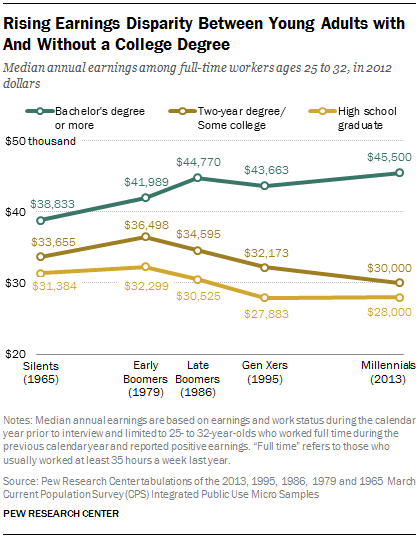
It is also possible to argue that our nation requires more college educated citizens in order to properly serve the needs of a 21st century economy.  Certainly, Professor Anthony Carnevale of Georgetown University believes so, and he believes that the Bureau of Labor Statistics’ estimate that only 27% of the jobs in the economy will require a BA by 2022 is “frighteningly low.”  Professor Carnevale and his colleagues at the Georgetown University Center on Education and the Workforce believe that by 2020, the economy will require 35% of the workforce will require a BA or higher.  This argument is predicated, in part, on the existence of a “college wage premium” that has grown in recent decades because employers are paying graduates with college degrees a higher wage than their non-college educated peers.  While the college wage premium is real and has grown since the late 1970s, the conclusions from Georgetown are not universally accepted.  To begin with, over 98% of job gains between 2007 and 2011 were made by those with advanced degrees beyond a bachelor’s.  Additionally, large numbers of today’s graduates with a bachelor’s are being hired into jobs that traditionally do not require a full four years of college, and while Georgetown’s study found that demand for college educated workers outstripped supply, the college wage premium they cite as evidence has been stuck for ten yearsBased on data from Pew Social trends, it is evident that much of the benefit of going to college is made up of the collapsing wages for non-college graduates rather than intense market competition for those with college degrees into jobs that require them:

SDT-higher-education-02-11-2014-0-03

Suffice to say, this is still an issue that is subject to appropriately vigorous debate, and it is unlikely we can look at the current number of college educated New Yorkers and say with certainty that it is sufficient or insufficient.

Another argument aims at a much harder nut to crack: the persistent imbalance in college attendance and completion by students who are ethnic minorities and who grow up in poverty.  Even with the newly designed examinations, white and Asian students far outperformed other cohorts of students, demonstrating something else that we know: while the number of minority students in higher education has been rising from the mid-1970’s until today, white students still make up 61% of American college students.  Hispanic students currently represent 14% of college students, and African American students make up 15%.  While these numbers roughly approximate these groups’ percentages in the general population of Generation Y, they do not reflect how decreased opportunities for higher education concentrate in urban, predominantly minority, communities. While that is a conversation and debate we ought to be having, past experience with Governor Cuomo suggests that he would steer the conversation towards more charter schools, even though the charter school segment as a whole did no better than the rest of the education system on the new exams.  The Governor certainly is not eager to discuss how his budgets have forced schools to work with dwindling resources, and he has continued to use what were originally designed as emergency budget measures to keep the state’s ledgers balanced without tax increases — on the backs of poor and rural schools.  So while it would be worthwhile to discuss how to extend genuine educational opportunity to more and more students, especially those in districts afflicted with urban and rural poverty, there is really no indication at all that Governor Cuomo is interested in a full-throated debate on the topic.

Instead, he wants to revisit the state’s teacher evaluation system because he believes that with state examination results like we have seen in recent years, many more teachers must be incompetent than the current system detects.

In the classic film “Casablanca,” Captain Louis Renault is ordered by his German overseer to close Rick’s American Cafe on any grounds he can find.  Captain Renault, played by the incomparable Claude Rains, closes the cafe on the grounds that he is “shocked, shocked to find out that gambling is going on in here” — immediately before he is handed his winnings for the evening.  Governor Cuomo wants us to believe that we must get even tougher on teachers in New York because of state exam results that a) reflect what we already know about the likely college bound population of New York students and b) that are the direct result of his commissioner pegging proficiency levels to college performance.

I am not sure what his “winnings” are in this act of hypocrisy, but he doesn’t rise to Claude Rains’ level of charm in performance.

4 Comments

Filed under Common Core, politics, Social Justice

What Education “Reformers” Do Not Understand About Teaching and Learning

It is often hard to understand the disconnect that seems to exist between the belief of prominent figures in education reform and the reality of teaching in America’s classrooms.  For example, at the end of September, Politico published an interview with self appointed education reformer Bill Gates, whose documented support for the Common Core State Standards, mass high stakes testing, teacher evaluations tied to testing and charter schools has greatly influenced the reform landscape of the past decade.  Gates, perhaps taking part in the efforts of reformers to have a “new conversation” to save the Common Core, treads familiar territory for himself in this interview.  Previously, he called upon teachers to defend the Common Core by appealing to its obvious utility and comparing it to industry standardization:

“If you have 50 different plug types, appliances wouldn’t be available and would be very expensive,” he said. But once an electric outlet becomes standardized, many companies can design appliances and competition ensues, creating variety and better prices for consumers, he said.

If states use common academic standards, the quality of classroom materials and professional development will improve, Gates said. Much of that material will be digital tools that are personalized to the student, he said. “To get this innovation out, common standards will be helpful,” he said.

He sounds off on similar themes in the Politico article, stating, ““Should Georgia have a different railroad width than anybody else? Should they teach multiplication in a different way? Oh, that’s brilliant. Who came up with that idea?”  Let me pause for a moment and give the technology mogul his due.  In industry, he is correct that standardized platforms for, say, delivering useful electricity from a wall socket, help spur technological innovations that make consumers’ lives better.  However, let me also state that the question of how to teach a child multiplication or how to read is vastly more complicated and has infinitely more variables than the question of how to attach an electric motor to a hand blender.

And besides, as teacher and blogger Peter Green notes, Gates simply does not understand the parameters of his metaphor and why it does not apply to teaching and learning.  Green writes:

Railroad gauges and plug configurations are, within certain engineering requirements, fairly arbitrary choices. Had railroad gauges been set a few inches wider or a few inches, it would not matter. The purpose of setting a standard is not to impose a choice that’s a better choice for the rails, but to impose a choice that makes all the rails work as parts of a larger whole. Within certain extremes, there’s no bad choice for gauge width; the actual width of the gauge matters less than the uniformity.

Decisions about educational standards are not arbitrary. Some educational choices are better than others, and those choices matter in and of themselves. The choice of standards matters far more than the uniformity. Human children are not in school for the primary purpose of being fitted to become part of a larger whole. Imposing a bad standards choice simply to have uniformity is a disastrous choice, but that is what the Common Core has done– sacrificed good standards in order to have uniformity, which is not even a desirable goal for human children in the first place.

Green’s point here should be crystal clear to anyone who is either connected to schooling or willing to think like those involved:  standards in education have to pay far more attention to the quality and impact of the standards than the standard of railroad gauges or electrical outlets have to because while a rail car can run along a track whatever size it is or a blender can draw electricity from an outlet regardless of its organization, a bad standard, if incentivized coercively enough will flow into instructional materials, teacher planning and assessments.  At the end of that journey, it will still be a bad standard regardless of standardization.

But even good standards are not guaranteed to leverage change in the classroom unless they are approached in manners that offer genuine support, collaboration and authentic buy in from the teachers involved in implementing them.  David Cohen, writing 24 years ago about efforts to enact mathematics reforms, presented the case of “Mrs. Oublier” in which he demonstrated that even with a teacher who was sincerely enthusiastic about teaching students to understand rather than to recite mathematics, her lack of fully understanding the conceptual changes to mathematics and her lack of a community of teachers continually working on their understanding led her to very questionable “reform” of her teaching.  Change was a three-legged stool, and with only one leg, her enthusiasm, Mrs. O was unable to really change.  The Common Core  so enthusiastically embraced by Bill Gates has the exact same problem on steroids.  Rushed in development and implementation, the standards are hardly uniformly excellent, supporting materials, similarly rushed, often confuse more than assist teachers, students, and parents in understanding expectations, and teachers have had no choice but to “buy in” to the reforms as states were required to use tests aligned with common standards if they wanted to drink at the trough of Race to the Top.  Nothing about this enterprise has demonstrated the least understanding of what it means to teach and to learn to teach.

In some ways, however, this is not a surprise.  Few of the current proponents of education reform have any classroom experience, and their knowledge of teaching and learning comes from their experiences as students in K-12 education.  Over a 13 year primary and secondary education, that translates to roughly 15,000 hours spent watching teachers teach.  No other college educated profession is so visible to the public as teachers are, and after so much time spent in the company of teachers teaching, vast swaths of the public think that they know what it is that teachers do.  Dan Lortie, in his seminal 1975 book “Schoolteacher: a Sociological Study,” dubbed this the “apprenticeship of observation,” which is largely responsible for the preconceived notions about teachers and teaching that most prospective teachers bring to their preparation.  These notions, while sincerely held and personally important to future teachers, are often simplistic and owe their formation to the narrow view of teaching one can glean simply by observing its most public performances in the classroom.  Development of content mastery, knowledge of students and their individual and collective needs as learners, a richly differentiated pedagogical repertoire that assists in transforming content into something that prompts learning, effectively managing the classroom learning environment, a reflective disposition that considers quantitative and qualitative input about how well students have learned and adjusts plans accordingly — none of that is truly visible to those who sit on the student side of the classroom except in how it is enacted in 40-60 minute long performances.

Untangling those visions of teaching and learning is one of the most interesting and difficult tasks of teacher education.  Even though much of what my students have learned from their time in K-12 school is superficial, quite a lot of it is deeply precious to them.  It is built upon the experience of working with beloved and respected teachers, and it comes from their own genuine enthusiasm for the experiences they had with content in those classrooms.  Our work in teacher education has to involve respecting that, helping students deconstruct their experiences so that they can see the craft involved in teaching, and prompting them to build upon rather than to destroy the visions with which they arrive.  I love this work, but I also recognize how difficult it can be for my students to make that journey in their time with us.  For starters, I do not have 15,000 hours in which to help them critically reflect upon their time in school, build more powerful visions of teaching and learning and teach them the pedagogical knowledge they need to enact those visions.  I have 30 credit hours, four field internships and student teaching.  Nested between the apprenticeship of observation and a, hopefully, long career teaching, university teacher education is necessarily a time when we demand a lot of prospective teachers so that they may best assist their future students.  Their journey to “the other side of the desk” is complex and packed.

It is a journey that Bill Gates has never taken himself, and I think it contributes to his almost entirely mechanistic approach to education reform: make everyone use the same thing, force compliance from teachers through assessment, wait for “innovation” to flow into the classroom via third party vendors all developing products for the same standards, and assume that everyone will get a high quality product at the end of the process.  Even if his assumptions are correct, teachers, and their learning, are left out of the process.  If learning to teach is a complex and iterative process involving close examination of preexisting ideas and critical evaluation of oneself, then learning to teach a reformed set of standards is not any less complex.  Consider again David Cohen’s lessons from Mrs. Oublier: even a teacher enthusiastic about the vision of teaching and learning embodied in a new set of standards needs far more than her enthusiasm and a new set of curriculum materials, and without a complete and robust effort to relearn how she saw mathematics and a community working together to help each other in that task, she fell far short.

This is not an implementation issue, so much as it is a perspective issue.  In the Politico interview, Gates talks about how standardizing teaching of multiplication across states is as obvious as standardizing railroads, and he calls standardization of learning at each grade level merely a “technocratic issue.”  He speaks admiringly of Asian countries that have “nice, thin textbooks,” and he calls the previous education landscape a “cacophony” simply because states had various standards.  And he also says that the standards mean that all students will be taught on what they will be tested, and “we should have great curriculum material.”  This harkens back to his previously quoted March call for teachers to “defend the core” where he promised standardization would lead to better materials.  Again, the teachers and teacher learning are missing from this process.

And that is because Bill Gates has never taught nor has he ever embarked upon the journey from student to teacher.

Despite having undertaken the task of reforming American education, Bill Gates does not understand the least thing about what it takes to become a teacher, nor does he understand the least thing about promoting teacher learning throughout the teaching career.  His reform choices and the elements that he continuously talks up as “reform” make the most sense if he thinks of teaching as the enactment of materials in the classroom, without sufficient comprehension of the long process of learning to teach that only begins with observations and assumptions gleaned from lengthy contact with teachers in classrooms.  These are assumptions about practice and how to bring about meaningful and positive change that no ed reformer would presume to make about the practice of doctors or attorneys, but they make it about teachers and learning.

And it is a big part of the reason why their enterprise is faltering.  You cannot reform what you do not understand.

2 Comments

Filed under Common Core, Gates Foundation, schools

Dear Common Core English Standards: Can we talk?

Back in 1993, when I had barely been teaching in my own high school English classroom for a month, I had an epiphany.  I looked around my classroom of ninth graders and realized, consciously, that they were not all going to become high school English teachers.  As epiphanies go, I admit that does not sound exceptional, but it was actually foundational for the rest of my career in education.  The reason for this was that I simultaneously realized that I was teaching English because of the lifelong qualitative relationship that I had with reading and writing in English.  My father probably read “Oscar the Otter” to me every night for a month when I was four.  As a young reader, I often wondered if I would ever have a friend as cool as Encyclopedia Brown’s sidekick, Sally Kimball.  Later, I was positive that I found a lifelong friend in Charles Wallace Murray, and my copies of “A Wrinkle in Time” and  “A Wind in the Door” were shortly falling apart from their spines.  Bilbo Baggins’ fate trading riddles in the dark is still a matter of tense anticipation, and what I remember most about a bout of chickenpox was that it gave me an opportunity to read all three existing “Hitchhiker’s Guide to the Galaxy” books in one afternoon.  Why was I a high school English teacher?  Because of the transformative power of reading to develop relationships over distance and centuries, to teach about cultures and ideals, to illuminate human nature, to amuse and to challenge.  I am a better person because of books, and I wanted students to discover similar experiences and to build skills that would allow them to both read and to write powerfully.

That most of my students would not seek the same path did not mean that they were incapable of such reading and writing, but it did mean that I could not ignore that they had their own reasons for being where they were, and that I had to allow them to find reasons for reading and writing that mattered to them.  In other words: You cannot be an English teacher and aim your instruction at the students who most remind you of yourself.

Common Core English Standards, you really need to learn that lesson.

I have read the standards, many times.  I have introduced them in foundations classes.  I am now working with teacher candidates in an English language arts methods class with the standards used for planning.  In this class, candidates not only are learning classroom methods for teaching English, but also they are learning the theoretical basis for adolescent literacy.  I have told them that if they squeeze the standards really hard and shake them a lot, it is possible to get something other than close textual reading out of them.

Common Core English Standards, you are making me a liar.

It is not that the Common Core English Standards do not describe aspects of reading and interpretation.  It is that they describe them from a single literary perspective, and then they backwards engineer them from high school all the way down to Kindergarten.  But don’t take my word on it, let’s look at the Reading Literature Standards themselves.

The Reading Literature Standards are laid out by what they call “College and Career Readiness” anchor standards that are iterated in each grade level.  Those ten anchor standards are organized in groups by Key Ideas and Details, Craft and Structure, Integration of Knowledge and Ideas, and Range of Reading and Text Complexity.  For the purpose of this exercise, I am going to select one standard under each of these groups to present at different levels.

From the grade 11-12 Reading Literature Standards:

Key Ideas and Details:

CCSS.ELA-Literacy.RL.11-12.1: Cite strong and thorough textual evidence to support analysis of what the text says explicitly as well as inferences drawn from the text, including determining where the text leaves matters uncertain.
Craft and Structure:

CCSS.ELA-Literacy.RL.11-12.5: Analyze how an author’s choices concerning how to structure specific parts of a text (e.g., the choice of where to begin or end a story, the choice to provide a comedic or tragic resolution) contribute to its overall structure and meaning as well as its aesthetic impact.

Integration of Knowledge and Ideas:

CCSS.ELA-Literacy.RL.11-12.7: Analyze multiple interpretations of a story, drama, or poem (e.g., recorded or live production of a play or recorded novel or poetry), evaluating how each version interprets the source text. (Include at least one play by Shakespeare and one play by an American dramatist.)

Range of Reading and Text Complexity:

CCSS.ELA-Literacy.RL.11-12.10: By the end of grade 11, read and comprehend literature, including stories, dramas, and poems, in the grades 11-CCR text complexity band proficiently, with scaffolding as needed at the high end of the range.

If you have graduated from a 4 year liberal arts college or university, odds are good that this sounds familiar regardless of your major.  The selected standards in Reading Literature represent a description of the close textual reading you were required to do as part of your introductory English coursework, possibly taught by an enthusiast of the New Criticism school of literary analysis from the mid-twentieth century.  For college bound students, this is not off the mark as far as a portion of their work with literature is concerned.  However, reading the entirety of the reading literature standards demonstrates that close textual reading is pretty much ALL that they contain.  Each of the anchor standard descriptors reiterates the anchors’ focus on the text — to the exclusion of the reader.

As mentioned, these standards then move down to Kindergarten, largely describing simpler tasks for less experienced readers.  From 6th grade:

CCSS.ELA-Literacy.RL.6.1: Cite textual evidence to support analysis of what the text says explicitly as well as inferences drawn from the text.

CCSS.ELA-Literacy.RL.6.5: Analyze how a particular sentence, chapter, scene, or stanza fits into the overall structure of a text and contributes to the development of the theme, setting, or plot.

CCSS.ELA-Literacy.RL.6.7: Compare and contrast the experience of reading a story, drama, or poem to listening to or viewing an audio, video, or live version of the text, including contrasting what they “see” and “hear” when reading the text to what they perceive when they listen or watch.

CCSS.ELA-Literacy.RL.6.10: By the end of the year, read and comprehend literature, including stories, dramas, and poems, in the grades 6-8 text complexity band proficiently, with scaffolding as needed at the high end of the range.

From 3rd grade:

CCSS.ELA-Literacy.RL.3.1: Ask and answer questions to demonstrate understanding of a text, referring explicitly to the text as the basis for the answers.

CCSS.ELA-Literacy.RL.3.5: Refer to parts of stories, dramas, and poems when writing or speaking about a text, using terms such as chapter, scene, and stanza; describe how each successive part builds on earlier sections.

CCSS.ELA-Literacy.RL.3.7: Explain how specific aspects of a text’s illustrations contribute to what is conveyed by the words in a story (e.g., create mood, emphasize aspects of a character or setting)

CCSS.ELA-Literacy.RL.3.10: By the end of the year, read and comprehend literature, including stories, dramas, and poetry, at the high end of the grades 2-3 text complexity band independently and proficiently.

From Kindergarten:

CCSS.ELA-Literacy.RL.K.1: With prompting and support, ask and answer questions about key details in a text.

CCSS.ELA-Literacy.RL.K.5: Recognize common types of texts (e.g., storybooks, poems).

CCSS.ELA-Literacy.RL.K.7: With prompting and support, describe the relationship between illustrations and the story in which they appear (e.g., what moment in a story an illustration depicts).

CCSS.ELA-Literacy.RL.K.10: Actively engage in group reading activities with purpose and understanding.

So what is wrong with this?  It represents a very specific purpose of reading literature, a purpose that does not serve the reasons why all children read, not even all children destined to become college English majors, and it is backwards engineered to grade levels when students cannot be expected to have full fluency.  What Common Core does is take reading literature and purpose it entirely to close textual reading, which is a tool of literary criticism, especially for the New Criticism school of analysis.  In New Criticism, the text is treated as self-contained, and it is the job of the reader to investigate it as an object to be understood via the structure of the text and without reference to external resources such as history, culture, psychology or the experiences of the reader.

This stands in stark opposition to Reader Response criticism where the role of the reader in creating meaning not only cannot be set aside, but also is absolutely essential for the words on the page to have any meaning whatsoever.  Louise Rosenblatt informed this school of thought by demonstrating that the process of reading is best understood as a transaction between the text and the individual readers who approach the task of reading it:

The transaction involving a reader and a printed text thus can be viewed as an event occurring at a particular time in a particular environment at a particular moment in the life history of the reader. The transaction will involve not only the past experience but also the present state and present interests or preoccupations of the reader. It stresses the possibility that printed marks on a page will become different linguistic symbols by virtue of transactions with different readers….

Does not the transactional point of view suggest that we should pay more attention to the experiential framework of any reading transaction? Is it not extraordinary that major social upheavals seem to have been required to disclose the fact that schools have consistently attempted to teach reading without looking at the language and life experience, the cognitive habits, that the child brought to the text? And should not this same concern be brought to bear on more than the problem of the language or dialect that the child brings? Should not a similar concern for reading as an event in a particular cultural and life situation be recognized as pertinent to all reading, for all children at all phases of their development as readers, from the simplest to the most sophisti­cated levels? (pp. 15-16)

Reader Response does not deny that there is a text with a structure that readers must encounter in order to make meaning, but it also recognizes the robust and essential elements brought by each individual reader in the meaning making process.  Instead of the text containing a single meaning to be derived by close textual analysis, the text is brought to many different meanings because of the histories, cultures, dispositions and experiences of the multitude of readers who transact with that text.

At this point, some advocates of the Common Core standards may protest that the Reading Literature standards are not trying to shoehorn all readers into New Criticism, and that with the tools of close textual reading, students and teachers could possibly engage in any number of reading experiences incorporating social, cultural, historical, psychological and personal knowledge.  To some degree, it is upon this that I have been hanging my promise to my own students that you can shake a social reading out of the CCSS if you just shake hard enough.  The problem is that I am not really convinced of that myself.  To begin with, even when the standards suggest some form of reading that is connected to something other than the text, it circles right back to close textual analysis. From the third grade standards:

CCSS.ELA-Literacy.RL.3.2
Recount stories, including fables, folktales, and myths from diverse cultures; determine the central message, lesson, or moral and explain how it is conveyed through key details in the text.
CCSS.ELA-Literacy.RL.3.3
Describe characters in a story (e.g., their traits, motivations, or feelings) and explain how their actions contribute to the sequence of events

Looking at these, I get somewhat hopeful.  RL3.2 states that students will recall some rich literature such as fables, folktales and myths which could become a great basis for comparing current and past societies, understanding the concept of a the heroic figure and how it relates to the child’s life.  But the standard quickly segues right back to picking out “key details in the text” in service of determining “the central message, lesson, or moral.” (emphasis added) Similarly, RL3.3 begins with some hope that students might develop personal relationships with the characters in the story and use those character traits to better understand themselves.  Then the standard immediately purposes their understanding to “explain how their actions contribute to the sequence of events.”  In Common Core, all literary roads lead to close textual analysis.  The reader is a bit player.

This shouldn’t come entirely as a surprise.  After all, one of the key players in the creation of the English Language Arts standards is David Coleman, current president of the College Board, philosophy graduate from Yale and Rhodes Scholar in English literature at Oxford University.  He is, plainly, a man of great intelligence and of sincere interest in the classical liberal arts.  What he is not, however, is a person with even the slightest credentials in literacy acquisition, elementary literacy or adolescent literacy.  As a student of classical philosophy and literature, he is no doubt quite familiar with literary criticism, but to infuse common standards in the English Language Arts with tools for literary criticism to the exclusion of all other ways to interact with texts all the way down to Kindergarten is a thoroughly strangled view of the role literature plays in the classroom.  This seems entirely unproblematic to Mr. Coleman, and while I have not read his thesis from Oxford, I have little reason to doubt that he is an enthusiast of New Criticism and other formalist schools of thought.  When presenting on the Common Core standards, Mr. Coleman derided what he described as a heavy emphasis on personal writing in most school curricula, thus:

When you add together the structure of the standards with the heavy testing regimen that have been tied to them and actual career consequences for teachers tied to those exams that were simultaneously put in place with the adoption of the CCSS, I find it hard to believe that very many teachers, on their own, are going to be able to use these standards to promote children’s love of literature from any social or experiential angle.  There is also extremely limited room for states to maneuver around the standards, as Mercedes Schneider reminds us here because the Memorandum of Understanding that states signed before adopting the CCSS only allows 15% of states standards to differ

If children in classrooms using the CCSS English standards learn to love reading on a deeply personal and affective level and develop a life long relationship with reading as a means of self exploration, it will be in spite of those standards, not because of them.

Did anyone have anything better for children before Common Core?  That’s difficult to answer because while states have been held to progress in examinations since the No Child Left Behind act of 2001, this is the first time that nearly nationwide assessments are going to be aligned with a single set of standards.  However, it is possible to speak about how states with standards different from Common Core did on nationally administered assessments prior to this endeavor.  For example, Massachusetts has long been recognized as a high performing state on the National Assessment of Educational Progress (NAEP).  In 2009, when Common Core was still twinkling in its authors’ eyes, Massachusetts’ 4th grade NAEP reading scores were higher than any other state in the nation.  At the time, Massachusetts was still using its own English Language Arts framework, adopted in 2001.  I would like to draw attention to Standard 9: Making Connections:

Students will deepen their understanding of a literary or non-literary work by relating it to its contemporary context or historical background.
By including supplementary reading selections that provide relevant historical and artistic background, teachers deepen students’ understanding of individual literary works and broaden their capacity to connect literature to other manifestations of the creative impulse.

The standard is then extrapolated forward, requiring that students examine works as related to the life and experiences of the author and in relationship to key concepts, ideas and controversies that existed in the society that produced the work itself.  Examinations such as these are fruitful grounds for personal experiences and comparisons of current society and events as well.  This is similar to principles articulated by the National Council of Teachers of English and the International Reading Association (NCTE/IRA) in the standards for the English Language Arts that they released in the 1990s.  Standards 1-3, in particular, articulate a broad vision of what reading is for and how readers go about doing it:

  1. Students read a wide range of print and non-print texts to build an understanding of texts, of themselves, and of the cultures of the United States and the world; to acquire new information; to respond to the needs and demands of society and the workplace; and for personal fulfillment. Among these texts are fiction and nonfiction, classic and contemporary works.
  2. Students read a wide range of literature from many periods in many genres to build an understanding of the many dimensions (e.g., philosophical, ethical, aesthetic) of human experience.
  3. Students apply a wide range of strategies to comprehend, interpret, evaluate, and appreciate texts. They draw on their prior experience, their interactions with other readers and writers, their knowledge of word meaning and of other texts, their word identification strategies, and their understanding of textual features (e.g., sound-letter correspondence, sentence structure, context, graphics).

Neither of these documents rules out close textual reading, nor do they dismiss the need for students to develop skills in creating sophisticated analyses using the tools of text.  Common Core, however, provides no explicit space for any other kind of reading or analysis, and it appears entirely uninformed by any framework of reading as a process that includes the reader in any capacity other than as faithful seeker of the text’s internally constructed meaning.  Readers who want to understand society and history via the text?  Readers who want to explore their own humanity across space and time with characters who live and breathe after centuries?  Readers who want to enjoy the feelings of a work of art without picking it apart into its component parts?

People don’t give a shit about what you feel or what you think.

66 Comments

Filed under Common Core, schools, Stories, teacher learning, teaching, Testing

If You Don’t Know What is Happening in Newark, You Should

Newark Public Schools began the school year under the “One Newark” program imposed upon the city by Trenton appointed Superintendent Cami Anderson.  The plan, which is the fruition of the partnership between Governor Chris Christie and former Mayor and current U.S. Senator Cory Booker, essentially speeds up the process by which neighborhood schools are labeled failures and turned over to charter school management and, in theory, opens up the entire city to a school choice plan potentially sending students all across the city in search of schools.  Community concern, parent, student and teacher, has been brushed aside, and the plan has been put into operation this school year.

Bob Braun, retired education reporter for the New Jersey Star Ledger has extensively covered the plan’s roll out on his blog, Bob Braun’s Ledger, and it is safe to say that he characterizes it more as a roll OVER of the entire community.  Schools were slated to close even when succeeding by every reasonable metricAnderson stopped attending monthly public meetings where she was hearing the public’s anger and confusion.  Even Secretary of Education Arne Duncan has expressed concern that Anderson’s plans are being rushed to implementation too quickly.  During the summer months, it was clear that Anderson had no operable plans for the transportation logistics problems caused by potentially busing students from the same families across the city to entirely different schools.  The lack of planning or even of care to plan was further evident this summer, when parents, taking off much needed work hours to participate in a school assignment process, were left waiting for hours in sweltering heat only to be told they would have to return another day.  Mind you, this wasn’t to enroll in an assigned school — it was just to get an assignment at all.  Mr. Braun reported one of just many heart-breaking stories entirely born of the cruelty being imposed upon Newark:

All the parents had stories to tell about the cruelty inflicted by the Anderson/Christie regime on the often poor and predominantly black and Hispanic residents of Newark. Typical was the story told by Marisol Mendez who came to the “One Newark” registration day to find placements for her 14-year-old son, Carlos Perez, and 9-year-old daughter, Emily Perez. The family lives in the North Ward and the children attended Abington Avenue but, when they applied under Anderson’s “One Newark” plan, Carlos, a special education student, they were  assigned to West Side High School and Emily was sent to a South Ward school.

“The placements were inappropriate for both of the children,” says Mendez. “My daughter is not going to take NJ Transit across town and my son needs a self-contained, special education class. He has had one all of his school career.”

Mendez tried to get answers from both the NPS administration and from charter schools. But, she says, two charter school operators–Newark Prep and K-12–told her they couldn’t take special education students. When she tried to speak to bureaucrats downtown, she received this shocking answer:

“They told me I should home-school my children.”

Anderson was upbeat on opening day, despite numerous reports of buses wandering the streets trying to find the students they were supposed to pick up.  But this week, the Newark Students Union tried to prove a point: that even in a politically disenfranchised community like Newark, people love their schools and will use whatever voice they can to make themselves heard.  On September 9th and 10th, students took part in direct action to protest what has been imposed upon them from outside political and economic alliances that see their entire school system as a worthy “experiment” at “creative destruction”.  With threats of citywide boycotts no longer supported by adult-led institutions such as the teachers’ union and the city clergy, these teens decided they had to be on the vanguard of demanding that Newark be heard: as reported by WABC News in New York City.  The student activists protested a second day by blockading the street near Anderson’s office as reported by WNBC the following day.  That protest culminated when police moved in to unchain the protesters, injuring the group’s leader, Kristin Towkaniuk.  Time will tell what will become in Newark, but despite their setbacks, it was genuinely inspiring to see students standing up when few adults are willing to do so.

And we all might have to get used to it.  I hope that I am wrong, but I have a terrible feeling that what is happening in Newark will shortly become the norm in American urban education.  Those schools have been treated to over 31 years of a relentless narrative of failure that has set them up for this kind of externally imposed disruption, and large portions of their populations are alienated constituencies in the body politic who certainly cannot muster the kind of money that drives policy today.

What worries me is that the growing backlash against the common standards, associated testing and use of testing to label students, teachers and schools as “failures” ripe for reorganization and take over is one with teeth because it has been pushed into our politically empowered communities, ones under no threat of state take over and loss of local control.  Peter Greene, a teacher and blogger, wrote about how at least one enthusiastic advocate of current reform trends, Michael Petrilli of the Fordham Institute, appears to be grasping this problem.  The gist is that Mr. Petrilli is now concerned that he and his fellow reform enthusiasts have mistakenly pushed their entire reform package into communities that have always thought highly of their schools, get the outcomes that they wish from those schools, have no easily identified need for drastic changes — plus they vote.  Some of them are even affiliated with powerful corporations who can provide the kind of monetary largesse that gets the attention of policy makers.

I could have told him this years ago if he had asked.  While a super majority of Americans think our schools are doing a mediocre job at best, a similar super majority of parents approve of the schools their children attend, and the Race To The Top package of reforms have taken the failure narrative from urban parents long used to it and pushed it out to the suburbs, whose parents are getting pissed at it.  Petrilli is even willing to admit that most high poverty schools are not failing so much as they are “no better and no worse” than average suburban schools.  However, he then pivots that such schools cannot “settle” for average and arrives at his conclusion that “no excuses” charter schools are the “best” suited for the job of propelling high poverty student populations to match students in affluent communities.

And this is why we can expect Newark to be replicated across the country if we don’t speak up even from the comfortable position of middle class school patrons.  I think Petrilli is correct when he diagnoses the reasons for growing push back against Common Core, testing and school failure.  Reformers have pushed so hard so quickly that they have challenged the politically empowered constituencies that policy setters need in order to stay in office. They certainly cannot charterize school districts where well-off families paid top dollar for homes in a neighborhood specifically because of the neighborhood schools.

But the efforts to turn over more public schools to charter management organizations will not give up easily.  If you have any doubt about that, recall that Wall Street donations pushed over 3 million dollars into the campaign of Shavar Jeffries for Newark mayor because his opponent, now-Mayor Ras Baraka opposed One Newark and its plans to turn over many more Newark schools to charters.  This is in a city where the mayor and school board have no real power over the schools.  There are well-financed and influential operations that want One Newark to become a model for urban education.

If that happens, we will have missed an opportunity.  If suburban parents manage to push back the disruption of current reforms from their communities, only to stand back and allow it to be imposed, full force, on communities without political power, it will be yet one more anti-democratic burden layered upon the backs of these communities.  It will be yet another case where we have abandoned children living in poverty as someone else’s problem, favoring the “easy” answers promised by education “reform” instead of the hard work of re-imagining a society without institutional racism and an economy where genuine opportunity flows upward.

We cannot afford to keep ignoring that.

6 Comments

Filed under Activism, Cami Anderson, charter schools, Chris Christie, Common Core, Cory Booker, Newark, One Newark, politics, schools, Social Justice

Gates’ Money and Privacy Activism — Opposition to Ed. Reform Hits the Mainstream

A few stories caught a lot of eyes over the weekend.  None of that is good news for education reformers who have banked on stealth and little reporting.

The first is a major article and interview regarding the role Bill Gates’ money has played in the development of, promotion of and adoption of the Common Core State Standards in the Washington Post.  The story is not entirely complete.  For starters, it fails to disclose that David Coleman already had funding from the Gates Foundation for his Student Achievement Partners, so a meeting with Gates in 2008 is not their first intersection.  Also, it does not explore the heavy hand that Gates has also had in the push for more high stakes testing to evaluate teachers via his funding of the highly flawed Measures of Effective Teaching study, nor does it examine the role that Gates has played in enabling technology entrepreneurs to mine the data generated from those tests without parental consent.

Regardless, the article is both informative and important for several reasons.  First, it is one of the first times anyone in a major news outlet has provided a portrait of the diverse opposition to current reform efforts in education that doesn’t make it sound like mostly the work of Alex Jones style cranks.  The article even quotes academics who question whether the standards are based on sound research on how children learn or even if there is a connection between quality standards and learning.  Second, this is an article in a major outlet that does not equivocate in the slightest about how much influence one very rich man has had in trying to control the entire course of American public education.  While it does not editorialize on the question, it is hard to read how many federal, state, nonprofit, academic and corporate entities were lobbied by, influenced by or funded by Gates and not wonder what role democracy has anymore when it comes to our public schools.

Finally, Gates himself comes across as defensive and dismissive:

Gates is disdainful of the rhetoric from opponents. He sees himself as a technocrat trying to foster solutions to a profound social problem — gaping inequalities in U.S. public education — by investing in promising new ideas.

This would be more convincing if Gates displayed the slightest interest in testing new ideas before unveiling them in 45 states at once before parents and teachers have a chance to understand them, indeed, before anyone has a chance to understand if they are a net positive or not.  From Gates’ point of view and experience, this must make sense.  He has compared common standards to standardized electrical outlets and computer code as a means of allowing innovation, and certainly getting DOS on most desktop computers in the world led to a lot of software developers having a common platform.  But education is not consumer electronics, and bypassing the entirety of stakeholders who value public education for a variety of reasons was going to lead to push back, and even today, Bill Gates does not demonstrate awareness of that.

The second article appeared in Politico and was dedicated to parent activists working to protect their children from data mining operations tied to public education.  This represents another public airing of activities whose proponents would prefer to avoid being seen in the open.  The report quotes New York’s Leonie Haimson of Class Size Matters about how parents have reacted when informed about the plans of technology firms to use pretty much every bit of data they can get their hands on, and it quotes worried data entrepreneurs coming to grips with parental opposition:

Many said they had always assumed parents would support their vision: to mine vast quantities of data for insights into what’s working, and what’s not, for individual students and for the education system as a whole.

“People took for granted that parents would understand [the benefits], that it was self-evident,” said Michael Horn, a co-founder of the Clayton Christensen Institute, an education think tank.

Instead, legitimate questions about data security have mixed with alarmist rhetoric in a combustible brew that’s “spreading like wildfire” on social media, said Aimee Rogstad Guidera, executive director of the Data Quality Campaign, a nonprofit advocacy group for data-driven education.

That fear, Guidera said, “leads to people saying, ‘Shut it down. No more.’”

Guidera hopes to counter the protests by circulating videos and graphics emphasizing the value of data. But she acknowledges the outrage will be hard to rein in.

Could the parent lobby scuttle a data revolution that’s been championed by the White House, pushed by billionaire philanthropists and embraced by reformers of both parties as the best hope to improve public education? “I do have that concern,” Guidera said. “Absolutely.”

The article doesn’t go into detail about just how much money is thought to be at stake and takes the data mining firms at their word that they only want to help, but I came away from reading it with one resounding message: this damage is entirely self inflicted, but the data miners see the parent activists as the problem.  They did not want to do the hard marketing work of convincing people that they were doing something valuable, and they did not anticipate that parents might see the data generated by their children’s public educations as something they’d want to protect rather than just shovel over for free.  It is hard to sympathize here, especially when they have avoided openness from the beginning.

Which leads to the third article from today: a call from the Gates Foundation for a two year “moratorium” on high stakes decisions based upon Common Core aligned testing.  This is the first official wavering from the Gates camp since the standards and testing drive began in earnest, and it is highly significant as an indication of concern that the whole enterprise is in trouble.  It may also be a miscalculation — yes, teacher opposition to using value added measures of their effectiveness based on standardized tests is strong, and yes, teachers have barely had time to adjust to the new standards.  But two years will not fix the flaws in VAMs, and it will not assuage parental concerns about the role of testing and data mining.  It will potentially take a chunk out of testing companies and data mining companies who were making business plans based upon all Common Core states embarking on wide scale testing next year, and I find it interesting that the Gates Foundation is willing to have them cool their heels while the standards’ supporters try to do something they have avoided all along: talk in public.

Leave a comment

Filed under Activism, Common Core, Funding, Gates Foundation, Media, Privacy, Testing, VAMs

Open Letter to President Obama — You Are Listening to the Wrong People

Dear Mr. President:

I am writing to you with three different roles.  First, I am the director of secondary education and secondary/special education teacher preparation at Seton Hall University where I have been on the faculty since 2002.  Second, I am a lifelong educator whose teaching experience at levels from seventh grade to graduate school courses stretches back to 1993. Finally and most importantly, sir, I am the father of two school aged children enrolled in the public schools of New York City.  All three of those roles in life have prompted me to write to you, and it is my hope that you will seriously consider what I have to say, for it is based upon my devotion to my children, my experience as a teacher and upon the data that is readily available about what is being done to schools during your administration.

With respect, Mr. President, you are listening to all the wrong people about our nation’s schools.

When you were inaugurated, many of us in education had hoped that your administration would urge Congress to roll back the detrimental aspects of the No Child Left Behind act, which had taken the previous two decades of educational failure rhetoric and placed a punishing regimen of unreasonable expectations, high stakes testing and punishment into effect that left schools and schools systems under threat of a “failure” label if they did not achieve near miraculous score gains in standardized examinations.  Instead, we got the Race to the Top program which has taken the worst elements of NCLB and made them even worse.  Your signature education initiative incentivized participating states to enroll in rushed and unproven common standards, increases the amount of high stakes testing at all levels of public education, subjects teachers to invalid measures of job performance and creates preferential treatment for charter schools that cynically manipulate data on their enrollment and achievements, sue to prevent public oversight of the public moneys they receive and whose expansion provides new investment vehicles for the very wealthy.  All of these results have rich and powerful advocates, and all of them are damaging to our nation’s public schools.

The Common Core State Standards have been described as a state led effort because of the role of the National Governors Association in their creation, but the work of a very few people is far more directly responsible for them.  David Coleman, now President of the College Board, Jason Zimba and Susan Pimentel of Student Achievement Incorporated worked with a small group of core writers that were largely representative of the testing and publishing industries to produce K-12 standards in English Language Arts and Mathematics in less than two years.  This is a staggering pace for such a complex project, and it was conducted in clear violation of highly regarded and accepted processes for the creation of standards.  Dr. Sandra Stotsky of the University of Arkansas was a member of the validation committee that was convened, in theory, to validate the quality of the standards, but she refused to signed off on them when, by her own account, repeated efforts to have the research basis for the standards produced by the writing committees went unanswered.  Once written, the standards were rapidly adopted by states due to the incentives of Race to the Top and aggressive spending of the Bill and Melinda Gates Foundation.  Diane Ravitch of New York University has repeatedly pointed out that this process was staggeringly flawed, and even more flawed than the opaque writing and promotion efforts has been the race to roll out the standards in nearly all states simultaneously with no small scale field testing and no known way for data from the implementation to be fed back to any body that is tasked with revising the standards based on such data.

Mr. Bill Gates seems enormously confident, absent any defensible evidence, that this is the correct path.  He provided funding to Student Achievement Incorporated and the National Governors Association, and has been spending lavishly since 2010 to make certain all forms of organizations continue to boost the standards.  Mr. Gates spoke this year at the Teaching and Learning Conference hosted by the National Board for Professional Teaching Standards (an organization he has given grants to recently), and his defense of national standards was telling.  According to the Washington Post:

Standardization is especially important to allow for innovation in the classroom, said Gates, who used an analogy of electrical outlets.

“If you have 50 different plug types, appliances wouldn’t be available and would be very expensive,” he said. But once an electric outlet becomes standardized, many companies can design appliances and competition ensues, creating variety and better prices for consumers, he said.

The version posted to the Gates Foundation website offers a more explanatory framing of the metaphor, but Mr. President, I hope the flaw in his thinking is evident.  Multi-state standards are not, inherently, a bad thing, primarily if used like the National Assessment of Educational Progress as a NO STAKES diagnostic tool, and Mr. Gates is correct that a variety of INDUSTRY standards have led to consumer innovations.  However, even after we accept a standard for early literacy acquisition to be age appropriate and based on research into how children learn to read, the process by which any given child meets that standard is vastly more complex than the process of attaching an electric motor to a hand blender; worse, it does not demonstrate an understanding that children develop at very varied rates, and that an age appropriate target for one child may be entirely inappropriate for a peer in the same classroom.

Even assuming that Mr. Gates is correct and that CCSS would allow teachers to innovate, Race to the Top and Mr. Gates’ own advocacy have worked to tie the CCSS to a regimen of high stakes testing the likes of which we have never seen and which are already incentivizing teachers and school districts to vastly narrow their teaching in response.  Mr. President, policy analysts refer to perverse incentives as those elements of policy that incentivize behavior in such a way that people can obtain the incentive while engaging in practices that are damaging or undesirable.  In this case, Race to the Top is the Mother of All Perverse Incentives.  Your administration required states to adopt test-based evaluation of teachers in addition to adoption of common standards.  This has resulted in states both enrolling in the CCSS testing consortia, and adopting Value Added Models (VAM) of teacher effectiveness as part of teacher assessment and retention.  Mr. President, you recently remarked that schools should not be teaching to the test even while your administration was stripping Washington State of its NCLB waiver over its desire to not use high stakes testing to evaluate teachers, but you could do little that incentivizes teaching to the test more than this.  Michelle Rhee’s tenure as D.C. Schools Chancellor provides an instructive anecdote.  Despite her denials and cursory investigation, it is very clear that her “raise test scores or be fired” approach spawned widespread cheating. That behavior is not excusable, but it is evidence of how far some people placed in extraordinarily difficult circumstances will go when subject to such incentives, and it is simply inevitable that short of cheating, the use of VAMs in teacher evaluation will result in more teaching to the test.

And VAMs themselves are invalid, Mr. President.  The American Statistical Association is quite clear on this in its recent statement on the use of VAMs for teacher evaluation.

The measure of student achievement is typically a score on a standardized test, and VAMs are only as good as the data fed into them. Ideally, tests should fully measure student achievement with respect to the curriculum objectives and content standards adopted by the state, in both breadth and depth. In practice, no test meets this stringent standard, and it needs to be recognized that, at best, most VAMs predict only performance on the test and not necessarily long-range learning outcomes. Other student outcomes are predicted only to the extent that they are correlated with test scores. A teacher’s efforts to encourage students’ creativity or help colleagues improve their instruction, for example, are not explicitly recognized in VAMs…

It is unknown how full implementation of an accountability system incorporating test-based indicators, such as those derived from VAMs, will affect the actions and dispositions of teachers, principals and other educators. Perceptions of transparency, fairness and credibility will be crucial in determining the degree of success of the system as a whole in achieving its goals of improving the quality of teaching. Given the unpredictability of such complex interacting forces, it is difficult to anticipate how the education system as a whole will be affected and how the educator labor market will respond.

This is clear-cut, sir.  There are no current high stakes tests that meet the requirements of a well developed VAM, and there is no evidence about how VAMs will influence the schools in which they are deployed, but your signature education program is incentivizing them anyway.

To date, no study reliably shows that current VAMs can be used the way they are going to be used over the next few years, but that has not stopped the Gates Foundation from being front and center in this issue as well.  The Gates commissioned “Measures of Effective Teaching” study concluded that VAMs can be effectively used to evaluate teachers, but Jesse Rothstein of the University of California at Berkeley demonstrated clearly how flawed the study was, especially how it drew conclusions only weakly supported by its own data:

The results presented in the report do not support the conclusions drawn from them. This is especially troubling because the Gates Foundation has widely circulated a stand-alone policy brief (with the same title as the research report) that omits the full analysis, so even careful readers will be unaware of the weak evidentiary basis for its conclusions…

Hence, while the report’s conclusion that teachers who perform well on one measure “tend to” do well on the other is technically correct, the tendency is shockingly weak.  As discussed below (and in contrast to many media summaries of the MET study), this important result casts substantial doubt on the utility of student test score gains as a measure of teacher effectiveness.  Moreover, the focus on the stable components – which cannot be observed directly but whose properties are inferred by researchers based on comparisons between classes taught be the same teacher – inflates the correlations among measures.  Around 45% of teacher who appear based on the actually-observed scores to be at the 80th percentile on one measure are in fact below average on the other. Although this problem would decrease if information from multiple years (or multiple courses in the same year) were averaged, in realistic settings misclassification rates would remain much higher than the already high rates inferred for the stable components.

It is almost inconceivable how it is that our nation is rushing forward with a package of reforms that are being implemented at breakneck speed with such damaging potential and with so little evidence to suggest that they will do anyone any good, and with mounting evidence that they are objectively harmful.  But one thing is actually very certain: these “reforms” and their attendant policies are making some people a substantial profit.

Three years ago, education writer and consultant and former National Board Certified Teacher Nancy Flanagan noted that the rush for CCSS implementation meant that a publishing bonanza was on the horizon.   Certainly, their implementation with the coming testing requirements has been a bonanza for Pearson who landed the contract to write and implement the Partnership for Assessment of Readiness for College and Careers (PARCC)  testing consortium.  At a predicted cost of 24 dollars for a set of tests as the math and ELA testing comes on line, Pearson is guaranteed a huge new income stream from the more than 10 million students currently in PARCC states.  But Pearson is only the most public face of making money off of the reforms put in place by your administration.  Common standards and mass testing generate vast amount of data, and technology companies are starting up all intending to mine that data for profit.  This is ground that has been ploughed by Rupert Murdoch who, when he began acquiring education technology firms, identified a “500 billion dollar sector” waiting for “big breakthroughs”.  Bill Gates has also been involved in this sector, setting up the data cloud storage firm InBloom for 100 million dollars, and watching it close when parental concerns over data security and the plan to allow vendors to access the data could not be overcome.  But other firms such as Knewton intend to continue data mining and creating products based upon that analysis, and none of them, regardless of how intriguing their products might be, demonstrate sufficient care about the need to explain their services to parents, the need to allow parents and guardians to opt their children out of the data pool or the need to build real support among the people whose children are being transformed into revenue.

I am asking you as a father, sir: would this be acceptable to you?  I regret to inform you, Mr. President, that your own administration has abetted this by changing the regulations that implement the Federal Education Rights and Privacy Act.

Publishers, testing companies and technology firms are not the only ones who are reaping new windfalls from your education policies, Mr. President.  It turns out that Wall Street investors are eager to see another aspect of Race to the Top, charter school expansion, continue as rapidly as everything else, and while many of them proclaim to be fans of the charter schools’ alleged “successes” it is also clear that many of them have also figured out how to make guaranteed money from supporting charter schools.  Hedge fund billionaires can use a combination of federal tax credits to make investing in charter school construction a vehicle that can guarantee a doubled return within 7 years.  This is entirely unlike traditional school construction funding via bond issues because such bond issues are done in the open and for a public with a vote for or against the responsible school boards.  This is done entirely in private and with no oversight and precious little public knowledge.  It is little wonder then that Wall Street interests are not only investing in charter school construction, they are also organizing PACs such as Democrats for Education Reform specifically to keep state governments granting more and more charters, something else that you enabled with the provisions of Race to the Top.

You might be able to justify this, Mr. President if you could claim that charter schools are actually the solution to American education, but to make that claim you would have to ignore evidence.  Many charters are excellent schools.  Many are terrible.  But there is no evidence that the charter school segment is consistently outperforming fully public schools.  There is, however, evidence that charter schools do not educate children with disabilities at comparable levels as fully public schools.  There is evidence that charter schools do not serve students who are English Language Learners like their fully public peer schools do.  There is evidence that one of the most prominent charter operators in New York City, Eva Moskowitz of Success Academy, is not telling the truth about the number of children in poverty that she serves, the real achievements of her schools test scores, or the rate of attrition for students with disabilities and language learning issues.

These schools are not miracle factories, Mr. President, but supporting their expansion is making people money.  Your Secretary of Education, Arne Duncan, once opined that Hurricane Katrina was the “best thing” ever for New Orleans Schools because it shook up the status quo and got people “serious” about reform.  That “reform” has meant that this week, the last public school in New Orleans has closed for good, and the city school system in entirely comprised of charter schools.  Amidst growing evidence that many prominent charter operators are not equally educating students and amidst disturbing studies about rising segregation in the charter sector, I cannot help but wonder how Secretary Duncan justifies his statement today.

No wonder teacher morale is at an all time low.

Your public voice in these issues has been a disaster for you, Mr. President.  Secretary Duncan may be the most controversial person to hold that office since its creation, and he has repeatedly demonstrated that he is both insensitive to teacher and parental concerns and fully vested in a false narrative about American education.  Mr. Duncan has frequently repeated to charges from corporate reformers and privatizers that American education is stagnant and that we can infer a need for their favored reforms from international testing data.  This is part of a narrative of deepening failure which thoroughly ignores how American students have never fared well on such measures and how these scores and our economic health have little connection.  Mr. Duncan has observed that he believes our teachers are not educated enough and we should be more like South Korea, despite the fact that South Korea’s educational “success” comes with high costs:  20% of family income on average spent on private “cram” classes, focus on drill and rote learning that leads to high test scores, and wide recognition that South Korean children face too much pressure, leading to an alarming youth suicide rate.  This is hardly praise worthy, sir.

Secretary Duncan’s misunderstanding extends to why people are criticizing the CCSS and other Race to the Top reforms.  I am sure that you know how he said that Common Core opponents are often “white suburban moms” who are upset to find out their children are not “as brilliant as they thought they were”.  Mr. Duncan apologized for the remark, but his insinuation that any opposition to CCSS is unreasonable betrays that he really does not understand the issue.  Mr. President, American parents, by wide margins, believe that the schools their children attend are doing very good work, and despite three decades of an unrelenting failure narrative, that percentage, over 70%, has remained stable.  What parents are saying is that Common Core, evaluating teachers by tests and the increase in high stakes testing and heavy pressure on schools to raise test scores at all costs have come too rapidly, with too little transparency, and with extreme negatives vis-a-vis how children experience school.  Mr. Duncan does not understand that as evidenced by his remarks in April with NY Commissioner John King where he called parental protests “drama and noise.”  Mr. Duncan may call the 10s of 1000s of families who have opted out of Pearson’s testing and the list of districts refusing to field test the exams “drama and noise”.  Many, myself included, call it a movement that is ignored and dismissed at peril.  I do not know if your Secretary of Education has told you that most opposition to reform comes from Glenn Beck styled cranks and spoiled suburbanites, but if he has, you have been sorely misinformed.

Mr. President, in 1999 Congress passed the Gramm-Leach-Bliley Act, also known as the Financial Services Modernization Act, and President Clinton signed it into law.  Although the trends in mortgage lending and investment products that led to the financial crisis had begun long before 1999, the removal of regulations that prevented commercial and investment banks and insurance firms from blending their businesses greatly accelerated the damage being done to our financial industry.

Mr. President, I am afraid that history will look upon Race to the Top as your Financial Services Modernization Act, a tool crafted to be cynically misappropriated by interests with no concern for the public good.

And what is so frustrating, Mr. President, is how entirely unnecessary this judgment of history will be.  Our schools need help, sir, but it is not help that will be found by racing to implement new standards, layering on more high stakes tests, threatening teachers’ livelihoods with invalid statistical models or by turning more and more of our urban school districts over to for profit charter school corporations.  Our schools are afflicted by the same thing that afflicts our society: rising poverty and constant cuts to assistance for the poor.  16 million children in the United States live in poverty; that is 22% of all children, 38.2% of all African American children and 35% of Hispanic children.  Our schools serve communities, and our segregation by income has increased over the past 30 years, meaning that both rich and poor increasingly live in communities with people mostly of their own income level.  The Residential Income Segregation Index (RISI) scores for Houston, Dallas, New York, Los Angeles and Philadelphia are all above 50, and the RISI has gone up in every region of the country since 1980.  Nationally, it is 46, an increase of 39% since 1980.

We see this when we look at our PISA scores broken down by the income characteristics of communities.  According to USC Professor Emeritus Stephen Krashen, the portrait of America’s schools look very different when poverty characteristics are considered.  In schools where less than 10% of the students qualify for free and reduced lunch, our PISA scores are higher than the average for any OECD nation, but where 75% or more of students are in poverty, the PISA scores are second to last.  Given that our communities are increasingly segregated by income, Mr. President, it is inevitable that test score data compared nation to nation will be misleading.

It is at this point that Arne Duncan, Michelle Rhee, Joel Klein, Eva Moskowitz, Andrew Cuomo, Bill Gates, Whitney Tilson, and a host of other corporate “reformers” will line up to accuse me of making “excuses” for “bad schools”.  They will insist, absent any evidence, that “great teachers” can close the achievement gap even if we completely fail to address poverty in our communities.  But it is not “making excuses” to insist that if we want a child living in poverty to succeed in school that we cannot ignore whether or not she knows if she is going to eat tonight, or if she will have a place to sleep, or if her parents will continue to work or any of the host of other matters that afflict children in poverty in ways that negatively impact their formal education.  Mr. President, we have known the long term impacts of poverty on children for some time now just as we have known that it has been growing and deepening, and we spend far less than our peer nations on helping to alleviate the detrimental impacts of poverty.  Nothing in education policy in the past three decades has done anything to address that.

That is not “excuse making,” Mr. President, that is aiming the analysis at the actual problem, whether or not addressing the problem will make anyone a profit.

You have an advantage that few of your predecessors had, Mr. President, and it is your demonstrated interest in and ability to genuinely listen to others.  Joshua Dubois wrote about your meetings with the families at Sandy Hook Elementary School, and how for hours, you sat, embraced, asked questions and listened to them. What strikes me, sir, is how, despite an election year warming up, you never once mentioned this to the press and never once used this remarkable testament to your character for political gain.  I urge you, Mr. President, to visit teachers, parents and children in the same manner, without cameras or vetting, and just ask them what they want our schools to be.  You will not find their answers easily mapped onto your education policies.

It is not too late for you to have a transformational impact on America’s schools, Mr. President, but it will take a number of immediate actions to have a chance.  I ask you to consider the following, badly needed, steps:

  1. Scrap Race to the Top: Your signature education policy is detrimental to children, teachers, schools and communities.  Ending it will not do away with the Common Core State Standards, testing or charter schools, but it will free states and districts to look truly reflectively at these initiatives and to voluntarily engage in as little or as much of them as they deem necessary and beneficial.  It will require proponents of these policies to make their cases in full view of the public in all 50 states instead of hiding behind coercive requirements for federal funding.
  2. Restore Federal Privacy Protections: Technology entrepreneurs may have truly powerful learning tools in development, but to make them work, they need student records deemed private under federal law.  Instead of engaging teachers and parents about these tools, they got your administration to revise regulations and are now mining those records without any meaningful consent.  This is unacceptable, and it must stop.  Our children are not sent to public school to be monetized without our consent.  Parents will listen to open and honest efforts to describe how these tools can benefit their children, but they will oppose efforts to bypass them.
  3. Be Serious About Holding Charter Schools Accountable to Civil Rights Legislation: Your administration recently expressed interest in making certain that charter schools meet federal civil rights requirements.  This is a good first step.  It must be applied vigorously, especially given how poorly many high profile charter operators do in serving students with disabilities, educating English Language Learners and retaining students of color after admission.  Your administration has granted enormous favoritism to charter schools, and they must be made fully accountable.
  4. Demand a Marshall Plan for School Aid and Construction:  Nearly all states are spending less money per pupil today than in 2008. In New York State, the average school district still receives $3.1 million less in state aid than they would have without budgetary tricks like the Gap Elimination Adjustment.  All across the country, our public schools are being told to implement a complex new curriculum, meet unrealistic testing requirements and to do so while having their budgets cut to the bone.  Further, in 2008, the AFT commissioned a study that estimated a need for over $250 billion in school infrastructure spending nationwide, a need that remains unmet.  It adds insult to injury that students come from homes that suffer from the deprivations of poverty and arrive in schools that are cold in the winter, hot in the summer and wet when it rains.  Our nation must do something about this.  At the same time, you must highlight schools where children in poverty thrive, not merely where they get good test scores.
  5. Replace Secretary Duncan: Mr. Duncan is entwined so deeply in the Race to the Top approach to reform that he is incapable of moving away from it.  Your Secretary of Education demonstrates no understanding of why people oppose current reforms, little willingness to see his mistakes as more than verbal slip ups, and he consistently misuses international test data to denigrate the quality of our schools and teachers.  If you want to protect our schools from the forces of corporate reform, Secretary Duncan cannot lead.

You have an opportunity, Mr. President, to retask the federal Department of Education with protecting our national Commons, our history of 200 years of seeing public education as a public good for communities and a private good for individuals.  Your administration has abetted the use of our public schools by private and corporate interests in ways that are actually detrimental to education.  If you wish that to not be your legacy, you must act now.

Sincerely,

Daniel S. Katz, Ph.D.

Director, Secondary and Secondary/Special Education Teacher Preparation, Seton Hall University

Career Educator

Father of Two Public School Children


Leave a comment

Filed under Activism, charter schools, Common Core, DFER, Gates Foundation, politics, Privacy, schools, Social Justice, Stories, teaching, Testing, VAMs

Can We Talk About Poverty And Violence NOW?

I became aware of this via a graduate school colleague.  Research from the CDC and Harvard University identifies that as much as 30% of young people in our urban areas suffer from Post Traumatic Stress Disorder as the result of living in communities afflicted by violence, a rate higher than soldiers returning from Iraq and Afghanistan.  This citation recently went viral because of report on a San Francisco CBS affiliate that mentioned the research — while deciding to coin the phrase “hood disease” to describe the phenomenon.  Response to that polarizing and sensationalist turn of phrase was swift, and it was well earned.  Hopefully, it will not obscure a chance to focus on a conversation that is desperately missing from today’s education conversation — the impact of poverty and violence on children and what it means to provide meaningful education for those children.

I am not optimistic, unfortunately.  Discussing the impacts of poverty and community violence on children would mean taking a good hard look at American society as a whole, how segregated we remain as a society (and how it is getting worse since 1980), how poorly we do as a country at helping families in poverty and how we largely ignore problems that are clustered in communities that are predominantly of color. I find it hard to believe that we are ready for a conversation today.  It would require more willingness for painful introspection and confrontation of racism that many prefer to believe does not exist.

Optimism is further undercut by the fact that the impacts of poverty on all sorts of outcomes for young people is not precisely news, although the PTSD estimates for community violence should cause more people to take notice.  “Effects of Poverty on Children” was published in 1997 and found vast differences in physical, cognitive, school achievement, and emotional and behavioral outcomes for children living in poverty, and it described the ways in which poverty influences these outcomes.  They recommended community health, parental education, in home interventions, and renewed efforts to eliminate deep, sustained poverty.  Not one of these recommendations found their way into the Bush era No Child Left Behind education reform bill nor into its Obama administration successor, Race to the Top.  Arizona State University Regents’ Professor Emeritus David Berliner delivered the Presidential Invited Speech at the 2005 meeting of the American Educational Research Association, and he titled in “Our Impoverished View of Education Reform.”  Among his conclusions:

All I am saying in this essay is that I am tired of acting like the schools, all alone, can do what is needed to help more people achieve higher levels of academic performance in our society. As Jean Anyon (1997, p. 168) put it “Attempting to fix inner city schools without fixing the city in which they are embedded is like trying to clean the air on one side of a screen door.”

To clean the air on both sides of the screen door we need to begin thinking about building a two-way system of accountability for contemporary America. The obligation that we educators have accepted to be accountable to our communities must become reciprocal. Our communities must also be accountable to those of us who work in the schools, and they can do this by creating social conditions for our nation that allow us to do our jobs well. Accountability is a two way process, it requires a principal and an agent. For too long schools have thought of themselves only as agents who must meet the demands of the principal, often the local community, state, or federal government. It is time for principals (and other school leaders) to become principals. That is, school people need to see communities as agents as well as principals and hold communities to standards that insure all our children are accorded the opportunities necessary for growing well.

It does take a whole village to raise a child, and we actually know a little bit about how to do that. What we seem not to know how to do in modern America is to raise the village, to promote communal values that insure that all our children will prosper. We need to face the fact that our whole society needs to be held as accountable for providing healthy children ready to learn, as our schools are for delivering quality instruction. One-way accountability, where we are always blaming the schools for the faults that we find, is neither just, nor likely to solve the problems we want to address.

But since that address in 2005, “one-way accountability” has not only dominated policy, it has actually spawned an entire industrial scaled investment in testing and data, entrenching it even deeper.  Even though it has very little to do with the issues that plague impoverished communities in our country and the schools that try to serve them.

Most of what you’ve read about our “failing” national schools is based on flawed data.  Even using the preferred tool of accountability advocates, standardized tests, the crisis in our public schools is one of community poverty.  This graphic comes courtesy of Christine McCarthy, a New York City public school teacher and recipient of a Distinguished Fullbright Award in Teaching:

Image

Stephen Krashen, professor emeritus at USC provides the data for this chart which should make it crystal clear that the constant doubling down on standards and testing will have no serious impact on the international testing gaps that produce such gnashing on the teeth in the media and in Washington.  A test does not alleviate the well documented impacts of poverty.  Firing a teacher whose students are performing poorly on a test does not alleviate the well documented impacts of poverty.

It is at this junction, that a Michelle Rhee or Joel Klein comes along, sometimes on a talk show, to say that there should be “no excuses” for even a school with a 75% or higher poverty rate.  Their preferred “no excuses” methods involve firing as many people as they can, closing down schools and turning more and more children over to charter school operators.  Certainly, many of those operators like to claim that they’ve found the “secret sauce” to educating within communities afflicted by high rates of poverty.  Eva Moskowitz’s “Success Academy” empire claims that it is educating the exact same students as the neighborhood schools in Harlem, but that claim is simply false, and a parent at Upper West Side Success documented on tape how administrators have tried to counsel out her son who has an IEP, something no neighborhood school could do.  Northstar Academy in Newark loves to claim at 100% graduation rate for seniors, but it fails to report its 50% attrition rate prior to senior year.

The lesson here is that there is no “special sauce” and “Superman” is a comic book hero.  We, as a society, have never figured out a way to provide large scale, genuine, educational opportunity to children growing up in communities with deep and persistent poverty.  We, as a society, are woefully uncommitted to alleviating poverty and have even come to accept the terrifying 20% rate of childhood poverty as normal and perhaps inevitable.  But absent those two commitments, no amount of firing teachers or testing students until they cry is going to “fix” American education.

And this is where I worry for the future again:  I think it is very likely that a combination of suburban parental outrage and teacher activism is going to push back hard on current reforms.  If Common Core survives, it will be substantially modified with fewer tests and less emphasis on value added models of teacher evaluation.  The fact is that pushing the punishment narrative that has been the burden of urban schools for so long to communities that generally like their schools is going to create a backlash.  But once those parents have pushed back and changed these systems, we will still be left with communities rife with damaging poverty and violence, and we will most likely go back to ignoring those facts.

And the next cycle of “reform” will ignore it too.

Leave a comment

Filed under charter schools, politics, schools, Social Justice, teaching, Testing, VAMs