Tag Archives: shenanigans

Anti-Tenure – Union Busting FIRST, Students Second

One consequence of becoming active in social media and blogging is crossing paths with people that you would not normally encounter face to face.  For example, among my normal Twitter feed comprised of classroom teachers, public school advocates, researchers and news sources, a certain gentleman was noticeably involved in several arguments.  Shortly thereafter, he began following me on Twitter.  His name is Dmitri Mehlhorn, and he is a former C.O.O. for Michelle Rhee’s Students First organization, and, suffice to say, he is a true believer in current education “reforms”.  When Rhee announced that she was stepping down as the head of Students First, Mr. Mehlhorn penned this astonishing piece of apologia for The Daily Beast on her behalf, which despite saying she was “right about everything” cannot really name a measurable outcome of Ms. Rhee’s activism that has improved education.  Mostly, he spends the article lamenting the attacks upon Ms. Rhee, even going so far as to paint her famous on camera firing of a school principal as her sending a “message” to teachers that she was on their side:

As I said, Mr. Mehlhorn is a true believer, and the arguments he was involved in on Twitter centered on former television anchor Campbell Brown’s efforts to sue teacher tenure out of existence in New York.  As a devotee of Michelle Rhee, Mehlhorn is obviously in favor the current lawsuits, and as a former close associate of Rhee’s organization, he ought to be well-versed in the arguments against teacher tenure and be able to explain why it is better for the profession and for students to end due process protections for teachers and make them at will employees.

In fact, that is not a simple argument to make, especially since all research demonstrates that the urban schools Mr. Mehlhorn and Ms. Brown insist will be made better by eliminating tenure suffer far more from high teacher TURNOVER with some districts losing up to 50% of teachers within 5 years.  However, Mr. Mehlhorn did not seem overly interested in making the argument, preferring to respond with broad accusations that “my side” did not “care” about doing anything while “children suffer”.  That prompted my request for an actual argument about how ending tenure will make schools better able to retain good teachers instead of vague accusations and assertions of his bona fides in education reform.  This is what he came up with:

I will confess that I had to read this several times before understanding that the gist of it was really Mr. Mehlhorn’s argument.  I also tried looking at it out of order and contemplated standing on my head before accepting that the argument was basically this: Good teachers work more hours than bad teachers (conceded).  So good teachers get paid less per hour than their bad teacher peers because for the same salary, they work more hours (conceded but in a nobody-calculates-teacher-pay-that-way-not-even-teachers kind of way).  Ergo, the presence of bad teachers demotivates good teachers who either leave the profession or don’t go into it at all knowing their work is not valued at as high an hourly wage as their bad teacher peers.

Confused

Now keep in mind that Mr. Mehlhorn is not RANDOMLY opining on this subject.  At Students First, teacher unions are not regarded highly.  Consider this post where a “balanced” perspective on teacher unions as “change agents” or “opposition” is considered.  The union as “change agent” comprised a handful of paragraphs from a DC public school teacher Eric Bethel (who has since been appointed as a principal in the district) about the union getting on board with “reform” – reforms that just happen to be those approved of by Michelle Rhee.  The second piece goes on at some length and is written by Hoover Institute Fellow Terry Moe who co-wrote the Bible of school choice “Politics, Markets and America’s Schools” and his basic point is that strong teacher unions will always prevent schools from changing.  His solution?  Make unions far less powerful.  This is a Students First presentation of “balance” on a key issue.

So Mr. Mehlhorn, prepped with Michelle Rhee’s culture of anti-unionism, ought to have a sophisticated argument as to why eliminating tenure will make schools better, not by merely removing the percentage of teachers who ought not be teaching at more rapid pace, but by addressing one of the most complicated problems actually facing schools: retaining teachers at our schools with the highest levels of poverty and disadvantage.

His best stab at it? A cost-benefit calculation on salary that I have never heard one teacher make in my entire 21 year long career in secondary and higher education.

The problem for Mr. Mehlhorn and for the argument he tried to represent is that this is a matter that ought to be quantifiable.  There ought to be a way for him to say that there are “X” “bad teachers” in the classroom who are protected by tenure laws.  Then he ought to be able to certify what percentage of X are effectively irremovable and tie that to their tenured status and no other reason such as ineffective school and district leadership.  Then he should be able to demonstrate that the harm inflicted upon 3,000,000 – X teachers and their classrooms and students will not be GREATER than the harm reduced by making it easier to remove X teachers.

Of course, he cannot do that or, at the very least, has not been given arguments to make those points.  While Mr. Mehlhorn proved very adept at dropping the names of researchers used by the plaintiffs in the Vergara lawsuit to claim that there is a specific monetary cost for students who have a “grossly ineffective teacher”, he was completely unable to or unwilling to address that the research is highly controversial, rests on exceptionally shaky assumptions, and is not widely accepted in its current form.  Additionally, the premise for going after tenure protections of ALL teachers summarily dismisses any other fix for the the assumed problem.  Michelle Rhee, Campbell Brown and Dmitri Mehlhorn do not advocate enhancing the process by which teachers are moved from probationary status.  They do not advocate for making principals more effective at their jobs (except for making it easier for them to fire teachers), and, in fact, advocate for making principals MORE adversarial to their faculty and undermining their ability to be instructional leaders.  They do not advocate for reforms to the procedures by which a school district can demonstrate cause for removing a teacher who is no longer probationary (something that already happened in New York State).  They advocate that every teacher become an at will employee.  Teachers have taken to Twitter with the hashtag #WithoutTenure to explain what the consequences of that would be for their ability to robustly advocate for their students’ needs, and this piece by Peter Greene makes it clear what could happen in schools where teachers lose their current job protections.

Further, from what we know about why teachers leave positions, resentment of other teachers making more money per hour does not enter the equation.  Richard Ingersoll of the University of Pennsylvania notes that teacher turnover is a significant phenomenon which drives a large proportion of the annual demand for new teachers.  While Dr. Ingersoll’s research notes that teachers at small, private schools actually turn over at rates that far exceed those elsewhere, he compared high poverty, urban teachers’ reasons for leaving with those of small, private schools and found that school management factors contributed highly to both populations’ reasons for leaving.  Small, private school teachers cited low salary overwhelmingly as a factor along with dissatisfaction with school administration, a concern shared with teachers in urban, high poverty schools who also listed lack of administrative support, low student motivation, discipline problems and lack of decision making support as roughly equal reasons for leaving.

Susan Moore Johnson of Harvard’s Project on the Next Generation of Teachers, affirms that the teaching environment has a large impact on teacher satisfaction, fully independent of the demographic contexts of the school and more closely related to the social conditions of working in the school.  Their research further states that a positive school climate can impact student learning, again independent of the school’s demographics.  Dr. Moore Johnson’s work also notes that once school environment factors are taken into account no student demographic factors remain as significant indicators of why teachers leave.  Factors that contribute to teacher dissatisfaction with working conditions include principal leadership that is effective, fair, provides instructional leadership and practices inclusive decision making.  Teachers also gauge the quality of their collegial relationships and issues regarding how student discipline is supported in these decisions.

Dr. Moore Johnson notes that the good news in this is that “unlike demographic characteristics of students, working conditions can be changed.”  To be fair to Mr. Mehlhorn and his ilk, one COULD make an argument that eliminating tenure will help “change” working conditions by making it simpler to weed out bad teachers — but you would have to push really hard to make that your first priority or even on the top ten list.  Improving principal leadership and building more structures for effective and productive collaboration among teachers should be near the top of such a list because 1) effective principals seek ways to meaningfully evaluate and support teachers and 2) a collaborative environment would more easily identify those teachers who do not want to improve and make a reasonable case of removal for cause under existing rules.  It would also have the benefit of aiming to support and improve everyone at a school not merely to exact punitive costs upon individual teachers and administrators, and it would preserve the ability of teachers to advocate on behalf of their students in cases that require a more adversarial stance.

But the anti-tenure campaign does not push meaningfully for any reforms to school climates.  In fact, they advocate making the climate worse by suggesting that all teachers must lose the “for cause” protections of tenure in order to weed out the minority of teachers deemed ineffective.  There is nothing in the current lawsuits that will improve what it is like to work in schools that suffer high rates of teacher attrition, and, thus, nothing in those suits that will help retain effective teachers for students in urban poverty.  Campbell Brown makes only token and meaningless statements about “raising up” the teaching profession, and she certainly is not suing any state legislatures for not instituting reforms that strengthen principal leadership or teachers’ collegiality.

At the end of the discussion, therefore, the effort to sue away tenure is not about making schools better directly through “removing ineffective teachers.”  It is about greatly weakening teacher unions, as argued by Terry Moe in the Students First blog post linked above.  People like Moe, Rhee, Brown and Mehlhorn clearly believe that those unions need to be broken first, and they ASSUME that schools will improve for students when teachers are more free to be treated like employees at Walmart.  That belief may be sincerely held, but they should stop obfuscating on it and admit that their primary goal is to bust one of the last large, middle class  unionized workforces left in America.

Mr. Mehlhorn, by the way, stopped following me on Twitter.

4 Comments

Filed under politics, teaching, Unions

#SupportTheCore: How Not To Do a Social Media Campaign

Michael Petrilli is not happy. The President of the Thomas B. Fordham Institute and leading supporter of the Common Core State Standards wanted Tuesday, August 12th to be a social media event.  With the standards becoming politically volatile, Petrilli concluded that CCSS backers needed to become “emotional” in order to shore up support:

So, backed with fresh funding from philanthropic supporters, including a $10.3 million grant awarded in May from the Bill & Melinda Gates Foundation, supporters are gearing up for a major reboot of the Common Core campaign. “We’ve been fighting emotion with talking points, and it doesn’t work,” said Mike Petrilli, executive vice president of the Fordham Institute, a leading supporter of the standards. “There’s got to be a way to get more emotional with our arguments if we want to win this thing. That means we have a lot more work to do.”

This, of course, implies that the only opposition to CCSS is based upon raw appeals to emotions and that there are no fact based reasons to oppose or question the standards.  To be fair to core supporters, with outfits like Breitbart, Glenn Beck and Michelle Malkin agitating their followers against the CCSS, opposition to the core has a strong group of low information and high paranoia types in the fold:

I try to keep people like that at about 1000 arm lengths at all times. On every issue, not just CCSS.

Regardless of the disposition of some CCSS opponents, it is disingenuous to act as if there is no fact-based and legitimate concern about the project.  For example, it is entirely reasonable to be concerned that the project was constructed with a narrow range of interests represented, that the standards were researched, written and disseminated with unprecedented haste, that there is no known mechanism for review and revision of the standards when feedback from the classroom is generated, that the standards are being pushed into classrooms nationwide without having been tested in representative sample sites first, that materials “aligned” with the CCSS have been created so quickly that there is no time to evaluate them for actual usefulness, that the testing consortia producing tests for the CCSS are secretive and the tests themselves are of questionable quality, that the mass of data generated by those tests create privacy and legitimate use concerns that have not been addressed, that the Core aligned testing will be used for questionable teacher evaluation purposes, that — well, you get the idea.  These are legitimate points of debates that require CCSS proponents to actually discuss openly and fairly in the public sphere, a debate this new tactic still eschews.

Mr. Petrilli and supporters hoped that August 12th would be a good day on social media for CCSS proponents using #SupportTheCore in their tweets.  There was even a “social media toolkit” distributed by the group “Educators 4 Excellence” that gave suggested formats for posts on different media.  The kit has recently been taken down from their site, but this post of “top tweets” demonstrates ones that followed their suggested formats.  (Educators 4 Excellence is a Gates Foundation funded group that focuses on recruiting young educators to the “reform” agenda, and which requires all new members to sign a pledge to support, among other ideas, the use of value-added models of teacher evaluation.  These are the same VAMs which the American Statistical Association warns are not valid for the evaluation of teachers, but for which the Gates Foundation funded a major study that concluded they could be used that way.)

August 12th arrived, and as linked above, Twitter had a number of people declaring support for the Core.  And then things changed a bit.  While a fair amount of people declaring that they DO NOT #SupportTheCore came from Breitbart and Malkin’s efforts, a large number of grassroots teacher groups took to Twitter to provide their own take on the issue:

https://twitter.com/KatieOsgood_/status/499201997057585152

It went on like that, and after a while Mr. Petrilli could not contain his displeasure:

Now my Twitter feed is full of rank and file teachers and researchers, so I do not know exactly what the Breitbart and Malkin set did on Twitter, but Mr. Petrilli needs to understand a basic Law of Social Media: once you put it out there, it is out of your control.  CCSS may have well-funded allegedly “grassroots” groups like Educators 4 Excellence on its side, but genuine grassroots action and activists have an energy that mere funding cannot match.  Taking to Twitter and denouncing all criticism as coming from “bullies” instead of taking their criticism as an invitation to open a dialogue?  Petulant.  And not precisely sincere from someone who has been using millions of dollars and an influential position in society to wedge in “reforms” without a real debate with both teachers and communities.

Twitter, Mr. Petrilli, is not a private retreat in the woods with hedge fund managers and fellow think tankers.  It is a scrum, and everyone with Internet access is invited.  Complaining about that makes you look ill-prepared to have any form of public discussion, as was pointed out by Principal Carol Burris of South Side High School in Rockville Centre, NY:

Mr. Petrilli points out that in polls, a majority of teachers support the Common Core, and based upon 2013 data, he is correct up to a point.  The National Education Association polled teachers and found that 26% support them “whole heartedly” while another 50% support them with “reservations”.  That is solid support, and some of it is no doubt based upon substance.  Deborah Lowenberg Ball of University of Michigan has written positively about the Common Core math standards as has Jo Boaler of Stanford University, and I certainly trust their judgement.  As for the English Language Arts standards?  I have personal concerns that the standards unnecessarily emphasize informational reading for upper grades based upon the framework of the National Assessment of Educational Progress (NAEP).  This flawed on two fronts: first, the NAEP is a no stakes assessment of the national educational landscape, and its targets for assessment are not meant to be translated into curriculum structures.  Second, David Coleman, now of the College Board, claims the 70% target was meant to be across the entire curriculum, but that was made clear nowhere in the standards themselves and since there are currently only math and ELA core standards, there is no guidance about how the task of teaching informational reading will be distributed.  Beyond the upper grade concerns, I am concerned that the early grade ELA standards rely upon an expectation that students’ skill levels will converge far too early, as if the authors wrote graduation standards for 12th grade and worked backwards from there without accounting for how early childhood development is high divergent.

But beyond this discussion (which is not happening among supporters of CCSS that I can tell) is the fact that Mr. Petrilli’s poll numbers get dicier the further down the path of education “reform” related to CCSS you get.  According to the same NEA poll, 55% of teachers say their districts are preparing to use standardized tests to evaluate them, 81% favor at least a 2-5 year long moratorium on those measures, only 26% of the 65% of teachers who have participated in CCSS training found it helpful and 67% have had to look for resources outside of school.  Among other changes teachers believe would assist students?  43% said smaller class sizes, 39% want more parental involvement and 22% said their students need up to date materials.  Reforms addressing those concerns have not been on the radar screen.

And this is the crux of the matter: Mr. Petrilli may be able to cite strong support or support with reservations from three quarters of teachers, but the reservations of 50% of those polled encompass the testing and teacher evaluations that are glued to the Common Core State Standards and have been from the beginning.  The standards were written by a group that heavily represented the testing industry, and they were adopted by states seeking grant money from the federal Race to the Top program – which required states to adopt common standards and tie teacher evaluations to student scores.  The Gates Foundation has spent heavily promoting the standards, and the foundation has a strong interest in evaluating teachers by student test scores as noted above. By now, the standards have been monetized and very well-connected interests have a stake in the testing system remaining in place, both technology entrepreneurs hoping to mine big data pools and the testing companies themselves.  At $24 dollars per student, Pearson looks to make over $20 million from New York City alone each time a Common Core aligned test is deployed.

Big interests both in private and public venues may be vested in the testing and evaluation of teachers tied to Common Core, but those reforms are driving a huge amount of the informed backlash.  While the standards themselves have flaws and controversies, the very teachers Mr. Petrilli has cited as supporting CCSS do not support either the heavy testing regimen coming with them or the flawed VAM evaluations tied to the testing.  Instead of trying to manufacture “emotion” among supporters of the standards, Mr. Petrilli would do better to try to disentangle them from the toxic mix of high stakes testing and evaluations that accompany them.  I have trouble picturing him doing so because both he and his allies are not simply supporting the standards — they are supporting the whole package the standards were designed to promote.

But until that happens, I cannot even consider saying that I #SupportTheCore — and I bet most teachers won’t either.

5 Comments

Filed under Common Core, Gates Foundation, Media, Pearson, politics, VAMs

Whoopi Goldberg Gets Taken to School on Tenure

This came across my Twitter feed this morning.

Keith Reeves is a teacher, and he decided to help Whoopi Goldberg better understand tenure.  Ms. Goldberg needed the lesson because in the wake of Campbell Brown’s publicity tour for her lawsuit against New York State’s tenure laws, The View did a brief segment on the suit, and, charitably, the segment could have been written by Michelle Rhee’s publicity agent.  One host repeated the boilerplate claim that teachers have a union but nobody is watching out for the kids (as if teachers, on the whole, did not do that).  Another host said, with emphasis, that a HARVARD ECONOMIST had estimated that a good teacher makes a difference of a quarter million dollars per child in the classroom — despite the fact that said economist, Raj Chetty, is hardly beyond professional criticism of his research techniques.

Then it was Ms. Goldberg’s turn who professed herself a “thinker” and then more or less demanded that all teachers go after the “bad teachers” and even suggested that “maybe some of those folks should go” from the Democratic party.  Presumably, she meant people who think that going after teacher tenure is not a good policy and who oppose changing it via lawsuits funded by — well, we don’t know by who.  Nobody is telling us.

The segment was brief and extremely low information.  Nobody disputes that there are bad teachers in classrooms, but nothing has been presented that demonstrates that tenure rules specifically are the main reason that they are there.  Nor has anything been presented that demonstrates that removal of tenure for ALL teachers is an effective policy for addressing that portion of the teacher corps that should be removed from teaching.  No amount of sincere shouting for the cameras is going to make that evidence appear.

Teachers and supporters took to Twitter to explain some of Ms. Goldberg and her compatriots’ misconceptions:

That’s obviously a small sample.  Well, Ms. Goldberg heard the words, but not the message and offered what can only be described as a trite and trivial self defense:

In steps Mr. Reeves with an eloquent and high information response for Ms. Goldberg:

His complete reply can be found at his blog, here.

As Dr. Alyssa Hadley Dunn of Michigan State University made clear in the Washington Post, the standard arguments against teacher tenure lack evidence and they are often thin on logic as well.  If teachers having tenure protections were highly correlated to ineffective teachers being in the classroom, then our wealthy suburbs that have the most experienced teachers with the lowest rates of teacher attrition (and thus the highest proportion of teachers with tenure) would have ineffective classroom after ineffective classroom.  Stripping all the teachers of a state of the due process rights they are afforded by tenure because it “makes sense” to people who have either not examined the research or who are falling for blatant distortions of the truth is not the best way to serve students.

I would like to think that with enough exposure to this argument, that it will begin to make sense to Ms. Goldberg, and that it will be taken into account the next time this topic is discussed in front of millions of viewers.

4 Comments

Filed under politics, teaching, Unions

Campbell Brown’s Brings the Anti-Tenure “Argument” to Stephen Colbert

As a former broadcast personality, Campbell Brown has some advantages when appearing on the media to discuss her campaign to end teachers’ workplace protections.  She has experience in interview techniques.  She understands what works well on camera and what does not.  She knows how to pitch her voice and use facial and body language to convey deep sincerity and earnestness regardless of what she really believes.  These served her well on Mr. Colbert’s program last week.

Campbell-Brown

Mr. Colbert is similarly skilled, but he plays a satirical representation of a right wing ideologue in order to lampoon a segment of the media and to keep his guests off balance.  I would argue that he did not level the full weight of his satirical talents upon Ms. Brown, but rather he waited until the end of the interview to present her with some serious challenges that she could not respond to adequately.  More on that later.

Valerie Strauss of the Washington Post provides a pretty thorough assessment of Ms. Brown’s many prevarications and reliance on talking points over evidence courtesy of Dr. Alyssa Hadley Dunn of Michigan State University.  Dr. Dunn makes it very clear that there simply isn’t a research base to support any of Ms. Brown’s assertions, and since she had made those assertions in the media prior to her appearance on The Colbert Report, I wish that Mr. Colbert had been more ready to take on some of the more stubborn and egregious talking points.  For example, Ms. Brown repeated her claim that New York State’s teachers cannot possible be as effective as job evaluations say they are because student test scores are too low:

SC: Okay, how’s the crisis in New York? What’s the problem here?

CB: So, if you look at, if you look at the, um, outcomes, student outcomes in New York, okay? So, 91 percent of teachers are around the state of New York are rated either “effective” or “highly effective,” and yet [SC: Sounds good.] 31 percent, [SC: Yep.] 31 percent of our kids are reading, writing, and doing math at grade level. How does that compute? I mean, how can you argue the status quo is okay with numbers like that??

SC: Well, I went to public school in South Carolina and 31 percent sounds like a majority to me.  (transcript is courtesy of Mercedes Schneider, teacher and author)

Mr. Colbert chose to lightly mock his own education, but there is a major, I would argue deliberate, flaw in Ms. Brown’s favored talking point.  First, the 31% figure does not measure students’ grade level performance; it measures the percentage of students who scored “proficient” or above on the new Common Core aligned testing piloted by the Pearson corporation in New York.  Second, the 31% proficiency rate was gamed by the process to determine the cut scores and openly predicted by New York State Education Commissioner John King before the tests were ever deployed.  From the Times-Union in 2013:

State Education Commissioner John King said he expected some push-back. At a Times Unioneditorial board meeting on Tuesday, he said the number of students considered proficient will likely drop by 30 points. He said, while that number is intimidating, it provides a more honest assessment of what New York’s students know. He acknowledged that makes for nervous educators, but said the state can’t afford to roll back the tougher new standards students will be expected to meet because just 35 percent of New York’s high school freshmen leave ready for college or a career four years later.

How could the commissioner so accurately predict the drop in test scores for the new examinations?  According to award-winning Principal Carol Burris, it is because his office deliberately sought to peg the cut scores between proficiency levels to markers that would leave just a third of New York students making the cut.  The condensed version of Burris’ analysis:  NY DOE sought information from the College Board on what SAT scores (widely considered only a loose predictor of college success) correlated to a successful first year in college, and set measures of that “success” that are clearly aimed at that 30% target.  Once in possession of the desired SAT scores in reading, writing and mathematics for a combined 1630 points, the state’s committee went about setting cut scores for each level of performance on the new CCSS aligned tests.  From Principal Burris again:

When the cut scores were set, the overall proficiency rate was 31 percent–close to the commissioner’s prediction.  The proportion of test takers who score 1630 on the SAT is 32 percent.  Coincidence?  Bet your sleeveless pineapple it’s not. Heck, the way I see it, the kids did not even need to show up for the test.

So is it honest for Ms. Brown to keep repeating that only 31% of NY students are at “grade level”? Absolutely not — first, because this is not a “grade level” measure and second, because the result was gamed from the beginning.

This also brings up another question.  If the goal of the “proficient” rating on the exams is “college and career ready” is a 31% proficiency rating actually wrong?  In 2013, 33.6% of the U.S. population aged 25-29 had a bachelors degree, which is up over 11 points from 22.5% in 1980 when the education “crisis” rhetoric began in earnest.  More of our young population is in possession of college degree today than ever before in our history, and the economic data does not suggest we are in a crisis of too few people with such degrees in the economy.  48% of recent college graduates are underemployed, and in 2010, over 5 million college graduates were employed in jobs requiring only a high school diploma.  Moreover, according to Pew Social Trends, today’s wage benefit for obtaining a college degree comes less from rising wages for college graduates than from cratering wages for those without college.

One could argue that more students need to be on path to be “college and career ready” by their third grade exams because college is increasingly necessary to keep from falling behind economically moreso than it is necessary to get ahead.  Something tells me that today’s reform advocates don’t want to emphasize that point.  We would do better to question if the distribution of students who qualify for and are successful at college are concentrated in specific communities and neighborhoods, but discussed honestly, that would require examining America’s rising Residential Income Segregation Index, another topic education reform advocates don’t like to discuss.

Mr. Colbert made a feint at this late in his interview with Ms. Brown:

SC: You can mention. I’ll edit it out, but you can mention it. [CB: Okay.] [Audience laughter.] All right, now, but, here’s, the thing is aren’t you opening a can of worms there, because [4:00] if you say the kids are entitled to e, equal education, if that’s your argument, doesn’t that mean eventually, you’re going to say, “Every child in the state of New York should have the same amount of money spent on their education”—rich community, poor community—pool it all in, split it all up among Bobby and Susie and Billy—everywhere. [Audience applause.] Because the argument is, everyone gets the same opportunity. [Audience applause.]

CB: But, but you, you’re suggesting that mon, that it’s all about the money, and I think it’s not about the money.

SC: Well, you’re suggesting it’s about equality, and money is one of the equations in equality, or have I just schooled you? [Audience laughter.]

Mr. Colbert did not let Ms. Brown duck the question of money and school funding entirely, but she quickly professed how she wants to “pay teachers more” AND treat them like “professionals” through evaluations.  Then she sidestepped to her “safe” territory by claiming it is almost impossible to fire a teacher with tenure.  As previously noted, Dr. Dunn of Michigan State makes it clear that these claims are completely problematic because first, new evaluations using student test scores focus on formulations of teachers’ impact that only accounts for 1-14% of variability between student performance and second, Ms. Brown’s information on the length of time needed to remove a tenured teacher is badly out of date and her assessment of that time is possibly off by more than a factor of four.  This all tied to her previous claims the “least effective” teachers are concentrated in schools with high levels of disadvantaged students, but her argument against tenure is not remotely related to that because measuring effectiveness via test scores automatically makes urban teachers less effective regardless of their experience and skill. Additionally, these school have far fewer tenured teachers because the turnover rate in many urban districts tops 50% in three years, resulting in a dearth of teachers with the skills that come from experience.

If tenure were truly the problem with teacher quality, then wealthy suburban districts with more stable and experienced teacher corps would not be the districts with high test scores and large percentages of college bound graduates.  In this sense, Ms. Brown’s fight against tenure resembles Republican led drives for voter ID laws that threaten to block 100s of 1000s of currently eligible voters in order to stop a “problem,’ voter impersonation, that occurs so rarely it does not statistically exist.

Mr. Colbert then pivoted to what appears to have been his most important question of the interview — what is the money involved in Ms. Brown’s lawsuit?

SC: Just trying to win, Campbell. Just trying to win, all right? Um, your organization, where does it’s money come from? That’s one of the things they asked me to ask you.

CB: I, I saw that on my Twitter feed today. The, the, who’s funding this effort?

SC: Yeah, who’s funding your, your effort, [CB: Kirkland Ellis.] your organization.

CB: The law firm…

SC: The law firm is funding it?

CB: Well, the law firm is doing this for free, so we haven’t gone out…

Ms. Brown’s point here appears to be that despite her fronting the organization that is facilitating the lawsuit, the efforts on behalf of that suit are, in essence, charitable.  This may be true as far as legal fees are concerned, but it is absurd on the face to even hint that there is no monetary value to the assistance Ms. Brown is giving the plaintiffs her organization recruited.  First, her connections and celebrity almost certainly played a role in obtaining the legal services.  Second, Ms. Brown is a media ready spokesperson who has been giving interviews and penning opinion articles on behalf of this cause, and such services would cost dearly if they came from a private consulting firm.  Further, Ms. Brown has managed to sign up the services of Incite Agency, led by former Obama administration alumni Robert Gibbs and Ben LaBolt to do publicity for the cause on a national level.  The plaintiffs in this case are enjoying pro bono legal services, Ms. Brown’s celebrity and public relations services from former White House personnel.  I think it is sufficient to say that those are no small levels of support.

Mr. Colbert pressed on about financial support and finally got Ms. Brown to admit to something which I find astonishing:

SC: So, the Partnership for Educational Justice [7:00] has not raised any money so far?

CB:Yeah, we are raising money.

SC: And who did you raise it from?

CB: I’m not gonna reveal who the donors are because the people (pointing toward window) are out…

SC: I’m going to respect that because I had a super PAC. [Audience applause.]

CB: I hear you. But, part of the reason is the people who are outside today, trying to protest, trying to silence our parents who want to have a voice in this debate…

SC: Exercising First Amendment rights…

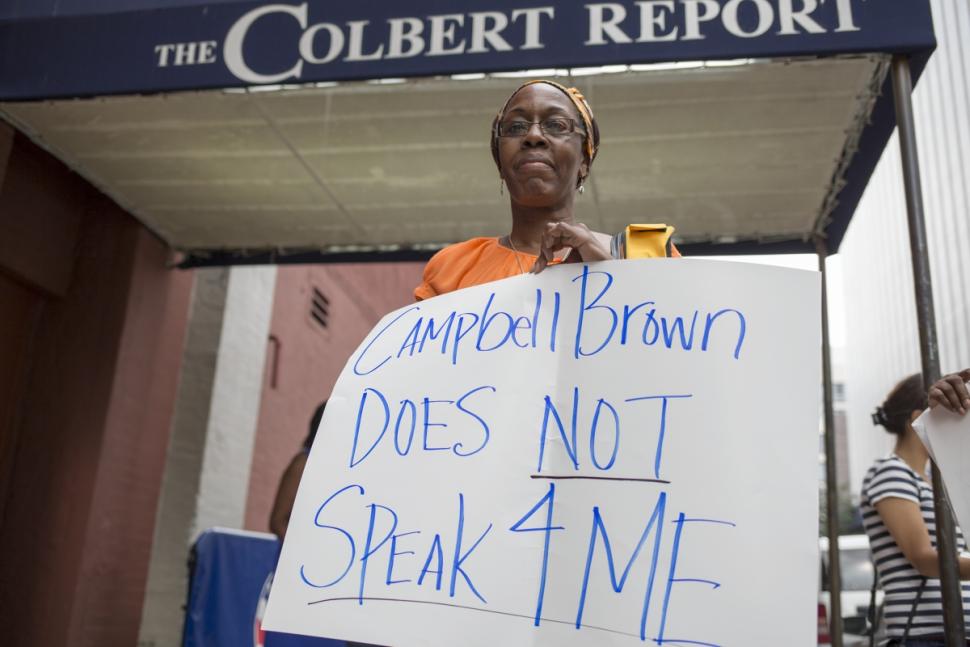
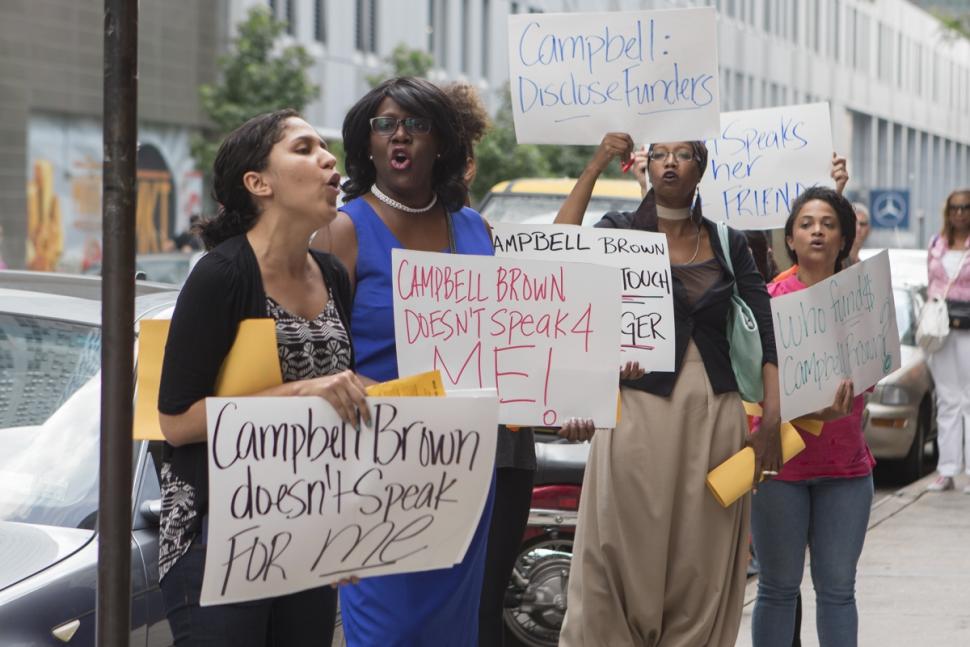
CB: Absolutely, but they’re also going to go after people who are funding this, and I think this is a good cause and an important cause, and if someone wants to contribute to this cause without having to put their name on it so they can become a target of the people who were out there earlier today, then I respect that.


Ms. Brown is married to Dan Senor, who was the former spokesman for the Coalition Provisional Authority in Iraq following the fall of the Hussein Regime.  He sits on the board of of Michelle Rhee’s StudentsFirstNY, and he joined hedge fund Elliot Management before becoming a top adviser to Presidential candidate Mitt Romney.  Ms. Brown is on the Board of Directors of Eva Moskowitz’s Success Academy chain of charter schools, an organization that boasts massive financial support from Wall Street.  Her ties to people who have been pouring money into education “reform” in the interest of charter schools is not difficult to establish, as blogger Mother Crusader has demonstrated.  Suffice to say that these are incredibly wealthy and politically connected people who are the most likely donors to her organization.

And Ms. Brown wants us to believe that they need to be “protected”.  That if people want to know who is funding lawsuits to challenge laws that were passed by democratically elected governments and job protections that were subject to open and adversarial negotiations between unions and administrators, they cannot know because the donors seeking to overturn such laws could not abide potential criticism of themselves in the public sphere.

Wow.

Let’s be clear.  Who are “the people who are outside today” who Ms. Brown assumes will bully and intimidate her donors?  According to The Daily News:


colbert1n-1-web

colbert1n-2-web

I am sure that Eva Moskowitz’s donors are just quaking in their boots…right after they drop another $400,000 into Governor Cuomo’s pockets.

Mr. Colbert did not sneak a camera crew down to the street to make Ms. Brown look as ridiculous as she richly deserved at that moment, but the fact that he led her to make such a ludicrous statement is telling in an of itself.  Today, it is very hard to trust that major media outlets will take the time and effort to research and interview people trying to lead public debate via deception, and on issues that require a genuine understanding of complex social phenomena, that is even less likely.  I have written before how abysmally the New York Times’ editorial staff have failed in that regard, preferring to take the statements of advocates with wealth and connections at face value.

Mr. Colbert is not a journalist, yet he and his fellow comedians Jon Stewart and John Oliver have become almost guardians of truth in recent years.  It is often more likely that Mr. Colbert or Mr. Stewart or Mr. Oliver will highlight the absurd inanities, half truths and contradictions routinely offered by politicians, pundits and advocates.  In the case of Ms. Brown, Mr. Colbert got her to openly confess to a truth that is gaining greater and greater public awareness: American governance is increasingly oligarchical in nature whereby elected officials craft policy more to serve the interests of their very wealthy donors rather than the interests of the actual voters who put them in office.  Ms. Brown’s undisclosed donor list is a perfect example of this, and her refusal to disclose under the fiction that her donors could possibly be intimidated by moms and teachers with home made posters should be mocked loudly and frequently.

I am grateful to Mr. Colbert for organizing his interview to that point, but I am saddened that we rely almost exclusively on satirists to get to the heart of public affairs these days.

3 Comments

Filed under Activism, Funding, Media, politics, schools, Social Justice, Testing, Unions, VAMs

David Berliner Responds to Economists Who Discount Role of Child Poverty via Diane Ravitch

From Diane Ravitch’s blog — incredibly important response to slight of hand “research”:


David Berliner Responds to Economists Who Discount Role of Child Poverty.

Leave a comment

Filed under Data, politics, Shared Posts, Social Justice

Jonathan Chait Joins His Esteemed Colleagues at the New York Times in Not Understanding a Thing About Teachers

I was reading my news feed yesterday morning, when I saw that Chalkbeat had retweeted an article from New York Magazine entitled “Teachers Unions Turn Against Democrats.”  Having noted that NEA members voted to call for Secretary of Education Arne Duncan’s resignation, and knowing that a significant factor in Fordham Law School professor Zephyr Teachout’s campaign to challenge sitting Governor Andrew Cuomo is Cuomo’s enthusiastic embrace of current education reforms, I was prepared for an interesting article.  Certainly, someone with Jonathan Chait’s experience and rhetorical talent would have an interesting examination of reform advocates’ efforts and rationales combined with the growing frustration of rank and file teachers and the balancing act attempted by union leaders trying to maintain their traditional coalition with Democrats and advocate for their members.

Boy, was I wrong.

Chait does acknowledge that Democrats have been forceful in pushing reform efforts that are more historically comfortable ground for Republicans, but his portrayal of the reforms themselves is entirely problematic and he ultimately chalks up firm opposition as the work of reactionary “hard liners”.  In Chait’s view, the center of this hard-liner coalition is New York University’s Diane Ravitch who has been blogging on the agenda of education reformers for several years now.

The leadership of this movement has fallen to Diane Ravitch, formerly a right-of-center education activist who has converted to the cause of teachers-union absolutism with an evangelical fervor, maintaining an almost superhuman schedule of public speaking and prolific blogging.

Ravitch has depicted education reform as a plot by corporate elites to privatize schools and destroy unions. If charter schools claim to help poor children by providing longer school days, then Ravitch is certain thatlonger school days cannot work. Having identified their enemies with the cause of pure evil, Ravitch and her fellow hard-liners have taken to defending not only the practice of paying teachers by length of service, but the structure and form of the school day (created in an era of stay-at-home mothers and designed around the summer harvest) as a standard of perfection that must be defended absolutely. Ravitch and her allies have found the leadership of the unions disturbingly faint of heart.

Goodness.

Does Chait expend even minimal effort in examining what in education reform is actually agitating teachers?  Beyond acknowledgement that the administration and its allies have embraced accountability and charter schools and implying that resistance to those efforts is the work of unthinking hardliners, not much.  He doesn’t examine teachers’ frustration and anxiety that the largest curriculum experiment in American history has been implemented with almost no study and little time to prepare at the behest of one man’s exceptional wealth.  He doesn’t examine how the “accountability” measures favored by reformers come from statistical models that are not accepted as valid measures of teachers’ impact on student learning.  He doesn’t look at the impact on students, teachers and schools of the constant drive for more testing of students, nor does he look at the corporations that are eager to monetize the results of those tests.

He does not consider the ways in which the rich and influential have used charter school expansion to line their own investment portfolios, nor does he consider the corrupting influence on Democratic politicians of hedge fund manager created political action committees that use campaign donations to ensure charter schools keep expanding. He does not examine that many charter school “successes” come at the expense of their appalling attrition rates, nor does he reference the new reports of widespread fraud and abuse of public money in the rapidly growing and poorly regulated charter sector.  He mentions the Vergara decision in California and opines that it “embarrasses” teacher unions by highlighting the “least-defensible aspect of their agenda and its most sympathetic victims,” but he does not mention the extremely questionable research that was used to support the case, nor does he mention that the victims in question could not name a single teacher who was “grossly ineffective”. Since Mr. Chait deems Dr. Ravitch to be unreasonable, here is the post trial brief that explains the issue.

Jonathan Chait is an experienced journalist and editor.  He had it entirely within his power to write an interesting piece on the potential of a rift between Democrats and one of their traditionally reliable constituencies, and to examine, fairly, the different sides of the issues.  Instead, he took it as a given that charter schools are successful alternatives and only union absolutists have any qualms about accountability and tenure reforms.

That, of course, would have taken more work than portraying Dr. Ravitch as the Abigail Williams of the teaching profession.


How Jon Chait Sees Diane Ravitch?

How Jon Chait Sees Diane Ravitch?

2 Comments

Filed under Media, Unions

“The best anti-poverty program around is….” a strong union.

In his 2010 State of the Union address, President Obama reviewed the legislation his administration had passed as favoring “reform” and “innovation” in our schools, and observed that “In the 21st century, the best anti-poverty program around is a world-class education.”  Since that address, we have seen the “reform” and “innovation” that the President was talking about: CCSS, high stakes testing, teacher evaluations tied to those evaluations, charter school expansion.  And now former members of the President’s administration are joining corporate reformer Campbell Brown in an effort to sue away teachers’ workplace protections.

But is the underlying assumption of the President’s statement that is driving all of these efforts to replace public education as we have known it with an amalgam of public and public-in-name-only schools with teachers who lack strong union protection and who are assessed primarily via student test scores even accurate?  Does a “world class education” function as the “best” anti-poverty program or was the President engaging in dangerously simplistic rhetoric that places a burden on primary, secondary and higher education without asking what conditions need to exist in the market for labor?

There isn’t a simple answer for this, and there are plenty of competing voices.  For example, the Bureau of Labor Statistics estimates that only 27% of the workforce need college degrees for our jobs, and they project only 23% of the labor force will need college or post graduate degrees in 2022.  This is disputed by Anthony Carnevale and colleagues at the Georgetown Center for Education and the Workforce, who note that the “college wage premium” has grown 37% since 1976, indicating that employers are currently willing to pay a premium for graduates with post secondary education.

Recent data and analysis suggest that college is worth the effort and even the debt in gained economic output over the course of one’s career.  The Federal Reserve notes that those with a bachelors degree are likely to earn up to a million dollars more over their lifetime than peers with only a high school education, and even those with associates degrees earn 100s of thousands more.  Once  cost of money out of pocket for the degree and inflation are considered, that still amounts to an additional 500 thousand.  However, these numbers should be read with additional research on the lifetime cost of debt accrued in obtaining the degree which can amount to over 200 thousand dollars in net assets by retirement and which disproportionately effects minority college graduate who take out higher debt loads on average.

So is that case closed?  Everyone should aspire to college education and secure themselves in the middle class? Not so fast.

While a premium exists in wages for college graduates over their peers, that premium has gone up for reasons other than demand for college educated workers.  Pew Social Trends demonstrates that one contributing factor in the increased gap is the sharp drop in wages for non college educated citizens even while wages for those with a college degree have remained stagnant when adjusted for inflation.  In 2012 dollars, a Millennial with a college degree earns $6600 more than a “Silent Generation” graduate in 1965, but only $730 more than a “Late Boomer” did in 1986.  Meanwhile, those Millennials without a college degree earns almost $3400 less today than in 1965.  College education, then, is indeed becoming a minimum requirement, but just to keep up at current, stagnant, levels of opportunity and to not fall off the cliff into chronic economic insecurity.

And this is where the decline in union representation in the workforce needs to be discussed.  It does not appear to be enough to grow a healthy and vibrant middle class simply to say that all middle class aspirants need to attend college, especially when the gap between college and non college income can be at least partially attributed to falling wages.  According to a paper from the National Bureau of Economic Research by Emin M. Dinlersoz of the Census Bureau and Jeremy Greenwood of University of Pennsylvania, the decline of organized labor can be attributed to technological innovation that either replaced or outsourced non-skilled jobs that traditionally enjoyed union representation.  While there is no doubt that globalization and technology have been highly disruptive forces to organized work forces, it is also insufficient an explanation.  To begin with, trade agreements and tax policies that lead to jobs being sent offshore are partially the result of choices made by elected officials as well as the result of innovation.  Second, the drop off in labor unionization is distinctly steep in the United States compared with other industrialized economies. If labor’s decline in the United States was solely the result of especially “creative destruction” in the economy and not at least partially the result of choices made by those who influence the economy, our labor decline would be far less steep.

Labor’s decline and the overall dismal growth of inequality in our economy have marched hand in hand since the late 1970s.  In this video, Colin Gordon of the University of Iowa maps the decline of union participation in the United States with the steady growth of the Gini coefficient:

Correlation may not be causality, but certain trend lines call our attention to possible causes, and Gordon reports research that notes up to a third of the rise in inequality in the 1980s and 1990s can be attributed to the decline of labor.  If we want to address what has been happening to America’s widely stagnating middle class and especially to the cratering lower middle class, we must look at the decline of unions.  While labor unions cannot revitalize by organizing jobs that no longer exist, there are credible arguments that even large swaths of the IT sector could benefit from unionization.

Which is why the full frontal assault on teachers’ unions since the Great Recession is both disheartening and an existential threat to the remains of the middle class.  The NEA and AFT represent more than 4 million unionized teachers, but more than that, their representation provides those teachers with an ability to negotiate openly and fairly for their wages, working conditions and job security.  Those negotiations help our children’s teachers maintain a middle class status they might not be able to achieve individually, and the due process rights they obtain from negotiations protect them in a job environment that has inherent political elements and can risk confrontation with the community.  Given the mass of new job pressures layered on to the teaching profession since No Child Left Behind and Race to the Top, it is unthinkable that teachers’ collective bargaining rights and job protections should be subject to legislative and legal challenges across the country.

But that is exactly what is happening, and it isn’t merely a challenge to teachers’ due process rights — it is aimed directly at one of the largest bodies of unionized middle class professionals left in the country.  Where will our Gini coefficient be in ten more years if teaching is no longer a unionized work force?

The contradictions of what we demand of teachers and with whom we entrust them and the goals of anti-union “reform” efforts to reduce teachers’ job securities and ability to negotiate fair wages and benefits are manifest.  President Obama tasks a “world class education” with reducing poverty in the face of the multitude of social and economic factors that have entrenched poverty in our society.  Every parent who sends a child to public school entrusts the teachers of that school with the well being of that child.  That breaking the strength of teachers’ collective bargaining rights has appeared as an urgent need to make education better belies are far more malicious intent behind the well financed campaigns of Michelle Rhee and Campbell Brown. Teachers should not be the only ones who take notice — the entire middle class should as well.

From Mike Thompson of the Detroit Free Press

From Mike Thompson of the Detroit Free Press

3 Comments

Filed under Activism, politics, Social Justice, Unions

Campbell Brown — the next hero of corporate reform

Following the Vergara decision in California where a judge declared that teacher labor protections violated students’ rights to a quality education, former NBC news and CNN personality Campbell Brown announced she would help bring a similar suit to New York State.  This is not Ms. Brown’s first foray into anti-union activism aimed at teachers.  In 2012, she unleashed a series of tweets that attacked New York City’s United Federation of Teachers for allegedly placing protection of accused sexual predators over children, and she penned an editorial for the Wall Street Journal demanding that the New York City Chancellor of schools be given absolute authority to fire teachers so accused without the use of an independent panel. Brown provided no evidence for accusations that this was a significant and mounting problem as she portrayed it, preferring a classic line of argumentation that any outcome a large number of people can agree is potentially wrong must mean the entire system needs to be turned upside down.  In this case,  the UFT defended maintaining due process rights for teachers accused of misconduct, which prompted Brown to insist they wanted genuine sexual predators returned to the classroom — without Brown bothering to examine details such as what percentage of accused teachers were actually cleared of wrong doing or what percentage were fired and prosecuted.

Brown portrayed herself at the time as simply a mother of two who was concerned about the effects of union job protections on children, but other sources have demonstrated she has a deeply personal conflict of interest that may be influencing what causes she is championing.  Ms. Brown is married to Dan Senor who was the chief spokesman for the provisional authority following the invasion of Iraq, and in 2012, he was a senior adviser to Republican Presidential candidate Mitt Romney.  Further, Mr. Senor sits on the board of StudentsFirstNY which is a part of Michelle Rhee’s network that expressly fights against teacher unions.  In response to union supporters and other journalists noting her apparent personal stake in making teacher unions a source of public outrage (a Romney administration certainly would have helped Mr. Senor’s career), Brown took the pages of Slate.com to sarcastically express her surprise at the push back and to take a little dig at her critics.

It is two years later, and Campbell Brown is delighted at the Vergara decision, and she is now partnering with high profile former Obama administration officials to craft similar lawsuits elsewhere beginning in New York.  The outcome is uncertain even though the Vergara case was based on exceptionally poor reasoning: many of the plaintiffs could not demonstrate that they have had “grossly ineffective” teachers, the judge misused the expert testimony and relied upon highly controversial research findings to determine the scope of damage that can be tied to a student having a poor teacher.  Brown, now allied with Obama spokesmen Robert Gibbs and Ben LaBolt, given pro bono legal services from former Bush administration adviser Jay Lefkowitz and presumably bankrolled by Michelle Rhee and her corporate allies, will likely bring a sharper and slicker case to New York.

This case is the apotheosis of corporate reform of our schools.  Teacher unions, while not perfect, stand as a safeguard that the people closest to the children in the classroom can negotiate for fair compensation and work with knowledge that they have due process in employment despite the highly public and sometimes contentious nature of their work.  Moreover, the teachers who make up their unions are the people, after parents, most connected to the individuality of the children entrusted to their care.  But corporate reform insists that looking at individual factors and looking at community factors is “making excuses” and that what you need are common standards, high stakes testing associated with those standards, teacher evaluation based upon test scores and then firing the “right” teachers based on those measures.  Corporate reform is decidedly uninterested in discussions about poverty and rising income segregation and insists that every problem in school can be laid at the feet of “bad teachers”.

The only major, organized, groups in the way of that are unions.

Rhee’s “Students First” organization should really be renamed “Teachers Last” because the main purpose of its legislative and litigation strategy is to put parents against teachers and to capitalize on America’s 30 year labor decline to break the AFT and NEA.  Michelle Rhee is a formidable organizer and fund raiser, but she is also under scrutiny for lacking real substance behind her thinking and for the practical outcomes of her approach to school system management.  After her politically strained tenure as Chancellor of D.C. public schools that contributed to the defeat of the mayor who recruited her, Rhee is not a public face for corporate reform who can go to the cameras without getting scrutiny.

In steps Ms. Brown as a fresh face for corporate reformers.  By now, many of the players are well known.  If you are talking about attacking teacher unions, you are talking about Michelle Rhee.  If you are talking about Common Core State Standards, you are talking about Bill Gates.  If you are talking about standardized testing, you are talking about the Pearson Corporation.  If you are talking about mass data mining and technology, you are talking about Rupert Murdoch.  We know this by now, and even some mainstream media sources are making the connections.

Campbell Brown presents herself as a media savvy personality who is in this fight as a “concerned mother” while Rhee and other anti-union forces provide the strategy and financing.

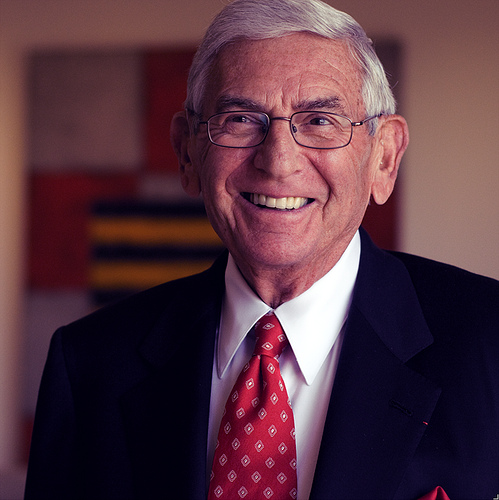
But when you see Campbell Brown, you see Michelle Rhee.  And when you see Michelle Rhee, you see Eli Broad.  And that just isn’t a pretty sight for teachers.


Campbell Brown

Campbell Brown

Michelle Rhee

Michelle Rhee

Eli Broad

Eli Broad

This gives me nightmares to be honest...

Brown-Rhee-Broad — This face keeps me up at night….

1 Comment

Filed under Activism, Funding, politics, Unions

President Obama: We Must Strengthen Unions

President Obama says unions must be strengthened. Meanwhile Secretary of Education Arne Duncan has openly praised the Vergara decision…which deprives California’s unionized teachers of due process rights:

https://twitter.com/arneduncan/status/476439303015628800

Empty lip service on a Friday makes me grumpy.

dianeravitch's avatarDiane Ravitch's blog

This is one of the strangest stories of the week or month or year. President Obama spoke in Pittsburgh about the importance of strengthening unions.

Unions are under siege and have been for several years, but I can’t remember when the President stepped up to defend them.

View original post

Leave a comment

Filed under Activism, politics

What Does It Really Take To Evaluate a Teacher Preparation Program?

The National Council on Teacher Quality (NCTQ) is back in the news having released their second report on the quality of teacher preparation in America.  To the surprise of nobody, they found that university based teacher preparation remains dismal.  Just last year, NCTQ described teacher education as “an industry of mediocrity” in a report so riddled with errors, it would have been reasonable to assume that they would fade away – if not permanently, then at least for a few years.  My favorite of their many mistakes was how they gave credit to Teachers College for having “highly selective” standards for admission to their undergraduate teacher preparation programs.  Friends and colleagues affirmed how selective these programs are — they have never admitted a single student because they do not exist.  Alas, the fade away did not happen, and they are back this year.

In order to understand how NCTQ could purport to make a serious contribution to teacher education while making such glaring errors and then putting them in view of the public, it is necessary to understands that the organization’s flaws are both methodological and philosophical.  NCTQ is an organization that was established by the Thomas Fordham Institute and has an expressed purpose to “shake up” traditional teacher preparation.  Given that they are generously funded by a laundry list of corporate reform advocates (The Gates Foundation, Edythe and Eli Broad, Carnegie Corporation, etc.) and given the presence of people like Michelle Rhee and Joel Klein on their advisory board, it stands to reason that they are looking for faults.  But more important is the preposterous methodology employed by NCTQ to “evaluate” programs for evidence of “quality”.  Even before schools of education, looking at their bias and their proposed methods, declined to actively cooperate with them, NCTQ proposed that they would evaluate all teacher preparation programs in the country by not visiting a single program and by not speaking to or surveying a single graduate.  Instead, they examine web sites and publically available documents such as course catalogs and syllabi for “evidence” of the programs covering topics that they consider essential.  When programs decline to turn over internal documents for their examination, NCTQ is not above using deception to acquire them.

Such “methodology” has been aptly compared to writing a review of a restaurant by reading an online menu and making conclusions about the quality of the food preparation.  NCTQ misses how instruction is delivered and evaluated in every meaningful way, but they do not seem especially concerned about that given that a number of programs have tried to correct NCTQ’s errors only to see them published anyway.  This would be comical if the organization was not given uncritical coverage in influential publications.  Last Fall, both Joe Nocera and Bill Keller took to the opinion pages of the New York Times and cited NCTQ’s ratings without any indication that the group is both politically biased and rife with errors.  This year’s report is not being met with quite so much attention, but NPR did a very friendly interview with NCTQ President Kate Walsh with little focus on the organization’s methodology.  NPR did ask one pertinent question and it was why, if teacher preparation is so dismal, don’t principals and superintendents sound the alarm that new teachers are not able to teach?  Walsh replied:

“There’s a great hesitancy of public school educators to stand up to higher ed,” Walsh explains. “They’ve almost been bullied by them, and one of the things (NCTQ) is trying to work on with districts is to get them to be more assertive about their needs and to say ‘I’m not going to hire from you until you teach effective ways of reading instruction.’ “

I would like to challenge Ms. Walsh to come to New Jersey and try to find a single high school principal who is willing to admit, even off record, that he or she is intimidated by me.  Go on.  I’ll wait.

More seriously, that claim is bizarre because while a handful of institutions may offer grants and opportunities that are attractive to school districts, the reality is that for quality teacher preparation, I need schools more than they need me.  I need partners who are willing to open up their experienced teachers’ classrooms for student teachers and for clinical internships and who are willing to mentor teacher candidates in ways that make a strong connection between their studies and their developing practice.  To suggest that relationship is so lopsided as to see school districts as cowed beneath the Teacher Preparation Industrial Complex is simply strange.

I would never state that teacher preparation does not need improvement.  There is always something new to learn, and there will always be an effort to make meaningful connections between theory and practice and to situate prospective teachers in classrooms where they learn from skilled mentors able to discuss practice meaningfully.  But I would like to offer what it looks like to really examine and evaluate your work and to subject it to meaningful outside examination and rating.  My teacher preparation program is accredited by the Council for the Accreditation of Educator Preparation (CAEP), formerly the National Council for the Accreditation of Teacher Education. Such bodies are recognized by state departments of education as having high standards for the review of teacher preparation programs and for having rigorous methods of evaluation.  In preparation for their review, I have to prepare a report about our secondary students studying to become high school English teachers and submit it for review to the National Council of Teachers of English to determine how well we prepare students who are specifically seeking to be English teachers (other content areas submit similar reports to other content specialty associations).  In this report, I provided complete data portraits of three cohorts of graduating candidates that showed that they knew English content, that they knew pedagogy for teaching English and that they knew how to assess students’ needs, design instruction to meet those needs and evaluate the effectiveness of their instruction.  The report drew data from their coursework, lesson planning in courses, evaluations from field internships prior to student teaching from university supervisors and cooperating teachers, evaluations from their semester long student teaching experience and a Teacher Work Sample capstone project in their student teaching seminar.

The report was submitted directly to the National Council of Teaches of English where multiple reviewers read it and granted our program National Recognition as meeting high quality standards for the preparation of English teachers.  This is only one of many reports written by my colleagues and represents only our preparation for an eventual site visit by CAEP where the entire unit will be evaluated.  Such work is time consuming, but I have to admit that to a degree, I actually enjoy it because it helps, indeed it requires, that I take a step back from my own practice and examine artifacts that are indicative of its success or failures.  The process means that I have to propose ways to use what I have learned from the evaluation process to make improvements for following cohorts, and it pushes all of us to not merely rely upon impressions of success and failure but to have substantive reasons for those assessments.

When I began teaching in 1993, I said to myself that the day I figure that I have nothing left to learn is the day that I should quit teaching.  Substantive internal and external evaluation helps assure that I keep looking for things to learn.

Of course, even this is not the be all and end all of effective teacher preparation.  Data driven assessment is very useful, but it also contains the danger of becoming reliant on data to the point that teaching is treated as merely a technical performance that is neatly mapable onto standards, which is untrue.  There are qualities to teaching and to learning to teach that are aesthetic and which require a qualitative approach.  Most teachers have a narrative of their reality in mind when they commit to becoming teachers, and they need to constantly revisit and revise that narrative in ways that allow them to understand others’ purposes and to challenge themselves and their sense of purpose.  These qualities, championed by Maxine Greene, are critical for prospective teachers AND the teachers of prospective teachers, so we should embrace the role of data in our work as a tool of continuous improvement.  But we should not raise it so far above all other matters that we ignore their importance as well.

Which is why in addition to the substantial work I have put in to demonstrating my program’s quality to actually qualified experts, there is another testimony that is not being currently examined by any agency in a way that captures their real importance.  I know a large group of early career teachers who are simply outstanding young educators and who are doing fantastic work, both quantitatively and qualitatively, with 1000s of students across the country.  They came to my classes from diverse backgrounds and with varying ideas about the critical importance of public education, but they all left having had shared experiences in university courses and in lengthy field assignments that taught them what it really means to move from being a student to being a teacher.  They are remarkably interesting and talented, and they balance deep understanding of how to transform content into pedagogically powerful experiences with their students with the aesthetics of classroom community and student motivation.  I am lucky to have worked with them and to continue to know of them and their teaching.

If you want to evaluate the quality of a teacher preparation program, you need to speak with and observe the teachers they graduate.

1 Comment

Filed under Media, NCTQ, teaching