Tag Archives: testing

Announcing the iSchool, or Something

Apple CEO Steve Jobs was not known as a philanthropist during his lifetime, but his wife, Laurene Powell Jobs, had a significant track record in philanthropic endeavors by the time of his death in 2011.  Educated with a Stanford MBA and with experience as a trader in Goldman Sachs, Ms. Powell Jobs has an extensive record in philanthropic activities since at least 1997, and education appears to be a specific interest. Beginning with a mentoring program for first time minority college attendees, she now sits on the boards of a number of familiar organizations such as Teach for America, New Schools Venture Fund, and Stand for Children.  According to her “Inside Philanthropy” profile, Ms. Powell Jobs is interested in education reforms that are “results driven” which is education philanthropy speak for “raises test scores”.  Hardly surprising, since her board memberships are groups that contribute to the deprofessionalization of teaching (TFA), raise capital for charter school ventures and advocate legislatures to allow charter school teacher training “academies” (New Schools Venture Fund), and which consistently attack teachers’ workplace protections and advocate for increasing the role of test scores in education and teacher evaluation (Stand For Children).

It should not, therefore, be a great surprise when The New York Times announced that she would donate $50 million towards a new education venture “to rethink high school.”  The effort is called “XQ: The Super School Project” and Ms. Powell Jobs said in an interview, “The system was created for the work force we needed 100 years ago. Things are not working the way we want it to be working. We’ve seen a lot of incremental changes over the last several years, but we’re saying, ‘Start from scratch.’ ”  This “from scratch” take on the American High School essentially looks like a grant program from the pot of $50 million that will eventually be distributed to 5 to 10 grantees sometime in the next year.

I know they are serious about this.  They’re advertising on bus kiosks in Manhattan:
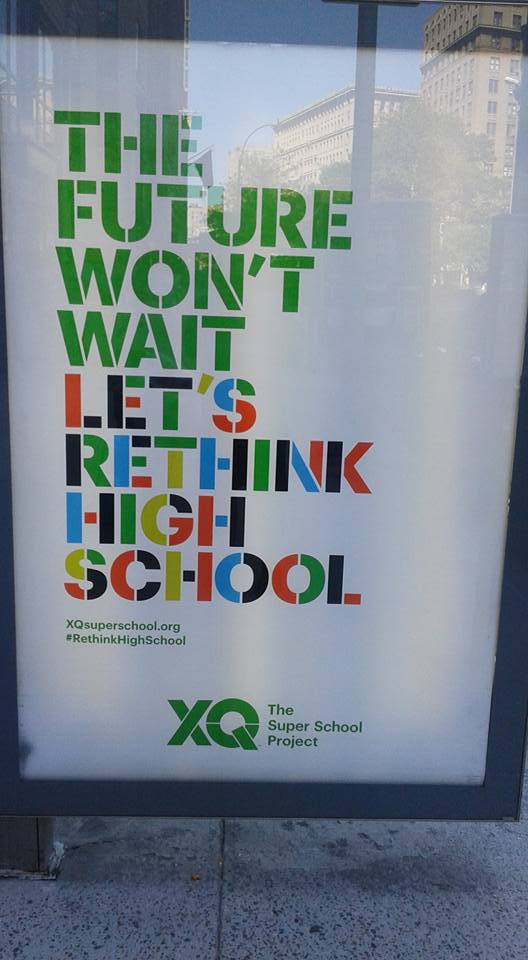
super schools

The project website tells you precious little about the values of the project itself, which might be a good sign if they are serious about soliciting widely for actual, community based, ideas for school experimentation instead of just opening the doors for a bunch of ready made “disruptors” already at work tearing down public education.  The composition of her core team as reported in The Times is not encouraging. There is a consultant named Keith Yamashita who has worked apparently mainly in technology and start ups.  Russlynn H. Ali is the former undersecretary of education for civil rights under Secretary Arne Duncan and has been working with Ms. Powell Jobs’ Emerson Collective.  More troubling is the presence of former senior adviser to New York City Schools Chancellor Joel Klein, Michelle Cahill.

Education blogger, author, and Louisiana teacher Mercedes Schneider once dubbed Chancellor Klein as “The Man From Whom Nothing Good Comes,” and I’d daresay he earned the title.  Certainly, the Klein Chancellor’s office unleashed a fair deal of havoc on Newark when Mark Zuckerberg’s 100 million dollar grant to remake the city’s schools was announced.  Former Klein insider, Chris Cerf, created a consulting firm that hoovered up a fair amount of the available cash, and Cerf himself moved in 2010 to the New Jersey State Commissioner’s office, meaning he was now overseeing the district. Klein’s NYC department of education also provided Newark with Superintendent Cami Anderson, whose disastrous tenure is chronicled by retired Star Ledger journalist Bob Braun.  Cerf and Anderson are most directly responsible for turning the Zuckerberg donation into the “One Newark” system, and Mark Webber helps fill in the holes in the most recent accounts of how that has turned out – especially in regards to Brick City’s charter sector.  Short version: Joel Klein’s office provided a significant portion of the reform “talent” that spent lavishly on consultants and threw the city’s schools into an incompetently and callously managed mess that has benefited the biggest charter operators most of all.

So let’s just say that the presence of another member of Joel Klein’s inner circle in a grant program to “rethink” schools requires serious skepticism.  At least the amount of money being spent is only half of a Zuckerberg, and it will be spread around rather than dropped into a single school district with the intention of blowing the entire kit and caboodle up.

However, I’d like the challenge two premises of the entire endeavor.  The first premise is that we still have the high school we created “for the workforce 100 years ago.”  In some respects this is actually true.  The school model based upon a set of discrete subjects taught in Carnegie units with students moving from subject to subject during the day was an organizational choice of the early 20th century.  Similarly, the comprehensive high school and extra curricular activities and sports with which we are familiar were choices incubated in the Progressive Era — none of these came down with Moses on Mt. Sinai.  However, to suggest that the school structure you recognize as school is somehow rooted in place, unchanging and incapable of meeting more modern needs, is not supported by evidence.

For example, that same school structure that Ms. Powell Jobs says was created for the workforce “100 years ago” has also graduated the workforces of the 1950s and 1960s as well as the workforces of the 1980s and 1990s – all economic periods vastly different than 1915. If one were to cite threats to the workforce in 2015, one would have to look at falling union membership, declines in wages for recent college graduates, a young work force burdened by mounting debt, corporate hoarding, unmet infrastructure needs, and taxation policies that have abetted income inequality before looking at how most ninth graders will study English for 50 minutes before moving on the their Algebra class.  Schools contribute to the shaping of the workforce, but they do not create the economic demands for workers that necessitate that workforce on their own.  And the reality is that the American economy has grown leaps and bounds with this same school system.  In fact, from 1929 to 2015 “real” Gross Domestic Product in 2009 dollars (opens in Excel) grew from 1056.6 billion dollars to 16,324.3 billion dollars — all with that school system lamented as being designed for the workforce of 1915.  Not bad.

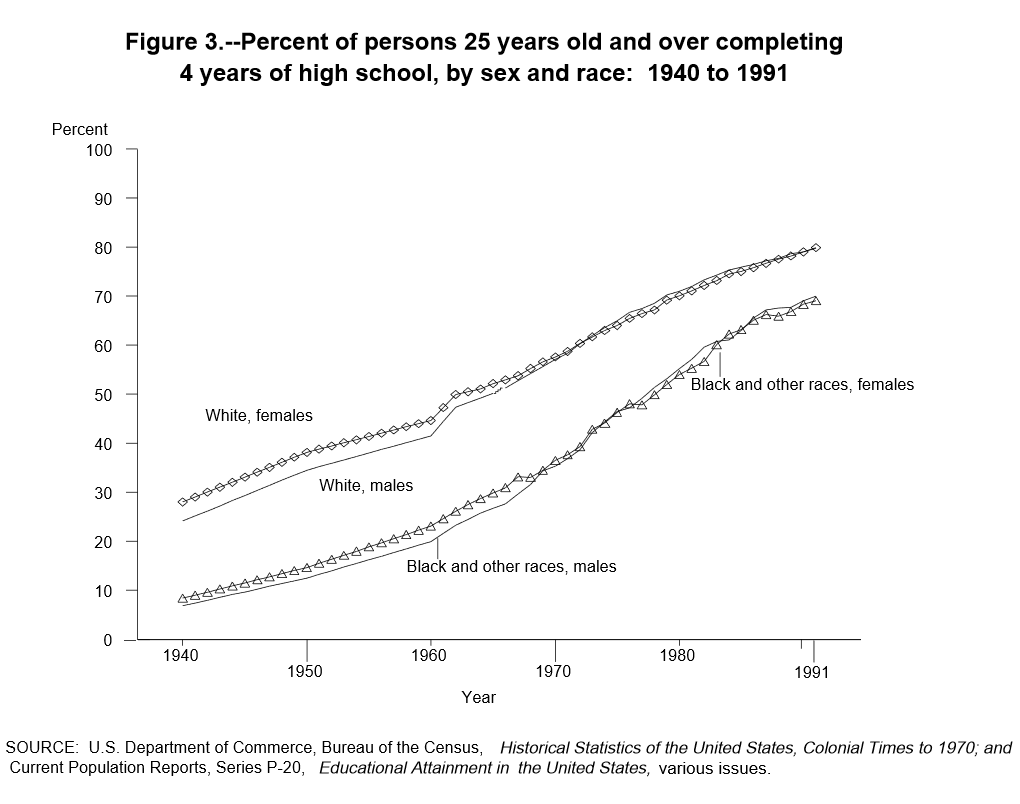
Further, schools have changed in the past century, in meaningful and significant ways.  The landmark report, 120 Years of American Education: A Statistical Portrait from the Department of Education’s Center for Education Statistics details a school system that has made vast developments in both the reach and equity of the system over time.  From the general formation of the comprehensive high school, the institution has continued to expand both the population it includes and the services it provides within its walls, reflecting major changes in how society views the reach of the political franchise.  Consider these two charts:
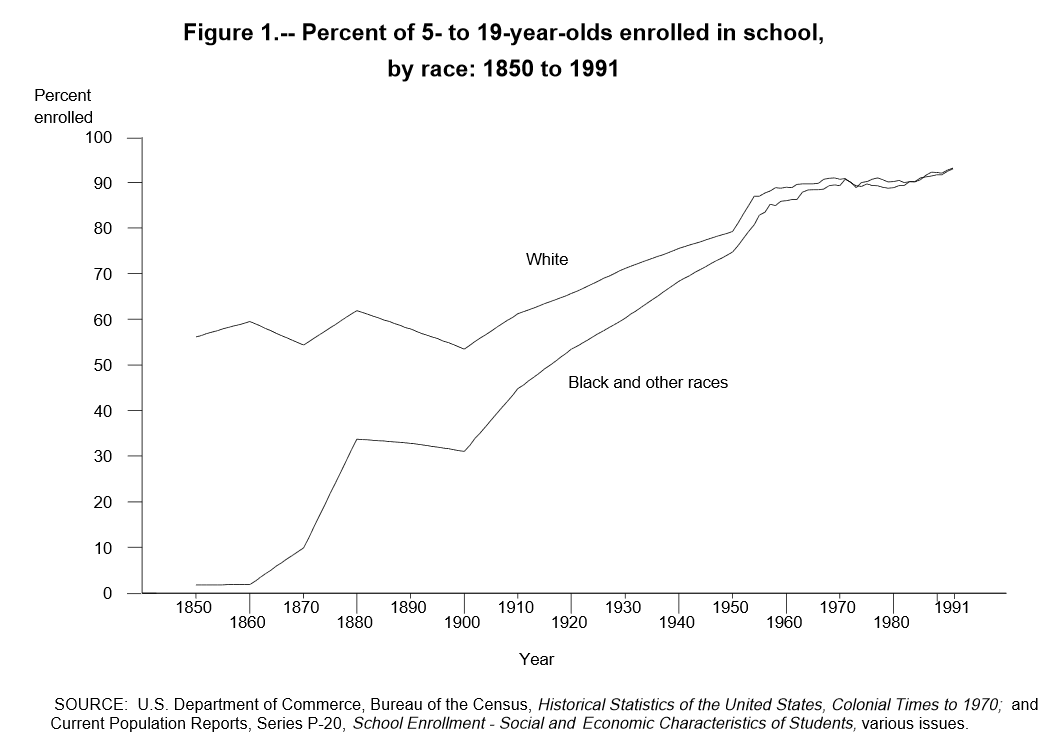
Total School Enrollments 5-19 year olds

Total high school completion by race

Similar progress and change can be seen in statistics relating to the educational attainment of women and to the number of children with disabilities being accommodated within public schools.  And these statistics on increased participation, completion, and services provided do not account for changes in subject matter content over time as well. The fact is that there are many things about our high schools that have been significantly dynamic over the past 100 years.

The second premise that needs to be challenged is that the schools we need should represent a “start from scratch” approach.  There are powerful ideas for change that many districts could implement with very little difficulty.  In their historical study Tinkering Toward Utopia: a Century of Public School Reform, scholars David Tyack and Larry Cuban demonstrated that many “big ideas” for school reform tended to be changed by school as much as they changed school, but that certain little ideas can have substantial impact.  For example, a simple offset of classroom walls creating niches changed the way teachers used their space substantially.  So while the XQ little marquee questions “What if we take our desks outside?” “What if learning is a game?” “What if we knock down these walls?” – I am left wondering “what more will you get with $50 million than 5-10 boutique programs that may not be scalable while you could be trying to leverage more meaningful changes within the existing system that already serves almost 15 million high school students?”

The fact is that we have some pretty good ideas already about what would leverage substantial change in our schools. Some of these ideas are larger than others and would require significantly more political capital to achieve.  However, if Ms. Powell Jobs is actually serious about our schools being “the great equalizers they were meant to be,” she should shake off the “disruptive start up” mentality of the XQ project and put her talents to work on some of the following ideas that never seem to make it into education reform’s portfolio of strategies:

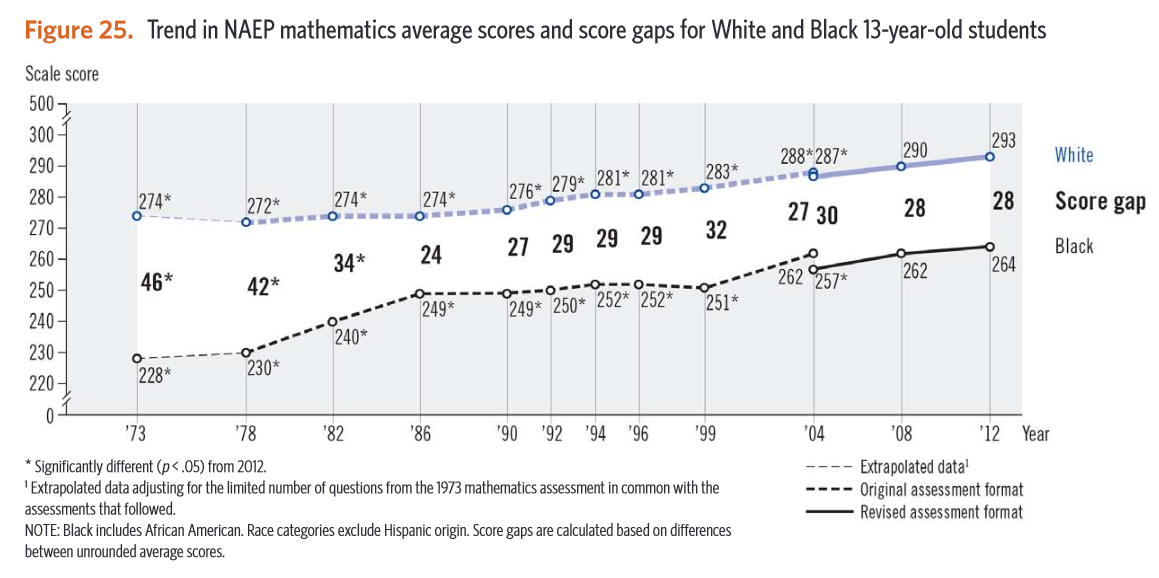
  • Integration: It matters, for both the majority and minority populations that are integrated, and we have historic evidence to demonstrate this.  The decrease in achievement gaps between white and black students as measured by the National Assessment of Education Progress closed rapidly and for a sustained period of time in the 1970s and early1980s before the cumulative impacts of white flight and abandonment of fair housing and integration policies stalled progress.  Since then, racial and economic segregation have increased vastly, to the great detriment of our students and their schools which saw an initial, large, burst of the gap closing after NCLB only to see it stall again.  While the issue of the achievement gap is extremely multifaceted and overlaps with declines and rises in child poverty, integration of our communities and schools remains an important and currently unutilized tool in school improvement.
  • Fair Funding: Advocates of current reforms like to scoff at school funding, but the reality is we maintain a perversely unfair and inadequate system of school finance that all but guarantees wealthy communities can fund the schools that they want while the rest of the system struggles to get sufficient state and federal aid to plug the holes in their budgets.  Resources and policies the reduce inequality cost money, and the reluctance to fund those resources and policies is one of the greatest stumbling blocks to educational improvement.
  • Class Size Reductions: Among the policies that can cost more money that politicians are reluctant to spend is class size reduction. It works.  It works well.  It works even better for poor and minority students. Increasing class sizes causes real and long term harm.
  • Teacher Retention and Development: This will come as a surprise to the organizations on whose boards Ms. Powell Jobs sits, but experienced teachers are better than newcomers.  The exuberance of youth is fantastic and necessary in the ongoing work of school, but it is best paired with experienced teachers who know what they are doing and who are willing to mentor their younger colleagues. If we want to improve schools, we should be looking at improving teacher retention, starting with a hard look at working conditions.
  • Reverse High Stakes Testing’s Detrimental Impacts: We’ve increased the amount of testing.  We’ve increased the stakes on testing.  To the surprise of nobody who understands policy incentives that means we’ve increased the amount of time spent teaching to the test and to test preparation, to the detriment of a rich curriculum and especially to the detriment of students attending majority minority schools threatened with closures and other punitive measures due to test scores.  The narrowing of the curriculum also has a detrimental impact on the very skills so-called education reformers claim our students need the most in the 21st century.  If Ms. Powell-Jobs really wants to improve high school, she could do a lot worse than to imitate her late husband’s business practices and to try very hard to kill off something that Bill Gates has worked to promote: high stakes testing in teacher evaluation.

$50 million is going to buy the XQ project a handful of high schools that may or may not be innovative and which may or may not be able to be scaled.  Or it could begin the process of lobbying policy makers to endorse what we actually knows works in education.  It would certainly be a lot better to see on the side of a bus kiosk.

7 Comments

Filed under Funding, Newark, schools, standards, Testing

NYSED’s Incoherent Opt Out Muddle

Pity those poor zealots of standardized testing in Albany.

No matter what they do, no matter what tactic they employ those pesky parents who are sick and tired of standardized testing consuming their children’s education won’t come around to see the error of their ways.

First, Governor Andrew Cuomo, perhaps taking an anticipatory victory lap days before his November re-election, unleashed a torrent of bad ideas upon his favorite punching bag – New York’s unionized public school teachers.  He vowed to “break up” the “public monopoly” of our free public school system which dates back to the formation of the New York Free School Society in 1805.  Governor Cuomo’s preferred method of “breaking” public education is the use of standardized test scores and growth models to designate schools and teachers as failures ripe for state take over and firing.

Then New York Board of Regents Chancellor Merryl Tisch and Governor Cuomo took up the role of pen pals after the election, declaring the need for much tougher teacher evaluation and tenure rules using, you guessed it, an even greater role for growth measures based on standardized test scores.  Governor Cuomo followed that communication by vetoing a bill he himself had proposed that would have given teachers and principals a two year grace period from professional consequences as a result of the still new Common Core aligned state examination, and then quickly announced a punishing agenda that led to 50% of teachers’ evaluations being tied to growth measures on the state examinations.

Dr. Tisch, for her part, attempted to take on the role of the velvet glove with a prepared speech to the New York State  Council of School Superintendents in March where she lamented the Opt Out movement in New York and compared it to the anti-vaccination movement:

Why on earth would you not want to know whether your child is on track for success in the fifth grade or success in college?  Why would you not want to know how your child and your school are doing compared to other children in district, region, and State?  Why would you not want to know the progress of our multi-billion dollar investment in education?  Why would you not want to know whether all students are making progress, not just the lucky few?

I do not pretend that test results are the only way to know, but they are an important piece of information.  They are the only common measure of progress we have.

We are not going to force kids to take tests.  That’s not the New York way.  But, we are going to continue to help students and parents understand that it is a terrible mistake to refuse the right to know.

We don’t refuse to go to the doctor for an annual check-up.  Most of us don’t refuse to get a vaccination.

Did you get that?  Standardized testing is as good for curing problems in education as vaccines are for preventing polio.

Dr. Tisch dug herself deeper in later comments, first trying to claim that the new teacher evaluation system over which Governor Cuomo held long overdue state aid hostage did not necessarily mean teachers would be evaluated 50% by student test scores, and then she publicly suggested that communities with histories of high test scores (i.e. wealthy, white communities) might be excused from the new evaluations – leaving a lot of African American and Hispanic teachers who teach predominantly in urban poverty on the hook and sparing their white peers.

When Commissioner John King, in a spectacular case of failing upward, left the NYSED to join Secretary of Education Arne Duncan in Washington, D.C., his replacement, MaryEllen Elia, formerly Superintendent of Florida’s sprawling Hillsborough district, was already known as a major fan of the Common Core standards, standardized testing, and evaluating teachers based on those tests.  Commissioner Elia immediately embarked upon a “goodwill tour” of sorts to listen to and to speak with stakeholders across the state.  The new commissioner did not waiver in her support for high stakes testing or in her opposition to opting children out of those exams, telling one audience that “Life is one big test.”

Then the opt out numbers came in with the results of the tests themselves, and New York’s rate of test refusal in 2015 jumped to 20% of all testable students, a huge leap from the previous year’s numbers.  And the charm offensive was over, with Commissioner Elia declaring to reporters that her office was in communication with the Secretary of Education in Washington over the potential “consequences” at hand for districts and schools where parental opt outs meant that fewer than 95% of students were tested as required by the No Child Left Behind act.  In other statements, she declared that opting out of the state tests was unreasonable and called school personnel who encouraged it unethical.

And almost as quickly as that was said, the backpedaling began.  Chancellor Tisch reported that the her office was told by the federal DOE weeks earlier that financial consequences were up to the state and that NYSED had no plans to do anything, saying, “I think when you withdraw money from a school district, what you’re doing is you’re hurting the kids in the school district. So I don’t think that’s an effective way to deal with it.”  The King of Test-Based Punishment, Andrew Cuomo, also declared that the state had no intentions of withholding money from communities that failed to reach 95% of students tested.  Commissioner Elia bid a hasty retreat from her earlier threats, first pivoting away from punishment to saying she planned to spend the next year trying to convince parents not to opt out of the exams and then saying that parents have a right to opt their children out of the state examinations.

The quick retreat from talk of punishment is no doubt tied to the dreadful politics that would be involved of playing games with funding, given that the funding in question is federal Title I money intended for districts with high percentages of children in poverty.  Withholding those moneys from the smaller number of districts and schools with high poverty and high opt outs while leaving affluent communities with high opt out numbers untouched would be a political firestorm, not to mention it is highly questionable whether NCLB was ever intended to punish schools and districts because of the actions of their parents.

The 2015 round goes to Opt Out:

mic drop

The future is, of course, murkier.  There is no chance at all that Commissioner Elia, Chancellor Tisch, and Governor Cuomo intend to back away from the central role of standardized testing in education policy for New York just as there is no indication that they really understand the multitude of reasons why parents are opting out.  Commissioner Elia’s “tool kit” for convincing parents to test their children will be an object of some interest, and there can be little doubt that significant pressure will be placed upon superintendents and principals to reign in their parents where Opt Out is strong or to block it from being established where it is not.

If Opt Out in New York grows by similar numbers for the 2016 examinations, the entire system will be on the verge of collapse, but it would be wrong to assume those numbers will materialize.  2015 was a particularly turbulent year with Governor Cuomo aggressively pursuing an agenda that made test and punish the centerpiece of New York schooling.  Further, the Opt Out movement’s future growth will also depend upon making inroads in urban and minority communities where support has been slower to grow than in the suburbs.  Nationally, African American and Hispanic parents are less likely to support opting out and less likely to say they would do so for their children than white parents (although they, like white parents, also value demonstrations of their children’s learning that are not based on standardized tests far more than they value the tests).  Given the civil rights history of the United States, it is not hard to understand and to appreciate why these parents might be more inclined to seek accountability for states and municipalities to take care of their children.  If Opt Out is to grow, it will need to listen to those concerns and articulate a compelling vision that addresses them.  Goodness knows, we can expect Commissioner Elia to tell them the test is the only way to hold schools accountable.

There are, of course, strong arguments to make for parents concerned about the historic failures of states and cities to hold themselves accountable for children of color.  The trends that harm education overall when standardized testing becomes a goal in and of itself hurts minority and urban communities even worse.  School closures, unaccountable charter schools, and the loss of non-tested subjects are trends that take their biggest bite out of those communities.  Further, contrary to the claims of testing advocates that only mass standardized testing can be used for accountability, districts and schools can use low stakes sampling to monitor the system and individual teachers can use small scale, formative assessment systems to track student progress.  The massively disruptive tests that replace the curriculum are not necessary.  Further, as Julian Vasquez-Heilig demonstrates, local accountability models not only exist, they are promising to bring communities back into how schools are held accountable.  These arguments need to be made more and more in public because we can count on NYSED to claim they are simply impossible.

For now, however, Opt Out has momentum on its side, and the bullies in Albany have backed down in a major way.

4 Comments

Filed under Activism, MaryEllen Elia, New York Board of Regents, Opt Out, Testing

Welcome Class of 2019: What We Owe Your Future Students and Their Parents

Today, I get to meet the next class of students who have entered my university seeking to become high school teachers.  This is always an exciting time in no small respect because being a part of their journey from student to student of teaching to teacher is some of the most rewarding work of my life, and I am consistently grateful for how their energy and optimism help revive my own year after year.

In recent years, that energy and optimism have been even more impressive because the in public battles over education and active disruption of today’s education “reform” have impacted these young people more than their counterparts in previous times.  The morale of their teachers has been dropping during their time in the classroom, and the inherently busy and often confusing world of the classroom has been increasingly stressful to those with whom we entrust our children.  If we accept what I believe is the very valid premise that the choice to become a teacher actually begins during one’s time as a student in teachers’ classrooms, then the students I meet today are among a remarkable group of young people who remain energized by education’s possibilities rather than discouraged by current circumstances.  Nationwide, it is getting harder to find such young people to enter the teacher preparation pipeline.

And I have good news for them – there are excellent reasons to expect growing and vocal support from the parents whose children they will eventually teach, and those reasons should both encourage and inspire them.

The annual PDK/Gallup poll on the public’s beliefs about education was published recently, and while the results should be the subject of much debate and no small amount of disagreement, two messages ring out clearly: First, the public does not buy high stakes standardized testing as the best measurement of what teachers do, and second, the people who know our schools the best are the most positive about those schools.

Every demographic surveyed said that there is too much emphasis on standardized testing by very wide margins.  64% of the national sample and 67% of public school parents believe so as well as 57% of African Americans, 60% of Hispanics, and 65% of whites in the national sample.  Support for opting out of standardized examinations showed more variation, but considering how test refusal was barely an issue a few years ago, the numbers in the survey may very well be surprising.  Nationally, 41% of those surveyed agreed opting out should be allowed, and 47% of public school parents agreed it should be allowed.  Whites agreed with allowing parents to opt out by 44% while 35% of Hispanics thought it should be allowed and 28% of African Americans thought it should be allowed.  This poses a challenge to opt out advocates, certainly, who have made only modest inroads in urban communities so far.

Parents who say they themselves would opt out was as high as 31% of public school parents with similar differences among different ethnic groups.  However, readers should remember that New York State, a national leader in the parental opt out movement, posted a test refusal rate of 20% for the 2015 examinations (which nearly matches the 21% of African American parents who would personally opt their children out), so there is room, given just this year’s support, to grow test refusal by significant numbers in the next year, complicating plans to evaluate teachers using test scores.

Survey respondents might not mind that, however, as they clearly find standardized tests a poor source of information on how teachers teach and how schools perform.  All demographic groups said that student engagement, students’ hopes for the future, and the percentage of students who graduate and go on to further education are vastly more important measures of school effectiveness than standardized test scores.  Similarly, all groups believed that samples of student work, teachers’ written evaluations, and teacher given grades were vastly more important indications of student progress, and all groups believed that teacher quality, expectations, principal leadership, and increased funding were more important tools for school improvement than measurement via standardized testing.  African American parents were most interested in using standardized test scores to compare students with students in other communities, states, and countries, but that support was only 34% saying it was “very important” and overall support at that level was only 22% of all public school parents.

Parents and others similarly disagreed with using student test scores to evaluate teachers.  Nationally, 43% of all those surveyed agreed with using student test scores that way, down from the slight majority who supported it in 2012 and up 5 points from last year’s survey.  Public school parents were most vocal in opposition with only 37% in support and 63% opposed.

The PDK/Gallup poll reaffirms a long term trend in the survey over the years: people tend to think their local schools and the schools their children attend are better than schools nationwide.  Local support for public schools remains robust in this year’s poll with 51% of the national sample giving their local schools a grade of A or B, and with 57% of public school parents saying the same.  Worryingly, only 23% of African Americans and 31% of Hispanics felt similarly, highlighting known discrepancies in our highly segregated schools.  Nationally, when public school parents were asked what grades they would give to the school attended by their oldest child, 70% said an A or a B.  All respondents noted funding as a key issue for schools and quality as well with all demographics citing it as the most important problem facing schools and citing it as very or somewhat important for school improvement.

With trends like these emerging from the polling data, it is not surprising that direct action movements from parents and students to highlight dilemmas facing their schools and to challenge unpopular policies have emerged.  The Opt Out movement is a large, growing, example of parental activism in communities across the country aimed at relieving schools of over testing.

In other communities, activists have come out to support their public schools via direct action as they’ve come under attack.  In Newark, NJ, students of the Newark Student Union have been leading a movement to demand attention for how school “reforms” have harmed them and their community.  Even more inspiring is the story in Chicago, where a dozen parent activists, having tried every possible means to save the last open enrollment high school in their community of Bronzeville, are beginning the third week of a hunger strike to save Dyett High School.  While the press has been slow to notice the story in Bronzeville, it has caught the interest and support of public school advocates across the country.

So as I welcome my new class of future teachers to their first college education classes today, I also have a message for them:  It is tempting, even easy, to spin a story of public education under attack and of those attacks winning, but you must also remember that you have the confidence and trust of parents in communities across the country, parents who understand the value of the work you have committed yourself to learning and doing.  Year after year in polls, their faith and belief in you is clear.  In the growth of Opt Out, their understanding of why the test and punish era of school accountability needs to be rolled back is evident.

And in communities like Newark and Bronzeville, students and parents are putting their very bodies on the line to support the importance of a fully public education.  You owe them nothing less than full reciprocation and your every effort to justify their trust.  Let’s get to work.

1 Comment

Filed under #FightForDyett, Activism, Newark, Newark Students Union, Opt Out, politics, schools, teacher learning

Reading at Frustration Level with J.K. Rowling

One of the more esoteric and interesting debates centered around the Common Core State Standards for English centers around text complexity and the concept of reading at “frustration level.”  The general idea behind instructing children at this level of text is that in order to improve as readers, children cannot only read texts that are within their current skill level and should be instructed using materials that challenge their reading.  As this article at Education Week notes, this is hardly a new concept, and it recapitulates debates that have gone on in reading circles for some time about the “best” ways to encourage young readers to develop.

On the one hand, the idea of instruction at so-called “frustration level” should not be exceptionally controversial if done by skilled teachers using high quality materials and carefully planned instruction.  After all, education theory has long accepted the idea of a “zone of proximal development” where a learner can accomplish a particular task with guidance and scaffolding and which exists between what the learner can do comfortably and what the learner cannot do yet.  Within this concept, we accept the likelihood that a learner will experience some degree of frustration and will make mistakes which can be actually instructive.  Movement from one “side” of the zone to the other is a matter of real accomplishment for learners, and since reading is a skill where learners move from simpler tasks to ones that are far more complex, it makes sense that teachers would have to use texts that push their students.

However, what the exact balance of “frustration level” texts should exist within the curriculum is a matter of healthy debate.  Proponents of the Common Core standards have generally believed that current popular reading programs in recent decades have allowed students too much “comfort” in instructional reading and have made significant increases in the amount of time students are expected to spend with texts they cannot read entirely independent of scaffolding.  For the record, researchers who I admire both personally and professionally have voiced support for increased text complexity, and I have no reason to doubt the sincerity and expertise of P. David Pearson, for example.  At the same time, I tend to agree with other critics who have rightly questioned the quality of materials aligned with Common Core for classroom teachers, the depth and quality of development for teachers expected to adapt the standards to their classrooms, and whether or not it is appropriate to TEST students at “frustration level” on the Common Core aligned PARCC examinations.  As Russ Walsh notes:

What happens when students are asked to read very difficult text? For those students who find the text challenging, but doable, they will redouble their efforts to figure it out. For the majority of children, however, who find the text at their frustration level, they may well give up. That is what frustration level in reading means. The ideal reading comprehension assessment passage will be easy for some, just right for most and challenging for some. The PARCC passages are likely to be very, very challenging for most.

But I want to set aside the testing and implementation questions and simply focus on a more fundamental question:  if we expect students to spend more time reading at levels that a truly challenging for them, what, apart from very careful and extremely skilled teaching, do they require?

This is not actually theoretical as my wife and I have been observing an exercise in this very question all summer long with our oldest child.  While a remarkably skilled and precocious verbal story teller, it has been a bit of a longer road for reading skills to develop.  Mind you, our child has had perfectly fine reading skills and is reading above most grade level assessments, but reading has not developed as visibly as spoken language skills.  What we found out a few years back after some examination was that many reading skills that we could not observe (such as segmenting and blending) were fully intact, but our child, being a perfectionist who hates displaying skills that are not completely independent, would hesitate to try them in front of others.  In fact, until our child had enough confidence to read reasonably interesting chapter books independently, reading together time was often a struggle between an adult trying to patiently coach breaking down unfamiliar words and a child stubbornly waiting for us to give up and read it ourselves.

Our child has progressed in school reading assessments using the “Fountas and Pinnell” leveled reading system. I have my suspicion that these assessments are tracking lower than our child’s actual reading level.  From reading together, I have noticed tendencies to read words that appear on the next page while trying to jump ahead when excited or having attention wander when bored.  Hardly surprising as this is not an exact science made a bit more problematic when working with a child who is easily bored by very strict academic tasks and who does not like feeling under scrutiny.  Regardless, one thing has been absolutely clear in the past year of schoolwork:  given a choice of free reading material, our child often selects books that fall into a very comfortable reading level and will sometimes opt to reread familiar books instead of branching out into new series.  This again is not especially worrisome for pleasure reading:  repetition can reinforce development of sight words and casual reading is best done by choice.

Which makes the past two months quite remarkable.

For family reading time, I often go to books above either of our children’s reading skills but with real potential interest as stories.  Our oldest child took to The Trumpet of the Swan this way and read it in bed for over a week after I finished reading it aloud.  Both of our children were rapt with attention to The Hobbit, although it did not become an adventure in self reading.  I have my eye on A Wrinkle in Time, The Chronicles of Narnia, and, just to really push matters a bit, The Sword and the Stone.  The reason I have some hope that one of those titles will become beloved in our home has to do with what we must only call The Summer of Harry Potter.

I tried reading the stories out loud for our children two years ago, but our oldest child, having a really empathetic nature and a difficulty with characters getting in trouble, did not want to listen past the first book.  But we began again in June, and as soon as I was done reading Harry Potter and the Sorcerer’s Stone, both children begged to see the movie, insisted that I dive right into Harry Potter and the Chamber of Secrets, and our oldest child began taking book one to bed every night and devoured it.  The Chamber of Secrets  was quickly read, and Harry Potter and the Prisoner of Azkeban fell to a combination of night time reading and reading on the bus to and from camp before I could begin reading it out loud for both of our children.  I have just begun reading Harry Potter and the Goblet of Fire aloud, and our older child is about two thirds of the way though Harry Potter and the Order of the Phoenix.  Our children go to bed around 8pm, and on more than one occasion, I have found our oldest child still awake after 10p, reading by headlamp.  I have been asked to turn off the television so more Harry Potter can be read.  The entirety of the supplemental Hogwarts Library series has been read independently, and my wife and I were bombarded with Quidditch facts and informational about magical creatures.

Now while I have said I believe our child’s tested reading level is below the actual skill level, it is also true that the advertised reading level of even the first of the Harry Potter books is probably still pretty high and that our child is spending at least some time reading at the so-called “frustration level” where the mechanics of the syntax and words not yet in sight word vocabulary will trip our child up.  Yet this is not slowing things down.  In fact, our child is reading with enthusiasm books that must occasionally frustrate mechanically and in situations that are increasingly scarier and more humanly complicated than anything read before.  Our child has had an historic dislike of main characters being mad with each other, but Harry Potter and Ron Weasley and Hermione Granger spend a good portion of Goblet of Fire angry at each other and that did not deter reading in the slightest.  From conversations, I know that the stories are understood.

So what is going on?  What would propel a young reader who has been reluctant to try out new books and who has never really taken to academic tasks with books to push so hard on known boundaries and comfortable texts?

Well, love.

Our child loves these books: the world J.K. Rowling created, the characters with depth and the ability to grow, the situations that test them.  Our child loves the overall arch of the story that is becoming evident as it progresses school year by school year.  The characters are at once entirely human and understandable while simultaneously inhabiting a world of surprising wonders.  If there is a reason to keep reading even though the books stretch on both a technical level and on an emotional level, it is because of love.

I think all of us, Common Core proponents and skeptics alike, want children to grow as readers — to stretch and to challenge themselves.  And we should all want children to have comfortable spaces within which to challenge themselves and within which they can just relax with the familiar and enjoyable.

But we should also remember what it is that inspires children to really push on their boundaries.  In school, it is with highly attentive teaching that provides sufficient modeling and supports and gives children a sense of agency to understand why they do what they do.  Outside of school, it is a deeply personal combination of factors with a lot of love in the mix.

And that’s something we ought to figure out how to get more of in school reading instruction as well.  Our oldest child loves what J.K. Rowling has created so much that just about nothing can deter total immersion in that world – not even how it pushes skills to develop.  That’s a good object lesson for school too.  Do we want children to really engage with their “frustration level”?  We ought to find out what they love…and maybe “frustration level” will seem a lot more like “a challenge I enjoy”.

6 Comments

Filed under child development, Common Core, standards, teaching, Testing

NY Commissioner Elia: The Time for Charm is Over; Let’s Start the Empty Threats

When MaryEllen Elia took over as Commissioner of Education in New York, she began by traveling the state to speak with various constituents about the direction of education in the Empire State.  This was no doubt in response to former Commissioner Dr. John King Jr.’s decided inability to listen to and to engage with stakeholders in public education, and Commissioner Elia should be granted kudos for being willing to step outside of her office in the current climate.  According to Principal Carol Burris, who attended the meeting between Commissioner Elia and New York State Allies for Public Education, MaryEllen Elia was cordial and generous with her time.  However, as was obvious from her resume in Florida, it is plain that New York’s new Commissioner is a true believe in the Holy Trinity of education reform: Common Core standards, high stakes standardized testing, and punishing schools and teachers whose students do not measure up on those examinations.  It is clear that the “listening tour” was more about changing the style than the substance of the New York State Education Department.  Ms. Burris, who recently took an early retirement to dedicate herself to defending public education, noted:

Back in the 1960s, Marshall McLuhan coined the phrase, “the medium is the message.” McLuhan argued that the medium that delivers any message is of equal, if not greater, importance than its content.   Clearly the Board of Regents believes that by pivoting from the stiff and professorial King to the attentive and engaging Elia, parents and teachers will come to their senses and begin to like the Common Core and its tests.

So while I will give Commissioner Elia some marks for actually speaking with stakeholders and for accepting opportunities to speak with opponents of her favorite education reforms, there is no reason to think she will change anything of substance.

And now the charm offensive is over.  It is time to start in with the threats.

In a conference call with reporters, Commissioner Elia reported that the NYSED is discussing with the US Department of Education potential consequences for schools with high numbers of students who refuse the state standardized examinations.  The Politico New York story was followed by a story in The New York Times which states:

Officials at the federal Education Department have awhile to decide what to do. The state will not officially report its test participation rate to the federal government until mid-December, and the number will not be considered final until sometime after that, the State Education Department said on Thursday.

On Wednesday, the federal Education Department’s spokeswoman, Dorie Nolt, said the agency was looking to the leadership of New York’s Education Department “to take the appropriate steps on behalf of all kids in the state.”

New York led the country in students refusing to take the state standardized exams with roughly 20% of students between grades 3 and 8 and in 11th grade refusing.  These numbers are not, however, evenly distributed with large numbers of the 200,000 students not sitting for the exams in Nassau and Suffolk counties on Long Island. However, as reported in the Times there were also high needs districts dependent upon Title 1 funds for students in poverty who had large opt out numbers.  Commissioner Elia told the Times that federal officials had asked her what “plan” she has for “dealing” with districts that have high numbers of opt outs.

So will this be how Opt Out ends?  With the federal DOE and NYSED joining together to punish districts who do not meet federal testing numbers until everybody agrees to play along?

Outlook not so good

In order to understand whether these threats have any teeth, one has to understand why they would be made in the first place.  There are several interconnected issues.

95% of all students in all subgroups must be tested annually.  Under the 2001 re-authorization of the Elementary and Secondary Education Act known as No Child Left Behind, every school in the country must test every student in mathematics and English every year between grades 3 and 8 and once in high school.  There are no exceptions allowed to this.  Based upon this requirement, there are a number of schools and districts where test refusal has dropped the percentage of tested students well below this threshold.  However –

NCLB testing requirements were meant for schools, districts, and states, not for parents and students.  When Congress passed NCLB on a bipartisan vote, their intention could not have been clearer.  They were concerned about historic evidence of communities and states quietly shunting certain populations of students outside of accountability measures and subsequently ignoring their educational needs.  This same argument has featured prominently in recent debates over renewal of NCLB and the fate of annual testing.  Regardless of what anyone thinks about the merits of annual testing of all students versus gradespan testing of samples of students, the intent of the legislation was to make certain that schools and states could not duck out of accountability for all of the students enrolled in public school.

In fact, the federal DOE made that same point to New York when it rejected some provisions of the state’s renewal application for waivers from various NCLB provisions.  The state requested that English language learners who have been in the country for less than two years be exempted from the state English examination, but the Federal DOE cited that the state has only a limited exemption capability and then referenced that the state is required to create a “single, statewide, accountability system” and that this “requirement is necessary to ensure that schools are held accountable for the academic achievement of all students…”  The state is extremely limited in its ability to exempt students from the examinations, and the schools are supposed to be accountable for their students’ learning.  To that end, New York State has contracted and administered a system of annual statewide testing, albeit a controversial one, and schools administer those tests.

However, nothing in the statutes can make a school force students to take a specific standardized exam, and there is no mechanism for punishing a student for not participating in an exam that makes up none of that student’s grade.  Schools across the state have implored parents to not opt their children out, they have put out contradictory information about what consequences might befall a school that falls below 95% of children tested, and they administered the exams to every child whose parents did not refuse them.  However, there is no statutory authority that allows a school or school district to compel taking the exam, and it is contrary to the intent of NCLB to hold them accountable for actions beyond their control.

Consider another federal education law: the Individuals with Disabilities in Education Act.  Under that law, schools and school districts must provide all students with a “free and appropriate public education” in the “least restrictive environment,” and schools are required to be proactive about students who are potentially disabled, conducting “child find” before the student falls behind academically.  School districts are sued routinely for failing to live up the provisions of IDEA, but if parents decline to participate in the evaluation process for special education services, the school is not held accountable for failing to evaluate and has only limited means to proceed without parents. In the case of IDEA, this is made explicit in the regulations.

NCLB does not address parental consent for or against annual standardized testing, but that is because the legislation is meant to hold schools, districts, and states accountable – not parents.  So long as all districts and schools are doing their best to ensure that as many students are tested as is possible, they are clearly fulfilling their obligations under the law.

About those waivers from the Federal DOE: While the Federal DOE did not grant all of New York’s waiver requests, the state is operating under a broad waiver from many of the more punishing provisions of NCLB.  This waiver specifically allows the state to identify schools that fail to make Annual Yearly Progress on standardized exams as Priority and Focus Schools instead of as schools for restructuring. 20% of Title I funds under the waiver no longer need to be spent on supplemental services and/or transportation for school choice options, and are replaced with funding for specific state programs and increased parental involvement.

Test refusal in large numbers in districts receiving Title I funds will complicate the state’s ability to identify reward schools, priority schools, and focus schools, but that is a matter between Albany and Washington, D.C. rather than between either capitol and individual schools.  Given that school districts have gone as far as to use the arguably abusive “sit and stare” policy to try to coerce test participation, there is no argument that either Albany nor Washington can make that holds entire schools responsible for the actions of a portion, plurality, or majority of their parents, so what argument is there to withdraw Title I money from specific schools when the entire state operates under waivers?

In a decade and a half has ANY school ever lost Title I funds for missing testing numbers? In a word, no.  Fairtest is a nonprofit that monitors testing across the country and advocates for changes to our standardized testing environment, and they are unaware of a single school, anywhere, that has ever lost Title I funds for missing the 95% testing requirement.  The scale of the Opt Out movement in New York may be a new phenomenon, but that does not suddenly grant Washington and Albany the power to do something they’ve never done before.

So what if Commissioner Elia and the US DOE find some way to claim statutory authority?  What then?  What then would be a political firestorm of epic proportions.  Apart from obvious lawsuits, imagine the situation. NYSED or the federal government threaten sanctions for failing to test 95% of students, but their only real option is to withhold Title I funds which are allocated to schools with significant percentages of students in poverty.  So that would leave a community like, say, Rockville Center on Long Island, which had a 62% opt out rate this Spring, essentially untouched. Why?  Rockville Center’s population’s is much wealthier than the state average, and its single middle school only has 10% of students qualifying for free and reduced price lunch.

Compare that to the Earth School in Manhattan.  According to this statement from the Movement of Rank and File Educators, 100 students at the ethnically diverse elementary school refused this year’s tests.  Earth School is 44% African American and Hispanic and 43% of its students qualify for free or reduced price lunch.  Or how about Dolgeville Middle School upstate where 64% of its students qualify for free or reduced price lunch and whose district had an 89% opt out rate?

Does anyone actually think that Albany or Washington could withstand the fury they would unleash by withholding federal money meant to aid schools with high percentages of student in poverty – inflicting great harm on students who are among the urban and rural poor – while leaving affluent suburban schools mostly unscathed?  The situation would be patently discriminatory on its face, and it could never stand either in the court of public opinion or in state and federal court.

NY Commissioner Elia and Secretary of Education Arne Duncan may be threatening to pull out a gun against Opt Out, but the first rule is never pull a gun you are not prepared to fire.  In this case, it would help to make sure the gun is loaded and is not, in fact, a banana.

5 Comments

Filed under Arne Duncan, MaryEllen Elia, NCLB, Opt Out, Testing

The New York Times Ponders An Emerging Teacher Shortage

Motoko Rich of The New York Times wrote a feature article for today’s print edition on the looming teacher shortage and the nationwide scramble to fill available teaching positions.  Predictions of a future teacher shortage are hardly new.  Consider this Senate hearing in 1997 where the then frequently made prediction that we would need “2 million new teachers over the next 10 years” was repeated by Senator Edward Kennedy of Massachusetts:

This chart is a good summation as to what the current conditions are. This year, K-12 enrollment reached an all-time high and will continue to rise over the next 7 years. 6,000 new public schools will be needed by the year 2006 just to maintain current class sizes. We will also need to hire 2 million teachers over the next decade to accommodate rising student enrollments and massive teacher requirements. And because of the overcrowding, schools are using trailers for classrooms and teaching students in former hallways, closets, and bathrooms. Overcrowded classrooms undermine discipline and decrease student morale.

The prediction seemed a lot less dire when compared to the fact that, at the time, we credentialed about 200,000 new teachers every year — or roughly 2 million over 10 years. This time, however, it might be different.

Ms. Rich’s article cites that budget cuts following the Great Recession led to dismissals across the country, which may have led to fewer college students willing to accumulate debt for uncertain job prospects.  Further, with the economic recovery showing sustained growth over the past few years, there may be a larger array of more attractive job prospects for the college educated.  Whatever the cause, the result is that school districts are having to dig deeper into the labor barrel to find people people willing to teach or even to find people with the appropriate credential to teach.  Ms. Rich’s article pays special attention to California which had 45,000 teaching candidates seeking credentials as the recession came on in 2008, but since then the number of candidates in programs has dropped more than 50% to barely 20,000 in 2012.  The Golden State used to issue roughly 20,000 credentials a year, but by 2012 that number was 15,000 – there are currently 21,500 spots open this year.  Ms. Rich cites federal data showing a 30% decline nationwide in the number of people seeking to become teachers.

This fact, and the potential reasons behind it, makes this teacher shortage potentially very different and one to which we should pay close attention.  While it may indeed be true that we had a hiccup due to uncertain job prospects during the Great Recession and that competition from growing technology fields could be factors in this shortage, Ms. Rich did not examine another possibility that might make this shortage far harder to overcome with typical labor market responses:

We’ve made teaching suck the past 15 years.

I just wrote about the groundbreaking collaboration between the Badass Teachers Association and the American Federation of teachers on the Quality of Workplace Life survey released this Spring.  While the 30,000 respondents to the 80 question survey were not statistically sampled, their input is an important first step towards understanding the consequences of our current education reform environment.  From physical and mental health to support and respect from policy makers and administrators to workplace bullying and harassment to time and training for new curriculum demands to over testing to their general enthusiasm for their profession, teachers sent loud and clear warnings that there is a crisis in teachers’ working conditions.

It isn’t hard to imagine why.  For two 8 year Presidencies, we have, via legislation and policy, made increasing demands that our schools and school teachers raise their students to overcome inter-generational poverty with practically no additional help whatsoever and under the threat of punitive school and job level sanctions.  We have narrowed the curriculum so that non tested subjects play a smaller role in our children’s education.  We have a counter factual but extremely well funded by dark money campaign to sue away teachers’ modest workplace protections and weaken their unions.  We have state after state in the Union insisting on using value added modeling of student standardized test scores for teacher evaluation and retention despite the long known fundamental flaws with that approach.  We have prominent governors of both major political parties declaring open warfare on teachers and calling public education a “monopoly” that needs to be broken up or going on national cable news to declare that the “national teachers union” needs a “punch in the face.”

Can I say for certain that there is a causal link between these phenomena and the growing claims of a teacher shortage? Not at this time.  But the possibility did not escape journalist David Sirota:

https://twitter.com/davidsirota/status/630474730433220608http://

What is especially worrying is how this time, talk of a teacher shortage could potentially become very long term unless we pivot quickly on school policy.  We have had more a full generation of students K-12 who have grown up in schools under No Child Left Behind and Race to the Top.  These students are the most tested and potentially test exhausted students in our nation’s history.  The BAT/AFT survey shows that their teachers may be facing unprecedented workplace expectations and stress at a time when school budgets are only beginning to recover, if at all, from cuts made during the Great Recession.  And no matter how professional and upbeat a manner teachers strive to portray for their students, nobody can keep that up every day without fail.

We know that the decision to become a teacher is historically one that is deeply tied to a student’s experiences in school itself. A prospective teacher learns to appreciate school and develops early, usually very incomplete, ideas and ideals about what it means to be a teacher from over 13,000 hours spent with teachers teaching from Kindergarten until the end of high school.  David Hansen explains teaching as vocational work, deeply rooted the individual seeking to become a teacher:

It implies that he or she knows something about him or herself, something important, valuable, worth acting upon.  One may have been drawn to teaching because of one’s own teachers or as a result of other outside influences. Still, the fact remains that now one has taken an interest oneself.  The idea of teaching “occupies” the person’s thoughts and imagination.  Again, this suggests that one conceives of teaching as more than a job, as more than a way to earn an income, although this consideration is obviously relevant.  Rather, one believes teaching to be potentially meaningful, as a the way to instantiate one’s desire to contribute to and engage with the world.

What kind of positive vocational sense can we expect young people considering teaching to develop in a school system beset by narrowed curricula and diminished teacher autonomy, by calls to eliminate poverty without any assistance whatsoever, by dishonest campaigns to break their unions, and by national politicians insulting them at every turn?

In 2006, David Berliner wrote eloquently on “Our Impoverished View of Education Reform” where he strongly questioned the “one way accountability” system set up via high stakes standardized testing:

All I am saying in this essay is that I am tired of acting like the schools, all alone, can do what is needed to help more people achieve higher levels of academic performance in our society. As Jean Anyon (1997, p. 168) put it “Attempting to fix inner city schools without fixing the city in which they are embedded is like trying to clean the air on one side of a screen door.”

To clean the air on both sides of the screen door we need to begin thinking about building a two-way system of accountability for contemporary America. The obligation that we educators have accepted to be accountable to our communities must become reciprocal. Our communities must also be accountable to those of us who work in the schools, and they can do this by creating social conditions for our nation that allow us to do our jobs well. Accountability is a two way process, it requires a principal and an agent. For too long schools have thought of themselves only as agents who must meet the demands of the principal, often the local community, state, or federal government. It is time for principals (and other school leaders) to become principals. That is, school people need to see communities as agents as well as principals and hold communities to standards that insure all our children are accorded the opportunities necessary for growing well.

Our consistent failure to heed Dr. Berliner’s warning may now be resulting in a genuine shortage of teachers, not merely of teachers being credentialed but of potential teachers in the pipeline eager to join the ranks.  Things need to change.  Now.

3 Comments

Filed under Chris Christie, Funding, teacher learning, teacher professsionalism, teaching, Testing, Unions

The Teaching Workplace: Missing the Forest for the Bathroom Stalls

In May of this year, the American Federation of Teachers released the results of a survey on teacher workplace stress conducted in collaboration with the Badass Teachers Association (BAT), a grassroots network of teachers across the country dedicated to pushing back “against so-called corporate education reform, or the Educational-Industrial Complex, and the damage it has done to students, schools, teachers, and communities.”  The survey focused on the quality of workplace life for teachers, and was comprised of 80 questions answered by over 30,000 participants. Results, presented in brief in this document, show a wide variety of issues that impact how teachers perceive their working conditions, including respect from politicians, the media, administrators, parents, and colleagues, frequency of workplace stress, major sources of stress, and frequency of bullying and negative health consequences within the workplace.  With so many participants, the survey is a notable first step to gaining major research and policy leverage for issues that have been impacting teachers for years, and it has already led to a meeting between the USDOE and the survey team of AFT and BAT representatives.

So it is somewhat disappointing that The Atlantic magazine decided to reduce the story to a tale of inadequate bathroom breaks.

To be fair, the article does discuss other workplace issues for teachers, and in a section of the survey report that also cites time pressure, disciplinary issues, and student aggression as everyday stressors for teachers, “lack of opportunity to use restroom” does stand out.  Further, the author, Alia Wong, makes very clear note of the health risks associated with inadequate hydration and use of the bathroom and quotes teachers in discussion forums noting the degradation of not being allowed basic sanitary needs.

However, the article missed a massive opportunity to take a substantive look at broader issues of workplace stress for teachers, potential reasons why it has been increasing in recent years, and how it contributes to the real staffing problem in our nation’s schools: the high percentage of teachers across the nation with fewer than 5 years of experience and the greater likelihood of schools with high percentages of students who are poor and ethnic minorities to have beginning teachers.  Research has shown that schools with blended cultures of experienced teachers able to mentor novices are best suited for teacher learning and professional development at all experience levels, and teachers in high poverty schools report that they leave either their schools or the profession entirely because of working conditions above any other factor.  The AFT and BAT collaboration on workplace stress opens the door to an incredibly important discussion that has, in recent years, been entirely shoved aside by anti-union activists who have declared, absent evidence, that experienced teachers protected by tenure are a central cause of school failure.

I was therefore disappointed that Ms. Wong’s article decided that, of all the issues reported in the public release of the survey, bathroom breaks warranted a lengthy treatment without pushing further on how workplace stress contributes to teacher turnover and the costs to students that come from high percentages of novice teachers who are often “on their own and presumed expert“.

Jamy Brice Hyde is a teacher in upstate New York, a member of the Badass Teachers Association, and a participant in the survey team that collaborated with the American Federation of Teachers.  According to Ms. Brice Hyde, The Atlantic “missed a tremendous opportunity to tell an incredible story about the crisis in public education. Because a teacher’s work environment is a student’s learning environment. They missed that.”  She spoke with me directly, and I learned that the survey has 31,342 respondents who answered the 80 questions online over a period of only 10 days at the end of April this year.  Ms. Brice Hyde explained that people had warned the team to only expect a few 1000 respondents given the general reach of such surveys, but the response rate was beyond anyone’s expectations.

Ms. Brice Hyde also confirmed that the survey results are not statistically weighted, and that the survey was solicited by a general call to AFT members rather than by statistical sampling.  As such, the results are only a beginning examination of the issue rather than a finished statistical analysis.  However, she confirmed that the raw data is currently being studied by qualified, university-based, researchers who are determining what can be validly inferred, so the process of learning from the survey will continue.

The survey itself was born from genuine grassroots discussions among members of the BAT group about conditions in the workplace, increase in teacher stress, and the very serious consequences many members have felt personally or seen among their colleagues, including recent suicides.  Contact with the AFT led to a conference call meeting with President Randi Weingarten, who Ms. Brice Hyde described as deeply impacted by the stories brought to the meeting and who immediately offered the teachers support to construct and disseminate the survey. President Weingarten, who spoke to me in a separate call, explained the impact of the phone conversation: “The level of need was so intense, and the level of disenfranchisement (of classroom teachers) was just so intense.”

Once the results were in and clear patterns in the responses were evident, the AFT lobbying team convinced Senator Booker of New Jersey and Senator Bennet of Colorado to author an amendment to Title 2 of the Elementary and Secondary Education Act to examine workplace stress for teachers.  President Weingarten was enthusiastic about both the collaboration with the BAT group and with its impact. “This time the process was as important as the product,” she said, “Because the process empowered people.”

The published survey results provide some stark highlights of what respondents believe to be the status of their profession and their working conditions.  While 89% strongly agreed that they were enthusiastic about their profession when they began their careers, only 15% could strongly agree now with another 38% somewhat agreeing.  A staggering 79% disagreed or strongly disagreed that they were “treated with respect” by elected officials, and 77% felt similarly about the media.  On the other hand, only 24% of respondents said the same thing about their students and their students’ parents, a result that reflects the annual KDP/Gallup poll which consistently shows that parents with children in public school hold those schools in high regard.

73% of teachers in the survey said they often find their workplace stressful, citing factors such as new initiatives being adopted without adequate support or professional development, negative portrayals of teachers and teaching in the media, uncertain job expectations, salary, and lack of participation in decision making as major sources of that stress.  Further, teachers said that mandated curricula, large class sizes, standardized testing, and lack of support for student discipline were daily sources of stress in the classroom.

Perhaps most alarming is the section reporting workplace bullying and health.  30% of all respondents reported having been bullied in the workplace, and 58% identified an administrator as a bully with 38% saying a coworker was a bully and 34% and 30% respectively identifying a student or a parent as a bully.  While 70% of respondents said their schools had a harassment and bullying in the workplace policy, only 42% said they got regular training on it.  45% of teachers in the survey did say they did not get adequate bathroom breaks, but it is possibly more disturbing to read that only half of teachers said their districts encourage them to use sick days when actually ill, and 26% said that in the past month their mental health was was not good for 9 or more days.

Jamy Brice Hyde informed me that the rest of the data set gave even more nuance to some of these problems.  Of the nearly one third of the respondents who had experienced harassment and bullying in the workplace, 64% believed it was not handled properly, and 38% of them did not report the experience to either a supervisor or a union representative.  84% said that they had not gotten union training on workplace harassment and bullying.  49% of the teachers responding said they had been treated for anxiety or depression at some point during their careers.

From the standpoint of professionalism, many of the responses should raise serious concerns as well.  Ms. Brice Hyde added that 45% of respondents disagreed with the idea that they can count upon support from their supervisor, and 52% disagreed that teaching allows they to make decisions on their own.  43% of the teachers said that they rarely or never have opportunities to make decisions that impact their work, and 45% said that their job interferes with family life. Structured support for new teachers is not the norm with 62% noting that their schools have no mentoring program for novices.

While 86% of survey respondents said that their feelings about teaching have changed in the past 2-3 years, Ms. Brice Hyde is hopeful that the data gathered by the BAT/AFT collaboration will lead to positive changes.  “The biggest thing we came away from this with is how to get local unions to be better as first responders to our teachers in need,” she said, “And to get the federal government to do a scientific study of teacher work conditions.”  I can certainly see her point, and I think she also correct to say that the survey has happened now “because it is relevant.”  Over 30,000 teachers took the opportunity to make their feelings about their workplaces known in only a 10 day period, and the results have already led to legislative change with the ESEA amendment by Senators Booker and Bennet.

This moment is, indeed, crucial. Research supports that working conditions are a central feature in teachers’ decisions to leave either a school or the profession.  Helen Ladd of Duke University found that more than 1 in 4 teachers in America had fewer than five years of experience in 2008, and her research further demonstrates that when it comes to teacher effectiveness, experience counts.  Harvard’s Project on the Next Generation of Teachers confirmed that working conditions is the number one reason why new teachers leave high poverty schools with no student factor even close in significance.  Recent research from the National Center for Educational Statistics suggests that national new teacher attrition over 5 years may be 17% which is much lower than previous estimates, but there may be flaws in comparing the new data with older research.  While this data does come from actually tracking a cohort of new teachers, it stopped after the fourth year while previous research by Richard Ingersoll of University of Pennsylvania drew estimates through 5 years in the classroom, and his estimates included teachers in private schools as well as public schools.  Also, the NCES study began tracking its cohort of teachers just when the Great Recession hit, so it is possible the attrition of this group of teachers was kept artificially lower than historic averages.

The NCES data, however, also speaks to the need to address the workplace.  First year teachers with mentors were far more likely to be teaching in their second year than those without.  Teachers who are better compensated tended to stay in teaching longer.  Teachers who began teaching in high poverty schools were slightly more likely to leave the profession entirely, but the data did not address the teachers who leave high poverty schools for more affluent schools, a significant source of staff turnover at such schools who pay a high price for such turnover.

The Badass Teachers Association’s collaboration with the American Federation of Teachers’ has provided valuable insights into which workplace conditions most seriously impact teachers and result in high levels of stress.  Our nation’s policymakers have made unprecedented demands on teacher accountability.  It is past time to hold the policymakers accountable for giving teachers the support and environment most conducive to their students’ learning.

That is a real story worth national attention.

11 Comments

Filed under Activism, Media, teacher professsionalism, teaching, Testing, Unions

Teachers: Chris Christie Wants to Punch You “In The Face”

New Jersey Governor Chris Christie is fond of saying that his preferred method of dealing with bullies is to “punch them in the face”.  It is the sort of “tough guy” talk that has served him up to this point of his political career and which used to earn him legions of fans who delighted in his outbursts of temper aimed at critics.  On Sunday of this week, he appeared on Jake Tapper’s “State of the Union” show on CNN, and when the host asked him “At the national level, who deserves a punch in the face?” he did not hesitate for a moment before saying “The national teachers’ union.”

(Mr. Tapper followed up this statement by a really hard hitting question asking Governor Christie why he was now saying his favorite New Jersey Musician is Jon Bon Jovi over Bruce Springsteen.)

So there you are — the very first people or entity that Governor Chris Christie thinks of when he contemplates a national level “punch in the face” are teachers and the union made up of millions of them.  Not the near historically ineffective legislative branch.  Not K Street’s infamous lobbying industry where former law makers go to get rich.  Not even the national press, attacks against whom have been red meat for conservative voters for decades.  The “national teachers’ union” which Chris Christie calls “the single most destructive force in public education in America.”

Observers of Governor Christie are hardly surprised by this as the governor, in his words, has been “saying this since 2009” when he sought the Governor’s office in New Jersey, and he has not let up his assault on the Garden State’s teachers since then.  In a New Hampshire Town Hall in June, Governor Christie gave a laugh line where he said that our national education system was a threat to the country equal to ISIS, and he went on to insult the work of the teachers he just compared to a fanatical terrorist organization:

“It’s the same as it was in the 1800s, for God’s sake. It’s a row of desks. Facing forward to a blackboard or a whiteboard. A person standing in the front of the room talking to the people in the desks. And they do so from roughly 8:30 to roughly 2:30 or 3 o’clock, and they’re off four months a year…We don’t have it (a longer school year) because the teachers’ union likes to be off 4 to 5 months a year.  They like to get a full time salary for a part time job.”

Governor Christie may have tried to give himself wiggle room by saying “teachers union,” but there is no doubt that he meant “teachers” – who make up the union membership, elect the union leaders, and about whose work he offered the most foul and disrespectful caricature this side of Bart Simpson’s relationship with Mrs. Krabappel. Chris Christie has zero respect for teachers whose work he thinks consists of talking at students for 6 hours a day and lazing around for a quarter of the year with nothing to do.

New Jersey teacher and researcher Mark Weber offers this definitive catalog of how often Governor Christie has used his office to denigrate teachers.  Amidst the outrageous accusations, such as saying teachers used students as “drug mules” for a social studies assignment, an interesting pattern stands out that also explains why the governor feels the need so often to punch people who offer public criticism.  Namely, famous “tough guy” who is always “telling it like it is” can dish out the punches, but he certainly cannot take them.  Consider Governor Christie’s assertion that the New Jersey Education Association said that he “hates children and loves millionaires.”  This was obviously in reference to a billboard campaign urging people to “Tell Governor Christie to protect our schools; not millionaires.”  Direct, but hardly an accusation that he hates children.  Further consider Weber’s documentation of Governor Christie claiming that NJEA officials prayed for his death when the “prayer” in question was a moderately tasteless joke.

More recently, Governor Christie has demanded that union leaders and rank and file “get realistic” over New Jersey’s ability to keep its pension system afloat, and accused those calling for him to abide by the 2011 pension reform plan that he himself championed –  and then abjectly refused to fund – of “gluttony.”  This is an astonishing effort to portray himself as the victim in the pension fight when he won the legislative fix he sought, refused to make the promised payments into the pension system, simultaneously gave management of huge portions of it to hedge funds that increased the state’s management payments to over $1.6 million a day, and is now crying poverty when unions and law makers demand that he keep his promises.

At the heart of Chris Christie’s most bellicose moments — with teachers and with others — is this same pattern: outrage at being challenged, portrayal of himself as the victim of others’ attacks, and using anger and energy to hide the fact that he has no real answer for the challenge presented. Even while asserting that as President the first people to get a “punch in the face” will be unionized teachers, he claims that he has “got the scars to show” that the unions are “the single most destructive force in public education.”

Any scars Governor Christie has are, in fact, self inflicted.  Pushing through and touting a pension reform plan that the NJEA accepted without threats of labor actions but then saw the Governor refuse to fund? Self inflicted.  Repeated encounters with professional teachers that show just how much Governor Christie enjoys punching down on those far less powerful than he is? Self inflicted. Pandering to primary voters at the expense of every school in the state that has been working overtime to keep up with the pace of reform demands in Trenton? Self inflicted.

Who has the real scars in New Jersey?  Teachers trying to work in schools that remain underfunded, and who are subject to performance evaluations based on ill thought out and invalid methods. Students whose educations are being distorted by a confusing and punishing system of high stakes evaluations that incentivize teachers and school districts to teach to the test. Families, and indeed entire cities, subjected to poorly and callously planned school “choice” plans that separate siblings and unleash chaos on schools without sufficient benefits.

That Governor Christie continues to portray himself as a “victim” in a drama where he is the main antagonist is no longer surprising.  What is hopeful is how few people seem to be buying it either in New Jersey or nationally.

6 Comments

Filed under Chris Christie, One Newark, politics, schools, Unions

Dear Senator Gillibrand: Public Schools Need Advocates, Not More Punishments

Dear Senator Gillibrand:

I am writing to you today wearing a number of different hats that I hope you will respect.  First, I am a constituent living in New York City who has been pleased to vote for you in the past.  Second, I am a life long educator, having studied education at our mutual alma mater, Dartmouth College and having taught at every level of school from junior high school to graduate school since 1993.  Third, I am a scholar of public education, having earned my doctorate in 2002 and currently serving as the director of secondary education preparation programs at Seton Hall University.  Fourth, and most importantly, I am the father of two public school students whose future education depends heavily upon the incentive systems that you and your fellow lawmakers vote upon in Washington, D.C.

I am writing to you for two reasons in particular.  As Jon Stewart noted on your recent appearance on The Daily Show, you have a reputation for working across the aisle on various issues and an ability to find common ground where few believe it exists.  I am also writing because you recently voted, along with almost all other Democrats, for Amendment 2241 to the “Every Child Achieves Act” introduced by Senators Coons, Murphy, Booker, Warren, and Durbin.  According to Senator Coons’ announcement of the amendment:

Specifically, the amendment would require state accountability systems to provide additional resources and support to local schools identified as any of the following:

  • In the bottom five percent of public schools as according to the state accountability system

  • A public high school where two-thirds or fewer students are graduating on time

  • Any public school where economically disadvantaged, disabled, minority, or English Language Learner students are not meeting state-set goals for achievement.

The sponsors asserted that the amendment was a “serious departure” from the No Child Left Behind accountability system as it mandated no federal consequences and left it to states to determine the interventions and consequences for schools that continue to struggle.  Despite these assurances, there remained significant reasons to oppose the amendment, reasons that nearly every member of the Democratic Caucus appeared to discount.

1. The amendment baked test and punish into the ESEA re-authorization.  While the announcement made a big deal about about states determining their accountability systems and interventions, the language of the amendment continued to emphasize test based systems and even echoed the “college and career readiness” language that is emblematic of the Common Core State Standards and their accompanying tests.  So while the amendment may have been presented as increasing state control of education and accountability, the actual language had significant emphasis on standardized testing, student growth measures, and statewide (standardized) measure(s) “which is consistent with progress toward readiness for postsecondary education or the workforce without the need for postsecondary remediation.”  Informed readers of the amendment recognize a continuation of the Common Core State Standards and annual testing with the state’s required to base their accountability upon such testing.

The emphasis on quantified measures is also present in the language requiring states to create interventions for schools in the “bottom 5 percent”.  While there is little doubt that many states have significant numbers of schools that struggle and which struggle for years at a time, the need to identify the “bottom 5 percent” each and every year is a kind of trap that means no matter how well a state manages to improve its schools, there will always be a portion of them labeled as failures in need of extra interventions.  Further, by emphasizing the quantity, the amendment would have guaranteed the further primacy of testing in accountability.

It may be well-intentioned for you and your Democratic colleagues to insist that states not neglect their most distressed schools and student populations, but it is well past time to move away from annual standardized testing.  We are almost a decade and a half in the No Child Left Behind era, and the data could not be clearer: high stakes testing and consequences do not work to substantively improve schools.  Kevin Welner and William Mathis of University of Colorado at Boulder brilliantly called for a sharp move away from test based accountability:

The ultimate question we should be asking isn’t whether test scores are good measures of learning, whether growth modeling captures what we want it to, or even whether test scores are increasing; it is whether the overall impact of the reform approach can improve or is improving education. Boosting test scores can, as we have all learned, be accomplished in lots of different ways, some of which focus on real learning but many of which do not. An incremental increase in reading or math scores means almost nothing, particularly if children’s engagement is decreased; if test-prep comes at a substantial cost to science, civics, and the arts; and if the focus of schooling as a whole shifts from learning to testing.

The way forward is not to tinker further with failed test-based accountability mechanisms; it is to learn from the best of our knowledge. We should not give up on reaching the Promised Land of equitable educational opportunities through substantially improved schooling, but we must study our maps and plan a wise path. This calls for a fundamental rebalancing —which requires a sustained, fair, adequate and equitable investment in all our children sufficient to provide them their educational birthright, and an evaluation system that focuses on the quality of the educational opportunities we provide to all of our children. As a nation, we made our greatest progress when we invested in all our children and in our society.

2. We don’t need annual testing of all children to find the problems we know are there.  Bruce Baker of Rutgers University makes it very clear that testing for accountability does not need to be a disruptive or annual affair.  Using sampling methods it is entirely possible for states to get a very accurate view of what is going on in their schools, and the insistence that we need to test everyone in every school every year, is based upon false premises of how our students are distributed and about how accurately testing can reflect upon individual classrooms.  Worse, we already know how tightly coupled test results and the demographic characteristics of a community are so that we likely do not need to test in order to know which schools are likely in need of more assistance.  My colleague, Dr. Chris Tienken of Seton Hall University, very neatly demonstrated this recently with a sophisticated regression analysis of different social capital indicators that accurately predicted test scores.

Standardized testing, then, is an endeavor that is best done is the least intrusive ways possible to keep one very broad eye on the community and to use the results to see if further, more detailed, analysis is necessary or not.  By attempting to retain them as a tool of high stakes accountability, Senate Democrats sought to maintain a lever which has failed to create significant results for an entire generation of students.

3. Resources matters — Democrats’ language on that was weak.  Just as we know that schools with high percentages of students in poverty indicate schools likely to struggle, we also know that our communities with poor families tend to have large percentages of them and lack community resources as well.  The language of the amendment called for states to identify struggling schools and to ensure “identified schools have access to resources, such as adequate facilities, funding, and technology” but the federal role in assisting this remains weak even as the federal government makes requirements upon states and municipalities.  While the amendment had references to many grant programs, it lay primary responsibility with the states while leaving one of the core inequalities in American education intact: how we fund schools and distribute resources.

Local funding by property taxation is an inherently unequal form of funding, and we rely upon state aid to provide additional funding, aid that is inadequate to the task.  Consider our home state of New York.  Commissioner Elia has identified 144 schools statewide that are struggling or persistently struggling as measured by state test scores.  These include schools in Albany, Buffalo, Hempstead, Mount Vernon, New York City, Rochester, Utica, and Yonkers.  It should come as no surprise that all of these districts are on the list of our most underfunded high need school districts in the state.  Based on the state’s own, inadequate, foundational aid formula, Hempstead should be getting $6,426 per pupil MORE this year than it is getting, and such accounting trickery has been played on every district in the state for years.

If the federal government were truly interested in helping our schools by holding states accountable, it would do better to focus upon how the different 50 states raise and distribute funds to our highest needs schools.

4. Test based accountability misses the real issues.  We can test and test and test some more.  We can gather as much data from those tests as we like.  But they will never tell us the underlying reasons for the gaps in test performance among our population.  Assuming that the tests are measuring worthwhile skills and knowledge, the existence of a gap in test measured performance tells us nothing about why it exists.  At its best, testing gives us an idea of where to examine more closely, but when raising the test score become a paramount concern for schools and districts, the consequences are not inherently desirable.

Can the federal government assist states and municipalities in the pursuit of an equitable education for all?  Certainly, but it would mean shifting the focus to resources and funding and away from test scores.  For example, the federal government could finally fulfill its promise of providing 40% of the cost to implement the Individuals With Disabilities in Education Act which it has never done.  The federal government could listen to its own data that suggests our nation’s schools need $197 billion in capital improvements and that a full quarter of schools with more than half of students qualifying for free and reduced lunch are in either fair or poor condition.  The federal government could focus improvement efforts on questions of teacher retention in our most struggling schools which, contrary to the rhetoric of those opposing teacher tenure, is a much greater problem than teachers staying too long.

The federal government could also learn from history.  After 14 years of testing and punishment, some tiny gains in the National Assessment of Educational Progress can be seen, but those gains are dwarfed by the closing of the student achievement gap measured through the 1970s and into the early 1980s:13 year old math NAEP

As you can see, from 1973 until 1986, the gap between White and Black 13 year-olds in mathematics shrank by 22 percentage points, at which point it began to rise again, slowly over the next decade, then decreased slightly after the passage of NCLB but at nowhere near the rate we saw from 1978 until 1986.  What explains this?  There are, of course, many possible reasons, but one that stands out in policy is that by the early 1980s we largely abandoned efforts to integrate our schools and to integrate our communities via fair housing policies.  Since the 1980s, our communities have become even more segregated by income levels, and our schools have re-segregated as well so that today, a typical African American student in 2007 attended a school where 59% of his peers were low income, up from 43% in 1989.

For almost 4 decades we have increasingly concentrated children with very great needs within communities that struggle to provide basic services and in schools that are consistently deprived to the resources and personnel they need to give the children in their care what they need to thrive. We do not need more federal accountability measures of this.  We require action aimed at the opportunity gap.

You have a deserved reputation for fairness and for finding ways to work with colleagues when others prefer to fight.  I challenge you to research these issues and bring them to your fellow lawmakers in bipartisan fashion.  I challenge to craft a federal education policy that emphasizes support and growth over test and punish. Use federal leverage with states to make sure state aid to local schools is up to their needs.  Propose the full funding of IDEA for the first time in its history.  Challenge colleagues to invest in the capital improvement needed so our children learn in buildings that are well equipped and safe.  Find federal resources that will help urban schools with recruitment, development, and retention of teachers.

And recognize that threatening schools with standardized test results cannot overcome our society-wide abandonment of integrated schools and communities.  Our public schools need advocates in Washington, not an entire caucus ready to reassert policies that distort education’s focus and ignore the real funding needs of our children’s schools.

Sincerely,

Daniel Katz, Ph.D.

2 Comments

Filed under Common Core, Funding, NCLB, politics, Testing

Teaching: A Profession Unlike Most Others

Sarah Blaine is the author at the excellent and thoughtful Parenting the Core blog.  She recently explored the question of whether or not teaching is a profession, recounting a law professor who argued teaching was not a profession because teachers did not control entry to the profession as doctors and lawyers do.  Ms. Blaine took that observation to a very intriguing and, I think, valuable discussion of how teachers could play a bigger and, consequently, far more informed than current regulators role in how people enter teaching.  It is worth your time to read the whole piece.

It also has spurred me to ponder the ways in which teaching is a profession, but a profession unlike most others that have high status in society.  Further, I have to wonder to what degree the efforts of the late 1980s and 1990s to construct a vision of teacher professionalism that is similar to those in medicine and law has contributed, at least indirectly, to some of our current dilemmas in what passes today for education “reform.”  Beginning with the A Nation At Risk report, teacher organizations and teacher research cast for ways by which the profession can embody the elements of professionalism and professionalization that define other fields of endeavor, but in doing so, we have opened ourselves to reforms that actually debilitate teaching and learning.

The status of teaching in general and of the teaching as a discipline for study is not a new problem.  David Labaree, in his collection of essays, The Trouble With Ed Schools, traces teaching and teacher preparation’s status anxiety back to the establishment of normal schools which were under pressure to turn out large numbers of mostly working class women to teach in the growing compulsory school systems of the 1800s.  When normal schools evolved into state colleges and universities, the new education schools with their teacher training missions were marginalized by the more established and prestigious fields of classical studies who relied on education schools to bring students to the universities but who did not respect teaching as a discipline of study and who did not respect the largely female population studying it.

The public’s familiarity with teaching and with teachers also complicates questions of professional status.  Unlike most other fields with professional expertise nearly every adult in society has extensive and intensive contact with teachers practicing their profession.  Doctors and lawyers are capable of enshrouding their professions in mystery because the average citizen, thankfully, has only periodic and limited needs of their services.  The average citizen, in contrast, spends more than 13,000 hours in teachers’ classrooms during what Dan Lortie called the “apprenticeship of observation” through which most people conclude that they are entirely familiar with the work of teachers and develop very strong assumptions about what it is that teachers know and do.  However, this familiarity is facile.  Students are not privy to the preparation that goes into teaching, nor do they understand what it is like to enact teaching while maintaining attention on each and every learner in the classroom, adjusting and pivoting as necessary, and taking effective opportunities when they present themselves. The result is that despite the enormous amount of time spent with teachers, very few former students see teaching as a highly complex practice that requires expertise and substantial experience.

The search for a definition of teacher professionalism may not be new, but it  began in earnest with the devastating rhetoric of the 1983 Reagan administration report A Nation At Risk which reported:

  • Too many teachers are being drawn from the bottom quarter of graduating high school and college students.

  • The teacher preparation curriculum is weighted heavily with courses in “educational methods” at the expense of courses in subjects to be taught. A survey of 1,350 institutions training teachers indicated that 41 percent of the time of elementary school teacher candidates is spent in education courses, which reduces the amount of time available for subject matter courses.

  • The average salary after 12 years of teaching is only $17,000 per year, and many teachers are required to supplement their income with part-time and summer employment. In addition, individual teachers have little influence in such critical professional decisions as, for example, textbook selection.

  • Despite widespread publicity about an overpopulation of teachers, severe shortages of certain kinds of teachers exist: in the fields of mathematics, science, and foreign languages; and among specialists in education for gifted and talented, language minority, and handicapped students.

  • The shortage of teachers in mathematics and science is particularly severe. A 1981 survey of 45 States revealed shortages of mathematics teachers in 43 States, critical shortages of earth sciences teachers in 33 States, and of physics teachers everywhere.

  • Half of the newly employed mathematics, science, and English teachers are not qualified to teach these subjects; fewer than one-third of U. S. high schools offer physics taught by qualified teachers.

Education leaders and policy makers rushed to respond to these criticisms. Teachers and teacher educators are familiar with the Carnegie Forum on Education and the Economy report A Nation Prepared, the various reports of the Holmes Group, John Goodlad’s Teachers for Our Nation’s Schools, the National Commission on Teaching and America’s Future report What Matters Most, the development of the Interstate Teacher Assessment and Support Consortium model teaching standards, increasing influence of organizations such as the Council for the Accreditation of Educator Preparation (formerly NCATE) and the National Board for Professional Teaching Standards, and with a growing industry of educational consultants such as Charlotte Danielson providing standards based rubrics and frameworks for teacher evaluation.

This mass body of work and effort and the attending changes in state and national policies that have flowed from them work on a vision not merely of teacher professionalism, the knowledge, skills, actions, and dispositions of professional teachers, but also of teacher professionalization, efforts to more closely align teaching and teacher preparation with the standards and technical rationales of high status professions such as medicine and law.  Such efforts appeal on two fronts.  First, they attend to concerns that teachers need more rigorous preparation for the difficult work of teaching and that teachers who complete their education with strong content knowledge, deep pedagogical knowledge, substantial understanding of learning and motivation, and who have meaningful experiences in the classroom prior to student teaching will have easier transitions into the world of full time teaching and begin their careers more able to help students learn.  Second, this reconfiguration of teacher preparation and conceptualizing of teaching as a profession akin to medicine and law attempted to instill higher status upon the profession in general.  Terms like “clinical experience” and “professional development school” and “master teacher” all convey a message that learning to teach is a rational experience with technical components that can be measured and that teachers should have ongoing and mediated entry into the professional roles much doctors who master a complex body of knowledge and then move into increasingly responsible roles within practice over time.  By adopting the preparation and learning structure of high status professions, teaching was envisioned to occupy a greater level of respect more commensurate with the importance of its mission.

There is much to recommend in this approach, and such efforts have spurred genuine innovations to improve how teachers are prepared.  It is important to acknowledge that contrary to many popular beliefs teachers possess specialized knowledge far beyond their understanding of the content that they teach.  Further, much as the technical knowledge of medicine and law must be put into practice, knowledge of content, theory, and pedagogy must be practiced in order to become skilled and it must slowly improve over time with the accumulation of experience.  Perhaps the most important aspect of the teacher professionalization discussion has been the continued focus upon moving from theory to practice in a controlled and mediated fashion, allowing prospective teachers to practice and to learn from practice long before they undertake full time teaching duties.

However, while moves to make learning to teach more clinical have opened valuable efforts to increase time teaching before licensure, it is vital that teachers, teacher educators, and policy makers understand the ways in which teaching is not like those high status professions professionalization has attempted to imitate.  To begin with, while there is an important knowledge base for teaching, it is a much softer knowledge than that held by high status professions.  Before moving into technical practice of medicine, medical students learn a tremendous amount of knowledge that is well-defined and clearly delineated.  This does not mean that medical knowledge is never changing; obviously, it is.  However, those changes take place through pain-staking research and replication before it can become part of the body of knowledge for practice.  When compared to this, teachers’ knowledge is less defined, more subject to change, and subject to particular circumstances that vary day to day and class to class.  Experienced teachers know that a “best practices” teaching strategy may not be a “best practice” for a particular bit of content or with a particular group of students, and because teaching has to be enacted authentically by individual teachers, different practitioners can find that so-called “best practices” are not “best practices” for them. Teachers are constantly experimenting and tinkering with their practice, often within the act of practice itself.

Lawyers can rely upon volumes of case law, and doctors have mountains of medical research backing their choices, but there is no laparoscopic appendectomy for teaching a room of 6 year olds how to read.

This should greatly complicate our desires to present teaching as a profession that can be mapped onto the professional education of fields that employ a more technical/rational approach.  Standards based preparation and evaluation can provide important starting points and frameworks for discussing, assessing, and improving teaching, but the rubrics and evaluation scores cannot become ends unto themselves.  Preparation and evaluation do a great disservice to teachers and teaching when rubric scores become more important than discussions about students and their learning that can be prompted by the categories on the rubric.  Too much of a focus on the technical at the expense of developmental understanding of learners and their needs reduces teachers’ teaching and students’ learning to outcomes which can be superficially inflated without substance.

It is possible that the teacher professionalization movement’s efforts, as well intentioned as they have been, are responsible for some of the mess that education “reform” has made of the teacher evaluation and testing environment.  After all, if teaching is a technical/rational activity whose practices result in observable and measurable outcomes, then it was not a big sell to policy makers for figures like Michelle Rhee and organizations like the Bill and Melinda Gates Foundation to suggest that teachers should be evaluated using supposedly “objective” results like standardized test scores.  Run through statistical formulas that claim to account for a vast number of variables that can impact students’ test score gains, reformers promise that test data, as a component of teacher evaluation, offers a fully objective view of teacher effectiveness. This slots nicely with the view of teacher professionalization that emphasizes measurement of teacher practice — even though the bulk of the evidence now says that such modeling does not work.

There are other reasons to question the teacher professionalization models or at least to insist that they be made more complex and nuanced.  To begin with, unlike high status professions, teaching is, by necessity, a vast field.  Doctors and lawyers maintain careful control on their supply and high skill specialties are even tighter, but the reality of compulsory, public, free education means that we need enough teachers, teaching specialists, and paraprofessionals to teach 50 million students in public elementary and secondary schools.  In any labor market, that means that teaching cannot claim a high status simply because supply has to be high compared to other professions requiring college education and certification.  We may value, or at least claim to value, teachers and the work they do for our society, but from the standpoint of scarcity, we cannot compare the field to others, and it would take a significant change in our society’s values to do so.  Further, the long history of low status associated with fields that are predominantly female is still with teaching, which remains a profession dominated by female practitioners.

Teacher professionalization is also complicated by the previously mentioned apprenticeship of observation.  While the long contact time with teachers and schools does not actually instruct the public about the fullness and the complexities of teaching, it does lend an extreme familiarity with teachers themselves and with the visible aspects of their practice that no other profession really has.  Hard knowledge professions carefully guard their knowledge within specialized preparation and language, effectively blocking outsiders from access without the mediation of the professional.  Teachers, from the public’s view, are in the business of giving knowledge away and making it more accessible.  While pedagogical knowledge is not readily available to non-teachers, the practice of it is visible in thousands of hours spent in teachers’ classrooms, the best of which result in students able to learn on their own.  The public may not really understand teaching, but there would be little value in the profession cloaking itself in the mystique conferred upon lawyers and doctors whose practice depends almost entirely upon their clients and patients being unable to practice for themselves.

The aura of mystery about knowledge and professional language in other fields is often accompanied by a general obligation to be distant and to minimize personal involvement with clients and patients.  Teachers, however, sit in an unusual place in terms of relationships with their “clients” and frequently need to cultivate professional but close relationships with individuals and groups of students that foster motivation and provide the affective support students need to succeed.  Many conceive of this as a mentoring relationship that helps students not only academically but also with social and emotional needs.  This stance both helps students and also comprises a significant portion of the “psychic rewards” that teachers historically report among the most gratifying aspects of their jobs.  Much like the deployment of pedagogy, such relationships and their attendant rewards will remain particular and impossible to measure in any rational sense, yet they remain among the core practices of teaching.

During the height of the teacher professionalization literature, David Hansen wrote cogently about teaching as a vocation and what that means to practitioners:

To describe the inclination to teach as a budding vocation also calls attention to the person’s sense of agency.  It implies that he or she knows something about him or herself, something important, valuable, worth acting upon.  One may have been drawn to teaching because of one’s own teachers or as a result of other outside influences. Still, the fact remains that now one has taken an interest oneself.  The idea of teaching “occupies” the person’s thoughts and imagination.  Again, this suggests that one conceives of teaching as more than a job, as more than a way to earn an income, although this consideration is obviously relevant.  Rather, one believes teaching to be potentially meaningful, as a the way to instantiate one’s desire to contribute to and engage with the world.

This is extremely important as we continue to discuss and debate what teaching as a profession means and what it looks like in practice.  I would not suggest abandoning all of the elements of teacher professionalization as we work to develop a rich view of teachers as professionals, but it is important to recognize the limits of standards and measurement.  Standards and rubrics for evaluation should be used as means to focus conversation on practice and its continued development rather than to focus on specific score bands on evaluations themselves.  We should flatly reject continued efforts to reduce teachers’ impact to fully rational statistical outcomes that have no proper basis in research.  And we should passionately embrace those aspects of teachers’ professionalism that is immeasurable and defend them as essential to teachers’ work.  Maybe we cannot measure inspiration and passion for children and their intellectual, social, and emotional development, but without those qualities, performances on professional standards rubrics are probably meaningless.

5 Comments

Filed under Data, standards, teacher learning, teacher professsionalism, teaching, Testing