Category Archives: charter schools

Dear Hillary – 2015 Version

Dear Secretary Clinton:

You have been a declared candidate for the Democratic nomination for President of the United States since April of this year. While your campaign for the nomination is quite new, many in the press treat your eventual victory as fait accompli, and have turned their attention to the growing Smorgasbord of candidates on the Republican side of the contest. Given the nature of Presidential politics today, this is probably good news for you as potential rivals for the Oval Office will now spend months of news cycles savaging each other and weakening the eventual Republican nominee.

It also gives you time to hone positions and messages while the national press endlessly opines on which Republican can win over the Tea Party and major donors simultaneously. I have a few modest proposals on education.

You enter this contest with some disadvantages on national education policy.  Having been a national figure for nearly a quarter century, you have spoken often, and often quite well, on the promise of public education and how we should support it.  However, your public career is also closely associated with neoliberal influences within the Democratic Party, and in education policy, that influence is typified by the John Podesta founded Center for American Progress which is a proponent of standards, standardized testing, evaluating teachers via standardized tests, expanding charter schools that take public money but are privately managed, and eliminating or significantly changing teacher workplace protections. Lately, a number of people have been circulating the 18 page missive you were sent in 1992 by Marc S. Tucker of the National Center on Education and the Economy which details a comprehensive and far more centrally controlled vision of education with now familiar emphasis on standards creating a “seamless system of unending skill development.”  Dubbed the “Dear Hillary” letter, Mr. Tucker’s vision is seen by many as a precursor of the current system of education “reform” which uses standards and testing to reduce variance among states, constantly talks about “college and career readiness” and making students meet nationally derived standards, holds teachers “accountable” to all students meeting standards, and reduces traditional governance and union influence to create “choice”.

Whether or not Mr. Tucker’s letter actually began the process to the 2015 school reform landscape or not isn’t germane to the fact that many connect his letter to you and ascribe its agenda to your candidacy.  This may be quite unfair, but it is also a reality in the national school reform debate into which you have entered as a candidate.  You must understand the degree to which we face a crisis in confidence among teachers and parents that has been growing for the past 14 years and which shows no signs of dying down by the general election campaign next year.  After years of struggling with the provisions of the No Child Left Behind Act, teachers had hoped that President Obama’s campaign rhetoric would result in recognition that unrealistic expectations and heavy emphasis on test-based accountability had damaged schools and teaching.  Instead, the new administration used the promise of funding and of waivers from NCLB’s most punishing provisions to rush the Common Core standards into adoption across the country and, far from reducing the influence of standardized, to use tests to evaluate teachers.  At the same time, a coordinated effort is underway across the country to challenge teachers’ workplace protections and to use campaign donations to influence politicians to join the fight against teachers’ unions and against traditional public schools.

Madame Secretary, you enter the campaign for the Presidency at a time when teacher morale has dropped precipitously, with those saying they are “highly satisfied” at work falling by 30 percentage points in the last six years.  The federal role in education will play a part in the upcoming election, and an unusual mix of our body politic opposes various aspects of that role for various reasons.  It would be a grievous mistake on your part to misread the criticism as solely the work of right wing activists or, as Secretary of Education Arne Duncan has done, the province of suburbanite mothers offended by the notion that their children are not brilliant. Among those opposed to or concerned with the past decade and a half of education reform are scholars warning that key elements of the reform agenda have little basis in research, parental and advocacy groups concerned about the detrimental influence of reform on curriculum, schools, and children, and a slowly increasing presence in civil rights and community justice groups recognizing that reform is tearing the heart out of communities and threatening equity without involving stakeholders in the process at all.

Your path to the nomination and to the Presidency probably does not require you to listen to these constituencies because deeply connected and extremely influential donors are tied to the reform movement, but your ability, if elected, to hit a “reset” button on our national education debate and to set a course forward that honors all stakeholders in our national education commons does require it. With respect, I would like to offer my own set of priorities for you to consider as you seek office, and I promise that it is briefer than Mr. Tucker’s.

Let states stay or go from the Common Core State Standards as they see fit.  Recently, you spoke with some dismay about how a “bipartisan” agreement to raise educational standards has now become political.  That take on the CCSS situation assumes that there was nothing political about the standards to begin with, and there I must disagree.  It is true that the National Governors Association agreed to take on the proposal to write a set of common standards and did so without falling along typical party lines.  But there are several aspects about the CCSS that were political from the very beginning and which are not made apolitical simply because they were not partisan.  First, the assumption that American education is in deep crisis and that we are “falling behind” other nations is a deeply political assumption that rests on a significant cherry picking of the available data and by concentrating on the worst possible reading of that data.  The “failure narrative” has been a central player in our education debate since the Reagan Administration released A Nation at Risk in 1983, but its underlying assumptions have been problematic from the beginning.  David Berliner and Gene Glass make it clear that the failure narrative is a deliberate lie that proposes that our entire school system is in crisis when when we have very specific problems with some of our schools and those problems are tightly coupled with concentrated poverty in communities.  The premise that we MUST have common standards if we are to not “fall behind” other nations is a premise steeped in a political agenda to require a massive change in how we administer one of the core institutions of our democracy.

Further, while the organizations that initiated the CCSS may have cut across political lines, politics at the federal level was essential to having 43 states and the District of Columbia adopt them.  When the Obama administration came into office, the CCSS project, already enjoying massive support from the Bill and Melinda Gates Foundation, received boosts from the Race to the Top program and offers of waivers from certain NCLB provisions.  How far would the Common Core State Standards have gone without these federal enticements? We will never know, but it is safe to assume that their adoption was given considerable velocity by these incentives which is staggering when you realize that the standards were proposed, allegedly researched, written, signed off on by various committees, and adopted in over 40 states in less than 4 years.  Advertising and political campaigns move that quickly — careful, deliberate, research-based overhauls to K-12 standards in English and mathematics do not, especially if they follow widely accepted processes for including a wide array of stakeholders and maximizing transparency.

How free are states to leave the the “state led” Common Core effort?  That’s an open question. Virginia, for example, never adopted the CCSS, and they have an NCLB waiver from Secretary Duncan’s DOE.  Washington state, however, lost its waiver for not being quick enough to implement another element of education reform — adding student growth on standardized tests to its teacher evaluation system.  How would the current USDOE respond to a state trying to back out of the Common Core?  I do not know, but I do know that if the standards have actual educative value, and many people sincerely believe that they do, then the federal leverage that has been used to put them in place, needs to be removed so that proponents and opponents can have the open and honest debate about common standards that never took place.  States should develop plans for careful implementation and development if they want to stay on board, and time must be given for the development of quality material aligned with the standards.  And states should be feel free to drop the CCSS and take a “wait and see” approach to study how other states’ implementation efforts are going.

But if you, as a candidate, like what you see in the Common Core, then your best way to get them unpoliticized is to recognize the politics that went into their development and adoption, and to give states absolute assurance that they can take their time in making them work or abandon them without consequence.

Reject teacher evaluations based upon student growth models.  The appeal of student growth models is obvious.  Using student testing data, growth models promise to free teacher evaluation from excessive subjectivity and local politics by using sophisticated statistical tools to isolate teachers’ input into the variation among student scores and properly rank teachers by their effectiveness.  Such a tool promises to leverage the power of data into making certain adults are accountable for the most crucial work of school — helping students reach their full potential.

Unfortunately, they don’t work.

Value added models (VAMs) and other related growth models are simply not up to the task of taking a snapshot of student performance in one year of school, completely isolating the teacher impact upon test scores, and producing a stable and reliable measure of teacher effectiveness.  The research body on this is growing and crystal clear: we should not be doing this, and by doing this we are only making it impossible for a teacher with an eye for survival to not teach to the test.

Despite this, Secretary Duncan has not only continued to support growth measures in teacher evaluation, he has proposed measuring the “effectiveness” of teacher preparation programs by the value added measures of their graduates.  In New York State, Governor Andrew Cuomo pushed for and got a revised teacher evaluation system where half of teacher effectiveness ratings are tied to standardized test scores.

If you want to restore balance and sanity to the education reform debate, you will pledge to appoint a Department of Education that backs off of growth measures and actually listens to the evidence that we do not have either the tests or the statistical tools to make this work, and that the consequences in the form of narrowed curricula and increasing the pressure associated with testing are unacceptable.

Praise innovation in education — but only from people telling the truth. Chicago Mayor Rahm Emanuel praised the Noble Charter School network for having found the “secret sauce” for improving academic performance — based on the schools’ test scores.  It turns out that an ingredient in that sauce is a system of cash fines for even small infractions to its strict disciplinary code, a practice that landed one unemployed single mother with a bill for $3000.

When the idea of a charter schools was first proposed to provide a system of small and innovative schools who would work with the most difficult children and feed their ideas to the system as a whole, it is doubtful that anyone expected schools that would turn its disciplinary code into a revenue stream, but the charter sector is sadly rife with schools claiming superior results while engaging in deceptive practices.  The “no excuses” brand of charters, to which Noble belongs, is especially guilty of this as they continuously compare their test scores to fully public schools in their districts, but then take their population of students, already skimmed via complex application processes for their lotteries, and further trim them with practices aimed at driving away students whose needs they refuse to accommodate.  Matthew Sprowal of New York City found this out when he won a lottery seat at Eva Mokowitz’s Success Academy but was quickly subjected to disciplinary practices that had the Kindergartener regularly throwing up and asking his mother if he would be “fired” from school.  His is not an isolated case in the network that is known for extremely strict discipline and an emphasis on test preparation that can overwhelm the rest of the curriculum.  They are hardly alone in this.  Dr. Bruce Baker of Rutgers University took a humorous look at the Uncommon Network school in Newark, New Jersey, North Star Academy, and he found that their claims of getting superior results from the same population of children as the district is completely deceptive.  It turns out that North Star has many fewer students who qualify for free lunch, they have half the population of students with disabilities and those they have are almost all low cost – with zero students with autism, emotional disturbance, or cognitive disabilities.  Even more shocking are the indications that those numbers may not simply represent a population that entered the lottery for admission, but it may be the result of selective attrition.  Historically, 50% of North Star student cohorts leave the school between 5th and 12th grade, and that goes up to 60% for African American boys in the school.

You must remember that these are students whose families sought out the school in the first place.

While a few advocates of the no excuses brand of schools admit that this kind of attrition is a feature rather than a bug, the general response from the sector is denial and silence.  This is not innovation.  It is a) the conflation of test scores with actual achievement and learning; b) the use of unethical disciplinary practices to induce an already self selected population to further self select; c) a distorted curriculum emphasizing test scores and specific training for standardized test.  It is likely that many of the surviving students do get a good education overall, but their school leaders should not try to favorably compare themselves to district schools, especially when their model of schooling requires them to have full public schools where students they drive away end up.  For an added insight, consider how KIPP co-founder Mike Feinberg struggled to find an adequate reason why he doesn’t send his own children to the school network that he established.

With over 6000 charter schools across the country, I am sure your campaign can find ones that genuinely innovate on behalf of children who have not been well served by their district schools and which take seriously the idea that charter schools are there to demonstrate innovative practices. (Dr. Julian Vasquez-Heilig has noted Making Waves and University of Texas Elementary as examples). Those schools do not have massive public relations campaigns, but if you are looking to praise schools outside the mainstream system, you should find them, and avoid the “no excuses” brands that routinely lie about their practices and the meaning of their results.

Money matters.  Governor Andrew Cuomo likes to opine that money is not an issue in New York State because of the size of the education budget.  That’s easy for him to say as his term in office has been an ongoing assault on state aid to education and a steadfast refusal to fund the Campaign for Fiscal Settlement settlement from 2007.  Governor Cuomo, who has never proposed an education budget that comes close to finding the still missing education aid, put in a cap on property taxes that limits municipalities from increasing local revenue, and continues to use the Gap Elimination Adjustment to remove promised aid to localities to the tune of nearly $3.1 million per district per year.  The resulting financial shenanigans leave many districts shorted thousands of dollars per pupil per year below the state’s already inadequate and unequal funding promises.

While the federal government funds only a small percent of local educational expenditures, there are promises you can make that will help districts cope with the fact that we fund education in this country by local property values and this takes a significant toll upon school districts with higher concentrations of poverty and devalued property. For example, when the federal government passed P.L. 94-142 in 1975, Congress promised that it would provide money that would cover 40% of the costs to districts for giving full services to children with disabilities.  Districts, schools, and teachers rose to that challenge and the percentage of children receiving special education services rose from 4.3% of students in the 1960s to 11.4% in 1989.  Congress did not, and it has never funded the federal disability law above 20% of costs to districts.

Our schools are estimated to need over $197 billion in infrastructure repairs and investments according to a study by the Institute of Education Sciences, and that figure is estimated at over $254 billion by the American Federation of Teachers.  The federal government provides grants for schools that offer wraparound services, a continuum of community based services frequently lacking in communities with deep poverty.  Such grants could be expanded and more funding added to Title I in order to support such schools and the efforts they undertake for our least served students.  Schools need additional funding to work on class size reductions which have strong support as means to improve academic achievement especially among disadvantaged students.  In fact, most changes that would significantly improve education for the disadvantaged students in our schools require funding increases, but most state are still funding education below 2008 levels.

President Obama used promises of federal funding to wedge in highly distorting education policies.  You should promise education funding to build capacity and growth.

Your money matters too.  In an age when unprecedented money is flowing into politics at every level, it is hard for any candidate to expressly shut off any source of cash, but if you want to be a candidate for public education and the children served by it, you must.  Consider the case of “Democrats for Education Reform (DFER)” and its companion organization “Education Reform Now (ERN).”  While these organizations influence and donate to Democratic candidates for office, both their funding and their intent are not rooted in the Democratic Party.  One of DFER’s principal founders is hedge fund manager Whitney Tilson, who described the rationale for his group’s name this way:

The real problem, politically, was not the Republican party, it was the Democratic party. So it dawned on us, over the course of six months or a year, that it had to be an inside job. The main obstacle to education reform was moving the Democratic party, and it had to be Democrats who did it, it had to be an inside job. So that was the thesis behind the organization. And the name – and the name was critical – we get a lot of flack for the name. You know, “Why are you Democrats for education reform? That’s very exclusionary. I mean, certainly there are Republicans in favor of education reform.” And we said, “We agree.” In fact, our natural allies, in many cases, are Republicans on this crusade, but the problem is not Republicans. We don’t need to convert the Republican party to our point of view…

DFER and ERN receive massive financial support from a cast of characters who are not traditional backers of Democrats: The Walton Family Foundation, Rupert Murdoch, Rex Sinquefield.  The causes they support include Koch funded campaigns against unions, vouchers, and privatization of education via the growth of privately managed charter school chains. If you want to see the influence of this kind of funding, look no further than Andrew Cuomo, who has gotten over $65,000 from ERN since 2010 and whose devotion to the cycle of using test scores as the only measure that matters, labeling schools as failing, closing schools, and turning them over to privately managed charters is without equal. This is hardly isolated to DFER,as a range of organizations funded by billionaires seek heavy influence over educational policy in New York. This fundamentally anti-democratic campaign by the hedge fund sector is not based on philanthropy as advertised as they have been figuring out ways to monetize support for charter schools for some time now, and this phenomenon is rampant in the charter sector nationwide.  Other aspects of today’s reforms generate massive revenue streams for publishing and testing giants like Pearson, and Rupert Murdoch himself called K-12 education a “$500 billion sector…that is waiting desperately to be transformed…” by technology.

These potential donors to your campaign are not in education reform because they primarily want to do good.  They are in it because they want to do well, and if you take their cash, you will be as bought and as compromised as Andrew Cuomo, Rahm Emanual, and President Obama.  You are perhaps better situated than any candidate in memory to forgo any single source of funding in favor of taking a stand.

Stand with our teachers. While the emphasis on testing and evaluating teachers with testing threatens our national teaching corps, a parallel campaign exists to remove teachers of the job protections and make it vastly easy to fire them at will. This campaign relies upon misunderstanding of what tenure is and expressly misrepresents the facts to the national media.  Worse, it thoroughly misses a far greater problem in our schools that serve high concentrations of disadvantaged students.  Far from being staffed with stereotypically jaded veterans uninterested in doing their jobs, our schools with high concentrations of children in poverty, are far more likely to have high numbers of first year teachers when compared to the suburban counterparts. Research shows that young teachers who leave such schools most frequently cite aspects of their working conditions – lack of support from administration, insufficient resources, no time to collaborate with co-workers – as the reasons why they leave.

Removing tenure from those teachers does absolutely nothing to stabilize the faculty in our most difficult schools, and it largely guarantees that such schools will continue to have a temporary workforce whose members never reach their full effectiveness on the job.  Further, removal of tenure protection disallows teachers who need to confront their administration on behalf of their students from doing so; it destroys teachers’ abilities to act as good stewards of their students.

Somehow, these facts do not stop the likes of Campbell Brown from framing the anti-tenure campaign as being for the “rights of students,” but the only logical conclusion from the misplaced effort is that they want teaching to become a far more temporary “career” than it currently is.  Teachers, having their effectiveness rated by invalid statistical measures, will be much more easily fired without the protections of tenure.  A perpetually young and more easily replaced teaching workforce will be both cheaper and easier to manage — a model embraced by the no excuses charter schools favored by many in today’s reform effort.  That breaking teachers’ union protections would also mean breaking the last large middle class unions in the country cannot be a coincidence either.

This is no way to build a profession based upon expertise and a sense of efficacy on behalf of our children.  Do not mince words on this.  Stand with our teachers.

It’s still the economy. Today’s education reform rhetoric calls upon us to adopt massively disruptive changes to how we deliver instruction, how we manage and administer public education for the entire country, and how we conceive of teaching as a profession.  The rationale given for this is very attractive, but it is entirely deceptive.  While reformers are correct that millions of American children, mostly minority, attend schools with low achievement records as measured by standardized tests, and that a great many of those children will not have realistic opportunities to pursue higher education and escape inter-generational poverty, reformers place nearly the entire requirement to lift those children upon their public schools and teachers. The reality is that while an education is likely to play a part in any personal narrative of financial success in America, there have to be genuine economic opportunities on the other side of that education for that narrative to come to fruition.

In 2015, this does not look likely without fundamental realignments in our economic and taxation policies that today’s reformers, backed and financed by billionaires, are loathe to discuss.  For most of the past 30 years, our nation’s workers have increased their productivity and created vast amounts of wealth without seeing any significant increases in their own wages.  The skewing of gains in wealth is so severe that the top 10% of earners currently make more than half of all the wages earned in the country. Will more college graduates make more opportunity?  That seems doubtful when you take into account that the wage benefit for going to college has increased only because wages for those with no college degree have collapsed since the early 1980s.  Even in the much touted STEM fields, entry level wages for qualified college graduates have remained flat for more than a decade.  If there is a significant skills shortage in the American workforce, basic labor economics cannot detect it.  I’ve argued this for several years, and this observation was recently affirmed by Paul Krugman at The New York Times:

Furthermore, there’s no evidence that a skills gap is holding back employment. After all, if businesses were desperate for workers with certain skills, they would presumably be offering premium wages to attract such workers. So where are these fortunate professions? You can find some examples here and there. Interestingly, some of the biggest recent wage gains are for skilled manual labor — sewing machine operators, boilermakers — as some manufacturing production moves back to America. But the notion that highly skilled workers are generally in demand is just false.

Finally, while the education/inequality story may once have seemed plausible, it hasn’t tracked reality for a long time. “The wages of the highest-skilled and highest-paid individuals have continued to increase steadily,” the Hamilton Project says. Actually, the inflation-adjusted earnings of highly educated Americans have gone nowhere since the late 1990s.

Our workforce today has more education than at any point in American history, but if that is still not enough, the labor market has apparently abandoned fundamental supply and demand.

Now one thing is absolutely clear on the education side of the equation.  Opportunity to gain a strong basic education and to pursue higher education is not equitably distributed, mostly to the detriment of minority children and the rural poor.  Further, education will play a likely role in those children’s success, but we cannot refuse to change anything about our economic assumptions and call upon schools to do all of the lifting out of poverty for children and families, especially at a time when the middle class is shrinking rapidly even as the population’s total education has increased. Your campaign can call for improvement to primary and secondary education, it can address soaring costs for higher education, and it can demand more from our nation’s teachers.  However, if it makes these demands absent any serious examination of our structural inequalities that prevent significant economic opportunities from reaching the vast majority of our children, then it will simply be more of what we have seen since 1983: dire rhetoric, false premises, testing, punishment, turning our public schools over to private operators and to a hidden investor class making money off of the system.

The next time the Whitney Tilsons of our education debate approach you for support of their programs in return for campaign cash, demand to know what they will promise to do to actually be “job creators” whose workers do not require public assistance simply to survive.  Demand to know what investments in our decaying infrastructure they will support via higher taxes on themselves.  Demand to know how they will compensate their workers for the increasing profitability of their ventures that depends upon labor.  Demand to know how they will support an economy that provides actual mobility for the rest of society rather than simply supporting their Gilded Age lifestyles. Demand to know how they will support the right of labor to organize and collectively bargain for wages and benefits, the decline of which accounts for up to a third of our increasing inequality.

I know many teachers, faculty, and school administrators who are willing to do their part for a better and more equitable future for our nation’s youth.  It is time for a national candidate to demand that education reform’s financial backers, who are reaping gains by privatizing our schools, do the same.

3 Comments

Filed under Activism, charter schools, Corruption, DFER, Funding, Gates Foundation, NCLB, schools, Social Justice

Have We Wasted Over a Decade?

A dominant narrative of the past decade and a half of education reform has been to highlight alleged persistent failures of our education system.  While this tale began long ago with the Reagan Administration report A Nation at Risk, it has been put into overdrive in the era of test based accountability that began with the No Child Left Behind Act.  That series of amendments to the Elementary and Secondary Education Act mandated annual standardized testing of all students in grades 3-8 and once in high school, set a target for 100% proficiency for all students in English and mathematics, and imposed consequences for schools and districts that either failed to reach proficiency targets or failed to test all students.  Under the Obama administration, the federal Department of Education has freed states from the most stringent requirements to meet those targets, but in return, states had to commit themselves to specific reforms such as the adoption of common standards, the use of standardized test data in the evaluation of teachers, and the expansion of charter schools.  All of these reforms are predicated on the constantly repeated belief that our citizens at all levels are falling behind international competitors, that our future workforce lacks the skills they will need in the 21st century, and that we have paid insufficient attention to the uneven distribution of equal opportunity in our nation.

But what if we’ve gotten the entire thing wrong the whole time?

Or, perhaps to be more accurate, what if the entire picture of American public education is simply far, far more complicated that the simplistic, even opportunistic, narrative of failure we’ve been hearing since 1983?  Two reports, noted in January of this year by Kay McSpadden of the Charlotte Observer, put the presumption of failure into question.   The first report was released by the National Center for Educational Statistics at the USDOE and was about the results of the Progress in International Reading Literacy Study (PIRLS).  According to the PIRL Study, the United States does very well compared to other nations and international cities, ranking below 4 other territories (Hong Kong, Russian Federation, Finland, Singapore) and not being significantly different than 7 others (Northern Ireland-GBR, Denmark, Croatia, Chinese Taipei-CHN, Ireland, England-GBR).  While PIRLS does not include all of the nations we typically see cited as outperforming the United States, the study evaluates whether or not students have learned the literacy skills likely to be taught in school, and in this category, students in the USA are doing quite well, with 56% of students achieving the “high” benchmark or greater.  In fact, when poverty characteristics are taken into account, the accomplishment of US students and schools is even more impressive.  Students in schools with between 10-25% of students eligible for free or reduced lunch scored 584, which is higher than the national average for top performing Singapore, a city state where roughly 1 in 10 households earns an income below the average monthly expenditure on basic needs and whose actual poverty rate may be higher.  At the same time, United States students whose schools have 75% or more students qualifying for free or reduced lunch, scored 520, roughly the same as African American students, and “tied” with France, 18 places behind the U.S. average.

The PIRLS data tells us something that we’ve known for some time.  United States testing data, much like United States educational funding, is tightly coupled with the poverty characteristics of the community tested.  Dr. Stephen Krashen, Professor Emeritus at University of Southern California, concluded that the unspectacular scores on U.S. students on the Program for International Student Assessment (PISA) are largely attributable to our 21% child poverty rate and the impact that has on communities and individual children.  PIRLS results tell a similar story, and the persistent connection between race and poverty in America similarly explains the score gap between African American students and other ethnic groups.

The second report cited by Ms. McSpadden was released by the Horace Mann League with the National Superintendent’s Roundtable, and is titled The Iceberg Effect, An International Look at Often Overlooked Education IndicatorsThe report compared the United States, Canada, China, Finland, France, Germany, Italy, Japan, and the United Kingdom on indicators of economic equity, social stress, support for young families, support for schools, student outcomes, and system outcomes.  Perhaps most interesting is that the United States ranked next to last or last on economic equity, social stress, and support for young families, ranked fourth in support for schools and fifth in student outcomes, but then ranked first in system outcomes.  In support for schools, the United States was well ranked in expenditures and class sizes, but U.S. teachers enjoy far less support than their international peers, clocking over 1000 hours in the classroom compared to the Finland and G7 average of 664 hours.  Student outcomes for the United States are very high in the fourth grade assessments but are brought down overall by high school assessments, and the report notes that gaps by SES exist in all countries.  Interestingly, in system outcomes, the U.S. leads the studied nations in the number of years of schooling completed, the portion of the population with high school diplomas and BA degrees, and has the largest proportion of high performing science students.

These results are actually quite astonishing when you consider the extremely low performance for the United States in indicators of economic stability and social support.  We ranked the just above China in terms of economic inequality, and our communities are subject to shockingly high levels of social stress in the form of violence and premature death from violence and drug use, which studies show have long lasting impact on health and brain development.  These indicators are not even offset in the U.S. by generous expenditures in support of families and children or access to preschool as we ranked only above China and below the G-7 and Finland.

One has to wonder if the individual student results would be closer to matching the U.S. system results if we had spent the past 13 years focusing on the first five indicators instead of upon test based accountability.

This is no idle speculation because since NCLB, our school system has been subjected largely to a federally imposed experiment in warped behavioral economics where first school districts and then individual teachers were incentivized by high stakes attached to standardized tests to improve themselves or be targeted, by those same test scores, for dire consequences.  However, in the absence of doing much of anything else to support teachers, schools, families, or communities, the tests have ceased to be a way to monitor performance and have become an object in and of themselves.  With the dominant theme of education reform being “Test – Label – Punish” we have crafted a “reform” environment that expects targets and incentives to pressure schools and teachers to close long known achievement gaps all by themselves with literally no other aspect of our political and economic infrastructure doing a thing — except close those schools and turn them over to privately run charter school operators who like to boast about their nearly miraculous test scores, but whose practices are entirely unlike what you would expect of a public education system that is designed to serve all students.

This is not a school accountability and improvement agenda so much as it is a system operating on the kind of incentive structures endemic at Enron before its collapse.  Little wonder, therefore, that Kevin G. Welner and William J. Mathis of University of Colorado at Boulder called for a sharp move away from test based accountability:

The ultimate question we should be asking isn’t whether test scores are good measures of learning, whether growth modeling captures what we want it to, or even whether test scores are increasing; it is whether the overall impact of the reform approach can improve or is improving education. Boosting test scores can, as we have all learned, be accomplished in lots of different ways, some of which focus on real learning but many of which do not. An incremental increase in reading or math scores means almost nothing, particularly if children’s engagement is decreased; if test-prep comes at a substantial cost to science, civics, and the arts; and if the focus of schooling as a whole shifts from learning to testing.

The way forward is not to tinker further with failed test-based accountability mechanisms; it is to learn from the best of our knowledge. We should not give up on reaching the Promised Land of equitable educational opportunities through substantially improved schooling, but we must study our maps and plan a wise path. This calls for a fundamental rebalancing —which requires a sustained, fair, adequate and equitable investment in all our children sufficient to provide them their educational birthright, and an evaluation system that focuses on the quality of the educational opportunities we provide to all of our children. As a nation, we made our greatest progress when we invested in all our children and in our society.

This call is incredibly important in no small part because education “reformers” are correct in one critical observation about American education even if their solutions are poorly constructed.  Educational opportunity is not evenly distributed in America in no small part because the known impacts of poverty on children tend to concentrated in specific zip codes due to rising levels of income segregation.  The upshot of this is that a school which serves a discernible number of children in poverty will tend to serve a large percentage of children in poverty while schools with students from economic advantage will have almost none.  We do not need standardized test based accountability to tell us that outcomes are different in Mt. Vernon than in Scarsdale, but we should demand action.

If not testing, labeling, and punishing, then what?  First, we have to recognize that community conditions directly impact schools, and if we expect schools to provide access to opportunities for their students, then we, as a society, need to accept responsibility for the lack of opportunities in many of our communities. 51% of today’s school children qualify for free or reduced lunch, meaning their families subsist  185% of the Federal Poverty Level or less, so I take it as a given that economic opportunities are not as abundant as they ought to be.

Second, we should recognize the support and capacity building we have completely failed to provide for schools by placing our focus on testing as more than system monitoring.  What could have been done differently if we had taken a different focus?

  • What if we had finally fulfilled federal promises to fund the Individuals With Disabilities in Education Act at 40% of average cost which has never been done?
  • What if we had taken seriously the 25% of schools with more than half of students eligible for free or reduced lunch that have physical facilities rated “fair” or “poor” and pledged to invest in school capital improvement needs across the nation estimated at $197 billion?
  • What if we had spent ten years expanding early childhood services and support for families?
  • What if we had pledged to get full wrap around services into all Title 1 schools?
  • What if we had recognized that working with high concentrations of high risk students requires a genuine commitment to resources and capacity building which has been nearly completely absent in the age of test based accountability?

By most measures, the past 14 years have been a completely wasted opportunity (except for the private charter school advocates who have been monetizing their school model and the corporations that have profited from testing).  It is time to stop.  It is time to make a commitment to education that is equal to the soaring rhetoric reformers have lavished upon testing.

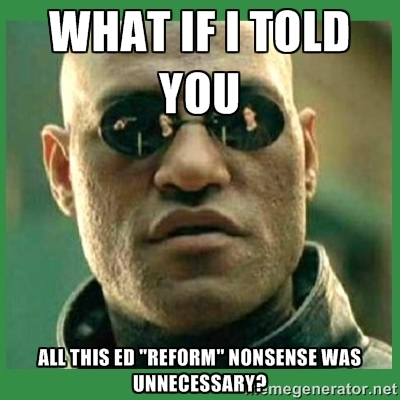
Morpheus

11 Comments

Filed under charter schools, Common Core, Data, Funding, NCLB, Pearson, politics, Social Justice, Testing

Does Anyone in Education Reform Care If Teaching is a Profession?

Bob Braun, retired veteran reporter for the New jersey Star Ledger and current independent blogger, reported earlier this month that state-appointed Newark Superintendent Cami Anderson announced that Newark teachers seeking graduate education would only get district stipends if they did all of their study at the Relay “Graduate School of Education.”  For those who are unfamiliar, Relay “Graduate School of Education” was singled out as an innovator by Secretary of Education Arne Duncan last November, but it is a “Graduate School of Education” that has not a single professor or doctoral level instructor or researcher affiliated with it.  In essence, it is a partnership of charter school chains Uncommon Schools, KIPP, and Achievement First, and it is housed in the Uncommon Schools affiliated North Star Academy.  Relay’s “curriculum” mostly consists of taking the non-certified faculty of the charter schools, giving them computer delivered modules on classroom management (and distributing copies of Teach Like a Champion), and placing them under the auspices of the “no excuses” brand of charter school operation and teachers who already have experience with it.

In the case of North Star Academy in Newark, that means that the teachers who earn certification through Relay “Graduate School of Education” will have “instructors” who meet state requirements for faculty degrees by the school claiming “equivalency” because they are such amazing teachers who get amazing results.  In Relay’s words that is “the equivalent of the leading entrepreneur teaching in MBA programs or the leading writers and artists teaching in MFA programs.”  That’s quite a lofty claim, especially when Dr. Bruce Baker of Rutgers University has demonstrated (repeatedly) that the “awesome” results of North Star are deeply connected to how the school has many fewer students with high needs due to poverty, language, or disabilities issues, how it suspends students at rates much higher than district schools, and how an African American male who enrolls in 5th grade has only a 40% chance to staying at the school until 12th grade.

So, there you have it: a “Graduate School of Education” without a single professor of education, offering teacher certification and degrees to the employees of the charter school in which it is housed, specializing in a curriculum that emphasizes teaching and discipline strategies that successfully drive away more than half the students whose families deliberately sought out the school in the first place. And THIS will be the sole provider of compensated continuing education for all of the teachers in the Newark Public Schools.

sheldon-throwspapers

What makes the embrace of Relay “Graduate School of Education” in Newark, Trenton, and Washington D.C. so frustrating is that university-based teacher preparation continues to have the standards for our graduates raised by the very same entities that think Relay should be allowed to call itself a graduate school and confer certification and degrees.  Trenton, in particular, is barreling ahead with proposed revisions to teacher certification rules that university-based programs will need to adhere to whether or not there is evidence that they will result in better teachers.  Currently, the young people who wish to become teachers must meet entrance criteria upon matriculating at our school.  Once in they must maintain a minimum GPA to take classes in their education major.  In addition to a full major in education courses, they must have a major in a content field within the College of Arts and Sciences, and they must take additional coursework in a liberal arts core to fulfill both university requirements and state requirements of a minimum number of credits in liberal arts courses.  Our program has extensive field work prior to student teaching that go beyond current state requirements that our students must coordinate with their full time class schedule.  The state also requires that all students seeking certification pass Praxis II examinations.  Various changes to the code requirements are under consideration in Trenton, all of which will make it more difficult for people to seek certification at universities.  Entrance requirements may be increased, or potential students can demonstrate “readiness” to begin their studies with another standardized exam.  The state is considering requiring what would amount to a year-long student teaching experience, and the next version of the state code will almost certainly require teacher candidates to submit a performance assessment to the state which, for all intents and purposes, will require most universities to adopt Pearson’s EdTPA assessment.

All of this probably sounds great if you agree uncritically with self appointed teacher quality watchdog, National Council on Teacher Quality, that declared teacher preparation an “industry of mediocrity” in a report so exhaustively researched that they failed to visit a single university campus and gleaned most of their quality “data” from online catalogs and program descriptions.  For more cautious observers, changes like these might be intriguing, but they come with questions and trade offs.  The biggest question is whether there is any evidence at all that trimming the available corps of potential teachers entering preparation and then holding those who make it in to more rigorous benchmarks will result in better learning in their eventual classrooms.  Critics of traditional teacher preparation often criticize the academic caliber of students entering teacher preparation without noting a very obvious point: if being the best student was absolutely essential to being the best teacher, then the nation’s professoriate would enjoy a much better reputation for teaching skills.

However, even beyond the question of evidence, advocates for increasing requirements on traditional teacher preparation need to acknowledge there are trade offs for increasing standards and requirements this way. Increasing the necessary test scores for entry into a program means that certain populations of students may not be able to even begin teacher preparation and prove their ability in a timely fashion and be effectively locked out of undergraduate study in the field (you can have one guess about from which communities most students who might not meet this hurdle would likely come).  A full year in the classroom for student teaching is an appealing idea  — that comes with massive logistical challenges for students trying to get all of their coursework completed in just 4 years and might make undergraduate preparation unworkable for transfer students and community college graduates.  A state required performance assessment is an idea worth exploring, but with indications that the state is willing to simply farm this out of a major testing corporation at a cost of $300 out of pocket for students, there should be a robust debate on the instrument itself and the ethics of tying up another certification requirement with a corporate revenue stream.

Assuming these issues could be resolved favorably and equitably, there is another issue to consider.  Current conditions and proposed changes all appear aimed at trying to ensure that high caliber students and high caliber students only enter and make it through traditional teacher preparation.  That goal might be defensible, but what, exactly, is Trenton, or any other state capitol for that matter, doing to make teaching an attractive prospect for such high caliber students?  Chris Christie breaking his own pension reform obligations probably isn’t a big incentive.  Despite claims to the contrary, New Jersey teacher salaries are not comparable to other professionals with similar education levels.  In my 22 years in education and higher education, I have yet to meet a single teacher who thinks the distorting stakes attached to current high stakes examinations would be a job perk.  The callous havoc unleashed upon school districts under state control by Trenton appointed superintendents cannot make many of the state’s best and brightest want to work in urban schools.  While Governor Chris Christie has not yet traveled to the New Jersey Education Association annual meeting in Atlantic City to personally beat up a teacher on the boardwalk, he has yelled at several of the state’s teachers in person and accused them of using students “like drug mules” for a Project Democracy assignment near school elections.  All of this is certainly going to entice New Jersey’s best students to accrue debt and work hard to enter a profession held in such esteem by the highest offices in the state:

Governor Chris Christie, Raising Teachers' Public Esteem Again

Governor Chris Christie, Raising Teachers’ Public Esteem Again

The disconnect between allowing Relay “school” to operate while placing these requirements on traditional programs and leveling this much disrespect upon working teachers is staggering.  To a degree, those of us in academic teacher preparation have ourselves to blame for some of this.  As the first wave of the “failing schools narrative” took shape with the release of A Nation at Risk in 1983, numerous reports and proposals were released that focused upon “professionalizing” the field of teaching, conjuring a future where the teacher workforce more closely resembled higher status professions in career trajectory and in clinical preparation.  While the wholesale transformation never happened, the clinical preparation ideology is well entrenched within different teaching standards, accreditation organizations, and among no small share of teacher educators themselves, and David Labaree of Stanford University noted in the early nineties that this focus emphasized teaching as a technical, rational, activity and potentially shut out public input the way medical fields protect their specialized knowledge.  Indeed, by accepting wide swaths of the teaching as technical/rational viewpoint, teacher education has limited the role of powerful visions of teacher development that embrace all of teaching’s complexities and, as Ruth Vinz wrote, begin “to look behind the act, the formula, the answers to the causes, conditions, and contexts.”  We have, in fact, participated in portraying teaching as technical practice whose most important aspects are measurable, so it is little wonder that policy makers are hurling a runaway train through that opening.

However, given the promotion of Relay “Graduate School of Education” and given the continuous disrespect and degradation of working conditions heaped upon teachers, I cannot accept that Trenton is really trying to elevate the profession — in either a technical manner or not.  Taken together, the current and proposed policy environment seems more geared towards greatly decreasing the number of teachers who obtain certificates via traditional teacher preparation while opening the door for many, many more to enter teaching via what amounts to on the job training without ever having studied for the job in the first place.  Trenton, intentionally or not, is engineering a shortage of teachers with credentials from undergraduate study, which will result in more schools like Relay “Graduate School of Education” being “needed” to fill in the gap by certifying their own employees.  Those who survive the “churn and burn” for which charter schools are famous would have state issued credentials to move on to fully public schools.

Or perhaps they won’t.  I find it hard to believe that today’s education “reformers” really believe that teaching is a profession at all.  If they did, the pressure to make certain only top students enter university-based teacher preparation and then to make sure those students have rigorous preparation would be coupled with similar efforts to raise the attractiveness of teaching as a lifelong career.  Instead, reformers act as if they believe that teaching is something you do in your twenties when you are idealistic and want to “give something back”  — and then you move on to a “real career” in some other sector.  If your charter school bosses like you, perhaps they will make you a school principal before you are 30, or they will set you on a path to become Commissioner of Education for the state of New York when you are only 36 years old.  But mostly, they will thank you for a few years of service and see you off to your grown up life outside of education.  After all, reformers’ favorite schools — “no excuses” charters — manage to train their students into “little test taking machines” without very many career teachers, so why should reformers really value teachers who dedicate their entire adult lives to teaching?  That people in their 30s, 40s, and 50s are dedicated and developing professionals who wish to remain in the classroom must seem like an amusing and quaint anachronism to them.

The teachers I know and work with are not laughing.

24 Comments

Filed under Cami Anderson, charter schools, Chris Christie, teacher learning, Testing

Dear NYS Assembly Members: Did We Stutter?

Allies of public education in New York have had some hope that Assembly Democrats were getting the message and were preparing to truly challenge Governor Andrew Cuomo’s appalling education agenda.  Speaker Carl Heastie and his colleagues released a proposal with $830 million more in school aid than the governor’s and with none of the strings attached to the aid that made the governor’s proposals so potentially damaging.  Gone were changes to teacher tenure and dismissal, increases in the state charter school cap, and increased authority for Albany to take over schools, all proposals the governor demands in return for raising school aid by $1 billion.  While the Assembly number is still far short of what is required to fully fund the Campaign for Fiscal Equity settlement that Albany has largely ignored since 2007, it was a push in the right direction.  Senate Democrats are reportedly casting their futures away from Governor Cuomo, and Assembly Democrats and Republicans are calling foul on the governor’s stated intention to shunt aside the Assembly if they do not give him exactly what he wants.  Meanwhile, U.S. Attorney Preet Bharara, having indicted former Assembly Speaker Sheldon Silver, is still sniffing around Albany which cannot be comfortable for a governor who is the top beneficiary of hedge fund money in the state and who assembled half of his campaign cash from fewer that 350 donors.

Even better than the brewing dissatisfaction with Governor Cuomo among law makers, even law makers of his own party, is the evidence that voters are increasingly stacking up against the Governor’s education proposals.   A Quinnipiac University poll released last week showed that Governor Cuomo’s approval rating has fallen 8 points since December, leaving him with a 50% job approval rating.  More telling, however, was that the poll revealed only 28% of respondents approved of the governor’s education plans, and that 55% said they trusted the state teachers union more when it came to improving education in the Empire State.  71% disagreed with tying teacher compensation to student test scores, and 65% said teacher tenure should not be tied to standardized test scores.  Governor Cuomo’s education proposals are so unpopular that his entire approval rating is being dragged down with voter dissatisfaction with those ideas.

Speaker Carl Heastie entered the infamous “three men in a room” negotiations where Albany’s power brokers convene to discuss what will actually be brought for a vote to the Assembly and Senate.  Governor Cuomo was there, as was Senate Majority Leader Dean Skelos whose Republican conference won an outright majority in the 2014 election.  In a break with protocol, Senator Jeffrey Klein, whose 5 person independent Democratic conference previously gave Senator Skelos control of the Senate, was involved in the negotiations, infuriating Senate Minority Leader, Democrat Andrea Stewart-Cousins, who contends that if Senator Klein can be there representing 5 members, she should be there to represent 25. With an increasingly defiant membership and with clear evidence of popular agitation against the governor’s education proposals, observers wanted Speaker Heastie to face down Governor Cuomo.  Instead, sources with the Alliance for Quality Education noted that a hastily made statement on Wednesday spoke about a $1.4 billion “compromise” school aid increase, $400 million less than the Assembly’s proposal.

One cannot help but wonder if Governor Cuomo has the firstborn children of all Assembly members locked up in Azkaban or something like that.

With all due respect (and no small portion of dismay), I must exhort Speaker Heastie and his conference to realize that this is not a time for compromise with Governor Cuomo.  There is no “reasonable middle ground” with proposals that are so pernicious to the quality of education in the state.  Accepting a half dose of poison is not a virtue.  It is worthwhile to note the affronts to our public schools from the governor that demand remedy:

Our schools are starved of monetary resources.  Governor Cuomo likes to say that money isn’t an issue because New York spends a lot, but his statement fails to acknowledge a simple truth that education costs what it costs and when you have high concentrations of poverty and other situations that complicate teaching and learning, you will need to spend more even if measurable results are slow to manifest.  Worse, however, is the fact that the governor’s claim is a blatant dodge of the fact that nobody in Albany has ever tried to actually fund the Campaign for Fiscal Equity settlement that would have increased Albany’s school aid by $7 billion.  Governor Cuomo’s proposal to increase aid by $1.1 billion is barely 20% of the amount needed to fully fund the CFE settlement, and his promise of a mere $380 million if he does not get his full set of proposed education changes is 7% of what is needed.  In addition to simply ignoring the state’s commitments to increase education aid, the governor and legislators have maintained the Gap Elimination Adjustment that Albany uses to take back budgeted school aid in the event of a shortfall, resulting in billions of dollars more in lost school aid cross the state with cuts in personnel and services in most districts.  In his first year in office, Governor Cuomo pushed for and got a property tax cap, which effectively limits how cities and towns might make up for lost state aid due to the GEA and unfunded CFE obligations.

The governor insists that money is not an issue even as he has strangled our schools at every opportunity.  The Assembly’s proposed increase is a mere down payment on correcting this.

The proposed teacher evaluations have no basis in research and will harm education statewide.  With the exception of a few die hard fans who think if they just wish hard enough, value-added modeling of teacher effectiveness will start to work, there is precious little research saying you can reliably and fairly use statistical modeling based on test scores to evaluate teachers.  Worse, we know that the high stakes testing environment instituted under the No Child Left Behind act has narrowed the curriculum and increased test preparation and given us practically nothing worthwhile in return.  No evidence based or frankly rational person would propose at this point to increase the role of standardized testing in our accountability systems for schools and teachers.

So, naturally, Governor Cuomo wants to increase test scores to a full 50% of teacher evaluations.  He wants a further 35% to be in the hands of “outside evaluators,” leaving a mere 15% for school principals.  The benefits of this approach will be non-existent while the damage is already entirely predictable.  The Assembly cannot compromise on this.

Raising the charter school cap will hurt our public schools.  The original idea behind charter schools was to create small, local, experiments in education that would work with students not well served in their schools and feed lessons learned back into the fully public system to see if they could be scaled.  That quickly morphed into the idea of charters as a form of competition seeking to draw both students and resources out of neighborhood schools, and today, the most prominent charters on the landscape are brands unto themselves.  Those charters are politically and financially connected; in New York their financiers have donated handsomely to the governor who has pretty much adopted their agenda lock, stock, and barrel.  More troubling, however, is the fact that the data shows the barely regulated charter school sector not only fails to feed scalable ideas to local schools, but also it acts parasitically.  In New York, charter schools cream students via lottery processes that put unnecessary barriers between the most disadvantaged students and entry.  Once accepted, parents have to agree to levels of involvement that are pose significant difficulties for families with low wage earning adults, and  behavioral expectations as low as Kindergarten result in students who do not immediately conform being pushed out.

The upshot?  No excuses charter school chains have student populations that are less poor, have many fewer students who are limited English proficient, and have fewer students with disabilities and almost no students with difficult to accommodate disabilities.  Once resource competition is factored in, the conclusion is inescapable:  large numbers of charter schools leave fully public schools with student populations that have much greater needs and many fewer resources available to meet those needs.

If the Assembly “compromises” on the charter school cap, it will guarantee further harm to all students.

Tax giveaways for private and parochial school donations while underfunding state school aid is an unacceptable double blow.  The governor’s proposed “tax credit” for education donations allows wealthy donors to take additional tax breaks on donations to private and parochial schools, and it has been criticized as a “back door voucher” plan that would divert money that might otherwise end up in public schools.  Governor Cuomo has also made the passage of the DREAM Act contingent upon passing the tax credit.  It is a sad state of affairs when a governor who has no intention of fully funding public schools would insist upon additional tax breaks for the extremely wealthy that favor private and parochial schools and would hold up the status of children of undocumented immigrants until those tax breaks are in place.  Unfortunately, at least one former opponent of the tax credits has flipped his position, and it is unclear what will come of these negotiations.

Offering the wealthy additional tax breaks to direct donations into private hands while our public schools remain underfunded by $5.6 billion a year should not even be on the table.

This budget process in Albany is no time for a falsely constructed “middle ground” to prevail in the name of “reasonableness.”  The Assembly’s budget proposal is simply a good down payment on the state’s legal obligations to fund public education at levels sufficient to the task.  Removing Governor Cuomo’s damaging reforms on teacher evaluation and dismissal, state take over of schools, charter schools, and tax giveaways to the wealthy is the only reasonable course of action.  There is no “reasonable compromise” between entirely pernicious and minimally acceptable.  Instead of compromising with the governor, Speaker Heastie should demand:

  • A timetable for full funding of the Campaign For Fiscal Equity settlement, adjusted for inflation, and with additional funds to make up for revenue lost because of the GEA and property tax caps.
  • Full repudiation of the GEA in all future school aid budgets.
  • No increases in the charter school cap unless comprehensive eforms place them on an equal playing field with fully public schools, disallow the practices that result in their very disparate student demographics, and subject them to full transparency in their finances and daily operations, especially their disciplinary practices.
  • No consideration of tax breaks for the wealthy to fund private and parochial schools while our public schools remain financially starved by the school aid budget, the gap elimination adjustment, and the property tax cap.

The Assembly needs to remember that Governor Cuomo enjoys a measly 28% approval of his education agenda.  55% of New Yorkers believe that NYSUT would do a better job of improving our schools.  This is a time to hold firm.

Unless, of course, Governor Cuomo really does have your children in Azkaban.  Trust me; we’d like to know.

Democrats, did He Who Must Not Be Named lock your children up here?

Democrats, did He Who Must Not Be Named lock your children up here?

1 Comment

Filed under charter schools, Corruption, Funding, Social Justice, Testing, VAMs

Mr. Petrilli Goes to Albany

Michael Petrilli is the President of the conservative education think tank, the Thomas B. Fordham Institute.  As such, he is a major voice in support of much of today’s education reform agenda, notably The Common Core State Standards, opposing teacher unions, and the expansion of charter schools and their networks.  It was surprising to some when he turned up as the invited keynote speaker at the New York State Council of School Superintendents Winter Institute.  Mr. Petrilli was himself aware of the potential controversy in his invitation to speak, and abruptly changed the title of his talk from “How to End the Education Reform Wars” to “How to Survive the Education Reform Wars.”  Diane Ravitch of New York University notes the irony of this reframing due to Mr. Petrilli’s prominent role in fomenting the “education reform wars” in the first place (Think of Dick Cheney giving advice on how to survive political and military turmoil in the Middle East).

Interestingly enough, there are some bright spots in Mr. Petrilli’s talk. The most notable was his declaration of Governor Andrew Cuomo’s plan to boost standardized testing to a full 50% of teacher evaluations as “insane” and citing that even other “reform leaders” are moving to using those measures less.  This is a positive statement from someone in Mr. Petrilli’s position, even if he gives it scant time in his speech, and hopefully it based on the body of research that plainly shows how value added measures of teacher effectiveness are pretty much bollocks.  It is also possible that someone sees the growing backlash against testing and the evaluation systems that encourage teaching to the test as threatening the entire reform agenda. Whatever his reason, it was notable that Mr. Petrilli chose this forum to condemn Governor Cuomo’s teacher evaluation plans. Mr. Petrilli also spent time critiquing some of his fellow reform-minded allies:

But on the other side, some of the reformers have equally extreme views. They say that public schools are failing unless each and everyone one of their graduates are college AND career ready. Each and every one.

Well.

Keep in mind that our highest performing state, Massachusetts, gets only fifty percent of students to that lofty standard. Should we aim to get more students college and career ready? Absolutely. Do I believe that the Common Core standards, if faithfully implemented, will help? Absolutely. Is a school failing if it doesn’t get every single student to that lofty standard? Of course not

I could spend time quibbling with Mr. Petrilli’s definition of “that lofty standard.” Massachusetts was using the MCAS in 2014, so I assume Mr. Petrilli is referring to the Bay State’s top in the nation National Assessment of Educational Progress (NAEP) results – which never mention “college and career readiness” because it is the NAEP, not Common Core.  Massachusetts was top of the nation in the 8th grade NAEP for 2013 with 48% of students reaching proficient and advanced in reading and 55% in mathematics — proficient represents solid academic performance and an ability to apply that knowledge in real world, analytic situations, so that is a heck on an accomplishment.  Given that 39.4% of Massachusetts adults over the age of 25 have a BA and that the Bay State economy seems to be picking up real momentum, it seems Massachusetts is poised to be a net exporter of college educated adults. Regardless, Mr. Petrilli is correct to note that reformers clinging to some kind of magical thinking that Common Core and a lofty enough set of expectations will get all kids ready to attend college are not playing in a world that resembles reality, so a sincere thanks for that.

Much of the rest of his address is complete bollocks, however.

Peter Greene does his usual indispensable review of the whole talk here, where he does an especially good job pointing out how Mr. Petrilli sets up some nice fantasy anti-reform activists who want to believe that poor kids cannot learn:

Petrilli uses the new fave talking point for reformsters in which he characterizes the pro-public-education folks (and name checks Diane Ravitch) as those who have given up, think that education is hopeless in the face of poverty, believe that schools cannot do any better. This is the new improved straw man version of dismissing reform critics because they “use poverty as an excuse.” It’s a snappy rhetorical point, but it’s a lie, a deliberate misreading of what folks in the pro-public-ed camp are saying.

It’s a particularly galling point coming from the man who has explained on more than one platform that the proper role of charters is to rescue those students who are deserving, snatching them from the midst of the undeserving mob. It’s galling from charter fans in general, as their whole point is that public schools are hopeless and we should not waste another cent trying to help them do better.

But it’s also insulting to the millions of teachers who are in the classroom day after day, doing the best they can with the resources they have. Hey, teachers– if you’re not succeeding with all of your students, it has nothing to do with obstacles and challenges in your path. You just don’t believe enough.

I can’t improve on that except to affirm how utterly disingenuous it is to take people who are trying to point out that our most most struggling schools typically try to work with populations that have heavy concentrations of poverty and that we have long known the lasting impacts of poverty and to portray that as saying “there is nothing schools can do.” Let’s clear this up:  Mr. Petrilli, when I and other critics of your version of education reform raise the issue of poverty and its demonstrable impact on children and the schools they attend, we do not do so to say that there is nothing that can be done.  We do so because if we as a society are truly concerned about whether a child in poverty can do her very best in school, then perhaps we should be concerned about whether or not she can EAT TODAY.  That means giving her school a lot more to work with in terms of special resources and staff, and that means the rest of society stepping up and taking responsibility for alleviating the deprivations she faces outside of school as well.  That’s why we resist your brand of “reform,” Mr. Petrilli.  It has to do with facts, not ideology.

Mr. Petrilli insists that Common Core is necessary because our standards were a joke before them:

Let me say a few words about this. As many of you know, I’m one of the strongest supporters of the Common Core out there. I’m the conservative they send to red states to testify and urge other Republicans not to drop these standards. And I support these standards because they are pegged to success for our young people—success in college or a good paying job.

That’s important because our earlier standards were set so low that they were sending false signals to kids and to parents that all was well, when it wasn’t. That kids were on track, when they weren’t. You know this. Those old standards and tests were set at such a low level that you could be reading or doing math at the 20th or 30th percentile nationally and be considered proficient.

The assertion that Common Core is “pegged to success” in terms of college and career readiness is one of the articles of faith among reformers, but it is also entirely unproven in practice as of today, and the opaque nature of their development does not provide evidence of how that confidence came about.  The statement also belies an odd faith in the seamlessness from standards to practice to achievement that is not so apparent in the world of education.  Consider Massachusetts again.  The top performing state on the 2013 NAEP was also recognized as having very high quality state standards before adopting the Common Core.  Now consider Texas.  According to Mr. Petrilli’s own organization, the Texas English standards from 2008 are of higher quality that the Common Core standards.  Yet in the 2013 NAEP, Texas, having remained with its own standards, was only above 7 other states in 8th grade reading.  Texas has made some improvement since the adoption of those standards, but it has hardly been dramatic.  Perhaps the teachers of Texas simply don’t believe enough, but my suspicion is that it takes a lot more than “high quality standards” to leverage change.

Mr. Petrilli pivoted his talk with a strangely insulting set of points for his audience:

But let me level with you: We’re frustrated with you too. For sure, we understand that your hands are often tied by union contracts, state regulations, and more. I’ll get to that in a bit. But we do see examples of areas where you are not taking advantage of the authority you DO have to do right by kids. My friend Rick Hess writes about Cage Busting Leaders. Some of those cages are of your own design.

The number-one example, of course, is around teacher evaluations. This whole national push for teacher evaluations came about because research showed that the vast majority of teachers were being given glowing evaluations. And it was clear that in many schools, those evaluations were not being treated seriously. Principals did a couple of fly-by observations a year, and that was it. It wasn’t enough to provide good feedback to teachers, and it sure wasn’t enough to identify teachers who might need to be encouraged to leave the classroom.

It is a fascinating approach to speak to an audience and tell them that they are essentially not doing their jobs, but perhaps the Superintendents were encouraged with the following words of sympathy:

Now, I have more sympathy for you than most reformers. As I see it, you’d have to be crazy as a principal in New York State to give your teachers bad evaluations. Because in New York State, it’s damn near impossible to actually fire a teacher. So if that’s the case, why make an enemy by giving a bad evaluation? It’s better to work the system to send that teacher somewhere else. Until and unless lawmakers here in Albany decide they want to make it significantly easier to fire a teacher, they better get used to seeing reports of lots of glowing evaluations.

Isn’t it nifty how this works out?  Superintendents and principals are not doing their jobs at all, but they get at least a little tea and sympathy because, after all, they may not be lazy — they may just be fearful of the mess that might happen if they did their jobs!

Captain-Picard-Facepalm

Let’s look at the claim that it is “impossible” to fire a teacher.  It is a common claim, one that anti-tenure activists like Campbell Brown like to repeat as if they are reading from the Gospel, but it is really true?  If your standard is the basic at will employment agreement that corporate managers and CEOs enjoy, then I suppose it is true.  Instead of simply calling an employee into the office and telling her to pack up her desk because security is escorting her off the property in ten minutes, school administrators actually have to employ a process and demonstrate cause to remove a tenured teacher.  That may take time and some effort, but it is hardly impossible.  Dr. Alyssa Hadley Dunn of Michigan State University examined Campbell Brown’s favorite claim that it takes over two calendar years to remove a tenured teacher in New York and found it wanting:

This statistic, which Ms. Brown peppers in all of her speeches, appears to be from a research brief of the New York State School Boards Association. This brief was based on the results of a self-report survey to which only 59% of districts responded and in which New York City (the largest district) was not even included. Jessica Glazer has written about whether or not the numbers are even accurate, and Bruce Baker points out, importantly, that quality may vary significantly between districts. Further, since the data was collected, after 2008, the state made efforts to reform tenure laws, changing the minimum years from two to three. Now, according to one report, only a slim majority of teachers receive tenure on the first attempt, and, in 2013, disciplinary cases took, on average, only 177 days statewide.

Considering the importance of teacher tenure for actually effective teachers — such as protecting them so they can speak out on behalf of their students and colleagues as documented in the link — the fact that removal takes effort should not be a point of contention, but Mr. Petrilli, and others like him, suffer from CEO envy in these matters.  CEOs have enormous power within the corporate world, overseen only by a board of directors.  So if you are the CEO of Apple, you can order everyone to focus like a laser on a handheld computer and release it even if the handwriting recognition software is not ready for prime time.  Then if you are the former CEO getting his job back, you can kill the whole project even though it has been greatly improved and will eventually provide you with the technology that will take over the phone market.  You can do all of this because you are the CEO and disruption by your will is in your tool kit.  School leaders work within organizations that are best characterized as “loosely coupled” which means that although organized hierarchically, schools allow significant autonomy among individuals, allow locally derived adaptations for changing conditions, and can have smaller parts of the system break down without damaging the entire system.  Leaders within such systems need different skill sets than corporate leaders, and simply imploring them to more aggressively remove ineffective probationary teachers, as Mr. Petrilli, does is insufficient to the task of being a real instructional leader within a school system, a role that requires significant rethinking of the role of principal from administrator to staff developer with resources coordinated and time allotted across the entire system.  “Fire them while they are young” just doesn’t cut it.

But is Mr. Petrilli’s contention even true?  Is it true that principals and superintendents don’t give tough evaluations because they know they cannot remove an ineffective teachers?  There’s a possible explanation that is left entirely unexplored in his talk: namely, the scoring bands for teacher evaluation in New York were set so that teachers who did not score as ineffective in any category could still be labeled as ineffective.  Principal Carol Burris explains that here as well as the different system that was imposed upon New York City by then Commissioner John King.  In the 2011-2013 scoring bands, it was possible for a teacher to get a low “developing” mark from the state test and the locally selected test measure, get 58 out of 60 points on the “other measures” and be labeled “ineffective.”  Not one score band in the ineffective range, but ineffective regardless.

So is it possible that principals and superintendents have not been vigorous enough in teacher evaluations because they dread the work of trying to remove an ineffective teacher as Mr. Petrilli contends?  Possibly – if you have a low opinion of their work ethic and professional pride.  It is equally possible that principals and superintendents know that the score bands are set up in a way that teachers can be found ineffective without having a single measure in a range that is labeled ineffective.  Cognizance of that inherent unfairness could easily skew observation scores upwards, especially for school leaders who have multiple and diverse other tasks to attend to.

Mr Petrilli’s biggest whopper comes near the end when he laments the assumed sea of red tape that holds back schools and claims the success of charter schools is attributable to their freedom from such requirements.  Then he tells superintendents to demand the same “freedom”:

The notion with charter schools is that the only way to cut this Gordian Knot is to start fresh, to opt out of the regulatory framework, and the union contract framework, entirely. And create a whole new paradigm.

And if you are frustrated by comparisons between your schools—your over regulated, hyper unionized schools,and the autonomous charter sector—you are right to be. But here’s my advice: Don’t fight em, join em. Ask for similar freedoms. Ask for similar autonomies. And if that fails, use chartering to advance your own goals. Stop fighting with one hand tied behind your back—tied up with red tape. Cut the ties. Come out swinging.

Here is CEO envy all over again, and it is wrong because someone’s (presumably, Petrilli’s) “red tape” is another person’s “Free And Appropriate Public Education” — just one of the many regulations that the “no excuses” brands of charter schools routinely opt themselves out of in pursuit of higher test scores.  Here we have Michael Petrilli, who has never been a teacher, a school administrator, or a qualified researcher, advising the superintendents of New York to push to free themselves from regulatory requirements that were put in place to protect vulnerable children in the first place.  And he tells them to seek this “freedom” to emulate a sector that he has openly and repeatedly said is right to restrict itself to “the strivers” and to rid itself of students who do not measure up.  We know what this looks like in practice — a Kindergarten child with manageable attention deficit throwing up in the morning because he is afraid he will be “fired” from school. 

Even without the emotional and ethical argument, we also know that charters as they are managed now in many urban areas make the local school system worse off for everyone else.  After the charter schools compete for space and other resources and after they effectively skim off the easiest to educate children and push out the ones who are not, you have district schools that have no say in how charters are managed and are left with demographics that are more disadvantaged, more disabled, and less able to speak English, all of whom need many more services from diminished remaining resources.

For Mr. Petrilli to come out and exhort his audience to demand allowance to act similarly and then to advocate, as he did on Twitter, that district public schools should be allowed to push out students as they see fit, is asking for a school system that is pathologically unwilling to work with anyone it doesn’t want to:

It would one thing for charter advocates like Mr. Petrilli to say the cream skimming is okay if he were to similarly advocate that the district public schools, working with the much higher needs students, had resources poured into them so they could accomplish the mission of educating the most needy.  Smaller class sizes, co-teaching, increased numbers of paraprofessionals, increased certified special education teachers, language programs, speech and physical therapy, social workers, health and nutrition programs, renovated facilities — tellingly, none of this made the list of things Mr. Petrilli told superintendents should go to bat for.

Because something else was missing from the speech — money.  Michael Petrilli was talking to a gathering of New York superintendents, a group of school system administrators who have seen their budgets plummet due to a state property tax cap and budget games in Albany that have cost the AVERAGE school district millions of dollars a year in state aid.  I do not know if the Superintendent of Hempstead was in the audience, but if she was, I do wonder if she feels like she needs to be a “cage busting” leader more than she needs Albany to not short her school district MORE THAN $6400 PER CHILD THIS YEAR.  It is something of a sick joke to talk to a group of district leaders about how to “survive the education reform wars” and offer no insight into how to fight to keep their school aid from being raided year after tedious year.  It is not remotely funny to advocate that they push for policies that, objectively, would require huge increases in local and state spending to make happen in a thoughtful and remotely helpful way and to still remain entirely mum about money.

I am sure Mr. Petrilli got polite applause. 

I would not be surprised if he got a significant number of eye rolls.