Category Archives: charter schools

Dear Randi

Dear Randi Weingarten,

You do not know me, but we have crossed paths on Twitter and education blogging circles.  In fact, I think you have kindly retweeted some of my writings to your followers on a few occasions.  I am writing because I have been following your political actions for some time in this election cycle, and while I think I understand what is motivating a great deal, I am concerned that as the leader of the American Federation of Teachers’ 1.6 million members you have been too willing to accept a “seat at the table” with politicians and foundations, a seat that has come at the expense of the rank and file.  I do not believe this has been your intention, but I also think that it is necessary to question whether or not politics as usual has broken down, whether or not having a seat at the table is worth the comprises necessary to get there. I respectfully suggest that this is one of those times.

Many of the bloggers and education activists I read have been very harsh towards you in their assessments.  Those assessments are based upon what they see as a long series of actions demonstrating a willingness to play ball with so-called reformers and to negotiate for changes in matters like teacher assessment and compensation and the Common Core State Standards.  Mercedes Schneider pulls few punches in this piece detailing cooperation with Eli Broad, the Gates Foundation, and other forces in education reform who have sought to weaken unions, pushed for unregulated charter schools, advocated evaluating teachers using standardized test scores based on the CCSS, and advocated to institute performance pay using those same measures. Blogger Jersey Jazzman wrote you an open letter in 2012 about the Newark contract, making predictions that have pretty much come true.  I know other bloggers and activists who’ve openly pondered nefarious reasons for your willingness to cooperate with people and institutions that have been demonstrably disruptive forces in ways that have rarely been beneficial for schools.

I’d like to make it clear that I do not share that negative assessment.

There are two polar opposed views of how unions ought to deal with efforts like the current reform movements.  The first, which is certainly familiar to many, is best described as following the maxim that if “you let the camel’s nose under the tent, the rest of the body will follow.”  In this view, any concession given to reformers means that a constant wave of detrimental ideas will follow, so union leaders should fight tooth and nail to keep them from happening.  It probably will not work 100%, and the public relations will be difficult to manage, but if reformers keep getting bloody noses, fewer of their ideas will come to fruition.  The other perspective, perhaps more popular in the post-World War II period, believes that having a “seat at the table” is important and more valuable in the long term than constant brawling.  In this view, trade offs have to be made so that policy can be guided into less harmful directions because policy makers only listen to insiders and policy will be made with or without your input.  The stance is less viscerally satisfying, but if the seat at the table is genuine, there is potential to have actual impact without subjecting rank and file and their students to constant turmoil.

I will admit that I see the wisdom of the less confrontational stance.  Policy will be made, and we live in an era when union power has been greatly diminished by loss of membership and political figures willing to attack unions.  If the union leadership is fully shut out of the inside of the political process, then the people who will be left will be lobbyists representing corporate interests and a growing cadre of the super wealthy who have discovered that they enjoy bending politicians to their will far more than they enjoy endowing hospitals and art museums.  In the absence of union leadership with any insider capacity, politicians and plutocrats will bend everything to their will without a voice representing the rank and file even within earshot.  This is not a position of purity, but it promises to keep balance.

There’s just one problem with this perspective.  It only is operable when the place offered at the table is genuine.  If the owners of the table only plan to shoot you underneath it, then preserving your seat can no longer be a viable priority. I respectfully suggest that today is such a time, and that the only move that truly serves your members is to walk away from the table that is populated by people acting in bad faith.

The first evidence of this is the absurd and personal campaign against you by Richard Berman.  As you know, Berman is a political consultant whose preferred tactics are so bottom feeding and vicious that an oil industry executive listening to him talk felt the need to expose him for type of operative that he is.  Berman has spent most of the past year coordinating a direct assault on teacher unions generally and you specifically, relying on hyperbolic tone, misleading information, and a staggeringly personal content.  I must note that you have been dignified, forceful, and inspiring in the responses I have seen to Berman’s attacks, but I also must note that there is a lesson in the mere existence of his campaign.

Berman works for corporate interests, and although he will not disclose his donors, it is not hard to guess the kinds of people behind him.  After your cooperation with Eli Broad on some issues and after your personal efforts to support the standards side of the Common Core, it would be atrocious for his funding to be coming from Broad or Gates, but there is no lack of other corporate interests from the Walton Family Foundation to the Koch Brothers to the Rupert Murdoch to Michelle Rhee’s Students First who would be more than happy to take up the cause.  And why would any of these people and foundations be eager to engage in such a puerile attack on you?  Well, you’ve stepped out of line.  You’ve warned reformers that their obsession with testing and evaluating teachers by tests have put the Common Core State Standards in trouble with teachers and parents.  To me, this was overdue because Race to the Top had super glued testing the standards from the get go, but for your supposed friends in reform, this kind of talk about the obvious is a betrayal.  Worse from their perspective?  You have defended teachers and their union won workplace protections from the lawsuits seeking to strip them from all of our nation’s teachers, and you have been willing to criticize supporters of the suits in public.

I’ve heard and read your defenses of tenure.  They have been eloquent.  They have been factual.  They have been passionate.  And they must be unforgivable to the types of people who hire the likes of Berman. It is fairly obvious that he was hired to “soften you up” prior to the Vergara lawsuit ramping up, and he has been charged with keeping up his attacks as you’ve defended teachers since then.  What’s the lesson here?  You are only favored by corporate reformers and their political allies as long as you stay entirely within the ranks.  Take a step out of line, and well, you are on billboards as the enemy of America’s children and subject to junior high pranking on social media.

More egregious, however, has been the steady stream of betrayals of teachers and schools by politicians who have been wooed by steady infusions of corporate cash and have participated in starving public schools of funds, forcing the CCSS, testing and test based evaluations into schools, and who have promoted charter school policies that concentrate high levels of disadvantaged students into the same district schools they have starved of funds.  Worse, these betrayals have come from Democratic politicians who have traditionally enjoyed strong labor support, and who, in public, claim to be allies of school and labor.  Republican Governors like Chris Christie of New Jersey and Scott Walker of Wisconsin have been incredibly hostile towards teachers and their unions, but they have also been forthright about their oppositional stance.  Meanwhile governors like New York’s Andrew Cuomo and Connecticut’s Dannel Malloy and mayors like Chicago’s Rahm Emanuel, Newark’s Cory Booker (now U.S. Senator from New Jersey), and Kevin Johnson of Sacramento have pursued public school policies harmful to teachers and students — even if some of them go through the motions of courting traditionally Democratic Party constituencies.

Governor Andrew Cuomo of New York has perhaps been the worst.  Governor Cuomo has continued to use the Gap Elimination Adjustment to balance his budget on the back of our schools.  Districts cannot make up the difference in lost school aid with local funds due to his property tax cap.  Governor Cuomo plays favorites with charter school operations that further disadvantage local schools and then attacks those local schools and teachers for poor test performance. Governor Cuomo’s education commissioner went out of his way to set the cut scores on state exams so that only 30% of students would be rated as proficient.  His record has been so damaging that the UFT took the extraordinary step of not making an endorsement in the 2014 gubernatorial election, and while many rank and file members would have preferred a stronger stance to endorse an opponent, it was an important step to publicly acknowledge that teachers in New York have no friend in the Governor’s Mansion.

It is because of these reasons that myself, and many others, were sorely disappointed by your tepid public response to Governor Cuomo’s latest outrage that he sees our system of free common schooling as a “public monopoly” that he wants to “break” and that he believes our state’s hard working teachers do not want to be evaluated.  He signaled not only his plans to double down on the destructive path of privatizing and testing, but also his utter disregard for teachers and the public purposes of education itself.  In response, you told reporters that his statements were most likely “campaign rhetoric” and that you had sent him a private letter explaining his errors.  To call the governor’s statements “campaign rhetoric” is to suggest that he is not entirely sincere in those statements and has tailored them for a political purpose, but I have to ask what in this man’s record suggests that he does not fully believe everything he has said?

Your statement reminded me of segment on WNYC’s Brian Lehrer show on October 31st.  On it, Working Families Party co-chair Karen Scharff and actress and activist Cynthia Nixon made the case for people to vote on the W.F.P. line even as the Governor had appeared in the hour before them, implicitly insulting the Working Families Party in favor of his newly created Women’s Equality Party line on the ballot:

“We’ve formed every kind of fringe party for every kind of reason,” the governor said. “We have Democrat, Republican, Green, red, white, blue, working people, working short people, working tall people. We’ve never had a women’s party.”

Many observers believe that the Governor created the W.E.P. line for no other reason than to siphon off votes from the progressive W.F.P. and possibly lead them to lose their ballot line in the future, and they believe he did this because the party made him fight for his spot on their line.  Karen Scharff and Cynthia Nixon made the case that if people voted on the W.F.P. line, they would remain a force in state politics and keep pressure on Governor Cuomo to be the “better Cuomo that we know is lurking inside…”

The thing is that I do not “know” that there is a “better Cuomo,” and I do not believe that anyone can make such a Cuomo show up.  When he has stood for traditional Democratic Party issues they have been issues that carry almost no political risk in this state: gun control, abortion rights, and marriage equality.  While those are significant, it is very clear that when it comes to fiscal policy and our public education system, he is taking his cues entirely from the corporate financiers of his campaigns. When a sitting governor takes 100s of 1000s of dollars from the backers of a single charter school chain, then manipulates circumstances to humiliate a mayor seeking funding and support for universal pre-K, and then enshrines forcing New York City to pay the rent for those schools right into the state budget — then we know full well that he has no intention of playing fair with our schools, our teachers, and our children.

I have seen you on Twitter stating that elections are “about choices,” and perhaps you believe that the Republican opponents to these Democratic Party privatizers are even worse.  You might be right — in the short term.  In the long term, however, it will be even worse if the Democratic Party continues its head first slide down the path of mass standardized testing, invalid teacher evaluations, mass teacher firing and school closings, selling off our educational commons to charter school corporations, and the breaking of one of the last unionized middle class professions in the country.  A Republican candidate may be hostile to teacher unions as well, and may deny teachers and their representatives a seat at the reform table, but I have to ask how is that any worse than being invited to that table only to be betrayed again and again?

Elections are, indeed, about choices, and perhaps 2014 and forward is the time to choose better candidates and to actively oppose those who are eager to sell off our educational commons no matter their party and no matter how they will respond if they make into office over our opposition.  The vote is one of the remaining democratic mechanisms that can still work in an age of dark money elections and politics.  Influential billionaires may own politicians’ ears in between elections, but those same politicians have to get past the voters, and we need strong voices to roundly condemn those who have betrayed public education to forces that seek to profit from it instead of nurturing it for the benefit of all.

When the seat at the table is a farce, we still have the ballot box and the picket line.  I urge you to consider what roles they have in the years ahead.

Sincerely,

Daniel S. Katz, Ph.D.

Public School Graduate

Lifetime Educator

Father of Two Public School Children

Addendum: After I published this piece, Randi Weingarten, after a day of travel, posted this piece on the AFT web page about the “difficult choices” facing New York voters.  The statement insinuates that Ms. Weingarten will not be voting for sitting Governor Andrew Cuomo, and while she describes the problems with the Republican challenger Rob Astorino, she is very firm with the Democrat:

It’s heartbreaking to see what’s happening in New York, especially after campaigning across the country for gubernatorial candidates who unequivocally support public education, respect teachers and will fight for the investment our schools need.

But in New York, the decision is painful. I am deeply disappointed and appalled by Gov. Cuomo’s recent statement that public education is a “monopoly” that needs to be busted up. (Frankly, it’s only hedge fund millionaires, right-wing privatizers and tea partiers who would use that terminology.) Public education is a public good and an anchor of democracy that is enshrined in our state constitution. Public education needs to be nurtured and reclaimed.

Ms. Weingarten concludes her statement by saying, “It’s well past time to fund our schools, care for our children, support our teachers, and stand up for workers and working families everywhere in our state.”

I wholeheartedly agree, and I sincerely hope that this signals a willingness to challenge Mr. Cuomo much more vigorously.
8 Comments

Filed under Activism, charter schools, Cory Booker, Gates Foundation, politics, schools, Unions

Andrew Cuomo Makes it Official: He’s at War With Teachers

New York Governor Andrew Cuomo recently sent some mixed signals on his education platform.  In late September, he declared that the teacher evaluation system in the Empire State needs “refinement” because even using standardized test scores to create value-added measures, too many teachers are found to be effective or highly effective. This month, however, the Cuomo campaign, perhaps responding to criticisms of his embrace of the Common Core State Standards, issued an ad that suggested a softer approach to education.  Featuring Governor Cuomo in a white sweater helping his similarly attired daughter with her homework at a table decorated with white pumpkins and a glass bowl of smooth pebbles, the ad promised “real teacher evaluations” and not using Common Core test scores for “five years.”  That promise, however, simply reflects an existing item in the state budget that delays including test scores in graduating students’ transcripts; it does not promise to not use the test scores to evaluate teachers in any way.  The governor’s softer, rather beige, image is an illusion.

There was no illusion this week, however.

Speaking with the New York Daily News editorial board, Mr. Cuomo emphasized his priorities on education for a second term in Albany:

“I believe these kinds of changes are probably the single best thing that I can do as governor that’s going to matter long-term,” he said, “to break what is in essence one of the only remaining public monopolies — and that’s what this is, it’s a public monopoly.”

He said the key is to put “real performance measures with some competition, which is why I like charter schools.”

Cuomo said he will push a plan that includes more incentives — and sanctions — that “make it a more rigorous evaluation system.”

The governor took a direct, insulting, swipe at the 600,000 members of the NYSUT, by saying, “The teachers don’t want to do the evaluations and they don’t want to do rigorous evaluations — I get it.  I feel exactly opposite.”

It is rare to have one person summarize, so succinctly, nearly everything that is wrong with the current education reform environment.  “Break…a public monopoly…competition, which I why I like charter schools…the teachers don’t want to do the evaluations.”  In those short turns of phrase, Andrew Cuomo demonstrates how he utterly fails to understand teachers, the corrupted “competition” environment he promotes, and the entire purpose of having a compulsory, common school system.  I personally cannot think of any statements he could have made that disqualify him more from having any power over how we educate our young people.

The governor, who expects to win Tuesday’s election by a wide margin, faced immediately backlash over his comments, but he has opted to double down and repeat the rhetoric of calling our state’s public schools a monopoly.  He has even gotten harsh criticism from the Working Families Party, whose endorsement he wrestled for this summer when the progressive party looked to ready to endorse Fordham Law School Professor Zephyr Teachout. W.F.P.’s state director, Bill Lipton commented:

“His proposed policies on public education will weaken, not strengthen our public education system, and they would represent a step away from the principle of high quality public education for all students. High stakes testing and competition are not the answer. Investment in the future is the answer, and that means progressive taxation and adequate resources for our schools.”

In return, Governor Cuomo’s campaign spokesman, Peter Kauffmann said, “This is all political blather.”  If anyone in the leadership of W.F.P. still has faith in Mr. Cuomo’s promises to them, I will be astonished.

I am going to address Mr. Cuomo’s statements in reverse order:

1) “The teachers don’t want to do the evaluations and they don’t want to do rigorous evaluations”

Mr. Cuomo bases this upon teacher opposition to the “rigorous” evaluations that include the use of students’ standardized test scores to determine if teachers are highly effective, effective, or not effective.  Not meeting the “effective” range on the evaluations can cost teachers tenure or it can initiate efforts to remove them from the classroom if they already have tenure.  Governor Cuomo is on record as believing that the current system is too lenient on teachers because under the new Common Core aligned examinations, student proficiency in the state has dropped dramatically while, in his view, too many teachers remain rated as effective and highly effective.  Presumably, the Governor wants to change the evaluation system so that administrator input is less important and so that the “rigorous” method of rating teachers by students’ test scores has more of an impact on their effectiveness ratings.  This is a fatally flawed approach, and it is fated to unleash appalling results for several important reasons.

First, as I have written previously, he has egregiously, and probably deliberately, misrepresented what the student proficiency ratings from the Common Core exams mean.  While students reaching proficient and highly proficient on the exams only reached 36% of test takers last year, the cut scores were deliberately set to reflect the percentage of students in the state whose combined SAT scores reflect reasonable first year college performance.  Unsurprisingly, the numbers of students who scored at proficient and above almost exactly mirrored the percentage of students with those SAT scores.  This cannot be construed as students and their teachers under-performing expectations, and, not for nothing, the percentage of New Yorkers over the age of 25 with a bachelor’s degree is 32.8%.

So let’s be perfectly clear: the Governor is saying that teachers in communities where large percentages of students do not attend college are automatically “not effective” teachers.

Second, the entire CONCEPT of tying teacher performance to standardized test scores rests on controversial premises and is not widely accepted by the research community.  The American Statistical Association warns that teacher input can only account for between 1-14% of student variability on standardized test performance, and they also do not believe that any current examination is able to effectively evaluate teacher input on student learning.  Further, advocates of value added models tend to make “heroic assumptions” in order to claim causation in their models, and they tend to ignore the complications for their models that arise when you recognize that students in schools are not assigned to teachers randomly.

I know many teachers who wish to improve their teaching and who would welcome a process that gives them good data on how to go about doing that.  I know no teachers who want to be subjected to evaluations that rely on flawed assumptions of what can be learned via standardized exams.

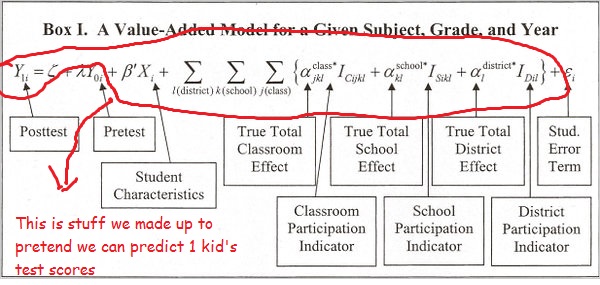
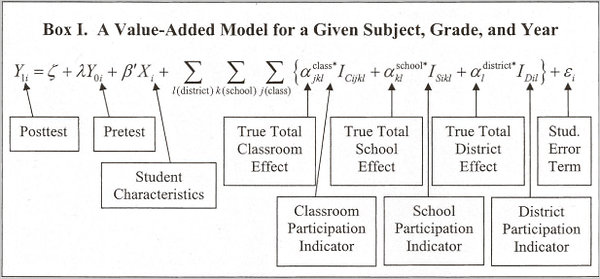
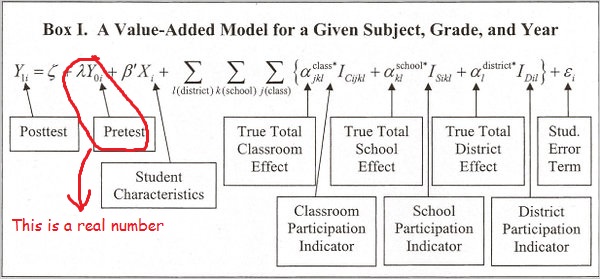
Finally, value added models tend to be incredibly opaque to the people who are evaluated by them.  For example, this is the Value Added Model that New York City used in the 2010-2011 school year:

NYC VAM

This is also the VAM that found teacher Stacey Issacson to be only in the SEVENTH percentile of teachers despite the fact that in her first year of teaching 65 of 66 students in her class scored “proficient” or above on the state examinations, and more than two dozen of her students in her first years of teaching went on to attend New York City’s selective high schools.  Perhaps worse than having a formula spit back such a negative rating was the inability of anyone to actually explain to her what landed her in such a position, and Ms. Issacson, with two Ivy League degrees to her name and the unconditional praise of her principal, could not understand how the model found her so deficient either.  Perhaps I can help.  In this image I have circled the real number that actually exists prior to value added modeling:

NYC VAMreal

And in this image, I circle everything else:

NYC VAMfake

Consider everything that might impact a student’s test performance that has nothing to do with the teacher.  Perhaps he finally got an IEP and is receiving paraprofessional support that improves his scores.  Perhaps there is a family situation that distracts him from school work for a period of time during the year.  Perhaps he is simply having a burst of cognitive growth because children do not grow in straight lines and is ready for this material at this time, or, subsequently, perhaps he had a developmental burst two years ago and is experiencing a perfectly normal regression to the norm.  Value added model advocates pretend that they can account for all of that statistical noise in single student for a single school year, and then they want to fire teachers on those assumptions.  This is what happens when macroeconomists get bored and try to use their methods on individual students’ test scores.

Governor Cuomo assumes that because teachers do not want to be subjected to statistically invalid, career ending, evaluations that they do not want to be evaluated.

2) “competition, which I why I like charter schools”

Charter schools were never supposed to be “competition” for the public school system.  As originally conceived, they would be schools given temporary charters and be relieved of certain regulations so that they could experiment with ways to teach populations of students who were historically difficult to teach in more traditionally organized schools.  In this vision, originally advocated by AFT President  Albert Shanker, charter schools would feed the lessons they learned back to the traditional school system in a mutually beneficial way.  Governor Cuomo’s idea is as far from that vision as it is possible to be and still be using the same language.

The Governor apparently thinks that charter schools are there to put pressure on fully public schools, and that the “competition” for students will act like a free marketplace to force improvement on the system.  This is a gospel that has deep roots, going as far back as Milton Friedman in 1955, and gaining intellectual heft for the voucher movement in the 1990s with Chubb and Moe’s 1990 volume, “Politics, Markets and America’s Schools.”  While vouchers have rarely been a popular idea, advocates for competition in public education have transformed charter schools into a parallel system that competes with fully public schools.  This has flaws on several levels.  First, it is an odd kind of marketplace when one provider is relieved of labor rules and various state and federal education regulations and the other is still held fully accountable for them.  Charter schools’ freedom from regulations was meant to allow for innovations that would help traditional schools learn, but instead it has become a “competition” where one competitor is participating in a sack race and the other in a 100 yard dash.  A sack race, by the way, is an entirely fine thing to participate in, but no race is legitimate when everyone isn’t required to follow the same rules.

Second, the presence of the charter sector as currently operated and regulated actively makes district schools worse off.  As Dr. Baker of Rutgers demonstrates, charter schools generally compete for demographic advantages over fully public schools.  They draw from a pool of applicants who are both attuned to the process and willing and/or able to participate in it.  Once students are admitted, many prominent charters, especially ones that get high praise from Governor Cuomo, engage in “substantial cream skimming” that results in their student populations being less poor, having fewer students on IEPs, and needing less instruction in English as a Second Language.  While charter operators deny engaging in these practices, well documented cases are available in the media.  Dr. Baker’s research confirms that when charter schools are able to do this, the district schools in the same community are left with student populations that more heavily concentrate the very populations of children that the charter schools are unwilling to accommodate.  Charter advocates then claim that they are getting “better” results with the “same” kids and protest loudly that they deserve a greater share of the finite resources available for schools, even when the costs of their transportation and building expenses are paid by the districts.

This isn’t just a sack racer versus a sprinter, then — the sprinter has slipped a couple of cinder blocks into his opponents’ sacks.  Teachers don’t mind that other schools may do things differently than they do in their own schools; they mind very much being berated for the results of system-wide neglect of their community schools, and they mind being negatively compared to schools that make their own rules and refuse to serve all children.

3) “Break…a public monopoly”

That we are poised to have a two term governor who describes New York’s public education system as “monopoly” is such a breath taking circumstance, that I am saddened beyond belief.  The common schools movement in this country was conceived of as an exercise in promoting the public good not merely in advancing individuals.  We wanted universal, compulsory, free education to serve the individual by promoting academic and economic merit as well by promoting the habits of mind and character that enrich a person’s experience in life.  We also wanted schools to promote the good of society by preparing individuals for the world of work beyond school and by preparing individuals to be thoughtful participants in our democracy who value civic virtues in addition to their own good.  For nearly two centuries, Americans have thought of public schools as the center of community civic life, something to be valued because it provides bedrock principles of democratic equality, and as our concept of democratic participation has expanded, so has our concept of plurality in schools.  From literacy for former slaves to women’s suffrage to incorporation of immigrants to tearing down White Supremacism and promoting civil rights, to inclusion of those with disabilities, to gender equality, to equal protection for LGBT citizens — our schools have helped us to reconceive our ideas of pluralism in every decade.

Schools have also stood as important symbols of our commitment to common aspects of our society that all have access to regardless of race, gender, or economic advantage.  There was a time in our nation’s history when we were dedicated not merely to building economic infrastructure, but also to building community, cultural, and natural infrastructure.  There are libraries, parks, museums, and publicly supported arts across our country that are testament to the belief that the world of knowledge, natural beauty, and the arts cannot be the sole province of the wealthy.  Public schools are part of that commitment, but to call them a “monopoly” reveals a mindset disregarding that heritage and which rejects it as a commitment to the future.  Does Governor Cuomo drive the New York Throughway and see a “public monopoly”?  Does he enter the Metropolitan Museum of Art in New York City whose entry fee is a suggested donation and see a “public monopoly”?  Does he want to “break up” the Franklin D. Roosevelt  and Watkins Glen State Parks?

What Governor Cuomo appears to believe is that education exists solely for the social mobility of individuals with no regard for the public purposes of education.  David Labaree of Stanford University posited in this 1997 essay, that the historic balance of purposes in education was already out of balance with current trends favoring education for individual social mobility far outweighing the public purposes of social efficiency and democratic equality.  Labaree was rightly concerned that if people only see education as the accumulation of credentials that can be turned in for economic advantage then not only will the civic purposes of education be swept aside, but also that the effort to accumulate the most valuable credentials for the least effort will diminish actual learning.  Governor Cuomo’s depiction of schools as a “public monopoly” only makes sense if he is mostly concerned with how education “consumers” accumulate valued goods from school, but discounts the essential services schools provide to our democracy.  It is an impoverished view that relegates school to just another mechanism to sort people in and out of economic advantage.

Governor Andrew Cuomo may not only be at war with teachers.  He may be at war with the very concept of public education.  If he does indeed win a second term on Tuesday, he must be opposed at every step of his distorted and dangerous ideas about our public schools.

11 Comments

Filed under charter schools, politics, schools, Social Justice, teaching, Testing, Unions, VAMs

New York Gubernatorial Election 2014 – When The Other Guy Winning Isn’t The Worst Thing I Can Think Of

Barring some titanic shift in the likely voting population in the next 15 days, Governor Andrew Cuomo will be reelected to a second term in office.  Governor Cuomo leads his Republican challenger, Rob Astorino, by an average of 54% to 30% with Green Party candidate Howie Hawkins hovering below 10%.  This polling is not recent as races that have already been called do not get constant polling, but barring all undecideds breaking for Mr. Astorino and a significant portion of Hawkins and Cuomo voters “defecting” for the Republican, Mr. Cuomo is all but guaranteed reelection.

This is a galling situation for a governor who has campaigned in a manner that has utterly disdained political engagement with the public and with his rivals.  Despite having raised a $40 million campaign war chest, Mr. Cuomo has barely campaigned at all.  His choice to all but ignore challenger Zephyr Teachout, the Fordham Law School professor and expert on corruption, did not merely mean he refrained from any debates, but also he physically ignored her presence from less than four feet away:

Erica Orden of The Wall Street Journal asked Governor Cuomo if he had spoken with Ms. Teachout at the parade:

Governor Cuomo defeated Ms. Teachout in the primary, but she made a surprising showing of 35% with Democratic primary voters despite having less than $250,000 and practically no name recognition among voters.  One might have hoped that Governor Cuomo would take a surprisingly strong challenge as a message that voters want him to be more accountable, but the Governor’s dismissive attitude towards engaging in public discussion of his record in unscripted formats remains.  He has agreed to but one debate before the election, and he will have no debate where he and Mr. Astorino have the stage by themselves.  This means that voters will go to the polls in November never having seen the Governor debate a main challenger, either in the primary or the general election, one on one.  Voters in New York are more likely to see Andrew Cuomo promoting his new autobiography than they are likely to see him take the podium to discuss election issues with his rivals.

In addition to this being a shameful and arrogant slap to the role of voters in evaluating candidates for high office, Mr. Cuomo has quite a lot that he should have to answer before audiences of voters and the media.  In 2013, the Governor created the Moreland Commission to independently investigate corruption in Albany, supposedly making good on his promise to tackle the “deficit of trust” that existed between the government and the people of New York.  After less than a year of continuous interference from the Governor’s office whenever the commission got too close to his allies,  Governor Cuomo abruptly disbanded the commission.  Moreland’s birth announcement promised New Yorkers that “Anything they want to look at, they can look at — me, the lieutenant governor, the attorney general, the comptroller, any senator, any assemblyman.”  Governor Cuomo stated upon disbanding the commission that “It’s my commission. I can’t ‘interfere’ with it, because it’s mine. It is controlled by me.”  Despite the incredibly corrupt manner in which the Governor’s office interfered with a supposedly independent investigation into corruption, the New York electorate, while broadly accepting that it was wrong, has barely budged in its voting intentions based on the controversy.

This is tragic for New York, not only because it all but assures that Governor Cuomo can glide to reelection, but also because it indicates that voters are unwilling to factor such blatant corruption into our voting calculus.  Political scientists Dr. Martin Gilens of Princeton and Dr. Benjamin Page of Northwestern recently published a study indicating that the American political system does not fully reflect that of a democracy.  Instead they note that an elite cadre of economically powerful individuals and institutions wield the fruits of increasing income inequality to leverage policy regardless of the will of the general voting public. The New York Times’ current magazine issue has a lengthy  exposé on how billionaires, on both sides of the political divide, are wielding their financial power to become “their own political parties.”  The power of such influence on policy is supremely evident in Governor Cuomo’s tenure, especially in his taxation and education policies.

For example, Governor Cuomo does not merely support charter schools in New York. When New York City Mayor Bill de Blasio sought to reign in their expansion after years of rubber stamp approval from Mayor Michael Bloomberg, Governor Cuomo not only voiced his support, but also he played a direct role in orchestrating an Albany rally on the same day that Mayor de Blasio was seeking support for his efforts to make universal pre-kindergarten happen in the city.  The Governor then went on and negotiated a state budget that specifically forbids the city from charging charter schools rent.  While New York voters are not opposed to charter schools overall, it is important to note two largely hidden facts in this debate.  The first is that the charter sector which got such direct support from the governor still enrolls only a small portion of New York State and New York City students.  New York City’s approximately 83,200 charter school students represent less than 8% of all New York City public school students,  and given the sector’s penchant for winnowing out students who might be more difficult to teach or whose disabilities might lead to lower test scores, there is a built in limit even to their willingness to serve all students, no matter how much they cover themselves in grandiose promises.

Second, the Governor’s direct hand in engineering both the rally and state budget was not precisely random or driven by pure policy.  There was money, a lot of it, at issue.  As of January, 2014, supporters of Eva Moskowitz’s Success Academy chain alone, had donated over $400,000 to Governor Cuomo’s campaign, and Ms. Moskowitz’s own PAC had sent him $65,000.  In recent years, Wall Street money has been pouring into the charter school sector, and it has done so in no small part because money managers have figured how to use the tax code to turn charter school investments into a reliable stream of guaranteed money.  Beyond just the charter school segment, venture firms generally see America’s 750 billion a year expenditures on public education as the last public “honey pot” that they can try to monetize for private purposes.

So New Yorkers, there is your Governor: taking 100s of 1000s of dollars from the supporters of just ONE charter school chain, and jury rigging the state budget so that its investors can continue to secure more public money into entirely private hands.  And he has done this while simultaneously choking school districts across the state of critical state aid to the tune of $3-4 billion a YEAR in New York City alone.  This is the man we are poised to send back to the Governor’s Mansion for another 4 years.  No wonder students from Middletown High School in Orange County produced the following video:

https://www.youtube.com/watch?v=7CKOJ6PzgCI

Typical political wisdom at this point sighs, shrugs its shoulders, and laments that the “other guy” is even worse just before it either stays home and doesn’t vote or holds its nose to pull the lever for the incumbent.  In this case, the most viable “other guy” is Westchester County Executive Rob Astorino.  New York Republicans have done a better job in selecting a candidate than they did in 2010 when they picked the entirely appalling Carl Paladino, but there are still substantive areas where Mr. Astorino is an unacceptable choice.  Mr. Astorino opposes abortion rights and gay marriage, despite his campaign assuring voters that he will not pursue substantive changes to existing state law.  Mr. Astorino has promised to withdraw New York from the Common Core State Standards and reduce the use of standardized tests for teacher and student evaluations if elected, but his education plan also calls for vouchers that can be used to send students to private or charter schools, which does nothing to slow down the transfer of public education money into private hands.

On the other hand, I cannot say that Albany with a Governor Astorino would be that much worse than one under a reelected Governor Cuomo.  Mr. Astorino is likely correct that he could do little in Albany to chip away at social issues where he is out of touch with New York voters, although that is not to say that he could do nothing at all.  It is also true that Governor Cuomo’s socially progressive accomplishments, while actually substantive, are not precisely areas where he took political risks. In 2011, New York support for same sex marriage was comfortably above 50% while opposition hovered around 35%.  Accomplishing same sex marriage in New York was a major victory for marriage equality, but the Governor did not risk his standing with voters to make it happen.  It worth noting that despite governing a state with a 27%  Democratic Party advantage in the electorate, the most progressive thing that Governor Cuomo has accomplished beyond marriage equality is hurting Sean Hannity’s feelings.

An Astorino victory could have two very positive outcomes.  First, it would signal to politicians seeking the Democratic nomination in races that they ignore liberal voters and kowtow to the entrenched money system that plagues our body politic at their peril.  As a liberal Democrat, I can tolerate elected officials more centrist than I am, but I cannot tolerate politicians who sell out the public good at the behest of billionaire donors with little regard for our state and national Commons.  Second, an Astorino victory could possibly embolden Democrats in Albany to do more than lay prostrate at the feet of the Governor’s office.  Andrew Cuomo is no doubt a brilliant political operator even if he is without his father’s rhetorical gifts.  What he has in abundance, however, is a willingness to threaten and place statewide Democrats in fear of angering him.  Is it possible that Assembly Democrats might see a Republican governor as an opportunity to advocate for their constituents instead of meekly to line up in fear of a governor who controls their party’s apparatus?  Possibly.  Is it likely?  I have no idea, but the exercise is worth considering.

With all of that said, will I pull the lever for Rob Astorino?  No, I will not.  If the Republican were within actual striking distance of Andrew Cuomo, I might consider the possibility of voting strategically, but since he is not, I intend to vote for the candidate who most represents my values, Green Party nominee Howie Hawkins.  It is possible that this makes me a part of the problem since my disdain for Governor Cuomo’s corruption will not lead me to vote for his most viable opponent in this race.  However, there are alternative fixes that need to be considered in future election cycles.

Money is buying policy.  There can be no doubt about that, but the officials who are bought when it comes to policy still have to stand for elections, and money does not always win at the polls.  Our corrupted government could be subjected to a slow and steady cleansing if politicians who consistently let themselves be bribed for the purpose of making policy were faced with robust and moderately financed challenges that more closely represent the wills of the voters.  Zephyr Teachout, with practically no campaign financing, an opponent and media that ignored her, and little name recognition, garnered 35% of the primary vote.  Imagine what a campaign with more time and even modestly raised financing from small donors (or – gasp! – fully public campaign funding) could have accomplished, but also it would take an electorate that is finally incensed about the state’s government swimming in what amount to endless bribes.

Further, labor unions, especially teacher’s unions, should take a much more principled stand in endorsements for candidates, especially on issues that directly effect teachers, schools, and students.  Playing along to have a seat at the table is no longer viable, and the New York State United Teachers union demonstrated this in the summer by refusing to endorse Andrew Cuomo for reelection.  It would have been better to have endorsed Zephyr Teachout, but this was a step in the right direction.  However, it needs to go further.  Unfortunately, the Connecticut Education Association has offered endorsement and campaign literature in support of Democratic Governor Dannel Malloy, whose education policies have been a reflection of Andrew Cuomo’s, even seeking to change the state school aid formula in a way that would cut state funding from districts like Hartford and New Haven.  Although Chicago Teachers Union President Karen Lewis has announced that she will not run against incumbent Mayor Rahm Emanuel as she recovers from cancer,  Mayor Emanuel only has a quarter of Chicagoans on his side on school issues, and he should face a robust challenge for the office. It is past time for unions to worry less about access to corrupted politicians and to help elect politicians who will put children and their teachers and schools ahead of the interests of billionaire profiteers.

It is at this point that some anti-union activists will scoff at the idea of cleaning up the corruption of money in politics with the assistance of unions.  After all, unions do spend money, often a lot of it, on political races, and unions collect large sums of cash from the dues of their memberships.  While true, this misses several important distinctions between union influence on politics and that of entirely private individuals.  Unions have monetary resources at their disposal, but they also have operating expenses, sometimes on behalf of memberships that number from the 1000s to the 100s of 1000s to the millions.  All of their cash cannot in practice flow into politics, while the personal wealth of a Michael Bloomberg or a David Koch stays in his bank account until it is donated.  Second, despite attempts to portray the situation otherwise, union political spending is being dwarfed by the flood of money from so-called “dark money” sources, and you have to ignore that spending to place unions at the top.  Unions regulated by the NLRB have to disclose all of their outside payments, but no such requirements exist for shell organizations set up to funnel undisclosed money into the system.  Regardless, Koch brother money alone in 2012 spent on PAC, individual candidates, and outside groups is estimated at over $400 million, which outstrips the top ten labor unions combined.  And that only reports money spent through foundations and nonprofits.  If recent patterns in spending are replicated this year, the 2014 election cycle may potentially reach as much as just under $1 BILLION in dark money.

To be sure, a reformed political system that brings the corruption of spending to bay will take a toll on union spending, but for the sake of their members and the students that they serve, the AFT and NEA must send notice that they will no longer trade a seat at the table for politicians who insist on trading their campaign contributions for sending billions of dollars of public education money into the hands of profiteers.

If voters listened, we might gain some of our democracy back — and our public education as well.


5 Comments

Filed under charter schools, Common Core, Funding, Media, politics, Unions

Success Academy’s Incredible Hypocrisy

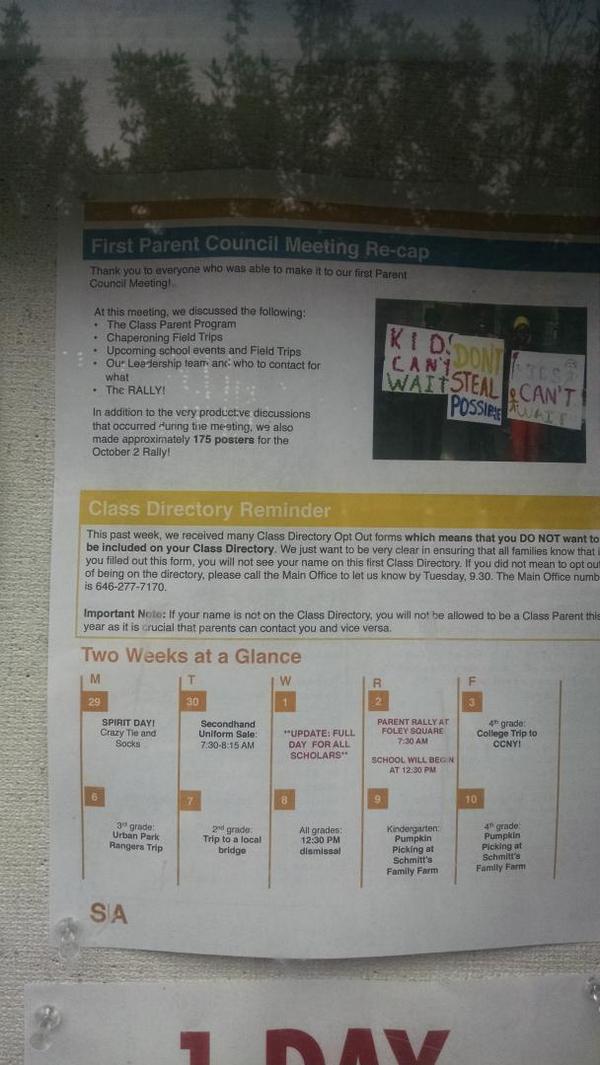
Eva Moskowitz wants to continue to expand her Success Academy chain of “no excuses” charter schools, but is concerned that New York Mayor Bill de Blasio will not automatically and enthusiastically endorse her plans as was customary under Mayor Michael Bloomberg.  Following the model of her successful Albany rally last Spring that led to a state budget forcing New York City to pay rent for all charter schools, charter enthusiasts plan a rally for Thursday, October 2nd in Foley Square at 9am which they are dubbing “Don’t Steal Possible”.  I have seen organizers on social media promise as many as 10,000 attendees, many of whom I presume will be Success Academy teachers and students who, like the weekday rally in Albany, will be given time off from a scheduled school day to provide appropriate optics for the event.

“Don’t Steal Possible” refers to network supporters claiming that they are pleading with the de Blasio administration to not “steal” opportunities from NYC’s most struggling students who want to attend a charter school, especially a Success Academy charter school, where their success is “possible.”  Supporters have taken to Twitter with #DontStealPossible (as have detractors)  and both individuals and organizations, including Ms. Moskowitz herself, have repeated similar talking points about how their mission is driven for NYC kids “trapped” in failing schools:

https://twitter.com/CorbieNest/status/517188041426096128

The 143,000 kids that they repeatedly mention refers to a “report” from charter school advocacy group “Families for Excellent Schools” that cited 371 DOE schools where student performance on the 2013 state examinations did not pass 10% being labeled as proficient.  The purpose of the rally and of Ms. Moskowitz’s expansion plans is to offer “possible” to all of those students so that they can “escape” from their failed schools.

They really have some nerve.

There are many things galling about using the students at 371 New York City schools that serve mostly impoverished minority families as optics for a plan to expand the Success Academy chain, often into neighborhoods that are not strugglingFirst, the article in the Daily News misrepresents the results of those state examinations, probably willfully.  These were the first examinations to align with the new Common Core standards, and they caused an extreme collapse of scores across the entire state.  Further, the examinations are not pegged to grade level skills in reading and mathematics. Period.  End of discussion.  “Proficient” in the new examinations is not a synonym for “grade level,” and anyone who mixes up those terms is misinformed or a liar.  Carol Burris, Principal at South Side High School, explains very clearly how the cut scores were set:

State Education Commissioner John King asked the College Board to “replicate research” to determine what PSAT and SAT scores predict first-year success in four-year colleges. The College Board was asked to correlate SAT scores with college grades to create probabilities of college success. You can read the report here.

Keep in mind that research shows that the SAT’s predictive power is only 22 percent. High school grades are a far better predictor of college success. The lack of validity of scores, without the context of grades, was not taken into consideration.

The New York study chose the following “probabilities” as the definition of college success:

* English Language Arts:  a 75 percent probability of obtaining a B- or better in a first-year college English course in a four-year college.

* Math: a 60 percent  probability of obtaining a C+ or better in a first-year math course in a four-year college….

….When the cut scores were set, the overall proficiency rate was 31 percent–close to the commissioner’s prediction.  The proportion of test takers who score 1630 on the SAT is 32 percent.  Coincidence?  Bet your sleeveless pineapple it’s not. Heck, the way I see it, the kids did not even need to show up for the test.

Argue, if you must, that the new proficiency standard is the appropriate way to set up how the exams are assessed.  But don’t call it “grade level” or “passing.”  They are neither of those things, nor were they designed to be those things.

Second, Ms. Moskowitz and her supporters are pleading, they say, on behalf of those “143,000 kids,” but there is no evidence from the work of her school network so far that Ms. Moskowitz would accommodate anywhere near all of those students even if her schools had enough seats.  First off, a lottery system, while in theory neutral, already skims from a student population by requiring parents and guardians who are informed enough about the system to actually apply in the first place.  Further, once students enroll in the Success Academy network, they are subject to attrition rates and rates of discipline that far outstrip the comparable DOE schools.  Success Academy 1 had an attrition rate greater than 50% since its opening school year in 2006-2007, and the network sends clear messages to parents that they do not want struggling kids in their schools.  The result, as demonstrated by Bruce Baker of Rutgers, is that Success Academies enroll far fewer students who are coming from high poverty homes, are English language learners, or have special education needs:

slide92

Success Academy wants you to believe that they are rallying so that nobody will “Steal Possible” from the students in New York City’s most struggling public schools, but all the data available about their past and current practices suggests that even if many of those students did win lottery seats in a Success Academy, many of them would be pushed out of the school.  Those children are being used to improve the appeal of Ms. Moskowitz’s expansion plans even though probably none of them will be present at tomorrow’s rally.  After all, they have school to attend, and no NYC principal is allowed to dismiss an entire school’s worth of children to a rally to pressure the mayor and Albany.

Third, if this was really a movement to tell the public and officials to “Don’t Steal Possible,” then one would assume that there would be causes involved that aided all of our city’s children, not just the ones that win charter lottery seats and are then allowed to stay at those charters.  Again from Professor Bruce Baker of Rutgers, Albany has manipulated its base state funding formula in ways that have shorted New York City somewhere between $3-4000 a YEAR per CHILD below previous calculations of state aid.  That amounts to $3-4 BILLION in state aid ANNUALLY that Albany has kept from reaching New York City.  Across the entire state of New York, the Gap Elimination Adjustment has deprived the average school district of $3.1 MILLION annually, and Governor Cuomo aggressively pursued and got a property tax cap so that districts cannot choose to make up the lost money locally.  Consider how much “possible” has absolutely been stolen from public schools in New York City and across the state by these policies, and then ask if Families for Excellent Schools and Success Academy’s wealthy backers in the financial industry will rally to change them.  The answer is, of course they won’t.  Those same donors and Ms. Moskowitz’s own PAC have donated generously to Andrew Cuomo’s campaign.

And this is the hypocrisy.  Ms. Moskowitz is going to excuse her teachers and students from a day of school to rally in alleged support of all of those kids she claims are “trapped” in “failing” DOE schools, and there is no doubt that an unacceptable number of our most vulnerable students are indeed in schools that struggle.  But there is NO evidence that Ms. Moskowitz wants all or even a bare majority of those students in HER schools.  There IS plenty of evidence that the most vulnerable children to reach a Success Academy find it very difficult to remain there, and there is incontrovertible evidence that Ms. Moskowitz and her financial backers support the reelection of a Governor who has choked schools of money for his entire first term in office.

“Don’t Steal Possible”?

Shameless.

UPDATE:  Courtesy of Mindy Rosier, a special education teacher in a co-located school, the Success Academy in her building has changed their normal Wednesday half-day to today, and the school is providing buses that met at 7:30am to take people to Foley Square.  The event is being billed as a “parent rally,” but with school at half day for the event, there is little doubt that many children will be accompanying them:

SA change of calendar SA bus

28 Comments

Filed under charter schools, Funding, politics, Social Justice

The Moral Perversity of Today’s Education “Reform”

The narrative of school failure that fuels today’s reform policies in education stretches back to the 1983 Reagan administration report, “A Nation at Risk.”  That document asserted that our national education system was so woefully inadequate to the task of educating for the future, that if it had been imposed upon us it “might be considered an act of war.”  The dire warnings have hardly abated, and in 2014, we are frequently told that our children and economy are in danger unless we fully embrace the vision of today’s reformers.  Moreover, today’s menu of reform, common standards, mass high stakes testing, value added evaluation of teachers, elimination of or severe curtailing of teachers’ workplace protections, promotion of charter schools and school choice, are frequently promoted by politicians and policy makers as civil rights issues.  Dr. Julian Vasquez Heilig notes:

Student achievement data in the U.S. show long-standing and persistent gaps in minority versus majority performance (Vasquez Heilig & Darling-Hammond, 2008). Public concern about pervasive inequalities in traditional public schools, combined with growing political, parental, and corporate support, has created the expectation that school choice is the solution for poor and minority youth (Vasquez Heilig, Williams, McNeil, & Lee, 2011). As a result, many reformers have framed school choice as a “civil rights” issue. Scott (2013a) argued that philanthropists, policy advocates, and leading pundits have followed Secretary Arne Duncan’s conjuring of Rosa Parks and the broader Civil Rights Movement as synonymous with market-based school choice.

It is notable that the school choice movement counts on prominent African American and Latina/o leaders to support vouchers, charters, parent trigger, and other forms of choice….In our recent Twitter exchange, (former California State Senator Gloria) Romero framed her bill as a civil rights remedy for low-performing schools. Clearly, African American and Latina/o leaders have formed advocacy coalitions to press for school choice as an alternative to the status quo as our nation has consistently and purposefully underserved students of color (Scott, 2011).

In the 21st century, we are exhorted to education reformers’ policy agenda by language invoking the struggles undertaken by some of our most heroic figures, Dr. Martin Luther King, Jr., Rosa Parks, Representative John Lewis, and told that the best way to close the historic education achievement gap between suburban white children and their urban African American and Latino peers is to embrace highly disruptive change.  We are further told that all of our children are still “at risk” because even in the well-off communities of our upper middle class, students are not learning what they need in a global economy.  Without education reform, our impoverished students will remain locked in poverty, and our comfortable students will slide into stagnation.

For the sake of this discussion, let me do something I never do.  Let me assume, momentarily, that the education reformers are correct.  Assume that common standards and aligned mass assessments will create a seamless system of curricula that challenge students meaningfully, and that those standards encompass a strong vision of student accomplishment.  Assume that adoption of the standards and assessments narrow the differences between states and districts so that expectations remain high for all students.  Assume the assessments are well-crafted and valid measures that stand as good proxies for student learning.  Assume value added measures of teacher evaluation are statistically valid and supported by a robust body of research.  Assume that eliminating the job protections of tenure would mean that vast numbers of students would have greater contact with skilled teachers and that there would be no negative consequences to the rest of the teacher workforce.  Assume that the proliferation of charter schools in urban school districts would give vastly more students options to attend a high performing school and that pressures from school choice schemes would increase the quality of zoned schools.  Assume that urban charter schools fully serve all students who arrive at their doors.  Assume that the advocates of “no excuses” charter schools are correct and that they genuinely demonstrate that closing the achievement gap can be accomplished entirely within school through teachers armed with extremely high expectations.

Assume every last bit of that is true.

Then what?

This is a more critical question than many realize because even if the performance gaps in American education closed overnight, we would still need an economy that can accommodate many more and more equitably distributed high performing graduates than we currently have.  Advocates of current reforms certainly seem to be banking on this.  Jonathan Chait of New York Magazine recently wrote that Eva Moskowitz of the Success Academy charter school network should be considered a “hero of American social justice,” and he declared that her schools have “been a staggering triumph of upward mobility.”  That’s quite a claim to make for a chain of schools whose oldest students have just begun high school, and, in fact, it rests almost entirely about the network’s accomplishments in state administered standard examinations.

However, the attractiveness of the claim is fairly obvious.  If we admit that economic injustice and that institutional racism have a detrimental impact upon students in poverty and students of color, then we have to admit that many of the gains made over the decades by students from upper middle class and upper class backgrounds are at least partially attributable to unearned privileges as well as to individual merit.  Further, we would have to engage in a policy discussion that attempts to alleviate the deprivations of poverty and institutional racism rather than to extol individuals to claw their way past such obstacles largely on their own.  The “no excuses” brand of charter schools claims that they have figured out how to lift all of their students to the same level of education and opportunity as students in the suburbs, and their policy allies are hardly shy about singing their virtues, as represented in standardized test scores:

Former New York City School Chancellor Joel Klein does not want to talk about the complicating factors surrounding Success Academy results, nor does he spend time considering how far such results could be replicated. Success Academy fits into a narrative that believes schools and teachers are fully responsible for providing all of the lift out of poverty.

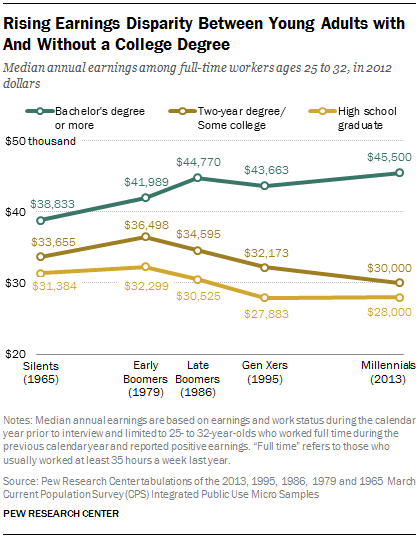
But, as I said, assume that it is possible and that Jonathan Chait’s premature declaration of social mobility comes true.  What awaits these students?  If current trends in economics do not begin to change soon, the answer to that question is not especially hopeful.  While there is still an discernible “college wage premium” for those who earn four year degrees, since the 1980s, a significant portion of that is more attributable to cratering wages among people without degrees than to significant wage growth among those with degrees:

Wage growth and decline by level of education

Wage growth and decline by level of education

While a Millennial with a college degree earns a wage that is $730 more than a late boomer with the same degree, the wage trends for those with either a two year degree and no degree have dropped precipitously since the early 80s compared with decades of modest but steady growth before.  A college degree may be necessary for a middle class career today, but more and more, it looks as if the degree is more a means to keep from falling into chronic income insecurity rather than as a genuine means of economic advancement.

If the middle class is increasingly a tenuous position in the American economy, it is even worse for the lower middle class, an economic stratum that has traditionally helped families transition from working class to more economically secure circumstances.  According the The Hamilton Project at the Brookings Institution, nearly half of American families live at 250 percent of the federal poverty level (FPL) or below, and 30 percent live between 100 percent and 250 percent of the FPL.  Unlike families below the poverty level, such lower middle class households are equally likely to be headed by a married couple or a single parent, and nearly half have a head of household who has attended at least some college.  The report on their economic struggles notes that, despite living above the poverty line, large percentages of these families rely upon a number of tax and transfer benefits such as SNAP and the Earned Income Tax Credit to remain above the FPL.  Indeed, without many of these programs, the number of families that would slip from an unsecured lower middle class to simple poverty is significant.  As a transition point from poverty to a more secure middle class, the lower middle class is faltering badly.

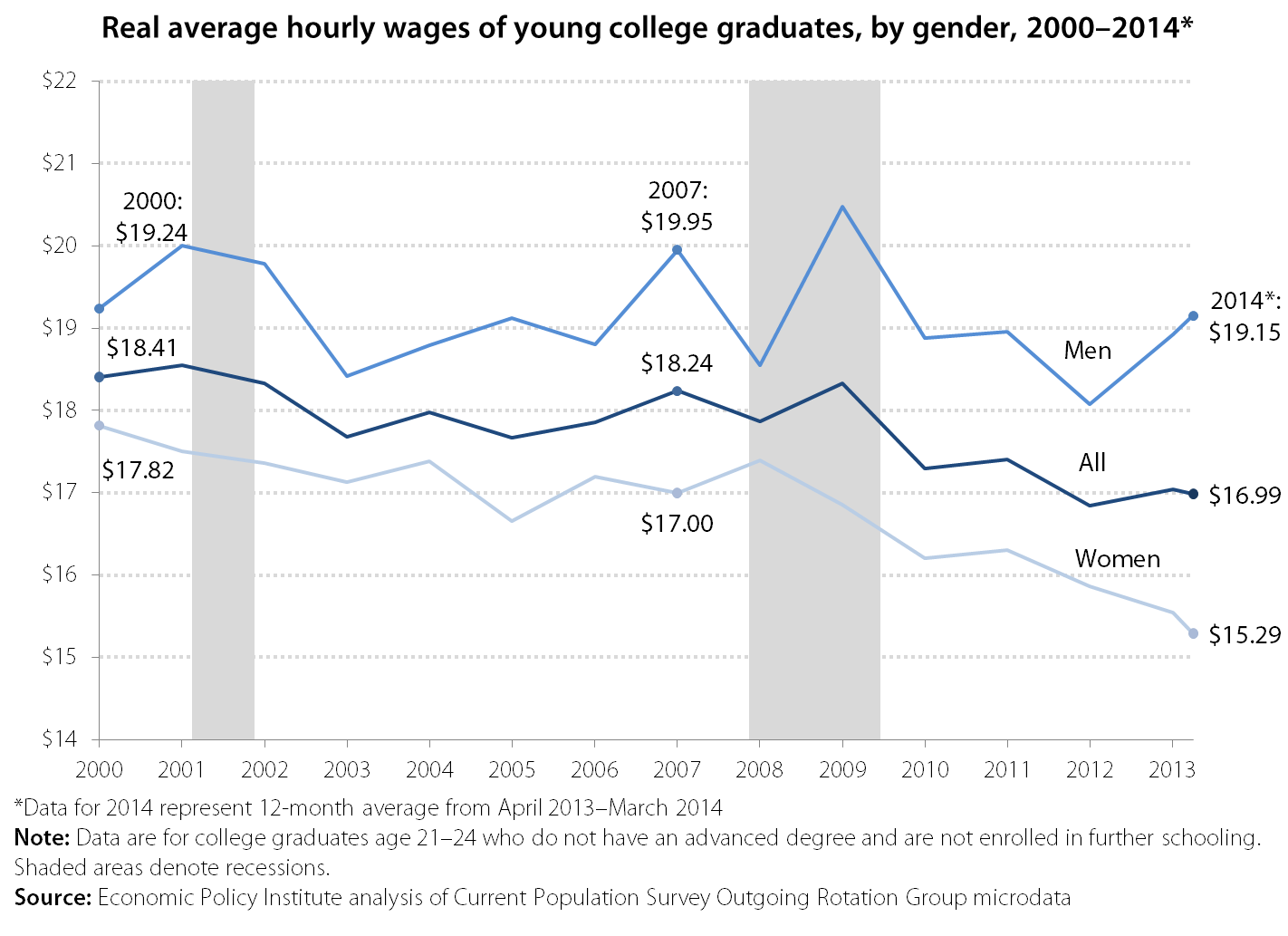
And where is the evidence that the economy is desperate for more workers with bachelors degrees?  It certainly is not in the wages earned by recent college graduates.  According to the Economic Policy Institute, wage growth adjusted for inflation has been nonexistent since 2000, and the downward trend has continued even as the economy has recovered from the Great Recession:

Wages for Recent College Graduates

Wages for Recent College Graduates

If college graduates were in short supply, basic labor economics dictates that businesses competing for them would have to offer higher wages, but even in the vaunted STEM fields, wages, while higher overall than in non-STEM fields, have not grown significantly for most of the 21st century.

Reality suggests that even if all education reform assumptions were true, graduates of a “properly reformed” school system would still graduate into an economy that is not equipped to lift them from poverty and that is barely equipped to maintain those in the middle class where they currently reside.  The recently published study by Karl Alexander of The Johns Hopkins University, The Long Shadow, illustrates just how complex and potentially unsuccessful the rise from poverty can be.  Out of 800 children studied from first grade to their late twenties, only 33 moved from the low income to the high income bracket.  While a good education is certainly a PART of a pathway out of poverty, it is by no means the ONLY way out, and with more and more workers in the economy struggling to keep pace, it is perverse to suggest that we bestow upon schools the sole responsibility for lifting children from poverty.

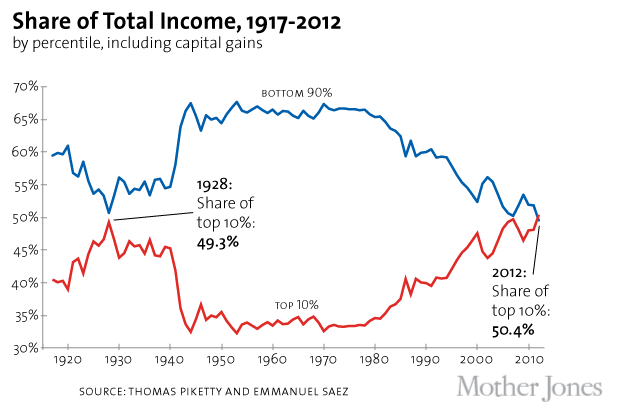
And yet that is exactly what is implicit and even explicit in reformers’ policy objectives and rhetoric.  When Jonathan Chait calls Success Academy a “triumph of upward mobility” he is expressly saying that equalizing standardized test scores through Moskowitz’s “no excuses” methodology will effectively raise the children in her schools to economic security.  But even if everything he says about her accomplishments is true, we cannot blithely assume that this academic accomplishment translates into mobility when the economy shows no indications of providing the kind of reward for work that would translate academic standing into economic standing.  Eva Moskowitz’s scholars still face a world where this trend shows no signs of abating:

Share of Total Income

And, of course, we know that we cannot grant the reformers that their agenda will work because much of it simply will not or is built upon faulty and deceptive claims.  Common standards are being implemented in 45 states simultaneously with virtually no field examination of whether or not they improved instruction at the classroom, school or district levels.  Evaluating teachers based on Value Added Models is problematic at best, statistically invalid at worse. There is scant to no evidence that the elimination of teacher tenure is going to significantly improve the teaching in urban schools, and, in fact, the states with the weakest teacher job protections tend to be states that perform very poorly on national assessments. Success Academy, despite claiming to teach similar high need populations as NYC district schools, has a very high attrition rate, and they do not replace students who leave.  This is a trait shared with many other “no excuses” charter schools who eventually have student populations with many fewer disabled students, English language learners and students on free and reduced lunch than their district counterparts.  They combine the selective attrition of the most difficult to teach students with an extreme emphasis on discipline for even minor infractions of the rules and, at Success Academy and elsewhere, a curriculum aimed at test preparation.  While there is little evidence yet that such test performance training will result in long term economic success, there is evidence that charter school expansion can make segregation actually worse.

And this is where reform advocacy devolves from being merely wrong-headed and into territory that is dangerously close to immoral.  America has one of the highest child poverty rates in the developed world.  It is well established that poverty and its deprivations have serious, often lifelong, impact on people in health, education and economic outcomes.  While improving educational opportunity for children in poverty is a necessary component of expanding opportunity, left to its own, education reform, ANY education reform, cannot make significant dents into the roadblocks that stand before our nation’s poor.  We do not have an economy where the lower middle class can survive on the wages offered for their work.  We do not have an economy where 90% of the wage earners possess more than 49 percent of the total income in the country, and we do not have an economy where the often expressed need for college educated workers has led to growth in income earned by college graduates.

Worse, we have accepted no society wide responsibility to address child poverty in any meaningful way that would lift more children into the economic circumstances more highly correlated with school success than any other factor.  In fact, as a society, we have responded to current economic circumstances with demands to cut discretionary programs in ways that can directly harm children, deepening the already woeful health, education and economic outcomes for children in poverty.  Matt Bruenig of Demos, estimates that with an investment of 1% of GDP in a straight transfer program, child poverty could be cut by 50 percent, almost instantly.  He further points out that our 24 percent of GDP taxation level is among the lowest in the developed world, and it is hard to argue that there is no room for an extra percentage point of GDP.

But there is no political will to discuss this or other direct approaches to lifting people out of poverty in our government.  More accurately, there is no willingness for the major political donors who effectively leverage significant portions of policy in America to do anything that changes either the economy or their taxation levels.  There is, however, significant interest in bypassing those discussions and placing all of the responsibility to both transforming our economy and for lifting disadvantaged children from poverty upon teachers and school.

It fits the meritocracy narrative, and it may tug at our cultural bias towards individualism in the face of daunting odds.

But it is immoral.

6 Comments

Filed under charter schools, Funding, politics, Social Justice

If You Don’t Know What is Happening in Newark, You Should

Newark Public Schools began the school year under the “One Newark” program imposed upon the city by Trenton appointed Superintendent Cami Anderson.  The plan, which is the fruition of the partnership between Governor Chris Christie and former Mayor and current U.S. Senator Cory Booker, essentially speeds up the process by which neighborhood schools are labeled failures and turned over to charter school management and, in theory, opens up the entire city to a school choice plan potentially sending students all across the city in search of schools.  Community concern, parent, student and teacher, has been brushed aside, and the plan has been put into operation this school year.

Bob Braun, retired education reporter for the New Jersey Star Ledger has extensively covered the plan’s roll out on his blog, Bob Braun’s Ledger, and it is safe to say that he characterizes it more as a roll OVER of the entire community.  Schools were slated to close even when succeeding by every reasonable metricAnderson stopped attending monthly public meetings where she was hearing the public’s anger and confusion.  Even Secretary of Education Arne Duncan has expressed concern that Anderson’s plans are being rushed to implementation too quickly.  During the summer months, it was clear that Anderson had no operable plans for the transportation logistics problems caused by potentially busing students from the same families across the city to entirely different schools.  The lack of planning or even of care to plan was further evident this summer, when parents, taking off much needed work hours to participate in a school assignment process, were left waiting for hours in sweltering heat only to be told they would have to return another day.  Mind you, this wasn’t to enroll in an assigned school — it was just to get an assignment at all.  Mr. Braun reported one of just many heart-breaking stories entirely born of the cruelty being imposed upon Newark:

All the parents had stories to tell about the cruelty inflicted by the Anderson/Christie regime on the often poor and predominantly black and Hispanic residents of Newark. Typical was the story told by Marisol Mendez who came to the “One Newark” registration day to find placements for her 14-year-old son, Carlos Perez, and 9-year-old daughter, Emily Perez. The family lives in the North Ward and the children attended Abington Avenue but, when they applied under Anderson’s “One Newark” plan, Carlos, a special education student, they were  assigned to West Side High School and Emily was sent to a South Ward school.

“The placements were inappropriate for both of the children,” says Mendez. “My daughter is not going to take NJ Transit across town and my son needs a self-contained, special education class. He has had one all of his school career.”

Mendez tried to get answers from both the NPS administration and from charter schools. But, she says, two charter school operators–Newark Prep and K-12–told her they couldn’t take special education students. When she tried to speak to bureaucrats downtown, she received this shocking answer:

“They told me I should home-school my children.”

Anderson was upbeat on opening day, despite numerous reports of buses wandering the streets trying to find the students they were supposed to pick up.  But this week, the Newark Students Union tried to prove a point: that even in a politically disenfranchised community like Newark, people love their schools and will use whatever voice they can to make themselves heard.  On September 9th and 10th, students took part in direct action to protest what has been imposed upon them from outside political and economic alliances that see their entire school system as a worthy “experiment” at “creative destruction”.  With threats of citywide boycotts no longer supported by adult-led institutions such as the teachers’ union and the city clergy, these teens decided they had to be on the vanguard of demanding that Newark be heard: as reported by WABC News in New York City.  The student activists protested a second day by blockading the street near Anderson’s office as reported by WNBC the following day.  That protest culminated when police moved in to unchain the protesters, injuring the group’s leader, Kristin Towkaniuk.  Time will tell what will become in Newark, but despite their setbacks, it was genuinely inspiring to see students standing up when few adults are willing to do so.

And we all might have to get used to it.  I hope that I am wrong, but I have a terrible feeling that what is happening in Newark will shortly become the norm in American urban education.  Those schools have been treated to over 31 years of a relentless narrative of failure that has set them up for this kind of externally imposed disruption, and large portions of their populations are alienated constituencies in the body politic who certainly cannot muster the kind of money that drives policy today.

What worries me is that the growing backlash against the common standards, associated testing and use of testing to label students, teachers and schools as “failures” ripe for reorganization and take over is one with teeth because it has been pushed into our politically empowered communities, ones under no threat of state take over and loss of local control.  Peter Greene, a teacher and blogger, wrote about how at least one enthusiastic advocate of current reform trends, Michael Petrilli of the Fordham Institute, appears to be grasping this problem.  The gist is that Mr. Petrilli is now concerned that he and his fellow reform enthusiasts have mistakenly pushed their entire reform package into communities that have always thought highly of their schools, get the outcomes that they wish from those schools, have no easily identified need for drastic changes — plus they vote.  Some of them are even affiliated with powerful corporations who can provide the kind of monetary largesse that gets the attention of policy makers.

I could have told him this years ago if he had asked.  While a super majority of Americans think our schools are doing a mediocre job at best, a similar super majority of parents approve of the schools their children attend, and the Race To The Top package of reforms have taken the failure narrative from urban parents long used to it and pushed it out to the suburbs, whose parents are getting pissed at it.  Petrilli is even willing to admit that most high poverty schools are not failing so much as they are “no better and no worse” than average suburban schools.  However, he then pivots that such schools cannot “settle” for average and arrives at his conclusion that “no excuses” charter schools are the “best” suited for the job of propelling high poverty student populations to match students in affluent communities.

And this is why we can expect Newark to be replicated across the country if we don’t speak up even from the comfortable position of middle class school patrons.  I think Petrilli is correct when he diagnoses the reasons for growing push back against Common Core, testing and school failure.  Reformers have pushed so hard so quickly that they have challenged the politically empowered constituencies that policy setters need in order to stay in office. They certainly cannot charterize school districts where well-off families paid top dollar for homes in a neighborhood specifically because of the neighborhood schools.

But the efforts to turn over more public schools to charter management organizations will not give up easily.  If you have any doubt about that, recall that Wall Street donations pushed over 3 million dollars into the campaign of Shavar Jeffries for Newark mayor because his opponent, now-Mayor Ras Baraka opposed One Newark and its plans to turn over many more Newark schools to charters.  This is in a city where the mayor and school board have no real power over the schools.  There are well-financed and influential operations that want One Newark to become a model for urban education.

If that happens, we will have missed an opportunity.  If suburban parents manage to push back the disruption of current reforms from their communities, only to stand back and allow it to be imposed, full force, on communities without political power, it will be yet one more anti-democratic burden layered upon the backs of these communities.  It will be yet another case where we have abandoned children living in poverty as someone else’s problem, favoring the “easy” answers promised by education “reform” instead of the hard work of re-imagining a society without institutional racism and an economy where genuine opportunity flows upward.

We cannot afford to keep ignoring that.

6 Comments

Filed under Activism, Cami Anderson, charter schools, Chris Christie, Common Core, Cory Booker, Newark, One Newark, politics, schools, Social Justice

New York Times Ignored Teacher Input on Eva Moskowitz

The September 7th New York Times Magazine ran a story by Daniel Bergner called “The Battle for New York Schools: Eva Moskowitz vs. Mayor Bill de Blasio”.  Bergner’s piece reads as an astonishing piece of hagiography to appear in the paper of record, ignoring any substantive argument about Ms. Moskowitz’s schools and repeating without critique her organization’s point of view.  Mr. Bergner did make note that he had spoken to critics of Ms. Moskowitz’s approach, notably Dr. Diane Ravitch of New York University whose input he represents thusly:

When I talked with her, Ravitch indicted the hedge-fund titans and business moguls — including Kenneth Langone, a founder of Home Depot, and the Walton family of Walmart — who put their weight behind promising charter schools, leading their boards and lending political clout. “When they call themselves reformers,” she says, “it’s something I gag on.” What these philanthropists are all about, Ravitch says, is making themselves feel good while using charters as a halfway step in a covert effort to pull the country toward the privatization of education. For charter opponents, liberalism is in jeopardy. And from this perspective, Moskowitz, with her results and her readiness to trumpet them, poses the greatest risk.

Knowing something of Dr. Ravitch’s criticisms of charters schools generally and of Ms. Moskowitz specifically, this struck me as an odd and likely incomplete representation of her input.  Sure enough, several days after publication, Dr. Ravitch responded in her own blog at some length. According to Dr. Ravitch, her conversation with Mr. Bergner was not represented in the published article:

I spent a lot of time on the phone with the author, Daniel Bergner. When he asked why I was critical of Moskowitz, I said that what she does to get high test scores is not a model for public education or even for other charters. The high scores of her students is due to intensive test prep and attrition. She gets her initial group of students by holding a lottery, which in itself is a selection process because the least functional families don’t apply. She enrolls small proportions of students with disabilities and English language learners as compared to the neighborhood public school. And as time goes by, many students leave.

The only Success Academy school that has fully grown to grades 3-8 tested 116 3rd graders but only 32 8th graders. Three other Success Academy schools have grown to 6th grade. One tested 121 3rd graders but only 55 6th graders, another 106 3rd graders but only 68 6th graders, and the last 83 3rd graders but only 54 6th graders. Why the shrinking student body? When students left the school, they were not replaced by other incoming students. When the eighth grade students who scored well on the state test took the admissions test for the specialized high schools like Stuyvesant and Bronx Science, not one of them passed the test.

She goes on to note that in addition to the phenomenon of selective attrition, she also discussed high rates of teacher attrition at network schools, but that Mr. Bergner argued with her instead of interviewing her.  Dr. Ravitch also notes that Mr. Bergner used different language than she did when discussing the issues with him, and all of her points about selective attrition were either ignored or glossed over with talking points that reflect Success Academy’s standard public statements.

While Dr. Ravitch has a platform to illuminate the distressing puffery that made it to the New York Times magazine posing as a multi-sided examination of a contentious public issue, a reader would be hard pressed to know that Mr. Bergner actually spoke to public school teachers who work in fully public schools that are co-located with Success Academy schools.  The sole hint of input is presented here:

That attitude (Moskowitz’s)  infuriates many teachers at regular schools. When I spoke with a handful, they used words like “metastasize” and “venal” to describe Success Academy’s proliferation. That Moskowitz’s wealthy board members choose to highly reward her track record — her salary and bonus for the 2012-13 school year totaled $567,500 — only adds to the union’s fury.

What is astonishing about that brief mention focused entirely upon a few potential epithets and alleged jealousy of Ms. Moskowitz’s salray is that Mr. Bergner DID speak with teachers who work in co-locations with Success Academy schools.  In fact, he spoke at length and clearly decided to disregard their input almost entirely. I am fortunate to know one of those teachers through local teacher advocacy groups, and she agreed to inform me about her discussions with Mr. Bergner and to share what it is like to be a teacher at a school where Ms. Moskowitz has claimed classroom space for her students.  Her name is Ms. Mindy Rosier, and she is a teacher at P.S. 811, the Mickey Mantle School, a special needs school within P.S. 149 in District 75.  They have been co-located with Success Academy since 2006, and this Spring, she and her colleagues found themselves in the center of the storm when Mayor de Blasio decided to not allow three previously agreed upon co-locations for Success Academy expansions.  The resulting highly public battle resulted in a 6 million dollar ad campaign accusing the mayor of throwing Success Academy students out of their schools, all funded by Ms. Moskowitz’s Wall Street supporters, and it culminated in Governor Andrew Cuomo helping coordinate a pro-Moskowitz rally in Albany that resulted in the city of New York being bound by the state budget to provide co-locations or pay rent for all charter schools.

Ms. Rosier was kind enough to answer my questions about what she thinks people in NYC need to know about the consequences of charter school co-locations awarded to Success Academy.  Much of this was what she told Mr. Bergner in a 45 minute long conversation whose content never made it to the New York Times Magazine:

Can you explain the school where you work?  Who are your students and what is the mission of your school?  

My school is PS811 at PS149. We are an additional site to the Mickey Mantle School family and we are also a part of District 75. My school site serves over 100 children with autism, learning disabilities, emotional and psychiatric disorders in a low income area in Harlem. Harlem Gems also have some rooms in our building. We all get along really well, with the exception of Success Academy.

The following is our mission statement;

The core values of P811M are articulated and expressed by a family of dedicated professionals committed to educating the whole child with integrity, compassion and respect. Our collective community effectively implements instructional practices geared to the individualized achievement of students’ social, emotional and academic goals. Each child’s individual assessment data informs this instruction. It is our goal to lead students towards maximum independence. With this independence, disabilities are turned into abilities.”

How did the co-location with Success Academy happen?  Were there discussions with parents and faculty/staff?  Do you know how it was decided to co-locate at your school?

Our site opened the same time as Success Academy began. It is my understanding that at that time, space for all was agreed upon. They had a certain amount of classes on one floor in one side of the building. I was hired at that school during the same time, so I am unaware of any other previous discussions with faculty/staff and parents. I don’t think anyone had a problem with that co-location then, but then again we had no idea what was to come.

How did the co-location process work?  Did you have any input into how the building would be divided between your school and Success Academy? 

At first, everything was fine. Then, over the next several years, they have requested more and more space from us. Up until last year, I did not know what the process was. I know our teachers did not have a say in this, and I really don’t know what the involvement of my admins were. I do know that just for one year, our former Chapter Leader (who now works for the UFT division for District 75 schools) was able to prevent more expansion on her part. Overall, we lost two floors that included classrooms, our library, our music room, our art room, our science room, and as a matter of making up one classroom, we lost our technology room as well. P.S.149 was so nice and offered us some available rooms at that time. Since, Success Academy has also expanded on their side and they lost an entire floor. So by last year, we had NO free space and P.S.149 was and is crunched for space as well.

Do the schools ever share any parts of the facilities?  If yes, how does that work out most of the time?  If not, do you know why?

We are NOT allowed on their floors. However, they always go through our hallways. Because of overcrowding and for safety reasons, they were told not to walk through a certain hallway during our dismissal times. My understanding was that they were not too happy about it and I have observed this still happening a couple of times over the years. All schools share the auditorium. In order to reserve time, coordination needs to be done. When Success Academy is using the auditorium, it is usually closed off to all others. Since our building is of a decent size, many of us cut through the back of the auditorium to the other exit to get to the P.S 149 side. (We have 3 classes on their second floor as well as a speech room and a resolution room.) So many times, when SA puts on a show or an event, it is very loud! There are two sets of doors that lead to the auditorium from our hallway. We have several rooms including classrooms close by. They have no problem keeping those doors open, disturbing our classrooms and other rooms. My office happens to be near there as well. So many times I have gotten up to close those two sets of doors. Sometimes I got looks doing so, but I didn’t care. We were all being disturbed. Noise levels do not have to be that loud. Even with the two doors shut, you still can here them. We just make do, like every other time. We do share the lunch room. In the mornings, SA has their breakfast first and then we do. There is another lunchroom on the P.S.149 side and also because of scheduling, their lunch begins around 10:40. On our side it is 11:30. Whether or not lunch staff starts on time, we have to be out of there just shy of 12. Our standardized students then have recess for a half hour, and then our alternative students have the next half hour. On Wednesdays, Success Academy has early dismissal. They are supposed to come out at 12:30. They exit through our playground. For the most part, they are already lined up to leave as we are heading back in from recess. There have been some occasions where at least one of their classes had come out really early. It was about 12:15 and my assigned class were in the middle of a kickball game. I yelled out several times to that teacher to please hold off, it is still our time. I know I was loud (that’s the Brooklyn in me) so I am pretty confident she heard me but chose to ignore me. My students LOVE recess and when they saw they had to end the game early they got upset very quickly and behaviors escalated. Me and one other para(professional) were trying our best to calm them down. There was another para who had gone inside earlier with another student because of a separate issue. When I saw that para come out, I yelled to him to get help which he did. This was a 4th grade class of about 12 who are all emotionally disturbed and learning disabled.  It was such a difficult situation. Some students had to be separated because their anger looked like it was going to lead to some fights. My lunch was next period, and I immediately informed my Assistant Principal. In front of me, she called their principal. I also had to write up several incident reports.

Now back to our lunchroom….our lunchroom is also our gym. Right after breakfast, it is cleaned up and the tables are folded and pushed to the sides. We have access to this space all mornings. Now the afternoon is a different story.  SA uses the the lunchroom in the afternoons. If P.S.149’s gym is available, they have been nice enough to let us share it. Otherwise adapted phys ed is done in the classrooms. Our gym teacher is wonderful and he has been great adapting to this situation. However, these are kids, kids with special needs, and they need to run a bit.

What changes have you seen in your work and your students’ educations since co-locating with Success Academy?  What do you think accounts for that?

We have done our best over the years to make sure that our students’ education has not been compromised in  any way. However, our students as well as those in P.S.149 have picked up on the fact that we are all treated differently from them by them.  Their teachers sometimes very obviously, have always looked down at our students even us teachers. I have tried to give them the benefit of the doubt that they are new teachers and they may just not understand what our students are going through. However, that is no excuse to give us looks or ignore us for simply saying “good morning.” There have also been some times where as I was passing, some of the kids have said “hi” to me. I love all children and without even realizing it I always acknowledge their presence even if it just a smile. I remember one time in particular those kids seemed so happy that I made their eye gaze, so I quickly said “hi” to them and slowly kept on walking by. A few of them said “hi” back and proudly told me how old they were. I would have loved to engage with them but they are not our students. Their teacher snapped at them to be quiet and to stand correctly on line. I felt so bad and I did look back. I didn’t want anyone in trouble for me simply saying “hi.”

Could you explain any changes to the environment/culture/feeling of the building during that time?  What do you think accounts for that?

There is definitely and us vs. them feeling in the air. I’ve been told that they have shiny clean floors, new doors, fancy bathrooms, etc. Meanwhile, we have teachers who have bought mops and even a vacuum cleaner to clean their rooms for they feel what is done is not efficient enough. Near our entrance, we have an adult bathroom. It is for staff and our parents. Success Academy parents as well have used it. For many months that bathroom went out of order. Honestly, I am not even sure it is fixed yet, but after all this time, I really hope so. So we would have to either use the closet of a bathroom in the staff lunch area or use one of the kids’ bathroom when it is not in use. You and I know that had that been an SA bathroom, it would have been fixed by the next day. SA also throws out tons of new or practically new materials often. At first, some of their teachers would sneak us some materials thinking we could benefit from it. They stopped out of fear. With all the great stuff that they have thrown out, they got angry when they found out that teachers from P.S.149 and I believe some of our teachers too would go through the piles and take what we could use. Well, now they only throw out their garbage shortly before pick up so that no one could get at it. Nice, right?

We have all seen them get Fresh Direct deliveries. Our kids too. Our students have a general feeling that SA students are special based on how they walk around and how they are personally treated either by looks or sometimes comments. Our students may be special needs, but they understand to a point that feeling of us vs. them. We do not at all refer to things that way at all.

It truly is sad. We are a school with teachers, other staff, and students. We are all supposed to be here for a reason. It is beyond me that this has been such a battle.

This past year teachers and other faculty were very angry. Once I heard about SA’s plan to take over last September, that’s when I started to get involved. Enough was enough. In October, I attended a hearing in my school building, I went to that Panel for Education Policy (PEP) in Brooklyn a week later, and subsequent to that, I have been a part of rallies and press conferences, etc. as I have detailed in my email. All of what happened at my school has led to my educational activism. I have read so much over the years. The more and more I read, the angrier I got. The Alliance For Quality Education has done so much for our school in order to save it and for that I am very thankfully to them and I still maintain a very good relationship with them. I was introduced to MORE (Movement of Rank and File Educators) in late April, and I now sit on its Steering Committee, committed to do right by our teachers and students. Instead of just being angry as I have been for so long, I finally did something about it by being proactive. I do have to say, since my activism began, I have made tons of new like-minded friend and I am grateful of that too.

Why do you think Eva Moskowitz and Mayor Bloomberg agreed to further expansion of Success Academy in your building?  What would you say to them about that if you could?

Oh, boy! I believe they are friends and that they run in same circles. They did not care, never did. When we went to that PEP in October, about putting through those charter locations, it was like nothing I have ever seen before. It was my first one. The room was packed with teachers from so many different schools. There were parents, students, and various community leaders including Letitia James and Noah Gotbaum. People were ANGRY. So many plead their case for two minutes at the mic, some with heart wrenching stories, and all the while the panel was very busy playing on their phones, looking bored and disinterested. It was disgusting. You could hear so many people yelling, “Get off your phones!” I did not speak at this PEP ,but a dear coworker did.  I hadn’t found my voice just yet at that time. She tried to give an impassioned speech and when they did not even look at her, she called them out on it and was STILL ignored. It sure seemed to us that the fix was in. Money and power talks and all else suffers.

How could you be so heartless? How can you say you are for all children when you have thought nothing about our community’s most vulnerable children, just willing to toss them aside like trash? A population that you refuse to educate and have sent as cast-offs our way? Knowing our building did NOT have any free space, why did you purposely choose to expand here? Why were parents lied to? Why did you perpetuate lies in the media and to the general public?  These are just some of the questions I would ask her (Eva Moskowitz) based solely on what she tried to do to my school. Trust me, there are so many more that we all have been asking her for a long time.

On the Families 4 Excellent Schools’ page on Facebook, I have gone back and forth with many, and most of those were parents. They had no clue as to what the truth was. So instead of them doing their homework, it was easier to call me a liar, a racist, clueless myself, etc., etc. I didn’t go on there to bash Success Academy. I went on there to inform them of the truth that was completely hidden to them and the general public.  After a while, I just had to stop. It was like beating my head against the wall. Moskowitz seems to be this cult-like figure to parents and they adore her. I have even heard her be called a savior!

As for Bloomberg, I used to like him, but that obviously changed.  Apparently, he came to our building several times to visit SA but never us. We never said “boo.” However when Farina came to our school for a quick walk through to see our space situation during this whole debacle, it became front page news in the NY Daily News with Farina’s big picture and bold letters SNUBBED.  Something to that affect, I don’t remember exactly. SA was pissed that even though she had a specific purpose for her visit to us, she did not go to visit them. She “snubbed” them and that made the front page! Honestly, I think I would simply ask him, “Why did you put money, politics, and power over the welfare of our beautiful special needs children?”

What do you think about the presentation of your concerns in the New York Times article that ran in the September 7th magazine?  Is there anything you think the reporter ought to explain to you and your fellow teachers?

I was beyond angry. I have no problem taking time out to talk about concerns I have, and on those things that I am passionate. I spent a considerable amount giving very specific facts, and they were all ignored. Other teachers were ignored. Parents were ignored. We all gave verifiable facts, but that did not matter. I personally feel that a good reporter should report both sides of the story. Way too many reporters and various mass media outlets have failed us, our school. our students, their parents, and the general public. I want to know why he blatantly ignored all of us and deceived the general public? Important information that I feel everyone should know, instead of blindly praising a woman with obvious deceitful tendencies simply because they have higher scores. There is a reason for that and the public needs to know the actual truth. Isn’t writing about and printing the truth Reporting 101? We ALL deserve a public apology with answers to the questions I have mentioned.

We need more reporters like Juan Gonzalez who is not afraid to tell the truth. He has posted several articles on SA, even one that had a focus on our school. He is one out of how many? AND because of all the faulty and biased information out there, when he does write something, he does not get any respect and he has been bashed.  “How do you say such things about Moskowitz and her schools?”

I’m mad as hell, and I’m not going to take it anymore!

###

Ms. Rosier has also written to the New York Times and Daniel Bergner to express her surprise that none of her conversation made it into the article, and to remind Mr. Bergner what she had said to him.  As of today, the letter has not appeared in the Times, but Ms. Rosier provides the text of it here.

26 Comments

Filed under Activism, charter schools, Media, Stories, Unions

How to Spot a Fake Grassroots Education Reform Group

One problem with today’s education reform environment is that a number of groups exist that call themselves “grassroots” organizations, but which have expanded rapidly because of large infusions of cash from corporations and foundations invested in pushing charter schools, mass high stakes testing, data mining students and the Common Core standards.  These groups do not exist to represent the organically derived priorities and shared interests of students, teachers and parents; they exist to put a more credible face on the priorities and shared interests of a very narrow but astonishingly influential set of repeating characters.  Take Educators 4 Excellence as an example.  On their website, they tout that they began as “two teachers” and wanted to give teachers a voice in a system that imposed changes from the top down, and now they are growing into 10 of 1000s of teachers in multiple states. What don’t they mention?  That they are funded by The Gates Foundation, which is not really a surprise because a) Gates has been funding a lot of similar efforts and b) their “pledge” includes evaluating teachers by value-added testing models (something Gates really, really likes) and supporting “choice” which is reform jargon for charter schools (something hedge fund managers really, REALLY like).  The group was central in the not-entirely-successful #supportthecore  social media campaign, and former Connecticut legislator Jonathan Pelto writes here about more of their rather miraculous funding.

When I was in high school, soap actor Peter Bergman did television ads for Vicks cough syrup with the tag line “I’m not a doctor but I play one on TV.”  At least he was upfront about it.

A few days back, The Washington Post ran a story about the founding of “Education Post” which is claiming to be a new source of information about topics in education that will avoid the supposed rancor in current public conversations.  To her credit, reporter Lyndsey Layton did report that it is funded by the Broad Foundation, Bloomberg Philanthropies and the Walton Family Foundation and is headed by the former communications director for Arne Duncan, so we have some heads up as to how that “reporting” on “what works” will tilt.

Genuine grassroots organizations cannot just pop up out of nowhere, grow by 1000s of members practically overnight, afford slick web designs, afford Manhattan rent and big staffs.  But without knowing what to look for it can be difficult for the casual observer, or even a working teacher, to spot the signs of a group that is more AstroTurf than grassroots.  I would like to offer the following guide as assistance, and I have chosen, not entirely randomly, Students for Education Reform.  Sounds like a great thing, doesn’t it?  Students?  Education reform?  Who wouldn’t want to support that?

From the Students for Education Reform webpage:


What started as two students working for educational justice in their own communities eventually grew from one college campus to twenty, and from twenty to over 140 undergraduate chapters at two- and four-year colleges in over 30 states. Our founders launched Students for Education Reform as college freshmen, each bringing a different perspective to the fight for educational equity: Alexis Morin is a lifelong public school student and was a local school board member in her Massachusetts district, and Catharine Bellinger is an aspiring teacher from Washington, DC. Together, Alexis and Catharine created a platform for college students to share their stories on one campus; by working with peers across the country, they grew SFER nationally during their sophomore and junior years. SFER’s members now represent the diversity of the American K-12 education system: the vast majority of us attended local district schools, while many others attended schools of choice – charter schools, parochial schools, and private schools. Together, we know what’s true, and what’s possible.

Ms. Morin and Ms. Bellinger started SFER in 2009 while freshmen at Princeton, and it has grown to 136 chapters in 33 states.  According to this blurb in Forbes, both of them had to put off their studies for a year to assist with the astonishingly paced growth of the group.  Which brings me to my first clue for spotting fake grassroots groups:

Growth at a pace that only a corporation’s monetary resources could manage.  Perhaps SFER’s founders had sincere interests in growing a real movement that included a genuine array of student voices (although the prominent mention of KIPP charter schools and North Star charter in this interview makes me doubt they had any vision except current corporate backed reforms in mind), but their growth could not have happened this rapidly without a serious infusion of assistance from outside.  That assistance, of course, came in the form of cash and the expectation that such cash would influence the values of the activism.

And Students for Education Reform definitely have been given cash.  This is evident in their web design which is a slick and well-executed page oddly reminiscent of the “Educators 4 Excellence” site.  SFER also has a national office in New York City, specifically on West 38th Street in the Garment District and near the Empire State Building and Pennsylvania Station.  While not the priciest office district in Manhattan, rents for office space on this site range from $27 per square foot to over $100.  That’s per month.  I’ll go out on a limb and assume someone is putting up the money for that which brings me to the second clue:

Who is funding the group and for how much?  This is readily known for SFER, thankfully.  According to this article from The Nation, SFER has gotten a hefty infusion of at least some of $1.6 million from Education Reform Now, the non-PAC wing of Democrats for Education Reform, in 2010.  ERN’s 2010 990 IRS form is available for your pleasure here, and the relevant page is 21.  Keep in mind, SFER was barely a year old in 2010, and it was already being infused with cash from Education Reform Now.  Not bad work for a pair of sophomores even if they are in Princeton.

It will help readers to know more about Education Reform Now and the affiliated political action committee, Democrats for Education Reform.  ERN operates as a 501c3 organization, and DFER helps spread campaign cash.  While ERN claims to be non-partisan and DFER claims to be an organization of Democrats, both groups are essentially joined together around the familiar causes of charter school expansion, mass high stakes testing and evaluating teachers based upon controversial and statistically invalid value-added measures of effectiveness.  DFER was founded in part by hedge fund manager Whitney Tilson, and the main purpose of the PAC is to influence Democratic politicians to support charter schools and high stakes testing.  Education Reform Now receives annual donations from the Walton Family Foundation, getting $1.1 million in 2011 and more than $2.8 million in 2013.  DFER takes in a diverse range of donors, all from the privatization end of the reform spectrum.  According to this graphic assembled by the Alliance for Quality Education, DFER’s money and political alliances include the Koch brothers, conservative financier Rex Sinquefield, Rupert Murdoch, The Walton Family Foundation, and the American Federation for Children, which is a charter supporting organization. 

Suffice to say that when you see Students for Education Reform, you are seeing a group whose existence is at least partially owed to Education Reform Now channeling Walton money into their ledgers.  With ERN’s ties to DFER, you also know that the policies supported by SFER will align very well with the privatization advocates who want to break teacher unions and replace fully public schools with privately managed charters.  SFER has to, or the money will dry up.

With such funds come influential advisers, and for SFER, that is a board of directors that is a made up of some heavy hitting finance and reform personalities.  Which comes to the third clue:

Who is REALLY running the operation?  SFER is upfront about their boards of directors, which boasts some very familiar names and organizations.  Amy Chou is the chief growth officer of the KIPP charter school network.  KIPP, it should be noted, is one of the “miracle” charter chains that claims they have “proven” that high poverty populations can close achievement gaps by doing things their way.  What they don’t mention is how self-selection and high attrition without backfilling vacated seats influences their success rates.  In fact, Bruce Baker of Rutgers University provides a simple chart showing how various “miracle” and some non-miracle charter networks compare in populations relative to fully public schools in NYC:

I don’t mind various ways of doing business, but I really mind being told miracles are happening when the data suggests something much more mundane, and largely unethical.  As an added bonus, one of KIPP’s founders, Mike Feinberg, was asked if his children were going to attend a KIPP school.  His fumbling answer would have been amusing under other circumstances.

Also on the board?  Christy Chin of the Draper Richards Kaplan Foundation, which is the philanthropy arm of the venture capital firm, Draper Richards.  Adam Cioth, the founder of Rolling Hills Capital and former investment banker at Goldman Sachs.  Justin Cohen, the president of Mass Insight Education which is the education wing of Mass Insight Global Partnerships, a financial industry alliance and lobbying group supporting “market-driven solutions”.  Shavar Jeffries, former mayoral candidate in Newark whose campaign received a huge influx of Wall Street cash in the final weeks. Jon Sackler, who is listed as the President of the Bouncer Foundation, but who is also a player in finance and investment and is a trustee with a major charter school management firm. Chris Stewart is listed as the executive director of the African American Leadership Forum, but he will also be blogging for the recently announced Education Post, funded by the Waltons, Broads and Bloomberg.  The board is rounded out by the Deputy General Council of Unilever and a graduate student at Harvard Divinity School, Rebecca Ledley, who is married to ERN and DFER board member Charles Ledley, and who is herself on the board of a charter school management company.

But, you know, what she’s studying in graduate school is MUCH more interesting.

This kind of slight of hand brings up my final clue about a fake grassroots organization and that is:

Do its supposed grassroots members have even a clue what the organization is about?  I have done grassroots politics.  As part of the steering committee that formed the Graduate Employees Union at Michigan State University, I know first hand that real grassroots work is painstaking and slow, requiring a lot of time to meet, debate and educate a population.  Yes, we got help and networking connections from the Michigan Federation of Teachers, but the actual door to door conversations with the 1000s of teaching assistants at the university?  We did that ourselves and aimed to help every potential member of our collective bargaining unit to understand the issues we believed could be solved by forming the union.

While the central office of Students For Education Reform is deeply entrenched in an exact kind of reform that emphasizes charter schools, testing and union busting, it is not clear that all chapter members, the ones called upon to be the public face of SFER at rallies and meetings, know this.  In 2012, SFER mobilized students to take part in a rally demanding that the UFT and city reach an agreement to implement a teacher evaluation system that included controversial value-added measures of teachers using testing data because there was a $300 million dollar implementation grant at stake.  They carried signs emphasizing the money that was at stake, and got people to talk about how important that money would be for city schools.  But one would think that if SFER was really worried about school funding, they’d be far more concerned about what Bruce Baker demonstrates here:  that the NYC school budget is shorted $3.4 BILLION ANNUALLY by Albany.  SFER showed up to protest the UFT’s reticence to accept a deal that included teacher evaluations that do not stand up to ANY scientific scrutiny, but to date, they do not seem to have mobilized any placards to protest what Dr. Baker points out.

Do these “students for education reform” even have the slightest clue what they are protesting?  I doubt it matters to their board of directors who are happy to have a ready to deploy force of good optics for the press, and who are not as honest as a 1986 cough syrup ad:

The good news? We learned something from the #supportthecore day on Twitter.  Genuine grassroots work may not have a Manhattan office.  It may not have a steady flow of cash from the Waltons.  It may not have a slick website and be able to boast 100s of chapter offices in only 4 years.  But it does have an energy that derives from authenticity.  And that has staying power.  The hedge fund managers are treating all of what they want to accomplish as simply an advertising matter, but it is a democracy matter and people will have a say, one way or another.


12 Comments

Filed under Activism, charter schools, DFER, Funding, Gates Foundation, politics, Unions, VAMs

Reflections on Ferguson — What does education mean in a world like this?

On August 9th, 2014, Michael Brown, an 18 year-old African American, was shot dead in the middle of the afternoon by police officer Darren Wilson in Ferguson, Missouri, a suburb of St. Louis.  Eye witness and police accounts of how the fatal encounter began differ, but three different witnesses reported that Mr. Brown had his hands in the air when Officer Wilson fired the shots that killed him.  As news of the killing and its circumstances spread, Ferguson, a community of 20,000 that is two thirds African American, saw protesters take to the streets where, on the first night, some looting occurred leading the police force to use tear gas to disperse crowds.  On the next several days, different protests were met with similar tactics, and then on August 13th, this happened:

ferguson1ferguson 2 ferguson 3

The Ferguson Police Department, a force on 53 officers, only 3 of whom are African American, made a demonstration of military power at their disposal that shocked many across the nation.  Combat body armor, military fatigues, armored vehicles, high powered weapons and police snipers were deployed to “control” a crowd of protesters that were peacefully assembled.  As night came on, the police decided to disperse the crowd again, and these were scenes that the nation saw:

ferguson 4

Police did not limit their use of force and intimidation to protesters: journalists were harassed and arrested in a McDonald’s for not leaving, and a camera crew from Al-Jazeera that was working behind the police barricades and easily identifiable as reporters was tear gassed:

In response to the events in Ferguson, MO, solidarity protests have happened across the country with protesters displaying the “Don’t Shoot” posture that has become symbolic of the circumstances surrounding Mr. Brown’s death:

solidaritysolidarity 2 solidarity 3 solidarity 4

Michael Brown’s death itself and the militarized police response to the following protests raise troubling questions about what it means to educate marginalized populations in the United States today.  Despite legal and legislative victories in the 1950s and 1960s that dismantled America’s legal apartheid state and despite efforts to take White Supremacism out of the mainstream of American social and political thought, it is plainly clear that the lives of minorities, and especially of African American and Latino men, remain in crisis.  This is not to downplay the realities of other racial groups and of women minorities, but it is to highlight a specific set of circumstances that make hope difficult to muster and maintain.  For example, Michael Brown did not have a criminal record.  He was a recent high school graduate, and he was supposed to begin attending college this month.  That didn’t matter, and he was treated as a person of suspect character and potential criminality when Officer Wilson made contact with him for no better reason than he and his friend were walking on the street rather than the sidewalk.  Mr. Brown’s friend and Officer Wilson give very different accounts of how that encounter unfolded (although Mr. Brown’s friend gives a similar accounting of his friend’s final moments as other witnesses), but there never would have been an encounter without Mr. Brown having been approached with suspicion in the first place. This demonstrates a real crisis in American society: to a large portion of the majority population, black men’s dignity and even their lives, do not matter.  It does not matter if Mr. Brown’s life can be shoehorned into a “good kid” narrative, because his presence as a black man on the street was enough to justify suspicion.

Following Trayvon Martin’s death in Florida, NPR host Michel Martin of “Tell Me More” hosted a conversation among a panel of African American reporters and commentators.  One of the most striking segments in the discussion was the concept of “The Talk,” a conversation that many African American parents of all social classes have with their sons.  “The Talk” is so specialized a conversation that many young men’s own sisters are unaware that this is advice that their brothers have received, but it was treated by the panelists as largely common knowledge.  In “The Talk,” parents advise their sons about how to behave if approached by the police, how to conduct oneself in a store so as to avoid accusations of theft (always take a receipt and a bag), how to speak to those in positions of authority.  The gist for general consumption is that it is, even in 2014, not good enough for a black or Latino male to be AS good as his white peers; he has to be absolutely beyond reproach, and, even then, he has to prepare himself for how he will act when, not if, he comes under suspicion merely because he is male and of color.

This is not advice that has a duplicate among white parents in the United States.  Racial hatred in the United States may no longer wear the snarling face of Bull Connor and it may not legally enforce segregation, but it still manifests itself in the daily indignities visited upon men of color and in the knowledge that one can always be suspected of criminality simply by minding one’s own business.  A death by a thousand cuts is still deadly.

While the Civil Rights Movement abolished legal apartheid in the United States, segregation remains a persistent problem because income segregation has been rising ever since we abandoned aggressive integration of schools and communities as a matter of policy. Since 1980, the Residential Income Segregation Index (RISI) has climbed to worrisome levels, and because income and race are proxies, especially in urban communities, communities that are segregated by income are defacto segregated by race.  Mr. Brown’s high school, for example, had only two graduation gowns for the entire senior class to share for photographs.  Young men like Michael Brown are born into communities starved of resources, in possession of crumbling institutions, and segregated from political constituencies that wield influence over decision makers, and when they, through strength of will, talent and with support of responsible adults in their lives, succeed, they are still entitled to be treated as criminal suspects first.

In addition to the individual and collective slights of institutionalized racism, the entire community of Ferguson was given first-hand account of what can happen when people protest such treatment, especially in marginalized communities.  While the militarization of the police in America is not a new subject, it has rarely been on display as obviously and shockingly as in Ferguson, Missouri on August 13th.  Such equipment used to intimidate and harass protesters and journalists in a community of barely 20,000 highlights the disturbing ways in which police forces across the country have been turned into para-military forces and are aided and abetted by federal programs designed to get surplus military hardware into the hands of even small town police departments.  While these resources have most commonly been used, unnecessarily, in drug related raids, the police in Ferguson decided to put them in full view of the nation, making visible the military style police tactics that have afflicted high poverty communities for some time.  It is not merely the presence of such arsenals and their potential use that is worrying, it is the fact that such arsenals represent a tragic shift away from the proper role of policing as serving and protecting a community to the role of occupying that same community.  Officers expected to use and deploy these tactics are themselves transformed via training and experience into a force tasked with putting down disorder; hence, police snipers on armed vehicles taking aim at lawfully assembled protesters and police harassing, arresting and tear gassing journalists.

What has changed is not the treatment of communities (the ACLU made it very clear that militarized police forces take heavy tolls on communities of color), but we can no longer pretend that we do not know.  Even a police department of 53 officers has high powered weaponry and armored vehicles, and they are willing to use them.  The consequences are appalling, and the fact that a democratic society tolerates those consequences is even worse.

Which is what brings up the question of education and what it means to appeal to schooling this society.  School is an enterprise that is premised around hope and purpose.  In order to truly engage with the operation of school, a child has to believe that there are reasons and purposes that make sense and has to have hope that school will lead somewhere desirable.  For very young children, it is possible to appeal to their need for connection and to their desire for adult approval, and, even then, deprivations from extreme poverty and lack of familial resources and stability can greatly complicate teachers’ work.  For adolescents, however, those complications are layered with the child’s own awareness of how the world has worked around him.  Seeing and believing that education holds promise when one has been subjected to “stop and frisk” policies while simply talking to friends on the street or when one’s neighbors have been subjected to military styled raids by the police takes extraordinary optimism and an ability to project a future that is not based on local experience of family and friends.

Such matters are made even harder when an unarmed teen is killed in the streets and when the protests in response are put down with a show of military power in a town of only 20,000.

That we blame young men raised within and conscious of such injustice for having trouble with optimism is one of our country’s cruelest jokes.  Education in this context is necessarily a complex enterprise with no easily scaled solutions, requiring a lot of hard work with each student as an individual.

But a growing amount of our attention in urban education is being consumed by charter school chains who claim, in essence, to be miracle factories.  As proof, they point to student populations that are largely minority and to scores on standardized tests that match or exceed suburban school systems.  Praised by politicians and recipients of lavish funding from venture philanthropists, such schools often enjoy well-appointed facilities and offer well-crafted optics of minority students in well-disciplined classrooms.  On the surface, their claims of having “figured out” urban education look plausible, but the reality is much less miraculous than that.

First, while students in most states are awarded seats in charter schools by lottery, it is not true that the population applying is identical to the general population in the school district.  At a minimum, such students have parents and/or guardians who are aware of and desirous of the promise of a charter school.  Second, student attrition at the charter school networks that claim such miraculous results is typically higher than in district schools, sometimes shockingly so, and the patterns of attrition are not random leading to classes with significantly fewer students who qualify for free and reduced lunch, who have learning disabilities and who are English language learners.  Third, many such schools do not “backfill” vacated seats which means that, paired with non-random attrition, the remaining classes of students are those who entered the school more likely to perform well on standardized tests.  Fourth, many of these schools dedicate substantial time to test preparation and to creating a culture where standardized test performance is the sine qua non of their mission.  In New York State, fully public schools are not allowed to spend more than 1-2% of the academic year in test preparation, but no such limit exists for charter schools.  These are all matters I tried to remind former New York City Schools Chancellor Joel Klein of when he enthused about Success Academy’s recent test scores on Twitter:

Mr. Klein is intelligent enough to know the meaning of the figures and reporting that I put in front of him.  He also knows that “replicating” the results of Success Academy is an inherently limited prospect because even if the charter school chain expanded to take in all of the children that it is willing to enroll and keep, that will leave all of the students Ms. Moskowitz’s schools have pushed out over the years.  Mr. Klein’s call to “replicate” this model is a call that will leave fully public schools full of students who are MORE poor, MORE disabled and LESS proficient in English than they are now even with New York City’s shockingly high RISI.  And I have never known Mr. Klein or his allies to advocate for funneling more academic resources, better teacher support or upgraded facilities to the district schools that would remain in such a system.  Indeed, as Bruce Baker of Rutgers University demonstrates, Governor Cuomo has made funding for fully public schools worse across the board without a peep of protest from Mr. Klein.

And it is important  also to consider what is being praised as a “remarkable” accomplishment.  The Success Academy chain does have noteworthy test scores, but those are inherently limited markers of student achievement and capabilities.  According to my colleague Dr. Christopher Tienken at Seton Hall University, for a multiple choice standardized test to thoroughly measure a SINGLE discrete skill, it takes twenty-five questions:

Either a test is thoroughly-designed and covers very few skills, or it covers many skills poorly. While students in the “miracle” charter schools gain very high test scores on the standardized tests, the more time in school that is aimed at preparing for the test formats, the less time is spent on creative, critical and flexible thinking.

What is galling, therefore, is not that such schools demonstrate achievement in standardized testing measures.  What is galling is that they are touted as having found “THE” answer when it comes to educating students who live within urban poverty, and that they have received both political and philanthropic favoritism even as their models for accomplishment push more and more disadvantaged students into zoned schools that are starved for resources and community.  Meanwhile, so long as these schools are touted as having found “the secret sauce” society at large continues to ignore the deprivations of poverty, insisting that with enough “grit” ANYONE can climb out of poverty.  Taxes don’t get raised on the wealthy.  We ignore how wages have stagnated for decades, the near destruction of the lower middle class and how a college education is more a means of not falling into chronic economic insecurity than a way to get ahead.

Most importantly, we can continue to ignore how income segregation results in racial segregation.  We can pretend that communities which are predominantly minority are not routinely treated as if everyone in them is a criminal suspect.  We can convince ourselves that there is no society wide responsibility to expand opportunity, alleviate the deprivations of poverty, fully fund our education system or directly confront the racism that still plagues how our institutions interact with people of color. In the minds of today’s education “reformers” none of that matters – schools and teachers and kids are supposed to climb up from underneath all of it with nothing more than a tough attitude and a battery of standardized tests.  And throughout all of this, teachers and students are offered no additional support, just more testing and more responsibility, and when the results do not happen quickly, teachers and students are labeled as failures.  It is like adding extra weight to Sisyphus’ burden and then blaming him for the existence of the stone.

Education is a hope-based enterprise.  The most dedicated and talented teachers can inspire hope in the young people under their care, but if society shares no responsibility for that hope, it cannot last.  Michael Brown is dead because he lived in a society that demanded he, and every man with his skin color, prove his innocence at all times.  The community that rose up to protest that fact and to insist that his life had value because ALL lives have value, was subject to militarized police brutality. Until we demand that the powerful in this country stop pushing comic book narratives and stop insisting that all we need for our urban youth is a “no excuses” school, until we value the lives of all of our children, until we admit to collective responsibility, in partnership with teachers and schools, for children, and until we pry racism out of our common institutions, this will not get better.

Those who look for simple answers that demand nothing of themselves and everything of teachers and students perpetuate this cycle.

4 Comments

Filed under #blacklivesmatter, Activism, charter schools, politics, schools, Social Justice, Uncategorized

Donna Brazile, Ted Strickland and Jennifer Granholm To Defend Public Education

Opponents of current reform trends in education (and even just those with some skepticism) have had few ways to get their messages out in the past decade.  While charter school chains have found wealthy investors and enthusiastic politicians, public school teachers have traditionally relied upon their unions to publicly advocate on their behalf.  However, until very recently both the AFT and the NEA have openly supported reforms such as the Common Core State Standards despite rank and file concerns, and both unions offered endorsements to Democratic candidates who have openly courted the same money that has backed charter school expansion, CCSS and evaluating teachers by high stakes tests, many teacher concerns have had limited means to reach the public.  Add to that a media that has seemed completely incapable of asking a single teacher about the combination of reform forces that have potential to greatly damage public education, it has been lonely work to try to raise alarms.

That may be changing.

First, there are some in the media actually asking hard questions about how such a narrow slate of characters have managed to push nearly all 50 states in the same curriculum direction without having a robust public debate.  The luster of charter schools as the proposed cure all for urban education is coming under question with more and more reporting of the opportunists who have rushed into the poorly regulated sector of education.  As Common Core has begun to reach classrooms with plans to begin mass testing of students and to implement value added measures for teacher evaluations, union leaders have backed away from initial support of the standards themselves.  They are joined by a small but growing movement of parents at the grassroots who are choosing to “opt out” their children from the increasing testing regimen that has characterized education reform of the past decade and a half.

These are all developments that promise to change the direction of our education reform discourse.  But it is likely not enough.  Proponents of Common Core, mass testing, test-based teacher evaluations and the rapid expansion of charter schools have the ears of major media figures, federal and state governments and are able to call upon deep pocketed allies to pummel those who try to slow down their goals.  Eva Moskowitz’s allies unleashed more than 3 million dollars in a 3 week advertising blitz against New York Mayor Bill de Blasio when he dared give her only 80 percent of what she wanted.  They also seem to recruit new front people easily — former NBC and CNN personality Campbell Brown has joined Michelle Rhee’s campaign against teacher job protections by taking the Vergara lawsuit on its first cross country tour to New York.

The balance of voices is changing.

The AFT announced the formation of a new lobbying group, Democrats for Public Education that will be chaired by former Ohio Governor Ted Strickland, former Michigan Governor Jennifer Granholm and DNC vice-chair Donna Brazile.  Ms. Brazile addressed the AFT convention:

Why does this change the balance?  For starters, it says that the leadership of America’s teacher unions is pivoting from hoping that reforms will be both disruptive AND productive to realizing that many reforms threaten the very nature of public education.  More importantly?  It provides media allies for defending public schools and their students and teachers.  Although the research on many reform efforts’ problematic outcomes is solid and growing, voice and access has been much slower.  What does Donna Brazile bring that academic research and the concerns of parents and classroom teachers does not?  Access.  Ms. Brazile’s phone calls get returned.  Mr. Strickland and Ms. Granholm are known in all 50 state capitols and Washington.  While Bill Gates, Michelle Rhee, Joel Klein and pro-reform politicians have had the media’s ears all to themselves and have, to date, successfully portrayed their opponents as not caring about kids, now there is an organization headlined by well-connected and well-known allies to provide the alternative perspective.  In an age of media driven by sound bites 24/7, that matters.

How did Democrats for Education Reform, the hedge-fund financed group that has donated to numerous Democrats in exchange for support of charter school expansion, respond to the announcement?  “Welcome to the jungle, baby” was it.

Think about that for a second.  They could have written about welcoming a public debate.  They could have written about their “disappointment” that such prominent people could not see the value of their ideas, but that they look forward to engaging the public.  They could have written a spirited defense of charter school innovation for students.

Instead, they offer what could be Gordon Gekko’s back-up tag phrase.  Someone is either arrogant or worried — and someone is not thinking about the kids first and foremost.

Leave a comment

Filed under Activism, charter schools, Common Core, DFER, Media, politics, Unions