Category Archives: politics

Anti-Tenure – Union Busting FIRST, Students Second

One consequence of becoming active in social media and blogging is crossing paths with people that you would not normally encounter face to face.  For example, among my normal Twitter feed comprised of classroom teachers, public school advocates, researchers and news sources, a certain gentleman was noticeably involved in several arguments.  Shortly thereafter, he began following me on Twitter.  His name is Dmitri Mehlhorn, and he is a former C.O.O. for Michelle Rhee’s Students First organization, and, suffice to say, he is a true believer in current education “reforms”.  When Rhee announced that she was stepping down as the head of Students First, Mr. Mehlhorn penned this astonishing piece of apologia for The Daily Beast on her behalf, which despite saying she was “right about everything” cannot really name a measurable outcome of Ms. Rhee’s activism that has improved education.  Mostly, he spends the article lamenting the attacks upon Ms. Rhee, even going so far as to paint her famous on camera firing of a school principal as her sending a “message” to teachers that she was on their side:

As I said, Mr. Mehlhorn is a true believer, and the arguments he was involved in on Twitter centered on former television anchor Campbell Brown’s efforts to sue teacher tenure out of existence in New York.  As a devotee of Michelle Rhee, Mehlhorn is obviously in favor the current lawsuits, and as a former close associate of Rhee’s organization, he ought to be well-versed in the arguments against teacher tenure and be able to explain why it is better for the profession and for students to end due process protections for teachers and make them at will employees.

In fact, that is not a simple argument to make, especially since all research demonstrates that the urban schools Mr. Mehlhorn and Ms. Brown insist will be made better by eliminating tenure suffer far more from high teacher TURNOVER with some districts losing up to 50% of teachers within 5 years.  However, Mr. Mehlhorn did not seem overly interested in making the argument, preferring to respond with broad accusations that “my side” did not “care” about doing anything while “children suffer”.  That prompted my request for an actual argument about how ending tenure will make schools better able to retain good teachers instead of vague accusations and assertions of his bona fides in education reform.  This is what he came up with:

I will confess that I had to read this several times before understanding that the gist of it was really Mr. Mehlhorn’s argument.  I also tried looking at it out of order and contemplated standing on my head before accepting that the argument was basically this: Good teachers work more hours than bad teachers (conceded).  So good teachers get paid less per hour than their bad teacher peers because for the same salary, they work more hours (conceded but in a nobody-calculates-teacher-pay-that-way-not-even-teachers kind of way).  Ergo, the presence of bad teachers demotivates good teachers who either leave the profession or don’t go into it at all knowing their work is not valued at as high an hourly wage as their bad teacher peers.

Confused

Now keep in mind that Mr. Mehlhorn is not RANDOMLY opining on this subject.  At Students First, teacher unions are not regarded highly.  Consider this post where a “balanced” perspective on teacher unions as “change agents” or “opposition” is considered.  The union as “change agent” comprised a handful of paragraphs from a DC public school teacher Eric Bethel (who has since been appointed as a principal in the district) about the union getting on board with “reform” – reforms that just happen to be those approved of by Michelle Rhee.  The second piece goes on at some length and is written by Hoover Institute Fellow Terry Moe who co-wrote the Bible of school choice “Politics, Markets and America’s Schools” and his basic point is that strong teacher unions will always prevent schools from changing.  His solution?  Make unions far less powerful.  This is a Students First presentation of “balance” on a key issue.

So Mr. Mehlhorn, prepped with Michelle Rhee’s culture of anti-unionism, ought to have a sophisticated argument as to why eliminating tenure will make schools better, not by merely removing the percentage of teachers who ought not be teaching at more rapid pace, but by addressing one of the most complicated problems actually facing schools: retaining teachers at our schools with the highest levels of poverty and disadvantage.

His best stab at it? A cost-benefit calculation on salary that I have never heard one teacher make in my entire 21 year long career in secondary and higher education.

The problem for Mr. Mehlhorn and for the argument he tried to represent is that this is a matter that ought to be quantifiable.  There ought to be a way for him to say that there are “X” “bad teachers” in the classroom who are protected by tenure laws.  Then he ought to be able to certify what percentage of X are effectively irremovable and tie that to their tenured status and no other reason such as ineffective school and district leadership.  Then he should be able to demonstrate that the harm inflicted upon 3,000,000 – X teachers and their classrooms and students will not be GREATER than the harm reduced by making it easier to remove X teachers.

Of course, he cannot do that or, at the very least, has not been given arguments to make those points.  While Mr. Mehlhorn proved very adept at dropping the names of researchers used by the plaintiffs in the Vergara lawsuit to claim that there is a specific monetary cost for students who have a “grossly ineffective teacher”, he was completely unable to or unwilling to address that the research is highly controversial, rests on exceptionally shaky assumptions, and is not widely accepted in its current form.  Additionally, the premise for going after tenure protections of ALL teachers summarily dismisses any other fix for the the assumed problem.  Michelle Rhee, Campbell Brown and Dmitri Mehlhorn do not advocate enhancing the process by which teachers are moved from probationary status.  They do not advocate for making principals more effective at their jobs (except for making it easier for them to fire teachers), and, in fact, advocate for making principals MORE adversarial to their faculty and undermining their ability to be instructional leaders.  They do not advocate for reforms to the procedures by which a school district can demonstrate cause for removing a teacher who is no longer probationary (something that already happened in New York State).  They advocate that every teacher become an at will employee.  Teachers have taken to Twitter with the hashtag #WithoutTenure to explain what the consequences of that would be for their ability to robustly advocate for their students’ needs, and this piece by Peter Greene makes it clear what could happen in schools where teachers lose their current job protections.

Further, from what we know about why teachers leave positions, resentment of other teachers making more money per hour does not enter the equation.  Richard Ingersoll of the University of Pennsylvania notes that teacher turnover is a significant phenomenon which drives a large proportion of the annual demand for new teachers.  While Dr. Ingersoll’s research notes that teachers at small, private schools actually turn over at rates that far exceed those elsewhere, he compared high poverty, urban teachers’ reasons for leaving with those of small, private schools and found that school management factors contributed highly to both populations’ reasons for leaving.  Small, private school teachers cited low salary overwhelmingly as a factor along with dissatisfaction with school administration, a concern shared with teachers in urban, high poverty schools who also listed lack of administrative support, low student motivation, discipline problems and lack of decision making support as roughly equal reasons for leaving.

Susan Moore Johnson of Harvard’s Project on the Next Generation of Teachers, affirms that the teaching environment has a large impact on teacher satisfaction, fully independent of the demographic contexts of the school and more closely related to the social conditions of working in the school.  Their research further states that a positive school climate can impact student learning, again independent of the school’s demographics.  Dr. Moore Johnson’s work also notes that once school environment factors are taken into account no student demographic factors remain as significant indicators of why teachers leave.  Factors that contribute to teacher dissatisfaction with working conditions include principal leadership that is effective, fair, provides instructional leadership and practices inclusive decision making.  Teachers also gauge the quality of their collegial relationships and issues regarding how student discipline is supported in these decisions.

Dr. Moore Johnson notes that the good news in this is that “unlike demographic characteristics of students, working conditions can be changed.”  To be fair to Mr. Mehlhorn and his ilk, one COULD make an argument that eliminating tenure will help “change” working conditions by making it simpler to weed out bad teachers — but you would have to push really hard to make that your first priority or even on the top ten list.  Improving principal leadership and building more structures for effective and productive collaboration among teachers should be near the top of such a list because 1) effective principals seek ways to meaningfully evaluate and support teachers and 2) a collaborative environment would more easily identify those teachers who do not want to improve and make a reasonable case of removal for cause under existing rules.  It would also have the benefit of aiming to support and improve everyone at a school not merely to exact punitive costs upon individual teachers and administrators, and it would preserve the ability of teachers to advocate on behalf of their students in cases that require a more adversarial stance.

But the anti-tenure campaign does not push meaningfully for any reforms to school climates.  In fact, they advocate making the climate worse by suggesting that all teachers must lose the “for cause” protections of tenure in order to weed out the minority of teachers deemed ineffective.  There is nothing in the current lawsuits that will improve what it is like to work in schools that suffer high rates of teacher attrition, and, thus, nothing in those suits that will help retain effective teachers for students in urban poverty.  Campbell Brown makes only token and meaningless statements about “raising up” the teaching profession, and she certainly is not suing any state legislatures for not instituting reforms that strengthen principal leadership or teachers’ collegiality.

At the end of the discussion, therefore, the effort to sue away tenure is not about making schools better directly through “removing ineffective teachers.”  It is about greatly weakening teacher unions, as argued by Terry Moe in the Students First blog post linked above.  People like Moe, Rhee, Brown and Mehlhorn clearly believe that those unions need to be broken first, and they ASSUME that schools will improve for students when teachers are more free to be treated like employees at Walmart.  That belief may be sincerely held, but they should stop obfuscating on it and admit that their primary goal is to bust one of the last large, middle class  unionized workforces left in America.

Mr. Mehlhorn, by the way, stopped following me on Twitter.

4 Comments

Filed under politics, teaching, Unions

Reflections on Ferguson — What does education mean in a world like this?

On August 9th, 2014, Michael Brown, an 18 year-old African American, was shot dead in the middle of the afternoon by police officer Darren Wilson in Ferguson, Missouri, a suburb of St. Louis.  Eye witness and police accounts of how the fatal encounter began differ, but three different witnesses reported that Mr. Brown had his hands in the air when Officer Wilson fired the shots that killed him.  As news of the killing and its circumstances spread, Ferguson, a community of 20,000 that is two thirds African American, saw protesters take to the streets where, on the first night, some looting occurred leading the police force to use tear gas to disperse crowds.  On the next several days, different protests were met with similar tactics, and then on August 13th, this happened:

ferguson1ferguson 2 ferguson 3

The Ferguson Police Department, a force on 53 officers, only 3 of whom are African American, made a demonstration of military power at their disposal that shocked many across the nation.  Combat body armor, military fatigues, armored vehicles, high powered weapons and police snipers were deployed to “control” a crowd of protesters that were peacefully assembled.  As night came on, the police decided to disperse the crowd again, and these were scenes that the nation saw:

ferguson 4

Police did not limit their use of force and intimidation to protesters: journalists were harassed and arrested in a McDonald’s for not leaving, and a camera crew from Al-Jazeera that was working behind the police barricades and easily identifiable as reporters was tear gassed:

In response to the events in Ferguson, MO, solidarity protests have happened across the country with protesters displaying the “Don’t Shoot” posture that has become symbolic of the circumstances surrounding Mr. Brown’s death:

solidaritysolidarity 2 solidarity 3 solidarity 4

Michael Brown’s death itself and the militarized police response to the following protests raise troubling questions about what it means to educate marginalized populations in the United States today.  Despite legal and legislative victories in the 1950s and 1960s that dismantled America’s legal apartheid state and despite efforts to take White Supremacism out of the mainstream of American social and political thought, it is plainly clear that the lives of minorities, and especially of African American and Latino men, remain in crisis.  This is not to downplay the realities of other racial groups and of women minorities, but it is to highlight a specific set of circumstances that make hope difficult to muster and maintain.  For example, Michael Brown did not have a criminal record.  He was a recent high school graduate, and he was supposed to begin attending college this month.  That didn’t matter, and he was treated as a person of suspect character and potential criminality when Officer Wilson made contact with him for no better reason than he and his friend were walking on the street rather than the sidewalk.  Mr. Brown’s friend and Officer Wilson give very different accounts of how that encounter unfolded (although Mr. Brown’s friend gives a similar accounting of his friend’s final moments as other witnesses), but there never would have been an encounter without Mr. Brown having been approached with suspicion in the first place. This demonstrates a real crisis in American society: to a large portion of the majority population, black men’s dignity and even their lives, do not matter.  It does not matter if Mr. Brown’s life can be shoehorned into a “good kid” narrative, because his presence as a black man on the street was enough to justify suspicion.

Following Trayvon Martin’s death in Florida, NPR host Michel Martin of “Tell Me More” hosted a conversation among a panel of African American reporters and commentators.  One of the most striking segments in the discussion was the concept of “The Talk,” a conversation that many African American parents of all social classes have with their sons.  “The Talk” is so specialized a conversation that many young men’s own sisters are unaware that this is advice that their brothers have received, but it was treated by the panelists as largely common knowledge.  In “The Talk,” parents advise their sons about how to behave if approached by the police, how to conduct oneself in a store so as to avoid accusations of theft (always take a receipt and a bag), how to speak to those in positions of authority.  The gist for general consumption is that it is, even in 2014, not good enough for a black or Latino male to be AS good as his white peers; he has to be absolutely beyond reproach, and, even then, he has to prepare himself for how he will act when, not if, he comes under suspicion merely because he is male and of color.

This is not advice that has a duplicate among white parents in the United States.  Racial hatred in the United States may no longer wear the snarling face of Bull Connor and it may not legally enforce segregation, but it still manifests itself in the daily indignities visited upon men of color and in the knowledge that one can always be suspected of criminality simply by minding one’s own business.  A death by a thousand cuts is still deadly.

While the Civil Rights Movement abolished legal apartheid in the United States, segregation remains a persistent problem because income segregation has been rising ever since we abandoned aggressive integration of schools and communities as a matter of policy. Since 1980, the Residential Income Segregation Index (RISI) has climbed to worrisome levels, and because income and race are proxies, especially in urban communities, communities that are segregated by income are defacto segregated by race.  Mr. Brown’s high school, for example, had only two graduation gowns for the entire senior class to share for photographs.  Young men like Michael Brown are born into communities starved of resources, in possession of crumbling institutions, and segregated from political constituencies that wield influence over decision makers, and when they, through strength of will, talent and with support of responsible adults in their lives, succeed, they are still entitled to be treated as criminal suspects first.

In addition to the individual and collective slights of institutionalized racism, the entire community of Ferguson was given first-hand account of what can happen when people protest such treatment, especially in marginalized communities.  While the militarization of the police in America is not a new subject, it has rarely been on display as obviously and shockingly as in Ferguson, Missouri on August 13th.  Such equipment used to intimidate and harass protesters and journalists in a community of barely 20,000 highlights the disturbing ways in which police forces across the country have been turned into para-military forces and are aided and abetted by federal programs designed to get surplus military hardware into the hands of even small town police departments.  While these resources have most commonly been used, unnecessarily, in drug related raids, the police in Ferguson decided to put them in full view of the nation, making visible the military style police tactics that have afflicted high poverty communities for some time.  It is not merely the presence of such arsenals and their potential use that is worrying, it is the fact that such arsenals represent a tragic shift away from the proper role of policing as serving and protecting a community to the role of occupying that same community.  Officers expected to use and deploy these tactics are themselves transformed via training and experience into a force tasked with putting down disorder; hence, police snipers on armed vehicles taking aim at lawfully assembled protesters and police harassing, arresting and tear gassing journalists.

What has changed is not the treatment of communities (the ACLU made it very clear that militarized police forces take heavy tolls on communities of color), but we can no longer pretend that we do not know.  Even a police department of 53 officers has high powered weaponry and armored vehicles, and they are willing to use them.  The consequences are appalling, and the fact that a democratic society tolerates those consequences is even worse.

Which is what brings up the question of education and what it means to appeal to schooling this society.  School is an enterprise that is premised around hope and purpose.  In order to truly engage with the operation of school, a child has to believe that there are reasons and purposes that make sense and has to have hope that school will lead somewhere desirable.  For very young children, it is possible to appeal to their need for connection and to their desire for adult approval, and, even then, deprivations from extreme poverty and lack of familial resources and stability can greatly complicate teachers’ work.  For adolescents, however, those complications are layered with the child’s own awareness of how the world has worked around him.  Seeing and believing that education holds promise when one has been subjected to “stop and frisk” policies while simply talking to friends on the street or when one’s neighbors have been subjected to military styled raids by the police takes extraordinary optimism and an ability to project a future that is not based on local experience of family and friends.

Such matters are made even harder when an unarmed teen is killed in the streets and when the protests in response are put down with a show of military power in a town of only 20,000.

That we blame young men raised within and conscious of such injustice for having trouble with optimism is one of our country’s cruelest jokes.  Education in this context is necessarily a complex enterprise with no easily scaled solutions, requiring a lot of hard work with each student as an individual.

But a growing amount of our attention in urban education is being consumed by charter school chains who claim, in essence, to be miracle factories.  As proof, they point to student populations that are largely minority and to scores on standardized tests that match or exceed suburban school systems.  Praised by politicians and recipients of lavish funding from venture philanthropists, such schools often enjoy well-appointed facilities and offer well-crafted optics of minority students in well-disciplined classrooms.  On the surface, their claims of having “figured out” urban education look plausible, but the reality is much less miraculous than that.

First, while students in most states are awarded seats in charter schools by lottery, it is not true that the population applying is identical to the general population in the school district.  At a minimum, such students have parents and/or guardians who are aware of and desirous of the promise of a charter school.  Second, student attrition at the charter school networks that claim such miraculous results is typically higher than in district schools, sometimes shockingly so, and the patterns of attrition are not random leading to classes with significantly fewer students who qualify for free and reduced lunch, who have learning disabilities and who are English language learners.  Third, many such schools do not “backfill” vacated seats which means that, paired with non-random attrition, the remaining classes of students are those who entered the school more likely to perform well on standardized tests.  Fourth, many of these schools dedicate substantial time to test preparation and to creating a culture where standardized test performance is the sine qua non of their mission.  In New York State, fully public schools are not allowed to spend more than 1-2% of the academic year in test preparation, but no such limit exists for charter schools.  These are all matters I tried to remind former New York City Schools Chancellor Joel Klein of when he enthused about Success Academy’s recent test scores on Twitter:

Mr. Klein is intelligent enough to know the meaning of the figures and reporting that I put in front of him.  He also knows that “replicating” the results of Success Academy is an inherently limited prospect because even if the charter school chain expanded to take in all of the children that it is willing to enroll and keep, that will leave all of the students Ms. Moskowitz’s schools have pushed out over the years.  Mr. Klein’s call to “replicate” this model is a call that will leave fully public schools full of students who are MORE poor, MORE disabled and LESS proficient in English than they are now even with New York City’s shockingly high RISI.  And I have never known Mr. Klein or his allies to advocate for funneling more academic resources, better teacher support or upgraded facilities to the district schools that would remain in such a system.  Indeed, as Bruce Baker of Rutgers University demonstrates, Governor Cuomo has made funding for fully public schools worse across the board without a peep of protest from Mr. Klein.

And it is important  also to consider what is being praised as a “remarkable” accomplishment.  The Success Academy chain does have noteworthy test scores, but those are inherently limited markers of student achievement and capabilities.  According to my colleague Dr. Christopher Tienken at Seton Hall University, for a multiple choice standardized test to thoroughly measure a SINGLE discrete skill, it takes twenty-five questions:

Either a test is thoroughly-designed and covers very few skills, or it covers many skills poorly. While students in the “miracle” charter schools gain very high test scores on the standardized tests, the more time in school that is aimed at preparing for the test formats, the less time is spent on creative, critical and flexible thinking.

What is galling, therefore, is not that such schools demonstrate achievement in standardized testing measures.  What is galling is that they are touted as having found “THE” answer when it comes to educating students who live within urban poverty, and that they have received both political and philanthropic favoritism even as their models for accomplishment push more and more disadvantaged students into zoned schools that are starved for resources and community.  Meanwhile, so long as these schools are touted as having found “the secret sauce” society at large continues to ignore the deprivations of poverty, insisting that with enough “grit” ANYONE can climb out of poverty.  Taxes don’t get raised on the wealthy.  We ignore how wages have stagnated for decades, the near destruction of the lower middle class and how a college education is more a means of not falling into chronic economic insecurity than a way to get ahead.

Most importantly, we can continue to ignore how income segregation results in racial segregation.  We can pretend that communities which are predominantly minority are not routinely treated as if everyone in them is a criminal suspect.  We can convince ourselves that there is no society wide responsibility to expand opportunity, alleviate the deprivations of poverty, fully fund our education system or directly confront the racism that still plagues how our institutions interact with people of color. In the minds of today’s education “reformers” none of that matters – schools and teachers and kids are supposed to climb up from underneath all of it with nothing more than a tough attitude and a battery of standardized tests.  And throughout all of this, teachers and students are offered no additional support, just more testing and more responsibility, and when the results do not happen quickly, teachers and students are labeled as failures.  It is like adding extra weight to Sisyphus’ burden and then blaming him for the existence of the stone.

Education is a hope-based enterprise.  The most dedicated and talented teachers can inspire hope in the young people under their care, but if society shares no responsibility for that hope, it cannot last.  Michael Brown is dead because he lived in a society that demanded he, and every man with his skin color, prove his innocence at all times.  The community that rose up to protest that fact and to insist that his life had value because ALL lives have value, was subject to militarized police brutality. Until we demand that the powerful in this country stop pushing comic book narratives and stop insisting that all we need for our urban youth is a “no excuses” school, until we value the lives of all of our children, until we admit to collective responsibility, in partnership with teachers and schools, for children, and until we pry racism out of our common institutions, this will not get better.

Those who look for simple answers that demand nothing of themselves and everything of teachers and students perpetuate this cycle.

4 Comments

Filed under #blacklivesmatter, Activism, charter schools, politics, schools, Social Justice, Uncategorized

Frank Bruni and the Failure of the New York Times

For more than a year now, I have despaired of the New York Times’ editorial page whenever the topic of education reform has come up.  It is not because those pages have disagreed with me, although it would be pleasant to occasionally see representation of lively and vital debate make it on to those pages.  It is because the editorialists who have opined on the reform efforts now engulfing America’s public education have appeared so ill-informed that there even is a debate to be had, writing pieces that have graced the pages of America’s “Gray Lady” of journalism with what could have been submitted to them as brochures from Bill Gates and Michelle Rhee.  On topics from the Common Core State Standards to the issues and concerns with teacher preparation, columnists such as David Brooks, Joe Nocera, Frank Bruni and Bill Keller have provided staggeringly limited perspectives and have even taken effectively discredited organizations and reports at face value.  Again, it is not that these columnists do not see things my way that is the problem, but by entirely failing to engage the arguments even in passing, they have acted as if those arguments do not exist.

Today, Frank Bruni entered the fray again with a remarkably one-sided piece about teacher tenure.  I will not dissect all of its problematic assumptions here, but I will point out that Bruni’s source on the “problems” with tenure is ONE individual, a former TFA teacher and current state senator in Colorado who was central to efforts that tied teachers’ contract renewals to multiple years of student gains in, you guessed it, standardized testing.  For his take on an issue that effects the working conditions and workplace protections of the millions of public school teachers in America to be limited to one source is staggering. Mr. Bruni also directly quotes the judge in the California Vergara lawsuit as if there were not reams of critiques of the judge’s legal reasoning and use of controversial research.

And thanks to some Internet sleuthing on Twitter, it also demonstrates an apparent flaw in how the OpEd page of the New York Times operates today.  Mr. Bruni may not come to the issue of teacher tenure entirely out of natural interest:

https://twitter.com/rratto/status/501704832609431552

According to this People Magazine article located by teachers and posted to Twitter, Mr. Bruni is a personal friend of Campbell Brown, the former NBC and CNN news personality who has dedicated herself to suing teacher tenure out of existence first in New York and then elsewhere.

Mr. Bruni is, of course, entitled to the friends he wishes, but the operation of the flagship newspaper of the world’s oldest continuous democracy ought to be better than this.  Given the thoroughly one-sided and completely unresearched positions staked out by David Brooks, Joe Nocera, Bill Keller and Frank Bruni, it is easy to postulate how Mr. Bruni’s wading into the Tenure Wars took place.  A personal phone call from a personal friend is made.  It is suggested that he ought to turn his talents upon this very important issue that is “for the kids”.  He is even given the name of an impressive person to contact and an offer of an introduction.  Voila.  “Partnership For Educational Justice” gets free replication of their talking points against teacher tenure on the OpEd page of the New York Times.

The position of opinion writer on the New York Times is a highly privileged one.  I suspect that those who hold that position are frequently contacted by the influential in society with suggestions towards what they should aim their pens.  It should come, therefore, with great sense of responsibility for recognizing when there are areas in our society with dynamic and complex debates, and, when taking a position, demonstrating an understanding of those complexities.

Mr. Bruni and his esteemed colleagues at the Times have repeatedly demonstrated no such understanding.  It is well past time for the editorial board to either seek out additional voices on these issues or to provide their opinion writers with remedial instruction on how to acknowledge and engage arguments without simply bypassing them in favor of one-sided talking points.

Alternately, Mr. Bruni and his colleagues could meet more people.  I know quite a few who would be happy to provide more information.

1 Comment

Filed under Media, politics, teaching, Unions

#SupportTheCore: How Not To Do a Social Media Campaign

Michael Petrilli is not happy. The President of the Thomas B. Fordham Institute and leading supporter of the Common Core State Standards wanted Tuesday, August 12th to be a social media event.  With the standards becoming politically volatile, Petrilli concluded that CCSS backers needed to become “emotional” in order to shore up support:

So, backed with fresh funding from philanthropic supporters, including a $10.3 million grant awarded in May from the Bill & Melinda Gates Foundation, supporters are gearing up for a major reboot of the Common Core campaign. “We’ve been fighting emotion with talking points, and it doesn’t work,” said Mike Petrilli, executive vice president of the Fordham Institute, a leading supporter of the standards. “There’s got to be a way to get more emotional with our arguments if we want to win this thing. That means we have a lot more work to do.”

This, of course, implies that the only opposition to CCSS is based upon raw appeals to emotions and that there are no fact based reasons to oppose or question the standards.  To be fair to core supporters, with outfits like Breitbart, Glenn Beck and Michelle Malkin agitating their followers against the CCSS, opposition to the core has a strong group of low information and high paranoia types in the fold:

I try to keep people like that at about 1000 arm lengths at all times. On every issue, not just CCSS.

Regardless of the disposition of some CCSS opponents, it is disingenuous to act as if there is no fact-based and legitimate concern about the project.  For example, it is entirely reasonable to be concerned that the project was constructed with a narrow range of interests represented, that the standards were researched, written and disseminated with unprecedented haste, that there is no known mechanism for review and revision of the standards when feedback from the classroom is generated, that the standards are being pushed into classrooms nationwide without having been tested in representative sample sites first, that materials “aligned” with the CCSS have been created so quickly that there is no time to evaluate them for actual usefulness, that the testing consortia producing tests for the CCSS are secretive and the tests themselves are of questionable quality, that the mass of data generated by those tests create privacy and legitimate use concerns that have not been addressed, that the Core aligned testing will be used for questionable teacher evaluation purposes, that — well, you get the idea.  These are legitimate points of debates that require CCSS proponents to actually discuss openly and fairly in the public sphere, a debate this new tactic still eschews.

Mr. Petrilli and supporters hoped that August 12th would be a good day on social media for CCSS proponents using #SupportTheCore in their tweets.  There was even a “social media toolkit” distributed by the group “Educators 4 Excellence” that gave suggested formats for posts on different media.  The kit has recently been taken down from their site, but this post of “top tweets” demonstrates ones that followed their suggested formats.  (Educators 4 Excellence is a Gates Foundation funded group that focuses on recruiting young educators to the “reform” agenda, and which requires all new members to sign a pledge to support, among other ideas, the use of value-added models of teacher evaluation.  These are the same VAMs which the American Statistical Association warns are not valid for the evaluation of teachers, but for which the Gates Foundation funded a major study that concluded they could be used that way.)

August 12th arrived, and as linked above, Twitter had a number of people declaring support for the Core.  And then things changed a bit.  While a fair amount of people declaring that they DO NOT #SupportTheCore came from Breitbart and Malkin’s efforts, a large number of grassroots teacher groups took to Twitter to provide their own take on the issue:

https://twitter.com/KatieOsgood_/status/499201997057585152

It went on like that, and after a while Mr. Petrilli could not contain his displeasure:

Now my Twitter feed is full of rank and file teachers and researchers, so I do not know exactly what the Breitbart and Malkin set did on Twitter, but Mr. Petrilli needs to understand a basic Law of Social Media: once you put it out there, it is out of your control.  CCSS may have well-funded allegedly “grassroots” groups like Educators 4 Excellence on its side, but genuine grassroots action and activists have an energy that mere funding cannot match.  Taking to Twitter and denouncing all criticism as coming from “bullies” instead of taking their criticism as an invitation to open a dialogue?  Petulant.  And not precisely sincere from someone who has been using millions of dollars and an influential position in society to wedge in “reforms” without a real debate with both teachers and communities.

Twitter, Mr. Petrilli, is not a private retreat in the woods with hedge fund managers and fellow think tankers.  It is a scrum, and everyone with Internet access is invited.  Complaining about that makes you look ill-prepared to have any form of public discussion, as was pointed out by Principal Carol Burris of South Side High School in Rockville Centre, NY:

Mr. Petrilli points out that in polls, a majority of teachers support the Common Core, and based upon 2013 data, he is correct up to a point.  The National Education Association polled teachers and found that 26% support them “whole heartedly” while another 50% support them with “reservations”.  That is solid support, and some of it is no doubt based upon substance.  Deborah Lowenberg Ball of University of Michigan has written positively about the Common Core math standards as has Jo Boaler of Stanford University, and I certainly trust their judgement.  As for the English Language Arts standards?  I have personal concerns that the standards unnecessarily emphasize informational reading for upper grades based upon the framework of the National Assessment of Educational Progress (NAEP).  This flawed on two fronts: first, the NAEP is a no stakes assessment of the national educational landscape, and its targets for assessment are not meant to be translated into curriculum structures.  Second, David Coleman, now of the College Board, claims the 70% target was meant to be across the entire curriculum, but that was made clear nowhere in the standards themselves and since there are currently only math and ELA core standards, there is no guidance about how the task of teaching informational reading will be distributed.  Beyond the upper grade concerns, I am concerned that the early grade ELA standards rely upon an expectation that students’ skill levels will converge far too early, as if the authors wrote graduation standards for 12th grade and worked backwards from there without accounting for how early childhood development is high divergent.

But beyond this discussion (which is not happening among supporters of CCSS that I can tell) is the fact that Mr. Petrilli’s poll numbers get dicier the further down the path of education “reform” related to CCSS you get.  According to the same NEA poll, 55% of teachers say their districts are preparing to use standardized tests to evaluate them, 81% favor at least a 2-5 year long moratorium on those measures, only 26% of the 65% of teachers who have participated in CCSS training found it helpful and 67% have had to look for resources outside of school.  Among other changes teachers believe would assist students?  43% said smaller class sizes, 39% want more parental involvement and 22% said their students need up to date materials.  Reforms addressing those concerns have not been on the radar screen.

And this is the crux of the matter: Mr. Petrilli may be able to cite strong support or support with reservations from three quarters of teachers, but the reservations of 50% of those polled encompass the testing and teacher evaluations that are glued to the Common Core State Standards and have been from the beginning.  The standards were written by a group that heavily represented the testing industry, and they were adopted by states seeking grant money from the federal Race to the Top program – which required states to adopt common standards and tie teacher evaluations to student scores.  The Gates Foundation has spent heavily promoting the standards, and the foundation has a strong interest in evaluating teachers by student test scores as noted above. By now, the standards have been monetized and very well-connected interests have a stake in the testing system remaining in place, both technology entrepreneurs hoping to mine big data pools and the testing companies themselves.  At $24 dollars per student, Pearson looks to make over $20 million from New York City alone each time a Common Core aligned test is deployed.

Big interests both in private and public venues may be vested in the testing and evaluation of teachers tied to Common Core, but those reforms are driving a huge amount of the informed backlash.  While the standards themselves have flaws and controversies, the very teachers Mr. Petrilli has cited as supporting CCSS do not support either the heavy testing regimen coming with them or the flawed VAM evaluations tied to the testing.  Instead of trying to manufacture “emotion” among supporters of the standards, Mr. Petrilli would do better to try to disentangle them from the toxic mix of high stakes testing and evaluations that accompany them.  I have trouble picturing him doing so because both he and his allies are not simply supporting the standards — they are supporting the whole package the standards were designed to promote.

But until that happens, I cannot even consider saying that I #SupportTheCore — and I bet most teachers won’t either.

5 Comments

Filed under Common Core, Gates Foundation, Media, Pearson, politics, VAMs

Messages From the Tenure War – “Teachers Aren’t Special”

When Campbell Brown goes on air to discuss the lawsuits against teacher tenure protections, she knows how to comport herself.  First, it is very important to profess her respect for teachers and the teaching profession and to make it clear she just wants teaching to be a well-compensated and treated profession.  Then she has to express a completely sincere desire that the profession improve for the sake itself and the children. At this point, she has to point out that the laws she is suing to overturn stand in the way of that improvement and that it is simply ridiculous to oppose that effort.  When on The Colbert Report, she conveyed this message by leaning forward and pitching her voice for maximum earnestness as she stated that everybody agrees that the due process and “last in first out” provisions are “just anachronistic.”  A media representative has to make the pitch appealing to the broadest possible demographic.

Her general audience supporters are under no such restraints.

I’ve been reading #WithoutTenure on Twitter and made the very poor choice to read comments on some news articles about the lawsuit.  Obviously, some people support Ms. Brown’s efforts, and that  is expected in a democratic society.  What I did not expect was the periodic denigration of teachers as a whole and fairly serious hostility to the concept that teachers have job protections  granted through tenure that the respondents do not believe other professions have.  A refrain that sums up the attitude is “Teachers aren’t special.”

Teachers aren’t special.

Hostility towards teachers’ due process protections is necessarily a complex phenomenon.  President Ronald Reagan made contempt for unionized workers fashionable in his first administration, and since the late 1970s, public approval for organized labor has ticked down from 59% to 52% with some fluctuations along the way.  Public disapproval, however, has steadily gained from 31% to 42%, meaning that there is decreasing middle ground in public opinion on unions at a time when less than 11% of the total workforce is unionized.  Some of the contemptuous remarks certainly stem from the growth in hostility to unions.

Some who expressed that opinion based it on their belief that teachers are given undue job protections via tenure that other professional workers in the economy do not have.  Part of this is stems from the popular misconception, encouraged by Ms. Brown, that a teacher with tenure has “permanent lifetime employment” and is shielded from removal even in the face of serious incompetence or misconduct.  Another part stems from a belief that the critics do not possess any particular protections in their employment, even in highly skilled fields, and a demand to know what about teachers makes them deserve what the others do not have.  This is a particularly odd and perhaps uniquely American aspect of class relationships.  Instead of asking why their employer or profession does not do more to protect and compensate them fairly, many Americans demand to know why others are better protected and/or compensated.  We tend to fight our class wars against each other in the United States.

I cannot solve that tangled mess in this essay, but I do want to examine one of its consequences: Teachers aren’t special.  It sits me back on my chair a bit, to be honest.  Wrapping my head around it is nearly impossible as I have spent every working day of my life since 1993 around teachers, either as a high school English teacher or as a graduate researcher or as a college professor.  I have met, worked with and taught some incredibly special teachers over the years, and I am continuously impressed by the caliber of young person who shows up at our teacher education program each Fall looking to start her or his professional career.  These are people who could have sought more lucrative careers , and having worked with them I do not doubt that most could have been successful in those careers.  However, something draws them to teaching: a passion for learning, for a subject matter and for the transformational power that it holds, for children and their growth.

Gary Fenstermacher, Richard Osguthorpe and Matthew Sanger, writing in the Summer, 2009 issue of Teacher Education Quarterly, discussed how teaching not only involves  content related to morality but also demands moral characteristics of teachers:

Just how teachers attended to moral matters became more apparent as we examined the connections between moral manner and moral content more closely.  We sought to “see” the ways they imparted moral ideas and ideals to their students.  We encountered six methods used by most or all of the teachers as they went about the work of teaching their students.  They are: 1) the construction of the classroom community, 2) showcasing specific students, 3) design and execution of academic task structures, 4) calling out for conduct of a particular kind, 5) private conversations, and 6) didactic instruction (Fenstermacher, 2001).  These six methods suggest how moral traits and dispositions of teachers might be reflected in their practice.  They also suggest an important interplay between moral content and moral manner. (p. 12)

The authors go on to ask their central question, “how do we seek ensure that those who teach possess a moral manner that is proper and appropriate for the tasks of teaching, and that they learn to employ this manner properly and appropriately in the course of instruction?” (p. 16)  This is something much deeper than professional ethics, although those matter for teachers as well, because we entrust that teachers will be involved in the implicit of explicit instruction of moral conduct for their students through both the curriculum and the environment in which it is taught.

It is very clear to me what it is that makes teachers “special,” and it is the sense that they are as much in a vocation that is of service to others as they are in a profession in service of themselves.  When people dismiss the due process rights in tenure by saying “teachers are not special” they are simply dead wrong.  It is true, however, that teachers are not unique in this central premise of vocationalism.  Many, in a wide range of professions, are driven by the call to serve purposes greater than themselves.  There are doctors who seek to aid those in lands afflicted by disease and warfare, and there are medical practitioners who eschew more lucrative practices in the effort to provide needed general and family practice.  There are lawyers who dedicate themselves to low cost or pro bono services for the indigent , and there are attorneys who seek to use their talents to right great wrongs.  Fields like nursing and social work are full of people who are on the front line of patient and client care and who are primarily motivated by their desire to help those in great need and with little voice.

Teachers are special.  They are not unique in how special they are.

Which still leaves an open question:  If teachers are special in a way that is shared across other professions what is it about tenure and its due process protections that matter for teachers?  There is no single answer to this.  However,  not only do teachers need strong due process, but also good teachers need it even more.  Reflecting back upon what Fenstermacher, Osguthorpe and Sanger wrote, it is clear that good teachers must be motivated to rock the boat on behalf of their students.  Having a “moral manner” is not simply about appropriate behavior, it is about appropriate advocacy that will sometimes run afoul of administration and community expectations.

A good teacher will question curriculum priorities and instructional materials on behalf of students and their needs.  A good teacher will question spending priorities within a school a district if classroom needs are neglected.  A good teacher will advocate that students receive special education, ESL and enrichment materials that will enhance their experience and provide them with opportunities to learn.  A good teacher will help unpopular viewpoints gain a voice within the class regardless of the teacher’s or the community’s views.  A good teacher insists on the integrity of instruction and assessment even if it means a popular student athlete is made ineligible to compete or if it means the child of a local politician does not pass a class.  A good teacher collaborates with peers and experiments with new teaching strategies and constantly questions whether or not what is happening in the classroom, the school and the community is what is best for students.  A good teacher will make people uncomfortable at least some of the time.

A good teacher must do all of these things even as he or she is an employee of a system controlled and administered via local politics.  Teachers, of all of the moral vocations, are the most public and the most in need of the ability to openly question and confront on behalf of students and learning.  Taking away the due process rights of tenure diminishes the ability of teachers to buck the system and to make necessary waves for the good of their students.

Reference:

Fenstermacher, G.D., Osguthorpe, R.D., Sanger, M. (2009). “Teaching Morally and Teaching Morality.” Teacher Education Quarterly, 36 (3), 7-19.

1 Comment

Filed under Activism, politics, Social Justice, teaching, Unions

A Funny Thing Happened on the Way to a News Show Tenure Lawsuit Discussion…

…intelligent and informed debate!

Melissa Harris-Perry, professor of politics and international affairs at Wake Forest University, has a Sunday morning show on MSNBC, and on August 10th, she had a panel on to discuss the recent attempts to bring California’s Vergara v. California lawsuit against teacher tenure protections to New York State.  Her panelists were Amy Goodman of Democracy Now, Randi Weingarten, President of the American Federation of Teachers, Dana Goldstein, author and reporter for The Marshall Project and Derrell Bradford of the NY Campaign for Achievement Now and formerly of Governor Christie’s Educator Effectiveness Task Force.

From the opening minute of the first segment, it is obvious that Ms. Harris-Perry was not going to let Mr. Bradford get away with Campbell Brown like talking points unchallenged, and the rest of the panel was certainly not inclined to back off either.  Ms. Harris-Perry quotes directly from the language of the challenged New York statutes in response to the standard claim that teachers with tenure have permanent lifetime employment.  Mr. Bradford tried to sneak in another favored talking point of the anti-tenure campaign by claiming a time frame of nearly 3 years to remove a teacher under the law, but Ms. Weingarten immediately pushed back with the changes that have already been made to the law and the current, more accurate figure nearly 1/6th the time of Mr. Bradford’s assertion.

For once, a media discussion on these lawsuits was not a monologue, and the moderator of the discussion, while not claiming the “neutral” ground so cherished by many figures, did something, in my opinion, more important.  She did not set up conditions of “false equivalency” where someone like Mr. Bradford, whose own history in education reform and willingness to try to frame his advocacy of privatization of schools in civil rights terminology is neither upfront nor honest, is treated as having equivalent facts on his side even if he is prevaricating on most of them.  While this is not “balanced” it is absolutely fair, and it is the result of the host having actually studied the issues before moderating her panel and clearly noting that Mr. Bradford’s side of the debate is routinely distorting the truth.  Would that we could have that more frequently.

The entire segment runs close to 30 minutes, but is worth it:

Melissa Harris-Perry August 10th, 2014 Part 1

Melissa Harris-Perry August 10th, 2014 Part 2

Melissa Harris-Perry August 10th, 2014 Part 3

Melissa Harris-Perry August 10th, 2014 Part 4
One notable exchange happens at 5 minutes, 44 seconds in the second segment, where Randi Weingarten says:

RW: How do we attract and retain well-prepared great teachers for our most needy kids? Because what’s happening is just a few miles down the road in Westchester we’re not talking about this issue but in Rochester we are and we are in the places where there’s intense, real social-economic issues.  So why are we not having that conversation? That is the conversation we need to have. (Turns to Derrell Bradford) And what I would argue is that you need to give people better working conditions. We need to make sure that they don’t feel that they are going to be fired if they try something new or if they stand up for their special needs kids.  That’s what we’d like to do.

Pay special attention to Mr. Bradford’s body and facial language during this.  Twice, near the end, he purses his lips and looks down very briefly.  I am possibly reading too much in this, but to my eyes he is distinctly uncomfortable at not being able to simply say what he wants without challenge.  Understandable, as Ms. Weingarten just cornered him repeating a talking point based on out of date data.

It happens again in segment 4, when Mr. Bradford lengthily admits that there is no “one thing” that is driving the achievement gaps and states that inequality is “hardwired” into the system.  He does not explain how eliminating tenure assists that in any way, and he even makes an ironic statement to my ears that we attract the least experienced teachers to the most needy kids — when his stance on tenure would do absolutely nothing to improve that situation and could actually make it worse.  Ms. Goldstein then notes that we have reduced the achievement gap in the past when we “aggressively” integrated schools, and Ms. Weingarten again pushes on the need for resources and support instead of attack.  I’d invite any reader to look at the body language of Mr. Bradford here as well.  When Ms. Weingarten talks about the outcomes of the NYC Chancellor’s District and the proven value of attracting and retaining great teachers and giving them and their students resources.  Mr. Bradford looked, to me, like he was trying to figure out a way to sidestep that or dismiss it when time ran out.

When the echo chamber is filled with more voices and when the host has studied the issue, the corporate reform advocates have a much harder time of it.

I want more.


Leave a comment

Filed under politics, Unions

Going After Tenure — Missing the Real Needs of Students

There is a character in the 1984 movie “Teachers” starring Nick Nolte and JoBeth Williams, who is unaffectionately named “Ditto,” played by Royal Dano.  Ditto is old, orderly, mind-numbingly boring and tenured.  His “teaching” consists of running off enough mimeographs each day for all of his students, sitting in the back of his classroom where he can see all of his students in rows, having his ditto sheets distributed, reading his newspaper and having students turn in the dittos when the bell rings.  So rigid is his routine that the students can do the entire process without him, a premise tested when he suffers a fatal coronary in class and none of his students notice.

The movie’s satirical take on jaded teachers strikes a humorous note by playing off of a lot of stereotypes and some common experiences.  Many people, sadly, have experienced classrooms with teachers either out of their depth or beyond their professionally useful life.  In a system of 60 million students and over 3 million practitioners, quality cannot possibly be uniformly excellent.  The situation in the movie also speaks to a number of popular if misinformed stereotypes, the most persistent of which is that once granted tenure, a teacher has no need to remain vigorous or skilled or even all that present in the classroom.

This movie must keep Michelle Rhee, Campbell Brown and Whoopi Goldberg up at night.

The argument against teacher tenure goes approximately like this:  1) children need a quality education in order to have opportunity to succeed 2) a quality education requires quality teachers 3) teachers of low quality are concentrated in schools that serve poor and minority students 4) poor and minority students do not do well on examinations because of those low quality teachers 5) doing poorly on standardized examinations is the main blocker of opportunity for poor and minority students  6) some low quality teachers have tenure 7) firing low quality teachers with tenure takes too much work 8) we need to do away with tenure so we can fire low quality teachers and replace them 9) replacing low quality teachers will raise test scores and improve opportunity 10)  if you don’t want to do that you care more about low quality teachers than you care about children.

The problem, however, is that a lot of that is hooey.

Assume, for example, that tenure is a problem, as reformers do, because it keeps low quality teachers in teaching for too long. This, however, is as much a function of administrators not doing their evaluative job as it is the due process guaranteed by tenure.  Further, if it was tenure that was the actual problem, we would expect to see negative impacts on the performance of those districts that have the largest portion of their faculty with tenure – suburban districts with the most experienced faculties compared with urban districts that have extremely high turn over rates.  This, however, is not the case.  When the PISA examination scores that give our political class such concerns are broken out by the poverty characteristics of communities, we see startling effects:

U.S. Reading Literacy Scores By Poverty Characteristics

David Berliner writes:

On each of these three international tests, U.S. public school students did terrific in the schools where poverty rates of families were under 10%, or even when poverty rates were between 10% and 25%. But we did not do well in schools where poverty rates were above 50%, and we did even worse on those tests in schools where poverty rates for families were in the 75-100% bracket.

So students who do the worst on international examinations are those who live in high poverty districts which, because of income segregation, tend to be urban and rural.  Despite the movie “Teachers”, those students do not attend schools that are full of dusty, burnt out teachers who are waiting to die at their desks.  Quite the contrary.  They are far more likely to attend schools with extremely high concentrations of novices.

Helen F. Ladd, professor of economics and public policy at Duke University, notes that today, over a quarter of the teacher workforce has less than five years of experience teaching.  This is a problem because experience actually matters in teacher effectiveness, and research supports the need for teachers who have made it through the steep learning curve of their early years in the classroom.  Teachers improve in effectiveness measures dramatically in this period, and while their gains level off, a workforce that is perpetually inexperienced is a workforce that is not optimally effective.  According to research from the University of New Hampshire’s Carsey Institute, districts that are urban, high poverty, high minority and rural are far more likely to have high numbers of first year teachers than suburban counterparts. Ten percent of the districts in their sample had a “critical value” of more than 17% novices teaching classes, which was double the overall sample average and is correlated with other effects such as teachers leaving the profession altogether.

It is crucial to pause for a moment and consider the contradiction here.  Our lowest performing schools are not plagued with teachers who are sit behind the mythic protections of tenure and do not do their jobs so much as they are burdened with a continually changing faculty who begin a steep learning period but who cannot be guaranteed to stay past five years.  Further, such schools are burdened with the attendant costs that come with high turnover rates such as recruitment and training, giving fewer resources for other forms of support.  So the attack on tenure has it backwards because the real problem for staff at our most struggling schools centers on too little retention of teachers.

Nicole S. Simon and Susan Moore Johnson of Harvard’s Project on the Next Generation of Teachers note many of the new teachers who leave working in urban and high poverty districts do so because of working conditions in such schools rather than any student demographic.  In fact, negative school climate and organizational factors are such powerful predictors of why teachers leave schools, that no student based factors remain statistically significant.  “Positive, trusting, working relationships” and “a strong sense of collective responsibility” prove to be strong predictors of schools that manage to retain teachers over schools with nearly identical student demographics.  Considering all of this, if reform advocates TRULY wanted to assist children who suffer because of bad teachers, they ought to advocate for the following:

1) Ways to support administrators doing their evaluative role seriously. As has been pointed out from numerous sources, tenure grants teachers due process in any effort to remove them from the classroom.  Administrators need to do this function, and they need to do it carefully and well, but that role is frequently an add on to an already extremely time consuming job.  Principals can be supported in this function by robust peer observation and mentoring systems, but this would require that teachers also have additional time needed to mentor and evaluate each other.

2) Improve teachers’ working conditions. High poverty schools are notoriously difficult places to work, but not for the stereotypical reasons people presume.  Teachers who seek out such careers are often highly motivated by a desire to do good, but face overcrowded classrooms, decaying facilities and inadequate resources.  Further, lack of planning and collaboration time isolates teachers and makes it more difficult to access the expertise and insights of their peers.  The saying that a teacher’s working conditions are a student’s learning conditions needs to be seriously considered.

3) Remove the Sword of Damocles. We know that high poverty correlates to low test scores, and we know that the reasons are far more complicated than reformers’ preferred explanation of blaming teachers for everything.  But the past 15 years of education reform have constantly increased the pressure on schools and teachers to raise test scores without our nation taking the least collective responsibility for alleviating our appalling child poverty rate.  We should still test, but for diagnostic and triage purposes rather than to increasingly motivate skilled teachers to flee districts where they are professionally threatened without adequate support.

4) Discuss poverty and its effects of children.  Education reformers have been consistently silent on this front except to accuse people who want to talk about it of “making excuses” for bad teachers.  That is dishonest of them.  Over 20% of our children come to school from homes that are in poverty with the negative impact on resources and development that comes from that.  Many of our urban schools have student populations that top 75% in poverty.  As David Berliner notes, we are obsessed with “one-way accountability” for schools and teachers to change this without requiring anything more of ourselves as a society.

5) Recognize that tenure protects teachers who rock the boat on behalf of their students.  The due process rights with tenure may make removing a bad teacher more complicated than simply saying “you’re fired”, but it comes with important freedoms that teachers need.  Many teachers have pointed out that tenure protects teachers from being threatened with capricious or political removal when they advocate for their students’ needs or call out bad behavior that harms students.  John Goodlad called this “good stewardship” and it is a vital characteristic that we want to encourage among teachers.

Those attacking tenure seek to take that away from all teachers.  That’s why I oppose them.


5 Comments

Filed under Activism, politics, schools, Unions

Whoopi Goldberg Gets Taken to School on Tenure

This came across my Twitter feed this morning.

Keith Reeves is a teacher, and he decided to help Whoopi Goldberg better understand tenure.  Ms. Goldberg needed the lesson because in the wake of Campbell Brown’s publicity tour for her lawsuit against New York State’s tenure laws, The View did a brief segment on the suit, and, charitably, the segment could have been written by Michelle Rhee’s publicity agent.  One host repeated the boilerplate claim that teachers have a union but nobody is watching out for the kids (as if teachers, on the whole, did not do that).  Another host said, with emphasis, that a HARVARD ECONOMIST had estimated that a good teacher makes a difference of a quarter million dollars per child in the classroom — despite the fact that said economist, Raj Chetty, is hardly beyond professional criticism of his research techniques.

Then it was Ms. Goldberg’s turn who professed herself a “thinker” and then more or less demanded that all teachers go after the “bad teachers” and even suggested that “maybe some of those folks should go” from the Democratic party.  Presumably, she meant people who think that going after teacher tenure is not a good policy and who oppose changing it via lawsuits funded by — well, we don’t know by who.  Nobody is telling us.

The segment was brief and extremely low information.  Nobody disputes that there are bad teachers in classrooms, but nothing has been presented that demonstrates that tenure rules specifically are the main reason that they are there.  Nor has anything been presented that demonstrates that removal of tenure for ALL teachers is an effective policy for addressing that portion of the teacher corps that should be removed from teaching.  No amount of sincere shouting for the cameras is going to make that evidence appear.

Teachers and supporters took to Twitter to explain some of Ms. Goldberg and her compatriots’ misconceptions:

That’s obviously a small sample.  Well, Ms. Goldberg heard the words, but not the message and offered what can only be described as a trite and trivial self defense:

In steps Mr. Reeves with an eloquent and high information response for Ms. Goldberg:

His complete reply can be found at his blog, here.

As Dr. Alyssa Hadley Dunn of Michigan State University made clear in the Washington Post, the standard arguments against teacher tenure lack evidence and they are often thin on logic as well.  If teachers having tenure protections were highly correlated to ineffective teachers being in the classroom, then our wealthy suburbs that have the most experienced teachers with the lowest rates of teacher attrition (and thus the highest proportion of teachers with tenure) would have ineffective classroom after ineffective classroom.  Stripping all the teachers of a state of the due process rights they are afforded by tenure because it “makes sense” to people who have either not examined the research or who are falling for blatant distortions of the truth is not the best way to serve students.

I would like to think that with enough exposure to this argument, that it will begin to make sense to Ms. Goldberg, and that it will be taken into account the next time this topic is discussed in front of millions of viewers.

4 Comments

Filed under politics, teaching, Unions

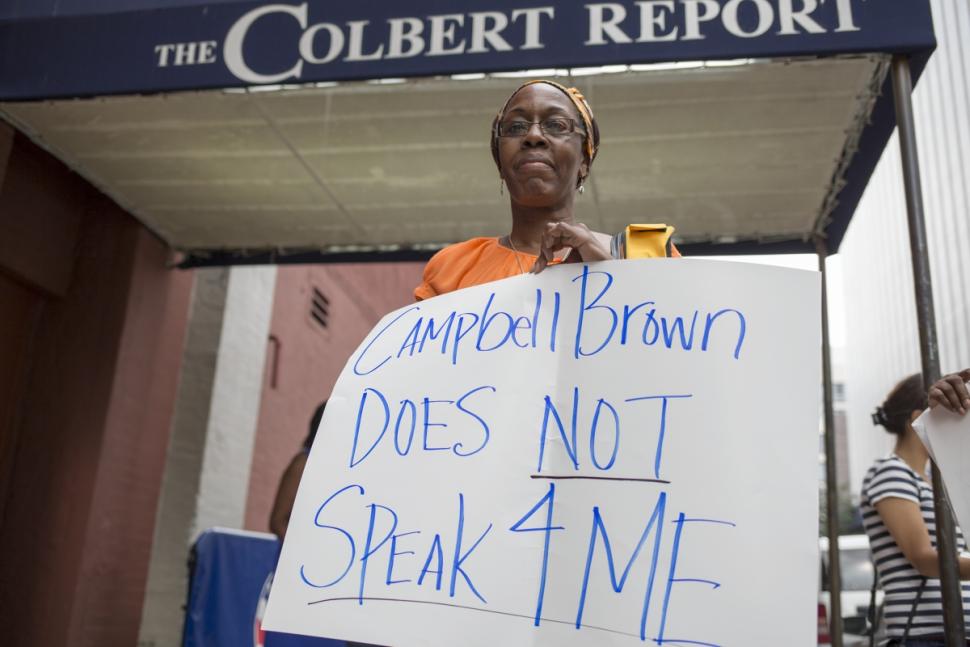
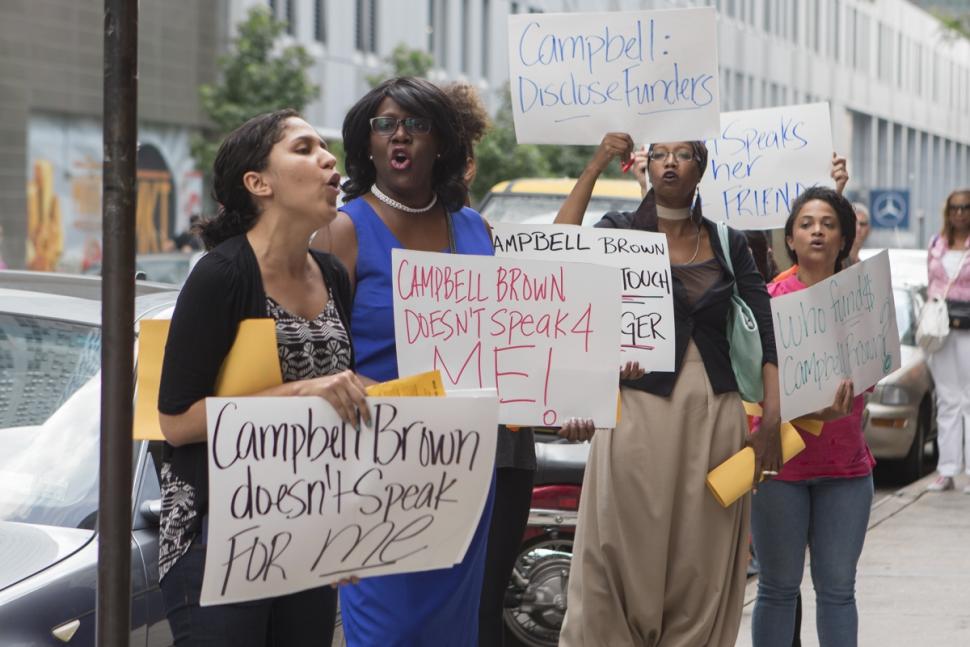
Campbell Brown’s Brings the Anti-Tenure “Argument” to Stephen Colbert

As a former broadcast personality, Campbell Brown has some advantages when appearing on the media to discuss her campaign to end teachers’ workplace protections.  She has experience in interview techniques.  She understands what works well on camera and what does not.  She knows how to pitch her voice and use facial and body language to convey deep sincerity and earnestness regardless of what she really believes.  These served her well on Mr. Colbert’s program last week.

Campbell-Brown

Mr. Colbert is similarly skilled, but he plays a satirical representation of a right wing ideologue in order to lampoon a segment of the media and to keep his guests off balance.  I would argue that he did not level the full weight of his satirical talents upon Ms. Brown, but rather he waited until the end of the interview to present her with some serious challenges that she could not respond to adequately.  More on that later.

Valerie Strauss of the Washington Post provides a pretty thorough assessment of Ms. Brown’s many prevarications and reliance on talking points over evidence courtesy of Dr. Alyssa Hadley Dunn of Michigan State University.  Dr. Dunn makes it very clear that there simply isn’t a research base to support any of Ms. Brown’s assertions, and since she had made those assertions in the media prior to her appearance on The Colbert Report, I wish that Mr. Colbert had been more ready to take on some of the more stubborn and egregious talking points.  For example, Ms. Brown repeated her claim that New York State’s teachers cannot possible be as effective as job evaluations say they are because student test scores are too low:

SC: Okay, how’s the crisis in New York? What’s the problem here?

CB: So, if you look at, if you look at the, um, outcomes, student outcomes in New York, okay? So, 91 percent of teachers are around the state of New York are rated either “effective” or “highly effective,” and yet [SC: Sounds good.] 31 percent, [SC: Yep.] 31 percent of our kids are reading, writing, and doing math at grade level. How does that compute? I mean, how can you argue the status quo is okay with numbers like that??

SC: Well, I went to public school in South Carolina and 31 percent sounds like a majority to me.  (transcript is courtesy of Mercedes Schneider, teacher and author)

Mr. Colbert chose to lightly mock his own education, but there is a major, I would argue deliberate, flaw in Ms. Brown’s favored talking point.  First, the 31% figure does not measure students’ grade level performance; it measures the percentage of students who scored “proficient” or above on the new Common Core aligned testing piloted by the Pearson corporation in New York.  Second, the 31% proficiency rate was gamed by the process to determine the cut scores and openly predicted by New York State Education Commissioner John King before the tests were ever deployed.  From the Times-Union in 2013:

State Education Commissioner John King said he expected some push-back. At a Times Unioneditorial board meeting on Tuesday, he said the number of students considered proficient will likely drop by 30 points. He said, while that number is intimidating, it provides a more honest assessment of what New York’s students know. He acknowledged that makes for nervous educators, but said the state can’t afford to roll back the tougher new standards students will be expected to meet because just 35 percent of New York’s high school freshmen leave ready for college or a career four years later.

How could the commissioner so accurately predict the drop in test scores for the new examinations?  According to award-winning Principal Carol Burris, it is because his office deliberately sought to peg the cut scores between proficiency levels to markers that would leave just a third of New York students making the cut.  The condensed version of Burris’ analysis:  NY DOE sought information from the College Board on what SAT scores (widely considered only a loose predictor of college success) correlated to a successful first year in college, and set measures of that “success” that are clearly aimed at that 30% target.  Once in possession of the desired SAT scores in reading, writing and mathematics for a combined 1630 points, the state’s committee went about setting cut scores for each level of performance on the new CCSS aligned tests.  From Principal Burris again:

When the cut scores were set, the overall proficiency rate was 31 percent–close to the commissioner’s prediction.  The proportion of test takers who score 1630 on the SAT is 32 percent.  Coincidence?  Bet your sleeveless pineapple it’s not. Heck, the way I see it, the kids did not even need to show up for the test.

So is it honest for Ms. Brown to keep repeating that only 31% of NY students are at “grade level”? Absolutely not — first, because this is not a “grade level” measure and second, because the result was gamed from the beginning.

This also brings up another question.  If the goal of the “proficient” rating on the exams is “college and career ready” is a 31% proficiency rating actually wrong?  In 2013, 33.6% of the U.S. population aged 25-29 had a bachelors degree, which is up over 11 points from 22.5% in 1980 when the education “crisis” rhetoric began in earnest.  More of our young population is in possession of college degree today than ever before in our history, and the economic data does not suggest we are in a crisis of too few people with such degrees in the economy.  48% of recent college graduates are underemployed, and in 2010, over 5 million college graduates were employed in jobs requiring only a high school diploma.  Moreover, according to Pew Social Trends, today’s wage benefit for obtaining a college degree comes less from rising wages for college graduates than from cratering wages for those without college.

One could argue that more students need to be on path to be “college and career ready” by their third grade exams because college is increasingly necessary to keep from falling behind economically moreso than it is necessary to get ahead.  Something tells me that today’s reform advocates don’t want to emphasize that point.  We would do better to question if the distribution of students who qualify for and are successful at college are concentrated in specific communities and neighborhoods, but discussed honestly, that would require examining America’s rising Residential Income Segregation Index, another topic education reform advocates don’t like to discuss.

Mr. Colbert made a feint at this late in his interview with Ms. Brown:

SC: You can mention. I’ll edit it out, but you can mention it. [CB: Okay.] [Audience laughter.] All right, now, but, here’s, the thing is aren’t you opening a can of worms there, because [4:00] if you say the kids are entitled to e, equal education, if that’s your argument, doesn’t that mean eventually, you’re going to say, “Every child in the state of New York should have the same amount of money spent on their education”—rich community, poor community—pool it all in, split it all up among Bobby and Susie and Billy—everywhere. [Audience applause.] Because the argument is, everyone gets the same opportunity. [Audience applause.]

CB: But, but you, you’re suggesting that mon, that it’s all about the money, and I think it’s not about the money.

SC: Well, you’re suggesting it’s about equality, and money is one of the equations in equality, or have I just schooled you? [Audience laughter.]

Mr. Colbert did not let Ms. Brown duck the question of money and school funding entirely, but she quickly professed how she wants to “pay teachers more” AND treat them like “professionals” through evaluations.  Then she sidestepped to her “safe” territory by claiming it is almost impossible to fire a teacher with tenure.  As previously noted, Dr. Dunn of Michigan State makes it clear that these claims are completely problematic because first, new evaluations using student test scores focus on formulations of teachers’ impact that only accounts for 1-14% of variability between student performance and second, Ms. Brown’s information on the length of time needed to remove a tenured teacher is badly out of date and her assessment of that time is possibly off by more than a factor of four.  This all tied to her previous claims the “least effective” teachers are concentrated in schools with high levels of disadvantaged students, but her argument against tenure is not remotely related to that because measuring effectiveness via test scores automatically makes urban teachers less effective regardless of their experience and skill. Additionally, these school have far fewer tenured teachers because the turnover rate in many urban districts tops 50% in three years, resulting in a dearth of teachers with the skills that come from experience.

If tenure were truly the problem with teacher quality, then wealthy suburban districts with more stable and experienced teacher corps would not be the districts with high test scores and large percentages of college bound graduates.  In this sense, Ms. Brown’s fight against tenure resembles Republican led drives for voter ID laws that threaten to block 100s of 1000s of currently eligible voters in order to stop a “problem,’ voter impersonation, that occurs so rarely it does not statistically exist.

Mr. Colbert then pivoted to what appears to have been his most important question of the interview — what is the money involved in Ms. Brown’s lawsuit?

SC: Just trying to win, Campbell. Just trying to win, all right? Um, your organization, where does it’s money come from? That’s one of the things they asked me to ask you.

CB: I, I saw that on my Twitter feed today. The, the, who’s funding this effort?

SC: Yeah, who’s funding your, your effort, [CB: Kirkland Ellis.] your organization.

CB: The law firm…

SC: The law firm is funding it?

CB: Well, the law firm is doing this for free, so we haven’t gone out…

Ms. Brown’s point here appears to be that despite her fronting the organization that is facilitating the lawsuit, the efforts on behalf of that suit are, in essence, charitable.  This may be true as far as legal fees are concerned, but it is absurd on the face to even hint that there is no monetary value to the assistance Ms. Brown is giving the plaintiffs her organization recruited.  First, her connections and celebrity almost certainly played a role in obtaining the legal services.  Second, Ms. Brown is a media ready spokesperson who has been giving interviews and penning opinion articles on behalf of this cause, and such services would cost dearly if they came from a private consulting firm.  Further, Ms. Brown has managed to sign up the services of Incite Agency, led by former Obama administration alumni Robert Gibbs and Ben LaBolt to do publicity for the cause on a national level.  The plaintiffs in this case are enjoying pro bono legal services, Ms. Brown’s celebrity and public relations services from former White House personnel.  I think it is sufficient to say that those are no small levels of support.

Mr. Colbert pressed on about financial support and finally got Ms. Brown to admit to something which I find astonishing:

SC: So, the Partnership for Educational Justice [7:00] has not raised any money so far?

CB:Yeah, we are raising money.

SC: And who did you raise it from?

CB: I’m not gonna reveal who the donors are because the people (pointing toward window) are out…

SC: I’m going to respect that because I had a super PAC. [Audience applause.]

CB: I hear you. But, part of the reason is the people who are outside today, trying to protest, trying to silence our parents who want to have a voice in this debate…

SC: Exercising First Amendment rights…

CB: Absolutely, but they’re also going to go after people who are funding this, and I think this is a good cause and an important cause, and if someone wants to contribute to this cause without having to put their name on it so they can become a target of the people who were out there earlier today, then I respect that.


Ms. Brown is married to Dan Senor, who was the former spokesman for the Coalition Provisional Authority in Iraq following the fall of the Hussein Regime.  He sits on the board of of Michelle Rhee’s StudentsFirstNY, and he joined hedge fund Elliot Management before becoming a top adviser to Presidential candidate Mitt Romney.  Ms. Brown is on the Board of Directors of Eva Moskowitz’s Success Academy chain of charter schools, an organization that boasts massive financial support from Wall Street.  Her ties to people who have been pouring money into education “reform” in the interest of charter schools is not difficult to establish, as blogger Mother Crusader has demonstrated.  Suffice to say that these are incredibly wealthy and politically connected people who are the most likely donors to her organization.

And Ms. Brown wants us to believe that they need to be “protected”.  That if people want to know who is funding lawsuits to challenge laws that were passed by democratically elected governments and job protections that were subject to open and adversarial negotiations between unions and administrators, they cannot know because the donors seeking to overturn such laws could not abide potential criticism of themselves in the public sphere.

Wow.

Let’s be clear.  Who are “the people who are outside today” who Ms. Brown assumes will bully and intimidate her donors?  According to The Daily News:


colbert1n-1-web

colbert1n-2-web

I am sure that Eva Moskowitz’s donors are just quaking in their boots…right after they drop another $400,000 into Governor Cuomo’s pockets.

Mr. Colbert did not sneak a camera crew down to the street to make Ms. Brown look as ridiculous as she richly deserved at that moment, but the fact that he led her to make such a ludicrous statement is telling in an of itself.  Today, it is very hard to trust that major media outlets will take the time and effort to research and interview people trying to lead public debate via deception, and on issues that require a genuine understanding of complex social phenomena, that is even less likely.  I have written before how abysmally the New York Times’ editorial staff have failed in that regard, preferring to take the statements of advocates with wealth and connections at face value.

Mr. Colbert is not a journalist, yet he and his fellow comedians Jon Stewart and John Oliver have become almost guardians of truth in recent years.  It is often more likely that Mr. Colbert or Mr. Stewart or Mr. Oliver will highlight the absurd inanities, half truths and contradictions routinely offered by politicians, pundits and advocates.  In the case of Ms. Brown, Mr. Colbert got her to openly confess to a truth that is gaining greater and greater public awareness: American governance is increasingly oligarchical in nature whereby elected officials craft policy more to serve the interests of their very wealthy donors rather than the interests of the actual voters who put them in office.  Ms. Brown’s undisclosed donor list is a perfect example of this, and her refusal to disclose under the fiction that her donors could possibly be intimidated by moms and teachers with home made posters should be mocked loudly and frequently.

I am grateful to Mr. Colbert for organizing his interview to that point, but I am saddened that we rely almost exclusively on satirists to get to the heart of public affairs these days.

3 Comments

Filed under Activism, Funding, Media, politics, schools, Social Justice, Testing, Unions, VAMs

Asking Markets to Do What They Do Poorly — School Reform

Early in my graduate school experience, I took a class with Phil Cusick, author of “The Egalitarian Ideal and the American High School” and “The School System: Its Nature and Logic”  .  The class was a seminar on how school systems functions both philosophically and organizationally.  While the course had a number of profound insights, one of Dr. Cusick’s observations has remained at the forefront of my thinking ever since.  “In America,” he said, “we don’t redistribute that much income, so we give everyone a free school instead.”  What he meant was that, politics of taxation and the welfare state aside, America does comparatively little that sets a strict bottom on the deprivations that poverty can afflict upon individuals and communities.  This much is true as any examination of poverty and social expenditures in first world countries can attest:

social safety gap

The purpose of school, therefore, is to provide a forum where any person, regardless of personal circumstance, can fairly demonstrate both potential and accomplishment.  Schools, philosophically, are meant to drive opportunity that we do not provide via leveling the distribution of resources.

That is a weighty mission, and it resonates with certain themes that are popular among American society such as the absence of a titular aristocracy and the belief that merit is properly recognized and rewarded.  Getting Americans to agree on how to deliver the circumstances most likely to deliver meritocracy is another matter entirely.

When it comes to school reform, the movement with greatest momentum currently is dedicated to school choice and the uses of market based forces to improve the opportunities for students enrolled in public education.  School systems across the country, where possible, have changed the ways in which students enroll in schools to deemphasize reliance upon zoned schools within geographic boundaries and to have public schools seek out students across those zoned districts.  Various instantiations of voucher programs encourage parents to seek out even nonpublic schools that will be subsidized with public money.  Straying far from their original conception as temporary laboratories for experimentation on behalf of the most difficult to teach students, charter schools operate in direct competition with district zoned schools and many have become brands unto themselves, aggressively expanding operations.

These ideas originated some decades previously with free market economists like Milton Friedman who in 1955 openly advocated for public education to more closely resemble markets for goods and services that have driven consumer innovation in the past two centuries.  Intellectually, they gained support from the work of John E. Chubb of the Brookings Institution and Terry Moe of Stanford University in their 1990 book entitled “Politics, Markets and America’s Schools” where they concluded that the most important predictor of a school’s success was the locus of control between traditional school boards and privately controlled schools.  Their prescription included the creation of school choice districts where schools would have to compete with each other to attract and retain students.

Despite the omissions from Chubb and Moe’s work, such ideas found powerful patrons among conservative politicians who enthusiastically advocated for school choice and voucher programs as the solution to the school failure narrative that took root with the release of “A Nation At Risk” during the Reagan Administration.  While originating with conservatives, school choice became a growing theme among Democrats in both the Clinton and Obama administrations and for Democratic governors across the country.  Although less likely to support vouchers that take public school budgets and transfer them to entirely private entities, the growth of charter schools and support among Democratic politicians represents a strong toehold for choice as an engine of reform on both sides of the political aisle.  Choice, in various forms, is recognized as the powerful driver of improvement and innovation across the mainstream political spectrum.

But is that a good thing?

The question is far less clear than advocates would have us believe.  Markets are, undeniably, a powerful tool for innovation, but whether or not that does or can apply to public education is quite a different matter.  It is important to consider the ways in which markets work.  As a matter of record,  I am not an economist, but what follows is not controversial ground.  Most markets for goods and services function by supplying the market with a range of innovative products, yes, but also a range of similar products that are available at different levels of quality and expense.  Many people, wealthy, middle class and working class, can afford to purchase personal transportation because the market that provides vehicles such as the Rolls Royce Phantom also provides the Ford Focus and used Honda Civics.  The individual in need of an automobile can usually, within a relatively short distance from him or herself, find an option that takes into account both the need for the good AND the ability of the buyer to go above the most basic fulfillment of the need.  Markets are exceptionally efficient at doing this, so while every person participating in the market may not be able to afford the best it has to offer, most people can find something.

But what about where everyone needs the same thing?

In education that may seem counterintuitive because it is taken as a given that all children can learn, but that not all children learn the same way.  However, taken another way, it is true that all children need the same thing:  they need the resources and the opportunities to accomplish the curriculum to the best of their current abilities in the ways by which they most effectively learn.  In other words, students do not need equal opportunities so much as they need equitable opportunities.  Consider the following illustration:

Can everyone enjoy this?

The Difference Between Equality and Equity

In the picture on the left, all three people have an absolutely equal playing field, but only two of them can achieve the goal of watching the baseball game.  With some minor tinkering, however, the third member of the group can achieve that goal because his specific needs have been accommodated without taking away anyone else’s opportunity to enjoy the game.  In an educational context, this is the why equal is not always the appropriate circumstance when a student is fully capable of accomplishing a task but needs individualized attention.

This sounds like an argument then for the market based and competitive goals of educational choice and policies that break down district zoning in assigning a student to a school, and I can understand that.  After all, if individualized attention is a key to promoting equity, it would make intuitive sense for more choices to provide more setting where that is possible.  However, I am drawn again the observation that market innovation is powerful when it is providing different levels of quality for the consumer.  Innovation and competition has made many kinds of good available to all consumers, but nobody can honestly argue that all such good are of similar quality and durability.  The same observation applies to services provided as well where consumers able to pay more enjoy levels of amenities not provided to those who do not.

But we demand very different from our compulsory education.  There is no “used Honda Civic” or “economy class seating” when it comes to teaching a child how to read, and providing equitable opportunities means that education “consumers” sometimes need to utilize MORE resources regardless of their ability to pay.  In order for a market system of schooling to really provide for equitable opportunities, several conditions seem extremely important.  First, the number of choices available would have to be sufficient to the task of every family having a genuine ability to enroll in a school or schools that meet their needs.  Even in major metropolitan areas, this is unlikely as a selection of schools cannot simply be packed onto a display wall like a selection of shoes, and after a certain point, families would incur unacceptable costs simply to transport their children to the array of schools they need.  Second, families would have to be equally engaged and knowledgeable about what children need and how to evaluate the claims of different schools about their accomplishments.  That also seems doubtful because when one makes a mistaken choice in typical markets for goods and services, there are options for returning or foregoing use of the item which does not exist when it comes to schools.  Certainly, the high turnover rates among many of the more prominent charter school operators suggests that even in a limited market, families seek out schools that are either “poor fits” for their children or that are unwilling to adjust themselves to meet the needs of the children they have.  Without zoned schools, such children would be at risk of having to “return” their educational opportunity every year.  Third, school choices cannot become more stratified than they already are due to income segregation in our communities.  In a marketplace, it is fully acceptable to provide consumers in different income strata different quality goods, but this cannot be permitted in education without the system perversely betraying promised opportunities.  Finally, a market of educational choices has to demonstrate that it truly provides better outcomes for the vast majority of students, both quantitatively and qualitatively, than a system of zoned schools.  To date, such metrics have been extremely elusive in research on both vouchers and charter schools to the point that one can reasonably question just how much more expansion of such ventures is really warranted.

Jan Resseger, a former education advocate for the United Church of Christ, recently noted that one of the primary advocates of the “portfolio” strategy of school choice, a mix of zoned schools and choice options promoted by the Center on Reinventing Pubic Education at the University of Washington, had recently admitted that troubling outcomes in many districts that have tried the strategy.  While Ms. Lake did not suggest the cycle of disruption was actually failing to improve education for the most vulnerable, the CRPE report levels heavy criticism at the way such reforms have been implemented without strict oversight to ensure all students have excellent school choices.  What is missing is an admission that market based forces are not necessarily the way to improve our national commons which includes compulsory education.

It would be disingenuous to suggest that local control of zoned schools has resulted in excellent schools for all children.  But it is much more disingenuous to subsequently ignore the impacts of our deep levels of income segregation and modest state and federal spending to alleviate the conditions of poverty in communities.  Faced with depleted local revenues and populations struggling to maintain subsistence levels of income, many of our school districts operate under conditions that make their work vastly more difficult even as we lay upon them the nearly sole responsibility for lifting those same communities out of poverty.  As David Berliner notes:

It does take a whole village to raise a child, and we actually know a little bit about how to do that. What we seem not to know how to do in modern America is to raise the village, to promote communal values that insure that all our children will prosper. We need to face the fact that our whole society needs to be held as accountable for providing healthy children ready to learn, as our schools are for delivering quality instruction. One-way accountability, where we are always blaming the schools for the faults that we find, is neither just, nor likely to solve the problems we want to address.

So what does this mean?  My own suggestions center around reemphasizing public education as a common good for society, and bringing our emphasis back to improving zoned schools.  This would require renewed interest in fully funding schools regardless of their needs and improving curricula and teaching locally, a major campaign to improve the infrastructure of zoned schools that still enroll a vast majority of our children, and efforts to invigorate school and community ties by deeper connections to civic organizations and the placement of community services within schools themselves to broaden the number of people who see the school as essential to their neighborhoods.  However, as Berliner notes, the accountability for alleviating poverty has to be two directional, and we as a society need to admit that we cannot place the entire burden of children climbing out of inter-generational poverty within communities whose economic prospects are dismal at best entirely upon the backs of teachers and schools.  As long as we continue to pass that buck and believe that the same economic forces that allow us a wide and varied choice of breakfast cereals are equipped to provide excellent schools for everyone we will continue to be disappointed.

1 Comment

Filed under Funding, politics, schools, Social Justice