Category Archives: politics

The Passion of St. Arne

Secretary of Education Arne Duncan will step down at the end of this year, and President Obama has announced that he will be replaced by former New York Commissioner of Education Dr. John King, Jr. as the acting Secretary of Education through the remainder of the administration.  Praising his often embattled Secretary of Education, President Obama said, ““He’s done more to bring our educational system, sometimes kicking and screaming, into the 21st century than anyone else….America will be better off for what he has done.”

We’ll leave that judgement to history.

As is often the case when prominent Washington figures prepare to ride off into the sunset (or out of town under cover of darkness depending on your point of view) it is time for “legacy punditry” to kick into overdrive and attempt to place Secretary Duncan in history.  Most of it is premature.  Quite a lot of it is insipid. And much of it just cannot resist creating a “balanced” narrative whether it is honest or not, which is where, Secretary Arne Duncan, Martyr of the Intransigent Teacher Unions comes into play.  Michael Grunwald of Politico.com wrote just such a piece last week, explaining the the choice of John King signals that President Obama has no intention of backing off any controversial reforms and strongly emphasizing union opposition to both Secretary Duncan and his chosen successor:

Duncan has been the public face of those differences; the National Education Association called for his resignation, while the American Federation of Teachers put him on an “improvement plan” like the ones school reformers have endorsed for incompetent teachers. He is leaving with U.S. graduation rates at an all-time high and dropout rates at an all-time low, but there has been a growing bipartisan backlash over some of his favored reforms, like the Common Core math and reading standards (derided as “Obamacore” by many conservatives) or the use of student test scores in teacher evaluations (derided as “test-and-punish” by unions). I recently mentioned to Duncan that it seems like the main theme uniting his reforms has been the idea that adults in the education system should be held accountable for making sure kids learn. “Just a little bit!” he responded.

That is, shall we say, a very charitable explanation of the central themes in Secretary Duncan’s reform portfolio of Common Core standards, high stakes testing, value added measures in teacher assessment, and favoritism for charter schools despite the ongoing and shocking series of scandals coming out of the sector.  Another way of explaining the Arne Duncan is approach is to ratchet up expectations without increasing supports, mistake things that are harder with things that are better, work hand in hand with one billionaire’s vision of education reform to push through or coerce over 40 states to adopt new standards largely written in secret, and ignore growing mountains of evidence that growth measures from standardized tests are not suited for individual teacher evaluation.  So while Mr. Grunwald may be right to point out union exasperation with Mr. Duncan and concern about his successor, there is a hell of a lot of context to that exasperation that is left out as he tries to balance his piece with current critics of both men.

So let me state it very clearly:  Secretary Duncan in Washington and Commissioner King in New York absolutely were not victims of the teacher unions.  They are victims of their own bull headed insistence in backing abjectly harmful policies even as the evidence mounted that they are harmful.

But that does not make a traditional Washington narrative where if there is one side, there must be an equal and equivalent other side, so the story of President Obama’s embattled Secretary of Education and his soon to be embattled next Secretary of Education is one where the reform side faces implacable resistance from unions seeking to maintain the status quo at all costs.  It is true that the National Education Association called for Arne Duncan’s resignation, and it is true that the American Federation of Teachers put him on a metaphorical improvement plan — last year.  After years of trying to work with education reform.

Both the NEA and AFT were early supporters of the Common Core State Standards and maintain high levels of support for the standards themselves to this day.  The NEA maintains this website on the CCSS, including a “ten facts” section that could have been penned by David Coleman himself, and the AFT is equally optimistic going back to a 2011 resolution urging good implementation.  Both national unions took initially positive views of potentially using student test score data as part of a “multiple measures” approach to teacher evaluation.  Part of the AFT’s 2010 statement on teacher evaluation and labor-management relations reads:
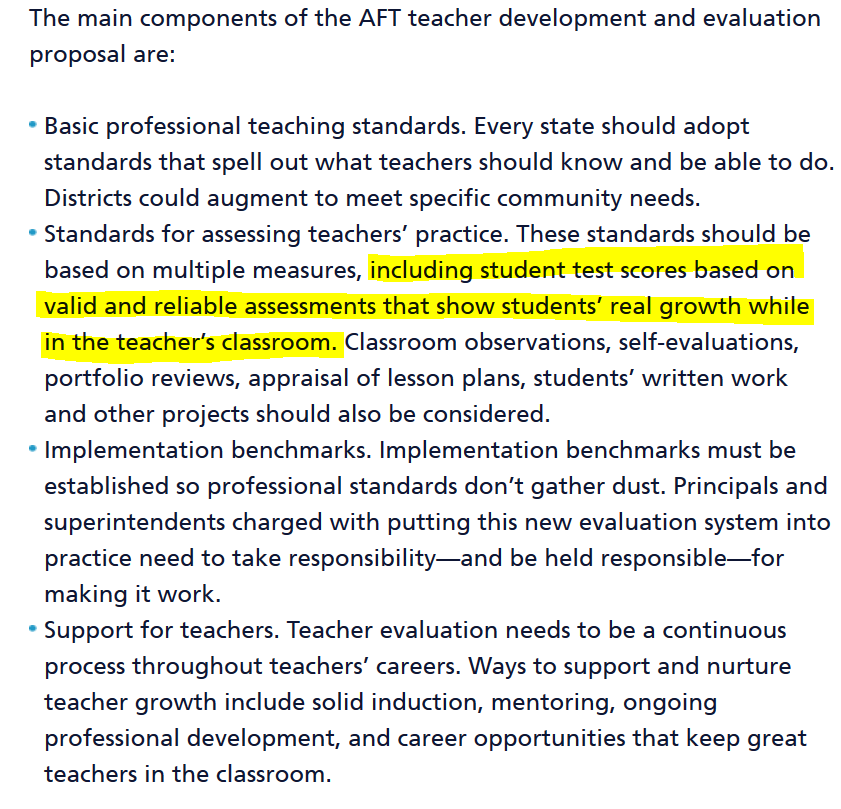
AFT teacher eval 2010

And from the NEA’s 2011 policy statement:
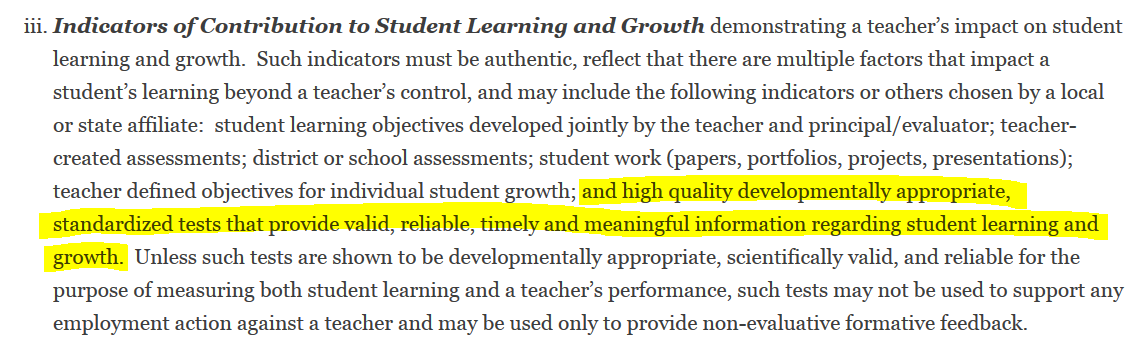
NEA teacher eval 2011

While both unions have repeatedly warned Secretary Duncan and the Obama administration that the push for more and more standardized testing was risking the entire education reform agenda, both unions were cooperative early on with key elements of education reform from the Obama White House: Common Core State Standards and the use of standardized testing data aligned with those standards in teacher evaluation.  It just so happens that these were key components in the White House’s Race to the Top grant competition and were conditions that had to be met to be granted waivers from the worst consequences of No Child Left Behind.  It also just so happens that another person, outside of the Cabinet, was pushing hard to get people on board to support the Common Core standards and growth models based on standardized tests:

Bill Gates

Not for nothing, both unions and their respective leaders at the time were listed as “important partners” when the Gates Foundation in 2009 announced $290 million in grants to 4 major school districts across the country to “develop and implement new approaches, strategies, and policies, including adopting better measures of teacher effectiveness that include growth in student achievement and college readiness; using those measures to boost teacher development, training, and support; tying tenure decisions more closely to teacher effectiveness measures and rewarding highly effective teachers through new career and compensation opportunities that keep them in the classroom; strengthening school leadership; and providing incentives for the most effective teachers to work in the highest-need schools and classrooms.”  The same announcement included the plan to spend $45 million on the Measures of Effective Teaching study – more or less to buy the research saying growth measures based on test data can be used in teacher evaluation and which, well, comes to that conclusion via some seriously dubious reasoning.  President of the AFT, Randi Weingarten, eventually backtracked from the support of growth measures in teacher evaluation, saying “VAM is a sham,” but this was in 2014, long after flaws with the Measures of Effective Teaching study’s conclusion began to be obvious.

So let’s be very clear: far from being antagonists to the Obama White House on education reform, the national teacher unions were key partners in critical elements of it from early on.  If Secretary Duncan’s simply G-d awful oversight of those initiatives (thoughtfully organized for careful consumption by Jersey Jazzman here) finally turned those organizations against him by 2014, it is strange to place union opposition at the center of the story.  In fact, despite the increased criticism and despite the late support for the parental Opt Out movement, teacher unions are STILL keeping their biggest leverage at bay.  Both the NEA and the AFT have already endorsed former Secretary of State Hillary Clinton for President despite her long standing connections with figures like John Podesta, who is running her campaign and was the founder of the Center for American Progress, a left of center think tank that is reliably in the pro-reform camp.  Further, with a few high visibility exceptions like the Chicago and Seattle strikes, neither union has been eager to take to the streets in opposition to the Duncan education agenda.  You don’t have to take my word for it, either.  The Bureau of Labor Statistics has an historic table of labor actions by any group of workers over 1000. The average public school teacher to pupil ratio in 2011 was 16 to 1 (this includes special education teachers and teachers of non-core classes), and there are 453 school districts in the country with more than 16,000 students – meaning if their teacher workforce went on strike, they’d be recorded in the BLM tables.  Considering how the education reforms most embraced by Secretary Duncan and the Obama administration have played out most contentiously in our large urban school systems, wouldn’t we be embroiled in job actions across the country if the AFT and NEA were the kind of opposition imagined by Michael Grunwald in his Politico piece?

I am sure that Secretary Duncan and his supporters both in the White House and in the education reform community would like to invoke the image of a martyr in a passion play, set upon by self interested forces seeking to maintain their privilege at the expense of the nation’s children.  But our national teacher unions do not fit that bill.  Far from opposing the reforms proposed from the Obama Department of Education, they embraced large portions of it and offered mainly precautions rather than opposition on other parts.  While elements of reform policies from this administration were involved in the Chicago Teacher Strike in 2012, there simply has not been labor unrest promoted by the AFT and NEA in the past 6 years.  Discontent among rank and file teachers has been growing in recent years, but union leadership did not really turn the corner on Arne Duncan until 2014. Value added measures are so poorly suited for teacher evaluation that the American Statistical Association urged policy makers not to use them, but AFT President Randi Weingarten’s opposition to VAMs preceded the ASA statement by only 3 months.

The reality is that Arne Duncan and John King did not merely run afoul of national and state level teacher unions – after years of doggedly pursuing policies that harm teaching – they ran afoul of parents and lawmakers as well.  Key aspects of Duncan and King’s favorite reforms are not favored by Americans and by parents even less so.  While charter schools enjoy public support, the Common Core standards, standardized testing, and using test data to evaluate teachers are widely viewed negatively.  67% of public school parents agree there is too much emphasis on standardized tests, and 80% of public school parents said student engagement was “very important” for measuring effectiveness compared to only 14% who said the same about test scores. 63% of public school parents disapprove of using standardized tests to evaluate teachers.

I’m not the only one noticing a theme here, right?  The problems that faced Arne Duncan and which John King faced in New York and will now face on a national level are problems born of loss of trust from parents, key stakeholders in education who turned around between 2009 and 2014 to find huge portions of their schools changing without even the least effort to include them in the conversation.  Secretary Duncan’s tin ear on these matters is almost legendary, but his successor may actually be worse, if that is possible. Dr. King could never communicate effectively with parents, leading to disastrous public meetings, and his refusal to discuss issues or entertain other viewpoints led lawmakers to bipartisan calls for his removal from office.  Mr. Grundwald’s piece in Politico suggests that Dr. King’s problem in New York were mainly with the union, but he fails to acknowledge that he left Albany just ahead of an angry mob of parents and legislators.

Sadly, it is the very background that Mr. Grunwald suggests should help Dr. King repair relationships with the nation’s teachers that actually prevents him from doing so.  Dr. King’s background story includes the loss of his teacher mother at a young age and his crediting teachers for turning around his life (Peter Greene rightly wonders if those same Brooklyn teachers, working under Dr. King’s policy environment, would have the room to set aside pacing guides and practice tests to nurture a child in need).  His allies in reform took to Twitter with #ISupportJohnKing to tout his life in education, but his particular life in education left him sorely unprepared for his role as NY Commissioner and even less prepared to be Secretary of Education.  Dr. King taught for three years, only one of them in a fully public school.  He then helped to found Roxbury Prep charter school in Boston before helping to found the Uncommon School network of no excuses charter schools, which relies heavily on out of school suspensions far in excess of local schools where they operate.  As a “no excuses” chain, Uncommon Schools can employ discipline methods disallowed by public schools and parents have no say if they disagree.  Dr. King was tapped from this sector to become Deputy Commissioner in New York and then ascended to the Commissioner’s office in 2011 at the age of 36.

Dr. King has almost no experience in his career where he was answerable to parents and the overlapping constituencies that are stakeholders in public education.  His style of charter school is almost entirely private in operation and parents unhappy with the way the school operates have no input via elected boards. He never served as principal of a fully public school or as a superintendent in a public school district where he was answerable to different people with sometimes opposing interests that needed to find compromise.  That lack of experience was evident in New York state as he increasingly avoided engaging parents and legislators, and there is no reason to believe he will change in the Secretary’s office.  While our new Secretary of Education will certainly be in for tough times from the national teacher unions, he will undoubtedly be in for equally or worse rough times from parents.

Inflexible unions versus the earnest reformers makes for good copy.  But it isn’t even half the story.

3 Comments

Filed under Arne Duncan, charter schools, Common Core, John King, politics

Goodbye, Arne Duncan…Hello, John King

Secretary of Education Arne Duncan, the Chief Bull in a China Shop of education “reform,” will step down in December.  Having spent his tenure in Washington working more at the behest of private foundations and billionaire backed advocacy groups than on behalf of constituencies like students, parents, and teachers (who he frequently insulted), Secretary Duncan will leave behind a legacy of rapid and coercive change and a burgeoning parental rebellion against corporate education reform.  Under his watch, states were incentivized to jump head first into the Common Core State Standards before they were even finished, confusing and rapidly developed CCSS classroom materials proliferated across numerous states, states were bribed to adopt teacher evaluation systems that use standardized tests scores to judge teacher effectiveness, and states were promised new tests that would actually demonstrate students’ “college and career readiness” but were delivered the so far execrable Common Core aligned examinations rolled out across the country.  The National Education Association has previously called for his resignation, and the American Federation of Teachers placed Secretary Duncan on an “improvement plan.”  So it would seem obvious that teachers and parents across the country should breathe a sigh of relief to see the controversial Secretary, whose affability is vastly overshadowed by his skill at breaking things, depart.

Not so fast.

The same reports of Arne Duncan’s pending resignation also state that former New York State Commissioner of Education, Dr. John King, Jr. will lead the Department of Education as Acting Secretary, possibly for the remainder of President Obama’s term which ends in January of 2017.  To say that Commissioner King’s departure from the Empire State was unlamented would be a mammoth understatement.  While far quieter than his current boss in the Federal DOE, Dr. King is no less devoted to the central tenants of education reform today: Common Core standards, mass standardized testing, evaluation of teachers using standardized tests, and the proliferation of loosely regulated charter schools.  What Dr. King lacks in dynamic public persona, he more than makes up for in dogged determination to plow ahead with a fixed agenda regardless of feedback or evidence.  Indeed, the most constant skill he demonstrated as the head of the New York State Education Department was his ability to patiently let feedback and criticism wash right over him and have no influence on decision making whatsoever.  Head of Class Size Matters, Leonie Haimson, had this to say upon his leaving:

John King was the most unpopular commissioner in the history of NY State.  He showed no respect for parents, teachers or student privacy.  Ironically, he was intent on protecting his own privacy, and routinely withheld public documents; our Freedom of Information request of his communications with inBloom and the Gates foundation is more than 1 ½ years overdue.  His resignation is good news for New York state; hopefully he will be unable to do as much damage at the US Department of Education.

Sadly, as the new head of the US Department of Education, Dr. King will be in quite a position to do a lot of damage over the next 15 months.

Dr. King has a remarkable personal story and truly impressive academic credentials, including include a B.A. from Harvard University, a J.D. from Yale Law School, and both an M.A. and Ed.D. from Teachers College at Columbia University.  After short stints in charter schools, he was tapped as a deputy commissioner in New York at the age of 34 and succeeded to the Commissioner’s office only two years later.  Now, at the age of 40, with scant experience in teaching and school leadership, including no time at all as a superintendent of any school district of any size, Dr. King will take over the work of a Cabinet Secretary with far reaching influence over the direction of public education in the country.

Dr. King’s leadership of NYSED was made complicated not only by the controversial policies that he was tasked with putting into place, but also by the rapidity with which he pursued those policies and his consistent ignoring of all stakeholders.  As the Common Core standards, the EngageNY materials to support the core, and as the aligned testing all were put into place at a breakneck speed, legitimate concerns and criticisms from teachers, parents, and lawmakers went unheeded.  Principal Elizabeth Philips of PS 321 in Park Slope noted questions about Common Core testing that simply were not heard in Albany:

In general terms, the tests were confusing, developmentally inappropriate and not well aligned with the Common Core standards. The questions were focused on small details in the passages, rather than on overall comprehension, and many were ambiguous. Children as young as 8 were asked several questions that required rereading four different paragraphs and then deciding which one of those paragraphs best connected to a fifth paragraph. There was a strong emphasis on questions addressing the structure rather than the meaning of the texts. There was also a striking lack of passages with an urban setting. And the tests were too long; none of us can figure out why we need to test for three days to determine how well a child reads and writes….

…At Public School 321, we entered this year’s testing period doing everything that we were supposed to do as a school. We limited test prep and kept the focus on great instruction. We reassured families that we would avoid stressing out their children, and we did. But we believed that New York State and Pearson would have listened to the extensive feedback they received last year and revised the tests accordingly. We were not naïve enough to think that the tests would be transformed, but we counted on their being slightly improved. It truly was shocking to look at the exams in third, fourth and fifth grade and to see that they were worse than ever. We felt as if we’d been had.

Not only were the standards and tests confusing, Dr. King’s department set about creating cut scores for the exams that all but guaranteed only a third of students in the state would be marked as “proficient.”  Following growing complaints across the state, the Commissioner attempted to “engage” parents and other stakeholders in meetings across the state, but one of those erupted disastrously in Poughkeepsie.  At the time, Regents Chancellor Merryl Tisch praised the Commissioner for his hard work, but she was subsequently quick to throw him under the bus when it became clear that NYSED had approved a charter school application submitted by a 22 year old who had lied up and down on his resume.  By the end of his tenure in the Commissioner’s office, there were bipartisan calls for his removal from office:

“For quite some time, Education Commissioner John King has closed off all meaningful conversation with parents, educators, administrators, and elected officials who have highlighted serious deficiencies in State Education Department policies,” Abinanti said. “He has exhibited a conscious disregard for their concerns.

“He should be listening, educating where criticisms are unfounded, and adopting changes where criticisms are valid,” the lawmaker continued. “His rigidity makes him unsuited for the position of Education Commissioner. Commissioner King should resign immediately.”

By the time, Dr. King left his office in Albany, he had created a great deal of chaos in New York schools, alienated every major constituency, and had created the conditions that led to the largest parental opt out movement in the history of standardized testing.

There you have it, America: your new Acting Secretary of Education.

67251-I-just-threw-up-in-my-mouth-a-Hslr

So will anything change in the United States Department of Education?  In a word: no.  Acting Secretary of Education Dr. John King, Jr. will not waver an inch on the Arne Duncan education agenda. Standardized testing will remain the sine qua non of educational quality and evaluation.  Charter schools will continue to be favored over fully public schools regardless of the evidence of their success.  The US DOE will continue to back efforts to break our national teachers’ unions.  And education policy will continue a thirty two year trend of demanding that our nation’s public schools be held fully accountable for creating economic opportunity for children in poverty without the rest of society being called upon to do a single thing to make those opportunities real.  The central fallacies of education reform in the modern era will remain cemented in place.

The only change we can expect is one of style.  While Arne Duncan blundered about in bull like fashion breaking all of the china, his successor will be quite content to quietly step on all of the shards to make certain they are good and broken.

4 Comments

Filed under Arne Duncan, Common Core, John King, New York Board of Regents, politics, Testing

Welcome Class of 2019: What We Owe Your Future Students and Their Parents

Today, I get to meet the next class of students who have entered my university seeking to become high school teachers.  This is always an exciting time in no small respect because being a part of their journey from student to student of teaching to teacher is some of the most rewarding work of my life, and I am consistently grateful for how their energy and optimism help revive my own year after year.

In recent years, that energy and optimism have been even more impressive because the in public battles over education and active disruption of today’s education “reform” have impacted these young people more than their counterparts in previous times.  The morale of their teachers has been dropping during their time in the classroom, and the inherently busy and often confusing world of the classroom has been increasingly stressful to those with whom we entrust our children.  If we accept what I believe is the very valid premise that the choice to become a teacher actually begins during one’s time as a student in teachers’ classrooms, then the students I meet today are among a remarkable group of young people who remain energized by education’s possibilities rather than discouraged by current circumstances.  Nationwide, it is getting harder to find such young people to enter the teacher preparation pipeline.

And I have good news for them – there are excellent reasons to expect growing and vocal support from the parents whose children they will eventually teach, and those reasons should both encourage and inspire them.

The annual PDK/Gallup poll on the public’s beliefs about education was published recently, and while the results should be the subject of much debate and no small amount of disagreement, two messages ring out clearly: First, the public does not buy high stakes standardized testing as the best measurement of what teachers do, and second, the people who know our schools the best are the most positive about those schools.

Every demographic surveyed said that there is too much emphasis on standardized testing by very wide margins.  64% of the national sample and 67% of public school parents believe so as well as 57% of African Americans, 60% of Hispanics, and 65% of whites in the national sample.  Support for opting out of standardized examinations showed more variation, but considering how test refusal was barely an issue a few years ago, the numbers in the survey may very well be surprising.  Nationally, 41% of those surveyed agreed opting out should be allowed, and 47% of public school parents agreed it should be allowed.  Whites agreed with allowing parents to opt out by 44% while 35% of Hispanics thought it should be allowed and 28% of African Americans thought it should be allowed.  This poses a challenge to opt out advocates, certainly, who have made only modest inroads in urban communities so far.

Parents who say they themselves would opt out was as high as 31% of public school parents with similar differences among different ethnic groups.  However, readers should remember that New York State, a national leader in the parental opt out movement, posted a test refusal rate of 20% for the 2015 examinations (which nearly matches the 21% of African American parents who would personally opt their children out), so there is room, given just this year’s support, to grow test refusal by significant numbers in the next year, complicating plans to evaluate teachers using test scores.

Survey respondents might not mind that, however, as they clearly find standardized tests a poor source of information on how teachers teach and how schools perform.  All demographic groups said that student engagement, students’ hopes for the future, and the percentage of students who graduate and go on to further education are vastly more important measures of school effectiveness than standardized test scores.  Similarly, all groups believed that samples of student work, teachers’ written evaluations, and teacher given grades were vastly more important indications of student progress, and all groups believed that teacher quality, expectations, principal leadership, and increased funding were more important tools for school improvement than measurement via standardized testing.  African American parents were most interested in using standardized test scores to compare students with students in other communities, states, and countries, but that support was only 34% saying it was “very important” and overall support at that level was only 22% of all public school parents.

Parents and others similarly disagreed with using student test scores to evaluate teachers.  Nationally, 43% of all those surveyed agreed with using student test scores that way, down from the slight majority who supported it in 2012 and up 5 points from last year’s survey.  Public school parents were most vocal in opposition with only 37% in support and 63% opposed.

The PDK/Gallup poll reaffirms a long term trend in the survey over the years: people tend to think their local schools and the schools their children attend are better than schools nationwide.  Local support for public schools remains robust in this year’s poll with 51% of the national sample giving their local schools a grade of A or B, and with 57% of public school parents saying the same.  Worryingly, only 23% of African Americans and 31% of Hispanics felt similarly, highlighting known discrepancies in our highly segregated schools.  Nationally, when public school parents were asked what grades they would give to the school attended by their oldest child, 70% said an A or a B.  All respondents noted funding as a key issue for schools and quality as well with all demographics citing it as the most important problem facing schools and citing it as very or somewhat important for school improvement.

With trends like these emerging from the polling data, it is not surprising that direct action movements from parents and students to highlight dilemmas facing their schools and to challenge unpopular policies have emerged.  The Opt Out movement is a large, growing, example of parental activism in communities across the country aimed at relieving schools of over testing.

In other communities, activists have come out to support their public schools via direct action as they’ve come under attack.  In Newark, NJ, students of the Newark Student Union have been leading a movement to demand attention for how school “reforms” have harmed them and their community.  Even more inspiring is the story in Chicago, where a dozen parent activists, having tried every possible means to save the last open enrollment high school in their community of Bronzeville, are beginning the third week of a hunger strike to save Dyett High School.  While the press has been slow to notice the story in Bronzeville, it has caught the interest and support of public school advocates across the country.

So as I welcome my new class of future teachers to their first college education classes today, I also have a message for them:  It is tempting, even easy, to spin a story of public education under attack and of those attacks winning, but you must also remember that you have the confidence and trust of parents in communities across the country, parents who understand the value of the work you have committed yourself to learning and doing.  Year after year in polls, their faith and belief in you is clear.  In the growth of Opt Out, their understanding of why the test and punish era of school accountability needs to be rolled back is evident.

And in communities like Newark and Bronzeville, students and parents are putting their very bodies on the line to support the importance of a fully public education.  You owe them nothing less than full reciprocation and your every effort to justify their trust.  Let’s get to work.

1 Comment

Filed under #FightForDyett, Activism, Newark, Newark Students Union, Opt Out, politics, schools, teacher learning

Teachers: Chris Christie Wants to Punch You “In The Face”

New Jersey Governor Chris Christie is fond of saying that his preferred method of dealing with bullies is to “punch them in the face”.  It is the sort of “tough guy” talk that has served him up to this point of his political career and which used to earn him legions of fans who delighted in his outbursts of temper aimed at critics.  On Sunday of this week, he appeared on Jake Tapper’s “State of the Union” show on CNN, and when the host asked him “At the national level, who deserves a punch in the face?” he did not hesitate for a moment before saying “The national teachers’ union.”

(Mr. Tapper followed up this statement by a really hard hitting question asking Governor Christie why he was now saying his favorite New Jersey Musician is Jon Bon Jovi over Bruce Springsteen.)

So there you are — the very first people or entity that Governor Chris Christie thinks of when he contemplates a national level “punch in the face” are teachers and the union made up of millions of them.  Not the near historically ineffective legislative branch.  Not K Street’s infamous lobbying industry where former law makers go to get rich.  Not even the national press, attacks against whom have been red meat for conservative voters for decades.  The “national teachers’ union” which Chris Christie calls “the single most destructive force in public education in America.”

Observers of Governor Christie are hardly surprised by this as the governor, in his words, has been “saying this since 2009” when he sought the Governor’s office in New Jersey, and he has not let up his assault on the Garden State’s teachers since then.  In a New Hampshire Town Hall in June, Governor Christie gave a laugh line where he said that our national education system was a threat to the country equal to ISIS, and he went on to insult the work of the teachers he just compared to a fanatical terrorist organization:

“It’s the same as it was in the 1800s, for God’s sake. It’s a row of desks. Facing forward to a blackboard or a whiteboard. A person standing in the front of the room talking to the people in the desks. And they do so from roughly 8:30 to roughly 2:30 or 3 o’clock, and they’re off four months a year…We don’t have it (a longer school year) because the teachers’ union likes to be off 4 to 5 months a year.  They like to get a full time salary for a part time job.”

Governor Christie may have tried to give himself wiggle room by saying “teachers union,” but there is no doubt that he meant “teachers” – who make up the union membership, elect the union leaders, and about whose work he offered the most foul and disrespectful caricature this side of Bart Simpson’s relationship with Mrs. Krabappel. Chris Christie has zero respect for teachers whose work he thinks consists of talking at students for 6 hours a day and lazing around for a quarter of the year with nothing to do.

New Jersey teacher and researcher Mark Weber offers this definitive catalog of how often Governor Christie has used his office to denigrate teachers.  Amidst the outrageous accusations, such as saying teachers used students as “drug mules” for a social studies assignment, an interesting pattern stands out that also explains why the governor feels the need so often to punch people who offer public criticism.  Namely, famous “tough guy” who is always “telling it like it is” can dish out the punches, but he certainly cannot take them.  Consider Governor Christie’s assertion that the New Jersey Education Association said that he “hates children and loves millionaires.”  This was obviously in reference to a billboard campaign urging people to “Tell Governor Christie to protect our schools; not millionaires.”  Direct, but hardly an accusation that he hates children.  Further consider Weber’s documentation of Governor Christie claiming that NJEA officials prayed for his death when the “prayer” in question was a moderately tasteless joke.

More recently, Governor Christie has demanded that union leaders and rank and file “get realistic” over New Jersey’s ability to keep its pension system afloat, and accused those calling for him to abide by the 2011 pension reform plan that he himself championed –  and then abjectly refused to fund – of “gluttony.”  This is an astonishing effort to portray himself as the victim in the pension fight when he won the legislative fix he sought, refused to make the promised payments into the pension system, simultaneously gave management of huge portions of it to hedge funds that increased the state’s management payments to over $1.6 million a day, and is now crying poverty when unions and law makers demand that he keep his promises.

At the heart of Chris Christie’s most bellicose moments — with teachers and with others — is this same pattern: outrage at being challenged, portrayal of himself as the victim of others’ attacks, and using anger and energy to hide the fact that he has no real answer for the challenge presented. Even while asserting that as President the first people to get a “punch in the face” will be unionized teachers, he claims that he has “got the scars to show” that the unions are “the single most destructive force in public education.”

Any scars Governor Christie has are, in fact, self inflicted.  Pushing through and touting a pension reform plan that the NJEA accepted without threats of labor actions but then saw the Governor refuse to fund? Self inflicted.  Repeated encounters with professional teachers that show just how much Governor Christie enjoys punching down on those far less powerful than he is? Self inflicted. Pandering to primary voters at the expense of every school in the state that has been working overtime to keep up with the pace of reform demands in Trenton? Self inflicted.

Who has the real scars in New Jersey?  Teachers trying to work in schools that remain underfunded, and who are subject to performance evaluations based on ill thought out and invalid methods. Students whose educations are being distorted by a confusing and punishing system of high stakes evaluations that incentivize teachers and school districts to teach to the test. Families, and indeed entire cities, subjected to poorly and callously planned school “choice” plans that separate siblings and unleash chaos on schools without sufficient benefits.

That Governor Christie continues to portray himself as a “victim” in a drama where he is the main antagonist is no longer surprising.  What is hopeful is how few people seem to be buying it either in New Jersey or nationally.

6 Comments

Filed under Chris Christie, One Newark, politics, schools, Unions

Dear Senator Gillibrand: Public Schools Need Advocates, Not More Punishments

Dear Senator Gillibrand:

I am writing to you today wearing a number of different hats that I hope you will respect.  First, I am a constituent living in New York City who has been pleased to vote for you in the past.  Second, I am a life long educator, having studied education at our mutual alma mater, Dartmouth College and having taught at every level of school from junior high school to graduate school since 1993.  Third, I am a scholar of public education, having earned my doctorate in 2002 and currently serving as the director of secondary education preparation programs at Seton Hall University.  Fourth, and most importantly, I am the father of two public school students whose future education depends heavily upon the incentive systems that you and your fellow lawmakers vote upon in Washington, D.C.

I am writing to you for two reasons in particular.  As Jon Stewart noted on your recent appearance on The Daily Show, you have a reputation for working across the aisle on various issues and an ability to find common ground where few believe it exists.  I am also writing because you recently voted, along with almost all other Democrats, for Amendment 2241 to the “Every Child Achieves Act” introduced by Senators Coons, Murphy, Booker, Warren, and Durbin.  According to Senator Coons’ announcement of the amendment:

Specifically, the amendment would require state accountability systems to provide additional resources and support to local schools identified as any of the following:

  • In the bottom five percent of public schools as according to the state accountability system

  • A public high school where two-thirds or fewer students are graduating on time

  • Any public school where economically disadvantaged, disabled, minority, or English Language Learner students are not meeting state-set goals for achievement.

The sponsors asserted that the amendment was a “serious departure” from the No Child Left Behind accountability system as it mandated no federal consequences and left it to states to determine the interventions and consequences for schools that continue to struggle.  Despite these assurances, there remained significant reasons to oppose the amendment, reasons that nearly every member of the Democratic Caucus appeared to discount.

1. The amendment baked test and punish into the ESEA re-authorization.  While the announcement made a big deal about about states determining their accountability systems and interventions, the language of the amendment continued to emphasize test based systems and even echoed the “college and career readiness” language that is emblematic of the Common Core State Standards and their accompanying tests.  So while the amendment may have been presented as increasing state control of education and accountability, the actual language had significant emphasis on standardized testing, student growth measures, and statewide (standardized) measure(s) “which is consistent with progress toward readiness for postsecondary education or the workforce without the need for postsecondary remediation.”  Informed readers of the amendment recognize a continuation of the Common Core State Standards and annual testing with the state’s required to base their accountability upon such testing.

The emphasis on quantified measures is also present in the language requiring states to create interventions for schools in the “bottom 5 percent”.  While there is little doubt that many states have significant numbers of schools that struggle and which struggle for years at a time, the need to identify the “bottom 5 percent” each and every year is a kind of trap that means no matter how well a state manages to improve its schools, there will always be a portion of them labeled as failures in need of extra interventions.  Further, by emphasizing the quantity, the amendment would have guaranteed the further primacy of testing in accountability.

It may be well-intentioned for you and your Democratic colleagues to insist that states not neglect their most distressed schools and student populations, but it is well past time to move away from annual standardized testing.  We are almost a decade and a half in the No Child Left Behind era, and the data could not be clearer: high stakes testing and consequences do not work to substantively improve schools.  Kevin Welner and William Mathis of University of Colorado at Boulder brilliantly called for a sharp move away from test based accountability:

The ultimate question we should be asking isn’t whether test scores are good measures of learning, whether growth modeling captures what we want it to, or even whether test scores are increasing; it is whether the overall impact of the reform approach can improve or is improving education. Boosting test scores can, as we have all learned, be accomplished in lots of different ways, some of which focus on real learning but many of which do not. An incremental increase in reading or math scores means almost nothing, particularly if children’s engagement is decreased; if test-prep comes at a substantial cost to science, civics, and the arts; and if the focus of schooling as a whole shifts from learning to testing.

The way forward is not to tinker further with failed test-based accountability mechanisms; it is to learn from the best of our knowledge. We should not give up on reaching the Promised Land of equitable educational opportunities through substantially improved schooling, but we must study our maps and plan a wise path. This calls for a fundamental rebalancing —which requires a sustained, fair, adequate and equitable investment in all our children sufficient to provide them their educational birthright, and an evaluation system that focuses on the quality of the educational opportunities we provide to all of our children. As a nation, we made our greatest progress when we invested in all our children and in our society.

2. We don’t need annual testing of all children to find the problems we know are there.  Bruce Baker of Rutgers University makes it very clear that testing for accountability does not need to be a disruptive or annual affair.  Using sampling methods it is entirely possible for states to get a very accurate view of what is going on in their schools, and the insistence that we need to test everyone in every school every year, is based upon false premises of how our students are distributed and about how accurately testing can reflect upon individual classrooms.  Worse, we already know how tightly coupled test results and the demographic characteristics of a community are so that we likely do not need to test in order to know which schools are likely in need of more assistance.  My colleague, Dr. Chris Tienken of Seton Hall University, very neatly demonstrated this recently with a sophisticated regression analysis of different social capital indicators that accurately predicted test scores.

Standardized testing, then, is an endeavor that is best done is the least intrusive ways possible to keep one very broad eye on the community and to use the results to see if further, more detailed, analysis is necessary or not.  By attempting to retain them as a tool of high stakes accountability, Senate Democrats sought to maintain a lever which has failed to create significant results for an entire generation of students.

3. Resources matters — Democrats’ language on that was weak.  Just as we know that schools with high percentages of students in poverty indicate schools likely to struggle, we also know that our communities with poor families tend to have large percentages of them and lack community resources as well.  The language of the amendment called for states to identify struggling schools and to ensure “identified schools have access to resources, such as adequate facilities, funding, and technology” but the federal role in assisting this remains weak even as the federal government makes requirements upon states and municipalities.  While the amendment had references to many grant programs, it lay primary responsibility with the states while leaving one of the core inequalities in American education intact: how we fund schools and distribute resources.

Local funding by property taxation is an inherently unequal form of funding, and we rely upon state aid to provide additional funding, aid that is inadequate to the task.  Consider our home state of New York.  Commissioner Elia has identified 144 schools statewide that are struggling or persistently struggling as measured by state test scores.  These include schools in Albany, Buffalo, Hempstead, Mount Vernon, New York City, Rochester, Utica, and Yonkers.  It should come as no surprise that all of these districts are on the list of our most underfunded high need school districts in the state.  Based on the state’s own, inadequate, foundational aid formula, Hempstead should be getting $6,426 per pupil MORE this year than it is getting, and such accounting trickery has been played on every district in the state for years.

If the federal government were truly interested in helping our schools by holding states accountable, it would do better to focus upon how the different 50 states raise and distribute funds to our highest needs schools.

4. Test based accountability misses the real issues.  We can test and test and test some more.  We can gather as much data from those tests as we like.  But they will never tell us the underlying reasons for the gaps in test performance among our population.  Assuming that the tests are measuring worthwhile skills and knowledge, the existence of a gap in test measured performance tells us nothing about why it exists.  At its best, testing gives us an idea of where to examine more closely, but when raising the test score become a paramount concern for schools and districts, the consequences are not inherently desirable.

Can the federal government assist states and municipalities in the pursuit of an equitable education for all?  Certainly, but it would mean shifting the focus to resources and funding and away from test scores.  For example, the federal government could finally fulfill its promise of providing 40% of the cost to implement the Individuals With Disabilities in Education Act which it has never done.  The federal government could listen to its own data that suggests our nation’s schools need $197 billion in capital improvements and that a full quarter of schools with more than half of students qualifying for free and reduced lunch are in either fair or poor condition.  The federal government could focus improvement efforts on questions of teacher retention in our most struggling schools which, contrary to the rhetoric of those opposing teacher tenure, is a much greater problem than teachers staying too long.

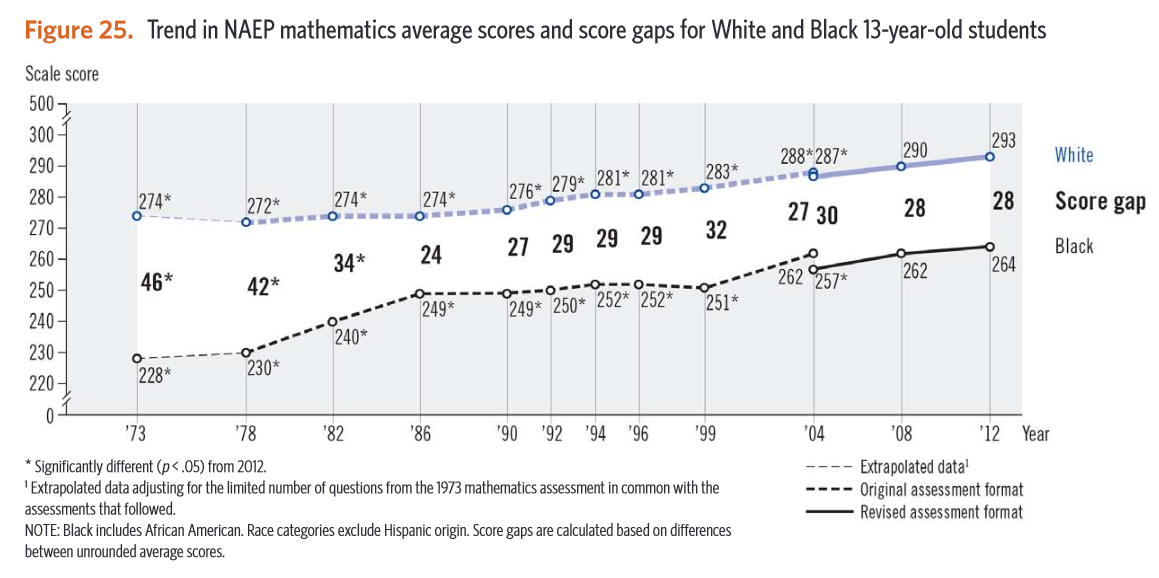
The federal government could also learn from history.  After 14 years of testing and punishment, some tiny gains in the National Assessment of Educational Progress can be seen, but those gains are dwarfed by the closing of the student achievement gap measured through the 1970s and into the early 1980s:13 year old math NAEP

As you can see, from 1973 until 1986, the gap between White and Black 13 year-olds in mathematics shrank by 22 percentage points, at which point it began to rise again, slowly over the next decade, then decreased slightly after the passage of NCLB but at nowhere near the rate we saw from 1978 until 1986.  What explains this?  There are, of course, many possible reasons, but one that stands out in policy is that by the early 1980s we largely abandoned efforts to integrate our schools and to integrate our communities via fair housing policies.  Since the 1980s, our communities have become even more segregated by income levels, and our schools have re-segregated as well so that today, a typical African American student in 2007 attended a school where 59% of his peers were low income, up from 43% in 1989.

For almost 4 decades we have increasingly concentrated children with very great needs within communities that struggle to provide basic services and in schools that are consistently deprived to the resources and personnel they need to give the children in their care what they need to thrive. We do not need more federal accountability measures of this.  We require action aimed at the opportunity gap.

You have a deserved reputation for fairness and for finding ways to work with colleagues when others prefer to fight.  I challenge you to research these issues and bring them to your fellow lawmakers in bipartisan fashion.  I challenge to craft a federal education policy that emphasizes support and growth over test and punish. Use federal leverage with states to make sure state aid to local schools is up to their needs.  Propose the full funding of IDEA for the first time in its history.  Challenge colleagues to invest in the capital improvement needed so our children learn in buildings that are well equipped and safe.  Find federal resources that will help urban schools with recruitment, development, and retention of teachers.

And recognize that threatening schools with standardized test results cannot overcome our society-wide abandonment of integrated schools and communities.  Our public schools need advocates in Washington, not an entire caucus ready to reassert policies that distort education’s focus and ignore the real funding needs of our children’s schools.

Sincerely,

Daniel Katz, Ph.D.

2 Comments

Filed under Common Core, Funding, NCLB, politics, Testing

America, Meet Chris Christie

New Jersey Governor Chris Christie is expected to make his long anticipated announcement that he will seek the Presidency, and he will do so at Livingston High School where he was president of his graduating class.  Knowing Governor Christie, the event will be long on biography and personality and short on specifics.  He is at his old high school, no doubt, to assert himself as a home grown, New Jersey “original.”  There will be a bit about how he is a “real” leader with experience “getting things done.”  We’ll hear some talk about how he is who he is, and that he only knows how to be honest and authentic.  The electorate will be given a choice to either take him as he is or not, but he certainly “won’t change who he is” for the sake of votes.  This makes him “different” from other politicians.

Then he will zip off to New Hampshire to see how that plays out for him.

Chris Christie’s persona and governing style may be multifaceted, but perhaps nothing is more emblematic of New Jersey’s governor than his ongoing, strained, relationship with the Garden State’s professional teaching corps.  Governors across the country from Wisconsin’s Scott Walker to New York’s Andrew Cuomo have waged high profile battles against their state’s teachers, and Governor Christie can hold his own among the most aggressive of them — adding his own personal flare for anger, broken promises, and constant blame shifting.  All of these factors have contributed to the governor’s plummeting approval ratings in his home state, and a few of them are highlighted here.

Chris Christie Doesn’t Keep His Promises And Then Blames Others

Running for governor, Chris Christie promised the teachers of New Jersey that he would be their ally and that their pensions would be protected when he was governor.  While union politics often raises our partisan divides, it is important to remember that traditionally teachers give up some salary with the promise of added security after retirement.  While New Jersey’s average teacher salary of just over $63,000 is in the top tier of the country, it is still well below many other New Jersey professions requiring a bachelor’s degree, and despite claims to the contrary, New Jersey teachers do not receive excessive pension payments.

Despite this and despite his promises, Governor Christie almost immediately pushed for and got a pension reform bill that he claimed fixed the pension system and would leave it solvent.  To be fair, the system had been shorted money owed to it from the state under a series of governors, but for a man who claimed in his campaign that he would leave pensions alone, it was a betrayal.  His utter refusal to keep up with the state’s promised payments into the system while teachers and other pubic workers had their contributions automatically deducted from paychecks and had to accept smaller benefits is a bigger betrayal.  Governor Christie’s refusal to make the state’s promised contributions to the fund have put it even deeper in the hole and led to a series of credit downgrades. Governor Christie just recently applied his veto pen to the state budget to slash the legislators’ call for a $3.1 billion payment into the pension fund, actually accusing others of “gluttony” for demanding that he make the payments into the system that he bragged would save it in 2011. Setting aside the irony of calling others gluttons when the governor has racked up almost $83,000 in taxpayer funded bills at the concessions for Giants and Jets games and a host of other charges indicating he enjoys the perks of his office, there is another, more ominous reason, why Chris Christie has nerve calling lawmakers and teachers “gluttons” for demanding he live up to the law he proposed.

When Governor Christie took office in 2010, New Jersey paid Wall Street firms $140.5 million annually to manage aspects of the pension system. By 2014, that figure ballooned to $600.2 million$1.6 million A DAY — meaning that over $1.5 billion of pension funds have gone to Wall Street in the form of fees since Christie took office.  The astronomical fees are in part because the administration shifted large portions of the pension fund into high fee hedge funds that promise higher returns for their fees but which have seriously underperformed with New Jersey’s money.  Additionally, there are serious questions about whether or not Christie has been showering pension management onto supporters and donors.  This year, the governor proposed sending $100 million of pension fund money to KSL Capital, a firm whose founder, Mike Shannon, donated $2.5 million to the Republican Governors’ Association, $500 thousand of which was donated when the RGA was spending $1.7 million for Chris Christie’s 2014 reelection campaign.

But retired teachers drawing a $41,000 a year pension are “gluttons.”

Chris Christie Won’t Fund New Jersey Schools

Governor Christie may be hoping for some home town love appearing at Livingston High School, but he will be doing so in a district he has squeezed financially, like he has for all school districts in New Jersey.  Entering office with New Jersey still reeling from the financial crisis, Governor Christie cut the state education budget by $1 billion below what the state aid formula said it should have been.  And even though the 2008 State Funding Reform Act and its funding formulas have not been changed, the Christie administration continues to underfund New Jersey schools leaving districts to try to find other sources of funding, a stretch in a state with already very high local property taxes.

In fact, Livingston, a district of roughly 5600 students, is supposed to get $4,312,693 in state aid according to the SFRA formula, but the township is only slated to get $2,536,196, a shortfall of over $1.7 million.  Statewide, education funding remains over $1 billion underfunded, and the administration has shown no interest in ever bringing the funding back up to what is legislatively required.

That probably has something to with why the Superintendent of Schools for Livingston was absent at the announcement.

Chris Christie’s Education Policies Suit Politics Not Our Students

The Governor recently unleashed a bit of chaos on the state’s schools by announcing that New Jersey would back out of the Common Core State Standards and begin to develop its own, better, standards just for New Jersey, citing federal interference in the CCSS that was making them not work.  Mind you, Governor Christie was singing quite a different tune to a convention of charter school boosters at the 2013 KIPP School Summit:

Of course, Governor Christie intends to keep New Jersey in the Partnership for Assessment of Readiness for College and Careers (PARCC) which are supposed to aligned with the Common Core standards, and he will continue to use the results of those examinations for teacher evaluations.  The idea, therefore, that New Jersey will see some major shift away from the standards is highly suspect since major policy incentives that require teachers to use them will remain firmly in place.  It is hard to escape the conclusion that Governor Christie is about to make a lot of noise and expend significant resources on writing “new standards” just so he can stump in Republican primaries claiming that he is resisting Common Core and distinguish himself from former Florida Governor Jeb Bush, who at least has the integrity to stick by his own bad ideas.

Political gain is almost certainly behind his refusal to make full pension fund payments as well.  Getting a pension reform bill through the New Jersey legislature was an important political win for the new governor while refusing to fund the reform and creating another crisis gives him a new chance to attack public employee unions as he seeks the Republican nomination.  Governor Christie talks a good game about respecting local control because it is politically resonant, but when it comes to majority African American and Hispanic districts in Camden, Jersey City, Patterson, and Newark, he shows no sign of relinquishing state control of the schools that has utterly failed students and teachers for years.

A disastrous example of this is the callously designed and ineptly implemented One Newark school “reform” plan for Newark Public Schools that is due to get a “new” leader in the person of former State Commissioner Chris Cerf who is replacing the widely reviled Cami Anderson (appointed by Chris Cerf). One Newark was set into motion in 2010, when Newark Mayor Cory Booker, accepting Mark Zuckerberg’s $100 million donation and with Chris Christie’s enthusiastic support, sent $2.8 million of grant money to the consulting firm Chris Cerf established to make a school reform plan for Newark — just before Governor Christie tapped him to take over the entire state as Commissioner where he directed nearly $20 million of Zuckerberg’s money to a variety of consultants.  Unsurprisingly, the One Newark plan that was put into motion emphasized turning as many schools as possible into charters, the one sector of education beloved of Wall Street and for far more than philanthropic reasons.

For Governor Christie, education policy serves to pander to political interests — abruptly switching standards, taking a chunk out of public unions — or it serves to satisfy the interests of political donors — funneling pension money into hedge funds, turning schools in profit making ventures for investors.  Actually educating children is an afterthought.

Governor Christie’s Famous Temper May Be Authentic But It Shouts Down Real Criticism.

Chris Christie’s temper and temper outbursts are integral to his brand.  He gains fans and YouTube hits by responding to critics with a pointed finger, a snarl, and a sharp rejoinder to “shut up.”

And its all an act to cover up his own errors and portray himself as a victim. Some of Governor Christie’s most famous outbursts have been directed at teachers.

There was the time that he accused teachers of using students as “drug mules.”  There was the time he claimed the NJEA was praying for death and put up ads that said he hated children, but the “prayer” was merely a joke in moderately poor taste and the ad in question said nothing of the sort: NJEA billboard 2011

Governor Christie’s numerous direct confrontations with teachers have been both condescending and hostile, inspiring one such teacher, Marie Corfield, to run for the state assembly.  Elementary school teacher, Melissa Tomlinson, wanted the Governor to explain why he kept calling New Jersey schools “failure factories,” and the result was predictable:

Governor Chris Christie, Raising Teachers' Public Esteem Again

Governor Chris Christie, Raising Teachers’ Public Esteem Again\

As he has prepared to become a Presidential candidate, the Governor has taken his refrains demeaning teachers on the road, repeating an often stated position of his that teachers are lazy and don’t really work full time jobs.  An accusation which is really rich for a governor who has spent half of 2015 out of state.

Chris Christie’s temper may have served his brand so far, but it has not really served his constituents.  In fact, it is most often used to avoid answering legitimate questions.  Consider how former Asbury Park City Councilman Jim Keady went to a Christie photo op on the Shore where he was bragging about the recovery from Hurricane Sandy.  According to Keady, despite Christie’s claims of being hands on and on top of the storm recovery, 80% of funds had yet to be dispersed, and he was treated to the “full Chris Christie.”  The Governor got to yell, bluster, and tell a resident from a town hard hit by the storm to “shut up,” but he did not have to discuss the growing list of problems with the state’s storm recovery that has left almost all of the 8000 residents eligible for funds to rebuild their home out in the cold.

So when you see Chris Christie get angry and get in the face of either the national press corps or some potential constituent, keep in mind that he is probably yelling to avoid answering a legitimate question.

Governor Christie is a Secretive Bully

Many people are familiar with the Bridgegate scandal and also familiar with the investigations that have never linked Chris Christie directly to the vindictive lane closures unleashed on Fort Lee by his appointees.  People may be less familiar with the aura of petty payback that typifies this administration and its dealings with stakeholders across the state.  Chris Christie may have not ordered the disaster on the George Washington Bridge, but much like Henry Plantagenet who bemoaned, “Who will rid me of this troublesome priest?” and was shocked – shocked! – when his henchmen murdered Thomas Becket, Governor Christie comes off as ridiculous when he cannot imagine why anyone in his administration would do such a thing. Perhaps they were taking the governor’s example to heart on how to treat people who do not do what you want them to do.  For example, Rutgers political science professor Alan Rosenthal was given a glowing tribute from the Governor upon his death, but shortly after Professor Rosenthal cast a tie breaking vote on a redistricting commission against Republicans’ favored proposal (after the Republicans on the commission refused a compromise plan), Governor Christie used his line item to veto to cut funding for a fellowship program at Rutgers run by Rosenthal.  Small wonder, then, that the Christie administration has been in court 22 times fighting efforts by watchdog groups and journalists to get information they have a right to obtain under New Jersey’s open records laws.  And when documents are produced?  WNYC’s President Laura Walker says they came to the radio station so heavily redacted as to be “all but meaningless.”

This is not the record of a tough talking, straight shooter who knows how to lead.  This is the record of a opportunist who uses the public resources at his disposal to harm constituents and then to tell them to shut up when they question him.

I work in New Jersey in teacher preparation.  I live in New York, and my children attend public school in New York City.  I often lament that on one side of the Hudson River, Chris Christie is gunning for my profession while on the other side, Andrew Cuomo is gunning for my children.  Chris Christie will spend today launching an effort to bring that special kind of leadership to the rest of the country.  May the country wise up to it and deny him any further national stage either as a candidate for the Presidency or as a member of a future President’s cabinet.

1 Comment

Filed under Chris Christie, Corruption, Cory Booker, Newark, One Newark, PARCC, politics

Newark, Please Meet the New Boss: Who Is The Old Boss’ Boss’ Old Boss

Controversial Newark, New Jersey Superintendent of Schools Cami Anderson is out of a job only 4 months into her renewed contract, and after a tumultuous year implementing the “One Newark” school reform program, including mass student walk outs, a 4 day occupation of Anderson’s office, and repeated calls for her ouster by Mayor Ras Baraka.  “One Newark” was controversial from the start, and essentially “blew up” the idea of a traditional public school system by throwing open the entire district to school choice, expanding the charter school sector within the city, and placing fully public schools under “renewal plans” (in many cases requiring entire schools of teachers to reapply for their jobs) while maintaining state control of the district which has been in effect for 20 years.  The plan opened with significant chaos and uncertainty, and a year in, there are significant questions about the capability of One Newark to really deliver on its promises, and, since the “renewal” plans began in 2012, there is more evidence that the reforms have not yielded better achievement and have had discriminatory impact on faculty and staff.

One thing is not in question: Anderson had a particularly difficult relationship with both parental and political stakeholders.  She slated schools to close even though they were meeting their growth targets.  She abruptly stopped attending school board meetings in an effort to not face parents angry at the impacts of reforms on their children.  The summer enrollment process for parents to simply put their children’s names into the system to have a school selected was poorly thought out and insensitively implementedState lawmakers waited for a year for Anderson to finally show up to a committee meeting to discuss her performance as superintendent.  Even if One Newark were indisputably a net good for Newark Public Schools, the sheer incompetence displayed when doing a basic job of a superintendent, effectively communicating with and balancing the overlapping needs of all of the stakeholders in public education, should have long ago disqualified Anderson from her job.

Allow me to indulge in a moment of praise for the young activists of the Newark Students’ Union who have been Profiles in Courage this past year.  When many of the organizations run by adults have been far too quiet, these young people have stood up and demanded that the media and public at large pay attention to what has been thrust upon Newark’s children, families, and teachers in the name of reform.  Their protests have brought national attention to Newark, and almost certainly contributed to Anderson’s departure.

Sadly, that is the end of the good news.

The reason for that is that replacement for Anderson will be none other than former Commissioner of Education for the State of New Jersey, Christopher Cerf, who abruptly left his office to join his former New York City DOE boss, Joel Klein, at Rupert Murdoch’s education technology venture, Amplify.  The Newark education board, which has no direct control over the school system, passed a nonbinding resolution calling for the appointment of assistant superintendent Roger Leon, and is scheduled to meet with Assistant Commissioner Peter Shulman to discuss “next steps” for the district’s leadership.  So, if Cerf’s appointment goes through, it will mean that he will replace a superintendent he himself appointed, and he will report to former underlings in Trenton.  The new boss isn’t the same as the old boss.  The new boss is the old boss’ boss’ old boss.

It is not hard to understand why Cerf might be looking for new employment opportunities after little more than a year at Amplify.  The technology venture is struggling mightily with expensive contracts, breakable hardware, and buggy software. Anderson’s mounting problems and inability to lead may have provided him with an opportune moment to jump ship.  It is unclear how many people in the country would be willing to step into the mess that exists in the Newark Superintendent’s office, and Cerf will certainly bring an intimate knowledge of the plans to completely change public education in Newark.  After all, he, along with former Mayor Cory Booker and Governor Chris Christie, was central in using Mark Zuckerberg’s $100 million donation to set the process in motion, setting up an expensive consulting operation before he was appointed to Commissioner’s office.

So this bizarre situation, where the state’s former highest education official will now run a school district whose outgoing superintendent reported to the incoming superintendent’s former underlings, may, as hard as it is to believe, be even worse for Newark.  As New Jersey teacher and Rutgers graduate student, Mark Weber notes on his personal blog:

This is why the S-L (Star Ledger) is almost certain to run an editorial very soon lauding Cerf ([editor]Moran’s neighbor in the very reformy town of Montclair) as the perfect pick to lead Newark’s schools to new heights. Because he’ll do exactly the same things Anderson is doing right now — but he’ll do it with a smile. He won’t fly off the handle when people dare to mention his own kids. He’ll show up to school board meetings and nod and take notes and promise to take everyone’s views under advisement.

And then he’ll go do exactly what Cami Anderson was doing before. Why wouldn’t he? Just as recently as this past December, Cerf was singing Anderson’s praises, even as he was demonizing those who stood against her. – See more at: http://jerseyjazzman.blogspot.com/2015/06/cerfs-up-in-newark-and-that-means-more.html#sthash.TvPD8ZhL.dpuf

Weber goes on to observe:

It’s also worth noting this same destructive idiocy was at play in Cerf’s policies later, when he ran the entire state’s education system. But this is how Cerf was trained. His (and Anderson’s) time at the NYCDOE under Joel Klein, coupled with his involvement in the Broad Superintendent’s Academy Book Club, formed his “creative disruption” mindset: use test scores to justify closing public schools and let privately governed charters take over. And if that’s not feasible, reconstitute the schools, generating as much instability as is possible.

This is precisely what has happened to Newark’s schools under Anderson. Even though there is no evidence that Newark’s charter schools are more effective or efficient, they have been given the green light to take an increasingly large share of the market. The district itself has been complicit in painting a false picture of the extent of their “success”; the district has also abetted their expansion as part of its One Newark plan, likely leading to even greater segregation within the district. – See more at: http://jerseyjazzman.blogspot.com/2015/06/cerfs-up-in-newark-and-that-means-more.html#sthash.TvPD8ZhL.dpuf

So Christopher Cerf is cut entirely of the same cloth as Cami Anderson with precisely the same training in philosophy and education reform.  He is a strong proponent of a business oriented view to schooling as if our public schools were similar to old business models that have failed to compete against consumer innovation.  He has no problem inflicting entirely unproven changes upon the education of 10s of 1000s of children because he believes “creative disruption” is just as valid a means of innovation in education as it is in consumer electronics.  Apparently, it is okay if some students get the Apple Macintosh 128K education while others get the Coleco Adam.

What makes Cerf stand out is not his policy differences with Anderson (of which he has precisely none).  It is his political ability, connections, and powerful patrons, including Senator Cory Booker, Governor Chris Christie, and former NYC Chancellor Joel Klein.  There is no reason to believe that he will not plunge straight ahead with One Newark and turn Newark into the “charter school capital of the nation.” There is no reason to believe that anything more than lip service will be paid to local control from a new superintendent who formerly ran the state with total disregard for local control, especially in the districts controlled by the state and subjected to maximum disruption regardless of local concerns.  The only thing to expect is that Chris Cerf will be skilled at inflicting harm upon Newark for however long he is in that office.

So Newark, please meet the new boss — and watch your back.

cerf is coming

2 Comments

Filed under Activism, Cami Anderson, charter schools, Chris Christie, Corruption, Cory Booker, Newark, Newark Students Union, One Newark, politics

Truthiness and Lack of Consequences

New York Governor Andrew Cuomo wants his education tax credit, which critics have identified as a backdoor voucher plan for private and parochial schools, and he wants it so badly that sources in Albany are saying he is trying to entice hesitant Democrats by tying strengthened rent regulations to passage of the credit.  This is a familiar tactic for Governor Cuomo who originally tied the tax credit together with the Dream Act and whose budget negotiation stance insisted that any increase in state aid for public schools had to be connected to his test-centric teacher evaluation plans.

Now, in the waning days of the legislative session, the Governor is charging hard at Assembly Democrats who have not signed on to his plan for the education tax credit.  The complex plan, which is being advertised as a boon for schools and struggling families, is a pool of $150 million with different set asides for getting money to different constituencies.  If enacted as proposed, the bill will provide $50 million in tax credits for donors to scholarship funds for low and middle income attendees at private and parochial schools, and it provides $20 million in credits for donations to public schools.  Donors could reduce their tax liability by 75% of their donations up to a full million dollars. Under the Governor’s proposal, another pool of $70 million will be set aside for credits to families who make up to $60,000 a year to help offset tuition at private and parochial schools for a total of $500 per family.  The Governor has also proposed a pool of $10 million for teachers at fully public schools and at charter schools to make up for out of pocket expenses for classroom supplies.  The state Senate, controlled by the Republican caucus, has passed its own version of the legislation.

Tax credits are different from tax deductions.  Deductions reduce your taxable income while credits typically are a dollar for dollar reduction in your total tax liability.  So while under the old charitable tax deduction available for donations to scholarship funds, a family donating $1 million could take a maximum deduction of $22,000 on state taxes, under the new tax credit, they could reduce that tax liability by $750,000.  This basically means that for a million dollar private donation to a scholarship fund for children attending private and parochial schools, the state will pay $750,000 of that by relieving the donor of that amount of his or her tax burden.  Although proponents insist that most recipients of the scholarships will be low and middle income, the proposal allows for scholarship money to go to families making as much as $300,000 a year.  The $500 a family credit is limited to families making less than $60,000 a year, but again, as a tax credit, this is basically a direct transfer of taxpayer money to a private or parochial school.  The teacher benefit is set at $200 per teacher.

Let’s be absolutely clear: a donation of a million dollars will be subsidized by tax payers to the tune of $750,000 for scholarships that might go to people earning $300,000 annually while genuinely needy families will get a $500 coupon for tuition (which is about 1/24 the average cost of tuition at a Catholic school in the United States) and teachers will get slightly less than the cost of 10 packs of multi-colored Sharpies.

At the end of the day, no matter what it is called, the bill is a complex transfer of public money to private hands with little guarantee that genuinely helpful sums of money will ever make it to genuinely needy families.

This is the proposal aggressively pushed by a governor who is billions of dollars behind the state’s constitutional obligation to fund public schools equitably, who continues to use accounting tricks to cheat school districts out of millions of dollars owed under the already inadequate funding in the state budget, who has restricted districts from increasing revenue locally without a super-majority, and then has the nerve to blame strangled school districts for not raising test scores.

If you are public education advocate on social media, you have probably seen some of the aggressive “truthiness” that has been masquerading as grassroots advocacy on this issue.  This is from Twitter:

I find this tweet to be emblematic of the past 30 plus years of claiming you can get something for nothing from advocates who want to funnel as much of our national commons into private hands as possible.  The $20 million in tax credits for  public education purposes would fund donations for public schools covering barely 1/2 of 1% of the over FIVE BILLION in unfunded state aid to schools left from the Campaign for Fiscal Equity Settlement.  And in order to get THAT, the public has to agree to tax credits that send $50 million in tax dollars to private and religious foundations and another $70 million that will go in $500 increments to private and parochial schools as “credits” that act as vouchers.  And itty bitty vouchers at that.

This is not a “tax free” way to increase spending on education, and the claim that this increases education spending without raising taxes is pure “truthiness”. This is taking a chunk of our current tax pool and divvying it up 80% into private hands.  Some of those hands may be extremely worthwhile and deserving of the generous support of their wealthy patrons.  But they are also not accountable to the same public purposes and oversight as our fully public schools, and many of them are religious organizations that are now going to be getting public funding.  By making these tax credits instead of tax deductions, Governor Cuomo has essentially crafted a proposal whose most generous subsidies amount to the very wealthy directing how their tax dollars get spent.  It is another example of political donor class writing themselves out of the rules by which everyone else lives.

Wavering Democrats in the Assembly should hold firm.  The precedent of this plan is too radical to approve.

7 Comments

Filed under Funding, politics, schools

Chester Finn and the Death of Kindergarten

Chester E. Finn, Jr. has been an influential figure in American education reform for a long time now.  President Emeritus of the Thomas B. Fordham Institute, a conservative think tank supporting most elements of today’s reform environment, former fellow at the Manhattan and Hudson Institutes, founding partner with the for profit school turned for profit school management organization Edison Project, former Assistant Secretary of Education for Presidents Ronald Reagan and George H.W. Bush, former Professor of Education at Vanderbilt University, and former chair of the National Assessment of Education Progress (NAEP) governing board, Dr. Finn has been a staple of the education reform landscape for decades.  According to his former colleague, Dr. Diane Ravitch of New York University, Dr. Finn has long held a low opinion of the quality of achievement in American education and has long wanted Americans to realize how poorly educated our children are.

And now it is Kindergarten’s turn.

Writing for the Fordham commentary website, Dr. Finn reports on the results of Maryland’s new “Kindergarten readiness” test administered individually by teachers and now available for the general public.  Dr. Finn, recently appointed to the Maryland State Board of Education, describes the results as “revealing and sobering”:

The assessment is individually administered by kindergarten teachers and was given this year to all of the Old Line State’s sixty-seven thousand kindergartners. The results are sorted into three bands, politely labeled “demonstrating readiness,” “developing readiness,” and “emerging readiness.” But only the first of these means actually ready to succeed in kindergarten—and slightly fewer than half of Maryland’s entering kindergartners met that standard.

Which is to say that more than half are not ready. This report candidly displays the results not just for the state as a whole, but also for each of Maryland’s twenty-four local districts—and further disaggregated in all the ways we have come to expect and demand in the NCLB era.

Every which way you look, you see gaps. And often the gaps are alarmingly wide—by district, by race, by income, and more. You may not be surprised, but you ought to be alarmed and energized. Children who enter school without what they need to succeed in kindergarten are destined to have great difficulty catching up, even in schools that do their utmost. It’s not impossible, but it’s very hard.

Allow me to give Dr. Finn half of a loaf here.  Early advantages matter for long term educational outcomes, although many critics have written about whether that is because of specific deficits in certain student populations or because schools systemically valorize  the cultural capital already possessed by society’s elites.  It is curious to me that Dr. Finn calls the results of the Kindergarten readiness test “revealing” because the finding of gaps between subgroups of students is entirely predictable based on what we know about poverty and its long lasting impacts.  Maryland has a total poverty rate under 10%, but 14% of its children live below the poverty line and another 17% live between the Federal Poverty Level and 200% of the Federal Poverty Level ($47,700 for a family of four).  So that is 31% of the children in Maryland living either below the poverty line or within striking distance of it.  The 1997 Princeton Study, The Effects of Poverty on Children, clearly documented how poverty in early childhood has long lasting impacts on physical, cognitive, school achievement, and emotional/behavioral development, so for Dr. Finn to say the results of the new Maryland assessment are “revealing” rather “confirming what we already know” is rhetorically nonsensical.

It is also nonsensical for Dr. Finn to say that HALF of Maryland’s children are not “ready” for Kindergarten (a term that is not actually defined or defended in his article), when the scale as reported is “demonstrating readiness” – “developing readiness” – “emerging readiness”.  According to the actual state report, not provided by Dr. Finn, 47% of Kindergarten students were found to be “demonstrating readiness”, 36% were “developing readiness”, and 17% were only at “emerging readiness”.  These terms are defined in the report as follows:

Demonstrating Readiness – a child demonstrates the foundational skills and behaviors that prepare him/her for curriculum based on the Kindergarten standards.

Developing Readiness – a child exhibits some of the foundational skills and behaviors that prepare him/her for curriculum based on the Kindergarten standards.

Emerging Readiness – a child displays minimal foundational skills and behaviors that prepare him/her for curriculum based on the Kindergarten standards.

And how does a teacher giving this assessment determine that?  Maryland provides a vague and unhelpful website for the public, but there are a few sample rubrics. Here is one for an observational item:

K rubric

So, a five year-old child “requires adult guidance to select the best idea and then put it into action” and to Dr. Chester Finn, THAT is evidence that the child is “not ready” for Kindergarten – rather than just normal evidence of a 5 year-old.

Interestingly, just one year ago, 83% of Maryland Kindergarten children were found to be “ready,” the precise sum of this year’s combined “demonstrating readiness” and “developing readiness.”  I’m sure THAT wasn’t deliberate at all.

And that’s the crux of the matter.  It would be one thing to develop high quality individualized assessment instruments that Maryland Kindergarten teachers could use to get snapshots of their incoming students and to fully individualize instruction or to use targeted interventions for some students.  It is an entirely different thing to redefine “Kindergarten readiness” to mean that 5 year-olds must engage in complex problem solving with no adult assistance and select “the best idea” (note the use of a definite article which narrows the number of correct ideas down to one) and then to publicize this as “evidence” that over half of our 5 year-olds are deficient.  In the pursuit of observing “the best idea” to solve a problem, how many entirely appropriate but fanciful ideas were set aside as evidence that a child was “developing readiness” rather than “demonstrating readiness”?  How many teachers will now use the results of this assessment to take the Kindergarten curriculum and try to push children into very narrow boxes of “correct” and “incorrect” ideas that stifle the kind of play based learning and experimentation that is entirely appropriate and healthy for very young children?

Professor of physics at Loyola University Maryland Joseph Ganem took the results of the Kindergarten assessment to task in the pages of The Baltimore Sun, faulting unrealistic and narrow expectations of the Common Core State Standards for the redefinition of readiness:

However, for skills in what Bloom calls the “cognitive domain,” the school curriculum has become blind not only to the progression of normal child development but also to natural variations in the rate that children develop. It is now expected that pre-school children should be able to grasp sophisticated concepts in mathematics and written language. In addition, it is expected that all children should be at the same cognitive level when they enter kindergarten, and proceed through the entire grade-school curriculum in lock step with one another. People, who think that all children can learn in unison, have obviously never worked with special needs children or the gifted and talented.

I agree with Dr. Ganem, and I will add that Dr. Finn’s attempt to portray these results as widely dire, rather than as indicating a specific population of children in poverty may need additional services, risks a deeper erosion of Kindergarten and early childhood education into narrow and unimaginative academics.  In their 1995 history of education reform, Tinkering Toward Utopia, David Tyack and Larry Cuban noted how the ideal of the “Children’s Garden” was quickly subsumed into preparation for the academic curriculum of grade school:

A much more modest bureaucratic rationale became central: that the kindergarten would prepare five year-olds for the first grade in a scientifically determined developmental way. Some of the features that had made the kindergarten exotic were slowly trimmed away or changed to fit the institutional character of the elementary school. (p. 69)

Dr. Finn proposes that we once again double down on this.  His solution to the problem created by rewriting the meaning of Kindergarten is “intensive, targeted early-childhood education for the kids who need it the most” which almost certainly means further pushing academic skills development to children as young as three. While I am a proponent of universal pre-K, I am mindful that “high quality” programs are far more than academic preparation and will often cloak such preparation in a focus upon learning via play.  In communities with high poverty, a focus on the family and whole child requires the existence of robust community-based social services that blunt the negative impacts of poverty on child development.  But if Dr. Finn believes that a 5 year-old who needs some adult guidance to select the ONE “best idea” in problem solving is not “ready” for Kindergarten, then I have little hope that an accompanying push for more early childhood education will preserve learning by play and attend to what we actually know children need.

For fifty years, we have continuously strangled the idea of free time and free play out of childhood in an academic arms race with our neighbors and other nations.  The consequences have been negative.  While we do have children who have needs that require specific interventions and resources, all of our children need time to grow and explore in their earliest education.

Turning pre-K into the new first grade the way we have already done to Kindergarten is not the answer.

10 Comments

Filed under child development, Common Core, Funding, politics, teaching, Testing

Chris Christie and the Magical Mystery Standards

Back in February, I noted that New Jersey Governor Chris Christie had begun to walk back his support of the Common Core State Standards.  The governor began sounding cautious notes about the implementation of the standards and about how the Obama administration has been involved in the adoption process and used funding as incentives for states to come and stay on board. These statements were directly contrary to the big, wet, sloppy kisses he gave to the standards and to Secretary of Education Arne Duncan at the KIPP School Summit in 2013:

Whoopsie.  How embarrassing.

Since it is now established fact that all Republican hopefuls for the nomination in 2016 who are not named “Jeb” have to be against the Common Core, Governor Christie assured Republicans in Iowa that his administration was really concerned about the federal role in the standards:

So we’re in the midst of a re-examination of it in New Jersey. I appointed a commission a few months ago to look at it in light of these new developments from the Obama administration and they’re going to come back to me with a report in the next I think six or eight weeks, then we’re going to take some action. It is something I’ve been very concerned about, because in the end education needs to be a local issue.

I suppose that commission got back to Christie as he decided to blow up the education section of most newspapers by announcing that he believed New Jersey should no longer follow the Common Core State Standards.  Speaking at Burlington County College, he declared:

It’s now been five years since Common Core was adopted and the truth is that it’s simply not working….It has brought only confusion and frustration to our parents and has brought distance between our teachers and the communities where they work. Instead of solving problems in our classrooms, it is creating new ones.

The Governor also announced he wants to form a group to develop “new standards right here in New Jersey,” and the news media went moderately crazy over the implications.  Observers closer to home and closer to classrooms were less impressed.  New Jersey parent Sarah Blaine noted that Governor Christie’s announcement took a swipe at the Common Core State Standards, but also pledged to keep New Jersey in the Partnership for Assessment of Readiness for College and Careers (PARCC) whose annual Common Core aligned testing debuted in New Jersey this Spring with widespread complaints and approximately 50,000 opt outs.  Ms. Blaine correctly notes the contradiction that Governor Christie wants to set aside the standards, but will keep the PARCC examinations that are designed to assess student mastery of the standards, and he will keep using the examinations as part of the dreadful AchieveNJ teacher evaluation system, thus keeping both the standards and the aligned assessments central to teachers’ work in New Jersey.  She concludes:

Christie’s announcement changes nothing, and shame on the media for lapping it up so naively. Christie’s so-called rejection of Common Core is simply a sound bite for him to take on the road to Iowa and New Hampshire while our NJ public school kids continue to deal with a language arts curriculum that doesn’t teach them to consider texts and ideas within their broader historical context….However, as long as the Common Core-aligned PARCC test continues to be the barometer to allegedly measure our schools, teachers, and children’s efficacy, Christie’s announcement is worth even less than the paper his speech was written on. If you believe otherwise, then man, I’ve got a bridge to sell you…

Peter Greene bluntly calls Governor Christie’s move an “empty gesture”, and New Jersey
music teacher and Rutgers graduate student Mark Weber, blasted the governor for “screaming hypocrisy” in suddenly claiming to care about what teachers think and about the integrity of local control:

America, take it from those of us living in Jersey: this man doesn’t care one whit about the Common Core, or education standards, or anything having to do with school policies. Chris Christie’s sole interest in education policy is in its worth as a political tool: a tool to diminish the strength of unions, demonize public workers, and shift the focus off of his own many, many failures as governor.
My colleague, Dr. Christopher Tienken of Seton Hall University, was not impressed by how seriously the governor wants new, locally developed, standards given his short time frame, noting, “This is years and years of work that it takes to do this.”  So in all likelihood, New Jersey can expect “New Jersey College and Career Readiness Standards” that are mostly Common Core but with a few definite and indefinite articles swapped around.
I am in complete agreement with Ms. Blaine that Chris Christie’s announcement is pure politics aimed at Republican Party caucus and primary voters in Iowa, New Hampshire, and South Carolina.  Republican voters lead the nation in disapproval of the Common Core with perhaps three quarters having a negative opinion of the standards.  While reasons for opposing the standards are diverse, there is a strong impression that the kinds of activist voters likely to participate in the early contests represent that most extreme, and often inaccurate, ideas about what the standards do and do not do.  With Chris Christie’s public move against the standards, Jeb Bush is left alone in the Republican field.
So just to be perfectly clear, New Jersey Governor Chris Christie, famed “tough guy” governor who “tells it like it is,” is throwing the Common Core brand off of his campaign bus so he can appeal to this guy:
For all of his declarations that the Common Core standards are not working and that the federal role has been too intrusive, Governor Christie still spoke the language of education reformers in his original remarks:

It’s not enough for most of our students to become proficient – we want all of our students, no matter their economic status or their race or ethnicity, to acquire the skills they need to compete in the 21st century.

And a look at the projected demands of employers in 15 years indicates that we will not be able to meet their needs unless we do a better job educating our children.

By 2030, it is projected that 55 percent of all new and replacement jobs will require people with a post-secondary degree. Yet in New Jersey today, only 42 percent of individuals over 25 have at least an associate degree.

Unless those numbers change – and they must change – that means that 15 years from now, nearly six out of every ten students will lack the basic requirement for a good job.

Where Governor Christie gets his numbers for how many college graduates will be needed by 2030 is unclear because projections vary from under 30% to the mid-40%, but with wages for college graduates basically stuck in place, there is little evidence in the labor market that we are short on graduates.  A more important question is why Governor Christie, like most reformers today, seems to attribute standards with an ability to make classrooms better prepare students for their future in the workforce:

And that’s where we must focus our attention – in every New Jersey classroom and home.  That’s where higher standards can be developed.

We do not want to be the first generation in our Nation’s history to leave our children less equipped and less prepared to build for themselves and their children a nation stronger and more prosperous than the one our parents gave to us.

We owe our kids the educational foundation they need to thrive, not just survive.

In reality, the connection between “quality” standards and classroom achievement looks tenuous at best. For example, Massachusetts is widely regarded as having had excellent standards prior to adopting the Common Core, and it basically was at the top of the country in the 2013 National Assessment of Educational Progress (NAEP).  Texas, meanwhile, was also recognized as having high quality standards prior to Common Core (which the Lone Star State did not adopt), but on the 2013 NAEP, it was only above 7 other states on 8th grade reading.  If quality standards were the elixir for student success, one would expect states with high quality standards to have convergent results from community to community, and yet, there is variability across communities within states as well.  Again, we can look at Massachusetts.   In 2013, Massachusetts urban communities were 32% at or above proficient in 8th grade reading compared to 28% nationally, and suburban communities were 52% at or above proficient compared to 39% nationally.  In 2005, those scores were 25% and 51% respectively.  So – 8 years with Massachusetts’ “high quality” standards, and there was no real movement in suburban achievement and some movement in urban achievement, a mixed bag still demonstrating significant variation in communities across the state even though their standards were the same.

What accounts for this?  The simple fact that standards are not magic and, on their own, do nothing to improve education.  Nor does tying school and teacher survival to standardized assessments aligned with those standards, the other favored tool of reformers.  What improves teaching and learning is often idiosyncratic, messy, and expensive.  However, general principles apply.  Writing in 1990, David Cohen presented the case of “Mrs. Oublier”, a California mathematics teacher who enthusiastically embraced the California math reforms and sincerely believed her practice was embodying them. Cohen, however, found her teaching more frequently belied a pre-reform understanding of the content of mathematics and dressed that understanding up in activities that looked like the reforms.  What held her back?  Her own insufficient education in the new ways of understanding mathematics and teaching mathematics plus the lack of a community consistently engaged in conversation and development on the standards.  Mrs. Oublier had one necessary component to reform and to improve her teaching, her own buy in and enthusiasm, but she lacked two critical other components.

This is something that modern reformers, Governor Christie included, never seem to acknowledge.  Standards, even high quality standards, mated with perverse incentives in the form of high stakes tests, do not reform or improve teaching.  Given the incentives to narrow the curriculum and to teach to the test, they can actually actively make matters worse.  When written clearly and in a developmentally appropriate manner, standards can, ideally, offer teachers end goal benchmarks from which they can “backwards design” instruction to take students from where they are to where they are going (hat tip the recently and too soon departed Grant Wiggins).

But on their own, they do not matter at all.  Teachers need to have genuine buy in, schools needs to be appropriately resourced with materials and meaningful professional development, and teachers need to work within genuinely collaborative learning communities where they and their colleagues are consistently engaged in what it means to teach and to improve teaching.  This cannot be done on the cheap by subjecting teachers and their students to stakes which make a standardized test the most important objective in the system.

And since we can pretty much guarantee that Governor Christie is not going to provide New Jersey schools with genuine respect and new resources, it will not matter if this Common Core backtrack of his results in genuinely new set of standards, a re-adoption of New Jersey’s previous standards, or simply a slap and dash rebranding of Common Core standards with a new name.  The Magical Mystery Standards that improve teaching and learning without a massive, lengthy, and expensive effort do school improvement the right way will never be written.

3 Comments

Filed under Chris Christie, Common Core, Funding, PARCC, politics