Category Archives: Social Justice

What I Am Thankful For: 140 Years of School Success

David Tyack and Larry Cuban, two of America’s most accomplished scholars in education, published the book “Tinkering Toward Utopia: A Century of Public School Reform” (1995) examining various efforts to reform American education and  explaining why schools tend to persist regardless of changes envisioned by reformers.  The book, arguably one of the best treatises on the subject in the past two decades, opens by noting how it is possible to portray American education as either evidence of progress or of regress depending almost entirely upon the motivations of the examiner:

Beliefs in progress or regress always convey a political message. Opinions about advance or decline in education reflect general confidence in American institutions.  Faith in the nation and its institutions was far higher in the aftermath of success in World War II than in the skeptical era of the Vietnam War and Watergate.  Expectations about education change, as do media representations of what is happening in schools. And the broader goals that education serves – the visions of possibility that animate the society – also shift in different periods, making it necessary to ask how people have judged progress, from what viewpoints, over what spans of time. (p. 14)

Tyack and Cuban take great care to demonstrate that much of our concept of progress or regress in education depends greatly upon how we frame questions and what questions we ask (or fail to ask).  For example, the great wave of educational expansion in the Progressive Era was influenced by the reformers’ beliefs that education could mold society for the better and that their progress was clearly reflected in statistics that showed greater and greater numbers of Americans obtaining more and more education.  At the same time, however, these same Progressives built a system with systemic inequalities enshrined in legally enforced segregation in some states and de facto segregation in others, with deep differences in school funding depending upon location, with limited college and career opportunities for women, and with few efforts to meet the educational needs of children with disabilities. The federal government’s Bureau of Indian Affairs set up a system of boarding schools for native children that were expressly racist and traumatizing.  The point here should be clear: whether or not schools are progressing is a consideration awash in choices of focus, not merely in data.

Today, Americans are in the third decade of an intense effort to convince them that the nation’s schools are failing.  Steeped in the rhetoric of existential threats in the Cold War, the Reagan administration released “A Nation at Risk: The Imperative of Education Reform” in 1983, which declared, in no uncertain terms, the belief that the education was not merely failing, but that it had already, definitively, failed:

If an unfriendly foreign power had attempted to impose on America the mediocre educational performance that exists today, we might well have viewed it as an act of war. As it stands, we have allowed this to happen to ourselves. We have even squandered the gains in student achievement made in the wake of the Sputnik challenge. Moreover, we have dismantled essential support systems which helped make those gains possible. We have, in effect, been committing an act of unthinking, unilateral educational disarmament. (p. 1)

President Reagan’s commission made such dire pronouncements at an opportune moment.  Having had confidence in the government shaken by both the Vietnam War and the Watergate scandal and having had confidence in our economic future beaten by declines in heavy industry, oil crises, stagflation, and back to back recessions, Americans had already lost confidence in education generally.  As Tyack and Cuban (1995) note, in 1973 Gallup polling reported that 61% of Americans thought their children would get a better education than they had gotten, but by 1979 that number had fallen to 41%.  But the authors also note that in 1985, while Americans did not have a high opinion of the national school system, only 27% of the them rating it as an A or a B, parents  with children in school rated those schools highly, 71% of them giving a grade of A or B to the school attended by their oldest child.  That discrepancy has remained notably stable over the decades.  In the 2014 version of the same poll, 17% of Americans rated the national school system as earning an A or a B while 67% of parents gave that grade to the school attended by their oldest child.

While that second number has been trending lower recently, it is note worthy even after three decades of constant criticism of our schools that a super-majority of parents remain favorably disposed to the schools they know the best. In the past decade and a half, that criticism has become omnipresent with a bipartisan selection of politicians demanding more and more of our schools and with private foundations and billionaire financiers pushing reforms to increase test based accountability in public education and to use what they see as evidence of failure to demand market-based changes to how we deliver our educational commons.  Microsoft founder and philanthropist Bill Gates burst into a public role demanding education reform in 2005 by declaring our entire system of education “obsolete”.  Secretary of Education Arne Duncan now famously opined that Hurricane Katrina was “the best thing that happened to the education system in New Orleans” because it provided the impetus to dramatically change the schools in the city, and the result is that the New Orleans school district is the first in the nation to be comprised entirely of charter schools.  Secretary Duncan’s words, insulting to the many who lost loved ones, homes, and livelihoods in the hurricane, make it clear that he believes hugely disruptive change is an imperative in education today.

But what if that is, from a variety of perspectives, unnecessary?  What if the story of American education is one of steady and cumulative progress and success?  What if the needs of our schools and the students in them are better seen from the perspective of systemic support rather than from systemic turmoil and disruption?  What if our leaders, both in politics and in business, are choosing to see American education in terms that can only be addressed by unleashing “creative destruction” without regard to the quantifiable goods that will be unpredictably harmed or dismantled by that force?

In 1993, the U.S. Department of Education’s Office of Education Research and Improvement, released an omnibus report entitled “120 Years of American Education: A Statistical Portrait“.  The report, presented in charts and graphs, demonstrates a steady progression in the reach of education from relatively small enterprise encompassing mostly a white and male population in the mid-1800s to a national enterprise available to and used by the majority of our population.  In many respects, it tracks the growth of American enfranchisement because as different populations in the country have been granted access to the right to vote and to protection from discrimination, their engagement with our educational commons has expanded as well.  So at the risk of taking a stance that Tyack and Cuban would acknowledge as political, I would like to present some of these findings as reasons to be thankful that previous generations of Americans invested meaningfully in an educational infrastructure as crucial to our economic health as our transportation, power, health, and water systems and as important to the vitality of our culture and psyches as our libraries, national parks, civic cultural institutions.

The growth of access to education and the depth of completion of education in the history of our common schools movement is evident.  In 1850, 56.2% of white children aged 5 to 19 years of age were enrolled in some form of schooling while only 1.8% of black children and children of other races were similarly enrolled.  By 1910, those numbers had climbed to 61.3% of white children and 44.8% of black children and children of other races, and by 1970, the numbers were 90.8% and 89.4% respectively, climbing to 93.1% and 93.2% in 1991.  In 1940, the percentage of males who completed 4 years of high school was 12.2% and 5.5% had 4 years or more of college for a median of 8.6 years of schooling completed, and the percentage of women who completed 4 years of high school was 16.4% and 3.8% had 4 years or more of college for a median of 8.7 years of schooling completed.  By 1991, 24.3% of males over the age of 25 had 4 years or more of college for a median of 12.8 years of schooling, and 18.8% of women over the age of 25 had 4 years or more of college for a median of 12.7 years of schooling.  Black men and men of other races only had a median of 5.4 years of formal schooling by age 25 in 1940, but that number rose to 12.6 years in 1991 with 17.8% of black men and men of other races having 4 or more years of college.  Black women and women of other races had a median of 12.5 years of completed school by 1991, and 15.8% of them had 4 or more years of college.

Over this time frame, illiteracy in the general and specific populations decreased.  In 1870, 20% of the population over the age of 14 was considered illiterate as defined by not being able to read or write in any language.  That percentage was a staggering 79.9% in the black population, but by 1910 the total illiteracy rate had decreased to 7.7%, and the rate in the black population had dropped to 30.5%.    Black illiteracy rates remained above 10% through 1952, but by 1979, they had fallen to 1.6%, and illiteracy in the total population was down to 0.6%.

Our nation’s schools were rarely accommodating places for students with disabilities with little to no recognition of specific learning disabilities until the 1970s.  In 1931, only 0.6% of children enrolled in schools were recognized as being disabled and in programs, and those were mostly speech, visual, and auditory disabilities with another large group of children recognized with cognitive impairments.  In the mid-1960s, this had grown to 4.3% of public school enrollments, but still without recognition of specific learning disabilities.  Due to litigation and legislation, this changed in the 1970s, and by 1989, 11.4% of the student population was served by special education programs with 2,050,000 children receiving accommodations for learning disabilities.

Student achievement as measured by the National Assessment of Educational Progress (NAEP) has made slow but steady gains in the decades since the federal government began the program.  In 1970-71, the average 17 year-old scored 285 in reading, 304 in mathematics (1972-73 data available), and 296 in science.  These scores rose slightly by 1990 to 290 in reading and 305 in mathematics, and fell slightly to 290 in science.  Black and Hispanic students made more notable gains in the NAEP during this time.  In 1970, black 17 year-olds scored 239 in reading, 270 in mathematics (1972-73 data available), and 250 in science (1972-73 data available).  By 1989, these scores rose to 267, 289, and 253 respectively.  For Hispanic students, reading scores of 252 in 1974 rose to 275 in 1989, math scores of 277 in 1972 rose to 255 in 1989, and science scores of 262 in 1976 remained stable in 1989.  Gains in the NAEP for higher level proficiencies also occurred across racial groups.  For example, level 300 in mathematics in the NAEP at high school is defined as being able to perform elementary algebra and geometry.  In 1977, 57.6% of white students scored in this range as did 16.8% of black students.  By 1989, those percentages had risen to 63.2% and 32.8% respectively.

Pursuit of higher education has also grown dramatically in the United States.  In 1869, 1.3% of the population aged 18-24 was enrolled in higher education of any form.  This number did not rise to 10% until 1945, but in the post World War II period it grew steadily, reaching 23.6% of the population in 1961, 41% of the population in 1981, and 53.7% of the population in 1991 with public institution enrollment of over 10.7 million split between 4 and 2 year schools.  In 1910, only 20 persons out of 1000 aged 23 had a bachelor’s degree, and by 1990, that number rose to 282 out of 1000 persons aged 23 years.  In 1990, the nation conferred 454,679 associate degrees, 1,049,657 bachelor’s degrees, and 323,844 master’s degrees.  It is noteworthy that female degree recipients outnumbered men in all of these categories when they lagged behind men in both bachelor’s degrees and master’s degrees as recently as 1980.

American educational progress did not end in the data for the 1993 report.  Educational attainment numbers rose between 1990 and 2013 across the board, with high school diploma acquisition rising to 94% of whites, 90% of blacks, and 76% of Hispanics.  The percentage of 25 to 29 year-olds with a bachelor’s degree rose to 34% of the total population, with white degree earners rising from 26% to 40%, black degree earners rising from 13% to 20%, and Hispanic degree earners rising from 8% to 16%, although the gap between groups in degree attainment did rise despite the nominal gains.  Women built on their previous gains, widening to a 7% difference in bachelor’s degree attainment from the 1990 data, and by 2013, 9% of women had a completed master’s degree compared to 6% of men.

Achievement results have also grown, although sometimes slowly, in this period.  According to the National Assessment of Educational Progress, 4th grade assessments grew between 1994 and 2010 with very slight gains in the upper percentiles of children taking the assessments, but with more dramatic gains in the lower quartile of test takers.  Children in the 25th percentile saw their average scores rise from 180 to 192, and students in the 10th percentile grew from 147 to 169.  The 2010 report notes that only a quarter of students tested rated as “proficient”, but that for 4th an 8th graders, the gains in proficiency from the 1994 data year was significant.  Further, gains in the NAEP assessments for black and Hispanic test takers in 2010 represented a narrowing of the achievement gap compared to the 1994 data.

It is important to remember that Tyack and Cuban argue that portrayals of education in progress or regress is frequently a political choice, and I have to confess that there are real and legitimate questions to ask of our schools.  Although schools have admirably followed the continuous, if slow, expansion of the American franchise with the expansion of educational opportunity, many of our schools, much like the communities in which they reside, languish with dilapidated facilities, outdated resources, inexperienced or overworked teachers, high class sizes, students who struggle, and community constituencies that are overlooked or actively disenfranchised by our political system.  And for the 31 years that we have been subjected to constant narratives of failing schools, our society has disinvested in infrastructure, seen its unionized workforce collapse, and largely accepted vastly growing income inequality as a fact of modern economics.  These trends only contribute to the deeply entrenched poverty in many of our urban and rural centers, and they highlight the now well known difficulties of getting ahead when one is born into poverty.  Worse, another growing trend in America, our rising residential segregation by income, means that those who are economically secure rarely even see the decayed streets, crumbling schools, and closed small businesses that more and more of our citizens live with routinely.

It is little wonder that schools struggle in communities with such problems.  Schools are social institutions, and when an entire community’s institutional infrastructure struggles to meet basic needs, it is tragic but hardly surprising when schools similarly struggle.  Education “reform” today, unfortunately, looks at those very schools and does not merely demand that they do better; it demands that they essentially take on the responsibility of transforming their entire communities with practically nothing demanded from society as a whole.  The great progress that we have made with our educational commons since the late 1800s did not happen by simply demanding more and layering more and more responsibility.  It came because we, as a society, invested heavily in the creation of a common school system, and then we took vigorous actions to open up access to more and more members of our society.

If we want to push through this lingering, neglected, frontier of educational opportunity in our country, we will need to become serious about everything that is necessary to rebuild our communities that suffer from inter-generational poverty by pouring in resources, and we will need to seriously demand an economy where full time work is properly rewarded, making education an obtainable means to a genuinely obtainable end.  Improved and revitalized school systems in these locales can be an critical part of revitalization — but they cannot bring that about on their own.

Our continued educational progress will not hinge on increased demands so much as it will hinge on increased support.
2 Comments

Filed under Data, Funding, politics, schools, Social Justice

Chancellor Merryl Tisch to Mayor Bill de Blasio: Drop Dead

Dr. Merryl Tisch is probably the most powerful person in the state of New York that you have never heard of.  As Chancellor of the Board of Regents for the powerful University of the State of New York, Dr. Tisch oversees a body that has all responsibility for overseeing and accrediting every educational institution in the state of New York from all public and private elementary and secondary schools, to nearly 250 public and private colleges and universities, to libraries and museums, to state historical societies, to public broadcasting facilities, to 47 licensed professions, to adult and career education services, to the official state archives.  Chancellor Tisch and her fellow Regents are appointed by the state legislature to five-year terms.  Dr. Tisch, a former first grade teacher in Jewish schools with a doctorate from Teachers College at Columbia University, has served on the Board of Regents continuously since 1996 and has been Chancellor since 2009.  With such far reaching powers and responsibilities, it is possible that the Chancellorship of the Board of Regents is the most powerful position in the state of New York that is not subject to election.

Chancellor Tisch is not adverse to taking harsh and public stances, and in 2011 even criticized the Bloomberg administration, which was never shy about going after allegedly failing schools, for not showing enough progress in the kind of numbers driven school improvement in favor today.  The Chancellor is also enthusiastic about the grinding state examination schedule that has been instituted from Albany, claiming that she “understands” the test anxiety felt by students but that the need for change is so urgent that “We have to just jump into the deep end.”  Blogger Jersey Jazzman notes that her understanding is an odd claim from a Chancellor who has never attended a school that believes in high stakes testing, has never taught in a school that believes in high stakes testing, and has never sent her own children to a school that believes in high stakes testing.

With such positions on education and reform, it should come as little surprise that Chancellor Tisch joined Governor Andrew Cuomo on the “If-It-Is-Sunday-It-Is-Time-To-Throw-Mayor-de Blasio-Under-The-Bus” parade by announcing that she wants to “aggressively” pursue more charter schools, and that the Mayor’s plan to turn around 94 of the city’s most troubled schools has until Spring before the Board of Regents moves to start closing them down.  Mayor de Blasio’s plan, which was only unveiled on November 3rd, will task $150 million over a three year period to transform most of the schools into “Community Schools” that do not simply seek improved academics, but also focus upon embedded social and community services to address many of the difficulties students face at home and in the community.  The schools will need to demonstrate improvement in attendance and academic performance, can turn over staff if needed, and may still face shutdown if they fail to improve in the given timeline.

Chancellor Tisch sounded less than impressed:

“It depends upon what they do with the money,” Tisch said. “There needs to be the capacity to manage how and where we place our teachers.”

The main issue, according to Tisch, is that the principals need leverage to fire educators if they don’t meet standards.

“It’s not just saying, ‘We’re gonna fix these schools,’” she said. “You gotta give the new principals and assistant principals the ability to hire the teachers that they want and fire the teachers that they don’t want.”

Her chosen metric of improvement appears to be how quickly the schools start to turn over staff: “From the state’s perspective, if we do not see movement with these lowest-performing schools in terms of their ability to retool their workforces by the spring, we will move to close them.” 

Mayor de Blasio outlined a three year timeline for improvement.  Chancellor Tisch says that he has about three months.  Mayoral control of the New York City Schools apparently is only for people in Dr. Tisch’s personal Rolodex.

What exactly does Chancellor Tisch mean when she demands to see such a quick “ability to retool their workforces”?  I have to agree with author of the Raginghorseblog, who teaches at one of the 94 schools in question and who writes here that Dr. Tisch mainly wants to see school administrators given free reign to fire masses of teachers regardless of their current due process rights.  Dr. Tisch is an intelligent person who fully knows that the Mayor cannot demonstrate significantly academic gains in these schools by Spring, so she is telling him that he is officially between a rock and a hard place.  If he does not move to pick a massive fight with the teacher’s union over firing large numbers of teachers without due process, then he will have a fight with the Board of Regents who will veto his school improvement proposal by shuttering the schools in question.

Doing this to a mayor who, in theory, has direct control of the city schools is stunningly disrespectful, but it has also become a popular pastime in Albany since the departure of Mayor Bloomberg.  Governor Cuomo did it last Spring by orchestrating a charter school rally in Albany on the same day that Mayor de Blasio was there to rally support for universal pre-K in the city.  The Governor did it again just before the election by declaring his intentions to make teacher evaluations even harder in the state even as Mayor de Blasio’s Chancellor, Carmen Farina, has been working to take the harsher edges off of school evaluations in the city.  Both Governor Cuomo and Dr. Tisch want to raise the cap on charter schools in the city and state and will likely pursue that with the legislature.  This is despite the growing evidence that the charter school sector, as currently regulated, concentrates more and more highly disadvantaged students into the remaining fully public schools which, unsurprisingly, continue to struggle.  The cycle, favored by billionaire Wall Street figures who donate heavily to both the charter schools and to politicians who support them, is pernicious enough that it invokes near conspiratorial overtones: declare fully public schools to be failing, close them, open up charter schools which attract families able to go through the application and lottery process, concentrate higher proportions of struggling students into remaining fully public schools, allow charter schools to push out harder to accommodate children, declare remaining fully public schools even bigger failures than before, close more of them and open more charter schools.

And for good measure, it must be noted that people are making fistfuls of money promoting this cycle of dislocation, concentration of disadvantage, and more dislocation.  It is also worth noting at this point that Dr. Tisch is married to the heir of the Loews Coporation, a diversified company involved in insurance, oil and gas exploration, and luxury hotel and resort properties, that has over $79 billion in total assets.  Her husband, James Tisch, owned, with several family members, stock worth $3.2 billion in 2012.  The people making money off of charter schools are in the same circle of financial titans as the Tisch family.

And now, it appears, Chancellor Tisch has given Mayor de Blasio, who ran as a progressive friend of New York City’s working families, an ultimatum: force a showdown with the teachers’ union and join the war to undermine what is left of American labor — or the Board of Regents will steamroll you.

I wish I could be surprised.

2 Comments

Filed under charter schools, Funding, New York Board of Regents, politics, Social Justice, Unions

Andrew Cuomo Makes it Official: He’s at War With Teachers

New York Governor Andrew Cuomo recently sent some mixed signals on his education platform.  In late September, he declared that the teacher evaluation system in the Empire State needs “refinement” because even using standardized test scores to create value-added measures, too many teachers are found to be effective or highly effective. This month, however, the Cuomo campaign, perhaps responding to criticisms of his embrace of the Common Core State Standards, issued an ad that suggested a softer approach to education.  Featuring Governor Cuomo in a white sweater helping his similarly attired daughter with her homework at a table decorated with white pumpkins and a glass bowl of smooth pebbles, the ad promised “real teacher evaluations” and not using Common Core test scores for “five years.”  That promise, however, simply reflects an existing item in the state budget that delays including test scores in graduating students’ transcripts; it does not promise to not use the test scores to evaluate teachers in any way.  The governor’s softer, rather beige, image is an illusion.

There was no illusion this week, however.

Speaking with the New York Daily News editorial board, Mr. Cuomo emphasized his priorities on education for a second term in Albany:

“I believe these kinds of changes are probably the single best thing that I can do as governor that’s going to matter long-term,” he said, “to break what is in essence one of the only remaining public monopolies — and that’s what this is, it’s a public monopoly.”

He said the key is to put “real performance measures with some competition, which is why I like charter schools.”

Cuomo said he will push a plan that includes more incentives — and sanctions — that “make it a more rigorous evaluation system.”

The governor took a direct, insulting, swipe at the 600,000 members of the NYSUT, by saying, “The teachers don’t want to do the evaluations and they don’t want to do rigorous evaluations — I get it.  I feel exactly opposite.”

It is rare to have one person summarize, so succinctly, nearly everything that is wrong with the current education reform environment.  “Break…a public monopoly…competition, which I why I like charter schools…the teachers don’t want to do the evaluations.”  In those short turns of phrase, Andrew Cuomo demonstrates how he utterly fails to understand teachers, the corrupted “competition” environment he promotes, and the entire purpose of having a compulsory, common school system.  I personally cannot think of any statements he could have made that disqualify him more from having any power over how we educate our young people.

The governor, who expects to win Tuesday’s election by a wide margin, faced immediately backlash over his comments, but he has opted to double down and repeat the rhetoric of calling our state’s public schools a monopoly.  He has even gotten harsh criticism from the Working Families Party, whose endorsement he wrestled for this summer when the progressive party looked to ready to endorse Fordham Law School Professor Zephyr Teachout. W.F.P.’s state director, Bill Lipton commented:

“His proposed policies on public education will weaken, not strengthen our public education system, and they would represent a step away from the principle of high quality public education for all students. High stakes testing and competition are not the answer. Investment in the future is the answer, and that means progressive taxation and adequate resources for our schools.”

In return, Governor Cuomo’s campaign spokesman, Peter Kauffmann said, “This is all political blather.”  If anyone in the leadership of W.F.P. still has faith in Mr. Cuomo’s promises to them, I will be astonished.

I am going to address Mr. Cuomo’s statements in reverse order:

1) “The teachers don’t want to do the evaluations and they don’t want to do rigorous evaluations”

Mr. Cuomo bases this upon teacher opposition to the “rigorous” evaluations that include the use of students’ standardized test scores to determine if teachers are highly effective, effective, or not effective.  Not meeting the “effective” range on the evaluations can cost teachers tenure or it can initiate efforts to remove them from the classroom if they already have tenure.  Governor Cuomo is on record as believing that the current system is too lenient on teachers because under the new Common Core aligned examinations, student proficiency in the state has dropped dramatically while, in his view, too many teachers remain rated as effective and highly effective.  Presumably, the Governor wants to change the evaluation system so that administrator input is less important and so that the “rigorous” method of rating teachers by students’ test scores has more of an impact on their effectiveness ratings.  This is a fatally flawed approach, and it is fated to unleash appalling results for several important reasons.

First, as I have written previously, he has egregiously, and probably deliberately, misrepresented what the student proficiency ratings from the Common Core exams mean.  While students reaching proficient and highly proficient on the exams only reached 36% of test takers last year, the cut scores were deliberately set to reflect the percentage of students in the state whose combined SAT scores reflect reasonable first year college performance.  Unsurprisingly, the numbers of students who scored at proficient and above almost exactly mirrored the percentage of students with those SAT scores.  This cannot be construed as students and their teachers under-performing expectations, and, not for nothing, the percentage of New Yorkers over the age of 25 with a bachelor’s degree is 32.8%.

So let’s be perfectly clear: the Governor is saying that teachers in communities where large percentages of students do not attend college are automatically “not effective” teachers.

Second, the entire CONCEPT of tying teacher performance to standardized test scores rests on controversial premises and is not widely accepted by the research community.  The American Statistical Association warns that teacher input can only account for between 1-14% of student variability on standardized test performance, and they also do not believe that any current examination is able to effectively evaluate teacher input on student learning.  Further, advocates of value added models tend to make “heroic assumptions” in order to claim causation in their models, and they tend to ignore the complications for their models that arise when you recognize that students in schools are not assigned to teachers randomly.

I know many teachers who wish to improve their teaching and who would welcome a process that gives them good data on how to go about doing that.  I know no teachers who want to be subjected to evaluations that rely on flawed assumptions of what can be learned via standardized exams.

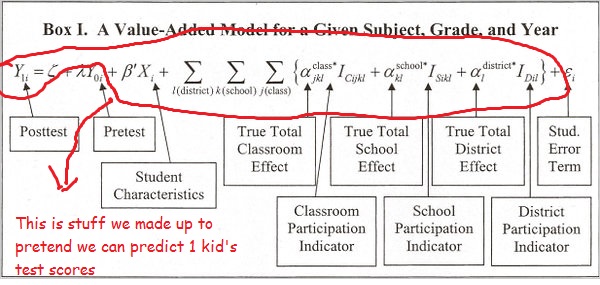
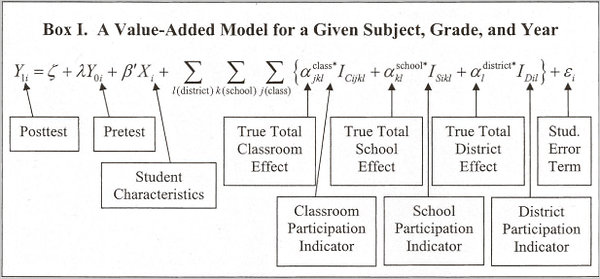
Finally, value added models tend to be incredibly opaque to the people who are evaluated by them.  For example, this is the Value Added Model that New York City used in the 2010-2011 school year:

NYC VAM

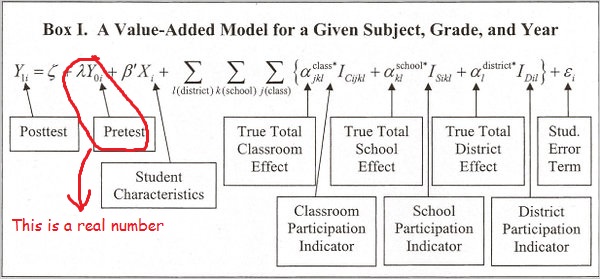
This is also the VAM that found teacher Stacey Issacson to be only in the SEVENTH percentile of teachers despite the fact that in her first year of teaching 65 of 66 students in her class scored “proficient” or above on the state examinations, and more than two dozen of her students in her first years of teaching went on to attend New York City’s selective high schools.  Perhaps worse than having a formula spit back such a negative rating was the inability of anyone to actually explain to her what landed her in such a position, and Ms. Issacson, with two Ivy League degrees to her name and the unconditional praise of her principal, could not understand how the model found her so deficient either.  Perhaps I can help.  In this image I have circled the real number that actually exists prior to value added modeling:

NYC VAMreal

And in this image, I circle everything else:

NYC VAMfake

Consider everything that might impact a student’s test performance that has nothing to do with the teacher.  Perhaps he finally got an IEP and is receiving paraprofessional support that improves his scores.  Perhaps there is a family situation that distracts him from school work for a period of time during the year.  Perhaps he is simply having a burst of cognitive growth because children do not grow in straight lines and is ready for this material at this time, or, subsequently, perhaps he had a developmental burst two years ago and is experiencing a perfectly normal regression to the norm.  Value added model advocates pretend that they can account for all of that statistical noise in single student for a single school year, and then they want to fire teachers on those assumptions.  This is what happens when macroeconomists get bored and try to use their methods on individual students’ test scores.

Governor Cuomo assumes that because teachers do not want to be subjected to statistically invalid, career ending, evaluations that they do not want to be evaluated.

2) “competition, which I why I like charter schools”

Charter schools were never supposed to be “competition” for the public school system.  As originally conceived, they would be schools given temporary charters and be relieved of certain regulations so that they could experiment with ways to teach populations of students who were historically difficult to teach in more traditionally organized schools.  In this vision, originally advocated by AFT President  Albert Shanker, charter schools would feed the lessons they learned back to the traditional school system in a mutually beneficial way.  Governor Cuomo’s idea is as far from that vision as it is possible to be and still be using the same language.

The Governor apparently thinks that charter schools are there to put pressure on fully public schools, and that the “competition” for students will act like a free marketplace to force improvement on the system.  This is a gospel that has deep roots, going as far back as Milton Friedman in 1955, and gaining intellectual heft for the voucher movement in the 1990s with Chubb and Moe’s 1990 volume, “Politics, Markets and America’s Schools.”  While vouchers have rarely been a popular idea, advocates for competition in public education have transformed charter schools into a parallel system that competes with fully public schools.  This has flaws on several levels.  First, it is an odd kind of marketplace when one provider is relieved of labor rules and various state and federal education regulations and the other is still held fully accountable for them.  Charter schools’ freedom from regulations was meant to allow for innovations that would help traditional schools learn, but instead it has become a “competition” where one competitor is participating in a sack race and the other in a 100 yard dash.  A sack race, by the way, is an entirely fine thing to participate in, but no race is legitimate when everyone isn’t required to follow the same rules.

Second, the presence of the charter sector as currently operated and regulated actively makes district schools worse off.  As Dr. Baker of Rutgers demonstrates, charter schools generally compete for demographic advantages over fully public schools.  They draw from a pool of applicants who are both attuned to the process and willing and/or able to participate in it.  Once students are admitted, many prominent charters, especially ones that get high praise from Governor Cuomo, engage in “substantial cream skimming” that results in their student populations being less poor, having fewer students on IEPs, and needing less instruction in English as a Second Language.  While charter operators deny engaging in these practices, well documented cases are available in the media.  Dr. Baker’s research confirms that when charter schools are able to do this, the district schools in the same community are left with student populations that more heavily concentrate the very populations of children that the charter schools are unwilling to accommodate.  Charter advocates then claim that they are getting “better” results with the “same” kids and protest loudly that they deserve a greater share of the finite resources available for schools, even when the costs of their transportation and building expenses are paid by the districts.

This isn’t just a sack racer versus a sprinter, then — the sprinter has slipped a couple of cinder blocks into his opponents’ sacks.  Teachers don’t mind that other schools may do things differently than they do in their own schools; they mind very much being berated for the results of system-wide neglect of their community schools, and they mind being negatively compared to schools that make their own rules and refuse to serve all children.

3) “Break…a public monopoly”

That we are poised to have a two term governor who describes New York’s public education system as “monopoly” is such a breath taking circumstance, that I am saddened beyond belief.  The common schools movement in this country was conceived of as an exercise in promoting the public good not merely in advancing individuals.  We wanted universal, compulsory, free education to serve the individual by promoting academic and economic merit as well by promoting the habits of mind and character that enrich a person’s experience in life.  We also wanted schools to promote the good of society by preparing individuals for the world of work beyond school and by preparing individuals to be thoughtful participants in our democracy who value civic virtues in addition to their own good.  For nearly two centuries, Americans have thought of public schools as the center of community civic life, something to be valued because it provides bedrock principles of democratic equality, and as our concept of democratic participation has expanded, so has our concept of plurality in schools.  From literacy for former slaves to women’s suffrage to incorporation of immigrants to tearing down White Supremacism and promoting civil rights, to inclusion of those with disabilities, to gender equality, to equal protection for LGBT citizens — our schools have helped us to reconceive our ideas of pluralism in every decade.

Schools have also stood as important symbols of our commitment to common aspects of our society that all have access to regardless of race, gender, or economic advantage.  There was a time in our nation’s history when we were dedicated not merely to building economic infrastructure, but also to building community, cultural, and natural infrastructure.  There are libraries, parks, museums, and publicly supported arts across our country that are testament to the belief that the world of knowledge, natural beauty, and the arts cannot be the sole province of the wealthy.  Public schools are part of that commitment, but to call them a “monopoly” reveals a mindset disregarding that heritage and which rejects it as a commitment to the future.  Does Governor Cuomo drive the New York Throughway and see a “public monopoly”?  Does he enter the Metropolitan Museum of Art in New York City whose entry fee is a suggested donation and see a “public monopoly”?  Does he want to “break up” the Franklin D. Roosevelt  and Watkins Glen State Parks?

What Governor Cuomo appears to believe is that education exists solely for the social mobility of individuals with no regard for the public purposes of education.  David Labaree of Stanford University posited in this 1997 essay, that the historic balance of purposes in education was already out of balance with current trends favoring education for individual social mobility far outweighing the public purposes of social efficiency and democratic equality.  Labaree was rightly concerned that if people only see education as the accumulation of credentials that can be turned in for economic advantage then not only will the civic purposes of education be swept aside, but also that the effort to accumulate the most valuable credentials for the least effort will diminish actual learning.  Governor Cuomo’s depiction of schools as a “public monopoly” only makes sense if he is mostly concerned with how education “consumers” accumulate valued goods from school, but discounts the essential services schools provide to our democracy.  It is an impoverished view that relegates school to just another mechanism to sort people in and out of economic advantage.

Governor Andrew Cuomo may not only be at war with teachers.  He may be at war with the very concept of public education.  If he does indeed win a second term on Tuesday, he must be opposed at every step of his distorted and dangerous ideas about our public schools.

11 Comments

Filed under charter schools, politics, schools, Social Justice, teaching, Testing, Unions, VAMs

So, Governor Cuomo, about those proficiency levels….

New York Governor Andrew Cuomo caused a stir among education observers recently by commenting on the need for future changes to the New York state teacher evaluation system.  The Governor is quoted in The Buffalo News:

Cuomo said he sees value in the teacher rankings, but said critics who question how 94 percent of the state’s teachers can be “highly effective” or “effective” have a valid point.

“I’m excited that we started,” Cuomo said of the teacher evaluation system put into effect during the 2012-13 school year. “And I think once we start to study it and learn it and refine it – because there’s no doubt it needs refinement, not everybody can get an ‘A,’ it can’t be – I think it’s going to be a very valuable tool.”

But he conceded the system might need more scrutiny.

Critics of the teacher evaluations have pointed out the wide gap between the 94 percent of teachers who were rated “effective” or “highly effective” and the number of students failing to do well on state tests and in other measures of student success.

State law required school districts to negotiate with teacher and principal unions to create evaluation systems within certain state requirements, including using student performance on state tests as one measure of how well a teacher is performing.

“The way we’ve done it the first few years is they’re negotiated locally. There is no statewide negotiation,” Cuomo said during a meeting with editors and reporters at The Buffalo News. “Each district negotiates it’s own criteria within certain mandates. So the suggestion was the way they negotiated it may be too loose because everyone’s doing well, and I think that’s a valid question.”

While some education bloggers speculate that this means Governor Cuomo will join an aggressive campaign to push out more experienced teachers in his second term, I am more interested in the mentality that the Governor is demonstrating here.  It is one that assumes that if 30% of New York students are being rated as “proficient” and “highly proficient” on the new, Common Core aligned, tests, then it is impossible that 94% of New York teachers are rated as “effective” and “highly effective” even though the new evaluation system makes generous use of value added measures of teacher performance utilizing test scores.  It is a mentality that is shared by Campbell Brown and others seeking to eliminate teachers’ due process rights via ending teacher tenure.  In fact, this is almost precisely what Ms. Brown said when she appeared on Stephen Colbert’s show earlier this year.  Mercedes Schneider, a teacher, author, and blogger from Louisiana provided this transcript:

CB: So, if you look at, if you look at the, um, outcomes, student outcomes in New York, okay? So, 91 percent of teachers are around the state of New York are rated either “effective” or “highly effective,” and yet [SC: Sounds good.] 31 percent, [SC: Yep.] 31 percent of our kids are reading, writing, and doing math at grade level. How does that compute? I mean, how can you argue the status quo is okay with numbers like that??

This same viewpoint was central to Eva Moskowitz’s recent advertising blitz to expand charter schools in New York City for the alleged benefit of an estimated 143,000 students she claims are trapped in “failing schools.”  The key information supporting that claim?  A “report” from the charter school advocacy group “Families for Excellent Schools” that claims at a quarter of New York City schools only 10% of students “pass” the state exams.  The Daily News reported this as students failing to read and do math at “grade level” like Ms. Brown did, and others repeatedly say that the students do not “pass” their exams.

The examinations, however, say no such thing.

It is important to recall that the examinations are aligned with the Common Core State Standards which invoke the language of “College and Career Readiness.”  In fact, New York’s Common Core testing consortium is PARCC, which stands for “Partnership for Assessment of Readiness for College and Careers.”  New York has been administering exams aligned with the new standards for two years now, and students are assessed as “highly proficient,” “proficient,” “partially proficient” and “not proficient” on a 1-4 point scale.  The result of the examinations has not been exceptional according to many observers, including the Governor.  In the 2012-13 school year, the first year of the new examinations, student proficiency levels dropped from 55% overall for English Language Arts to 31% and remained there in the 2013-2014 school year.  In mathematics, a proficiency level of 65% in 2011-2012 dropped to 31% in 2012-2013 and rose slightly last year to 36%.  The numbers are even lower for students who belong to ethnic minorities or who are from economically disadvantaged families.  African American students plunged from a 37% proficiency level in English to 16% in the first year of examinations, and Hispanic students fell from 40% to 18% with students from poor families tracking closely to these numbers.

However, these percentages are absent context if we do not understand how “proficient” is determined, and that determination was plainly designed to get percentages like this.  Carol Burris, an award-winning principal from South Side High School, makes it very clear that Commissioner John King set the cut scores at different levels of proficiency based on data designed to reflect SAT scores that are loosely correlated with “successful” completion of freshman level college English and mathematics courses.  Although the use of the SAT is dubious and the definitions of “success” in college level courses arbitrary, it was no surprise that the proficiency levels of the new exams closely tracked the target SAT levels.  As Principal Burris notes:

After coming up with three scores — 540 in math, 560 in reading and 530 in writing– the College Board determined the percentage of New York students who achieved those SAT scores. Those percentages were used to “inform” the cut score setting committee.  As the committee went through questions, according to member Dr. Baldassarre-Hopkins, the SED helpers said,  “If you put your bookmark on page X for level 3 [passing], it would be aligned with these data [referring to the college readiness data],” thus nudging the cut score where they wanted it to be.

When the cut scores were set, the overall proficiency rate was 31 percent–close to the commissioner’s prediction.  The proportion of test takers who score 1630 on the SAT is 32 percent.  Coincidence?  Bet your sleeveless pineapple it’s not. Heck, the way I see it, the kids did not even need to show up for the test.

It is possible, I suppose, to argue that since the Common Core State Standards and the accompanying examinations ARE supposed to be tied to “college and career readiness” that there is nothing conceptually wrong with the examinations themselves producing much lower proficiency levels than previous exams.  Certainly, it is worth a vigorous discussion in public about what the exams are supposed to reflect and whether or not we want the criteria to be aimed at the population of New York students likely to go on to post-secondary education.  Just to make this more interesting:  the percentage of New York state residents over the age of 25 in possession of a bachelor’s degree?  32.8%.   So Commissioner King’s cut scores discovered roughly the population of the state likely to continue into higher education.

One thing should be very clear from this:  Levels 3 and 4 in the Common Core aligned examinations do NOT, have not, and will not align with “grade level” performance at ANY level of the New York school system (unless you want to argue that most NY residents without a BA graduated high school BELOW grade level), and if you have been talking as if they do, you need to stop.  Yesterday.

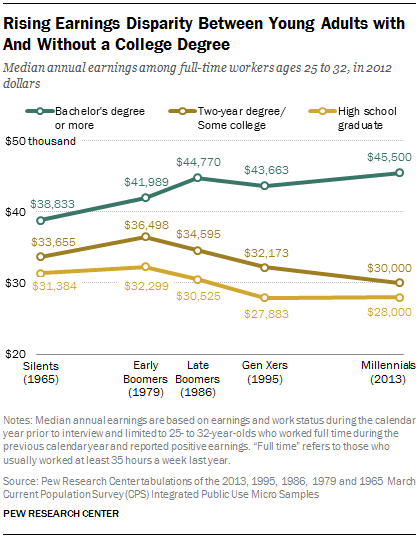
It is also possible to argue that our nation requires more college educated citizens in order to properly serve the needs of a 21st century economy.  Certainly, Professor Anthony Carnevale of Georgetown University believes so, and he believes that the Bureau of Labor Statistics’ estimate that only 27% of the jobs in the economy will require a BA by 2022 is “frighteningly low.”  Professor Carnevale and his colleagues at the Georgetown University Center on Education and the Workforce believe that by 2020, the economy will require 35% of the workforce will require a BA or higher.  This argument is predicated, in part, on the existence of a “college wage premium” that has grown in recent decades because employers are paying graduates with college degrees a higher wage than their non-college educated peers.  While the college wage premium is real and has grown since the late 1970s, the conclusions from Georgetown are not universally accepted.  To begin with, over 98% of job gains between 2007 and 2011 were made by those with advanced degrees beyond a bachelor’s.  Additionally, large numbers of today’s graduates with a bachelor’s are being hired into jobs that traditionally do not require a full four years of college, and while Georgetown’s study found that demand for college educated workers outstripped supply, the college wage premium they cite as evidence has been stuck for ten yearsBased on data from Pew Social trends, it is evident that much of the benefit of going to college is made up of the collapsing wages for non-college graduates rather than intense market competition for those with college degrees into jobs that require them:

SDT-higher-education-02-11-2014-0-03

Suffice to say, this is still an issue that is subject to appropriately vigorous debate, and it is unlikely we can look at the current number of college educated New Yorkers and say with certainty that it is sufficient or insufficient.

Another argument aims at a much harder nut to crack: the persistent imbalance in college attendance and completion by students who are ethnic minorities and who grow up in poverty.  Even with the newly designed examinations, white and Asian students far outperformed other cohorts of students, demonstrating something else that we know: while the number of minority students in higher education has been rising from the mid-1970’s until today, white students still make up 61% of American college students.  Hispanic students currently represent 14% of college students, and African American students make up 15%.  While these numbers roughly approximate these groups’ percentages in the general population of Generation Y, they do not reflect how decreased opportunities for higher education concentrate in urban, predominantly minority, communities. While that is a conversation and debate we ought to be having, past experience with Governor Cuomo suggests that he would steer the conversation towards more charter schools, even though the charter school segment as a whole did no better than the rest of the education system on the new exams.  The Governor certainly is not eager to discuss how his budgets have forced schools to work with dwindling resources, and he has continued to use what were originally designed as emergency budget measures to keep the state’s ledgers balanced without tax increases — on the backs of poor and rural schools.  So while it would be worthwhile to discuss how to extend genuine educational opportunity to more and more students, especially those in districts afflicted with urban and rural poverty, there is really no indication at all that Governor Cuomo is interested in a full-throated debate on the topic.

Instead, he wants to revisit the state’s teacher evaluation system because he believes that with state examination results like we have seen in recent years, many more teachers must be incompetent than the current system detects.

In the classic film “Casablanca,” Captain Louis Renault is ordered by his German overseer to close Rick’s American Cafe on any grounds he can find.  Captain Renault, played by the incomparable Claude Rains, closes the cafe on the grounds that he is “shocked, shocked to find out that gambling is going on in here” — immediately before he is handed his winnings for the evening.  Governor Cuomo wants us to believe that we must get even tougher on teachers in New York because of state exam results that a) reflect what we already know about the likely college bound population of New York students and b) that are the direct result of his commissioner pegging proficiency levels to college performance.

I am not sure what his “winnings” are in this act of hypocrisy, but he doesn’t rise to Claude Rains’ level of charm in performance.

4 Comments

Filed under Common Core, politics, Social Justice

Success Academy’s Incredible Hypocrisy

Eva Moskowitz wants to continue to expand her Success Academy chain of “no excuses” charter schools, but is concerned that New York Mayor Bill de Blasio will not automatically and enthusiastically endorse her plans as was customary under Mayor Michael Bloomberg.  Following the model of her successful Albany rally last Spring that led to a state budget forcing New York City to pay rent for all charter schools, charter enthusiasts plan a rally for Thursday, October 2nd in Foley Square at 9am which they are dubbing “Don’t Steal Possible”.  I have seen organizers on social media promise as many as 10,000 attendees, many of whom I presume will be Success Academy teachers and students who, like the weekday rally in Albany, will be given time off from a scheduled school day to provide appropriate optics for the event.

“Don’t Steal Possible” refers to network supporters claiming that they are pleading with the de Blasio administration to not “steal” opportunities from NYC’s most struggling students who want to attend a charter school, especially a Success Academy charter school, where their success is “possible.”  Supporters have taken to Twitter with #DontStealPossible (as have detractors)  and both individuals and organizations, including Ms. Moskowitz herself, have repeated similar talking points about how their mission is driven for NYC kids “trapped” in failing schools:

https://twitter.com/CorbieNest/status/517188041426096128

The 143,000 kids that they repeatedly mention refers to a “report” from charter school advocacy group “Families for Excellent Schools” that cited 371 DOE schools where student performance on the 2013 state examinations did not pass 10% being labeled as proficient.  The purpose of the rally and of Ms. Moskowitz’s expansion plans is to offer “possible” to all of those students so that they can “escape” from their failed schools.

They really have some nerve.

There are many things galling about using the students at 371 New York City schools that serve mostly impoverished minority families as optics for a plan to expand the Success Academy chain, often into neighborhoods that are not strugglingFirst, the article in the Daily News misrepresents the results of those state examinations, probably willfully.  These were the first examinations to align with the new Common Core standards, and they caused an extreme collapse of scores across the entire state.  Further, the examinations are not pegged to grade level skills in reading and mathematics. Period.  End of discussion.  “Proficient” in the new examinations is not a synonym for “grade level,” and anyone who mixes up those terms is misinformed or a liar.  Carol Burris, Principal at South Side High School, explains very clearly how the cut scores were set:

State Education Commissioner John King asked the College Board to “replicate research” to determine what PSAT and SAT scores predict first-year success in four-year colleges. The College Board was asked to correlate SAT scores with college grades to create probabilities of college success. You can read the report here.

Keep in mind that research shows that the SAT’s predictive power is only 22 percent. High school grades are a far better predictor of college success. The lack of validity of scores, without the context of grades, was not taken into consideration.

The New York study chose the following “probabilities” as the definition of college success:

* English Language Arts:  a 75 percent probability of obtaining a B- or better in a first-year college English course in a four-year college.

* Math: a 60 percent  probability of obtaining a C+ or better in a first-year math course in a four-year college….

….When the cut scores were set, the overall proficiency rate was 31 percent–close to the commissioner’s prediction.  The proportion of test takers who score 1630 on the SAT is 32 percent.  Coincidence?  Bet your sleeveless pineapple it’s not. Heck, the way I see it, the kids did not even need to show up for the test.

Argue, if you must, that the new proficiency standard is the appropriate way to set up how the exams are assessed.  But don’t call it “grade level” or “passing.”  They are neither of those things, nor were they designed to be those things.

Second, Ms. Moskowitz and her supporters are pleading, they say, on behalf of those “143,000 kids,” but there is no evidence from the work of her school network so far that Ms. Moskowitz would accommodate anywhere near all of those students even if her schools had enough seats.  First off, a lottery system, while in theory neutral, already skims from a student population by requiring parents and guardians who are informed enough about the system to actually apply in the first place.  Further, once students enroll in the Success Academy network, they are subject to attrition rates and rates of discipline that far outstrip the comparable DOE schools.  Success Academy 1 had an attrition rate greater than 50% since its opening school year in 2006-2007, and the network sends clear messages to parents that they do not want struggling kids in their schools.  The result, as demonstrated by Bruce Baker of Rutgers, is that Success Academies enroll far fewer students who are coming from high poverty homes, are English language learners, or have special education needs:

slide92

Success Academy wants you to believe that they are rallying so that nobody will “Steal Possible” from the students in New York City’s most struggling public schools, but all the data available about their past and current practices suggests that even if many of those students did win lottery seats in a Success Academy, many of them would be pushed out of the school.  Those children are being used to improve the appeal of Ms. Moskowitz’s expansion plans even though probably none of them will be present at tomorrow’s rally.  After all, they have school to attend, and no NYC principal is allowed to dismiss an entire school’s worth of children to a rally to pressure the mayor and Albany.

Third, if this was really a movement to tell the public and officials to “Don’t Steal Possible,” then one would assume that there would be causes involved that aided all of our city’s children, not just the ones that win charter lottery seats and are then allowed to stay at those charters.  Again from Professor Bruce Baker of Rutgers, Albany has manipulated its base state funding formula in ways that have shorted New York City somewhere between $3-4000 a YEAR per CHILD below previous calculations of state aid.  That amounts to $3-4 BILLION in state aid ANNUALLY that Albany has kept from reaching New York City.  Across the entire state of New York, the Gap Elimination Adjustment has deprived the average school district of $3.1 MILLION annually, and Governor Cuomo aggressively pursued and got a property tax cap so that districts cannot choose to make up the lost money locally.  Consider how much “possible” has absolutely been stolen from public schools in New York City and across the state by these policies, and then ask if Families for Excellent Schools and Success Academy’s wealthy backers in the financial industry will rally to change them.  The answer is, of course they won’t.  Those same donors and Ms. Moskowitz’s own PAC have donated generously to Andrew Cuomo’s campaign.

And this is the hypocrisy.  Ms. Moskowitz is going to excuse her teachers and students from a day of school to rally in alleged support of all of those kids she claims are “trapped” in “failing” DOE schools, and there is no doubt that an unacceptable number of our most vulnerable students are indeed in schools that struggle.  But there is NO evidence that Ms. Moskowitz wants all or even a bare majority of those students in HER schools.  There IS plenty of evidence that the most vulnerable children to reach a Success Academy find it very difficult to remain there, and there is incontrovertible evidence that Ms. Moskowitz and her financial backers support the reelection of a Governor who has choked schools of money for his entire first term in office.

“Don’t Steal Possible”?

Shameless.

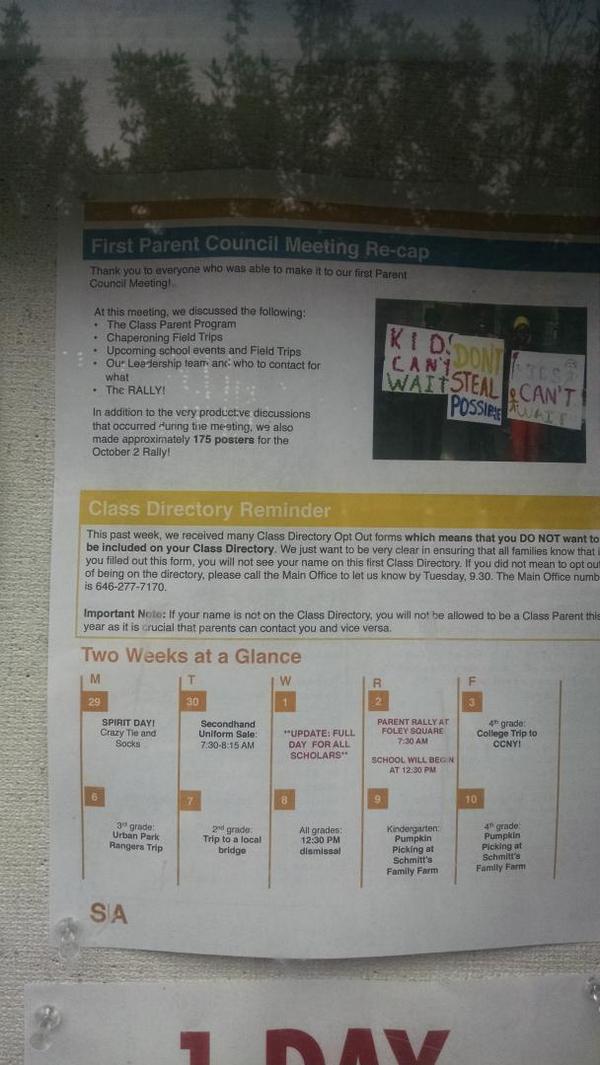
UPDATE:  Courtesy of Mindy Rosier, a special education teacher in a co-located school, the Success Academy in her building has changed their normal Wednesday half-day to today, and the school is providing buses that met at 7:30am to take people to Foley Square.  The event is being billed as a “parent rally,” but with school at half day for the event, there is little doubt that many children will be accompanying them:

SA change of calendar SA bus

28 Comments

Filed under charter schools, Funding, politics, Social Justice

The Moral Perversity of Today’s Education “Reform”

The narrative of school failure that fuels today’s reform policies in education stretches back to the 1983 Reagan administration report, “A Nation at Risk.”  That document asserted that our national education system was so woefully inadequate to the task of educating for the future, that if it had been imposed upon us it “might be considered an act of war.”  The dire warnings have hardly abated, and in 2014, we are frequently told that our children and economy are in danger unless we fully embrace the vision of today’s reformers.  Moreover, today’s menu of reform, common standards, mass high stakes testing, value added evaluation of teachers, elimination of or severe curtailing of teachers’ workplace protections, promotion of charter schools and school choice, are frequently promoted by politicians and policy makers as civil rights issues.  Dr. Julian Vasquez Heilig notes:

Student achievement data in the U.S. show long-standing and persistent gaps in minority versus majority performance (Vasquez Heilig & Darling-Hammond, 2008). Public concern about pervasive inequalities in traditional public schools, combined with growing political, parental, and corporate support, has created the expectation that school choice is the solution for poor and minority youth (Vasquez Heilig, Williams, McNeil, & Lee, 2011). As a result, many reformers have framed school choice as a “civil rights” issue. Scott (2013a) argued that philanthropists, policy advocates, and leading pundits have followed Secretary Arne Duncan’s conjuring of Rosa Parks and the broader Civil Rights Movement as synonymous with market-based school choice.

It is notable that the school choice movement counts on prominent African American and Latina/o leaders to support vouchers, charters, parent trigger, and other forms of choice….In our recent Twitter exchange, (former California State Senator Gloria) Romero framed her bill as a civil rights remedy for low-performing schools. Clearly, African American and Latina/o leaders have formed advocacy coalitions to press for school choice as an alternative to the status quo as our nation has consistently and purposefully underserved students of color (Scott, 2011).

In the 21st century, we are exhorted to education reformers’ policy agenda by language invoking the struggles undertaken by some of our most heroic figures, Dr. Martin Luther King, Jr., Rosa Parks, Representative John Lewis, and told that the best way to close the historic education achievement gap between suburban white children and their urban African American and Latino peers is to embrace highly disruptive change.  We are further told that all of our children are still “at risk” because even in the well-off communities of our upper middle class, students are not learning what they need in a global economy.  Without education reform, our impoverished students will remain locked in poverty, and our comfortable students will slide into stagnation.

For the sake of this discussion, let me do something I never do.  Let me assume, momentarily, that the education reformers are correct.  Assume that common standards and aligned mass assessments will create a seamless system of curricula that challenge students meaningfully, and that those standards encompass a strong vision of student accomplishment.  Assume that adoption of the standards and assessments narrow the differences between states and districts so that expectations remain high for all students.  Assume the assessments are well-crafted and valid measures that stand as good proxies for student learning.  Assume value added measures of teacher evaluation are statistically valid and supported by a robust body of research.  Assume that eliminating the job protections of tenure would mean that vast numbers of students would have greater contact with skilled teachers and that there would be no negative consequences to the rest of the teacher workforce.  Assume that the proliferation of charter schools in urban school districts would give vastly more students options to attend a high performing school and that pressures from school choice schemes would increase the quality of zoned schools.  Assume that urban charter schools fully serve all students who arrive at their doors.  Assume that the advocates of “no excuses” charter schools are correct and that they genuinely demonstrate that closing the achievement gap can be accomplished entirely within school through teachers armed with extremely high expectations.

Assume every last bit of that is true.

Then what?

This is a more critical question than many realize because even if the performance gaps in American education closed overnight, we would still need an economy that can accommodate many more and more equitably distributed high performing graduates than we currently have.  Advocates of current reforms certainly seem to be banking on this.  Jonathan Chait of New York Magazine recently wrote that Eva Moskowitz of the Success Academy charter school network should be considered a “hero of American social justice,” and he declared that her schools have “been a staggering triumph of upward mobility.”  That’s quite a claim to make for a chain of schools whose oldest students have just begun high school, and, in fact, it rests almost entirely about the network’s accomplishments in state administered standard examinations.

However, the attractiveness of the claim is fairly obvious.  If we admit that economic injustice and that institutional racism have a detrimental impact upon students in poverty and students of color, then we have to admit that many of the gains made over the decades by students from upper middle class and upper class backgrounds are at least partially attributable to unearned privileges as well as to individual merit.  Further, we would have to engage in a policy discussion that attempts to alleviate the deprivations of poverty and institutional racism rather than to extol individuals to claw their way past such obstacles largely on their own.  The “no excuses” brand of charter schools claims that they have figured out how to lift all of their students to the same level of education and opportunity as students in the suburbs, and their policy allies are hardly shy about singing their virtues, as represented in standardized test scores:

Former New York City School Chancellor Joel Klein does not want to talk about the complicating factors surrounding Success Academy results, nor does he spend time considering how far such results could be replicated. Success Academy fits into a narrative that believes schools and teachers are fully responsible for providing all of the lift out of poverty.

But, as I said, assume that it is possible and that Jonathan Chait’s premature declaration of social mobility comes true.  What awaits these students?  If current trends in economics do not begin to change soon, the answer to that question is not especially hopeful.  While there is still an discernible “college wage premium” for those who earn four year degrees, since the 1980s, a significant portion of that is more attributable to cratering wages among people without degrees than to significant wage growth among those with degrees:

Wage growth and decline by level of education

Wage growth and decline by level of education

While a Millennial with a college degree earns a wage that is $730 more than a late boomer with the same degree, the wage trends for those with either a two year degree and no degree have dropped precipitously since the early 80s compared with decades of modest but steady growth before.  A college degree may be necessary for a middle class career today, but more and more, it looks as if the degree is more a means to keep from falling into chronic income insecurity rather than as a genuine means of economic advancement.

If the middle class is increasingly a tenuous position in the American economy, it is even worse for the lower middle class, an economic stratum that has traditionally helped families transition from working class to more economically secure circumstances.  According the The Hamilton Project at the Brookings Institution, nearly half of American families live at 250 percent of the federal poverty level (FPL) or below, and 30 percent live between 100 percent and 250 percent of the FPL.  Unlike families below the poverty level, such lower middle class households are equally likely to be headed by a married couple or a single parent, and nearly half have a head of household who has attended at least some college.  The report on their economic struggles notes that, despite living above the poverty line, large percentages of these families rely upon a number of tax and transfer benefits such as SNAP and the Earned Income Tax Credit to remain above the FPL.  Indeed, without many of these programs, the number of families that would slip from an unsecured lower middle class to simple poverty is significant.  As a transition point from poverty to a more secure middle class, the lower middle class is faltering badly.

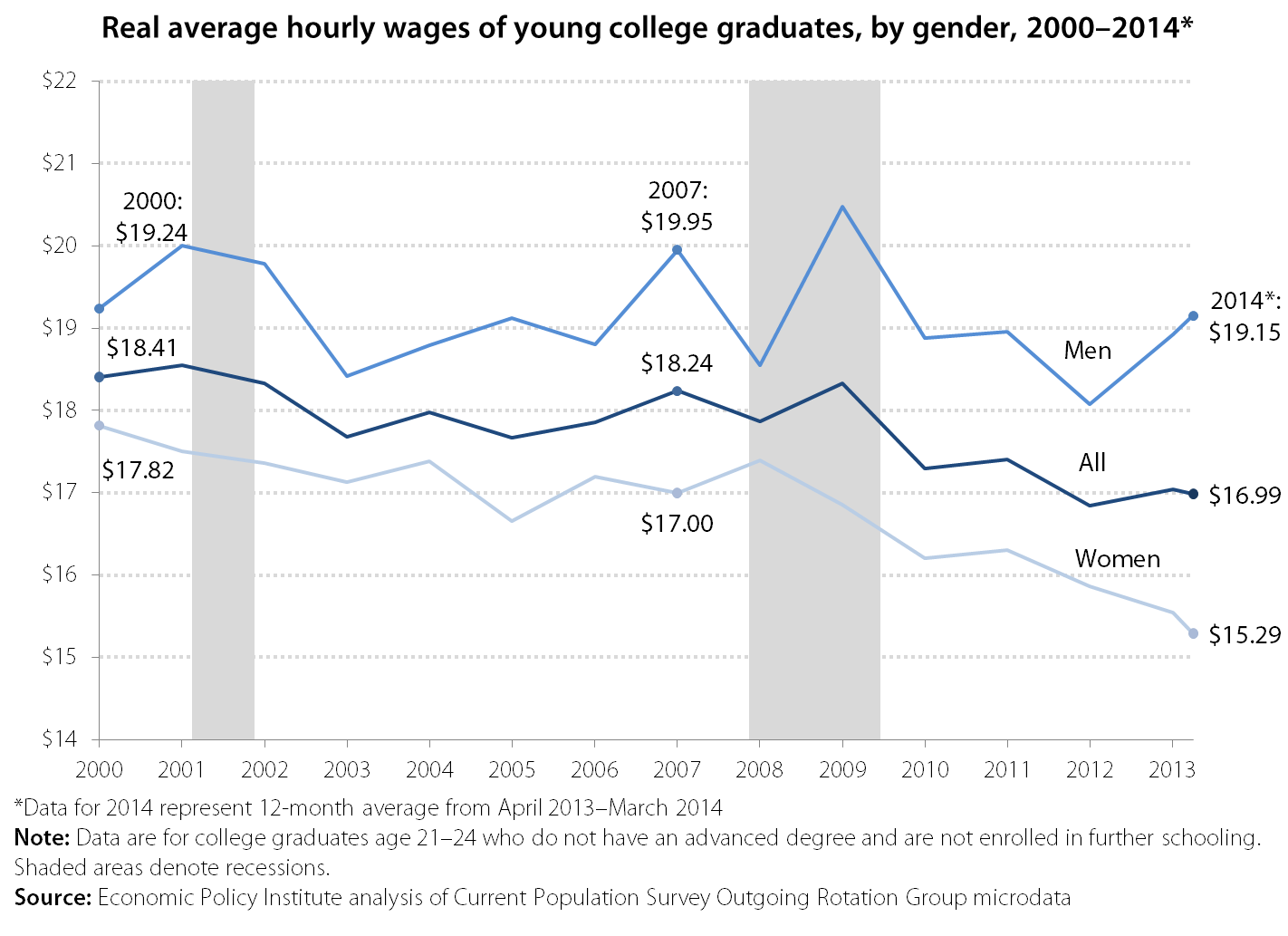
And where is the evidence that the economy is desperate for more workers with bachelors degrees?  It certainly is not in the wages earned by recent college graduates.  According to the Economic Policy Institute, wage growth adjusted for inflation has been nonexistent since 2000, and the downward trend has continued even as the economy has recovered from the Great Recession:

Wages for Recent College Graduates

Wages for Recent College Graduates

If college graduates were in short supply, basic labor economics dictates that businesses competing for them would have to offer higher wages, but even in the vaunted STEM fields, wages, while higher overall than in non-STEM fields, have not grown significantly for most of the 21st century.

Reality suggests that even if all education reform assumptions were true, graduates of a “properly reformed” school system would still graduate into an economy that is not equipped to lift them from poverty and that is barely equipped to maintain those in the middle class where they currently reside.  The recently published study by Karl Alexander of The Johns Hopkins University, The Long Shadow, illustrates just how complex and potentially unsuccessful the rise from poverty can be.  Out of 800 children studied from first grade to their late twenties, only 33 moved from the low income to the high income bracket.  While a good education is certainly a PART of a pathway out of poverty, it is by no means the ONLY way out, and with more and more workers in the economy struggling to keep pace, it is perverse to suggest that we bestow upon schools the sole responsibility for lifting children from poverty.

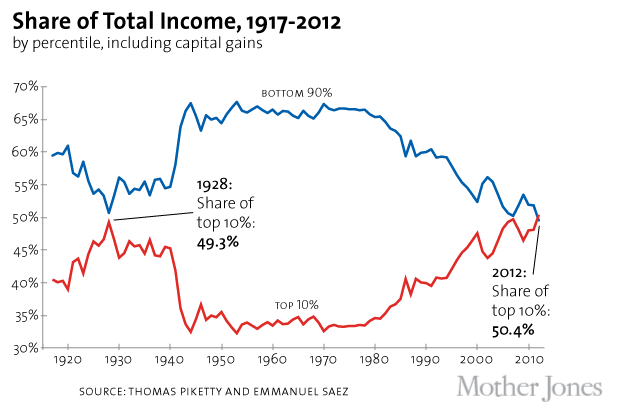
And yet that is exactly what is implicit and even explicit in reformers’ policy objectives and rhetoric.  When Jonathan Chait calls Success Academy a “triumph of upward mobility” he is expressly saying that equalizing standardized test scores through Moskowitz’s “no excuses” methodology will effectively raise the children in her schools to economic security.  But even if everything he says about her accomplishments is true, we cannot blithely assume that this academic accomplishment translates into mobility when the economy shows no indications of providing the kind of reward for work that would translate academic standing into economic standing.  Eva Moskowitz’s scholars still face a world where this trend shows no signs of abating:

Share of Total Income

And, of course, we know that we cannot grant the reformers that their agenda will work because much of it simply will not or is built upon faulty and deceptive claims.  Common standards are being implemented in 45 states simultaneously with virtually no field examination of whether or not they improved instruction at the classroom, school or district levels.  Evaluating teachers based on Value Added Models is problematic at best, statistically invalid at worse. There is scant to no evidence that the elimination of teacher tenure is going to significantly improve the teaching in urban schools, and, in fact, the states with the weakest teacher job protections tend to be states that perform very poorly on national assessments. Success Academy, despite claiming to teach similar high need populations as NYC district schools, has a very high attrition rate, and they do not replace students who leave.  This is a trait shared with many other “no excuses” charter schools who eventually have student populations with many fewer disabled students, English language learners and students on free and reduced lunch than their district counterparts.  They combine the selective attrition of the most difficult to teach students with an extreme emphasis on discipline for even minor infractions of the rules and, at Success Academy and elsewhere, a curriculum aimed at test preparation.  While there is little evidence yet that such test performance training will result in long term economic success, there is evidence that charter school expansion can make segregation actually worse.

And this is where reform advocacy devolves from being merely wrong-headed and into territory that is dangerously close to immoral.  America has one of the highest child poverty rates in the developed world.  It is well established that poverty and its deprivations have serious, often lifelong, impact on people in health, education and economic outcomes.  While improving educational opportunity for children in poverty is a necessary component of expanding opportunity, left to its own, education reform, ANY education reform, cannot make significant dents into the roadblocks that stand before our nation’s poor.  We do not have an economy where the lower middle class can survive on the wages offered for their work.  We do not have an economy where 90% of the wage earners possess more than 49 percent of the total income in the country, and we do not have an economy where the often expressed need for college educated workers has led to growth in income earned by college graduates.

Worse, we have accepted no society wide responsibility to address child poverty in any meaningful way that would lift more children into the economic circumstances more highly correlated with school success than any other factor.  In fact, as a society, we have responded to current economic circumstances with demands to cut discretionary programs in ways that can directly harm children, deepening the already woeful health, education and economic outcomes for children in poverty.  Matt Bruenig of Demos, estimates that with an investment of 1% of GDP in a straight transfer program, child poverty could be cut by 50 percent, almost instantly.  He further points out that our 24 percent of GDP taxation level is among the lowest in the developed world, and it is hard to argue that there is no room for an extra percentage point of GDP.

But there is no political will to discuss this or other direct approaches to lifting people out of poverty in our government.  More accurately, there is no willingness for the major political donors who effectively leverage significant portions of policy in America to do anything that changes either the economy or their taxation levels.  There is, however, significant interest in bypassing those discussions and placing all of the responsibility to both transforming our economy and for lifting disadvantaged children from poverty upon teachers and school.

It fits the meritocracy narrative, and it may tug at our cultural bias towards individualism in the face of daunting odds.

But it is immoral.

6 Comments

Filed under charter schools, Funding, politics, Social Justice

If You Don’t Know What is Happening in Newark, You Should

Newark Public Schools began the school year under the “One Newark” program imposed upon the city by Trenton appointed Superintendent Cami Anderson.  The plan, which is the fruition of the partnership between Governor Chris Christie and former Mayor and current U.S. Senator Cory Booker, essentially speeds up the process by which neighborhood schools are labeled failures and turned over to charter school management and, in theory, opens up the entire city to a school choice plan potentially sending students all across the city in search of schools.  Community concern, parent, student and teacher, has been brushed aside, and the plan has been put into operation this school year.

Bob Braun, retired education reporter for the New Jersey Star Ledger has extensively covered the plan’s roll out on his blog, Bob Braun’s Ledger, and it is safe to say that he characterizes it more as a roll OVER of the entire community.  Schools were slated to close even when succeeding by every reasonable metricAnderson stopped attending monthly public meetings where she was hearing the public’s anger and confusion.  Even Secretary of Education Arne Duncan has expressed concern that Anderson’s plans are being rushed to implementation too quickly.  During the summer months, it was clear that Anderson had no operable plans for the transportation logistics problems caused by potentially busing students from the same families across the city to entirely different schools.  The lack of planning or even of care to plan was further evident this summer, when parents, taking off much needed work hours to participate in a school assignment process, were left waiting for hours in sweltering heat only to be told they would have to return another day.  Mind you, this wasn’t to enroll in an assigned school — it was just to get an assignment at all.  Mr. Braun reported one of just many heart-breaking stories entirely born of the cruelty being imposed upon Newark:

All the parents had stories to tell about the cruelty inflicted by the Anderson/Christie regime on the often poor and predominantly black and Hispanic residents of Newark. Typical was the story told by Marisol Mendez who came to the “One Newark” registration day to find placements for her 14-year-old son, Carlos Perez, and 9-year-old daughter, Emily Perez. The family lives in the North Ward and the children attended Abington Avenue but, when they applied under Anderson’s “One Newark” plan, Carlos, a special education student, they were  assigned to West Side High School and Emily was sent to a South Ward school.

“The placements were inappropriate for both of the children,” says Mendez. “My daughter is not going to take NJ Transit across town and my son needs a self-contained, special education class. He has had one all of his school career.”

Mendez tried to get answers from both the NPS administration and from charter schools. But, she says, two charter school operators–Newark Prep and K-12–told her they couldn’t take special education students. When she tried to speak to bureaucrats downtown, she received this shocking answer:

“They told me I should home-school my children.”

Anderson was upbeat on opening day, despite numerous reports of buses wandering the streets trying to find the students they were supposed to pick up.  But this week, the Newark Students Union tried to prove a point: that even in a politically disenfranchised community like Newark, people love their schools and will use whatever voice they can to make themselves heard.  On September 9th and 10th, students took part in direct action to protest what has been imposed upon them from outside political and economic alliances that see their entire school system as a worthy “experiment” at “creative destruction”.  With threats of citywide boycotts no longer supported by adult-led institutions such as the teachers’ union and the city clergy, these teens decided they had to be on the vanguard of demanding that Newark be heard: as reported by WABC News in New York City.  The student activists protested a second day by blockading the street near Anderson’s office as reported by WNBC the following day.  That protest culminated when police moved in to unchain the protesters, injuring the group’s leader, Kristin Towkaniuk.  Time will tell what will become in Newark, but despite their setbacks, it was genuinely inspiring to see students standing up when few adults are willing to do so.

And we all might have to get used to it.  I hope that I am wrong, but I have a terrible feeling that what is happening in Newark will shortly become the norm in American urban education.  Those schools have been treated to over 31 years of a relentless narrative of failure that has set them up for this kind of externally imposed disruption, and large portions of their populations are alienated constituencies in the body politic who certainly cannot muster the kind of money that drives policy today.

What worries me is that the growing backlash against the common standards, associated testing and use of testing to label students, teachers and schools as “failures” ripe for reorganization and take over is one with teeth because it has been pushed into our politically empowered communities, ones under no threat of state take over and loss of local control.  Peter Greene, a teacher and blogger, wrote about how at least one enthusiastic advocate of current reform trends, Michael Petrilli of the Fordham Institute, appears to be grasping this problem.  The gist is that Mr. Petrilli is now concerned that he and his fellow reform enthusiasts have mistakenly pushed their entire reform package into communities that have always thought highly of their schools, get the outcomes that they wish from those schools, have no easily identified need for drastic changes — plus they vote.  Some of them are even affiliated with powerful corporations who can provide the kind of monetary largesse that gets the attention of policy makers.

I could have told him this years ago if he had asked.  While a super majority of Americans think our schools are doing a mediocre job at best, a similar super majority of parents approve of the schools their children attend, and the Race To The Top package of reforms have taken the failure narrative from urban parents long used to it and pushed it out to the suburbs, whose parents are getting pissed at it.  Petrilli is even willing to admit that most high poverty schools are not failing so much as they are “no better and no worse” than average suburban schools.  However, he then pivots that such schools cannot “settle” for average and arrives at his conclusion that “no excuses” charter schools are the “best” suited for the job of propelling high poverty student populations to match students in affluent communities.

And this is why we can expect Newark to be replicated across the country if we don’t speak up even from the comfortable position of middle class school patrons.  I think Petrilli is correct when he diagnoses the reasons for growing push back against Common Core, testing and school failure.  Reformers have pushed so hard so quickly that they have challenged the politically empowered constituencies that policy setters need in order to stay in office. They certainly cannot charterize school districts where well-off families paid top dollar for homes in a neighborhood specifically because of the neighborhood schools.

But the efforts to turn over more public schools to charter management organizations will not give up easily.  If you have any doubt about that, recall that Wall Street donations pushed over 3 million dollars into the campaign of Shavar Jeffries for Newark mayor because his opponent, now-Mayor Ras Baraka opposed One Newark and its plans to turn over many more Newark schools to charters.  This is in a city where the mayor and school board have no real power over the schools.  There are well-financed and influential operations that want One Newark to become a model for urban education.

If that happens, we will have missed an opportunity.  If suburban parents manage to push back the disruption of current reforms from their communities, only to stand back and allow it to be imposed, full force, on communities without political power, it will be yet one more anti-democratic burden layered upon the backs of these communities.  It will be yet another case where we have abandoned children living in poverty as someone else’s problem, favoring the “easy” answers promised by education “reform” instead of the hard work of re-imagining a society without institutional racism and an economy where genuine opportunity flows upward.

We cannot afford to keep ignoring that.

6 Comments

Filed under Activism, Cami Anderson, charter schools, Chris Christie, Common Core, Cory Booker, Newark, One Newark, politics, schools, Social Justice

Cuomo Lost My Vote, But Teachout and Wu Have Earned It

Back in April, I wrote extensively about how New York Governor Andrew Cuomo lost my vote, not merely in the primary but for any election he intends to run in, ever.  The upshot is that his treatment of public in education in New York State has been so harmful and so devious that it is obvious that he has no interest whatsoever in doing anything for schools other than acting at the behest of his donors.  Governor Cuomo’s budgets have strangled local school aid, and his tax policies have prevented districts from making up shortfalls.  His Common Core implementation has been overly disruptive, and his administration is enthusiastic about using poorly designed examinations to fuel statistically invalid evaluations of teachers.  The governor reached a breath-taking low in Eva Moskowitz’s campaign to prevent her charter school chain from having to pay rent in New York City, and the governor, as reported in the New York Times, did not merely stand by her — he actively made her rally in Albany against Mayor De Blasio happen.  Thanks to his efforts, the state budget REQUIRES New York City to pay Moskowitz’s rent even though her charter school chain is so flush with cash from hedge fund donors that she can unleash a multi-millon dollar attack campaign on almost no notice whatsoever.

All of this is tied fairly directly to the overlap of donors between Cuomo and the charter school market in New YorkCharter school investors have managed to make them work as an investment vehicle for themselves, and they have donated heavily to politicians who they believe will keep ordering more charters to open.  If you want to know how Governor Cuomo will decide on an education issue, you can save yourself the trouble and consult the wish list of “Democrats for Education Reform“, the astroturf organization set up by hedge fund manager Whitney Tilson mostly to put political pressure on Democratic politicians to support unfettered expansion of charter schools and to do so by funneling money donated from interests like the Walton Family Foundation through them and to candidates.

Is it any wonder that when the supposedly independent Moreland Commission to Investigate Public Corruption actually dared to do its job that Governor Cuomo abruptly shut it down?

So Governor Cuomo cannot have my vote, but I am happy to say that Zephyr Teachout and Tim Wu can, and for positive reasons, not simply as protest votes.  The reasons that I am voting for Teachout and Wu:

  • Teachout and Wu offer a positive vision of governance.  Zephyr Teachout and Tim Wu endorse the vision of an “open democracy” that would enhance the values of our society and live up to the towering but often unfulfilled rhetoric of American inclusiveness.  America’s greatest stories are those when we have enlarged the franchise to embrace historically marginalized and ignored populations, and the Teachout/Wu ticket endorses this openly.
  • Teachout and Wu are not bought.  Martin Gilens of Princeton University and Benjamin Page of Northwestern University shook up the political and pundit classes with their study that concludes the United States has become an oligarchy.  Their conclusion was based upon analysis that found policies were more likely to become law when backed by the small proportion of the population that wields economic power — even when such policies are disliked by super majorities of the voting population.  Governor Cuomo, as demonstrated by his public education policies, listens to the donors who can marshal 100s of 1000s of dollars for his campaign coffers even when it comes at the expense of properly funding our schools.  Having candidates like Teachout and Wu on the ballot allows voters to endorse representatives who are not bought and paid for by the current campaign finance system and who have pledged to change that system.  And despite the depressing conclusions about our current oligarchical trend, I see hope because money may sway policy, but it does not always sway elections.  If money always won at the ballot box, then Linda McMahon would be a United States Senator (twice), so voters still hold one power that gets elected officials to sit up and notice: the power to keep them from office via the vote.
  • Teachout and Wu have the expertise we need today.  Zephyr Teachout is a nationally recognized expert in government corruption.  Tim Wu is a fierce advocate of an open Internet and coined the expression “Net Neutrality.”  What are two of the most pressing issues for the future of our democracy?  Corruption and whether or not our digital infrastructure will remain a place of opportunity and equal access.  Unfortunately, our government is not listening to the experts on these issues, falling again for the advocacy of cash.  If the government will not listen to expertise, then it is perhaps time to place expertise in the government.
  • Teachout and Wu believe the education is a vital part of our national commons.  For the past dozen years, our education system has been warped far from its role to provide individual opportunity and to provide our citizenry with the knowledge and skills to fully participate in a democracy.  Current education “reforms” make education serve private interests and, preversely, private profit while claiming the mantra of civil rights and educational opportunity — even while they increase segregation and starve fully public schools of funds and resources.  Teachout and Wu see through that veil to the fundamental threat to public education and, by extension, to the threat to democracy itself.
  • Even if Teachout and Wu lose, we can win something important.  Governor Cuomo has ambitions.  There is little doubt in my mind that he sees the Oval Office in his future.  Given the version of corrupt, oligarchical politics that he represents, it is vital that he not cruise back into office in November.  If Teachout and Wu gain even a significant minority in the September 9th primary, Governor Cuomo’s armor will be tarnished on the national stage, and national Democrats will have to acknowledge that they cannot ignore the liberal vote in pursuit of unlimited campaign cash.  This is not as impossible a task for national Democrats as it may seem.  In poll after poll, the national electorate favors policies that are far more progressive than are politically viable because of the campaign financing system under which we currently suffer.  If voters finally refuse to vote for politicians tied to oligarchs instead of to the people, that can begin to change.
  • When I disagree with Teachout and Wu, the reasons do not make me angry: Governor Cuomo’s education policies are disastrous, and, worse, he arrived at them by doing the will of campaign donors who are serving their own interests.  I do not agree with Teachout and Wu on every single issue, but those positions are the results of their personal convictions and their study.  Those are differences with which I can discuss and for which I have respect.
  • Teachout and Wu dance while campaigning:

I am happy that I will be voting FOR Zephyr Teachout and Tim Wu on September 9th.  If you are a Democrat in New York, I urge you to do the same.  We need to send a message.  We need to vote for values that truly resonate with our own.  We need to say that we demand better.

1 Comment

Filed under Activism, politics, Social Justice

Reflections on Ferguson — What does education mean in a world like this?

On August 9th, 2014, Michael Brown, an 18 year-old African American, was shot dead in the middle of the afternoon by police officer Darren Wilson in Ferguson, Missouri, a suburb of St. Louis.  Eye witness and police accounts of how the fatal encounter began differ, but three different witnesses reported that Mr. Brown had his hands in the air when Officer Wilson fired the shots that killed him.  As news of the killing and its circumstances spread, Ferguson, a community of 20,000 that is two thirds African American, saw protesters take to the streets where, on the first night, some looting occurred leading the police force to use tear gas to disperse crowds.  On the next several days, different protests were met with similar tactics, and then on August 13th, this happened:

ferguson1ferguson 2 ferguson 3

The Ferguson Police Department, a force on 53 officers, only 3 of whom are African American, made a demonstration of military power at their disposal that shocked many across the nation.  Combat body armor, military fatigues, armored vehicles, high powered weapons and police snipers were deployed to “control” a crowd of protesters that were peacefully assembled.  As night came on, the police decided to disperse the crowd again, and these were scenes that the nation saw:

ferguson 4

Police did not limit their use of force and intimidation to protesters: journalists were harassed and arrested in a McDonald’s for not leaving, and a camera crew from Al-Jazeera that was working behind the police barricades and easily identifiable as reporters was tear gassed:

In response to the events in Ferguson, MO, solidarity protests have happened across the country with protesters displaying the “Don’t Shoot” posture that has become symbolic of the circumstances surrounding Mr. Brown’s death:

solidaritysolidarity 2 solidarity 3 solidarity 4

Michael Brown’s death itself and the militarized police response to the following protests raise troubling questions about what it means to educate marginalized populations in the United States today.  Despite legal and legislative victories in the 1950s and 1960s that dismantled America’s legal apartheid state and despite efforts to take White Supremacism out of the mainstream of American social and political thought, it is plainly clear that the lives of minorities, and especially of African American and Latino men, remain in crisis.  This is not to downplay the realities of other racial groups and of women minorities, but it is to highlight a specific set of circumstances that make hope difficult to muster and maintain.  For example, Michael Brown did not have a criminal record.  He was a recent high school graduate, and he was supposed to begin attending college this month.  That didn’t matter, and he was treated as a person of suspect character and potential criminality when Officer Wilson made contact with him for no better reason than he and his friend were walking on the street rather than the sidewalk.  Mr. Brown’s friend and Officer Wilson give very different accounts of how that encounter unfolded (although Mr. Brown’s friend gives a similar accounting of his friend’s final moments as other witnesses), but there never would have been an encounter without Mr. Brown having been approached with suspicion in the first place. This demonstrates a real crisis in American society: to a large portion of the majority population, black men’s dignity and even their lives, do not matter.  It does not matter if Mr. Brown’s life can be shoehorned into a “good kid” narrative, because his presence as a black man on the street was enough to justify suspicion.

Following Trayvon Martin’s death in Florida, NPR host Michel Martin of “Tell Me More” hosted a conversation among a panel of African American reporters and commentators.  One of the most striking segments in the discussion was the concept of “The Talk,” a conversation that many African American parents of all social classes have with their sons.  “The Talk” is so specialized a conversation that many young men’s own sisters are unaware that this is advice that their brothers have received, but it was treated by the panelists as largely common knowledge.  In “The Talk,” parents advise their sons about how to behave if approached by the police, how to conduct oneself in a store so as to avoid accusations of theft (always take a receipt and a bag), how to speak to those in positions of authority.  The gist for general consumption is that it is, even in 2014, not good enough for a black or Latino male to be AS good as his white peers; he has to be absolutely beyond reproach, and, even then, he has to prepare himself for how he will act when, not if, he comes under suspicion merely because he is male and of color.

This is not advice that has a duplicate among white parents in the United States.  Racial hatred in the United States may no longer wear the snarling face of Bull Connor and it may not legally enforce segregation, but it still manifests itself in the daily indignities visited upon men of color and in the knowledge that one can always be suspected of criminality simply by minding one’s own business.  A death by a thousand cuts is still deadly.

While the Civil Rights Movement abolished legal apartheid in the United States, segregation remains a persistent problem because income segregation has been rising ever since we abandoned aggressive integration of schools and communities as a matter of policy. Since 1980, the Residential Income Segregation Index (RISI) has climbed to worrisome levels, and because income and race are proxies, especially in urban communities, communities that are segregated by income are defacto segregated by race.  Mr. Brown’s high school, for example, had only two graduation gowns for the entire senior class to share for photographs.  Young men like Michael Brown are born into communities starved of resources, in possession of crumbling institutions, and segregated from political constituencies that wield influence over decision makers, and when they, through strength of will, talent and with support of responsible adults in their lives, succeed, they are still entitled to be treated as criminal suspects first.

In addition to the individual and collective slights of institutionalized racism, the entire community of Ferguson was given first-hand account of what can happen when people protest such treatment, especially in marginalized communities.  While the militarization of the police in America is not a new subject, it has rarely been on display as obviously and shockingly as in Ferguson, Missouri on August 13th.  Such equipment used to intimidate and harass protesters and journalists in a community of barely 20,000 highlights the disturbing ways in which police forces across the country have been turned into para-military forces and are aided and abetted by federal programs designed to get surplus military hardware into the hands of even small town police departments.  While these resources have most commonly been used, unnecessarily, in drug related raids, the police in Ferguson decided to put them in full view of the nation, making visible the military style police tactics that have afflicted high poverty communities for some time.  It is not merely the presence of such arsenals and their potential use that is worrying, it is the fact that such arsenals represent a tragic shift away from the proper role of policing as serving and protecting a community to the role of occupying that same community.  Officers expected to use and deploy these tactics are themselves transformed via training and experience into a force tasked with putting down disorder; hence, police snipers on armed vehicles taking aim at lawfully assembled protesters and police harassing, arresting and tear gassing journalists.

What has changed is not the treatment of communities (the ACLU made it very clear that militarized police forces take heavy tolls on communities of color), but we can no longer pretend that we do not know.  Even a police department of 53 officers has high powered weaponry and armored vehicles, and they are willing to use them.  The consequences are appalling, and the fact that a democratic society tolerates those consequences is even worse.

Which is what brings up the question of education and what it means to appeal to schooling this society.  School is an enterprise that is premised around hope and purpose.  In order to truly engage with the operation of school, a child has to believe that there are reasons and purposes that make sense and has to have hope that school will lead somewhere desirable.  For very young children, it is possible to appeal to their need for connection and to their desire for adult approval, and, even then, deprivations from extreme poverty and lack of familial resources and stability can greatly complicate teachers’ work.  For adolescents, however, those complications are layered with the child’s own awareness of how the world has worked around him.  Seeing and believing that education holds promise when one has been subjected to “stop and frisk” policies while simply talking to friends on the street or when one’s neighbors have been subjected to military styled raids by the police takes extraordinary optimism and an ability to project a future that is not based on local experience of family and friends.

Such matters are made even harder when an unarmed teen is killed in the streets and when the protests in response are put down with a show of military power in a town of only 20,000.

That we blame young men raised within and conscious of such injustice for having trouble with optimism is one of our country’s cruelest jokes.  Education in this context is necessarily a complex enterprise with no easily scaled solutions, requiring a lot of hard work with each student as an individual.

But a growing amount of our attention in urban education is being consumed by charter school chains who claim, in essence, to be miracle factories.  As proof, they point to student populations that are largely minority and to scores on standardized tests that match or exceed suburban school systems.  Praised by politicians and recipients of lavish funding from venture philanthropists, such schools often enjoy well-appointed facilities and offer well-crafted optics of minority students in well-disciplined classrooms.  On the surface, their claims of having “figured out” urban education look plausible, but the reality is much less miraculous than that.

First, while students in most states are awarded seats in charter schools by lottery, it is not true that the population applying is identical to the general population in the school district.  At a minimum, such students have parents and/or guardians who are aware of and desirous of the promise of a charter school.  Second, student attrition at the charter school networks that claim such miraculous results is typically higher than in district schools, sometimes shockingly so, and the patterns of attrition are not random leading to classes with significantly fewer students who qualify for free and reduced lunch, who have learning disabilities and who are English language learners.  Third, many such schools do not “backfill” vacated seats which means that, paired with non-random attrition, the remaining classes of students are those who entered the school more likely to perform well on standardized tests.  Fourth, many of these schools dedicate substantial time to test preparation and to creating a culture where standardized test performance is the sine qua non of their mission.  In New York State, fully public schools are not allowed to spend more than 1-2% of the academic year in test preparation, but no such limit exists for charter schools.  These are all matters I tried to remind former New York City Schools Chancellor Joel Klein of when he enthused about Success Academy’s recent test scores on Twitter:

Mr. Klein is intelligent enough to know the meaning of the figures and reporting that I put in front of him.  He also knows that “replicating” the results of Success Academy is an inherently limited prospect because even if the charter school chain expanded to take in all of the children that it is willing to enroll and keep, that will leave all of the students Ms. Moskowitz’s schools have pushed out over the years.  Mr. Klein’s call to “replicate” this model is a call that will leave fully public schools full of students who are MORE poor, MORE disabled and LESS proficient in English than they are now even with New York City’s shockingly high RISI.  And I have never known Mr. Klein or his allies to advocate for funneling more academic resources, better teacher support or upgraded facilities to the district schools that would remain in such a system.  Indeed, as Bruce Baker of Rutgers University demonstrates, Governor Cuomo has made funding for fully public schools worse across the board without a peep of protest from Mr. Klein.

And it is important  also to consider what is being praised as a “remarkable” accomplishment.  The Success Academy chain does have noteworthy test scores, but those are inherently limited markers of student achievement and capabilities.  According to my colleague Dr. Christopher Tienken at Seton Hall University, for a multiple choice standardized test to thoroughly measure a SINGLE discrete skill, it takes twenty-five questions:

Either a test is thoroughly-designed and covers very few skills, or it covers many skills poorly. While students in the “miracle” charter schools gain very high test scores on the standardized tests, the more time in school that is aimed at preparing for the test formats, the less time is spent on creative, critical and flexible thinking.

What is galling, therefore, is not that such schools demonstrate achievement in standardized testing measures.  What is galling is that they are touted as having found “THE” answer when it comes to educating students who live within urban poverty, and that they have received both political and philanthropic favoritism even as their models for accomplishment push more and more disadvantaged students into zoned schools that are starved for resources and community.  Meanwhile, so long as these schools are touted as having found “the secret sauce” society at large continues to ignore the deprivations of poverty, insisting that with enough “grit” ANYONE can climb out of poverty.  Taxes don’t get raised on the wealthy.  We ignore how wages have stagnated for decades, the near destruction of the lower middle class and how a college education is more a means of not falling into chronic economic insecurity than a way to get ahead.

Most importantly, we can continue to ignore how income segregation results in racial segregation.  We can pretend that communities which are predominantly minority are not routinely treated as if everyone in them is a criminal suspect.  We can convince ourselves that there is no society wide responsibility to expand opportunity, alleviate the deprivations of poverty, fully fund our education system or directly confront the racism that still plagues how our institutions interact with people of color. In the minds of today’s education “reformers” none of that matters – schools and teachers and kids are supposed to climb up from underneath all of it with nothing more than a tough attitude and a battery of standardized tests.  And throughout all of this, teachers and students are offered no additional support, just more testing and more responsibility, and when the results do not happen quickly, teachers and students are labeled as failures.  It is like adding extra weight to Sisyphus’ burden and then blaming him for the existence of the stone.

Education is a hope-based enterprise.  The most dedicated and talented teachers can inspire hope in the young people under their care, but if society shares no responsibility for that hope, it cannot last.  Michael Brown is dead because he lived in a society that demanded he, and every man with his skin color, prove his innocence at all times.  The community that rose up to protest that fact and to insist that his life had value because ALL lives have value, was subject to militarized police brutality. Until we demand that the powerful in this country stop pushing comic book narratives and stop insisting that all we need for our urban youth is a “no excuses” school, until we value the lives of all of our children, until we admit to collective responsibility, in partnership with teachers and schools, for children, and until we pry racism out of our common institutions, this will not get better.

Those who look for simple answers that demand nothing of themselves and everything of teachers and students perpetuate this cycle.

4 Comments

Filed under #blacklivesmatter, Activism, charter schools, politics, schools, Social Justice, Uncategorized

Messages From the Tenure War – “Teachers Aren’t Special”

When Campbell Brown goes on air to discuss the lawsuits against teacher tenure protections, she knows how to comport herself.  First, it is very important to profess her respect for teachers and the teaching profession and to make it clear she just wants teaching to be a well-compensated and treated profession.  Then she has to express a completely sincere desire that the profession improve for the sake itself and the children. At this point, she has to point out that the laws she is suing to overturn stand in the way of that improvement and that it is simply ridiculous to oppose that effort.  When on The Colbert Report, she conveyed this message by leaning forward and pitching her voice for maximum earnestness as she stated that everybody agrees that the due process and “last in first out” provisions are “just anachronistic.”  A media representative has to make the pitch appealing to the broadest possible demographic.

Her general audience supporters are under no such restraints.

I’ve been reading #WithoutTenure on Twitter and made the very poor choice to read comments on some news articles about the lawsuit.  Obviously, some people support Ms. Brown’s efforts, and that  is expected in a democratic society.  What I did not expect was the periodic denigration of teachers as a whole and fairly serious hostility to the concept that teachers have job protections  granted through tenure that the respondents do not believe other professions have.  A refrain that sums up the attitude is “Teachers aren’t special.”

Teachers aren’t special.

Hostility towards teachers’ due process protections is necessarily a complex phenomenon.  President Ronald Reagan made contempt for unionized workers fashionable in his first administration, and since the late 1970s, public approval for organized labor has ticked down from 59% to 52% with some fluctuations along the way.  Public disapproval, however, has steadily gained from 31% to 42%, meaning that there is decreasing middle ground in public opinion on unions at a time when less than 11% of the total workforce is unionized.  Some of the contemptuous remarks certainly stem from the growth in hostility to unions.

Some who expressed that opinion based it on their belief that teachers are given undue job protections via tenure that other professional workers in the economy do not have.  Part of this is stems from the popular misconception, encouraged by Ms. Brown, that a teacher with tenure has “permanent lifetime employment” and is shielded from removal even in the face of serious incompetence or misconduct.  Another part stems from a belief that the critics do not possess any particular protections in their employment, even in highly skilled fields, and a demand to know what about teachers makes them deserve what the others do not have.  This is a particularly odd and perhaps uniquely American aspect of class relationships.  Instead of asking why their employer or profession does not do more to protect and compensate them fairly, many Americans demand to know why others are better protected and/or compensated.  We tend to fight our class wars against each other in the United States.

I cannot solve that tangled mess in this essay, but I do want to examine one of its consequences: Teachers aren’t special.  It sits me back on my chair a bit, to be honest.  Wrapping my head around it is nearly impossible as I have spent every working day of my life since 1993 around teachers, either as a high school English teacher or as a graduate researcher or as a college professor.  I have met, worked with and taught some incredibly special teachers over the years, and I am continuously impressed by the caliber of young person who shows up at our teacher education program each Fall looking to start her or his professional career.  These are people who could have sought more lucrative careers , and having worked with them I do not doubt that most could have been successful in those careers.  However, something draws them to teaching: a passion for learning, for a subject matter and for the transformational power that it holds, for children and their growth.

Gary Fenstermacher, Richard Osguthorpe and Matthew Sanger, writing in the Summer, 2009 issue of Teacher Education Quarterly, discussed how teaching not only involves  content related to morality but also demands moral characteristics of teachers:

Just how teachers attended to moral matters became more apparent as we examined the connections between moral manner and moral content more closely.  We sought to “see” the ways they imparted moral ideas and ideals to their students.  We encountered six methods used by most or all of the teachers as they went about the work of teaching their students.  They are: 1) the construction of the classroom community, 2) showcasing specific students, 3) design and execution of academic task structures, 4) calling out for conduct of a particular kind, 5) private conversations, and 6) didactic instruction (Fenstermacher, 2001).  These six methods suggest how moral traits and dispositions of teachers might be reflected in their practice.  They also suggest an important interplay between moral content and moral manner. (p. 12)

The authors go on to ask their central question, “how do we seek ensure that those who teach possess a moral manner that is proper and appropriate for the tasks of teaching, and that they learn to employ this manner properly and appropriately in the course of instruction?” (p. 16)  This is something much deeper than professional ethics, although those matter for teachers as well, because we entrust that teachers will be involved in the implicit of explicit instruction of moral conduct for their students through both the curriculum and the environment in which it is taught.

It is very clear to me what it is that makes teachers “special,” and it is the sense that they are as much in a vocation that is of service to others as they are in a profession in service of themselves.  When people dismiss the due process rights in tenure by saying “teachers are not special” they are simply dead wrong.  It is true, however, that teachers are not unique in this central premise of vocationalism.  Many, in a wide range of professions, are driven by the call to serve purposes greater than themselves.  There are doctors who seek to aid those in lands afflicted by disease and warfare, and there are medical practitioners who eschew more lucrative practices in the effort to provide needed general and family practice.  There are lawyers who dedicate themselves to low cost or pro bono services for the indigent , and there are attorneys who seek to use their talents to right great wrongs.  Fields like nursing and social work are full of people who are on the front line of patient and client care and who are primarily motivated by their desire to help those in great need and with little voice.

Teachers are special.  They are not unique in how special they are.

Which still leaves an open question:  If teachers are special in a way that is shared across other professions what is it about tenure and its due process protections that matter for teachers?  There is no single answer to this.  However,  not only do teachers need strong due process, but also good teachers need it even more.  Reflecting back upon what Fenstermacher, Osguthorpe and Sanger wrote, it is clear that good teachers must be motivated to rock the boat on behalf of their students.  Having a “moral manner” is not simply about appropriate behavior, it is about appropriate advocacy that will sometimes run afoul of administration and community expectations.

A good teacher will question curriculum priorities and instructional materials on behalf of students and their needs.  A good teacher will question spending priorities within a school a district if classroom needs are neglected.  A good teacher will advocate that students receive special education, ESL and enrichment materials that will enhance their experience and provide them with opportunities to learn.  A good teacher will help unpopular viewpoints gain a voice within the class regardless of the teacher’s or the community’s views.  A good teacher insists on the integrity of instruction and assessment even if it means a popular student athlete is made ineligible to compete or if it means the child of a local politician does not pass a class.  A good teacher collaborates with peers and experiments with new teaching strategies and constantly questions whether or not what is happening in the classroom, the school and the community is what is best for students.  A good teacher will make people uncomfortable at least some of the time.

A good teacher must do all of these things even as he or she is an employee of a system controlled and administered via local politics.  Teachers, of all of the moral vocations, are the most public and the most in need of the ability to openly question and confront on behalf of students and learning.  Taking away the due process rights of tenure diminishes the ability of teachers to buck the system and to make necessary waves for the good of their students.

Reference:

Fenstermacher, G.D., Osguthorpe, R.D., Sanger, M. (2009). “Teaching Morally and Teaching Morality.” Teacher Education Quarterly, 36 (3), 7-19.

1 Comment

Filed under Activism, politics, Social Justice, teaching, Unions