Category Archives: Testing

Preparing for the Post-NCLB World

Barring substantial shifts in the political landscape, both houses of Congress are expected to vote on the re-authorization of the Elementary and Secondary Education Act which has just come out of the conference committee.  If passed in both the House and the Senate, the bill, dubbed the Every Student Succeeds Act, is expected to be signed into law by President Obama before the end of the year.  This will officially usher us into the post No Child Left Behind era, and, as is typical with legislation nowadays, there is something in the final product to frustrate and worry pretty much everyone.  While ESSA represents tangible improvements over the widely hated NCLB, there are worrisome elements in it and a great deal of larger and more fundamental aspects are handed over to the states where we can probably expect prolonged fights over implementation.

Nineteenth Century lawyer-poet John Godfrey Saxe noted, “Laws, like sausages, cease to inspire respect in proportion as we know how they are made.”  He probably had something like the agonizing and lengthy wrangling over rewriting the Elementary and Secondary Education Act in mind when he said it, especially this final stretch when lawmakers will vote on a 1000 page long conference bill they have not read thoroughly.  And, indeed, it seems some choice bits got chopped up and inserted into this final version, notably a chance for private financial interests to make money on public education dollars.

we-re-making-sausages-o

Consider language for Title I, Part D for prevention and intervention programs for children and youth who are neglected, delinquent, and at risk, section 1424 allowing funds to go to “pay for success initiatives,” and similar language in Title IV, Part A.  ESSA defines a “pay for success initiative” as a “performance-based grant, contract, or cooperative agreement awarded by a public entity in which a commitment is made to pay for improved outcomes that result in social benefit and direct cost savings or cost avoidance to the public sector.”  The gist is that private entities can put up money as a loan for a public program and if they save money in the process of being more effective or more efficient than the public sector, they can keep a portion of the money saved. This is the kind of creative use of private philanthropy and financing that is supposed to incentivize deep pocketed entities to do good – and end up doing right well in the process.

Goldman Sachs experimented with the model in Utah by financing preschool for 595 additional children in a well regarded program, 110 of whom were expected to need special education services. After a year in the Goldman sponsored intervention, only 1 student entering Kindergarten was found to need those services, and the financial giant will now be paid $2500 per pupil per grade without special education services until students reach sixth grade when the amount of money will go down. That’ll come to $1.9 million dollars on top of the original money loaned and paid back.

Fred Klonsky, a retired Chicago teacher and current blogger, is highly skeptical both of the payments back to Goldman and of the claim that 109 students out of 110 were no longer in need of special education services after a year in preschool.  I have to admit that I share that skepticism and certainly think that social impact bond financing allowed in ESSA will require very vigilant monitoring to make certain outfits like Goldman Sachs are not creating perverse incentives to simply overlook a need and “save” money.  They are a largely unproven vehicle for creating social change, although some are organized to minimize risk for private capital while giving them a lucrative upside.  It isn’t hard to imagine who lobbied to get that language inserted into the Title I and Title IV changes then.

For that matter, as Mercedes Schneider notes in her first assessment of the bill, charter schools get a big, wet kiss, and there are grants that read as friendly to Teach for America’s role in “teacher preparation”.

So – sausage.

That said, there are many changes to the current education landscape contained in ESSA, many of them positive.  The Badass Teachers Association has a solid look of the good and the far less than good in the bill.  On the troubling side, ESL students are potentially labeled using very crude means, encouragement of merit pay, misplaced confidence in adaptive assessments and misgivings that “individualized instruction” will lead to more time in front of screens rather than with teachers, and, of greatest concern, continuation of NCLB’s requirement of annual testing of every child each year between grades 3 and 8 and once in high school and it caps alternate assessments for disabled students.  However, ESSA spins much more authority for accountability and assessments to the states, includes mechanisms to improve teacher workplace conditions, prohibits the federal DOE from interfering in state laws regarding parents opting children out of state assessments, and there are positive developments for homeless children, impact aid, Native American education, state innovation and local flexibility.

Most notable, however, are the repeated smack downs of the federal Department of Education and clear prohibitions on the Secretary of Education taking an active role in shaping state policies regarding standards, assessments, and accountability systems.  Consider this from Title VIII, section 8526:

No officer or employee of the Federal Government shall, through grants, contracts, or other cooperative agreements, mandate, direct, or control a State, local educational agency, or school’s specific instructional content, academic standards and assessments, curricula, or program of instruction developed and implemented to meet the requirements of this Act (including any requirement, direction, or mandate to adopt the Common Core State Standards developed under the Common Core State Standards Initiative, any other academic standards common to a significant number of States, or any assessment, instructional content, or curriculum aligned to such standards), nor shall anything in this Act be construed to authorize such officer or employee to do so.

I believe that when historians write the story of the Test and Punish Era of public school reform, this language will be noted as the “Take A Seat, Arne” Act of 2015.

mrbeandanc_KrxTTijg

Education Week noted a week ago that “accountability hawks” were already unhappy with the information coming out of the conference committee.  Sandy Kress, an original designer of NCLB, worried that states were going to be allowed to create accountability systems not based on student learning.  Chad Aldeman, a partner at Bellweather Education Partners, worries that states will give in to inertia and not push for improvements for their most at risk students.  Meanwhile, the National Association of Secondary Schools Principals applauded the available framework, noting the removal of Annual Yearly Progress (AYP) requirements and “unworkable” school turnaround models.  The National Governors Association announced full approval for the conference bill, saying that it “restored the balance” between Washington, D.C. and the states.

So – is NCLB well and truly dead?

Not exactly, no.

While some of the worst provisions of NCLB have finally had a stake driven into their hearts, the states are still required to test and the create accountability systems, so the upshot is that making sure both those tests and the systems are fair and based upon what schools and children need will now have to be done state by state.  Monty Neill of FairTest notes that this will not be a simple matter: States still have to rank schools largely on test scores, there is ambiguity on how “additional indicators” for English Language Learners will be weighted compared to test scores, states have to identify the bottom 5% of schools based on test scores and intervene with measures designed by the state.  In other words: whether or not schools find themselves under a test and punish regime or in a monitoring and support system will largely depend upon how states treat their newly reclaimed authority.

There is no reason to believe that the advocates of test and punish will pack up shop now that the Secretary of Education has been severely limited.  After all, federal help was useful for the spread of the Common Core State Standards, the testing consortia, and the adoption of growth measures in teacher evaluation, but it was hardly to only entity to help.  Both the National Governors Association and the National Council of Chief State School Officers were on board with the Common Core State Standards and the shared assessments.  The Gates Foundation is certainly active in state and local education policy, using grants and other leverage to push through favored policies. Powerful private interests have financial stakes in declaring public schools failures and turning them over to private management.  They give lavishly to their allies in state government.  Think about governors like Andrew Cuomo of New York, Dannel Malloy of Connecticut, Chris Christie of New Jersey, and Scott Walker of Wisconsin – advocates of our fully public schools have our work cut out for us.

So – roll up your sleeves wherever you live and work.  This has only just started.

2 Comments

Filed under Arne Duncan, charter schools, Chris Christie, Common Core, ESSA, Gates Foundation, NCLB, Opt Out, PARCC, politics, standards, Testing, VAMs

Who Was The Last “Education President”?

On September 25th, 1988, Vice President George H.W. Bush, then the Republican nominee for President, was in a debate with his Democratic Party rival, Massachusetts Governor Michael Dukakis, and declared that he wanted to be “The Education President.”

I want to be the education President, because I want to see us do better. We’re putting more money per child into education, and we are not performing as we should. […] And I would like to urge the school superintendents and the others around the country to stand up now and keep us moving forward on a path towards real excellence.

Eventually, the Republican nominee would become President George H.W. Bush, and his education agenda was a continuation of the path forged under Ronald Reagan that led to the era of test-based accountability.  Presidents and Presidential aspirants have all set their sights on making an impact on our nation’s education system, whether it was Bill Clinton calling for 90% graduation rates and “meaningful” national examination standards, or George W. Bush claiming standardized test scores were stagnant and promoting new accountability for teachers and students – including a system of rewards and punishments that would become known as No Child Left Behind, or Barack Obama promising more aid to the neediest schools, touting merit pay plans, and decrying too much focus on testing.

But who was the most recent occupant of the Oval Office who deserves the title “The Education President”?  When was the last time an American President signed into law an education bill that has had a substantial, sustained,  and positive impact upon education?

Gerald Ford.

This is not sarcasm because it was President Gerald Ford who, on November 29th, 1975, signed PL94-142, also known as the Education for All Handicapped Children Act, into law.  President Ford issued a signing statement expressing his concern that the law would cost too much, but over its 40 year history and re-authorization as the Individuals with Disabilities in Education Act (IDEA), the legislation has improved educational opportunities and outcomes for millions upon millions of students who had previously faced neglect and discrimination within school.  While the law continuously needs reflection and improvement, especially in the realm of federal funding which has never approached the 40% promised by Congress in 1975, the legislation remains a landmark that provides the basis for a vastly expanded mission for our nation’s schools and progress towards fulfilling opportunity for all.

Ford

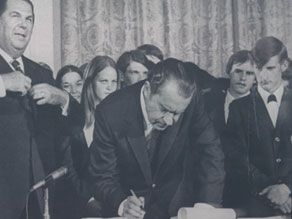
PL94-142 was not an isolated case of federal legislation signed by the President improving our nation’s schools.  President Richard Nixon signed the Rehabilitation Act of 1973 that included Section 504, providing protection from discrimination based on disability when an employer or organization receives federal funding.  Section 504 meant that schools could not bar students with physical and mental impairments from receiving an education and required them to provide a free and appropriate public education (FAPE) to all qualified students.   Prior to signing this legislation, President Nixon signed the Education Amendments of 1972 which included Title IX, stating, “No person in the United States shall, on the basis of sex, be excluded from participation in, be denied the benefits of, or be subjected to discrimination under any education program or activity receiving Federal financial assistance.”

Nixon

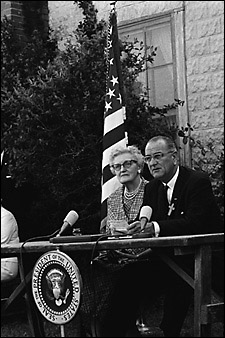
President Lyndon Johnson, following the landmark Civil Rights Act, signed the Elementary and Secondary Education Act (ESEA) into law on April 11th, 1965.  The original law provided federal funds for research, strengthening state departments of education, and, perhaps most importantly, funding to assist the schooling of low income students, and among its earliest amendments were provisions for handicapped children and bilingual education programs.  The Title I provisions, especially, noted the inequitable ways in which schools are funded using property tax revenues that immediately place communities with high percentages of low income families at a disadvantage.  Although the ESEA has since been subsumed by the standardized test based accountability regime of the 2001 amendments known as No Child Left Behind, the original legislation was intended to help with President Johnson’s “War on Poverty” by bringing resources that only the federal government could leverage to schools serving our neediest children.

Johnson2

Indeed, that focus upon using federal reach and the enforcement of civil rights to expand resources available to schools while requiring them not to discriminate upon race, gender, language spoken, or disability status marked a robust period of education legislation premised upon equity and the recognition that certain populations of students were historically marginalized and required direct action of the law aimed at states and municipalities that might have otherwise ignored them.  In many regards, these efforts were astonishingly successful.  In 1971, before the passage of Title IX, women were 3.7 million of 8.9 million college students.  In 1991, they were 7.7 million of 14.1 million.  Before the passage of PL94-142, 5.9% of students in public schools were identified as disabled with no data available on the numbers with specific learning disabilities.  In 1989, 11.4% of students were identified as disabled, including more than 2 million classified with specific learning disabilities.  These efforts were substantive, aimed at increasing access and equity, and their positive benefits have continued for decades and likely more to come.

Since then?  Not so much.

President Ronald Reagan, after campaigning on abolishing the newly minted cabinet seat of Secretary of Education, set education policy away from equity and opportunity and into standards and accountability with the harsh language of school failure that has dominated our discussion  ever since the 1983 publication of A Nation At Risk:

If an unfriendly foreign power had attempted to impose on America the mediocre educational performance that exists today, we might well have viewed it as an act of war. As it stands, we have allowed this to happen to ourselves. We have even squandered the gains in student achievement made in the wake of the Sputnik challenge. Moreover, we have dismantled essential support systems which helped make those gains possible. We have, in effect, been committing an act of unthinking, unilateral educational disarmament.

Our society and its educational institutions seem to have lost sight of the basic purposes of schooling, and of the high expectations and disciplined effort needed to attain them. This report, the result of 18 months of study, seeks to generate reform of our educational system in fundamental ways and to renew the Nation’s commitment to schools and colleges of high quality throughout the length and breadth of our land.

The Reagan Administration followed in 1988 with amendments to the ESEA requiring states to “document and define” academic achievement for disadvantaged students using standardized test score measures, and ESEA funds began being tied to academic performance of disadvantaged children.  President George H.W. Bush proposed his “America 2000” legislation calling for national standards and testing of students but which failed due to conservative opposition in the Senate.  Standards based education policies were similarly advanced, however, by President Bill Clinton whose “Goals 2000” agenda focused upon student achievement, tougher academic standards, application of those standards to all students, and monitoring reform efforts via standardized testing.

The stage, then, was well set by three previous administrations for the 2001 re-authorization of the ESEA which was touted as “No Child Left Behind” by President George W. Bush.  NCLB required all schools to demonstrate annual yearly progress for all students in all subgroups, and failure to meet AYP for five years in row could result in school closures, turning schools over to private charter operators, or giving school operation to private or state managers.

Upon passage, the law enjoyed support in both parties and numerous civil rights organizations, and the logic of that is not difficult to understand.  By 2001, wide gulfs in test measured achievement remained stubbornly persistent between well off, mostly white, suburban communities and their poor, most African American and Hispanic, urban counterparts, and the language of NCLB demanded that states and municipalities address that through accountability systems with little wiggle room.  Given the undeniable need for federal action in both civil rights and expansion of educational equity in the 1960s and 1970s, the federal accountability in NCLB was a logical, if ill-fated, marriage of federal standards and accountability efforts with vigorous enforcement from Washington.

The ill-fated portion of that assessment lies with what was obvious from the beginning: by tying lofty goals to punishing consequences dependent entirely upon the results of standardized testing, NCLB unleashed entirely predictable and increasingly damaging consequences to the depth and breadth of curriculum enjoyed by children, especially children in schools labeled as struggling:

In contrast, since the advent of No Child Left Behind (NCLB), with its high stakes for schools, the traditional pattern of time allocation across subjects in elementary schools has changed markedly. Five years into NCLB, researchers found that 62 percent of a nationally representative sample of all districts in the United States—and 75 percent of districts with at least one school identified as needing improvement—increased the amount of time spent on language arts and math in elementary schools. These increases were substantial: a 47 percent increase in language arts and a 37 percent increase in math. Correspondingly, these districts decreased time allotted to other subjects and activities, including science, social studies, art, music, physical education, and recess (McMurrer, 2007).

President Barack Obama campaigned in 2008 as a Presidential aspirant who was aware of these fact, deriding the test and punish focus of the law, the lack of resources given to schools and teachers working with struggling students, and the teaching to the test that was incentivized by the law:

“Math and science are not the opposite of art and music. Those things are compatible and we want kids to get a well-rounded education. Part of the problem we’ve had is that ‘No Child Left Behind,’ the law that was passed by Bush, said we want high standards, which is good, but they said we are going to measure those high standards only by a single high stakes standardized test that we are going to apply during the middle of the school year…a whole bunch of schools said we gotta teach to this test, and art and music isn’t tested… It’s a shame.”

In reality, the administration of President Barack Obama, while loosening some of the proficiency targets of NCLB, has plainly made the most problematic aspects of the law even worse, and quite likely earning President Obama the label as the worst President for education policy in the post-World War II era.  President Obama, acting through Secretary of Education Arne Duncan, has made testing an even bigger focus of school by coercing states to adopt invalid and unproven measures of teacher performance using standardized tests.  Instead of merely working in a school that faces negative consequences based on test scores, teachers themselves face career sanctions if they do not “adequately” raise student test scores.  President Obama’s Department of Education has lavished money and favorable policies upon the charter school sector while thoroughly failing to oversee the money it has dispersed.   The administration was so interested in fulfilling the long held goal of national standards, that it helped the Gates Foundation push through rushed and unproven standards to almost all states by using the promise of federal grants and waivers from NCLB provisions.  These changes have been touted as voluntary and “state led,” but when Washington state did not pass legislation tying teacher evaluations to student growth measures, the Obama DOE brought down the hammer and revoked its waiver.

Today, 32 years after the beginning of the standards and accountability movement, 14 years into the test and punish era of school accountability, and almost 7 years into the Obama administration’s doubling down on standardized testing to measure teachers, teacher morale is at all time lows and the nation’s teacher preparation programs are struggling to find candidates.  Far from continuing the vital work of expanded opportunity and equity that spanned administrations from President Eisenhower’s use of federal troops to desegregate Central High School in Little Rock, Arkansas to  President Ford’s signing of PL94-142, the past five administrations have slowly tightened the grip of standardized testing on our schools until they have become a warped goal in and of themselves and have damaged the very children supposedly helped by them.  Standardized tests used to sort children have always disproportionately harmed poor children and children of color, and the frequent, high-stakes, accountability testing of NCLB has both narrowed the curriculum and slowed progress in closing the achievement gap, progress that saw its most sustained and dramatic gains in the 1970s.

So what has been missing from the education policies of Ronald Reagan, George H.W. Bush, Bill Clinton, George W. Bush, and Barack Obama? Equity.  The educational policies that came to fruition via the original ESEA, Title IX, Section 504, and PL94-142 all were premised on the federal role of expanding resources and equity for children facing discrimination in school and society at large.  They marshaled funding and rules for schools so that they could not deny either access or equity, and they tasked the federal government with treating these as matters of civil rights.  More recent “reform” efforts are entirely about accountability without increasing the resources available to schools in order to meet those goals in a meaningful way, nor does “reform” specifically address the conditions within which schools exist, leaving them with the sole responsibility to uplift all children regardless of circumstance.  Where once federal education efforts sought to increase access to education and to increase the resources available for that education, today it demands that school increase performance in all situations without any other state actor taking responsibility for the well-being of the children in school.  David Berliner noted this in 2006:

It does take a whole village to raise a child, and we actually know a little bit about how to do that. What we seem not to know how to do in modern America is to raise the village, to promote communal values that insure that all our children will prosper. We need to face the fact that our whole society needs to be held as accountable for providing healthy children ready to learn, as our schools are for delivering quality instruction. One-way accountability, where we are always blaming the schools for the faults that we find, is neither just, nor likely to solve the problems we want to address.

We won’t have a President who deserves the title “The Education President” until we once again have a public servant in the Oval Office who sets equity of access and equity of resources as primary goals of federal education policy.  Five administrations ignoring the lessons of history and the evidence of research is enough.

obama-bush-clinton-530x375

“Wait, you hated your teachers too?”


5 Comments

Filed under Activism, Arne Duncan, charter schools, Common Core, Funding, Gates Foundation, NCLB, politics, schools, Social Justice, standards, Testing, VAMs

When is a Pledge to Decrease Testing Not a Pledge to Decrease Testing?

Apparently, when President Obama makes it.

Honestly, at this point in his administration, expecting President Obama to well and truly take action to reverse the damage of the “test and punish” era of school accountability is like expecting the Bush administration to not start unnecessary wars.  That, however, did not prevent the national media from declaring that President Obama’s weekend call for reducing the burden of standardized testing in public schools a major departure from previous policies.  David Dayen of Salon gushed that the President was breaking “with twenty years of precedent,” and Mother Jones’ Julia Lurie wrote that “the announcement represents a significant change in course for the Obama administration.” Nearly every major news outlet declared the announcement a move to limit the time spent on standardized testing in school, and American Federation of Teachers President Randi Weingarten hopefully declared the announcement a move towards fixing an urgent problem in education today:

People deeply informed on the issue of high stakes testing and its warping impact on our schools are far less hopeful than President Weingarten and not remotely as gushing as the national press.  Peter Greene of Curmudgucation held no punches over the weekend, flatly declaring that the Obama plan “sucks and changes nothing.”  His key points are entirely accurate and properly cut through the smoke and mirrors of the announcement to a purpose more aimed at trying to trick anti-testing advocates into complacency:

The fact that the administration noticed, again, that there’s an issue here is nice. But all they’re doing is laying down a barrage of protective PR cover. This is, once again, worse than nothing because it not only doesn’t really address the problem, but it encourages everyone to throw a victory party, put down their angry signs, and go home. Don’t go to the party, and don’t put down your signs.

Anthony Cody of Living in Dialogue noted, quite correctly, that President Obama has sounded this note before and utterly failed to follow through with anything that would diminish the punishing role of current testing policies.  The administration apparently hopes the announcement and some minor shifts will allow them to bide their time while changing very little:

First, President Obama remains unaware of the very limited educational value of standardized tests, and second, the administration remains absolutely committed to tests playing a key role in America’s classrooms. As some have pointed out, now that the PARCC and SBAC tests are here, and have plainly failed to deliver on Duncan’s 2010 promise that they would measure creativity and critical thinking so much better than any previous test, now we are looking forward to the NEXT generation of tests, which will be “competency-based.” Cue the test vendors for another multi-million dollar development project.

No matter how bad the current tests are, the new and better tests are always just around the corner. And anyone who dares to question this optimistic projection is a Luddite afraid of accountability.

Dr. Audrey Amrein-Beardsley, an expert on value added measures at Arizona State University, was not impressed with the announcement either, noting that the proposed 2% limit on time spent on testing would still mean 18 hours of annual standardized test taking time for most students.  She further observed:

In addition, all of this was also based (at least in part, see also here) on new survey results recently released by the Council of the Great City Schools, in which researchers set out to determine how much time is spent on testing. They found that across their (large) district members, the average time spent testing was “surprisingly low [?!?]” at 2.34%, which study authors calculate to be approximately 4.22 total days spent on just testing (i.e., around 21 hours if one assumes, again, an average day’s instructional time = 5 hours). Again, this does not include time spent preparing for tests, nor does it include other non-standardized tests (e.g., those that teachers develop and use to assess their students’ learning).

So, really, the feds did not decrease the amount of time spent testing really at all, they literally just rounded down, losing 34 hundredths of a whole. For more information about this survey research study, click here.

Interestingly, the 2% idea apparently comes from Secretary Duncan’s slated replacement, former New York Commissioner and current senior adviser, Dr. John King Jr. who puts such a limit in place in New York in order to placate growing concerns over the dominant role of standardized testing in the state.

Well, we all know how that turned out, right?

Perhaps most damning was the scathing response penned by Robert Pondiscio for US News and Word Report.  Mr. Pondiscio is a senior fellow at the Thomas B. Fordham Institute, a conservative think tank that has been highly supportive of the Common Core and associated testing, an adviser to the Democracy Prep chain of no-excuses charter schools, and while he is generally well disposed to the data from standardized testing, he has also been willing to question to impact of the stakes attached to them in the current environment.  That questioning was in overdrive in his commentary:

But one would have to be cynical or naive not to understand that the moment you use tests, which are designed to measure student performance, to trigger various corrective actions and interventions effecting teachers and schools, you are fundamentally shifting tests from providing evidence of student performance to something closer to the very purpose of schooling. This is precisely what has been occurring in our schools for the last decade or more. When parents complain, rightfully so, about over-testing, what they are almost certainly responding to is not the tests themselves, which take up a vanishingly small amount of class time, but the effects of test-and-prep culture, which has fundamentally changed the experience of schooling for our children, and not always for the better.

The Obama talk on testing seeks to curry favor with parents and teachers (and their unions) while doing nearly nothing to change the fundamental role of testing and its effect on schooling. It’s all well and good to “encourage” states, districts and schools to limit testing, but as long as test-driven accountability measures, which are driven substantially by federal law, are used not to provide feedback to parents and other stakeholders but to trigger corrective measures in schools, it won’t matter if children take two tests or 2000; the effects will be the same.

While I question the degree of positives that Mr. Pondiscio lavishes upon standardized testing data (“the life-blood that courses through the arteries” – really?), I am not, myself, against limited standardized testing being part of a comprehensive system of school monitoring and being the very beginning point of school improvement efforts.  What is most striking to me is how clearly, however, that Mr. Pondsicio has identified the problem with the perverse incentives testing has placed upon our schools in the era of No Child Left Behind and Race to the Top:  The stakes placed upon the tests have transformed their purpose from being “in the background” monitors of schools, school systems, and state performance into being objects unto themselves.  The tests and “adding value” to student performance on them have become a substantial purpose of education instead of a by product of a rich and meaningful educational program.

That’s a problem, and it is good that someone prominent in education reform circles has noted it for some time now and is willing to go on record in a major publication to call President Obama and his education team to the mat for it.  Mr. Pondiscio, who says test based measures are the most reliable and objective teacher evaluation tool, appears willing to give that up because its side effects have driven teachers away from the Common Core and from any testing whatsoever.  I disagree vigorously with the idea that test based measure are either reliable or objective (and the bulk of the research evidence is on my side on this), but I actually sympathize with Mr. Pondiscio’s predicament and his apparent frustration that the administration steadfastly refuses to get it.  I have written on this before, urging reformers who really want a chance at building support for common standards and who value the use of standardized testing at all to decouple them from high stakes before popular revulsion violently swings the pendulum out of their reach for the next two decades.  Common standards, done thoughtfully and carefully (the Common Core were not) and disseminated by genuine common interest among states entering fully voluntary partnerships (the states in Common Core did not) and offered to teachers with appropriate time for development of their own knowledge and curricula with high quality materials (teachers in Common Core states never got that) is a defensible proposition.  Comprehensive system monitoring that uses standardized test data limited to the purposes for which it can work well is also entirely defensible.

It is also swirling in the drain reserved for ideas that end up flushed out of the education system, and Mr. Pondiscio appears aware that he has many of his own allies to blame for it, and, hence, his frustration.  The problem, however, is one that his allies in Washington and various state capitols also seem unwilling to acknowledge, and unless, they do acknowledge it, they have little incentive to back off of testing policies tied to high stakes.

The problem is that they are lazy.

School accountability and improvement is difficult and often uncertain work.  When used honestly, standardized test score data can tell you where to begin, but it should never be confused with evidence of what needs to happen in a school.  Are there schools with low test scores and low value added that are Dickensian nightmares that should be closed as soon as possible?  Sure.  There are 98,000 public schools in the country.  But there are also schools with low test scores and low value added that are full of devoted teachers, strong school leaders, and committed parents, but who need resources to provide genuine educational opportunities for all learners and to do so in a way that does not cheat them of a well-rounded and holistic education.  For that matter, there are schools that boast of their great test scores and high value added, but they get there by being Victorian work houses worthy of Scrooge where children are basically beaten into submission.

The point is that you do not know until you go to the school and actually investigate.

But the Arne Duncans and the John Kings do not want to do that.  They want to sit in offices in Albany and Washington, look over spreadsheets, and make sweeping judgements about which schools are winners and which schools are losers.  They cannot really give up the high stakes attached to the standardized tests because that would mean they would have to do the hard of work of accountability and renewal, the work that actually can inform smart choices based upon community input.

And we can’t have that, now, can we?

3 Comments

Filed under Arne Duncan, Common Core, John King, Testing, VAMs

Lies, Damned Lies, and PARCC Scores

In February of this year, as communities and schools in New Jersey were awaiting the arrival of PARCC testing, I wrote this opinion piece for the Bergen County Record.  In it, I said:

What can be expected? If experiences of other states that have already implemented PARCC- and CCSS-aligned exams are illustrative, New Jersey’s teachers, students and parents can expect steep declines in the percentage of students scoring in the higher levels of achievement. Neighboring New York, for example, has its own Pearson-designed CCSS-aligned exam, and the percentage of students scoring proficient or highly proficient was cut essentially in half to roughly 35 percent for both math and English….

….There is no reason to believe that 11th-graders today are any less skilled than their peers who took the HSPA last year or who took the NAEP in 2013, but there are plenty of reasons to believe that a drop in scores on PARCC will be exploited for political purposes.

It is a terrible burden being proven correct so often.

The New Jersey DOE released its report on the statewide results on PARCC this week, and immediately their meaning was thoroughly misrepresented by the media and by state Commissioner David Hespe. Writing for NJ.com, Adam Clark said that the results mean “The majority of New Jersey students in grades 3 through 11 failed to meet grade-level expectations on controversial math and English tests the state says provide the most accurate measurement of student performance yet.”  In the same article, Commissioner Hespe is cited as saying:

Overall, the results show that high school graduation requirements are not rigorous enough for most students to be successful after graduation, state Education Commissioner David Hespe said. The 2014-15 results set a new baseline for improving student achievement, he said.

“There is still much work to be done in ensuring all of our students are fully prepared for the 21st century demands of college and career,” Hespe said.

Neither claim is remotely based on a factual representation of what these test scores mean.  As my colleague Dr. Chris Tienken noted:

https://twitter.com/ChrisTienken/status/656907630825353217

To begin with, the statement that the majority of students “failed to meet grade level expectations” is entirely dependent upon the “meets expectations” and “exceeds expectations” being a proper representation of “grade level” work for each year tested.  There is no basis for making this determination.  PARCC has not provided research to bolster that claim, and, more importantly, we know that reading passages in the exam were specifically several grade levels above what can be developmentally expected of different aged readers.  Russ Walsh of Rider University analyzed sample PARCC reading passages that were available in February of this year, and he found that using most agreed upon methods of determining readability that they were inappropriate for use in testing.  There is no justification for such choices in test design unless the test makers want to push the cut scores for meeting and exceeding expectations well above what the median student is even capable of developmentally.  It is therefore entirely unjustifiable to call these examination results proof that our students are not doing their work “at grade level,” and honestly, it is getting damned tiring to have to repeat that endlessly.

Commissioner Hespe’s comments were no more helpful, and certainly were not based in facts.  The Commissioner repeated the often heard claims that the PARCC exams represent a more appropriate set of skills to demonstrate that our students are “ready” for the 21st Century and to measure their “college and career readiness,” but the justifications for those claims have never been subjected to public scrutiny.  While the language of “college and career readiness” is slathered all over the Common Core State Standards and the aligned examinations written by PARCC and SBAC, repeating a slogan is a marketing tool rather than research validation.  Five years after the standards were rammed through into 43 states and the District of Columbia, we are no closer to understanding the validity of the claim that the standards embody “college and career readiness” nor are we closer to knowing that the examinations can sort out who is or is not “ready.”

Further, the Commissioner’s claim that the test results “prove” that New Jersey high school graduation requirements are “not rigorous enough for most students to be successful after graduation” rests on two unproven contentions: 1) that PARCC actually is sorting those who are “ready” for college and careers from those who are not and 2) students who do not score “at expectations” or above can blame any lack of success they have later in life on their primary and secondary education rather than on macroeconomic forces that have systematically hollowed out opportunity.

Let’s consider the first part of that claim.  PARCC claims that its Pearson written exam is a “next generation” assessment that really requires students to think rather than to respond, but does it actually achieve that end?  Julie Campbell of Dobbs Ferry, New York, has had experience with students taking the New York common core aligned examinations which are also written by Pearson, and while she is supportive of the Common Core Standards, she is highly critical of the caliber of “thinking” the exams require:

The four-point extended response question is troubling in and of itself because it instructs students to: explain how Zac Sunderland from “The Young Man and the Sea” demonstrates the ideas described in “How to be a Smart Risk-Taker.”  After reading both passages, one might find it difficult to argue that Zac Sunderland demonstrates the ideas found in “How to be a Smart Risk-Taker” because sailing solo around the world as a teenager is a pretty outrageous risk! But the question does not allow students to evaluate Zac as a risk taker and decide whether he demonstrates the ideas in the risk taker passage. Such a question, in fact, could be a good critical thinking exercise in line with the Common Core standards! Rather students are essentially given a thesis that they must defend: they MUST prove that Zac demonstrates competency in his risk/reward analysis.

So one can hardly be surprised to find an answer like this:

 One idea described in “How to be a Smart Risk-taker” is evaluating risks. It is smart to take a risk only when the potential upside outweighs the potential downside. Zac took the risk because the downside “dying” was outweighed by the upside (adventure, experience, record, and showing that young people can do way more than expected from them). (pg 87)

Do you find this to be a valid claim? Is the downside of “dying” really outweighed by the upside, “adventure”? Is this example indicative of Zac Sunderland being a “Smart Risk Taker”? I think most reasonable people would argue against this notion and surmise that the student has a flawed understanding of risk/reward based on the passage. According to Pearson and New York State, however, this response is exemplary. It gets a 4.

There may not be “one right answer” in an examination like this, but what might be actually worse is that students can be actively coached to submit “plug and play” answers which mimic a style of thinking but which have no depth and, worse, can be nonsensical just so long as they hit the correct rubric markers.

We should also question Commissioner Hespe’s contention that these exams are showing us anything new about our high school graduates and students in general.  They most decidedly are not.  Again, the New York experience is illustrative. Jersey Jazzman does an outstanding job demonstrating that in New York State, even as proficiency levels tumbled off the proverbial cliff, the actual distribution of scale scores on the different exams barely moved at all.  The reason is simple: once raw scores are converted into scale scores on a standardized exam, they, by design, reflect a normal distribution of scores, and it does not matter if the exam is “harder” or not — the distribution of scaled scores will continue to represent a bell curve, and once the previous scores and current scores are represented by a scatter plot, 85% of the new scores are explained by the old scores.  In other words: the “new” and “better” tests were not actually saying anything that was not known by the older tests.  The decision to set proficiency levels so that many fewer students are “meeting expectations” is a choice that is completely unrelated to the distribution of scores on the tests.

So let’s check if we really are concerned that New Jersey students are graduating not “ready for college and careers.”  Here are the statewide scores on PARCC according to the DOE release:

NJ ELA PARCC

NJ MATH PARCC

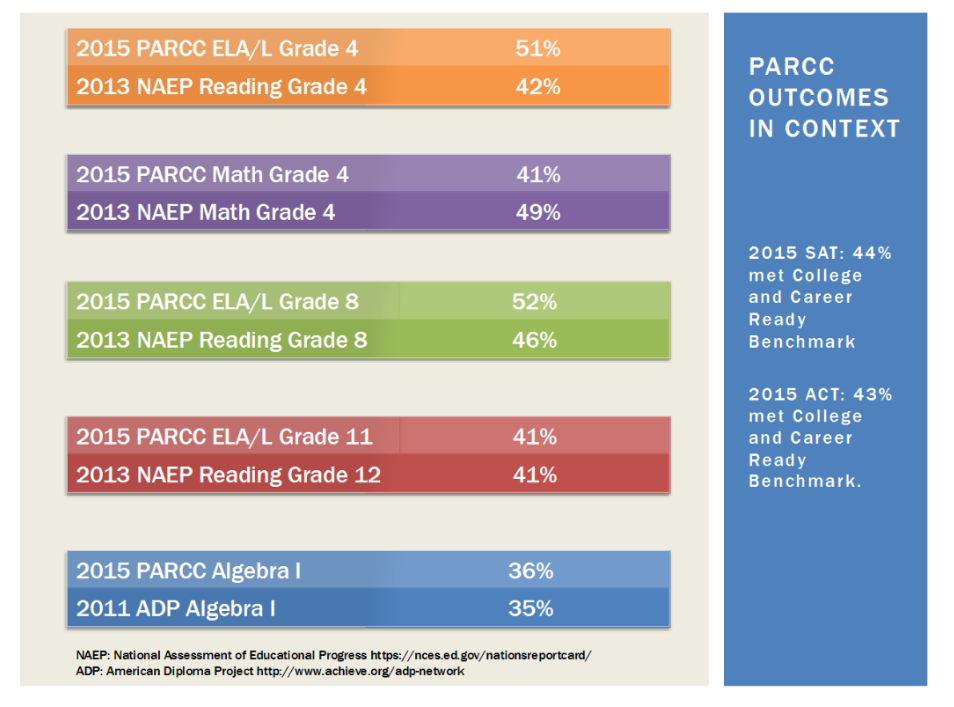
So this means, in the language of PARCC, that “only” 41% of New Jersey 11th graders are “on track” to be “college and career ready” in English, and “only” 36% of Algebra students are similarly situated (Again, remember that score distributions are likely almost entirely unchanged from the previous state assessments – this is about how high the cut scores are set).  Oddly enough, the DOE pretty much admits that we did not need PARCC to demonstrate this to us because New Jersey participates in the National Assessment of Educational Progress testing every several years, and, wouldn’t you know it, NAEP and PARCC results are not perfectly aligned, but they come pretty darned close (as do SAT and ACT scores):

NJ NAEP AND PARCC

The high school reading and algebra proficiency levels are almost entirely identical comparing PARCC to NAEP.  Dr. Diane Ravitch of New York University sat on the NAEP Board of Governors and has repeatedly explained that both the “advanced” and “proficient” levels in NAEP represent very high level work at the “A” level for secondary students.  So not only have the PARCC scores told us things about our students in NJ that we already knew from NAEP, but also it reaffirms the NAEP findings that over 40% of New Jersey high school seniors are capable of A level work in English and over a third of those students are capable of A level work in Algebra.

If the goal is to have all of our students “college and career ready” by reading and doing algebra at the “meets” and “exceeds expectations” level on a test roughly correlated to NAEP levels indicating A level achievement, then we might as well shut down shop right now because our schools will always fail.  Moreover, we should vigorously question the implication that any student getting respectful if not outstanding grades in core subjects is doomed to failure, and we should certainly question a goal of “college and career readiness” that appears entirely limited to “ready for admission to a 4 year selective college.”  The nonsensical approach of using cut scores to identify the percentage of students likely to seek a 4 year degree and labeling them our only students who are “ready” is based more on a desire to label more schools and students as failures than any other consideration.

The reality is that there are crises relating to education and opportunity both in New Jersey and in the country as a whole.  The first crisis is related to the distribution of opportunity via our education system.  I can walk a few miles from the campus where I teach and find a community where over 70% of the adults over the age of 25 have a college degree, and I can walk a few miles in the exact opposite direction and find a community where that is only 12% of the population.  That is unacceptable and needs to change; it is also something that we knew full well before the PARCC examinations came along, and which we will not address by berating test scores while ignoring the importance of fair and equitable school funding.

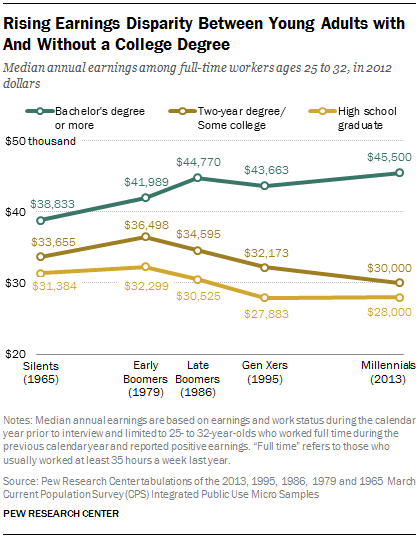
The second crisis is in our economy and the simple fact that our economy has shown no signs of actually needing more people with bachelors degrees.  Since 1986, the dollar adjusted wages for people with a BA in the country have grown only by $700, but the college wage premium has grown largely because of the collapse of wages for people without those degrees:

SDT-higher-education-02-11-2014-0-03

Far from needing many more college graduates, which would push wages even further down, we need an economy where people who work full time without a degree can survive well above subsistence level and closer to their college educated peers as they used to before 1980.  Unless Commissioner Hespe and his fellow PARCC supporters are arguing that college really is the new high school – in which case they had better get to work right away finding a way to make it free for everyone because we cannot possibly survive an economic system that both requires everyone to have a specific degree and requires them to accumulate crushing debt in pursuit of it.

(Just a side observation:  remember when PARCC promised that their “next generation assessments” would “help teachers know where to strengthen their instruction and let parents know how their children are doing”?  It is now about half a year later, and those students have been in their NEW teachers’ classrooms for almost 2 full months now. It is far too late for teachers to even use the score reports to make adjustments in their curricula that they were developing all summer long without the PARCC results. If the goal of the assessments was to give teachers actionable data in anything remotely resembling real time, they are a crashing, embarrassing failure, and given the testing schedule in late Spring, they are likely to remain so.)

5 Comments

Filed under Common Core, Opt Out, PARCC, Testing

Goodbye, Arne Duncan…Hello, John King

Secretary of Education Arne Duncan, the Chief Bull in a China Shop of education “reform,” will step down in December.  Having spent his tenure in Washington working more at the behest of private foundations and billionaire backed advocacy groups than on behalf of constituencies like students, parents, and teachers (who he frequently insulted), Secretary Duncan will leave behind a legacy of rapid and coercive change and a burgeoning parental rebellion against corporate education reform.  Under his watch, states were incentivized to jump head first into the Common Core State Standards before they were even finished, confusing and rapidly developed CCSS classroom materials proliferated across numerous states, states were bribed to adopt teacher evaluation systems that use standardized tests scores to judge teacher effectiveness, and states were promised new tests that would actually demonstrate students’ “college and career readiness” but were delivered the so far execrable Common Core aligned examinations rolled out across the country.  The National Education Association has previously called for his resignation, and the American Federation of Teachers placed Secretary Duncan on an “improvement plan.”  So it would seem obvious that teachers and parents across the country should breathe a sigh of relief to see the controversial Secretary, whose affability is vastly overshadowed by his skill at breaking things, depart.

Not so fast.

The same reports of Arne Duncan’s pending resignation also state that former New York State Commissioner of Education, Dr. John King, Jr. will lead the Department of Education as Acting Secretary, possibly for the remainder of President Obama’s term which ends in January of 2017.  To say that Commissioner King’s departure from the Empire State was unlamented would be a mammoth understatement.  While far quieter than his current boss in the Federal DOE, Dr. King is no less devoted to the central tenants of education reform today: Common Core standards, mass standardized testing, evaluation of teachers using standardized tests, and the proliferation of loosely regulated charter schools.  What Dr. King lacks in dynamic public persona, he more than makes up for in dogged determination to plow ahead with a fixed agenda regardless of feedback or evidence.  Indeed, the most constant skill he demonstrated as the head of the New York State Education Department was his ability to patiently let feedback and criticism wash right over him and have no influence on decision making whatsoever.  Head of Class Size Matters, Leonie Haimson, had this to say upon his leaving:

John King was the most unpopular commissioner in the history of NY State.  He showed no respect for parents, teachers or student privacy.  Ironically, he was intent on protecting his own privacy, and routinely withheld public documents; our Freedom of Information request of his communications with inBloom and the Gates foundation is more than 1 ½ years overdue.  His resignation is good news for New York state; hopefully he will be unable to do as much damage at the US Department of Education.

Sadly, as the new head of the US Department of Education, Dr. King will be in quite a position to do a lot of damage over the next 15 months.

Dr. King has a remarkable personal story and truly impressive academic credentials, including include a B.A. from Harvard University, a J.D. from Yale Law School, and both an M.A. and Ed.D. from Teachers College at Columbia University.  After short stints in charter schools, he was tapped as a deputy commissioner in New York at the age of 34 and succeeded to the Commissioner’s office only two years later.  Now, at the age of 40, with scant experience in teaching and school leadership, including no time at all as a superintendent of any school district of any size, Dr. King will take over the work of a Cabinet Secretary with far reaching influence over the direction of public education in the country.

Dr. King’s leadership of NYSED was made complicated not only by the controversial policies that he was tasked with putting into place, but also by the rapidity with which he pursued those policies and his consistent ignoring of all stakeholders.  As the Common Core standards, the EngageNY materials to support the core, and as the aligned testing all were put into place at a breakneck speed, legitimate concerns and criticisms from teachers, parents, and lawmakers went unheeded.  Principal Elizabeth Philips of PS 321 in Park Slope noted questions about Common Core testing that simply were not heard in Albany:

In general terms, the tests were confusing, developmentally inappropriate and not well aligned with the Common Core standards. The questions were focused on small details in the passages, rather than on overall comprehension, and many were ambiguous. Children as young as 8 were asked several questions that required rereading four different paragraphs and then deciding which one of those paragraphs best connected to a fifth paragraph. There was a strong emphasis on questions addressing the structure rather than the meaning of the texts. There was also a striking lack of passages with an urban setting. And the tests were too long; none of us can figure out why we need to test for three days to determine how well a child reads and writes….

…At Public School 321, we entered this year’s testing period doing everything that we were supposed to do as a school. We limited test prep and kept the focus on great instruction. We reassured families that we would avoid stressing out their children, and we did. But we believed that New York State and Pearson would have listened to the extensive feedback they received last year and revised the tests accordingly. We were not naïve enough to think that the tests would be transformed, but we counted on their being slightly improved. It truly was shocking to look at the exams in third, fourth and fifth grade and to see that they were worse than ever. We felt as if we’d been had.

Not only were the standards and tests confusing, Dr. King’s department set about creating cut scores for the exams that all but guaranteed only a third of students in the state would be marked as “proficient.”  Following growing complaints across the state, the Commissioner attempted to “engage” parents and other stakeholders in meetings across the state, but one of those erupted disastrously in Poughkeepsie.  At the time, Regents Chancellor Merryl Tisch praised the Commissioner for his hard work, but she was subsequently quick to throw him under the bus when it became clear that NYSED had approved a charter school application submitted by a 22 year old who had lied up and down on his resume.  By the end of his tenure in the Commissioner’s office, there were bipartisan calls for his removal from office:

“For quite some time, Education Commissioner John King has closed off all meaningful conversation with parents, educators, administrators, and elected officials who have highlighted serious deficiencies in State Education Department policies,” Abinanti said. “He has exhibited a conscious disregard for their concerns.

“He should be listening, educating where criticisms are unfounded, and adopting changes where criticisms are valid,” the lawmaker continued. “His rigidity makes him unsuited for the position of Education Commissioner. Commissioner King should resign immediately.”

By the time, Dr. King left his office in Albany, he had created a great deal of chaos in New York schools, alienated every major constituency, and had created the conditions that led to the largest parental opt out movement in the history of standardized testing.

There you have it, America: your new Acting Secretary of Education.

67251-I-just-threw-up-in-my-mouth-a-Hslr

So will anything change in the United States Department of Education?  In a word: no.  Acting Secretary of Education Dr. John King, Jr. will not waver an inch on the Arne Duncan education agenda. Standardized testing will remain the sine qua non of educational quality and evaluation.  Charter schools will continue to be favored over fully public schools regardless of the evidence of their success.  The US DOE will continue to back efforts to break our national teachers’ unions.  And education policy will continue a thirty two year trend of demanding that our nation’s public schools be held fully accountable for creating economic opportunity for children in poverty without the rest of society being called upon to do a single thing to make those opportunities real.  The central fallacies of education reform in the modern era will remain cemented in place.

The only change we can expect is one of style.  While Arne Duncan blundered about in bull like fashion breaking all of the china, his successor will be quite content to quietly step on all of the shards to make certain they are good and broken.

4 Comments

Filed under Arne Duncan, Common Core, John King, New York Board of Regents, politics, Testing

“Families” For Excellent Schools Sets a New Bar for Chutzpah

“Families” For Excellent Schools, the hedge-fund and foundation backed advocacy group that has waged constant war on New York Mayor Bill DeBlasio on behalf of the charter school sector in general and Eva Moskowitz’s Success Academy brand in particular, has postponed a planned rally for September 30th due to weather concerns.  Ms. Moskowitz’s 34 schools had planned to cancel classes for the morning to boost attendance for the gathering in Cadman Plaza which was to feature Jennifer Hudson.  Organizers announced the rally will go ahead on October 7th, but it also comes in the wake of a controversial ad buy by FES in which they accuse Mayor DeBlasio of condemning African American children to inferior educations, presumably by merely failing to embrace 100% of what the charter sector in New York City wants and by not allowing Ms. Moskowitz to simply point at an existing school and say “gimme” any longer.

The ad, entitled “A Tale of Two Boys,” can be easily found, and goes like this: Two young boys, one white and one black, are being walked to school, passing each other on the street.  The ad declares that the white child lives in a wealthy neighborhood and has an excellent school and will probably go on to college.  The black child, however, lives in a poor neighborhood, is forced to attend a failing school and will not have a chance to go to college.  The ad ends by contrasting the two young boys with the white child reading happily in school and the black child looking morose and bored, and then it chides the Mayor for allowing this to happen and declaring that “half a million” children “need new schools”.

The ad, which is costing FES 100s of 1000s of dollars, drew immediate criticism from numerous sources for relying upon racial stereotypes and for using the circumstances of minority children to advocate “solutions” that serve the political agenda of conservative organizations (such as the Walton Family Foundation and the Broad Foundation) who have been pushing privatizing education and breaking teachers’ unions for years.  Bertha Lewis of the Black Institute flatly declared the ad racist, and Zakiyah Ansari of the Alliance for Quality Education said, “They are using a black face to push their political agenda, and they make the assumption that all black people are poor…They used our children in a race-baiting commercial.”

Criticism of FES is not limited to the new ad buy.  Writing for The Progressive, New York City teacher, activist, and author Jose Vilson notes about the now postponed rally:

Families for Excellent Schools (an awkward name since everyone wants excellent schools surely), prints “Don’t Steal Possible” on red shirts and hands them out across the city. When a whole host of inequitable conditions, including the stratification of rich and poor, steal possibilities (and lives) from children and adults of color on a daily basis, we won’t see similarly impassioned rallies for their rights. When parents have to take off work for a rally or risk their student getting transferred to a local public school that was stripped of funds for losing students to charter schools, that’s also stealing possible….

What’s most disenchanting about the upcoming rally, though, is that the rally doesn’t serve equal and equitable agency for school-aged children. It ultimately serves the agenda of a handful of people who won’t put their shoes to the cement alongside parents who just want their children to thrive in a good school. If the messaging comes from an unknown busybody and not from the very people affected by the schooling of their children, that’s another swindle our children cannot afford.

Allow me to grant FES a crumb of fact within all of this: educational opportunities are not equally or evenly distributed throughout this city, just as they are not within this country.  Our nation is deeply segregated by income which becomes in many cases a proxy for segregation by race.  A consequence of this is that communities with notable levels of poverty tend to have high levels of poverty, meaning that in order to function well their schools need substantial funding, funding which is denied to them by state and local sources.  Many such schools struggle to provide their students with what they need, leading to lower educational outcomes and diminished opportunities.  However, Jose Vilson rightly points out that many schools with high levels of poverty actually have excellent programs, skilled teachers, and involved PTAs, and they are unfairly deemed “failures” by groups like FES because of one measure only: standardized test scores.  If such schools were also fairly funded and given the resources and capacity to provide all of the services their students need, they could thrive even more.  This is hardly an isolated case.  The portrayal of schools serving mostly minority and mostly impoverished children as nightmares of uncaring and corrupt adults passing along children without concern is a vicious narrative used to justify poaching off as much as the public system into private hands as possible.  “Families” For Excellent Schools’ preferred solutions actually make matters worse for the majority of students.

FES has only a passing relationship with the truth, as demonstrated by Professor Bruce Baker of Rutgers University.  Dr. Baker thoroughly destroys the group’s argument that more money per pupil in fully public schools actually harms outcomes by demonstrating that the schools with the highest per pupil spending also have the highest concentrations of special education students and students qualifying for free lunch.  Unshockingly, schools with those populations of students need more money per student in general, and achieving higher value added as measured by tests absolutely takes more money.  Dr. Baker’s research further demonstrates that the charter school sector, as currently administered, acts in a parasitic manner, siphoning off students who have lower rates of high poverty, learning disabilities, and language learning needs and skimming the resources the fully public schools need to provide appropriate services for the children who remain.  While high need districts within New York are face serious underfunding by the state’s own formula for school aid, advocates for charter schools like FES simultaneously call for more resources to be funneled from those public schools and dare to call them “failures” for not thriving.
The nerve of FES running an ad accusing the mayor of allowing African American children to languish is failing schools should be obvious – and deeply offensive – to anyone informed on the issue.  There is no doubt that too many schools struggle, but “Families” For Excellent Schools has no actual interest in improving the educational outcomes for all students in New York City.  In fact, extending genuine opportunities to all students in New York City is completely antithetical to their operating principles and would damage their brand management strategies.
Nationwide, the charter school sector has well-crafted approaches to winnow down the families who even apply to enter open lotteries – even in states where they are mandated to use random lotteries to prevent them from cherry picking students.  While Stephanie Simon’s report for Reuters noted that well known charter operators such as KIPP and Success Academy use simple application forms, that does not mean they seek to retain all of the students who make it into their schools.  Success Academy is known, in particular for practices that drive away significant portions of their students as noted here by former New York high school principal and current Executive Director of the Network for Public Education, Carol Burris who noted how Success Academy 1 in Harlem opened with 127 first graders in 2009 but only 82 remained to begin 6th grade (Interestingly, Success CEO Eva Moskowitz denied the accusation of excessive attrition in the comments section, accusing Ms. Burris of ignoring data that showed charter retention was somewhat higher overall than in nearby schools within the city.  Of course, Ms. Moskowitz was citing data for the entire charter sector while Ms. Burris was looking at the original Success Academy, and Ms. Moskowitz consistently fails to acknowledge that district schools have to replace children who leave when new students arrive at any time and that every child who leaves her schools represents a family that sought out Success Academy deliberately.)
Families that do seek out and get to attend Ms. Moskowitz’s schools quickly learn what it takes to remain there.  A parent handbook for Success Academy obtained by FOIL requests shows that Success Academy requires weekend or additional “academy” sessions for repeat “violations” of its requirements.  Excused absences cannot be had for parental illness, transportation problems, or doctor appointments.  Parental reading is a daily requirement in K-2 with no exceptions as is parental oversight of homework – which is given only in English.  While parental involvement is an important aspect for many students’ achievement, Ms. Moskowitz is essentially mandating parents who are both competent in English and who are in work and family situations stable enough to meet those expectations.  A single parent working evenings and whose child care is a relative speaking limited English is going to be unable to fulfill these requirements.
 The Success Academy network is not precisely subtle that it neither has the time to work with students who need even minor behavioral accommodations nor is it willing to keep them.  Kevin Sprowal was a Kindergarten student in Success Academy who had never been in serious trouble for behavior in three years of pre-school was suddenly disciplined constantly to the point that he felt sick at the thought of going to school.  His mother, Katherine Sprowal, received a direct message from Ms. Moskowitz that she interpreted as a veiled urging to transfer, and the school psychologist flatly said her child should be in a different school.  It is hard to take the “open lottery” for Success Academy seriously when it immediately begins to filter out five year olds who turn out to have perfectly manageable attention deficit.
The network’s methods are plainly brutal in many respects. In a special report in April of this year (that, of course, drew indignant responses from Ms. Moskowtiz), The New York Times documented the extreme high pressure placed upon the network’s very young children, including practices that are, in turn, manipulative and plainly abusive:

But at Success Academy Harlem 4, one boy’s struggles were there for all to see: On two colored charts in the hallway, where the students’ performance on weekly spelling and math quizzes was tracked, his name was at the bottom, in a red zone denoting that he was below grade level….

Success has stringent rules about behavior, down to how students are supposed to sit in the classroom: their backs straight, and their feet on the floor if they are in a chair or legs crossed if they are sitting on the floor. The rationale is that good posture and not fidgeting make it easier to pay attention. Some teachers who had orderly classrooms and a record of good student performance said, after their first year, their school leaders allowed them to bend the rules somewhat, such as not requiring students to clasp their hands as long as their hands were still….

Success did not allow a reporter to observe test preparations, but teachers and students described a regimen that can sometimes be grueling.

To prepare for the reading tests, students spend up to 90 minutes each day working on “Close Reading Mastery” exercises, consisting of passages followed by multiple-choice questions. The last two Saturdays before the exams, students are required to go to school for practice tests.

Students who do well on practice tests can win prizes, such as remote-controlled cars, arts and crafts kits, and board games. Former teachers said that they were instructed to keep the prizes displayed in the front of their classroom to keep students motivated.

Students who are judged to not be trying hard enough are assigned to “effort academy.” While they redo their work, their classmates are getting a reward — like playing dodge ball against the teachers, throwing pies in the face of the principal or running through the hallways while the students in the lower grades cheer….

At one point, her leadership resident — what the network calls assistant principals — criticized her for not responding strongly enough when a student made a mistake. The leadership resident told her that she should have taken the student’s paper and ripped it up in front of her. Students were not supposed to go to the restroom during practice tests, she said, and she heard a leader from another school praise the dedication of a child who had wet his pants rather than take a break….

At Success Academy Harlem 1, as the original school is now called, 23 percent of the 896 students were suspended for at least one day in 2012-13, the last year for which the state has data. At Public School 149, a school in the same building, 3 percent of students were suspended during that same period. Statewide, the average suspension rate is 4 percent. (A spokeswoman for Success said that the suspension rate at Success Academy Harlem 1 has since declined to 14 percent, and that several of the newer schools had rates below 10 percent.)

Students who frequently got in trouble sometimes left the network, former staff members said, because their parents got frustrated with the repeated suspensions or with being called in constantly to sit with their children at school…

“We can NOT let up on them,” she continued. “Any scholar who is not using the plan of attack will go to effort academy, have their parent called, and will miss electives. This is serious business, and there has to be misery felt for the kids who are not doing what is expected of them.”

Public shaming.  Extremely narrow behavioral norms for children as low as five.  Extra school work as punishment for not meeting standardized testing goals.  Obsessive focus on standardized test preparation. Open and blatant bribes for children who excel on test based measures.  Children who can quickly adapt to this and perform on tests as expected are welcome at Success Academy.

Which brings us back to chutzpah.  “Families” For Excellent Schools will rally next week with Ms. Moskowitz’s students front and center providing the optics of minority children in need of great schools and opportunities.  They will claim to be there for the “half a million” children “trapped in failing schools” (last year, they claimed it was 143,000) and who need “new schools, now” – by which they mean charter schools in the Eva Moskowitz model.

But those charter schools – and Ms. Moskowitz’s schools in particular – do not want all of those children they will claim to speak for next week.  They want the children whose parents have stable enough work lives and English proficient enough that they can meet all of the out of school expectations without exception.  They want children who do not require any accommodations that would alter their extraordinarily rigid approach to early childhood behavior.  They want children who can immediately adapt at the age of five to excessive conformity, who can handle public shaming and extraordinary pressure, and who will emerge from that environment with high standardized scores.  Everyone else can go pound sand.  More specifically, everyone else can go back to their district schools which now have even higher concentrations of children in high poverty, with serious special learning needs, and with English language learning needs but which have fewer monetary and physical resources with which to help those children.  Far from speaking for half a million kids in need of great schools, “Families” For Excellent Schools will use 1000s of children as props to denigrate the work and efforts of 100s of schools and tens of 1000s of teachers and hundreds of 1000s of other children simply because of their test scores.  Worse, they will call for even more resources to be hoovered out of those schools – even though the “no excuses” charter sector in New York is 100% dependent upon having zoned schools that will take the children they refuse to accommodate.

“Families” For Excellent Schools does not give a damn about most of the children in New York.  Don’t let them get away with claiming they do.

2 Comments

Filed under "Families" For Excellent Schools, charter schools, Social Justice, Testing

Announcing the iSchool, or Something

Apple CEO Steve Jobs was not known as a philanthropist during his lifetime, but his wife, Laurene Powell Jobs, had a significant track record in philanthropic endeavors by the time of his death in 2011.  Educated with a Stanford MBA and with experience as a trader in Goldman Sachs, Ms. Powell Jobs has an extensive record in philanthropic activities since at least 1997, and education appears to be a specific interest. Beginning with a mentoring program for first time minority college attendees, she now sits on the boards of a number of familiar organizations such as Teach for America, New Schools Venture Fund, and Stand for Children.  According to her “Inside Philanthropy” profile, Ms. Powell Jobs is interested in education reforms that are “results driven” which is education philanthropy speak for “raises test scores”.  Hardly surprising, since her board memberships are groups that contribute to the deprofessionalization of teaching (TFA), raise capital for charter school ventures and advocate legislatures to allow charter school teacher training “academies” (New Schools Venture Fund), and which consistently attack teachers’ workplace protections and advocate for increasing the role of test scores in education and teacher evaluation (Stand For Children).

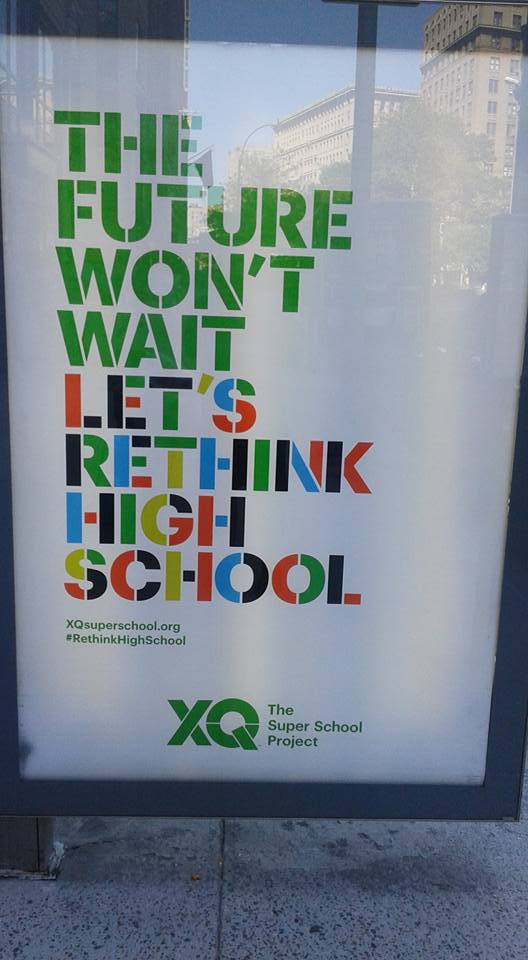
It should not, therefore, be a great surprise when The New York Times announced that she would donate $50 million towards a new education venture “to rethink high school.”  The effort is called “XQ: The Super School Project” and Ms. Powell Jobs said in an interview, “The system was created for the work force we needed 100 years ago. Things are not working the way we want it to be working. We’ve seen a lot of incremental changes over the last several years, but we’re saying, ‘Start from scratch.’ ”  This “from scratch” take on the American High School essentially looks like a grant program from the pot of $50 million that will eventually be distributed to 5 to 10 grantees sometime in the next year.

I know they are serious about this.  They’re advertising on bus kiosks in Manhattan:

super schools

The project website tells you precious little about the values of the project itself, which might be a good sign if they are serious about soliciting widely for actual, community based, ideas for school experimentation instead of just opening the doors for a bunch of ready made “disruptors” already at work tearing down public education.  The composition of her core team as reported in The Times is not encouraging. There is a consultant named Keith Yamashita who has worked apparently mainly in technology and start ups.  Russlynn H. Ali is the former undersecretary of education for civil rights under Secretary Arne Duncan and has been working with Ms. Powell Jobs’ Emerson Collective.  More troubling is the presence of former senior adviser to New York City Schools Chancellor Joel Klein, Michelle Cahill.

Education blogger, author, and Louisiana teacher Mercedes Schneider once dubbed Chancellor Klein as “The Man From Whom Nothing Good Comes,” and I’d daresay he earned the title.  Certainly, the Klein Chancellor’s office unleashed a fair deal of havoc on Newark when Mark Zuckerberg’s 100 million dollar grant to remake the city’s schools was announced.  Former Klein insider, Chris Cerf, created a consulting firm that hoovered up a fair amount of the available cash, and Cerf himself moved in 2010 to the New Jersey State Commissioner’s office, meaning he was now overseeing the district. Klein’s NYC department of education also provided Newark with Superintendent Cami Anderson, whose disastrous tenure is chronicled by retired Star Ledger journalist Bob Braun.  Cerf and Anderson are most directly responsible for turning the Zuckerberg donation into the “One Newark” system, and Mark Webber helps fill in the holes in the most recent accounts of how that has turned out – especially in regards to Brick City’s charter sector.  Short version: Joel Klein’s office provided a significant portion of the reform “talent” that spent lavishly on consultants and threw the city’s schools into an incompetently and callously managed mess that has benefited the biggest charter operators most of all.

So let’s just say that the presence of another member of Joel Klein’s inner circle in a grant program to “rethink” schools requires serious skepticism.  At least the amount of money being spent is only half of a Zuckerberg, and it will be spread around rather than dropped into a single school district with the intention of blowing the entire kit and caboodle up.

However, I’d like the challenge two premises of the entire endeavor.  The first premise is that we still have the high school we created “for the workforce 100 years ago.”  In some respects this is actually true.  The school model based upon a set of discrete subjects taught in Carnegie units with students moving from subject to subject during the day was an organizational choice of the early 20th century.  Similarly, the comprehensive high school and extra curricular activities and sports with which we are familiar were choices incubated in the Progressive Era — none of these came down with Moses on Mt. Sinai.  However, to suggest that the school structure you recognize as school is somehow rooted in place, unchanging and incapable of meeting more modern needs, is not supported by evidence.

For example, that same school structure that Ms. Powell Jobs says was created for the workforce “100 years ago” has also graduated the workforces of the 1950s and 1960s as well as the workforces of the 1980s and 1990s – all economic periods vastly different than 1915. If one were to cite threats to the workforce in 2015, one would have to look at falling union membership, declines in wages for recent college graduates, a young work force burdened by mounting debt, corporate hoarding, unmet infrastructure needs, and taxation policies that have abetted income inequality before looking at how most ninth graders will study English for 50 minutes before moving on the their Algebra class.  Schools contribute to the shaping of the workforce, but they do not create the economic demands for workers that necessitate that workforce on their own.  And the reality is that the American economy has grown leaps and bounds with this same school system.  In fact, from 1929 to 2015 “real” Gross Domestic Product in 2009 dollars (opens in Excel) grew from 1056.6 billion dollars to 16,324.3 billion dollars — all with that school system lamented as being designed for the workforce of 1915.  Not bad.

Further, schools have changed in the past century, in meaningful and significant ways.  The landmark report, 120 Years of American Education: A Statistical Portrait from the Department of Education’s Center for Education Statistics details a school system that has made vast developments in both the reach and equity of the system over time.  From the general formation of the comprehensive high school, the institution has continued to expand both the population it includes and the services it provides within its walls, reflecting major changes in how society views the reach of the political franchise.  Consider these two charts:

Total School Enrollments 5-19 year olds

Total high school completion by race

Similar progress and change can be seen in statistics relating to the educational attainment of women and to the number of children with disabilities being accommodated within public schools.  And these statistics on increased participation, completion, and services provided do not account for changes in subject matter content over time as well. The fact is that there are many things about our high schools that have been significantly dynamic over the past 100 years.

The second premise that needs to be challenged is that the schools we need should represent a “start from scratch” approach.  There are powerful ideas for change that many districts could implement with very little difficulty.  In their historical study Tinkering Toward Utopia: a Century of Public School Reform, scholars David Tyack and Larry Cuban demonstrated that many “big ideas” for school reform tended to be changed by school as much as they changed school, but that certain little ideas can have substantial impact.  For example, a simple offset of classroom walls creating niches changed the way teachers used their space substantially.  So while the XQ little marquee questions “What if we take our desks outside?” “What if learning is a game?” “What if we knock down these walls?” – I am left wondering “what more will you get with $50 million than 5-10 boutique programs that may not be scalable while you could be trying to leverage more meaningful changes within the existing system that already serves almost 15 million high school students?”

The fact is that we have some pretty good ideas already about what would leverage substantial change in our schools. Some of these ideas are larger than others and would require significantly more political capital to achieve.  However, if Ms. Powell Jobs is actually serious about our schools being “the great equalizers they were meant to be,” she should shake off the “disruptive start up” mentality of the XQ project and put her talents to work on some of the following ideas that never seem to make it into education reform’s portfolio of strategies:

  • Integration: It matters, for both the majority and minority populations that are integrated, and we have historic evidence to demonstrate this.  The decrease in achievement gaps between white and black students as measured by the National Assessment of Education Progress closed rapidly and for a sustained period of time in the 1970s and early1980s before the cumulative impacts of white flight and abandonment of fair housing and integration policies stalled progress.  Since then, racial and economic segregation have increased vastly, to the great detriment of our students and their schools which saw an initial, large, burst of the gap closing after NCLB only to see it stall again.  While the issue of the achievement gap is extremely multifaceted and overlaps with declines and rises in child poverty, integration of our communities and schools remains an important and currently unutilized tool in school improvement.
  • Fair Funding: Advocates of current reforms like to scoff at school funding, but the reality is we maintain a perversely unfair and inadequate system of school finance that all but guarantees wealthy communities can fund the schools that they want while the rest of the system struggles to get sufficient state and federal aid to plug the holes in their budgets.  Resources and policies the reduce inequality cost money, and the reluctance to fund those resources and policies is one of the greatest stumbling blocks to educational improvement.
  • Class Size Reductions: Among the policies that can cost more money that politicians are reluctant to spend is class size reduction. It works.  It works well.  It works even better for poor and minority students. Increasing class sizes causes real and long term harm.
  • Teacher Retention and Development: This will come as a surprise to the organizations on whose boards Ms. Powell Jobs sits, but experienced teachers are better than newcomers.  The exuberance of youth is fantastic and necessary in the ongoing work of school, but it is best paired with experienced teachers who know what they are doing and who are willing to mentor their younger colleagues. If we want to improve schools, we should be looking at improving teacher retention, starting with a hard look at working conditions.
  • Reverse High Stakes Testing’s Detrimental Impacts: We’ve increased the amount of testing.  We’ve increased the stakes on testing.  To the surprise of nobody who understands policy incentives that means we’ve increased the amount of time spent teaching to the test and to test preparation, to the detriment of a rich curriculum and especially to the detriment of students attending majority minority schools threatened with closures and other punitive measures due to test scores.  The narrowing of the curriculum also has a detrimental impact on the very skills so-called education reformers claim our students need the most in the 21st century.  If Ms. Powell-Jobs really wants to improve high school, she could do a lot worse than to imitate her late husband’s business practices and to try very hard to kill off something that Bill Gates has worked to promote: high stakes testing in teacher evaluation.

$50 million is going to buy the XQ project a handful of high schools that may or may not be innovative and which may or may not be able to be scaled.  Or it could begin the process of lobbying policy makers to endorse what we actually knows works in education.  It would certainly be a lot better to see on the side of a bus kiosk.

7 Comments

Filed under Funding, Newark, schools, standards, Testing

NYSED’s Incoherent Opt Out Muddle

Pity those poor zealots of standardized testing in Albany.

No matter what they do, no matter what tactic they employ those pesky parents who are sick and tired of standardized testing consuming their children’s education won’t come around to see the error of their ways.

First, Governor Andrew Cuomo, perhaps taking an anticipatory victory lap days before his November re-election, unleashed a torrent of bad ideas upon his favorite punching bag – New York’s unionized public school teachers.  He vowed to “break up” the “public monopoly” of our free public school system which dates back to the formation of the New York Free School Society in 1805.  Governor Cuomo’s preferred method of “breaking” public education is the use of standardized test scores and growth models to designate schools and teachers as failures ripe for state take over and firing.

Then New York Board of Regents Chancellor Merryl Tisch and Governor Cuomo took up the role of pen pals after the election, declaring the need for much tougher teacher evaluation and tenure rules using, you guessed it, an even greater role for growth measures based on standardized test scores.  Governor Cuomo followed that communication by vetoing a bill he himself had proposed that would have given teachers and principals a two year grace period from professional consequences as a result of the still new Common Core aligned state examination, and then quickly announced a punishing agenda that led to 50% of teachers’ evaluations being tied to growth measures on the state examinations.

Dr. Tisch, for her part, attempted to take on the role of the velvet glove with a prepared speech to the New York State  Council of School Superintendents in March where she lamented the Opt Out movement in New York and compared it to the anti-vaccination movement:

Why on earth would you not want to know whether your child is on track for success in the fifth grade or success in college?  Why would you not want to know how your child and your school are doing compared to other children in district, region, and State?  Why would you not want to know the progress of our multi-billion dollar investment in education?  Why would you not want to know whether all students are making progress, not just the lucky few?

I do not pretend that test results are the only way to know, but they are an important piece of information.  They are the only common measure of progress we have.

We are not going to force kids to take tests.  That’s not the New York way.  But, we are going to continue to help students and parents understand that it is a terrible mistake to refuse the right to know.

We don’t refuse to go to the doctor for an annual check-up.  Most of us don’t refuse to get a vaccination.

Did you get that?  Standardized testing is as good for curing problems in education as vaccines are for preventing polio.

Dr. Tisch dug herself deeper in later comments, first trying to claim that the new teacher evaluation system over which Governor Cuomo held long overdue state aid hostage did not necessarily mean teachers would be evaluated 50% by student test scores, and then she publicly suggested that communities with histories of high test scores (i.e. wealthy, white communities) might be excused from the new evaluations – leaving a lot of African American and Hispanic teachers who teach predominantly in urban poverty on the hook and sparing their white peers.

When Commissioner John King, in a spectacular case of failing upward, left the NYSED to join Secretary of Education Arne Duncan in Washington, D.C., his replacement, MaryEllen Elia, formerly Superintendent of Florida’s sprawling Hillsborough district, was already known as a major fan of the Common Core standards, standardized testing, and evaluating teachers based on those tests.  Commissioner Elia immediately embarked upon a “goodwill tour” of sorts to listen to and to speak with stakeholders across the state.  The new commissioner did not waiver in her support for high stakes testing or in her opposition to opting children out of those exams, telling one audience that “Life is one big test.”

Then the opt out numbers came in with the results of the tests themselves, and New York’s rate of test refusal in 2015 jumped to 20% of all testable students, a huge leap from the previous year’s numbers.  And the charm offensive was over, with Commissioner Elia declaring to reporters that her office was in communication with the Secretary of Education in Washington over the potential “consequences” at hand for districts and schools where parental opt outs meant that fewer than 95% of students were tested as required by the No Child Left Behind act.  In other statements, she declared that opting out of the state tests was unreasonable and called school personnel who encouraged it unethical.

And almost as quickly as that was said, the backpedaling began.  Chancellor Tisch reported that the her office was told by the federal DOE weeks earlier that financial consequences were up to the state and that NYSED had no plans to do anything, saying, “I think when you withdraw money from a school district, what you’re doing is you’re hurting the kids in the school district. So I don’t think that’s an effective way to deal with it.”  The King of Test-Based Punishment, Andrew Cuomo, also declared that the state had no intentions of withholding money from communities that failed to reach 95% of students tested.  Commissioner Elia bid a hasty retreat from her earlier threats, first pivoting away from punishment to saying she planned to spend the next year trying to convince parents not to opt out of the exams and then saying that parents have a right to opt their children out of the state examinations.

The quick retreat from talk of punishment is no doubt tied to the dreadful politics that would be involved of playing games with funding, given that the funding in question is federal Title I money intended for districts with high percentages of children in poverty.  Withholding those moneys from the smaller number of districts and schools with high poverty and high opt outs while leaving affluent communities with high opt out numbers untouched would be a political firestorm, not to mention it is highly questionable whether NCLB was ever intended to punish schools and districts because of the actions of their parents.

The 2015 round goes to Opt Out:

mic drop

The future is, of course, murkier.  There is no chance at all that Commissioner Elia, Chancellor Tisch, and Governor Cuomo intend to back away from the central role of standardized testing in education policy for New York just as there is no indication that they really understand the multitude of reasons why parents are opting out.  Commissioner Elia’s “tool kit” for convincing parents to test their children will be an object of some interest, and there can be little doubt that significant pressure will be placed upon superintendents and principals to reign in their parents where Opt Out is strong or to block it from being established where it is not.

If Opt Out in New York grows by similar numbers for the 2016 examinations, the entire system will be on the verge of collapse, but it would be wrong to assume those numbers will materialize.  2015 was a particularly turbulent year with Governor Cuomo aggressively pursuing an agenda that made test and punish the centerpiece of New York schooling.  Further, the Opt Out movement’s future growth will also depend upon making inroads in urban and minority communities where support has been slower to grow than in the suburbs.  Nationally, African American and Hispanic parents are less likely to support opting out and less likely to say they would do so for their children than white parents (although they, like white parents, also value demonstrations of their children’s learning that are not based on standardized tests far more than they value the tests).  Given the civil rights history of the United States, it is not hard to understand and to appreciate why these parents might be more inclined to seek accountability for states and municipalities to take care of their children.  If Opt Out is to grow, it will need to listen to those concerns and articulate a compelling vision that addresses them.  Goodness knows, we can expect Commissioner Elia to tell them the test is the only way to hold schools accountable.

There are, of course, strong arguments to make for parents concerned about the historic failures of states and cities to hold themselves accountable for children of color.  The trends that harm education overall when standardized testing becomes a goal in and of itself hurts minority and urban communities even worse.  School closures, unaccountable charter schools, and the loss of non-tested subjects are trends that take their biggest bite out of those communities.  Further, contrary to the claims of testing advocates that only mass standardized testing can be used for accountability, districts and schools can use low stakes sampling to monitor the system and individual teachers can use small scale, formative assessment systems to track student progress.  The massively disruptive tests that replace the curriculum are not necessary.  Further, as Julian Vasquez-Heilig demonstrates, local accountability models not only exist, they are promising to bring communities back into how schools are held accountable.  These arguments need to be made more and more in public because we can count on NYSED to claim they are simply impossible.

For now, however, Opt Out has momentum on its side, and the bullies in Albany have backed down in a major way.

4 Comments

Filed under Activism, MaryEllen Elia, New York Board of Regents, Opt Out, Testing

Reading at Frustration Level with J.K. Rowling

One of the more esoteric and interesting debates centered around the Common Core State Standards for English centers around text complexity and the concept of reading at “frustration level.”  The general idea behind instructing children at this level of text is that in order to improve as readers, children cannot only read texts that are within their current skill level and should be instructed using materials that challenge their reading.  As this article at Education Week notes, this is hardly a new concept, and it recapitulates debates that have gone on in reading circles for some time about the “best” ways to encourage young readers to develop.

On the one hand, the idea of instruction at so-called “frustration level” should not be exceptionally controversial if done by skilled teachers using high quality materials and carefully planned instruction.  After all, education theory has long accepted the idea of a “zone of proximal development” where a learner can accomplish a particular task with guidance and scaffolding and which exists between what the learner can do comfortably and what the learner cannot do yet.  Within this concept, we accept the likelihood that a learner will experience some degree of frustration and will make mistakes which can be actually instructive.  Movement from one “side” of the zone to the other is a matter of real accomplishment for learners, and since reading is a skill where learners move from simpler tasks to ones that are far more complex, it makes sense that teachers would have to use texts that push their students.

However, what the exact balance of “frustration level” texts should exist within the curriculum is a matter of healthy debate.  Proponents of the Common Core standards have generally believed that current popular reading programs in recent decades have allowed students too much “comfort” in instructional reading and have made significant increases in the amount of time students are expected to spend with texts they cannot read entirely independent of scaffolding.  For the record, researchers who I admire both personally and professionally have voiced support for increased text complexity, and I have no reason to doubt the sincerity and expertise of P. David Pearson, for example.  At the same time, I tend to agree with other critics who have rightly questioned the quality of materials aligned with Common Core for classroom teachers, the depth and quality of development for teachers expected to adapt the standards to their classrooms, and whether or not it is appropriate to TEST students at “frustration level” on the Common Core aligned PARCC examinations.  As Russ Walsh notes:

What happens when students are asked to read very difficult text? For those students who find the text challenging, but doable, they will redouble their efforts to figure it out. For the majority of children, however, who find the text at their frustration level, they may well give up. That is what frustration level in reading means. The ideal reading comprehension assessment passage will be easy for some, just right for most and challenging for some. The PARCC passages are likely to be very, very challenging for most.

But I want to set aside the testing and implementation questions and simply focus on a more fundamental question:  if we expect students to spend more time reading at levels that a truly challenging for them, what, apart from very careful and extremely skilled teaching, do they require?

This is not actually theoretical as my wife and I have been observing an exercise in this very question all summer long with our oldest child.  While a remarkably skilled and precocious verbal story teller, it has been a bit of a longer road for reading skills to develop.  Mind you, our child has had perfectly fine reading skills and is reading above most grade level assessments, but reading has not developed as visibly as spoken language skills.  What we found out a few years back after some examination was that many reading skills that we could not observe (such as segmenting and blending) were fully intact, but our child, being a perfectionist who hates displaying skills that are not completely independent, would hesitate to try them in front of others.  In fact, until our child had enough confidence to read reasonably interesting chapter books independently, reading together time was often a struggle between an adult trying to patiently coach breaking down unfamiliar words and a child stubbornly waiting for us to give up and read it ourselves.

Our child has progressed in school reading assessments using the “Fountas and Pinnell” leveled reading system. I have my suspicion that these assessments are tracking lower than our child’s actual reading level.  From reading together, I have noticed tendencies to read words that appear on the next page while trying to jump ahead when excited or having attention wander when bored.  Hardly surprising as this is not an exact science made a bit more problematic when working with a child who is easily bored by very strict academic tasks and who does not like feeling under scrutiny.  Regardless, one thing has been absolutely clear in the past year of schoolwork:  given a choice of free reading material, our child often selects books that fall into a very comfortable reading level and will sometimes opt to reread familiar books instead of branching out into new series.  This again is not especially worrisome for pleasure reading:  repetition can reinforce development of sight words and casual reading is best done by choice.

Which makes the past two months quite remarkable.

For family reading time, I often go to books above either of our children’s reading skills but with real potential interest as stories.  Our oldest child took to The Trumpet of the Swan this way and read it in bed for over a week after I finished reading it aloud.  Both of our children were rapt with attention to The Hobbit, although it did not become an adventure in self reading.  I have my eye on A Wrinkle in Time, The Chronicles of Narnia, and, just to really push matters a bit, The Sword and the Stone.  The reason I have some hope that one of those titles will become beloved in our home has to do with what we must only call The Summer of Harry Potter.

I tried reading the stories out loud for our children two years ago, but our oldest child, having a really empathetic nature and a difficulty with characters getting in trouble, did not want to listen past the first book.  But we began again in June, and as soon as I was done reading Harry Potter and the Sorcerer’s Stone, both children begged to see the movie, insisted that I dive right into Harry Potter and the Chamber of Secrets, and our oldest child began taking book one to bed every night and devoured it.  The Chamber of Secrets  was quickly read, and Harry Potter and the Prisoner of Azkeban fell to a combination of night time reading and reading on the bus to and from camp before I could begin reading it out loud for both of our children.  I have just begun reading Harry Potter and the Goblet of Fire aloud, and our older child is about two thirds of the way though Harry Potter and the Order of the Phoenix.  Our children go to bed around 8pm, and on more than one occasion, I have found our oldest child still awake after 10p, reading by headlamp.  I have been asked to turn off the television so more Harry Potter can be read.  The entirety of the supplemental Hogwarts Library series has been read independently, and my wife and I were bombarded with Quidditch facts and informational about magical creatures.

Now while I have said I believe our child’s tested reading level is below the actual skill level, it is also true that the advertised reading level of even the first of the Harry Potter books is probably still pretty high and that our child is spending at least some time reading at the so-called “frustration level” where the mechanics of the syntax and words not yet in sight word vocabulary will trip our child up.  Yet this is not slowing things down.  In fact, our child is reading with enthusiasm books that must occasionally frustrate mechanically and in situations that are increasingly scarier and more humanly complicated than anything read before.  Our child has had an historic dislike of main characters being mad with each other, but Harry Potter and Ron Weasley and Hermione Granger spend a good portion of Goblet of Fire angry at each other and that did not deter reading in the slightest.  From conversations, I know that the stories are understood.

So what is going on?  What would propel a young reader who has been reluctant to try out new books and who has never really taken to academic tasks with books to push so hard on known boundaries and comfortable texts?

Well, love.

Our child loves these books: the world J.K. Rowling created, the characters with depth and the ability to grow, the situations that test them.  Our child loves the overall arch of the story that is becoming evident as it progresses school year by school year.  The characters are at once entirely human and understandable while simultaneously inhabiting a world of surprising wonders.  If there is a reason to keep reading even though the books stretch on both a technical level and on an emotional level, it is because of love.

I think all of us, Common Core proponents and skeptics alike, want children to grow as readers — to stretch and to challenge themselves.  And we should all want children to have comfortable spaces within which to challenge themselves and within which they can just relax with the familiar and enjoyable.

But we should also remember what it is that inspires children to really push on their boundaries.  In school, it is with highly attentive teaching that provides sufficient modeling and supports and gives children a sense of agency to understand why they do what they do.  Outside of school, it is a deeply personal combination of factors with a lot of love in the mix.

And that’s something we ought to figure out how to get more of in school reading instruction as well.  Our oldest child loves what J.K. Rowling has created so much that just about nothing can deter total immersion in that world – not even how it pushes skills to develop.  That’s a good object lesson for school too.  Do we want children to really engage with their “frustration level”?  We ought to find out what they love…and maybe “frustration level” will seem a lot more like “a challenge I enjoy”.

6 Comments

Filed under child development, Common Core, standards, teaching, Testing

NY Commissioner Elia: The Time for Charm is Over; Let’s Start the Empty Threats

When MaryEllen Elia took over as Commissioner of Education in New York, she began by traveling the state to speak with various constituents about the direction of education in the Empire State.  This was no doubt in response to former Commissioner Dr. John King Jr.’s decided inability to listen to and to engage with stakeholders in public education, and Commissioner Elia should be granted kudos for being willing to step outside of her office in the current climate.  According to Principal Carol Burris, who attended the meeting between Commissioner Elia and New York State Allies for Public Education, MaryEllen Elia was cordial and generous with her time.  However, as was obvious from her resume in Florida, it is plain that New York’s new Commissioner is a true believe in the Holy Trinity of education reform: Common Core standards, high stakes standardized testing, and punishing schools and teachers whose students do not measure up on those examinations.  It is clear that the “listening tour” was more about changing the style than the substance of the New York State Education Department.  Ms. Burris, who recently took an early retirement to dedicate herself to defending public education, noted:

Back in the 1960s, Marshall McLuhan coined the phrase, “the medium is the message.” McLuhan argued that the medium that delivers any message is of equal, if not greater, importance than its content.   Clearly the Board of Regents believes that by pivoting from the stiff and professorial King to the attentive and engaging Elia, parents and teachers will come to their senses and begin to like the Common Core and its tests.

So while I will give Commissioner Elia some marks for actually speaking with stakeholders and for accepting opportunities to speak with opponents of her favorite education reforms, there is no reason to think she will change anything of substance.

And now the charm offensive is over.  It is time to start in with the threats.

In a conference call with reporters, Commissioner Elia reported that the NYSED is discussing with the US Department of Education potential consequences for schools with high numbers of students who refuse the state standardized examinations.  The Politico New York story was followed by a story in The New York Times which states:

Officials at the federal Education Department have awhile to decide what to do. The state will not officially report its test participation rate to the federal government until mid-December, and the number will not be considered final until sometime after that, the State Education Department said on Thursday.

On Wednesday, the federal Education Department’s spokeswoman, Dorie Nolt, said the agency was looking to the leadership of New York’s Education Department “to take the appropriate steps on behalf of all kids in the state.”

New York led the country in students refusing to take the state standardized exams with roughly 20% of students between grades 3 and 8 and in 11th grade refusing.  These numbers are not, however, evenly distributed with large numbers of the 200,000 students not sitting for the exams in Nassau and Suffolk counties on Long Island. However, as reported in the Times there were also high needs districts dependent upon Title 1 funds for students in poverty who had large opt out numbers.  Commissioner Elia told the Times that federal officials had asked her what “plan” she has for “dealing” with districts that have high numbers of opt outs.

So will this be how Opt Out ends?  With the federal DOE and NYSED joining together to punish districts who do not meet federal testing numbers until everybody agrees to play along?

Outlook not so good

In order to understand whether these threats have any teeth, one has to understand why they would be made in the first place.  There are several interconnected issues.

95% of all students in all subgroups must be tested annually.  Under the 2001 re-authorization of the Elementary and Secondary Education Act known as No Child Left Behind, every school in the country must test every student in mathematics and English every year between grades 3 and 8 and once in high school.  There are no exceptions allowed to this.  Based upon this requirement, there are a number of schools and districts where test refusal has dropped the percentage of tested students well below this threshold.  However –

NCLB testing requirements were meant for schools, districts, and states, not for parents and students.  When Congress passed NCLB on a bipartisan vote, their intention could not have been clearer.  They were concerned about historic evidence of communities and states quietly shunting certain populations of students outside of accountability measures and subsequently ignoring their educational needs.  This same argument has featured prominently in recent debates over renewal of NCLB and the fate of annual testing.  Regardless of what anyone thinks about the merits of annual testing of all students versus gradespan testing of samples of students, the intent of the legislation was to make certain that schools and states could not duck out of accountability for all of the students enrolled in public school.

In fact, the federal DOE made that same point to New York when it rejected some provisions of the state’s renewal application for waivers from various NCLB provisions.  The state requested that English language learners who have been in the country for less than two years be exempted from the state English examination, but the Federal DOE cited that the state has only a limited exemption capability and then referenced that the state is required to create a “single, statewide, accountability system” and that this “requirement is necessary to ensure that schools are held accountable for the academic achievement of all students…”  The state is extremely limited in its ability to exempt students from the examinations, and the schools are supposed to be accountable for their students’ learning.  To that end, New York State has contracted and administered a system of annual statewide testing, albeit a controversial one, and schools administer those tests.

However, nothing in the statutes can make a school force students to take a specific standardized exam, and there is no mechanism for punishing a student for not participating in an exam that makes up none of that student’s grade.  Schools across the state have implored parents to not opt their children out, they have put out contradictory information about what consequences might befall a school that falls below 95% of children tested, and they administered the exams to every child whose parents did not refuse them.  However, there is no statutory authority that allows a school or school district to compel taking the exam, and it is contrary to the intent of NCLB to hold them accountable for actions beyond their control.

Consider another federal education law: the Individuals with Disabilities in Education Act.  Under that law, schools and school districts must provide all students with a “free and appropriate public education” in the “least restrictive environment,” and schools are required to be proactive about students who are potentially disabled, conducting “child find” before the student falls behind academically.  School districts are sued routinely for failing to live up the provisions of IDEA, but if parents decline to participate in the evaluation process for special education services, the school is not held accountable for failing to evaluate and has only limited means to proceed without parents. In the case of IDEA, this is made explicit in the regulations.

NCLB does not address parental consent for or against annual standardized testing, but that is because the legislation is meant to hold schools, districts, and states accountable – not parents.  So long as all districts and schools are doing their best to ensure that as many students are tested as is possible, they are clearly fulfilling their obligations under the law.

About those waivers from the Federal DOE: While the Federal DOE did not grant all of New York’s waiver requests, the state is operating under a broad waiver from many of the more punishing provisions of NCLB.  This waiver specifically allows the state to identify schools that fail to make Annual Yearly Progress on standardized exams as Priority and Focus Schools instead of as schools for restructuring. 20% of Title I funds under the waiver no longer need to be spent on supplemental services and/or transportation for school choice options, and are replaced with funding for specific state programs and increased parental involvement.

Test refusal in large numbers in districts receiving Title I funds will complicate the state’s ability to identify reward schools, priority schools, and focus schools, but that is a matter between Albany and Washington, D.C. rather than between either capitol and individual schools.  Given that school districts have gone as far as to use the arguably abusive “sit and stare” policy to try to coerce test participation, there is no argument that either Albany nor Washington can make that holds entire schools responsible for the actions of a portion, plurality, or majority of their parents, so what argument is there to withdraw Title I money from specific schools when the entire state operates under waivers?

In a decade and a half has ANY school ever lost Title I funds for missing testing numbers? In a word, no.  Fairtest is a nonprofit that monitors testing across the country and advocates for changes to our standardized testing environment, and they are unaware of a single school, anywhere, that has ever lost Title I funds for missing the 95% testing requirement.  The scale of the Opt Out movement in New York may be a new phenomenon, but that does not suddenly grant Washington and Albany the power to do something they’ve never done before.

So what if Commissioner Elia and the US DOE find some way to claim statutory authority?  What then?  What then would be a political firestorm of epic proportions.  Apart from obvious lawsuits, imagine the situation. NYSED or the federal government threaten sanctions for failing to test 95% of students, but their only real option is to withhold Title I funds which are allocated to schools with significant percentages of students in poverty.  So that would leave a community like, say, Rockville Center on Long Island, which had a 62% opt out rate this Spring, essentially untouched. Why?  Rockville Center’s population’s is much wealthier than the state average, and its single middle school only has 10% of students qualifying for free and reduced price lunch.

Compare that to the Earth School in Manhattan.  According to this statement from the Movement of Rank and File Educators, 100 students at the ethnically diverse elementary school refused this year’s tests.  Earth School is 44% African American and Hispanic and 43% of its students qualify for free or reduced price lunch.  Or how about Dolgeville Middle School upstate where 64% of its students qualify for free or reduced price lunch and whose district had an 89% opt out rate?

Does anyone actually think that Albany or Washington could withstand the fury they would unleash by withholding federal money meant to aid schools with high percentages of student in poverty – inflicting great harm on students who are among the urban and rural poor – while leaving affluent suburban schools mostly unscathed?  The situation would be patently discriminatory on its face, and it could never stand either in the court of public opinion or in state and federal court.

NY Commissioner Elia and Secretary of Education Arne Duncan may be threatening to pull out a gun against Opt Out, but the first rule is never pull a gun you are not prepared to fire.  In this case, it would help to make sure the gun is loaded and is not, in fact, a banana.

5 Comments

Filed under Arne Duncan, MaryEllen Elia, NCLB, Opt Out, Testing