Category Archives: Testing

Dear Opt Out: Won’t Somebody PLEASE Think of the Property Values??

USA Today ran a story last week from the Journal News of Westchester County about the growing Opt Out movement.  The article was fairly mild in tone, cited numbers about the unprecedented size of the current testing boycott, and gave time to proponents of the testing mandates and the information generated by the tests.  One quote, however, really stood out from out the rest.  It was from Nicole Brisbane, the New York state director for “Democrats for Education Reform,” who said:

“Schools are one of the biggest differentiators of value in the suburbs. How valuable will a house be in Scarsdale when it isn’t clear that Scarsdale schools are doing any better than the rest of Westchester or even the state? Opting out of tests only robs parents of that crucial data. “

Wow.

For those who are not in the know, DFER is an organization that is not actually made up of grassroots Democrats working for education reform so much as it is a front group for very large, mainly conservative, donors to influence Democratic politicians to support what passes for education “reform” these days.  While DFER has certainly influenced a number of Democratic politicians by funneling campaign contributions made possible by DFER’s funding sources (The Walton Family Foundation, Rupert Murdoch, Rex Sinquefield, etc), it’s stated purpose is to change the positions of Democrats on questions like charter schools and tying teacher evaluations to test scores to those more likely found in the Republican Party.

Whitney Tilson, the billionaire hedge fund manager at the heart of DFER, was actually quite upfront about this:

“The real problem, politically, was not the Republican party, it was the Democratic party. So it dawned on us, over the course of six months or a year, that it had to be an inside job. The main obstacle to education reform was moving the Democratic party, and it had to be Democrats who did it, it had to be an inside job. So that was the thesis behind the organization. And the name – and the name was critical – we get a lot of flack for the name. You know, “Why are you Democrats for education reform? That’s very exclusionary. I mean, certainly there are Republicans in favor of education reform.” And we said, “We agree.” In fact, our natural allies, in many cases, are Republicans on this crusade, but the problem is not Republicans. We don’t need to convert the Republican party to our point of view…”

So DFER is not REALLY “Democrats for Education Reform” so much as it is “Billionaires For Education Reform Bribing Democrats to Wreck Public Education,” but BFERBDWPE is hard to make look snappy on a flyer.  That is, however, exactly how NY Governor Andrew Cuomo got to be the poster child for destroying public schools from the Democratic Party side of things.

Peter Greene of the Curmudgucation blog was especially insightful in his take on Ms. Brisbane’s bizarre set of priorities:

But at least we have a great new reason that all students need to take those tests– without them, the Betters would have one less badge of their Betterness. Testing will help us put Those People in their place. Don’t let your class down! Don’t let the property values drop! Get in there and take a test for the team.

Yup — the NY State Director for the hedge funded political bribery outfit PAC most devoted to high stakes testing essentially told parents in the suburbs to have their children lie back, close their eyes, and think of Scarsdale.  Especially their property values.

While that “reasoning,” and I use the term loosely, is bizarre enough, I’d like to take it just a little bit further.  Ms. Brisbane is, of course, correct that the value of property in a community has links to the perceived quality of the schools in that community.  Towns with school systems that have reputations for excellence and with high percentages of students moving on to desirable colleges do see increases in assessed property values.  Of course, this phenomenon predates not only the Common Aligned state examinations, it predates the entire period of test based accountability introduced with No Child Left Behind.  One has to wonder how the parents of Scarsdale could have ever known anything about their community’s schools before they got the state issued two page report that includes no item analysis whatsoever?

It is interesting that Ms. Brisbane chose Scarsdale as her example, given its long standing reputation as one of the wealthiest communities in the country.  However, you do not have to take my word for that.  The United States Census Bureau curates census data by community, so we can look directly at some key indicators for Scarsdale.  The Village of Scarsdale is 82.7% white compared with NY state which is 65.7% white, and it is 13% Asian with African American and Hispanic populations of 1.5% and 3.9% respectively.  Scarsdale’s population of people speaking a language other than English at home is actually closer to the state average than it’s racial make up with 21.5% of the population.

A staggering 85.7% of the population over 25 has at least a bachelors degree compared with a state average of 33.2%.  Per capita income is $109,044 and household income is $233,311 compared to the state averages of $32,382 and $58,003 respectively.  In NY state, the median value of a home is $288,200, and while the table does not have a specific median value in Scarsdale, the footnote says that it is over $1 million.  Scarsdale’s population living below the poverty level is 1.7% compared to a state average of 15.3%.

A family considering sending its children to Scarsdale schools will likely know something about the village’s school system just because they can afford to live there in the first place. I should also be clear:  I do not believe that someone living in Scarsdale is living there so that he does not have to live with people who are poor or minority.  However, the fact that he can afford to live there means that he does not live with very many people who are poor or minority by default.

Ms. Brisbane, however, wanted to know how parents in Scarsdale will COMPARE themselves to other communities, even in Westchester county.  Fair enough.  Westchester has had historic problems with integrating lower income and minority families within the county, so let’s look at the nearby city of Mt. Vernon next.  Mt. Vernon is 63.4% African American and 14.3% Hispanic.  23.1% of people over the age of 5 speak a language other than English at home, and the percentage of people over 25 years of age with a bachelor’s degree is below the state average at 26.4%.  Per capita income is $27,454 and household income is $49,328. While the median home price is $392,300, only 37.7% of the population are home owners. 16% of the population lives below the poverty line.

Demographic information from the New York State Education Department shows some stark contrasts that match or actually amplify the census data.  Scarsdale High School is 89% white or Asian while only 1% of the school is of Limited English Proficiency and there are so few economically disadvantaged students that the data is suppressed to prevent them (him? her?) from being personally identified.  Mt. Vernon High School is 79% African American and 17% Hispanic, higher than the averages for the city overall.  While only 4% of the school is LEP, 65% of the students in the school are economically disadvantaged, meaning their family qualifies for public assistance programs such as free and reduced price lunch. A family of four qualifies for reduced price lunch at 185% of the federal poverty level or $44,863.

The same NYSED web site reports school data on student graduation rates and on the Regents exam.  (Yes, Ms. Brisbane, I am relying on a test-based comparison, using a long established EXIT examination used in the state of New York that predates the additional annual testing required by NCLB.  I will admit that your hypothetical home owner or potential buyer would have some interest in how certain school performance markers compare in different communities — I am also pointing out that these markers already exist).  In Scarsdale, graduation rates are essentially 100%, and the percentage of students who earned 75 or higher on the English Regents exam and scored 80 or higher on a math Regents examination was 81% in 2014; the state average was 38%.  In Mt. Vernon, the 2014 graduation rate was 47%, down from 54% the prior year.  In 2014, only 3% of the graduating cohort reached the English and math scores of 75 and 80 or higher, down from 8% the prior year.  Interestingly, Scarsdale’s very small African American and Hispanic populations do not score as high as their white and Asian classmates on the Regents examination with only 60% of African American and 65% of Hispanic students reaching the “aspirational” levels.

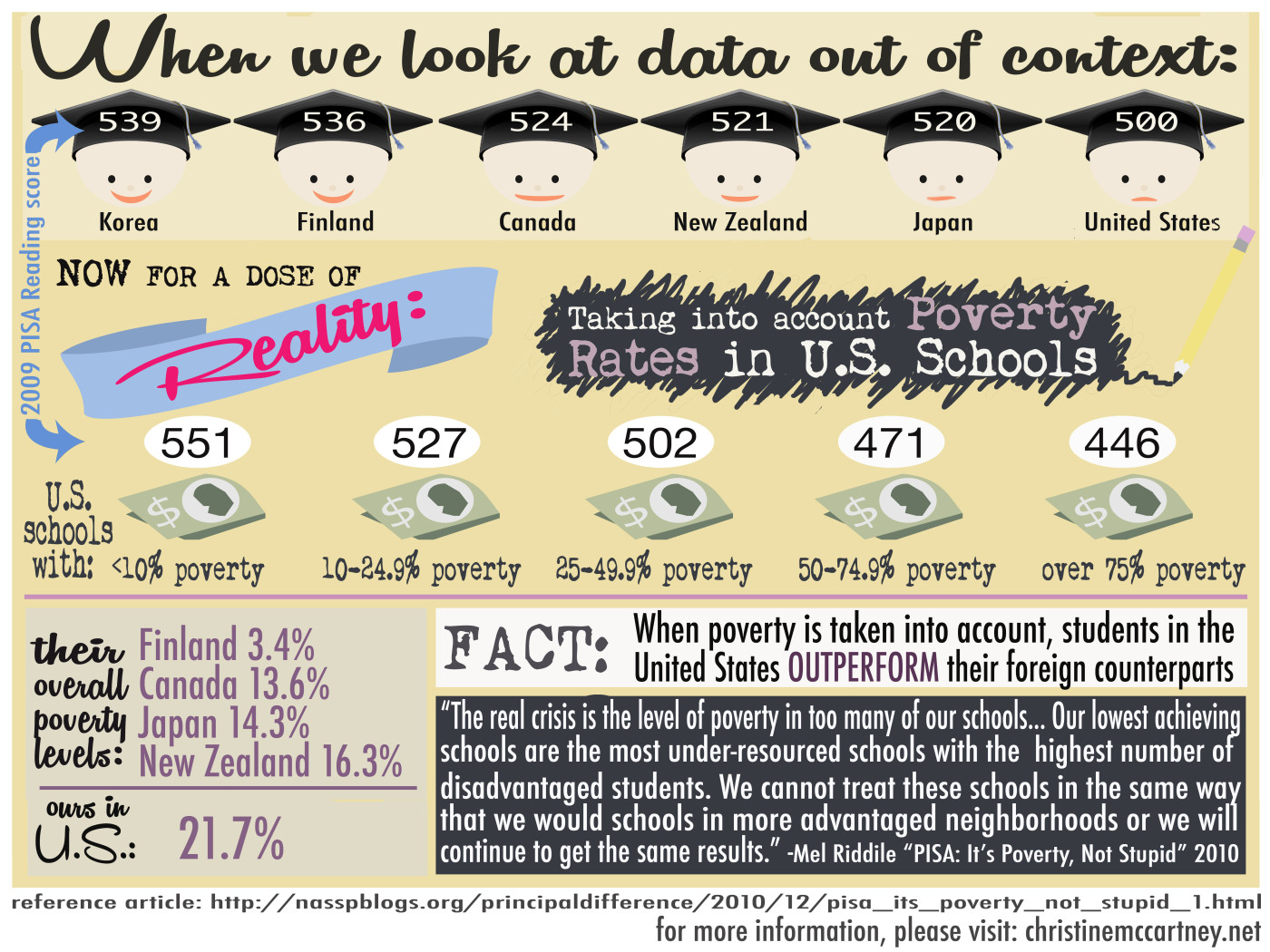
It is worth noting that I began by looking at the race and income characteristics of these communities, but since the negative impacts of poverty on educational outcomes is well known, the fact that Mt. Vernon has a school population that is much poorer than Scarsdale’s means the diminished graduation outcomes are not unexpected.  In fact, it mirrors a national phenomenon that finds when there are greater concentrations of students in poverty, testable outcomes are much lower than in communities with few students in poverty.

poverty stupid

This is where education reform advocates like to accuse their critics of fatalism and saying that there is “nothing we can do” to get better educational outcomes for children in impoverished communities.  I will agree with the premise that geographic location and income level should not be seen as determinative, and the comparison between Scarsdale and Mt. Vernon should not be taken to mean the graduation rates and diminished achievement data in Mt. Vernon should be acceptable.  However, the point of this blog is to demonstrate that there is quite a lot of data available with which one can compare Scarsdale and another community in Westchester County, and that such data has been available for many years before the Common Core aligned examinations came along.  There is, in fact, very little that these tests will tell us in community by community comparison that we do not already know.

There is something that we do know, however, and it is something that Governor Cuomo continues to do far too little to address.  Namely, the Mt. Vernon school district was shorted almost $2300 per student in state foundational school aid in the 2014-2015 school year.  So while it is all nice and well that Ms. Brisbane and her bosses at BFERBDWPE want to be able to tell a tale of communities whose homes are made more valuable by student test scores, there is another tale they fail to acknowledge: that of schools populated with students in poverty whose budgets have been repeatedly starved.

Meanwhile, Ms. Brisbane’s Scarsdale parents can take comfort in the knowledge that six residents in the Class of 2013 alone got into Harvard University.  They could have found that out without the Common Core tests too.

5 Comments

Filed under Common Core, Corruption, DFER, Funding, Social Justice, Testing

What if We Really Cared About Teacher Preparation?

Abstract

Efforts to reform teacher education in recent years have focused on demands for higher quality candidates and indicators of rigorous preparation without careful consideration of the total policy environment in which such preparation must take place.  In the era of test based accountability, efforts to recruit, prepare and induct qualified and passionate new teachers are severely hampered by contradictory and high stakes priorities enacted by state level policy makers.  In this article, I locate the different policy pressures that make thoughtful and effective teacher preparation less likely and explain what teacher preparation would look like if we took a systemic and developmental approach to teacher education that recognized how teachers learn.  Policy makers need to understand the interconnected nature of their decisions and offer policies aimed at support and growth of teachers at all experience levels and at development of capacity in universities, schools, school districts, and state offices.

###

It is, of course, easy to criticize the reform plans for teacher education that are in various stages of implementation in New Jersey.  Most proposed changes exist either as evidence-free assertions that “more is better” or as potentially defensible proposals whose consequences remain unexamined.  Perhaps most importantly, they exist in tandem with other policies in both teacher preparation and education in general that seem to contradict their central premises of attracting only the best students to teacher preparation and holding them to rigorous professional standards.  Demonstrating those contradictions is an exercise that lends itself to sarcastic wit and to taking potshots at those in authority, a two for one deal that is difficult to resist.

More daunting, however, is putting forth a positive vision of what teacher preparation ought to look like if we accept the premise that all involved would favor seeing passionate and able young teachers take to our classrooms after being strongly prepared to meet the challenges of teaching.  One does not have to seek out the poorly supported declarations of agenda-driven, self-appointed “teacher quality” watchdogs to find negative assessments of teacher preparation; they are deeply embedded in the popular culture which frequently asserts that teachers are “born” rather than made.  These assertions are expertly addressed here by David Berliner, past president of the American Educational Research Association.  However, it is important to note that a belief in teaching as a craft whose knowledge cannot be learned outside of experience is common among teachers themselves and strongly related to teacher education’s continued struggles to provide meaningful contexts for practice prior to teaching (and the reality that no controlled practice environment is fully sufficient to represent full time teaching under any circumstances).

Those of us who labor in good conscience for the preparation of tomorrow’s teachers need to articulate visions of that preparation focused upon the needs of teachers and their students.  My goal here is to detail concerns and priorities that should exist at three different stages of teachers’ professional preparation: recruitment, preparation, and induction.

Recruitment

Becoming a teacher is unlike training to join most other professions in no small part due to our apparent familiarity with teaching and teachers.  Dan Lortie, in his landmark 1975 work, Schoolteacher: A Sociological Study, observed that a typical student spends 13,000 hours observing teachers teaching during the course of a K-12 education.  That is a remarkable level of familiarity that does not exist for professions like law, psychology, medical doctors, or nurses, and, as Lortie notes, it takes place in fairly close quarters and frequently develops interpersonal relationships as well.  A strong theme among people seeking to become teachers is a desire for continuity in the experience of school; having enjoyed school themselves and having developed meaningful relationships with teachers during the long “Apprenticeship of Observation,” many teachers enter the profession desiring not to begin anew, but rather to continue.  While the apprenticeship is lengthy, it can also be deceptive because, as Lortie notes, the student’s vantage point is substantially different from the teacher’s, and it does not lend itself to viewing teaching via pedagogy and the goal-setting orientation that drives teachers’ decision making. Regardless of the limitations of student perspectives, they do matter for future teachers, many of whom seek a teaching career based upon those perceptions and the personal value derived from them.

If future teachers develop deep seated beliefs about teachers and teaching during their prolonged experience in school, we should want that experience to convey a powerful vision of meaningful learning upon them.  Our current policy environment of “test and punish” which was instituted under the No Child Left Behind act and placed into overdrive with Race to the Top has resulted in a more narrow curriculum focused upon tested subjects and a deep decline in teacher satisfaction with their jobs.  Between 2008 and 20012, teachers who are “very satisfied” on the job declined from 62 percent to 39 percent, a 25 year low, and the percentage of teachers who report that they are “under great stress” several days each week rose to 51%. A curtailed curriculum and dissatisfied teachers who cite lack of time for professional development and collaboration with their colleagues are not ingredients for P-12 schools that will nurture the next generation of teachers.  In fact, recent evidence from the United States Department of Education shows enrollment in teacher preparation programs, including alternate route programs, dropping 10% overall nationwide with several state, such as California where applicants for teacher preparation shrunk by 53%, showing steep declines.

Policy makers need to pay especially close attention to the working conditions of teachers not merely because those conditions impact teacher satisfaction and student learning, but also because it impacts the building of professional commitment by future teachers. The idea of future teachers building their commitment throughout their long apprenticeship in P-12 education is related to the concept of teaching as vocational work, a concept that has been unwisely disregarded in this era of high stakes accountability via measurement.  David Hansen of the University of Illinois at Chicago wrote in 1994 that teachers develop a sense of their work as vocational through dispositions and through their tight connection to the very specific social context of teaching and enacting teaching.  Hansen writes that seeing teaching as a vocation…

…suggests that the person regards teaching as more than simply a choice among the array of jobs available in society.  It may even mean for such a person that there is something false about describing the desire to teach as a choice at all.  An individual who is strongly inclined toward teaching seems to be a person who is not debating whether to teach but rather is contemplating how or under what circumstances to do so.  He or she may be considering teaching in schools, in institutions of higher education, or in one of the many other social setting – from military bases to visitors’ centers – in which teaching can occur.  But it may be years before such a person takes action.  He or she may work for a long time in other lines of endeavor – business, law, parenting, the medical field – before the right conditions materialize.  This posture in fact describes may persons who are entering teaching today. To describe the inclination to teach as a budding vocation also calls attention to the person’s sense of agency.  It implies that he or she knows something about him or herself, something important, valuable, worth acting upon.  One may have been drawn to teaching because of one’s own teachers or as a result of other outside influences. Still, the fact remains that now one has taken an interest oneself.  The idea of teaching “occupies” the person’s thoughts and imagination.  Again, this suggests that one conceives of teaching as more than a job, as more than a way to earn an income, although this consideration is obviously relevant.  Rather, one believes teaching to be potentially meaningful, as a the way to instantiate one’s desire to contribute to and engage with the world.  (pp. 266-267)

We would do well to remember this concept for several critical reasons.  If we want young people or career switchers to become teachers, we have to accept the variety of reasons why people make the decision to teach.  Lortie’s observation that many teachers seek continuity with an experience they themselves found desirable reminds us to enable working conditions that foster teacher satisfaction, student learning, and a positive disposition towards teaching among future teachers. Excessive test preparation, teachers without time to collaborate positively with colleagues, and general stress among teachers and students act as disincentives for otherwise interested students to consider teaching and may distort vocational aspirations.

It also should caution us about the type of person who becomes interested in teaching under such circumstances, as Lortie also noted that the desire to continue in school also contributed to teacher conservatism, the impulse to replicate existing practices.  Hansen’s vocational framework deepens this dilemma because for a person to act upon a sense of vocation in a particular field there must be a field where the individual’s desire to serve and to contribute can be enacted.  Jobs incentives such as pay and benefits matter, but they will be insufficient if a potential teacher sees a field dominated by distorting policy initiatives that focus work upon aspects that detract from the sense of motivating purpose.  When accountability ceases to be a monitoring activity that reflects upon teacher effectiveness and becomes a goal in and of itself as it has in test-based accountability, we risk undermining the critical sense of self which motivates students to become teachers.

In addition to attending to the school climate that shapes potential teachers and the sense of vocation they develop prior to teacher education, policy makers need to consider what they are looking for as requirements for prospective teachers.  Many policies are aimed at driving up the academic qualifications of students seeking to become teachers, and a frequently cited “fact” about why this is important is because high performing Finland supposedly only accepts the “top 10%” of students to become teachers. While it is true that only 10% of applicants for spots in teacher training programs are accepted at Finnish universities, it is not exactly true that they are all the “top 10%”.  In fact, according to Pasi Sahlberg, a Finnish educator and visiting professor at Harvard University, Finland’s teacher preparation programs seek applicants from across the academic spectrum in attendance at university, and they do this because “…successful education systems are more concerned about finding the right people to become career-long educators” and because the best students are not always the best teachers.  It is actually likely that students who have at least some experience struggling in school will be far more receptive to the need to differentiate their teaching and will know from experience that students can need a variety of supports in order to succeed with challenging material.  State policy makers and university based teacher preparation should look far beneath simple test scores to identify prospective teachers with genuine commitment and passion for teaching and learning.

Preparation

Situated between 13,000 hours of being a student in teachers’ classrooms and entering a profession of millions of fellow teachers are four, short, years for undergraduate teacher preparation.  Consider Lortie’s warnings about teacher sentiments.  If the long apprenticeship of observation leads prospective teachers to strong ideas about what teaching is, but those ideas cannot encompass all of the real work that makes teaching happen, and if the desire for continuity with previous school experiences leads teachers to conservatism by favoring smaller scale changes, if any, then a four year undergraduate teacher preparation experience is a necessary step to help prospective teachers enlarge not only their knowledge and teaching repertoire, but also to enlarge their vision of what teaching and learning actually are.  It stands in stark contrast to alternative pathways into teaching that rely upon teachers training on the job and without space and time to fully embrace what their work means.

Consider Maxine Greene’s warning in her 1978 essay Teaching: The Question of Personal Reality where she writes about teachers without self knowledge encountering the school system:

The problem is that, confronted with structural and political pressures, many teachers (even effectual ones) cope by becoming merely efficient, by functioning compliantly—like Kafkaesque clerks. There are many who protect themselves by remaining basically uninvolved; there are many who are so bored, so lacking in expectancy, they no longer care. I doubt that many teachers deliberately choose to act as accomplices in a system they themselves understand to be inequitable; but feelings of powerlessness, coupled with indifference, may permit the so-called “hidden curriculum” to be communicated uncritically to students. Alienated teachers, out of touch with their own existential reality, may contribute to the distancing and even to the manipulating that presumably take place in many schools….Looking back, recapturing their stories, teachers can recover their own standpoints on the social world. Reminded of the importance of biographical situation and the ways in which it conditions perspective, they may be able to understand the provisional character of their knowing, of all knowing. They may come to see that, like other living beings, they could only discern profiles, aspects of the world.

Greene’s argument points to a vital role for undergraduate teacher preparation in coaxing future teachers to understand themselves and others not merely for self reflection but also to understand that all knowledge is provisional and to value the perspectives their own students will bring with them, greatly expanding the possibilities of their own teaching. Andy Hargreaves argues that while Lortie and his successors have presented “conservatism” as a professional trait, it is actually best regarded as a “social and political ideology and power relationship,” so change “must first be needed, wanted and acknowledged” if any of the characteristics inhibiting change in teaching are to diminish.  Like Greene’s analysis, this is intensely personal and not an endeavor likely to be completed without significant time and space to challenge deeply rooted assumptions about how teachers teach and how students learn, especially students whose lives do not reflect the experiences of our mostly white, mostly middle class, teaching corps.

Gary Fenstermacher expands upon John Goodlad’s concept of teaching as practicing “stewardship” to include “a deep and thorough understanding of the nature and purpose of formal education in a free society.”   Learning to teach, then, requires a genuine commitment on the part of programs and participants to explore dispositions that allow prospective teachers to see their work not only as a continuation of their own school experience, but also as a set of experiences with potential transformative power for both their students and society.  Teacher education that does not lay that gauntlet at our students’ feet risks thoughtless replication instead of empowering improvement.

Undergraduate preparation is also an important, and sheltered, environment in which future teachers develop professional knowledge and repertoires to use in the classroom.  While popular sentiment, as mentioned previously, suggests that teachers only “know” what their students learn, that sentiment is uninformed by what it takes to transform content into something pedagogically powerful that lasts for students.  I actually sympathize with teachers who groan when someone comes along with a new “best way” to teach that is typically a repackaging of long-known ideas into a new textbook and professional development workshop series.  On the other hand, behind a lot of academic rhetoric are critically important concepts for teachers that can be effective frameworks for practice.  Linda Darling-Hammond notes that significant research demonstrates routes to teaching that lack significant pedagogical training and student teaching result in teachers who only have generic teaching skills of limited range.

Darling Hammond, however, cautions university programs against complacency, especially in critical aspects of preparation such as developing deep content and pedagogical knowledge as well as closely tying university and school based preparation together.  Many programs have extended preparation time, and a growing number of university based teacher preparation programs have expended the time and resources to develop school based partnerships where prospective teachers gain richer opportunities to practice what they are learning in environments that encourage them to learn from those experiences.  It is worth noting that when done well, such partnerships go far beyond developing teachers who can consistently check off the right ticky boxes on the Danielson framework.  Darling Hammond notes that the most promising teacher preparation practices “envision the professional teacher as one who learns from teaching rather than one who has finished learning how to teach…”  We are, in fact, talking about a stance towards professionalism as beginning with strong skills and continuously learning and developing rather than simply achieving specific point ranges on a rubric.

Sharon Feiman-Nemser characterized the central tasks of teacher preparation as “analyzing beliefs and forming new visions, developing subject matter knowledge for teaching, developing understanding of learners and learning, developing a beginning repertoire, and developing the tools to study teaching.”  To accomplish such tasks, teacher preparation programs need “conceptual coherence” meaning programs need to be organized around central principles that inform the structure, content, and assessment of courses and experiences and sequences them so that prospective teachers have the best possible chances to develop their abilities.  Articulating a conceptual vision is not simply slapping a “mission statement” on a website, then; rather, it is a core set of beliefs guiding decision making and how evidence is used for program development.

Programs also need “purposeful, integrated field experiences.”  This critical component to teacher preparation allows prospective teachers to gain practical experience applying their growing knowledge and teaching repertoire, and it allows them to test teaching theories in supported environments.  Feiman-Nemser notes that promising programs include a variety of activities for prospective teachers in the field that prompt them to think critically about their experience so that the traditional divide between theory and practice is lessened.  Kenneth Zeichner writes that the traditional disconnect can be diminished by programs creating “hybrid spaces” where the expertise and knowledge held by teachers is given equal footing with the academic knowledge housed at university campuses.  He further notes that a growing body of research demonstrates that teacher preparation programs that coordinate course activities and assignments with “carefully mentored” field experiences better prepare teachers who are able to “successfully enact complex teaching practices.”

Undergraduate programs further need to pay “attention to teachers as learners.”  Programs have to prompt their students to challenge and extend their existing assumptions about teaching and learning, and they have to actively help them challenge those assumptions “in response to students’ changing knowledge, skills, and beliefs.”  As Feiman-Nemser points out, this is not merely a disposition to be fostered in prospective teachers, but also it is one that should be modeled by program faculty who engage in teaching methods they expect of their students.  Such preparation to teach and to learn from teaching serves the interests of program graduates’ future students, and it gives the graduates skills they will need to make best use of their need to learn and develop when they enter the profession full time.

It should be noted that elements such as these in teacher preparation require more than program faculty who are conscious of these elements and conscientious about the need to make certain all teacher candidates enjoy preparation guided by these principles.  Elements of this work are entirely within the control of teacher education programs, and, notably, state level policies on the qualifications of teacher candidates have very little impact upon them except to narrow the pipeline of potential future teachers.  However, other elements depend heavily upon state and local policies, and they can be negatively impacted by them.  Zeichner notes that the kind of clinical work that is necessary for teacher education to be effective is still rarely valued at research universities, and that faculty who take the time and effort to foster genuine two-way ties with practicing teachers suffer detrimental consequences to their careers.  Further, in a time of continued cuts to state support for higher education, it is exceptionally hard for university programs to build and scale the kinds of meaningful partnerships in local schools needed to prepare prospective teachers.  If we expect teacher education to provide excellent preparation, policy makers need to facilitate the necessary elements of that preparation.

Also, we need policy makers to consider the environment that they are pushing into our public schools.  Teaching is a time consuming and demanding profession even under ideal circumstances; increased demands upon teachers with no changes in their other work requirements serves as a disincentive to accept novices in their classrooms.  The impacts of state policies on teachers is no small matter.  In New Jersey, all teachers have to submit Student Growth Objectives as part of their annual evaluation, and while the early explanation of SGOs suggested a potentially valuable process of self examination with the support of administrators, the reality is a time consuming mess for which teachers have received little training and even less time.  Page 16 of the state distributed SGO Guidebook is a textbook case of instructing people to create meaningless tables that resemble statistical analysis but bear absolutely no resemblance to statistics done with any integrity.  Teachers in subjects that are tested in the PARCC consortium exams are also evaluated using Student Growth Percentiles (SGPs) which have some advantage over value added models by being relatively stable but which are also statistically correlated with the percentage of children in poverty.  Bruce Baker of Rutgers sarcastically and correctly questions the validity of SGPs since they only seem to work if we assume that, somehow, the only truly effective teachers in the state of New Jersey ended up in wealthy school districts.

Given the demands to produce laborious yet meaningless statistical analyses of themselves and given the use of questionable measures of their teaching effectiveness via student test scores, it is perhaps miraculous that any teachers at all agree to work with inexperienced undergraduates in field placements and in student teaching.  However, we might all legitimately ask policy makers what conditions they envision enabling truly deep and risky work with novices in public schools?  Are teachers enabled with the time and support to mentor?  Are principals and other administrators given the chance to be instructional leaders who foster collaboration and professional growth?  Are there incentives and funding necessary to develop actual two-way collaboration between universities and schools?

Induction

The early career phase and its steep learning curve seems more and more like an abandoned concept in today’s policy environment, yet it remains critically important.  A simple reality is that regardless of the quality of teacher preparation, there is only just so much that can be done prior to actually teaching.  It is not that high quality programs do not prepare teachers more able to take on their full time responsibilities; it is that the mediated and supported environment of teacher education and mentored field experiences cannot fully replicate the reality of full time classroom teaching with the full range of both instructional responsibilities and demands to acculturate to a new school and community.  Teachers have been, traditionally, placed into their first classroom on the exact same footing as their experienced peers and expected to perform with only those supports either in place or absent from the schools in which they work.

This is no small matter because, far from the “crisis” of tenured teachers resting on their laurels as portrayed by anti-union activists like Campbell Brown, our schools face a far more serious problem with excessive turn over and the early exit of young teachers from the profession.  Richard Ingersoll demonstrates that teacher turnover is a significant phenomenon and a substantial factor in the need for new teachers each year.  Additional research by Dr. Ingersoll for the Alliance for Excellent Education calculates that the movement of teachers from one school to another and the replacement of teachers who leave the profession entirely costs upwards of $2.2 billion each year.  Dr. Helen Ladd of Duke University reports that in 2008, more than a quarter of our nation’s teachers had five years of experience or less, and that concentrations of teachers with limited experience are found in schools serving underprivileged children.  This is especially problematic given that teachers gain in effectiveness very rapidly in the early career with a general leveling off after 15 years of experience;  Dr. Ladd’s research found that teachers with that level of experience are generally twice as effective as teachers with only two years in the classroom.  Experienced teachers provide schools and students with other advantages as well, but the general point should be clear:  we can increase requirements on teacher preparation and upon graduates of teacher preparation all we want, but if the systemic ignoring of the early teaching career continues, those changes will yield nothing.

Researchers from Harvard’s Project on the Next Generation of Teachers have found that working conditions are the strongest predictor of why teachers leave a given school or the profession.  Among the school climate elements that impact teacher turnover are the level of trust and support apparent in administration, higher levels of order denoted by matters like student absenteeism and respect, and collegiality in the form of strong support and rapport among teachers.  Further, the researchers note that while policy makers can try to impact these aspects of the school environment, they are unlikely to succeed without careful attention to capacity building in the schools and in the district and state offices that seek positive change.  For example, expanded and positive collegial interaction requires serious consideration of teaching schedules and administrative duties, so that they can focus upon planning and collaboration with colleagues and curriculum experts, practices that are implemented in higher performing countries.  This is not work that can be accomplished on the cheap by rewriting regulations; it needs funding and direct support.

While such initiatives would benefit teachers across the experience levels, special attention should be paid to teachers in the early stage of their career.  Before test based accountability dominated the school landscape, we had good evidence that school culture and climate mattered significantly for the success and retention of new teachers.  According to Susan M. Kardos and associates, schools that were characterized as having “integrated” professional cultures had a blend of experience levels among teachers and new teachers found high levels of support and sustain collaboration across experience levels that was supported by administrators.  In such schools, new teachers were not expected to be polished veterans and found serious efforts taken to provide them with appropriate mentors and to regard them as learning and developing colleagues.  Making such environments work requires shared norms that are supported by administrators who work to provide the time and space necessary for productive collaboration across different experience levels of teachers with an expressed goal of improving teaching and learning.

While inspired leadership can build such environments, policy makers can assist by taking the induction period seriously and by seeing that mentoring of new teachers is not a haphazard add on to teachers’ existing work.  Feiman-Nemser makes clear that induction of new teachers will happen whether or not it is designed by policy because regardless of the quality of their preparation, new teachers must undertake the following tasks in their early career: gaining local knowledge of students, curriculum, and school context, designing responsive curriculum and instruction, enacting a beginning repertoire in purposeful ways, creating a classroom learning community, developing a professional identity, and learning in and from practice.  While quality teacher preparation can lay the groundwork for all of these tasks, they must be implemented within a specific school and community context for a new teacher to be successful, and that process can either be left to chance or policy can seek to increase the number of fruitful contexts for induction so novices are not left to rely upon luck for their specific needs to be recognized and addressed.

Formalizing induction can take different approaches, and policy makers need to carefully consider how they wish to support the matter.  Feiman-Nemser observes that promising induction policies seek mentors for new teachers who are appropriate given the context and people involved and allow reduced teaching loads so that novices and mentors can actually collaborate.  Strong induction programs also allow for novice development over a period of time, so policy should not confine mentoring and support to just the first year of teaching.  Mentors provide genuine and constructive feedback aimed at improving novice practice, and schools and districts provide regular development specific to the needs of novice teachers.  Effective mentoring and induction also embraces the dual role of assistance and assessment of novices, so mentors cannot simply confine themselves to a cheer leading role; their practice has to come with tools and dispositions aimed at improving novice teaching.  Just as we recognize that the very best students are not always destined to become the very best teachers, we recognize that the very best teachers are not always well-suited for mentoring.  Novices need “caring and competent mentors” who are well prepared for their role and given training to understand how to teach teachers.  Under ideal circumstances, the mentoring process is two way as mentor teachers, in the process of supporting and teaching novices, sharpen their abilities to observe, analyze, collaborate, assess, coach and other skills important to their improvement of teachers and schools.

It must be noted again that such work and policy does not come without cost.  Schools and districts coping with decreased state spending on education, are unlikely to afford resource and personnel intensive policies on their own.  If districts can find additional funding, it seems likely they will use it to make up for cuts to programs previously supported by the state (In New Jersey, for example, over 11,000 vulnerable students lost access to after school programs between the hours of 3 and 6pm in the 2011 budget cuts).  However, if policy makers are serious about the need for high quality teachers, and if they see the threats to teacher quality and student learning inherent in early career turnover, then they must consider legitimate efforts to create early career induction and mentoring within integrated professional cultures as the norm rather than as lucky exceptions.

###

Policy makers have to consider the kinds of school environments their efforts have developed.  Just as teacher stress and job dissatisfaction are serious impediments to recruiting prospective teachers to the field, and just as evaluation requirements that force teachers to create meaningless reports of their teaching and to increase the amount of time spent on test preparation stand in the way of experienced teachers opening their classrooms to novices, those same policies are inherent barriers to instituting deliberate policies of mentoring and induction.  Test based accountability and evaluation tasks with little inherent legitimacy but high time commitments are distorting elements in today’s schools.  They absorb time and priority from even the very best teachers in our schools, and they given nothing of value in return.  Worse, they serve as a disincentive for teachers who would be genuinely accomplished mentors of preservice and early career teachers to even consider taking on the role.

Policy needs a serious realignment to consider what practices can be instituted that would shift accountability from a test and punish focus and into a support and growth focus when it comes to teacher quality.  Recruitment of students into teacher preparation can only happen in an environment when the actual rewards of teaching are evident.  Most teachers would be unlikely to turn down an offer of better salaries across the board, but by overwhelming margins, teachers want to be able to work for the best of their students and they want more time and resources to do that well.  Current policies in most jurisdictions simply pile more work on teachers with fewer resources and demand growth in test scores as the main indicator of success.

Higher demands on teacher education are not made in a vacuum.  It may be defensible to seek higher entrance requirements into teacher education and to call for more work in the field by teacher candidates, but the development of genuinely quality partnerships between schools and universities is resource and time intensive work that is difficult to accomplish simply by fiat from state capitols.  Capacity must be built at all levels of the system, and resources in the form of money and development time have to be built into the changes for work to be genuinely meaningful.  Further, experienced teachers, even those disposed to mentoring, cannot be fairly expected to participate in increased responsibilities for teacher education under current circumstances.

In the era of test based accountability, little attention has been given to the needs of novice teachers during their induction period, and that has continued the long standing and increasingly unsustainable churn in early career teaching.  Our schools lose both money and valuable experience as the unique needs in induction remain met only by haphazard circumstance rather than by a systemic focus on novices as learners, colleagues as mentors, and teachers as growing throughout their careers.  While school climate cannot be commanded from afar, policy makers ignore the circumstances that they incentivize at the peril of both teachers and students.  Induction of novice teachers will happen whether we attend to it or not, and failing to do so in any systemic way perpetuates the current “system” that has no focus or operating principles.

Becoming a teacher is frequently a lengthy journey.  Our future teachers are in our public schools right now forming their earliest, and sometimes most enduring, ideals about what purposes are served by public education and what the work of teaching and learning entails.  This time period is absolutely essential to the formation of their sense of vocation and commitment to the best ideals of education.  Entry into teacher preparation, in many senses, begins with the first desire to be like a child’s favorite teacher, but the path laid before that prospective teacher is one within the influence of policy.  If we want that path to be both effective and purposeful, then we need to understand it and use policy to enable its best possibilities.

References:

Alexander, F. (2014, April 21). What Teachers Really Want. The WashingtoN Post. Retrieved April 19, 2015, from http://www.washingtonpost.com/blogs/answer-sheet/wp/2014/04/21/what-teachers-really-want/

Alliance for Excellent Education (2014). On the path to equity: Improving the effectiveness of beginning teachers. Washington, DC: Mariana Haynes.

Baker, B. (2014, January 30). An Update on New Jersey’s SGPs: Year 2 – Still not valid! Retrieved April 19, 2015, from https://schoolfinance101.wordpress.com/2014/01/31/an-update-on-new-jerseys-sgps-year-2-still-not-valid/

Berliner, D. (2000). A Personal Response to Those Who Bash Teacher Education. Journal of Teacher Education, 51(5), 358-371.

Cawelti, G. (2006). The Side Effects of NCLB. Educational Leadership, 64(3), 64-68.

Darling-Hammond, L. (2000). How Teacher Education Matters. Journal of Teacher Education, 51(3), 166-173.

Darling-Hammond, L. (2013, June 18). Why The NCTQ Teacher Prep Rating Are Nonsense. The Washington Post. Retrieved April 19, 2015, from http://www.washingtonpost.com/blogs/answer-sheet/wp/2013/06/18/why-the-nctq-teacher-prep-ratings-are-nonsense/

Day, T. (2005). Teachers’ Craft Knowledge: A Constant in Times of Change? Irish Educational Studies, 24(1), 21-30.

Feiman-Nemser, S. (2001). From Preparation to Practice: Designing a Continuum to Strengthen and Sustain Teaching. Teachers College Record, 103(6), 1013-1055.

Fenstermacher, G.D. (1999). Teaching on both sides of the classroom door. In K.A. Sirotnik & R. Soder (Eds.), The beat of a different drummer: Essays on educational renewal in honor of John Goodlad (pp. 186-196). New York: Peter Lang Publishing, Inc.

Greene, M. (1978). Teaching: The Question of Personal Reality. Teachers College Record, 80(1), 22-35. Retrieved April 19, 2015, from http://www.tcrecord.org/Content.asp?ContentId=1080

Hadley Dunn, A. (2014, August 3). Fact-Checking Campbell Brown: What she said, what research really shows. The Washington Post. Retrieved April 19, 2015, from http://www.washingtonpost.com/blogs/answer-sheet/wp/2014/08/03/fact-checking-campbell-brown-what-she-said-what-research-really-shows/

Hansen, D. (1994). Teaching and the Sense of Vocation. Educational Theory, 44(3), 259-275.

Hargreaves, A. (2009). Presentism, Conservatism, and Individualism: The Legacy of Dan Lortie’s “Schoolteacher: A Sociological Study” Curriculum Inquiry, 40(1), 143-155.

Ingersoll, R. (2001). Teacher Turnover and Teacher Shortages: An Organizational Analysis. American Educational Research Journal, 38(3), 499-534.

Johnson, N., Oliff, P., & Williams, E. (2011, February 9). Update on State Budget Cuts. Retrieved April 19, 2015, from http://www.cbpp.org/cms/?fa=view&id=1214

Kardos, S., Moore Johnson, S., Peske, H., Kauffman, D., & Liu, E. (2001). Counting of Colleagues: New Teachers Encounter the Professional Cultures of Their Schools. Educational Administration Quarterly, 37(2), 250-290.

Katz, D. (2015, March 27). Does Anyone in Education Reform Care If Teaching is a Profession? Retrieved April 19, 2015, from https://danielskatz.net/2015/03/27/does-anyone-in-education-reform-care-if-teaching-is-a-profession/.

Ladd, H. (2013, November 24). How Do We Stop the Revolving Door of New Teachers? Atlanta Journal Constitution. Retrieved April 19, 2015, from http://www.ajc.com/weblogs/get-schooled/2013/nov/24/how-do-we-stop-revolving-door-new-teachers/

Leachman, M., & Mai, C. (2014, May 20). Most State Funding Schools Less Than Before the Recession. Retrieved April 19, 2015, from http://www.cbpp.org/cms/?fa=view&id=4011

Lortie, D. (2002). Schoolteacher: A sociological study. Chicago: University of Chicago Press.

McGuire, K. (2015, February 23). As veteran teachers face more time demands, placing student teachers becomes more difficult. Star Tribune. Retrieved April 19, 2015, from http://www.startribune.com/local/west/293771361.html

MetLife, Inc. (2013). The Metlife Survey of the American Teacher: Challenges for School Leadership. New York, NY: Harris Interaction. Retrieved April 19, 2015, from https://www.metlife.com/assets/cao/foundation/MetLife-Teacher-Survey-2012.pdf.

Moore Johnson, S., Kraft, M., & Papay, J. (2012). How Context Matters in High Needs Schools: The Effects of Teachers’ Working Conditions on Their Professional Satisfaction and Their Students’ Achievement. Teachers College Record, 114(10), 1-39. Retrieved April 19, 2015, from http://www.tcrecord.org/content.asp?contentid=16685.

Ravitch, D. (2014, March 24). How New Jersey is Trying to Break its Teachers. Retrieved April 19, 2015, from http://dianeravitch.net/2014/03/28/teacher-how-new-jersey-is-trying-to-break-its-teachers/

Sahlberg, P. (2015, March 31). Q: What Makes Finnish Teachers So Special? A: It’s Not Brains. The Guardian. Retrieved April 19, 2015, from http://www.theguardian.com/education/2015/mar/31/finnish-teachers-special-train-teach

Sawchuck, S. (2014, October 21). Steep Drops Seen in Teacher-Prep Enrollment Numbers. Edweek. Retrieved April 19, 2015 from http://www.edweek.org/ew/articles/2014/10/22/09enroll.h34.html.

Simon, N., Moore Johnson, S. (2013). Teacher Turnover in High Poverty Schools: What We Know and Can Do. (Working Paper: Project on the Next Generation of Teachers). Retrieved April 19, 2015, from http://isites.harvard.edu/fs/docs/icb.topic1231814.files//Teacher%20Turnover%20in%20High-Poverty%20Schools.pdf.

Taylor, A. (2011, December 14). 26 Amazing Facts About Finland’s Unorthodox Education System. Retrieved April 19, 2015, from http://www.businessinsider.com/finland-education-school-2011-12#teachers-are-selected-from-the-top-10-of-graduates-19

Zeichner, K. (2010). Rethinking the Connections Between Campus Courses and Field Experiences in College- And University-Based Teacher Education. Journal of Teacher Education, 61(1-2), 89-99.
2 Comments

Filed under Funding, NCLB, politics, schools, teacher learning, teaching, Testing

Merryl Tisch Suggests Firing A Lot of Black and Hispanic Teachers

New York Regents Chancellor Dr. Merryl Tisch has been downplaying the potential negative consequences of sweeping changes to teacher tenure and evaluation in the new state budget.  On April 1st, she commented that the new system does not specifically say that test scores make up 50% of teacher evaluations and suggested that concerns over the weight given to tests was overblown.  Dr. Tisch is technically correct which, as we all know, is the best kind of correct.  The new evaluation law does not say scores are 50% and it leaves various weighting decisions to the Regents and the NYSED.  However, the scoring matrix, which is in the law, has two axes, one of which is for test scores.  I can count really well up to two, and it is fairly obvious the tests, as one axis out of two, are 50% of the evaluation (not to mention that both axes determine the outcome in the matrix roughly equally).

Dr. Tisch was back in the press this morning, suggesting that she thinks the new evaluation system should potentially be lifted from districts that have had strong records of student achievement.  The upshot is that if a district has high graduation and college acceptance rates and strong “college readiness” (aka test scores), they could be freed from state regulations and allowed to craft their own evaluation and accountability systems within certain parameters.  Dr. Tisch suggested that such changes could come from the Commissioner’s regulatory power, but she would also consider asking legislators to make amendments to the newly passed system allowing these changes.  In her view, such changes in favor of high performing districts would “…give them the respect that they deserve for the job that they do, and let us turn our attention, our scarce resources and our capacity to the districts that really need us in terms of access and opportunity for students.”

It would also mean many fewer African American and Latino teachers would ever get tenure and many more of them would be fired.

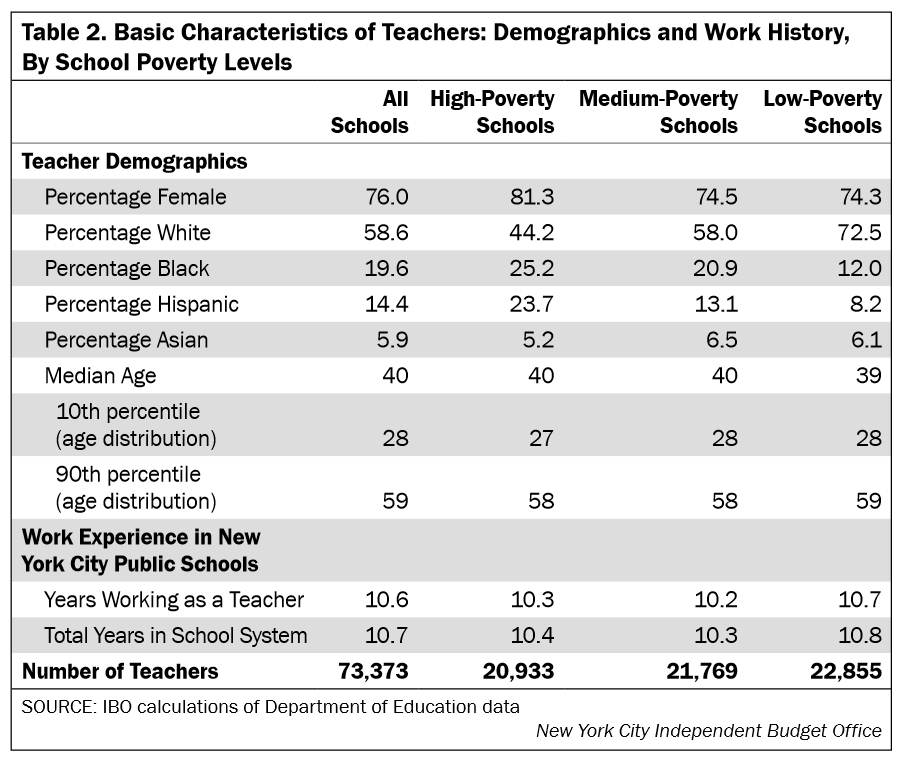
Now I am not suggesting that Chancellor Tisch actually hopes to do this, but there are consequences to not thinking things through in policy.  Exempting districts with records of high achievement from the new evaluation requirements would place a significantly heavier burden on teachers of color and result in their removal at disproportionate percentages.  The reason for this is fairly simple: just as our communities and schools are segregated by race and income, so are our teachers.  In New York State, 9.8% of teachers are Hispanic and 8.6% are African American.  These numbers are not, however, even distributed across the state.  In New York City, for example, African American teachers make up 19.6% of all teachers and Hispanic teachers are 14.4% of all teachers.  The numbers shoot up when you are talking about schools with a high percentage of students in poverty:

Teachers by race and poverty

Now we are talking about schools where 25.2% of the teachers are African American and 23.7% are Hispanic, while in schools that are low poverty, those numbers are only 12% and 8.2% respectively.  That means of the roughly 21,000 African American teachers and the roughly 24,000 Hispanic teachers in the state of New York, 5,275 of the African American teachers and 4,961 of the Hispanic teachers work in high poverty schools in the city of New York alone.

Given the long known impact of poverty on school performance, it doesn’t take a degree in rocket science (or even a doctorate in education from Teachers College) to understand that schools with higher concentrations of poverty are going to be schools where more students struggle to demonstrate annual progress on standardized tests and that the teachers who teach them will have similar trouble demonstrating their “value added” to those test scores as required in the new evaluation.  What percentage of new African American and Hispanic teachers in New York will struggle to and ultimately fail to reach “effective” for three out of four years in the new tenure process?  What percentage of their more experienced colleagues will fluctuate between “ineffective” and “developing” because the lack of statistical validity given to one axis of the new evaluation matrix?  How many schools with high concentrations of poor children and faculty who are disproportionately African American and Hispanic will be forced to sacrifice social studies, science, art, music, and health education in favor of mimicking the teaching practices of charter schools who emphasize test preparation for months of the school year?

Looking for a way to allow high income districts with good test scores to avoid the new evaluations might be a politically savvy move to allay growing discontent among outspoken parents.  But it will also end up kicking teachers of color and their students right in the teeth as they, already hard pressed by test based accountability, will be the only ones to bear the full brunt of the new system.

The sad part is that Dr. Tisch is not entirely wrong, but her statement demonstrates only a minor understanding of how to use data to leverage system wide change.  She suggests that relieving high performing districts would allow the NYSED to focus its efforts and resources on struggling districts, but she has not offered any insight into how that would work as a system that focuses on support and growth rather than on test and punish.  It is possible to use system wide data to identify schools and school systems that can have greater autonomy, but the policy should be wedded to increasing resources and support within schools that struggle with the understanding that the vast majority of teachers want to do well by their students and that a great many are doing precisely that even if it is not captured on one test.  Instituting a continuous improvement policy takes time and patience and resources — things for which Dr. Tisch has not recently demonstrated patience.

So I have to ask the Chancellor: If you uncouple wealthy districts from the new accountability system will you simultaneously implement a vastly different perspective for our struggling school districts with high levels of poverty? Will you embrace a support and growth model of system wide change and work to find ways to de-emphasize test and punish?  Because if you do not, the end result of your suggestions will simply be to subject schools with a majority of poor students and high percentages of African American and Hispanic teachers to the kind of churn and burn faculty turnover that we tend to see in many urban charter schools while leaving teachers and students in the majority white suburbs largely untouched.

That cannot possibly be what you want — right, Dr. Tisch?

21 Comments

Filed under New York Board of Regents, teacher learning, Testing

Who Will be NYSED’s “Outside Evaluators”?

As more details emerge from the budget agreement hammered out between Assembly and Senate leadership and Governor Andrew Cuomo, more questions seem to need urgent answers.  The Governor got many of the education items that he wanted, especially regarding tenure and teacher evaluations.  His original proposal called for 50% of teacher evaluations to come from standardized testing, 35% from an “outside evaluator,” and only 15% from school principals.  All three of these elements are in the budget framework and potentially the budget bills being debated as the deadline looms, but the final weight of the different items will depend upon work done by the New York State Education Department between now and June 30th.  Regardless of the final weight given to these items, no teacher in the state will be found to be more than “developing” if the test score component is “ineffective,” and all teachers will be evaluated with an outside observer’s input.  Any district that does not submit and receive approval of an evaluation plan using these guidelines will get no increase in state aid for the coming year.

The outside observer component was of special interest to Governor Cuomo who called the current evaluations (that he fought to implement originally) “baloney” and who apparently does not trust that school principals are capable of evaluating their teachers.  Taken out of context, the idea of an additional set of eyes observing teachers using some kind of common metric is intriguing.  Kind of like giving every newborn child in the country a pony.  You like the idea until you start thinking about how it could possibly work.  In the end you realize that the most predictable result is that a lot of people are going to end up with pony poop in their kitchens.

Capital New York reports this morning that a few more details are emerging on the teacher evaluation system:

There will be two required observations, from a teacher’s principal or administrator and an “independent” evaluator, who could be a principal, administrator or “highly effective” teacher from another school or district. As Cuomo originally proposed, a college professor or retired educator could also serve as the independent evaluator. A peer observation will be optional.

The logistics of this will likely prove very daunting.  Who, exactly, will be the “outside evaluators” for all of the schools in New York State?  According to the governor and law makers, they will be a hodge podge of administrators, “highly effective” teachers, college professors, or retirees.  This, at least, is a more qualified proposed group than Pearson Corporation’s essay scorers who were recruited in part by advertising on Craig’s List, but what is the scale of this endeavor?

Classroom observations are currently done by school principals and other related district administrators who are already employed by districts to do a full range of duties, not just teacher evaluations.  There are 4,530 public schools across all of the school districts in New York State (not including charters), and 203,457 classroom teachers who work in those schools (not including paraprofessionals, etc.).  That means that in any given year, roughly 4500 principals are doing some or all of the observations for all of the teachers in their buildings.  This includes scheduling a classroom visit, doing the observation with appropriate notes, optimally having a pre and post observation discussion with the observed teacher, and writing up the evaluation report using the current scoring band system.  Now that work will have to be duplicated over 200,000 times by the outside evaluators who will be approved to observe and to evaluate teachers in the state.

So who will we get to do this?

Will school principals do this for teachers outside their districts? I have my doubts.  Principals are very busy people with a heavy load of time intensive and often politically sensitive work to accomplish.  If a principal is already observing and evaluating all teachers in his or her building, how much time will that person have to travel to other districts and replicate that work for a school system that does not employ him or her full time?

Will “highly effective” teachers do this for teachers outside their own districts?  First, the proposed system is not designed to find very many teachers “highly effective” to begin with, so this will be a limited pool that may change from year to year.  Second, it is highly doubtful that many teachers, regardless of skill level, will line up to undertake this role outside of their own schools.  There is some precedent for experienced and highly regarded teachers taking a role to assist and review peers within their own schools and districts, but such programs are costly and usually require release time from classroom teaching.  Will many of New York’s “highly effective” classroom teachers take on travel and cost their districts substitute teacher costs so they can travel outside of district to evaluate other teachers?  I would not hold my breath waiting for that.

Will college professors do this in addition to their scholarly and teaching pursuits?  For that matter, how many professors are actually qualified to do such work in the state?  The NYSED website says that over 100 university based undergraduate and graduate programs in the state lead to teacher certification, so there may, in fact, be qualified faculty in the state to take on some of the load.  However, recall that roughly 4500 school principals or assistant administrators are responsible for ALL of the teacher evaluations for over 203,000 classroom teachers.  Very few university faculty will likely consider taking on even a partial load of teacher evaluations if it inhibits their ability to teach on campus and to conduct research in their fields.  If the state were considering fostering many more deep university and school district partnerships it might be plausible to use faculty for some of this work, but it is highly unlikely if the call is simply for faculty to take on additional responsibilities that do not serve their professional goals.

Will retired teachers agree to do this work?  I do not know.  Maybe, but I kind of doubt it under current circumstances.  A retired teacher would likely not be qualified to evaluate too many teachers in a single school if it meant observing outside of his or her certification area.  As a teacher education program director, I know many retired teachers who have been willing to give of their time and wisdom to supervise our student teachers.  They do it because they love teaching and want to help mentor new young people into the profession.  Will Governor Cuomo and the NYSED be able to find large numbers of retired teachers who want to do work aimed at REMOVING many more teachers?  I have my doubts.

This will also be an expensive proposition.  Doing all of teacher evaluation twice every year will require a workforce large enough to do that portion of administrators’ work each and every year.  We will need a workforce of at least 1100 evaluators doing at least one evaluation a day during the school year to observe and evaluate every classroom teacher in the state (and, of course, every school day is not a day available for observations), and that assumes a nice, evenly distributed available pool of evaluators matched to teachers.  Unless there is a line item in the budget to pay for all of them, then it will likely be up to the districts to hire evaluators and pay them for their time and travel.  So which art or music teacher will your district have to cut this year to pay for the outside evaluators?

Come to think of it, the pony idea might be more feasible.  And cleaner.

9 Comments

Filed under Funding, New York Board of Regents, politics, schools, teaching, Testing

When “Evaluation” Means “Ruin Teaching”

Observers of the budget negotiation process in Albany, N.Y. had some reasons to be hopeful over the past week.  Various reports indicated that the new Assembly Speaker, Assemblyman Carl Heastie of the Bronx, was holding firm against various education proposals from Governor Andrew Cuomo.  Backed by polling showing the public in New York dead set against the Governor’s proposals by wide margins, it looked like much of the education agenda laid out in the January budget address was at risk.  And early reports from Sunday suggested that the Assembly representatives secured significant increases in education aid and managed to trim a number of the worst proposals from the budget framework.  An aid increase between $1.4-$1.6 billion dollars is in the agreement, and Governor Cuomo’s plans to lift the charter school cap and provide a new tax credit for donations to private schools are both absent from the framework.

Teacher evaluations and tenure, however, remained problematic.  The evaluation agreement still relies upon standardized testing, outside evaluations, and principal evaluations, but at unspecified weightings.  In a tenure process extended to four years, new teachers would have to have three years rated as “effective” to earn tenure, and teachers earning “ineffective” in consecutive years would face an expedited removal process of 90 days.  Reports of these proposals reaching the budget framework obviously concerned those hoping for relief from test based accountability and an evaluation process that recognized the mounting evidence against value-added models of teacher effectiveness based on standardized tests.

Oh, what a difference 12 hours has made.

Not only are the evaluation proposals worse than originally feared, but also the desperately needed increase in school aid is contingent upon cities and towns adopting the evaluation framework and having it approved by Albany before November.  According to the Capital New York report, Deputy Commissioner Ken Wagner explained the following details of the agreed upon evaluation framework in the budget negotiation:

  • Increase in state aid will not happen if a district fails to submit a new evaluation and have it approved by November 15th.
  • Tenure will be extended to a four year process, and a probationary teacher must have an “effective” or better rating for three of those four years.  A rating of “ineffective” in the fourth year will deny tenure.
  • The state Education Department will be tasked with creating a “matrix” based upon test scores, outside evaluators, and principal evaluations; districts may request an additional state examination to be developed by the NYSED, but it is unclear how many districts would want more testing in the current environment.

These conditions were on top of earlier reports that stated that the evaluation system would be designed so that a teacher who is found “ineffective” based on the testing portion of the matrix will not be able to be rated higher than “developing” overall regardless of the observation scores.  In essence, the state Education Department has until June to craft a teacher evaluation system where test scores will govern whether or not a teacher can be rated “effective,” and districts have until November to submit their plans to implement such a system or they will receive none of the budgeted aid increase.

This is not a plan to strengthen teaching.  This is a plan to use test scores to severely curtail the teaching profession in the state of New York.

The reasons not to use value-added models for teacher evaluation are numerous, but the most important ones are:

  1. Teacher input on the differences among student test scores is too low and the models used to locate that input are not reliable enough to be used to evaluate individual teachers.  This is the judgement of the American Statistical Association whose statement on using value-added models makes it clear the models have very large standard errors that make ranking teachers by them unstable.
  2. The instability of VAMs is considerable, and teachers who are deemed “irreplaceable” because of a VAM ranking in one year can be ranked very differently in subsequent years.
  3. Even teachers who are known to be excellent and teach advanced students can be found “ineffective” by VAM ranking.  Working in an excellent school with highly privileged students who score extremely well on tests is not a guarantee of an effective VAM ranking.
  4. Teachers who score well on VAM ranking do not necessarily score well when their students are tested on measures of critical thinking, suggesting that VAMs do a poor job of finding out which teachers are actually promoting meaningful learning with their students.

What possible outcome will be the result of the teacher evaluation proposals in Albany?  For starters, it will not only be much more difficult to obtain tenure, it may become impossible without converting significant portions of the curriculum into test preparation.  If teachers are held to a top ranking of “developing” if the test based portion of the evaluation is “ineffective” then it is distressingly possible that many new teachers will not be able to reach “effective” or better for three out of four years, and it will be through no fault of their own given the problems with VAM derived rankings.  Just as the No Child Left Behind act resulted in a narrowed curriculum due to pressure from high stakes testing, New York is poised to exacerbate that problem, and parents can expect their children to spend fewer hours with social studies, science, art, music, health, and physical education.  The final results of the budget negotiation may not be as bad as Governor Cuomo initially proposed, but there is still a hefty dose of poison in it that threatens to increase the replacement of our schools’ curricula with testing while gaining no actual improvement in the teacher workforce.

Noticeably absent from anyone in Albany who professes to care about the quality of teachers in the Empire State?  Support.  Meaningful professional development and education.  Mentoring and induction proposals.  While there is no “one size fits all” in helping teachers grow in their jobs, there are general principles that matter.  The Albany budget negotiations offer no support for schools to improve their working conditions and general environment, factors that research shows have impact on both teacher satisfaction and student learning independent of demographics of the school.  Supporting principals in being genuine instructional leaders within their schools and providing teachers with real opportunities to collaborate and to lead across experience levels would do far more to substantively improve student achievement than hanging yet one more Sword of Damocles over teachers’ heads.  Doing so would require an actual investment of funds and resources not tied to blackmail demands.

That might be a novel approach for Albany these days, but it is the only one that is right.

New York Assembly members can be found and contacted from this page.  Members of the Senate can be found here.  The New York State Allies for Public Education has a list of the important leaders’ offices here.  Every phone call, email, and Tweet makes a statement.

2 Comments

Filed under Corruption, Funding, NCLB, New York Board of Regents, politics, teacher learning, teaching, Testing

Does Anyone in Education Reform Care If Teaching is a Profession?

Bob Braun, retired veteran reporter for the New jersey Star Ledger and current independent blogger, reported earlier this month that state-appointed Newark Superintendent Cami Anderson announced that Newark teachers seeking graduate education would only get district stipends if they did all of their study at the Relay “Graduate School of Education.”  For those who are unfamiliar, Relay “Graduate School of Education” was singled out as an innovator by Secretary of Education Arne Duncan last November, but it is a “Graduate School of Education” that has not a single professor or doctoral level instructor or researcher affiliated with it.  In essence, it is a partnership of charter school chains Uncommon Schools, KIPP, and Achievement First, and it is housed in the Uncommon Schools affiliated North Star Academy.  Relay’s “curriculum” mostly consists of taking the non-certified faculty of the charter schools, giving them computer delivered modules on classroom management (and distributing copies of Teach Like a Champion), and placing them under the auspices of the “no excuses” brand of charter school operation and teachers who already have experience with it.

In the case of North Star Academy in Newark, that means that the teachers who earn certification through Relay “Graduate School of Education” will have “instructors” who meet state requirements for faculty degrees by the school claiming “equivalency” because they are such amazing teachers who get amazing results.  In Relay’s words that is “the equivalent of the leading entrepreneur teaching in MBA programs or the leading writers and artists teaching in MFA programs.”  That’s quite a lofty claim, especially when Dr. Bruce Baker of Rutgers University has demonstrated (repeatedly) that the “awesome” results of North Star are deeply connected to how the school has many fewer students with high needs due to poverty, language, or disabilities issues, how it suspends students at rates much higher than district schools, and how an African American male who enrolls in 5th grade has only a 40% chance to staying at the school until 12th grade.

So, there you have it: a “Graduate School of Education” without a single professor of education, offering teacher certification and degrees to the employees of the charter school in which it is housed, specializing in a curriculum that emphasizes teaching and discipline strategies that successfully drive away more than half the students whose families deliberately sought out the school in the first place. And THIS will be the sole provider of compensated continuing education for all of the teachers in the Newark Public Schools.

sheldon-throwspapers

What makes the embrace of Relay “Graduate School of Education” in Newark, Trenton, and Washington D.C. so frustrating is that university-based teacher preparation continues to have the standards for our graduates raised by the very same entities that think Relay should be allowed to call itself a graduate school and confer certification and degrees.  Trenton, in particular, is barreling ahead with proposed revisions to teacher certification rules that university-based programs will need to adhere to whether or not there is evidence that they will result in better teachers.  Currently, the young people who wish to become teachers must meet entrance criteria upon matriculating at our school.  Once in they must maintain a minimum GPA to take classes in their education major.  In addition to a full major in education courses, they must have a major in a content field within the College of Arts and Sciences, and they must take additional coursework in a liberal arts core to fulfill both university requirements and state requirements of a minimum number of credits in liberal arts courses.  Our program has extensive field work prior to student teaching that go beyond current state requirements that our students must coordinate with their full time class schedule.  The state also requires that all students seeking certification pass Praxis II examinations.  Various changes to the code requirements are under consideration in Trenton, all of which will make it more difficult for people to seek certification at universities.  Entrance requirements may be increased, or potential students can demonstrate “readiness” to begin their studies with another standardized exam.  The state is considering requiring what would amount to a year-long student teaching experience, and the next version of the state code will almost certainly require teacher candidates to submit a performance assessment to the state which, for all intents and purposes, will require most universities to adopt Pearson’s EdTPA assessment.

All of this probably sounds great if you agree uncritically with self appointed teacher quality watchdog, National Council on Teacher Quality, that declared teacher preparation an “industry of mediocrity” in a report so exhaustively researched that they failed to visit a single university campus and gleaned most of their quality “data” from online catalogs and program descriptions.  For more cautious observers, changes like these might be intriguing, but they come with questions and trade offs.  The biggest question is whether there is any evidence at all that trimming the available corps of potential teachers entering preparation and then holding those who make it in to more rigorous benchmarks will result in better learning in their eventual classrooms.  Critics of traditional teacher preparation often criticize the academic caliber of students entering teacher preparation without noting a very obvious point: if being the best student was absolutely essential to being the best teacher, then the nation’s professoriate would enjoy a much better reputation for teaching skills.

However, even beyond the question of evidence, advocates for increasing requirements on traditional teacher preparation need to acknowledge there are trade offs for increasing standards and requirements this way. Increasing the necessary test scores for entry into a program means that certain populations of students may not be able to even begin teacher preparation and prove their ability in a timely fashion and be effectively locked out of undergraduate study in the field (you can have one guess about from which communities most students who might not meet this hurdle would likely come).  A full year in the classroom for student teaching is an appealing idea  — that comes with massive logistical challenges for students trying to get all of their coursework completed in just 4 years and might make undergraduate preparation unworkable for transfer students and community college graduates.  A state required performance assessment is an idea worth exploring, but with indications that the state is willing to simply farm this out of a major testing corporation at a cost of $300 out of pocket for students, there should be a robust debate on the instrument itself and the ethics of tying up another certification requirement with a corporate revenue stream.

Assuming these issues could be resolved favorably and equitably, there is another issue to consider.  Current conditions and proposed changes all appear aimed at trying to ensure that high caliber students and high caliber students only enter and make it through traditional teacher preparation.  That goal might be defensible, but what, exactly, is Trenton, or any other state capitol for that matter, doing to make teaching an attractive prospect for such high caliber students?  Chris Christie breaking his own pension reform obligations probably isn’t a big incentive.  Despite claims to the contrary, New Jersey teacher salaries are not comparable to other professionals with similar education levels.  In my 22 years in education and higher education, I have yet to meet a single teacher who thinks the distorting stakes attached to current high stakes examinations would be a job perk.  The callous havoc unleashed upon school districts under state control by Trenton appointed superintendents cannot make many of the state’s best and brightest want to work in urban schools.  While Governor Chris Christie has not yet traveled to the New Jersey Education Association annual meeting in Atlantic City to personally beat up a teacher on the boardwalk, he has yelled at several of the state’s teachers in person and accused them of using students “like drug mules” for a Project Democracy assignment near school elections.  All of this is certainly going to entice New Jersey’s best students to accrue debt and work hard to enter a profession held in such esteem by the highest offices in the state:

Governor Chris Christie, Raising Teachers' Public Esteem Again

Governor Chris Christie, Raising Teachers’ Public Esteem Again

The disconnect between allowing Relay “school” to operate while placing these requirements on traditional programs and leveling this much disrespect upon working teachers is staggering.  To a degree, those of us in academic teacher preparation have ourselves to blame for some of this.  As the first wave of the “failing schools narrative” took shape with the release of A Nation at Risk in 1983, numerous reports and proposals were released that focused upon “professionalizing” the field of teaching, conjuring a future where the teacher workforce more closely resembled higher status professions in career trajectory and in clinical preparation.  While the wholesale transformation never happened, the clinical preparation ideology is well entrenched within different teaching standards, accreditation organizations, and among no small share of teacher educators themselves, and David Labaree of Stanford University noted in the early nineties that this focus emphasized teaching as a technical, rational, activity and potentially shut out public input the way medical fields protect their specialized knowledge.  Indeed, by accepting wide swaths of the teaching as technical/rational viewpoint, teacher education has limited the role of powerful visions of teacher development that embrace all of teaching’s complexities and, as Ruth Vinz wrote, begin “to look behind the act, the formula, the answers to the causes, conditions, and contexts.”  We have, in fact, participated in portraying teaching as technical practice whose most important aspects are measurable, so it is little wonder that policy makers are hurling a runaway train through that opening.

However, given the promotion of Relay “Graduate School of Education” and given the continuous disrespect and degradation of working conditions heaped upon teachers, I cannot accept that Trenton is really trying to elevate the profession — in either a technical manner or not.  Taken together, the current and proposed policy environment seems more geared towards greatly decreasing the number of teachers who obtain certificates via traditional teacher preparation while opening the door for many, many more to enter teaching via what amounts to on the job training without ever having studied for the job in the first place.  Trenton, intentionally or not, is engineering a shortage of teachers with credentials from undergraduate study, which will result in more schools like Relay “Graduate School of Education” being “needed” to fill in the gap by certifying their own employees.  Those who survive the “churn and burn” for which charter schools are famous would have state issued credentials to move on to fully public schools.

Or perhaps they won’t.  I find it hard to believe that today’s education “reformers” really believe that teaching is a profession at all.  If they did, the pressure to make certain only top students enter university-based teacher preparation and then to make sure those students have rigorous preparation would be coupled with similar efforts to raise the attractiveness of teaching as a lifelong career.  Instead, reformers act as if they believe that teaching is something you do in your twenties when you are idealistic and want to “give something back”  — and then you move on to a “real career” in some other sector.  If your charter school bosses like you, perhaps they will make you a school principal before you are 30, or they will set you on a path to become Commissioner of Education for the state of New York when you are only 36 years old.  But mostly, they will thank you for a few years of service and see you off to your grown up life outside of education.  After all, reformers’ favorite schools — “no excuses” charters — manage to train their students into “little test taking machines” without very many career teachers, so why should reformers really value teachers who dedicate their entire adult lives to teaching?  That people in their 30s, 40s, and 50s are dedicated and developing professionals who wish to remain in the classroom must seem like an amusing and quaint anachronism to them.

The teachers I know and work with are not laughing.

24 Comments

Filed under Cami Anderson, charter schools, Chris Christie, teacher learning, Testing

Dear NYS Assembly Members: Did We Stutter?

Allies of public education in New York have had some hope that Assembly Democrats were getting the message and were preparing to truly challenge Governor Andrew Cuomo’s appalling education agenda.  Speaker Carl Heastie and his colleagues released a proposal with $830 million more in school aid than the governor’s and with none of the strings attached to the aid that made the governor’s proposals so potentially damaging.  Gone were changes to teacher tenure and dismissal, increases in the state charter school cap, and increased authority for Albany to take over schools, all proposals the governor demands in return for raising school aid by $1 billion.  While the Assembly number is still far short of what is required to fully fund the Campaign for Fiscal Equity settlement that Albany has largely ignored since 2007, it was a push in the right direction.  Senate Democrats are reportedly casting their futures away from Governor Cuomo, and Assembly Democrats and Republicans are calling foul on the governor’s stated intention to shunt aside the Assembly if they do not give him exactly what he wants.  Meanwhile, U.S. Attorney Preet Bharara, having indicted former Assembly Speaker Sheldon Silver, is still sniffing around Albany which cannot be comfortable for a governor who is the top beneficiary of hedge fund money in the state and who assembled half of his campaign cash from fewer that 350 donors.

Even better than the brewing dissatisfaction with Governor Cuomo among law makers, even law makers of his own party, is the evidence that voters are increasingly stacking up against the Governor’s education proposals.   A Quinnipiac University poll released last week showed that Governor Cuomo’s approval rating has fallen 8 points since December, leaving him with a 50% job approval rating.  More telling, however, was that the poll revealed only 28% of respondents approved of the governor’s education plans, and that 55% said they trusted the state teachers union more when it came to improving education in the Empire State.  71% disagreed with tying teacher compensation to student test scores, and 65% said teacher tenure should not be tied to standardized test scores.  Governor Cuomo’s education proposals are so unpopular that his entire approval rating is being dragged down with voter dissatisfaction with those ideas.

Speaker Carl Heastie entered the infamous “three men in a room” negotiations where Albany’s power brokers convene to discuss what will actually be brought for a vote to the Assembly and Senate.  Governor Cuomo was there, as was Senate Majority Leader Dean Skelos whose Republican conference won an outright majority in the 2014 election.  In a break with protocol, Senator Jeffrey Klein, whose 5 person independent Democratic conference previously gave Senator Skelos control of the Senate, was involved in the negotiations, infuriating Senate Minority Leader, Democrat Andrea Stewart-Cousins, who contends that if Senator Klein can be there representing 5 members, she should be there to represent 25. With an increasingly defiant membership and with clear evidence of popular agitation against the governor’s education proposals, observers wanted Speaker Heastie to face down Governor Cuomo.  Instead, sources with the Alliance for Quality Education noted that a hastily made statement on Wednesday spoke about a $1.4 billion “compromise” school aid increase, $400 million less than the Assembly’s proposal.

One cannot help but wonder if Governor Cuomo has the firstborn children of all Assembly members locked up in Azkaban or something like that.

With all due respect (and no small portion of dismay), I must exhort Speaker Heastie and his conference to realize that this is not a time for compromise with Governor Cuomo.  There is no “reasonable middle ground” with proposals that are so pernicious to the quality of education in the state.  Accepting a half dose of poison is not a virtue.  It is worthwhile to note the affronts to our public schools from the governor that demand remedy:

Our schools are starved of monetary resources.  Governor Cuomo likes to say that money isn’t an issue because New York spends a lot, but his statement fails to acknowledge a simple truth that education costs what it costs and when you have high concentrations of poverty and other situations that complicate teaching and learning, you will need to spend more even if measurable results are slow to manifest.  Worse, however, is the fact that the governor’s claim is a blatant dodge of the fact that nobody in Albany has ever tried to actually fund the Campaign for Fiscal Equity settlement that would have increased Albany’s school aid by $7 billion.  Governor Cuomo’s proposal to increase aid by $1.1 billion is barely 20% of the amount needed to fully fund the CFE settlement, and his promise of a mere $380 million if he does not get his full set of proposed education changes is 7% of what is needed.  In addition to simply ignoring the state’s commitments to increase education aid, the governor and legislators have maintained the Gap Elimination Adjustment that Albany uses to take back budgeted school aid in the event of a shortfall, resulting in billions of dollars more in lost school aid cross the state with cuts in personnel and services in most districts.  In his first year in office, Governor Cuomo pushed for and got a property tax cap, which effectively limits how cities and towns might make up for lost state aid due to the GEA and unfunded CFE obligations.

The governor insists that money is not an issue even as he has strangled our schools at every opportunity.  The Assembly’s proposed increase is a mere down payment on correcting this.

The proposed teacher evaluations have no basis in research and will harm education statewide.  With the exception of a few die hard fans who think if they just wish hard enough, value-added modeling of teacher effectiveness will start to work, there is precious little research saying you can reliably and fairly use statistical modeling based on test scores to evaluate teachers.  Worse, we know that the high stakes testing environment instituted under the No Child Left Behind act has narrowed the curriculum and increased test preparation and given us practically nothing worthwhile in return.  No evidence based or frankly rational person would propose at this point to increase the role of standardized testing in our accountability systems for schools and teachers.

So, naturally, Governor Cuomo wants to increase test scores to a full 50% of teacher evaluations.  He wants a further 35% to be in the hands of “outside evaluators,” leaving a mere 15% for school principals.  The benefits of this approach will be non-existent while the damage is already entirely predictable.  The Assembly cannot compromise on this.

Raising the charter school cap will hurt our public schools.  The original idea behind charter schools was to create small, local, experiments in education that would work with students not well served in their schools and feed lessons learned back into the fully public system to see if they could be scaled.  That quickly morphed into the idea of charters as a form of competition seeking to draw both students and resources out of neighborhood schools, and today, the most prominent charters on the landscape are brands unto themselves.  Those charters are politically and financially connected; in New York their financiers have donated handsomely to the governor who has pretty much adopted their agenda lock, stock, and barrel.  More troubling, however, is the fact that the data shows the barely regulated charter school sector not only fails to feed scalable ideas to local schools, but also it acts parasitically.  In New York, charter schools cream students via lottery processes that put unnecessary barriers between the most disadvantaged students and entry.  Once accepted, parents have to agree to levels of involvement that are pose significant difficulties for families with low wage earning adults, and  behavioral expectations as low as Kindergarten result in students who do not immediately conform being pushed out.

The upshot?  No excuses charter school chains have student populations that are less poor, have many fewer students who are limited English proficient, and have fewer students with disabilities and almost no students with difficult to accommodate disabilities.  Once resource competition is factored in, the conclusion is inescapable:  large numbers of charter schools leave fully public schools with student populations that have much greater needs and many fewer resources available to meet those needs.

If the Assembly “compromises” on the charter school cap, it will guarantee further harm to all students.

Tax giveaways for private and parochial school donations while underfunding state school aid is an unacceptable double blow.  The governor’s proposed “tax credit” for education donations allows wealthy donors to take additional tax breaks on donations to private and parochial schools, and it has been criticized as a “back door voucher” plan that would divert money that might otherwise end up in public schools.  Governor Cuomo has also made the passage of the DREAM Act contingent upon passing the tax credit.  It is a sad state of affairs when a governor who has no intention of fully funding public schools would insist upon additional tax breaks for the extremely wealthy that favor private and parochial schools and would hold up the status of children of undocumented immigrants until those tax breaks are in place.  Unfortunately, at least one former opponent of the tax credits has flipped his position, and it is unclear what will come of these negotiations.

Offering the wealthy additional tax breaks to direct donations into private hands while our public schools remain underfunded by $5.6 billion a year should not even be on the table.

This budget process in Albany is no time for a falsely constructed “middle ground” to prevail in the name of “reasonableness.”  The Assembly’s budget proposal is simply a good down payment on the state’s legal obligations to fund public education at levels sufficient to the task.  Removing Governor Cuomo’s damaging reforms on teacher evaluation and dismissal, state take over of schools, charter schools, and tax giveaways to the wealthy is the only reasonable course of action.  There is no “reasonable compromise” between entirely pernicious and minimally acceptable.  Instead of compromising with the governor, Speaker Heastie should demand:

  • A timetable for full funding of the Campaign For Fiscal Equity settlement, adjusted for inflation, and with additional funds to make up for revenue lost because of the GEA and property tax caps.
  • Full repudiation of the GEA in all future school aid budgets.
  • No increases in the charter school cap unless comprehensive eforms place them on an equal playing field with fully public schools, disallow the practices that result in their very disparate student demographics, and subject them to full transparency in their finances and daily operations, especially their disciplinary practices.
  • No consideration of tax breaks for the wealthy to fund private and parochial schools while our public schools remain financially starved by the school aid budget, the gap elimination adjustment, and the property tax cap.

The Assembly needs to remember that Governor Cuomo enjoys a measly 28% approval of his education agenda.  55% of New Yorkers believe that NYSUT would do a better job of improving our schools.  This is a time to hold firm.

Unless, of course, Governor Cuomo really does have your children in Azkaban.  Trust me; we’d like to know.

Democrats, did He Who Must Not Be Named lock your children up here?

Democrats, did He Who Must Not Be Named lock your children up here?

1 Comment

Filed under charter schools, Corruption, Funding, Social Justice, Testing, VAMs

Merryl Tisch: Let Them Eat Test Scores

New York State Regents Chancellor Dr. Merryl Tisch addressed the winter institute of the New York State Council of School Superintendents last week.  Her prepared remarks were fairly dry compared to the lively yet facile talk given by keynote speaker Michael Petrilli, President of the Thomas B. Fordham Institute, who extolled the gathered superintendents to be “cage busting” leaders without mentioning that most of them were being routinely stiffed by Albany’s school aid budget.  Dr. Tisch stuck to three main points: rigor, flexibility, and comparing parents who opt their children out of annual standardized exams to people who refuse to get their children vaccinated.  Oh wait, that last one was folded into her discussion of “the future.”  I’ll get back to that.

Dr. Tisch’s comments on rigor were brief and not exceptionally interesting.  She took issue with an unnamed “national leader” in education who claimed a good school was one “where parents want to send their children, teachers want to teach, and students are engaged.”  According to Dr. Tisch, this missed a necessary component: “…students are challenged by high standards and are supported in their growth by great and caring teachers.”  Neither “high standards” nor “rigor” are actually defined by Dr. Tisch, and I am familiar with entire schools of educational philosophy that assert student engagement actually comes from doing challenging and meaningful work in partnership with teachers who support student growth, so Dr. Tisch’s objection could have been phrased as simple clarification and served a much more useful purpose.

However, I would point out that this focus on “high standards” as a proxy for “rigor” or “engagement” is a patently simplistic.  In my critique of Michael Petrilli’s comments to the same audience of superintendents, I pointed out that the connection between recognized high quality standards and student achievement as measured on assessments like the NAEP is tenuous at best, and it points to a need to actually pay far more attention to the systems that support (or fail to support) teaching than to the documents that serve as a starting place for planning.  Chancellor Tisch, however, has demonstrated little patience for systemic change, and last November announced she would move aggressively by Spring to start closing New York City’s most struggling schools even though Mayor De Blasio had only just announced a three year program to turn around those schools.

Amongst its other, undefined, characteristics, “rigor” simply has no patience.

Dr. Tisch’s remarks quickly pivoted to flexibility, where she was just as vague and rambling as her shorter remarks on vigor had been.  There is some boilerplate acknowledgement that “one size does not fit all,” and a few specific points where the Regents have either asked for more flexibility from the USDOE or delayed high stakes consequences for students.  The superintendents got an acknowledgement that “college readiness is complicated,” and that a single test score cannot capture qualities like “persistence, collaboration, and creativity.”    However, they were assured that the Regents understood this as the Diploma with Advanced Designation “requires persistence through advanced math and science courses, as well as advanced coursework in CTE or World Language or the Arts.”

Well, gosh.

I am baffled by Dr. Tisch’s assessment of “flexibility” that includes no mention of content, pedagogy, differentiation of instruction, reduced class sizes, co-teaching, organizational and leadership changes, or frankly anything else that actually might result in improved teaching reaching more students.  Highlighting a request to the federal government for the “flexibility” to treat English language learners in a sane and humane manner is highlighting a minimal obligation and does not speak to me of a department whose cup is overflowing with much flexibility.  Further, saying an “advanced designation” Regents Diploma “requires persistence” because it requires advanced coursework is mistaking dutifully checking off ticky boxes with a complex and highly variable psychological phenomenon.  “Collaboration and creativity” get stunningly brief mentions but no substance whatsoever.

This thinking is not merely stuck inside the box, but it is holding desperately on to the box and wailing in terror at the thought of being dragged out it.

Dr. Tisch turned to discussion of “the future” with a brief boast that the Board of Regents has proposed a $2 billion increase in school funding which is, in fact, the largest increase proposed by anyone in Albany.  That sum, while substantial and welcome, would be, if it passed, more than $3.5 billion SHORT of the minimum sum necessary for the state to meets its obligations in the 2007 Campaign for Fiscal Equity settlement.  I am certain the superintendents were pleased to hear her actually address the issue of foundational aid and the gap elimination adjustment, but they probably would have liked more than a paragraph on it.  She also previewed the Regents’ priorities that the next state Commissioner be someone who is “good at listening, explaining, and adjusting course as warranted” among other qualities.  This is good news in no small part because the outgoing Commissioner of Education, John King Jr., was fundamentally incapable of listening, demonstrated no ability or willingness to explain anything to anyone, and was as willing to “change course” as a cat is willing to be walked on a leash.

Chancellor Tisch reserved the longest portion of her address to a defense of testing and to denouncing the opt out movement.  The defense of annual testing of all children is familiar by now and as wrong as it is when uttered by Secretary of Education Duncan or the editorial board of The New York Times: If we don’t test every child in every school in every grade then kids “disappear.”  As far as monitoring the system overall is concerned, this is inaccurate and representative sampling of student populations in ways that are minimally intrusive are fully capable of telling us how we are doing as a whole.  If Dr. Tisch is worried that individual students “disappear” then our efforts would be far better served working to give all teachers access to more sophisticated and less intrusive formative assessment tools that could actually provide useful feedback during the school year and could help teachers and parents effectively discuss individual students’ progress. The insistence on mass delivered standardized tests attached to high stakes has already done sufficient damage to curriculum breadth and done so little to raise student achievement on stable measures like the NAEP that there is no good argument to maintain it.

The the Chancellor turned to opting out:

If you encourage test refusal, you have made a very powerful statement. We all want the tests to be even better – as short as possible and as closely matched to instruction as possible.  That is a fair critique, and we continue to improve the tests over time.

However, some have a very different goal.  They have said they want to bring down the whole system on which adult accountability is based – even if only a little bit – on evidence of student learning.

I am much less cynical, and I see things very differently.  I believe that test refusal is a terrible mistake because it eliminates important information about how our kids are doing.

Why on earth would you not want to know whether your child is on track for success in the fifth grade or success in college?  Why would you not want to know how your child and your school are doing compared to other children in district, region, and State?  Why would you not want to know the progress of our multi-billion dollar investment in education?  Why would you not want to know whether all students are making progress, not just the lucky few?

I do not pretend that test results are the only way to know, but they are an important piece of information.  They are the only common measure of progress we have.

We are not going to force kids to take tests.  That’s not the New York way.  But, we are going to continue to help students and parents understand that it is a terrible mistake to refuse the right to know.

We don’t refuse to go to the doctor for an annual check-up.  Most of us don’t refuse to get a vaccination.  We should not refuse the test (emphasis mine).

Most of this section of her talk betrays the same staggering lack of imagination that is common among the defenders of annual testing — and it conflates entirely different purposes of assessment.  Keeping tabs on the system and how it functions does not require annual testing of all children to be effective, and keeping tabs of individual children is done with much greater nuance and usefulness by a raft of other tools, both qualitative and quantitative, that teachers can use in ways that actually inform instruction of individual children.  If the Regents want to help teachers develop them, adapt them, and create systems for effectively communicating between school and the home, then that would be a welcomed effort, but Dr. Tisch is mainly saying the critical element here is locating every child’s place on a box and whisker plot while she pays very minor lip service to more useful measures.

The truly telling part, however, is her comparison of refusing to have a child tested with refusing routine medical care and vaccination.  Despite a half-hearted attempt to note that tests are not the only way to know how a child is doing, Dr. Tisch apparently believes that having your child sit for a standardized examination is as important to that child’s long term readiness in school as having your child vaccinated against polio is to keeping your child out of an iron lung. The comparison is actually breathtaking because whereas annual visits to the doctor usually involve a number of different measures of health and keeping a routine vaccination schedule is based upon individual and public health concerns, annual standardized testing provides a generally crude snapshot look at individual children’s academic accomplishments and test refusal has zero impact on any one else’s ability to get an education. “Opting out” of routine medical care is frequently a decision to discount well-established science about personal and communal health benefits.  Opting out of high stakes standardized examinations is a decision based upon — well, I will only speak for myself and my family here.

Absent massive changes, my wife and I intend to opt our oldest child out of New York’s Common Core aligned and Pearson designed examinations.  Our reasons are a bit more involved than Dr. Tisch apparently assumes:

First, the tests are of questionable appropriateness for the age of the children taking them.  Russ Walsh of Rider University in New Jersey examined Pearson’s sample reading passages for the PARCC exams, and he found that by most accepted measures of readability, the material was up to two grade levels above the age of the children taking the exams. While the Common Core exams are meant to be challenging, this is an absurd way to design a mass standardized test and a completely back door way to redefine what is considered average skills.  My family objects to a standardized exam that is designed to flummox students who are not entering the test well above their grade level skills.

Second, the New York State Education Department, led by John King Jr., set the proficiency cut scores in a way that deliberately and predictably places almost 70% of the students in our state as below proficiency and did so with no public explanation as to why.  NYSED pegged cut scores to performance levels roughly indicative or SAT scores that were roughly indicative of first year college “success.”  There has been no public discussion or debate about why this is an appropriate way to define “proficient” for all students, regardless of their college plans, but the result was entirely predictable — the percentage of students reaching “proficient” is slightly larger than the percentage of adults over 24 in New York with a BA.  My family objects to opaque changes in the meaning of test scores.

Third, the lack of explanation of what these scores mean or attempts to justify the way they were set has resulted in a thoroughly dishonest representation of what the scores mean from a multitude of sources, including the media, anti-tenure and pro-charter school advocates, and Governor Cuomo himself. Campbell Brown who has taken the legal battle to strip teachers of tenure protections to New York, repeatedly says the test scores mean students are not reading or doing math “at grade level.”  The charter school advocacy group “Families for Excellent Schools” released a report where it uses the test scores to claim that over 140,000 NYC students are in schools where 90% of the students cannot read or do math at grade level, and this misrepresentation is dutifully repeated in the media. Governor Cuomo repeatedly uses the test scores to insist that there must be many more incompetent teachers in our schools. The combined goal of this rhetoric is obvious: the closing of many more public schools so they can be turned over to charter school operators who appropriate the rhetoric of the Civil Rights Movement while funneling public money into private hands and increasing segregation of the schools.  My family objects to the cynical and opportunistic manipulation of the test scores that has gone on without a peep of objection or correction from the Board of Regents, the department of education, or the Commissioner.

Fourth, both Dr. Tisch and the governor intend to use the test scores in invalid ways that will objectively harm educational quality in our state. Dr. Tisch, in communications between her office and Governor Cuomo, endorsed raising the percentage of teacher evaluations governed by standardized test scores from 20% to 40%.  Governor Cuomo’s “Opportunity Agenda” calls for raising it to a full 50%.  Both of these ideas are horrible and run contrary to the warnings and advice of actual experts in statistics and evaluation.  Far from improving education in our state, these plans will hasten an already alarming narrowing of the curriculum and give teachers heavy incentives to teach to the test.  Instead of ferreting out bad teachers, this will take random and unpredictable aim at even excellent teachers.  Dr. Tisch thinks people who object to this want to tear down the “adult accountability” system, but it would be more accurate to say we object to that system being built upon a foundation of Grade A Bullplop.  My family does not want our child’s test scores used to further deprofessionalize teachers and harm the curriculum.

Fifth, my child will not gain a blessed damned thing by sitting for hours upon hours in these examinations.  Our oldest child is quite bright as every teacher from pre-K until now has attested.  Our oldest child is also quite creative and can spend hours in inventive and imaginative play.  Our oldest child also does most thinking and reasoning via talk, so work that is entirely done silently at a seat is sometimes a struggle and sometimes torturous.  While it is true that school work (and work work) will eventually necessitate an ability and willingness to work for long stretches in silence, it is also true that our oldest child is a young kid and should fully explore being that first.  Further, future school and work will also necessitate discussion and collaboration, qualities that our standardized exams do not remotely address.  My child needs assessments that demonstrate a full range of strengths and challenges rather than one that will foster a sense of failure and inadequacy and then be used to punish teachers for having a student who thinks orally. My family objects to subjecting our child to frustration that serves no constructive purpose.

I would submit to Dr. Tisch that far from being like refusing routine medical care, our plan to refuse standardized tests is akin to switching medical providers because the last three times you went with a mild fever and headache the doctor’s boss insisted you have a colonoscopy.  And then used the results of that to fire the doctor because you didn’t get better.

If Dr. Tisch is serious that standardized tests are “an important measure” then she should be working to rehabilitate them so they are only being used for what they can actually accomplish.  Testing to monitor how the system is serving students needn’t be disruptive of the entire system.  Assessment to check student progress and communicate that to parents should consist of a broad portfolio of tools for teachers to use in the classroom, and the NYSED would do better to invest in those and in new pathways to communicate to parents and guardians.  Testing to evaluate teachers based upon adequate yearly progress using value added measures should be tossed onto the dung heap of abandoned educational fads in favor of teacher evaluations designed to identify actually beneficial teaching in the classroom.

What does the future hold, Chancellor Tisch?  A school system whose improvement is based upon models of growth and support?  Or lots and lots of tests?

Leave a comment

Filed under Common Core, New York Board of Regents, Pearson, Testing

Pearson’s Intellectual Property — Why Is This Even a Thing?

Bob Braun, a five decade veteran of the Newark Star Ledger and currently an independent blogger, blew up a portion of the internet on Friday by reporting that Pearson, the international education giant responsible for the PARCC examinations currently underway, was “spying” on students’ social media activity.  According to a letter from Watchung Hills Regional High School District Superintendent Elizabeth Jewett, the district test coordinator got a late night phone call from New Jersey DOE after Pearson initiated a “priority one alert” for a breech of test security within the district.  NJDOE informed the district that they believed Pearson’s alert was for a student who took a picture of a test item during testing and posted it to Twitter, and the state suggested that the district should discipline the offending student.  However, upon examination, the district ascertained that a student had tweeted a comment well after testing was over and included no picture at all.  The tweet has since been deleted by the student, but given the 140 character limit on Twitter, it is extremely unlikely that any significant breech of test security could have possibly occurred.  However, the incident revealed that Pearson is monitoring social media for any and all references to the testing going on and is prepared to initiate state level investigations of individual students (how else would NJDOE know the district and student involved?) over very flimsy circumstances.

The story took off very quickly as did Mr. Braun’s accusation that Pearson is “spying” on students’ social media.  The web site was loading very slowly on Friday night likely due to very high traffic, but by later that night it was completely inaccessible and Mr. Braun reported on Facebook that his web host informed him a denial of service attack was underway from an as of yet unidentified sources.  Meanwhile, outraged parents and anti-testing/anti-PARCC sentiments took off in social media:

https://twitter.com/manville71/status/576851582312054784

https://twitter.com/allionthemove/status/576823310702477312

https://twitter.com/qbgone/status/576806592642969600

Let me state that I am unconvinced that “spying” is exactly the correct word over “monitoring.”  The reality is that most corporations of any size are monitoring social media routinely to check on their reputations and potential scandals.  In a world where social word of mouth is genuinely a thing, it makes business sense for them to do so, and social media is not communication in the private space.  If you don’t believe me, wait until you have a bad customer experience with your cable company and then take to Twitter about it — If you don’t get a response from someone in corporate within 24 hours, I owe you a coffee.

However, even from a “monitoring” social media perspective, Pearson’s actions are troubling.  I will concede that the company — and participating PARCC states — have an interest in test security while a standardized test is being deployed (although I also agree with Peter Greene that this level of test security does not bode well for the quality of these exams), but what, exactly, causes Pearson to raise a “priority one alert” and contact a state department of education with sufficient information to locate a district and specific child in question?  What information about a minor’s social media use does Pearson consider its business to pass along to the top education officers in a state?  To what depth does Pearson consider itself able to impose a gag order on other people’s children and use state capitols to enforce it?

Remember — the child in question did not send out a photograph of the exam, merely a single tweet limited to 140 characters AFTER testing for the day was over.  For that, Pearson initiated contact with the NJDOE that sent Trenton thundering into the student’s social media account and alerting district officials when frankly, nothing should have happened at all.  Thankfully, Superintendent Jewett is reasonable and knowledgeable about social media; it could have easily gone south really quickly.

Pearson’s hyperactive attitude towards test security is disturbing not only because of how it is being enacted without concern of proportion, privacy, and the implications of initiating state level investigations into unremarkable student speech.  It is also disturbing because of its connection to Pearson’s larger perspective on its intellectual property and the allowance the public sector gives them in defense of it.  While discussing this on Twitter, I encountered a user who stated that he “applauded” Pearson “defending its intellectual property,” which led me to a single question:

Why is Pearson’s intellectual property even a thing after it delivers a exam to be used for public education?

Considering the following:

  • PARRC was seeded with part of a federal grant worth over $300 million to create examinations for the Common Core State Standards.
  • Pearson was the only bidder for the contract to write the examinations for PARCC.
  • That makes the Pearson written PARCC examinations the only CCSS examination in 12 states and the District of Columbia — Pearson writes CCSS aligned examinations for other states such as New York.
  • Pearson’s contract with New Jersey alone is worth more than $100 million over 4 years.
  • The examination is high stakes – with implications for teacher evaluation and a possible future role in graduation requirements.
  • The examination is used by the state to fulfill federal requirements under the No Child Left Behind Act that all students in all schools between grades 3-8 and in grade 11 be tested in English and Mathematics.  Unlike other standardized examinations students takes, these exams are mandated by state and federal laws.
  • Pearson has no intention of releasing complete copies of this year’s exams even after they have been fully deployed and assessed.

This isn’t even like copyright rules preventing photocopying textbooks — textbooks publishers rightly expect that schools will buy enough copies of their texts for students using them, and they are in direct competition with other potential text providers.  Pearson has an exclusive contract to provide examinations for millions of students (a contract it did not exactly sweat bullets to obtain).  These examinations are used for high stakes purposes.  The examinations fulfill federal mandates for testing in our public schools, and they inform personnel decisions locally, administrative decisions at the district and state levels, and federal actions nationally.  The company is providing a contracted service in our public education system which is, itself, compulsory and, for the time being at least, democratically controlled.

Once they are done writing the exams, why isn’t Pearson required to turn the entire kit and kaboodle over to the state and thus to the voters and tax payers who provide the vast majority of decision making and funding to public education?

I am unaware of a construction company that, after delivering a highway project, reserves lanes for its own use or to pull up and recycle in other projects.  Generally speaking, government buildings do not have entire floors blocked off for use of the contractors who built them.  When Northrop Grumman delivered the USS Ronald Reagan to the Navy, they did not block off sections of the ship that the Navy cannot access.  If such companies create or develop a process of construction or tool for use in construction, they can protect that via patents, but once the contracted item is finished, we generally understand it as belonging to the public who paid for it.

But when it comes to items that are not physical in nature, we accept an arrangement where the public foots enormous costs to only lease the product in question.  Think of electronic voting machines.  I can think of few things as important as protecting public confidence in the integrity of their vote, but companies are not required to make the code for voting machines open source and the public depends upon leaks to inform us of potential security holes in the devices.  Similarly, Pearson is providing a mandated service for our compulsory public education system, and the results of that service will have actual consequences not just for the individual teachers and students involved, but also for the entire system.  Confidence in what they are providing and informed decision making about whether or not what they are providing is desirable requires open and informed discussion and debate — such discussion and debate is impossible while Pearson’s intellectual property is valued more highly than the public purposes it allegedly serves.

In a small way, you cannot even blame Pearson.  They made contracts with states that allowed them to behave this way, and they are a publicly traded company with $17.75 billion in market capital.  Doing everything to maximize their revenue and return to investors is what they do and not a secret.  However, we elect governors who appoint leaders to state education departments; they represent us.  Craven obsequiousness in making contracts worth 100s of millions of taxpayers’ dollars is unnecessary and unacceptable.  It is possible, I suppose, that if our elected leaders and their appointees insisted upon reasonable contracts and the full disclosure of all test materials after the tests are over, then the cost would go up, perhaps to a level states could ill afford and leading to pulling back of the test and punish regime that is currently driving education policy and warping curriculum into test preparation.

Heavens.  That would be terrible.

18 Comments

Filed under Common Core, Corruption, PARCC, Pearson, Testing

New York Times Fails Education Reform – Again

Two weeks ago the New York Times published a guest editorial by Chad Aldeman defending keeping annual testing as a part of the Elementary and Secondary Education Act (ESEA) as Congress is debating revisions and renewals to the changes made in the 2001 No Child Left Behind Act (NCLB).  I was not especially impressed.  Today, the editorial board itself has chimed in with what could have been a carbon copy of Mr. Aldeman’s position.  The board implores Congress to maintain annual testing as a key component of federal education law, and, unsurprisingly, I find the arguments less than stellar.

The board covers fairly familiar ground while acknowledging that some aspects of NCLB have been negative, such as the inability of test based accountability to distinguish between so-called “failing” schools and schools that missed certain accountability targets as measured by tests.  The board also acknowledges that testing has expanded to consume too much attention in many states and districts.

However, their recommendation that states “fix this” by “identifying and discarding unnecessary tests and, if necessary, placing explicit limits on how much time can be spent on testing” misses that it is the FEDERAL accountability requirements that spawned excessive testing and test preparation in the first place.  It is an act of fancy rhetorical footwork to blame states and municipalities for an over focus on standardized testing when FEDERAL requirements have incentivized that very focus, first with threats to label schools as failures under NCLB and then with the Obama administration pressuring states to use discredited statistical models to evaluate teachers as part of Race to the Top.  The “wave of over-testing that swept this country’s schools during the last decade” is the responsibility of the federal government, and it is up to the federal government to fix it.

The board repeats claims familiar in reform circles that annual testing is needed because if we do not test every child in every year, “parents would never know how well their children were doing.”  This claim remains staggeringly bereft of imagination every time it is written by another person or organization intent on seeing annual testing maintained.  Set aside the reality that a child whose parents or guardians need a standardized test to know how she is doing in school is a child with much bigger problems than whether or not her state administers an annual test, and consider how many, far more meaningful ways, there are to communicate how a student is doing in school.  Annual tests come late in the year, focus upon content that does not indicate creativity and problem solving, and report results far too late to be used for the benefit of individual students.  Fortunately, we have myriads of ways to help teachers assess students, use that information to improve instruction, AND communicate with parents.  There are teacher designed tests, portfolio assessment systems, project based learning, and computer delivered adaptive assessments that give immediate, formative feedback.  Every single one of these ideas will let parents know how their children are doing, and some of them could readily be pegged to provide comparisons to other students if absolutely deemed necessary (doubtful).  How a mass standardized test EVERY year would remain necessary with a collection of tools like this instead of a carefully sampled exam reported every couple of years is beyond me.  Regardless, the Obama administration invested $330 million to write new, even bigger, standardized exams for the Common Core State Standards.

The Times board also states that “national test data clearly show that since the unpopular No Child Left Behind Act was signed in 2002, academic performance for the country’s students has improved and achievement gaps between white and minority children have narrowed.”  The implication here is that we owe that to NCLB, an assumption that is made problematic by taking a wider view of achievement history as reported by the National Assessment of Educational Progress (NAEP).  It is true that the gap between white and black 13 year-olds, for example, in mathematics and reading closed from 32 points to 28 points and from 29 points to 23 points respectively in between 1999 and 2012.  However, longer term trends show much more dramatic gains in the 1970s and early 1980s:

13 year old math NAEP

NAEP Reading

In between 1973 and 1986, the gap in mathematics achievement closed by 22 points, and in between 1971 and 1988, the reading gap closed by 21 points.  Modest gains in closing the gap in the early years of NCLB were statistically significant, but no significant gains were made in mathematics and in reading between 2008 and 2012.

The Times is praising an anemic record of “effectiveness” for test based accountability, and it fails to consider what might contribute to the steady and significant improvement in the 1970s and early 1980s and what might account for how those gains leveled off or decreased in the late 1980s and 1990s.  Consider that the 1970s saw the last major effort by politicians and courts to expand desegregation of our schools by placing school districts, including many in northern states, under court orders to integrate their schools systems.  This effort peaked in the 1980s and since then, schools have become re-segregated in no small part because of white flight.  Boston, Massachusetts, which had a particularly contentious relationship with court ordered integration, saw the percentage of white students in public school plummet by more than 40 points between 1970 and 1990, a change that cannot be explained by simple increases in the minority population:

boston

White flight was also a proxy for the middle class abandoning urban communities, and in the 30 years between 1980 and 2010, the percentages of people who live in housing tracts dominated by their own income levels has risen nationwide.  The change in the Residential Income Segregation Index (RISI) is in the double digits for many of our most populated urban areas:

risi increase

So here is what the editorial board of the Times fails to consider:  Achievement gaps on the NAEP narrowed dramatically during the 1970s and early 1980s when the nation was still pursuing policies of deliberate integration.  However, the cumulative impact of white and middle class populations leaving cities in the 1960s, 70s, and 80s led directly to re-segregation of our communities and schools, and the trends since 1980 have been towards greater and greater income segregation.  Today, more than 50% of students attending public school qualify for free or reduced lunch programs which means that, because of the previously mentioned trends, more and more school districts have higher concentrations of poverty.  We also know from analysis of the international PISA exam, that students in United States communities with different levels of poverty scored very differently on standardized exams.

Given this, the fact that during the 90s the gap in achievement measured by NAEP increased only slightly in math and increased in reading but began to narrow again BEFORE NCLB should be celebrated as an achievement of hard working schools facing deteriorating conditions within their communities.

The Editorial Board of the Times fails to make any convincing argument that maintaining standardized testing of every child in every grade each year is necessary to address the root problems our education system faces — concentration of poverty and increased segregation in our communities. Do we need annual testing to tell us that poverty in childhood has lifelong consequences in health, education, and economic opportunity?  Do we need annual testing to tell us that communities with high concentrations of minority students from impoverished households struggle on test based measures?  Do we need annual testing to tell us that income segregation means that constituencies with political power have no personal stakes in the outcomes for disenfranchised constituencies?  Do we need annual testing to tell us that governors and state houses from Albany to Madison have cut state spending for education and maintain patently discriminatory state aid funding formulas?

We do not.  And as Kevin Welner and William Mathis of University of Colorado at Boulder remind us in this policy memo, what we need is “sustained, fair, adequate and equitable investment in all our children sufficient to provide them their educational birthright…”  That will not happen while high stakes testing is driving our education system.

10 Comments

Filed under Media, NCLB, Social Justice, Testing