
Category Archives: Unions

New York Times Ignored Teacher Input on Eva Moskowitz

The September 7th New York Times Magazine ran a story by Daniel Bergner called “The Battle for New York Schools: Eva Moskowitz vs. Mayor Bill de Blasio”.  Bergner’s piece reads as an astonishing piece of hagiography to appear in the paper of record, ignoring any substantive argument about Ms. Moskowitz’s schools and repeating without critique her organization’s point of view.  Mr. Bergner did make note that he had spoken to critics of Ms. Moskowitz’s approach, notably Dr. Diane Ravitch of New York University whose input he represents thusly:

When I talked with her, Ravitch indicted the hedge-fund titans and business moguls — including Kenneth Langone, a founder of Home Depot, and the Walton family of Walmart — who put their weight behind promising charter schools, leading their boards and lending political clout. “When they call themselves reformers,” she says, “it’s something I gag on.” What these philanthropists are all about, Ravitch says, is making themselves feel good while using charters as a halfway step in a covert effort to pull the country toward the privatization of education. For charter opponents, liberalism is in jeopardy. And from this perspective, Moskowitz, with her results and her readiness to trumpet them, poses the greatest risk.

Knowing something of Dr. Ravitch’s criticisms of charters schools generally and of Ms. Moskowitz specifically, this struck me as an odd and likely incomplete representation of her input.  Sure enough, several days after publication, Dr. Ravitch responded in her own blog at some length. According to Dr. Ravitch, her conversation with Mr. Bergner was not represented in the published article:

I spent a lot of time on the phone with the author, Daniel Bergner. When he asked why I was critical of Moskowitz, I said that what she does to get high test scores is not a model for public education or even for other charters. The high scores of her students is due to intensive test prep and attrition. She gets her initial group of students by holding a lottery, which in itself is a selection process because the least functional families don’t apply. She enrolls small proportions of students with disabilities and English language learners as compared to the neighborhood public school. And as time goes by, many students leave.

The only Success Academy school that has fully grown to grades 3-8 tested 116 3rd graders but only 32 8th graders. Three other Success Academy schools have grown to 6th grade. One tested 121 3rd graders but only 55 6th graders, another 106 3rd graders but only 68 6th graders, and the last 83 3rd graders but only 54 6th graders. Why the shrinking student body? When students left the school, they were not replaced by other incoming students. When the eighth grade students who scored well on the state test took the admissions test for the specialized high schools like Stuyvesant and Bronx Science, not one of them passed the test.

She goes on to note that in addition to the phenomenon of selective attrition, she also discussed high rates of teacher attrition at network schools, but that Mr. Bergner argued with her instead of interviewing her.  Dr. Ravitch also notes that Mr. Bergner used different language than she did when discussing the issues with him, and all of her points about selective attrition were either ignored or glossed over with talking points that reflect Success Academy’s standard public statements.

While Dr. Ravitch has a platform to illuminate the distressing puffery that made it to the New York Times magazine posing as a multi-sided examination of a contentious public issue, a reader would be hard pressed to know that Mr. Bergner actually spoke to public school teachers who work in fully public schools that are co-located with Success Academy schools.  The sole hint of input is presented here:

That attitude (Moskowitz’s)  infuriates many teachers at regular schools. When I spoke with a handful, they used words like “metastasize” and “venal” to describe Success Academy’s proliferation. That Moskowitz’s wealthy board members choose to highly reward her track record — her salary and bonus for the 2012-13 school year totaled $567,500 — only adds to the union’s fury.

What is astonishing about that brief mention focused entirely upon a few potential epithets and alleged jealousy of Ms. Moskowitz’s salray is that Mr. Bergner DID speak with teachers who work in co-locations with Success Academy schools.  In fact, he spoke at length and clearly decided to disregard their input almost entirely. I am fortunate to know one of those teachers through local teacher advocacy groups, and she agreed to inform me about her discussions with Mr. Bergner and to share what it is like to be a teacher at a school where Ms. Moskowitz has claimed classroom space for her students.  Her name is Ms. Mindy Rosier, and she is a teacher at P.S. 811, the Mickey Mantle School, a special needs school within P.S. 149 in District 75.  They have been co-located with Success Academy since 2006, and this Spring, she and her colleagues found themselves in the center of the storm when Mayor de Blasio decided to not allow three previously agreed upon co-locations for Success Academy expansions.  The resulting highly public battle resulted in a 6 million dollar ad campaign accusing the mayor of throwing Success Academy students out of their schools, all funded by Ms. Moskowitz’s Wall Street supporters, and it culminated in Governor Andrew Cuomo helping coordinate a pro-Moskowitz rally in Albany that resulted in the city of New York being bound by the state budget to provide co-locations or pay rent for all charter schools.

Ms. Rosier was kind enough to answer my questions about what she thinks people in NYC need to know about the consequences of charter school co-locations awarded to Success Academy.  Much of this was what she told Mr. Bergner in a 45 minute long conversation whose content never made it to the New York Times Magazine:

Can you explain the school where you work?  Who are your students and what is the mission of your school?  

My school is PS811 at PS149. We are an additional site to the Mickey Mantle School family and we are also a part of District 75. My school site serves over 100 children with autism, learning disabilities, emotional and psychiatric disorders in a low income area in Harlem. Harlem Gems also have some rooms in our building. We all get along really well, with the exception of Success Academy.

The following is our mission statement;

The core values of P811M are articulated and expressed by a family of dedicated professionals committed to educating the whole child with integrity, compassion and respect. Our collective community effectively implements instructional practices geared to the individualized achievement of students’ social, emotional and academic goals. Each child’s individual assessment data informs this instruction. It is our goal to lead students towards maximum independence. With this independence, disabilities are turned into abilities.”

How did the co-location with Success Academy happen?  Were there discussions with parents and faculty/staff?  Do you know how it was decided to co-locate at your school?

Our site opened the same time as Success Academy began. It is my understanding that at that time, space for all was agreed upon. They had a certain amount of classes on one floor in one side of the building. I was hired at that school during the same time, so I am unaware of any other previous discussions with faculty/staff and parents. I don’t think anyone had a problem with that co-location then, but then again we had no idea what was to come.

How did the co-location process work?  Did you have any input into how the building would be divided between your school and Success Academy? 

At first, everything was fine. Then, over the next several years, they have requested more and more space from us. Up until last year, I did not know what the process was. I know our teachers did not have a say in this, and I really don’t know what the involvement of my admins were. I do know that just for one year, our former Chapter Leader (who now works for the UFT division for District 75 schools) was able to prevent more expansion on her part. Overall, we lost two floors that included classrooms, our library, our music room, our art room, our science room, and as a matter of making up one classroom, we lost our technology room as well. P.S.149 was so nice and offered us some available rooms at that time. Since, Success Academy has also expanded on their side and they lost an entire floor. So by last year, we had NO free space and P.S.149 was and is crunched for space as well.

Do the schools ever share any parts of the facilities?  If yes, how does that work out most of the time?  If not, do you know why?

We are NOT allowed on their floors. However, they always go through our hallways. Because of overcrowding and for safety reasons, they were told not to walk through a certain hallway during our dismissal times. My understanding was that they were not too happy about it and I have observed this still happening a couple of times over the years. All schools share the auditorium. In order to reserve time, coordination needs to be done. When Success Academy is using the auditorium, it is usually closed off to all others. Since our building is of a decent size, many of us cut through the back of the auditorium to the other exit to get to the P.S 149 side. (We have 3 classes on their second floor as well as a speech room and a resolution room.) So many times, when SA puts on a show or an event, it is very loud! There are two sets of doors that lead to the auditorium from our hallway. We have several rooms including classrooms close by. They have no problem keeping those doors open, disturbing our classrooms and other rooms. My office happens to be near there as well. So many times I have gotten up to close those two sets of doors. Sometimes I got looks doing so, but I didn’t care. We were all being disturbed. Noise levels do not have to be that loud. Even with the two doors shut, you still can here them. We just make do, like every other time. We do share the lunch room. In the mornings, SA has their breakfast first and then we do. There is another lunchroom on the P.S.149 side and also because of scheduling, their lunch begins around 10:40. On our side it is 11:30. Whether or not lunch staff starts on time, we have to be out of there just shy of 12. Our standardized students then have recess for a half hour, and then our alternative students have the next half hour. On Wednesdays, Success Academy has early dismissal. They are supposed to come out at 12:30. They exit through our playground. For the most part, they are already lined up to leave as we are heading back in from recess. There have been some occasions where at least one of their classes had come out really early. It was about 12:15 and my assigned class were in the middle of a kickball game. I yelled out several times to that teacher to please hold off, it is still our time. I know I was loud (that’s the Brooklyn in me) so I am pretty confident she heard me but chose to ignore me. My students LOVE recess and when they saw they had to end the game early they got upset very quickly and behaviors escalated. Me and one other para(professional) were trying our best to calm them down. There was another para who had gone inside earlier with another student because of a separate issue. When I saw that para come out, I yelled to him to get help which he did. This was a 4th grade class of about 12 who are all emotionally disturbed and learning disabled.  It was such a difficult situation. Some students had to be separated because their anger looked like it was going to lead to some fights. My lunch was next period, and I immediately informed my Assistant Principal. In front of me, she called their principal. I also had to write up several incident reports.

Now back to our lunchroom….our lunchroom is also our gym. Right after breakfast, it is cleaned up and the tables are folded and pushed to the sides. We have access to this space all mornings. Now the afternoon is a different story.  SA uses the the lunchroom in the afternoons. If P.S.149’s gym is available, they have been nice enough to let us share it. Otherwise adapted phys ed is done in the classrooms. Our gym teacher is wonderful and he has been great adapting to this situation. However, these are kids, kids with special needs, and they need to run a bit.

What changes have you seen in your work and your students’ educations since co-locating with Success Academy?  What do you think accounts for that?

We have done our best over the years to make sure that our students’ education has not been compromised in  any way. However, our students as well as those in P.S.149 have picked up on the fact that we are all treated differently from them by them.  Their teachers sometimes very obviously, have always looked down at our students even us teachers. I have tried to give them the benefit of the doubt that they are new teachers and they may just not understand what our students are going through. However, that is no excuse to give us looks or ignore us for simply saying “good morning.” There have also been some times where as I was passing, some of the kids have said “hi” to me. I love all children and without even realizing it I always acknowledge their presence even if it just a smile. I remember one time in particular those kids seemed so happy that I made their eye gaze, so I quickly said “hi” to them and slowly kept on walking by. A few of them said “hi” back and proudly told me how old they were. I would have loved to engage with them but they are not our students. Their teacher snapped at them to be quiet and to stand correctly on line. I felt so bad and I did look back. I didn’t want anyone in trouble for me simply saying “hi.”

Could you explain any changes to the environment/culture/feeling of the building during that time?  What do you think accounts for that?

There is definitely and us vs. them feeling in the air. I’ve been told that they have shiny clean floors, new doors, fancy bathrooms, etc. Meanwhile, we have teachers who have bought mops and even a vacuum cleaner to clean their rooms for they feel what is done is not efficient enough. Near our entrance, we have an adult bathroom. It is for staff and our parents. Success Academy parents as well have used it. For many months that bathroom went out of order. Honestly, I am not even sure it is fixed yet, but after all this time, I really hope so. So we would have to either use the closet of a bathroom in the staff lunch area or use one of the kids’ bathroom when it is not in use. You and I know that had that been an SA bathroom, it would have been fixed by the next day. SA also throws out tons of new or practically new materials often. At first, some of their teachers would sneak us some materials thinking we could benefit from it. They stopped out of fear. With all the great stuff that they have thrown out, they got angry when they found out that teachers from P.S.149 and I believe some of our teachers too would go through the piles and take what we could use. Well, now they only throw out their garbage shortly before pick up so that no one could get at it. Nice, right?

We have all seen them get Fresh Direct deliveries. Our kids too. Our students have a general feeling that SA students are special based on how they walk around and how they are personally treated either by looks or sometimes comments. Our students may be special needs, but they understand to a point that feeling of us vs. them. We do not at all refer to things that way at all.

It truly is sad. We are a school with teachers, other staff, and students. We are all supposed to be here for a reason. It is beyond me that this has been such a battle.

This past year teachers and other faculty were very angry. Once I heard about SA’s plan to take over last September, that’s when I started to get involved. Enough was enough. In October, I attended a hearing in my school building, I went to that Panel for Education Policy (PEP) in Brooklyn a week later, and subsequent to that, I have been a part of rallies and press conferences, etc. as I have detailed in my email. All of what happened at my school has led to my educational activism. I have read so much over the years. The more and more I read, the angrier I got. The Alliance For Quality Education has done so much for our school in order to save it and for that I am very thankfully to them and I still maintain a very good relationship with them. I was introduced to MORE (Movement of Rank and File Educators) in late April, and I now sit on its Steering Committee, committed to do right by our teachers and students. Instead of just being angry as I have been for so long, I finally did something about it by being proactive. I do have to say, since my activism began, I have made tons of new like-minded friend and I am grateful of that too.

Why do you think Eva Moskowitz and Mayor Bloomberg agreed to further expansion of Success Academy in your building?  What would you say to them about that if you could?

Oh, boy! I believe they are friends and that they run in same circles. They did not care, never did. When we went to that PEP in October, about putting through those charter locations, it was like nothing I have ever seen before. It was my first one. The room was packed with teachers from so many different schools. There were parents, students, and various community leaders including Letitia James and Noah Gotbaum. People were ANGRY. So many plead their case for two minutes at the mic, some with heart wrenching stories, and all the while the panel was very busy playing on their phones, looking bored and disinterested. It was disgusting. You could hear so many people yelling, “Get off your phones!” I did not speak at this PEP ,but a dear coworker did.  I hadn’t found my voice just yet at that time. She tried to give an impassioned speech and when they did not even look at her, she called them out on it and was STILL ignored. It sure seemed to us that the fix was in. Money and power talks and all else suffers.

How could you be so heartless? How can you say you are for all children when you have thought nothing about our community’s most vulnerable children, just willing to toss them aside like trash? A population that you refuse to educate and have sent as cast-offs our way? Knowing our building did NOT have any free space, why did you purposely choose to expand here? Why were parents lied to? Why did you perpetuate lies in the media and to the general public?  These are just some of the questions I would ask her (Eva Moskowitz) based solely on what she tried to do to my school. Trust me, there are so many more that we all have been asking her for a long time.

On the Families 4 Excellent Schools’ page on Facebook, I have gone back and forth with many, and most of those were parents. They had no clue as to what the truth was. So instead of them doing their homework, it was easier to call me a liar, a racist, clueless myself, etc., etc. I didn’t go on there to bash Success Academy. I went on there to inform them of the truth that was completely hidden to them and the general public.  After a while, I just had to stop. It was like beating my head against the wall. Moskowitz seems to be this cult-like figure to parents and they adore her. I have even heard her be called a savior!

As for Bloomberg, I used to like him, but that obviously changed.  Apparently, he came to our building several times to visit SA but never us. We never said “boo.” However when Farina came to our school for a quick walk through to see our space situation during this whole debacle, it became front page news in the NY Daily News with Farina’s big picture and bold letters SNUBBED.  Something to that affect, I don’t remember exactly. SA was pissed that even though she had a specific purpose for her visit to us, she did not go to visit them. She “snubbed” them and that made the front page! Honestly, I think I would simply ask him, “Why did you put money, politics, and power over the welfare of our beautiful special needs children?”

What do you think about the presentation of your concerns in the New York Times article that ran in the September 7th magazine?  Is there anything you think the reporter ought to explain to you and your fellow teachers?

I was beyond angry. I have no problem taking time out to talk about concerns I have, and on those things that I am passionate. I spent a considerable amount giving very specific facts, and they were all ignored. Other teachers were ignored. Parents were ignored. We all gave verifiable facts, but that did not matter. I personally feel that a good reporter should report both sides of the story. Way too many reporters and various mass media outlets have failed us, our school. our students, their parents, and the general public. I want to know why he blatantly ignored all of us and deceived the general public? Important information that I feel everyone should know, instead of blindly praising a woman with obvious deceitful tendencies simply because they have higher scores. There is a reason for that and the public needs to know the actual truth. Isn’t writing about and printing the truth Reporting 101? We ALL deserve a public apology with answers to the questions I have mentioned.

We need more reporters like Juan Gonzalez who is not afraid to tell the truth. He has posted several articles on SA, even one that had a focus on our school. He is one out of how many? AND because of all the faulty and biased information out there, when he does write something, he does not get any respect and he has been bashed.  “How do you say such things about Moskowitz and her schools?”

I’m mad as hell, and I’m not going to take it anymore!

###

Ms. Rosier has also written to the New York Times and Daniel Bergner to express her surprise that none of her conversation made it into the article, and to remind Mr. Bergner what she had said to him.  As of today, the letter has not appeared in the Times, but Ms. Rosier provides the text of it here.

26 Comments

Filed under Activism, charter schools, Media, Stories, Unions

How to Spot a Fake Grassroots Education Reform Group

One problem with today’s education reform environment is that a number of groups exist that call themselves “grassroots” organizations, but which have expanded rapidly because of large infusions of cash from corporations and foundations invested in pushing charter schools, mass high stakes testing, data mining students and the Common Core standards.  These groups do not exist to represent the organically derived priorities and shared interests of students, teachers and parents; they exist to put a more credible face on the priorities and shared interests of a very narrow but astonishingly influential set of repeating characters.  Take Educators 4 Excellence as an example.  On their website, they tout that they began as “two teachers” and wanted to give teachers a voice in a system that imposed changes from the top down, and now they are growing into 10 of 1000s of teachers in multiple states. What don’t they mention?  That they are funded by The Gates Foundation, which is not really a surprise because a) Gates has been funding a lot of similar efforts and b) their “pledge” includes evaluating teachers by value-added testing models (something Gates really, really likes) and supporting “choice” which is reform jargon for charter schools (something hedge fund managers really, REALLY like).  The group was central in the not-entirely-successful #supportthecore  social media campaign, and former Connecticut legislator Jonathan Pelto writes here about more of their rather miraculous funding.

When I was in high school, soap actor Peter Bergman did television ads for Vicks cough syrup with the tag line “I’m not a doctor but I play one on TV.”  At least he was upfront about it.

A few days back, The Washington Post ran a story about the founding of “Education Post” which is claiming to be a new source of information about topics in education that will avoid the supposed rancor in current public conversations.  To her credit, reporter Lyndsey Layton did report that it is funded by the Broad Foundation, Bloomberg Philanthropies and the Walton Family Foundation and is headed by the former communications director for Arne Duncan, so we have some heads up as to how that “reporting” on “what works” will tilt.

Genuine grassroots organizations cannot just pop up out of nowhere, grow by 1000s of members practically overnight, afford slick web designs, afford Manhattan rent and big staffs.  But without knowing what to look for it can be difficult for the casual observer, or even a working teacher, to spot the signs of a group that is more AstroTurf than grassroots.  I would like to offer the following guide as assistance, and I have chosen, not entirely randomly, Students for Education Reform.  Sounds like a great thing, doesn’t it?  Students?  Education reform?  Who wouldn’t want to support that?

From the Students for Education Reform webpage:


What started as two students working for educational justice in their own communities eventually grew from one college campus to twenty, and from twenty to over 140 undergraduate chapters at two- and four-year colleges in over 30 states. Our founders launched Students for Education Reform as college freshmen, each bringing a different perspective to the fight for educational equity: Alexis Morin is a lifelong public school student and was a local school board member in her Massachusetts district, and Catharine Bellinger is an aspiring teacher from Washington, DC. Together, Alexis and Catharine created a platform for college students to share their stories on one campus; by working with peers across the country, they grew SFER nationally during their sophomore and junior years. SFER’s members now represent the diversity of the American K-12 education system: the vast majority of us attended local district schools, while many others attended schools of choice – charter schools, parochial schools, and private schools. Together, we know what’s true, and what’s possible.

Ms. Morin and Ms. Bellinger started SFER in 2009 while freshmen at Princeton, and it has grown to 136 chapters in 33 states.  According to this blurb in Forbes, both of them had to put off their studies for a year to assist with the astonishingly paced growth of the group.  Which brings me to my first clue for spotting fake grassroots groups:

Growth at a pace that only a corporation’s monetary resources could manage.  Perhaps SFER’s founders had sincere interests in growing a real movement that included a genuine array of student voices (although the prominent mention of KIPP charter schools and North Star charter in this interview makes me doubt they had any vision except current corporate backed reforms in mind), but their growth could not have happened this rapidly without a serious infusion of assistance from outside.  That assistance, of course, came in the form of cash and the expectation that such cash would influence the values of the activism.

And Students for Education Reform definitely have been given cash.  This is evident in their web design which is a slick and well-executed page oddly reminiscent of the “Educators 4 Excellence” site.  SFER also has a national office in New York City, specifically on West 38th Street in the Garment District and near the Empire State Building and Pennsylvania Station.  While not the priciest office district in Manhattan, rents for office space on this site range from $27 per square foot to over $100.  That’s per month.  I’ll go out on a limb and assume someone is putting up the money for that which brings me to the second clue:

Who is funding the group and for how much?  This is readily known for SFER, thankfully.  According to this article from The Nation, SFER has gotten a hefty infusion of at least some of $1.6 million from Education Reform Now, the non-PAC wing of Democrats for Education Reform, in 2010.  ERN’s 2010 990 IRS form is available for your pleasure here, and the relevant page is 21.  Keep in mind, SFER was barely a year old in 2010, and it was already being infused with cash from Education Reform Now.  Not bad work for a pair of sophomores even if they are in Princeton.

It will help readers to know more about Education Reform Now and the affiliated political action committee, Democrats for Education Reform.  ERN operates as a 501c3 organization, and DFER helps spread campaign cash.  While ERN claims to be non-partisan and DFER claims to be an organization of Democrats, both groups are essentially joined together around the familiar causes of charter school expansion, mass high stakes testing and evaluating teachers based upon controversial and statistically invalid value-added measures of effectiveness.  DFER was founded in part by hedge fund manager Whitney Tilson, and the main purpose of the PAC is to influence Democratic politicians to support charter schools and high stakes testing.  Education Reform Now receives annual donations from the Walton Family Foundation, getting $1.1 million in 2011 and more than $2.8 million in 2013.  DFER takes in a diverse range of donors, all from the privatization end of the reform spectrum.  According to this graphic assembled by the Alliance for Quality Education, DFER’s money and political alliances include the Koch brothers, conservative financier Rex Sinquefield, Rupert Murdoch, The Walton Family Foundation, and the American Federation for Children, which is a charter supporting organization. 

Suffice to say that when you see Students for Education Reform, you are seeing a group whose existence is at least partially owed to Education Reform Now channeling Walton money into their ledgers.  With ERN’s ties to DFER, you also know that the policies supported by SFER will align very well with the privatization advocates who want to break teacher unions and replace fully public schools with privately managed charters.  SFER has to, or the money will dry up.

With such funds come influential advisers, and for SFER, that is a board of directors that is a made up of some heavy hitting finance and reform personalities.  Which comes to the third clue:

Who is REALLY running the operation?  SFER is upfront about their boards of directors, which boasts some very familiar names and organizations.  Amy Chou is the chief growth officer of the KIPP charter school network.  KIPP, it should be noted, is one of the “miracle” charter chains that claims they have “proven” that high poverty populations can close achievement gaps by doing things their way.  What they don’t mention is how self-selection and high attrition without backfilling vacated seats influences their success rates.  In fact, Bruce Baker of Rutgers University provides a simple chart showing how various “miracle” and some non-miracle charter networks compare in populations relative to fully public schools in NYC:

I don’t mind various ways of doing business, but I really mind being told miracles are happening when the data suggests something much more mundane, and largely unethical.  As an added bonus, one of KIPP’s founders, Mike Feinberg, was asked if his children were going to attend a KIPP school.  His fumbling answer would have been amusing under other circumstances.

Also on the board?  Christy Chin of the Draper Richards Kaplan Foundation, which is the philanthropy arm of the venture capital firm, Draper Richards.  Adam Cioth, the founder of Rolling Hills Capital and former investment banker at Goldman Sachs.  Justin Cohen, the president of Mass Insight Education which is the education wing of Mass Insight Global Partnerships, a financial industry alliance and lobbying group supporting “market-driven solutions”.  Shavar Jeffries, former mayoral candidate in Newark whose campaign received a huge influx of Wall Street cash in the final weeks. Jon Sackler, who is listed as the President of the Bouncer Foundation, but who is also a player in finance and investment and is a trustee with a major charter school management firm. Chris Stewart is listed as the executive director of the African American Leadership Forum, but he will also be blogging for the recently announced Education Post, funded by the Waltons, Broads and Bloomberg.  The board is rounded out by the Deputy General Council of Unilever and a graduate student at Harvard Divinity School, Rebecca Ledley, who is married to ERN and DFER board member Charles Ledley, and who is herself on the board of a charter school management company.

But, you know, what she’s studying in graduate school is MUCH more interesting.

This kind of slight of hand brings up my final clue about a fake grassroots organization and that is:

Do its supposed grassroots members have even a clue what the organization is about?  I have done grassroots politics.  As part of the steering committee that formed the Graduate Employees Union at Michigan State University, I know first hand that real grassroots work is painstaking and slow, requiring a lot of time to meet, debate and educate a population.  Yes, we got help and networking connections from the Michigan Federation of Teachers, but the actual door to door conversations with the 1000s of teaching assistants at the university?  We did that ourselves and aimed to help every potential member of our collective bargaining unit to understand the issues we believed could be solved by forming the union.

While the central office of Students For Education Reform is deeply entrenched in an exact kind of reform that emphasizes charter schools, testing and union busting, it is not clear that all chapter members, the ones called upon to be the public face of SFER at rallies and meetings, know this.  In 2012, SFER mobilized students to take part in a rally demanding that the UFT and city reach an agreement to implement a teacher evaluation system that included controversial value-added measures of teachers using testing data because there was a $300 million dollar implementation grant at stake.  They carried signs emphasizing the money that was at stake, and got people to talk about how important that money would be for city schools.  But one would think that if SFER was really worried about school funding, they’d be far more concerned about what Bruce Baker demonstrates here:  that the NYC school budget is shorted $3.4 BILLION ANNUALLY by Albany.  SFER showed up to protest the UFT’s reticence to accept a deal that included teacher evaluations that do not stand up to ANY scientific scrutiny, but to date, they do not seem to have mobilized any placards to protest what Dr. Baker points out.

Do these “students for education reform” even have the slightest clue what they are protesting?  I doubt it matters to their board of directors who are happy to have a ready to deploy force of good optics for the press, and who are not as honest as a 1986 cough syrup ad:

The good news? We learned something from the #supportthecore day on Twitter.  Genuine grassroots work may not have a Manhattan office.  It may not have a steady flow of cash from the Waltons.  It may not have a slick website and be able to boast 100s of chapter offices in only 4 years.  But it does have an energy that derives from authenticity.  And that has staying power.  The hedge fund managers are treating all of what they want to accomplish as simply an advertising matter, but it is a democracy matter and people will have a say, one way or another.


12 Comments

Filed under Activism, charter schools, DFER, Funding, Gates Foundation, politics, Unions, VAMs

NYCPU to Campbell Brown: Curse Your Sudden but Inevitable Betrayal!

Mona Davids and the New York City Parents Union are disappointed in Campbell Brown.  Ms. Davids, whose causes as a parent activist in New York have been various and have led her to join or oppose other education advocates and “reformers” depending on the issue at hand, followed the Vergara decision in California with plans to file her own lawsuit in New York aimed at laws she claims protect incompetent educators.  While not as far reaching as the Vergara plaintiffs’ case, Ms. Davids aims to have injunctions issued against “last in, first out” and other dismissal rules.

Ms. Davids initially expected and received assistance from Campbell Brown’s “Partnership for Eduational Justice” that initiated its own, separate suit with a more Vergara-like profile than Ms. Davids’.  According to interviews given to Eclectablog, Ms. Brown contacted Ms. David’s and NYCPU Vice-President Sam Pirozzolo wanting to discuss and coordinate efforts, but that meeting was cancelled.  Concerned that PEJ would file a lawsuit first, NYCPU rushed to file in Staten Island on July 3, 2014.  Davids and Pirozzolo claim they were subsequently contacted by Brown again who praised them and offered help which initially manifested with input from Brown’s attorney on how to amend the NYCPU suit to improve it.  Meanwhile, Brown filed her own lawsuit in Albany in an emotionally orchestrated press conference.  The NYCPU lawsuit soon got support from “Students Matter,” the California group funded by technology entrepreneur David Welch which launched the Vergara suit, and legal representation was offered by law firm Gibson Dunn.  It certainly seemed as if the anti-tenure forces in New York were coordinating their efforts.

Given the similarities between Davids’ and Brown’s suits, New York Attorney General Eric Schneiderman filed a motion to have the suits combined in Staten Island, and a hearing with all parties was agreed to for September 3rd.

Davids and Pirozzolo allege that what happened next is the fault of Brown and her allies threatening parties supporting the NYCPU suit.  Officially, both Gibson Dunn and Students Matter have withdrawn their support and representation in the NYCPU lawsuit, and the New York Post reports “sources” saying Gibson Dunn had existing education clients not pleased with them representing Davids.  That doesn’t explain why Students Matter withdrew, and according to their interview with Electablog, both Davids and Pirozzolo claim they were told by their Gibson Dunn attorney that Brown had directly stirred up the trouble with the firm’s existing clients.  Brown, in keeping with her established practice of not disclosing very much about how Partnership for Educational Justice operates, had no comment for the NY Post story.  What this means is that the New York City Parents Union is slated to go into the September 3rd hearing with no effective legal representation, and Brown, who has told the press that she expects both suits to be merged, will likely find her organization in effective control of the whole deal.

Davids and her organization have been firing off Tweets and speaking to anyone who will listen about how they believe Brown has sought to hijack the entire cause for herself:

It is, of course, impossible to know exactly what is going on here.  It is entirely possible that Gibson Dunn, a 124 year-old firm with office in 18 cities across 4 continents, did not bother to check if Ms. Davids’ group had any negative experiences with their existing clients or had been involved in legal action with them.  It is entirely possible that Gibson Dunn found Ms. Davids’ group too difficult to work with or had irreconcilable ideas about how to proceed.  It is possible that Students Matter simply felt that Ms. Davids’ more modestly framed lawsuit was not aggressive enough to suit its own form of advocacy.

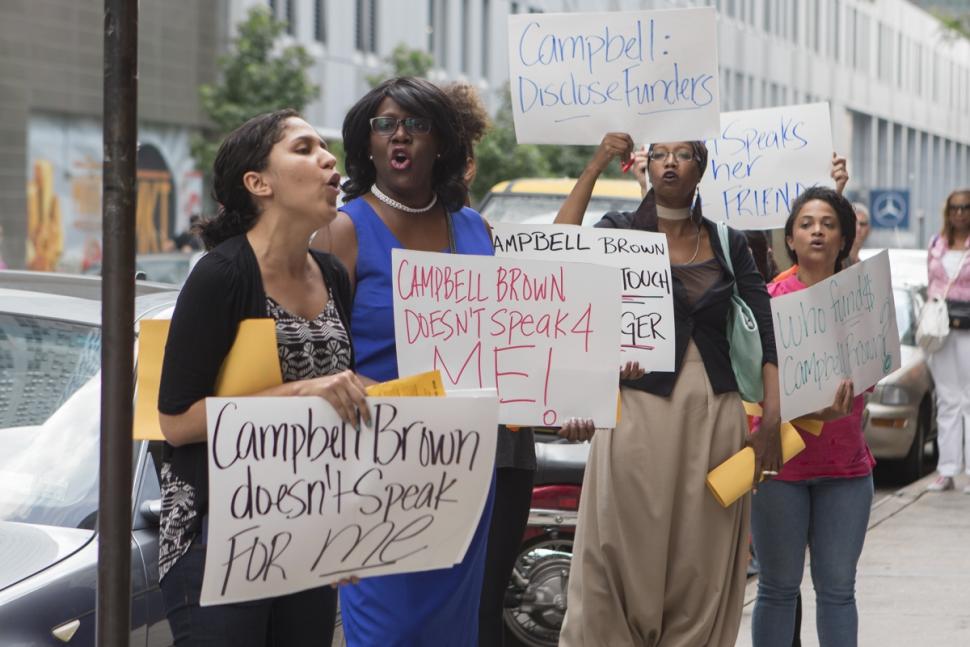
It is also entirely possible that Ms. Brown and her organization want full control of the agenda and have decided to sweep aside Ms. Davids by behind the scenes manipulation.  It certainly would fit Ms. Brown’s profile of secrecy.  She has steadfastly refused to discuss who is funding her organization, citing the ridiculous and anti-democratic notion that her funders deserve to have huge influence over the future of public education in this country without anyone knowing who they are.  When appearing on The Colbert Report, she even said she didn’t want “the people who are outside today” to “silence” the debate, so her funders should remain anonymous.  “The people” to which she was referring?  The ones who could “silence” Brown’s millionaire and billionaire financiers?  A handful of parents and teachers with home made signs:

colbert1n-2-web


So we probably cannot expect a clear explanation from Brown about how Gibson Dunn AND Students Matter yanked their support out from under Mona Davids, but we know one thing for certain:  These developments put Brown in the driver’s seat.

As for Ms. Davids and Mr. Pirozzolo  — it is probably unfair to suggest that they absolutely should have seen this coming, but I think it is fair to say they were quite naive in 1) trying to get in on the national drive to break teacher unions from their position as a local organization 2) trusting that Campbell Brown’s primary motivation is what is “best for children” while she deflects any attempt to get information on what interests are behind her efforts.  I do not always agree with NYC Parents Union, and I think that their efforts would have been far better spent on what the research tells us about how to retain great teachers — increase support for principal leadership, teacher collaboration and improvements to the workplace environment.

However, from the position of a Campbell Brown or a David Welch, NYCPU is also small potatoes.  Their executive board doesn’t even have a SINGLE hedge fund manager which is a requirement these days in education “reform” circles.  If they are going to insist upon having an opinion and input instead of simply providing parents to make for good optics at press conferences where Ms. Brown can cry about how “honored” she is to be near them, then they are more trouble than they are worth.  Campbell Brown has a mission to break up the workplace protections of the last large group of unionized middle class workers in the country, and this is her career now.  She’s got secret billionaires to please.  She’s got the efforts of former high level White House staffers to coordinate.  She’s got more legal coups to coordinate with famous legal scholars like Lawrence Tribe.  This is making her famous again, and if history is any judge about the career trajectories of education reformers, she is likely to get (more) rich doing so.

Did anyone REALLY think that New York City Parents Union was going to be an equal partner in this?  Does anyone doubt whether this is about what is “best for children” instead of what is “best” for breaking the backs of unions and keeping Campbell Brown in the news?

The betrayal may have been sudden, but it was probably inevitable.

https://www.youtube.com/watch?v=znxFrgql5dc

5 Comments

Filed under Activism, Funding, Media, politics, Unions

Anti-Tenure – Union Busting FIRST, Students Second

One consequence of becoming active in social media and blogging is crossing paths with people that you would not normally encounter face to face.  For example, among my normal Twitter feed comprised of classroom teachers, public school advocates, researchers and news sources, a certain gentleman was noticeably involved in several arguments.  Shortly thereafter, he began following me on Twitter.  His name is Dmitri Mehlhorn, and he is a former C.O.O. for Michelle Rhee’s Students First organization, and, suffice to say, he is a true believer in current education “reforms”.  When Rhee announced that she was stepping down as the head of Students First, Mr. Mehlhorn penned this astonishing piece of apologia for The Daily Beast on her behalf, which despite saying she was “right about everything” cannot really name a measurable outcome of Ms. Rhee’s activism that has improved education.  Mostly, he spends the article lamenting the attacks upon Ms. Rhee, even going so far as to paint her famous on camera firing of a school principal as her sending a “message” to teachers that she was on their side:

As I said, Mr. Mehlhorn is a true believer, and the arguments he was involved in on Twitter centered on former television anchor Campbell Brown’s efforts to sue teacher tenure out of existence in New York.  As a devotee of Michelle Rhee, Mehlhorn is obviously in favor the current lawsuits, and as a former close associate of Rhee’s organization, he ought to be well-versed in the arguments against teacher tenure and be able to explain why it is better for the profession and for students to end due process protections for teachers and make them at will employees.

In fact, that is not a simple argument to make, especially since all research demonstrates that the urban schools Mr. Mehlhorn and Ms. Brown insist will be made better by eliminating tenure suffer far more from high teacher TURNOVER with some districts losing up to 50% of teachers within 5 years.  However, Mr. Mehlhorn did not seem overly interested in making the argument, preferring to respond with broad accusations that “my side” did not “care” about doing anything while “children suffer”.  That prompted my request for an actual argument about how ending tenure will make schools better able to retain good teachers instead of vague accusations and assertions of his bona fides in education reform.  This is what he came up with:

I will confess that I had to read this several times before understanding that the gist of it was really Mr. Mehlhorn’s argument.  I also tried looking at it out of order and contemplated standing on my head before accepting that the argument was basically this: Good teachers work more hours than bad teachers (conceded).  So good teachers get paid less per hour than their bad teacher peers because for the same salary, they work more hours (conceded but in a nobody-calculates-teacher-pay-that-way-not-even-teachers kind of way).  Ergo, the presence of bad teachers demotivates good teachers who either leave the profession or don’t go into it at all knowing their work is not valued at as high an hourly wage as their bad teacher peers.

Confused

Now keep in mind that Mr. Mehlhorn is not RANDOMLY opining on this subject.  At Students First, teacher unions are not regarded highly.  Consider this post where a “balanced” perspective on teacher unions as “change agents” or “opposition” is considered.  The union as “change agent” comprised a handful of paragraphs from a DC public school teacher Eric Bethel (who has since been appointed as a principal in the district) about the union getting on board with “reform” – reforms that just happen to be those approved of by Michelle Rhee.  The second piece goes on at some length and is written by Hoover Institute Fellow Terry Moe who co-wrote the Bible of school choice “Politics, Markets and America’s Schools” and his basic point is that strong teacher unions will always prevent schools from changing.  His solution?  Make unions far less powerful.  This is a Students First presentation of “balance” on a key issue.

So Mr. Mehlhorn, prepped with Michelle Rhee’s culture of anti-unionism, ought to have a sophisticated argument as to why eliminating tenure will make schools better, not by merely removing the percentage of teachers who ought not be teaching at more rapid pace, but by addressing one of the most complicated problems actually facing schools: retaining teachers at our schools with the highest levels of poverty and disadvantage.

His best stab at it? A cost-benefit calculation on salary that I have never heard one teacher make in my entire 21 year long career in secondary and higher education.

The problem for Mr. Mehlhorn and for the argument he tried to represent is that this is a matter that ought to be quantifiable.  There ought to be a way for him to say that there are “X” “bad teachers” in the classroom who are protected by tenure laws.  Then he ought to be able to certify what percentage of X are effectively irremovable and tie that to their tenured status and no other reason such as ineffective school and district leadership.  Then he should be able to demonstrate that the harm inflicted upon 3,000,000 – X teachers and their classrooms and students will not be GREATER than the harm reduced by making it easier to remove X teachers.

Of course, he cannot do that or, at the very least, has not been given arguments to make those points.  While Mr. Mehlhorn proved very adept at dropping the names of researchers used by the plaintiffs in the Vergara lawsuit to claim that there is a specific monetary cost for students who have a “grossly ineffective teacher”, he was completely unable to or unwilling to address that the research is highly controversial, rests on exceptionally shaky assumptions, and is not widely accepted in its current form.  Additionally, the premise for going after tenure protections of ALL teachers summarily dismisses any other fix for the the assumed problem.  Michelle Rhee, Campbell Brown and Dmitri Mehlhorn do not advocate enhancing the process by which teachers are moved from probationary status.  They do not advocate for making principals more effective at their jobs (except for making it easier for them to fire teachers), and, in fact, advocate for making principals MORE adversarial to their faculty and undermining their ability to be instructional leaders.  They do not advocate for reforms to the procedures by which a school district can demonstrate cause for removing a teacher who is no longer probationary (something that already happened in New York State).  They advocate that every teacher become an at will employee.  Teachers have taken to Twitter with the hashtag #WithoutTenure to explain what the consequences of that would be for their ability to robustly advocate for their students’ needs, and this piece by Peter Greene makes it clear what could happen in schools where teachers lose their current job protections.

Further, from what we know about why teachers leave positions, resentment of other teachers making more money per hour does not enter the equation.  Richard Ingersoll of the University of Pennsylvania notes that teacher turnover is a significant phenomenon which drives a large proportion of the annual demand for new teachers.  While Dr. Ingersoll’s research notes that teachers at small, private schools actually turn over at rates that far exceed those elsewhere, he compared high poverty, urban teachers’ reasons for leaving with those of small, private schools and found that school management factors contributed highly to both populations’ reasons for leaving.  Small, private school teachers cited low salary overwhelmingly as a factor along with dissatisfaction with school administration, a concern shared with teachers in urban, high poverty schools who also listed lack of administrative support, low student motivation, discipline problems and lack of decision making support as roughly equal reasons for leaving.

Susan Moore Johnson of Harvard’s Project on the Next Generation of Teachers, affirms that the teaching environment has a large impact on teacher satisfaction, fully independent of the demographic contexts of the school and more closely related to the social conditions of working in the school.  Their research further states that a positive school climate can impact student learning, again independent of the school’s demographics.  Dr. Moore Johnson’s work also notes that once school environment factors are taken into account no student demographic factors remain as significant indicators of why teachers leave.  Factors that contribute to teacher dissatisfaction with working conditions include principal leadership that is effective, fair, provides instructional leadership and practices inclusive decision making.  Teachers also gauge the quality of their collegial relationships and issues regarding how student discipline is supported in these decisions.

Dr. Moore Johnson notes that the good news in this is that “unlike demographic characteristics of students, working conditions can be changed.”  To be fair to Mr. Mehlhorn and his ilk, one COULD make an argument that eliminating tenure will help “change” working conditions by making it simpler to weed out bad teachers — but you would have to push really hard to make that your first priority or even on the top ten list.  Improving principal leadership and building more structures for effective and productive collaboration among teachers should be near the top of such a list because 1) effective principals seek ways to meaningfully evaluate and support teachers and 2) a collaborative environment would more easily identify those teachers who do not want to improve and make a reasonable case of removal for cause under existing rules.  It would also have the benefit of aiming to support and improve everyone at a school not merely to exact punitive costs upon individual teachers and administrators, and it would preserve the ability of teachers to advocate on behalf of their students in cases that require a more adversarial stance.

But the anti-tenure campaign does not push meaningfully for any reforms to school climates.  In fact, they advocate making the climate worse by suggesting that all teachers must lose the “for cause” protections of tenure in order to weed out the minority of teachers deemed ineffective.  There is nothing in the current lawsuits that will improve what it is like to work in schools that suffer high rates of teacher attrition, and, thus, nothing in those suits that will help retain effective teachers for students in urban poverty.  Campbell Brown makes only token and meaningless statements about “raising up” the teaching profession, and she certainly is not suing any state legislatures for not instituting reforms that strengthen principal leadership or teachers’ collegiality.

At the end of the discussion, therefore, the effort to sue away tenure is not about making schools better directly through “removing ineffective teachers.”  It is about greatly weakening teacher unions, as argued by Terry Moe in the Students First blog post linked above.  People like Moe, Rhee, Brown and Mehlhorn clearly believe that those unions need to be broken first, and they ASSUME that schools will improve for students when teachers are more free to be treated like employees at Walmart.  That belief may be sincerely held, but they should stop obfuscating on it and admit that their primary goal is to bust one of the last large, middle class  unionized workforces left in America.

Mr. Mehlhorn, by the way, stopped following me on Twitter.

4 Comments

Filed under politics, teaching, Unions

Frank Bruni and the Failure of the New York Times

For more than a year now, I have despaired of the New York Times’ editorial page whenever the topic of education reform has come up.  It is not because those pages have disagreed with me, although it would be pleasant to occasionally see representation of lively and vital debate make it on to those pages.  It is because the editorialists who have opined on the reform efforts now engulfing America’s public education have appeared so ill-informed that there even is a debate to be had, writing pieces that have graced the pages of America’s “Gray Lady” of journalism with what could have been submitted to them as brochures from Bill Gates and Michelle Rhee.  On topics from the Common Core State Standards to the issues and concerns with teacher preparation, columnists such as David Brooks, Joe Nocera, Frank Bruni and Bill Keller have provided staggeringly limited perspectives and have even taken effectively discredited organizations and reports at face value.  Again, it is not that these columnists do not see things my way that is the problem, but by entirely failing to engage the arguments even in passing, they have acted as if those arguments do not exist.

Today, Frank Bruni entered the fray again with a remarkably one-sided piece about teacher tenure.  I will not dissect all of its problematic assumptions here, but I will point out that Bruni’s source on the “problems” with tenure is ONE individual, a former TFA teacher and current state senator in Colorado who was central to efforts that tied teachers’ contract renewals to multiple years of student gains in, you guessed it, standardized testing.  For his take on an issue that effects the working conditions and workplace protections of the millions of public school teachers in America to be limited to one source is staggering. Mr. Bruni also directly quotes the judge in the California Vergara lawsuit as if there were not reams of critiques of the judge’s legal reasoning and use of controversial research.

And thanks to some Internet sleuthing on Twitter, it also demonstrates an apparent flaw in how the OpEd page of the New York Times operates today.  Mr. Bruni may not come to the issue of teacher tenure entirely out of natural interest:

https://twitter.com/rratto/status/501704832609431552

According to this People Magazine article located by teachers and posted to Twitter, Mr. Bruni is a personal friend of Campbell Brown, the former NBC and CNN news personality who has dedicated herself to suing teacher tenure out of existence first in New York and then elsewhere.

Mr. Bruni is, of course, entitled to the friends he wishes, but the operation of the flagship newspaper of the world’s oldest continuous democracy ought to be better than this.  Given the thoroughly one-sided and completely unresearched positions staked out by David Brooks, Joe Nocera, Bill Keller and Frank Bruni, it is easy to postulate how Mr. Bruni’s wading into the Tenure Wars took place.  A personal phone call from a personal friend is made.  It is suggested that he ought to turn his talents upon this very important issue that is “for the kids”.  He is even given the name of an impressive person to contact and an offer of an introduction.  Voila.  “Partnership For Educational Justice” gets free replication of their talking points against teacher tenure on the OpEd page of the New York Times.

The position of opinion writer on the New York Times is a highly privileged one.  I suspect that those who hold that position are frequently contacted by the influential in society with suggestions towards what they should aim their pens.  It should come, therefore, with great sense of responsibility for recognizing when there are areas in our society with dynamic and complex debates, and, when taking a position, demonstrating an understanding of those complexities.

Mr. Bruni and his esteemed colleagues at the Times have repeatedly demonstrated no such understanding.  It is well past time for the editorial board to either seek out additional voices on these issues or to provide their opinion writers with remedial instruction on how to acknowledge and engage arguments without simply bypassing them in favor of one-sided talking points.

Alternately, Mr. Bruni and his colleagues could meet more people.  I know quite a few who would be happy to provide more information.

1 Comment

Filed under Media, politics, teaching, Unions

Messages From the Tenure War – “Teachers Aren’t Special”

When Campbell Brown goes on air to discuss the lawsuits against teacher tenure protections, she knows how to comport herself.  First, it is very important to profess her respect for teachers and the teaching profession and to make it clear she just wants teaching to be a well-compensated and treated profession.  Then she has to express a completely sincere desire that the profession improve for the sake itself and the children. At this point, she has to point out that the laws she is suing to overturn stand in the way of that improvement and that it is simply ridiculous to oppose that effort.  When on The Colbert Report, she conveyed this message by leaning forward and pitching her voice for maximum earnestness as she stated that everybody agrees that the due process and “last in first out” provisions are “just anachronistic.”  A media representative has to make the pitch appealing to the broadest possible demographic.

Her general audience supporters are under no such restraints.

I’ve been reading #WithoutTenure on Twitter and made the very poor choice to read comments on some news articles about the lawsuit.  Obviously, some people support Ms. Brown’s efforts, and that  is expected in a democratic society.  What I did not expect was the periodic denigration of teachers as a whole and fairly serious hostility to the concept that teachers have job protections  granted through tenure that the respondents do not believe other professions have.  A refrain that sums up the attitude is “Teachers aren’t special.”

Teachers aren’t special.

Hostility towards teachers’ due process protections is necessarily a complex phenomenon.  President Ronald Reagan made contempt for unionized workers fashionable in his first administration, and since the late 1970s, public approval for organized labor has ticked down from 59% to 52% with some fluctuations along the way.  Public disapproval, however, has steadily gained from 31% to 42%, meaning that there is decreasing middle ground in public opinion on unions at a time when less than 11% of the total workforce is unionized.  Some of the contemptuous remarks certainly stem from the growth in hostility to unions.

Some who expressed that opinion based it on their belief that teachers are given undue job protections via tenure that other professional workers in the economy do not have.  Part of this is stems from the popular misconception, encouraged by Ms. Brown, that a teacher with tenure has “permanent lifetime employment” and is shielded from removal even in the face of serious incompetence or misconduct.  Another part stems from a belief that the critics do not possess any particular protections in their employment, even in highly skilled fields, and a demand to know what about teachers makes them deserve what the others do not have.  This is a particularly odd and perhaps uniquely American aspect of class relationships.  Instead of asking why their employer or profession does not do more to protect and compensate them fairly, many Americans demand to know why others are better protected and/or compensated.  We tend to fight our class wars against each other in the United States.

I cannot solve that tangled mess in this essay, but I do want to examine one of its consequences: Teachers aren’t special.  It sits me back on my chair a bit, to be honest.  Wrapping my head around it is nearly impossible as I have spent every working day of my life since 1993 around teachers, either as a high school English teacher or as a graduate researcher or as a college professor.  I have met, worked with and taught some incredibly special teachers over the years, and I am continuously impressed by the caliber of young person who shows up at our teacher education program each Fall looking to start her or his professional career.  These are people who could have sought more lucrative careers , and having worked with them I do not doubt that most could have been successful in those careers.  However, something draws them to teaching: a passion for learning, for a subject matter and for the transformational power that it holds, for children and their growth.

Gary Fenstermacher, Richard Osguthorpe and Matthew Sanger, writing in the Summer, 2009 issue of Teacher Education Quarterly, discussed how teaching not only involves  content related to morality but also demands moral characteristics of teachers:

Just how teachers attended to moral matters became more apparent as we examined the connections between moral manner and moral content more closely.  We sought to “see” the ways they imparted moral ideas and ideals to their students.  We encountered six methods used by most or all of the teachers as they went about the work of teaching their students.  They are: 1) the construction of the classroom community, 2) showcasing specific students, 3) design and execution of academic task structures, 4) calling out for conduct of a particular kind, 5) private conversations, and 6) didactic instruction (Fenstermacher, 2001).  These six methods suggest how moral traits and dispositions of teachers might be reflected in their practice.  They also suggest an important interplay between moral content and moral manner. (p. 12)

The authors go on to ask their central question, “how do we seek ensure that those who teach possess a moral manner that is proper and appropriate for the tasks of teaching, and that they learn to employ this manner properly and appropriately in the course of instruction?” (p. 16)  This is something much deeper than professional ethics, although those matter for teachers as well, because we entrust that teachers will be involved in the implicit of explicit instruction of moral conduct for their students through both the curriculum and the environment in which it is taught.

It is very clear to me what it is that makes teachers “special,” and it is the sense that they are as much in a vocation that is of service to others as they are in a profession in service of themselves.  When people dismiss the due process rights in tenure by saying “teachers are not special” they are simply dead wrong.  It is true, however, that teachers are not unique in this central premise of vocationalism.  Many, in a wide range of professions, are driven by the call to serve purposes greater than themselves.  There are doctors who seek to aid those in lands afflicted by disease and warfare, and there are medical practitioners who eschew more lucrative practices in the effort to provide needed general and family practice.  There are lawyers who dedicate themselves to low cost or pro bono services for the indigent , and there are attorneys who seek to use their talents to right great wrongs.  Fields like nursing and social work are full of people who are on the front line of patient and client care and who are primarily motivated by their desire to help those in great need and with little voice.

Teachers are special.  They are not unique in how special they are.

Which still leaves an open question:  If teachers are special in a way that is shared across other professions what is it about tenure and its due process protections that matter for teachers?  There is no single answer to this.  However,  not only do teachers need strong due process, but also good teachers need it even more.  Reflecting back upon what Fenstermacher, Osguthorpe and Sanger wrote, it is clear that good teachers must be motivated to rock the boat on behalf of their students.  Having a “moral manner” is not simply about appropriate behavior, it is about appropriate advocacy that will sometimes run afoul of administration and community expectations.

A good teacher will question curriculum priorities and instructional materials on behalf of students and their needs.  A good teacher will question spending priorities within a school a district if classroom needs are neglected.  A good teacher will advocate that students receive special education, ESL and enrichment materials that will enhance their experience and provide them with opportunities to learn.  A good teacher will help unpopular viewpoints gain a voice within the class regardless of the teacher’s or the community’s views.  A good teacher insists on the integrity of instruction and assessment even if it means a popular student athlete is made ineligible to compete or if it means the child of a local politician does not pass a class.  A good teacher collaborates with peers and experiments with new teaching strategies and constantly questions whether or not what is happening in the classroom, the school and the community is what is best for students.  A good teacher will make people uncomfortable at least some of the time.

A good teacher must do all of these things even as he or she is an employee of a system controlled and administered via local politics.  Teachers, of all of the moral vocations, are the most public and the most in need of the ability to openly question and confront on behalf of students and learning.  Taking away the due process rights of tenure diminishes the ability of teachers to buck the system and to make necessary waves for the good of their students.

Reference:

Fenstermacher, G.D., Osguthorpe, R.D., Sanger, M. (2009). “Teaching Morally and Teaching Morality.” Teacher Education Quarterly, 36 (3), 7-19.

1 Comment

Filed under Activism, politics, Social Justice, teaching, Unions

A Funny Thing Happened on the Way to a News Show Tenure Lawsuit Discussion…

…intelligent and informed debate!

Melissa Harris-Perry, professor of politics and international affairs at Wake Forest University, has a Sunday morning show on MSNBC, and on August 10th, she had a panel on to discuss the recent attempts to bring California’s Vergara v. California lawsuit against teacher tenure protections to New York State.  Her panelists were Amy Goodman of Democracy Now, Randi Weingarten, President of the American Federation of Teachers, Dana Goldstein, author and reporter for The Marshall Project and Derrell Bradford of the NY Campaign for Achievement Now and formerly of Governor Christie’s Educator Effectiveness Task Force.

From the opening minute of the first segment, it is obvious that Ms. Harris-Perry was not going to let Mr. Bradford get away with Campbell Brown like talking points unchallenged, and the rest of the panel was certainly not inclined to back off either.  Ms. Harris-Perry quotes directly from the language of the challenged New York statutes in response to the standard claim that teachers with tenure have permanent lifetime employment.  Mr. Bradford tried to sneak in another favored talking point of the anti-tenure campaign by claiming a time frame of nearly 3 years to remove a teacher under the law, but Ms. Weingarten immediately pushed back with the changes that have already been made to the law and the current, more accurate figure nearly 1/6th the time of Mr. Bradford’s assertion.

For once, a media discussion on these lawsuits was not a monologue, and the moderator of the discussion, while not claiming the “neutral” ground so cherished by many figures, did something, in my opinion, more important.  She did not set up conditions of “false equivalency” where someone like Mr. Bradford, whose own history in education reform and willingness to try to frame his advocacy of privatization of schools in civil rights terminology is neither upfront nor honest, is treated as having equivalent facts on his side even if he is prevaricating on most of them.  While this is not “balanced” it is absolutely fair, and it is the result of the host having actually studied the issues before moderating her panel and clearly noting that Mr. Bradford’s side of the debate is routinely distorting the truth.  Would that we could have that more frequently.

The entire segment runs close to 30 minutes, but is worth it:

Melissa Harris-Perry August 10th, 2014 Part 1

Melissa Harris-Perry August 10th, 2014 Part 2

Melissa Harris-Perry August 10th, 2014 Part 3

Melissa Harris-Perry August 10th, 2014 Part 4
One notable exchange happens at 5 minutes, 44 seconds in the second segment, where Randi Weingarten says:

RW: How do we attract and retain well-prepared great teachers for our most needy kids? Because what’s happening is just a few miles down the road in Westchester we’re not talking about this issue but in Rochester we are and we are in the places where there’s intense, real social-economic issues.  So why are we not having that conversation? That is the conversation we need to have. (Turns to Derrell Bradford) And what I would argue is that you need to give people better working conditions. We need to make sure that they don’t feel that they are going to be fired if they try something new or if they stand up for their special needs kids.  That’s what we’d like to do.

Pay special attention to Mr. Bradford’s body and facial language during this.  Twice, near the end, he purses his lips and looks down very briefly.  I am possibly reading too much in this, but to my eyes he is distinctly uncomfortable at not being able to simply say what he wants without challenge.  Understandable, as Ms. Weingarten just cornered him repeating a talking point based on out of date data.

It happens again in segment 4, when Mr. Bradford lengthily admits that there is no “one thing” that is driving the achievement gaps and states that inequality is “hardwired” into the system.  He does not explain how eliminating tenure assists that in any way, and he even makes an ironic statement to my ears that we attract the least experienced teachers to the most needy kids — when his stance on tenure would do absolutely nothing to improve that situation and could actually make it worse.  Ms. Goldstein then notes that we have reduced the achievement gap in the past when we “aggressively” integrated schools, and Ms. Weingarten again pushes on the need for resources and support instead of attack.  I’d invite any reader to look at the body language of Mr. Bradford here as well.  When Ms. Weingarten talks about the outcomes of the NYC Chancellor’s District and the proven value of attracting and retaining great teachers and giving them and their students resources.  Mr. Bradford looked, to me, like he was trying to figure out a way to sidestep that or dismiss it when time ran out.

When the echo chamber is filled with more voices and when the host has studied the issue, the corporate reform advocates have a much harder time of it.

I want more.


Leave a comment

Filed under politics, Unions

Going After Tenure — Missing the Real Needs of Students

There is a character in the 1984 movie “Teachers” starring Nick Nolte and JoBeth Williams, who is unaffectionately named “Ditto,” played by Royal Dano.  Ditto is old, orderly, mind-numbingly boring and tenured.  His “teaching” consists of running off enough mimeographs each day for all of his students, sitting in the back of his classroom where he can see all of his students in rows, having his ditto sheets distributed, reading his newspaper and having students turn in the dittos when the bell rings.  So rigid is his routine that the students can do the entire process without him, a premise tested when he suffers a fatal coronary in class and none of his students notice.

The movie’s satirical take on jaded teachers strikes a humorous note by playing off of a lot of stereotypes and some common experiences.  Many people, sadly, have experienced classrooms with teachers either out of their depth or beyond their professionally useful life.  In a system of 60 million students and over 3 million practitioners, quality cannot possibly be uniformly excellent.  The situation in the movie also speaks to a number of popular if misinformed stereotypes, the most persistent of which is that once granted tenure, a teacher has no need to remain vigorous or skilled or even all that present in the classroom.

This movie must keep Michelle Rhee, Campbell Brown and Whoopi Goldberg up at night.

The argument against teacher tenure goes approximately like this:  1) children need a quality education in order to have opportunity to succeed 2) a quality education requires quality teachers 3) teachers of low quality are concentrated in schools that serve poor and minority students 4) poor and minority students do not do well on examinations because of those low quality teachers 5) doing poorly on standardized examinations is the main blocker of opportunity for poor and minority students  6) some low quality teachers have tenure 7) firing low quality teachers with tenure takes too much work 8) we need to do away with tenure so we can fire low quality teachers and replace them 9) replacing low quality teachers will raise test scores and improve opportunity 10)  if you don’t want to do that you care more about low quality teachers than you care about children.

The problem, however, is that a lot of that is hooey.

Assume, for example, that tenure is a problem, as reformers do, because it keeps low quality teachers in teaching for too long. This, however, is as much a function of administrators not doing their evaluative job as it is the due process guaranteed by tenure.  Further, if it was tenure that was the actual problem, we would expect to see negative impacts on the performance of those districts that have the largest portion of their faculty with tenure – suburban districts with the most experienced faculties compared with urban districts that have extremely high turn over rates.  This, however, is not the case.  When the PISA examination scores that give our political class such concerns are broken out by the poverty characteristics of communities, we see startling effects:

U.S. Reading Literacy Scores By Poverty Characteristics

David Berliner writes:

On each of these three international tests, U.S. public school students did terrific in the schools where poverty rates of families were under 10%, or even when poverty rates were between 10% and 25%. But we did not do well in schools where poverty rates were above 50%, and we did even worse on those tests in schools where poverty rates for families were in the 75-100% bracket.

So students who do the worst on international examinations are those who live in high poverty districts which, because of income segregation, tend to be urban and rural.  Despite the movie “Teachers”, those students do not attend schools that are full of dusty, burnt out teachers who are waiting to die at their desks.  Quite the contrary.  They are far more likely to attend schools with extremely high concentrations of novices.

Helen F. Ladd, professor of economics and public policy at Duke University, notes that today, over a quarter of the teacher workforce has less than five years of experience teaching.  This is a problem because experience actually matters in teacher effectiveness, and research supports the need for teachers who have made it through the steep learning curve of their early years in the classroom.  Teachers improve in effectiveness measures dramatically in this period, and while their gains level off, a workforce that is perpetually inexperienced is a workforce that is not optimally effective.  According to research from the University of New Hampshire’s Carsey Institute, districts that are urban, high poverty, high minority and rural are far more likely to have high numbers of first year teachers than suburban counterparts. Ten percent of the districts in their sample had a “critical value” of more than 17% novices teaching classes, which was double the overall sample average and is correlated with other effects such as teachers leaving the profession altogether.

It is crucial to pause for a moment and consider the contradiction here.  Our lowest performing schools are not plagued with teachers who are sit behind the mythic protections of tenure and do not do their jobs so much as they are burdened with a continually changing faculty who begin a steep learning period but who cannot be guaranteed to stay past five years.  Further, such schools are burdened with the attendant costs that come with high turnover rates such as recruitment and training, giving fewer resources for other forms of support.  So the attack on tenure has it backwards because the real problem for staff at our most struggling schools centers on too little retention of teachers.

Nicole S. Simon and Susan Moore Johnson of Harvard’s Project on the Next Generation of Teachers note many of the new teachers who leave working in urban and high poverty districts do so because of working conditions in such schools rather than any student demographic.  In fact, negative school climate and organizational factors are such powerful predictors of why teachers leave schools, that no student based factors remain statistically significant.  “Positive, trusting, working relationships” and “a strong sense of collective responsibility” prove to be strong predictors of schools that manage to retain teachers over schools with nearly identical student demographics.  Considering all of this, if reform advocates TRULY wanted to assist children who suffer because of bad teachers, they ought to advocate for the following:

1) Ways to support administrators doing their evaluative role seriously. As has been pointed out from numerous sources, tenure grants teachers due process in any effort to remove them from the classroom.  Administrators need to do this function, and they need to do it carefully and well, but that role is frequently an add on to an already extremely time consuming job.  Principals can be supported in this function by robust peer observation and mentoring systems, but this would require that teachers also have additional time needed to mentor and evaluate each other.

2) Improve teachers’ working conditions. High poverty schools are notoriously difficult places to work, but not for the stereotypical reasons people presume.  Teachers who seek out such careers are often highly motivated by a desire to do good, but face overcrowded classrooms, decaying facilities and inadequate resources.  Further, lack of planning and collaboration time isolates teachers and makes it more difficult to access the expertise and insights of their peers.  The saying that a teacher’s working conditions are a student’s learning conditions needs to be seriously considered.

3) Remove the Sword of Damocles. We know that high poverty correlates to low test scores, and we know that the reasons are far more complicated than reformers’ preferred explanation of blaming teachers for everything.  But the past 15 years of education reform have constantly increased the pressure on schools and teachers to raise test scores without our nation taking the least collective responsibility for alleviating our appalling child poverty rate.  We should still test, but for diagnostic and triage purposes rather than to increasingly motivate skilled teachers to flee districts where they are professionally threatened without adequate support.

4) Discuss poverty and its effects of children.  Education reformers have been consistently silent on this front except to accuse people who want to talk about it of “making excuses” for bad teachers.  That is dishonest of them.  Over 20% of our children come to school from homes that are in poverty with the negative impact on resources and development that comes from that.  Many of our urban schools have student populations that top 75% in poverty.  As David Berliner notes, we are obsessed with “one-way accountability” for schools and teachers to change this without requiring anything more of ourselves as a society.

5) Recognize that tenure protects teachers who rock the boat on behalf of their students.  The due process rights with tenure may make removing a bad teacher more complicated than simply saying “you’re fired”, but it comes with important freedoms that teachers need.  Many teachers have pointed out that tenure protects teachers from being threatened with capricious or political removal when they advocate for their students’ needs or call out bad behavior that harms students.  John Goodlad called this “good stewardship” and it is a vital characteristic that we want to encourage among teachers.

Those attacking tenure seek to take that away from all teachers.  That’s why I oppose them.


5 Comments

Filed under Activism, politics, schools, Unions

Whoopi Goldberg Gets Taken to School on Tenure

This came across my Twitter feed this morning.

Keith Reeves is a teacher, and he decided to help Whoopi Goldberg better understand tenure.  Ms. Goldberg needed the lesson because in the wake of Campbell Brown’s publicity tour for her lawsuit against New York State’s tenure laws, The View did a brief segment on the suit, and, charitably, the segment could have been written by Michelle Rhee’s publicity agent.  One host repeated the boilerplate claim that teachers have a union but nobody is watching out for the kids (as if teachers, on the whole, did not do that).  Another host said, with emphasis, that a HARVARD ECONOMIST had estimated that a good teacher makes a difference of a quarter million dollars per child in the classroom — despite the fact that said economist, Raj Chetty, is hardly beyond professional criticism of his research techniques.

Then it was Ms. Goldberg’s turn who professed herself a “thinker” and then more or less demanded that all teachers go after the “bad teachers” and even suggested that “maybe some of those folks should go” from the Democratic party.  Presumably, she meant people who think that going after teacher tenure is not a good policy and who oppose changing it via lawsuits funded by — well, we don’t know by who.  Nobody is telling us.

The segment was brief and extremely low information.  Nobody disputes that there are bad teachers in classrooms, but nothing has been presented that demonstrates that tenure rules specifically are the main reason that they are there.  Nor has anything been presented that demonstrates that removal of tenure for ALL teachers is an effective policy for addressing that portion of the teacher corps that should be removed from teaching.  No amount of sincere shouting for the cameras is going to make that evidence appear.

Teachers and supporters took to Twitter to explain some of Ms. Goldberg and her compatriots’ misconceptions:

That’s obviously a small sample.  Well, Ms. Goldberg heard the words, but not the message and offered what can only be described as a trite and trivial self defense:

In steps Mr. Reeves with an eloquent and high information response for Ms. Goldberg:

His complete reply can be found at his blog, here.

As Dr. Alyssa Hadley Dunn of Michigan State University made clear in the Washington Post, the standard arguments against teacher tenure lack evidence and they are often thin on logic as well.  If teachers having tenure protections were highly correlated to ineffective teachers being in the classroom, then our wealthy suburbs that have the most experienced teachers with the lowest rates of teacher attrition (and thus the highest proportion of teachers with tenure) would have ineffective classroom after ineffective classroom.  Stripping all the teachers of a state of the due process rights they are afforded by tenure because it “makes sense” to people who have either not examined the research or who are falling for blatant distortions of the truth is not the best way to serve students.

I would like to think that with enough exposure to this argument, that it will begin to make sense to Ms. Goldberg, and that it will be taken into account the next time this topic is discussed in front of millions of viewers.

4 Comments

Filed under politics, teaching, Unions

Campbell Brown’s Brings the Anti-Tenure “Argument” to Stephen Colbert

As a former broadcast personality, Campbell Brown has some advantages when appearing on the media to discuss her campaign to end teachers’ workplace protections.  She has experience in interview techniques.  She understands what works well on camera and what does not.  She knows how to pitch her voice and use facial and body language to convey deep sincerity and earnestness regardless of what she really believes.  These served her well on Mr. Colbert’s program last week.

Campbell-Brown

Mr. Colbert is similarly skilled, but he plays a satirical representation of a right wing ideologue in order to lampoon a segment of the media and to keep his guests off balance.  I would argue that he did not level the full weight of his satirical talents upon Ms. Brown, but rather he waited until the end of the interview to present her with some serious challenges that she could not respond to adequately.  More on that later.

Valerie Strauss of the Washington Post provides a pretty thorough assessment of Ms. Brown’s many prevarications and reliance on talking points over evidence courtesy of Dr. Alyssa Hadley Dunn of Michigan State University.  Dr. Dunn makes it very clear that there simply isn’t a research base to support any of Ms. Brown’s assertions, and since she had made those assertions in the media prior to her appearance on The Colbert Report, I wish that Mr. Colbert had been more ready to take on some of the more stubborn and egregious talking points.  For example, Ms. Brown repeated her claim that New York State’s teachers cannot possible be as effective as job evaluations say they are because student test scores are too low:

SC: Okay, how’s the crisis in New York? What’s the problem here?

CB: So, if you look at, if you look at the, um, outcomes, student outcomes in New York, okay? So, 91 percent of teachers are around the state of New York are rated either “effective” or “highly effective,” and yet [SC: Sounds good.] 31 percent, [SC: Yep.] 31 percent of our kids are reading, writing, and doing math at grade level. How does that compute? I mean, how can you argue the status quo is okay with numbers like that??

SC: Well, I went to public school in South Carolina and 31 percent sounds like a majority to me.  (transcript is courtesy of Mercedes Schneider, teacher and author)

Mr. Colbert chose to lightly mock his own education, but there is a major, I would argue deliberate, flaw in Ms. Brown’s favored talking point.  First, the 31% figure does not measure students’ grade level performance; it measures the percentage of students who scored “proficient” or above on the new Common Core aligned testing piloted by the Pearson corporation in New York.  Second, the 31% proficiency rate was gamed by the process to determine the cut scores and openly predicted by New York State Education Commissioner John King before the tests were ever deployed.  From the Times-Union in 2013:

State Education Commissioner John King said he expected some push-back. At a Times Unioneditorial board meeting on Tuesday, he said the number of students considered proficient will likely drop by 30 points. He said, while that number is intimidating, it provides a more honest assessment of what New York’s students know. He acknowledged that makes for nervous educators, but said the state can’t afford to roll back the tougher new standards students will be expected to meet because just 35 percent of New York’s high school freshmen leave ready for college or a career four years later.

How could the commissioner so accurately predict the drop in test scores for the new examinations?  According to award-winning Principal Carol Burris, it is because his office deliberately sought to peg the cut scores between proficiency levels to markers that would leave just a third of New York students making the cut.  The condensed version of Burris’ analysis:  NY DOE sought information from the College Board on what SAT scores (widely considered only a loose predictor of college success) correlated to a successful first year in college, and set measures of that “success” that are clearly aimed at that 30% target.  Once in possession of the desired SAT scores in reading, writing and mathematics for a combined 1630 points, the state’s committee went about setting cut scores for each level of performance on the new CCSS aligned tests.  From Principal Burris again:

When the cut scores were set, the overall proficiency rate was 31 percent–close to the commissioner’s prediction.  The proportion of test takers who score 1630 on the SAT is 32 percent.  Coincidence?  Bet your sleeveless pineapple it’s not. Heck, the way I see it, the kids did not even need to show up for the test.

So is it honest for Ms. Brown to keep repeating that only 31% of NY students are at “grade level”? Absolutely not — first, because this is not a “grade level” measure and second, because the result was gamed from the beginning.

This also brings up another question.  If the goal of the “proficient” rating on the exams is “college and career ready” is a 31% proficiency rating actually wrong?  In 2013, 33.6% of the U.S. population aged 25-29 had a bachelors degree, which is up over 11 points from 22.5% in 1980 when the education “crisis” rhetoric began in earnest.  More of our young population is in possession of college degree today than ever before in our history, and the economic data does not suggest we are in a crisis of too few people with such degrees in the economy.  48% of recent college graduates are underemployed, and in 2010, over 5 million college graduates were employed in jobs requiring only a high school diploma.  Moreover, according to Pew Social Trends, today’s wage benefit for obtaining a college degree comes less from rising wages for college graduates than from cratering wages for those without college.

One could argue that more students need to be on path to be “college and career ready” by their third grade exams because college is increasingly necessary to keep from falling behind economically moreso than it is necessary to get ahead.  Something tells me that today’s reform advocates don’t want to emphasize that point.  We would do better to question if the distribution of students who qualify for and are successful at college are concentrated in specific communities and neighborhoods, but discussed honestly, that would require examining America’s rising Residential Income Segregation Index, another topic education reform advocates don’t like to discuss.

Mr. Colbert made a feint at this late in his interview with Ms. Brown:

SC: You can mention. I’ll edit it out, but you can mention it. [CB: Okay.] [Audience laughter.] All right, now, but, here’s, the thing is aren’t you opening a can of worms there, because [4:00] if you say the kids are entitled to e, equal education, if that’s your argument, doesn’t that mean eventually, you’re going to say, “Every child in the state of New York should have the same amount of money spent on their education”—rich community, poor community—pool it all in, split it all up among Bobby and Susie and Billy—everywhere. [Audience applause.] Because the argument is, everyone gets the same opportunity. [Audience applause.]

CB: But, but you, you’re suggesting that mon, that it’s all about the money, and I think it’s not about the money.

SC: Well, you’re suggesting it’s about equality, and money is one of the equations in equality, or have I just schooled you? [Audience laughter.]

Mr. Colbert did not let Ms. Brown duck the question of money and school funding entirely, but she quickly professed how she wants to “pay teachers more” AND treat them like “professionals” through evaluations.  Then she sidestepped to her “safe” territory by claiming it is almost impossible to fire a teacher with tenure.  As previously noted, Dr. Dunn of Michigan State makes it clear that these claims are completely problematic because first, new evaluations using student test scores focus on formulations of teachers’ impact that only accounts for 1-14% of variability between student performance and second, Ms. Brown’s information on the length of time needed to remove a tenured teacher is badly out of date and her assessment of that time is possibly off by more than a factor of four.  This all tied to her previous claims the “least effective” teachers are concentrated in schools with high levels of disadvantaged students, but her argument against tenure is not remotely related to that because measuring effectiveness via test scores automatically makes urban teachers less effective regardless of their experience and skill. Additionally, these school have far fewer tenured teachers because the turnover rate in many urban districts tops 50% in three years, resulting in a dearth of teachers with the skills that come from experience.

If tenure were truly the problem with teacher quality, then wealthy suburban districts with more stable and experienced teacher corps would not be the districts with high test scores and large percentages of college bound graduates.  In this sense, Ms. Brown’s fight against tenure resembles Republican led drives for voter ID laws that threaten to block 100s of 1000s of currently eligible voters in order to stop a “problem,’ voter impersonation, that occurs so rarely it does not statistically exist.

Mr. Colbert then pivoted to what appears to have been his most important question of the interview — what is the money involved in Ms. Brown’s lawsuit?

SC: Just trying to win, Campbell. Just trying to win, all right? Um, your organization, where does it’s money come from? That’s one of the things they asked me to ask you.

CB: I, I saw that on my Twitter feed today. The, the, who’s funding this effort?

SC: Yeah, who’s funding your, your effort, [CB: Kirkland Ellis.] your organization.

CB: The law firm…

SC: The law firm is funding it?

CB: Well, the law firm is doing this for free, so we haven’t gone out…

Ms. Brown’s point here appears to be that despite her fronting the organization that is facilitating the lawsuit, the efforts on behalf of that suit are, in essence, charitable.  This may be true as far as legal fees are concerned, but it is absurd on the face to even hint that there is no monetary value to the assistance Ms. Brown is giving the plaintiffs her organization recruited.  First, her connections and celebrity almost certainly played a role in obtaining the legal services.  Second, Ms. Brown is a media ready spokesperson who has been giving interviews and penning opinion articles on behalf of this cause, and such services would cost dearly if they came from a private consulting firm.  Further, Ms. Brown has managed to sign up the services of Incite Agency, led by former Obama administration alumni Robert Gibbs and Ben LaBolt to do publicity for the cause on a national level.  The plaintiffs in this case are enjoying pro bono legal services, Ms. Brown’s celebrity and public relations services from former White House personnel.  I think it is sufficient to say that those are no small levels of support.

Mr. Colbert pressed on about financial support and finally got Ms. Brown to admit to something which I find astonishing:

SC: So, the Partnership for Educational Justice [7:00] has not raised any money so far?

CB:Yeah, we are raising money.

SC: And who did you raise it from?

CB: I’m not gonna reveal who the donors are because the people (pointing toward window) are out…

SC: I’m going to respect that because I had a super PAC. [Audience applause.]

CB: I hear you. But, part of the reason is the people who are outside today, trying to protest, trying to silence our parents who want to have a voice in this debate…

SC: Exercising First Amendment rights…

CB: Absolutely, but they’re also going to go after people who are funding this, and I think this is a good cause and an important cause, and if someone wants to contribute to this cause without having to put their name on it so they can become a target of the people who were out there earlier today, then I respect that.


Ms. Brown is married to Dan Senor, who was the former spokesman for the Coalition Provisional Authority in Iraq following the fall of the Hussein Regime.  He sits on the board of of Michelle Rhee’s StudentsFirstNY, and he joined hedge fund Elliot Management before becoming a top adviser to Presidential candidate Mitt Romney.  Ms. Brown is on the Board of Directors of Eva Moskowitz’s Success Academy chain of charter schools, an organization that boasts massive financial support from Wall Street.  Her ties to people who have been pouring money into education “reform” in the interest of charter schools is not difficult to establish, as blogger Mother Crusader has demonstrated.  Suffice to say that these are incredibly wealthy and politically connected people who are the most likely donors to her organization.

And Ms. Brown wants us to believe that they need to be “protected”.  That if people want to know who is funding lawsuits to challenge laws that were passed by democratically elected governments and job protections that were subject to open and adversarial negotiations between unions and administrators, they cannot know because the donors seeking to overturn such laws could not abide potential criticism of themselves in the public sphere.

Wow.

Let’s be clear.  Who are “the people who are outside today” who Ms. Brown assumes will bully and intimidate her donors?  According to The Daily News:


colbert1n-1-web

colbert1n-2-web

I am sure that Eva Moskowitz’s donors are just quaking in their boots…right after they drop another $400,000 into Governor Cuomo’s pockets.

Mr. Colbert did not sneak a camera crew down to the street to make Ms. Brown look as ridiculous as she richly deserved at that moment, but the fact that he led her to make such a ludicrous statement is telling in an of itself.  Today, it is very hard to trust that major media outlets will take the time and effort to research and interview people trying to lead public debate via deception, and on issues that require a genuine understanding of complex social phenomena, that is even less likely.  I have written before how abysmally the New York Times’ editorial staff have failed in that regard, preferring to take the statements of advocates with wealth and connections at face value.

Mr. Colbert is not a journalist, yet he and his fellow comedians Jon Stewart and John Oliver have become almost guardians of truth in recent years.  It is often more likely that Mr. Colbert or Mr. Stewart or Mr. Oliver will highlight the absurd inanities, half truths and contradictions routinely offered by politicians, pundits and advocates.  In the case of Ms. Brown, Mr. Colbert got her to openly confess to a truth that is gaining greater and greater public awareness: American governance is increasingly oligarchical in nature whereby elected officials craft policy more to serve the interests of their very wealthy donors rather than the interests of the actual voters who put them in office.  Ms. Brown’s undisclosed donor list is a perfect example of this, and her refusal to disclose under the fiction that her donors could possibly be intimidated by moms and teachers with home made posters should be mocked loudly and frequently.

I am grateful to Mr. Colbert for organizing his interview to that point, but I am saddened that we rely almost exclusively on satirists to get to the heart of public affairs these days.

3 Comments

Filed under Activism, Funding, Media, politics, schools, Social Justice, Testing, Unions, VAMs