AFT Endorses Hillary Clinton – More than 200 Days Before the Iowa Caucuses

President of the American Federation of Teachers, Randi Weingarten, blew up my social media feeds by announcing that the union of 1.6 million would officially endorse Hillary Clinton for President of the United States — more than 200 days before voters assemble for the Iowa Caucuses on February 1, 2016.  The news makes the American Federation of Teachers the first major labor union to weigh in with an official endorsement of any candidate for President, and the union executive board insists that it was the result of careful deliberation and consultation with members:
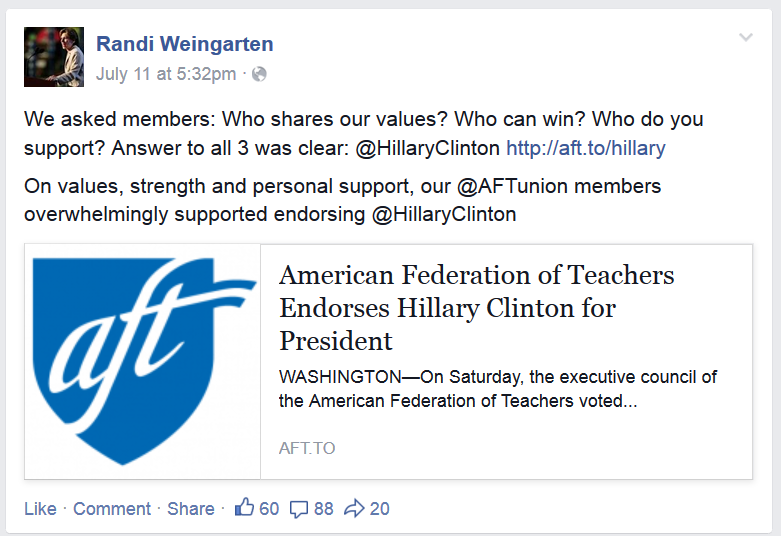
Randi2

Suffice to say that my social media feeds lean harder to the left than most, so it is likely that the immediately negative replies that came pouring in are not precisely representative:

https://twitter.com/PoliteEric/status/620083179639189504

https://twitter.com/Sashammy/status/620043089302978562

Some critics of the early endorsement assert that this was essentially inevitable given the long time close association between Randi Weingarten and Secretary Clinton and that Ms. Weingarten sits on the board of the pro-Clinton political action committee, Priorities USA.  For her part, Ms. Weingarten and the executive board insist that the union undertook extensive outreach to members, including meetings with candidates, town halls, surveys and the use of its “You Decide” website to reach more than “1 million members.”

While AFT members I follow on social media have complained about the sample size of the official poll (1,150 members overall with a margin of error of 3.3 percentage points; 683 Democratic primary voters with a margin of error of 4.1 percentage points), I have to admit that given proper sampling methods, such sample sizes are entirely valid, even if the relatively tiny total numbers compared to the size of the union leave many members feeling left out.  It should also be noted that the survey results are a little bit “massaged” in the official announcements.  When President Weingarten says that those polled favor Hillary Clinton by a 3 to 1 margin, that is true of Democratic primary voters only.  The survey reports that the 60% of AFT members identify as either Democrats or Independents, meaning that 40% of members are Republicans or third party supporters.  Presumably, in making the statement that AFT members back the Clinton candidacy by a 3 to 1 margin, that excludes the opinions of Republican members or of independent or third party members who lean conservative.

The same survey goes on to make a number of salient points about members’ overall positive assessment of Secretary Clinton’s chances, their likelihood to vote for her over top tier Republican rivals, and their assessment of her ability to handle major issues.  Surveyed members give Secretary Clinton an 11 to 1 edge over Senator Bernie Sanders in electability, give her a 41 point edge over Sanders in “standing up for public education,” and she holds a wider margin than Senator Sanders over possible Republican nominees such as former Florida Governor Jeb Bush, Wisconsin Governor Scott Walker, and Florida Senator Marco Rubio.  The report, in fact, goes well out of its way to highlight Secretary Clinton’s margins over Senator Bernie Sanders even though former Rhode Island Senator and Governor Lincoln Chafee, former Maryland Governor Martin O’Malley, and former Virginia Senator Jim Webb are all declared candidates as well.

Smart money suggests that Secretary Clinton’s path to the nomination is fairly smooth (she secured 27 of 46 Democratic Senators’ endorsements by April).  However, with more than 6 months before the first contests with actual voters, it is not unreasonable to wait for a few more months while union members learn more about the candidates.  To be certain, Senator Sanders faces a huge struggle to gain enough supporters to prevent Secretary Clinton from winning the nomination.  He is enjoying strong support already in both Iowa and New Hampshire where voters’ early attention to the race may benefit him, but his national appeal to Democratic voters may peak as the contest moves to states with large non-white populations with whom he has found little traction so far.  Of course, a year out from the Iowa Caucuses in 2007, then-Senator Barack Obama  was only just gaining ground on then-Senator Hillary Clinton among African American voters, so while Senator Sanders has his work cut out for him, there is time for a few surprises.

Which goes back to how the AFT polling is being presented.  Yes, it shows Secretary Clinton with large leads on many important factors — but possibly well before many members are well informed about the candidates’ positions on issues such as public education and at a point when Secretary Clinton’s almost 25 years on the national stage lends her immediate advantages in name recognition over her rivals.  By endorsing so far ahead of the actual contests, the union risks turning some members’ attention away from the candidates’ positions and it allows Secretary Clinton to claim a mantra as the public education candidate — perhaps well before she has actually earned it.

At this point, it is easy to anticipate a question: do I think that Jeb Bush, Scott Walker, or Chris Christie would be better public education candidates?  So let me be clear.  No.  Good Lord, no.  No.  No.  No.  However, it is 2015, and if we have learned something about politicians and public education after two terms of President George W. Bush and nearly two terms of President Barack Obama, it is this:

We don’t need a public education candidate who is simply better than a likely Republican nominee.  We need a public education candidate who is better than President Barack Obama.

In 2008, candidate Obama spoke to the National Education Association two months before the election:

“Math and science are not the opposite of art and music. Those things are compatible and we want kids to get a well-rounded education. Part of the problem we’ve had is that ‘No Child Left Behind,’ the law that was passed by Bush, said we want high standards, which is good, but they said we are going to measure those high standards only by a single high stakes standardized test that we are going to apply during the middle of the school year…a whole bunch of schools said we gotta teach to this test, and art and music isn’t tested… It’s a shame.”

We know how this has turned out.  Through the Race to the Top program and promise of waivers from NCLB punitive measures, President Obama’s Department of Education has made matters even worse by pushing for the rapid adoption of common standards before anyone could assess their quality or prepare teachers for adoption, no decrease in the emphasis on tested subjects over the rest of the curriculum, and the adoption of student growth measures in individual teacher assessment — which ignores what the research says we can fairly and effectively do with test data.  While Governor Scott Walker of Wisconsin is staking his political future on being the nation’s biggest enemy of public sector unions, and while former Governor Jeb Bush is a devoted member of the corporate education reform club, it is not as if the Democratic Party is bereft of leading figures whose education policies line up neatly with corporate reform’s trifecta of testing, punishment, and privatizing public schools.  From New Jersey Senator Cory Booker to Connecticut Governor Dannel Malloy to Chicago Mayor Rahm Emanuel to New York Governor Andrew Cuomo, prominent Democrats have been influenced by and endorsed what currently passes for reform in American education.

So it frankly isn’t enough that Secretary Clinton is “electable” and that she would be somewhat better for public education than a likely rival in the national election.  I want to know if she is going to be any better than the last 7 years of the Obama administration’s education policy led by his horrendous Secretary of Education Arne Duncan and backed by an entire chorus line of Democrats taking money from the same interests leading the charge against our public schools.

Will Hillary Clinton be better if she reaches the Oval Office?

My tea leaves are not that hopeful on the subject.  How did the hedge fund front group, Democrats for Education Reform, react to Secretary Clinton’s announcement?  With elation:

“We join Democrats and Americans around the country in celebrating Hillary Clinton’s announcement that she will seek the Presidency. Hillary Clinton has a proven track record of looking out for students—from her days as Arkansas’ First Lady when she spearheaded efforts to reform and improve the state’s public schools through to her efforts as U.S. Secretary of State to stand up for the right of every child to attend school. We are hopeful that she continues that strong record, and carries on President Obama’s legacy of promoting quality teachers and benchmarks that give every student a chance to succeed no matter their background.”

DFER does not exist as some genuine grassroots efforts by rank and file Democrats to support change in education.  It is the brainchild of hedge fund managers like Whitney Tilson who invented the group to influence elected Democrats to adopt education positions more common among Republicans:

The real problem, politically, was not the Republican party, it was the Democratic party. So it dawned on us, over the course of six months or a year, that it had to be an inside job. The main obstacle to education reform was moving the Democratic party, and it had to be Democrats who did it, it had to be an inside job. So that was the thesis behind the organization. And the name – and the name was critical – we get a lot of flack for the name. You know, “Why are you Democrats for education reform? That’s very exclusionary. I mean, certainly there are Republicans in favor of education reform.” And we said, “We agree.” In fact, our natural allies, in many cases, are Republicans on this crusade, but the problem is not Republicans. We don’t need to convert the Republican party to our point of view…

Financed by groups like the Walton Family Foundation, DFER and its companion organization, Education Reform Now, funnel money and influence to Democrats who in turn pledge to support standardized testing, weakening teachers’ unions, and replacing public schools with privately operated charter schools.  If they are overjoyed with Secretary Clinton’s candidacy, she has some serious outreach to classroom teachers she needs to do.

Peter Greene of Curmudgucation also notes that Secretary Clinton has deep ties to the Center for American Progress whose founder, John Podesta, is serving as the chair of her campaign.  While CAP has an overall left leaning agenda, on education it has been a predictable and reliable ally of corporate reform, pushing for the Common Core standards, emphasizing testing and attacking efforts to reduce it, and generally keeping up the drum beat of rhetoric portraying our nation’s schools as failures without any serious examination of childhood and community poverty.

Both of these examples are a bit of “guilt by association,” but if the rank and file teachers who make up a union like the AFT are going to see their leadership offer the entire union’s endorsement this early in the contest, they have a right to know what Hillary Clinton would actually do as President that is significantly better for our nation’s schools than what we have suffered for a decade and half now.

What could Secretary Clinton do, right now, that would be a beginning of the outreach that should have preceded this endorsement?

  1. Instead of playing the naif on how “politics” has gotten into the Common Core State Standards, she could recognize that they were political from the very start and promise states that they will suffer no consequences if they want to genuinely evaluate them and make informed decisions about whether or not to continue.  I believe that people of good conscience can differ on the wisdom of common standards and on the quality of these standards, but it is hard to escape the deep flaws with how they were developed and disseminated with no significant public engagement and on premises of a national crisis in education that is misleading and distracting from our appalling childhood poverty levels.  If Secretary Clinton moves the conversation in that direction, I will listen.
  2. Secretary Clinton should unequivocally call out the legal assaults on teachers’ workplace protections for what they are: billionaires (David Welch) hiring millionaires (Michelle Rhee, Campbell Brown) to ruin the livelihoods of middle class teachers.  In doing so, they not only rely upon entirely false narratives about what tenure is and whether or not tenured teachers are actually a root cause of struggling schools, but also they are aiming to weaken or destroy among the last large groups of unionized, middle class professionals.  If Secretary Clinton clearly denounces these efforts and pledges to support teachers under attack (as opposed to current Education Secretary Arne Duncan who essentially praised the Vergara decision), I will listen.
  3. Secretary Clinton must call for a genuine draw down of standardized testing from its current place where it threatens to consume public education, and call efforts to tie teacher job evaluations to standardized test scores what they are — failures with no backing in legitimate research.  She should denounce Secretary Duncan’s repeated insults to parents protesting how testing is consuming their children’s schools and demonstrate that she at least understands why those parents are exercising one of the few powers they have by opting their children out of the examination, data collection, and school punishment system initiated with No Child Left Behind and made worse under Race to the Top.  If she shows that she actually understands the research on teacher evaluation and that she understands and appreciates what parents are saying, I will listen.
  4. Secretary Clinton should tell Democrats for Education Reform and Education Reform Now (and the whole host of advocacy groups out there seeking to capture policy makers and funnel as much of our educational commons into private hands as possible) to get stuffed.  I don’t pretend that this is easy.  Candidates for the Presidency need astronomical sums of cash, and these people promise it.  But Barack Obama’s Presidency and the actions of a host of other Democratic office holders has taught public education advocates that who a politicians owes for money can matter more than the voters who elected them in the first place.  But these donors are not in public education to do good; they are in it to do right well, and if Secretary Clinton refuses to accept any more support from them after having gotten the AFT endorsement, I can promise that I will listen.


7 Comments

Filed under Uncategorized

Teaching: A Profession Unlike Most Others

Sarah Blaine is the author at the excellent and thoughtful Parenting the Core blog.  She recently explored the question of whether or not teaching is a profession, recounting a law professor who argued teaching was not a profession because teachers did not control entry to the profession as doctors and lawyers do.  Ms. Blaine took that observation to a very intriguing and, I think, valuable discussion of how teachers could play a bigger and, consequently, far more informed than current regulators role in how people enter teaching.  It is worth your time to read the whole piece.

It also has spurred me to ponder the ways in which teaching is a profession, but a profession unlike most others that have high status in society.  Further, I have to wonder to what degree the efforts of the late 1980s and 1990s to construct a vision of teacher professionalism that is similar to those in medicine and law has contributed, at least indirectly, to some of our current dilemmas in what passes today for education “reform.”  Beginning with the A Nation At Risk report, teacher organizations and teacher research cast for ways by which the profession can embody the elements of professionalism and professionalization that define other fields of endeavor, but in doing so, we have opened ourselves to reforms that actually debilitate teaching and learning.

The status of teaching in general and of the teaching as a discipline for study is not a new problem.  David Labaree, in his collection of essays, The Trouble With Ed Schools, traces teaching and teacher preparation’s status anxiety back to the establishment of normal schools which were under pressure to turn out large numbers of mostly working class women to teach in the growing compulsory school systems of the 1800s.  When normal schools evolved into state colleges and universities, the new education schools with their teacher training missions were marginalized by the more established and prestigious fields of classical studies who relied on education schools to bring students to the universities but who did not respect teaching as a discipline of study and who did not respect the largely female population studying it.

The public’s familiarity with teaching and with teachers also complicates questions of professional status.  Unlike most other fields with professional expertise nearly every adult in society has extensive and intensive contact with teachers practicing their profession.  Doctors and lawyers are capable of enshrouding their professions in mystery because the average citizen, thankfully, has only periodic and limited needs of their services.  The average citizen, in contrast, spends more than 13,000 hours in teachers’ classrooms during what Dan Lortie called the “apprenticeship of observation” through which most people conclude that they are entirely familiar with the work of teachers and develop very strong assumptions about what it is that teachers know and do.  However, this familiarity is facile.  Students are not privy to the preparation that goes into teaching, nor do they understand what it is like to enact teaching while maintaining attention on each and every learner in the classroom, adjusting and pivoting as necessary, and taking effective opportunities when they present themselves. The result is that despite the enormous amount of time spent with teachers, very few former students see teaching as a highly complex practice that requires expertise and substantial experience.

The search for a definition of teacher professionalism may not be new, but it  began in earnest with the devastating rhetoric of the 1983 Reagan administration report A Nation At Risk which reported:

  • Too many teachers are being drawn from the bottom quarter of graduating high school and college students.

  • The teacher preparation curriculum is weighted heavily with courses in “educational methods” at the expense of courses in subjects to be taught. A survey of 1,350 institutions training teachers indicated that 41 percent of the time of elementary school teacher candidates is spent in education courses, which reduces the amount of time available for subject matter courses.

  • The average salary after 12 years of teaching is only $17,000 per year, and many teachers are required to supplement their income with part-time and summer employment. In addition, individual teachers have little influence in such critical professional decisions as, for example, textbook selection.

  • Despite widespread publicity about an overpopulation of teachers, severe shortages of certain kinds of teachers exist: in the fields of mathematics, science, and foreign languages; and among specialists in education for gifted and talented, language minority, and handicapped students.

  • The shortage of teachers in mathematics and science is particularly severe. A 1981 survey of 45 States revealed shortages of mathematics teachers in 43 States, critical shortages of earth sciences teachers in 33 States, and of physics teachers everywhere.

  • Half of the newly employed mathematics, science, and English teachers are not qualified to teach these subjects; fewer than one-third of U. S. high schools offer physics taught by qualified teachers.

Education leaders and policy makers rushed to respond to these criticisms. Teachers and teacher educators are familiar with the Carnegie Forum on Education and the Economy report A Nation Prepared, the various reports of the Holmes Group, John Goodlad’s Teachers for Our Nation’s Schools, the National Commission on Teaching and America’s Future report What Matters Most, the development of the Interstate Teacher Assessment and Support Consortium model teaching standards, increasing influence of organizations such as the Council for the Accreditation of Educator Preparation (formerly NCATE) and the National Board for Professional Teaching Standards, and with a growing industry of educational consultants such as Charlotte Danielson providing standards based rubrics and frameworks for teacher evaluation.

This mass body of work and effort and the attending changes in state and national policies that have flowed from them work on a vision not merely of teacher professionalism, the knowledge, skills, actions, and dispositions of professional teachers, but also of teacher professionalization, efforts to more closely align teaching and teacher preparation with the standards and technical rationales of high status professions such as medicine and law.  Such efforts appeal on two fronts.  First, they attend to concerns that teachers need more rigorous preparation for the difficult work of teaching and that teachers who complete their education with strong content knowledge, deep pedagogical knowledge, substantial understanding of learning and motivation, and who have meaningful experiences in the classroom prior to student teaching will have easier transitions into the world of full time teaching and begin their careers more able to help students learn.  Second, this reconfiguration of teacher preparation and conceptualizing of teaching as a profession akin to medicine and law attempted to instill higher status upon the profession in general.  Terms like “clinical experience” and “professional development school” and “master teacher” all convey a message that learning to teach is a rational experience with technical components that can be measured and that teachers should have ongoing and mediated entry into the professional roles much doctors who master a complex body of knowledge and then move into increasingly responsible roles within practice over time.  By adopting the preparation and learning structure of high status professions, teaching was envisioned to occupy a greater level of respect more commensurate with the importance of its mission.

There is much to recommend in this approach, and such efforts have spurred genuine innovations to improve how teachers are prepared.  It is important to acknowledge that contrary to many popular beliefs teachers possess specialized knowledge far beyond their understanding of the content that they teach.  Further, much as the technical knowledge of medicine and law must be put into practice, knowledge of content, theory, and pedagogy must be practiced in order to become skilled and it must slowly improve over time with the accumulation of experience.  Perhaps the most important aspect of the teacher professionalization discussion has been the continued focus upon moving from theory to practice in a controlled and mediated fashion, allowing prospective teachers to practice and to learn from practice long before they undertake full time teaching duties.

However, while moves to make learning to teach more clinical have opened valuable efforts to increase time teaching before licensure, it is vital that teachers, teacher educators, and policy makers understand the ways in which teaching is not like those high status professions professionalization has attempted to imitate.  To begin with, while there is an important knowledge base for teaching, it is a much softer knowledge than that held by high status professions.  Before moving into technical practice of medicine, medical students learn a tremendous amount of knowledge that is well-defined and clearly delineated.  This does not mean that medical knowledge is never changing; obviously, it is.  However, those changes take place through pain-staking research and replication before it can become part of the body of knowledge for practice.  When compared to this, teachers’ knowledge is less defined, more subject to change, and subject to particular circumstances that vary day to day and class to class.  Experienced teachers know that a “best practices” teaching strategy may not be a “best practice” for a particular bit of content or with a particular group of students, and because teaching has to be enacted authentically by individual teachers, different practitioners can find that so-called “best practices” are not “best practices” for them. Teachers are constantly experimenting and tinkering with their practice, often within the act of practice itself.

Lawyers can rely upon volumes of case law, and doctors have mountains of medical research backing their choices, but there is no laparoscopic appendectomy for teaching a room of 6 year olds how to read.

This should greatly complicate our desires to present teaching as a profession that can be mapped onto the professional education of fields that employ a more technical/rational approach.  Standards based preparation and evaluation can provide important starting points and frameworks for discussing, assessing, and improving teaching, but the rubrics and evaluation scores cannot become ends unto themselves.  Preparation and evaluation do a great disservice to teachers and teaching when rubric scores become more important than discussions about students and their learning that can be prompted by the categories on the rubric.  Too much of a focus on the technical at the expense of developmental understanding of learners and their needs reduces teachers’ teaching and students’ learning to outcomes which can be superficially inflated without substance.

It is possible that the teacher professionalization movement’s efforts, as well intentioned as they have been, are responsible for some of the mess that education “reform” has made of the teacher evaluation and testing environment.  After all, if teaching is a technical/rational activity whose practices result in observable and measurable outcomes, then it was not a big sell to policy makers for figures like Michelle Rhee and organizations like the Bill and Melinda Gates Foundation to suggest that teachers should be evaluated using supposedly “objective” results like standardized test scores.  Run through statistical formulas that claim to account for a vast number of variables that can impact students’ test score gains, reformers promise that test data, as a component of teacher evaluation, offers a fully objective view of teacher effectiveness. This slots nicely with the view of teacher professionalization that emphasizes measurement of teacher practice — even though the bulk of the evidence now says that such modeling does not work.

There are other reasons to question the teacher professionalization models or at least to insist that they be made more complex and nuanced.  To begin with, unlike high status professions, teaching is, by necessity, a vast field.  Doctors and lawyers maintain careful control on their supply and high skill specialties are even tighter, but the reality of compulsory, public, free education means that we need enough teachers, teaching specialists, and paraprofessionals to teach 50 million students in public elementary and secondary schools.  In any labor market, that means that teaching cannot claim a high status simply because supply has to be high compared to other professions requiring college education and certification.  We may value, or at least claim to value, teachers and the work they do for our society, but from the standpoint of scarcity, we cannot compare the field to others, and it would take a significant change in our society’s values to do so.  Further, the long history of low status associated with fields that are predominantly female is still with teaching, which remains a profession dominated by female practitioners.

Teacher professionalization is also complicated by the previously mentioned apprenticeship of observation.  While the long contact time with teachers and schools does not actually instruct the public about the fullness and the complexities of teaching, it does lend an extreme familiarity with teachers themselves and with the visible aspects of their practice that no other profession really has.  Hard knowledge professions carefully guard their knowledge within specialized preparation and language, effectively blocking outsiders from access without the mediation of the professional.  Teachers, from the public’s view, are in the business of giving knowledge away and making it more accessible.  While pedagogical knowledge is not readily available to non-teachers, the practice of it is visible in thousands of hours spent in teachers’ classrooms, the best of which result in students able to learn on their own.  The public may not really understand teaching, but there would be little value in the profession cloaking itself in the mystique conferred upon lawyers and doctors whose practice depends almost entirely upon their clients and patients being unable to practice for themselves.

The aura of mystery about knowledge and professional language in other fields is often accompanied by a general obligation to be distant and to minimize personal involvement with clients and patients.  Teachers, however, sit in an unusual place in terms of relationships with their “clients” and frequently need to cultivate professional but close relationships with individuals and groups of students that foster motivation and provide the affective support students need to succeed.  Many conceive of this as a mentoring relationship that helps students not only academically but also with social and emotional needs.  This stance both helps students and also comprises a significant portion of the “psychic rewards” that teachers historically report among the most gratifying aspects of their jobs.  Much like the deployment of pedagogy, such relationships and their attendant rewards will remain particular and impossible to measure in any rational sense, yet they remain among the core practices of teaching.

During the height of the teacher professionalization literature, David Hansen wrote cogently about teaching as a vocation and what that means to practitioners:

To describe the inclination to teach as a budding vocation also calls attention to the person’s sense of agency.  It implies that he or she knows something about him or herself, something important, valuable, worth acting upon.  One may have been drawn to teaching because of one’s own teachers or as a result of other outside influences. Still, the fact remains that now one has taken an interest oneself.  The idea of teaching “occupies” the person’s thoughts and imagination.  Again, this suggests that one conceives of teaching as more than a job, as more than a way to earn an income, although this consideration is obviously relevant.  Rather, one believes teaching to be potentially meaningful, as a the way to instantiate one’s desire to contribute to and engage with the world.

This is extremely important as we continue to discuss and debate what teaching as a profession means and what it looks like in practice.  I would not suggest abandoning all of the elements of teacher professionalization as we work to develop a rich view of teachers as professionals, but it is important to recognize the limits of standards and measurement.  Standards and rubrics for evaluation should be used as means to focus conversation on practice and its continued development rather than to focus on specific score bands on evaluations themselves.  We should flatly reject continued efforts to reduce teachers’ impact to fully rational statistical outcomes that have no proper basis in research.  And we should passionately embrace those aspects of teachers’ professionalism that is immeasurable and defend them as essential to teachers’ work.  Maybe we cannot measure inspiration and passion for children and their intellectual, social, and emotional development, but without those qualities, performances on professional standards rubrics are probably meaningless.

5 Comments

Filed under Data, standards, teacher learning, teacher professsionalism, teaching, Testing

America, Meet Chris Christie

New Jersey Governor Chris Christie is expected to make his long anticipated announcement that he will seek the Presidency, and he will do so at Livingston High School where he was president of his graduating class.  Knowing Governor Christie, the event will be long on biography and personality and short on specifics.  He is at his old high school, no doubt, to assert himself as a home grown, New Jersey “original.”  There will be a bit about how he is a “real” leader with experience “getting things done.”  We’ll hear some talk about how he is who he is, and that he only knows how to be honest and authentic.  The electorate will be given a choice to either take him as he is or not, but he certainly “won’t change who he is” for the sake of votes.  This makes him “different” from other politicians.

Then he will zip off to New Hampshire to see how that plays out for him.

Chris Christie’s persona and governing style may be multifaceted, but perhaps nothing is more emblematic of New Jersey’s governor than his ongoing, strained, relationship with the Garden State’s professional teaching corps.  Governors across the country from Wisconsin’s Scott Walker to New York’s Andrew Cuomo have waged high profile battles against their state’s teachers, and Governor Christie can hold his own among the most aggressive of them — adding his own personal flare for anger, broken promises, and constant blame shifting.  All of these factors have contributed to the governor’s plummeting approval ratings in his home state, and a few of them are highlighted here.

Chris Christie Doesn’t Keep His Promises And Then Blames Others

Running for governor, Chris Christie promised the teachers of New Jersey that he would be their ally and that their pensions would be protected when he was governor.  While union politics often raises our partisan divides, it is important to remember that traditionally teachers give up some salary with the promise of added security after retirement.  While New Jersey’s average teacher salary of just over $63,000 is in the top tier of the country, it is still well below many other New Jersey professions requiring a bachelor’s degree, and despite claims to the contrary, New Jersey teachers do not receive excessive pension payments.

Despite this and despite his promises, Governor Christie almost immediately pushed for and got a pension reform bill that he claimed fixed the pension system and would leave it solvent.  To be fair, the system had been shorted money owed to it from the state under a series of governors, but for a man who claimed in his campaign that he would leave pensions alone, it was a betrayal.  His utter refusal to keep up with the state’s promised payments into the system while teachers and other pubic workers had their contributions automatically deducted from paychecks and had to accept smaller benefits is a bigger betrayal.  Governor Christie’s refusal to make the state’s promised contributions to the fund have put it even deeper in the hole and led to a series of credit downgrades. Governor Christie just recently applied his veto pen to the state budget to slash the legislators’ call for a $3.1 billion payment into the pension fund, actually accusing others of “gluttony” for demanding that he make the payments into the system that he bragged would save it in 2011. Setting aside the irony of calling others gluttons when the governor has racked up almost $83,000 in taxpayer funded bills at the concessions for Giants and Jets games and a host of other charges indicating he enjoys the perks of his office, there is another, more ominous reason, why Chris Christie has nerve calling lawmakers and teachers “gluttons” for demanding he live up to the law he proposed.

When Governor Christie took office in 2010, New Jersey paid Wall Street firms $140.5 million annually to manage aspects of the pension system. By 2014, that figure ballooned to $600.2 million$1.6 million A DAY — meaning that over $1.5 billion of pension funds have gone to Wall Street in the form of fees since Christie took office.  The astronomical fees are in part because the administration shifted large portions of the pension fund into high fee hedge funds that promise higher returns for their fees but which have seriously underperformed with New Jersey’s money.  Additionally, there are serious questions about whether or not Christie has been showering pension management onto supporters and donors.  This year, the governor proposed sending $100 million of pension fund money to KSL Capital, a firm whose founder, Mike Shannon, donated $2.5 million to the Republican Governors’ Association, $500 thousand of which was donated when the RGA was spending $1.7 million for Chris Christie’s 2014 reelection campaign.

But retired teachers drawing a $41,000 a year pension are “gluttons.”

Chris Christie Won’t Fund New Jersey Schools

Governor Christie may be hoping for some home town love appearing at Livingston High School, but he will be doing so in a district he has squeezed financially, like he has for all school districts in New Jersey.  Entering office with New Jersey still reeling from the financial crisis, Governor Christie cut the state education budget by $1 billion below what the state aid formula said it should have been.  And even though the 2008 State Funding Reform Act and its funding formulas have not been changed, the Christie administration continues to underfund New Jersey schools leaving districts to try to find other sources of funding, a stretch in a state with already very high local property taxes.

In fact, Livingston, a district of roughly 5600 students, is supposed to get $4,312,693 in state aid according to the SFRA formula, but the township is only slated to get $2,536,196, a shortfall of over $1.7 million.  Statewide, education funding remains over $1 billion underfunded, and the administration has shown no interest in ever bringing the funding back up to what is legislatively required.

That probably has something to with why the Superintendent of Schools for Livingston was absent at the announcement.

Chris Christie’s Education Policies Suit Politics Not Our Students

The Governor recently unleashed a bit of chaos on the state’s schools by announcing that New Jersey would back out of the Common Core State Standards and begin to develop its own, better, standards just for New Jersey, citing federal interference in the CCSS that was making them not work.  Mind you, Governor Christie was singing quite a different tune to a convention of charter school boosters at the 2013 KIPP School Summit:

Of course, Governor Christie intends to keep New Jersey in the Partnership for Assessment of Readiness for College and Careers (PARCC) which are supposed to aligned with the Common Core standards, and he will continue to use the results of those examinations for teacher evaluations.  The idea, therefore, that New Jersey will see some major shift away from the standards is highly suspect since major policy incentives that require teachers to use them will remain firmly in place.  It is hard to escape the conclusion that Governor Christie is about to make a lot of noise and expend significant resources on writing “new standards” just so he can stump in Republican primaries claiming that he is resisting Common Core and distinguish himself from former Florida Governor Jeb Bush, who at least has the integrity to stick by his own bad ideas.

Political gain is almost certainly behind his refusal to make full pension fund payments as well.  Getting a pension reform bill through the New Jersey legislature was an important political win for the new governor while refusing to fund the reform and creating another crisis gives him a new chance to attack public employee unions as he seeks the Republican nomination.  Governor Christie talks a good game about respecting local control because it is politically resonant, but when it comes to majority African American and Hispanic districts in Camden, Jersey City, Patterson, and Newark, he shows no sign of relinquishing state control of the schools that has utterly failed students and teachers for years.

A disastrous example of this is the callously designed and ineptly implemented One Newark school “reform” plan for Newark Public Schools that is due to get a “new” leader in the person of former State Commissioner Chris Cerf who is replacing the widely reviled Cami Anderson (appointed by Chris Cerf). One Newark was set into motion in 2010, when Newark Mayor Cory Booker, accepting Mark Zuckerberg’s $100 million donation and with Chris Christie’s enthusiastic support, sent $2.8 million of grant money to the consulting firm Chris Cerf established to make a school reform plan for Newark — just before Governor Christie tapped him to take over the entire state as Commissioner where he directed nearly $20 million of Zuckerberg’s money to a variety of consultants.  Unsurprisingly, the One Newark plan that was put into motion emphasized turning as many schools as possible into charters, the one sector of education beloved of Wall Street and for far more than philanthropic reasons.

For Governor Christie, education policy serves to pander to political interests — abruptly switching standards, taking a chunk out of public unions — or it serves to satisfy the interests of political donors — funneling pension money into hedge funds, turning schools in profit making ventures for investors.  Actually educating children is an afterthought.

Governor Christie’s Famous Temper May Be Authentic But It Shouts Down Real Criticism.

Chris Christie’s temper and temper outbursts are integral to his brand.  He gains fans and YouTube hits by responding to critics with a pointed finger, a snarl, and a sharp rejoinder to “shut up.”

And its all an act to cover up his own errors and portray himself as a victim. Some of Governor Christie’s most famous outbursts have been directed at teachers.

There was the time that he accused teachers of using students as “drug mules.”  There was the time he claimed the NJEA was praying for death and put up ads that said he hated children, but the “prayer” was merely a joke in moderately poor taste and the ad in question said nothing of the sort: NJEA billboard 2011

Governor Christie’s numerous direct confrontations with teachers have been both condescending and hostile, inspiring one such teacher, Marie Corfield, to run for the state assembly.  Elementary school teacher, Melissa Tomlinson, wanted the Governor to explain why he kept calling New Jersey schools “failure factories,” and the result was predictable:

Governor Chris Christie, Raising Teachers' Public Esteem Again

Governor Chris Christie, Raising Teachers’ Public Esteem Again\

As he has prepared to become a Presidential candidate, the Governor has taken his refrains demeaning teachers on the road, repeating an often stated position of his that teachers are lazy and don’t really work full time jobs.  An accusation which is really rich for a governor who has spent half of 2015 out of state.

Chris Christie’s temper may have served his brand so far, but it has not really served his constituents.  In fact, it is most often used to avoid answering legitimate questions.  Consider how former Asbury Park City Councilman Jim Keady went to a Christie photo op on the Shore where he was bragging about the recovery from Hurricane Sandy.  According to Keady, despite Christie’s claims of being hands on and on top of the storm recovery, 80% of funds had yet to be dispersed, and he was treated to the “full Chris Christie.”  The Governor got to yell, bluster, and tell a resident from a town hard hit by the storm to “shut up,” but he did not have to discuss the growing list of problems with the state’s storm recovery that has left almost all of the 8000 residents eligible for funds to rebuild their home out in the cold.

So when you see Chris Christie get angry and get in the face of either the national press corps or some potential constituent, keep in mind that he is probably yelling to avoid answering a legitimate question.

Governor Christie is a Secretive Bully

Many people are familiar with the Bridgegate scandal and also familiar with the investigations that have never linked Chris Christie directly to the vindictive lane closures unleashed on Fort Lee by his appointees.  People may be less familiar with the aura of petty payback that typifies this administration and its dealings with stakeholders across the state.  Chris Christie may have not ordered the disaster on the George Washington Bridge, but much like Henry Plantagenet who bemoaned, “Who will rid me of this troublesome priest?” and was shocked – shocked! – when his henchmen murdered Thomas Becket, Governor Christie comes off as ridiculous when he cannot imagine why anyone in his administration would do such a thing. Perhaps they were taking the governor’s example to heart on how to treat people who do not do what you want them to do.  For example, Rutgers political science professor Alan Rosenthal was given a glowing tribute from the Governor upon his death, but shortly after Professor Rosenthal cast a tie breaking vote on a redistricting commission against Republicans’ favored proposal (after the Republicans on the commission refused a compromise plan), Governor Christie used his line item to veto to cut funding for a fellowship program at Rutgers run by Rosenthal.  Small wonder, then, that the Christie administration has been in court 22 times fighting efforts by watchdog groups and journalists to get information they have a right to obtain under New Jersey’s open records laws.  And when documents are produced?  WNYC’s President Laura Walker says they came to the radio station so heavily redacted as to be “all but meaningless.”

This is not the record of a tough talking, straight shooter who knows how to lead.  This is the record of a opportunist who uses the public resources at his disposal to harm constituents and then to tell them to shut up when they question him.

I work in New Jersey in teacher preparation.  I live in New York, and my children attend public school in New York City.  I often lament that on one side of the Hudson River, Chris Christie is gunning for my profession while on the other side, Andrew Cuomo is gunning for my children.  Chris Christie will spend today launching an effort to bring that special kind of leadership to the rest of the country.  May the country wise up to it and deny him any further national stage either as a candidate for the Presidency or as a member of a future President’s cabinet.

1 Comment

Filed under Chris Christie, Corruption, Cory Booker, Newark, One Newark, PARCC, politics

Newark, Please Meet the New Boss: Who Is The Old Boss’ Boss’ Old Boss

Controversial Newark, New Jersey Superintendent of Schools Cami Anderson is out of a job only 4 months into her renewed contract, and after a tumultuous year implementing the “One Newark” school reform program, including mass student walk outs, a 4 day occupation of Anderson’s office, and repeated calls for her ouster by Mayor Ras Baraka.  “One Newark” was controversial from the start, and essentially “blew up” the idea of a traditional public school system by throwing open the entire district to school choice, expanding the charter school sector within the city, and placing fully public schools under “renewal plans” (in many cases requiring entire schools of teachers to reapply for their jobs) while maintaining state control of the district which has been in effect for 20 years.  The plan opened with significant chaos and uncertainty, and a year in, there are significant questions about the capability of One Newark to really deliver on its promises, and, since the “renewal” plans began in 2012, there is more evidence that the reforms have not yielded better achievement and have had discriminatory impact on faculty and staff.

One thing is not in question: Anderson had a particularly difficult relationship with both parental and political stakeholders.  She slated schools to close even though they were meeting their growth targets.  She abruptly stopped attending school board meetings in an effort to not face parents angry at the impacts of reforms on their children.  The summer enrollment process for parents to simply put their children’s names into the system to have a school selected was poorly thought out and insensitively implementedState lawmakers waited for a year for Anderson to finally show up to a committee meeting to discuss her performance as superintendent.  Even if One Newark were indisputably a net good for Newark Public Schools, the sheer incompetence displayed when doing a basic job of a superintendent, effectively communicating with and balancing the overlapping needs of all of the stakeholders in public education, should have long ago disqualified Anderson from her job.

Allow me to indulge in a moment of praise for the young activists of the Newark Students’ Union who have been Profiles in Courage this past year.  When many of the organizations run by adults have been far too quiet, these young people have stood up and demanded that the media and public at large pay attention to what has been thrust upon Newark’s children, families, and teachers in the name of reform.  Their protests have brought national attention to Newark, and almost certainly contributed to Anderson’s departure.

Sadly, that is the end of the good news.

The reason for that is that replacement for Anderson will be none other than former Commissioner of Education for the State of New Jersey, Christopher Cerf, who abruptly left his office to join his former New York City DOE boss, Joel Klein, at Rupert Murdoch’s education technology venture, Amplify.  The Newark education board, which has no direct control over the school system, passed a nonbinding resolution calling for the appointment of assistant superintendent Roger Leon, and is scheduled to meet with Assistant Commissioner Peter Shulman to discuss “next steps” for the district’s leadership.  So, if Cerf’s appointment goes through, it will mean that he will replace a superintendent he himself appointed, and he will report to former underlings in Trenton.  The new boss isn’t the same as the old boss.  The new boss is the old boss’ boss’ old boss.

It is not hard to understand why Cerf might be looking for new employment opportunities after little more than a year at Amplify.  The technology venture is struggling mightily with expensive contracts, breakable hardware, and buggy software. Anderson’s mounting problems and inability to lead may have provided him with an opportune moment to jump ship.  It is unclear how many people in the country would be willing to step into the mess that exists in the Newark Superintendent’s office, and Cerf will certainly bring an intimate knowledge of the plans to completely change public education in Newark.  After all, he, along with former Mayor Cory Booker and Governor Chris Christie, was central in using Mark Zuckerberg’s $100 million donation to set the process in motion, setting up an expensive consulting operation before he was appointed to Commissioner’s office.

So this bizarre situation, where the state’s former highest education official will now run a school district whose outgoing superintendent reported to the incoming superintendent’s former underlings, may, as hard as it is to believe, be even worse for Newark.  As New Jersey teacher and Rutgers graduate student, Mark Weber notes on his personal blog:

This is why the S-L (Star Ledger) is almost certain to run an editorial very soon lauding Cerf ([editor]Moran’s neighbor in the very reformy town of Montclair) as the perfect pick to lead Newark’s schools to new heights. Because he’ll do exactly the same things Anderson is doing right now — but he’ll do it with a smile. He won’t fly off the handle when people dare to mention his own kids. He’ll show up to school board meetings and nod and take notes and promise to take everyone’s views under advisement.

And then he’ll go do exactly what Cami Anderson was doing before. Why wouldn’t he? Just as recently as this past December, Cerf was singing Anderson’s praises, even as he was demonizing those who stood against her. – See more at: http://jerseyjazzman.blogspot.com/2015/06/cerfs-up-in-newark-and-that-means-more.html#sthash.TvPD8ZhL.dpuf

Weber goes on to observe:

It’s also worth noting this same destructive idiocy was at play in Cerf’s policies later, when he ran the entire state’s education system. But this is how Cerf was trained. His (and Anderson’s) time at the NYCDOE under Joel Klein, coupled with his involvement in the Broad Superintendent’s Academy Book Club, formed his “creative disruption” mindset: use test scores to justify closing public schools and let privately governed charters take over. And if that’s not feasible, reconstitute the schools, generating as much instability as is possible.

This is precisely what has happened to Newark’s schools under Anderson. Even though there is no evidence that Newark’s charter schools are more effective or efficient, they have been given the green light to take an increasingly large share of the market. The district itself has been complicit in painting a false picture of the extent of their “success”; the district has also abetted their expansion as part of its One Newark plan, likely leading to even greater segregation within the district. – See more at: http://jerseyjazzman.blogspot.com/2015/06/cerfs-up-in-newark-and-that-means-more.html#sthash.TvPD8ZhL.dpuf

So Christopher Cerf is cut entirely of the same cloth as Cami Anderson with precisely the same training in philosophy and education reform.  He is a strong proponent of a business oriented view to schooling as if our public schools were similar to old business models that have failed to compete against consumer innovation.  He has no problem inflicting entirely unproven changes upon the education of 10s of 1000s of children because he believes “creative disruption” is just as valid a means of innovation in education as it is in consumer electronics.  Apparently, it is okay if some students get the Apple Macintosh 128K education while others get the Coleco Adam.

What makes Cerf stand out is not his policy differences with Anderson (of which he has precisely none).  It is his political ability, connections, and powerful patrons, including Senator Cory Booker, Governor Chris Christie, and former NYC Chancellor Joel Klein.  There is no reason to believe that he will not plunge straight ahead with One Newark and turn Newark into the “charter school capital of the nation.” There is no reason to believe that anything more than lip service will be paid to local control from a new superintendent who formerly ran the state with total disregard for local control, especially in the districts controlled by the state and subjected to maximum disruption regardless of local concerns.  The only thing to expect is that Chris Cerf will be skilled at inflicting harm upon Newark for however long he is in that office.

So Newark, please meet the new boss — and watch your back.

cerf is coming

2 Comments

Filed under Activism, Cami Anderson, charter schools, Chris Christie, Corruption, Cory Booker, Newark, Newark Students Union, One Newark, politics

“The Fierce Urgency Of Now” – Social Justice Must Be Educators’ Mission

I do not usually rewrite these after publishing — but a flurry of comments that followed my original publication required it. Too many politicians are somehow unable to bring themselves to place Roof where he belongs in the continuity of White Supremacists in our history. It must be called out.

danielkatz2014's avatarDaniel Katz, Ph.D.

On June 17th, 2015, the 21 year-old Dylann Storm Roof, entered the historic Emanuel African Methodist Episcopal Church in Charleston, South Carolina.  The church, led by the Reverend Clementa Pickney who, in addition to his pulpit, was a state senator, is the oldest traditionally Black Church in the South and has long been a fixture of the struggle for emancipation and civil rights during its almost 200 year history.  According to witnesses, Roof sat down with the dozen people participating in weekly Bible study for nearly an hour before he stood up, took out his pistol and began shooting.  Before he was done, he had reloaded multiple times and left 9 people dead, including Reverend Pickney.  Survivors quickly reported that when his victims implored him to stop, Roof told them, “I have to do it.  You rape our women and you’re taking over our country.”

Roof’s victims are Tywanza Sanders

View original post 2,049 more words

Leave a comment

Filed under Uncategorized

“The Fierce Urgency Of Now” – Social Justice Must Be Educators’ Mission

On June 17th, 2015, the 21 year-old Dylann Storm Roof, entered the historic Emanuel African Methodist Episcopal Church in Charleston, South Carolina.  The church, led by the Reverend Clementa Pickney who, in addition to his pulpit, was a state senator, is the oldest traditionally Black Church in the South and has long been a fixture of the struggle for emancipation and civil rights during its almost 200 year history.  According to witnesses, Roof sat down with the dozen people participating in weekly Bible study for nearly an hour before he stood up, took out his pistol and began shooting.  Before he was done, he had reloaded multiple times and left 9 people dead, including Reverend Pickney.  Survivors quickly reported that when his victims implored him to stop, Roof told them, “I have to do it.  You rape our women and you’re taking over our country.”

Roof’s victims are Tywanza Sanders, 26, who stood between Roof and his elderly aunt to try to convince him to put away his gun, Sharonda Coleman-Singleton, 45, a school speech therapist and girls track and field coach, Cynthia Hurd, 54, a librarian for over 3 decades, DePayne Middleton-Doctor, 49, admissions coordinator for Southern Wesleyan University, Ethel Lee Lance, 70, a sexton at Emanuel Church who had worked there for over 30 years, Susie Jackson, 87, Mr. Sanders’ aunt and longtime attendee at Emanuel Church, Myra Thompson, 59, a visitor from Holy Trinity Episcopal Church who had joined the evening’s Bible study, Reverend Daniel Lee Simmons, Sr., 74, also a visitor to Emanuel Church, and Reverend Clementa Pickney, 41, senior pastor of Emanuel Church and state senator in South Carolina.

The victims of Wednesday's racist terrorist attack.

The victims of Wednesday’s racist terrorist attack.

Dylann Roof, who is white, was captured by police on Thursday. Pieces of his story are emerging, but it was evident early in the case that deeply rooted racial hatred motivated him.  The survivors’ statements make that clear.  His selection of one of the most historic icons of the struggle to abolish slavery and to reach legal equality for African Americans makes it clear.  His own profile picture on Facebook where he is displaying the flags of Apartheid-era South Africa and Colonial Rhodesia, both nations where minority white populations governed to the exclusion of the black majority, makes that clear:

Roof Racist

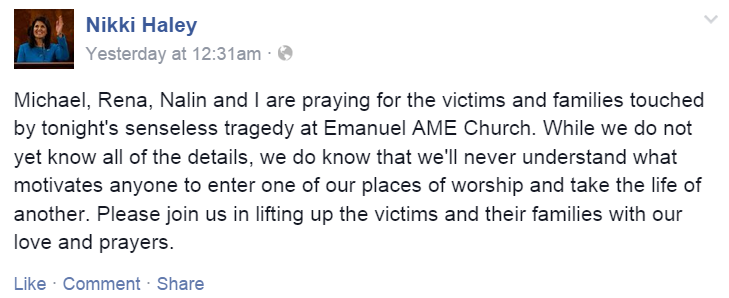
And yet, the next morning, when enough of the story was directly in our faces to know that racism and a desire to instill racial terror was front and center, a national media outlet and some political figures were attempting to obfuscate that truth.  South Carolina Governor Nikki Haley, the first woman elected to the governor’s office in South Carolina, and one of only two women of color elected to a governor’s office in American history, issued a statement stating “we’ll never understand what motivates anyone to enter one of our places of worship and take the life of another.”

Haley

South Carolina Senator and candidate for the Republican nomination for President, Lindsey Graham, when asked if the shooting was a hate crime or an act of mental illness, responded saying “Probably both. There are real people out there that are organized to kill people in religion and based on race. This guy is just whacked out…But it’s 2015, there are people out there looking for Christians to kill them.”  Senator Graham also defended the Confederate Battle Flag which, due to a quirk of South Carolina law, flies over a memorial adjacent to the state capitol and is the only flag not flying at half mast today.

As the story unfolded, more Republican candidates obfuscated Roof’s obvious intentions.  Former Florida Governor Jeb Bush initially danced around the question of whether or not Roof was motivated by racial hatred.  Former Pennsylvania Senator Rick Santorum declared the killings an “assault on our religious liberties” without apparently mentioning the racial component of the crime.  Former Texas Governor Rick Perry was more willing to attribute Roof’s murders to psychiatric drugs than to racial hatred.

On Thursday morning, Fox’s morning show, Fox & Friends, went out of its way to portray the murders as an attack on Christianity, deliberately setting aside the nature of the church that was attacked and what the survivors were already reporting.  Co-host Elisabeth Hasselbeck even went so far as to comment about how “we’re not safe in our own churches” as if Roof’s intention were not perfectly clear and he could have just as easily murdered people in Hasselbeck’s church.

Is someone confused here?

Is someone confused here?

The Wall Street Journal, in an editorial where they said that Roof’s murders were caused by “a problem that defies explanation” went on to state, categorically, that the institutional racism of the 1950s and 1960s that allowed acts of racist terrorism to go unprosecuted no longer exists.  While it is fair to say that the overt White Supremacy of the past is greatly diminished and the influence the Klan once held over elected officials and judicial proceedings is basically no more, it is a horrendous dismissal of reality to say institutional racism no longer exists, and to claim that Dylann Roof’s professed White Supremacist motivations have no explanation.  The disparate impact of policing policies of the past three decades on African Americans is not disputable, and we know that when individuals bring their racial prejudices into positions of institutional authority, that can lead to serious economic discrimination.  And in a very embarrassing example of the power that racism still holds, Earl Holt, the president of the Conservative Citizens Council, whose website apparently helped to radicalize Dylann Roof until he pledged himself to starting a race war, has been a generous donor to Republican politicians — many of whom are now returning his money or donating it to charity.

To their credit, many of the Presidential candidates who have waffled on Roof’s motivation, have now joined Governor Nikki Haley in stating that it is time for the Confederate Battle Flag to be taken down from the memorial adjacent to the state capitol building.

I wish to be very clear here.  What the hosts and producers at Fox & Friends did, and, to a lesser degree, what Senator Graham and Governor Haley, did is an act of erasure.  There is no doubt about what motivated Dylann Roof’s terrorism.  There was no doubt on Thursday morning even though the production team of a major morning program mightily tried to remove it from their “discussion.”  Hasselbeck said the attack happened at a “historic church” rather than a “historic BLACK church” and that omission could not have been more deliberate or more outrageous.  The 200 year history of the Emanuel African Methodist Episcopal Church is wrapped inextricably to the struggles and triumphs of the African American community in the South, and they did nothing less than try to erase that entire history out of some perverse desire to not name racist terrorism inspired by the very worst in our national heritage for what it is.

I do not know the true motivation behind those who cannot bring themselves to unequivocally state that racial hatred and White Supremacy is what drove Dylann Roof to his actions.  Perhaps they are racists themselves and sympathize with Roof’s seething hatred and fear of black people.  Perhaps they are cynical and see more political utility to casting this as an unknowable act of barbarity or as part of a larger script about religion being under attack.  Perhaps they know that a minor but potent part of the constituency and audience are sympathetic to Roof’s motives if not his actions and will respond negatively in the polls or ratings if they hear White Supremacy called out in public.  Whatever the reason, there is nothing admirable in failing to call Dylann Roof exactly what he is: a White Supremacist who deliberately chose one of the most iconic symbols of the African American community for an act of terrorism as devastating as any in the 1950s and 1960s.

Jon Stewart, setting aside his normal comedic monologue in favor of more sober reflection perhaps summed up that phenomenon perfectly:

I heard someone on the news say “Tragedy has visited this church.” This wasn’t a tornado. This was a racist. This was a guy with a Rhodesia badge on his sweater. You know, so the idea that — you know, I hate to even use this pun, but this one is black and white. There’s no nuance here.

And we’re going to keep pretending like, “I don’t get it. What happened? This one guy lost his mind.” But we are steeped in that culture in this country and we refuse to recognize it, and I cannot believe how hard people are working to discount it. In South Carolina, the roads that black people drive on are named for Confederate generals who fought to keep black people from being able to drive freely on that road. That’s insanity. That’s racial wallpaper. That’s — that’s — you can’t allow that, you know.

Nine people were shot in a black church by a white guy who hated them, who wanted to start some kind of civil war. The Confederate flag flies over South Carolina, and the roads are named for Confederate generals, and the white guy’s the one who feels like his country is being taken away from him. We’re bringing it on ourselves. And that’s the thing. Al-Qaeda, all those guys, ISIS, they’re not s— compared to the damage that we can apparently do to ourselves on a regular basis.

And this is where the role of educators has to be considered very seriously.  The victims of Dylann Roof are the latest in a long history of attacks against crucial landmarks in the lives of our African American countrymen and women and against their very lives themselves.  The Black Church has been a cornerstone of African American community and activism for centuries, and its role has subjected it to repeated and vicious attacks from the original Klu Klux Klan of Confederate General Nathan Bedford Forrest, through the rise of the Second Klan in the 1920s and the waves of riots and violence inflicted upon African American communities across the country, to the waves of violence against the Civil Rights movement in the 1950s and 1960s.  White Supremacy and Apartheid always defended itself through violence and terrorism, and while the struggles of the mid-20th Century may have legislatively defeated those institutions, we did not stamp them out of existence.  Roof’s attack on a historic Black Church was the first deadly attack since the 1963 Alabama bombing and 1964 murder of civil rights workers, but it was by no means the only attack on a Black Church in the past 52 years.

Americans may like to imagine that we left White Supremacy behind with the 1960s, but it is clear that the hatred still seethes within many of our countrymen, and it is very clear that it boiled over in Dylann Roof spurring him to annihilate members of the Charleston black community as they studied the Bible in one of the cornerstone institutions of that community.  And it happened in a state where a sitting United States Senator and Presidential candidate still feels the need to defend the state sponsored flying of a flag that led 100s of 1000s of men into battle to keep blacks in bondage.  There is no ambiguity here.  Roof is a vicious racist inspired to act by the still present legacies of White Supremacy which we refuse to confront boldly and bluntly.  He apparently self radicalized by immersing himself in an online world where White Power advocates work collectively to stir up racial hatred and to advocate for race war — an advocacy that Roof took to its next logical step.

The result is an act of abject terrorism meant to make people feel unsafe in their most precious institutions, which deprives the black community in Charleston of beloved mentors and family members, and which deprives the state of South Carolina of a remarkable, young spiritual and political leader whose potential for good seemed limitless a few days ago:

As a scholar, as an educator, and as a member of a community still seeking racial justice, it is my obligation to passionately denounce not merely Roof’s act of racist terrorism, but also to denounce those who want to strip it of its historical and social contexts and leave it “merely” as the act of one, lone, troubled young man for which none of the rest of us have any responsibility.  That is a lie.  And it can only be confronted by a passionate and genuine commitment to social justice and for speaking out in defense of social justice.  We cannot allow either the media or our leaders to murder both history and the truth when speaking about Charleston without hearing from us.

The martyrs in Charleston — The Honorable Clementa Pickney, 41, Tywanza Sanders, 26, Sharonda Coleman-Singleton, 45, Cynthia Hurd, 54, DePayne Middleton-Doctor, 49, Ethel Lee Lance, 70, Susie Jackson, 87,  Myra Thompson, 59, and Reverend Daniel Lee Simmons, Sr., 74 — deserve our resolve and our dedication to social justice.

6 Comments

Filed under #blacklivesmatter, Activism, racism, Social Justice

“SGPs Are Not Test Scores” And Other Tales From Trenton

Last week, I got to attend a talk by a high level representative of the New Jersey Department of Education who explained where we are going regarding the Partnership for Assessment of Readiness for College and Careers (PARCC) assessments administered in the Spring.  Little was said that was especially new or interesting.  We heard an enthusiastic appraisal of the computer interface and the “success” of the computer administered exams.  Next steps include how the state will disseminate and interpret data when it eventually comes back with hopes that everyone will find it very useful and very granular.  A talking point expressly did not rule out using PARCC results for grade level promotion or graduation in the future, but it was not emphasized.  Time was spent lamenting what teachers have been saying about the PARCC as if they were simply misinformed about how good the examinations are and how useful the data will be.

And at one point, the DOE representative said, in response to a question, that “SGPs (student growth percentiles) are not test scores.”

Let that sink in for a minute.  “SGPs are not test scores.”

This is one of those incredible moments in time when an actually true statement is, in fact, entirely misleading.  It is absolutely true that SGPs are not raw test scores, and it would incorrect to simply say that New Jersey teachers are evaluated using test scores.  A Student Growth Percentile is a computation that compares a student to other students with similar previous year scores and predicts how much that student should “grow” as measured on an annual standardized test.  When used in teacher evaluation, the difference between a student’s anticipated growth and the actual scores, either positive or negative, are attributed to the teacher.  Proponents of manipulating test data this way believe that these measures are more “objective” than standard administrator observations of teachers because they are tied to students’ actual performance on a measure of their learning.

So, it is technically true that “SGPs are not test scores.”  In much the same way that a houses are not trees.  However, if you want to make a house and have no idea from where you will get the lumber, you won’t get very far.  In the same vein, without standardized tests to feed into their calculations, SGPs and other related growth scores used to evaluate teachers would not exist.

Of course, planning to make your SGP out of test scores the way it has been done in New Jersey might very well be a wasted exercise.  Bruce Baker of Rutgers University and Joseph Oluwole of Montclair State University discussed the many problems underlying New Jersey Student Growth Percentiles in this 2013 NJ Education Policy Forum discussion:

…since student growth percentiles make no attempt (by design) to consider other factors that contribute to student achievement growth, the measures have significant potential for omitted variables bias.  SGPs leave the interpreter of the data to naively infer (by omission) that all growth among students in the classroom of a given teacher must be associated with that teacher. Research on VAMs indicates that even subtle changes to explanatory variables in value-added models change substantively the ratings of individual.Omitting key variables can lead to bias and including them can reduce that bias.  Excluding all potential explanatory variables, as do SGPs, takes this problem to the extreme by simply ignoring the possibility of omitted variables bias while omitting a plethora of widely used explanatory variables.

The authors explain how the state’s claim that using the same starting points for students “fully accounts” for variables such as poverty is unsupported by research or methodology. Further, there are multiple potential reasons why schools’ average proficiency scores correlate to their growth percentiles, but the SGP model makes it impossible to say which is correct.

Dr. Baker revisited this topic a year later on his personal blog.  With an additional year of data, he noted that SGPs were almost as closely correlated with the poverty characteristics of a school as they were with themselves and were also as related to prior performance as they were to themselves.  So while the SGPs were relatively “reliable,” meaning that they produced consistent results over time, there is no reason to believe that they are valid, meaning that they are actually measuring what they are said to measure.  Taking the growth percentiles as a valid measure of teaching would have you  believe that the distribution of ineffective teachers in New Jersey just happens to directly concentrate into schools with high percentages of students in poverty and low overall proficiency levels on standardized tests. You would have to believe this even though SGPs were never actually designed to statistically isolate teacher input into student test scores.

So, yes — “SGPs are not test scores.”  They are just a lousy thing to do WITH test scores and to put into teachers’ evaluations and tenure decisions.

Perhaps the most frustrating aspect of this is not the even the sleight of hand explanation of SGPs and their relationship with test scores.  It is the wasted time and opportunity that could have been spent developing and implementing teacher evaluations that were aimed at support and improvement rather than at ranking and removing.  Linda Darling Hammond, writing for the Stanford Center for Opportunity Policy in Education, proposed a comprehensive system of teacher evaluation that incorporates truly thoughtful and research supported policies.  Her proposal begins the process with standards and locally designed standards-based evaluation, incorporates genuine performance assessments, builds capacity and structures to actually support fair standards-based evaluation, and provides ongoing and meaningful learning opportunities for all teachers.  Most importantly, Dr. Darling-Hammond states that evaluation should include evidence of student learning but from sources other than standardized tests, and she rejects growth measures such as SGPs and Value-Added Models because of the ever increasing research base that says they are unreliable and create poor incentives in education.  Dedicated teachers know that they are constantly generating evidence of student learning, but to date, policy makers have only shown interest in the most broadly implemented and facile demonstrations.

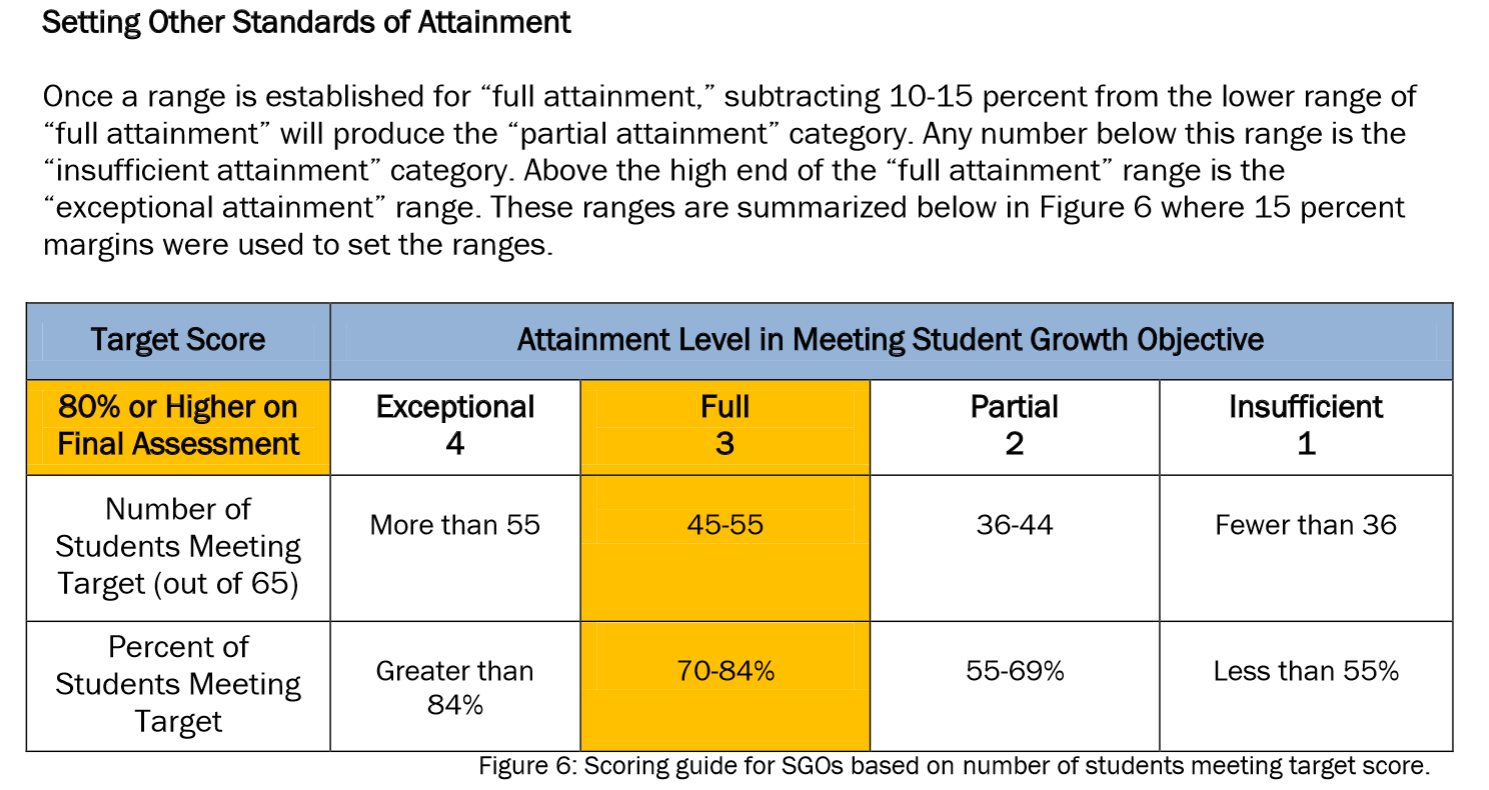
Taking Darling-Hammond’s vision seriously would mean admitting failure and hitting a reset button all the way back to the drawing board in New Jersey.  Trenton would need to admit that Student Growth Percentiles cannot be fairly attributed to teacher input when they were never designed to find that in the first place, and the problems with Value-Added Models in other states mean that growth measures in general should be rejected.  Further, if the state were to become serious about teachers actually demonstrating student learning in meaningful ways, the DOE would need to reject the “Student Growth Objective” (SGO) process that it has established as a second leg of the evaluation process. While the concept of the SGO sounded promising when first proposed, the state guidebook makes it an exercise in accounting mostly.  Teachers are instructed to only select objectives that are measured by data, they are told to select a level of performance demonstrating “considerable learning” with no guidance on how to make that determination via data, they are required to determine how many students could meet that level with no explanation of how to project that based on existing data, and then they are told to set an entirely arbitrary 10-15 percent range below that for partial obtainment of the objective.

From page 16 of the SGO manual:

page 16

These are not instructions to help teachers conduct meaningful self study of their teaching effectiveness.  These are instructions designed to create easy to read tables.

Teaching, teacher evaluation, and providing meaningful support for teachers to grow in an environment that is both supportive and focused on student learning is a serious endeavor.  It requires a systemic approach, real capacity, and the development of tools sensitive to and responsive to context.  It cannot be forced by incentives that distract from the most important work teachers do with students: fostering genuine curiosity and love of learning around rich content and meaningful tasks with that content.

It certainly cannot be made out of standardized test scores.

6 Comments

Filed under Common Core, Data, PARCC, Testing, VAMs

Truthiness and Lack of Consequences

New York Governor Andrew Cuomo wants his education tax credit, which critics have identified as a backdoor voucher plan for private and parochial schools, and he wants it so badly that sources in Albany are saying he is trying to entice hesitant Democrats by tying strengthened rent regulations to passage of the credit.  This is a familiar tactic for Governor Cuomo who originally tied the tax credit together with the Dream Act and whose budget negotiation stance insisted that any increase in state aid for public schools had to be connected to his test-centric teacher evaluation plans.

Now, in the waning days of the legislative session, the Governor is charging hard at Assembly Democrats who have not signed on to his plan for the education tax credit.  The complex plan, which is being advertised as a boon for schools and struggling families, is a pool of $150 million with different set asides for getting money to different constituencies.  If enacted as proposed, the bill will provide $50 million in tax credits for donors to scholarship funds for low and middle income attendees at private and parochial schools, and it provides $20 million in credits for donations to public schools.  Donors could reduce their tax liability by 75% of their donations up to a full million dollars. Under the Governor’s proposal, another pool of $70 million will be set aside for credits to families who make up to $60,000 a year to help offset tuition at private and parochial schools for a total of $500 per family.  The Governor has also proposed a pool of $10 million for teachers at fully public schools and at charter schools to make up for out of pocket expenses for classroom supplies.  The state Senate, controlled by the Republican caucus, has passed its own version of the legislation.

Tax credits are different from tax deductions.  Deductions reduce your taxable income while credits typically are a dollar for dollar reduction in your total tax liability.  So while under the old charitable tax deduction available for donations to scholarship funds, a family donating $1 million could take a maximum deduction of $22,000 on state taxes, under the new tax credit, they could reduce that tax liability by $750,000.  This basically means that for a million dollar private donation to a scholarship fund for children attending private and parochial schools, the state will pay $750,000 of that by relieving the donor of that amount of his or her tax burden.  Although proponents insist that most recipients of the scholarships will be low and middle income, the proposal allows for scholarship money to go to families making as much as $300,000 a year.  The $500 a family credit is limited to families making less than $60,000 a year, but again, as a tax credit, this is basically a direct transfer of taxpayer money to a private or parochial school.  The teacher benefit is set at $200 per teacher.

Let’s be absolutely clear: a donation of a million dollars will be subsidized by tax payers to the tune of $750,000 for scholarships that might go to people earning $300,000 annually while genuinely needy families will get a $500 coupon for tuition (which is about 1/24 the average cost of tuition at a Catholic school in the United States) and teachers will get slightly less than the cost of 10 packs of multi-colored Sharpies.

At the end of the day, no matter what it is called, the bill is a complex transfer of public money to private hands with little guarantee that genuinely helpful sums of money will ever make it to genuinely needy families.

This is the proposal aggressively pushed by a governor who is billions of dollars behind the state’s constitutional obligation to fund public schools equitably, who continues to use accounting tricks to cheat school districts out of millions of dollars owed under the already inadequate funding in the state budget, who has restricted districts from increasing revenue locally without a super-majority, and then has the nerve to blame strangled school districts for not raising test scores.

If you are public education advocate on social media, you have probably seen some of the aggressive “truthiness” that has been masquerading as grassroots advocacy on this issue.  This is from Twitter:

I find this tweet to be emblematic of the past 30 plus years of claiming you can get something for nothing from advocates who want to funnel as much of our national commons into private hands as possible.  The $20 million in tax credits for  public education purposes would fund donations for public schools covering barely 1/2 of 1% of the over FIVE BILLION in unfunded state aid to schools left from the Campaign for Fiscal Equity Settlement.  And in order to get THAT, the public has to agree to tax credits that send $50 million in tax dollars to private and religious foundations and another $70 million that will go in $500 increments to private and parochial schools as “credits” that act as vouchers.  And itty bitty vouchers at that.

This is not a “tax free” way to increase spending on education, and the claim that this increases education spending without raising taxes is pure “truthiness”. This is taking a chunk of our current tax pool and divvying it up 80% into private hands.  Some of those hands may be extremely worthwhile and deserving of the generous support of their wealthy patrons.  But they are also not accountable to the same public purposes and oversight as our fully public schools, and many of them are religious organizations that are now going to be getting public funding.  By making these tax credits instead of tax deductions, Governor Cuomo has essentially crafted a proposal whose most generous subsidies amount to the very wealthy directing how their tax dollars get spent.  It is another example of political donor class writing themselves out of the rules by which everyone else lives.

Wavering Democrats in the Assembly should hold firm.  The precedent of this plan is too radical to approve.

7 Comments

Filed under Funding, politics, schools

Chester Finn and the Death of Kindergarten

Chester E. Finn, Jr. has been an influential figure in American education reform for a long time now.  President Emeritus of the Thomas B. Fordham Institute, a conservative think tank supporting most elements of today’s reform environment, former fellow at the Manhattan and Hudson Institutes, founding partner with the for profit school turned for profit school management organization Edison Project, former Assistant Secretary of Education for Presidents Ronald Reagan and George H.W. Bush, former Professor of Education at Vanderbilt University, and former chair of the National Assessment of Education Progress (NAEP) governing board, Dr. Finn has been a staple of the education reform landscape for decades.  According to his former colleague, Dr. Diane Ravitch of New York University, Dr. Finn has long held a low opinion of the quality of achievement in American education and has long wanted Americans to realize how poorly educated our children are.

And now it is Kindergarten’s turn.

Writing for the Fordham commentary website, Dr. Finn reports on the results of Maryland’s new “Kindergarten readiness” test administered individually by teachers and now available for the general public.  Dr. Finn, recently appointed to the Maryland State Board of Education, describes the results as “revealing and sobering”:

The assessment is individually administered by kindergarten teachers and was given this year to all of the Old Line State’s sixty-seven thousand kindergartners. The results are sorted into three bands, politely labeled “demonstrating readiness,” “developing readiness,” and “emerging readiness.” But only the first of these means actually ready to succeed in kindergarten—and slightly fewer than half of Maryland’s entering kindergartners met that standard.

Which is to say that more than half are not ready. This report candidly displays the results not just for the state as a whole, but also for each of Maryland’s twenty-four local districts—and further disaggregated in all the ways we have come to expect and demand in the NCLB era.

Every which way you look, you see gaps. And often the gaps are alarmingly wide—by district, by race, by income, and more. You may not be surprised, but you ought to be alarmed and energized. Children who enter school without what they need to succeed in kindergarten are destined to have great difficulty catching up, even in schools that do their utmost. It’s not impossible, but it’s very hard.

Allow me to give Dr. Finn half of a loaf here.  Early advantages matter for long term educational outcomes, although many critics have written about whether that is because of specific deficits in certain student populations or because schools systemically valorize  the cultural capital already possessed by society’s elites.  It is curious to me that Dr. Finn calls the results of the Kindergarten readiness test “revealing” because the finding of gaps between subgroups of students is entirely predictable based on what we know about poverty and its long lasting impacts.  Maryland has a total poverty rate under 10%, but 14% of its children live below the poverty line and another 17% live between the Federal Poverty Level and 200% of the Federal Poverty Level ($47,700 for a family of four).  So that is 31% of the children in Maryland living either below the poverty line or within striking distance of it.  The 1997 Princeton Study, The Effects of Poverty on Children, clearly documented how poverty in early childhood has long lasting impacts on physical, cognitive, school achievement, and emotional/behavioral development, so for Dr. Finn to say the results of the new Maryland assessment are “revealing” rather “confirming what we already know” is rhetorically nonsensical.

It is also nonsensical for Dr. Finn to say that HALF of Maryland’s children are not “ready” for Kindergarten (a term that is not actually defined or defended in his article), when the scale as reported is “demonstrating readiness” – “developing readiness” – “emerging readiness”.  According to the actual state report, not provided by Dr. Finn, 47% of Kindergarten students were found to be “demonstrating readiness”, 36% were “developing readiness”, and 17% were only at “emerging readiness”.  These terms are defined in the report as follows:

Demonstrating Readiness – a child demonstrates the foundational skills and behaviors that prepare him/her for curriculum based on the Kindergarten standards.

Developing Readiness – a child exhibits some of the foundational skills and behaviors that prepare him/her for curriculum based on the Kindergarten standards.

Emerging Readiness – a child displays minimal foundational skills and behaviors that prepare him/her for curriculum based on the Kindergarten standards.

And how does a teacher giving this assessment determine that?  Maryland provides a vague and unhelpful website for the public, but there are a few sample rubrics. Here is one for an observational item:

K rubric

So, a five year-old child “requires adult guidance to select the best idea and then put it into action” and to Dr. Chester Finn, THAT is evidence that the child is “not ready” for Kindergarten – rather than just normal evidence of a 5 year-old.

Interestingly, just one year ago, 83% of Maryland Kindergarten children were found to be “ready,” the precise sum of this year’s combined “demonstrating readiness” and “developing readiness.”  I’m sure THAT wasn’t deliberate at all.

And that’s the crux of the matter.  It would be one thing to develop high quality individualized assessment instruments that Maryland Kindergarten teachers could use to get snapshots of their incoming students and to fully individualize instruction or to use targeted interventions for some students.  It is an entirely different thing to redefine “Kindergarten readiness” to mean that 5 year-olds must engage in complex problem solving with no adult assistance and select “the best idea” (note the use of a definite article which narrows the number of correct ideas down to one) and then to publicize this as “evidence” that over half of our 5 year-olds are deficient.  In the pursuit of observing “the best idea” to solve a problem, how many entirely appropriate but fanciful ideas were set aside as evidence that a child was “developing readiness” rather than “demonstrating readiness”?  How many teachers will now use the results of this assessment to take the Kindergarten curriculum and try to push children into very narrow boxes of “correct” and “incorrect” ideas that stifle the kind of play based learning and experimentation that is entirely appropriate and healthy for very young children?

Professor of physics at Loyola University Maryland Joseph Ganem took the results of the Kindergarten assessment to task in the pages of The Baltimore Sun, faulting unrealistic and narrow expectations of the Common Core State Standards for the redefinition of readiness:

However, for skills in what Bloom calls the “cognitive domain,” the school curriculum has become blind not only to the progression of normal child development but also to natural variations in the rate that children develop. It is now expected that pre-school children should be able to grasp sophisticated concepts in mathematics and written language. In addition, it is expected that all children should be at the same cognitive level when they enter kindergarten, and proceed through the entire grade-school curriculum in lock step with one another. People, who think that all children can learn in unison, have obviously never worked with special needs children or the gifted and talented.

I agree with Dr. Ganem, and I will add that Dr. Finn’s attempt to portray these results as widely dire, rather than as indicating a specific population of children in poverty may need additional services, risks a deeper erosion of Kindergarten and early childhood education into narrow and unimaginative academics.  In their 1995 history of education reform, Tinkering Toward Utopia, David Tyack and Larry Cuban noted how the ideal of the “Children’s Garden” was quickly subsumed into preparation for the academic curriculum of grade school:

A much more modest bureaucratic rationale became central: that the kindergarten would prepare five year-olds for the first grade in a scientifically determined developmental way. Some of the features that had made the kindergarten exotic were slowly trimmed away or changed to fit the institutional character of the elementary school. (p. 69)

Dr. Finn proposes that we once again double down on this.  His solution to the problem created by rewriting the meaning of Kindergarten is “intensive, targeted early-childhood education for the kids who need it the most” which almost certainly means further pushing academic skills development to children as young as three. While I am a proponent of universal pre-K, I am mindful that “high quality” programs are far more than academic preparation and will often cloak such preparation in a focus upon learning via play.  In communities with high poverty, a focus on the family and whole child requires the existence of robust community-based social services that blunt the negative impacts of poverty on child development.  But if Dr. Finn believes that a 5 year-old who needs some adult guidance to select the ONE “best idea” in problem solving is not “ready” for Kindergarten, then I have little hope that an accompanying push for more early childhood education will preserve learning by play and attend to what we actually know children need.

For fifty years, we have continuously strangled the idea of free time and free play out of childhood in an academic arms race with our neighbors and other nations.  The consequences have been negative.  While we do have children who have needs that require specific interventions and resources, all of our children need time to grow and explore in their earliest education.

Turning pre-K into the new first grade the way we have already done to Kindergarten is not the answer.

10 Comments

Filed under child development, Common Core, Funding, politics, teaching, Testing

Chris Christie and the Magical Mystery Standards

Back in February, I noted that New Jersey Governor Chris Christie had begun to walk back his support of the Common Core State Standards.  The governor began sounding cautious notes about the implementation of the standards and about how the Obama administration has been involved in the adoption process and used funding as incentives for states to come and stay on board. These statements were directly contrary to the big, wet, sloppy kisses he gave to the standards and to Secretary of Education Arne Duncan at the KIPP School Summit in 2013:

Whoopsie.  How embarrassing.

Since it is now established fact that all Republican hopefuls for the nomination in 2016 who are not named “Jeb” have to be against the Common Core, Governor Christie assured Republicans in Iowa that his administration was really concerned about the federal role in the standards:

So we’re in the midst of a re-examination of it in New Jersey. I appointed a commission a few months ago to look at it in light of these new developments from the Obama administration and they’re going to come back to me with a report in the next I think six or eight weeks, then we’re going to take some action. It is something I’ve been very concerned about, because in the end education needs to be a local issue.

I suppose that commission got back to Christie as he decided to blow up the education section of most newspapers by announcing that he believed New Jersey should no longer follow the Common Core State Standards.  Speaking at Burlington County College, he declared:

It’s now been five years since Common Core was adopted and the truth is that it’s simply not working….It has brought only confusion and frustration to our parents and has brought distance between our teachers and the communities where they work. Instead of solving problems in our classrooms, it is creating new ones.

The Governor also announced he wants to form a group to develop “new standards right here in New Jersey,” and the news media went moderately crazy over the implications.  Observers closer to home and closer to classrooms were less impressed.  New Jersey parent Sarah Blaine noted that Governor Christie’s announcement took a swipe at the Common Core State Standards, but also pledged to keep New Jersey in the Partnership for Assessment of Readiness for College and Careers (PARCC) whose annual Common Core aligned testing debuted in New Jersey this Spring with widespread complaints and approximately 50,000 opt outs.  Ms. Blaine correctly notes the contradiction that Governor Christie wants to set aside the standards, but will keep the PARCC examinations that are designed to assess student mastery of the standards, and he will keep using the examinations as part of the dreadful AchieveNJ teacher evaluation system, thus keeping both the standards and the aligned assessments central to teachers’ work in New Jersey.  She concludes:

Christie’s announcement changes nothing, and shame on the media for lapping it up so naively. Christie’s so-called rejection of Common Core is simply a sound bite for him to take on the road to Iowa and New Hampshire while our NJ public school kids continue to deal with a language arts curriculum that doesn’t teach them to consider texts and ideas within their broader historical context….However, as long as the Common Core-aligned PARCC test continues to be the barometer to allegedly measure our schools, teachers, and children’s efficacy, Christie’s announcement is worth even less than the paper his speech was written on. If you believe otherwise, then man, I’ve got a bridge to sell you…

Peter Greene bluntly calls Governor Christie’s move an “empty gesture”, and New Jersey
music teacher and Rutgers graduate student Mark Weber, blasted the governor for “screaming hypocrisy” in suddenly claiming to care about what teachers think and about the integrity of local control:

America, take it from those of us living in Jersey: this man doesn’t care one whit about the Common Core, or education standards, or anything having to do with school policies. Chris Christie’s sole interest in education policy is in its worth as a political tool: a tool to diminish the strength of unions, demonize public workers, and shift the focus off of his own many, many failures as governor.
My colleague, Dr. Christopher Tienken of Seton Hall University, was not impressed by how seriously the governor wants new, locally developed, standards given his short time frame, noting, “This is years and years of work that it takes to do this.”  So in all likelihood, New Jersey can expect “New Jersey College and Career Readiness Standards” that are mostly Common Core but with a few definite and indefinite articles swapped around.
I am in complete agreement with Ms. Blaine that Chris Christie’s announcement is pure politics aimed at Republican Party caucus and primary voters in Iowa, New Hampshire, and South Carolina.  Republican voters lead the nation in disapproval of the Common Core with perhaps three quarters having a negative opinion of the standards.  While reasons for opposing the standards are diverse, there is a strong impression that the kinds of activist voters likely to participate in the early contests represent that most extreme, and often inaccurate, ideas about what the standards do and do not do.  With Chris Christie’s public move against the standards, Jeb Bush is left alone in the Republican field.
So just to be perfectly clear, New Jersey Governor Chris Christie, famed “tough guy” governor who “tells it like it is,” is throwing the Common Core brand off of his campaign bus so he can appeal to this guy:
For all of his declarations that the Common Core standards are not working and that the federal role has been too intrusive, Governor Christie still spoke the language of education reformers in his original remarks:

It’s not enough for most of our students to become proficient – we want all of our students, no matter their economic status or their race or ethnicity, to acquire the skills they need to compete in the 21st century.

And a look at the projected demands of employers in 15 years indicates that we will not be able to meet their needs unless we do a better job educating our children.

By 2030, it is projected that 55 percent of all new and replacement jobs will require people with a post-secondary degree. Yet in New Jersey today, only 42 percent of individuals over 25 have at least an associate degree.

Unless those numbers change – and they must change – that means that 15 years from now, nearly six out of every ten students will lack the basic requirement for a good job.

Where Governor Christie gets his numbers for how many college graduates will be needed by 2030 is unclear because projections vary from under 30% to the mid-40%, but with wages for college graduates basically stuck in place, there is little evidence in the labor market that we are short on graduates.  A more important question is why Governor Christie, like most reformers today, seems to attribute standards with an ability to make classrooms better prepare students for their future in the workforce:

And that’s where we must focus our attention – in every New Jersey classroom and home.  That’s where higher standards can be developed.

We do not want to be the first generation in our Nation’s history to leave our children less equipped and less prepared to build for themselves and their children a nation stronger and more prosperous than the one our parents gave to us.

We owe our kids the educational foundation they need to thrive, not just survive.

In reality, the connection between “quality” standards and classroom achievement looks tenuous at best. For example, Massachusetts is widely regarded as having had excellent standards prior to adopting the Common Core, and it basically was at the top of the country in the 2013 National Assessment of Educational Progress (NAEP).  Texas, meanwhile, was also recognized as having high quality standards prior to Common Core (which the Lone Star State did not adopt), but on the 2013 NAEP, it was only above 7 other states on 8th grade reading.  If quality standards were the elixir for student success, one would expect states with high quality standards to have convergent results from community to community, and yet, there is variability across communities within states as well.  Again, we can look at Massachusetts.   In 2013, Massachusetts urban communities were 32% at or above proficient in 8th grade reading compared to 28% nationally, and suburban communities were 52% at or above proficient compared to 39% nationally.  In 2005, those scores were 25% and 51% respectively.  So – 8 years with Massachusetts’ “high quality” standards, and there was no real movement in suburban achievement and some movement in urban achievement, a mixed bag still demonstrating significant variation in communities across the state even though their standards were the same.

What accounts for this?  The simple fact that standards are not magic and, on their own, do nothing to improve education.  Nor does tying school and teacher survival to standardized assessments aligned with those standards, the other favored tool of reformers.  What improves teaching and learning is often idiosyncratic, messy, and expensive.  However, general principles apply.  Writing in 1990, David Cohen presented the case of “Mrs. Oublier”, a California mathematics teacher who enthusiastically embraced the California math reforms and sincerely believed her practice was embodying them. Cohen, however, found her teaching more frequently belied a pre-reform understanding of the content of mathematics and dressed that understanding up in activities that looked like the reforms.  What held her back?  Her own insufficient education in the new ways of understanding mathematics and teaching mathematics plus the lack of a community consistently engaged in conversation and development on the standards.  Mrs. Oublier had one necessary component to reform and to improve her teaching, her own buy in and enthusiasm, but she lacked two critical other components.

This is something that modern reformers, Governor Christie included, never seem to acknowledge.  Standards, even high quality standards, mated with perverse incentives in the form of high stakes tests, do not reform or improve teaching.  Given the incentives to narrow the curriculum and to teach to the test, they can actually actively make matters worse.  When written clearly and in a developmentally appropriate manner, standards can, ideally, offer teachers end goal benchmarks from which they can “backwards design” instruction to take students from where they are to where they are going (hat tip the recently and too soon departed Grant Wiggins).

But on their own, they do not matter at all.  Teachers need to have genuine buy in, schools needs to be appropriately resourced with materials and meaningful professional development, and teachers need to work within genuinely collaborative learning communities where they and their colleagues are consistently engaged in what it means to teach and to improve teaching.  This cannot be done on the cheap by subjecting teachers and their students to stakes which make a standardized test the most important objective in the system.

And since we can pretty much guarantee that Governor Christie is not going to provide New Jersey schools with genuine respect and new resources, it will not matter if this Common Core backtrack of his results in genuinely new set of standards, a re-adoption of New Jersey’s previous standards, or simply a slap and dash rebranding of Common Core standards with a new name.  The Magical Mystery Standards that improve teaching and learning without a massive, lengthy, and expensive effort do school improvement the right way will never be written.

3 Comments

Filed under Chris Christie, Common Core, Funding, PARCC, politics