Chris Christie and the Common Core Two Step

Governor Chris Christie of New Jersey is a Tough Guy.  The New Jersey Republican revels in his reputation as a politician who says what he thinks without apology and who is willing to get into dust ups with constituents who challenge him in public.  There have been moments in his tenure in Trenton when this has had a certain bipartisan charm, such as when, with Superstorm Sandy bearing down on the Garden State, the governor told people to “get the hell off the beach.”  Unfortunately, many more examples of Christie being “authentic” are unnecessary and embarrassing examples of temper — such as the time Governor Christie, when faced with former Navy SEAL and current Rutgers Law School student William Brown in a town hall meeting ended up calling the veteran an “idiot” and had him escorted out.

Here is Governor Christie also in 2012, expressing his anger at a passerby who made negative remarks about his education policies:

Then there was the time that Governor Christie was in the Jersey Shore community of Belmar to talk on the second anniversary of Sandy and tout his record on the recovery, but when he was confronted by a former Asbury Park city council member Jim Keady over how 80% of recovery money was not yet dispersed, Mr. Keady was treated to full Chris Christie:

Mr. Keady explains himself nicely here:

Governor Christie has saved some his most “authentic” moments for New Jersey’s public school teachers and their union.  Early in his first term, he accused the union of using students as “drug mules” because of a civics lesson in Monroe Township on the eve of statewide school budget votes – after he had already proposed deep cuts to state aid.  The governor accused the NJEA of placing ads that accused him of “hating kids” and of openly praying for his death.  New Jersey teacher and blogger Jersey Jazzman makes clear just how big a pile of hooey those accusations are.  The “prayer” was little more than a joke in questionable taste, and this was the billboard in question:

NJEA billboard 2011

The Governor has also made his hostility clear in direct confrontations with New Jersey teachers.  Marie Corfield, an art teacher in the Flemington-Raritan Regional School District, went to a Christie Town Hall in 2010 to challenge his education policies and rhetoric.  Mr. Christie, not appreciating what he deemed a disrespectful look on Ms. Corfield’s face, launched into a monologue that suited him so well, it went up on his Youtube channel to help cement his Tough Guy reputation. It also inspired Marie Corfield to run for Assembly:

And there was the time, days before his reelection, that Governor Christie met elementary teacher Melissa Tomlinson at a campaign rally where she asked why he was constantly calling New Jersey public schools “failure factories“.  The result was predictable:

Christie Yells Again

Governor Christie has been on board with education reform from the beginning of his term, applying for Race to the Top funding, adopting the Common Core State Standards, joining the PARCC consortium as a governing state, crafting new teacher evaluations using student test scores, and working to expand charter schools in the state.  Nobody can likely recall any doubt about any of these initiatives from anyone within the governor’s inner circle and certainly not from Governor Christie himself.  In fact, in August 2013, Governor Christie appeared at the KIPP Schools Summit in Las Vegas and spoke positively about the Common Core initiative and the Obama Administration:

“We are doing Common Core in New Jersey and we’re going to continue. And, this is one of those areas where I have agreed more with the President than not. And with Secretary Duncan. They haven’t been perfect on this, but they’ve been better than a lot of folks have been in terms of the reform movement.”

Given Governor Christie’s reputation for being a genuine Tough Guy who sticks to his guns even if it is not popular, it was odd to find that he apparently would like what was said in Vegas to stay in Vegas and is now walking back that support for Republican audiences in Iowa:

“I’ve said this before.  I have grave concerns about the way this has been done and especially the way the Obama administration has tried to implement it through tying federal funding to these things.  And that changes the entire nature of it from what was initially supposed to be a voluntary system that states could decide on their own.”

Lyndsey Layton in the Washington Post reported that Governor Christie went on in those remarks to say:

“So we’re in the midst of a re-examination of it in New Jersey. I appointed a commission a few months ago to look at it in light of these new developments from the Obama administration and they’re going to come back to me with a report in the next I think six or eight weeks, then we’re going to take some action. It is something I’ve been very concerned about, because in the end education needs to be a local issue.”

What could possibly be going on that would give the famously self confident and unapologetically “authentic” “Tough Guy” governor to start walking back from reforms he has been pursuing since 2010 with barely pausing to breath?  What could plant any seed of doubt in his generally doubt free mind?

Oh, right.

Chris Christie is running for the Republican nomination for President.  One of his main rivals will be former Florida Governor Jeb Bush who is trying to stick with his support of Common Core while not naming it too often.  Governor Christie must be mindful that Republican support for Common Core has fallen in the past year with 58% of Republican parents opposing the standards and only 19% viewing them favorably.  While most of those opponents likely object to the standards on substantive grounds, Mr. Christie must also be mindful that conservative opposition to the standards also include no small number of these people:

https://twitter.com/dimebag5150/status/566021629298606083

https://twitter.com/HellOfAPrez/status/550098761398366209

https://twitter.com/jonithoreau/status/539600974072250368

…who also, according to popular theory, wield outsized influence in primaries.

Will trying to two step his support for education reform to the right of Jeb Bush work for Governor Christie?  I have no idea.  Recent polling suggests that Common Core may not be so toxic in all early voting states, and primary voters may not be as extreme and polarized as commonly thought.  So Governor Christie is trying to distinguish himself from Governor Bush, but to what effect is up in the air.

What is not up in the air is what this “rethinking” means for New Jersey: Bupkas.

The New Jersey Department of Education website still contains links to the Common Core State Standards in the English Language Arts and Mathematics and links to college and career readiness and to New Jersey’s resource page for teaching Common Core.  The AchieveNJ section of the DOE site is still up, complete with links to Student Growth Percentiles for teachers in tested subjects and Student Growth Objectives for teachers in all subjects.  PARCC assessments are still being fully implemented this spring as scheduled, and the Commissioner sent “guidance” to districts that strongly suggested that districts could face consequences if too many parents opted their children out of the assessments and that there was no requirement for schools to provide those students with alternative settings. Trenton-appointed Newark Superintendent Cami Anderson is still in place and still thundering ahead with the One Newark plan to turn the district into the “charter school capital” of the nation.

There is no sign that any of that is being reconsidered in Trenton.  Governor Christie may move one foot away from his education record while in Iowa or New Hampshire, but residents of the Garden State should expect the “Tough Guy’s” other foot to stomp down with emphasis right where it already is.

3 Comments

Filed under Cami Anderson, charter schools, Chris Christie, Common Core, Newark, One Newark, PARCC, Testing

Saving Mr. Data

I am beginning to think that enthusiasts of standardized testing and data in education accountability are feeling nervous these days.  Senator Lamar Alexander of Tennessee is the new chair of the Senate committee on Health, Education, Labor, and Pensions, and he has set about the long overdue process of renewing and/or revising the No Child Left Behind Act which required annual testing of all students in every state.  The outcome of that process and of the House’s parallel bill which left committee already and which failed to adopt a Democratic sponsored amendment to require states to adopt “college and career ready standards” and to use standardized test results in accountability systems, will play a significant role in the current policy environment that is best summarized as “test and punish”.

However, it is not just a Republican controlled Congress that is threatening federal mandates for universal and annual standardized testing.  An unusual coalition of small government conservatives and anti-testing progressives have joined with growing numbers of parents concerned with how test based accountability is consuming their children’s education.  The once unthinkable is now being thought out loud and in the open — Congress could reauthorize the Elementary and Secondary Education Act without provisions requiring that all states test all students in all grades.

This would, obviously, be a blow to a cornerstone provision of NCLB that once enjoyed bipartisan support as a necessary measure to ensure that states did not try to duck being accountable for all students.  It would also throw a huge monkey-wrench into favored policies of the Obama administration promoted by Secretary of Education Arne Duncan. While the Common Core State Standards might survive in some form without annual standardized testing, the testing consortia, Partnership for Assessment of Readiness for College and Careers (PARCC) and Smarter Balance Assessment Consortium (SBAC), began their work with the support of federal grants almost as soon as the standards were being adopted thanks to financial support from the Bill and Melinda Gates Foundation and federal incentives from the Race to the Top grant program.  If annual testing requirements were scrapped by Congress, it is an open question how many states would keep Common Core and stay with the testing programs created for it.  Another policy threatened by removing annual testing requirements is the assessment of teachers by the test scores of their students.  Despite wide criticism from the research community, Secretary Duncan remains firmly committed to tying teacher evaluations to students’ annual progress on standardized examinations, and without annual examinations of all students, you cannot run their results through discredited and unstable statistical models to determine if teachers deserve their jobs.

So defenders of annual testing have work to do in public if they are going to save their baby,

One such recent effort appeared in the New York Times on February 6th. Penned by Chad Aldeman, a partner at Bellwether Education and former adviser to Secretary Duncan’s Department of Education, it is simply titled “In Defense of Annual Testing”, and it lays out what are becoming familiar efforts to shore up presumably left leaning support for keeping NCLB’s annual testing requirements.  These are not arguments that should be casually dismissed, and they have the moral authority of some of the nation’s most distinguished civil rights organizations that originally signed on for the accountability measures in NCLB when it passed and who have reiterated their support.

They are, however, arguments that don’t stand up to serious scrutiny.

Aldeman opens with a brief assertion of a now familiar claim:

But annual testing has tremendous value. It lets schools follow students’ progress closely, and it allows for measurement of how much students learn and grow over time, not just where they are in a single moment.

This claim suggests that without ANNUAL standardized testing of ALL students then we will not know how INDIVIDUAL students are progressing through school.  It has echoes in Secretary Duncan’s anecdote of how he tutored a great kid in his youth who had been tricked into thinking he was progressing towards college but who was barely reading at a third grade level.  According to Secretary Duncan’s telling, this young man was the proverbial “child left behind” for whose education nobody had ever taken any real responsibility.  Annual testing was the only effective means to catch how he was being poorly served and demand that someone do something about it, and Secretary Duncan even presented annual testing of all students as a parental tool: “Will we work together to ensure every parent’s right to know every year how much progress her child is making in school? Or is that optional?”

The problem is that this line of thinking shows a staggering lack of imagination.

As an argument, it fails to acknowledge that there are many other, and far more interesting, points of data that can be used by teachers, parents, and schools to keep far more compelling tabs on student progress throughout the year.  Locally designed and implemented ongoing assessments such as portfolios and project based learning can provide teachers with ongoing and meaningful insights into how children are learning, and report cards can be reformed to provide parents and guardians with far more nuanced information.

It is even possible to use externally designed assessments in more interesting ways that help inform teachers, students, and parents in real time.  Bruce Baker of Rutgers University notes that computer-based “adaptive assessments” given individually and with no stakes attached can be the basis of a system of formative assessment that gives immediate feedback to teachers about student progress that can be used to craft individual learning plans for those who struggle.  In coordination with portfolios and project based learning (and with full disclosure of how they use data and substantial privacy safeguards), computer based assessments could become a valuable tool based on data.  Dr. Baker further notes such data-driven and formative assessments would be vastly more useful than mass administered tests whose results are distributed months after the fact when students have already moved on to their next grade levels.

Aldeman dedicates most of his Times piece, however, on the belief that NOT testing every child in every year will allow states and localities to wiggle out from being accountable to all students all the time:

The grade-span approach would eviscerate the ability to look at particular groups of students within schools. Instead of having multiple grades over which schools could compile results, each school would be held responsible only for the performance of students in a single grade. Not only would this lower the quality of the data, but it would also raise the stakes of the tests: If you think the stakes are too high now, imagine being a fifth grader in a school where your score determines the results of the entire school.

Worst of all, under this approach, far fewer schools would be on the hook for paying attention to historically disadvantaged groups of students. A school with 10 Hispanic students in each grade would no longer be held accountable for whether those students were making sufficient progress, because the 10 fifth graders wouldn’t be enough to count as a meaningful population size.

Let me state that as a liberal with an eye for history, this argument is certainly intriguing.  We are a nation that only 12 years before my birth required the National Guard to let nine African American students attend a high school ordered to desegregate.  In 1969, the year I was born, the Supreme Court issued a ruling calling for Southern states to cease delays in desegregating their schools — a full 15 years after Brown v. Board found such arrangements unconstitutional.  Federal legislation and federal court cases were also instrumental in holding states and municipalities responsible for ending gender discrimination, for providing students with disabilities access to an education, and for providing support for students learning English.  It is no doubt this record of positive intervention at the federal level and of state delays in implementing equality of opportunity that motivated civil rights groups to endorse annual testing in NCLB and to stand with it today.

That does not change that such testing is unnecessary, is unacceptably disruptive to learning, and is narrowing curricula nationwide.

Mr. Aldeman is suggesting that eliminating annual testing will mean huge swaths of children will be hidden from the test and that the test stakes will be raised enormously with only exam being used.  The stakes argument hinges on a mistaken impression of what the exams say and what should be done with the data they produce.  For the stakes on gradespan testing to be even higher than they are today, one has to assume that such testing is used not only to monitor the education system but also to actively punish schools with low test results.  While few would argue that schools with poor results should be permitted to languish, the kinds of punitive measures embodied in NCLB are not a necessary result of monitoring student test scores.  Under the leadership of Superintendent Tony Alvarado, New York City’s Community District 2 implemented a complex and interconnect culture of reform that included standards and assessments.  However, data from the assessments were used to monitor how schools in the district were doing and to allocate resources for improvement and innovation where they were most needed and with the constant goal of instructional improvement.  Again, Dr. Baker of Rutgers makes a salient observation:

Here’s the really important part, which also relates to my thermometer example above. The testing measures themselves ARE NOT THE ACTIONABLE INFORMATION. Testing provides information on symptoms, not causes or underlying processes. It is pure folly to look at low test scores for a given institution, and follow up with an action plan to “improve test scores,” or close the school if/when test scores don’t improve, without ever taking stock of the potential causes behind the low test scores. TEST SCORES ARE SYMPTOMS, NOT CAUSES, NOT ACTIONABLE IN AND OF THEMSELVES.

Recognition of that fact and crafting policy responses to low test scores with that in mind would necessarily lower the stakes on the tests themselves.

Further, while there might be some argument for an annual test that could contribute to closer monitoring of those symptoms, there is no argument that convincingly says that such tests must be given to every student in every grade in order to get a good picture of how schools and school systems serve historically disadvantaged children.  First, a low stakes system of formative assessments, both qualitative and quantitative, could apply to all children and would conform to accommodations for children with special needs.  So there can readily be ways for teachers, schools, and parents to know how ALL students are doing during the course of the year.

Once we’ve set aside the issue of having a meaningful, formative assessment system for all students that can actually assist teachers, there’s no truly compelling argument against properly devised sampling of students for standardized testing.  Implemented correctly, sampling would not leave substantial numbers of children invisible as Mr. Aldeman fears, and we would stop spending inordinate time trying to ferret out distinctions in performance within schools when, as Dr. Baker once again notes, the greatest and most consequential differences in test measured achievement exist between schools and districts, not within them.  Insisting upon keeping annual testing of every student in every grade keeps an unnecessarily disruptive system in place as part of an accountability system that, in fifteen years, has not yielded sufficient results to justify the sacrifices in teacher autonomy over instruction and the sacrifices in non-tested subjects being shunted aside in favor of test preparation.  In fact, the only people to “benefit” from this system are private test designers like Pearson, who are being handed not just lucrative contracts but also terabytes of data to mine for new products, and advocates of firing as many teachers as possible based upon student test scores.

This is especially frustrating to me because data, when used with a clear understanding of what it can and what it cannot do, is a tool, an important tool at that.  It can help us develop broad pictures of what is happening in schools, and it can direct our attention to places that require more careful and nuanced study.  The persistent overreach and abuse of its capabilities is building a backlash that makes it much harder to successfully advocate for more judicious and appropriate use of what can be learned.  If we wish to SAVE data and its uses in school, it would be best to set aside NCLB and begin again sensibly.

I believe I see the problem, Captain.  My head's been severed.

I believe I see the problem, Captain. My head’s been severed.

12 Comments

Filed under Data, NCLB, politics, teaching, Testing, VAMs

My Guest Editorial for The Record

You can read me today at NorthJersey.Com discussing the upcoming PARCC examinations in New Jersey.

Leave a comment

Filed under Uncategorized

The New York Times or The Onion? “Is Your First Grader College Ready?”

Every now and again, a serious news outlet runs a story that requires multiple readings to tell that it is not someone trying deliberately to invoke Poe’s Law.  The internet axiom states that it is not possible to construct a satire of an extreme form of belief that will not be mistaken as sincere belief by a substantial portion of readers.  Poe’s Law is most often invoked to humorously highlight beliefs that are both fervently believed but so devoid of actual factual basis or a semblance of reasoning that they lampoon the person holding them.

Welcome to Poe’s Law: College and Career Readiness Edition.

“College and Career Readiness” is language that is plastered all over the Common Core State Standards and the accompanying standardized examinations offered by the Partnership for Assessment of Readiness for College and Careers (PARCC) and the Smarter Balanced Assessment Consortium (SBAC).  In essence, the expression means that every student in the country should be taught a curriculum that prepares him or her with the essential mathematics and literacy skills necessary to succeed in entry level college courses or to successfully complete entry level job training in presumably desirable careers.  Proponents of the Common Core State Standards assure us that the common standards provide a proper and attainable platform from which elementary and secondary teachers can educate students to that level, and proponents of the accompanying PARRC and SBAC examinations, frequently the same people, assure us that exams will help us know that every child is on track to be college and career ready — or not.  Regardless of your assessment of those claims and the foundation that underlies (or fails to underlie) them, that’s the promise for standards beginning in Kindergarten and yearly examinations beginning in third grade.

So enter the New York Times with an article asking, and this is not a headline stolen from The Onion, “Is Your First Grader College Ready?” detailing various programs and efforts to raise preparation for college with children as young as first grade:

What is college? To Madison Comer, a confident 6-year-old, it is a very big place. “It’s tall,” she explained, outlining the head of Tuffy, the North Carolina State mascot, with a gray crayon. “It’s like high school but it’s higher.”

Elizabeth Mangan, who plans to be a veterinarian because she loves her puppy, pointed out that she, too, would attend North Carolina State. “Me and Madison are going to the same college,” she said.

And what is college? “It’s someplace where you go to get your career.”

Billy Nalls, meanwhile, was drawing curving horns and jagged teeth on Rameses the Ram on a paper pennant representing the University of North Carolina. “I’m drawing him as angry,” he said. In college, Billy wants to learn to make a Transformer (“It’s like a robot that comes from Cybertron”). And what happens at college? “You get smarter and smarter every day.”

Let me say that some of what is discussed in the article is not precisely off base.  Proponents of these approaches are correct that many students who will eventually go to college grow up in homes with college educated parents and with an underlying assumption that college is just a normal part of growing up.  When both of your parents had post-secondary education and career paths requiring that education, it is simply a background assumption in your life that college is likely compared to growing up in entire zip codes were very few of the adults have studied beyond high school.  It is also true that many first generation college students face challenges to their success that are not common among families with a history of college education, and that they often require support beyond the traditional college “bridge” programs.

So what is almost satirical about some of the approaches described in the Times?

It is one thing to talk to first grade students about what they want to be when they grow up.  For students who are growing up without many community models of post-secondary education, I can see potential in the middle school activities described that emphasize recognizing what would be needed to accomplish their ambitions.  However, the early elementary discourse transforms from surprising to comical to frustrating in very short order.  Six year-olds are not simply talking about what they want to be as grown ups; they are naming specific schools and filling out mock applications for the bulletin board.  The first grade teacher is quoted discussing that it is not enough to ask children what they want to be: “We need to ask them, ‘How will you get there?’ Even if I am teaching preschool, the word ‘college’ has to be in there.”  The approach is not simply being applied in districts with high concentrations of disadvantage; the article quotes a college planner from Westchester County, New York who compares college preparation to becoming an Olympic skater whose training begins in earnest at age 6.

A 6 year old future Olympian, however, is capable of understanding that she loves skating and perhaps that she is unusually good at it and wishes to spend a lot of time doing it.  It might not be a stretch for that 6 year old to know that the world’s best skaters can get a gold medal and to want that.  Her ability to visualize the path from being 6 to an Olympic medal?  Not there.  And it is pretty much guaranteed that future college graduates, at the age of 6, are simply incapable of envisioning something so distant and abstract.  This is the kind of “program” you get when a vaguely attentive superintendent hears the constant repetition of “college and career readiness” in reform circles and hastily writes a memo.

What is also close to farcical in the described approaches is how ways that students “prepare for college applications” in wealthier communities that first grade mock applications and middle school campus visits miss.  Those children have access to community recreation and athletic leagues.  They have schools with library/media centers that are funded and staffed.  They have community and school based arts and music education.  They have summer camps. Their homes have books and toys suitable for free play.  Their schools are often new or extremely well maintained and upgraded. Very few of them are food insecure or at risk of homelessness.

Everything I have listed is directly connected to students becoming “college and career ready,” so while I can support consciously organizing very young children to play “grown up” and following that with earlier than typical planning for certain students, that does not even qualify as a quarter of a loaf if we do not discuss the kind of cultural capital activities that have nothing to do with pinning mock college applications on a first grade bulletin board. Are we willing to embed resources in beautifully designed community centers that replicate what suburban kids have at home?  Are we willing to fully fund school and community libraries and art and music programs?  Are we going to expand recreation and summer camp opportunities?  Will we rebuild crumbling school infrastructure in our urban and rural communities?  Will we embrace, rather than cut, our obligations to keep people from being hungry and homeless?

Meanwhile I have a suggestion that would do a lot more for the first graders described in the Times article than a “cut and paste worksheet” describing the steps to get into college.  Give every kid in that class a good set of plain Legos, some dolls, and other toys that promote unstructured, creative PLAY — let them negotiate and explore their SIX YEAR OLD MINDS.  There will be plenty of time to stress them out and confuse them in only two more years when they take their third grade PARCC or SBAC examinations:

Ginger graduated high school college and career ready, and she got into Harvard University.  Her parents make too much money to qualify for needs-based financial aid, and they are underwater on their mortgage.  At $60,000 a year for tuition, room, and board, and at 8% interest, calculate for how many years SALLIE MAE will OWN Ginger if she begins her career at Starbucks.  Then recalculate how that will change if Ginger’s loans are bought by a securities bundler after five years and sold as bonds.  Show all of your work.

10 Comments

Filed under child development, Common Core, Funding, Media, schools

Paving The Road to Hell — And Other Gates Foundation Initiatives

Towards the end of last year, the Seattle Times provided coverage of the Gates Foundation’s report on the tenth anniversary of its global health initiative. After a decade of effort and a billion dollars invested, Bill Gates admitted that despite the investment he had been “pretty naive” about how long it would take to significantly improve public health outcomes in the developing world. Most notable was Gates’ admission that the problems in his approach were not merely ones about overcoming scientific hurdles, but rather they seriously underestimated the challenges of implementing highly technological “solutions” in countries where the majority of the population lack secure access to routine infrastructure which, in the words of Dr. David McCoy of Queen Mary University in London, are “the barriers to existing solutions.”

Both Peter Greene of the Curmudgucation blog and Anthony Cody of Living in Dialogue have written excellent pieces on this somewhat quiet but very important admission by Bill Gates.  Greene astutely notes that Gates’ realization of his limitations does not actually lead him to understand why his approach is flawed:

Gates wants to use systems to change society, but his understanding of how humans and culture and society and communities change is faulty. It’s not surprising that Gates is naive– it’s surprising that he is always naive in the same way. It always boils down to “I really thought people would behave differently.” And although I’ve rarely seen him acknowledge it print, it also boils down to, “There were plenty of people who could have told me better, but I didn’t listen to them.”

The non-success of Grand Challenges is just like the failure of the Gates Common Core initiative. Gates did not take the time to do his homework about the pre-existing structures and systems. He did not value the expertise of people already working in the field, and so he did not consult it or listen to it. He put an unwarranted faith in his created systems, and imagined that they would prevail because everyone on the ground would be easily assimilated into the new imposed-from-outside system. He became frustrated by peoples’ insistence on seeing things through their own point-of-view rather than his. And he spent a huge amount of money attempting to impose his vision on everybody else.

This is an important observation because it shows that there is a flawed perspective rooted at the heart of the Gates Foundation, and while the man and the institution may be able to recognize failures, they are not inclined to understand why they have failed.  Anthony Cody also recognizes this observation as he lines up quotes from the central figures at the Gates Foundation that demonstrate little regard for the knowledge about teaching held by teachers and wonders if the “humility” earned in Grand Challenges project will translate to humility about the foundation’s approach to education reform.  I believe that Greene and Cody are completely on point and insightful in their observations and questions on these points, and it is important for people outside the Gates Foundation to constantly remind it that education is a complex and interconnected set of systems with knowledgeable and invested stakeholders that cannot simply be plowed over and disregarded without consequences.

A specific quote from Melinda Gates cited by Mr. Cody struck me in particular, and I believe it highlights some of the difficulties we face in enticing the Gates’ and their namesake foundation to listen.  Cody quotes Mrs. Gates from 2011:

It may surprise you–it was certainly surprising to us–but the field of education doesn’t know very much at all about effective teaching. We have all known terrific teachers. You watch them at work for 10 minutes and you can tell how thoroughly they’ve mastered the craft. But nobody has been able to identify what, precisely, makes them so outstanding.

This ignorance has serious ramifications. We can’t give teachers the right kind of support because there’s no way to distinguish the right kind from the wrong kind. We can’t evaluate teaching because we are not consistent in what we’re looking for. We can’t spread best practices because we can’t capture them in the first place.

Asserting that “the field of education doesn’t know very much at all about effective teaching” is one of those statements most frequently made by people who do not want to have to bother with how much information there is that refutes the statement.  However, if Mrs. Gates wants to fill herself in on what the “field of education” knows about effective teaching, she could begin with the 4th edition of The Handbook of Research on Teaching.  It might even be worth her while to read the third edition, see if a full version of the second edition is available, and then finish up with the original publication from 1963.  A fifth edition was supposed to published in 2014, but it seems that the editors are taking some extra time to be careful with it.

Then, for kicks, she might want to talk to some of America’s working teachers and see if they know anything as well.

Of course, knowing this field as I do, I suspect that someone who has been working in the technocratic solutions domain for this many years will still object that the multiple 1000s of pages of research on teaching to which I have referred still won’t tell us what “effective teaching” is.  Researching education is, by necessity, working with a “soft field” where you are unlikely to find absolute answers to your questions.  What we know changes as related fields like psychology build their knowledge base, and ideas can circulate in and out of favor as what schools are expected to do evolves with societal priorities.  Most importantly, research on teaching has to consider how variable the 100,000 schools and millions of classrooms across the country are and how that variability influences the teaching that is both possible and that is needed.  We are not engineering within the parameters of Newtonian physics, and that is appropriate.

Mrs. Gates’ other assertion that “you watch them (great teachers) at work for 10 minutes and you can tell how thoroughly they’ve mastered the craft” (but, gosh darn it, we just don’t know why they are so great!) is the kind of statement made by people who really don’t understand teaching.  Of course, there are great teachers, and, of course, you can be impressed by them fairly quickly, but to say that you KNOW someone has thoroughly “mastered the craft” in ten minutes is romantic in the style of teachers whose lives have been edited by Hollywood.  What does Mrs. Gates risk missing in her ten minute assessment?

  • The lesson that worked very well in the first period but worked far less well in the third period.
  • The day when the lesson plan was simply off base.
  • The work that teacher did outside of the classroom determining what students knew, selecting teaching and learning strategies that would help them build upon that, figuring out what would help the teacher know the students had learned.
  • ANY of the uncertainty in the previously described process and the necessity to pivot if that uncertainty disrupts the plan.
  • How the teacher self assesses and with what information.
  • The week when that teacher has sick children at home, cannot get enough sleep, and has little time to plan.
  • The week disrupted by excessive standardized testing or mandatory field tests of examinations.
  • ANYTHING, really, beyond being impressed by Razzle Dazzle without thinking about substance.

Mrs. Gates’ comment makes the most sense to me if she is unaware of the level of work that goes into lending that impressive ten minutes substance, and if she is not especially discerning about whether or not the substance exists.  In fact, in ten minutes, it is sadly easy to be taken in by weak teaching that is buoyed by personality.  I witnessed this early in my teacher education career when I supervised a student teacher who I eventually had to counsel out of the profession.  She was an intelligent young woman, but she was not up to the task of leading a classroom even on her best day and simply could not gain student attention.  What was interesting, however, was how her struggles demonstrated the weaknesses of her cooperating teacher, a 20 year veteran who, with only ten minutes to watch her, would have impressed an outside observer.  She was a dynamic personality who kept the energy level of her class high, but when her student teacher took over the lesson plans, the thinness of the teaching was painfully obvious over time.  Visit after visit, I witnessed the same teaching approach of presentation and then practice via seat work, and it was clear that the only reason the teaching I first saw SEEMED skilled was the personal energy of the cooperating teacher.  The situation became awkward as my shy and hesitant student teacher made obvious the thin planning that went into the classroom.

Mrs Gates’ ten minute observation would have, most likely, been taken in by the Razzle Dazzle:

…and missed whether or not there was substance.  For that matter, Mrs. Gates’ ten minutes would miss a lot of genuinely great teachers simply having an inevitable bad day.

The problem here is complicated and frustrating.  Melinda Gates’ comment demonstrates first, that the Gates Foundation does not really understand (or is dismissive of) the real complexities and uncertainties involved in being a “great teacher,” and second, that the foundation thinks it can ultimately identify precisely WHAT makes their teaching “great” and distribute that throughout the teaching corps.  Instead of appreciating that research on teaching is various because teaching itself is various, the foundation’s leadership seems wedded to an idea that we need singular answers scaled throughout the entire system.

It reminds me of some of the mixed-bag innovations from the Progressive era which, contrary to popular imagination, was not all trust busting, union victories, and establishment of national parks.  Consider “scientific management” that arose from the work of Frederick Taylor and which greatly influenced how factory work was conceived.  Taylor studied work flow to determine the “best” ways for laborers to perform their tasks, and much of what he determined was useful for productivity and workers themselves.  For example, he concluded that workers needed rest periods which was not an accepted practice at the time.  However, faith in “Taylorism” rapidly overstated its ability to scale up the “best” way to do certain tasks, leading to conflicts with workers themselves, such as the famous incident at the Watertown Arsenal when one molder sparked a mass walk out in response to being timed by a stop watch.  While scientific management survives in different incarnations today, Taylorism itself was more geared towards the automation of tasks since workers were not allowed to vary how they did their work once “innovations” were put into place.

I’ve come to think that the Gates Foundation suffers from a similar problem: armed with an interesting and worthwhile question – “How can we identify and support great teaching?” – they have approached it as a technocratic matter instead of as a sociological one.  In doing so, they have vastly overestimated the strength of their tools and vastly underestimated the knowledge and the agency of what they hoped to reform.  The result is rapidly devolving into a discordant mess of overlapping perverse incentives that mistake common standards with a platform for effective teaching, treat standardized test scores as strongly indicative of teacher impact, and encourage teaching narrowly to the tested curriculum. Teachers and parents are increasingly reacting much the same way that the early 20th century workers did when told their ideas mattered less than a supervisor with a stop watch.

We’ve paved roads like this before, and the destinations were not exactly what was hoped for.

3 Comments

Filed under Common Core, Gates Foundation, Stories, Testing

Does Andrew Cuomo REALLY Want Parents to Understand What is Happening With Education?

Last week, New York Governor Andrew Cuomo sat down with the editorial board of the New York Daily News to discuss his reasons for upping the ante in his campaign to decrease teachers’ workplace protections and to make 85% of teacher evaluations depend upon standardized exams and observers outside of school.  During his meeting, he characterized the NYSUT, which withheld its endorsement during his reelection campaign, as an “industry” more interested in protecting its members than with the children that those members teach, and he bragged about berating a union representative who claimed to represent students.  The Governor also claimed that the only reason there is not more agitation for the kind of reforms that he is pursuing is because parents do not really know what is going on in their schools:

“If (the public) understood what was happening with education to their children, there would be an outrage in this city,” Cuomo said. “I’m telling you, they would take City Hall down brick by brick.

“It’s only because it’s complicated that people don’t get it.”

That’s quite a pronouncement from the Governor when citywide surveys show that well over 90% of public school parents in NYC are satisfied with the instructional environment in their children’s schools, agree that their schools keep them informed of their children’s progress, and would recommend their school to other parents.  That same survey showed that parents’ top concern by far was classroom sizes — “firing a hell of a lot more teachers” did not break into the top ten.

But, you know, Governor Cuomo knows “what is happening with education to their children” far better than the parents.

Of course, it is possible that the most vulnerable parents and student populations are not represented in the survey data which is a legitimate concern, and there is certainly no doubt that there are schools where great many students struggle to learn a basic curriculum.  However, for the Governor to claim that all sits at the feet of our teachers means he is ignoring vast amounts of evidence.  Dr. Aaron Pallas of Teachers College notes:

Anyone who doubts that poverty and district finances matter in the achievement equation need only look at a scatterplot of the percentage of third-graders in a school who are proficient in English Language Arts and the percentage of students in that school who are eligible for a free or reduced-price lunch. In schools where 90 percent or more of the students are eligible for free or reduced-price lunch, 15 percent of the students are proficient. Conversely, in schools where fewer than 10 percent of students are free-lunch-eligible, an average of 53 percent are proficient. This is not because all of the good teachers are in low-poverty schools.

So while the Governor’s proposals will make it far less likely that any beginning teacher will ever reach tenure in New York state, his proposed “solution” for schools with very few students reaching proficiency on state exams has literally no connection to the strongest correlation with low performance — poverty.

On a much broader set of issues, I am not at all certain that Governor Cuomo REALLY wants parents who “understood what was happening with education to their children” — because what is happening right out of the Governor’s office is pitchfork worthy.

Does Governor Cuomo really want parents to understand what is happening with funding in Albany? If they did, they would know that both litigation and legislation committed Albany to increase annual education aid to districts by 7 billion dollars in 2007, but that the state remains about 5.6 billion dollars BELOW that target.  They would know that the Governor, who scoffs at the notion that schools are underfunded, continues to use the Gap Elimination Adjustment to plug holes in the operating budget by raiding promised aid to school districts, and that the GEA has stolen 8 billion dollars from districts financially squeezed on the other end by the property tax cap the Governor put in place.  They would know that using the funding formula put in place in 2007, Albany is shorting New York City as much as $3-4000 PER PUPIL in a system with over 1 million pupils.

They would know that the Governor’s pledge to increase education aid by $1.1 billion is less than 20% of the funding needed for the state to meet its obligations to schools districts, and that the $380 million he will allow if he does not get the changes he wants represents barely 7%.

Does Governor Cuomo really want parents to understand what is happening with charter school favoritism in Albany?  If they did, they would know that last year as New York Mayor Bill De Blasio was slowing down the expansion of Eva Moskowitz’s Success Academy chain of charter schools because one such expansion was set to kick students with special needs out of their school, Governor Cuomo did not merely support Eva Moskowitz’s multi-million dollar ad campaign against the Mayor and her Albany rally to pressure lawmakers — he participated in making the rally happen.  They would know that after blindsiding the Mayor who was in Albany to rally support for universal Pre-K the same day as Moskowitz shut down her schools and bused her students and parents to the state capitol, the Governor orchestrated budget legislation mandating that New York City pay the rent of all charter schools, even ones that can raise $7.75 million in a single fund raiser.  They would know that Ms. Moskowitz in particular keeps her operations so opaque that she has sued repeatedly to prevent the state from auditing her finances.  They would find out that these supposedly “public schools” have appallingly high attrition rates that come from the almost impossibly strict behavioral standards that are applied even to Kindergarten students, and they would know that a key ally of no-excuses charter schools, Michael Petrilli of the Thomas B. Fordham Institute, openly admitted that such attrition is a feature rather than a bug and that the charter sector has no interest in educating all of our children.

I am quite sure that Governor Cuomo does not want parents to understand how Success Academy (and other charter school) donors have showered him with campaign donations, nor would he like them to tie his largesse to the charter sector to the same backers who have been steadily using charter schools to monetize public education expenditures.

Does Governor Cuomo really want parents to understand what is really happening with the PARRC examination proficiency scores?  If they did, they would know that far from representing a dramatic drop in student achievement, the drop in students reaching “proficient” or higher was engineered by the New York State Education Department under outgoing Commissioner John King.  They would know that “proficient” is neither tied to grade level expectations nor to any reasonable definition of “passing,” and they would know that when anti-teacher activists like Campbell Brown or public dollar profiteers like Eva Moskowitz repeatedly claim that our students are “failing” because of those exams that they are being “economical with the truth.”  They would know that when the Governor asks in his “Opportunity Agenda Book“:

“Last year, less than one percent of teachers in New York State were rated ineffective; but state test results show that statewide only 35.8 percent of our students in 3rd through 8th grades were proficient in math and 31.4 percent were proficient in English Language Arts. We must ask ourselves: how can so many of our students be failing if our teachers are all succeeding?” (p. 228)

…he has joined the anti-public school forces in thoroughly misrepresenting the meaning of the current test scores, and that such misrepresentation is almost certainly deliberate.  Parents would also learn that the value added models based on student standardized test scores that the Governor wants to raise to 50% of teacher evaluations are not endorsed by the American Statistical Association, and that there is no strong research basis for using them as such an important component of teacher evaluation.  They would understand that using a test score rigged to drop most students below the proficient level as the majority of teacher evaluation is little more than a set up to fire teachers with no benefit for their children.

Does Governor Cuomo really want parents to understand what is really happening with our democracy?  While Assembly Speaker Sheldon Silver’s indictment for corruption represents old school quid pro quo misuse of public office for private gain, Governor Cuomo represents something potentially more dangerous to democracy.  Just 341 donors accounted for over half of the Governor’s $40 million campaign fundraising.  81.6% of his donors gave at least $10,000.  Among those donors are major backers of charter school expansion, including donors who funded a $4.2 million Students First NY effort to put the state senate in Republican hands and who collectively donated more than $160,000 directly to Governor Cuomo.

If parents “understand what is really happening” then they would likely notice how Governor Cuomo governs as if he is far more beholden to his high profile donors than to the voters of New York.

Do you REALLY want parents “to understand what is happening with education,” Mr. Cuomo?

5 Comments

Filed under charter schools, Corruption, Funding, politics

New York Parents Alert: Sample Letter For Your PTA

With Governor Cuomo’s damaging education proposals in the open, it is incredibly important that parents become informed about what he intends and stand up to defend their children’s schools. The text below is a slightly modified version of a letter I have sent to the heads of the PTA in my children’s schools in New York City.  In it, I lay out a brief summary of the Governor’s proposals, why it will harm our schools, and urge the PTA to take action to education our parent population about what is going on.

I invite anyone to use the bulk of the text to write your own PTA letters:

My child attends P.S. ***, and I am writing about an issue that I believe is of urgent importance for all parents of public school students in New York State.

Governor Cuomo delivered his State of the State address this week.  As you probably know, he plans many changes to education, including dramatic changes to the ways teachers are evaluated.  It is my belief as a lifelong educator with 21 years teaching experience from 7th grade to higher education and as a scholar of education practice and policy that Governor Cuomo’s teacher evaluation proposals are not merely ill advised; they are abjectly dangerous to the quality of education in every school in the state.

The Governor is proposing that the portion of teacher evaluations tied to student performance on standardized test scores be raised from 20% to 50%.  He further proposes that the remaining 50% be based upon two observations, one conducted by a local administrator for 15% and the other conducted by an approved outside observer for 35%.  The Governor also wants any teacher found “ineffective” on either measure to be unable to be rated as higher than “developing”.

The test score component is problematic for several reasons.  First, it is based upon value-added modeling (VAM) which predicts student annual gains on tests and rates a teacher based on whether students met, exceeded, or fell below the prediction. VAMs, however, are both unreliable and unstable.  The American Statistical Association is so concerned about the use of VAMs in teacher evaluation that they issued a statement last year warning that they do a very poor job capturing teacher input in student learning and should not be used.  VAMs are also unstable, and teachers whose VAM ratings place them in the top quintile in one year can be ranked much lower subsequently which further demonstrates how poorly they capture teacher input.  Teachers in excellent schools are not safe from these models.  In 2011, the “worst” 8th grade math teacher in NYC according to the VAM was at Anderson School, a citywide gifted and talented program.  The VAM placed her at the bottom of all 1300 8th grade math teachers in the city even though all of her honors students passed the Regents Integrated Algebra exam, a third of them with perfect scores.

If Governor Cuomo gets his way, such a teacher will have no recourse because the VAM will count as a full 50% of the evaluation, and a principal like ours will be limited to only 15% of that teacher’s evaluation.  85% of teacher evaluation will be determined by Albany with no local say.

Since NCLB passed in 2001, the increased stakes attached to standardized exams have resulted in a nationwide narrowing of curricula with subjects like social studies, science, art, music, and health losing instructional time because of the drastic consequences attached to mathematics and ELA.  If Governor Cuomo gets the teacher evaluation system he wants, even teachers at PS 87 will be pressured similarly because of the emphasis on value added models and the plan to make principals effectively irrelevant to evaluating their own faculty.  Further, as more experienced teachers are forced out of the classroom for questionable reasons, they will be replaced by new teachers facing steep learning curves to become effective teachers – if they survive long enough.

I strongly recommend that the PTA consider bringing this issue to the attention of PS *** parent community.  There is a limited time this winter for lawmakers in Albany to hear from their constituents, and I firmly believe that every school in the state will be negatively impacted by this plan.

Thank you for your consideration.

2 Comments

Filed under Activism, politics, Social Justice, VAMs

Andrew Cuomo to New York State: Your Teachers Stink. I Will Fire Them. I will Break Their Union.

The gauntlet that New York Governor Andrew Cuomo and New York Regents Chancellor Merryl Tisch picked up with their public correspondence in December has been thrown down.  The Governor announced his plans to revamp and revise education in New York with his State of the State address on January 21st, and it was accompanied by a book detailing his policy proposals.  On teacher evaluation, Governor Cuomo is delivering a massive change — and a direct challenge to community control of their teacher workforce.  If the governor gets his way, 50% of teachers’ evaluations will be controlled by students’ annual progress on standardized tests, and no teacher rated “ineffective” in either half of the evaluation will be scored higher than “developing.”   The other 50% of annual evaluations will be comprised of two observations, one by a school administrator and another by an “independent observer” in the form of an administrator from another district or a state approved outside agency.  The so-called “independent observer” observation will count for 35% of the evaluation.  Local administrators are to be restricted to 15%.

New York State principals?  Andrew Cuomo says you cannot do your jobs.  New York State communities?  Nobody in your town is qualified to evaluate your children’s teachers.  Andrew Cuomo wants to take that away for Albany.

Governor Cuomo insists that these draconian measures are necessary because only a third of New York students scored as proficient or highly proficient on the new Common Core aligned standardized examinations, and by his logic that means the teacher evaluation system, which currently weights the results of those exams for 20%, is “baloney” because only 1% of teachers were found ineffective.  However, tying a criticism of the teacher ineffectiveness to the CCSS aligned exams is flagrantly mendacious because “proficient” was never tied to “grade level” or “passing”;  it was tied to SAT scores loosely predictive of college success.

Governor Cuomo’s teacher evaluation plan is set to punish teachers for not graduating vastly more students ready to succeed in college, as measured by one test score, than currently attend college.

What can reasonably be predicted as an outcome of this?  Plenty.  And none of it will be pretty.

First, this policy will fall heavily upon districts with high levels of poverty which are tightly concentrated because of New York’s appallingly high Residential Income Segregation Index.  We know from disaggregated PISA data that schools with high levels of poverty struggle in standardized test achievement compared to schools in affluent communities. Following Governor Cuomo’s logic it is not that these schools and their teachers struggle with the long established deprivations of poverty upon their student population and would benefit from aggressive plans of economic renewal and integration; it is that their teachers are ineffective and need to be fired.

Second, no teacher in New York will be actually safe no matter how good they are or how talented their students.  The value-added models (VAMs) of teacher performance based on standardized tests are by now subject to so much research demonstrating their unreliability that using them at all is indefensible.  The American Statistical Association (ASA) warned last year that teacher input can only account for 1-14% of student variability on standardized tests, and VAM generated rankings of teachers are not stable, meaning a teacher can be in the top 20% in one year and slide below the median in a subsequent year.  If you think that your child attending a selective public school with a math teacher whose students all pass a challenging algebra examination will have that teacher spared via VAMs — think again.  Teachers who are excellent by every other conceivable model of assessment can be rated as the “worst” grade level teacher in New York City via value-added modeling.

And Governor Cuomo wants that to be 50% of teacher evaluations.

The predictable outcome of this will be an objectively worse education for nearly every student in the state.  Consequences from the No Child Left Behind law’s focus on test-based accountability include a steady narrowing of school curricula to subjects that are tested, leaving science, the social studies, the arts, and health as dwindling portions of public eduction.  Teaching to the test as is common practice in “no excuses” charter schools will become a prominent methodology in historically struggling schools, and it will grow in currently successful schools as well.  Teachers and administrators will have little choice — with so much riding on VAMs that unstable and able to find teachers of advanced students in the bottom 10% of teachers, test preparation as curriculum will spread.  Further, as experienced teachers are pushed out, the teacher workforce will become younger, assuming that New York State schools can possibly entice new teachers to start a career under these conditions.  These will be novices whose classroom skills will be on a steep learning curve for their early years, and many of them will be forced out by VAMs before reaching the point where their skills start to level off.

A less experienced teacher workforce teaching more and more to the test — THAT is the likely outcome of Governor Cuomo’s evaluation proposals.  There will also be no local measure that can preserve a teacher in his or her job because the only local component of the evaluation system – local administrator observations – will be restricted to 15%.  Are you a principal whose teachers work in underfunded facilities with students who live in poverty?  Tough.  Are you a parent whose child’s teacher works with gifted students in a curriculum accelerated 2-3 years beyond the test?  Tough.  Are you a school board member who wants to preserve the social studies, sciences, art, music, and health?  Tough.  85% of your teachers’ evaluations are outside the input of any local stakeholders; Albany will be in control.  And Governor Cuomo will hold nearly three quarters of a potential increase in aid for schools hostage unless he gets his way.

It is impossible to not connect the dots here.  Among Governor Cuomo’s most reliable donors are Wall Street supporters of charter school expansion who can turn such schools into revenue streams for private corporations using public money.  Charter schools, among whose strongest supporters at the Thomas B. Fordham Institute recently admitted are in the business of pushing out harder to educate children, have been turned into a way to monetize our public education budgets.  Governor Cuomo, who raised half of his $40 million election war chest from just 341 donors, owes that sector.

The only entity with enough members and resources to resist that is the NYSUT.

Most of Governor Cuomo’s teacher evaluation plans (and his other education proposals) will make our schools objectively worse places to learn with many fewer experienced teachers and a diminishing curriculum.  However, they will make the teachers’ union much weaker with an unstable and uncertain cadre of members who have less experience and no practical job security — and who will not be able to effectively resist more and more of our public schools turned over to private interests.

Everything about this is wrong.

74 Comments

Filed under Corruption, New York Board of Regents, politics, schools, Testing, Unions

More than Half of America’s School Children Qualify for Free or Reduced Lunch

I want to say to you as I move to my conclusion, as we talk about “Where do we go from here?” that we must honestly face the fact that the movement must address itself to the question of restructuring the whole of American society. (Yes) There are forty million poor people here, and one day we must ask the question, “Why are there forty million poor people in America?” And when you begin to ask that question, you are raising a question about the economic system, about a broader distribution of wealth. When you ask that question, you begin to question the capitalistic economy. (Yes) And I’m simply saying that more and more, we’ve got to begin to ask questions about the whole society. We are called upon to help the discouraged beggars in life’s marketplace. (Yes) But one day we must come to see that an edifice which produces beggars needs restructuring. (All right) It means that questions must be raised. And you see, my friends, when you deal with this you begin to ask the question, “Who owns the oil?” (Yes) You begin to ask the question, “Who owns the iron ore?” (Yes) You begin to ask the question, “Why is it that people have to pay water bills in a world that’s two-thirds water?” (All right) These are words that must be said. (All right)

Dr. Martin Luther King, Jr. August 16, 1967 “Where Do We Go From Here?”

On January 16th, The Washington Post ran a story by Lyndsey Layton about a new report finding that slightly more than half of all American public school students now come from officially low income families. The headline stating those children come from “poor” families was slightly misleading as qualifying for reduced lunch does not require that a family be at the Federal Poverty Level (FPL) which is $23,850 for a family of four. Families qualify for free meals at school at 130% of the FPL ($31,005 for a family of 4), and they qualify for reduced lunch at 185% of the FPL ($44,123 for a family of 4).  However, the reality is that almost half of our public school students live in poverty, near poverty, and low income conditions.  This has dramatic implications for them and for the schools in which they study.

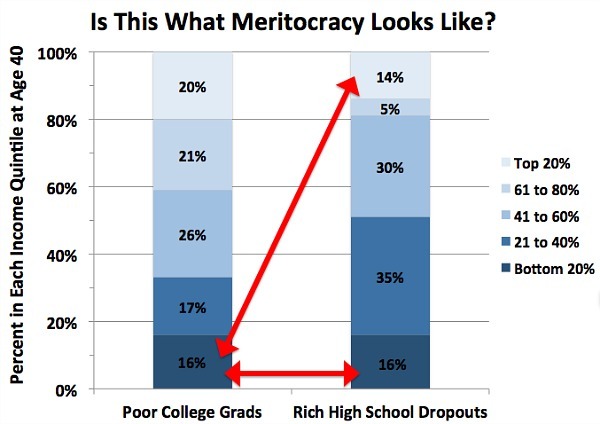
Poverty acts as a third rail in American policy discussions, and it often feels that recognizing the reality for people who live in poverty or near poverty is immediately treated as an attack on American ideals of a meritocratic society.  Reality, however, remains reality, and the deep impacts of poverty upon young people are known.  The 1997 Princeton Study is nearly 20 years old and clearly demonstrated the health, cognitive, educational, and behavioral differences that can be attributed to growing up in poverty.  More recently, the  30 year long Baltimore study reported how intensely stubborn poverty is and how unlikely it is for a child born into poverty to move into the middle class or higher.  Recent research also notes that in addition to long known advantages of higher income families such as educational resources, a poor child who does “everything right” is still barely MORE likely to be economically successful that a rich child who drops out of school – and both are equally likely to be in the lowest quintile of income earners:

Poor-Grads-Rich-Dropouts

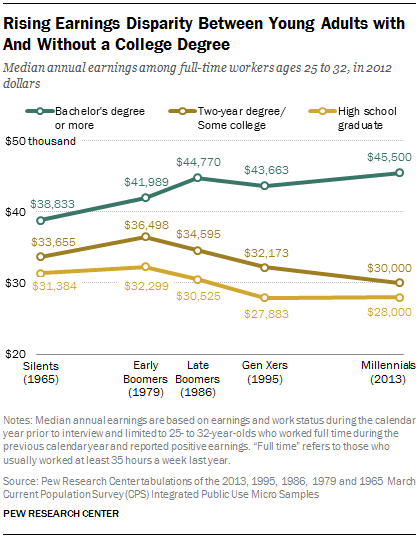
As equally troubling as these findings is the difficulty in any prospect of fixing them by current opportunities.  While going to college remains a viable way to maintain economic position for most attendees, it is not because wages for such graduates have been rising to meet inflation or a job market demand for such workers.  Wages for current college graduates is not much higher than it was in the mid-1980s, but the wage premium for a college degree has grown because of the collapse of wages for workers without a college education:

SDT-higher-education-02-11-2014-0-03

In addition, the lower middle class, historically an important rung on the economic ladder, is not merely struggling; iis largely stay afloat only because of federal transfer programs that take the edge off of their stagnant and falling wages — even as they tend to pay the largest marginal tax rates of all income groups.  The conclusion here is one that has only recently pushed into margins of the mainstream:  it is extremely difficult for individuals and families to move up the economic ladder when several rungs have been sawn off…and individuals and families who slip from the lower middle rung to the bottom have few opportunities to regain security.

All of which makes our current educational “reforms” staggeringly galling, immoral even.  Reformers have been touting for years now changes to our educational commons that involve turning as many neighborhood public schools in charter schools as possible, measuring all success and failures in school by standardized test scores, and attacking the workplace protections of teachers as the only way to “guarantee” that every child has an excellent teacher.  In doing so they literally ignore all the ways in which poverty’s deprivations impact school, and they place upon public school all of the responsibility to boost students’ economic fortunes.  Unexamined?  Tax and trade policies that make it possible for just 4 hedge fund managers to earn more income in a single year than every single Kindergarten teacher in America combined.  Corporations whose business models do not include paying full time employees enough money to avoid going on public assistance.  Wages for most workers that have barely moved in real purchasing power since the mid-1960s. That concentration of income means that 10% of income earners now make more than half of all income in America.  Education “reformers” demand that “fixing” that should rest entirely upon America’s education system — even as their allies in state capitols around the country have played budget games to keep from raising taxes on the wealthy.  In New York State, that amounts to billions of dollars of year that Albany pledged but never delivered to local public schools.

Only in America would education “reform” be millionaires (Campbell Brown, Michelle Rhee, Joel Klein) working for billionaires (Whitney Tilson, Rupert Murdoch, Eli Broad, the Walton family, Bill Gates) to convince poor and lower middle class communities that the problems in education and economic opportunity for their children rest entirely upon the barely middle class teachers in their local schools.

Professor Yohuru Williams of Fairfield University notes that those same “reformers” have taken up the mantle of civil rights in their demands that school be responsible for providing all the opportunity for children in poverty — usually as cover for schemes that privatize more and more of our educational commons.  Dr. Williams takes issue with their adoption of Dr. King for their cause:

For King, the Beloved Community was a global vision of human cooperation and understanding where all peoples could share in the abundant resources of the planet. He believed that universal standards of human decency could be used to challenge the existence of poverty, famine, and economic displacement in all of its forms. A celebration of achievement and an appreciation of fraternity would blot out racism, discrimination, and distinctions of any kind that sought to divide rather than elevate people—no matter what race, religion, or test score. The Beloved Community promoted international cooperation over competition. The goal of education should be not to measure our progress against the world but to harness our combined intelligence to triumph over the great social, scientific, humanistic, and environmental issues of our time.

While it seeks to claim the mantle of the movement and Dr. King’s legacy, corporate education reform is rooted in fear, fired by competition and driven by division. It seeks to undermine community rather than build it and, for this reason, it is the ultimate betrayal of the goals and values of the movement.

This observation is especially important today on the date set aside for reflection on the legacy of Dr. Martin Luther King Jr. and on the work that is left unfinished from his movement.  One of the most glaring unfinished task today is the poverty and near poverty that afflicts over half of our students in public education.  Accompanying that is the coordinated campaign of deflection and misdirection by our current generation of education “reformers” who want to pitch community members against each and against public education while the policy makers and the oligarchs who influence them most heavily continue to ignore the wishes of bi-partisan majorities in the electorate.

It is well past time that we revoked their appropriation of Dr. King’s mantle.  It belongs with those who want our nation to finally confront poverty, not with those who blame public school for the decisions of the powerful.

1 Comment

Filed under Activism, Corruption, politics, Social Justice

Arne Duncan’s Great Kid Story Problem

In his speech laying out administration priorities for the renewal or rewrite of No Child Left Behind, Secretary of Education Arne Duncan turned to a personal anecdote to explain the imperative of accountability based reform:

In between my junior and senior year at college, I took a year off to help in my mother’s after-school tutoring program on the South Side of Chicago and figure out if I really wanted to devote my life to this fight for educational opportunity.

One of the students I tutored was a basketball player at the local high school, who was studying to take his ACT.

He was a great kid who had done all the right things. In a very violent neighborhood, he had stayed away from the gangs. He didn’t drink, he didn’t use drugs. He was actually an honor roll student with a “B” average, and on track to graduate. I initially thought this was absolutely a young man who could beat the odds and defy the negative stereotypes of young black men.

But as we started to work together, I was heartbroken to quickly realize that he was basically functionally illiterate.

He was reading at maybe a 2nd or 3rd grade level, and was unable to put together a written paragraph. Tragically, he had played by all the rules, but had no idea how far behind he was. Throughout his life, he had been led to believe that he was on-track for college success.

And he was nowhere close.

The educational system had failed him, and the buck stopped nowhere.

This is the kind of personal story that makes great fodder for satirical pieces in The Onion, but I will grant Secretary Duncan a point: there are children in the system who are passed along from grade to grade without learning enough to be successful in more complex subjects later on.  And the Secretary has a point that in too many cases like these few people are willing to take responsibility.  When I talk to my education students about this, I frame this as a cycle of blame passing:  The ninth grade teacher has a student who cannot write well and blames the junior high teachers for what they didn’t teach.  The junior high teachers blame the middle school teachers, and the middle school teachers blame the elementary school teachers.  Eventually, the child is in utero and nobody has taken proper responsibility for teaching the child as he has arrived in the classroom that year.  Given that higher education institutions report that about 20% of first year students need to take at least one remedial class when they arrive (and even 12.8% of entering students at very selective 4 year schools), it is reasonable to ask if our elementary and secondary education systems can do a better job preparing more students for further schooling.

Of course, answering such questions are complex.  Critics and reformers often point to the number of college students in need of some remediation and state those students are “not ready” for college.  That’s far too broad a brush.  For starters, the numbers are variable by the type of institution reporting, by race and ethnicity, by gender, by age of student, by dependency status, and by the educational obtainment of the parents of the student receiving remediation.   Additionally, students can receive a wide variety of remediation in college from a single studies skills course to an entire plate of courses meant to “plug holes” from elementary and secondary education.  A student who dropped out of high school, got a GED at 25, and enrolled in Community College who needs math instruction to progress in a STEM program is far less worrisome than the young man in Secretary Duncan’s anecdote who is reported as laboring under the impression that his reading level being at The Magic Treehouse series is going to get him into college.

There’s just a problem.  Secretary Duncan’s priorities for the NCLB revision won’t help him either.

It isn’t that someone shouldn’t have taken responsibility for the young man’s learning (although how Secretary Duncan, at the callow age of 20 or 21 could actually tell that nobody had done so is left unexplained); it’s that forcing that responsibility by holding his teachers accountable to his standardized test scores each and every year, as favored by the Obama administration, is one of the worst paths to take to help him.

“Testing” is not a dirty word.  As part of a multiple assessment system to help teachers, students, and parents know where students stand and in what areas students need help.  Formative assessments, however they are developed and administered, are meant to provide the kind of feedback that can personalize instruction and help teachers as they create a rich and complete curriculum.  Dr. Bruce Baker of Rutgers University notes for what such assessments cannot be used:

This information should NOT be used for “accountability” purposes. It should NOT be mined/aggregated/modeled to determine at high level whether institutions or individuals are “doing their jobs,” or for closing schools and firing teachers. That’s not to say, however, that there might not be some use for institutions (schools districts) mining these data to determine how student progress is being made on certain concepts/skills across schools, in order to identify, strengths and weaknesses. In other words, for thoughtful data informed management. Current annual assessments aren’t particularly useful for “data informed” leadership either. But this stuff could be, given the right modeling tools.

This is the approach we use to ensure that no child is left behind. By the time annual, uniform, standardized assessment data are returned in relatively meaningless aggregate scores to the front office 6 months down the road, those kids have already been left behind, and the information provided isn’t even sufficiently fine grained as to be helpful in helping them to catch up.

Dr. Baker differentiates testing used for individual diagnostic purposes and testing used for accountability/system monitoring purposes:

When it comes to testing for system monitoring, where we are looking at institutions and systems, rather than individuals, immediate feedback is less important. Time intervals can be longer, because institutional change occurs over the long haul, not from just this year, to next. Further, we want our sampling – our measurements – to be as minimally intrusive as possible – both in terms of the number of times we take those measurements, and in terms of the number of measurements we take at any one time. In part, we want measurement for accountability purposes to be non-intrusive so that teachers and local administrators, and the kids especially, can get on with their day – with their learning – development of knowledge and skills.

So, when it comes to “System Monitoring” the most appropriate approach is to use a sampling scheme that is minimally sufficient to capture, at point in time, achievement levels of kids in any given school or district (Institution). You don’t have to test every kid in a school to know how kids in that school are doing. You don’t have to have any one kid take an entire test, if you creatively distribute relevant test items across appropriately sampled kids. Using sampling methods like those used in the National Assessment of Educational Progress can go a long way toward reducing the intrusiveness of testing while providing potentially more valid estimates of institutional performance (how well schools and districts are doing).

The distinctions here should be obvious, and they are crucial:  accountability relies upon system wide data that is best captured via sampling, and monitoring system wide trends via data does not require that every child be tested in the same standardized test every single year.  As Dr. Baker has shown previously, trying to take this data and use it for accountability of individual teachers based upon value-added modeling does not produce results that are stable and are therefore pretty useless.

Wouldn’t you know that Secretary Duncan has it exactly backwards?

By insisting that large standardized measures be given to every child every year AND endorsing using those data for individual teacher accountability, the Secretary is calling for maintaining a standardized testing regime that is needlessly intrusive and for applying the data from those tests for the wrong purposes.  Worse, it is incentivizing the worst kind of teaching, practices to which Secretary Duncan gave a passing acknowledgement as destructive but which his insistence upon placing the highest stakes on an intrusive testing schedule will entrench into classrooms.  We’ve seen this in the years since NCLB with narrowing curricula and more focus on tested subjects that upon a full, rich curriculum.

One other rationale is possible by insisting upon annual, large scale examinations for every child, but it is one that betrays a lack of imagination.  Secretary Duncan said that:

I believe parents, and teachers, and students have both the right and the absolute need to know how much progress all students are making each year towards college- and career-readiness. The reality of unexpected, crushing disappointments, about the actual lack of college preparedness cannot continue to happen to hard working 16- and 17-year olds – it is not fair to them, and it is simply too late. Those days must be over.

That means that all students need to take annual, statewide assessments that are aligned to their teacher’s classroom instruction in reading and math in grades 3 through 8, and once in high school.

Secretary Duncan is suggesting that mass standardized tests given annually are the tools needed by parents to monitor their children’s progress.  I suppose there may be families out there who are itching for that packet from the state DOE that comes weeks or months after the standardized exam, but I think it is far more likely that parents would like to know that teachers have access and utilize a steady stream of tools to assist their students and to communicate with families.  As it stands, Secretary Duncan insists on giving those parents a single test result that can suggest something is going on but which cannot say a blessed thing about why it is going on.

Arne Duncan is worried about that great kid he met three decades ago.  Sadly, he doesn’t have a clue about what would have helped that child not get lost in the system.

3 Comments

Filed under Common Core, Data, NCLB, teaching, Testing