Tag Archives: Activism

Why We Need the “Public” in Public Education

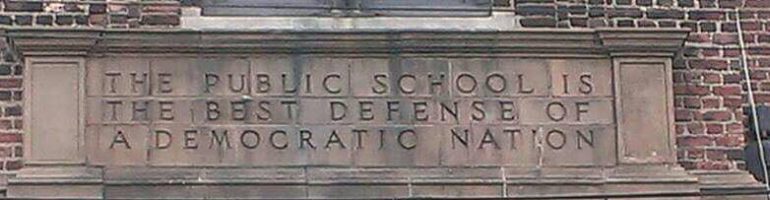
Without undervaluing any other human agency, it may be safely affirmed that the Common School, improved and energized, as it can easily be, may become the most effective and benignant of all the forces of civilization. Two reasons sustain this position. In the first place, there is a universality in its operation, which can be affirmed of no other institution whatever. If administered in the spirit of justice and conciliation, all the rising generation may be brought within the circle of its reformatory and elevating influences. And, in the second place, the materials upon which it operates are so pliant and ductile as to be susceptible of assuming a greater variety of forms than any other earthly work of the Creator.

– Horace Mann, Twelfth Annual Report to the Secretary of the Massachusetts State Board of Education, 1848

It is perhaps difficult to remember, in 2016, that the original purposes of the American common school movement lay in ideals about the public good as well as goals for individual advancement.  Since the publication of A Nation at Risk in 1983, politicians and policy makers have emphasized accountability as the primary goal of school law with an increasing emphasis on accountability for individual student outcomes.  Often supported by parents who saw the purpose of their children’s education in the accumulation of credentials, accountability as a framework for school success gives special importance to whether or not schools boost students’ seeking to improve their financial and social situations.  School is doing its job, we are told, in those places where the enterprise of personal advancement works as anticipated, and school is a failure when too many students remain locked generation by generation in the same economic circumstances as their parents.

The appeal of this is understandable, but it is also perilous.  David Labaree of Stanford University warned in 1997 that our concept of school’s purpose was already significantly out of balance.  Arguing that the rise of standards and accountability emphasized social efficiency goals for the labor force, Labaree also noted the significant rise of social mobility  for individuals as a key goal for public education:

Instead, the main threat comes from the growing dominance of the social mobility goal over the others. Although this goal (in coalition with the democratic equality goal) has been a major factor in motivating a progressive politics of education over the years, the increasing hegemony of the mobility goal and its narrow consumer-based approach to education have led to the reconceptualization of education as a purely private good.

We are now, in the late 1990s, experiencing the sobering consequences of this ideological shift. We find credentialism triumphing over learning in our schools, with a commodified form of education winning an edge over useful substance. We find public schools under attack, not just because they are deemed ineffective but also because they are public. After all, if education is indeed a private good, then the next step (according to the influential right wing in today’s educational politics) is to withdraw public control entirely and move toward a fully privatized system of education.

We are almost twenty years later and these forces have been driving education policy for most of that time.  Accountability measures set up under No Child Left Behind demanded that schools show consistent progress in increasing students’ standardized test scores, and the Obama administration’s Race to the Top Program moved accountability down to the individual classroom level – with the expectation that teachers would oversee constant student growth absent any other considerations.  Advocates of the Common Core State Standards wrapped themselves in the language of social efficiency by constantly emphasizing American competitiveness in the international economy and in the language of social mobility by claiming the standards would lead all students to become ready for “college and careers”.  Meanwhile, Common Core aligned testing systems have promised American parents that score reportscan  inform them whether or not their individual children are “on track” for college and career readiness, and no less a figure than former Secretary of Education Arne Duncan declared that our educational goal should be to be “able to look every second grader in the eye and say, ‘You’re on track, you’re going to be able to go to a good college, or you’re not…'”

As Labaree noted, there is nothing wrong, per se, in the goals of social efficiency and social mobility.  They have, in various instantiations, been significant forces in American public education and provided legitimate rationales for our national investment in universal, compulsory education.  We have long called upon schools to provide the economy with workers prepared for the ages in which they lived, and our constant expansion of education’s reach is at least partially premised on the belief that all children, regardless of circumstances, should have an equal chance to succeed in school and therefore achieve economically.  In his Twelfth Annual Report to the Secretary of the Massachusetts State Board of Education, Horace Mann stated:

Education, then, beyond all other devices of human origin, is the great equalizer of the conditions of men – the balance-wheel of the social machinery. I do not here mean that it so elevates the moral nature as to make men disdain and abhor the oppression of their fellow-men. This idea pertains to another of its attributes. But I mean that it gives each man the independence and the means, by which he can resist the selfishness of other men. It does better than to disarm the poor of their hostility towards the rich; it prevents being poor.

Mann embraced the power of education not merely to fairly distribute existing wealth, but also to create new wealth, adding both individuals and the nation itself.  However, Mann’s vision of the developing common school did not end with these purposes, and, as the opening quote demonstrates, he devoted great significance for the role of a public school system in promoting the very values necessary for the health and vitality of a democracy.  The common school ideally welcomes all the children of a community, creating a truly shared space without regard to economic and social stratification, and Mann recognized that children could be greatly influenced at a very young age by their education.  By educating those normally considered outcast by society – described in Mann’s 19th century language “in teaching the blind, and the deaf and dumb, in kindling the latent spark of intelligence that lurks in an idiot’s mind, and in the more holy work of reforming abandoned and outcast children” – society can save itself “against intemperance, avarice, war, slavery, bigotry, the woes of want and the wickedness of waste.”

Further, Mann envisioned a strong role for education in preparing all citizens to both embrace and cherish their franchise:

If the responsibleness and value of the elective franchise were duly appreciated, the day of our State and National elections would be among the most solemn and religious days in the calendar. Men would approach them, not only with preparation and solicitude, but with the sobriety and solemnity, with which discreet and religious-minded men meet the great crises of life. No man would throw away his vote, through caprice or wantonness, any more than he would throw away his estate, or sell his family into bondage. No man would cast his vote through malice or revenge, any more than a good surgeon would amputate a limb, or a good navigator sail through perilous straits, under the same criminal passions.

The contrasts with preparing children for jobs and for individual advancement are obvious and critical.  The “public” in public education refers to truly public purposes not merely to sources of funding, and those purposes are related to foundational aspirations of the American Republic.  Public education must be pluralistic by welcoming the children of all community members within its reach.  Public education must be equitable in assuring all children in attendance are provided with what they need to learn.  Public education must support a healthy and vigorous democracy by educating all in our system of government and promoting our admiration of the voting franchise.  It is absolutely and shamefully true that our public schools, like our society, have frequently failed these ideals.  School and society enforced a legal apartheid system for generations, and when the legal edifices of segregation fell, people with means fled integration.  Our system of school funding frequently betrays equity by leaving communities with low property values struggling to meet the needs of their students.  However, it is also true that our schools have steadily grown more inclusive over time, mirroring the slow but usually consistent progress of our society.

Mann was keenly aware that the democratic mission of school could be perilous.  After lengthy discussion of the keys problems that politics and political controversy could visit upon schools, leading to withdrawal of public support, Mann proposes a largely common sense position for schools in the civic curriculum:

Surely, between these extremes, there must be a medium not difficult to be found. And is not this the middle course, which all sensible and judicious men, all patriots, and all genuine republicans, must approve?–namely, that those articles in the creed of republicanism, which are accepted by all, believed in by all, and which form the common basis of our political faith, shall be taught to all. But when the teacher, in the course of his lessons or lectures on the fundamental law, arrives at a controverted text, he is either to read it without comment or remark; or, at most, he is only to say that the passage is the subject of disputation, and that the schoolroom is neither the tribunal to adjudicate, nor the forum to discuss it.

Mann’s proposal is for a studied neutrality that should be familiar to many teachers of civics.  In a modern classroom, teachers are frequently called upon to be moderators of contentious political topics rather than to be advocates, and by declining to take sides while ideally allowing open and full discussion, teachers can avoid exerting undue influence on matters of political conscience.  This is certainly a sensible position given the role teachers must take upon being fair and politically inclusive, and it is not hard to understand that in most situations, it is necessary for teachers to approach politics with caution and neutrality.

Under most situations.  But not under all situations.

There are times when situations in politics do not merely involve passionate partisan division,  but actually call into question values such as pluralism, equity, and democracy that are essential for truly public education.  There was no virtue, for example, for school and school leaders to treat Bull Connor as merely another citizen who held a passionate opinion.  Connor’s vicious racism and willingness to use violence to defend White Supremacy had a constituency, but no ethical validity.  So while school leaders in his time may have risked some of the political chaos that Horace Mann feared, speaking and, yes, teaching against Connor would have been the correct stance in defense of the values that make education public.

We are witnessing something akin to Bull Connor play out in the nomination contest for the Presidency of the Republican Party.  As hard as it is to imagine, the nomination for President of the United States is plausibly within reach of real estate developer Donald Trump who has run a campaign based upon plans to mass deport over 11 million people within two year, unleashing havoc upon the entire country and likely requiring a network of concentration camps to hold people being “processed,” a blanket ban upon over a billion people in the world from entering the country based on their religion, promises that he can force a sovereign nation to pay us billions of dollars to build a wall on their border, promises to make torture legal, has promised to order the military to commit war crimes, relishes the idea of setting off a global trade war, doesn’t possess even a casual relationship with truth, happily repeats racist mythology about African Americans and crime and about Muslims and September 11, is a lifelong misogynist, finds it unusually difficult to turn down the support of avowed White Supremacists, at a minimum flirts with fascist imagery and ideasis obsessed with “strong leaders” even when they are autocratic thugs, and, temporarily, turned the Presidential race into a conversation about this size of his penis.

If it is possible to be worse than the candidate’s avowed policies, many among his supporters come close.  While all of Donald Trump’s supporters are not racists, some of the worst racists in the country have identified his positions and rhetoric as their own. Consider white supremacist Matthew Heimbach, who was caught on camera in early march violently pushing and shoving an African American woman as she was ejected from a Trump rally in Louisville, Kentucky.  In fact, Trump supporters have a history of violently reacting the presence of protestors, even ones being entirely peaceful.  Despite his weak denials, the candidate has long encouraged and incited violence, expressing his desire to beat protestors and his promises to pay legal bills for supporters who engage in violence.  And just to make things even better, a group of Trump’s supporters have started organizing themselves to “expose” “plots” to disrupt campaign events and to use social media to encourage rally attendees to identify specific people at Mr. Trump’s rallies. Because in the past century, devotees of strongman ideology organizing to intimidate others has never gone horribly wrong.

While American politics possesses many backwaters that are, at a minimum, distressing, this campaign goes well beyond them in its reach if not in its ugliness.  If Donald Trump wins the nomination of the Republican Party, then one of our two historic great parties will have endorsed a platform of exclusion and violence that has energized and emboldened some of the very worst people in our nation.  Consider the implications: a political party that issued the Emancipation Proclamation under Abraham Lincoln, that forcibly integrated public schools over the violent objections of White Supremacists under Dwight Eisenhower, and that expanded educational opportunity to children with disabilities under Gerald Ford will put up for President a man whose major policy proposals center on narrowing America.  At its core, the Trump campaign is against pluralism and inclusion – and it is willing to employ violent rhetoric that stirs up actual violence in its pursuit.

This is far beyond mere partisan politics, for it threatens the very values that make public education possible. There is no “public” in public education if we do not, even with our manifest flaws, strive towards greater pluralism and greater equity within those schools, and how can we strive towards those goals if our electorate rejects them for the highest office in the land – and tacitly endorses Trump’s racism, sexism, nativism, and affection for strongman rhetoric and violence?  The normal political season role for schools and for teachers is to arbitrate among competing ideals for the future of our democracy, but a normal political season does not typically feature a campaign that actually threatens the core values needed to have a democracy.  Schools and, especially, school leaders cannot be on the sidelines under circumstances where vast portions of the public are actually threatened. Truly public education cannot be silent this time.



4 Comments

Filed under Activism, Drumpf, Media, politics, racism, Social Justice

The Inequalities Are Still Savage

Twenty-five years ago, author and activist Jonathan Kozol published what remains one of the most important examinations of educational inequity ever printed, Savage InequalitiesThe book is a direct and searing look at how districts serving urban minority children suffered from segregation, inequitable funding, and crumbling facilities while serving student populations suffering the worst deprivations of poverty.  It is a story of malign neglect where school funding based upon the value of a community’s property compounds the economic and environmental violence inflicted upon helpless children.  Kozol criss-crossed the country from East St. Louis, Illinois to New York City, to Camden, New Jersey, to Washington, DC, examining schools and speaking with the students in them.  What he reported should have shaken America to its core.  Consider the following from East St. Louis:

East St. Louis – which the local press refers to as an “inner city without an outer city” – has some of the sickest children in America.  Of the 66 cities in Illinois, East St. Louis ranks first in fetal death, first in premature birth, and third in infant death. Among the negative factors listed by the city’s health director are the sewage running in streets, air that has been fouled by the local plants, the high lead levels noted in the soil, poverty, lack of education, crime, dilapidated housing, insufficient health care, unemployment.  Hospital care is deficient too.  There is no place to have a baby in East St. Louis….Although dental problems don’t command the instant fears associated with low birth weight, fetal death or cholera, they do have the consequence of wearing down the stamina of children and defeating their ambitions.  Bleeding gums, impacted teeth and rotting teeth are routine matters for the children I interviewed in the South Bronx. Children get used to feeling constant pain. They go to sleep with it.  They go to school with it.

Later in the chapter on East St. Louis, a 14 year-old girl spoke about the annual celebration of Dr. Martin Luther King, Jr. and startled Mr. Kozol by calling the reading of “I Have a Dream” perfunctory.  She explained her thinking: “We have a school in East St. Louis named for Dr. King.  The school is full of sewer water and the doors are locked with chains.  Every student in that school is black. It’s like a terrible joke on history.”

In the years since Jonathan Kozol wrote Savage Inequalities, great changes have happened in the U.S. economy.  Our Gross Domestic Product has grown, in chained 2009 dollars, from $8.9 trillion to $15.9 trillion.  Internet use has become almost universal as has mobile cellular use.  The Dow Jones Industrial Average opened 1990 at 2810.2, and it closed 2015 above 17,000. In 1987, Forbes magazine published a list of 140 international billionaires, 44 of whom lived in the U.S. By 2012, that list swelled to 1,226 – 425 of them living in America.  With such incredible increases in wealth and life changing technologies, one would assume that it would be hard to replicate Mr. Kozol’s exegesis on inequality in America.

But one would be wrong.

In the 2012-2013 school year, the federal government estimated that 53% of the nation’s school buildings needed repairs, renovations, or modernization at an estimated cost of $197 billion.  It has long been known that adverse building conditions have discernible impact on student achievement and on teacher morale and effectiveness.  60% of schools serving communities where 75% or more of students qualify for free and reduced price lunch needed such repairs compared with 48% of schools where 35% of students qualify.

Poverty in the United States dropped from a high of 22.4% of the population in the late 1950s to its lowest point of 11.1% in 1973, but in 1980 it began to rise again, reaching 15.3% in 1993 when it began to decline until the year 2000. Today, the Census Bureau reports that the poverty rate sits at 14.8% where it has stayed roughly unchanged since the end of the Great Recession. Poverty’s reach is not distributed evenly in society with African American and Hispanic citizens living below the poverty line at rates twice as high as White and Asian Americans.  21.1% of children aged 18 and younger live in poverty.  Of the 34 member nations of the Organization for Economic Cooperation and Development, the United States’ child poverty level is only surpassed by 5 nations.  In the time since the publication of Savage Inequalities and today, whatever progress that has been made in reducing poverty in the United States has regressed considerably.

Family income has lost ground it gained in the past 25 years as well.  In 1990, median household income was $52,623, and it rose to $57,843 in 1999; in 2014, it was $53,657. In 1986, the average starting wage for a person with BA was $44,770, but by 2013, it had only risen to $45,500 while average starting wages for workers with no college fell from $30,525 to only $28,000.  The stagnation and lost ground of large swaths of American families manifests in health outcomes.  While the top quintiles of income earners have gained years of life expectancy since 1980, the lowest quintiles have remained unchanged for men and have actually declined for poor women.  The United States has a staggering imprisonment rate of 698 per 100,000 population – outpacing Rwanda, Russia, and China – leaving millions of citizens with dismal employment prospects and no ability to vote.

These figures would be stunning enough in their stark detail, but recent, horrifying examples, make it clear that the tragic personal situations that were detailed a quarter of a century ago by Jonathan Kozol still haunt us.  Consider the unmitigated disaster still being uncovered in Flint, Michigan.  The city, after years of cutbacks, was placed under a state appointed emergency manager in 2011 who had the power to appeal local decisions and make cost cutting a primary goal.  That manager, Darnell Earley, blames the Flint City Council for switching from the Detroit water system, supplied by Lake Huron, to the Flint River (as a temporary source until a new system came online), but members of the council flatly deny this and local reporting cannot find reference to using Flint River water in council resolutions.  However the switch was made, the result has been a calamity. In order to use the heavily polluted river water, it had to be treated, but as soon as the water came on line, residents complained about the color, smell, and taste of the water despite assurances from Mr. Earley’s office that it was safe to drink.  For 18 months, Flint residents could see the problems with their water with their own eyes, but hidden from view was a worse danger: the treated water was corrosive and leaching metals, including lead, from the aging pipes in Flint.  It took a pediatrician, Dr. Mona Hanna-Attisha, to uncover the depth of the matter – with parents complaining about hair loss and rashes in their families, she pulled lead level records and found rates had doubled or tripled.

Lead poisoning’s impacts are life long .  There is no cure.

The circular firing squad of local and state officials blaming others for the crisis is on full display, but that does not change the fact that serious problems with Flint’s water were evident within months of the switch.  By October of 2014, General Motors reached an agreement to switch water sources because the water from the Flint River was too corrosive to use in their engine manufacturing facility.  GM’s water change came at a cost of $400,000 a year and had the approval of the emergency manager – even though the water continued to be piped into resident’s homes.  Flint officials and the state appointed manager knew in October, 2014 that the water every person in Flint was drinking, including all of its children, was unfit for use in a factoryBy summer, 2015, researchers from Virginia Tech University had confirmed that lead particulate levels in Flint drinking water was far beyond safe levels, some samples containing a mind-boggling 2000 parts per billion.  Despite this, the city was not reconnected to Lake Huron sourced water until October, and the now corroded pipes continue to leach toxic metals into the city’s drinking water.

Mr. Earley is now the emergency manager for Detroit Public Schools, and teachers there are staging a series of sick outs to protest deplorable conditions in many of their buildings.  Just how deplorable? Mushrooms have been found growing on walls in Vernor Elementary School:

DPS mushrooms

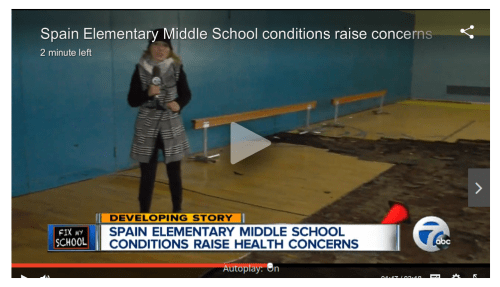
At Spain Elementary School, the gymnasium is unusable due to buckled floors, leaking ceilings, and mold growth:

DPS Decayed Floor

In a demonstration of supreme self unawareness, Mr. Earley held a press conference to denounce the teachers’ actions, and a Saginaw lawmaker called upon the state education authorities to sanction Detroit’s teachers.

The reality here is both frightening and harsh, but there is a simple truth at the heart of it.  If the citizens of Flint have been poisoned by their own water supply and if the children of Detroit attend schools that are decaying and full of mold and mushrooms it is because we have let it be so.  The United States of America has never been collectively wealthier at any time in its history, but our commitment to the well being of all of us has not been this low since before the Presidency of Theodore Roosevelt – and the distribution of wealth has not been this unequal since before the Great Depression.  We look at the total money spent on education and declare that it is “a lot” of money without bothering to ask what needs to spent to make certain that every child comes from a safe and healthy community and has a safe and healthy school to attend.  That this question is not on the lips of every candidate for the Presidency is a stunning indictment of our current social order.

We must remember: our current situation is a choice, one made at the expense of our future.  A society that pumps $4.8 billion in corporate subsidies to oil companies alone does not have to poison its children.  A consumer culture that literally wastes $11.8 billion a year on bottled water can fund new school construction.  A nation that tolerates a weapon program that is 7 years behind schedule and $167 billion over budget does not have to tolerate a single child going to a school that jeopardizes her health.  Our politicians would prefer to blame teachers than to demand that their donors give a fraction more.

The inequalities are still savage.

58 Comments

Filed under Activism, Corruption, Funding, Media, politics, racism, schools, Social Justice

What Teachers Owe Tamir Rice

Imagine, for a moment, you are a teacher predominantly of students of color.  Now imagine that one of your students’ siblings is a 12 year old playing in a public park with a toy pellet gun when police, responding to a caller who said that the gun was “probably”fake, pull their cruiser within feet of the child, jump out before the car even stops, and shoot him in the stomach within two seconds.  Or perhaps your student’s father was shopping in a Walmart where he picked up a BB gun from the store shelves, and police officers approached him and shot him without giving him any time at all to respond – despite the fact that what he was carrying was a toy from the store’s own shelves.  Or perhaps your student’s aunt or older sister is driving long distance to begin a job at her alma mater in Texas when she is pulled over for a very minor traffic violation, and during the stop, the officer becomes increasingly hostile to her legitimate questions, threatens her with his taser, violently throws her to the ground and arrests her without ever explaining why – and she is found dead in her jail cell in an alleged suicide that not one of her friends and family believes.

And now imagine that in not one of these cases is a single person even required to stand trial for deaths of young black people simply minding their own business.

Of course, these tragedies – and the infuriating aftermaths that send a chilling message about how black lives can be cut down on the slightest or imagined provocation by state actors with no fear of consequence – do not have to be directly connected to your students’ lives.  All they need to do is watch these events unfold in the news and wonder if it will ever be someone they know and love.  Or they can reflect on their own experiences with discrimination and the gradual toll it takes on their psyche.  The reality is that if you are a teacher of students of color in America, these events impact the children in your care, possibly more deeply than you have ever known.

Very talented authors with far more authentic ties to these experiences of racism and the horrendous messages we send to young people of color have written on the what these outcomes feel like and the dire sense that our society is inherently hostile to black bodies.  Charles Blow’s words upon the death of Tamir Rice are searing.  Brittany Cooper astutely points out how the system does not value black lives. Ta-Nehisi Coates wrote to his teen aged son (in an article adapted from his book) about the reality of life for black people to this day:

“And you know now, if you did not before, that the police departments of your country have been endowed with the authority to destroy your body. It does not matter if the destruction is the result of an unfortunate overreaction. It does not matter if it originates in a misunderstanding. It does not matter if the destruction springs from a foolish policy. Sell cigarettes without the proper authority and your body can be destroyed. Turn into a dark stairwell and your body can be destroyed. The destroyers will rarely be held accountable. Mostly they will receive pensions.”

Boys and girls touched and confused by tragedies – both personal and national in scale – enter teachers’ classrooms every day.  Young men and women whose consciousness of injustice is flaring brighter than America’s white majority can possibly understand enter teachers’ classrooms every day.  In today’s education environment – where achievement scores matter far more to policy makers than the humanity of those in school – this poses a difficult and possibly contradictory dilemma. As teachers, our responsibilities to children demand that we acknowledge and affirm the lived realities of their lives.  It further demands that we confirm their sense of injustice in the world in real and substantive ways.  Even though most teachers will never experience racism the way their students of color do, it is vital that they work to help those students maintain visions of their futures and how to obtain them as they navigate their lives.

But perhaps most important, and most difficult, is the need for teachers to admit our own culpability in an oppressive social system and to join our students and their communities in actively opposing it.  School is, for better or worse, a social institution, funded and shaped by our collective aspirations – and by our numerous failings.  If our police departments openly engage in racial profiling and use selective enforcement of the law as a revenue stream, and if politically popular policies of mass incarceration leave millions of mostly black and Hispanic men unable to find work, and if the water minority children in cities like Flint drink can be replaced with toxic sources to save money, and if the right to vote itself is subject to constant and organized obstruction aimed at diffusing the impact of minority voting, can we really absolve our schools and ourselves from any responsibility for the injustices that impact so many of our students?

Individually, teachers may bear little responsibility for the school to prison pipeline and the different policies that quickly consign students to low expectations and betrayal of their right to an equitable education – although there can be no honest denial that many teachers either willingly or unthinkingly support questionable and actively harmful disciplinary practices in their schools.  But both individually and collectively, teachers can lend their voices to the public discourse on education and demand that the chief architects of school’s role in devaluing of young people of color be called out.  We can speak out against the deliberate and chronic underfunding of schools for our most vulnerable children.  We can oppose the constant threats of school closures that disproportionately impact black and Hispanic children.  We can demand to know why schools with high proportions of black and Hispanic children are most likely to have police officers who increasingly treat school disciplinary matters like law enforcement on the street.  We can argue for smaller class sizes, improved physical plants, and the replacement of rigid zero tolerance discipline with restorative justice practices.  We can call out politicians and school officials who ignore that schools cannot afford libraries or librarians and have to cut their art and music programs.

In short, we can demand, loudly and continuously, that all of our students have the schools that the most privileged in society take for granted.  For three decades now, we have replaced calls for equity and justice in schools with calls for accountability and consequences in much the same way that we have made policing and our prisons rougher and more concerned with numbers than with justice.  Those policies have failed us as a nation, and they have been catastrophic for our most vulnerable children.  Millions of children are told that the only choices they have are between chronically underfunded and decaying zoned schools or a privately operated charter school that may work to push them out of the school or whose discipline policies favor total control of behavior rather than fostering leadership. This horrendous dichotomy cannot be the best a society with 17 trillion dollar GDP can deliver.  If it is so, it is because we choose to let it be so.

Schools themselves cannot transform society, but if millions of public school teachers can demand the tools and resources we need to truly transform schools into models of social justice that fully affirm the lives of students, perhaps we can lead the way for the rest of our critical institutions.  Perhaps we can gain the moral authority to demand it.

We owe it to the children to try.

5 Comments

Filed under #blacklivesmatter, Activism, politics, racism, schools, Social Justice

Being Thankful

It is easy when writing a blog to get caught up in negativity.  In a strange way, it can be a form of fun.  You sharpen your instincts for sarcasm while deploying your skills skewering policies and people actively causing harm to a topic near and dear to your heart.  In today’s public education battles, with billions of dollars being deployed to reshape one of our core democratic institutions without the public’s input, it is almost always easier to state what I am against than what I am for.  Sometimes that is intensely necessary as getting past catchy slogans and plans not backed with research requires taking claims apart with deliberation and focus.  But it is not enough. It fails to highlight the real good being done by pro-public education activists every day.

So I’d like to take this appropriate time of the year to consider for what and for whom I am thankful in addition to my family, my friends, and my community.  Every single group or event for which I am thankful has made significant strides to keep public education public and mindful of its core missions in an age when powerful forces are trying to bend it away from them without bothering to convince the public.

I am thankful for the Opt Out movement.  I am not against the prudent use of very limited and minimally disruptive standardized testing for very limited purposes.  We have gotten far from that in the age of test-based accountability, and the real consequences for the quality of education are well known.  Despite the evident dangers of test-based accountability, the federal government and the states, spurred by intense lobbying by private foundations, actually made the situation worse since the 2008 election, making teachers’ livelihoods tied to statistical uses of standardized test data that is not even supported by the American Statistical Association.

Parents, after watching a decade of standardized testing slowly taking over every aspect of education, are finally saying “enough” and demanding that education regain its sanity.  They are tired of being ignored and rolled over.  They are tired of being told the schools they cherish are failures.  They are tired of seeing test preparation pushing aside genuine learning.  They have been insulted by the Secretary of Education as spoiled complainers.  They’ve been implicitly called union pawns and openly compared to anti-vaxxers by the powerful Chancellor of the New York Board of Regents.  They’ve been threatened if their districts don’t somehow manage to convince and/or force them to test their children.

And it hasn’t deterred them one iota.  20% of New York state’s eligible children refused the state standardized tests in 2015, and there is little to suggest that number will go down.  The message is being heard broadly.  President Obama dedicated time to voice concern about over-testing, although the substance of his actual remarks was not impressive.  More impressive?  A report in The New York Times indicating that Governor Andrew Cuomo may be on the verge of throwing in the towel on test based evaluations of New York’s teachers.  This is the same governor who a year ago declared that the evaluation system he had pushed for himself was “baloney” and declared his intention to make student test scores 50% of teacher evaluations – which he got through the state budget process.

For Governor Cuomo to be considering, as reported by Kate Taylor of The Times, reducing the role of testing in teacher evaluation – and even contemplating removing it altogether – is tremendous.  It is not merely blinking; it is a flat out collapse, and I suspect the governor’s allies at Students First and other reform outfits will be howling their protests soon enough.  But for now, this development can be entirely chalked up to Opt Out’s relentless focus and refusal to fold under pressure.  Of course, history shows that Cuomo cannot be trusted, and he is probably calculating that if he can mollify suburban voters by relieving some of the testing frenzy, then he and his allies can regroup and focus upon taking away local control from urban districts and converting as many of their schools into charters as possible.  In fact, Michael Petrilli of the Thomas B. Fordham Institute already laid out this strategy in 2014 – saying that reformers had overplayed their hands by saying that even suburban public schools were failures and should instead focus as much as possible on getting no-excuses charter schools into place in urban school systems on the false premise that the test prep factories really represent “excellence”.

So the challenge for Opt Out in the future will be to recognize the progress it has made and to keep fighting so that all children are given schools freed from testing mania and full of enriching and empowering curricula.  I think they can do it.

I am thankful for the Badass Teachers. True grassroots movements are incredible to watch.  They are the result of hard work and organizing, usually spreading because a small group of people kept talking to others until a large group is formed around common principles.  It cannot be faked.  It cannot be bought with foundation money buying splashy web pages and getting “commitment” in return for funding.  It is born out of genuine, lived, passions.

That’s the Badass Teachers Association, or BATs, in a nutshell.  This organization of classroom teachers and allies was born out of teachers who were increasingly frustrated by the efforts of reformers to blame them for all of the problems that land in school but for which society at large accepts no responsibility.  In short order, it has grown to tens of 1000s of members across the country, and it is a vibrant presence in social media and, increasingly, the wider public discourse on our national educational commons.

And they have had an amazing impact already, influencing both national union leaders and legislation in our nation’s capitol.  Because they are a true grassroots organization, BATs leadership and BAT members are in constant and close proximity to each other, and real conversations about real teachers and classrooms are ongoing.  That led to genuine concern over the number of teachers speaking about workplace stress increasing under current reforms, leading even to recent suicides.  Members of the Badass Teachers contacted the American Federation of Teachers which led to direct conversations with AFT President Randi Weingarten.  President Weingarten lent AFT assistance to the BATs in putting together a first of its kind teacher workplace survey which went live in April of this year.  In a mere ten days, over 31 THOUSAND classroom teachers responded.  The team of teachers who wrote the 80 question survey were told to expect maybe 1000 responses.

The initial results are available online here.  On its own, such a survey highlighting the impacts of today’s education environment would be incredible, but the influence is much more far reaching.  The survey results gave the AFT enough information to convince Senators Corey Booker of New Jersey and Michael Bennet of Colorado to author an amendment to Title II of the Elementary and Secondary Education Act legislation directing the federal DOE to examine workplace stress among teachers.  In a conversation with me, President Weingarten of the AFT expressed her enthusiasm for the work the BATs group did.  “This time the process was as important as the product,” she said, “Because the process empowered people.”

To witness the impacts of influence flowing up from the real grassroots – that is empowering and it is potentially very long lasting.  I cannot wait to see what the BATs do in the upcoming years.

I am thankful for the Dyett Hunger Strikers.   We live in a time when school privatizers have wrapped themselves in the language of the civil rights struggle and have claimed that their efforts to wrest control of our public schools away from democracy is a civil rights matter.  Given the history of local and state control fighting integration and racial justice, it is not entirely surprising that they have allies among traditional civil rights organizations on matters like testing and accountability.

But the overall package has little to do with civil rights, and while suburban parent constituencies have been angered recently by the impacts of over testing and loss of local input into schooling, urban communities of color have been experiencing that loss of voice for years now.  Dr. Denisha Jones of Howard University makes it very clear how school reform efforts aimed at privatization of public schools are not civil rights advances: privatization is unaccountable and refuses to serve all children as public schools do; school choice leads more to schools choosing the children they want rather than families choosing the schools they want; privatized schools employs huge percentages of novice teachers who they burn out and replace with more novices in short order – experienced teachers are, ironically, reserved for the fully public schools in suburban communities while privatized schools in urban communities get well intentioned do gooders with no experience.  In school privatization, wealthy communities retain full control of their schools while poorer communities are given “choices” — but only those the more powerful deign to give them.

With that in mind, it was incredibly powerful when a group of parent and community activists in the Bronzeville neighborhood of Chicago did something astonishing.  They went on a hunger strike to demand that the Chicago Public Schools and Mayor Rahm Emanuel listen to what the community had been advocating for and planning for over several years: a fully public, open enrollment high school with a green technology and global leadership focus that had been carefully planned for within the community. The strike continued for an agonizing 34 days during which Mayor Emanuel pettily refused to acknowledge the strikers but during which CPS gave ground in slow dribs and drabs. The strikers won not only the reopening of their community’s high school, but also the commitment that it will be an open enrollment, public school not handed over to an outside contractor.  And while CPS would not commit to their specific plan, there will be elements of the green technology and global leadership focus in the school.

The strikers, however, did more than win some concessions on one school.  They put a dramatic spotlight on the inequities of how “reform” plays out in impoverished communities in our country.  While they were starving themselves for a fully public school, CPS, which had claimed budget woes in efforts to close 50 schools in predominantly African American and Hispanic neighborhoods, unveiled plans for multimillion dollar annexes in schools in predominantly white neighborhoods.  Jitu Brown, a lifelong community activist in Chicago, made this discrepancy in education reform crystal clear:

“There’s a huge fight now that I hope this hunger strike has helped to energize and that is the fight for sustainable community schools not only in Chicago but around the country.  You shouldn’t have cities like New Orleans where the largest base of African American home owners in the United States are labeled as refugees and their city is taken from them. They lose their county hospital. They lose their schools and now virtually every school in New Orleans is run by a private company that makes a profit off of administering what is supposedly a human right.  Children in New Orleans have a perfectly good school across the street but they can’t go because they didn’t win the lottery to go.”

Mr. Brown’s fellow hunger striker, April Stogner, spoke on this with John Hockenberry of Public Radio International:

“When you talk about community, the community should be involved in the decisions, and we were not involved. We submitted this plan. We’ve been working on this plan for well over five years, so it’s funny that he said you’re doing what’s best for our community. You don’t know what’s best for our community, or we wouldn’t have had 49 schools closing at one time. Tell the truth and say what it is.  They just want to make money off the backs of our children, and they feel like they can just come into our community and take what they want. But we’re not having that anymore.”

This was a fight that refused to cede the moral high ground to school reformers and put a clear spotlight on how little community voices matter to the people who claim to be acting on their behalf.  The fight for Dyett High School was a powerful message that while the civil rights movement has made great strides using federal power for equality, that does not mean that school privatizers can claim that mantle by grabbing power from afar and then steamrolling communities.  Mr. Brown went on to say:

“There is no group of people who is better than the others. We are different. You know, we have different cultures, but we all bring something…. and we should not stand for inequity.  Because an inequitable school system an inequitable system denies us the joy of knowing each other. It denies us the joy of building a country together. Building a community together. Building a system together. And we have for too long – I mean our white brothers and sisters, but I mean as Americans period — we’ve ignored the racism that flows through this country, that feeds it like food. We’ve ignored it.”

In a time when one of the most important discussions we are having as a nation is the one prompted by the Black Lives Matter movement and its insistence that we face the systemic inequalities built upon racism  permeating our society still, it is incredibly powerful for a community to rise up and insist that their SCHOOLS matter as well.  It is absolutely shameful that people had to put their very bodies on the line for more than a month to make that message completely clear, but it is inspiring that they did so.  I hope to hear much more from them in the coming years.

1 Comment

Filed under #blacklivesmatter, #FightForDyett, Activism, Cory Booker, Opt Out, politics, racism, schools, Social Justice, Unions

Spring Valley High School Assault: When “Moderation” is Violence

On Monday afternoon, video footage showing a School Resource Officer (SRO) in Columbia, South Carolina’s Spring Valley High School flipping over a seated female student and hurling her across the room began to go viral.  The video, of which there are now several versions from different classmates, shows the officer, Ben Fields, approaching the seated student, talking to her briefly, and then flipping her backwards in her desk before hurling her across the room while classmates and a school administrator look on passively:

https://twitter.com/ShaunKing/status/658746548076027904

Officer Fields, who has been the subject of lawsuits for excessive force and discrimination, has been fired according to Sheriff Leon Lott, and the federal Department of Justice has begun its own investigation.  Initial reports that the young woman is orphaned appear to be false, but her status in the foster care system is still in question.  Classmate Niya Kenny was arrested along with the other student and told local media that she was trying to stand up for her schoolmate:

“I know this girl don’t got nobody and I couldn’t believe this was happening,” Kenny explained. “I had never seen nothing like that in my life, a man use that much force on a little girl. A big man, like 300 pounds of full muscle. I was like ‘no way, no way.’ You can’t do nothing like that to a little girl. I’m talking about she’s like 5’6″.”

The story, as we know it now, unfolded when the young woman’s teacher caught her with her cell phone out and ended up requesting that she leave class.  When she did not, an administrator was brought in who called in Officer Fields.  There is no indication that the young woman did anything other than passively remain in the classroom when asked to leave. Another classmate, who took one of the videos currently circulating, said that the girl was apologetic about having her phone out and about not leaving.  He said the situation turned violent when the girl told Officer Fields that she did not know who he was:

“I’ve never seen anything so nasty looking, so sick to the point that you know, other students are turning away, don’t know what to do, and are just scared for their lives,” Robinson said. “That’s supposed to be somebody that’s going to protect us. Not somebody that we need to be scare off, or afraid.”

“That was wrong. There was no justifiable reason for why he did that to that girl.”

I am going to start with some premises that I consider to be undeniable.  I know that some people will deny them anyway, but in my mind, as an educator, as a parent, and as a citizen, these are not up for negotiation:

  • First: The grown ups in this classroom utterly failed this child.  Regardless of her behavior (or more accurately, her lack of behavior), the adults in the room are acting in loco parentis and have legal and moral obligations to treat every child in the room with the utmost care as if they were their own.  There were tools for deescalation that both the teacher and the administrator could have used before ever calling in Officer Fields.  If those had not worked, Officer Fields’ inexcusably went almost immediately to violent assault.
  • Second:  There is no excuse, no justification, no set of circumstances, no words spoken that can ever justify the level of violence that was inflicted upon this girl and the terror she and her classmates must have experienced as a result.  She was seated.  She was passive.  There was no threat of violence or harm to anyone in the room that warranted a physical response of any kind.  Officer Fields was not placing himself between fighting students to prevent harm to themselves or to others.  He flung a child across the room solely because she did not comply with an order.
  • Third: Whether or not the young woman in question is orphaned, in foster care, or not is entirely beside the point. Our desires to find good kid versus bad kid narratives is part of our misplaced desire to sympathize with an entirely innocent, pure, victim of brutality when the fact is that we should sympathize with any victim of brutality.  It clouds our judgement and distracts from the inexcusable choices made by the adults in the classroom.  Trayvon Martin was posthumously defamed for the “sin” of not being a “perfect victim.”  Eric Garner was blamed for his own death.  Ultimately, the demand for victims of institutionalized brutality to be “perfect” is a demand to rationalize their deaths and wounds as deserved and a demand to clear our own consciences for systems that benefit us and brutalize others.

As is typical in the age of social media, there is now a steady stream of fault finders declaring that the young woman deserved her treatment and looking frame by frame at her being hauled backwards in her desk for evidence that she “caused” the assault.  I have no time or patience for that, and I readily chalk it up to racism.  But there is also a call from many that I have seen to be “cautious,” to assess the girl’s behavior, and to “wait for all the facts” as if there is some hidden information that might balance to blame assessment.

I get the temptation.  As teachers, we are frequently called upon to moderate opposing sides, and we are trained to look for multiple points of view on a range of contentious issues.  The good teacher will sometimes have to defend a point of view that he or she disagrees with if it is unpopular and is being dismissed without consideration by our students.  But this is simply not one of those cases – a seated child, passively resisting an order to leave the classroom, and who poses no threat to anyone, simply cannot be hurled across a room, and it is not “moderation” to call for more information, or to call to see both sides, or to insist that the young woman’s behavior must occupy our attention as well.  It is, intentional or not, the perpetuation of violence.  It draws our attention away from the failures of the adults in the classroom to find a peaceful solution to a peaceful problem.

Writing for The New York Times, Roxane Grey asked, pointedly, “Where Are Black Children Safe?”

Time and again, in such situations, black people are asked, why don’t we mind our place? To be black in America is to exist with the presumption of guilt, burdened by an implacable demand to prove our innocence. We are asked impossible questions by people who completely ignore a reality where so many of the rules we are supposed to follow are expressly designed to subjugate and work against our best interests. We ignore the reality that we cannot just follow the rules and find our way to acceptance, equality or justice. Respectability politics are a delusion.

Far too little attention is being given to who the young girl is, or that, according to the lawyer representing her, she is in foster care. When that officer saw her, sitting quietly, defiantly, she was not allowed to be human. She was not allowed to have a complex story. She was held to a standard of absolute obedience. She was not given the opportunity to explain the why of her defiance because she was a black body that needed to be disciplined by any means necessary.

This reality, that so many children of color cannot even find refuge in school and are subjected to detrimental policies that we have long known do not work, strikes at the very heart of our moral responsibilities as teachers.  If students in our care face institutional violence, it is a massive failure of our role as stewards, and we must resist it on their behalf.  Allowing ourselves to become distracted by calls for “moderation” of viewpoint in response to that is another failure, and it makes us accomplices in a system that makes it impossible for a young person of color to ever not be at fault when assaulted.

I am reminded of Dr. Martin Luther King Jr. who wrote this in his Letter From a Birmingham Jail:

I must make two honest confessions to you, my Christian and Jewish brothers. First, I must confess that over the past few years I have been gravely disappointed with the white moderate. I have almost reached the regrettable conclusion that the Negro’s great stumbling block in his stride toward freedom is not the White Citizen’s Counciler or the Ku Klux Klanner, but the white moderate, who is more devoted to “order” than to justice; who prefers a negative peace which is the absence of tension to a positive peace which is the presence of justice; who constantly says: “I agree with you in the goal you seek, but I cannot agree with your methods of direct action”; who paternalistically believes he can set the timetable for another man’s freedom; who lives by a mythical concept of time and who constantly advises the Negro to wait for a “more convenient season.” Shallow understanding from people of good will is more frustrating than absolute misunderstanding from people of ill will. Lukewarm acceptance is much more bewildering than outright rejection.

I had hoped that the white moderate would understand that law and order exist for the purpose of establishing justice and that when they fail in this purpose they become the dangerously structured dams that block the flow of social progress. I had hoped that the white moderate would understand that the present tension in the South is a necessary phase of the transition from an obnoxious negative peace, in which the Negro passively accepted his unjust plight, to a substantive and positive peace, in which all men will respect the dignity and worth of human personality.

More than half a century later, even with the tangible progress that has been made in America, that same impulse to call for “moderation” and “balance” when presented with abject injustice is still with us.  It is a call that comes most frequently from a place of comfort and privilege that apparently cannot tolerate being made uncomfortable.  It is a call that shields enfranchised people from examining their own privilege and causes them to vote for leaders and policies that subject others far from them to injustice and violence.

And it is one of the most intractable problems that we face.

6 Comments

Filed under #blacklivesmatter, Activism, racism, Social Justice

Eva Moskowitz is Out of Control

Fresh off their rally with charter school parents and students on October 7th, “Families” For Excellent Schools has announced that they will hold another rally on Wednesday the 21st of October.   This rally, which will be held in Manhattan’s Foley Square, will reportedly feature nearly 1,000 charter school teachers predominantly from Eva Moskowitz’s Success Academy network.  While some teachers from Achievement First, Uncommon Schools, and KIPP are expected to be present, Ms. Moskowitz’s workforce will be the primary participants, and the network just so happens to have a scheduled half school day so that teachers can show up to the rally for the purpose of pressuring law makers into allowing more charter schools in the city.  Chew on that for a moment: a scheduled half day of school.  A political rally.  The teachers in attendance.

I don’t know about you, but when my children’s unionized public school teachers take a half day, it is because they are in professional development workshops and related activities.  They certainly are not being taken from their schools to a rally organized by a lobbying group funded specifically to increase their influence with lawmakers in City Hall and in Albany.  In fact, try to imagine this scenario: Chancellor Farina organizes a half day of work for all city schools and then coordinates a rally for public schools with the UFT on the same day and 1000s of public school teachers, rather than using the half day for professional development, show up near city hall to provide the optics.  If you can pretend for one second that Governor Cuomo would not be demanding that the Assembly and Senate hold hearings and seek potential sanctions against both the union and the Chancellor, I question your grip on reality.

It would be one thing for “Families” For Excellent Schools to organize political rallies for parents and supporters of charter schools to attend and to use that platform to advocate for more such schools.  That is indisputably their right.  It becomes much more questionable when those rallies are organized in such a way that Eva Moskowitz closes her schools during multiple rallies, leaving parents with no place to send their children and essentially forcing them to take a day from work to attend so that they and their children add to event’s optics.  That is within their rights, but frankly, it is cheap and coercive.  But now the network will use a half day of instruction to provide its teachers to send a political message on education policy.  And considering the extraordinarily high pressure work environment at Success Academy that is also verified by job review sites, it is hard to believe that very many of the promised teachers for next week’s rally feel comfortable declining to participate.

And it is monstrously unethical: our fully public schools would spark legitimate outrage if they organized a school day around sending their employees to a political rally organized by a lobbyist organization.  How can it be tolerable for Eva Moskowitz to use her employees, and students, and parents as window dressing for campaigns to funnel more and more public school funding and public school facilities into her organization that she has repeatedly refused to allow “outsiders” to hold her accountable?  What Superintendent of schools has such authority?

It is important to remind ourselves that “Families” for Excellent Schools is a 501 (c) (3) “public charity” that is a front for billionaire backed efforts to radically privatize public education and break public sector unions.  While tax exempt law forbids them from backing specific political campaigns, they are allowed to lobby and to “educate” the public which they do by funneling money from a variety of sources such as the Walton Family Foundation, the Broad Foundation, and Education Reform Now – another dark money financed organization connected with “Democrats” For Education Reform.  “Families” For Excellent Schools suddenly shot up in revenue from June of 2013 when they reported $1,000,777 in revenue to June 2014 when they reported $12,265,162.  Of that, an eye watering $9,137,910 was spent on campaign and advocacy activities, and while their 990 Schedule A cites no portion of their contributions from “individuals” giving more than 2% of total contributions — that means anyone could give $278,103 without it showing up in that part of the form.

This is supposed to be a grassroots organization representing the families of children in charter schools.

And Eva Moskowitz consistently gives them compelling optics at their rallies with children, parents, and, now, teachers – dismissed from school for a “half day” that would get any superintendent in the state fired and possibly prosecuted.

Is Eva Moskowitz running a chain of schools or is she running the lobbying arm for her billionaire backers who see the expansion of the charter school sector as a means for profit and as a means to break public sector unions? Public school advocates certainly hold rallies to support public education, but we have to do so on weekends and after school hours for reasons that should similarly prohibit Success Academy and other charter schools from providing school hour props for “Families” For Excellent Schools.  Our appallingly lax rules for tax exempt organizations may allow for this, but there is no reason why our charter school authorizing bodies and the legislators who write school law should tolerate this.  We need our representatives in Albany to change charter school rules so that orchestrating the participation of students and teachers in obviously political events during what should be school hours is expressly prohibited.

And then maybe we should explore whether or not “Families” for Excellent Schools is actually within the allowable exempt purposes in the Internal Revenue Code, or whether it is there to use children, their families, and their teachers to enact policies that enrich its donors.

Boy, would that be interesting.

klein mosk

10 Comments

Filed under "Families" For Excellent Schools, charter schools, Unions

The Hunger Strike Ended: The #FightForDyett Continues

A week ago, the hunger strike by community activists in the Bronzeville neighborhood of Chicago fighting to re-open Dyett High School as an open enrollment, neighborhood school with a focus on global leadership and green technology came to a close.  Two hunger strikers had already dropped their action due to growing health concerns, and the remaining members decided that their victories warranted living to fight on.  They have sent a ringing message about the importance of community schools and community voices. Despite the stubborn refusal of Chicago Public Schools to endorse their years in the making plan which included numerous Chicago institutions and thorough research and despite Mayor Rahm Emanuel’s petty refusal to acknowledge the hunger strikers without being forced, there are genuine victories that can be attributed to these activists.  Before the hunger strike, they forced CPS to commit to reopening the school.  During the hunger strike, CPS announced its idea of a “compromise” to make the school open enrollment but without the focus on global leadership and green technology.

Shortly after the hunger strike ended, Jitu Brown, spoke with Robin Hiller of the Network for Public EducationMr. Brown, who participated in the hunger strike, is a lifelong resident of Chicago’s south side, a long time community organizer with the Kenwood Oakland Community Organization, and the national director of the Journey for Justice Alliance.  After briefly describing what must have been the best bowl of soup in his life, Mr. Brown explained to Ms. Hiller what he saw as the strikers’ accomplishments:

“We’re very clear on the accomplishments that have come as the result of, not just the hunger strike, but the work of organized parents and students in Bronzeville. You know, last year we rallied together and we made the district commit to reopening it.  The district tried to run a runaround on us and make it a contract school.  And this year we won that fight, and it will be a public open enrollment neighborhood school. We are in conversation with the district because we will not, we will definitely be part of the infrastructure regarding how that school is developed.  There’s some agreement on using the green technology and global leadership as staples in the curriculum.  So we, at 34 days, as people began to get seriously ill, you had a number of people that had been hospitalized, and the response from the city let us know they would let us rot.  And the fight is bigger than this fight for Dyett High School. We are winning this fight, and we will continue to win it.”

It is important to note that among the dozens of schools closed under Rahm Emanuel’s watch, the Dyett High School campaign is unique in getting a closed school reopened and in preserving it as an open enrollment school governed by the Chicago Public Schools instead of turned over to private contractors seeking to earn profits off of public education.

Mr. Brown was also very clear about the central challenge in the fight for public education — inequity and the glaring examples of it within Chicago that reflect shameful national trends.  While the Bronzeville activists were starving for the sake of an open enrollment school, Mayor Emanuel, who has consistently claimed budget woes while closing schools in predominantly minority communities, unveiled the plans for a $21 million annex to relieve overcrowding at the Abraham Lincoln Elementary School and a $14 million dollar annex at Wildwood World Magnet School — both of which are majority white.  Mr. Brown noted how often it is that the greatest disruption and the greatest deprivation of resources are inflicted upon schools that serve the neediest children – schools that are then deemed failures and turned over to privatized operators:

“There’s a huge fight now that I hope this hunger strike has helped to energize and that is the fight for sustainable community schools not only in Chicago but around the country.  You shouldn’t have cities like New Orleans where the largest base of African American home owners in the United States are labeled as refugees and their city is taken from them. They lose their county hospital. They lose their schools and now virtually every school in New Orleans is run by a private company that makes a profit off of administering what is supposedly a human right.  Children in New Orleans have a perfectly good school across the street but they can’t go because they didn’t win the lottery to go.”

Mr. Brown also expounded upon the challenges that will face the community now that the hunger strike is over and that Chicago Public Schools will move ahead, having signaled they are not open to genuinely listening to the community itself:

“Where we go from here is we sent a message to the district is that you can no longer come into communities and snatch away the institutions that our taxes pay for and that you will respect community voice or you will meet community outrage. What we need to realize now is that the privatization movement needs to die…..There is no such thing as school choice in black communities. This should be a clear illustration of that to everyone. We chose a neighborhood school. We chose global leadership and green technology. And they fought back against it because they are not used to black people practicing self determination. But we have that right as any other community does to say this is what we want for our children.”

This work ahead is going to be difficult.  Already, CPS is signaling that while they moved ahead with Dyett as an open enrollment school, they have no intention of including the community in its operation.  On the 24th, CPS announced that the new principal of the re-opened school will be Bronzeville resident and current principal of Clark Magnet High School, Beulah McLoyd.  While Mr. Brown said that Ms. McLoyd is an excellent educator, he expressed concern that, yet again, the community members who have demonstrated unwavering commitment to the school were not included in any discussions about the school’s leadership.  The Chicago Sun Times also reported that local council elections to run the school will not be held for at least three years, meaning decision making can completely bypass the neighborhood.  As if to drive home this point, CPS held a hearing on the boundaries of the re-opened school, but they held it in the evening on Friday – at their downtown headquarters, almost 7 miles by I-94 from Walter Dyett High School.  From The Sun Times:

“They want to appear with this hearing that they gave the community an opportunity to speak out. But it’s 6 p.m. on a Friday night. This should have been held in the community,” said Bronzeville resident Anthony Travis. “This turnout is what they wanted so they can go back and say, ‘Oh, the community didn’t care.’ But that’s not true. People went on a hunger strike, went to jail for Dyett. I got arrested twice. For them to pull this shenanigan makes no sense.”

The “sense” is sadly the kind of sense all too prevalent in Rahm Emanuel’s Chicago and in many cities whose underfunded and sabotaged schools serve students in poverty: the “sense” of community silence where people from outside the community determine what is or is not available.  Mayor Emanuel’s CPS gave just enough to say to the press that they “met” the protestor’s “halfway” but it will shut them out of every other decision making process for as long as possible.

In the face of that, it is remarkable that Mr. Brown and his fellow activists remain positive, but the vision that drives the #FightForDyett is one that can energize an entire movement to maintain our public education system as a public good as well as an individual good.  Near the end of his interview, he said:

“My lived experience working with children – and I’ve worked with African American children, I’ve taught white children, I’ve taught Latino children – my experience is that all children need is consistency, love, and opportunity. And that consistency has to be constant opportunity, constant equity, constant belief that they can be anything. And that is demonstrated by the places we put them in, the opportunities we give them. Every child can excel. There is no group of people who is better than the others. We are different. You know, we have different cultures, but we all bring something…. and we should not stand for inequity.  Because an inequitable school system an inequitable system denies us the joy of knowing each other. It denies us the joy of building a country together. Building a community together. Building a system together. And we have for too long – I mean our white brothers and sisters, but I mean as Americans period — we’ve ignored the racism that flows through this country, that feeds it like food. We’ve ignored it.”

Constant opportunity. Constant equity.  Constant belief.  And a recognition that as a nation we have a long way to go before we can claim to be past the racist legacy of our history.  That’s a set of core beliefs we should all be able to acknowledge if we truly care about all children.

2 Comments

Filed under #blacklivesmatter, #FightForDyett, Activism, Corruption, Social Justice

#FightForDyett: What Would YOU Sacrifice for a Fully Supported, Fully Public School?

The hunger strike by 12 parents and community activists in Chicago fighting for an open enrollment, fully public, high school in the Bronzeville neighborhood will soon pass the one month mark.  Ten days ago, Chicago Public Schools announced a “compromise” that would have Dyett re-open as an open enrollment school but with an arts based focus instead of the as the Global Leadership and Green Technology school that was submitted by the Coalition to Save Dyett.  That school proposal, developed over the course of years with assistance from the University of Illinois at Chicago, the Chicago Teachers Union, the Kenwood Oakland Community Organization, Teachers for Social Justice, Black Metropolis Convention & Tourism Council, Blacks in Green, the Chicago Botanic Garden, and the Annenberg Institute, was submitted earlier in the year when CPS solicited proposals to re-open the Dyett campus.  The announcement of an arts based school was done suddenly and with no discussion with community members who have been fighting for years to keep a fully public high school open in Bronzeville.

And so the hunger strike continues, including continued public pressure on CPS and elected officials, and candlelight vigils outside the Obama family home:

Pressure has perhaps increased with national media picking up on the story in outlets such as The New York Times, Slate Magazine, Essence Magazine,  and Public Radio International.  The Takeaway’s John Hockenberry spoke with hunger striker and grandmother of three, April Stogner, for nearly 7 minutes on the 25th day of the hunger strike.

Mr. Hockenberry asked her why the hunger strike was continuing when the city had agreed to an open enrollment school:

“…the decision to re-open Dyett as an open enrollment school we already had that decision last year to re-open it. What we’ve been fighting for is to have it as the global leadership school. What they’re trying to give us is not what the community asked for.  They never brought us to the table to make this decision. Many people think that it’s a win for us, but we don’t see it as that. We don’t feel that that’s victorious, and for that reason, that’s why we’re in day 25 of the hunger strike.”

Peter Greene of Curmudgucation made an excellent point about this on his blog shortly after the CPS decision was announced:

Emanuel faced an ever-growing mess, and he had to decide what to save, what absolutely could not be sacrificed in salvaging some sort of end to the public hunger strike. And he decided the one thing that he absolutely could not give up was the policy of keeping community voices silent. Okay, let them have open enrollment. But don’t let them speak. Don’t let them have a say in making any decisions about the school. And just to make it clear, don’t use their years of research and planning for the school design– because that’ll make it clear who’s still in complete control of what happens in their school.

This effort to run around the community activists – the very people who have been in Bronzeville trying to make Dyett a success despite the continuous history of being undermined by Chicago Public Schools from day one — allows Mayor Rahm Emanuel to claim he met the protestors “part way” and made a “compromise” while entirely ignoring their voices. The move was for public relations, not for the community and their goals.

And what are their goals?  Ms. Stogner explained that to Mr. Hockenberry as well:

“I would envision Dyett being a school that’s connected to the other schools in the community, the grammar schools. You’re talking about a school that has a beautiful garden, a rooftop where you can have a garden. Everything is geared toward green technology where our kids would be ensured to have a future in green technology and be sure that they’ll have jobs. Yes, we like arts and all that.  That’s fine and dandy.  But our kids can do more than dance and sing and jump around…..It’s crazy when I was listening to the statement that you played from the mayor and they always say that they want to do what’s best for the children. This is not what’s best for our children. When you talk about community, the community should be involved in the decisions, and we were not involved. We submitted this plan. We’ve been working on this plan for well over five years, so it’s funny that he said you’re doing what’s best for our community. You don’t know what’s best for our community, or we wouldn’t have had 49 schools closing at one time. Tell the truth and say what it is.  They just want to make money off the backs of our children, and they feel like they can just come into our community and take what they want. But we’re not having that anymore.”

This vision is incredibly powerful because it is not simply about what kinds of schools are available for the children in Bronzeville, but also it is about whether or not the community itself will be heard when it plainly makes clear what is desired. It is also about pointing out that when communities are called upon to “sacrifice” during times of economic crisis, the bulk of that sacrifice comes from communities that are disproportionately black, brown, and poor:

Julian Vasquez Heilig makes this abundantly clear in one of his recent posts about the Dyett hunger strikers.  Chicago Public Schools spends $13,433 per pupil.  How does that compare to wealthy, suburban communities uneffected by school closures or the need to go on a hunger strike to highlight the plight of their schools?  Seneca Township spends $25,289 per pupil.  Sunset Ridge spends $22,683.  Evanston Township, $21,428.  Ms. Stogner is keenly aware of this:

“The mayor — he’s one of the biggest gangsters I’ve seen in a long time.  Yes, anyone who doesn’t value our kids that already speaks to what kind of person our mayor is. Anyone who closes schools — those are community institutions. Where else would our children have to go?  What schools need is to be invested in, not disinvested in. It’s easy to take away all the resources from these children and these schools and say that they’re failing. But what did you do to make sure that they were excelling?  You took everything.  They don’t have libraries. No resources. You take out all of our black and brown teachers, people who love and care about our kids, who can teach them their history. That’s not what you want, but you have money for charters, turnaround schools.  I have a problem with that. Everybody should have a problem with that.”

The perversity of this is abundantly clear:  we task public education with offering opportunity to those willing to take it in our society, and to ensure that such opportunity is equitably available, we charge truly public schools with taking and accommodating all the students who arrive at their door, regardless of circumstances. It is one of the most truly democratic exercises in our society and it has historically expanded its reach as we have expanded the political and social franchise as well.  But there is one glaring obstacle to it truly functioning that way: the same economic inequality that infuses and segregates our society along race and class similarly segregates our schools into institutions offering astonishing opportunities and institutions struggling to keep up with the needs that arrive every day without equitable funding.  That term, equitable, is important because when a school has a high concentration of students with needs that must be accommodated, the appropriate per pupil funding will almost certainly be greater than in communities where almost all children come from comfortable homes with abundant family resources.

And yet, instead of that promise, they are given closed schools, fired teachers, unaccountable charters, and blighted neighborhoods; so the hunger strike continues.

The #Dyett12 require all of us to ask just what would we sacrifice for the principals of democratic education and community voices in our own schools?  I have to confess that I have been entirely lucky in my life in this question.  I grew up in a suburban Massachusetts town with well resourced schools.  My own children are growing up in a neighborhood of New York City where we have never had to question if they would have access to excellent public schools. My children go through their lives never knowing what it is like to be suspected of wrong doing simply for the color of their skin. Residents of our borough who live a mere two miles from us are not so lucky and live with injustices we can read about but will never experience.  That in the city of Chicago in 2015 there are people who have been on hunger strike for nearly a month to simply have what their peers in the suburbs never even question – an excellent, fully public school – is heart breaking and infuriating at the same time.

Ms. Stogner and her fellow hunger strikers offer a glimpse of a potential shifting of our education debate in this country to one that listens to the voices from the ground up instead of imposing solutions from above that more often than not hurt rather than help. When asked about her family, Ms. Stogner said:

“My grandson, I brought him out with me yesterday for the first time because I felt like he needed to know why when they’re at home eating, and grandma is just drinking water, why she isn’t eating. I need him to understand that you are important, you do matter. I don’t want him to believe that people can just come in his neighborhood and tell him he’s not good enough to have s school to go to up the street from him, a good community school, a great community school, a world class community school. He needs to know whatever you believe in, you stand up and you fight for it by any means necessary.”

We should all be teaching lessons so valuable to our children.

1 Comment

Filed under #blacklivesmatter, #FightForDyett, Activism, charter schools, Corruption

NYSED’s Incoherent Opt Out Muddle

Pity those poor zealots of standardized testing in Albany.

No matter what they do, no matter what tactic they employ those pesky parents who are sick and tired of standardized testing consuming their children’s education won’t come around to see the error of their ways.

First, Governor Andrew Cuomo, perhaps taking an anticipatory victory lap days before his November re-election, unleashed a torrent of bad ideas upon his favorite punching bag – New York’s unionized public school teachers.  He vowed to “break up” the “public monopoly” of our free public school system which dates back to the formation of the New York Free School Society in 1805.  Governor Cuomo’s preferred method of “breaking” public education is the use of standardized test scores and growth models to designate schools and teachers as failures ripe for state take over and firing.

Then New York Board of Regents Chancellor Merryl Tisch and Governor Cuomo took up the role of pen pals after the election, declaring the need for much tougher teacher evaluation and tenure rules using, you guessed it, an even greater role for growth measures based on standardized test scores.  Governor Cuomo followed that communication by vetoing a bill he himself had proposed that would have given teachers and principals a two year grace period from professional consequences as a result of the still new Common Core aligned state examination, and then quickly announced a punishing agenda that led to 50% of teachers’ evaluations being tied to growth measures on the state examinations.

Dr. Tisch, for her part, attempted to take on the role of the velvet glove with a prepared speech to the New York State  Council of School Superintendents in March where she lamented the Opt Out movement in New York and compared it to the anti-vaccination movement:

Why on earth would you not want to know whether your child is on track for success in the fifth grade or success in college?  Why would you not want to know how your child and your school are doing compared to other children in district, region, and State?  Why would you not want to know the progress of our multi-billion dollar investment in education?  Why would you not want to know whether all students are making progress, not just the lucky few?

I do not pretend that test results are the only way to know, but they are an important piece of information.  They are the only common measure of progress we have.

We are not going to force kids to take tests.  That’s not the New York way.  But, we are going to continue to help students and parents understand that it is a terrible mistake to refuse the right to know.

We don’t refuse to go to the doctor for an annual check-up.  Most of us don’t refuse to get a vaccination.

Did you get that?  Standardized testing is as good for curing problems in education as vaccines are for preventing polio.

Dr. Tisch dug herself deeper in later comments, first trying to claim that the new teacher evaluation system over which Governor Cuomo held long overdue state aid hostage did not necessarily mean teachers would be evaluated 50% by student test scores, and then she publicly suggested that communities with histories of high test scores (i.e. wealthy, white communities) might be excused from the new evaluations – leaving a lot of African American and Hispanic teachers who teach predominantly in urban poverty on the hook and sparing their white peers.

When Commissioner John King, in a spectacular case of failing upward, left the NYSED to join Secretary of Education Arne Duncan in Washington, D.C., his replacement, MaryEllen Elia, formerly Superintendent of Florida’s sprawling Hillsborough district, was already known as a major fan of the Common Core standards, standardized testing, and evaluating teachers based on those tests.  Commissioner Elia immediately embarked upon a “goodwill tour” of sorts to listen to and to speak with stakeholders across the state.  The new commissioner did not waiver in her support for high stakes testing or in her opposition to opting children out of those exams, telling one audience that “Life is one big test.”

Then the opt out numbers came in with the results of the tests themselves, and New York’s rate of test refusal in 2015 jumped to 20% of all testable students, a huge leap from the previous year’s numbers.  And the charm offensive was over, with Commissioner Elia declaring to reporters that her office was in communication with the Secretary of Education in Washington over the potential “consequences” at hand for districts and schools where parental opt outs meant that fewer than 95% of students were tested as required by the No Child Left Behind act.  In other statements, she declared that opting out of the state tests was unreasonable and called school personnel who encouraged it unethical.

And almost as quickly as that was said, the backpedaling began.  Chancellor Tisch reported that the her office was told by the federal DOE weeks earlier that financial consequences were up to the state and that NYSED had no plans to do anything, saying, “I think when you withdraw money from a school district, what you’re doing is you’re hurting the kids in the school district. So I don’t think that’s an effective way to deal with it.”  The King of Test-Based Punishment, Andrew Cuomo, also declared that the state had no intentions of withholding money from communities that failed to reach 95% of students tested.  Commissioner Elia bid a hasty retreat from her earlier threats, first pivoting away from punishment to saying she planned to spend the next year trying to convince parents not to opt out of the exams and then saying that parents have a right to opt their children out of the state examinations.

The quick retreat from talk of punishment is no doubt tied to the dreadful politics that would be involved of playing games with funding, given that the funding in question is federal Title I money intended for districts with high percentages of children in poverty.  Withholding those moneys from the smaller number of districts and schools with high poverty and high opt outs while leaving affluent communities with high opt out numbers untouched would be a political firestorm, not to mention it is highly questionable whether NCLB was ever intended to punish schools and districts because of the actions of their parents.

The 2015 round goes to Opt Out:

mic drop

The future is, of course, murkier.  There is no chance at all that Commissioner Elia, Chancellor Tisch, and Governor Cuomo intend to back away from the central role of standardized testing in education policy for New York just as there is no indication that they really understand the multitude of reasons why parents are opting out.  Commissioner Elia’s “tool kit” for convincing parents to test their children will be an object of some interest, and there can be little doubt that significant pressure will be placed upon superintendents and principals to reign in their parents where Opt Out is strong or to block it from being established where it is not.

If Opt Out in New York grows by similar numbers for the 2016 examinations, the entire system will be on the verge of collapse, but it would be wrong to assume those numbers will materialize.  2015 was a particularly turbulent year with Governor Cuomo aggressively pursuing an agenda that made test and punish the centerpiece of New York schooling.  Further, the Opt Out movement’s future growth will also depend upon making inroads in urban and minority communities where support has been slower to grow than in the suburbs.  Nationally, African American and Hispanic parents are less likely to support opting out and less likely to say they would do so for their children than white parents (although they, like white parents, also value demonstrations of their children’s learning that are not based on standardized tests far more than they value the tests).  Given the civil rights history of the United States, it is not hard to understand and to appreciate why these parents might be more inclined to seek accountability for states and municipalities to take care of their children.  If Opt Out is to grow, it will need to listen to those concerns and articulate a compelling vision that addresses them.  Goodness knows, we can expect Commissioner Elia to tell them the test is the only way to hold schools accountable.

There are, of course, strong arguments to make for parents concerned about the historic failures of states and cities to hold themselves accountable for children of color.  The trends that harm education overall when standardized testing becomes a goal in and of itself hurts minority and urban communities even worse.  School closures, unaccountable charter schools, and the loss of non-tested subjects are trends that take their biggest bite out of those communities.  Further, contrary to the claims of testing advocates that only mass standardized testing can be used for accountability, districts and schools can use low stakes sampling to monitor the system and individual teachers can use small scale, formative assessment systems to track student progress.  The massively disruptive tests that replace the curriculum are not necessary.  Further, as Julian Vasquez-Heilig demonstrates, local accountability models not only exist, they are promising to bring communities back into how schools are held accountable.  These arguments need to be made more and more in public because we can count on NYSED to claim they are simply impossible.

For now, however, Opt Out has momentum on its side, and the bullies in Albany have backed down in a major way.

4 Comments

Filed under Activism, MaryEllen Elia, New York Board of Regents, Opt Out, Testing

#FightForDyett Puts Parents’ Actual Bodies on the Line for Fully Public Education

On August 17th, a group of 12 parents and community activists in the historic Bronzeville section of Chicago began a hunger strike to preserve the last open enrollment high school in their community.  Their fast, where they have consumed nothing but water and light liquids such as broth, is now in its third week, and even though they managed to get Chicago Mayor Rahm Emanuel to meet briefly with them after a contentious town hall style budget meeting yesterday, no commitments were made that satisfied their needs.  So they continue their hunger strike, despite the adverse effects on their health, and a public plea from a coalition of health professionals urging the Mayor to taking action on the strikers’ issues to prevent a tragedy.

Despite the insulting tone argument that The Chicago Tribune’s Eric Zorn recently offered, chiding the Dyett hunger strikers for their tactics, this action is not taken rashly and is the result of a true community coalition being rebuffed at every turn.  The Bronzeville neighborhood of Chicago is one of America’s most historic African American communities and was a major destination for African Americans seeking a better life during the Great Migration.  In 2012, Chicago Public Schools announced it would “phase out” and close Dyett High School which is the last open enrollment high school for Bronzeville, and this year the CPS accepted three proposals for a new school in the building, two from outside organizations and a proposal for a “Global Leadership and Green Technology” school submitted by the Coalition to Revitalize Walter H. Dyett High School.  The coalition, which has been advocating all along to keep the school open and to transform it into the leadership and green technology school based in the community, has played by every rule and procedure put in front of it by Mayor Emanuel’s school department, seeking to keep their voices and the voices of their neighbors heard.

The process, however, has been repeatedly delayed, most recently with an August meeting pushed out to September, which precipitated the decision to begin a hunger strike:

And the strikers remain there, outside a shuttered high school that, as Peter Greene rightfully points out, was actually improving before the central office decided to abandon it and where an entirely community based proposal for its future remains ignored and stalled by a city bureaucracy more interested in opportunities to gentrify than in building up communities. They are now in their third week without solid food, waiting for the city to answer them.

Especially significant is for what the Dyett hunger strikers have put their bodies on the line. Dr. Julian Vasquez Heilig details a timeline for Dyett High School since 1999 when it was converted from a middle school that seemed almost intentionally to court failure.  Nearby King High School was turned into a selective enrollment school, and CPS converted Dyett into a high school that opened with only 7 books in its library and unequipped science labs.  Community members worked to build up the school which is where students who do not qualify for King go, and then in 2006, CPS closed Englewood High School, sending an additional 125 students to Dyett with no additional resources.  Despite this, the community continued to invest in Dyett and its future and then in 2012, CPS announced plans to phase out and close the school.  At every point, community organizations and parents have worked together to help develop a school community within Dyett, and at every point, authorities outside of Bronzeville have hurled wrenches into those efforts.

If Walter H. Dyett remains closed or if it is replaced with schools that do not have open enrollment, there will be no high school in Bronzeville that is truly the responsibility of the entire community.  While education reform touts parental “choice” as a cure-all for urban education, it is far too often comprised of “any choice but a democratically organized and locally comprised school.”  The ideal of an open enrollment, neighborhood, school is not merely an organizational choice for school departments.  It is a profound expression of the democratic ideal and of communities’ investments in themselves.  A truly public school is open to everyone who lives in its zone with no exceptions, and it is bound by law and by professional morality to do its utmost for every child regardless of race, socioeconomic circumstances, or special needs.  Public schools cannot counsel out or harass students with special needs until they give up and transfer somewhere else, and while it would be incorrect to assert that our urban and predominantly minority public schools have always lived up to these ideals, when properly supported and given investments in facilities, staff development, and surrounding community development, they remain one of the truest expressions of democratic equality in our society and are bedrock for their neighborhoods.  Consider the stunning investment in architecture that was once expressed in Chicago’s public schools for a nice visual understanding of how important these ideals were and wonder at what children must have thought when brought to the doors of these buildings.

The point is not lost to note that as neighborhoods became more and more minority over decades such grand investment vanished.  Organizer and now hunger striker Jitu Brown expressed this eloquently last year as he questioned CPS’ plans for Dyett:

Why can’t we have public schools? Why do low-income minority students need to have their schools run by private contractors? We want this school to anchor the community for the next 75 years. We’re not interested in a short-term contract that can be broken.

And there may be more at stake than the consequences to Bronzeville if Dyett is not allowed to reopen as an open enrollment school.  Chicago teacher and activist Michelle Gunderson notes:

For those of us who have witnessed the privatization of our school systems, we know all too well what is at stake if Dyett High School no longer is in the hands of the community. Once we have one neighborhood without an open enrollment high school it will be all too easy for subsequent parts of our city to fall like dominoes, creating a system of privatized schools.

Perhaps that goal makes sense to people who only envision disruption and competition as vehicles of improvement over investment and cooperation, but to lose all fully public schools is to lose far more than a system of governance.  It is to lose community identity, shared responsibility for community youth, and institutions purposed for democratic equality.  Hunger striker Monique Smith told The Washington Post, ““This is really about the privatization of education, it’s about having sustainable community schools in every neighborhood…This is a much larger struggle.”

That this should happen in Bronzeville — which Eve Ewing reminds us is historically significant for its role in The Great Migration and for the African American intellectual, literary, and political leaders who have called it home — is an even more significant blow in a time when black activists have organized to highlight the violence state sanctioned actions have inflicted against their bodies.  It is not an exaggeration to observe that the deliberate neglect and subsequent closing of Walter H. Dyett High School is an act of state sanctioned violence against the community body of Bronzeville.

And now 12 brave activists have called upon a long tradition of direct action and placed their actual bodies on the line for the sake of their community and whether or not it will be deprived of a core democratic institution.  If you believe that Mayor Rahm Emanuel and Chicago Public Schools are long overdue to respond to that injustice, call (773) 533-1500 to leave a message for CPS CEO Forrest Claypool.  It is week three.  Enough is enough.

Leave a comment

Filed under #blacklivesmatter, #FightForDyett, Activism, charter schools, Social Justice