Tag Archives: shenanigans

How to Appreciate Teachers

It is the national PTA Teacher Appreciation Week 2016, and there are a number of ideas hosted on the PTA’s website for how you can #thankateacher.  If you are a teacher, you can start a GoFundMe campaign for classroom supplies or, if you are a parent, to personally thank your children’s teachers. The PTA offers a toolkit so you can plan events to honor teachers in your schools as part of a celebration that has taken place in the first week of May since 1984.

(The National Alliance for “Public” Charter Schools also decided to schedule their “National Charter Schools Week” for the same week this year in what I am sure was not a deliberate effort to steal some free publicity at all.)

Teacher Appreciation Week is, of course, a lovely idea, and when it was launched in 1984, I doubt any of its founders could envision the issues facing teachers and teaching today.  Teachers across the country are getting cards, flowers, baked good, and some very well deserved nachesHistorically, teachers always have been highly motivated by the affective rewards of teaching – seeing children learn, gaining affirmation from their successes, building relationships with children and colleagues – but who can say no a nicely concentrated dose of positivity?

Gift baskets and flowers, however, don’t address the other 175 days of the school year, and those remain, as they have for some time now, unnecessarily stressful and subject to policies and incentives that diminish teachers’ autonomy and satisfaction in their work.  Teachers remain with policies that reduce their ability to plan their own classrooms, subjected to evaluations based upon invalid statistical methods using standardized test scores, and blamed for everything from being lazy to putting the future of the nation in jeopardy.  No wonder that enrollments in teacher preparation programs have fallen steeply from a high of over 700,000 in 2009 to barely above 450,000 in 2014 – high school students have ears and eyes, after all.  If we keep appreciating teachers like this, we may not have very many of them left to appreciate.

How should we really appreciate our teachers all year long?  A few suggestions:

Actually Treat Teachers as Professionals.  Education reform has an unfortunate tendency to treat teachers as if they are hopelessly outdated, the equivalent of a quill pen and parchment in the digital age.  In that view, teachers need a constant stream of prescriptive measures to make certain that they don’t bungle the job: new standards, scripted curricula, computer delivered instruction, constant outside assessment.  I know very few teachers who do not welcome the opportunity to try and use new tools that could improve their teaching, but tools are no substitute for actual professionals who use them skillfully – or who evaluate them and decide to seek better ones.  In many respects, that’s an operable definition of professional: someone who knows her or his job, what is necessary to accomplish it skillfully, and is trusted to construct practice effectively out of a variety of available resources in order to meet local needs.

For more and more teachers that sense of agency and professional practice is fading in a mass of expectations and initiatives that have given them little participation and voice.  In the workplace survey conducted by the the Badass Teachers Association with the AFT, 40% of respondents said that lack of say in decision making was a source of stress, and a whopping 71% of respondents cited new initiatives without proper training and development as sources of stress. 35% were stressed by a mandated curriculum, 32% by standardized testing, and 27% by data gathering expectations. A staggering 73% of respondents said they were often stressed on the job, and those teachers were less likely to have actual decision making capacity or trust their administrators to support them.  79% of teachers do not believe that elected officials treat them with respect, and 77% do not believe that the media treats them with respect.

The opposite of this is not showing up with flowers once a year and crowd sourcing classroom supplies. What teachers need is a near 180 degree turn in the way policy and policymakers treat them. If teachers are professionals, then they need to be welcomed into policy discussions and their recommendations, and reservations, taken seriously.  Further, teachers need to be allowed sufficient autonomy to both construct curricula that match their specific students and circumstances and to make necessary adjustments based upon what happens during the school year.  Such professional decision making is nearly impossible in an environment that insists upon scripted lessons and that places enormous power in the hands of one time snap shot assessments that become ends unto themselves. Professional evaluation of teachers can incorporate a wide range of materials that actually reflect the meaningful work teachers do with students embedded within a system predicated on growth and support rather than upon measurement and punishment.  Imagine schools where teachers work collaboratively on how to best approach the needs of students and where administrators and policy makers endeavor to get them the tools and resources they need to implement those plans.  We can get there, but only with a  genuine sea change in our priorities and how we view teachers.

Give Teachers the Time and Resources to Do Their Jobs: Attitude and involvement are steps in the right direction, but without the time and resources needed to do their jobs well and to continuously grow within their teaching, it will have little meaning.  Grappling with new ideas and different ways of understanding subjects and pedagogy takes significant time within a community of other professionals who are given meaningful chances to grow.  It would be unthinkable in other professions for outsiders with no specific expertise in the field to sweep in and tell practitioners to change and change quickly, yet nearly every major initiative in school reform since No Child Left Behind has done exactly that, and we have almost nothing positive to show for it.  It is time to spend less time measuring teaching and more time enabling it. How might we do this?

  • Reducing class sizes: Research is pretty clear on this — smaller class sizes improve academic outcomes for students and increase student engagement overall, and they improve long term outcomes for students and retention of teachers.
  • Time for teacher collaboration: We’ve known this for ages. Teachers and students benefit when teachers are able to effectively collaborate with each other, and in order to do that, they need space and time.  While teachers are often willing to give some of their existing time for this, it is also a systemic responsibility that has to be enabled by policy and administration.
  • Fully fund mandates: Lawmakers love giving teachers responsibilities.  They usually fail to love funding those responsibilities.  Consider the Individuals with Disabilities in Education Act.  When it was signed into law by President Ford, Congress promised to fund 40% of the costs.  Congress has never done better than 20% in 41 years.
  • Embed needed social services for our most needy children: Children who come from highly stressed communities need far greater resources than their peers in more affluent communities, and one of the best ways to address this is to embed high quality services within their schools. Early access to nutrition, health providers, social workers, and after school support programs all have positive short and long term benefits for high needs children, and they help teachers focus on a fuller education for their students.  Certainly these services are a far better investment of resources than continuing to fund the school to prison pipeline through increasingly criminalizing school discipline.
  • Repair our schools: The federal government estimates that nearly half of our nation’s schools need repairs and modernization to  the amount of $197 billion.  This number does not capture the truly decrepit situation in some of our nation’s schools, however. Public schools in Detroit, for example, have numerous cases of buildings falling apart with mold, water damage, and even mushrooms growing from the walls. It is appalling that we can expect anyone to teach or to learn in such conditions.

The teachers that I know want to do their jobs, and they want to do their jobs well.  If we truly appreciated them we would enable that work with the time and resources necessary for them to truly do it.

Fund all of this: That might sound obvious, but it is something that has apparently escaped the federal government and our nation’s governors.  Despite the economic recovery, governors across the country from both parties still have not restored education spending to pre-2008 levels and some are still cutting.  New York remains billions of dollars annually below agreed upon funding levels from nearly a decade ago (although it did spend almost 2 million dollars arguing in court that it shouldn’t have to), and Governor Andrew Cuomo has repeatedly insisted that the money doesn’t matter.

Bollocks.  Dr. Bruce Baker of Rutgers explains:

We are being led down a destructive road to stupid – by arrogant , intellectually bankrupt, philosophically inconsistent, empirically invalid and often downright dumb ideas being swallowed whole and parroted by an increasingly inept media – all, in the end creating a massive ed reform haboob distracting us from the relatively straightforward needs of our public schools.

Many of the issues plaguing our current public education system require mundane, logical solutions – or at least first steps.

Money matters. Having more helps and yes, having less hurts, especially when those who need the most get the least.

Equitable and adequate funding are prerequisite conditions either for an improved status-quo public education system OR for a structurally reformed one.

It’s just that simple.

Everything we need to see costs more money – sometimes a lot more money – and it is well past time that we stop simply saying that teachers are “heroes” and step up as a society to fund what is necessary for them to do their jobs to the best of their ability.

Stop attacking teachers’ professionalism and professional unions: Another front in today’s education reform is to speak with one mouth about how important teachers are and how it is vital to make certain that every child has a “highly effective” teacher, and then to speak with another mouth attacking the very notion of teachers as lifelong professionals. Education reform seems far more interested in promoting “market disruption” in teacher preparation rather than strengthening actual professional education and providing career long, meaningful, professional development.

Across the country, there is a genuine war being waged with dark money against teachers’ workplace rights.  Hoping to build off of the initial – and now thankfully reversed – success of the Vergara lawsuit in California, former news anchor Campbell Brown has taken a pile of undisclosed money to fund similar efforts across the country for the purpose of turning all teachers into at will employees.  The fact that most of her arguments do not stand up to any kind of scrutiny does not appear to matter to her backers who continue to funnel money into her efforts. Worse, those same backers appear entirely disinterested in how incredibly complicated teachers’ workplaces are and how many competing interests intersect in their work – which Peter Greene very cogently explained is one of the most important reasons for the due process protections of tenure:

A private employee serves one master — the company.

A public school teacher serves many “bosses”. And on any given day, many of those bosses will fight for ascendency. A teacher cannot serve all of those interests — and yet that is the teacher’s mandate. Tenure is meant to shield the teacher from the political fallout of these battles:  to give the teacher the freedom to balance all these interests as she sees best.

I would add to this that a truly professional teacher must often be a thorn in the side of administration — advocating for the children in her classroom even if it means telling an administrator that he is wrong. But the attack on teachers personally and professionally really has very little to do with any realistic understanding of what it means to teach and to be a teacher.  It looks very much more like a concerted effort to turn teaching into a job that an idealistic person may do for a few years in her 20s before being replaced with a fresh, newly idealistic, candidate who will teach for a few years using a scripted curriculum and then move on as well. If we truly appreciate teachers, we need to embrace making their professional education improve through thoughtful and substantive preparation for a lifelong career, and we need to defend the hard won protections in the workplace that make truly professional teaching possible.  Rejecting efforts to turn them into lightly trained and easily replaced cogs is absolutely essential.

So it is Teacher Appreciation Week.  The teachers in your community surely thank you for the ways you made them smile the past five school days.  They will also truly thank you for appreciating them the rest of the school year if you truly recognize their work and  genuinely support what makes that work possible.

2 Comments

Filed under classrooms, Common Core, Data, ESSA, Funding, Media, NCLB, politics, schools, Social Justice, standards, teacher learning, teacher professsionalism, teaching, Testing, Unions, VAMs

How Far Have We Sunk? Pretty Far.

At the end of April, Washington Post education reporter Valerie Strauss wrote in her Answer Sheet blog that the Harley Avenue Primary School in the town of Elwood, N.Y. recently canceled its annual Kindergarten play so they could dedicate more time to making certain the children are prepared for “college and career.”  The cancelled show was to be performed in the middle of May, and a letter to parents explaining the rationale was dated April 25th of this year – so there is little chance that this is actually an elaborate April Fool’s prank.  In the text of the letter, the school told parents:

The reason for eliminating the Kindergarten show is simple. We are responsible for preparing children for college and career with valuable lifelong skills and know that we can best do that by having them become strong readers, writers, coworkers and problem solvers. Please do not fault us for making professional decisions that we know will never be able to please everyone. But know that we are making these decisions with the interests of all children in mind.

A Kindergarten play. Canceled. Because Kindergarten children need to be prepared. “For college and career.” And the play would taken too much time away from THAT.

picard

We can certainly start with the obvious – for five year olds, putting on a play DOES help them learn “valuable lifelong skills.”  Working together, learning dialogue and songs, taking direction, expressing themselves, pushing their boundaries, taking risks — in what possible universe are these not fantastic learning experiences for Kindergarten children?  If there is a better recent example of missing the forest for the trees, I haven’t seen it.

On a more serious note, this also rings horribly of how terribly awry childhood has been going in this age of standards and “rigor” and high stakes.  Not only are we pushing academic tasks to younger and younger ages where they are simply inappropriate, there is growing evidence that it actively harms children to do so:

New research sounds a particularly disquieting note. A major evaluation of Tennessee’s publicly funded preschool system, published in September, found that although children who had attended preschool initially exhibited more “school readiness” skills when they entered kindergarten than did their non-preschool-attending peers, by the time they were in first grade their attitudes toward school were deteriorating. And by second grade they performed worse on tests measuring literacy, language, and math skills. The researchers told New York magazine that overreliance on direct instruction and repetitive, poorly structured pedagogy were likely culprits; children who’d been subjected to the same insipid tasks year after year after year were understandably losing their enthusiasm for learning.

Very young children need play.  This is hardly in dispute.  But in recent years, there has been increasing focus on test based performance by third grade that has created pressure to ensure children are “ready” by increasing academics in earlier and earlier grades.  While very young children are capable of learning skills and knowledge that will feed into academic performance later on, they need to learn it in ways that actually meet their needs.  By the time a Kindergarten class cannot spare the time to put on a show — which, incidentally, will teach the children a lot – because of pressure to focus on “college and career” readiness, then something is horribly, horribly wrong.

It is also bizarre that a community like Elwood would feel this kind of pressure.  According the United States Census,  47.9% of the community residents have a bachelor’s degree or higher compared with statewide number of 33.7%.  Median household income in Elwood is $108,401 compared to a statewide median of $58,687, and only 2.7% of the population lives below the federal poverty line while the average is 15.6% statewide.  The median value of owner occupied homes in Elwood is $478,300 while the statewide median is $283,700.  Elwood also compares favorably to Suffolk County on Long Island as a whole.  In Suffolk County, 37.5% of the population has a B.A. or higher, the median household income is $88,323, and the median home value is $376,800.

Elwood’s public schools appear to be doing well also.  The New York State Education Department’s data portal shows exceptional performance on state standardized tests in Elwood.  Harley Avenue Elementary is a K-2 school which feeds into James H. Boyd Elementary’s 3-5 program. Although 25% of students opted out in 2015, the proficiency numbers between the 2014 and 2015 tests do not appear different in any appreciable way.  In the 2014 tests, 15% of students scored a level 4 in the ELA exams, and 38% scored at level 3 while statewide averages were 9% and 22% respectively.  In math, James H. Boyd students also out performed state average with 23% scoring level 4 and 34% at level 3 in 2014 while statewide those numbers were 14% and 22%.  While these numbers are not the highest in Suffolk County, they are well above the average.

So – we have a small town.  Better educated, wealthier, and performing better on state assessments than other communities in its county and state.  But they cannot spare time in Kindergarten to put on a play.  And while this example has raised many eyebrows, it goes without question that the high stakes environment has taken an even heavier toll on minority students in the form of narrowed curricula and ever increasing pressure to teach to the test.  Sadly, we knew this even before No Child Left Behind was passed as evidence from the so-called “Texas Miracle” showed diminished quality in education at all schools, but especially at Latino majority schools. Our ethnic minority and economically disadvantaged students were the canaries in the coalmine showing us how high stakes testing diminishes educational quality.  By the time towns like Elwood are figuring it out, we’ve pretty well killed every canary we have.

Something else stands out here as well.  Administrators in Elwood have taken significant flack from all sorts of critics for both canceling the show and then for justifying it on the grounds that those tiny Kindergarten kids need to be subjected to more rigor and more college and career readiness.  And yet, those administrators did not invent the policy environment they work within.  In today’s zero sum game of education as competition, perhaps Elwood’s administrators are looking around at the nearby schools that “outrank” them and figuring they need to up their game in order to look good enough.  The pressure to think like that is not exactly new, but recently it has increased dramatically, and three men bear far more responsibility for that than the public school administrators in Elwood:

Gates

Bill Gates spent 100s of millions of dollar rushing the Common Core State Standards into public schools without anyone having time to prepare schools and teachers for them or even knowing if they were actually any good.  Secretary of Education Arne Duncan famously said that he thought “We should be able to look every second grader in the eye and say, ‘You’re on track, you’re going to be able to go to a good college, or you’re not,’ ” – signaling how obsession with standardized testing was only going to get worse in the country.  Chief architect of the Common Core, David Coleman, expressed his disdain for writing in school that detracts from analysis and his ideas of rigor, saying that “As you grow up in this world, you realize people really don’t give a s— about what you feel or what you think.”  These three men, with their impatience, their obsession with standardized testing data, and their general disdain for anything that doesn’t match their priorities have inflicted great damage on American public education, wielding influence far beyond their wisdom.

So if Kindergarten children in Elwood, New York cannot have a play because they need to be “college and career ready,” we should aim our disgust at the people who invented that phrase and made 50 million school aged children chase it without a single public debate on the issue.

Kindergarten


ADDENDUM: When the article from The Washington Post was forwarded to me, I failed to notice that it was dated from April of 2014. Unfortunately, as an Elwood parents affirms in the comments, the annual Kindergarten play has not been reinstated.  I hope the children of Elwood get a return to sanity in the near future.

8 Comments

Filed under Arne Duncan, child development, Common Core, Data, Gates Foundation, Testing

Andrew Cuomo – Still Petty and Destructive

When New York Governor Andrew Cuomo gave his 2016 budget address, he sounded like a changed man.  Less that 4% of his speech was dedicated to P-12 education compared to over 20% of his 2015 budget address where he detailed a brutal agenda to make student test scores 50% of teachers’ evaluations and calling the existing teacher evaluation system, which he had previously championed, “baloney” solely because it failed to find more teachers incompetent.  Governor Cuomo charged hard at this agenda, ramming it through the budget process, but then he took a beating in public opinion polling and set off the largest opt out movement in the nation.  After months of various agencies and entities trying to walk back the harshest measures of the 2015 budget bill, Governor Cuomo’s 2016 speech in Albany presented a far less ambitious P-12 education agenda, highlighting only the light concessions he had made on standards and testing and promising to find enough money finally to stop stealing school aid from districts via the hated gap elimination adjustment.  Observers could have been forgiven for thinking this signaled a change in Governor Cuomo’s approach to education and that he might be willing to finally recognize that growth and support are better tools than test and punish.

Not a chance in Hell.

Last week, the state Division of the Budget, which reports directly to the Governor, announced that 70 schools which had improved sufficiently to be removed from receivership would no longer be eligible for state improvement funds.  The argument is based upon the fact that $75 million in state school improvement funding is only available to schools on the receivership list even though New York State Education Department spokesman Jonathan Burman argued that removing the money just as the schools have made progress “makes no sense.”

The Governor’s Division of the Budget could have responded in any number of ways.  They could have expressed pride in the success of schools that were removed from the list and pledged to find other ways to support their growth and development.  They could have lamented the limitations of the state receivership law that potentially leaves schools in the untenable position of having to function under constant threat of being closed even when they meet their improvement targets or of losing critically needed funds.  They could have called for an immediate legislative fix allowing the Division of the Budget to keep school improvement funds allocated while schools actually improve. After all, isn’t the purpose of examining school performance and requiring clear improvement targets about improving the schools?

Not a chance in Hell.

Spokesman for the budget division, Morris Peters fired back,  “To suggest that these schools should remain eligible for the funding even though they were removed from the program is contrary to the law and, most importantly, a blatant disservice to the children who have been condemned to these failing schools and received sub-quality education for decades.”  Mr. Peters went on to claim that NYSED had “unilaterally” removed the schools from the list, so they could not get the money.  Not a word about the improvement the schools had made.  Not a word of regret that schools which had made actual progress would lose funds.  Just a snarl worthy of the nastiest we have ever seen coming out of education “reform” in New York stapled to a gripe about NYSED actually exercising its legitimate authority.

It is helpful to revisit education authority in New York.  Contrary to Mr. Peters’ petulant gripe, the executive branch of New York has almost no direct education authority whatsoever.  Most of that authority resides with the New York State Education Department which is run by the Commissioner of Education appointed by the state Board of Regents.  The Regents, through the Commissioner, oversee the complex and sprawling University of the State of New York which includes over 7000 public and private schools, 248 public and private colleges and universities, 7000 libraries, 750 museums, the State Archives, 48 licensed professions employing over 750,000 practitioners, and 240,000 certified public school teachers, administrators, and counselors.  The Regents themselves are selected by the Legislature to represent different judicial districts and at large seats, and they elect their own Chancellor. The Executive Branch, meaning the Governor’s office, has no legal authority over the USNY and its board of Regents whatsoever.

This is not to say that the Governor is without any authority or influence.  The budget is a powerful tool with which to shape agendas, and Mr. Cuomo has wielded it like Mjolnir to smash everything in sight.  The Governor can also pressure legislators to pass favored policies, and he can cultivate a working relationship with the Regents.  Certainly, Governor Cuomo and former Regents Chancellor Merryl Tisch enjoyed a chummy enough partnership, exchanging letters towards the end of calendar year 2014 that became a rough outline of Mr. Cuomo’s 2015 education agenda.  However, the Board of Regents has a new Chancellor, Betty Rosa, a former New York City teacher and administrator, who told reporters that if she were a parent and not on the Board of Regents, she “would opt out at this time.” Time will obviously tell, but it is very likely that Governor Cuomo will face far more challenges from Chancellor Rosa than he would like.

Which makes the sneering disdain from Mr. Cuomo’s budget spokesman so glaring.  Under the terms of waivers from the worst provisions of the No Child Left Behind law that New York got from the Obama administration, the state has to identify and provide interventions for so-called priority and focus schools that comprise the bottom 5% and 10% of schools respectively.  Additional legislation in New York requires that schools be identified as “struggling” and “persistently struggling”among the 5% designated “priority schools,” and these schools have very short timelines within which to make progress before they are at risk of extremely drastic consequences such as being closed and turned over to private management.  The more savvy reader will note that, based upon test scores, there will ALWAYS be a “bottom 5%” of schools in the state, so even if schools currently on the list are removed, a fresh round of schools will be eligible for priority school status immediately and given the same threats.

Not that that matters to the Governor’s office which complained bitterly that NYSED used its authority to recognize schools facing severe consequences and had improved.  Apparently, it doesn’t even matter that many of the schools removed from the list had actually made progress in the previous year according to federal accountability reports that were not available when they were originally listed.  If I had to guess, I’d wager that Governor Cuomo is most upset that the schools are no longer legally under threat of being shut down and given to charter school networks so clearly favored by him and by his campaign donors.  Recognize that the schools in question were making progress?  Recognize that remaining on the list would keep them under constant threat even though they had succeeded in beginning the improvement process?  Recognize that progress should be supported and call for ways to continue to support the schools even though they no longer met the criteria for “struggling” and “persistently struggling” schools?  Recognize that some of the interventions slated under the state grants – such as developing community schools with wrap around services for high need students – are interventions that all schools with students in extreme poverty should consider?

Not a chance in Hell. This is Andrew Cuomo’s Albany.


3 Comments

Filed under Betty Rosa, Funding, MaryEllen Elia, NCLB, New York Board of Regents, politics, Testing

Kansas Has Had Just About Enough of This Public Education Nonsense

Like many states from the former American frontier, Kansas has a long, and often proud, history of offering free public education for its citizens.  The territory’s  first free public school in Council Grove was established in 1851 for the children of white government workers and others who traveled along the Sante Fe trail.  In 1858, the Territorial Legislature authorized the office of Territorial Superintendent of Common Schools and County Superintendents, beginning the process of opening common schools within walking distance of most eligible students. The 1861 Constitution of the new state of Kansas recognized the need for a uniform system of Common Schools and schools for higher grades as well.

By the 1870s, so-called “log schools” were established across Kansas, and in 1874 the first compulsory school attendance law was passed requiring students between the ages of 8-14 years old attend a 3-4 month school year.  The state wanted to promote more than a primary education by 1885, and public county high schools were developed.  Like many states, the earliest teacher credentials merely required a demonstration of basic literacy, but Kansas followed national trends in the late 1800s to implement more stringent requirements for acquiring a teaching certificate, and the state board began accrediting teacher education programs in 1893.

Kansas was at the center of the fight to overturn school segregation when the Topeka Board of Education fought to maintain its segregated school system all the way to the Supreme Court in the landmark Brown v. Board of Education in 1954.  Although the Topeka Board of Education was on the wrong side of the case, that loss paved the way for active integration efforts that continued throughout the 1950s, 1960s, and 1970s until efforts stalled after Ronald Reagan’s election.  In many respects, the story of public education in Kansas reflects the story of public education across many of our nation’s states: progress, both voluntary and compelled, slowly ensuring that the scope and promise of public education reaches more and more citizens.

Kansas may just be done with all of that nonsense.

Governor Samuel Brownback’s pledge to turn Kansas into a laboratory of conservative, small government experimentation is certainly well known by now – as is the havoc that it has unleashed upon tax revenue and economic growth.  Governor Brownback’s budgets have slashed deeply into Kansas primary, secondary, and higher education on multiple occasions, and his 2015 budget hacked another $44.5 million, and cuts amounting to another $57 million are on the table for this year.  Spending on public schools has been so inadequate that in 2014, the Kansas Supreme Court ordered the legislature to increase spending and to use that money to alleviate funding disparities between districts.  While the highest court asked a lower court to reconsider its order that spending increase statewide by an eye watering $400 million a year, legislators were essentially ordered to get adequate funding to poorer districts.  Lawmakers and the Governor failed so spectacularly at that task that the Kansas Supreme Court ordered them in February of this year to fix the matter by June 30th.

One might think that after years of self-imposed budget shortfalls standing between Kansas legislators and their Constitutional obligation to fund schools, that someone in Topeka might take a moment to reflect upon the sustainability of their desire to cut government to the bone.  Someone, you might expect, might ask that if they cannot find the money to provide the most widely agreed upon functions of government – a functioning common school system – then what are they doing to the future of Kansas?

Not a chance.

Kansas legislators would prefer to impeach judges than actually fund their schools. Instead of impeaching judges for misconduct, the proposed law, which had the immediate support of half of the state Senate upon introduction, would allow for impeachment over attempting to “usurp the power” of law makers or the governor.  The bill passed the Kansas Senate and now sits in the judiciary committee in the House where it is unlikely to meet much opposition.  The message Kansas law makers are sending?  Don’t tell us when we are violating our Constitutional obligations to fund an appropriate education for all children in Kansas — shut up and let us keep cutting taxes.

If you think it could not get possibly worse, you lack the destructive imagination of some Kansas lawmakers.  Introduced in House Bill 2741, which was filed just before a month long recess, is the Kansas Education Freedom Act – a potential final nail in the coffin of public education in the Sunflower State.  Under this plan, parents would be able to take 70% of the funds allocated for per pupil aid in their district and use it to pay for private schools, online schools, homeschooling, or private tutors.  While the legislation would require education in certain core subjects, oversight of that would fall to the State Treasurer instead of the Department of Education, and students educated under these funds would not be subject to the state tests used to assess district schools.  And just to rub a little more salt in the wounds of public schools, the legislation restricts spending of state funds so severely that it cannot be used for school meal programs and even extracurricular activities such as band that have courses connected to them might not be able to use state money.

70% of per pupil funds – gone. The moment a family selects to pursue an option, basically any option, other than the district school.

Vouchers have been tried in several major cities over the past few decades, and their record – on increasing access to additional options, on improving student outcomes, on improving public schools via competition, and on general school finances – is nothing to brag about.  The Kansas legislation proposes opening the door for public school funds to be sent to online charter schools even though recent studies demonstrate that such schools have “an overwhelmingly negative impact.”  Even the pro-charter school organization The National Alliance for Public Charter Schools found the results so disturbing that they said they were “a call to action” for policy makers.  It also seems odd that a state desperately trying to slash its education costs would propose sending money to students and families who would normally cost the system very little – students attending private schools or being home schooled.  If this passes, each one of those students will cost the state 70% of a student attending a local school.

But beyond these alarming cautions is another, even more disturbing, implication of the bill: the complete abandonment of public education as a PUBLIC endeavor premised on equity and pluralism.  The scheme worked out in the “Kansas Education Freedom Act” is to essentially tell families that the only purpose of an education is to maximize what they can individually get out a marketplace.  In the long history of public education in America, it is very hard to find examples of completely abandoning the public purposes of compulsory education such as civic education and community based ideals such as pluralism and equity.  H.B. 2741 basically chucks that in favor of a mad dash to grab resources for individuals instead of making sure that all individuals live near quality resources.  It is not difficult to predict how parents with means at their disposals will use this legislation to elbow others out of their way.

Voucher proponents have always papered over concerns about access and equity in their schemes largely because their favored mechanisms – marketplaces – are designed specifically to provide great variation in quality based on ability to pay.  But it is very different to say that it is okay that the car marketplace allows some people to buy Bentleys while others buy used cars; it is entirely another to say that someone should seek out the equivalent of a 1987 Yugo for a child’s education. Since vouchers have not historically opened a wide range of options for poorer families, let alone a wide range of quality options, the likely outcome of H.B. 2741 will be to simply transfer public money to people already seeking private education, decreasing community stakes in local schools and, by extension, local communities.

Kansas wrote its commitment to public education directly into its Constitution in 1861.  Is 2016 the year that it says it is done bothering with it altogether?

toto

3 Comments

Filed under charter schools, Funding, politics, Social Justice

NYC Hasn’t Gotten the Opt Out Memo

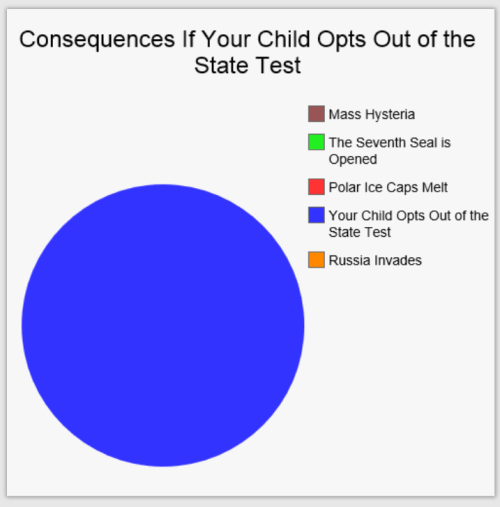
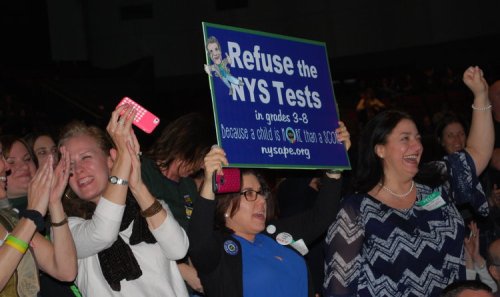
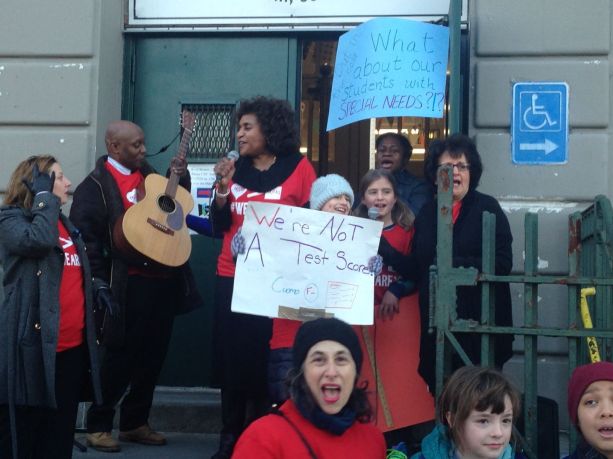
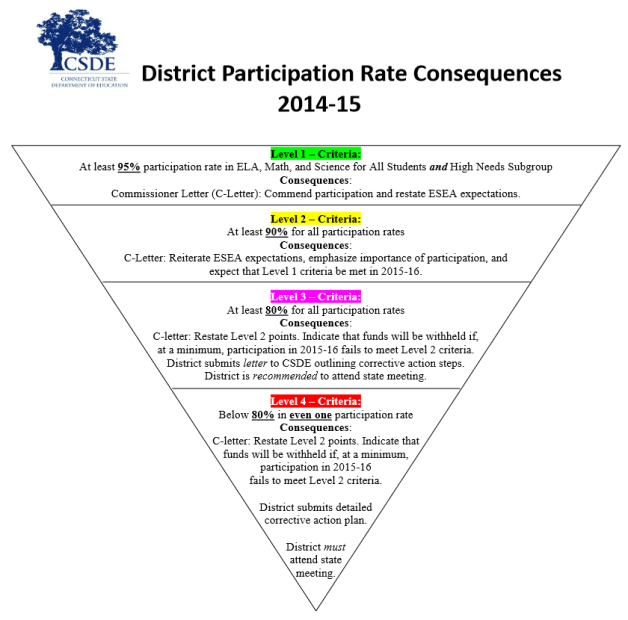
Let’s begin with one simple premise: nobody at the New York State Education Department wants to see Opt Out continue to be a significant factor in the Empire State.  The United States Department of Education sent a variety of states letters explaining they had an obligation to test 95% of all student in all subgroups without fail, even offering various measures from cajoling to threatening that the states could take to get all of those students to sit down and be tested. After some initial stumbles, NYSED settled on a “kinder and gentler” approach, trying to coax the 20% of eligible families to opt back in to the tests.  Regents Chancellor Merryl Tisch and Governor Andrew Cuomo quickly ran away from NYSED Commissioner Elia’s suggestion that districts with high opt out might lose funding.  In short order, Commissioner Elia affirmed that her office had no intention of withholding funds and admitted that parents had the legal right to refuse to submit their child for the state exams.  In the following months, Albany introduced a series of changes to the exams – such as reducing them by a few question and removing time limits – that they hoped with allay parental concerns, and Commissioner Elia’s office put together a “tool kit” for district and schools to use to explain the exams to parents.  The information provided for both letters and presentations emphasizes what NYSED sees as positive and necessary aspects of the tests instead of negative consequences for low test participation rates.

Parents and educators may disagree about the significance of the changes and about the accuracy of the information in the state materials, but the strategy was obvious: Gently persuade parents and communities back into the fold.  This was certainly a sensible approach considering the pasting Albany took not only on state testing but also on the entire education agenda championed by Governor Cuomo throughout 2015.  Even before he managed to bully his plans to use state tests as 50% of teacher evaluations through the Assembly, voters disapproved of his education agenda by extremely wide margins.  The Governor took such a pummeling in the polls on education in 2015, that his 2016 budget address only had 364 words on P-12 education that more or less reduced his entire platform to “yadda yadda yadda…teachers are swell.”  When it comes to public education in the Empire State, our leaders in Albany have spent most of 2016 trying to pour gallons of honey on their plate full of vinegar.

Someone in New York City did not get the memo, apparently.

Test refusal was not a significant issue in New York City last year, although a handful of schools saw much higher opt out rates than the city in general. But the office of New York City Schools Chancellor Carmen Farina apparently wants to take no chances of it gaining more than a toehold.  Pro-testing forces upstate seem happy to rely upon outside groups to carry the “opt in” message and to focus on emphasizing what they see as meeting test protesters part way, but the offices in Tweed aren’t taking any risks that opt out can grow and thrive in the Big Apple. In the run up to the tests, The New York Times reported ongoing and serious negative talk about teachers who spoke out against the tests and in favor of opting out:

At a forum in December, Anita Skop, the superintendent of District 15 in Brooklyn, which had the highest rate of test refusals in the city last year, said that for an educator to encourage opting out was a political act and that public employees were barred from using their positions to make political statements.

On March 7, the teachers at Public School 234 in TriBeCa, where only two students opted out last year, emailed the school’s parents a broadside against the tests. The email said the exams hurt “every single class of students across the school” because of the resources they consumed.

But 10 days later, when dozens of parents showed up for a PTA meeting where they expected to hear more about the tests, the teachers were nowhere to be seen. The school’s principal explained that “it didn’t feel safe” for them to speak, adding that their union had informed them that their email could be considered insubordination. The principal, Lisa Ripperger, introduced an official from the Education Department who was there to “help oversee our meeting.”

Several principals said they had been told by either the schools chancellor, Carmen Fariña, or their superintendents that they and their teachers should not encourage opting out. There were no specific consequences mentioned, but the warnings were enough to deter some educators.

One could possibly claim teachers speaking against the tests are engaging in political speech against contract rule – or one could argue they are expressing a professional opinion on the negative impact of testing they see with their own eyes in their own classrooms.  Certainly, the letter from PS234 teachers, as described, focuses on the consequences to students’ learning conditions rather than on any political outcome, but DOE is clearly trying to back channel messages to principals and teachers that negative comments about the test are off limits.  That would certainly explain an incident at PS 84 in Williamsburg where a principal chastised a fifth grader handing out Opt Out information until the child cried and then herded all third through fifth grade into an impromptu assembly to tell them to “get this opt out stuff out of your head.”  The principal went on to tell students not to listen to their parents and that the state exams would make them smarter.

That was not the behavior of a professional educational leader who feels free to allow open discussion of an important issue within the school.  For that matter, the principal’s behavior was arguably in violation of long standing case law on students’ first amendment rights within school.

Susan Trout, a Manhattan parent, forwarded a letter that her child’s middle school principal sent to all 8th grade parents, warning them about the consequences of a large number of opt outs:

This is a “low stakes year” for the eighth graders. Their performance on the exams will not be used by the high schools for placement or for admissions. It is not, however, a “low stakes year” for *******. If we do not test 95% of our students, the school will automatically be categorized as a School Under Review by New York State. This will result in a series of measures which may force us to change our curriculum, our staffing decisions and our program. It most certainly comes with close review of the school by the state, along with the paperwork to defend the school’s performance. This may negatively affect the students who will be at ***** for the next couple of years.

According to Ms. Trout, parents in her school who wrote to the principal expressing their desire to opt out of the test were then contacted individually by the school’s parent coordinator with the following message:

Hello.  By refusing to participate, you are putting us in jeopardy of no longer being considered a school in good standing.  We must have 95% participation to keep our school grade as is.  I would ask you to reconsider having your children take the test.  It is actually good practice for  their high school career since they will be tested a great deal in the college application process!

She then contacted the office of the Public Advocate in New York City for clarification, and got quite a different answer:

Regulations state that if a district has 3 consecutive years failing a SPECIFIC category, then they can be identified. If one year it’s because of special Ed scores, next year participation rates, the next was a whole other category, then no changes. Has to be failure of the SAME category 3 years running.  Even the handful of districts that fell below 95% for 4 years in a row (handful in NYS) were still not penalized or labeled. The label forces a plan put in place to fix the category/reason for failure, in this case, a parent boycott. The state knew better than to go forward with any consequence. 

Districts that were focus districts last year AND had less than 95% were taken off the list. Doesn’t make sense that % alone would cause them to be labeled. I realize all of the above specifies districts, not schools. However,confirmed by DOE staffer: there is absolutely NO POLICY that says one instance of <95% participation would result in “automatic characterization” of anything by NYS. It’s not an “automatic” process and is in fact based upon the previous 2-3 years in the event that a school falls below 95% in one year.

The information given by DOE to the Public Advocate’s office is diametrically opposed to the information a middle school administration circulated to parents.  Ms. Trout asked her parent coordinator about this discrepancy and was told that the information was from a “directive” from the district superintendent. Again, this is completely out of proportion to what any other level of education governance in the state is saying right now, and it is vexing, not because the city administration believes in testing, but because it is relying on incomplete and often misleading means to support the tests.

There was a brief moment, when it looked like the NYC educational bureaucracy was softening a bit.  Chancellor Farina was reported as having said in a private meeting that she would consider opting out a child if that child had a certain kind of Individualized Education Plan or was a new arrival in the country with very limited English, and Mayor Bill de Blasio met with opt out advocates in order to hear their views, clarifying that he still thought the tests were important.

Any hope that there was room for openness at Tweed, however, was shut down rapidly as the tests began this week.  Chancellor Farina said that her earlier comments were taken “out of context” and she further chastised parents who opt out, saying: “I believe students go to school to be held accountable for their work…What are you saying about your child?  What are you saying about your belief in them to do something that they’ve been gearing for all year?” This statement is fairly breathtaking.  It is one thing to believe in a system of school accountability that includes standardized testing, although the history of the No Child Left Behind era is pretty clear on this: test based accountability has had 15 years for results and it does not have themBut the Chancellor’s statement frames the accountability tests as objectives of the school year unto themselves.  The tests hold students “accountable for their work”?  The state standardized accountability test is “something they’ve been gearing for all year”?  I can honestly think of few ways of framing this worse than Chancellor Farina just did.  My children are preparing for many important things in their education this year – sitting in a standardized exam that takes longer to finish than the LSAT or the MCAT is just about the least important thing they could do.

I suppose — I just suppose — that we could be at least a little grateful for the wild spinning and random lashing out from the Chancellor’s office.  NYSED has tinkered a smidgen around the edges of the tests and they’ve taken a softer tone with the public.  But there can be no doubt – they want Opt Out to go away so they can keep these tests as the status quo.  Chancellor Farina, on the other hand, is being aggressive about her dislike for Opting Out, leading to repeated situations where parents are being told information that is flatly contrary to NYSED’s stated policies. History suggests that this level of overreaction and misdirection aimed at parents backfires.  If Opt Out grows in NYC, we might just have the Chancellor to thank for it.

Opting Out


4 Comments

Filed under Activism, MaryEllen Elia, NCLB, Opt Out, Testing

What The Election Taught Me About Ed Reformers

It is March, and one of our nation’s historically great political parties is still on track to nominate a lying, bloviating vulgarian with authoritarian policy proposals, a penchant for re-tweeting quotes from Italian Fascist Benito Mussolini , and a reluctance to condemn the Ku Klux Klan.  For many months, political pundits have consistently predicted his campaign’s demise, and his campaign has consistently refused to match their predictions.  What has been truly astonishing has been the silence of the Republican donor class, a group of billionaires who have, until this race, been able to command the obsequiousness of politicians seeking the Republican nomination.   The New York Times recently reported that as long ago as the last Fall, when Mr. Trump’s candidacy was showing far more staying power than was assumed possible, that an anti-Trump super PAC was proposed to help make the candidate unpalatable to voters – but not a single donor stepped forward.

To be sure, getting caught in the line of Mr. Trump’s fire can be catastrophic for regular people.  The Times also highlighted how Trump’s prolific use of Twitter focuses his ire on targets at all levels.  Cheri Jacobus is a Republican strategist and contributor to a number of media outlets, and when she criticized Donald Trump for failing to participate in the last debate before Iowa, he unloaded on her – and was quickly followed by a swarm of his followers who relentlessly attacked her for days.  In the same report, editor of The National Review, Rich Lowry, admitted that even the top Republican donors are afraid to take on Mr. Trump out of fear of his ability to send a tidal wave of negative publicity at them.

It would appear that the donor class, by and large, are cowards.

I can sympathize with a figure like Ms. Jacobus who, despite her reasonably influential political perch, has to fend off social media attacks on her own.  That is no doubt time consuming, highly disruptive, and, worse, stressful given the attacks ranged from merely nasty to outright sexist and vulgar.  But what, exactly, does a man like Sheldon Adelson fear?  Or the Koch brothers?  Or Paul Singer?  People like this have spokesmen for their spokesmen, yet the fear of being mocked on Twitter drove them away from even trying to oppose a man whose influence on the Republican Party they loathe?  More likely, they fear too much attention focused on their quiet, behind the scenes, roles as Kingmakers and agenda setters within the political system.  Daniel Shulman, who has documented the nearly 40 year long effort by the Koch brothers to change American politics via foundations, grants, and backing candidates for office, wrote in Vanity Fair:

One thing that has held the Koch network back so far, in addition to the Trump backers within their ranks, is the concern that taking on Trump would inevitably draw the thin-skinned tycoon’s legendary invective, which it almost certainly would. If the Kochs go after Trump, rest assured that he will take every opportunity to highlight how he’s being attacked by a cabal of billionaires seeking to control the outcome of the election. And this more or less explains their caution to this point. By taking on Trump, the Kochs risk lending credence to his claims of being an outsider who is battling against a corrupt political system rigged by the elites.

Does this sound familiar to supporters of public education today?

It certainly should.  While education reform has been played out in public, the financiers of those efforts have been less fond of the limelight on the whole.  Dr. Diane Ravitch of New York University has frequently called them as “The Billionaire Boys Club” originally referring to the Bill and Melinda Gates Foundation, the Eli and Edith Broad Foundation, and the Walton Family Foundations whose efforts coincided over various aspects of education reform in the past 15 years.  That “club” has many more members now, all working in various efforts to transform school via a combination of common standards and high stakes testing, breaking workplace protections for unionized teachers, and pushing for the expansion of school privatization via vouchers and charter schools.  While some journalism has examined the role of big money in education reform, most of these “reformers” prefer to stay out of the spotlight, channeling money through foundations and 501(c) 3 groups, creating astroturf organizations to pose as teachers genuinely interested in corporate reform, buying politicians who force through laws and budgets favorable to their agenda, and hiring public spokespeople to launch splashy legal and web based campaigns to break teachers’ unions.

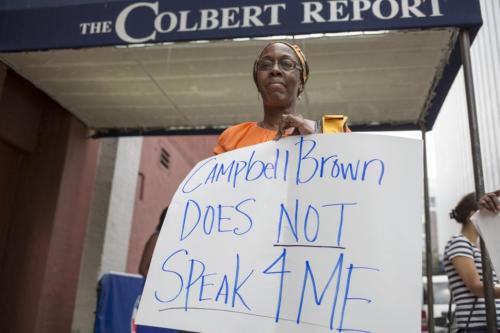
But the billionaires backing all of this and using the leverage of tremendous wealth to circumvent democratic processes do not, generally speaking, care to do all of this for themselves and go well out of their way to shield their efforts from public scrutiny.  It is hard to forget the scene of former CNN anchor Campbell Brown going to Stephen Colbert’s Comedy Central show to tout her campaign against teacher tenure – and steadfastly refusing to even hint at who was funding her efforts.  Her rationale?  Protesters might bother her benefactors:

CB:Yeah, we are raising money.

SC: And who did you raise it from?

CB: I’m not gonna reveal who the donors are because the people (pointing toward window) are out…

SC: I’m going to respect that because I had a super PAC. [Audience applause.]

CB: I hear you. But, part of the reason is the people who are outside today, trying to protest, trying to silence our parents who want to have a voice in this debate…

SC: Exercising First Amendment rights…

CB: Absolutely, but they’re also going to go after people who are funding this, and I think this is a good cause and an important cause, and if someone wants to contribute to this cause without having to put their name on it so they can become a target of the people who were out there earlier today, then I respect that.

Just to be clear the “people who were out there earlier today” was a small group of mothers and teachers with hand made signs:

colbert1n-1-web

colbert1n-2-web

This pattern is hardly isolated to Campbell Brown’s efforts either.  While hedge fund manager Whitney Tilson is less shy than most about openly explaining his goals of influencing Democratic politicians to adopt privatization goals, his organization, “Democrats” for Education Reform funnels large sums of cash and influence from a variety of sources, mostly groups like the Walton Family Foundation.  When education reform’s paid advocates found that they had trouble responding to public education supporters on social media, former Obama administration DOE official Peter Cunningham was simply granted $12 million dollars to found the “Education Post” to “create a better conversation” but also, in his own words, to create “the ability to swarm” on social media and to “hire” and “subsidize” bloggers. While Bill Gates is far more visible than most financiers of education reform, one of his biggest efforts to date was managing to organize 45 states and D.C. to adopt the Common Core State Standards without most parents or teachers realizing it was happening – by aiming almost entirely at power brokers and foundations in between election cycles.

Wherever you turn in education reform today, you find a think tank, or 501(c)3, or astroturf group, or pseudo-media outlet being paid handsomely to create the public impression of organic support for reformers’ ideas.  Direct and natural engagement with the public is not one of their stronger skill sets.  Which loops back to Republican donors and their unwillingness to confront Donald Trump.  On the one hand, it looks ridiculous that some of the nation’s wealthiest and most influential individuals are so afraid of negative public attention that they dithered for months, but on the other hand given how successfully they have influenced public policy without having to bother with actual democracy and given how bipartisan majorities of American voters already think the system is rigged in favor the ultra-wealthy, it makes sense that those most blatantly manipulating the system would hesitate to step out of the back rooms and into the public’s view.

The good news for advocates of public education is that Trump’s level of ignorant bullying and outright vulgar bigotry is hardly necessary to make education reformers uneasy about scrutiny.  For Campbell Brown, a few teachers and mothers with Sharpies rattled her ability to lie about teachers’ workplace protections on behalf of her donors. Peter Cunningham needed $12 million in foundation cash to pay bloggers to counter the efforts of working teachers with blogs and on social media who are defending their profession for free.  The vast sums of money spent by Bill Gates to prop up and support the Common Core State Standards have not prevented dwindling support among parents and teachers as they grow more familiar with its impact on schools.  Helping to keep light shining on how the donor class is pushing policy without the public’s consent goes hand in hand with the how harmful those policies have been.  They’ve repeatedly shown that they dislike scrutiny.

We have no reason to oblige them.

3 Comments

Filed under Activism, Common Core, Corruption, DFER, Gates Foundation, politics

“Education Next” Discovers That Water is Wet

Education Next is a reliable source of pro-education reform content.  Published by Stanford University’s libertarian leaning Hoover Institution which “seeks to secure and safeguard peace, improve the human condition, and limit government intrusion into the lives of individuals,” the magazine/journal is also sponsored by Kennedy School of Government’s Program on Education Policy and Governance (affiliated with reliably pro-reform organizations like the Heritage Foundation, the Alliance for School Choice,  Center for Education Reform, and the Heartland Institute) and the conservative Thomas B. Fordham Institute, dedicated to the premise that pretty much our entire education system is dysfunctional or dumbed down.  Education Next blends characteristics of magazine publishing and peer reviewed journals in a quarterly publication that occasionally has tastes towards provocations that few purely academic journals would attempt.  Michael Petrilli, the President of Fordham, is both a research fellow at Hoover and an editor at Education Next, and, by his own admission, loves “to mix it up” – which can put the publication in controversial spots even within the pro-reform community.

For the Summer 2016 issue, the publication is not courting controversy so much as it is stating the obvious and begging the question.  Editor-in-Chief and Henry Lee Shattuck Professor of Government at Harvard University Paul Peterson and Harvard post-doctoral candidates Samuel Barrows and Thomas Gift offer us the “good news” that in the wake of Common Core, states are setting “rigorous standards.”  I say this with a degree of tongue-in-cheek because the article’s conclusion are fairly obvious – if you start with the premise that everything education reform has been saying for the past decade and a half is pretty much entirely true.  Raise questions or complications to the exercise of standards, high stakes accountability testing, and their utility as policy levers and the entire exercise gets a lot less laudatory.

Dr. Peterson and his associates lay out their case like this:

  • Most states and the District of Columbia adopted the Common Core State Standards or some variation of the standards.  To their credit, the authors do not avoid the major role of the Gates Foundation in financially supporting the CCSS and of the Obama administration in creating incentives for states to adopt the standards, and they provide some insight into the opposition to the standards from both liberal and conservative sides of the issue (although they greatly oversimplify liberal concerns to union politics – even though both major national teacher unions signed on the Common Core experiment).
  • Since 2005, Education Next has used a grade scale for state proficiency standards developed by the Program on Education Policy and Governance where Dr. Peterson works (and which is a sponsor of Education Next).  According to this scale “state standards have suddenly skyrocketed.”
  • The authors also infer that if results from NCLB mandated annual proficiency examinations are close to state results on the National Assessment of Educational Progress (NAEP) then the state proficiency standard is as strict as the NAEP.  The authors refer to their assessment of states as “truth in advertising” about how well states tell parents how their children are actually doing.  This is another variation of the “honesty gap” argument that has was featured prominently by education reformers as states and communities got ready to receive the results of Common Core aligned testing.
  • According to the “size of the difference between the percentages of students identified as proficient by state and by NAEP exams in 4th and 8th grade math and reading,” “the last two years have witnessed the largest jump in state standards since they were established as part of the federal accountability program.”  The authors report that 36 states have “strengthened their standards,” and they further declare “the Common Core consortium has achieved one of its key policy objectives: the raising of state proficiency standards throughout much of the United States.”
  • The authors admit that the opt out rates in some states may complicate these scores; to whatever degree students who refuse the tests would have been high scorers, this would artificially lower the percentage of students scoring proficient.  Further, Massachusetts allowed districts to select between the state’s original MCAS exams or the new PARCC exams, but there is no way as of yet to know if higher performing districts kept the MCAS.
  • The authors also observe that states’ standards performance has narrowed recently with 80% of state proficiency rates being within 15 points of their NAEP results.

So to sum up: The federal government provided incentives and policy pressure for states to sign on to the Common Core State Standards.  States are now administering federally mandated accountability testing aligned with those standards (28 of them with either the PARCC or SBAC testing groups specifically chartered to write CCSS aligned exams).  The percentage of students who rank proficient in these exams is much closer to the percentage of students who rank proficient on the NAEP in those same states.  Education Next handed out a bunch of As to states because they “raised their standards.”

In other news: Water is wet.

water is wet

Dr. Peterson’s argument here is a little bit as if I took up alpaca ranching and then two years later praised myself for all of the timid, wooly, camelids on my property.  Education Next may give states enormous credit for decreasing the percentage of students who are deemed proficient in their state tests and bringing those percentages closer to the results of the NAEP, but the desirability of this is unexamined as is why doing so raises a state in the authors’ estimation.

This is no small question because it is hardly a given that a decrease in the gap between state exam proficiency percentages and those on NAEP indicates actual educational improvement or even that standards are actually “rigorous” as the Education Next headline claims.  New Jersey, for example, scored very well in the authors’ rating with 2.1% fewer students ranked as proficient in state testing compared to the last NAEP.  According to Education Next, New Jersey earned only a C in 2005 well before the Common Core State Standards, but research by Dr. Chris Tienken and Dr. Eunyoung Kim of Seton Hall University with Dr. Dario Sforza, Principal of Henry B. Pecton Regional High School, found that, using Webb’s Depth of Knowledge framework, New Jersey’s pre-Common Core Standards required more creative and strategic thinking in English Language Arts.  New Jersey may have scored higher on Education Next’s metric, but the standards being used in K-12 English arguably demand less higher order thinking.

Dr. Peterson and his associates also leave the desirability of getting state proficiency levels closer to NAEP’s entirely unexamined and simply assume that it is a good thing.  This, too, is no small question because the NAEP’s proficiency targets are deliberately set very high.  Dr. Diane Ravitch of New York University sat on the NAEP Board of Governors for seven years and explains here that proficient and highly proficient in the NAEP are pegged to very high level work in the A range for most students.  Further, she explains here that this was done deliberately because Dr. Chester Finn, who chaired the NAEP Board, is not impressed with the quality of American education in general and wanted the proficiency levels in NAEP to reflect that.  The PARCC consortium consulted NAEP heavily in the creation of its test while SBAC used far less from the NAEP, but as of last May, SBAC did not expect scores to vary that much from the national program.  Even outside the consortia, states looked very deliberately to decrease the number of students labeled proficient.  New York State linked its proficiency levels to performance on the test that an ETS study said was predictive of SAT scores only a third of students obtain; lo and behold, the number of students labeled proficient dropped to about a third.  This was also roughly the same as New York’s eighth grade NAEP English results which have been 33% or 35% at proficient or above since 2003.  Just for good measure, 33.2% of New Yorkers over the age of 25 have a Bachelor’s degree or higher.

None of this, however, changes a simple fact: the setting of cut scores for different levels of proficiency is a choice independent of how the scale scores from the exams are distributed.  New Jersey teacher, Rutgers graduate student, and blogger Jersey Jazzman deftly explains that even when New York set its cut scores to a very high level, the distribution of scale scores on the state exam barely moved, and that is because the decision to place cut scores is independent of how students do on the test itself and of how schools and districts and states compare to each other.  Gaps between subgroups and communities still exist and students’ performance on the test itself remains largely unchanged whether “proficient” is set to capture 60% of all test takes or 30%.  It should be noted that based on the authors’ descriptions, a state could probably have changed nothing about their standards or their accountability exam, set their cut scores to label fewer kids as proficient, and gotten a high grade in their report.

Left undiscussed is whether or not this is remotely desirable for a state system of accountability testing.  If “proficient” and “highly proficient” are achievement labels that should be reserved for students likely to go to a four year college or university, then education reform advocates have never effectively made that case to the public, preferring instead to point to the results on state testing that have been designed with this specific result in mind and declaring themselves correct about how poor a job our nation’s schools are doing. On the other hand, even if these cut score level are correct, what is the argument that we need vastly more children scoring at these levels?  I’ve argued repeatedly on these pages that there is little economic evidence that the nation’s economy is in need of more Bachelor’s degrees and that the inability of people to get ahead with a college education or to live above a subsistence level without one is a much greater crisis needing vastly more widespread action than can be achieved by schools alone.  While it is absolutely true that educational opportunity, like economic opportunity, is unequally distributed by race and class, the solutions for that are not going to be found by rigging cut scores but rather by substantially addressing something education reformers today generally discount: inequitable and inadequate school funding.

Ultimately, a lot of education reform, this report included, is a giant exercise of begging the question where a conclusion is presumed to be true without ever having been argued:

“These test results show that states have made their proficiency standards more rigorous.”

“Why do they show that?”

“The percentages of students scoring ‘proficient’ is closer to the NAEP than on prior tests.”

“Why does that show that the state standards are more rigorous?”

“Because NAEP is a rigorous exam.”

hermione_eye_roll

4 Comments

Filed under Common Core, Data, Gates Foundation, NCLB, PARCC, standards, Testing

Andrew Cuomo and the Difference a Year Makes

New York Governor Andrew Cuomo began 2015 with a hard charge against public schools and public school teachers in particular.  Having called public education a “monopoly”  he wanted to “bust” during his reelection campaign in 2014,  he vetoed a bill his own office had proposed that would have protected teachers and principals from consequences because of low test scores for a two year period, and his office opened a correspondence with Regents Chancellor Dr. Merryl Tisch where they both agreed that it was necessary to change teacher and principal evaluations to greatly increase the portion determined by growth measures on standardized tests.

The Governor came out swinging for New York’s public schools in his 2015 State of the State Address, delivered on January 21st:

Education – the great equalizer. And this is the area, my friends where I think we need to do the most reform and frankly where reform is going to be difficult, given the situation of the way education is funded in this state. Our education system needs dramatic reform and it has for years and I believe this is the year to do it. This is the year to roll up our sleeves and take on the dramatic challenge that has eluded us for so many years for so many reasons.

Governor Cuomo dedicated 2,254 words of his 10, 324 word speech to P-12 education, and he certainly kept his promise to put forth “dramatic reform.”  He attacked the quality of teachers by citing a entry exam that nearly a third of prospective teachers did not pass in the previous year.  He attacked the then existing teacher evaluation system in the state, which he had previously championed, as “baloney” because it rated too many teachers as effective and highly effective.  The Governor justified this by citing that “only” 38% of students were “college ready” and he rattled off other proficiency levels on state exams as more proof that very many more teachers have to be rated ineffective.  In doing so, he failed to mention that the cut scores for “proficient” and “highly proficient” were deliberately pegged by the New York State Education Department to scale scores that only about a third of students were expected to reach.  Despite this, Governor Cuomo took it as a matter of faith that many more teachers deserved to be labeled ineffective, and his proposed teacher evaluation system shifted 50% of teacher evaluations to student growth on standardized exams.  Further, he demanded the use of outside evaluators for teacher observations, and the book that was released with his address specified that those evaluators would count for 35% of teachers’ ratings, leaving local administrators with only 15% of input on their own teachers.  He also called for tenure to be limited to teachers who received 5 consecutive years of effective ratings, and he offered a $20,000 bonus for highly rated teachers.  That was joined by a proposal to allow school districts to get rid of any teacher with two ineffective ratings.

The Governor went on to scoff at the idea of more money helping the schools he labeled as failing, and instead called for any school that is deemed failing for three years to be turned over to another school district, a not-for-profit, or a turn around “expert” and he specifically cited charter schools as part of that effort, calling for statewide cap to be lifted.  Governor Cuomo addressed funding, but largely to hold the state’s school hostage to his reforms: he proposed an increase in funding of 4.8% or $1.1 billion if, and only if, the legislature passed his reforms – otherwise, the increase would top out at 1.7% or $377 million.  Mind you, this is in a state where Albany has continued to use the Gap Elimination Adjustment for years after the economic crisis eased, cutting promised aid from school districts to plug holes in revenue shortfalls for the entire state budget.  This accounting trick has cost New York public schools billions of dollars in promised state aid from an aid budget that itself was short $5.6 billion needed to meet long promised commitments to equity in school funding.

The Governor forcefully went after this agenda, spending copious amounts of political capital and goodwill among the public, and while he did not get everything he wanted, on teacher evaluations, he finally forced state lawmakers to give him precisely what he wanted in order to meet the budget deadline.  By all accounts, Governor Cuomo had won a sweeping change that was bound that transform New York into a cutting edge laboratory in the “test and punish” philosophy of education “improvement”.

What has happened since then has been a lot different.

Over the summer, NYSED’s new Commissioner, MaryEllen Elia, went on a “listening tour” of the state to, in theory, hear concerns of parents and teachers after the rocky tenure of her predecessor Dr. John King, Jr., but she also made her take on high stakes testing apparent by calling life “one big test“.  Commissioner Elia’s “charm” took a different turn when she announced to reporters that her office was in communication with the federal education department over potential consequences for schools and school districts that failed to test 95% of all students.  However, that stance was almost immediately reversed by Regents Chancellor Tisch who declared that Washington was leaving the matter to the state and that the Regents had no intention of withholding funds, and even Governor Cuomo echoed that sentiment, leaving the new Commissioner out on a limb from which she bid a hasty retreat.

Things got even weirder in the Fall when Governor Cuomo, citing widespread dissatisfaction with the implementation of the Common Core State Standards as well as questions about their quality and lack of input from stakeholders, announced a new commission to review the standards, review New York’s curriculum guidance and support, and review the testing environment in the state.  The commission returned in December with a framework of proposals, including pushing full transition of changes to how standards are implemented and teachers are evaluated out to the 2019-2020 school year, although critics remained only cautiously skeptical.

Meanwhile, Regents Chancellor Tisch was seeking wiggle room in the reform environment as well.  As early as April last year, she suggested that school districts would need an additional year to implement the evaluation system passed in the state budget, and in December, the Board of Regents went further by pushing the deadline for using state test scores in teacher evaluation to the 2019-2020 school year as well.  While most districts are still operating under the previous evaluation system where 20% of teacher evaluation is based upon state scores, 20% based upon local measures, and 60% on observations, this move by the Regents means that the portion tied to the contentious state tests needs to be replaced locally – and if implementation of the new evaluation system happens in the following year, towns will still need more local measures since the state tests will not be used in evaluation.  Currently, 83 districts managed to negotiate an approved implementation of the new evaluation system, but they will now need measures other than the state exam.

Governor Cuomo took to the stage again this month to deliver his 2016 State of the State address, and the tone could hardly have been more different.  Last year, more than a fifth of the 10,300 word address was dedicated to his punishing P-12 education agenda.  This year? 364 words.  Out of a 9,683 word speech.  Barely 3.75% of his address.  And what did he offer?

  • He bragged a little bit about reforms that he made no mention of last year – like increasing parental involvement and reducing testing and the Common Core recommendations.
  • An increase of $2.1 billion in funding over 2 years.
  • Using that money to end the Gap Elimination Adjustment.
  • He made a vague call to turn “failing” schools into community schools, and repeated a positive platitude or three about charter schools.
  • Suggested that we can attract and keep the best teachers – by offering a $200 tax credit to cover their out of pocket expense. New York teachers may not have to worry any more about choosing between decorating their classrooms and a visit to the dentist.

This is, shall we say, a far less ambitious and far less confrontational agenda for a Governor whose donor base expects sweeping changes that benefit their interests.  Is there something that might account for such a dramatic change in tone and ambition?


Oh, right.

After months of Governor Cuomo’s aggressive charge against New York teachers, and after months of protests across the state, the Common Core aligned state assessments were given and reports of huge opt out numbers came in.  In August, those numbers were confirmed: 20% of New York State students eligible to take the tests, roughly 200,000 in all, refused them. This was huge increase over the previous year, and a majority of New York school districts did not test the 95% of all students required by federal law with a substantial number seeing refusal rates above 50%.  Governor Cuomo, aided by Chancellor Tisch and former NYSED Commissioner John King, managed for foment a full blown parents’ revolt against his education priorities, and everything we’ve seen since the budget bill last April – Commissioner Elia’s threats and rapid retreat, Chancellor Tisch pushing the new evaluation system off for a year, Governor Cuomo’s Common Core and testing commission, the Regents delaying using state test scores in teacher evaluations, Governor Cuomo reducing his own education agenda to “YaddaYaddaYadda – Teachers are swell” – is likely a sustained effort to put out fires and take the urgency out of test refusal.

This being Andrew Cuomo, of course, changes in tone are not necessarily tied to changes in substance.  While state tests may be on hold for teacher evaluations until 2019-2020, that merely represents a delay, and districts will still have to use some kind of test data for 50% of teacher evaluations when the new teacher evaluations actually get started next year. Assemblyman Charles Barron correctly points out that Governor Cuomo’s promised increase in school funding is more spin than substance, amounting to barely a portion of what the state still owes school districts under agreements made long ago.  In fact, the governor’s proposal would use much of that increase to stop hacking away at promised, inadequate, aid via the Gap Elimination Adjustment, which is a bit like asking school districts to be happy that they will only be starved rather than starved and punched.  Finally, nobody should forget how Governor Cuomo made a long list of promises to secure the endorsement of The Working Families Party and head off a challenge from his left in 2014 – only to give the progressive party the royal shaft.

Andrew Cuomo wants New York’s families and teachers to believe he is a changed and humbled man.  History suggests it is a scam.

4 Comments

Filed under Common Core, Funding, John King, MaryEllen Elia, New York Board of Regents, Opt Out, politics, Testing

Chris Christie Calls Mandatory Recess Bill “Stupid”

New Jersey Governor Chris Christie took time out of his busy schedule as a failing Presidential candidate this week to veto a bill that would have mandated 20 minutes of recess for all New Jersey schoolchildren between Kindergarten and 5th grade.  Speaking with Fox News, the Governor said that “part of my job as governor is to veto the stupid bills. That was a stupid bill and I vetoed it.”  He also characterized the bill as “crazy government run amok” and mischaracterized it as requiring outdoor recess regardless of the weather conditions; the actual language of the bill expressed a preference for outdoor recess when possible.  Governor Christie further berated the legislators who passed the bill by saying, “With all the other problems we have to deal with, my Legislature is worried about recess for kids from kindergarten to fifth grade?”

I think we need to clarify some points:

Collaborating with private donors to transform the city of Newark’s school system in an unproven experiment, turning the city schools over to an inept and defensive administrator who planned to close schools that were meeting their improvement goals and sending families across the city whether they wanted to go or not?  That is not “crazy government run amok”.

A $108 MILLION contract with the Pearson Corporation to provide an unproven and disruptive state assessment system whose results were thoroughly misrepresented by the state’s highest education appointee?  That is not “crazy government run amok”.

Granting a “graduate school of education” that is primarily a collaboration of charter school networks training their own teachers in the “no excuses” methods the sole contract to provide continuing education for teachers in the state’s largest city while increasing the requirements for traditional teacher preparation programs?  That is not “crazy government run amok”.

Ramming through a major overhaul of the state’s pension fund, refusing to actually pay the state’s agreed upon contribution, but giving management of those funds to politically connected Wall Street firms who jacked up the fees to over $600 million a YEAR?  That is not “crazy government run amok”.

“Crazy government run amok” is making certain that state education law requires that very young children get a daily chance to play outside while they are in school.

picard

Governor Christie’s mocking of the legislature for spending time on something so frivolous is also sorely misplaced.  Far from being unimportant, the American Academy of Pediatrics has called recess “crucial” and cites tangible benefits of regularly scheduled play for children attending school:

Just as physical education and physical fitness have well-recognized benefits for personal and academic performance, recess offers its own, unique benefits. Recess represents an essential, planned respite from rigorous cognitive tasks. It affords a time to rest, play, imagine, think, move, and socialize. After recess, for children or after a corresponding break time for adolescents, students are more attentive and better able to perform cognitively. In addition, recess helps young children to develop social skills that are otherwise not acquired in the more structured classroom environment.

Restrictions or even loss of recess time is a national phenomenon, and the New Jersey law would have protected students from districts who felt the pressure to spend more time on academics and test preparation from stealing that time from recess — and yes, this has happened in New Jersey.  Far from being something that the state’s lawmakers should not have bothered with, protecting children from well-intentioned but ultimately damaging policies is absolutely something that needed to be done.  Mounting evidence suggests that this generation of schoolchildren are being pushed into more and more academic focus at younger and younger ages to their detriment. Even children as young as Pre-Kindergarten are losing play based learning that is developmentally appropriate and actually crucial to their long term social and academic well-being.  Writing in The Atlantic, Erika Chistakis notes:

Preschool classrooms have become increasingly fraught spaces, with teachers cajoling their charges to finish their “work” before they can go play. And yet, even as preschoolers are learning more pre-academic skills at earlier ages, I’ve heard many teachers say that they seem somehow—is it possible?—less inquisitive and less engaged than the kids of earlier generations. More children today seem to lack the language skills needed to retell a simple story or to use basic connecting words and prepositions. They can’t make a conceptual analogy between, say, the veins on a leaf and the veins in their own hands.

New research sounds a particularly disquieting note. A major evaluation of Tennessee’s publicly funded preschool system, published in September, found that although children who had attended preschool initially exhibited more “school readiness” skills when they entered kindergarten than did their non-preschool-attending peers, by the time they were in first grade their attitudes toward school were deteriorating. And by second grade they performed worse on tests measuring literacy, language, and math skills. The researchers told New York magazine that overreliance on direct instruction and repetitive, poorly structured pedagogy were likely culprits; children who’d been subjected to the same insipid tasks year after year after year were understandably losing their enthusiasm for learning.

That’s right. The same educational policies that are pushing academic goals down to ever earlier levels seem to be contributing to—while at the same time obscuring—the fact that young children are gaining fewer skills, not more.

This isn’t complicated.  This isn’t disputable.  Children need play.  Very young children cannot learn without opportunities to play.  The only flaw with the New Jersey legislation Governor Christie vetoed is that it doesn’t go far enough to protect our youngest school children from misguided efforts to increase their academic “performance” by denying them what they need to thrive.  Our children need recess.  They also need more play oriented learning premised on discovery and social interaction, and they need far less emphasis on tasks that look “rigorous” to adults but which stifle their development and steal time from genuine learning.

Governor Christie isn’t merely wrong; he is cruelly wrong.  The “stupid” thing is the steady chipping away of what our children need.  Perhaps the Governor could remember that as he is trying to score points with primary voters who are not interested in his candidacy.

17 Comments

Filed under Cami Anderson, child development, Chris Christie, classrooms, Cory Booker, Newark, One Newark, PARCC, Pearson, politics, Testing

Connecticut Recommends Thumbscrews

Connecticut’s Democratic Governor Dannel Malloy does not always grab attention in the annals of corporate education reform.  Wisconsin Governor Scott Walker has made battles with public unions more central to his image.  New Jersey Governor Chris Christie plainly relishes getting to act “tough” and yell at teachers questioning his agenda. Democratic Mayor of Chicago Rahm Emanuel shuttered 50 public schools, mostly serving ethnic minority children, in one go, without caring to listen at all to the residents of the impacted neighborhoods.  Neighboring governor and fellow Democrat Andrew Cuomo of New York staked a huge portion of his agenda for 2015 on ramming through controversial education reforms, and his approval rating both overall and especially on education have tanked in a highly visible manner.  Compared to headline grabbers like these, Governor Malloy does not seem to get much attention.

Which is a shame because when it comes to the Holy Trinity of education reform – common standards, standardized testing tied to punitive consequences, and preference for charter schools over district schools, Governor Malloy is the complete package. In 2012, he called for major changes to teacher tenure in Connecticut, earning praise from ConnCAN, an education reform group promoting charter schools.  Facing push back from teachers and parents about the pace and nature of education reforms, Governor Malloy was forced to call for a “slow down” in the pace of reforms, especially tying teacher evaluations to standardized test results.  $91,000 in campaign donations flowed to Connecticut Democrats from a single wealthy businessman and charter school advocate, Jonathan Sackler, and three members of his family; those donations and others from Wall Street were rewarded with proposals for over $21 million in new charter school funding while public school spending remains flat.

It is pretty clear that Governor Malloy stands shoulder to shoulder with New York’s Andrew Cuomo and Chicago’s Rahm Emanuel even if he prefers to draw less national attention to himself.  So it is perhaps not surprising that his education department is contemplating thumbscrews for the Opt Out movement in Connecticut.

Opt Out was not the force in Connecticut that it was in neighboring New York with only 11,200 students not taking the state exams while the state says 267,000 did.  However, a number of individual districts did not meet the 95% testing requirement of No Child Left Behind which was continued in the new Every Child Succeeds Acts, and in some districts those numbers were significant. Roughly 7 out of 10 high school juniors opted out in Stonington, and participation fell below 95% in over 30 communities.

This Fall, roughly a dozen states got a letter from Ann Whalen at the US Department of Education, an adviser who is acting as the assistant secretary of elementary and secondary education, reminding them that their districts need to test no less than 95 percent of all students and that the state needs an action plan to deal with those who do not.  The letter opens by reminding state chief education officers of the legal requirements to test all children in grades 3-8 and once in high schools, that the examinations must be same for all students, and no student may be excluded from the examinations.  Ms. Whalen asserts that the sections of the law she cites “set out the rule that all students must be assessed.” The letter continues to remind the state officers that both their state and local authorities who receive Title I, Part A money assured that they would test all students in accordance with the law.  Ms. Whalen also offers “suggestions” for actions state education authorities can take to address participation in the assessments:

  • Lowering an LEA’s or school’s rating in the State’s accountability system or amending the system flag an LEA or school with a low participation rate.
  • Counting non-participants as non-proficient in accountability determinations.
  • Requiring an LEA or school to develop an improvement plan, or take corrective actions to ensure that all students participate in the statewide assessments in the future, and providing the SEA’s process to review and monitor such plans.
  • Requiring an LEA or school to implement additional interventions aligned with the reason for low student participation, or even if the state’s accountability system does not officially designate schools for such interventions.
  • Designating an LEA or school as “high risk,” or a comparable status under the State’s laws and regulations, with a clear explanation for the implications of such a designation.
  • Withholding or directing use of State aid and/or funding flexibility.

Ms. Whalen also reminds the states that they have “a range of other enforcement actions” including placing conditions on Title I, Part A grants or even withholding them.  For a real kicker, she goes on to say that if states with less than 95% participation in the 2014-2015 school year do not assess 95% of students this year, then the federal education department “will take one or more of the following actions: (1) withhold Title I, Part A State administration funds; (2) place the State’s Title I, Part A grant on high-risk and direct the State to use a portion of its Title I State administrative funds to address low participation rates; or (3) withhold or redirect Title VI State assessment funds.”

Short version: States with Opt Out numbers that put them or local districts below 95% test participation must bargain, cajole, plead, or threaten districts and schools into making that target.  The Federal Education Department has put in writing that not only failure to take action to address low assessment rates, but also failure to meet the 95% target this year, WILL result in some form of punitive action from Washington.  Presumably, the degree of the punishment will depend upon how vigorous the state actions are.  It is also safe to assume that the Education Department offices in Washington have a new logo:

DOE seal


Connecticut got its own version of this letter from Dr. Monique Chism in the office of state support, and Connecticut’s Commissioner of Education Dr. Dianna Wentzell quietly sent the state’s reply on December 4th, waiting until December 28th to release it to the public. In the letter, Dr. Wentzell assures Washington that although Connecticut met the 95% participation rate statewide, they are “not pleased” that a number of districts did not do so, and the state has devised a tiered intervention system to “ensure that districts meeting the standard are commended, those failing marginally are gently alerted, and those falling behind are strongly reminded of the potential consequences and provided support to remedy the situation in 2015-2016.”  In the next school year, Connecticut’s accountability system will “lower a school by one category for low participation rates in the 2015-2016 year.”  The system is explained in a graphic:

con consequences

Districts in Connecticut are now warned: if your test participation rates were below 80% in any category, funds WILL be withheld if this year’s participation rate is not at least 90%.

This remains as problematic as it has been every time the federal government or a state entity has raised it.  Yes, it is true that federal law requires that at least 95 percent of all students in all subcategories are tested in the participating grades.  Yes, it is true that state and local officials have to do what they can to test the students in the participating grades and have almost no legal authority to exempt any of those students.  However, the statute was written to prevent states and local school authorities from hiding low performing student populations from accountability systems.  I challenge Dr. Wentzell, Dr. Chism, or Ms. Whalen to find a single line of statutory authority to compel parents to submit their children for examination or to find any legislative intent in the original NCLB legislation or its successor to punish schools and districts for not exerting 95% control of the parents in their district.  There have been schools since 2001 who have not managed to test 95% of their students, but there is not a single example of a school being punished for that.

In the end, Connecticut, at the prodding of the Federal Education Department, is setting itself up for an unpleasant confrontation with parents, often parents that elected officials find difficult to ignore, with very shaky legal footing.  North Haven High School, for example, had extremely low participation rates on the 11th grade exams.  The community also has a median home value $22,000 above the state median and median household income $16,000 above the state median.  With only 4% of its residents below the poverty line compared to the state average of over 10% it is unlikely that North Haven’s schools rely significantly upon Title I funds, so it is unclear exactly what money Dr. Wentzell would withhold.  However, the loss of any money intended to help children who are in poverty based upon actions of parents rather than upon actions of school authorities is unprecedented, contrary to the intention of any federal and state accountability laws – and far more likely to increase the parental backlash than to bottle it up.


8 Comments

Filed under Activism, Dannel Malloy, ESSA, Funding, NCLB, Opt Out, politics, Testing