Tag Archives: testing

New York Times Editorial Board on Annual Testing: “PREECCCIIOOOUUUUSSS!”

The Editorial Board of The New York Times is a reliable source of pro-education reform articles, and yesterday they published their take on the potential new testing environment that will be ushered in if the “Every Student Succeeds Act” (ESSA) is passed and signed into law.  The Board was relieved that earlier drafts which “seemed poised to weaken…its protections for impoverished children” were changed in the final legislation and urged its passage by the Senate.  What “protections” for our most vulnerable children were at stake?

Annual standardized testing of all children.

picard

The Board acknowledged flaws with how No Child Left Behind labeled and sanctioned schools, noting that testing well beyond federally required exams proliferated as states and school districts administered diagnostic and practice exams lest they fail to prepare students for the examination with potentially dire consequences.  They also correctly noted that the backlash against testing is justified – even if they only tangentially admit the central role of federal policy across two administrations in getting us to this point.  However, they also celebrated the preservation of annual standardized testing of all students in grades 3 through 8 and once in high school, and they approved of maintaining the requirement that schools must test 95% of all students and called it a discouragement to the opt-out movement.

The Editorial Board treads familiar, almost entirely mythological, ground with their defense of annual testing of all students:  Once upon a time, the federal government “kept doling out education money to the states no matter how abysmally their school systems performed,” and the requirement for mass standardized testing was “to make sure that students in all districts were making progress and that poor and minority students were being educated.”  This mythology is summarized by the Board’s concern that previous ESSA drafts “would have allowed state to end annual testing altogether, which would leave the country no way of knowing whether students are learning anything or not.” (emphasis added)

hermione_eye_roll

This is, as usual, a staggering lack of imagination, and an insistence upon maintaining annual tests because of properties they do not possess.  Only testing every child in every grade level lets us know if children are learning.  Only testing every child in every grade allows us to hold districts and schools and teachers accountable.  If we do not test every child in every grade, then historically disadvantaged populations will be allowed to sink even further and the promise of equal opportunity will be lost.

Such statements might have been viable in 2001 when the NCLB legislation was passed with bipartisan support, but after nearly a decade and a half, there is no evidence to be found that test based accountability is telling us anything we did not already know from other means, nor is there evidence that the children whose plights provided NCLB’s rationale are prospering. To be honest, at this point in our policy cycle, it takes a love of annual standardized testing similar to Smeagol’s love of the One Ring to be blinded as to how thoroughly it has failed to improve our schools.  Consider the latest round of data from the National Assessment of Education Progress.  NAEP, dubbed “The Nation’s Report Card,” is a set of standardized tests given to a representative sample of students in 4th grade, 8th grade, and high school from all states every other year, and it is the only consistent measurement of student knowledge across 4 decades of administration.  The 2015 results were released this Fall, and they do not speak well of test-based accountability and its impact on the “achievement gap” between majority and minority children:
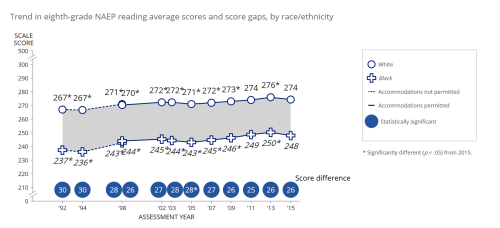
NCLB Era Reading Gap

If we mark the NLCB era from the 2002 test administration, then we have to conclude that, in the 8th grade reading NAEP, the gap in scores between white and black students has closed a grand total of one point.  The 4th grade gap has closed a more generous four points in the same time.  In mathematics, the NCLB era has seen a score gap in both 4th and 8th grade close all of three points.

One might suppose, given the enormous importance of annual testing of all students imagined by The Times and other testing advocates, that we must surely see far worse in data from previous eras, and to be certain, the period from the late 1980s until the mid-1990s saw distressing increases in test measured gaps before they stabilized prior to NCLB.  However, before the late 1980s, there was another picture altogether:

NAEP Reading13 year old math NAEP

In both reading and mathematics for 8th graders, 1973 through 1988 saw sharp decreases in the measured achievement gaps, closing by 21 and 22 points respectively.  While no single factor can wholly account for this, it is hardly surprising that the substantial progress towards educational equality began to erode as our nation abandoned policies of active integration and fair housing during the Reagan administration and as courts with larger conservative majorities released school districts from oversight with integration in mind.  The reality is that integration is a key improvement strategy for our nation’s most at risk students, and national policy has largely abandoned it in favor of first the standards based accountability policies of the late 1980s and the 1990s and then the test and punish policies of the NCLB era.  With soaring inequality impacting the majority of Americans and our communities and with our collective abandonment of integrated, mixed-income housing contributing to the highest levels of income segregation in the post-War period, why do we need to test every child in every grade in every year to learn that the trends which have negatively impacted almost all Americans and their communities have also impacted our schools?

The Times‘ Editorial Board betrays a staggering lack of imagination when they insist that we must test annually to know “whether students (are) learning anything or not.”  Dr. Bruce Baker of Rutgers University argues cogently that if the purpose is to use standardized test data to monitor schools and school systems, you do not need to test every child every year at all; that can be accomplished by testing samples of students every couple of years.  Further, if your goal is to know if individual students are progressing in their learning then there are far more important tools that could be used by teachers in formative assessments without any stakes attached that could inform them and parents far more effectively than a mass standardized test whose results come back well into the following school year.

It is also entirely possible to hold schools and teachers accountable without our mass testing ritual and all of the distortions it causes to genuine learning.  Grade span testing or semi-annual of student samples would give state and federal officials sufficient data to know when a closer look at a district or school is warranted (although, just like with annual testing, it does not remotely explain what will be found when looking).  There are nearly infinite alternative measures of schools such as graduation rates, suspension rates, teacher retention and turnover, teacher qualifications, class sizes, post graduation reports, student engagement, parental engagement, parent satisfaction surveys.  Every one of these items – and many others – is a way of understanding what is happening inside of a school, and while ESSA allows states to design accountability systems that use them, the role of testing data will still remain grossly outsized.  We also have alternative models of accountability that involve both community stakeholders and teachers themselves such as the local accountability and funding formula efforts in California and peer review systems that already have substantial success where they have been employed.  Robust models of teacher accountability exist, and they emphasize the role of teachers as professionals capable of engaging in substantive understanding of their own work and the role of evaluation in supporting teachers as its primary goal.

There is a limited role that standardized test data can play in a comprehensive system of school monitoring, development, and accountability, but it must play a small role at best in coordination with a system that is premised on support and development.  However, no school accountability system, regardless of premise, is capable of turning around a 40 year long, society spanning, trend towards inequality and segregation. That requires far more than clinging to annual, mass, standardized testing as our most vital means of giving every child access to an equitable education, and if The Times and other testing advocates really cannot see past that, then they are not merely shortsighted; they are clinging to damaging and delusional policies.  A bit like our, poor, deluded Smeagol and his final cry of “Precious!”

happygollum_zps35a4611a.gif~c200

The last supporter of annual testing?

5 Comments

Filed under Data, ESSA, Media, NCLB, Opt Out, politics, standards, Testing

Preparing for the Post-NCLB World

Barring substantial shifts in the political landscape, both houses of Congress are expected to vote on the re-authorization of the Elementary and Secondary Education Act which has just come out of the conference committee.  If passed in both the House and the Senate, the bill, dubbed the Every Student Succeeds Act, is expected to be signed into law by President Obama before the end of the year.  This will officially usher us into the post No Child Left Behind era, and, as is typical with legislation nowadays, there is something in the final product to frustrate and worry pretty much everyone.  While ESSA represents tangible improvements over the widely hated NCLB, there are worrisome elements in it and a great deal of larger and more fundamental aspects are handed over to the states where we can probably expect prolonged fights over implementation.

Nineteenth Century lawyer-poet John Godfrey Saxe noted, “Laws, like sausages, cease to inspire respect in proportion as we know how they are made.”  He probably had something like the agonizing and lengthy wrangling over rewriting the Elementary and Secondary Education Act in mind when he said it, especially this final stretch when lawmakers will vote on a 1000 page long conference bill they have not read thoroughly.  And, indeed, it seems some choice bits got chopped up and inserted into this final version, notably a chance for private financial interests to make money on public education dollars.

we-re-making-sausages-o

Consider language for Title I, Part D for prevention and intervention programs for children and youth who are neglected, delinquent, and at risk, section 1424 allowing funds to go to “pay for success initiatives,” and similar language in Title IV, Part A.  ESSA defines a “pay for success initiative” as a “performance-based grant, contract, or cooperative agreement awarded by a public entity in which a commitment is made to pay for improved outcomes that result in social benefit and direct cost savings or cost avoidance to the public sector.”  The gist is that private entities can put up money as a loan for a public program and if they save money in the process of being more effective or more efficient than the public sector, they can keep a portion of the money saved. This is the kind of creative use of private philanthropy and financing that is supposed to incentivize deep pocketed entities to do good – and end up doing right well in the process.

Goldman Sachs experimented with the model in Utah by financing preschool for 595 additional children in a well regarded program, 110 of whom were expected to need special education services. After a year in the Goldman sponsored intervention, only 1 student entering Kindergarten was found to need those services, and the financial giant will now be paid $2500 per pupil per grade without special education services until students reach sixth grade when the amount of money will go down. That’ll come to $1.9 million dollars on top of the original money loaned and paid back.

Fred Klonsky, a retired Chicago teacher and current blogger, is highly skeptical both of the payments back to Goldman and of the claim that 109 students out of 110 were no longer in need of special education services after a year in preschool.  I have to admit that I share that skepticism and certainly think that social impact bond financing allowed in ESSA will require very vigilant monitoring to make certain outfits like Goldman Sachs are not creating perverse incentives to simply overlook a need and “save” money.  They are a largely unproven vehicle for creating social change, although some are organized to minimize risk for private capital while giving them a lucrative upside.  It isn’t hard to imagine who lobbied to get that language inserted into the Title I and Title IV changes then.

For that matter, as Mercedes Schneider notes in her first assessment of the bill, charter schools get a big, wet kiss, and there are grants that read as friendly to Teach for America’s role in “teacher preparation”.

So – sausage.

That said, there are many changes to the current education landscape contained in ESSA, many of them positive.  The Badass Teachers Association has a solid look of the good and the far less than good in the bill.  On the troubling side, ESL students are potentially labeled using very crude means, encouragement of merit pay, misplaced confidence in adaptive assessments and misgivings that “individualized instruction” will lead to more time in front of screens rather than with teachers, and, of greatest concern, continuation of NCLB’s requirement of annual testing of every child each year between grades 3 and 8 and once in high school and it caps alternate assessments for disabled students.  However, ESSA spins much more authority for accountability and assessments to the states, includes mechanisms to improve teacher workplace conditions, prohibits the federal DOE from interfering in state laws regarding parents opting children out of state assessments, and there are positive developments for homeless children, impact aid, Native American education, state innovation and local flexibility.

Most notable, however, are the repeated smack downs of the federal Department of Education and clear prohibitions on the Secretary of Education taking an active role in shaping state policies regarding standards, assessments, and accountability systems.  Consider this from Title VIII, section 8526:

No officer or employee of the Federal Government shall, through grants, contracts, or other cooperative agreements, mandate, direct, or control a State, local educational agency, or school’s specific instructional content, academic standards and assessments, curricula, or program of instruction developed and implemented to meet the requirements of this Act (including any requirement, direction, or mandate to adopt the Common Core State Standards developed under the Common Core State Standards Initiative, any other academic standards common to a significant number of States, or any assessment, instructional content, or curriculum aligned to such standards), nor shall anything in this Act be construed to authorize such officer or employee to do so.

I believe that when historians write the story of the Test and Punish Era of public school reform, this language will be noted as the “Take A Seat, Arne” Act of 2015.

mrbeandanc_KrxTTijg

Education Week noted a week ago that “accountability hawks” were already unhappy with the information coming out of the conference committee.  Sandy Kress, an original designer of NCLB, worried that states were going to be allowed to create accountability systems not based on student learning.  Chad Aldeman, a partner at Bellweather Education Partners, worries that states will give in to inertia and not push for improvements for their most at risk students.  Meanwhile, the National Association of Secondary Schools Principals applauded the available framework, noting the removal of Annual Yearly Progress (AYP) requirements and “unworkable” school turnaround models.  The National Governors Association announced full approval for the conference bill, saying that it “restored the balance” between Washington, D.C. and the states.

So – is NCLB well and truly dead?

Not exactly, no.

While some of the worst provisions of NCLB have finally had a stake driven into their hearts, the states are still required to test and the create accountability systems, so the upshot is that making sure both those tests and the systems are fair and based upon what schools and children need will now have to be done state by state.  Monty Neill of FairTest notes that this will not be a simple matter: States still have to rank schools largely on test scores, there is ambiguity on how “additional indicators” for English Language Learners will be weighted compared to test scores, states have to identify the bottom 5% of schools based on test scores and intervene with measures designed by the state.  In other words: whether or not schools find themselves under a test and punish regime or in a monitoring and support system will largely depend upon how states treat their newly reclaimed authority.

There is no reason to believe that the advocates of test and punish will pack up shop now that the Secretary of Education has been severely limited.  After all, federal help was useful for the spread of the Common Core State Standards, the testing consortia, and the adoption of growth measures in teacher evaluation, but it was hardly to only entity to help.  Both the National Governors Association and the National Council of Chief State School Officers were on board with the Common Core State Standards and the shared assessments.  The Gates Foundation is certainly active in state and local education policy, using grants and other leverage to push through favored policies. Powerful private interests have financial stakes in declaring public schools failures and turning them over to private management.  They give lavishly to their allies in state government.  Think about governors like Andrew Cuomo of New York, Dannel Malloy of Connecticut, Chris Christie of New Jersey, and Scott Walker of Wisconsin – advocates of our fully public schools have our work cut out for us.

So – roll up your sleeves wherever you live and work.  This has only just started.

2 Comments

Filed under Arne Duncan, charter schools, Chris Christie, Common Core, ESSA, Gates Foundation, NCLB, Opt Out, PARCC, politics, standards, Testing, VAMs

Being Thankful

It is easy when writing a blog to get caught up in negativity.  In a strange way, it can be a form of fun.  You sharpen your instincts for sarcasm while deploying your skills skewering policies and people actively causing harm to a topic near and dear to your heart.  In today’s public education battles, with billions of dollars being deployed to reshape one of our core democratic institutions without the public’s input, it is almost always easier to state what I am against than what I am for.  Sometimes that is intensely necessary as getting past catchy slogans and plans not backed with research requires taking claims apart with deliberation and focus.  But it is not enough. It fails to highlight the real good being done by pro-public education activists every day.

So I’d like to take this appropriate time of the year to consider for what and for whom I am thankful in addition to my family, my friends, and my community.  Every single group or event for which I am thankful has made significant strides to keep public education public and mindful of its core missions in an age when powerful forces are trying to bend it away from them without bothering to convince the public.

I am thankful for the Opt Out movement.  I am not against the prudent use of very limited and minimally disruptive standardized testing for very limited purposes.  We have gotten far from that in the age of test-based accountability, and the real consequences for the quality of education are well known.  Despite the evident dangers of test-based accountability, the federal government and the states, spurred by intense lobbying by private foundations, actually made the situation worse since the 2008 election, making teachers’ livelihoods tied to statistical uses of standardized test data that is not even supported by the American Statistical Association.

Parents, after watching a decade of standardized testing slowly taking over every aspect of education, are finally saying “enough” and demanding that education regain its sanity.  They are tired of being ignored and rolled over.  They are tired of being told the schools they cherish are failures.  They are tired of seeing test preparation pushing aside genuine learning.  They have been insulted by the Secretary of Education as spoiled complainers.  They’ve been implicitly called union pawns and openly compared to anti-vaxxers by the powerful Chancellor of the New York Board of Regents.  They’ve been threatened if their districts don’t somehow manage to convince and/or force them to test their children.

And it hasn’t deterred them one iota.  20% of New York state’s eligible children refused the state standardized tests in 2015, and there is little to suggest that number will go down.  The message is being heard broadly.  President Obama dedicated time to voice concern about over-testing, although the substance of his actual remarks was not impressive.  More impressive?  A report in The New York Times indicating that Governor Andrew Cuomo may be on the verge of throwing in the towel on test based evaluations of New York’s teachers.  This is the same governor who a year ago declared that the evaluation system he had pushed for himself was “baloney” and declared his intention to make student test scores 50% of teacher evaluations – which he got through the state budget process.

For Governor Cuomo to be considering, as reported by Kate Taylor of The Times, reducing the role of testing in teacher evaluation – and even contemplating removing it altogether – is tremendous.  It is not merely blinking; it is a flat out collapse, and I suspect the governor’s allies at Students First and other reform outfits will be howling their protests soon enough.  But for now, this development can be entirely chalked up to Opt Out’s relentless focus and refusal to fold under pressure.  Of course, history shows that Cuomo cannot be trusted, and he is probably calculating that if he can mollify suburban voters by relieving some of the testing frenzy, then he and his allies can regroup and focus upon taking away local control from urban districts and converting as many of their schools into charters as possible.  In fact, Michael Petrilli of the Thomas B. Fordham Institute already laid out this strategy in 2014 – saying that reformers had overplayed their hands by saying that even suburban public schools were failures and should instead focus as much as possible on getting no-excuses charter schools into place in urban school systems on the false premise that the test prep factories really represent “excellence”.

So the challenge for Opt Out in the future will be to recognize the progress it has made and to keep fighting so that all children are given schools freed from testing mania and full of enriching and empowering curricula.  I think they can do it.

I am thankful for the Badass Teachers. True grassroots movements are incredible to watch.  They are the result of hard work and organizing, usually spreading because a small group of people kept talking to others until a large group is formed around common principles.  It cannot be faked.  It cannot be bought with foundation money buying splashy web pages and getting “commitment” in return for funding.  It is born out of genuine, lived, passions.

That’s the Badass Teachers Association, or BATs, in a nutshell.  This organization of classroom teachers and allies was born out of teachers who were increasingly frustrated by the efforts of reformers to blame them for all of the problems that land in school but for which society at large accepts no responsibility.  In short order, it has grown to tens of 1000s of members across the country, and it is a vibrant presence in social media and, increasingly, the wider public discourse on our national educational commons.

And they have had an amazing impact already, influencing both national union leaders and legislation in our nation’s capitol.  Because they are a true grassroots organization, BATs leadership and BAT members are in constant and close proximity to each other, and real conversations about real teachers and classrooms are ongoing.  That led to genuine concern over the number of teachers speaking about workplace stress increasing under current reforms, leading even to recent suicides.  Members of the Badass Teachers contacted the American Federation of Teachers which led to direct conversations with AFT President Randi Weingarten.  President Weingarten lent AFT assistance to the BATs in putting together a first of its kind teacher workplace survey which went live in April of this year.  In a mere ten days, over 31 THOUSAND classroom teachers responded.  The team of teachers who wrote the 80 question survey were told to expect maybe 1000 responses.

The initial results are available online here.  On its own, such a survey highlighting the impacts of today’s education environment would be incredible, but the influence is much more far reaching.  The survey results gave the AFT enough information to convince Senators Corey Booker of New Jersey and Michael Bennet of Colorado to author an amendment to Title II of the Elementary and Secondary Education Act legislation directing the federal DOE to examine workplace stress among teachers.  In a conversation with me, President Weingarten of the AFT expressed her enthusiasm for the work the BATs group did.  “This time the process was as important as the product,” she said, “Because the process empowered people.”

To witness the impacts of influence flowing up from the real grassroots – that is empowering and it is potentially very long lasting.  I cannot wait to see what the BATs do in the upcoming years.

I am thankful for the Dyett Hunger Strikers.   We live in a time when school privatizers have wrapped themselves in the language of the civil rights struggle and have claimed that their efforts to wrest control of our public schools away from democracy is a civil rights matter.  Given the history of local and state control fighting integration and racial justice, it is not entirely surprising that they have allies among traditional civil rights organizations on matters like testing and accountability.

But the overall package has little to do with civil rights, and while suburban parent constituencies have been angered recently by the impacts of over testing and loss of local input into schooling, urban communities of color have been experiencing that loss of voice for years now.  Dr. Denisha Jones of Howard University makes it very clear how school reform efforts aimed at privatization of public schools are not civil rights advances: privatization is unaccountable and refuses to serve all children as public schools do; school choice leads more to schools choosing the children they want rather than families choosing the schools they want; privatized schools employs huge percentages of novice teachers who they burn out and replace with more novices in short order – experienced teachers are, ironically, reserved for the fully public schools in suburban communities while privatized schools in urban communities get well intentioned do gooders with no experience.  In school privatization, wealthy communities retain full control of their schools while poorer communities are given “choices” — but only those the more powerful deign to give them.

With that in mind, it was incredibly powerful when a group of parent and community activists in the Bronzeville neighborhood of Chicago did something astonishing.  They went on a hunger strike to demand that the Chicago Public Schools and Mayor Rahm Emanuel listen to what the community had been advocating for and planning for over several years: a fully public, open enrollment high school with a green technology and global leadership focus that had been carefully planned for within the community. The strike continued for an agonizing 34 days during which Mayor Emanuel pettily refused to acknowledge the strikers but during which CPS gave ground in slow dribs and drabs. The strikers won not only the reopening of their community’s high school, but also the commitment that it will be an open enrollment, public school not handed over to an outside contractor.  And while CPS would not commit to their specific plan, there will be elements of the green technology and global leadership focus in the school.

The strikers, however, did more than win some concessions on one school.  They put a dramatic spotlight on the inequities of how “reform” plays out in impoverished communities in our country.  While they were starving themselves for a fully public school, CPS, which had claimed budget woes in efforts to close 50 schools in predominantly African American and Hispanic neighborhoods, unveiled plans for multimillion dollar annexes in schools in predominantly white neighborhoods.  Jitu Brown, a lifelong community activist in Chicago, made this discrepancy in education reform crystal clear:

“There’s a huge fight now that I hope this hunger strike has helped to energize and that is the fight for sustainable community schools not only in Chicago but around the country.  You shouldn’t have cities like New Orleans where the largest base of African American home owners in the United States are labeled as refugees and their city is taken from them. They lose their county hospital. They lose their schools and now virtually every school in New Orleans is run by a private company that makes a profit off of administering what is supposedly a human right.  Children in New Orleans have a perfectly good school across the street but they can’t go because they didn’t win the lottery to go.”

Mr. Brown’s fellow hunger striker, April Stogner, spoke on this with John Hockenberry of Public Radio International:

“When you talk about community, the community should be involved in the decisions, and we were not involved. We submitted this plan. We’ve been working on this plan for well over five years, so it’s funny that he said you’re doing what’s best for our community. You don’t know what’s best for our community, or we wouldn’t have had 49 schools closing at one time. Tell the truth and say what it is.  They just want to make money off the backs of our children, and they feel like they can just come into our community and take what they want. But we’re not having that anymore.”

This was a fight that refused to cede the moral high ground to school reformers and put a clear spotlight on how little community voices matter to the people who claim to be acting on their behalf.  The fight for Dyett High School was a powerful message that while the civil rights movement has made great strides using federal power for equality, that does not mean that school privatizers can claim that mantle by grabbing power from afar and then steamrolling communities.  Mr. Brown went on to say:

“There is no group of people who is better than the others. We are different. You know, we have different cultures, but we all bring something…. and we should not stand for inequity.  Because an inequitable school system an inequitable system denies us the joy of knowing each other. It denies us the joy of building a country together. Building a community together. Building a system together. And we have for too long – I mean our white brothers and sisters, but I mean as Americans period — we’ve ignored the racism that flows through this country, that feeds it like food. We’ve ignored it.”

In a time when one of the most important discussions we are having as a nation is the one prompted by the Black Lives Matter movement and its insistence that we face the systemic inequalities built upon racism  permeating our society still, it is incredibly powerful for a community to rise up and insist that their SCHOOLS matter as well.  It is absolutely shameful that people had to put their very bodies on the line for more than a month to make that message completely clear, but it is inspiring that they did so.  I hope to hear much more from them in the coming years.

1 Comment

Filed under #blacklivesmatter, #FightForDyett, Activism, Cory Booker, Opt Out, politics, racism, schools, Social Justice, Unions

Eva Moskowitz Cannot Help Herself

My grandfather had many folk wisdom expressions, but one that sticks with me is “When you are sitting 100 feet in the air, sawing furiously at the branch you are on, be sure to sit on the the TREE side of the cut.”  The meaning here is simple enough: perilous situations demand caution, and it is probably a good idea to check and double check what you are doing lest you end up like these guys:

giphy

I don’t think anyone has shared this advice with Eva Moskowitz.

The Success Academy charter school CEO just had a truly horrible October, in which her suspension policies were put into an uncomfortable spotlight, she retaliated by publishing the disciplinary records of a former student who is only ten years old and by demanding an apology from PBS, a complaint about Moskowitz’s violation of privacy laws was filed with federal DOE, and The New York Times ran a blockbuster story on how one of Moskowitz’s principals kept a “got to go” list of students who he deliberately pushed out of his Success Academy, confirming what data already shows: Success Academy uses a combination of excessive punishment and direct pressure to remove students who win lottery seats at the school.

Under normal circumstances, a polarizing figure like Moskowitz might consider staying out of the spotlight for a time, let coverage find different stories, and work with her powerful backers behind the scenes.  Such thinking does not appear to be in Moskowitz’s DNA, for she took to the pages of The Wall Street Journal on November 12th to explain what Success Academy discipline is based upon.  According to Moskowitz’s telling of the story, when she founded the original school as Harlem Success Academy, she had no specific pedagogy or theory of discipline in mind, but it was the work one inspirational veteran teacher who converted her and her teachers to his particular brand of magic:

I wish I could claim that I’ve developed some revolutionary pedagogical approach at Success, but the humbling truth is this: Most of what I know about teaching I learned from one person, an educator named Paul Fucaloro who taught in New York City district schools for four decades…

…I wasn’t completely sold on Paul’s approach at first, but when one of our schools was having trouble, I’d dispatch him to help. He’d tell the teachers to give him a class full of all the kids who had the worst behavioral and academic problems. The teachers thought this was nuts but they’d do so, and then a few days later they’d drop by Paul’s classroom and find these students acting so differently that they were nearly unrecognizable. Within weeks, the students would make months’ worth of academic progress.

According to Moskowitz, Mr. Fucaloro’s technique was nothing more complicated than very high expectations and a strict insistence that students focus upon him or whoever else was talking with clear physical signs: hands clasped, eyes fixed on whoever was speaking, no fidgeting or other distractions:

Paul’s students had to sit with hands clasped and look at whomever was speaking (called “tracking”). They couldn’t stare off into space, play with objects, rest their head on their hands in boredom, or act like what Paul called “sourpusses” who brought an attitude of negativity or indifference to the classroom. Paul made students demonstrate to him that at every single moment they were focused on learning.

Readers are obviously supposed to infer that Mr. Fucaloro’s methods are so fool-proof that any sufficiently determined teacher can employ them with any group of students and achieve the same results which explains the sky high results on state examinations in her network of schools.  Moskowitz claims that she was essentially a pedagogical blank slate who was only convinced by Paul Fucaloro’s astonishing results and then perpetuated his methods so effectively that Success Academy schools can literally have almost any teacher command almost any class’ full attention all day.

wheels

This narrative is not believable on numerous fronts.  First, it is nearly impossible to believe that Eva Moskowitz went into the development of her charter school network a complete naif with no idea how she wanted the school to operate.   Whatever criticisms she has earned over the years, not knowing her mind is hardly typical.  Daniel Bergner of The New York Times published a hagiographic portrait of Moskowitz in the summer of 2014 in which the 1982 Stuyvesant graduate could not contain her contempt for what she saw as lax standards at New York City’s most selective high school.  As a member of the New York City Council, Moskowitz was known as tough, confrontational, and an expert on education issues while her demanding managerial style led to high levels of turn over among her staff.  Moskowitz’s own impatience with other people is even evident her only published work of scholarship following her doctoral degree in history.  The book, published in 2001, is titled In Therapy We Trust: America’s Obsession With Self-Fulfillment, claiming that Americans today turn to psychology and self-help experts for guidance and “excuses” as fervently as they used to seek religious guidance. Such negative assessments of most her fellow citizens’ needs probably explains why she reacted with overt derision when Mayor Bill De Blasio sought to implement restorative discipline strategies in city schools.

Suffice to say that I find it laughable that Eva Moskowitz had no idea how strict a discipline system she wished to implement from the beginning.

Another reason for doubting this narrative is that we know that Success Academy methods are hardly limited to what Moskowitz describes, and we know it from Mr. Fucaloro himself.  New York Magazine did an extensive story on the rapidly growing Success Academy chain  and Ms. Moskowitz herself in 2010, and Mr. Fucaloro is featured prominently boasting that his test preparation focus and extra work transforms children into “little test taking machines.”  Further, the type of extremely rigid behavior accepted at Success Academy is drilled early via Kindergarten “boot camps,” and Mr. Fucaloro makes what would be a shocking confession in a true public school:

At Harlem Success, disability is a dirty word. “I’m not a big believer in special ed,” Fucaloro says. For many children who arrive with individualized education programs, or IEPs, he goes on, the real issues are “maturity and undoing what the parents allow the kids to do in the house—usually mama—and I reverse that right away.” When remediation falls short, according to sources in and around the network, families are counseled out. “Eva told us that the school is not a social-service agency,” says the Harlem Success teacher. “That was an actual quote.”

Such attitudes appear foundational and durable at Success Academy given Kate Taylor’s report on the network’s “polarizing methods” for The New York Times earlier this year where public shaming of low performers is common enough that children have been known to wet themselves from the stress.  Mr. Fucaloro’s stance on disabilities is particularly shocking, however, and indicative that Success Academy’s Director of Instruction did far more than teach Moskowitz’s teachers to have high expectations for student behavior – and that his methods go far beyond anything he was allowed to do as a public school teacher.  Simply ignoring an IEP and subjecting students with disabilities to behavior modification is not an option for public school teachers (unless abetted by an unethical administration).  Nor is a Kindergarten “boot camp.”  Nor is out of school suspension for five year olds.  Nor is a 65 infraction long behavioral manual.  This list is lengthy, but the message is clear: far from simply being inspired by the high expectations Mr. Fucaloro and his singular attention to student focus, Success Academy teachers are trained in a program of extreme behavior modification backed by punitive consequences, options that are neither professionally nor morally available to truly public schools.

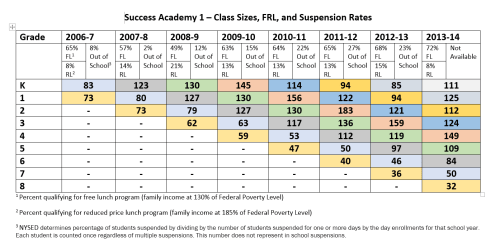
Finally, we know that Moskowitz is being highly selective in her story because of the data.  Let’s take her at her word that Mr. Fucaloro was a demanding but highly effective and appreciated teacher in his public school career.  Not to take anything away from that, but he is hardly unique in that regard. There are countless public school teachers who work hard to effectively establish the learning environment for their students.  Lots of teachers set high expectations for both learning and behavior, so that is hardly unique either.  However, just demonstrating and proving tracking and other techniques, as Moskowitz claims, is hardly all that happened in the early days of Success Academy.  Consider the following table, compiled from NYSED data:

SA1 Data

Two items are of note here.  First, the pattern of student attrition is curious.  Success Academy has not backfilled vacated seats after third grade until this year and still only does so through fourth grade, claiming that admitting new students unused to Success Academy methods would be detrimental.  It is therefore not surprising to see how many of the cohorts in the chart show drop offs around third and fourth grades – any students who left the school were not replaced as is required policy for fully public schools.  This pattern repeats cohort after cohort with growth in early grades, followed by sharp winnowing accumulating over time.  The third Kindergarten cohort is especially noteworthy, growing from 130 students in 2008 to 136 by third grade before shrinking to 109 two years later in fifth grade, an almost 20% change.  Remember, every student who begins at a Success Academy represents a family that went out of its way to seek out that school.

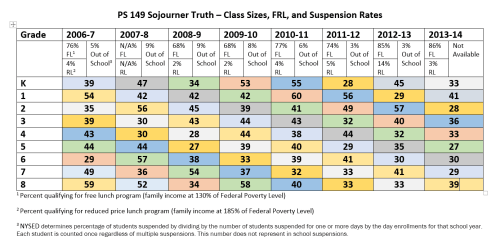
The second item is the dramatic growth in out of school suspensions.  NYSED reports the percentage of students suspended in a given school year, which does not account for single students suspended multiple time nor does it account for in school discipline.  In its first two years, Success Academy 1 suspended 8% and 2% of its students respectively. Over the next five years, however, those numbers jumped to 12%, 15%, 22%, 27%, and 23%.  These figures are eye-watering, and to compare, we can look at the same data from PS149 Sojourner Truth, the zoned K-8 public school co-located with Success Academy 1 grades Kindergarten through 4th grade:

PS149 Data

Of course, cohorts in PS149 do experience attrition as well, sometimes significant attrition, but there is no specific pattern of when students leave the school or of when cohorts shrink or grow.  However, the most striking difference is the out of school suspension rates which top out at 9% and are as low as 3% for two successive years.  Whatever else is happening at PS 149, the school is not heavily wielding out of school suspension with its students.

What does this mean?  The most obvious inference is that even if Moskowitz is being truthful and that Mr. Fucaloro is an astonishing teacher who was quickly able to establish a well disciplined and effective classroom environment where others struggled, it was far harder to scale up that level of discipline and effectiveness without massively increasing punitive disciplinary consequences, including out of school suspension rates nine times higher than a co-located school in the 2011-2012 school year.  The “secret sauce” at Success Academy’s setting of behavior for its students is not duplicating “the most gifted educator” Moskowitz has ever met – it is sending very young children home from school, sometimes until their parents give up and go away.

By the way, the out of school suspension rate for 2011-2012 at Upper West Success, a school where 29% of students qualify for free lunch and 10% for reduced price lunch?  5%.   Apparently suspension rates in the high 20s are a necessity for schools where 78% of the students are in or near poverty.

None of this is really surprising to those who have been paying attention over the years, but what is surprising is Moskowitz’s inability to resist mythologizing herself and her schools — when the people she is telling myths about are on record with the press and when the school’s use of heavy handed suspensions is not in dispute.  Then again, maybe it isn’t surprising.  Moskowitz provides a big and likely inadvertent insight into her thought process:

Some critics find our approach rigid and overbearing. I’ve got two of these critics in my own home: my kids, who attend Success. They complain when they get into trouble for not tracking the speaker. They were listening, they protest. Maybe so. But sometimes when kids look like they’re daydreaming, it’s because they are, and we can’t allow that possibility.

“Daydreaming….and we can’t allow that possibility.”  Nobody denies that a well managed environment where students are attentive is a big part of successful teaching.  Nobody even denies that some teachers have an incredible capability for that and others can learn from them.  But at the point when your desire for order and control cannot allow the “possibility” that a very young child might occasionally daydream during a long school day, you are no longer practicing classroom management.

You are engaging in a pathology.

7 Comments

Filed under charter schools, classrooms, Data, teaching

Who Was The Last “Education President”?

On September 25th, 1988, Vice President George H.W. Bush, then the Republican nominee for President, was in a debate with his Democratic Party rival, Massachusetts Governor Michael Dukakis, and declared that he wanted to be “The Education President.”

I want to be the education President, because I want to see us do better. We’re putting more money per child into education, and we are not performing as we should. […] And I would like to urge the school superintendents and the others around the country to stand up now and keep us moving forward on a path towards real excellence.

Eventually, the Republican nominee would become President George H.W. Bush, and his education agenda was a continuation of the path forged under Ronald Reagan that led to the era of test-based accountability.  Presidents and Presidential aspirants have all set their sights on making an impact on our nation’s education system, whether it was Bill Clinton calling for 90% graduation rates and “meaningful” national examination standards, or George W. Bush claiming standardized test scores were stagnant and promoting new accountability for teachers and students – including a system of rewards and punishments that would become known as No Child Left Behind, or Barack Obama promising more aid to the neediest schools, touting merit pay plans, and decrying too much focus on testing.

But who was the most recent occupant of the Oval Office who deserves the title “The Education President”?  When was the last time an American President signed into law an education bill that has had a substantial, sustained,  and positive impact upon education?

Gerald Ford.

This is not sarcasm because it was President Gerald Ford who, on November 29th, 1975, signed PL94-142, also known as the Education for All Handicapped Children Act, into law.  President Ford issued a signing statement expressing his concern that the law would cost too much, but over its 40 year history and re-authorization as the Individuals with Disabilities in Education Act (IDEA), the legislation has improved educational opportunities and outcomes for millions upon millions of students who had previously faced neglect and discrimination within school.  While the law continuously needs reflection and improvement, especially in the realm of federal funding which has never approached the 40% promised by Congress in 1975, the legislation remains a landmark that provides the basis for a vastly expanded mission for our nation’s schools and progress towards fulfilling opportunity for all.

Ford

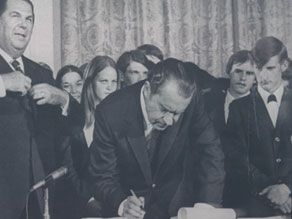
PL94-142 was not an isolated case of federal legislation signed by the President improving our nation’s schools.  President Richard Nixon signed the Rehabilitation Act of 1973 that included Section 504, providing protection from discrimination based on disability when an employer or organization receives federal funding.  Section 504 meant that schools could not bar students with physical and mental impairments from receiving an education and required them to provide a free and appropriate public education (FAPE) to all qualified students.   Prior to signing this legislation, President Nixon signed the Education Amendments of 1972 which included Title IX, stating, “No person in the United States shall, on the basis of sex, be excluded from participation in, be denied the benefits of, or be subjected to discrimination under any education program or activity receiving Federal financial assistance.”

Nixon

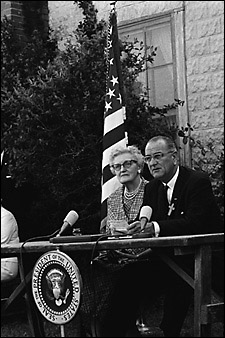
President Lyndon Johnson, following the landmark Civil Rights Act, signed the Elementary and Secondary Education Act (ESEA) into law on April 11th, 1965.  The original law provided federal funds for research, strengthening state departments of education, and, perhaps most importantly, funding to assist the schooling of low income students, and among its earliest amendments were provisions for handicapped children and bilingual education programs.  The Title I provisions, especially, noted the inequitable ways in which schools are funded using property tax revenues that immediately place communities with high percentages of low income families at a disadvantage.  Although the ESEA has since been subsumed by the standardized test based accountability regime of the 2001 amendments known as No Child Left Behind, the original legislation was intended to help with President Johnson’s “War on Poverty” by bringing resources that only the federal government could leverage to schools serving our neediest children.

Johnson2

Indeed, that focus upon using federal reach and the enforcement of civil rights to expand resources available to schools while requiring them not to discriminate upon race, gender, language spoken, or disability status marked a robust period of education legislation premised upon equity and the recognition that certain populations of students were historically marginalized and required direct action of the law aimed at states and municipalities that might have otherwise ignored them.  In many regards, these efforts were astonishingly successful.  In 1971, before the passage of Title IX, women were 3.7 million of 8.9 million college students.  In 1991, they were 7.7 million of 14.1 million.  Before the passage of PL94-142, 5.9% of students in public schools were identified as disabled with no data available on the numbers with specific learning disabilities.  In 1989, 11.4% of students were identified as disabled, including more than 2 million classified with specific learning disabilities.  These efforts were substantive, aimed at increasing access and equity, and their positive benefits have continued for decades and likely more to come.

Since then?  Not so much.

President Ronald Reagan, after campaigning on abolishing the newly minted cabinet seat of Secretary of Education, set education policy away from equity and opportunity and into standards and accountability with the harsh language of school failure that has dominated our discussion  ever since the 1983 publication of A Nation At Risk:

If an unfriendly foreign power had attempted to impose on America the mediocre educational performance that exists today, we might well have viewed it as an act of war. As it stands, we have allowed this to happen to ourselves. We have even squandered the gains in student achievement made in the wake of the Sputnik challenge. Moreover, we have dismantled essential support systems which helped make those gains possible. We have, in effect, been committing an act of unthinking, unilateral educational disarmament.

Our society and its educational institutions seem to have lost sight of the basic purposes of schooling, and of the high expectations and disciplined effort needed to attain them. This report, the result of 18 months of study, seeks to generate reform of our educational system in fundamental ways and to renew the Nation’s commitment to schools and colleges of high quality throughout the length and breadth of our land.

The Reagan Administration followed in 1988 with amendments to the ESEA requiring states to “document and define” academic achievement for disadvantaged students using standardized test score measures, and ESEA funds began being tied to academic performance of disadvantaged children.  President George H.W. Bush proposed his “America 2000” legislation calling for national standards and testing of students but which failed due to conservative opposition in the Senate.  Standards based education policies were similarly advanced, however, by President Bill Clinton whose “Goals 2000” agenda focused upon student achievement, tougher academic standards, application of those standards to all students, and monitoring reform efforts via standardized testing.

The stage, then, was well set by three previous administrations for the 2001 re-authorization of the ESEA which was touted as “No Child Left Behind” by President George W. Bush.  NCLB required all schools to demonstrate annual yearly progress for all students in all subgroups, and failure to meet AYP for five years in row could result in school closures, turning schools over to private charter operators, or giving school operation to private or state managers.

Upon passage, the law enjoyed support in both parties and numerous civil rights organizations, and the logic of that is not difficult to understand.  By 2001, wide gulfs in test measured achievement remained stubbornly persistent between well off, mostly white, suburban communities and their poor, most African American and Hispanic, urban counterparts, and the language of NCLB demanded that states and municipalities address that through accountability systems with little wiggle room.  Given the undeniable need for federal action in both civil rights and expansion of educational equity in the 1960s and 1970s, the federal accountability in NCLB was a logical, if ill-fated, marriage of federal standards and accountability efforts with vigorous enforcement from Washington.

The ill-fated portion of that assessment lies with what was obvious from the beginning: by tying lofty goals to punishing consequences dependent entirely upon the results of standardized testing, NCLB unleashed entirely predictable and increasingly damaging consequences to the depth and breadth of curriculum enjoyed by children, especially children in schools labeled as struggling:

In contrast, since the advent of No Child Left Behind (NCLB), with its high stakes for schools, the traditional pattern of time allocation across subjects in elementary schools has changed markedly. Five years into NCLB, researchers found that 62 percent of a nationally representative sample of all districts in the United States—and 75 percent of districts with at least one school identified as needing improvement—increased the amount of time spent on language arts and math in elementary schools. These increases were substantial: a 47 percent increase in language arts and a 37 percent increase in math. Correspondingly, these districts decreased time allotted to other subjects and activities, including science, social studies, art, music, physical education, and recess (McMurrer, 2007).

President Barack Obama campaigned in 2008 as a Presidential aspirant who was aware of these fact, deriding the test and punish focus of the law, the lack of resources given to schools and teachers working with struggling students, and the teaching to the test that was incentivized by the law:

“Math and science are not the opposite of art and music. Those things are compatible and we want kids to get a well-rounded education. Part of the problem we’ve had is that ‘No Child Left Behind,’ the law that was passed by Bush, said we want high standards, which is good, but they said we are going to measure those high standards only by a single high stakes standardized test that we are going to apply during the middle of the school year…a whole bunch of schools said we gotta teach to this test, and art and music isn’t tested… It’s a shame.”

In reality, the administration of President Barack Obama, while loosening some of the proficiency targets of NCLB, has plainly made the most problematic aspects of the law even worse, and quite likely earning President Obama the label as the worst President for education policy in the post-World War II era.  President Obama, acting through Secretary of Education Arne Duncan, has made testing an even bigger focus of school by coercing states to adopt invalid and unproven measures of teacher performance using standardized tests.  Instead of merely working in a school that faces negative consequences based on test scores, teachers themselves face career sanctions if they do not “adequately” raise student test scores.  President Obama’s Department of Education has lavished money and favorable policies upon the charter school sector while thoroughly failing to oversee the money it has dispersed.   The administration was so interested in fulfilling the long held goal of national standards, that it helped the Gates Foundation push through rushed and unproven standards to almost all states by using the promise of federal grants and waivers from NCLB provisions.  These changes have been touted as voluntary and “state led,” but when Washington state did not pass legislation tying teacher evaluations to student growth measures, the Obama DOE brought down the hammer and revoked its waiver.

Today, 32 years after the beginning of the standards and accountability movement, 14 years into the test and punish era of school accountability, and almost 7 years into the Obama administration’s doubling down on standardized testing to measure teachers, teacher morale is at all time lows and the nation’s teacher preparation programs are struggling to find candidates.  Far from continuing the vital work of expanded opportunity and equity that spanned administrations from President Eisenhower’s use of federal troops to desegregate Central High School in Little Rock, Arkansas to  President Ford’s signing of PL94-142, the past five administrations have slowly tightened the grip of standardized testing on our schools until they have become a warped goal in and of themselves and have damaged the very children supposedly helped by them.  Standardized tests used to sort children have always disproportionately harmed poor children and children of color, and the frequent, high-stakes, accountability testing of NCLB has both narrowed the curriculum and slowed progress in closing the achievement gap, progress that saw its most sustained and dramatic gains in the 1970s.

So what has been missing from the education policies of Ronald Reagan, George H.W. Bush, Bill Clinton, George W. Bush, and Barack Obama? Equity.  The educational policies that came to fruition via the original ESEA, Title IX, Section 504, and PL94-142 all were premised on the federal role of expanding resources and equity for children facing discrimination in school and society at large.  They marshaled funding and rules for schools so that they could not deny either access or equity, and they tasked the federal government with treating these as matters of civil rights.  More recent “reform” efforts are entirely about accountability without increasing the resources available to schools in order to meet those goals in a meaningful way, nor does “reform” specifically address the conditions within which schools exist, leaving them with the sole responsibility to uplift all children regardless of circumstance.  Where once federal education efforts sought to increase access to education and to increase the resources available for that education, today it demands that school increase performance in all situations without any other state actor taking responsibility for the well-being of the children in school.  David Berliner noted this in 2006:

It does take a whole village to raise a child, and we actually know a little bit about how to do that. What we seem not to know how to do in modern America is to raise the village, to promote communal values that insure that all our children will prosper. We need to face the fact that our whole society needs to be held as accountable for providing healthy children ready to learn, as our schools are for delivering quality instruction. One-way accountability, where we are always blaming the schools for the faults that we find, is neither just, nor likely to solve the problems we want to address.

We won’t have a President who deserves the title “The Education President” until we once again have a public servant in the Oval Office who sets equity of access and equity of resources as primary goals of federal education policy.  Five administrations ignoring the lessons of history and the evidence of research is enough.

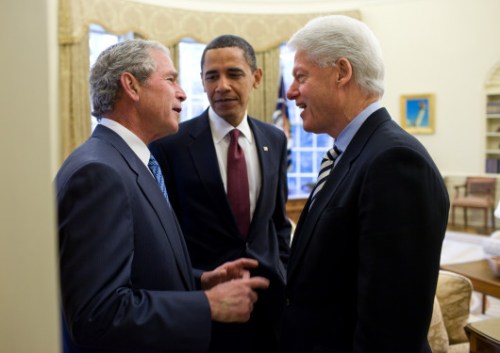
obama-bush-clinton-530x375

“Wait, you hated your teachers too?”


5 Comments

Filed under Activism, Arne Duncan, charter schools, Common Core, Funding, Gates Foundation, NCLB, politics, schools, Social Justice, standards, Testing, VAMs

Dr. John King Jr.’s Experience and the Failures of Today’s Reform

When current U.S. Secretary of Education Arne Duncan announced that he would step down at the end of this calendar year, President Obama immediately stated that current deputy secretary and former Commissioner of the New York State Education Department, Dr. John B. King, Jr. would replace him in January.  Supporters of the Secretary designee took to Twitter with #ISupportJohnKing, touting his personal biography and what they called his lifelong experience in education.  It is undeniable that Dr. King has an immensely impressive, even inspirational, biography.  Orphaned at a young age, the future Secretary of Education credits New York City school teachers with “saving” him, and he has built upon his obviously prodigious academic talents to earn degree credentials second to none.  After a short stint teaching, he co-founded the Roxbury Prep charter school in Boston before helping to lead the Uncommon Schools network of no-excuses charter schools.  He was tapped in 2009 to become the assistant commissioner of education at NYSED, and in 2011, he was elevated to the Commissioner’s office at the age of 36.  It is without question, that he is a man of enormous drive and intelligence, and, as his supporters say, he has extensive experience in the field of education.

But what if it is totally the wrong experience?

This is not an idle question because while public education advocates often note how frequently major proponents of reform have no practical experience in education before being elevated to positions of influence and authority, all experience is not equivalent, and there is plenty of evidence that Dr. King’s experience in education leaves him ill prepared for the political exigencies of educational leadership outside of the no-excuses charter sector.  In fact, the first time in his long career in education that Dr. King was truly answerable to political and parental constituencies was when he was elevated to lead the NYSED, and it was a disaster.  While informed and dogged in pursuit of the policies which landed him his office, he demonstrated no legitimate understanding that he was leader of a system of education that depended upon support from lawmakers, parents, and the body politic in general.  Policies on the Common Core State Standards and associated testing were both disruptive and demanding with little effort to help teachers and families adjust, and promises to listen to what educators were saying about policies went unfulfilled.  Public meetings where parents voiced their opinions on new state policies did not go well, forcing him to cancel scheduled meetings and change the format to decrease his contact with constituents.  Lawmakers similarly found Dr. King unresponsive to their concerns, leading to a rare display of bipartisan sentiment in Albany as legislators called for his removal.

While I know many critics of education reform in general and of John King in particular who have a wide range of opinions on why his tenure at NYSED was as stormy as his public affect was passive, the simplest explanation that I can see is that there is nothing in Dr. King’s experience that remotely prepared him for the responsiveness needed in our fully public school system.  When he took the Commissioner’s office at NYSED, that was the first time in his entire career in various sectors of education where he was accountable to the political constituencies that have voice in public education policy and practice.  Consider his role as a charter school leader.  While the charter school sector is publicly funded, it is not remotely fully publicly accountable.  Some charter operators are exceptionally aggressive in defending themselves from public oversight, but all of them are deliberately separated from the democratic processes that oversee the funding and operation of our fully public schools.  A school principal is a an educational leader and a political figure with constituencies among elected officials, taxpayers, parents of children in the school, the children themselves, and teachers.  Public school superintendents are similarly situated although at a higher level than school principals.  Charter school operators excuse themselves from much of that, periodically subjecting themselves to review by their authorizing bodies, but otherwise functioning not only outside of local, elected accountability systems, but often excusing themselves from following education law – and gaining support from the courts to do so.

Even in responsiveness to parents, charters are not particularly obligated to be especially deferential.  The “no excuses” sector of charter schools in particular tends to place heavy demands upon parents and vigorously enforces narrow behavioral norms on children as young as five years old.  Since charter schools are schools of choice, the response to any parent concerned over disciplinary or academic practices can be limited to “maybe this isn’t the school for you” or other means to counsel out families.  The Uncommon School Network that Dr. King led before joining NYSED is an exemplar in this respect with Roxbury Prep inflicting a 40% out of school suspension rate upon its students in 2013-2014 (which, sadly, is an improvement on a the previous school year’s 60% out of school suspension rate).  This pattern is typical among the entire Uncommon Schools network which have much higher suspension rates than their neighboring schools in the three state where they operate.  And since there is no political authority to which charter schools need to answer and since parents who dislike these policies do not have to be considered, it is hardly surprising that many such school demonstrate stunning cohort attrition rates, such as North Star Academy, an Uncommon affiliate in Newark, New Jersey, where only 25% of African American boys who enroll in 5th grade are likely to make it to 12th.

This level of inflicted control without giving voice to any constituency was and apparently still is unproblematic to Dr. King who points to the measured outcomes for the students who manage to adapt to and remain within the system.  Dr. Pedro Noguera of New York University, speaking at the Courageous Schools Conference in 2011, recalled a visit to Roxbury Prep where he asked Dr. King a pointed question about the type of messages his students were receiving:

I’ve visited this school, and I noticed that children are not allowed to talk in the hall, and they get punished for the most minor infraction. And when I talked with John King afterwards, I said, “I’ve never seen a school that serves affluent children where they’re not allowed to talk in the hall.” And he said, “Well, that might be true, but this is the model that works for us, we’ve found that this is the model that our kids need.”

So I asked him, “Are you preparing these kids to be leaders or followers? Because leaders get to talk in the hall. They get to talk over lunch, they get to go to the bathroom, and people can trust them. They don’t need surveillance and police officers in the bathroom.” And he looked at me like I was talking Latin, because his mindset is that these children couldn’t do that.

It is unlikely that there is a competent principal or superintendent of schools in the country who would be surprised to face questions about methods and policies, but Dr. Noguera’s recounting demonstrates the extreme limitations of John King’s experiences.  His extreme focus and concentration upon executing an agreed upon set of priorities are traits that serve executives well in the business world (although even there an ability to pause, evaluate, and change direction are necessary), but in our fully public schools that focus has to be tempered by full awareness of and a degree of deference to the overlapping and sometimes in conflict constituencies that oversee, fund, and participate in our schools.

This is trickier than most expect.  A typical school district looks like a highly integrated, top down system of management that is mostly analogous to a corporate structure.  You have an elected school board (corporate board elected by shareholders) that hires a superintendent of schools (CEO) who is then responsible for hiring various central office administrators (corporate vice presidents and other chief officers) and school administrators (upper and management) who in turn hire and manage classroom teachers (customer contact personnel).  From the outside it looks very neat and corporate with an easy flow of directives from the top of the organization all the way down to the classroom, but the reality is far more complicated than that and of necessity.  When Karl Weick analyzed the concept of “loosely coupled systems” he used educational organizations as a clear exemplar precisely because tight top down control is not truly compatible with how schools and school systems work, which actually lends a number of clear advantages to the system.  Within the loosely coupled system, different elements of the organization are connected to each other, but each retains significant individual identity and may only influence the behavior of the others indirectly.

A result of this is how different relationships and associations that exist outside of the formal organizational chart of the school system can exert a great deal of influence upon how the school system responds to needs both inside the school and within the community.  Phil Cusick explains how this operates in his 1993 work, The School System: Its Nature and Logic:

Of the different types of associations in the system, the primary is the designation of the formal organization’s participants according to role and status…..

A second type of association in the personal but purposeful relations among those with formal designation and within the formal system….Each chapter in this book reveals participants deciding how they will behave and seeking out colleagues inside the organization with whom to act out their decisions.  The formal organization is filled with these personal and purposeful associations, too numerous to be formally recognized, which operate inside and drive the organization.

The third type of association consists of those that join people inside with people outside the schools. The system is replete with freestanding, single purpose associations that include parents, students, policymakers, critics, change agents, teachers, and administrators, combining their efforts to achieve some end.  These are the most interesting, because they reveal the breadth of the system and thereby justify the assertion that the system extends far beyond the schools….

…Not only do those outside seek to influence those inside.  Those inside and those outside are part of the same system.  They adhere to the same principles of free conscience and free association, and they join efforts and act out their visions of education in the same arena.  This constant shifting into multiple and overlapping groups and groups into coalitions is what makes school board politics, as described by Cuban (1975), so entertaining. It is also why school administrators tend to be cautious and to regard their communities warily.  Their authority is always open to challenge by one or another group: either one of the system’s recognized groups or a group organized for the purpose of opposing an administrative action. (pp. 219-221)

To be certain, such associations have not always protected students’ interests, especially students in the Jim Crow era where local “interests” maintained White Supremacism, but powerful associations of advocates for children of color, for students with disabilities, for gender equality, and for LGBT students have used these same mechanisms to influence change at every level of the system.  The weakness of Dr. King and of many of today’s reform advocates in understanding and navigating these systems should be apparent, and their general surprise at the backlashes they have faced further indicates their lack of understanding of the how the system operates.  Bill Gates himself openly admitted “The cities where our foundation has put the most money is where there is a single person responsible. In New York, Chicago and Washington, DC, the mayor has the responsibility for the school system.” That may have been expedient in pushing his favored reforms from the top into schools, but it has pretty well failed to win over lawmakers, teachers, and parent constituencies who still operate within a system that provides them with the means to influence the direction of policy and have a say in outcomes.

Gates is occasionally able to admit that he was mistaken in an area he intended to reform, but he seems oddly incapable of grappling with why those efforts founder. It seems evident that he has spent precious little time trying to actually understand how public education functions at either the organization or system level.  Similarly, reform advocates who get Gates support, such as John King, often have extremely limited experience with the majority of the education system and seem absolutely flustered when it does not respond like the tightly controlled systems they prefer.

This does not mean, of course, that people with extensive experience in the education system will reject the reforms embraced by Gates and his beneficiaries.  Dr. King’s successor in New York State is Commissioner MaryEllen Elia, and she has precisely the kind of biography that would teach one how to operate a statewide school system – and she is as dedicated to common standards and mass standardized testing as anyone in the country.  That’s a talent set that seems in short supply on the reform side of the debate, and until they stop acting as if public input is something that can be bullied out of the way or papered over with slick ad and social media campaigns, they will continue to lurch about our schools, running into growing opposition to their priorities.

3 Comments

Filed under Arne Duncan, charter schools, Gates Foundation, John King, MaryEllen Elia

When is a Pledge to Decrease Testing Not a Pledge to Decrease Testing?

Apparently, when President Obama makes it.

Honestly, at this point in his administration, expecting President Obama to well and truly take action to reverse the damage of the “test and punish” era of school accountability is like expecting the Bush administration to not start unnecessary wars.  That, however, did not prevent the national media from declaring that President Obama’s weekend call for reducing the burden of standardized testing in public schools a major departure from previous policies.  David Dayen of Salon gushed that the President was breaking “with twenty years of precedent,” and Mother Jones’ Julia Lurie wrote that “the announcement represents a significant change in course for the Obama administration.” Nearly every major news outlet declared the announcement a move to limit the time spent on standardized testing in school, and American Federation of Teachers President Randi Weingarten hopefully declared the announcement a move towards fixing an urgent problem in education today:

People deeply informed on the issue of high stakes testing and its warping impact on our schools are far less hopeful than President Weingarten and not remotely as gushing as the national press.  Peter Greene of Curmudgucation held no punches over the weekend, flatly declaring that the Obama plan “sucks and changes nothing.”  His key points are entirely accurate and properly cut through the smoke and mirrors of the announcement to a purpose more aimed at trying to trick anti-testing advocates into complacency:

The fact that the administration noticed, again, that there’s an issue here is nice. But all they’re doing is laying down a barrage of protective PR cover. This is, once again, worse than nothing because it not only doesn’t really address the problem, but it encourages everyone to throw a victory party, put down their angry signs, and go home. Don’t go to the party, and don’t put down your signs.

Anthony Cody of Living in Dialogue noted, quite correctly, that President Obama has sounded this note before and utterly failed to follow through with anything that would diminish the punishing role of current testing policies.  The administration apparently hopes the announcement and some minor shifts will allow them to bide their time while changing very little:

First, President Obama remains unaware of the very limited educational value of standardized tests, and second, the administration remains absolutely committed to tests playing a key role in America’s classrooms. As some have pointed out, now that the PARCC and SBAC tests are here, and have plainly failed to deliver on Duncan’s 2010 promise that they would measure creativity and critical thinking so much better than any previous test, now we are looking forward to the NEXT generation of tests, which will be “competency-based.” Cue the test vendors for another multi-million dollar development project.

No matter how bad the current tests are, the new and better tests are always just around the corner. And anyone who dares to question this optimistic projection is a Luddite afraid of accountability.

Dr. Audrey Amrein-Beardsley, an expert on value added measures at Arizona State University, was not impressed with the announcement either, noting that the proposed 2% limit on time spent on testing would still mean 18 hours of annual standardized test taking time for most students.  She further observed:

In addition, all of this was also based (at least in part, see also here) on new survey results recently released by the Council of the Great City Schools, in which researchers set out to determine how much time is spent on testing. They found that across their (large) district members, the average time spent testing was “surprisingly low [?!?]” at 2.34%, which study authors calculate to be approximately 4.22 total days spent on just testing (i.e., around 21 hours if one assumes, again, an average day’s instructional time = 5 hours). Again, this does not include time spent preparing for tests, nor does it include other non-standardized tests (e.g., those that teachers develop and use to assess their students’ learning).

So, really, the feds did not decrease the amount of time spent testing really at all, they literally just rounded down, losing 34 hundredths of a whole. For more information about this survey research study, click here.

Interestingly, the 2% idea apparently comes from Secretary Duncan’s slated replacement, former New York Commissioner and current senior adviser, Dr. John King Jr. who puts such a limit in place in New York in order to placate growing concerns over the dominant role of standardized testing in the state.

Well, we all know how that turned out, right?

Perhaps most damning was the scathing response penned by Robert Pondiscio for US News and Word Report.  Mr. Pondiscio is a senior fellow at the Thomas B. Fordham Institute, a conservative think tank that has been highly supportive of the Common Core and associated testing, an adviser to the Democracy Prep chain of no-excuses charter schools, and while he is generally well disposed to the data from standardized testing, he has also been willing to question to impact of the stakes attached to them in the current environment.  That questioning was in overdrive in his commentary:

But one would have to be cynical or naive not to understand that the moment you use tests, which are designed to measure student performance, to trigger various corrective actions and interventions effecting teachers and schools, you are fundamentally shifting tests from providing evidence of student performance to something closer to the very purpose of schooling. This is precisely what has been occurring in our schools for the last decade or more. When parents complain, rightfully so, about over-testing, what they are almost certainly responding to is not the tests themselves, which take up a vanishingly small amount of class time, but the effects of test-and-prep culture, which has fundamentally changed the experience of schooling for our children, and not always for the better.

The Obama talk on testing seeks to curry favor with parents and teachers (and their unions) while doing nearly nothing to change the fundamental role of testing and its effect on schooling. It’s all well and good to “encourage” states, districts and schools to limit testing, but as long as test-driven accountability measures, which are driven substantially by federal law, are used not to provide feedback to parents and other stakeholders but to trigger corrective measures in schools, it won’t matter if children take two tests or 2000; the effects will be the same.

While I question the degree of positives that Mr. Pondiscio lavishes upon standardized testing data (“the life-blood that courses through the arteries” – really?), I am not, myself, against limited standardized testing being part of a comprehensive system of school monitoring and being the very beginning point of school improvement efforts.  What is most striking to me is how clearly, however, that Mr. Pondsicio has identified the problem with the perverse incentives testing has placed upon our schools in the era of No Child Left Behind and Race to the Top:  The stakes placed upon the tests have transformed their purpose from being “in the background” monitors of schools, school systems, and state performance into being objects unto themselves.  The tests and “adding value” to student performance on them have become a substantial purpose of education instead of a by product of a rich and meaningful educational program.

That’s a problem, and it is good that someone prominent in education reform circles has noted it for some time now and is willing to go on record in a major publication to call President Obama and his education team to the mat for it.  Mr. Pondiscio, who says test based measures are the most reliable and objective teacher evaluation tool, appears willing to give that up because its side effects have driven teachers away from the Common Core and from any testing whatsoever.  I disagree vigorously with the idea that test based measure are either reliable or objective (and the bulk of the research evidence is on my side on this), but I actually sympathize with Mr. Pondiscio’s predicament and his apparent frustration that the administration steadfastly refuses to get it.  I have written on this before, urging reformers who really want a chance at building support for common standards and who value the use of standardized testing at all to decouple them from high stakes before popular revulsion violently swings the pendulum out of their reach for the next two decades.  Common standards, done thoughtfully and carefully (the Common Core were not) and disseminated by genuine common interest among states entering fully voluntary partnerships (the states in Common Core did not) and offered to teachers with appropriate time for development of their own knowledge and curricula with high quality materials (teachers in Common Core states never got that) is a defensible proposition.  Comprehensive system monitoring that uses standardized test data limited to the purposes for which it can work well is also entirely defensible.

It is also swirling in the drain reserved for ideas that end up flushed out of the education system, and Mr. Pondiscio appears aware that he has many of his own allies to blame for it, and, hence, his frustration.  The problem, however, is one that his allies in Washington and various state capitols also seem unwilling to acknowledge, and unless, they do acknowledge it, they have little incentive to back off of testing policies tied to high stakes.

The problem is that they are lazy.

School accountability and improvement is difficult and often uncertain work.  When used honestly, standardized test score data can tell you where to begin, but it should never be confused with evidence of what needs to happen in a school.  Are there schools with low test scores and low value added that are Dickensian nightmares that should be closed as soon as possible?  Sure.  There are 98,000 public schools in the country.  But there are also schools with low test scores and low value added that are full of devoted teachers, strong school leaders, and committed parents, but who need resources to provide genuine educational opportunities for all learners and to do so in a way that does not cheat them of a well-rounded and holistic education.  For that matter, there are schools that boast of their great test scores and high value added, but they get there by being Victorian work houses worthy of Scrooge where children are basically beaten into submission.

The point is that you do not know until you go to the school and actually investigate.

But the Arne Duncans and the John Kings do not want to do that.  They want to sit in offices in Albany and Washington, look over spreadsheets, and make sweeping judgements about which schools are winners and which schools are losers.  They cannot really give up the high stakes attached to the standardized tests because that would mean they would have to do the hard of work of accountability and renewal, the work that actually can inform smart choices based upon community input.

And we can’t have that, now, can we?

3 Comments

Filed under Arne Duncan, Common Core, John King, Testing, VAMs

Lies, Damned Lies, and PARCC Scores

In February of this year, as communities and schools in New Jersey were awaiting the arrival of PARCC testing, I wrote this opinion piece for the Bergen County Record.  In it, I said:

What can be expected? If experiences of other states that have already implemented PARCC- and CCSS-aligned exams are illustrative, New Jersey’s teachers, students and parents can expect steep declines in the percentage of students scoring in the higher levels of achievement. Neighboring New York, for example, has its own Pearson-designed CCSS-aligned exam, and the percentage of students scoring proficient or highly proficient was cut essentially in half to roughly 35 percent for both math and English….

….There is no reason to believe that 11th-graders today are any less skilled than their peers who took the HSPA last year or who took the NAEP in 2013, but there are plenty of reasons to believe that a drop in scores on PARCC will be exploited for political purposes.

It is a terrible burden being proven correct so often.

The New Jersey DOE released its report on the statewide results on PARCC this week, and immediately their meaning was thoroughly misrepresented by the media and by state Commissioner David Hespe. Writing for NJ.com, Adam Clark said that the results mean “The majority of New Jersey students in grades 3 through 11 failed to meet grade-level expectations on controversial math and English tests the state says provide the most accurate measurement of student performance yet.”  In the same article, Commissioner Hespe is cited as saying:

Overall, the results show that high school graduation requirements are not rigorous enough for most students to be successful after graduation, state Education Commissioner David Hespe said. The 2014-15 results set a new baseline for improving student achievement, he said.

“There is still much work to be done in ensuring all of our students are fully prepared for the 21st century demands of college and career,” Hespe said.

Neither claim is remotely based on a factual representation of what these test scores mean.  As my colleague Dr. Chris Tienken noted:

https://twitter.com/ChrisTienken/status/656907630825353217

To begin with, the statement that the majority of students “failed to meet grade level expectations” is entirely dependent upon the “meets expectations” and “exceeds expectations” being a proper representation of “grade level” work for each year tested.  There is no basis for making this determination.  PARCC has not provided research to bolster that claim, and, more importantly, we know that reading passages in the exam were specifically several grade levels above what can be developmentally expected of different aged readers.  Russ Walsh of Rider University analyzed sample PARCC reading passages that were available in February of this year, and he found that using most agreed upon methods of determining readability that they were inappropriate for use in testing.  There is no justification for such choices in test design unless the test makers want to push the cut scores for meeting and exceeding expectations well above what the median student is even capable of developmentally.  It is therefore entirely unjustifiable to call these examination results proof that our students are not doing their work “at grade level,” and honestly, it is getting damned tiring to have to repeat that endlessly.

Commissioner Hespe’s comments were no more helpful, and certainly were not based in facts.  The Commissioner repeated the often heard claims that the PARCC exams represent a more appropriate set of skills to demonstrate that our students are “ready” for the 21st Century and to measure their “college and career readiness,” but the justifications for those claims have never been subjected to public scrutiny.  While the language of “college and career readiness” is slathered all over the Common Core State Standards and the aligned examinations written by PARCC and SBAC, repeating a slogan is a marketing tool rather than research validation.  Five years after the standards were rammed through into 43 states and the District of Columbia, we are no closer to understanding the validity of the claim that the standards embody “college and career readiness” nor are we closer to knowing that the examinations can sort out who is or is not “ready.”

Further, the Commissioner’s claim that the test results “prove” that New Jersey high school graduation requirements are “not rigorous enough for most students to be successful after graduation” rests on two unproven contentions: 1) that PARCC actually is sorting those who are “ready” for college and careers from those who are not and 2) students who do not score “at expectations” or above can blame any lack of success they have later in life on their primary and secondary education rather than on macroeconomic forces that have systematically hollowed out opportunity.

Let’s consider the first part of that claim.  PARCC claims that its Pearson written exam is a “next generation” assessment that really requires students to think rather than to respond, but does it actually achieve that end?  Julie Campbell of Dobbs Ferry, New York, has had experience with students taking the New York common core aligned examinations which are also written by Pearson, and while she is supportive of the Common Core Standards, she is highly critical of the caliber of “thinking” the exams require:

The four-point extended response question is troubling in and of itself because it instructs students to: explain how Zac Sunderland from “The Young Man and the Sea” demonstrates the ideas described in “How to be a Smart Risk-Taker.”  After reading both passages, one might find it difficult to argue that Zac Sunderland demonstrates the ideas found in “How to be a Smart Risk-Taker” because sailing solo around the world as a teenager is a pretty outrageous risk! But the question does not allow students to evaluate Zac as a risk taker and decide whether he demonstrates the ideas in the risk taker passage. Such a question, in fact, could be a good critical thinking exercise in line with the Common Core standards! Rather students are essentially given a thesis that they must defend: they MUST prove that Zac demonstrates competency in his risk/reward analysis.

So one can hardly be surprised to find an answer like this:

 One idea described in “How to be a Smart Risk-taker” is evaluating risks. It is smart to take a risk only when the potential upside outweighs the potential downside. Zac took the risk because the downside “dying” was outweighed by the upside (adventure, experience, record, and showing that young people can do way more than expected from them). (pg 87)

Do you find this to be a valid claim? Is the downside of “dying” really outweighed by the upside, “adventure”? Is this example indicative of Zac Sunderland being a “Smart Risk Taker”? I think most reasonable people would argue against this notion and surmise that the student has a flawed understanding of risk/reward based on the passage. According to Pearson and New York State, however, this response is exemplary. It gets a 4.

There may not be “one right answer” in an examination like this, but what might be actually worse is that students can be actively coached to submit “plug and play” answers which mimic a style of thinking but which have no depth and, worse, can be nonsensical just so long as they hit the correct rubric markers.

We should also question Commissioner Hespe’s contention that these exams are showing us anything new about our high school graduates and students in general.  They most decidedly are not.  Again, the New York experience is illustrative. Jersey Jazzman does an outstanding job demonstrating that in New York State, even as proficiency levels tumbled off the proverbial cliff, the actual distribution of scale scores on the different exams barely moved at all.  The reason is simple: once raw scores are converted into scale scores on a standardized exam, they, by design, reflect a normal distribution of scores, and it does not matter if the exam is “harder” or not — the distribution of scaled scores will continue to represent a bell curve, and once the previous scores and current scores are represented by a scatter plot, 85% of the new scores are explained by the old scores.  In other words: the “new” and “better” tests were not actually saying anything that was not known by the older tests.  The decision to set proficiency levels so that many fewer students are “meeting expectations” is a choice that is completely unrelated to the distribution of scores on the tests.

So let’s check if we really are concerned that New Jersey students are graduating not “ready for college and careers.”  Here are the statewide scores on PARCC according to the DOE release:

NJ ELA PARCC

NJ MATH PARCC

So this means, in the language of PARCC, that “only” 41% of New Jersey 11th graders are “on track” to be “college and career ready” in English, and “only” 36% of Algebra students are similarly situated (Again, remember that score distributions are likely almost entirely unchanged from the previous state assessments – this is about how high the cut scores are set).  Oddly enough, the DOE pretty much admits that we did not need PARCC to demonstrate this to us because New Jersey participates in the National Assessment of Educational Progress testing every several years, and, wouldn’t you know it, NAEP and PARCC results are not perfectly aligned, but they come pretty darned close (as do SAT and ACT scores):

NJ NAEP AND PARCC

The high school reading and algebra proficiency levels are almost entirely identical comparing PARCC to NAEP.  Dr. Diane Ravitch of New York University sat on the NAEP Board of Governors and has repeatedly explained that both the “advanced” and “proficient” levels in NAEP represent very high level work at the “A” level for secondary students.  So not only have the PARCC scores told us things about our students in NJ that we already knew from NAEP, but also it reaffirms the NAEP findings that over 40% of New Jersey high school seniors are capable of A level work in English and over a third of those students are capable of A level work in Algebra.

If the goal is to have all of our students “college and career ready” by reading and doing algebra at the “meets” and “exceeds expectations” level on a test roughly correlated to NAEP levels indicating A level achievement, then we might as well shut down shop right now because our schools will always fail.  Moreover, we should vigorously question the implication that any student getting respectful if not outstanding grades in core subjects is doomed to failure, and we should certainly question a goal of “college and career readiness” that appears entirely limited to “ready for admission to a 4 year selective college.”  The nonsensical approach of using cut scores to identify the percentage of students likely to seek a 4 year degree and labeling them our only students who are “ready” is based more on a desire to label more schools and students as failures than any other consideration.

The reality is that there are crises relating to education and opportunity both in New Jersey and in the country as a whole.  The first crisis is related to the distribution of opportunity via our education system.  I can walk a few miles from the campus where I teach and find a community where over 70% of the adults over the age of 25 have a college degree, and I can walk a few miles in the exact opposite direction and find a community where that is only 12% of the population.  That is unacceptable and needs to change; it is also something that we knew full well before the PARCC examinations came along, and which we will not address by berating test scores while ignoring the importance of fair and equitable school funding.

The second crisis is in our economy and the simple fact that our economy has shown no signs of actually needing more people with bachelors degrees.  Since 1986, the dollar adjusted wages for people with a BA in the country have grown only by $700, but the college wage premium has grown largely because of the collapse of wages for people without those degrees:

SDT-higher-education-02-11-2014-0-03

Far from needing many more college graduates, which would push wages even further down, we need an economy where people who work full time without a degree can survive well above subsistence level and closer to their college educated peers as they used to before 1980.  Unless Commissioner Hespe and his fellow PARCC supporters are arguing that college really is the new high school – in which case they had better get to work right away finding a way to make it free for everyone because we cannot possibly survive an economic system that both requires everyone to have a specific degree and requires them to accumulate crushing debt in pursuit of it.

(Just a side observation:  remember when PARCC promised that their “next generation assessments” would “help teachers know where to strengthen their instruction and let parents know how their children are doing”?  It is now about half a year later, and those students have been in their NEW teachers’ classrooms for almost 2 full months now. It is far too late for teachers to even use the score reports to make adjustments in their curricula that they were developing all summer long without the PARCC results. If the goal of the assessments was to give teachers actionable data in anything remotely resembling real time, they are a crashing, embarrassing failure, and given the testing schedule in late Spring, they are likely to remain so.)

5 Comments

Filed under Common Core, Opt Out, PARCC, Testing

The Passion of St. Arne

Secretary of Education Arne Duncan will step down at the end of this year, and President Obama has announced that he will be replaced by former New York Commissioner of Education Dr. John King, Jr. as the acting Secretary of Education through the remainder of the administration.  Praising his often embattled Secretary of Education, President Obama said, ““He’s done more to bring our educational system, sometimes kicking and screaming, into the 21st century than anyone else….America will be better off for what he has done.”

We’ll leave that judgement to history.

As is often the case when prominent Washington figures prepare to ride off into the sunset (or out of town under cover of darkness depending on your point of view) it is time for “legacy punditry” to kick into overdrive and attempt to place Secretary Duncan in history.  Most of it is premature.  Quite a lot of it is insipid. And much of it just cannot resist creating a “balanced” narrative whether it is honest or not, which is where, Secretary Arne Duncan, Martyr of the Intransigent Teacher Unions comes into play.  Michael Grunwald of Politico.com wrote just such a piece last week, explaining the the choice of John King signals that President Obama has no intention of backing off any controversial reforms and strongly emphasizing union opposition to both Secretary Duncan and his chosen successor:

Duncan has been the public face of those differences; the National Education Association called for his resignation, while the American Federation of Teachers put him on an “improvement plan” like the ones school reformers have endorsed for incompetent teachers. He is leaving with U.S. graduation rates at an all-time high and dropout rates at an all-time low, but there has been a growing bipartisan backlash over some of his favored reforms, like the Common Core math and reading standards (derided as “Obamacore” by many conservatives) or the use of student test scores in teacher evaluations (derided as “test-and-punish” by unions). I recently mentioned to Duncan that it seems like the main theme uniting his reforms has been the idea that adults in the education system should be held accountable for making sure kids learn. “Just a little bit!” he responded.

That is, shall we say, a very charitable explanation of the central themes in Secretary Duncan’s reform portfolio of Common Core standards, high stakes testing, value added measures in teacher assessment, and favoritism for charter schools despite the ongoing and shocking series of scandals coming out of the sector.  Another way of explaining the Arne Duncan is approach is to ratchet up expectations without increasing supports, mistake things that are harder with things that are better, work hand in hand with one billionaire’s vision of education reform to push through or coerce over 40 states to adopt new standards largely written in secret, and ignore growing mountains of evidence that growth measures from standardized tests are not suited for individual teacher evaluation.  So while Mr. Grunwald may be right to point out union exasperation with Mr. Duncan and concern about his successor, there is a hell of a lot of context to that exasperation that is left out as he tries to balance his piece with current critics of both men.

So let me state it very clearly:  Secretary Duncan in Washington and Commissioner King in New York absolutely were not victims of the teacher unions.  They are victims of their own bull headed insistence in backing abjectly harmful policies even as the evidence mounted that they are harmful.

But that does not make a traditional Washington narrative where if there is one side, there must be an equal and equivalent other side, so the story of President Obama’s embattled Secretary of Education and his soon to be embattled next Secretary of Education is one where the reform side faces implacable resistance from unions seeking to maintain the status quo at all costs.  It is true that the National Education Association called for Arne Duncan’s resignation, and it is true that the American Federation of Teachers put him on a metaphorical improvement plan — last year.  After years of trying to work with education reform.

Both the NEA and AFT were early supporters of the Common Core State Standards and maintain high levels of support for the standards themselves to this day.  The NEA maintains this website on the CCSS, including a “ten facts” section that could have been penned by David Coleman himself, and the AFT is equally optimistic going back to a 2011 resolution urging good implementation.  Both national unions took initially positive views of potentially using student test score data as part of a “multiple measures” approach to teacher evaluation.  Part of the AFT’s 2010 statement on teacher evaluation and labor-management relations reads:

AFT teacher eval 2010

And from the NEA’s 2011 policy statement:

NEA teacher eval 2011

While both unions have repeatedly warned Secretary Duncan and the Obama administration that the push for more and more standardized testing was risking the entire education reform agenda, both unions were cooperative early on with key elements of education reform from the Obama White House: Common Core State Standards and the use of standardized testing data aligned with those standards in teacher evaluation.  It just so happens that these were key components in the White House’s Race to the Top grant competition and were conditions that had to be met to be granted waivers from the worst consequences of No Child Left Behind.  It also just so happens that another person, outside of the Cabinet, was pushing hard to get people on board to support the Common Core standards and growth models based on standardized tests:

Bill Gates

Not for nothing, both unions and their respective leaders at the time were listed as “important partners” when the Gates Foundation in 2009 announced $290 million in grants to 4 major school districts across the country to “develop and implement new approaches, strategies, and policies, including adopting better measures of teacher effectiveness that include growth in student achievement and college readiness; using those measures to boost teacher development, training, and support; tying tenure decisions more closely to teacher effectiveness measures and rewarding highly effective teachers through new career and compensation opportunities that keep them in the classroom; strengthening school leadership; and providing incentives for the most effective teachers to work in the highest-need schools and classrooms.”  The same announcement included the plan to spend $45 million on the Measures of Effective Teaching study – more or less to buy the research saying growth measures based on test data can be used in teacher evaluation and which, well, comes to that conclusion via some seriously dubious reasoning.  President of the AFT, Randi Weingarten, eventually backtracked from the support of growth measures in teacher evaluation, saying “VAM is a sham,” but this was in 2014, long after flaws with the Measures of Effective Teaching study’s conclusion began to be obvious.

So let’s be very clear: far from being antagonists to the Obama White House on education reform, the national teacher unions were key partners in critical elements of it from early on.  If Secretary Duncan’s simply G-d awful oversight of those initiatives (thoughtfully organized for careful consumption by Jersey Jazzman here) finally turned those organizations against him by 2014, it is strange to place union opposition at the center of the story.  In fact, despite the increased criticism and despite the late support for the parental Opt Out movement, teacher unions are STILL keeping their biggest leverage at bay.  Both the NEA and the AFT have already endorsed former Secretary of State Hillary Clinton for President despite her long standing connections with figures like John Podesta, who is running her campaign and was the founder of the Center for American Progress, a left of center think tank that is reliably in the pro-reform camp.  Further, with a few high visibility exceptions like the Chicago and Seattle strikes, neither union has been eager to take to the streets in opposition to the Duncan education agenda.  You don’t have to take my word for it, either.  The Bureau of Labor Statistics has an historic table of labor actions by any group of workers over 1000. The average public school teacher to pupil ratio in 2011 was 16 to 1 (this includes special education teachers and teachers of non-core classes), and there are 453 school districts in the country with more than 16,000 students – meaning if their teacher workforce went on strike, they’d be recorded in the BLM tables.  Considering how the education reforms most embraced by Secretary Duncan and the Obama administration have played out most contentiously in our large urban school systems, wouldn’t we be embroiled in job actions across the country if the AFT and NEA were the kind of opposition imagined by Michael Grunwald in his Politico piece?

I am sure that Secretary Duncan and his supporters both in the White House and in the education reform community would like to invoke the image of a martyr in a passion play, set upon by self interested forces seeking to maintain their privilege at the expense of the nation’s children.  But our national teacher unions do not fit that bill.  Far from opposing the reforms proposed from the Obama Department of Education, they embraced large portions of it and offered mainly precautions rather than opposition on other parts.  While elements of reform policies from this administration were involved in the Chicago Teacher Strike in 2012, there simply has not been labor unrest promoted by the AFT and NEA in the past 6 years.  Discontent among rank and file teachers has been growing in recent years, but union leadership did not really turn the corner on Arne Duncan until 2014. Value added measures are so poorly suited for teacher evaluation that the American Statistical Association urged policy makers not to use them, but AFT President Randi Weingarten’s opposition to VAMs preceded the ASA statement by only 3 months.

The reality is that Arne Duncan and John King did not merely run afoul of national and state level teacher unions – after years of doggedly pursuing policies that harm teaching – they ran afoul of parents and lawmakers as well.  Key aspects of Duncan and King’s favorite reforms are not favored by Americans and by parents even less so.  While charter schools enjoy public support, the Common Core standards, standardized testing, and using test data to evaluate teachers are widely viewed negatively.  67% of public school parents agree there is too much emphasis on standardized tests, and 80% of public school parents said student engagement was “very important” for measuring effectiveness compared to only 14% who said the same about test scores. 63% of public school parents disapprove of using standardized tests to evaluate teachers.

I’m not the only one noticing a theme here, right?  The problems that faced Arne Duncan and which John King faced in New York and will now face on a national level are problems born of loss of trust from parents, key stakeholders in education who turned around between 2009 and 2014 to find huge portions of their schools changing without even the least effort to include them in the conversation.  Secretary Duncan’s tin ear on these matters is almost legendary, but his successor may actually be worse, if that is possible. Dr. King could never communicate effectively with parents, leading to disastrous public meetings, and his refusal to discuss issues or entertain other viewpoints led lawmakers to bipartisan calls for his removal from office.  Mr. Grundwald’s piece in Politico suggests that Dr. King’s problem in New York were mainly with the union, but he fails to acknowledge that he left Albany just ahead of an angry mob of parents and legislators.

Sadly, it is the very background that Mr. Grunwald suggests should help Dr. King repair relationships with the nation’s teachers that actually prevents him from doing so.  Dr. King’s background story includes the loss of his teacher mother at a young age and his crediting teachers for turning around his life (Peter Greene rightly wonders if those same Brooklyn teachers, working under Dr. King’s policy environment, would have the room to set aside pacing guides and practice tests to nurture a child in need).  His allies in reform took to Twitter with #ISupportJohnKing to tout his life in education, but his particular life in education left him sorely unprepared for his role as NY Commissioner and even less prepared to be Secretary of Education.  Dr. King taught for three years, only one of them in a fully public school.  He then helped to found Roxbury Prep charter school in Boston before helping to found the Uncommon School network of no excuses charter schools, which relies heavily on out of school suspensions far in excess of local schools where they operate.  As a “no excuses” chain, Uncommon Schools can employ discipline methods disallowed by public schools and parents have no say if they disagree.  Dr. King was tapped from this sector to become Deputy Commissioner in New York and then ascended to the Commissioner’s office in 2011 at the age of 36.

Dr. King has almost no experience in his career where he was answerable to parents and the overlapping constituencies that are stakeholders in public education.  His style of charter school is almost entirely private in operation and parents unhappy with the way the school operates have no input via elected boards. He never served as principal of a fully public school or as a superintendent in a public school district where he was answerable to different people with sometimes opposing interests that needed to find compromise.  That lack of experience was evident in New York state as he increasingly avoided engaging parents and legislators, and there is no reason to believe he will change in the Secretary’s office.  While our new Secretary of Education will certainly be in for tough times from the national teacher unions, he will undoubtedly be in for equally or worse rough times from parents.

Inflexible unions versus the earnest reformers makes for good copy.  But it isn’t even half the story.

3 Comments

Filed under Arne Duncan, charter schools, Common Core, John King, politics

“Families” For Excellent Schools Sets a New Bar for Chutzpah

“Families” For Excellent Schools, the hedge-fund and foundation backed advocacy group that has waged constant war on New York Mayor Bill DeBlasio on behalf of the charter school sector in general and Eva Moskowitz’s Success Academy brand in particular, has postponed a planned rally for September 30th due to weather concerns.  Ms. Moskowitz’s 34 schools had planned to cancel classes for the morning to boost attendance for the gathering in Cadman Plaza which was to feature Jennifer Hudson.  Organizers announced the rally will go ahead on October 7th, but it also comes in the wake of a controversial ad buy by FES in which they accuse Mayor DeBlasio of condemning African American children to inferior educations, presumably by merely failing to embrace 100% of what the charter sector in New York City wants and by not allowing Ms. Moskowitz to simply point at an existing school and say “gimme” any longer.

The ad, entitled “A Tale of Two Boys,” can be easily found, and goes like this: Two young boys, one white and one black, are being walked to school, passing each other on the street.  The ad declares that the white child lives in a wealthy neighborhood and has an excellent school and will probably go on to college.  The black child, however, lives in a poor neighborhood, is forced to attend a failing school and will not have a chance to go to college.  The ad ends by contrasting the two young boys with the white child reading happily in school and the black child looking morose and bored, and then it chides the Mayor for allowing this to happen and declaring that “half a million” children “need new schools”.

The ad, which is costing FES 100s of 1000s of dollars, drew immediate criticism from numerous sources for relying upon racial stereotypes and for using the circumstances of minority children to advocate “solutions” that serve the political agenda of conservative organizations (such as the Walton Family Foundation and the Broad Foundation) who have been pushing privatizing education and breaking teachers’ unions for years.  Bertha Lewis of the Black Institute flatly declared the ad racist, and Zakiyah Ansari of the Alliance for Quality Education said, “They are using a black face to push their political agenda, and they make the assumption that all black people are poor…They used our children in a race-baiting commercial.”

Criticism of FES is not limited to the new ad buy.  Writing for The Progressive, New York City teacher, activist, and author Jose Vilson notes about the now postponed rally:

Families for Excellent Schools (an awkward name since everyone wants excellent schools surely), prints “Don’t Steal Possible” on red shirts and hands them out across the city. When a whole host of inequitable conditions, including the stratification of rich and poor, steal possibilities (and lives) from children and adults of color on a daily basis, we won’t see similarly impassioned rallies for their rights. When parents have to take off work for a rally or risk their student getting transferred to a local public school that was stripped of funds for losing students to charter schools, that’s also stealing possible….

What’s most disenchanting about the upcoming rally, though, is that the rally doesn’t serve equal and equitable agency for school-aged children. It ultimately serves the agenda of a handful of people who won’t put their shoes to the cement alongside parents who just want their children to thrive in a good school. If the messaging comes from an unknown busybody and not from the very people affected by the schooling of their children, that’s another swindle our children cannot afford.

Allow me to grant FES a crumb of fact within all of this: educational opportunities are not equally or evenly distributed throughout this city, just as they are not within this country.  Our nation is deeply segregated by income which becomes in many cases a proxy for segregation by race.  A consequence of this is that communities with notable levels of poverty tend to have high levels of poverty, meaning that in order to function well their schools need substantial funding, funding which is denied to them by state and local sources.  Many such schools struggle to provide their students with what they need, leading to lower educational outcomes and diminished opportunities.  However, Jose Vilson rightly points out that many schools with high levels of poverty actually have excellent programs, skilled teachers, and involved PTAs, and they are unfairly deemed “failures” by groups like FES because of one measure only: standardized test scores.  If such schools were also fairly funded and given the resources and capacity to provide all of the services their students need, they could thrive even more.  This is hardly an isolated case.  The portrayal of schools serving mostly minority and mostly impoverished children as nightmares of uncaring and corrupt adults passing along children without concern is a vicious narrative used to justify poaching off as much as the public system into private hands as possible.  “Families” For Excellent Schools’ preferred solutions actually make matters worse for the majority of students.

FES has only a passing relationship with the truth, as demonstrated by Professor Bruce Baker of Rutgers University.  Dr. Baker thoroughly destroys the group’s argument that more money per pupil in fully public schools actually harms outcomes by demonstrating that the schools with the highest per pupil spending also have the highest concentrations of special education students and students qualifying for free lunch.  Unshockingly, schools with those populations of students need more money per student in general, and achieving higher value added as measured by tests absolutely takes more money.  Dr. Baker’s research further demonstrates that the charter school sector, as currently administered, acts in a parasitic manner, siphoning off students who have lower rates of high poverty, learning disabilities, and language learning needs and skimming the resources the fully public schools need to provide appropriate services for the children who remain.  While high need districts within New York are face serious underfunding by the state’s own formula for school aid, advocates for charter schools like FES simultaneously call for more resources to be funneled from those public schools and dare to call them “failures” for not thriving.
The nerve of FES running an ad accusing the mayor of allowing African American children to languish is failing schools should be obvious – and deeply offensive – to anyone informed on the issue.  There is no doubt that too many schools struggle, but “Families” For Excellent Schools has no actual interest in improving the educational outcomes for all students in New York City.  In fact, extending genuine opportunities to all students in New York City is completely antithetical to their operating principles and would damage their brand management strategies.
Nationwide, the charter school sector has well-crafted approaches to winnow down the families who even apply to enter open lotteries – even in states where they are mandated to use random lotteries to prevent them from cherry picking students.  While Stephanie Simon’s report for Reuters noted that well known charter operators such as KIPP and Success Academy use simple application forms, that does not mean they seek to retain all of the students who make it into their schools.  Success Academy is known, in particular for practices that drive away significant portions of their students as noted here by former New York high school principal and current Executive Director of the Network for Public Education, Carol Burris who noted how Success Academy 1 in Harlem opened with 127 first graders in 2009 but only 82 remained to begin 6th grade (Interestingly, Success CEO Eva Moskowitz denied the accusation of excessive attrition in the comments section, accusing Ms. Burris of ignoring data that showed charter retention was somewhat higher overall than in nearby schools within the city.  Of course, Ms. Moskowitz was citing data for the entire charter sector while Ms. Burris was looking at the original Success Academy, and Ms. Moskowitz consistently fails to acknowledge that district schools have to replace children who leave when new students arrive at any time and that every child who leaves her schools represents a family that sought out Success Academy deliberately.)
Families that do seek out and get to attend Ms. Moskowitz’s schools quickly learn what it takes to remain there.  A parent handbook for Success Academy obtained by FOIL requests shows that Success Academy requires weekend or additional “academy” sessions for repeat “violations” of its requirements.  Excused absences cannot be had for parental illness, transportation problems, or doctor appointments.  Parental reading is a daily requirement in K-2 with no exceptions as is parental oversight of homework – which is given only in English.  While parental involvement is an important aspect for many students’ achievement, Ms. Moskowitz is essentially mandating parents who are both competent in English and who are in work and family situations stable enough to meet those expectations.  A single parent working evenings and whose child care is a relative speaking limited English is going to be unable to fulfill these requirements.
 The Success Academy network is not precisely subtle that it neither has the time to work with students who need even minor behavioral accommodations nor is it willing to keep them.  Kevin Sprowal was a Kindergarten student in Success Academy who had never been in serious trouble for behavior in three years of pre-school was suddenly disciplined constantly to the point that he felt sick at the thought of going to school.  His mother, Katherine Sprowal, received a direct message from Ms. Moskowitz that she interpreted as a veiled urging to transfer, and the school psychologist flatly said her child should be in a different school.  It is hard to take the “open lottery” for Success Academy seriously when it immediately begins to filter out five year olds who turn out to have perfectly manageable attention deficit.
The network’s methods are plainly brutal in many respects. In a special report in April of this year (that, of course, drew indignant responses from Ms. Moskowtiz), The New York Times documented the extreme high pressure placed upon the network’s very young children, including practices that are, in turn, manipulative and plainly abusive:

But at Success Academy Harlem 4, one boy’s struggles were there for all to see: On two colored charts in the hallway, where the students’ performance on weekly spelling and math quizzes was tracked, his name was at the bottom, in a red zone denoting that he was below grade level….

Success has stringent rules about behavior, down to how students are supposed to sit in the classroom: their backs straight, and their feet on the floor if they are in a chair or legs crossed if they are sitting on the floor. The rationale is that good posture and not fidgeting make it easier to pay attention. Some teachers who had orderly classrooms and a record of good student performance said, after their first year, their school leaders allowed them to bend the rules somewhat, such as not requiring students to clasp their hands as long as their hands were still….

Success did not allow a reporter to observe test preparations, but teachers and students described a regimen that can sometimes be grueling.

To prepare for the reading tests, students spend up to 90 minutes each day working on “Close Reading Mastery” exercises, consisting of passages followed by multiple-choice questions. The last two Saturdays before the exams, students are required to go to school for practice tests.

Students who do well on practice tests can win prizes, such as remote-controlled cars, arts and crafts kits, and board games. Former teachers said that they were instructed to keep the prizes displayed in the front of their classroom to keep students motivated.

Students who are judged to not be trying hard enough are assigned to “effort academy.” While they redo their work, their classmates are getting a reward — like playing dodge ball against the teachers, throwing pies in the face of the principal or running through the hallways while the students in the lower grades cheer….

At one point, her leadership resident — what the network calls assistant principals — criticized her for not responding strongly enough when a student made a mistake. The leadership resident told her that she should have taken the student’s paper and ripped it up in front of her. Students were not supposed to go to the restroom during practice tests, she said, and she heard a leader from another school praise the dedication of a child who had wet his pants rather than take a break….

At Success Academy Harlem 1, as the original school is now called, 23 percent of the 896 students were suspended for at least one day in 2012-13, the last year for which the state has data. At Public School 149, a school in the same building, 3 percent of students were suspended during that same period. Statewide, the average suspension rate is 4 percent. (A spokeswoman for Success said that the suspension rate at Success Academy Harlem 1 has since declined to 14 percent, and that several of the newer schools had rates below 10 percent.)

Students who frequently got in trouble sometimes left the network, former staff members said, because their parents got frustrated with the repeated suspensions or with being called in constantly to sit with their children at school…

“We can NOT let up on them,” she continued. “Any scholar who is not using the plan of attack will go to effort academy, have their parent called, and will miss electives. This is serious business, and there has to be misery felt for the kids who are not doing what is expected of them.”

Public shaming.  Extremely narrow behavioral norms for children as low as five.  Extra school work as punishment for not meeting standardized testing goals.  Obsessive focus on standardized test preparation. Open and blatant bribes for children who excel on test based measures.  Children who can quickly adapt to this and perform on tests as expected are welcome at Success Academy.

Which brings us back to chutzpah.  “Families” For Excellent Schools will rally next week with Ms. Moskowitz’s students front and center providing the optics of minority children in need of great schools and opportunities.  They will claim to be there for the “half a million” children “trapped in failing schools” (last year, they claimed it was 143,000) and who need “new schools, now” – by which they mean charter schools in the Eva Moskowitz model.

But those charter schools – and Ms. Moskowitz’s schools in particular – do not want all of those children they will claim to speak for next week.  They want the children whose parents have stable enough work lives and English proficient enough that they can meet all of the out of school expectations without exception.  They want children who do not require any accommodations that would alter their extraordinarily rigid approach to early childhood behavior.  They want children who can immediately adapt at the age of five to excessive conformity, who can handle public shaming and extraordinary pressure, and who will emerge from that environment with high standardized scores.  Everyone else can go pound sand.  More specifically, everyone else can go back to their district schools which now have even higher concentrations of children in high poverty, with serious special learning needs, and with English language learning needs but which have fewer monetary and physical resources with which to help those children.  Far from speaking for half a million kids in need of great schools, “Families” For Excellent Schools will use 1000s of children as props to denigrate the work and efforts of 100s of schools and tens of 1000s of teachers and hundreds of 1000s of other children simply because of their test scores.  Worse, they will call for even more resources to be hoovered out of those schools – even though the “no excuses” charter sector in New York is 100% dependent upon having zoned schools that will take the children they refuse to accommodate.

“Families” For Excellent Schools does not give a damn about most of the children in New York.  Don’t let them get away with claiming they do.

2 Comments

Filed under "Families" For Excellent Schools, charter schools, Social Justice, Testing