Tag Archives: testing

“SGPs Are Not Test Scores” And Other Tales From Trenton

Last week, I got to attend a talk by a high level representative of the New Jersey Department of Education who explained where we are going regarding the Partnership for Assessment of Readiness for College and Careers (PARCC) assessments administered in the Spring.  Little was said that was especially new or interesting.  We heard an enthusiastic appraisal of the computer interface and the “success” of the computer administered exams.  Next steps include how the state will disseminate and interpret data when it eventually comes back with hopes that everyone will find it very useful and very granular.  A talking point expressly did not rule out using PARCC results for grade level promotion or graduation in the future, but it was not emphasized.  Time was spent lamenting what teachers have been saying about the PARCC as if they were simply misinformed about how good the examinations are and how useful the data will be.

And at one point, the DOE representative said, in response to a question, that “SGPs (student growth percentiles) are not test scores.”

Let that sink in for a minute.  “SGPs are not test scores.”

This is one of those incredible moments in time when an actually true statement is, in fact, entirely misleading.  It is absolutely true that SGPs are not raw test scores, and it would incorrect to simply say that New Jersey teachers are evaluated using test scores.  A Student Growth Percentile is a computation that compares a student to other students with similar previous year scores and predicts how much that student should “grow” as measured on an annual standardized test.  When used in teacher evaluation, the difference between a student’s anticipated growth and the actual scores, either positive or negative, are attributed to the teacher.  Proponents of manipulating test data this way believe that these measures are more “objective” than standard administrator observations of teachers because they are tied to students’ actual performance on a measure of their learning.

So, it is technically true that “SGPs are not test scores.”  In much the same way that a houses are not trees.  However, if you want to make a house and have no idea from where you will get the lumber, you won’t get very far.  In the same vein, without standardized tests to feed into their calculations, SGPs and other related growth scores used to evaluate teachers would not exist.

Of course, planning to make your SGP out of test scores the way it has been done in New Jersey might very well be a wasted exercise.  Bruce Baker of Rutgers University and Joseph Oluwole of Montclair State University discussed the many problems underlying New Jersey Student Growth Percentiles in this 2013 NJ Education Policy Forum discussion:

…since student growth percentiles make no attempt (by design) to consider other factors that contribute to student achievement growth, the measures have significant potential for omitted variables bias.  SGPs leave the interpreter of the data to naively infer (by omission) that all growth among students in the classroom of a given teacher must be associated with that teacher. Research on VAMs indicates that even subtle changes to explanatory variables in value-added models change substantively the ratings of individual.Omitting key variables can lead to bias and including them can reduce that bias.  Excluding all potential explanatory variables, as do SGPs, takes this problem to the extreme by simply ignoring the possibility of omitted variables bias while omitting a plethora of widely used explanatory variables.

The authors explain how the state’s claim that using the same starting points for students “fully accounts” for variables such as poverty is unsupported by research or methodology. Further, there are multiple potential reasons why schools’ average proficiency scores correlate to their growth percentiles, but the SGP model makes it impossible to say which is correct.

Dr. Baker revisited this topic a year later on his personal blog.  With an additional year of data, he noted that SGPs were almost as closely correlated with the poverty characteristics of a school as they were with themselves and were also as related to prior performance as they were to themselves.  So while the SGPs were relatively “reliable,” meaning that they produced consistent results over time, there is no reason to believe that they are valid, meaning that they are actually measuring what they are said to measure.  Taking the growth percentiles as a valid measure of teaching would have you  believe that the distribution of ineffective teachers in New Jersey just happens to directly concentrate into schools with high percentages of students in poverty and low overall proficiency levels on standardized tests. You would have to believe this even though SGPs were never actually designed to statistically isolate teacher input into student test scores.

So, yes — “SGPs are not test scores.”  They are just a lousy thing to do WITH test scores and to put into teachers’ evaluations and tenure decisions.

Perhaps the most frustrating aspect of this is not the even the sleight of hand explanation of SGPs and their relationship with test scores.  It is the wasted time and opportunity that could have been spent developing and implementing teacher evaluations that were aimed at support and improvement rather than at ranking and removing.  Linda Darling Hammond, writing for the Stanford Center for Opportunity Policy in Education, proposed a comprehensive system of teacher evaluation that incorporates truly thoughtful and research supported policies.  Her proposal begins the process with standards and locally designed standards-based evaluation, incorporates genuine performance assessments, builds capacity and structures to actually support fair standards-based evaluation, and provides ongoing and meaningful learning opportunities for all teachers.  Most importantly, Dr. Darling-Hammond states that evaluation should include evidence of student learning but from sources other than standardized tests, and she rejects growth measures such as SGPs and Value-Added Models because of the ever increasing research base that says they are unreliable and create poor incentives in education.  Dedicated teachers know that they are constantly generating evidence of student learning, but to date, policy makers have only shown interest in the most broadly implemented and facile demonstrations.

Taking Darling-Hammond’s vision seriously would mean admitting failure and hitting a reset button all the way back to the drawing board in New Jersey.  Trenton would need to admit that Student Growth Percentiles cannot be fairly attributed to teacher input when they were never designed to find that in the first place, and the problems with Value-Added Models in other states mean that growth measures in general should be rejected.  Further, if the state were to become serious about teachers actually demonstrating student learning in meaningful ways, the DOE would need to reject the “Student Growth Objective” (SGO) process that it has established as a second leg of the evaluation process. While the concept of the SGO sounded promising when first proposed, the state guidebook makes it an exercise in accounting mostly.  Teachers are instructed to only select objectives that are measured by data, they are told to select a level of performance demonstrating “considerable learning” with no guidance on how to make that determination via data, they are required to determine how many students could meet that level with no explanation of how to project that based on existing data, and then they are told to set an entirely arbitrary 10-15 percent range below that for partial obtainment of the objective.

From page 16 of the SGO manual:

page 16

These are not instructions to help teachers conduct meaningful self study of their teaching effectiveness.  These are instructions designed to create easy to read tables.

Teaching, teacher evaluation, and providing meaningful support for teachers to grow in an environment that is both supportive and focused on student learning is a serious endeavor.  It requires a systemic approach, real capacity, and the development of tools sensitive to and responsive to context.  It cannot be forced by incentives that distract from the most important work teachers do with students: fostering genuine curiosity and love of learning around rich content and meaningful tasks with that content.

It certainly cannot be made out of standardized test scores.

6 Comments

Filed under Common Core, Data, PARCC, Testing, VAMs

Chris Christie and the Magical Mystery Standards

Back in February, I noted that New Jersey Governor Chris Christie had begun to walk back his support of the Common Core State Standards.  The governor began sounding cautious notes about the implementation of the standards and about how the Obama administration has been involved in the adoption process and used funding as incentives for states to come and stay on board. These statements were directly contrary to the big, wet, sloppy kisses he gave to the standards and to Secretary of Education Arne Duncan at the KIPP School Summit in 2013:

Whoopsie.  How embarrassing.

Since it is now established fact that all Republican hopefuls for the nomination in 2016 who are not named “Jeb” have to be against the Common Core, Governor Christie assured Republicans in Iowa that his administration was really concerned about the federal role in the standards:

So we’re in the midst of a re-examination of it in New Jersey. I appointed a commission a few months ago to look at it in light of these new developments from the Obama administration and they’re going to come back to me with a report in the next I think six or eight weeks, then we’re going to take some action. It is something I’ve been very concerned about, because in the end education needs to be a local issue.

I suppose that commission got back to Christie as he decided to blow up the education section of most newspapers by announcing that he believed New Jersey should no longer follow the Common Core State Standards.  Speaking at Burlington County College, he declared:

It’s now been five years since Common Core was adopted and the truth is that it’s simply not working….It has brought only confusion and frustration to our parents and has brought distance between our teachers and the communities where they work. Instead of solving problems in our classrooms, it is creating new ones.

The Governor also announced he wants to form a group to develop “new standards right here in New Jersey,” and the news media went moderately crazy over the implications.  Observers closer to home and closer to classrooms were less impressed.  New Jersey parent Sarah Blaine noted that Governor Christie’s announcement took a swipe at the Common Core State Standards, but also pledged to keep New Jersey in the Partnership for Assessment of Readiness for College and Careers (PARCC) whose annual Common Core aligned testing debuted in New Jersey this Spring with widespread complaints and approximately 50,000 opt outs.  Ms. Blaine correctly notes the contradiction that Governor Christie wants to set aside the standards, but will keep the PARCC examinations that are designed to assess student mastery of the standards, and he will keep using the examinations as part of the dreadful AchieveNJ teacher evaluation system, thus keeping both the standards and the aligned assessments central to teachers’ work in New Jersey.  She concludes:

Christie’s announcement changes nothing, and shame on the media for lapping it up so naively. Christie’s so-called rejection of Common Core is simply a sound bite for him to take on the road to Iowa and New Hampshire while our NJ public school kids continue to deal with a language arts curriculum that doesn’t teach them to consider texts and ideas within their broader historical context….However, as long as the Common Core-aligned PARCC test continues to be the barometer to allegedly measure our schools, teachers, and children’s efficacy, Christie’s announcement is worth even less than the paper his speech was written on. If you believe otherwise, then man, I’ve got a bridge to sell you…

Peter Greene bluntly calls Governor Christie’s move an “empty gesture”, and New Jersey
music teacher and Rutgers graduate student Mark Weber, blasted the governor for “screaming hypocrisy” in suddenly claiming to care about what teachers think and about the integrity of local control:

America, take it from those of us living in Jersey: this man doesn’t care one whit about the Common Core, or education standards, or anything having to do with school policies. Chris Christie’s sole interest in education policy is in its worth as a political tool: a tool to diminish the strength of unions, demonize public workers, and shift the focus off of his own many, many failures as governor.
My colleague, Dr. Christopher Tienken of Seton Hall University, was not impressed by how seriously the governor wants new, locally developed, standards given his short time frame, noting, “This is years and years of work that it takes to do this.”  So in all likelihood, New Jersey can expect “New Jersey College and Career Readiness Standards” that are mostly Common Core but with a few definite and indefinite articles swapped around.
I am in complete agreement with Ms. Blaine that Chris Christie’s announcement is pure politics aimed at Republican Party caucus and primary voters in Iowa, New Hampshire, and South Carolina.  Republican voters lead the nation in disapproval of the Common Core with perhaps three quarters having a negative opinion of the standards.  While reasons for opposing the standards are diverse, there is a strong impression that the kinds of activist voters likely to participate in the early contests represent that most extreme, and often inaccurate, ideas about what the standards do and do not do.  With Chris Christie’s public move against the standards, Jeb Bush is left alone in the Republican field.
So just to be perfectly clear, New Jersey Governor Chris Christie, famed “tough guy” governor who “tells it like it is,” is throwing the Common Core brand off of his campaign bus so he can appeal to this guy:
For all of his declarations that the Common Core standards are not working and that the federal role has been too intrusive, Governor Christie still spoke the language of education reformers in his original remarks:

It’s not enough for most of our students to become proficient – we want all of our students, no matter their economic status or their race or ethnicity, to acquire the skills they need to compete in the 21st century.

And a look at the projected demands of employers in 15 years indicates that we will not be able to meet their needs unless we do a better job educating our children.

By 2030, it is projected that 55 percent of all new and replacement jobs will require people with a post-secondary degree. Yet in New Jersey today, only 42 percent of individuals over 25 have at least an associate degree.

Unless those numbers change – and they must change – that means that 15 years from now, nearly six out of every ten students will lack the basic requirement for a good job.

Where Governor Christie gets his numbers for how many college graduates will be needed by 2030 is unclear because projections vary from under 30% to the mid-40%, but with wages for college graduates basically stuck in place, there is little evidence in the labor market that we are short on graduates.  A more important question is why Governor Christie, like most reformers today, seems to attribute standards with an ability to make classrooms better prepare students for their future in the workforce:

And that’s where we must focus our attention – in every New Jersey classroom and home.  That’s where higher standards can be developed.

We do not want to be the first generation in our Nation’s history to leave our children less equipped and less prepared to build for themselves and their children a nation stronger and more prosperous than the one our parents gave to us.

We owe our kids the educational foundation they need to thrive, not just survive.

In reality, the connection between “quality” standards and classroom achievement looks tenuous at best. For example, Massachusetts is widely regarded as having had excellent standards prior to adopting the Common Core, and it basically was at the top of the country in the 2013 National Assessment of Educational Progress (NAEP).  Texas, meanwhile, was also recognized as having high quality standards prior to Common Core (which the Lone Star State did not adopt), but on the 2013 NAEP, it was only above 7 other states on 8th grade reading.  If quality standards were the elixir for student success, one would expect states with high quality standards to have convergent results from community to community, and yet, there is variability across communities within states as well.  Again, we can look at Massachusetts.   In 2013, Massachusetts urban communities were 32% at or above proficient in 8th grade reading compared to 28% nationally, and suburban communities were 52% at or above proficient compared to 39% nationally.  In 2005, those scores were 25% and 51% respectively.  So – 8 years with Massachusetts’ “high quality” standards, and there was no real movement in suburban achievement and some movement in urban achievement, a mixed bag still demonstrating significant variation in communities across the state even though their standards were the same.

What accounts for this?  The simple fact that standards are not magic and, on their own, do nothing to improve education.  Nor does tying school and teacher survival to standardized assessments aligned with those standards, the other favored tool of reformers.  What improves teaching and learning is often idiosyncratic, messy, and expensive.  However, general principles apply.  Writing in 1990, David Cohen presented the case of “Mrs. Oublier”, a California mathematics teacher who enthusiastically embraced the California math reforms and sincerely believed her practice was embodying them. Cohen, however, found her teaching more frequently belied a pre-reform understanding of the content of mathematics and dressed that understanding up in activities that looked like the reforms.  What held her back?  Her own insufficient education in the new ways of understanding mathematics and teaching mathematics plus the lack of a community consistently engaged in conversation and development on the standards.  Mrs. Oublier had one necessary component to reform and to improve her teaching, her own buy in and enthusiasm, but she lacked two critical other components.

This is something that modern reformers, Governor Christie included, never seem to acknowledge.  Standards, even high quality standards, mated with perverse incentives in the form of high stakes tests, do not reform or improve teaching.  Given the incentives to narrow the curriculum and to teach to the test, they can actually actively make matters worse.  When written clearly and in a developmentally appropriate manner, standards can, ideally, offer teachers end goal benchmarks from which they can “backwards design” instruction to take students from where they are to where they are going (hat tip the recently and too soon departed Grant Wiggins).

But on their own, they do not matter at all.  Teachers need to have genuine buy in, schools needs to be appropriately resourced with materials and meaningful professional development, and teachers need to work within genuinely collaborative learning communities where they and their colleagues are consistently engaged in what it means to teach and to improve teaching.  This cannot be done on the cheap by subjecting teachers and their students to stakes which make a standardized test the most important objective in the system.

And since we can pretty much guarantee that Governor Christie is not going to provide New Jersey schools with genuine respect and new resources, it will not matter if this Common Core backtrack of his results in genuinely new set of standards, a re-adoption of New Jersey’s previous standards, or simply a slap and dash rebranding of Common Core standards with a new name.  The Magical Mystery Standards that improve teaching and learning without a massive, lengthy, and expensive effort do school improvement the right way will never be written.

3 Comments

Filed under Chris Christie, Common Core, Funding, PARCC, politics

Look Out, NY Opt Out: Here Comes the Pro-Testing Charm Offensive

The University of the State of New York (USNY) has a new Commissioner of Education.  By a unanimous vote, the Board of Regents selected MaryEllen Elia, the recently fired superintendent of Hillsborough County, Florida,  to head the New York State Education Department (NYSED) and serve as President of USNY which, in addition to overseeing the entire public K-12 education system of 7000 schools, oversees more than 240 public and private universities, 7000 libraries, the state archives, special schools for the hearing and visually impaired, over 750,000 licensed professionals, and over 200,000 certified public school teachers.  She replaces former Commissioner, John King, Jr., and unlike her predecessor, she brings significant experience with public education, including a decade leading the 8th largest school district in the country where she was awarded 2015 Superintendent of the Year for Florida just a few weeks before a series of conflicts with the school boiled over in her early dismissal.  Under her leadership, her district was given a $100 million grant from the Bill and Melinda Gates Foundation to tie teacher evaluation and compensation to student performance.  While the grant program includes mentoring, principal evaluation, and peer evaluation, the district was also tasked to “develop fair and accurate measures of effective teaching” — for the Gates Foundation, this almost always means including at least some growth measures based upon student test scores.

Ms. Elia is certainly a change from former Commissioner Dr. John King Jr. whose impressive academic credentials were never matched with an equally impressive ability to listen to stakeholders and whose lack of experience at any level of public education was painfully obvious.  From her recent statements, Commissioner Elia is aware of what undid her predecessor:

“I think it is important for us to communicate with all of those people who have the stake in what’s happening in education,” said Elia, who most recently led the nation’s eighth largest school district, Hillsborough County, Florida, a racially and socioeconomically varied area that includes the city of Tampa. “So, yes, my plan is to be out in the state, listening to various groups and getting feedback and making sure that there is a response when that feedback is brought back to the department.”

Whether or not she is genuinely capable of do so remains to be seen.  Although she ran Hillsborough for an impressive ten years and was successful in securing the Gates Foundation grant, her removal represented long standing frustration with her leadership style which critics described as consistently uninterested in communicating with people she deemed as opponents.  More pronounced criticism described a workforce under Ms. Elia that was “cowed” and afraid to speak up about concerns for fear of retaliation, and board members complained they often did not get information they needed from her — even when a 7 yearpold stopped breathing and later died during a school bus ride.  Commissioner Elia had strong and loyal defenders as well, especially among the business community, but if her primary role coming back to New York is to lead a charm offensive that Dr. King was never able to do, watchdog organizations in the Empire State will need to keep a close eye on the substance behind the style.

While our new Commissioner is preparing to go on a speaking and listening tour of the state, she would do well to try to understand exactly why New York is the current leader in the nationwide Opt Out movement against today’s standardized testing policies, having seen test refusals jump from nearly 60,000 in 2014 to 200,000 in 2015.  In comments to the New York State Council of School Superintendents, Board of Regents Chancellor Dr. Merryl Tisch, lamented parents who opt their children out of standardized examinations, compared them to people refusing vaccination for their children, and pledged that “…we are going to continue to help students and parents understand that it is a terrible mistake to refuse the right to know.”  In April, Chancellor Tisch insinuated that the growth of the opt out movement was the fault of the dispute between New York Governor Andrew Cuomo and the state teachers’ union, making roughly 200,000 families pawns in a labor dispute.

So let’s just say that if Commissioner Elia is going to travel the state to understand the concerns of families and teachers, she needs to genuinely listen because NYSED has had cotton stuffed in its ears for some time now.

The first thing she needs to understand is that simply explaining why we test as suggested by Dr. Tisch is not going to be sufficient.  The still growing discontent in New York is not simply because nobody has bothered to explain the vision behind education policy in the state – to the degree that such a vision exists.  The reality that nobody at NYSED appears willing to examine is that parents understand that there are very real and actually tangible costs to making standardized testing as high stakes as it has become in the No Child Left Behind era, and, worse, they are increasingly aware that those policies do not work and should be set aside.  What has happened in the past decade and a half is a classic example of ever increasing perverse incentives that have taken standardized tests and converted them from an occasional check on the system into an increasingly important end unto themselves by which entire schools and individual teachers’ lives depend.  Since little has been done concurrent with high stakes accountability to actually support and improve schools with resources and innovative services, the result has been a policy environment where the tests have consumed more and more of the curriculum.  If you do not understand that parents are increasingly fed up with these phenomena and if you do not have a reasonable set of answers for them, then it is not likely that they will be swayed by mere explanations of why NYSED does what it does.  Parents want change, not platitudes.

It is unclear to me if Ms. Elias is suited for that task.

While New York’s new commissioner is clearly far more experienced and far more understanding of how education consists of intersecting and overlapping stakeholders that policy must consider, her record is no less devoted to the core elements of “reform” — Common Core Standards, standardized testing, use of testing to rank and sort schools and teachers — than her predecessor’s or her new Chancellor’s.  In the application for the $100 million grant from the Bill and Melinda Gates Foundation, Hillsborough predicted they would fire at least 5% of the districts tenured teachers for “poor performance,”  and the grant work led her to develop, with collaboration from the teachers’ union, an evaluation system that uses test scores for 40% of teachers’ ratings.

All but guaranteeing the percentage of teachers you will fire in an application to revamp your teacher evaluation and reward system should raise any serious thinker’s eyebrows.  It smacks of the kind of stack ranking of employees that, ironically, the Gates founded Microsoft finally ditched after a disastrous decade of evaluating employees that way destroyed effective collaboration.   If the Hillsborough application was taken seriously in the early years, teachers with low growth scores had to be constantly concerned if they would hit that bottom 5% in combination with other measures and be in danger of losing their jobs.  While not as daft as the Microsoft system that required every employee in every unit to be placed on a normal curve, the five percent prediction amounted to over 420 teachers a year.  As it turns out, the district came nowhere near that number by 2012, but it did manage to make a significant number of employees jittery.

Of greater concern is Commissioner Elia’s comments on how to incorporate test scores into evaluations as she enters a state with a new evaluation matrix that gives those scores an entire axis:

“The research is very unclear on any weight at all,” she said, when asked about Governor Andrew Cuomo’s proposal to base evaluations 50 percent on tests. “There have not been any studies that indicate that 50 percent is better than 40 percent is better than 20 or 30. And so I think what we need to do is get out there, work together collaboratively to come up with what we believe is a reasonable approach to evaluation, and constantly be getting feedback. And when it needs to shift, we need to shift it.”

I’d like to offer a suggestion on what weight to give standardized test scores in the evaluation of teachers:

None. Zip. Nada. Bupkas.

The destructive nature of including standardized testing data in teacher evaluation is discussed above.  It narrows the curriculum.  It incentivizes schools and teachers to make the test itself the curriculum. It consumes instructional time and resources that could be better used.  It focuses learning on the least interesting skills and diminishes actual love of learning.  It serves as a disincentive for both teachers and students to take risks that might diminish test scores.  But there is an even more important reason to reduce the role of standardized testing data in teacher evaluation.

It doesn’t work.

Maybe one could have pretended otherwise in 2009-2010, but this should not even be controversial anymore.  Growth models for teacher evaluation based upon standardized testing data do not work.  In order for a growth measure to work, it has to be be able to peel away every factor that accounts for the differences among student test scores that is not attributable to the teacher, and we simply do not have statistical models that do this reliably.  Commonly used models have standard errors as high as 36% for a single year of data, and they would require a decade of data to reduce the likelihood of mislabeling a teacher to 12%.  Growth models are unstable, and ones that tend to produce stable results tend to be poorly designed. The models have a strange ability to label even teachers who are locally known to be excellent working with advanced students as ineffective because of how little room there is for students to not hit the model’s predicted scores.

No wonder then that the American Statistical Association released a statement in 2014 saying that Value Added Models should not be use for teacher evaluation.  Yet here we are in 2015 with Governor Cuomo having successfully browbeaten the state Assembly and Senate into passing a budget that makes value added measures based on test scores effectively half of the evaluation system for teachers, and with a new Commissioner who is pondering what percentage is “correct” for such measures. This all but guarantees that the tests will continue to have both a disruptive and distorting effect on schools and classrooms, threatening teachers who are good at what they do and diminishing the depth and breadth of the curriculum students experience.

It also means that the reasons for the Opt Out movement to both exist and grow remain firmly in place.

Education reformers today seem to treat any resistance to their favored policies as simple matters of marketing — throw a lot of money at consistent messaging and people will come around to realize that they actually love what you are selling.  That approach can work in the world of innovative technology where people need to learn how it can change their daily lives. Education reform is not like that, however.  First, we are pretty familiar with how standardized testing is overwhelming education as we well into the second decade of test based accountability.  Second, people do not favor using those tests to evaluate teachers; while over 60% strongly agree that evaluation should help remove ineffective teachers, 61% oppose using tests scores to do that, up from 47% in 2012. Third, in the same PDK/Gallup Poll, parents with children in school reported something they have consistently said over decades: they like the schools their children attend. For 30 years, the percentage of parents giving their children’s schools grades of A or B has hovered near or above 70%.  It has dipped lately, but that is as likely connected to the disruptive impacts of Common Core and associated testing as it is connected to parents agreeing with reformers.

So reformers may want to believe they need to sell families on a new iPhone.  In reality, they are peddling New Coke: messing fundamentally with something people like without giving them a substantial benefit in return.

This is the challenge Commissioner Elia faces as she considers how to mount a defense of New York state policy to an increasingly restive population.  If she continues to try to convince parents that they really love the taste of New Coke instead of laying the groundwork for the NYSED to walk back its disastrous policies, this will not go well.

4 Comments

Filed under Gates Foundation, NCLB, New York Board of Regents, Opt Out, Testing

Being an Education Reformer Means Never Having to Say You’re Sorry

If you’ve been the least bit of attention to the growing movement against standardized testing, you’ve probably sought out, seen, or read a summary of John Oliver’s Epic Take Down of both testing policy and the testing industry.  In the odd chance that you are not among the 3.5 million to have watched it on Youtube alone, find yourself a nice spot, pour yourself a lovely beverage, and enjoy:

Mercy.

John Oliver’s tour de force went viral for a number of reasons.  A lot of participants and advocates in the growing Opt Out movement, having been insulted by our current Secretary of Education Arne Duncan for being whiny suburban moms who are upset that their children are not brilliant and by the Chancellor of the New York State Board of Regents Merryl Tisch who compared them to people forgoing measles vaccination, were delighted that a figure with a national audience correctly addressed their concerns about how testing is driving education and education policy.  Further, Mr. Oliver’s monologue and exegesis of pro-testing dogma hit a huge number of entirely accurate points that fully deserve the mocking he heaped upon them: the pandering promises made by candidates to ease testing burdens, the proliferation of testing at the federal and state levels, the difficulty in making an accountability system work, the shift of testing from a tool to an ends unto itself, the ridiculous lengths districts now go to make testing the raison d’etre of the school year, the use of statistical models to assess teachers that originated with the analysis of cattle breeding, the quality of the assessments themselves, and the Kraken of Educational Testing and Publishing: Pearson Education.  Mr. Oliver even highlighted Pearson’s innumerable errors, the gag orders that prevent people from discussing those errors, and their search for test scorers on Craigslist.  His closing gave voice to sentiment that is increasingly shared among parents, teachers, and researchers:

Look, we’ve had more than a decade of standardized testing now, and maybe it is time to put the test to the test. The original goal was to narrow the achievement gap and to boost our scores relative to the rest of the world. Well, a 2013 study found no support for the idea that No Child Left Behind has narrowed the achievement gap, and our schools on the international tests have not only failed to rise, they’re slightly down. And I do not want to hear what that French kid thinks of those results: Oh, all this time and all this money and your Race to the Top has been, how you say, a meandering jog on a treadmill. All of this for a little of what both Presidents asked for when selling their reforms…Right, so let’s look at that: because as far as I can see, this is a system that has enriched multiple companies and which pays and fires teachers with a cattle birthing formula, confuses children with talking pineapples, and has the same kinds of rules for transparency that Brad Pitt had for Fight Club. So for Pearson, the other companies, and all the lawmakers who have supported this system, the true test is going to be either convincing everyone that it works or accepting it doesn’t work and fixing it. Because at the risk of sounding like a standardized test scorer, your numbers are not good.  And if it seems unfair to have your fates riding on a complicated metric that failed to take institutional factors into account and might not even tell the whole story, well, you’re not wrong about that but YOU do not get to complain about it.

Mercy.

Of course, even as individual teachers and parents were making this episode go viral, proponents were sulking that the testing system that is central to the entire enterprise of measurement and punishment running reform today was being attacked so effectively.  Peter Cunningham is a former official in the Obama Department of Education who is currently running an outfit called The Education Post which was funded with over $12 million from the Eli Broad Foundation, the Walton Family Foundation, Michael Bloomberg, and an anonymous donor to create a “better conversation” about education reform.  In a recent interview with freelance journalist Jennifer Berkshire, Mr. Cunningham explained that he and fellow reform advocates felt like they were being “swarmed” whenever they went into public, and his non-profit was supposed to “rise to the defense” of people advocating for reform.  The implication here, by the way, is hilarious.  Reform outfits are richly funded by the Gates Foundation, Broad, the Waltons, Whitney Tilson, and a host of other organizations funneling huge sums of cash into promoting our current reform environment — but teacher and parents with Twitter accounts are a force that needs another multi-million dollar effort to counter, presumably because there aren’t 10s of 1000s of teachers and parents willing to band together and say, “You know, what we really need in school is even MORE pressure to make the test the curriculum.”  So Peter Cunningham, armed with millions in cash is there to “…hire bloggers and…subsidize bloggers who are already out there and who we want to support or give more lift. I think it’s fine. As you know, I have all this money. I have to spend it.”

Mercy.

Of course, the stated purpose of The Education Post is create a “better conversation,” so given that John Oliver had ripped a sizable, factually accurate, hole in one of education reform’s most important tools — mass, annual testing — how did Peter Cunningham contribute to “a better conversation”?  He called Mr. Oliver’s piece “tedious” and accused him of “throwing poor children under the bus” — because in reform circles, it is a matter of faith that only testing every child every year will force schools to close the achievement gap even though, as Mr. Oliver noted, there is scant evidence that it is working out like that.  While Mr. Cunningham was repeating a standard line in education reform about the moral imperative of standardized testing, his colleague, Valentina Korkes, took a more plaintive approach as a supposed fan of John Oliver’s whose heart was broken over his takedown of testing.  Ms. Korkes’ piece also covered familiar ground.  First, she chided John Oliver for not mentioning that the current strongest centers of test resistance are in communities that are wealthier than average and in the suburbs.  She claimed that the proliferation of testing at all levels — which reformers are recently lining up to decry — has nothing to do with federal policy that only mandates 17 tests.  And finally, she claims that No Child Left Behind has seen gains in the achievement gap on measures like the National Assessment of Educational Progress (NAEP), so John Oliver could not say the tests did nobody any good.  What does Ms. Korkes leave out?  First, while she is correct that test resistance numbers are greatest in wealthier communities, there is the inconvenient fact that toeholds are showing up in the communities she and her fellow testing advocates claim to support, and there is no reason to discount the likelihood that these will grow in following years as the compelling reasons for them to do so are rooted in history and research.  Similarly, while there have been very slight gains in NAEP scores during the life of NCLB, these are dwarfed by the gains that were made when federal policy in the 1970s and early 1980s was focused on equity and integration.

In fact, Ms. Korkes’ affinity for the current testing regime in our schools is indicative of a chain of thought that is pretty well discredited by now.  Reformers claim over and over that without annual testing of all children then we will never know how individual children are doing and we will hide achievement gaps from the public as schools are alleged to have done prior to NCLB.  However, Dr. Bruce Baker of Rutgers University lays out pretty clearly that we have much more promising tools for ongoing formative assessment of individual students, and we have far less disruptive means of doing meaningful assessment of the entire system that do not require all children to be tested each year.  Further, Dr. Julian Vazquez Heilig of California State University, Sacramento, has laid out a compelling vision of accountability for education that uses data as one of its tools but which is community based and sensitive to locally understood needs. It is simply a deliberate lack of imagination from reform advocates to profess that our current system is the only means we have available to improve education.

The simple truth of our landscape today is that our testing system is far too disruptive, and it is tied to an accountability system that warps the high stakes examinations into goals unto themselves.  Ms. Korkes, like many reform advocates, is mindful that testing has increased dramatically, but she is unwilling to entertain the role that reformers have had in bringing us to this point.  She accuses John Oliver of misleading people on the state a federal policies related to testing by not emphasizing that of the 113 standardized tests taken by the average student by 12th grade, 96 of them are not mandated by the federal government.  This is an accurate point, but it is also a point that involves significant sleight of hand, and an effort to race past the fact that it was the federal government which put such high stakes on standardized testing that states and localities followed suit to prepare their students for The Annual Big One. No Child Left Behind required that all schools in all districts in all states have 100% of their students testing as “proficient” in math and English in 2014, and NCLB required all schools to make annual yearly progress (AYP) in standardized test scores or face an increasing series of interventions leading to complete restructuring (often closing the school and turning it over to a charter operator).  With such stakes attached the end of year tests mandated by NCLB, it is beyond disingenuous for testing advocates to wash their hands of states and districts requiring additional tests to benchmark students throughout the year.

While the Obama administration promised to curb the growth of testing through NCLB, their key initiatives have made matters even worse. States may have gotten waivers from the most unrealistic expectations of 100% proficiency and AYP, but to get those waivers they had to agree to make testing a significant portion of teachers’ evaluations and to evaluate all teachers in all grades using data.  Since the federally mandated tests are only in English and mathematics, this requires the use of more tests — or states can find themselves subjected to the original provisions of NCLB.  So let’s be clear about the chain of cause and effect here:  The federal government mandated both unrealistic goals and harsh consequences based upon student scores on standardized tests, resulting in states and districts adopting more benchmarking assessments so they were not taken by surprise with the federally mandated assessments.  A new administration enters and “relieves” schools from some of those provisions, but only if states and districts agree to use data for evaluation of all teachers and the most common means of using data is value added modeling, which is shockingly unreliable but mandated anyway. This moves the dire consequences of students not doing well on the examinations directly on to the shoulders of individual teachers who are not only faced with increasing time spent testing, but also who are faced with powerful incentives to narrow their curriculum into direct test preparation.

But Ms. Korkes wants you to believe that federal requirements have nothing to do with that, which is something like a car manufacturer signalling its employees that cost is the only thing that matters and then being shocked when safety related recalls become more common. Today, over testing is not a problem because of the mandated tests but because of the incentive structure that has been tied to them which make them the most important goal in the entire system.  Claiming shock at the degree to which testing is consuming time and curriculum is a new turn for reformers, but it rings hollow when they try to foist blame for over testing on those pesky states and school districts — which are responding to incentives entirely outside of their control.  Secretary of Education Arne Duncan, in an opinion piece in The Washington Post last year tried to acknowledge the problem while trying to distribute the blame across the entire system:

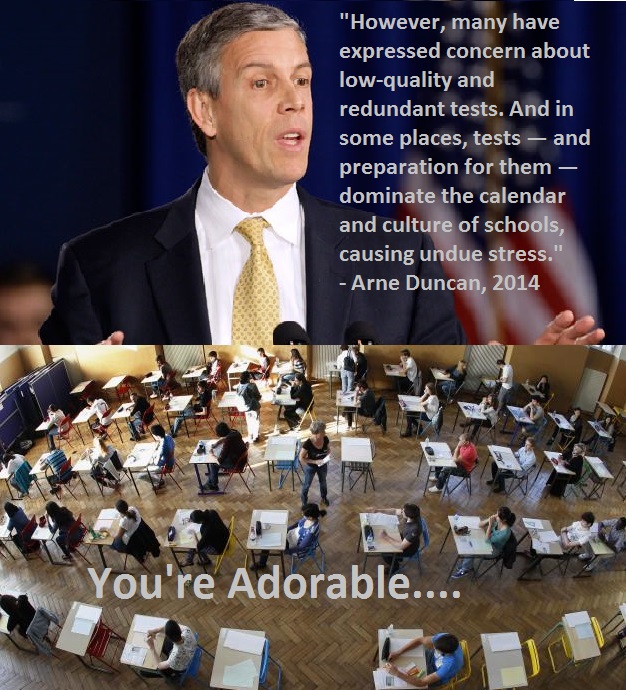
However, many have expressed concern about low-quality and redundant tests. And in some places, tests — and preparation for them — dominate the calendar and culture of schools, causing undue stress.

Policymakers at every level bear responsibility here — and that includes me and my department. We will support state and district leaders in taking on this issue and provide technical assistance to those who seek it.

Has such assistance come in the form of revisiting federal policy to decouple twisted incentives from monitoring education?  Has such assistance come in the form of listening to what research says about value added modeling and dropping it as a favored policy?  Has such assistance come as recognition that growth and support is a more viable policy for struggling schools than test and punish?  Has such assistance come even in the form of an apology from Secretary Duncan and other testing advocates for having made testing so dominant that we have lost any focus on how lack of equity in education rests with policymakers trying to make school their sole anti-poverty program?

Don’t count on it.

Arne Duncan is terribly concerned about all this over testing

Arne Duncan is terribly concerned about all this over testing

2 Comments

Filed under Common Core, Data, Gates Foundation, Opt Out, Pearson, Testing

Welcome to the Class of 2015 — We Need You

This week, our teacher preparation program welcomes the graduates of the Class of 2015 as our teacher colleagues.  These accomplished young teachers are joining the profession at a time of great challenges, but it is also at a time of great opportunities, and having worked with them closely for the past four years, I am convinced that they will do well with those opportunities.  These young people are intelligent; they are dedicated; they are talented; and they are prepared.  It has been an immense pleasure to see their professional journeys.

It would be a disservice to them to downplay the challenges they face as new members of the profession.  Today’s graduates were mostly born in 1993 which means that they were in third grade when the No Child Left Behind Act in 2001 mandated annual standardized testing for all children in all grades between three and eight and once again in high school.  They went through their formative elementary and secondary education as the high stakes attached to mandated testing was squeezing the curriculum into a narrower box with less art, music, social studies, and science.  While the impacts of Race to the Top, the Common Core State Standards, and PARCC and SBAC testing did not influence their education, they have done their clinical internships and student teaching within schools and with cooperating teachers who have had to grapple with these issues as well as the growing movement of parents who are denying schools the right to administer standardized tests to their children.

Now they leave their university preparation to enter teaching just as these matters are fully breaking upon our schools.  The CCSS are implemented in 43 states and the District of Columbia.  Mass standardized examinations aligned with the standards are now implemented in dozens of states, and they promise to find many fewer students proficient in mathematics and English than just a year ago.  States that won Race to the Top grants or were granted NCLB waivers from the USDOE are using growth measures based on standardized testing to evaluate teachers, despite the fact that the sum of research on growth measures demonstrates that they are unstable, unreliable, and have standard errors so large that even with 10 years of data, a teacher still has more than a 10% chance of being mislabeled.

If these challenges were not hard enough, the confluence of hastily implemented and ill-conceived policies comes amidst a rhetorical turn against teachers as the major culprits behind students whose test scores do not rise.  Today’s reform environment lavishes transformational power upon education, but it simultaneously measures that transformation via crudely designed standardized tests and then blames allegedly incompetent teachers when literally nothing else is done to improve the lives or communities of students who struggle.  A coordinated effort is underway to first assess teachers via standardized test results and then to remove any workplace protections teacher have to make it easier to fire them at will.  It is little wonder that the percentage of teachers who say they are highly satisfied on the job has dropped 30 percentage points to its lowest in a generation.

A distressing side effect of this environment are the number of more experienced teachers who appear ready to discourage our new colleagues from either entering the field altogether or from bothering to have hope on the job.  Peter Greene of Curmudgucation reminds us that this is a distressing and unethical practice, and he points out the specific work of the activists in the Young Teachers Collective who are directly asking their experienced colleagues to stop discouraging them.

I hope to G-d that my proud young graduates side with the activists at YTC.  We need them very badly.

Unlike Baby Boomers and my fellow Gen Xers who indulge in annual, graduation week denigration of the Millennials for their supposed faults, I am a fan of this generation.  Having worked closely with them for years now, I find this report on their outstanding and community oriented values to be absolutely correct.  Young adults today are more diverse than their predecessors, more open to diversity than any generation in history, better educated than anyone gives them credit for, and more desirous of being good parents and good neighbors than of the aggrandizement of self typified by generations who modeled our lives after Gordon Gekko.

So let me build on Peter’s plea for people to not be jerks to young teachers, and to add my own plea: young teachers, we need you.  We need you because you have been well-prepared.  We need you because if you do not stay we will have wasted the earned experience and skills you will gain in your first decade on the job, and that will harm future students.  We also need you because of those same values that typify your generation and which will serve as a tremendous asset to protect and preserve truly public education.

But if that is going to happen, we also need you to buck some typical trends in teaching and schooling.  It is very typical for teachers to simply keep their heads low, close the door, and wait for the current political tides to shift.  That is unlikely to work today; people are getting rich messing around with our schools, and they see our nation’s commitment to education for all as a $780 billion honeypot to monetize.  The good news in the midst of this is that the people still back our public schools, and while many have bought the relentless narrative that our schools writ large are failing, parents overwhelmingly support the schools their children attend.  You can generally count on the support of your students’ parents.

We need you, therefore, to be confident in that support and to help lend a voice, early in your careers, for certain truths that can reach the public only if they are amplified by many voices:

We need you to remind people that school and teachers cannot do it all alone.  Education is a likely component of most success stories in our country, but education did not play its role in those successes alone.  Education reform talks about education as key to overcoming poverty, but it spends very little time talking about how the advantage gap is overcome by much more than “grit” and “no excuses.”  We certainly see few reformers admit the severe funding gaps between our richest and poorest schools, and Governor Andrew Cuomo of New York has openly scoffed that funding has any role to play in educational inequities.

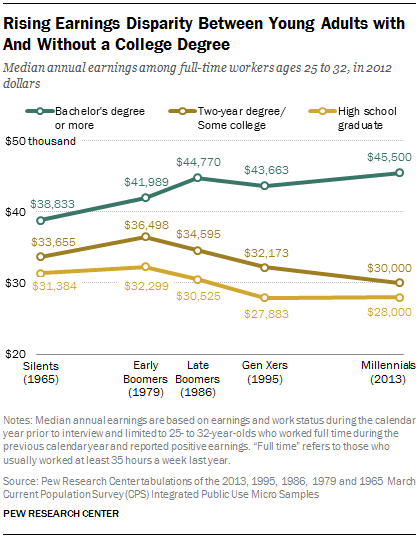
But even beyond that issue, there is a question about the central premise of education reform today; namely, if all students acquired more and better education, would they be able to leap over poverty in their careers?  The evidence for this is unclear because even though college degree holders greatly out earn non degree holders, that gap has grown because of cratering wages for less education rather than growing wages for more:

SDT-higher-education-02-11-2014-0-03

Increasing numbers of college degree holders will not magically create more middle class households unless the number of jobs genuinely requiring college education increase as well.  Education reformers who tout the power of standards and testing to prepare students who are “college and career ready” would do well to ask their billionaire backers to support middle class economics and actually be “job creators” if they really believe education will overcome poverty.  It won’t without fundamental changes in economic opportunity on the other side of education.

We need young teachers to speak up for fundamental truths about their children in communities of poverty. Grit and no excuses make for great bumper stickers and they can produce test practice mills that result in test scores.  But truly standing up for children is more than sloganeering and shutting down schools whose children are hungry and live in communities with few genuine opportunities.  The reality is that in many of our urban communities, black and brown children go to schools with inexperienced teachers, limited services, crumbling facilities, and over crowded classrooms and then go home to neighborhoods that have been in economic decline for decades.  None of the favored reforms today are doing anything to alleviate those conditions, and many of them are making them actively worse.

We need young teachers in such communities to have the bravery of Marylin Zuniga who has lost her job teaching third graders for a series of events based on her desire to embrace both action and compassion.  Ms. Zuniga had her students read and discuss a quote about justice from Mumia Abu-Jamal who was convicted of murdering a police officer in a 1981 trial that drew strong questions about the fairness of the trial and of the appeals court from Amnesty International.  Later in the year, Ms. Zuniga allowed her students to write get well letters to Mr. Abu-Jamal when she told them he was sick and they wanted to write to him.  While Mr. Abu-Jamal’s case stirs very strong emotion, especially among law enforcement, it is important to consider what Ms. Zuniga was doing with her students, most of whom are children of color in a poor neighborhood: she asked them to consider the legitimate voice of a black man in prison whose case raises difficult questions about the justice system, and on their own, the children showed and exercised compassion.  For young people whose lives are already disrupted by family members in trouble with the criminal justice system, this is a lesson with risks that are worth exploring.  And many in her community rushed to support her even though they were unsuccessful.

If we truly care about the children in poverty in our schools, we need more teachers willing to take such risks and to affirm their students’ desires to see humanity in everyone.  We need them to assert and to affirm their values of inclusiveness and human dignity even if it means taking a risk. Many decried Ms. Zuniga’s actions, but those who knew her the best affirmed the extraordinary stewardship she exercised for children who are already struggling.

We need young teachers to stand together.  There are many forces trying to fragment teachers from working together for their students’ true interests.  There are AstroTurf groups like “Educators 4 Excellence” who take large sums of money to act like a genuine grassroots group but whose pledge includes supporting discredited teacher evaluation methods favored by union busting corporate donors.  There is the “Education Post” headed by Peter Cunningham, formerly of the Obama Administration, and funded with millions of dollars from Eli Broad and the Walton Family Foundation to make a “better conversation” but mostly to pay people to respond to criticisms of education reform as if they have grassroots support.

So when I plead with young teachers to “stand together” I do not just mean to join your union and be active (although, yes, I do mean that too).  I also mean to do what your generation does better than any of us — maintain close and genuine bonds across distance via technology and to forge naturally occurring and completely authentic communities to support each other and to support your students.  Talk to each other.  Share ideas.  Plan.  Respond in the public sphere.  Magnify your voices.  Make stories of public school success go viral.  You have something that corporate reformers can never replicate:  you have authenticity.  Use it.

So, Class of 2015, welcome to our profession.  I am honored that you are my colleagues.  Please stay.  Please lead.

3 Comments

Filed under Activism, Funding, Media, Opt Out, politics, Social Justice, Unions

Have We Wasted Over a Decade?

A dominant narrative of the past decade and a half of education reform has been to highlight alleged persistent failures of our education system.  While this tale began long ago with the Reagan Administration report A Nation at Risk, it has been put into overdrive in the era of test based accountability that began with the No Child Left Behind Act.  That series of amendments to the Elementary and Secondary Education Act mandated annual standardized testing of all students in grades 3-8 and once in high school, set a target for 100% proficiency for all students in English and mathematics, and imposed consequences for schools and districts that either failed to reach proficiency targets or failed to test all students.  Under the Obama administration, the federal Department of Education has freed states from the most stringent requirements to meet those targets, but in return, states had to commit themselves to specific reforms such as the adoption of common standards, the use of standardized test data in the evaluation of teachers, and the expansion of charter schools.  All of these reforms are predicated on the constantly repeated belief that our citizens at all levels are falling behind international competitors, that our future workforce lacks the skills they will need in the 21st century, and that we have paid insufficient attention to the uneven distribution of equal opportunity in our nation.

But what if we’ve gotten the entire thing wrong the whole time?

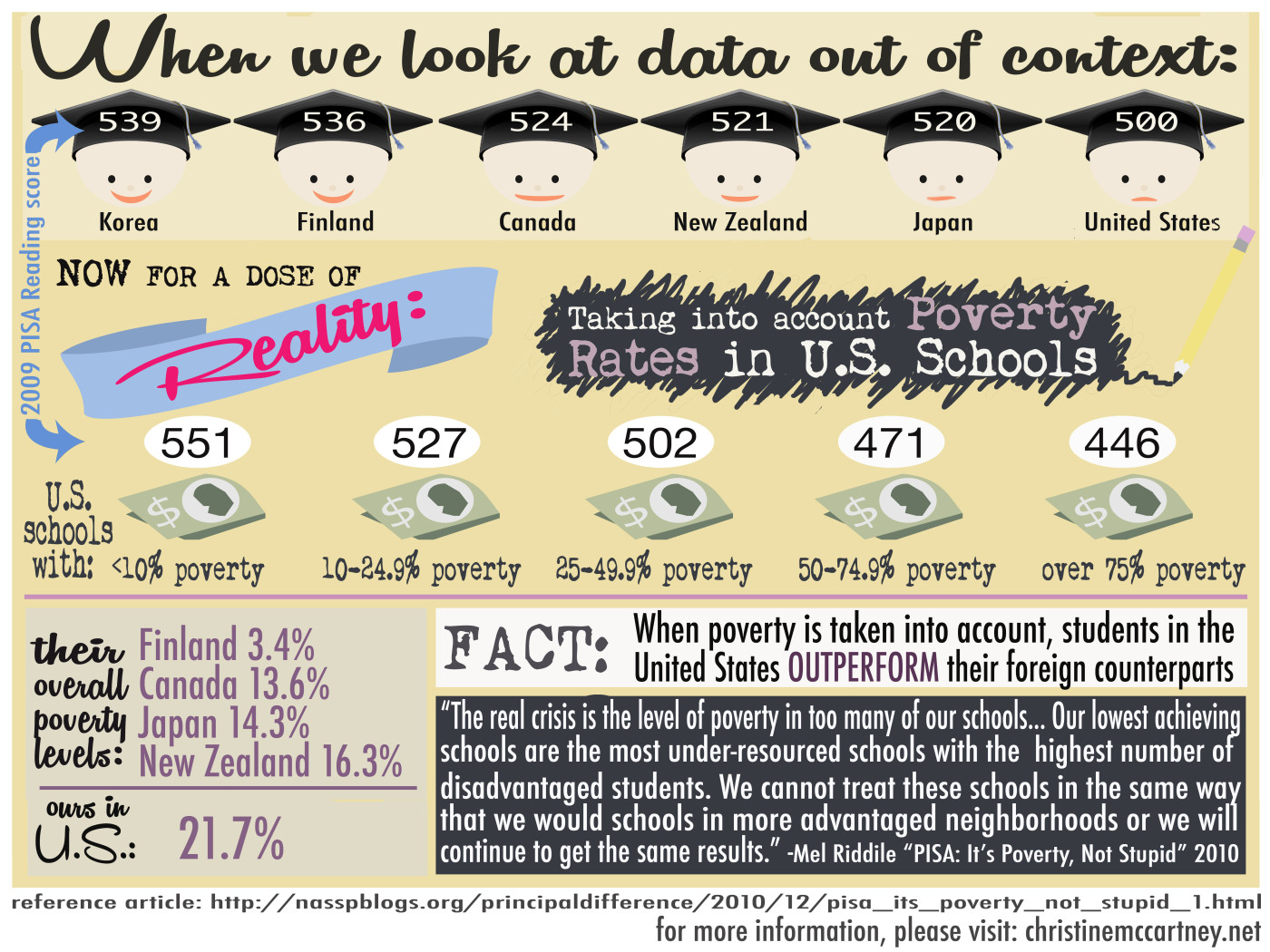
Or, perhaps to be more accurate, what if the entire picture of American public education is simply far, far more complicated that the simplistic, even opportunistic, narrative of failure we’ve been hearing since 1983?  Two reports, noted in January of this year by Kay McSpadden of the Charlotte Observer, put the presumption of failure into question.   The first report was released by the National Center for Educational Statistics at the USDOE and was about the results of the Progress in International Reading Literacy Study (PIRLS).  According to the PIRL Study, the United States does very well compared to other nations and international cities, ranking below 4 other territories (Hong Kong, Russian Federation, Finland, Singapore) and not being significantly different than 7 others (Northern Ireland-GBR, Denmark, Croatia, Chinese Taipei-CHN, Ireland, England-GBR).  While PIRLS does not include all of the nations we typically see cited as outperforming the United States, the study evaluates whether or not students have learned the literacy skills likely to be taught in school, and in this category, students in the USA are doing quite well, with 56% of students achieving the “high” benchmark or greater.  In fact, when poverty characteristics are taken into account, the accomplishment of US students and schools is even more impressive.  Students in schools with between 10-25% of students eligible for free or reduced lunch scored 584, which is higher than the national average for top performing Singapore, a city state where roughly 1 in 10 households earns an income below the average monthly expenditure on basic needs and whose actual poverty rate may be higher.  At the same time, United States students whose schools have 75% or more students qualifying for free or reduced lunch, scored 520, roughly the same as African American students, and “tied” with France, 18 places behind the U.S. average.

The PIRLS data tells us something that we’ve known for some time.  United States testing data, much like United States educational funding, is tightly coupled with the poverty characteristics of the community tested.  Dr. Stephen Krashen, Professor Emeritus at University of Southern California, concluded that the unspectacular scores on U.S. students on the Program for International Student Assessment (PISA) are largely attributable to our 21% child poverty rate and the impact that has on communities and individual children.  PIRLS results tell a similar story, and the persistent connection between race and poverty in America similarly explains the score gap between African American students and other ethnic groups.

The second report cited by Ms. McSpadden was released by the Horace Mann League with the National Superintendent’s Roundtable, and is titled The Iceberg Effect, An International Look at Often Overlooked Education IndicatorsThe report compared the United States, Canada, China, Finland, France, Germany, Italy, Japan, and the United Kingdom on indicators of economic equity, social stress, support for young families, support for schools, student outcomes, and system outcomes.  Perhaps most interesting is that the United States ranked next to last or last on economic equity, social stress, and support for young families, ranked fourth in support for schools and fifth in student outcomes, but then ranked first in system outcomes.  In support for schools, the United States was well ranked in expenditures and class sizes, but U.S. teachers enjoy far less support than their international peers, clocking over 1000 hours in the classroom compared to the Finland and G7 average of 664 hours.  Student outcomes for the United States are very high in the fourth grade assessments but are brought down overall by high school assessments, and the report notes that gaps by SES exist in all countries.  Interestingly, in system outcomes, the U.S. leads the studied nations in the number of years of schooling completed, the portion of the population with high school diplomas and BA degrees, and has the largest proportion of high performing science students.

These results are actually quite astonishing when you consider the extremely low performance for the United States in indicators of economic stability and social support.  We ranked the just above China in terms of economic inequality, and our communities are subject to shockingly high levels of social stress in the form of violence and premature death from violence and drug use, which studies show have long lasting impact on health and brain development.  These indicators are not even offset in the U.S. by generous expenditures in support of families and children or access to preschool as we ranked only above China and below the G-7 and Finland.

One has to wonder if the individual student results would be closer to matching the U.S. system results if we had spent the past 13 years focusing on the first five indicators instead of upon test based accountability.

This is no idle speculation because since NCLB, our school system has been subjected largely to a federally imposed experiment in warped behavioral economics where first school districts and then individual teachers were incentivized by high stakes attached to standardized tests to improve themselves or be targeted, by those same test scores, for dire consequences.  However, in the absence of doing much of anything else to support teachers, schools, families, or communities, the tests have ceased to be a way to monitor performance and have become an object in and of themselves.  With the dominant theme of education reform being “Test – Label – Punish” we have crafted a “reform” environment that expects targets and incentives to pressure schools and teachers to close long known achievement gaps all by themselves with literally no other aspect of our political and economic infrastructure doing a thing — except close those schools and turn them over to privately run charter school operators who like to boast about their nearly miraculous test scores, but whose practices are entirely unlike what you would expect of a public education system that is designed to serve all students.

This is not a school accountability and improvement agenda so much as it is a system operating on the kind of incentive structures endemic at Enron before its collapse.  Little wonder, therefore, that Kevin G. Welner and William J. Mathis of University of Colorado at Boulder called for a sharp move away from test based accountability:

The ultimate question we should be asking isn’t whether test scores are good measures of learning, whether growth modeling captures what we want it to, or even whether test scores are increasing; it is whether the overall impact of the reform approach can improve or is improving education. Boosting test scores can, as we have all learned, be accomplished in lots of different ways, some of which focus on real learning but many of which do not. An incremental increase in reading or math scores means almost nothing, particularly if children’s engagement is decreased; if test-prep comes at a substantial cost to science, civics, and the arts; and if the focus of schooling as a whole shifts from learning to testing.

The way forward is not to tinker further with failed test-based accountability mechanisms; it is to learn from the best of our knowledge. We should not give up on reaching the Promised Land of equitable educational opportunities through substantially improved schooling, but we must study our maps and plan a wise path. This calls for a fundamental rebalancing —which requires a sustained, fair, adequate and equitable investment in all our children sufficient to provide them their educational birthright, and an evaluation system that focuses on the quality of the educational opportunities we provide to all of our children. As a nation, we made our greatest progress when we invested in all our children and in our society.

This call is incredibly important in no small part because education “reformers” are correct in one critical observation about American education even if their solutions are poorly constructed.  Educational opportunity is not evenly distributed in America in no small part because the known impacts of poverty on children tend to concentrated in specific zip codes due to rising levels of income segregation.  The upshot of this is that a school which serves a discernible number of children in poverty will tend to serve a large percentage of children in poverty while schools with students from economic advantage will have almost none.  We do not need standardized test based accountability to tell us that outcomes are different in Mt. Vernon than in Scarsdale, but we should demand action.

If not testing, labeling, and punishing, then what?  First, we have to recognize that community conditions directly impact schools, and if we expect schools to provide access to opportunities for their students, then we, as a society, need to accept responsibility for the lack of opportunities in many of our communities. 51% of today’s school children qualify for free or reduced lunch, meaning their families subsist  185% of the Federal Poverty Level or less, so I take it as a given that economic opportunities are not as abundant as they ought to be.

Second, we should recognize the support and capacity building we have completely failed to provide for schools by placing our focus on testing as more than system monitoring.  What could have been done differently if we had taken a different focus?

  • What if we had finally fulfilled federal promises to fund the Individuals With Disabilities in Education Act at 40% of average cost which has never been done?
  • What if we had taken seriously the 25% of schools with more than half of students eligible for free or reduced lunch that have physical facilities rated “fair” or “poor” and pledged to invest in school capital improvement needs across the nation estimated at $197 billion?
  • What if we had spent ten years expanding early childhood services and support for families?
  • What if we had pledged to get full wrap around services into all Title 1 schools?
  • What if we had recognized that working with high concentrations of high risk students requires a genuine commitment to resources and capacity building which has been nearly completely absent in the age of test based accountability?

By most measures, the past 14 years have been a completely wasted opportunity (except for the private charter school advocates who have been monetizing their school model and the corporations that have profited from testing).  It is time to stop.  It is time to make a commitment to education that is equal to the soaring rhetoric reformers have lavished upon testing.

Morpheus

11 Comments

Filed under charter schools, Common Core, Data, Funding, NCLB, Pearson, politics, Social Justice, Testing

Was Arne Duncan Ever a Child?

Secretary of Education Arne Duncan appears displeased with the national Opt Out movement.  In an interview with New York Times reporter Motoko Rich at the Education Writers Association national seminar in Chicago this week, Secretary Duncan stated that the federal Department of Education might have to “step in” if states do not make sure districts have enough students who take the federally mandated annual tests. States are required to have at least 95% of students in all schools be tested in each year from grades 3 to 8 and once in high school under the current provisions of No Child Left Behind, and in most states those tests are currently being aligned with the Common Core State Standards whose adoption was encouraged by Secretary Duncan’s DOE via the Race to the Top grant competition and the offer of federal waivers from the most punishing provisions of NCLB.  Secretary Duncan gave some acknowledgement that some students may be over tested, but he also went on to say:

 …the tests are “just not a traumatic event” for his children, who attend public school in Virginia.

“It’s just part of most kids’ education growing up,” he said. “Sometimes the adults make a big deal and that creates some trauma for the kids.”

Where to start?

Peter Greene of the Curmudgucation blog took on the broader set of Secretary Duncan’s comments earlier this week, and coined the term “Duncanswer” whereby the Secretary gives a response to a question that is entirely canned and skillfully uses ideas from the question itself to cover that he has no real understanding of the issue.  I’d like to offer an additional feature of a “Duncanswer”: utter refusal to accept responsibility for any negative outcome of your choices.

The Secretary of Education essentially told the parents of nearly 200,000 students in New York state alone that if any children are traumatized by the Common Core aligned testing it is their own damn fault.  His statement indicates that he views annual testing, particularly THIS annual testing, as simply an aspect of childhood, perhaps inconvenient, but not really a big deal.  But the important thing to remember is that if children leave the testing crying or sick to their stomachs, then it is their parents’ and teachers’ fault for being so dramatic.

Perhaps a review of recent history is necessary.  While Bill Gates may have been central to funding the development of the Common Core State Standards, we simply would not see them in classrooms across the country with standardized testing rolled out already and teachers’ evaluations connected to those tests without Secretary of Education Arne Duncan and his signature initiatives.  In the midst of the financial crisis, the federal DOE enticed states with promises of funding via the Race to the Top grant competition.  Even states who did not get grants were encouraged to adopt signature reforms with the offer of waivers from the most punitive provisions of NCLB.  States seeking grants or waivers agreed to adopt common standards to prepare students for “college and careers” and to use accountability systems based on “student growth.”  It was, of course, just a coincidence that “college and career readiness” is the catchphrase of the Common Core State Standards which were less than a year old in 2011, but which had already been adopted, often sight unseen, by dozens of states climbing over each other for grants or waivers.  Since states would soon need new standardized tests aligned to the CCSS standards for use in teacher evaluations, it must have been a coincidence that Secretary Duncan had already awarded over $300 million to the Partnership for Assessment of Readiness for College and Careers (PARCC) and Smarter Balanced Assessment Consortium (SBAC) in 2010 to develop shared assessments for the standards that had been completed in June of that year.

So from an idea among some ambitious people with no actual experience in teaching and no expertise in child development and learning in 2008 to the development of completed and copyrighted K-12 standards in both English and mathematics in 2010 to adoption by dozens of states before the standards were finished to full scale roll out of aligned examinations with connection to teacher assessments in 2015, the entire system that we have today is fully the responsibility of Secretary Duncan and the Obama administration.  Others may have provided monetary support, may have glad handed various stake holders, and may have taken on the development process themselves, but none of that work would be guiding education in 43 states and the District of Columbia without Arne Duncan’s efforts.

And let’s be perfectly clear: nothing in education does or should move this quickly.  As Diane Ravitch of New York University notes, following “due process” guidelines for the development of standards of this scale and nature is important to ensure they are developed thoughtfully and that they are developed in a manner that is responsive to the numerous stakeholders in the policy.  In the time spent writing the standards, a more legitimate process would have possibly begun to compile the research base on content and learning necessary to begin the drafting process, but the backers of the standards, including Secretary Duncan, had a priority to move quickly before input could bog down the process.  If Secretary Duncan is irritated that so many people are now opposing the standards and the accompanying testing, he might want to learn that, in general, people do not like turning around and finding out that the entire basis upon which they thought their children’s education rests has been changed without public discussion.

And if the dissatisfaction is growing, it is because although parents did not know about the Common Core standards (as 55% did not in a 2013 survey), they have little chance to avoid learning about the examinations now.  While many parents are not well informed about them, that will certainly change over time as PARCC and SBAC exams continue in subsequent years. Parental discontent in New York has grown since the Pearson designed Common Core exams debuted here in 2013, and parents’ reasons are not baseless or simple whims. Multiple sources document known reading passages in the New York exams that are substantially above grade level and requiring students to answers questions on a standardized exam that objectively have multiple correct answers.  Elementary school students are sitting for examinations that take longer overall to complete than the bar exam.  With high stakes testing already having narrowed school curricula nationwide, parents would be correct to worry that teachers, faced with evaluations based on statistically invalid measures of their effectiveness from those tests, will face more pressure to devote time to test preparation.

Secretary Duncan, is it ” just part of most kids’ education” for kids to sit in tests that are longer than the bar exam, with reading passages years above their grade in complexity and interest level, ever single year?

Or is it the result of a set of choices that you helped set in motion?  One has to wonder what Secretary Duncan recalls about being a child if he thinks this system is “just part of most kids’ education” and not a rather extraordinary set of circumstances that is reaping some very sour fruit.  These exams are not magic.  By most reports they are not even all that good.  And they are far more disruptive than a basic accountability system needs to be.  But, boy howdy, the Secretary of Education is making them high stakes.  Just consider what Secretary Duncan did to Washington State when they had the nerve to allow districts to choose between state and local assessment in evaluating teachers.

These-arent-the-droids

But what can we make of the Secretary’s threat that the federal government may have to “step in” if parents opting children out of exams continues to grow?  Parental refusal to allow a child to take the exam is not a state policy violating an agreement between the USDOE and the state government.  States are not orchestrating opt outs, and in many cases, parents are given dubious information about the legality of their choice.  Can Secretary Duncan threaten states where opt out numbers mean many schools are not reaching the 95% testing threshold?

Dr. Christopher Tienken of Seton Hall University and Dr. Julia Sass Rubin of Rutgers University say the matter is hardly cut and dry.  First, the federal mandate for 95% testing exists so that schools cannot deliberately hide subgroups of students from accountability.  There is nothing in the law or in the intent of the law that prevents parents from refusing a child’s participation, and it is not the schools that are organizing test refusal.  Further, they note that the waiver agreement between states and the USDOE can override that testing requirement; in New Jersey, for example, only 250 schools are actually held to the 95% testing requirement and if they do not make it, up to 30% of their Title I money can be used by the state for specific interventions.  That doesn’t take money away, however; it allows the NJDOE control over money that it technically has control over anyway.

Drs. Tienken and Sass Rubin additionally note that if the USDOE has to sanction districts and schools for missing the 95% testing target they have missed the boat already.  In New Jersey alone, 175 schools missed the 95% target in 2014 without penalty, and, in fact, no school has ever been treated punitively by the USDOE for not having 95% of its students tested.  Can Secretary Duncan suddenly drop his agency on states and districts not for any actions taken by those governments but because their parents have gotten unruly?  How does he propose those communities seek compliance when his entrance into the matter can only make more people angry at the direction of educational policy?

For that matter, does he think he can long maintain his ability to coerce the states if the re-authorization of the Elementary and Secondary Education Act makes it out of Congress in its current form?

However this plays out, we can likely guarantee one thing: Arne Duncan will accept responsibility for absolutely none of it.  Maybe he just never stopped being a child.

8 Comments

Filed under Common Core, NCLB, Opt Out, PARCC, Pearson, Testing

Shoe Horning Opt Out into the Unions vs. Reformers Narrative

New York Times education reporters Kate Taylor and Motoko Rich published a story this week on the burgeoning Opt Out Movement.  As the oldest paper of record in the United States, the Times has been slow to report on what has been a largely local story that has now evolved into a statewide and even national phenomenon.  While this is understandable given its role in the national discourse, what is not understandable is the way the story was framed into something unrecognizable to most participants in Opt Out.  The article briefly mentioned parent led groups working with teacher unions, but a reader with no prior experience on the matter would easily leave the article entirely convinced that Opt Out is both union promoted and union generated.

Secky Fascione, director of organizing for the National Education Association, the largest nationwide teachers’ union, said reining in testing was the union’s top organizing priority. In the past month, Ms. Fascione said, chapters in 27 states have organized against testing, including holding rallies; petition drives; showings of “Standardized,” a documentary critical of testing; and sessions telling parents they have a right to keep their children from taking tests, as tens of thousands of parents around the country have done.

“Does it give us a platform?” said Karen E. Magee, the president of New York State United Teachers. “Absolutely.”

Ms. Taylor and Ms. Rich would be right to note that union leaders like Randi Weingarten of the American Federation of Teachers and Karen Magee of the New York State United Teachers have recently given vocal support to Opt Out.  It is also true that other union affiliates have taken action in the past several months to support parents who choose to opt their children out of taking the PARCC or Smarter Balance testing that are rolling out nationwide this year.  Further, it is true that many of the unions find themselves in deep conflict with state capitols and with the Federal DOE where policies using those tests for teacher evaluations have originated.

But it is singularly misleading to frame this conflict as one that originates with the unions.

Diane Ravitch of New York University reported on her blog that one of the founders of United Opt Out, Peggy Robertson, had this to say in response to the article in The Times:

When United Opt Out National began over four years ago we were simply a facebook page with a file for each state. Within hours our FB group page was flooded with opt out requests and now we have opt out leaders all over the country and grassroots opt out groups popping up everywhere. I think Florida has 25 at this point – probably more since I last checked – and mind you they did this all on their own. UOO has simply been a catalyst and a support. What is even more fascinating, and sad, is that UOO has reached out to the unions many times, and never received a response. You will notice that United Opt Out National is rarely mentioned in recent articles. I think that’s because we represent the people. The power of the people.

Sadly, it cannot be claimed by the reporters in question that they did not know the parent origins of the Opt Out movement, either:

https://twitter.com/BiancaTanis/status/590471826226184192

If the Opt Out story is only now growing of interest to the national education reporters of The New York Times because now national and state level unions, having seen where a significant portion of parental sentiment is heading, have begun to help amplify the message, that is fair, although perhaps short sighted depending upon your perspective.  However, to leave readers with the impression that a movement which has been growing for four years and which has resulted, this Spring, in over 175,000 test refusals in New York State alone, is working at the behest of the national teachers’ unions is not only disrespectful of parental leadership, but also it is disrespectful of facts.  While their voice and influence is welcome, union leadership followed the parents on this issue.

President Weingarten’s and President Magee’s support has been welcomed this Spring, but as Ms. Robertson pointed out, unions have been asked to assist before with much more tepid responses.  While disappointing, that is also not expected.  Union leaders generally have to preserve an ability to speak with policy makers, so a degree of caution in promoting a movement that aims to pull the rug out from under test based accountability and spark a confrontation with those implementing that policy is expected.  What has changed is that in New York, Governor Cuomo decided his reelection “mandated” was to charge like a mad bull through teaching as a profession, and nationwide, the Common Core aligned PARCC and Smarter Balance examinations are debuting — to not exactly glowing reviews.  Nationwide, increasing numbers of parents are tiring of annual standardized testing becoming a goal in and of itself instead of taking a proper role in monitoring the education system. No amount of condescending horse pucky from educational “leaders” will change that.

So the real story in Opt Out is that unions are coming around to support a parent led and developed movement.  While Ms. Taylor and Ms. Rich do acknowledge that some union leadership is not really on board, they missed the serious split within New York’s UFT — New Action Caucus may have put up a motion to support Opt Out, but that motion repeats an earlier attempt by the Movement of Rank and File Educators (MORE) Caucus to pass a similar resolution in March. Here’s Lauren Cohen of P.S. 321 raising the resolution. This is an ongoing and contentious debate within the UFT not presented in the article.

So why miss the back story and leave readers with the impression that parents are a vehicle for union grievances?  I have to agree with Bruce Baker of Rutgers who commented:

The real story of how we got to April of 2015 with hundreds of thousands of opt outs in New York and many thousands more across the country is a messy one.  It involved parental volunteers, activists from a wide variety of political affiliations, a growing body of research on the damage of test-based accountability and the unreliability of using tests to evaluate teachers, and, yes, growing union grievances.  It is a story that would have to include the reluctance of union leadership to be seen in front of the issue to the frustration of both parents and rank and file members.  It would be about the slow convergence of many forces at work in our education system, including the shadowy world of deep pocketed oligarchs who leverage astonishing sums of money into even more astonishing influence regardless of the people’s will.

But that isn’t neatly dualistic.  That isn’t the story certain influential people want to read.  So we get this.

5 Comments

Filed under Activism, Common Core, Media, Opt Out, politics

Dear Opt Out: Won’t Somebody PLEASE Think of the Property Values??

USA Today ran a story last week from the Journal News of Westchester County about the growing Opt Out movement.  The article was fairly mild in tone, cited numbers about the unprecedented size of the current testing boycott, and gave time to proponents of the testing mandates and the information generated by the tests.  One quote, however, really stood out from out the rest.  It was from Nicole Brisbane, the New York state director for “Democrats for Education Reform,” who said:

“Schools are one of the biggest differentiators of value in the suburbs. How valuable will a house be in Scarsdale when it isn’t clear that Scarsdale schools are doing any better than the rest of Westchester or even the state? Opting out of tests only robs parents of that crucial data. “

Wow.

For those who are not in the know, DFER is an organization that is not actually made up of grassroots Democrats working for education reform so much as it is a front group for very large, mainly conservative, donors to influence Democratic politicians to support what passes for education “reform” these days.  While DFER has certainly influenced a number of Democratic politicians by funneling campaign contributions made possible by DFER’s funding sources (The Walton Family Foundation, Rupert Murdoch, Rex Sinquefield, etc), it’s stated purpose is to change the positions of Democrats on questions like charter schools and tying teacher evaluations to test scores to those more likely found in the Republican Party.

Whitney Tilson, the billionaire hedge fund manager at the heart of DFER, was actually quite upfront about this:

“The real problem, politically, was not the Republican party, it was the Democratic party. So it dawned on us, over the course of six months or a year, that it had to be an inside job. The main obstacle to education reform was moving the Democratic party, and it had to be Democrats who did it, it had to be an inside job. So that was the thesis behind the organization. And the name – and the name was critical – we get a lot of flack for the name. You know, “Why are you Democrats for education reform? That’s very exclusionary. I mean, certainly there are Republicans in favor of education reform.” And we said, “We agree.” In fact, our natural allies, in many cases, are Republicans on this crusade, but the problem is not Republicans. We don’t need to convert the Republican party to our point of view…”

So DFER is not REALLY “Democrats for Education Reform” so much as it is “Billionaires For Education Reform Bribing Democrats to Wreck Public Education,” but BFERBDWPE is hard to make look snappy on a flyer.  That is, however, exactly how NY Governor Andrew Cuomo got to be the poster child for destroying public schools from the Democratic Party side of things.

Peter Greene of the Curmudgucation blog was especially insightful in his take on Ms. Brisbane’s bizarre set of priorities:

But at least we have a great new reason that all students need to take those tests– without them, the Betters would have one less badge of their Betterness. Testing will help us put Those People in their place. Don’t let your class down! Don’t let the property values drop! Get in there and take a test for the team.

Yup — the NY State Director for the hedge funded political bribery outfit PAC most devoted to high stakes testing essentially told parents in the suburbs to have their children lie back, close their eyes, and think of Scarsdale.  Especially their property values.

While that “reasoning,” and I use the term loosely, is bizarre enough, I’d like to take it just a little bit further.  Ms. Brisbane is, of course, correct that the value of property in a community has links to the perceived quality of the schools in that community.  Towns with school systems that have reputations for excellence and with high percentages of students moving on to desirable colleges do see increases in assessed property values.  Of course, this phenomenon predates not only the Common Aligned state examinations, it predates the entire period of test based accountability introduced with No Child Left Behind.  One has to wonder how the parents of Scarsdale could have ever known anything about their community’s schools before they got the state issued two page report that includes no item analysis whatsoever?

It is interesting that Ms. Brisbane chose Scarsdale as her example, given its long standing reputation as one of the wealthiest communities in the country.  However, you do not have to take my word for that.  The United States Census Bureau curates census data by community, so we can look directly at some key indicators for Scarsdale.  The Village of Scarsdale is 82.7% white compared with NY state which is 65.7% white, and it is 13% Asian with African American and Hispanic populations of 1.5% and 3.9% respectively.  Scarsdale’s population of people speaking a language other than English at home is actually closer to the state average than it’s racial make up with 21.5% of the population.

A staggering 85.7% of the population over 25 has at least a bachelors degree compared with a state average of 33.2%.  Per capita income is $109,044 and household income is $233,311 compared to the state averages of $32,382 and $58,003 respectively.  In NY state, the median value of a home is $288,200, and while the table does not have a specific median value in Scarsdale, the footnote says that it is over $1 million.  Scarsdale’s population living below the poverty level is 1.7% compared to a state average of 15.3%.

A family considering sending its children to Scarsdale schools will likely know something about the village’s school system just because they can afford to live there in the first place. I should also be clear:  I do not believe that someone living in Scarsdale is living there so that he does not have to live with people who are poor or minority.  However, the fact that he can afford to live there means that he does not live with very many people who are poor or minority by default.

Ms. Brisbane, however, wanted to know how parents in Scarsdale will COMPARE themselves to other communities, even in Westchester county.  Fair enough.  Westchester has had historic problems with integrating lower income and minority families within the county, so let’s look at the nearby city of Mt. Vernon next.  Mt. Vernon is 63.4% African American and 14.3% Hispanic.  23.1% of people over the age of 5 speak a language other than English at home, and the percentage of people over 25 years of age with a bachelor’s degree is below the state average at 26.4%.  Per capita income is $27,454 and household income is $49,328. While the median home price is $392,300, only 37.7% of the population are home owners. 16% of the population lives below the poverty line.

Demographic information from the New York State Education Department shows some stark contrasts that match or actually amplify the census data.  Scarsdale High School is 89% white or Asian while only 1% of the school is of Limited English Proficiency and there are so few economically disadvantaged students that the data is suppressed to prevent them (him? her?) from being personally identified.  Mt. Vernon High School is 79% African American and 17% Hispanic, higher than the averages for the city overall.  While only 4% of the school is LEP, 65% of the students in the school are economically disadvantaged, meaning their family qualifies for public assistance programs such as free and reduced price lunch. A family of four qualifies for reduced price lunch at 185% of the federal poverty level or $44,863.

The same NYSED web site reports school data on student graduation rates and on the Regents exam.  (Yes, Ms. Brisbane, I am relying on a test-based comparison, using a long established EXIT examination used in the state of New York that predates the additional annual testing required by NCLB.  I will admit that your hypothetical home owner or potential buyer would have some interest in how certain school performance markers compare in different communities — I am also pointing out that these markers already exist).  In Scarsdale, graduation rates are essentially 100%, and the percentage of students who earned 75 or higher on the English Regents exam and scored 80 or higher on a math Regents examination was 81% in 2014; the state average was 38%.  In Mt. Vernon, the 2014 graduation rate was 47%, down from 54% the prior year.  In 2014, only 3% of the graduating cohort reached the English and math scores of 75 and 80 or higher, down from 8% the prior year.  Interestingly, Scarsdale’s very small African American and Hispanic populations do not score as high as their white and Asian classmates on the Regents examination with only 60% of African American and 65% of Hispanic students reaching the “aspirational” levels.

It is worth noting that I began by looking at the race and income characteristics of these communities, but since the negative impacts of poverty on educational outcomes is well known, the fact that Mt. Vernon has a school population that is much poorer than Scarsdale’s means the diminished graduation outcomes are not unexpected.  In fact, it mirrors a national phenomenon that finds when there are greater concentrations of students in poverty, testable outcomes are much lower than in communities with few students in poverty.

poverty stupid

This is where education reform advocates like to accuse their critics of fatalism and saying that there is “nothing we can do” to get better educational outcomes for children in impoverished communities.  I will agree with the premise that geographic location and income level should not be seen as determinative, and the comparison between Scarsdale and Mt. Vernon should not be taken to mean the graduation rates and diminished achievement data in Mt. Vernon should be acceptable.  However, the point of this blog is to demonstrate that there is quite a lot of data available with which one can compare Scarsdale and another community in Westchester County, and that such data has been available for many years before the Common Core aligned examinations came along.  There is, in fact, very little that these tests will tell us in community by community comparison that we do not already know.

There is something that we do know, however, and it is something that Governor Cuomo continues to do far too little to address.  Namely, the Mt. Vernon school district was shorted almost $2300 per student in state foundational school aid in the 2014-2015 school year.  So while it is all nice and well that Ms. Brisbane and her bosses at BFERBDWPE want to be able to tell a tale of communities whose homes are made more valuable by student test scores, there is another tale they fail to acknowledge: that of schools populated with students in poverty whose budgets have been repeatedly starved.

Meanwhile, Ms. Brisbane’s Scarsdale parents can take comfort in the knowledge that six residents in the Class of 2013 alone got into Harvard University.  They could have found that out without the Common Core tests too.

5 Comments

Filed under Common Core, Corruption, DFER, Funding, Social Justice, Testing

What if We Really Cared About Teacher Preparation?

Abstract

Efforts to reform teacher education in recent years have focused on demands for higher quality candidates and indicators of rigorous preparation without careful consideration of the total policy environment in which such preparation must take place.  In the era of test based accountability, efforts to recruit, prepare and induct qualified and passionate new teachers are severely hampered by contradictory and high stakes priorities enacted by state level policy makers.  In this article, I locate the different policy pressures that make thoughtful and effective teacher preparation less likely and explain what teacher preparation would look like if we took a systemic and developmental approach to teacher education that recognized how teachers learn.  Policy makers need to understand the interconnected nature of their decisions and offer policies aimed at support and growth of teachers at all experience levels and at development of capacity in universities, schools, school districts, and state offices.

###

It is, of course, easy to criticize the reform plans for teacher education that are in various stages of implementation in New Jersey.  Most proposed changes exist either as evidence-free assertions that “more is better” or as potentially defensible proposals whose consequences remain unexamined.  Perhaps most importantly, they exist in tandem with other policies in both teacher preparation and education in general that seem to contradict their central premises of attracting only the best students to teacher preparation and holding them to rigorous professional standards.  Demonstrating those contradictions is an exercise that lends itself to sarcastic wit and to taking potshots at those in authority, a two for one deal that is difficult to resist.

More daunting, however, is putting forth a positive vision of what teacher preparation ought to look like if we accept the premise that all involved would favor seeing passionate and able young teachers take to our classrooms after being strongly prepared to meet the challenges of teaching.  One does not have to seek out the poorly supported declarations of agenda-driven, self-appointed “teacher quality” watchdogs to find negative assessments of teacher preparation; they are deeply embedded in the popular culture which frequently asserts that teachers are “born” rather than made.  These assertions are expertly addressed here by David Berliner, past president of the American Educational Research Association.  However, it is important to note that a belief in teaching as a craft whose knowledge cannot be learned outside of experience is common among teachers themselves and strongly related to teacher education’s continued struggles to provide meaningful contexts for practice prior to teaching (and the reality that no controlled practice environment is fully sufficient to represent full time teaching under any circumstances).

Those of us who labor in good conscience for the preparation of tomorrow’s teachers need to articulate visions of that preparation focused upon the needs of teachers and their students.  My goal here is to detail concerns and priorities that should exist at three different stages of teachers’ professional preparation: recruitment, preparation, and induction.

Recruitment

Becoming a teacher is unlike training to join most other professions in no small part due to our apparent familiarity with teaching and teachers.  Dan Lortie, in his landmark 1975 work, Schoolteacher: A Sociological Study, observed that a typical student spends 13,000 hours observing teachers teaching during the course of a K-12 education.  That is a remarkable level of familiarity that does not exist for professions like law, psychology, medical doctors, or nurses, and, as Lortie notes, it takes place in fairly close quarters and frequently develops interpersonal relationships as well.  A strong theme among people seeking to become teachers is a desire for continuity in the experience of school; having enjoyed school themselves and having developed meaningful relationships with teachers during the long “Apprenticeship of Observation,” many teachers enter the profession desiring not to begin anew, but rather to continue.  While the apprenticeship is lengthy, it can also be deceptive because, as Lortie notes, the student’s vantage point is substantially different from the teacher’s, and it does not lend itself to viewing teaching via pedagogy and the goal-setting orientation that drives teachers’ decision making. Regardless of the limitations of student perspectives, they do matter for future teachers, many of whom seek a teaching career based upon those perceptions and the personal value derived from them.

If future teachers develop deep seated beliefs about teachers and teaching during their prolonged experience in school, we should want that experience to convey a powerful vision of meaningful learning upon them.  Our current policy environment of “test and punish” which was instituted under the No Child Left Behind act and placed into overdrive with Race to the Top has resulted in a more narrow curriculum focused upon tested subjects and a deep decline in teacher satisfaction with their jobs.  Between 2008 and 20012, teachers who are “very satisfied” on the job declined from 62 percent to 39 percent, a 25 year low, and the percentage of teachers who report that they are “under great stress” several days each week rose to 51%. A curtailed curriculum and dissatisfied teachers who cite lack of time for professional development and collaboration with their colleagues are not ingredients for P-12 schools that will nurture the next generation of teachers.  In fact, recent evidence from the United States Department of Education shows enrollment in teacher preparation programs, including alternate route programs, dropping 10% overall nationwide with several state, such as California where applicants for teacher preparation shrunk by 53%, showing steep declines.

Policy makers need to pay especially close attention to the working conditions of teachers not merely because those conditions impact teacher satisfaction and student learning, but also because it impacts the building of professional commitment by future teachers. The idea of future teachers building their commitment throughout their long apprenticeship in P-12 education is related to the concept of teaching as vocational work, a concept that has been unwisely disregarded in this era of high stakes accountability via measurement.  David Hansen of the University of Illinois at Chicago wrote in 1994 that teachers develop a sense of their work as vocational through dispositions and through their tight connection to the very specific social context of teaching and enacting teaching.  Hansen writes that seeing teaching as a vocation…

…suggests that the person regards teaching as more than simply a choice among the array of jobs available in society.  It may even mean for such a person that there is something false about describing the desire to teach as a choice at all.  An individual who is strongly inclined toward teaching seems to be a person who is not debating whether to teach but rather is contemplating how or under what circumstances to do so.  He or she may be considering teaching in schools, in institutions of higher education, or in one of the many other social setting – from military bases to visitors’ centers – in which teaching can occur.  But it may be years before such a person takes action.  He or she may work for a long time in other lines of endeavor – business, law, parenting, the medical field – before the right conditions materialize.  This posture in fact describes may persons who are entering teaching today. To describe the inclination to teach as a budding vocation also calls attention to the person’s sense of agency.  It implies that he or she knows something about him or herself, something important, valuable, worth acting upon.  One may have been drawn to teaching because of one’s own teachers or as a result of other outside influences. Still, the fact remains that now one has taken an interest oneself.  The idea of teaching “occupies” the person’s thoughts and imagination.  Again, this suggests that one conceives of teaching as more than a job, as more than a way to earn an income, although this consideration is obviously relevant.  Rather, one believes teaching to be potentially meaningful, as a the way to instantiate one’s desire to contribute to and engage with the world.  (pp. 266-267)

We would do well to remember this concept for several critical reasons.  If we want young people or career switchers to become teachers, we have to accept the variety of reasons why people make the decision to teach.  Lortie’s observation that many teachers seek continuity with an experience they themselves found desirable reminds us to enable working conditions that foster teacher satisfaction, student learning, and a positive disposition towards teaching among future teachers. Excessive test preparation, teachers without time to collaborate positively with colleagues, and general stress among teachers and students act as disincentives for otherwise interested students to consider teaching and may distort vocational aspirations.

It also should caution us about the type of person who becomes interested in teaching under such circumstances, as Lortie also noted that the desire to continue in school also contributed to teacher conservatism, the impulse to replicate existing practices.  Hansen’s vocational framework deepens this dilemma because for a person to act upon a sense of vocation in a particular field there must be a field where the individual’s desire to serve and to contribute can be enacted.  Jobs incentives such as pay and benefits matter, but they will be insufficient if a potential teacher sees a field dominated by distorting policy initiatives that focus work upon aspects that detract from the sense of motivating purpose.  When accountability ceases to be a monitoring activity that reflects upon teacher effectiveness and becomes a goal in and of itself as it has in test-based accountability, we risk undermining the critical sense of self which motivates students to become teachers.

In addition to attending to the school climate that shapes potential teachers and the sense of vocation they develop prior to teacher education, policy makers need to consider what they are looking for as requirements for prospective teachers.  Many policies are aimed at driving up the academic qualifications of students seeking to become teachers, and a frequently cited “fact” about why this is important is because high performing Finland supposedly only accepts the “top 10%” of students to become teachers. While it is true that only 10% of applicants for spots in teacher training programs are accepted at Finnish universities, it is not exactly true that they are all the “top 10%”.  In fact, according to Pasi Sahlberg, a Finnish educator and visiting professor at Harvard University, Finland’s teacher preparation programs seek applicants from across the academic spectrum in attendance at university, and they do this because “…successful education systems are more concerned about finding the right people to become career-long educators” and because the best students are not always the best teachers.  It is actually likely that students who have at least some experience struggling in school will be far more receptive to the need to differentiate their teaching and will know from experience that students can need a variety of supports in order to succeed with challenging material.  State policy makers and university based teacher preparation should look far beneath simple test scores to identify prospective teachers with genuine commitment and passion for teaching and learning.

Preparation

Situated between 13,000 hours of being a student in teachers’ classrooms and entering a profession of millions of fellow teachers are four, short, years for undergraduate teacher preparation.  Consider Lortie’s warnings about teacher sentiments.  If the long apprenticeship of observation leads prospective teachers to strong ideas about what teaching is, but those ideas cannot encompass all of the real work that makes teaching happen, and if the desire for continuity with previous school experiences leads teachers to conservatism by favoring smaller scale changes, if any, then a four year undergraduate teacher preparation experience is a necessary step to help prospective teachers enlarge not only their knowledge and teaching repertoire, but also to enlarge their vision of what teaching and learning actually are.  It stands in stark contrast to alternative pathways into teaching that rely upon teachers training on the job and without space and time to fully embrace what their work means.

Consider Maxine Greene’s warning in her 1978 essay Teaching: The Question of Personal Reality where she writes about teachers without self knowledge encountering the school system:

The problem is that, confronted with structural and political pressures, many teachers (even effectual ones) cope by becoming merely efficient, by functioning compliantly—like Kafkaesque clerks. There are many who protect themselves by remaining basically uninvolved; there are many who are so bored, so lacking in expectancy, they no longer care. I doubt that many teachers deliberately choose to act as accomplices in a system they themselves understand to be inequitable; but feelings of powerlessness, coupled with indifference, may permit the so-called “hidden curriculum” to be communicated uncritically to students. Alienated teachers, out of touch with their own existential reality, may contribute to the distancing and even to the manipulating that presumably take place in many schools….Looking back, recapturing their stories, teachers can recover their own standpoints on the social world. Reminded of the importance of biographical situation and the ways in which it conditions perspective, they may be able to understand the provisional character of their knowing, of all knowing. They may come to see that, like other living beings, they could only discern profiles, aspects of the world.

Greene’s argument points to a vital role for undergraduate teacher preparation in coaxing future teachers to understand themselves and others not merely for self reflection but also to understand that all knowledge is provisional and to value the perspectives their own students will bring with them, greatly expanding the possibilities of their own teaching. Andy Hargreaves argues that while Lortie and his successors have presented “conservatism” as a professional trait, it is actually best regarded as a “social and political ideology and power relationship,” so change “must first be needed, wanted and acknowledged” if any of the characteristics inhibiting change in teaching are to diminish.  Like Greene’s analysis, this is intensely personal and not an endeavor likely to be completed without significant time and space to challenge deeply rooted assumptions about how teachers teach and how students learn, especially students whose lives do not reflect the experiences of our mostly white, mostly middle class, teaching corps.

Gary Fenstermacher expands upon John Goodlad’s concept of teaching as practicing “stewardship” to include “a deep and thorough understanding of the nature and purpose of formal education in a free society.”   Learning to teach, then, requires a genuine commitment on the part of programs and participants to explore dispositions that allow prospective teachers to see their work not only as a continuation of their own school experience, but also as a set of experiences with potential transformative power for both their students and society.  Teacher education that does not lay that gauntlet at our students’ feet risks thoughtless replication instead of empowering improvement.

Undergraduate preparation is also an important, and sheltered, environment in which future teachers develop professional knowledge and repertoires to use in the classroom.  While popular sentiment, as mentioned previously, suggests that teachers only “know” what their students learn, that sentiment is uninformed by what it takes to transform content into something pedagogically powerful that lasts for students.  I actually sympathize with teachers who groan when someone comes along with a new “best way” to teach that is typically a repackaging of long-known ideas into a new textbook and professional development workshop series.  On the other hand, behind a lot of academic rhetoric are critically important concepts for teachers that can be effective frameworks for practice.  Linda Darling-Hammond notes that significant research demonstrates routes to teaching that lack significant pedagogical training and student teaching result in teachers who only have generic teaching skills of limited range.

Darling Hammond, however, cautions university programs against complacency, especially in critical aspects of preparation such as developing deep content and pedagogical knowledge as well as closely tying university and school based preparation together.  Many programs have extended preparation time, and a growing number of university based teacher preparation programs have expended the time and resources to develop school based partnerships where prospective teachers gain richer opportunities to practice what they are learning in environments that encourage them to learn from those experiences.  It is worth noting that when done well, such partnerships go far beyond developing teachers who can consistently check off the right ticky boxes on the Danielson framework.  Darling Hammond notes that the most promising teacher preparation practices “envision the professional teacher as one who learns from teaching rather than one who has finished learning how to teach…”  We are, in fact, talking about a stance towards professionalism as beginning with strong skills and continuously learning and developing rather than simply achieving specific point ranges on a rubric.

Sharon Feiman-Nemser characterized the central tasks of teacher preparation as “analyzing beliefs and forming new visions, developing subject matter knowledge for teaching, developing understanding of learners and learning, developing a beginning repertoire, and developing the tools to study teaching.”  To accomplish such tasks, teacher preparation programs need “conceptual coherence” meaning programs need to be organized around central principles that inform the structure, content, and assessment of courses and experiences and sequences them so that prospective teachers have the best possible chances to develop their abilities.  Articulating a conceptual vision is not simply slapping a “mission statement” on a website, then; rather, it is a core set of beliefs guiding decision making and how evidence is used for program development.

Programs also need “purposeful, integrated field experiences.”  This critical component to teacher preparation allows prospective teachers to gain practical experience applying their growing knowledge and teaching repertoire, and it allows them to test teaching theories in supported environments.  Feiman-Nemser notes that promising programs include a variety of activities for prospective teachers in the field that prompt them to think critically about their experience so that the traditional divide between theory and practice is lessened.  Kenneth Zeichner writes that the traditional disconnect can be diminished by programs creating “hybrid spaces” where the expertise and knowledge held by teachers is given equal footing with the academic knowledge housed at university campuses.  He further notes that a growing body of research demonstrates that teacher preparation programs that coordinate course activities and assignments with “carefully mentored” field experiences better prepare teachers who are able to “successfully enact complex teaching practices.”

Undergraduate programs further need to pay “attention to teachers as learners.”  Programs have to prompt their students to challenge and extend their existing assumptions about teaching and learning, and they have to actively help them challenge those assumptions “in response to students’ changing knowledge, skills, and beliefs.”  As Feiman-Nemser points out, this is not merely a disposition to be fostered in prospective teachers, but also it is one that should be modeled by program faculty who engage in teaching methods they expect of their students.  Such preparation to teach and to learn from teaching serves the interests of program graduates’ future students, and it gives the graduates skills they will need to make best use of their need to learn and develop when they enter the profession full time.

It should be noted that elements such as these in teacher preparation require more than program faculty who are conscious of these elements and conscientious about the need to make certain all teacher candidates enjoy preparation guided by these principles.  Elements of this work are entirely within the control of teacher education programs, and, notably, state level policies on the qualifications of teacher candidates have very little impact upon them except to narrow the pipeline of potential future teachers.  However, other elements depend heavily upon state and local policies, and they can be negatively impacted by them.  Zeichner notes that the kind of clinical work that is necessary for teacher education to be effective is still rarely valued at research universities, and that faculty who take the time and effort to foster genuine two-way ties with practicing teachers suffer detrimental consequences to their careers.  Further, in a time of continued cuts to state support for higher education, it is exceptionally hard for university programs to build and scale the kinds of meaningful partnerships in local schools needed to prepare prospective teachers.  If we expect teacher education to provide excellent preparation, policy makers need to facilitate the necessary elements of that preparation.

Also, we need policy makers to consider the environment that they are pushing into our public schools.  Teaching is a time consuming and demanding profession even under ideal circumstances; increased demands upon teachers with no changes in their other work requirements serves as a disincentive to accept novices in their classrooms.  The impacts of state policies on teachers is no small matter.  In New Jersey, all teachers have to submit Student Growth Objectives as part of their annual evaluation, and while the early explanation of SGOs suggested a potentially valuable process of self examination with the support of administrators, the reality is a time consuming mess for which teachers have received little training and even less time.  Page 16 of the state distributed SGO Guidebook is a textbook case of instructing people to create meaningless tables that resemble statistical analysis but bear absolutely no resemblance to statistics done with any integrity.  Teachers in subjects that are tested in the PARCC consortium exams are also evaluated using Student Growth Percentiles (SGPs) which have some advantage over value added models by being relatively stable but which are also statistically correlated with the percentage of children in poverty.  Bruce Baker of Rutgers sarcastically and correctly questions the validity of SGPs since they only seem to work if we assume that, somehow, the only truly effective teachers in the state of New Jersey ended up in wealthy school districts.

Given the demands to produce laborious yet meaningless statistical analyses of themselves and given the use of questionable measures of their teaching effectiveness via student test scores, it is perhaps miraculous that any teachers at all agree to work with inexperienced undergraduates in field placements and in student teaching.  However, we might all legitimately ask policy makers what conditions they envision enabling truly deep and risky work with novices in public schools?  Are teachers enabled with the time and support to mentor?  Are principals and other administrators given the chance to be instructional leaders who foster collaboration and professional growth?  Are there incentives and funding necessary to develop actual two-way collaboration between universities and schools?

Induction

The early career phase and its steep learning curve seems more and more like an abandoned concept in today’s policy environment, yet it remains critically important.  A simple reality is that regardless of the quality of teacher preparation, there is only just so much that can be done prior to actually teaching.  It is not that high quality programs do not prepare teachers more able to take on their full time responsibilities; it is that the mediated and supported environment of teacher education and mentored field experiences cannot fully replicate the reality of full time classroom teaching with the full range of both instructional responsibilities and demands to acculturate to a new school and community.  Teachers have been, traditionally, placed into their first classroom on the exact same footing as their experienced peers and expected to perform with only those supports either in place or absent from the schools in which they work.

This is no small matter because, far from the “crisis” of tenured teachers resting on their laurels as portrayed by anti-union activists like Campbell Brown, our schools face a far more serious problem with excessive turn over and the early exit of young teachers from the profession.  Richard Ingersoll demonstrates that teacher turnover is a significant phenomenon and a substantial factor in the need for new teachers each year.  Additional research by Dr. Ingersoll for the Alliance for Excellent Education calculates that the movement of teachers from one school to another and the replacement of teachers who leave the profession entirely costs upwards of $2.2 billion each year.  Dr. Helen Ladd of Duke University reports that in 2008, more than a quarter of our nation’s teachers had five years of experience or less, and that concentrations of teachers with limited experience are found in schools serving underprivileged children.  This is especially problematic given that teachers gain in effectiveness very rapidly in the early career with a general leveling off after 15 years of experience;  Dr. Ladd’s research found that teachers with that level of experience are generally twice as effective as teachers with only two years in the classroom.  Experienced teachers provide schools and students with other advantages as well, but the general point should be clear:  we can increase requirements on teacher preparation and upon graduates of teacher preparation all we want, but if the systemic ignoring of the early teaching career continues, those changes will yield nothing.

Researchers from Harvard’s Project on the Next Generation of Teachers have found that working conditions are the strongest predictor of why teachers leave a given school or the profession.  Among the school climate elements that impact teacher turnover are the level of trust and support apparent in administration, higher levels of order denoted by matters like student absenteeism and respect, and collegiality in the form of strong support and rapport among teachers.  Further, the researchers note that while policy makers can try to impact these aspects of the school environment, they are unlikely to succeed without careful attention to capacity building in the schools and in the district and state offices that seek positive change.  For example, expanded and positive collegial interaction requires serious consideration of teaching schedules and administrative duties, so that they can focus upon planning and collaboration with colleagues and curriculum experts, practices that are implemented in higher performing countries.  This is not work that can be accomplished on the cheap by rewriting regulations; it needs funding and direct support.

While such initiatives would benefit teachers across the experience levels, special attention should be paid to teachers in the early stage of their career.  Before test based accountability dominated the school landscape, we had good evidence that school culture and climate mattered significantly for the success and retention of new teachers.  According to Susan M. Kardos and associates, schools that were characterized as having “integrated” professional cultures had a blend of experience levels among teachers and new teachers found high levels of support and sustain collaboration across experience levels that was supported by administrators.  In such schools, new teachers were not expected to be polished veterans and found serious efforts taken to provide them with appropriate mentors and to regard them as learning and developing colleagues.  Making such environments work requires shared norms that are supported by administrators who work to provide the time and space necessary for productive collaboration across different experience levels of teachers with an expressed goal of improving teaching and learning.

While inspired leadership can build such environments, policy makers can assist by taking the induction period seriously and by seeing that mentoring of new teachers is not a haphazard add on to teachers’ existing work.  Feiman-Nemser makes clear that induction of new teachers will happen whether or not it is designed by policy because regardless of the quality of their preparation, new teachers must undertake the following tasks in their early career: gaining local knowledge of students, curriculum, and school context, designing responsive curriculum and instruction, enacting a beginning repertoire in purposeful ways, creating a classroom learning community, developing a professional identity, and learning in and from practice.  While quality teacher preparation can lay the groundwork for all of these tasks, they must be implemented within a specific school and community context for a new teacher to be successful, and that process can either be left to chance or policy can seek to increase the number of fruitful contexts for induction so novices are not left to rely upon luck for their specific needs to be recognized and addressed.

Formalizing induction can take different approaches, and policy makers need to carefully consider how they wish to support the matter.  Feiman-Nemser observes that promising induction policies seek mentors for new teachers who are appropriate given the context and people involved and allow reduced teaching loads so that novices and mentors can actually collaborate.  Strong induction programs also allow for novice development over a period of time, so policy should not confine mentoring and support to just the first year of teaching.  Mentors provide genuine and constructive feedback aimed at improving novice practice, and schools and districts provide regular development specific to the needs of novice teachers.  Effective mentoring and induction also embraces the dual role of assistance and assessment of novices, so mentors cannot simply confine themselves to a cheer leading role; their practice has to come with tools and dispositions aimed at improving novice teaching.  Just as we recognize that the very best students are not always destined to become the very best teachers, we recognize that the very best teachers are not always well-suited for mentoring.  Novices need “caring and competent mentors” who are well prepared for their role and given training to understand how to teach teachers.  Under ideal circumstances, the mentoring process is two way as mentor teachers, in the process of supporting and teaching novices, sharpen their abilities to observe, analyze, collaborate, assess, coach and other skills important to their improvement of teachers and schools.

It must be noted again that such work and policy does not come without cost.  Schools and districts coping with decreased state spending on education, are unlikely to afford resource and personnel intensive policies on their own.  If districts can find additional funding, it seems likely they will use it to make up for cuts to programs previously supported by the state (In New Jersey, for example, over 11,000 vulnerable students lost access to after school programs between the hours of 3 and 6pm in the 2011 budget cuts).  However, if policy makers are serious about the need for high quality teachers, and if they see the threats to teacher quality and student learning inherent in early career turnover, then they must consider legitimate efforts to create early career induction and mentoring within integrated professional cultures as the norm rather than as lucky exceptions.

###

Policy makers have to consider the kinds of school environments their efforts have developed.  Just as teacher stress and job dissatisfaction are serious impediments to recruiting prospective teachers to the field, and just as evaluation requirements that force teachers to create meaningless reports of their teaching and to increase the amount of time spent on test preparation stand in the way of experienced teachers opening their classrooms to novices, those same policies are inherent barriers to instituting deliberate policies of mentoring and induction.  Test based accountability and evaluation tasks with little inherent legitimacy but high time commitments are distorting elements in today’s schools.  They absorb time and priority from even the very best teachers in our schools, and they given nothing of value in return.  Worse, they serve as a disincentive for teachers who would be genuinely accomplished mentors of preservice and early career teachers to even consider taking on the role.

Policy needs a serious realignment to consider what practices can be instituted that would shift accountability from a test and punish focus and into a support and growth focus when it comes to teacher quality.  Recruitment of students into teacher preparation can only happen in an environment when the actual rewards of teaching are evident.  Most teachers would be unlikely to turn down an offer of better salaries across the board, but by overwhelming margins, teachers want to be able to work for the best of their students and they want more time and resources to do that well.  Current policies in most jurisdictions simply pile more work on teachers with fewer resources and demand growth in test scores as the main indicator of success.

Higher demands on teacher education are not made in a vacuum.  It may be defensible to seek higher entrance requirements into teacher education and to call for more work in the field by teacher candidates, but the development of genuinely quality partnerships between schools and universities is resource and time intensive work that is difficult to accomplish simply by fiat from state capitols.  Capacity must be built at all levels of the system, and resources in the form of money and development time have to be built into the changes for work to be genuinely meaningful.  Further, experienced teachers, even those disposed to mentoring, cannot be fairly expected to participate in increased responsibilities for teacher education under current circumstances.

In the era of test based accountability, little attention has been given to the needs of novice teachers during their induction period, and that has continued the long standing and increasingly unsustainable churn in early career teaching.  Our schools lose both money and valuable experience as the unique needs in induction remain met only by haphazard circumstance rather than by a systemic focus on novices as learners, colleagues as mentors, and teachers as growing throughout their careers.  While school climate cannot be commanded from afar, policy makers ignore the circumstances that they incentivize at the peril of both teachers and students.  Induction of novice teachers will happen whether we attend to it or not, and failing to do so in any systemic way perpetuates the current “system” that has no focus or operating principles.

Becoming a teacher is frequently a lengthy journey.  Our future teachers are in our public schools right now forming their earliest, and sometimes most enduring, ideals about what purposes are served by public education and what the work of teaching and learning entails.  This time period is absolutely essential to the formation of their sense of vocation and commitment to the best ideals of education.  Entry into teacher preparation, in many senses, begins with the first desire to be like a child’s favorite teacher, but the path laid before that prospective teacher is one within the influence of policy.  If we want that path to be both effective and purposeful, then we need to understand it and use policy to enable its best possibilities.

References:

Alexander, F. (2014, April 21). What Teachers Really Want. The WashingtoN Post. Retrieved April 19, 2015, from http://www.washingtonpost.com/blogs/answer-sheet/wp/2014/04/21/what-teachers-really-want/

Alliance for Excellent Education (2014). On the path to equity: Improving the effectiveness of beginning teachers. Washington, DC: Mariana Haynes.

Baker, B. (2014, January 30). An Update on New Jersey’s SGPs: Year 2 – Still not valid! Retrieved April 19, 2015, from https://schoolfinance101.wordpress.com/2014/01/31/an-update-on-new-jerseys-sgps-year-2-still-not-valid/

Berliner, D. (2000). A Personal Response to Those Who Bash Teacher Education. Journal of Teacher Education, 51(5), 358-371.

Cawelti, G. (2006). The Side Effects of NCLB. Educational Leadership, 64(3), 64-68.

Darling-Hammond, L. (2000). How Teacher Education Matters. Journal of Teacher Education, 51(3), 166-173.

Darling-Hammond, L. (2013, June 18). Why The NCTQ Teacher Prep Rating Are Nonsense. The Washington Post. Retrieved April 19, 2015, from http://www.washingtonpost.com/blogs/answer-sheet/wp/2013/06/18/why-the-nctq-teacher-prep-ratings-are-nonsense/

Day, T. (2005). Teachers’ Craft Knowledge: A Constant in Times of Change? Irish Educational Studies, 24(1), 21-30.

Feiman-Nemser, S. (2001). From Preparation to Practice: Designing a Continuum to Strengthen and Sustain Teaching. Teachers College Record, 103(6), 1013-1055.

Fenstermacher, G.D. (1999). Teaching on both sides of the classroom door. In K.A. Sirotnik & R. Soder (Eds.), The beat of a different drummer: Essays on educational renewal in honor of John Goodlad (pp. 186-196). New York: Peter Lang Publishing, Inc.

Greene, M. (1978). Teaching: The Question of Personal Reality. Teachers College Record, 80(1), 22-35. Retrieved April 19, 2015, from http://www.tcrecord.org/Content.asp?ContentId=1080

Hadley Dunn, A. (2014, August 3). Fact-Checking Campbell Brown: What she said, what research really shows. The Washington Post. Retrieved April 19, 2015, from http://www.washingtonpost.com/blogs/answer-sheet/wp/2014/08/03/fact-checking-campbell-brown-what-she-said-what-research-really-shows/

Hansen, D. (1994). Teaching and the Sense of Vocation. Educational Theory, 44(3), 259-275.

Hargreaves, A. (2009). Presentism, Conservatism, and Individualism: The Legacy of Dan Lortie’s “Schoolteacher: A Sociological Study” Curriculum Inquiry, 40(1), 143-155.

Ingersoll, R. (2001). Teacher Turnover and Teacher Shortages: An Organizational Analysis. American Educational Research Journal, 38(3), 499-534.

Johnson, N., Oliff, P., & Williams, E. (2011, February 9). Update on State Budget Cuts. Retrieved April 19, 2015, from http://www.cbpp.org/cms/?fa=view&id=1214

Kardos, S., Moore Johnson, S., Peske, H., Kauffman, D., & Liu, E. (2001). Counting of Colleagues: New Teachers Encounter the Professional Cultures of Their Schools. Educational Administration Quarterly, 37(2), 250-290.

Katz, D. (2015, March 27). Does Anyone in Education Reform Care If Teaching is a Profession? Retrieved April 19, 2015, from https://danielskatz.net/2015/03/27/does-anyone-in-education-reform-care-if-teaching-is-a-profession/.

Ladd, H. (2013, November 24). How Do We Stop the Revolving Door of New Teachers? Atlanta Journal Constitution. Retrieved April 19, 2015, from http://www.ajc.com/weblogs/get-schooled/2013/nov/24/how-do-we-stop-revolving-door-new-teachers/

Leachman, M., & Mai, C. (2014, May 20). Most State Funding Schools Less Than Before the Recession. Retrieved April 19, 2015, from http://www.cbpp.org/cms/?fa=view&id=4011

Lortie, D. (2002). Schoolteacher: A sociological study. Chicago: University of Chicago Press.

McGuire, K. (2015, February 23). As veteran teachers face more time demands, placing student teachers becomes more difficult. Star Tribune. Retrieved April 19, 2015, from http://www.startribune.com/local/west/293771361.html

MetLife, Inc. (2013). The Metlife Survey of the American Teacher: Challenges for School Leadership. New York, NY: Harris Interaction. Retrieved April 19, 2015, from https://www.metlife.com/assets/cao/foundation/MetLife-Teacher-Survey-2012.pdf.

Moore Johnson, S., Kraft, M., & Papay, J. (2012). How Context Matters in High Needs Schools: The Effects of Teachers’ Working Conditions on Their Professional Satisfaction and Their Students’ Achievement. Teachers College Record, 114(10), 1-39. Retrieved April 19, 2015, from http://www.tcrecord.org/content.asp?contentid=16685.

Ravitch, D. (2014, March 24). How New Jersey is Trying to Break its Teachers. Retrieved April 19, 2015, from http://dianeravitch.net/2014/03/28/teacher-how-new-jersey-is-trying-to-break-its-teachers/

Sahlberg, P. (2015, March 31). Q: What Makes Finnish Teachers So Special? A: It’s Not Brains. The Guardian. Retrieved April 19, 2015, from http://www.theguardian.com/education/2015/mar/31/finnish-teachers-special-train-teach

Sawchuck, S. (2014, October 21). Steep Drops Seen in Teacher-Prep Enrollment Numbers. Edweek. Retrieved April 19, 2015 from http://www.edweek.org/ew/articles/2014/10/22/09enroll.h34.html.

Simon, N., Moore Johnson, S. (2013). Teacher Turnover in High Poverty Schools: What We Know and Can Do. (Working Paper: Project on the Next Generation of Teachers). Retrieved April 19, 2015, from http://isites.harvard.edu/fs/docs/icb.topic1231814.files//Teacher%20Turnover%20in%20High-Poverty%20Schools.pdf.

Taylor, A. (2011, December 14). 26 Amazing Facts About Finland’s Unorthodox Education System. Retrieved April 19, 2015, from http://www.businessinsider.com/finland-education-school-2011-12#teachers-are-selected-from-the-top-10-of-graduates-19

Zeichner, K. (2010). Rethinking the Connections Between Campus Courses and Field Experiences in College- And University-Based Teacher Education. Journal of Teacher Education, 61(1-2), 89-99.
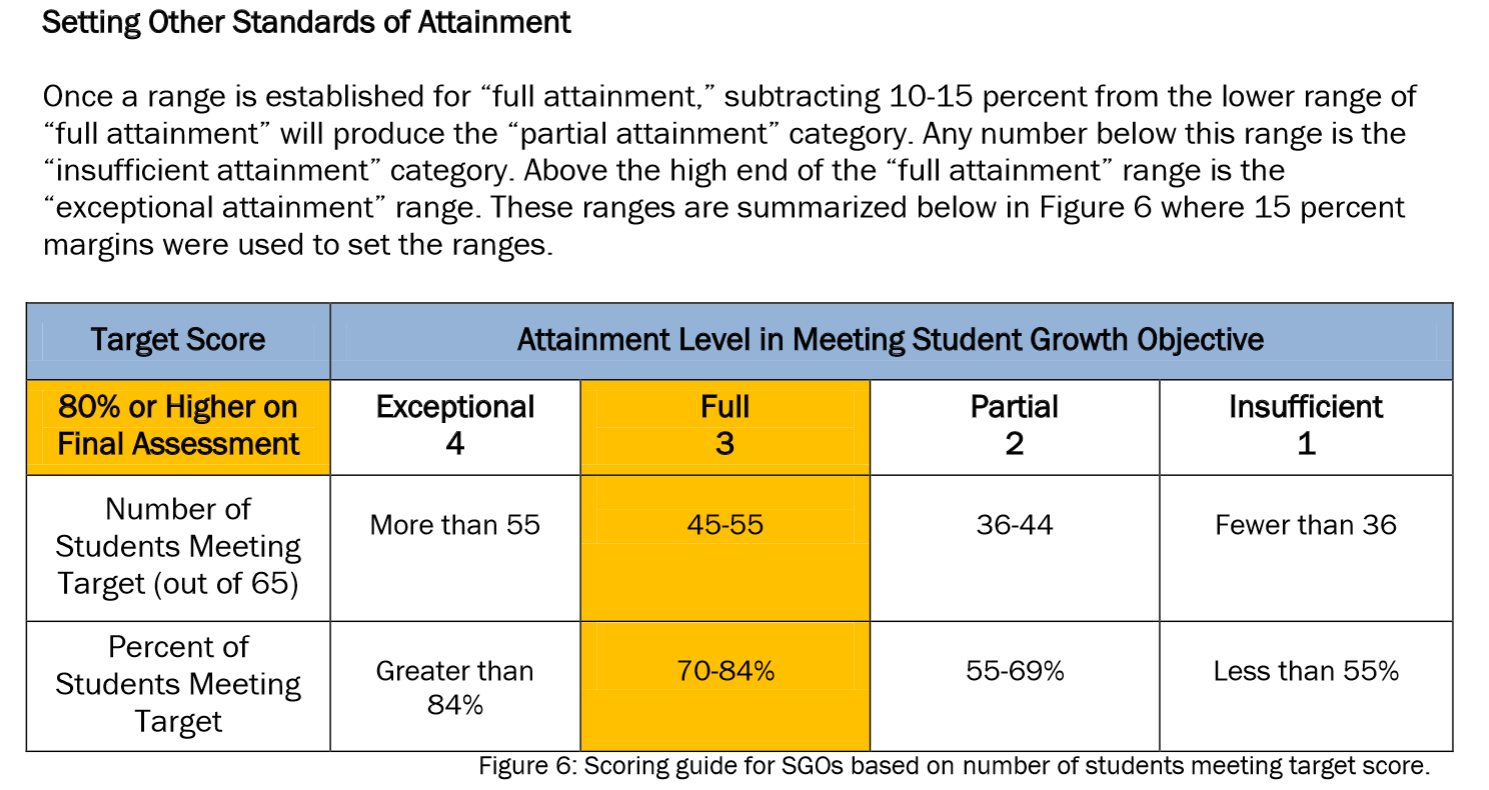
2 Comments

Filed under Funding, NCLB, politics, schools, teacher learning, teaching, Testing