Tag Archives: testing

Does Anyone in Education Reform Care If Teaching is a Profession?

Bob Braun, retired veteran reporter for the New jersey Star Ledger and current independent blogger, reported earlier this month that state-appointed Newark Superintendent Cami Anderson announced that Newark teachers seeking graduate education would only get district stipends if they did all of their study at the Relay “Graduate School of Education.”  For those who are unfamiliar, Relay “Graduate School of Education” was singled out as an innovator by Secretary of Education Arne Duncan last November, but it is a “Graduate School of Education” that has not a single professor or doctoral level instructor or researcher affiliated with it.  In essence, it is a partnership of charter school chains Uncommon Schools, KIPP, and Achievement First, and it is housed in the Uncommon Schools affiliated North Star Academy.  Relay’s “curriculum” mostly consists of taking the non-certified faculty of the charter schools, giving them computer delivered modules on classroom management (and distributing copies of Teach Like a Champion), and placing them under the auspices of the “no excuses” brand of charter school operation and teachers who already have experience with it.

In the case of North Star Academy in Newark, that means that the teachers who earn certification through Relay “Graduate School of Education” will have “instructors” who meet state requirements for faculty degrees by the school claiming “equivalency” because they are such amazing teachers who get amazing results.  In Relay’s words that is “the equivalent of the leading entrepreneur teaching in MBA programs or the leading writers and artists teaching in MFA programs.”  That’s quite a lofty claim, especially when Dr. Bruce Baker of Rutgers University has demonstrated (repeatedly) that the “awesome” results of North Star are deeply connected to how the school has many fewer students with high needs due to poverty, language, or disabilities issues, how it suspends students at rates much higher than district schools, and how an African American male who enrolls in 5th grade has only a 40% chance to staying at the school until 12th grade.

So, there you have it: a “Graduate School of Education” without a single professor of education, offering teacher certification and degrees to the employees of the charter school in which it is housed, specializing in a curriculum that emphasizes teaching and discipline strategies that successfully drive away more than half the students whose families deliberately sought out the school in the first place. And THIS will be the sole provider of compensated continuing education for all of the teachers in the Newark Public Schools.

sheldon-throwspapers

What makes the embrace of Relay “Graduate School of Education” in Newark, Trenton, and Washington D.C. so frustrating is that university-based teacher preparation continues to have the standards for our graduates raised by the very same entities that think Relay should be allowed to call itself a graduate school and confer certification and degrees.  Trenton, in particular, is barreling ahead with proposed revisions to teacher certification rules that university-based programs will need to adhere to whether or not there is evidence that they will result in better teachers.  Currently, the young people who wish to become teachers must meet entrance criteria upon matriculating at our school.  Once in they must maintain a minimum GPA to take classes in their education major.  In addition to a full major in education courses, they must have a major in a content field within the College of Arts and Sciences, and they must take additional coursework in a liberal arts core to fulfill both university requirements and state requirements of a minimum number of credits in liberal arts courses.  Our program has extensive field work prior to student teaching that go beyond current state requirements that our students must coordinate with their full time class schedule.  The state also requires that all students seeking certification pass Praxis II examinations.  Various changes to the code requirements are under consideration in Trenton, all of which will make it more difficult for people to seek certification at universities.  Entrance requirements may be increased, or potential students can demonstrate “readiness” to begin their studies with another standardized exam.  The state is considering requiring what would amount to a year-long student teaching experience, and the next version of the state code will almost certainly require teacher candidates to submit a performance assessment to the state which, for all intents and purposes, will require most universities to adopt Pearson’s EdTPA assessment.

All of this probably sounds great if you agree uncritically with self appointed teacher quality watchdog, National Council on Teacher Quality, that declared teacher preparation an “industry of mediocrity” in a report so exhaustively researched that they failed to visit a single university campus and gleaned most of their quality “data” from online catalogs and program descriptions.  For more cautious observers, changes like these might be intriguing, but they come with questions and trade offs.  The biggest question is whether there is any evidence at all that trimming the available corps of potential teachers entering preparation and then holding those who make it in to more rigorous benchmarks will result in better learning in their eventual classrooms.  Critics of traditional teacher preparation often criticize the academic caliber of students entering teacher preparation without noting a very obvious point: if being the best student was absolutely essential to being the best teacher, then the nation’s professoriate would enjoy a much better reputation for teaching skills.

However, even beyond the question of evidence, advocates for increasing requirements on traditional teacher preparation need to acknowledge there are trade offs for increasing standards and requirements this way. Increasing the necessary test scores for entry into a program means that certain populations of students may not be able to even begin teacher preparation and prove their ability in a timely fashion and be effectively locked out of undergraduate study in the field (you can have one guess about from which communities most students who might not meet this hurdle would likely come).  A full year in the classroom for student teaching is an appealing idea  — that comes with massive logistical challenges for students trying to get all of their coursework completed in just 4 years and might make undergraduate preparation unworkable for transfer students and community college graduates.  A state required performance assessment is an idea worth exploring, but with indications that the state is willing to simply farm this out of a major testing corporation at a cost of $300 out of pocket for students, there should be a robust debate on the instrument itself and the ethics of tying up another certification requirement with a corporate revenue stream.

Assuming these issues could be resolved favorably and equitably, there is another issue to consider.  Current conditions and proposed changes all appear aimed at trying to ensure that high caliber students and high caliber students only enter and make it through traditional teacher preparation.  That goal might be defensible, but what, exactly, is Trenton, or any other state capitol for that matter, doing to make teaching an attractive prospect for such high caliber students?  Chris Christie breaking his own pension reform obligations probably isn’t a big incentive.  Despite claims to the contrary, New Jersey teacher salaries are not comparable to other professionals with similar education levels.  In my 22 years in education and higher education, I have yet to meet a single teacher who thinks the distorting stakes attached to current high stakes examinations would be a job perk.  The callous havoc unleashed upon school districts under state control by Trenton appointed superintendents cannot make many of the state’s best and brightest want to work in urban schools.  While Governor Chris Christie has not yet traveled to the New Jersey Education Association annual meeting in Atlantic City to personally beat up a teacher on the boardwalk, he has yelled at several of the state’s teachers in person and accused them of using students “like drug mules” for a Project Democracy assignment near school elections.  All of this is certainly going to entice New Jersey’s best students to accrue debt and work hard to enter a profession held in such esteem by the highest offices in the state:

Governor Chris Christie, Raising Teachers' Public Esteem Again

Governor Chris Christie, Raising Teachers’ Public Esteem Again

The disconnect between allowing Relay “school” to operate while placing these requirements on traditional programs and leveling this much disrespect upon working teachers is staggering.  To a degree, those of us in academic teacher preparation have ourselves to blame for some of this.  As the first wave of the “failing schools narrative” took shape with the release of A Nation at Risk in 1983, numerous reports and proposals were released that focused upon “professionalizing” the field of teaching, conjuring a future where the teacher workforce more closely resembled higher status professions in career trajectory and in clinical preparation.  While the wholesale transformation never happened, the clinical preparation ideology is well entrenched within different teaching standards, accreditation organizations, and among no small share of teacher educators themselves, and David Labaree of Stanford University noted in the early nineties that this focus emphasized teaching as a technical, rational, activity and potentially shut out public input the way medical fields protect their specialized knowledge.  Indeed, by accepting wide swaths of the teaching as technical/rational viewpoint, teacher education has limited the role of powerful visions of teacher development that embrace all of teaching’s complexities and, as Ruth Vinz wrote, begin “to look behind the act, the formula, the answers to the causes, conditions, and contexts.”  We have, in fact, participated in portraying teaching as technical practice whose most important aspects are measurable, so it is little wonder that policy makers are hurling a runaway train through that opening.

However, given the promotion of Relay “Graduate School of Education” and given the continuous disrespect and degradation of working conditions heaped upon teachers, I cannot accept that Trenton is really trying to elevate the profession — in either a technical manner or not.  Taken together, the current and proposed policy environment seems more geared towards greatly decreasing the number of teachers who obtain certificates via traditional teacher preparation while opening the door for many, many more to enter teaching via what amounts to on the job training without ever having studied for the job in the first place.  Trenton, intentionally or not, is engineering a shortage of teachers with credentials from undergraduate study, which will result in more schools like Relay “Graduate School of Education” being “needed” to fill in the gap by certifying their own employees.  Those who survive the “churn and burn” for which charter schools are famous would have state issued credentials to move on to fully public schools.

Or perhaps they won’t.  I find it hard to believe that today’s education “reformers” really believe that teaching is a profession at all.  If they did, the pressure to make certain only top students enter university-based teacher preparation and then to make sure those students have rigorous preparation would be coupled with similar efforts to raise the attractiveness of teaching as a lifelong career.  Instead, reformers act as if they believe that teaching is something you do in your twenties when you are idealistic and want to “give something back”  — and then you move on to a “real career” in some other sector.  If your charter school bosses like you, perhaps they will make you a school principal before you are 30, or they will set you on a path to become Commissioner of Education for the state of New York when you are only 36 years old.  But mostly, they will thank you for a few years of service and see you off to your grown up life outside of education.  After all, reformers’ favorite schools — “no excuses” charters — manage to train their students into “little test taking machines” without very many career teachers, so why should reformers really value teachers who dedicate their entire adult lives to teaching?  That people in their 30s, 40s, and 50s are dedicated and developing professionals who wish to remain in the classroom must seem like an amusing and quaint anachronism to them.

The teachers I know and work with are not laughing.
24 Comments

Filed under Cami Anderson, charter schools, Chris Christie, teacher learning, Testing

Merryl Tisch: Let Them Eat Test Scores

New York State Regents Chancellor Dr. Merryl Tisch addressed the winter institute of the New York State Council of School Superintendents last week.  Her prepared remarks were fairly dry compared to the lively yet facile talk given by keynote speaker Michael Petrilli, President of the Thomas B. Fordham Institute, who extolled the gathered superintendents to be “cage busting” leaders without mentioning that most of them were being routinely stiffed by Albany’s school aid budget.  Dr. Tisch stuck to three main points: rigor, flexibility, and comparing parents who opt their children out of annual standardized exams to people who refuse to get their children vaccinated.  Oh wait, that last one was folded into her discussion of “the future.”  I’ll get back to that.

Dr. Tisch’s comments on rigor were brief and not exceptionally interesting.  She took issue with an unnamed “national leader” in education who claimed a good school was one “where parents want to send their children, teachers want to teach, and students are engaged.”  According to Dr. Tisch, this missed a necessary component: “…students are challenged by high standards and are supported in their growth by great and caring teachers.”  Neither “high standards” nor “rigor” are actually defined by Dr. Tisch, and I am familiar with entire schools of educational philosophy that assert student engagement actually comes from doing challenging and meaningful work in partnership with teachers who support student growth, so Dr. Tisch’s objection could have been phrased as simple clarification and served a much more useful purpose.

However, I would point out that this focus on “high standards” as a proxy for “rigor” or “engagement” is a patently simplistic.  In my critique of Michael Petrilli’s comments to the same audience of superintendents, I pointed out that the connection between recognized high quality standards and student achievement as measured on assessments like the NAEP is tenuous at best, and it points to a need to actually pay far more attention to the systems that support (or fail to support) teaching than to the documents that serve as a starting place for planning.  Chancellor Tisch, however, has demonstrated little patience for systemic change, and last November announced she would move aggressively by Spring to start closing New York City’s most struggling schools even though Mayor De Blasio had only just announced a three year program to turn around those schools.

Amongst its other, undefined, characteristics, “rigor” simply has no patience.

Dr. Tisch’s remarks quickly pivoted to flexibility, where she was just as vague and rambling as her shorter remarks on vigor had been.  There is some boilerplate acknowledgement that “one size does not fit all,” and a few specific points where the Regents have either asked for more flexibility from the USDOE or delayed high stakes consequences for students.  The superintendents got an acknowledgement that “college readiness is complicated,” and that a single test score cannot capture qualities like “persistence, collaboration, and creativity.”    However, they were assured that the Regents understood this as the Diploma with Advanced Designation “requires persistence through advanced math and science courses, as well as advanced coursework in CTE or World Language or the Arts.”

Well, gosh.

I am baffled by Dr. Tisch’s assessment of “flexibility” that includes no mention of content, pedagogy, differentiation of instruction, reduced class sizes, co-teaching, organizational and leadership changes, or frankly anything else that actually might result in improved teaching reaching more students.  Highlighting a request to the federal government for the “flexibility” to treat English language learners in a sane and humane manner is highlighting a minimal obligation and does not speak to me of a department whose cup is overflowing with much flexibility.  Further, saying an “advanced designation” Regents Diploma “requires persistence” because it requires advanced coursework is mistaking dutifully checking off ticky boxes with a complex and highly variable psychological phenomenon.  “Collaboration and creativity” get stunningly brief mentions but no substance whatsoever.

This thinking is not merely stuck inside the box, but it is holding desperately on to the box and wailing in terror at the thought of being dragged out it.

Dr. Tisch turned to discussion of “the future” with a brief boast that the Board of Regents has proposed a $2 billion increase in school funding which is, in fact, the largest increase proposed by anyone in Albany.  That sum, while substantial and welcome, would be, if it passed, more than $3.5 billion SHORT of the minimum sum necessary for the state to meets its obligations in the 2007 Campaign for Fiscal Equity settlement.  I am certain the superintendents were pleased to hear her actually address the issue of foundational aid and the gap elimination adjustment, but they probably would have liked more than a paragraph on it.  She also previewed the Regents’ priorities that the next state Commissioner be someone who is “good at listening, explaining, and adjusting course as warranted” among other qualities.  This is good news in no small part because the outgoing Commissioner of Education, John King Jr., was fundamentally incapable of listening, demonstrated no ability or willingness to explain anything to anyone, and was as willing to “change course” as a cat is willing to be walked on a leash.

Chancellor Tisch reserved the longest portion of her address to a defense of testing and to denouncing the opt out movement.  The defense of annual testing of all children is familiar by now and as wrong as it is when uttered by Secretary of Education Duncan or the editorial board of The New York Times: If we don’t test every child in every school in every grade then kids “disappear.”  As far as monitoring the system overall is concerned, this is inaccurate and representative sampling of student populations in ways that are minimally intrusive are fully capable of telling us how we are doing as a whole.  If Dr. Tisch is worried that individual students “disappear” then our efforts would be far better served working to give all teachers access to more sophisticated and less intrusive formative assessment tools that could actually provide useful feedback during the school year and could help teachers and parents effectively discuss individual students’ progress. The insistence on mass delivered standardized tests attached to high stakes has already done sufficient damage to curriculum breadth and done so little to raise student achievement on stable measures like the NAEP that there is no good argument to maintain it.

The the Chancellor turned to opting out:

If you encourage test refusal, you have made a very powerful statement. We all want the tests to be even better – as short as possible and as closely matched to instruction as possible.  That is a fair critique, and we continue to improve the tests over time.

However, some have a very different goal.  They have said they want to bring down the whole system on which adult accountability is based – even if only a little bit – on evidence of student learning.

I am much less cynical, and I see things very differently.  I believe that test refusal is a terrible mistake because it eliminates important information about how our kids are doing.

Why on earth would you not want to know whether your child is on track for success in the fifth grade or success in college?  Why would you not want to know how your child and your school are doing compared to other children in district, region, and State?  Why would you not want to know the progress of our multi-billion dollar investment in education?  Why would you not want to know whether all students are making progress, not just the lucky few?

I do not pretend that test results are the only way to know, but they are an important piece of information.  They are the only common measure of progress we have.

We are not going to force kids to take tests.  That’s not the New York way.  But, we are going to continue to help students and parents understand that it is a terrible mistake to refuse the right to know.

We don’t refuse to go to the doctor for an annual check-up.  Most of us don’t refuse to get a vaccination.  We should not refuse the test (emphasis mine).

Most of this section of her talk betrays the same staggering lack of imagination that is common among the defenders of annual testing — and it conflates entirely different purposes of assessment.  Keeping tabs on the system and how it functions does not require annual testing of all children to be effective, and keeping tabs of individual children is done with much greater nuance and usefulness by a raft of other tools, both qualitative and quantitative, that teachers can use in ways that actually inform instruction of individual children.  If the Regents want to help teachers develop them, adapt them, and create systems for effectively communicating between school and the home, then that would be a welcomed effort, but Dr. Tisch is mainly saying the critical element here is locating every child’s place on a box and whisker plot while she pays very minor lip service to more useful measures.

The truly telling part, however, is her comparison of refusing to have a child tested with refusing routine medical care and vaccination.  Despite a half-hearted attempt to note that tests are not the only way to know how a child is doing, Dr. Tisch apparently believes that having your child sit for a standardized examination is as important to that child’s long term readiness in school as having your child vaccinated against polio is to keeping your child out of an iron lung. The comparison is actually breathtaking because whereas annual visits to the doctor usually involve a number of different measures of health and keeping a routine vaccination schedule is based upon individual and public health concerns, annual standardized testing provides a generally crude snapshot look at individual children’s academic accomplishments and test refusal has zero impact on any one else’s ability to get an education. “Opting out” of routine medical care is frequently a decision to discount well-established science about personal and communal health benefits.  Opting out of high stakes standardized examinations is a decision based upon — well, I will only speak for myself and my family here.

Absent massive changes, my wife and I intend to opt our oldest child out of New York’s Common Core aligned and Pearson designed examinations.  Our reasons are a bit more involved than Dr. Tisch apparently assumes:

First, the tests are of questionable appropriateness for the age of the children taking them.  Russ Walsh of Rider University in New Jersey examined Pearson’s sample reading passages for the PARCC exams, and he found that by most accepted measures of readability, the material was up to two grade levels above the age of the children taking the exams. While the Common Core exams are meant to be challenging, this is an absurd way to design a mass standardized test and a completely back door way to redefine what is considered average skills.  My family objects to a standardized exam that is designed to flummox students who are not entering the test well above their grade level skills.

Second, the New York State Education Department, led by John King Jr., set the proficiency cut scores in a way that deliberately and predictably places almost 70% of the students in our state as below proficiency and did so with no public explanation as to why.  NYSED pegged cut scores to performance levels roughly indicative or SAT scores that were roughly indicative of first year college “success.”  There has been no public discussion or debate about why this is an appropriate way to define “proficient” for all students, regardless of their college plans, but the result was entirely predictable — the percentage of students reaching “proficient” is slightly larger than the percentage of adults over 24 in New York with a BA.  My family objects to opaque changes in the meaning of test scores.

Third, the lack of explanation of what these scores mean or attempts to justify the way they were set has resulted in a thoroughly dishonest representation of what the scores mean from a multitude of sources, including the media, anti-tenure and pro-charter school advocates, and Governor Cuomo himself. Campbell Brown who has taken the legal battle to strip teachers of tenure protections to New York, repeatedly says the test scores mean students are not reading or doing math “at grade level.”  The charter school advocacy group “Families for Excellent Schools” released a report where it uses the test scores to claim that over 140,000 NYC students are in schools where 90% of the students cannot read or do math at grade level, and this misrepresentation is dutifully repeated in the media. Governor Cuomo repeatedly uses the test scores to insist that there must be many more incompetent teachers in our schools. The combined goal of this rhetoric is obvious: the closing of many more public schools so they can be turned over to charter school operators who appropriate the rhetoric of the Civil Rights Movement while funneling public money into private hands and increasing segregation of the schools.  My family objects to the cynical and opportunistic manipulation of the test scores that has gone on without a peep of objection or correction from the Board of Regents, the department of education, or the Commissioner.

Fourth, both Dr. Tisch and the governor intend to use the test scores in invalid ways that will objectively harm educational quality in our state. Dr. Tisch, in communications between her office and Governor Cuomo, endorsed raising the percentage of teacher evaluations governed by standardized test scores from 20% to 40%.  Governor Cuomo’s “Opportunity Agenda” calls for raising it to a full 50%.  Both of these ideas are horrible and run contrary to the warnings and advice of actual experts in statistics and evaluation.  Far from improving education in our state, these plans will hasten an already alarming narrowing of the curriculum and give teachers heavy incentives to teach to the test.  Instead of ferreting out bad teachers, this will take random and unpredictable aim at even excellent teachers.  Dr. Tisch thinks people who object to this want to tear down the “adult accountability” system, but it would be more accurate to say we object to that system being built upon a foundation of Grade A Bullplop.  My family does not want our child’s test scores used to further deprofessionalize teachers and harm the curriculum.

Fifth, my child will not gain a blessed damned thing by sitting for hours upon hours in these examinations.  Our oldest child is quite bright as every teacher from pre-K until now has attested.  Our oldest child is also quite creative and can spend hours in inventive and imaginative play.  Our oldest child also does most thinking and reasoning via talk, so work that is entirely done silently at a seat is sometimes a struggle and sometimes torturous.  While it is true that school work (and work work) will eventually necessitate an ability and willingness to work for long stretches in silence, it is also true that our oldest child is a young kid and should fully explore being that first.  Further, future school and work will also necessitate discussion and collaboration, qualities that our standardized exams do not remotely address.  My child needs assessments that demonstrate a full range of strengths and challenges rather than one that will foster a sense of failure and inadequacy and then be used to punish teachers for having a student who thinks orally. My family objects to subjecting our child to frustration that serves no constructive purpose.

I would submit to Dr. Tisch that far from being like refusing routine medical care, our plan to refuse standardized tests is akin to switching medical providers because the last three times you went with a mild fever and headache the doctor’s boss insisted you have a colonoscopy.  And then used the results of that to fire the doctor because you didn’t get better.

If Dr. Tisch is serious that standardized tests are “an important measure” then she should be working to rehabilitate them so they are only being used for what they can actually accomplish.  Testing to monitor how the system is serving students needn’t be disruptive of the entire system.  Assessment to check student progress and communicate that to parents should consist of a broad portfolio of tools for teachers to use in the classroom, and the NYSED would do better to invest in those and in new pathways to communicate to parents and guardians.  Testing to evaluate teachers based upon adequate yearly progress using value added measures should be tossed onto the dung heap of abandoned educational fads in favor of teacher evaluations designed to identify actually beneficial teaching in the classroom.

What does the future hold, Chancellor Tisch?  A school system whose improvement is based upon models of growth and support?  Or lots and lots of tests?

Leave a comment

Filed under Common Core, New York Board of Regents, Pearson, Testing

Pearson’s Intellectual Property — Why Is This Even a Thing?

Bob Braun, a five decade veteran of the Newark Star Ledger and currently an independent blogger, blew up a portion of the internet on Friday by reporting that Pearson, the international education giant responsible for the PARCC examinations currently underway, was “spying” on students’ social media activity.  According to a letter from Watchung Hills Regional High School District Superintendent Elizabeth Jewett, the district test coordinator got a late night phone call from New Jersey DOE after Pearson initiated a “priority one alert” for a breech of test security within the district.  NJDOE informed the district that they believed Pearson’s alert was for a student who took a picture of a test item during testing and posted it to Twitter, and the state suggested that the district should discipline the offending student.  However, upon examination, the district ascertained that a student had tweeted a comment well after testing was over and included no picture at all.  The tweet has since been deleted by the student, but given the 140 character limit on Twitter, it is extremely unlikely that any significant breech of test security could have possibly occurred.  However, the incident revealed that Pearson is monitoring social media for any and all references to the testing going on and is prepared to initiate state level investigations of individual students (how else would NJDOE know the district and student involved?) over very flimsy circumstances.

The story took off very quickly as did Mr. Braun’s accusation that Pearson is “spying” on students’ social media.  The web site was loading very slowly on Friday night likely due to very high traffic, but by later that night it was completely inaccessible and Mr. Braun reported on Facebook that his web host informed him a denial of service attack was underway from an as of yet unidentified sources.  Meanwhile, outraged parents and anti-testing/anti-PARCC sentiments took off in social media:

https://twitter.com/manville71/status/576851582312054784

https://twitter.com/allionthemove/status/576823310702477312

https://twitter.com/qbgone/status/576806592642969600

Let me state that I am unconvinced that “spying” is exactly the correct word over “monitoring.”  The reality is that most corporations of any size are monitoring social media routinely to check on their reputations and potential scandals.  In a world where social word of mouth is genuinely a thing, it makes business sense for them to do so, and social media is not communication in the private space.  If you don’t believe me, wait until you have a bad customer experience with your cable company and then take to Twitter about it — If you don’t get a response from someone in corporate within 24 hours, I owe you a coffee.

However, even from a “monitoring” social media perspective, Pearson’s actions are troubling.  I will concede that the company — and participating PARCC states — have an interest in test security while a standardized test is being deployed (although I also agree with Peter Greene that this level of test security does not bode well for the quality of these exams), but what, exactly, causes Pearson to raise a “priority one alert” and contact a state department of education with sufficient information to locate a district and specific child in question?  What information about a minor’s social media use does Pearson consider its business to pass along to the top education officers in a state?  To what depth does Pearson consider itself able to impose a gag order on other people’s children and use state capitols to enforce it?

Remember — the child in question did not send out a photograph of the exam, merely a single tweet limited to 140 characters AFTER testing for the day was over.  For that, Pearson initiated contact with the NJDOE that sent Trenton thundering into the student’s social media account and alerting district officials when frankly, nothing should have happened at all.  Thankfully, Superintendent Jewett is reasonable and knowledgeable about social media; it could have easily gone south really quickly.

Pearson’s hyperactive attitude towards test security is disturbing not only because of how it is being enacted without concern of proportion, privacy, and the implications of initiating state level investigations into unremarkable student speech.  It is also disturbing because of its connection to Pearson’s larger perspective on its intellectual property and the allowance the public sector gives them in defense of it.  While discussing this on Twitter, I encountered a user who stated that he “applauded” Pearson “defending its intellectual property,” which led me to a single question:

Why is Pearson’s intellectual property even a thing after it delivers a exam to be used for public education?

Considering the following:

  • PARRC was seeded with part of a federal grant worth over $300 million to create examinations for the Common Core State Standards.
  • Pearson was the only bidder for the contract to write the examinations for PARCC.
  • That makes the Pearson written PARCC examinations the only CCSS examination in 12 states and the District of Columbia — Pearson writes CCSS aligned examinations for other states such as New York.
  • Pearson’s contract with New Jersey alone is worth more than $100 million over 4 years.
  • The examination is high stakes – with implications for teacher evaluation and a possible future role in graduation requirements.
  • The examination is used by the state to fulfill federal requirements under the No Child Left Behind Act that all students in all schools between grades 3-8 and in grade 11 be tested in English and Mathematics.  Unlike other standardized examinations students takes, these exams are mandated by state and federal laws.
  • Pearson has no intention of releasing complete copies of this year’s exams even after they have been fully deployed and assessed.

This isn’t even like copyright rules preventing photocopying textbooks — textbooks publishers rightly expect that schools will buy enough copies of their texts for students using them, and they are in direct competition with other potential text providers.  Pearson has an exclusive contract to provide examinations for millions of students (a contract it did not exactly sweat bullets to obtain).  These examinations are used for high stakes purposes.  The examinations fulfill federal mandates for testing in our public schools, and they inform personnel decisions locally, administrative decisions at the district and state levels, and federal actions nationally.  The company is providing a contracted service in our public education system which is, itself, compulsory and, for the time being at least, democratically controlled.

Once they are done writing the exams, why isn’t Pearson required to turn the entire kit and kaboodle over to the state and thus to the voters and tax payers who provide the vast majority of decision making and funding to public education?

I am unaware of a construction company that, after delivering a highway project, reserves lanes for its own use or to pull up and recycle in other projects.  Generally speaking, government buildings do not have entire floors blocked off for use of the contractors who built them.  When Northrop Grumman delivered the USS Ronald Reagan to the Navy, they did not block off sections of the ship that the Navy cannot access.  If such companies create or develop a process of construction or tool for use in construction, they can protect that via patents, but once the contracted item is finished, we generally understand it as belonging to the public who paid for it.

But when it comes to items that are not physical in nature, we accept an arrangement where the public foots enormous costs to only lease the product in question.  Think of electronic voting machines.  I can think of few things as important as protecting public confidence in the integrity of their vote, but companies are not required to make the code for voting machines open source and the public depends upon leaks to inform us of potential security holes in the devices.  Similarly, Pearson is providing a mandated service for our compulsory public education system, and the results of that service will have actual consequences not just for the individual teachers and students involved, but also for the entire system.  Confidence in what they are providing and informed decision making about whether or not what they are providing is desirable requires open and informed discussion and debate — such discussion and debate is impossible while Pearson’s intellectual property is valued more highly than the public purposes it allegedly serves.

In a small way, you cannot even blame Pearson.  They made contracts with states that allowed them to behave this way, and they are a publicly traded company with $17.75 billion in market capital.  Doing everything to maximize their revenue and return to investors is what they do and not a secret.  However, we elect governors who appoint leaders to state education departments; they represent us.  Craven obsequiousness in making contracts worth 100s of millions of taxpayers’ dollars is unnecessary and unacceptable.  It is possible, I suppose, that if our elected leaders and their appointees insisted upon reasonable contracts and the full disclosure of all test materials after the tests are over, then the cost would go up, perhaps to a level states could ill afford and leading to pulling back of the test and punish regime that is currently driving education policy and warping curriculum into test preparation.

Heavens.  That would be terrible.

18 Comments

Filed under Common Core, Corruption, PARCC, Pearson, Testing

New York Times Fails Education Reform – Again

Two weeks ago the New York Times published a guest editorial by Chad Aldeman defending keeping annual testing as a part of the Elementary and Secondary Education Act (ESEA) as Congress is debating revisions and renewals to the changes made in the 2001 No Child Left Behind Act (NCLB).  I was not especially impressed.  Today, the editorial board itself has chimed in with what could have been a carbon copy of Mr. Aldeman’s position.  The board implores Congress to maintain annual testing as a key component of federal education law, and, unsurprisingly, I find the arguments less than stellar.

The board covers fairly familiar ground while acknowledging that some aspects of NCLB have been negative, such as the inability of test based accountability to distinguish between so-called “failing” schools and schools that missed certain accountability targets as measured by tests.  The board also acknowledges that testing has expanded to consume too much attention in many states and districts.

However, their recommendation that states “fix this” by “identifying and discarding unnecessary tests and, if necessary, placing explicit limits on how much time can be spent on testing” misses that it is the FEDERAL accountability requirements that spawned excessive testing and test preparation in the first place.  It is an act of fancy rhetorical footwork to blame states and municipalities for an over focus on standardized testing when FEDERAL requirements have incentivized that very focus, first with threats to label schools as failures under NCLB and then with the Obama administration pressuring states to use discredited statistical models to evaluate teachers as part of Race to the Top.  The “wave of over-testing that swept this country’s schools during the last decade” is the responsibility of the federal government, and it is up to the federal government to fix it.

The board repeats claims familiar in reform circles that annual testing is needed because if we do not test every child in every year, “parents would never know how well their children were doing.”  This claim remains staggeringly bereft of imagination every time it is written by another person or organization intent on seeing annual testing maintained.  Set aside the reality that a child whose parents or guardians need a standardized test to know how she is doing in school is a child with much bigger problems than whether or not her state administers an annual test, and consider how many, far more meaningful ways, there are to communicate how a student is doing in school.  Annual tests come late in the year, focus upon content that does not indicate creativity and problem solving, and report results far too late to be used for the benefit of individual students.  Fortunately, we have myriads of ways to help teachers assess students, use that information to improve instruction, AND communicate with parents.  There are teacher designed tests, portfolio assessment systems, project based learning, and computer delivered adaptive assessments that give immediate, formative feedback.  Every single one of these ideas will let parents know how their children are doing, and some of them could readily be pegged to provide comparisons to other students if absolutely deemed necessary (doubtful).  How a mass standardized test EVERY year would remain necessary with a collection of tools like this instead of a carefully sampled exam reported every couple of years is beyond me.  Regardless, the Obama administration invested $330 million to write new, even bigger, standardized exams for the Common Core State Standards.

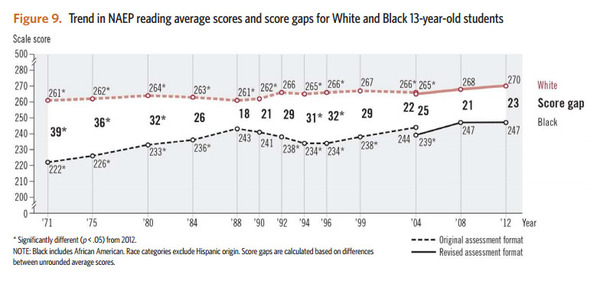
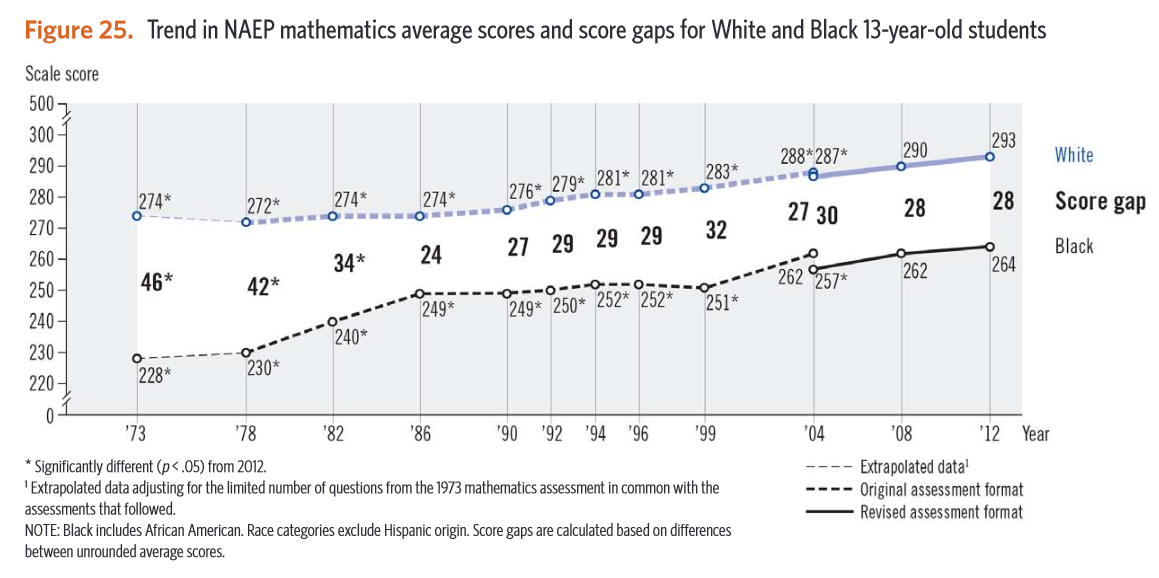
The Times board also states that “national test data clearly show that since the unpopular No Child Left Behind Act was signed in 2002, academic performance for the country’s students has improved and achievement gaps between white and minority children have narrowed.”  The implication here is that we owe that to NCLB, an assumption that is made problematic by taking a wider view of achievement history as reported by the National Assessment of Educational Progress (NAEP).  It is true that the gap between white and black 13 year-olds, for example, in mathematics and reading closed from 32 points to 28 points and from 29 points to 23 points respectively in between 1999 and 2012.  However, longer term trends show much more dramatic gains in the 1970s and early 1980s:

13 year old math NAEP

NAEP Reading

In between 1973 and 1986, the gap in mathematics achievement closed by 22 points, and in between 1971 and 1988, the reading gap closed by 21 points.  Modest gains in closing the gap in the early years of NCLB were statistically significant, but no significant gains were made in mathematics and in reading between 2008 and 2012.

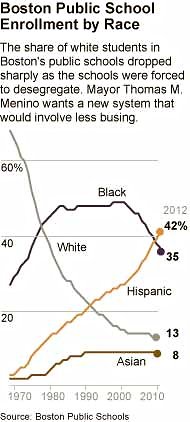
The Times is praising an anemic record of “effectiveness” for test based accountability, and it fails to consider what might contribute to the steady and significant improvement in the 1970s and early 1980s and what might account for how those gains leveled off or decreased in the late 1980s and 1990s.  Consider that the 1970s saw the last major effort by politicians and courts to expand desegregation of our schools by placing school districts, including many in northern states, under court orders to integrate their schools systems.  This effort peaked in the 1980s and since then, schools have become re-segregated in no small part because of white flight.  Boston, Massachusetts, which had a particularly contentious relationship with court ordered integration, saw the percentage of white students in public school plummet by more than 40 points between 1970 and 1990, a change that cannot be explained by simple increases in the minority population:

boston

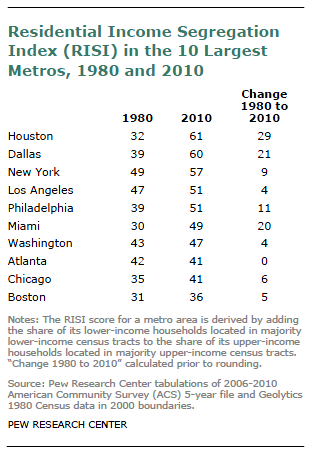
White flight was also a proxy for the middle class abandoning urban communities, and in the 30 years between 1980 and 2010, the percentages of people who live in housing tracts dominated by their own income levels has risen nationwide.  The change in the Residential Income Segregation Index (RISI) is in the double digits for many of our most populated urban areas:

risi increase

So here is what the editorial board of the Times fails to consider:  Achievement gaps on the NAEP narrowed dramatically during the 1970s and early 1980s when the nation was still pursuing policies of deliberate integration.  However, the cumulative impact of white and middle class populations leaving cities in the 1960s, 70s, and 80s led directly to re-segregation of our communities and schools, and the trends since 1980 have been towards greater and greater income segregation.  Today, more than 50% of students attending public school qualify for free or reduced lunch programs which means that, because of the previously mentioned trends, more and more school districts have higher concentrations of poverty.  We also know from analysis of the international PISA exam, that students in United States communities with different levels of poverty scored very differently on standardized exams.

Given this, the fact that during the 90s the gap in achievement measured by NAEP increased only slightly in math and increased in reading but began to narrow again BEFORE NCLB should be celebrated as an achievement of hard working schools facing deteriorating conditions within their communities.

The Editorial Board of the Times fails to make any convincing argument that maintaining standardized testing of every child in every grade each year is necessary to address the root problems our education system faces — concentration of poverty and increased segregation in our communities. Do we need annual testing to tell us that poverty in childhood has lifelong consequences in health, education, and economic opportunity?  Do we need annual testing to tell us that communities with high concentrations of minority students from impoverished households struggle on test based measures?  Do we need annual testing to tell us that income segregation means that constituencies with political power have no personal stakes in the outcomes for disenfranchised constituencies?  Do we need annual testing to tell us that governors and state houses from Albany to Madison have cut state spending for education and maintain patently discriminatory state aid funding formulas?

We do not.  And as Kevin Welner and William Mathis of University of Colorado at Boulder remind us in this policy memo, what we need is “sustained, fair, adequate and equitable investment in all our children sufficient to provide them their educational birthright…”  That will not happen while high stakes testing is driving our education system.

10 Comments

Filed under Media, NCLB, Social Justice, Testing

Chris Christie and the Common Core Two Step

Governor Chris Christie of New Jersey is a Tough Guy.  The New Jersey Republican revels in his reputation as a politician who says what he thinks without apology and who is willing to get into dust ups with constituents who challenge him in public.  There have been moments in his tenure in Trenton when this has had a certain bipartisan charm, such as when, with Superstorm Sandy bearing down on the Garden State, the governor told people to “get the hell off the beach.”  Unfortunately, many more examples of Christie being “authentic” are unnecessary and embarrassing examples of temper — such as the time Governor Christie, when faced with former Navy SEAL and current Rutgers Law School student William Brown in a town hall meeting ended up calling the veteran an “idiot” and had him escorted out.

Here is Governor Christie also in 2012, expressing his anger at a passerby who made negative remarks about his education policies:

Then there was the time that Governor Christie was in the Jersey Shore community of Belmar to talk on the second anniversary of Sandy and tout his record on the recovery, but when he was confronted by a former Asbury Park city council member Jim Keady over how 80% of recovery money was not yet dispersed, Mr. Keady was treated to full Chris Christie:

Mr. Keady explains himself nicely here:

Governor Christie has saved some his most “authentic” moments for New Jersey’s public school teachers and their union.  Early in his first term, he accused the union of using students as “drug mules” because of a civics lesson in Monroe Township on the eve of statewide school budget votes – after he had already proposed deep cuts to state aid.  The governor accused the NJEA of placing ads that accused him of “hating kids” and of openly praying for his death.  New Jersey teacher and blogger Jersey Jazzman makes clear just how big a pile of hooey those accusations are.  The “prayer” was little more than a joke in questionable taste, and this was the billboard in question:

NJEA billboard 2011

The Governor has also made his hostility clear in direct confrontations with New Jersey teachers.  Marie Corfield, an art teacher in the Flemington-Raritan Regional School District, went to a Christie Town Hall in 2010 to challenge his education policies and rhetoric.  Mr. Christie, not appreciating what he deemed a disrespectful look on Ms. Corfield’s face, launched into a monologue that suited him so well, it went up on his Youtube channel to help cement his Tough Guy reputation. It also inspired Marie Corfield to run for Assembly:

And there was the time, days before his reelection, that Governor Christie met elementary teacher Melissa Tomlinson at a campaign rally where she asked why he was constantly calling New Jersey public schools “failure factories“.  The result was predictable:

Christie Yells Again

Governor Christie has been on board with education reform from the beginning of his term, applying for Race to the Top funding, adopting the Common Core State Standards, joining the PARCC consortium as a governing state, crafting new teacher evaluations using student test scores, and working to expand charter schools in the state.  Nobody can likely recall any doubt about any of these initiatives from anyone within the governor’s inner circle and certainly not from Governor Christie himself.  In fact, in August 2013, Governor Christie appeared at the KIPP Schools Summit in Las Vegas and spoke positively about the Common Core initiative and the Obama Administration:

“We are doing Common Core in New Jersey and we’re going to continue. And, this is one of those areas where I have agreed more with the President than not. And with Secretary Duncan. They haven’t been perfect on this, but they’ve been better than a lot of folks have been in terms of the reform movement.”

Given Governor Christie’s reputation for being a genuine Tough Guy who sticks to his guns even if it is not popular, it was odd to find that he apparently would like what was said in Vegas to stay in Vegas and is now walking back that support for Republican audiences in Iowa:

“I’ve said this before.  I have grave concerns about the way this has been done and especially the way the Obama administration has tried to implement it through tying federal funding to these things.  And that changes the entire nature of it from what was initially supposed to be a voluntary system that states could decide on their own.”

Lyndsey Layton in the Washington Post reported that Governor Christie went on in those remarks to say:

“So we’re in the midst of a re-examination of it in New Jersey. I appointed a commission a few months ago to look at it in light of these new developments from the Obama administration and they’re going to come back to me with a report in the next I think six or eight weeks, then we’re going to take some action. It is something I’ve been very concerned about, because in the end education needs to be a local issue.”

What could possibly be going on that would give the famously self confident and unapologetically “authentic” “Tough Guy” governor to start walking back from reforms he has been pursuing since 2010 with barely pausing to breath?  What could plant any seed of doubt in his generally doubt free mind?

Oh, right.

Chris Christie is running for the Republican nomination for President.  One of his main rivals will be former Florida Governor Jeb Bush who is trying to stick with his support of Common Core while not naming it too often.  Governor Christie must be mindful that Republican support for Common Core has fallen in the past year with 58% of Republican parents opposing the standards and only 19% viewing them favorably.  While most of those opponents likely object to the standards on substantive grounds, Mr. Christie must also be mindful that conservative opposition to the standards also include no small number of these people:

https://twitter.com/dimebag5150/status/566021629298606083

https://twitter.com/HellOfAPrez/status/550098761398366209

https://twitter.com/jonithoreau/status/539600974072250368

…who also, according to popular theory, wield outsized influence in primaries.

Will trying to two step his support for education reform to the right of Jeb Bush work for Governor Christie?  I have no idea.  Recent polling suggests that Common Core may not be so toxic in all early voting states, and primary voters may not be as extreme and polarized as commonly thought.  So Governor Christie is trying to distinguish himself from Governor Bush, but to what effect is up in the air.

What is not up in the air is what this “rethinking” means for New Jersey: Bupkas.

The New Jersey Department of Education website still contains links to the Common Core State Standards in the English Language Arts and Mathematics and links to college and career readiness and to New Jersey’s resource page for teaching Common Core.  The AchieveNJ section of the DOE site is still up, complete with links to Student Growth Percentiles for teachers in tested subjects and Student Growth Objectives for teachers in all subjects.  PARCC assessments are still being fully implemented this spring as scheduled, and the Commissioner sent “guidance” to districts that strongly suggested that districts could face consequences if too many parents opted their children out of the assessments and that there was no requirement for schools to provide those students with alternative settings. Trenton-appointed Newark Superintendent Cami Anderson is still in place and still thundering ahead with the One Newark plan to turn the district into the “charter school capital” of the nation.

There is no sign that any of that is being reconsidered in Trenton.  Governor Christie may move one foot away from his education record while in Iowa or New Hampshire, but residents of the Garden State should expect the “Tough Guy’s” other foot to stomp down with emphasis right where it already is.

3 Comments

Filed under Cami Anderson, charter schools, Chris Christie, Common Core, Newark, One Newark, PARCC, Testing

Saving Mr. Data

I am beginning to think that enthusiasts of standardized testing and data in education accountability are feeling nervous these days.  Senator Lamar Alexander of Tennessee is the new chair of the Senate committee on Health, Education, Labor, and Pensions, and he has set about the long overdue process of renewing and/or revising the No Child Left Behind Act which required annual testing of all students in every state.  The outcome of that process and of the House’s parallel bill which left committee already and which failed to adopt a Democratic sponsored amendment to require states to adopt “college and career ready standards” and to use standardized test results in accountability systems, will play a significant role in the current policy environment that is best summarized as “test and punish”.

However, it is not just a Republican controlled Congress that is threatening federal mandates for universal and annual standardized testing.  An unusual coalition of small government conservatives and anti-testing progressives have joined with growing numbers of parents concerned with how test based accountability is consuming their children’s education.  The once unthinkable is now being thought out loud and in the open — Congress could reauthorize the Elementary and Secondary Education Act without provisions requiring that all states test all students in all grades.

This would, obviously, be a blow to a cornerstone provision of NCLB that once enjoyed bipartisan support as a necessary measure to ensure that states did not try to duck being accountable for all students.  It would also throw a huge monkey-wrench into favored policies of the Obama administration promoted by Secretary of Education Arne Duncan. While the Common Core State Standards might survive in some form without annual standardized testing, the testing consortia, Partnership for Assessment of Readiness for College and Careers (PARCC) and Smarter Balance Assessment Consortium (SBAC), began their work with the support of federal grants almost as soon as the standards were being adopted thanks to financial support from the Bill and Melinda Gates Foundation and federal incentives from the Race to the Top grant program.  If annual testing requirements were scrapped by Congress, it is an open question how many states would keep Common Core and stay with the testing programs created for it.  Another policy threatened by removing annual testing requirements is the assessment of teachers by the test scores of their students.  Despite wide criticism from the research community, Secretary Duncan remains firmly committed to tying teacher evaluations to students’ annual progress on standardized examinations, and without annual examinations of all students, you cannot run their results through discredited and unstable statistical models to determine if teachers deserve their jobs.

So defenders of annual testing have work to do in public if they are going to save their baby,

One such recent effort appeared in the New York Times on February 6th. Penned by Chad Aldeman, a partner at Bellwether Education and former adviser to Secretary Duncan’s Department of Education, it is simply titled “In Defense of Annual Testing”, and it lays out what are becoming familiar efforts to shore up presumably left leaning support for keeping NCLB’s annual testing requirements.  These are not arguments that should be casually dismissed, and they have the moral authority of some of the nation’s most distinguished civil rights organizations that originally signed on for the accountability measures in NCLB when it passed and who have reiterated their support.

They are, however, arguments that don’t stand up to serious scrutiny.

Aldeman opens with a brief assertion of a now familiar claim:

But annual testing has tremendous value. It lets schools follow students’ progress closely, and it allows for measurement of how much students learn and grow over time, not just where they are in a single moment.

This claim suggests that without ANNUAL standardized testing of ALL students then we will not know how INDIVIDUAL students are progressing through school.  It has echoes in Secretary Duncan’s anecdote of how he tutored a great kid in his youth who had been tricked into thinking he was progressing towards college but who was barely reading at a third grade level.  According to Secretary Duncan’s telling, this young man was the proverbial “child left behind” for whose education nobody had ever taken any real responsibility.  Annual testing was the only effective means to catch how he was being poorly served and demand that someone do something about it, and Secretary Duncan even presented annual testing of all students as a parental tool: “Will we work together to ensure every parent’s right to know every year how much progress her child is making in school? Or is that optional?”

The problem is that this line of thinking shows a staggering lack of imagination.

As an argument, it fails to acknowledge that there are many other, and far more interesting, points of data that can be used by teachers, parents, and schools to keep far more compelling tabs on student progress throughout the year.  Locally designed and implemented ongoing assessments such as portfolios and project based learning can provide teachers with ongoing and meaningful insights into how children are learning, and report cards can be reformed to provide parents and guardians with far more nuanced information.

It is even possible to use externally designed assessments in more interesting ways that help inform teachers, students, and parents in real time.  Bruce Baker of Rutgers University notes that computer-based “adaptive assessments” given individually and with no stakes attached can be the basis of a system of formative assessment that gives immediate feedback to teachers about student progress that can be used to craft individual learning plans for those who struggle.  In coordination with portfolios and project based learning (and with full disclosure of how they use data and substantial privacy safeguards), computer based assessments could become a valuable tool based on data.  Dr. Baker further notes such data-driven and formative assessments would be vastly more useful than mass administered tests whose results are distributed months after the fact when students have already moved on to their next grade levels.

Aldeman dedicates most of his Times piece, however, on the belief that NOT testing every child in every year will allow states and localities to wiggle out from being accountable to all students all the time:

The grade-span approach would eviscerate the ability to look at particular groups of students within schools. Instead of having multiple grades over which schools could compile results, each school would be held responsible only for the performance of students in a single grade. Not only would this lower the quality of the data, but it would also raise the stakes of the tests: If you think the stakes are too high now, imagine being a fifth grader in a school where your score determines the results of the entire school.

Worst of all, under this approach, far fewer schools would be on the hook for paying attention to historically disadvantaged groups of students. A school with 10 Hispanic students in each grade would no longer be held accountable for whether those students were making sufficient progress, because the 10 fifth graders wouldn’t be enough to count as a meaningful population size.

Let me state that as a liberal with an eye for history, this argument is certainly intriguing.  We are a nation that only 12 years before my birth required the National Guard to let nine African American students attend a high school ordered to desegregate.  In 1969, the year I was born, the Supreme Court issued a ruling calling for Southern states to cease delays in desegregating their schools — a full 15 years after Brown v. Board found such arrangements unconstitutional.  Federal legislation and federal court cases were also instrumental in holding states and municipalities responsible for ending gender discrimination, for providing students with disabilities access to an education, and for providing support for students learning English.  It is no doubt this record of positive intervention at the federal level and of state delays in implementing equality of opportunity that motivated civil rights groups to endorse annual testing in NCLB and to stand with it today.

That does not change that such testing is unnecessary, is unacceptably disruptive to learning, and is narrowing curricula nationwide.

Mr. Aldeman is suggesting that eliminating annual testing will mean huge swaths of children will be hidden from the test and that the test stakes will be raised enormously with only exam being used.  The stakes argument hinges on a mistaken impression of what the exams say and what should be done with the data they produce.  For the stakes on gradespan testing to be even higher than they are today, one has to assume that such testing is used not only to monitor the education system but also to actively punish schools with low test results.  While few would argue that schools with poor results should be permitted to languish, the kinds of punitive measures embodied in NCLB are not a necessary result of monitoring student test scores.  Under the leadership of Superintendent Tony Alvarado, New York City’s Community District 2 implemented a complex and interconnect culture of reform that included standards and assessments.  However, data from the assessments were used to monitor how schools in the district were doing and to allocate resources for improvement and innovation where they were most needed and with the constant goal of instructional improvement.  Again, Dr. Baker of Rutgers makes a salient observation:

Here’s the really important part, which also relates to my thermometer example above. The testing measures themselves ARE NOT THE ACTIONABLE INFORMATION. Testing provides information on symptoms, not causes or underlying processes. It is pure folly to look at low test scores for a given institution, and follow up with an action plan to “improve test scores,” or close the school if/when test scores don’t improve, without ever taking stock of the potential causes behind the low test scores. TEST SCORES ARE SYMPTOMS, NOT CAUSES, NOT ACTIONABLE IN AND OF THEMSELVES.

Recognition of that fact and crafting policy responses to low test scores with that in mind would necessarily lower the stakes on the tests themselves.

Further, while there might be some argument for an annual test that could contribute to closer monitoring of those symptoms, there is no argument that convincingly says that such tests must be given to every student in every grade in order to get a good picture of how schools and school systems serve historically disadvantaged children.  First, a low stakes system of formative assessments, both qualitative and quantitative, could apply to all children and would conform to accommodations for children with special needs.  So there can readily be ways for teachers, schools, and parents to know how ALL students are doing during the course of the year.

Once we’ve set aside the issue of having a meaningful, formative assessment system for all students that can actually assist teachers, there’s no truly compelling argument against properly devised sampling of students for standardized testing.  Implemented correctly, sampling would not leave substantial numbers of children invisible as Mr. Aldeman fears, and we would stop spending inordinate time trying to ferret out distinctions in performance within schools when, as Dr. Baker once again notes, the greatest and most consequential differences in test measured achievement exist between schools and districts, not within them.  Insisting upon keeping annual testing of every student in every grade keeps an unnecessarily disruptive system in place as part of an accountability system that, in fifteen years, has not yielded sufficient results to justify the sacrifices in teacher autonomy over instruction and the sacrifices in non-tested subjects being shunted aside in favor of test preparation.  In fact, the only people to “benefit” from this system are private test designers like Pearson, who are being handed not just lucrative contracts but also terabytes of data to mine for new products, and advocates of firing as many teachers as possible based upon student test scores.

This is especially frustrating to me because data, when used with a clear understanding of what it can and what it cannot do, is a tool, an important tool at that.  It can help us develop broad pictures of what is happening in schools, and it can direct our attention to places that require more careful and nuanced study.  The persistent overreach and abuse of its capabilities is building a backlash that makes it much harder to successfully advocate for more judicious and appropriate use of what can be learned.  If we wish to SAVE data and its uses in school, it would be best to set aside NCLB and begin again sensibly.

I believe I see the problem, Captain.  My head's been severed.

I believe I see the problem, Captain. My head’s been severed.

12 Comments

Filed under Data, NCLB, politics, teaching, Testing, VAMs

Paving The Road to Hell — And Other Gates Foundation Initiatives

Towards the end of last year, the Seattle Times provided coverage of the Gates Foundation’s report on the tenth anniversary of its global health initiative. After a decade of effort and a billion dollars invested, Bill Gates admitted that despite the investment he had been “pretty naive” about how long it would take to significantly improve public health outcomes in the developing world. Most notable was Gates’ admission that the problems in his approach were not merely ones about overcoming scientific hurdles, but rather they seriously underestimated the challenges of implementing highly technological “solutions” in countries where the majority of the population lack secure access to routine infrastructure which, in the words of Dr. David McCoy of Queen Mary University in London, are “the barriers to existing solutions.”

Both Peter Greene of the Curmudgucation blog and Anthony Cody of Living in Dialogue have written excellent pieces on this somewhat quiet but very important admission by Bill Gates.  Greene astutely notes that Gates’ realization of his limitations does not actually lead him to understand why his approach is flawed:

Gates wants to use systems to change society, but his understanding of how humans and culture and society and communities change is faulty. It’s not surprising that Gates is naive– it’s surprising that he is always naive in the same way. It always boils down to “I really thought people would behave differently.” And although I’ve rarely seen him acknowledge it print, it also boils down to, “There were plenty of people who could have told me better, but I didn’t listen to them.”

The non-success of Grand Challenges is just like the failure of the Gates Common Core initiative. Gates did not take the time to do his homework about the pre-existing structures and systems. He did not value the expertise of people already working in the field, and so he did not consult it or listen to it. He put an unwarranted faith in his created systems, and imagined that they would prevail because everyone on the ground would be easily assimilated into the new imposed-from-outside system. He became frustrated by peoples’ insistence on seeing things through their own point-of-view rather than his. And he spent a huge amount of money attempting to impose his vision on everybody else.

This is an important observation because it shows that there is a flawed perspective rooted at the heart of the Gates Foundation, and while the man and the institution may be able to recognize failures, they are not inclined to understand why they have failed.  Anthony Cody also recognizes this observation as he lines up quotes from the central figures at the Gates Foundation that demonstrate little regard for the knowledge about teaching held by teachers and wonders if the “humility” earned in Grand Challenges project will translate to humility about the foundation’s approach to education reform.  I believe that Greene and Cody are completely on point and insightful in their observations and questions on these points, and it is important for people outside the Gates Foundation to constantly remind it that education is a complex and interconnected set of systems with knowledgeable and invested stakeholders that cannot simply be plowed over and disregarded without consequences.

A specific quote from Melinda Gates cited by Mr. Cody struck me in particular, and I believe it highlights some of the difficulties we face in enticing the Gates’ and their namesake foundation to listen.  Cody quotes Mrs. Gates from 2011:

It may surprise you–it was certainly surprising to us–but the field of education doesn’t know very much at all about effective teaching. We have all known terrific teachers. You watch them at work for 10 minutes and you can tell how thoroughly they’ve mastered the craft. But nobody has been able to identify what, precisely, makes them so outstanding.

This ignorance has serious ramifications. We can’t give teachers the right kind of support because there’s no way to distinguish the right kind from the wrong kind. We can’t evaluate teaching because we are not consistent in what we’re looking for. We can’t spread best practices because we can’t capture them in the first place.

Asserting that “the field of education doesn’t know very much at all about effective teaching” is one of those statements most frequently made by people who do not want to have to bother with how much information there is that refutes the statement.  However, if Mrs. Gates wants to fill herself in on what the “field of education” knows about effective teaching, she could begin with the 4th edition of The Handbook of Research on Teaching.  It might even be worth her while to read the third edition, see if a full version of the second edition is available, and then finish up with the original publication from 1963.  A fifth edition was supposed to published in 2014, but it seems that the editors are taking some extra time to be careful with it.

Then, for kicks, she might want to talk to some of America’s working teachers and see if they know anything as well.

Of course, knowing this field as I do, I suspect that someone who has been working in the technocratic solutions domain for this many years will still object that the multiple 1000s of pages of research on teaching to which I have referred still won’t tell us what “effective teaching” is.  Researching education is, by necessity, working with a “soft field” where you are unlikely to find absolute answers to your questions.  What we know changes as related fields like psychology build their knowledge base, and ideas can circulate in and out of favor as what schools are expected to do evolves with societal priorities.  Most importantly, research on teaching has to consider how variable the 100,000 schools and millions of classrooms across the country are and how that variability influences the teaching that is both possible and that is needed.  We are not engineering within the parameters of Newtonian physics, and that is appropriate.

Mrs. Gates’ other assertion that “you watch them (great teachers) at work for 10 minutes and you can tell how thoroughly they’ve mastered the craft” (but, gosh darn it, we just don’t know why they are so great!) is the kind of statement made by people who really don’t understand teaching.  Of course, there are great teachers, and, of course, you can be impressed by them fairly quickly, but to say that you KNOW someone has thoroughly “mastered the craft” in ten minutes is romantic in the style of teachers whose lives have been edited by Hollywood.  What does Mrs. Gates risk missing in her ten minute assessment?

  • The lesson that worked very well in the first period but worked far less well in the third period.
  • The day when the lesson plan was simply off base.
  • The work that teacher did outside of the classroom determining what students knew, selecting teaching and learning strategies that would help them build upon that, figuring out what would help the teacher know the students had learned.
  • ANY of the uncertainty in the previously described process and the necessity to pivot if that uncertainty disrupts the plan.
  • How the teacher self assesses and with what information.
  • The week when that teacher has sick children at home, cannot get enough sleep, and has little time to plan.
  • The week disrupted by excessive standardized testing or mandatory field tests of examinations.
  • ANYTHING, really, beyond being impressed by Razzle Dazzle without thinking about substance.

Mrs. Gates’ comment makes the most sense to me if she is unaware of the level of work that goes into lending that impressive ten minutes substance, and if she is not especially discerning about whether or not the substance exists.  In fact, in ten minutes, it is sadly easy to be taken in by weak teaching that is buoyed by personality.  I witnessed this early in my teacher education career when I supervised a student teacher who I eventually had to counsel out of the profession.  She was an intelligent young woman, but she was not up to the task of leading a classroom even on her best day and simply could not gain student attention.  What was interesting, however, was how her struggles demonstrated the weaknesses of her cooperating teacher, a 20 year veteran who, with only ten minutes to watch her, would have impressed an outside observer.  She was a dynamic personality who kept the energy level of her class high, but when her student teacher took over the lesson plans, the thinness of the teaching was painfully obvious over time.  Visit after visit, I witnessed the same teaching approach of presentation and then practice via seat work, and it was clear that the only reason the teaching I first saw SEEMED skilled was the personal energy of the cooperating teacher.  The situation became awkward as my shy and hesitant student teacher made obvious the thin planning that went into the classroom.

Mrs Gates’ ten minute observation would have, most likely, been taken in by the Razzle Dazzle:

…and missed whether or not there was substance.  For that matter, Mrs. Gates’ ten minutes would miss a lot of genuinely great teachers simply having an inevitable bad day.

The problem here is complicated and frustrating.  Melinda Gates’ comment demonstrates first, that the Gates Foundation does not really understand (or is dismissive of) the real complexities and uncertainties involved in being a “great teacher,” and second, that the foundation thinks it can ultimately identify precisely WHAT makes their teaching “great” and distribute that throughout the teaching corps.  Instead of appreciating that research on teaching is various because teaching itself is various, the foundation’s leadership seems wedded to an idea that we need singular answers scaled throughout the entire system.

It reminds me of some of the mixed-bag innovations from the Progressive era which, contrary to popular imagination, was not all trust busting, union victories, and establishment of national parks.  Consider “scientific management” that arose from the work of Frederick Taylor and which greatly influenced how factory work was conceived.  Taylor studied work flow to determine the “best” ways for laborers to perform their tasks, and much of what he determined was useful for productivity and workers themselves.  For example, he concluded that workers needed rest periods which was not an accepted practice at the time.  However, faith in “Taylorism” rapidly overstated its ability to scale up the “best” way to do certain tasks, leading to conflicts with workers themselves, such as the famous incident at the Watertown Arsenal when one molder sparked a mass walk out in response to being timed by a stop watch.  While scientific management survives in different incarnations today, Taylorism itself was more geared towards the automation of tasks since workers were not allowed to vary how they did their work once “innovations” were put into place.

I’ve come to think that the Gates Foundation suffers from a similar problem: armed with an interesting and worthwhile question – “How can we identify and support great teaching?” – they have approached it as a technocratic matter instead of as a sociological one.  In doing so, they have vastly overestimated the strength of their tools and vastly underestimated the knowledge and the agency of what they hoped to reform.  The result is rapidly devolving into a discordant mess of overlapping perverse incentives that mistake common standards with a platform for effective teaching, treat standardized test scores as strongly indicative of teacher impact, and encourage teaching narrowly to the tested curriculum. Teachers and parents are increasingly reacting much the same way that the early 20th century workers did when told their ideas mattered less than a supervisor with a stop watch.

We’ve paved roads like this before, and the destinations were not exactly what was hoped for.

3 Comments

Filed under Common Core, Gates Foundation, Stories, Testing

Andrew Cuomo to New York State: Your Teachers Stink. I Will Fire Them. I will Break Their Union.

The gauntlet that New York Governor Andrew Cuomo and New York Regents Chancellor Merryl Tisch picked up with their public correspondence in December has been thrown down.  The Governor announced his plans to revamp and revise education in New York with his State of the State address on January 21st, and it was accompanied by a book detailing his policy proposals.  On teacher evaluation, Governor Cuomo is delivering a massive change — and a direct challenge to community control of their teacher workforce.  If the governor gets his way, 50% of teachers’ evaluations will be controlled by students’ annual progress on standardized tests, and no teacher rated “ineffective” in either half of the evaluation will be scored higher than “developing.”   The other 50% of annual evaluations will be comprised of two observations, one by a school administrator and another by an “independent observer” in the form of an administrator from another district or a state approved outside agency.  The so-called “independent observer” observation will count for 35% of the evaluation.  Local administrators are to be restricted to 15%.

New York State principals?  Andrew Cuomo says you cannot do your jobs.  New York State communities?  Nobody in your town is qualified to evaluate your children’s teachers.  Andrew Cuomo wants to take that away for Albany.

Governor Cuomo insists that these draconian measures are necessary because only a third of New York students scored as proficient or highly proficient on the new Common Core aligned standardized examinations, and by his logic that means the teacher evaluation system, which currently weights the results of those exams for 20%, is “baloney” because only 1% of teachers were found ineffective.  However, tying a criticism of the teacher ineffectiveness to the CCSS aligned exams is flagrantly mendacious because “proficient” was never tied to “grade level” or “passing”;  it was tied to SAT scores loosely predictive of college success.

Governor Cuomo’s teacher evaluation plan is set to punish teachers for not graduating vastly more students ready to succeed in college, as measured by one test score, than currently attend college.

What can reasonably be predicted as an outcome of this?  Plenty.  And none of it will be pretty.

First, this policy will fall heavily upon districts with high levels of poverty which are tightly concentrated because of New York’s appallingly high Residential Income Segregation Index.  We know from disaggregated PISA data that schools with high levels of poverty struggle in standardized test achievement compared to schools in affluent communities. Following Governor Cuomo’s logic it is not that these schools and their teachers struggle with the long established deprivations of poverty upon their student population and would benefit from aggressive plans of economic renewal and integration; it is that their teachers are ineffective and need to be fired.

Second, no teacher in New York will be actually safe no matter how good they are or how talented their students.  The value-added models (VAMs) of teacher performance based on standardized tests are by now subject to so much research demonstrating their unreliability that using them at all is indefensible.  The American Statistical Association (ASA) warned last year that teacher input can only account for 1-14% of student variability on standardized tests, and VAM generated rankings of teachers are not stable, meaning a teacher can be in the top 20% in one year and slide below the median in a subsequent year.  If you think that your child attending a selective public school with a math teacher whose students all pass a challenging algebra examination will have that teacher spared via VAMs — think again.  Teachers who are excellent by every other conceivable model of assessment can be rated as the “worst” grade level teacher in New York City via value-added modeling.

And Governor Cuomo wants that to be 50% of teacher evaluations.

The predictable outcome of this will be an objectively worse education for nearly every student in the state.  Consequences from the No Child Left Behind law’s focus on test-based accountability include a steady narrowing of school curricula to subjects that are tested, leaving science, the social studies, the arts, and health as dwindling portions of public eduction.  Teaching to the test as is common practice in “no excuses” charter schools will become a prominent methodology in historically struggling schools, and it will grow in currently successful schools as well.  Teachers and administrators will have little choice — with so much riding on VAMs that unstable and able to find teachers of advanced students in the bottom 10% of teachers, test preparation as curriculum will spread.  Further, as experienced teachers are pushed out, the teacher workforce will become younger, assuming that New York State schools can possibly entice new teachers to start a career under these conditions.  These will be novices whose classroom skills will be on a steep learning curve for their early years, and many of them will be forced out by VAMs before reaching the point where their skills start to level off.

A less experienced teacher workforce teaching more and more to the test — THAT is the likely outcome of Governor Cuomo’s evaluation proposals.  There will also be no local measure that can preserve a teacher in his or her job because the only local component of the evaluation system – local administrator observations – will be restricted to 15%.  Are you a principal whose teachers work in underfunded facilities with students who live in poverty?  Tough.  Are you a parent whose child’s teacher works with gifted students in a curriculum accelerated 2-3 years beyond the test?  Tough.  Are you a school board member who wants to preserve the social studies, sciences, art, music, and health?  Tough.  85% of your teachers’ evaluations are outside the input of any local stakeholders; Albany will be in control.  And Governor Cuomo will hold nearly three quarters of a potential increase in aid for schools hostage unless he gets his way.

It is impossible to not connect the dots here.  Among Governor Cuomo’s most reliable donors are Wall Street supporters of charter school expansion who can turn such schools into revenue streams for private corporations using public money.  Charter schools, among whose strongest supporters at the Thomas B. Fordham Institute recently admitted are in the business of pushing out harder to educate children, have been turned into a way to monetize our public education budgets.  Governor Cuomo, who raised half of his $40 million election war chest from just 341 donors, owes that sector.

The only entity with enough members and resources to resist that is the NYSUT.

Most of Governor Cuomo’s teacher evaluation plans (and his other education proposals) will make our schools objectively worse places to learn with many fewer experienced teachers and a diminishing curriculum.  However, they will make the teachers’ union much weaker with an unstable and uncertain cadre of members who have less experience and no practical job security — and who will not be able to effectively resist more and more of our public schools turned over to private interests.

Everything about this is wrong.

74 Comments

Filed under Corruption, New York Board of Regents, politics, schools, Testing, Unions

Arne Duncan’s Great Kid Story Problem

In his speech laying out administration priorities for the renewal or rewrite of No Child Left Behind, Secretary of Education Arne Duncan turned to a personal anecdote to explain the imperative of accountability based reform:

In between my junior and senior year at college, I took a year off to help in my mother’s after-school tutoring program on the South Side of Chicago and figure out if I really wanted to devote my life to this fight for educational opportunity.

One of the students I tutored was a basketball player at the local high school, who was studying to take his ACT.

He was a great kid who had done all the right things. In a very violent neighborhood, he had stayed away from the gangs. He didn’t drink, he didn’t use drugs. He was actually an honor roll student with a “B” average, and on track to graduate. I initially thought this was absolutely a young man who could beat the odds and defy the negative stereotypes of young black men.

But as we started to work together, I was heartbroken to quickly realize that he was basically functionally illiterate.

He was reading at maybe a 2nd or 3rd grade level, and was unable to put together a written paragraph. Tragically, he had played by all the rules, but had no idea how far behind he was. Throughout his life, he had been led to believe that he was on-track for college success.

And he was nowhere close.

The educational system had failed him, and the buck stopped nowhere.

This is the kind of personal story that makes great fodder for satirical pieces in The Onion, but I will grant Secretary Duncan a point: there are children in the system who are passed along from grade to grade without learning enough to be successful in more complex subjects later on.  And the Secretary has a point that in too many cases like these few people are willing to take responsibility.  When I talk to my education students about this, I frame this as a cycle of blame passing:  The ninth grade teacher has a student who cannot write well and blames the junior high teachers for what they didn’t teach.  The junior high teachers blame the middle school teachers, and the middle school teachers blame the elementary school teachers.  Eventually, the child is in utero and nobody has taken proper responsibility for teaching the child as he has arrived in the classroom that year.  Given that higher education institutions report that about 20% of first year students need to take at least one remedial class when they arrive (and even 12.8% of entering students at very selective 4 year schools), it is reasonable to ask if our elementary and secondary education systems can do a better job preparing more students for further schooling.

Of course, answering such questions are complex.  Critics and reformers often point to the number of college students in need of some remediation and state those students are “not ready” for college.  That’s far too broad a brush.  For starters, the numbers are variable by the type of institution reporting, by race and ethnicity, by gender, by age of student, by dependency status, and by the educational obtainment of the parents of the student receiving remediation.   Additionally, students can receive a wide variety of remediation in college from a single studies skills course to an entire plate of courses meant to “plug holes” from elementary and secondary education.  A student who dropped out of high school, got a GED at 25, and enrolled in Community College who needs math instruction to progress in a STEM program is far less worrisome than the young man in Secretary Duncan’s anecdote who is reported as laboring under the impression that his reading level being at The Magic Treehouse series is going to get him into college.

There’s just a problem.  Secretary Duncan’s priorities for the NCLB revision won’t help him either.

It isn’t that someone shouldn’t have taken responsibility for the young man’s learning (although how Secretary Duncan, at the callow age of 20 or 21 could actually tell that nobody had done so is left unexplained); it’s that forcing that responsibility by holding his teachers accountable to his standardized test scores each and every year, as favored by the Obama administration, is one of the worst paths to take to help him.

“Testing” is not a dirty word.  As part of a multiple assessment system to help teachers, students, and parents know where students stand and in what areas students need help.  Formative assessments, however they are developed and administered, are meant to provide the kind of feedback that can personalize instruction and help teachers as they create a rich and complete curriculum.  Dr. Bruce Baker of Rutgers University notes for what such assessments cannot be used:

This information should NOT be used for “accountability” purposes. It should NOT be mined/aggregated/modeled to determine at high level whether institutions or individuals are “doing their jobs,” or for closing schools and firing teachers. That’s not to say, however, that there might not be some use for institutions (schools districts) mining these data to determine how student progress is being made on certain concepts/skills across schools, in order to identify, strengths and weaknesses. In other words, for thoughtful data informed management. Current annual assessments aren’t particularly useful for “data informed” leadership either. But this stuff could be, given the right modeling tools.

This is the approach we use to ensure that no child is left behind. By the time annual, uniform, standardized assessment data are returned in relatively meaningless aggregate scores to the front office 6 months down the road, those kids have already been left behind, and the information provided isn’t even sufficiently fine grained as to be helpful in helping them to catch up.

Dr. Baker differentiates testing used for individual diagnostic purposes and testing used for accountability/system monitoring purposes:

When it comes to testing for system monitoring, where we are looking at institutions and systems, rather than individuals, immediate feedback is less important. Time intervals can be longer, because institutional change occurs over the long haul, not from just this year, to next. Further, we want our sampling – our measurements – to be as minimally intrusive as possible – both in terms of the number of times we take those measurements, and in terms of the number of measurements we take at any one time. In part, we want measurement for accountability purposes to be non-intrusive so that teachers and local administrators, and the kids especially, can get on with their day – with their learning – development of knowledge and skills.

So, when it comes to “System Monitoring” the most appropriate approach is to use a sampling scheme that is minimally sufficient to capture, at point in time, achievement levels of kids in any given school or district (Institution). You don’t have to test every kid in a school to know how kids in that school are doing. You don’t have to have any one kid take an entire test, if you creatively distribute relevant test items across appropriately sampled kids. Using sampling methods like those used in the National Assessment of Educational Progress can go a long way toward reducing the intrusiveness of testing while providing potentially more valid estimates of institutional performance (how well schools and districts are doing).

The distinctions here should be obvious, and they are crucial:  accountability relies upon system wide data that is best captured via sampling, and monitoring system wide trends via data does not require that every child be tested in the same standardized test every single year.  As Dr. Baker has shown previously, trying to take this data and use it for accountability of individual teachers based upon value-added modeling does not produce results that are stable and are therefore pretty useless.

Wouldn’t you know that Secretary Duncan has it exactly backwards?

By insisting that large standardized measures be given to every child every year AND endorsing using those data for individual teacher accountability, the Secretary is calling for maintaining a standardized testing regime that is needlessly intrusive and for applying the data from those tests for the wrong purposes.  Worse, it is incentivizing the worst kind of teaching, practices to which Secretary Duncan gave a passing acknowledgement as destructive but which his insistence upon placing the highest stakes on an intrusive testing schedule will entrench into classrooms.  We’ve seen this in the years since NCLB with narrowing curricula and more focus on tested subjects that upon a full, rich curriculum.

One other rationale is possible by insisting upon annual, large scale examinations for every child, but it is one that betrays a lack of imagination.  Secretary Duncan said that:

I believe parents, and teachers, and students have both the right and the absolute need to know how much progress all students are making each year towards college- and career-readiness. The reality of unexpected, crushing disappointments, about the actual lack of college preparedness cannot continue to happen to hard working 16- and 17-year olds – it is not fair to them, and it is simply too late. Those days must be over.

That means that all students need to take annual, statewide assessments that are aligned to their teacher’s classroom instruction in reading and math in grades 3 through 8, and once in high school.

Secretary Duncan is suggesting that mass standardized tests given annually are the tools needed by parents to monitor their children’s progress.  I suppose there may be families out there who are itching for that packet from the state DOE that comes weeks or months after the standardized exam, but I think it is far more likely that parents would like to know that teachers have access and utilize a steady stream of tools to assist their students and to communicate with families.  As it stands, Secretary Duncan insists on giving those parents a single test result that can suggest something is going on but which cannot say a blessed thing about why it is going on.

Arne Duncan is worried about that great kid he met three decades ago.  Sadly, he doesn’t have a clue about what would have helped that child not get lost in the system.

3 Comments

Filed under Common Core, Data, NCLB, teaching, Testing

Liberal Apostasy: Is It Time To Downgrade the Federal Department of Education?

Washington has seen recent jockeying for positions on the debate to repeal or revise the No Child Left Behind (NCLB) as Republican Senator and former Secretary of Education Lamar Alexander takes over the Senate Committee on Health, Education, Labor & Pensions.  Senator Alexander has signaled that he intends to engage in significant overhauls of the 2001 law which updated the Elementary and Secondary Education Act of 1965 and which has been due for re-authorization since 2007.  He will likely find atypical allies from traditionally Democratic leaning teacher unions who will join more conservative advocates in calling for a decrease in standardized testing and walking back Obama Administration initiatives that have pushed states to evaluate individual teachers and make tenure and dismissal processes tied to such scores.

Current Secretary of Education Arne Duncan laid out some of his priorities for an overhaul of the legislation in a speech on January 12th, and he was joined by a group statement from a number of venerable civil rights organizations that, among their other priorities for federal education law, called on lawmakers to preserve the annual standardized testing requirements from NCLB.  Given the historic problems in many state with both resistance to integration and with neglecting urban and rural student populations which led to more vigorous federal education laws in the first place, it is not surprising that such organizations would want a new education law to retain tight oversight provisions for the states.  Secretary Duncan, in his planned remarks, emphasized accountability:

I believe parents, and teachers, and students have both the right and the absolute need to know how much progress all students are making each year towards college- and career-readiness. The reality of unexpected, crushing disappointments, about the actual lack of college preparedness cannot continue to happen to hard-working 16- and 17-year olds – it is not fair to them, and it is simply too late. Those days must be over.

That means that all students need to take annual, statewide assessments that are aligned to their teacher’s classroom instruction in reading and math in grades 3 through 8, and once in high school.

As he continued, he framed the need for accountability in civil rights language:

Will we work together to ensure that every public school makes a real priority of the educational progress of minority students, those living in poverty – be there rural, urban, or someplace else — those with disabilities, those learning English, or other groups that have struggled in school in the past? Should unacceptable achievement gaps require action? Or is that simply optional?

Secretary Duncan’s questions were poignant, and the moral authority of the NAACP and the ACLU should have reminded listeners that we have historically done a poor job improving educational opportunity for students minority students and students in poverty.  However, the insistence that annual, standardized test-based accountability is the only solution to making certain that we are accountable to all of our students is deeply flawed.  It is flawed because the testing regimen that Secretary Duncan supports has already narrowed the curriculum received by huge swaths of our student population, even though Secretary Duncan declared that non-tested subjects like science and the arts “are essentials, not luxuries.”  It is flawed because even though Secretary Duncan stated that teachers and principals deserve support, the national reality is that most states are still spending less on education today than they did before the Great Recession even as the federal government has pushed those states to demand much more from those same teachers and principals.  It is flawed because while Secretary Duncan said he believes “teachers deserve fair, genuinely helpful systems for evaluation and professional growth that identify excellence and take into account student learning growth,” his favored metric is the value-added model (VAM) of teacher performance, and the research simply does not support using VAMs as either “fair” or “genuinely helpful” and they certainly cannot “identify excellence” with reliability.

Secretary Duncan once famously said that “We should be able to look every second grader in the eye and say, ‘You’re on track, you’re going to be able to go to a good college, or you’re not,’” so his faith in power of standardized testing data is long lasting and probably sincere, but it has led his department, under the guise of relieving states from the most punishing aspects of NCLB, to push states in educational directions that are legitimately damaging to the public’s trust in education and which incentivize schools and teachers to further narrow their curriculum in search of higher test performance.

Which leads me to a question: Is it time to downgrade the federal department of education?

This is not an idle question because while I believe that the federal legislation from the 1960s and 1970s was a necessary beginning to address systemic inequalities in educational opportunity for the poor, for minorities, for women, and for people with disabilities, the Cabinet level role of the Department of Education has become highly problematic in today’s hyper-focus on standardized testing.  The federal DOE was actually created by Congress in 1979 in order to strengthen the federal commitment to public education and to increase coordination and accountability for the various federal laws that have direct impact on schools.  The department was immediately under fire from conservative activists interested in a smaller federal government, and President Reagan, riding the conservative wave that put him in office, pledged to abolish the fledgling department.  This did not happen, and by the 1990s, the department was secure under the successive Presidencies of George H.W. Bush and Bill Clinton.  With the bipartisan passage of No Child Left Behind, the department was firmly entrenched in pushing states to hold schools accountable to student achievement on standardized test scores, and while the Obama administration Race to the Top grants allowed states to apply for waivers on NCLB requirements that all children read and do math “at grade level,” states had to agree to adopt common standards, expand charter schools, and use standardized test scores to evaluate teachers.  Secretary Duncan made it clear that he would hold states receiving waivers to those agreements when in April of last year, he stripped Washington state’s NCLB waivers for not meeting the federal department’s “requirements for reform.” 

The federal government provides roughly 12% of the annual national spending of $550 billion on elementary and secondary education.  While this does not represent a sum that comes close to helping states meet federal requirements, it has proven enough for the federal government to use the Department of Education to push policies like test-based accountability and rapid expansion of charter schools upon states and locales that might seek other ways to improve their schools given more flexibility.  Title 1 funds, for example, reach 56,000 schools serving 21 million children, but since NCLB those funds have been tied towards demonstration of student annual progress via standardized testing and during the Obama administration states were required to use standardized tests to evaluate teachers if the received waivers from other NCLB provisions.  The federal government can use its funding to enforce specific policy priorities on the states, but it rarely funds those priorities enough to help school districts implement them effectively.  For example, for 40 years the federal government has failed to fully fund the Individuals with Disabilities in Education Act (IDEA), covering roughly 17% of the cost of the legislation even though it has long promised states to cover a full 40%.

Questioning the Cabinet level role of the DOE does not mean abandoning the landmark legislation in education that proceeded the department’s formation, and it is important to recognize the significant and needed impact of that legislation.  Congress passed the Education for All Handicapped Children in 1975.  In the 1969-1970 school year, a total of 2,677,000 children representing 5.9% of all children in public school received special education services, but none of them were identified with specific learning disabilities.  In the 1979-1980 school year, 4,005,000 children representing 8.9% of all students received special education services, including almost 1.3 million with specific learning disabilities that were being accommodated.  Title IX was passed in 1972 when 386,683 women received bachelors degrees, representing 46% of degrees conferred.  By 1979-1980 school year, that percentage had risen to 49%.  In 1960, five years before the Elementary and Secondary Education Act was passed, the median years of school attended by an African American male was 7.9, and by 1980, that had increased to 11.9 years — more important, the gap in the median number of years in school between white and black males closed from 20 percentage points.

All of these gains occurred in the wake of landmark federal legislation, but before the Department of Education was created in its current form.

What makes the current federal DOE so problematic in 2015 is not the role that it was created to play, but the fact that most initiatives out of it since Congress passed No Child Left Behind resemble a classic case of regulatory capture by the for profit charter school sector, the testing industry, and the data mining industries.  Unlike other cases of regulatory capture, there appears to be no prospect for partisan realignment as administrations change and monied interests involved in the Executive branch shift — successive two-term Republican and Democratic administrations have charged down the current path, prioritizing testing with increasingly higher stakes.

While eliminating the Cabinet level DOE would impede some of these forces, I am also mindful of important considerations.  First, the civil rights organizations that have signed on supporting Secretary Duncan’s priorities are not wrong in their concern that states have historically neglected and have even actively discriminated against certain populations, and that states and localities must be held accountable for providing equal access and equal opportunities for all of their students. While I disagree that yearly high stakes examinations are the way to ensure that, nobody can reasonably look at our history and dismiss the issue.  Second, demoting the federal DOE might complicate the plans of the interests who have worked to monetize public education, but it is not as if they are absent from state level government. When it comes to adding requirements to teachers while cutting funding and when it comes to turning public schools over to charter corporations, there is little daylight between Democratic star politicians like New York Governor Andrew Cuomo, Chicago Mayor Rahm Emmanuel, and former Newark Mayor and now United States Senator Cory Booker and Republican counterparts such as Scott Walker of Wisconsin and Chris Christie of New Jersey.

Finally, as Arthur Camins notes here, our problem of the past 15 years can be described as the federal DOE “reaching for the wrong things:”

The problem over the last several decades of education policy is not overreach. It is that the federal government has been reaching for the wrong things in the wrong places with the wrong policy levers. For example, the nation has largely abandoned efforts to end segregation, arguably a prime driver of education inequity. The large-scale, community-building infrastructure and WPA and CCC employment efforts of the Great Depression have given way to the limited escape from poverty marketing pitch of education policy following the Great Recession. Whereas the 1960s War on Poverty targeted community resource issues, current education efforts target the behavior of individual teachers and pits parents against one in other in competition for admission to selected schools.

Professor Camins’ points are well-taken, but advocates for returning public education to the public’s care need ideas for addressing how education policy has been captured in both Washington D.C. and in state capitols. Consider the case of Andrew Cuomo who raised over $40 million between his inauguration in 2010 and reelection in 2014 — more than half of which came from just 341 donors, donors who expect influence upon the governor commensurate with their investment.  In essence, this is a question of rooting up corruption and the circumvention of democratic processes, but as Fordham Law Professor Zephyr Teacher demonstrates, there are no easy answers.

But we must seek answers, even difficult ones.  What has happened at the federal DOE is dangerous for quality and equitable public education, but it is also a symptom of a problem endemic in our politics.  Mere handfuls of extremely wealthy people can override the wishes of millions of voters and circumvent public debate on crucial issues.

We cannot afford it any longer.

4 Comments

Filed under Chris Christie, Corruption, Cory Booker, Funding, Gates Foundation, politics, Social Justice